EP0334095B1 - Verfahren zur Herstellung von Polymerpulvern - Google Patents
Verfahren zur Herstellung von Polymerpulvern Download PDFInfo
- Publication number
- EP0334095B1 EP0334095B1 EP89103960A EP89103960A EP0334095B1 EP 0334095 B1 EP0334095 B1 EP 0334095B1 EP 89103960 A EP89103960 A EP 89103960A EP 89103960 A EP89103960 A EP 89103960A EP 0334095 B1 EP0334095 B1 EP 0334095B1
- Authority
- EP
- European Patent Office
- Prior art keywords
- particles
- polymer
- solvent
- water
- silica
- Prior art date
- Legal status (The legal status is an assumption and is not a legal conclusion. Google has not performed a legal analysis and makes no representation as to the accuracy of the status listed.)
- Expired - Lifetime
Links
- 238000000034 method Methods 0.000 title claims description 38
- 239000000843 powder Substances 0.000 title description 12
- 239000002245 particle Substances 0.000 claims description 91
- 229920000642 polymer Polymers 0.000 claims description 73
- 239000002904 solvent Substances 0.000 claims description 59
- VYPSYNLAJGMNEJ-UHFFFAOYSA-N Silicium dioxide Chemical compound O=[Si]=O VYPSYNLAJGMNEJ-UHFFFAOYSA-N 0.000 claims description 53
- XLYOFNOQVPJJNP-UHFFFAOYSA-N water Substances O XLYOFNOQVPJJNP-UHFFFAOYSA-N 0.000 claims description 45
- 239000000243 solution Substances 0.000 claims description 29
- 239000000377 silicon dioxide Substances 0.000 claims description 19
- 239000007787 solid Substances 0.000 claims description 17
- 239000002270 dispersing agent Substances 0.000 claims description 14
- 239000006185 dispersion Substances 0.000 claims description 13
- 239000007864 aqueous solution Substances 0.000 claims description 10
- 238000013019 agitation Methods 0.000 claims description 8
- 238000004519 manufacturing process Methods 0.000 claims description 7
- 239000000725 suspension Substances 0.000 claims description 7
- 239000003795 chemical substances by application Substances 0.000 claims description 6
- 239000003086 colorant Substances 0.000 claims description 6
- WNLRTRBMVRJNCN-UHFFFAOYSA-N adipic acid Chemical compound OC(=O)CCCCC(O)=O WNLRTRBMVRJNCN-UHFFFAOYSA-N 0.000 claims description 4
- 239000001361 adipic acid Substances 0.000 claims description 2
- 235000011037 adipic acid Nutrition 0.000 claims description 2
- 239000007859 condensation product Substances 0.000 claims description 2
- ZBCBWPMODOFKDW-UHFFFAOYSA-N diethanolamine Chemical compound OCCNCCO ZBCBWPMODOFKDW-UHFFFAOYSA-N 0.000 claims description 2
- 239000006249 magnetic particle Substances 0.000 claims 1
- YMWUJEATGCHHMB-UHFFFAOYSA-N Dichloromethane Chemical compound ClCCl YMWUJEATGCHHMB-UHFFFAOYSA-N 0.000 description 48
- 229920001577 copolymer Polymers 0.000 description 13
- YXFVVABEGXRONW-UHFFFAOYSA-N Toluene Chemical compound CC1=CC=CC=C1 YXFVVABEGXRONW-UHFFFAOYSA-N 0.000 description 12
- 239000008346 aqueous phase Substances 0.000 description 10
- 238000009826 distribution Methods 0.000 description 9
- 239000012071 phase Substances 0.000 description 9
- 229920000728 polyester Polymers 0.000 description 9
- VEXZGXHMUGYJMC-UHFFFAOYSA-N Hydrochloric acid Chemical compound Cl VEXZGXHMUGYJMC-UHFFFAOYSA-N 0.000 description 8
- 239000012074 organic phase Substances 0.000 description 7
- -1 polyethylene Polymers 0.000 description 7
- IJGRMHOSHXDMSA-UHFFFAOYSA-N Atomic nitrogen Chemical compound N#N IJGRMHOSHXDMSA-UHFFFAOYSA-N 0.000 description 6
- XEKOWRVHYACXOJ-UHFFFAOYSA-N Ethyl acetate Chemical compound CCOC(C)=O XEKOWRVHYACXOJ-UHFFFAOYSA-N 0.000 description 6
- HEMHJVSKTPXQMS-UHFFFAOYSA-M Sodium hydroxide Chemical compound [OH-].[Na+] HEMHJVSKTPXQMS-UHFFFAOYSA-M 0.000 description 6
- PPBRXRYQALVLMV-UHFFFAOYSA-N Styrene Chemical compound C=CC1=CC=CC=C1 PPBRXRYQALVLMV-UHFFFAOYSA-N 0.000 description 6
- KWYUFKZDYYNOTN-UHFFFAOYSA-M Potassium hydroxide Chemical compound [OH-].[K+] KWYUFKZDYYNOTN-UHFFFAOYSA-M 0.000 description 5
- 239000011324 bead Substances 0.000 description 5
- 238000001914 filtration Methods 0.000 description 5
- 235000012239 silicon dioxide Nutrition 0.000 description 5
- 229910052681 coesite Inorganic materials 0.000 description 4
- 229910052906 cristobalite Inorganic materials 0.000 description 4
- 238000000227 grinding Methods 0.000 description 4
- SZVJSHCCFOBDDC-UHFFFAOYSA-N iron(II,III) oxide Inorganic materials O=[Fe]O[Fe]O[Fe]=O SZVJSHCCFOBDDC-UHFFFAOYSA-N 0.000 description 4
- 239000007788 liquid Substances 0.000 description 4
- 239000000463 material Substances 0.000 description 4
- 239000003381 stabilizer Substances 0.000 description 4
- 229910052682 stishovite Inorganic materials 0.000 description 4
- 229910052905 tridymite Inorganic materials 0.000 description 4
- PEDCQBHIVMGVHV-UHFFFAOYSA-N Glycerine Chemical compound OCC(O)CO PEDCQBHIVMGVHV-UHFFFAOYSA-N 0.000 description 3
- 230000005587 bubbling Effects 0.000 description 3
- 238000004090 dissolution Methods 0.000 description 3
- 239000004615 ingredient Substances 0.000 description 3
- 238000002844 melting Methods 0.000 description 3
- 230000008018 melting Effects 0.000 description 3
- 238000003801 milling Methods 0.000 description 3
- 238000002156 mixing Methods 0.000 description 3
- 239000000203 mixture Substances 0.000 description 3
- 229910052757 nitrogen Inorganic materials 0.000 description 3
- 239000000049 pigment Substances 0.000 description 3
- 238000002360 preparation method Methods 0.000 description 3
- PYWVYCXTNDRMGF-UHFFFAOYSA-N rhodamine B Chemical compound [Cl-].C=12C=CC(=[N+](CC)CC)C=C2OC2=CC(N(CC)CC)=CC=C2C=1C1=CC=CC=C1C(O)=O PYWVYCXTNDRMGF-UHFFFAOYSA-N 0.000 description 3
- 238000003756 stirring Methods 0.000 description 3
- UOCLXMDMGBRAIB-UHFFFAOYSA-N 1,1,1-trichloroethane Chemical compound CC(Cl)(Cl)Cl UOCLXMDMGBRAIB-UHFFFAOYSA-N 0.000 description 2
- 229920000084 Gum arabic Polymers 0.000 description 2
- 239000004952 Polyamide Substances 0.000 description 2
- 241000978776 Senegalia senegal Species 0.000 description 2
- KKEYFWRCBNTPAC-UHFFFAOYSA-N Terephthalic acid Chemical compound OC(=O)C1=CC=C(C(O)=O)C=C1 KKEYFWRCBNTPAC-UHFFFAOYSA-N 0.000 description 2
- BZHJMEDXRYGGRV-UHFFFAOYSA-N Vinyl chloride Chemical compound ClC=C BZHJMEDXRYGGRV-UHFFFAOYSA-N 0.000 description 2
- 239000000205 acacia gum Substances 0.000 description 2
- 235000010489 acacia gum Nutrition 0.000 description 2
- 239000007900 aqueous suspension Substances 0.000 description 2
- TUZBYYLVVXPEMA-UHFFFAOYSA-N butyl prop-2-enoate;styrene Chemical compound C=CC1=CC=CC=C1.CCCCOC(=O)C=C TUZBYYLVVXPEMA-UHFFFAOYSA-N 0.000 description 2
- NEHMKBQYUWJMIP-UHFFFAOYSA-N chloromethane Chemical compound ClC NEHMKBQYUWJMIP-UHFFFAOYSA-N 0.000 description 2
- 238000004581 coalescence Methods 0.000 description 2
- 238000001816 cooling Methods 0.000 description 2
- JHIVVAPYMSGYDF-UHFFFAOYSA-N cyclohexanone Chemical compound O=C1CCCCC1 JHIVVAPYMSGYDF-UHFFFAOYSA-N 0.000 description 2
- 238000001035 drying Methods 0.000 description 2
- 230000000694 effects Effects 0.000 description 2
- 235000019439 ethyl acetate Nutrition 0.000 description 2
- 229940093499 ethyl acetate Drugs 0.000 description 2
- 238000001704 evaporation Methods 0.000 description 2
- 230000008020 evaporation Effects 0.000 description 2
- 239000011552 falling film Substances 0.000 description 2
- 238000010438 heat treatment Methods 0.000 description 2
- 239000000178 monomer Substances 0.000 description 2
- 229920002647 polyamide Polymers 0.000 description 2
- 239000004417 polycarbonate Substances 0.000 description 2
- 229920000515 polycarbonate Polymers 0.000 description 2
- 229920000915 polyvinyl chloride Polymers 0.000 description 2
- 229920005989 resin Polymers 0.000 description 2
- 239000011347 resin Substances 0.000 description 2
- 239000004094 surface-active agent Substances 0.000 description 2
- 238000010557 suspension polymerization reaction Methods 0.000 description 2
- VZGDMQKNWNREIO-UHFFFAOYSA-N tetrachloromethane Chemical compound ClC(Cl)(Cl)Cl VZGDMQKNWNREIO-UHFFFAOYSA-N 0.000 description 2
- DNIAPMSPPWPWGF-GSVOUGTGSA-N (R)-(-)-Propylene glycol Chemical compound C[C@@H](O)CO DNIAPMSPPWPWGF-GSVOUGTGSA-N 0.000 description 1
- WSLDOOZREJYCGB-UHFFFAOYSA-N 1,2-Dichloroethane Chemical compound ClCCCl WSLDOOZREJYCGB-UHFFFAOYSA-N 0.000 description 1
- ZWEHNKRNPOVVGH-UHFFFAOYSA-N 2-Butanone Chemical compound CCC(C)=O ZWEHNKRNPOVVGH-UHFFFAOYSA-N 0.000 description 1
- FGLBSLMDCBOPQK-UHFFFAOYSA-N 2-nitropropane Chemical compound CC(C)[N+]([O-])=O FGLBSLMDCBOPQK-UHFFFAOYSA-N 0.000 description 1
- 229920000178 Acrylic resin Polymers 0.000 description 1
- 239000004925 Acrylic resin Substances 0.000 description 1
- 239000004215 Carbon black (E152) Substances 0.000 description 1
- 229920008347 Cellulose acetate propionate Polymers 0.000 description 1
- DQEFEBPAPFSJLV-UHFFFAOYSA-N Cellulose propionate Chemical compound CCC(=O)OCC1OC(OC(=O)CC)C(OC(=O)CC)C(OC(=O)CC)C1OC1C(OC(=O)CC)C(OC(=O)CC)C(OC(=O)CC)C(COC(=O)CC)O1 DQEFEBPAPFSJLV-UHFFFAOYSA-N 0.000 description 1
- 239000004709 Chlorinated polyethylene Substances 0.000 description 1
- ZAMOUSCENKQFHK-UHFFFAOYSA-N Chlorine atom Chemical compound [Cl] ZAMOUSCENKQFHK-UHFFFAOYSA-N 0.000 description 1
- HEDRZPFGACZZDS-UHFFFAOYSA-N Chloroform Chemical compound ClC(Cl)Cl HEDRZPFGACZZDS-UHFFFAOYSA-N 0.000 description 1
- LFQSCWFLJHTTHZ-UHFFFAOYSA-N Ethanol Chemical compound CCO LFQSCWFLJHTTHZ-UHFFFAOYSA-N 0.000 description 1
- 239000001856 Ethyl cellulose Substances 0.000 description 1
- ZZSNKZQZMQGXPY-UHFFFAOYSA-N Ethyl cellulose Chemical compound CCOCC1OC(OC)C(OCC)C(OCC)C1OC1C(O)C(O)C(OC)C(CO)O1 ZZSNKZQZMQGXPY-UHFFFAOYSA-N 0.000 description 1
- 229920000219 Ethylene vinyl alcohol Polymers 0.000 description 1
- KRHYYFGTRYWZRS-UHFFFAOYSA-M Fluoride anion Chemical compound [F-] KRHYYFGTRYWZRS-UHFFFAOYSA-M 0.000 description 1
- 108010010803 Gelatin Proteins 0.000 description 1
- KWYHDKDOAIKMQN-UHFFFAOYSA-N N,N,N',N'-tetramethylethylenediamine Chemical compound CN(C)CCN(C)C KWYHDKDOAIKMQN-UHFFFAOYSA-N 0.000 description 1
- 229920002292 Nylon 6 Polymers 0.000 description 1
- 229920000305 Nylon 6,10 Polymers 0.000 description 1
- 229920002302 Nylon 6,6 Polymers 0.000 description 1
- CTQNGGLPUBDAKN-UHFFFAOYSA-N O-Xylene Chemical compound CC1=CC=CC=C1C CTQNGGLPUBDAKN-UHFFFAOYSA-N 0.000 description 1
- 229930040373 Paraformaldehyde Natural products 0.000 description 1
- 229920002319 Poly(methyl acrylate) Polymers 0.000 description 1
- 239000004698 Polyethylene Substances 0.000 description 1
- 229920002367 Polyisobutene Polymers 0.000 description 1
- 239000004743 Polypropylene Substances 0.000 description 1
- 239000004793 Polystyrene Substances 0.000 description 1
- 229920007962 Styrene Methyl Methacrylate Polymers 0.000 description 1
- XTXRWKRVRITETP-UHFFFAOYSA-N Vinyl acetate Chemical compound CC(=O)OC=C XTXRWKRVRITETP-UHFFFAOYSA-N 0.000 description 1
- DHKHKXVYLBGOIT-UHFFFAOYSA-N acetaldehyde Diethyl Acetal Natural products CCOC(C)OCC DHKHKXVYLBGOIT-UHFFFAOYSA-N 0.000 description 1
- 150000001241 acetals Chemical class 0.000 description 1
- 229920006243 acrylic copolymer Polymers 0.000 description 1
- 150000001336 alkenes Chemical class 0.000 description 1
- 239000012736 aqueous medium Substances 0.000 description 1
- 239000011230 binding agent Substances 0.000 description 1
- 239000001055 blue pigment Substances 0.000 description 1
- 238000009835 boiling Methods 0.000 description 1
- 125000000484 butyl group Chemical group [H]C([*])([H])C([H])([H])C([H])([H])C([H])([H])[H] 0.000 description 1
- 239000002775 capsule Substances 0.000 description 1
- 239000006229 carbon black Substances 0.000 description 1
- 239000001913 cellulose Substances 0.000 description 1
- 229920002678 cellulose Polymers 0.000 description 1
- 229920002301 cellulose acetate Polymers 0.000 description 1
- 229920006217 cellulose acetate butyrate Polymers 0.000 description 1
- 229920006218 cellulose propionate Polymers 0.000 description 1
- 239000000460 chlorine Substances 0.000 description 1
- 229910052801 chlorine Inorganic materials 0.000 description 1
- 229960001701 chloroform Drugs 0.000 description 1
- 239000008119 colloidal silica Substances 0.000 description 1
- 229940043237 diethanolamine Drugs 0.000 description 1
- XTDYIOOONNVFMA-UHFFFAOYSA-N dimethyl pentanedioate Chemical compound COC(=O)CCCC(=O)OC XTDYIOOONNVFMA-UHFFFAOYSA-N 0.000 description 1
- 239000000975 dye Substances 0.000 description 1
- 239000003995 emulsifying agent Substances 0.000 description 1
- 230000001804 emulsifying effect Effects 0.000 description 1
- 239000000839 emulsion Substances 0.000 description 1
- 238000007720 emulsion polymerization reaction Methods 0.000 description 1
- SUPCQIBBMFXVTL-UHFFFAOYSA-N ethyl 2-methylprop-2-enoate Chemical compound CCOC(=O)C(C)=C SUPCQIBBMFXVTL-UHFFFAOYSA-N 0.000 description 1
- 235000019325 ethyl cellulose Nutrition 0.000 description 1
- 229920001249 ethyl cellulose Polymers 0.000 description 1
- 229920006244 ethylene-ethyl acrylate Polymers 0.000 description 1
- 229920006225 ethylene-methyl acrylate Polymers 0.000 description 1
- 239000012530 fluid Substances 0.000 description 1
- 239000008273 gelatin Substances 0.000 description 1
- 229920000159 gelatin Polymers 0.000 description 1
- 235000019322 gelatine Nutrition 0.000 description 1
- 235000011852 gelatine desserts Nutrition 0.000 description 1
- 150000008282 halocarbons Chemical class 0.000 description 1
- 229920001519 homopolymer Polymers 0.000 description 1
- 229930195733 hydrocarbon Natural products 0.000 description 1
- 150000002430 hydrocarbons Chemical class 0.000 description 1
- XMBWDFGMSWQBCA-UHFFFAOYSA-N hydrogen iodide Chemical compound I XMBWDFGMSWQBCA-UHFFFAOYSA-N 0.000 description 1
- 230000002209 hydrophobic effect Effects 0.000 description 1
- 239000012535 impurity Substances 0.000 description 1
- 230000001788 irregular Effects 0.000 description 1
- 239000000696 magnetic material Substances 0.000 description 1
- ADFPJHOAARPYLP-UHFFFAOYSA-N methyl 2-methylprop-2-enoate;styrene Chemical compound COC(=O)C(C)=C.C=CC1=CC=CC=C1 ADFPJHOAARPYLP-UHFFFAOYSA-N 0.000 description 1
- 239000011259 mixed solution Substances 0.000 description 1
- DNIAPMSPPWPWGF-UHFFFAOYSA-N monopropylene glycol Natural products CC(O)CO DNIAPMSPPWPWGF-UHFFFAOYSA-N 0.000 description 1
- PVWOIHVRPOBWPI-UHFFFAOYSA-N n-propyl iodide Chemical compound CCCI PVWOIHVRPOBWPI-UHFFFAOYSA-N 0.000 description 1
- JRZJOMJEPLMPRA-UHFFFAOYSA-N olefin Natural products CCCCCCCC=C JRZJOMJEPLMPRA-UHFFFAOYSA-N 0.000 description 1
- 239000005416 organic matter Substances 0.000 description 1
- 239000011146 organic particle Substances 0.000 description 1
- 239000003960 organic solvent Substances 0.000 description 1
- 239000002798 polar solvent Substances 0.000 description 1
- 229920001483 poly(ethyl methacrylate) polymer Polymers 0.000 description 1
- 229920001200 poly(ethylene-vinyl acetate) Polymers 0.000 description 1
- 229920003229 poly(methyl methacrylate) Polymers 0.000 description 1
- 229920002037 poly(vinyl butyral) polymer Polymers 0.000 description 1
- 238000006068 polycondensation reaction Methods 0.000 description 1
- 229920001225 polyester resin Polymers 0.000 description 1
- 239000004645 polyester resin Substances 0.000 description 1
- 229920000573 polyethylene Polymers 0.000 description 1
- 239000002861 polymer material Substances 0.000 description 1
- 238000006116 polymerization reaction Methods 0.000 description 1
- 239000004926 polymethyl methacrylate Substances 0.000 description 1
- 229920006324 polyoxymethylene Polymers 0.000 description 1
- 229920001155 polypropylene Polymers 0.000 description 1
- 229920002223 polystyrene Polymers 0.000 description 1
- 229920001343 polytetrafluoroethylene Polymers 0.000 description 1
- 239000004810 polytetrafluoroethylene Substances 0.000 description 1
- 229920002635 polyurethane Polymers 0.000 description 1
- 239000004814 polyurethane Substances 0.000 description 1
- 239000004800 polyvinyl chloride Substances 0.000 description 1
- QQONPFPTGQHPMA-UHFFFAOYSA-N propylene Natural products CC=C QQONPFPTGQHPMA-UHFFFAOYSA-N 0.000 description 1
- 235000013772 propylene glycol Nutrition 0.000 description 1
- 229960004063 propylene glycol Drugs 0.000 description 1
- 125000004805 propylene group Chemical group [H]C([H])([H])C([H])([*:1])C([H])([H])[*:2] 0.000 description 1
- 239000013557 residual solvent Substances 0.000 description 1
- 238000010008 shearing Methods 0.000 description 1
- 238000007873 sieving Methods 0.000 description 1
- 239000002002 slurry Substances 0.000 description 1
- 239000000344 soap Substances 0.000 description 1
- 239000006104 solid solution Substances 0.000 description 1
- 239000012798 spherical particle Substances 0.000 description 1
- 239000000126 substance Substances 0.000 description 1
- JOXIMZWYDAKGHI-UHFFFAOYSA-M toluene-4-sulfonate Chemical compound CC1=CC=C(S([O-])(=O)=O)C=C1 JOXIMZWYDAKGHI-UHFFFAOYSA-M 0.000 description 1
- 229920002554 vinyl polymer Polymers 0.000 description 1
- 238000005406 washing Methods 0.000 description 1
- 239000008096 xylene Substances 0.000 description 1
Images
Classifications
-
- C—CHEMISTRY; METALLURGY
- C08—ORGANIC MACROMOLECULAR COMPOUNDS; THEIR PREPARATION OR CHEMICAL WORKING-UP; COMPOSITIONS BASED THEREON
- C08J—WORKING-UP; GENERAL PROCESSES OF COMPOUNDING; AFTER-TREATMENT NOT COVERED BY SUBCLASSES C08B, C08C, C08F, C08G or C08H
- C08J3/00—Processes of treating or compounding macromolecular substances
- C08J3/12—Powdering or granulating
- C08J3/14—Powdering or granulating by precipitation from solutions
-
- G—PHYSICS
- G03—PHOTOGRAPHY; CINEMATOGRAPHY; ANALOGOUS TECHNIQUES USING WAVES OTHER THAN OPTICAL WAVES; ELECTROGRAPHY; HOLOGRAPHY
- G03G—ELECTROGRAPHY; ELECTROPHOTOGRAPHY; MAGNETOGRAPHY
- G03G9/00—Developers
- G03G9/08—Developers with toner particles
- G03G9/0802—Preparation methods
- G03G9/0804—Preparation methods whereby the components are brought together in a liquid dispersing medium
-
- G—PHYSICS
- G03—PHOTOGRAPHY; CINEMATOGRAPHY; ANALOGOUS TECHNIQUES USING WAVES OTHER THAN OPTICAL WAVES; ELECTROGRAPHY; HOLOGRAPHY
- G03G—ELECTROGRAPHY; ELECTROPHOTOGRAPHY; MAGNETOGRAPHY
- G03G9/00—Developers
- G03G9/08—Developers with toner particles
- G03G9/10—Developers with toner particles characterised by carrier particles
Definitions
- This invention relates to a method of preparing the polymeric powders suitable as electrostatographic toner and carrier particles. More particularly, this invention relates to a method of preparing toner and/or carrier particles having controlled and predetermined size and size distribution.
- polymeric particles including toner and carrier are prepared by numerous methods, probably the most primitive of which is by grinding bulk polymer materials to a suitable particle size and/or particle size distribution.
- the disadvantages of this process are widely known.
- the particles are of a totally irregular shape after grinding and may not be suitable for the intended purpose and secondly, because of the toughness of some types of polymeric materials grinding cannot be accomplished.
- U.S. Patent 3,586,654 discloses numerous techniques for preparing polymer powders in addition to the grinding technique including a solution process, wherein a polymer is dissolved in a solvent and then precipitated from the solvent by the addition of a non-solvent that is miscible with the solvent; the dispersion process wherein molten polymer is introduced into a water solution containing dispersing agents such as soaps, and several similar techniques including the claimed invention thereof which is a process for preparing powders by dispersing polymer particles in a liquid that is a non-solvent for the polymer, heating the dispersion together with agitation above the melting temperature of the polymer and then cooling to recover the solidified polymer particles.
- U.S. Patent 3,847,886 teaches a method of making small particles of solid polymer by dissolving a polymer in a water immiscible polar solvent, emulsifying the solution in water, generally with the use of an emulsifying agent, adding a water immiscible organic liquid that is miscible with the solvent but a non-solvent for the polymer and recovering the polymer particles.
- U.S. Patent 4,254,207 provides a method of making small spherical particles of crystalline condensation-type polymers by agitating a fluid mixture of the crystalline polymer in an aprotic liquid which is a non-solvent for the polymer and containing an acid-modified polymer of propylene at a temperature above the crystalline melting point of the polymer, cooling and recovering the solid particles from the aprotic liquid.
- Japanese Kokai No Sho 61-91666 discloses a method of making toner by dispersing a binder resin in an halogenated hydrocarbon solvent, dispersing the mixed solution in an aqueous medium and after removing the solvent, dehydrating and drying the resulting particles.
- Polymeric powders can also be prepared by emulsion and suspension polymerization techniques.
- suspension polymerization monomer droplets are dispersed in a water solution and polymerization takes place within each droplet.
- the solidified polymer particles are separated from the remainder of the system.
- Patents utilizing these techniques referred to as "limited coalescence" include U.S. Patents 2,934,530, 3,615,972, 2,932,629 and 4,314,932. These methods, however, are limited with respect to the type of polymer that can be prepared.
- European patent application 0 133 353 discloses a method for obtaining pressure-fixable toners comprising the steps of dissolving or dipersing the colorant, a wax and a capsule wall-forming resin in an organic solvent, dispersing the resulting dipersion or solution in a dispersion-stabilizing solution, removing the solvent by evaporation, dispersing the resulting encapsulated toner in a lower alcohol to remove the residual solvent, and drying the toner.
- the dispersion-stabilizing solution is an aqueous solution which contains hydrophilic colloidal materials such as gelatin and gum arabic, or could be an aqueous solution containing hydrophilic colloidal materials such as colloidal silica.
- the dispersion-stabilizing solution is gum arabic and silica particles are not exemplified. This method allows to obtain encapsulated toners having a stable particle size distribution, but does not allow to obtain toner particles having a predetermined and controlled size and particle distribution.
- the invention as claimed in Claim 1 provides a method of making toner and/or carrier particles regardless of the chemical nature of the polymer employed, for a predetermined size and size distribution.
- Silica particles are present preferably in a concentration of from 0.5 to 21 milliliters of a 50 percent by weight dispersion in water based on 100 grams of the polymer and solvent present, more preferably in an amount from 0.5 to 10 milliliters of a 50 percent by weight dispersion/100 grams of solvent and polymer, the silica being present as a water-insoluble solid particulate suspension stabilizer, subjecting the dispersion to a high sheer action thereby reducing the particle size of the droplets in water, removing the water immiscible solvent and solid silica particulate suspension stabilizer from the polymer particles thus formed and recovering the polymeric powder from the water phase.
- the invention contemplates the preparation of toner or carrier from any type of polymer that is soluble in a solvent that is immiscible with water.
- the size and size distribution of the resulting particles can be predetermined and controlled by the relative quantities of the particular polymer employed, the solvent, the quantity and size of the water-insoluble solid silica particulate suspension stabilizer, and the size to which the solvent-polymer droplets are reduced by the agitation employed.
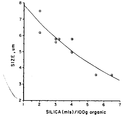
- the initial particle size can be predetermined by the concentration of silica stabilizer employed in accordance with the figure. While it is contemplated that the method of this invention applies equally to either toner or carrier particles, for the purpose simplicity in describing this invention, only toner particles will be mentioned throughout this specification.
- the sole figure is a graph showing the relationship of the concentration of the silica particles in milliliters/100 grams of organic matter in the droplets as it relates to the size of the initial polymer particles in ⁇ m including solvent formed by the process of this invention when the particle size of the silica particles is from 13 - 24 nanometers.
- concentration of silica particles in milliliters is spoken of, the volume in milliliters is meant a 50 percent by weight dispersion of silica particles in water.
- the polymer from which the polymeric powders are to be made is dissolved in a quantity of a solvent, the solvent being immiscible with water.
- the quantity of solvent is important in that the size of the particles thus prepared under given agitation conditions influences the size of the powder particles that result. It is generally the case that higher concentrations of polymer in the solvent produce larger particle size powder particles having a lower degree of shrinkage than that produced by lower concentrations of polymer in the same solvent.
- the concentration of the polymer in the solvent should be from about 1 to about 80 and preferably from about 2 to about 60% by weight.
- concentration of polymer in solvent is generally maintained at from 10 to 35% by weight for a polyester resin having a number average molecular weight of 10,000 and a weight average molecular weight of 200,000.
- the solution of polymer in the solvent is next introduced into an aqueous solution containing a particulate dispersing agent and a promoter which drives the particulate dispersing agent to the interface between the water layer and the polymer solvent droplets formed by the agitation conducted on the system.
- a particulate dispersing agent which drives the particulate dispersing agent to the interface between the water layer and the polymer solvent droplets formed by the agitation conducted on the system.
- it is generally desired to control the pH of the system at a value of from 2 to 7, preferably from 3 to 6 and most preferably 4.
- the promoter should be present in an amount of 1 to about 10 percent and preferably from about 2 to 7 percent based on the weight of the polymer and solvent.
- the size of the droplets formed depends on the shearing action on the system plus the amount of the particulate dispersing agent employed.
- the polymer in solution be introduced into the aqueous phase in a microfluidizer such as Model No. 110T produced by Microfluidics Manufacturing.
- a microfluidizer such as Model No. 110T produced by Microfluidics Manufacturing.
- the droplets of polymer in solvent are dispersed and reduced in size in the water phase in a high shear agitation zone and upon exiting this zone the particle size of the polymer in solution results as a discontinuous phase in the continuous aqueous phase.
- Each of the polymer-in-solution droplets are surrounded by the solid dispersing agent, which within predetermined limits in accordance with the figure, limits and controls both the size and size distribution of the solvent-polymer droplets.
- the particle size of the polymer/solvent droplets are established.
- the solvent is next removed from the droplets by any suitable technique, such as, for example, heating the entire system to vaporize the solvent and thus remove it from the discontinuous phase droplets remaining in the aqueous solution surrounded by the SiO2 particles.
- the SiO2 dispersing agent may be removed from the surface of the polymer particles by any suitable technique such as dissolving in HF or other fluoride ion or by adding an alkaline agent such as potassium hydroxide to the aqueous phase containing the polymer particles to thereby raise the pH to at least about 12 while stirring. This method is preferred. Subsequently to raising the pH and dissolving the silica, the polymer particles can be recovered by filtration and finally washed with water or other agents to remove any desired impurities from the surface thereof.
- any suitable technique such as dissolving in HF or other fluoride ion or by adding an alkaline agent such as potassium hydroxide to the aqueous phase containing the polymer particles to thereby raise the pH to at least about 12 while stirring. This method is preferred.
- the polymer particles can be recovered by filtration and finally washed with water or other agents to remove any desired impurities from the surface thereof.
- the invention is applicable to the preparation of polymeric toner particles from any type of polymer that is capable of being dissolved in a solvent that is immiscible with water and includes such as, for example, olefin homopolymers and copolymers, such as polyethylene, polypropylene, polyisobutylene, and polyisopentylene; polyfluoroolefins, such as polytetrafluoroethylene and polytrifluorochloroethylene; polyamides, such as polyhexamethylene adipamide, polyhexamethylene sebacamide, and polycaprolactam; acrylic resins, such as polymethylmethacrylate, polymethylacrylate, polyethylmethacrylate, and styrene-methylmethacrylate; ethylene-methyl acrylate copolymers, ethylene-ethyl acrylate copolymers, ethylene-ethyl methacrylate copolymers, polystyrene and copolymers of styrene and cop
- Any suitable solvent that will dissolve the polymer and which is also immiscible with water may be used in the practice of this invention such as for example, chloromethane, dichloromethane, ethyl acetate, vinyl chloride, MEK, trichloromethane, carbon tetrachloride, ethylene chloride, trichloroethane, toluene, xylene, cyclohexanone and 2-nitropropane.
- a particularly useful solvent in the practice of this invention is dichloromethane for the reason that it is both a good solvent for many polymers while at the same time it is immiscible with water. Further, its volatility is such that it is readily removed from the discontinuous phase droplets by evaporation.
- the SiO2 dispersing agent generally should have dimensions such that they are from 0.001 ⁇ m to 1 ⁇ m preferably from 5 to 35 nanometers and most preferably from 10 - 25 nanometers. The size and concentration of these particles controls and predetermines the size of the final toner particle.
- a particularly useful silica dispersing agent is sold by DuPont under the name Ludox TM .
- the promoter that is water soluble and effects the hydrophilic/hydrophobic balance of the solid dispersing agent in the aqueous solution is employed in order to drive the solid dispersing agent to the polymer/solvent droplet-water interface. It is a water soluble condensation product of diethanol amine and adipic acid or poly(adipic acid-co-methylaminoethanol). Generally, the promoter is used in amounts of from about at least 0.2 and preferably 0.25 to about 0.6 parts per 100 parts of aqueous solution.
- the quantities of the various ingredients and their relationship to each other can vary over wide ranges, however, it has generally been found that the ratio of the polymer to the solvent should vary in an amount of from about 1 to about 80 percent by weight of combined weight of the polymer and the solvent and that the combined weight of the polymer in the solvent should vary with respect to the quantity of water employed in an amount of from about 25 to about 50 percent in weight. Also the size and quantity of the solid dispersing agent depends upon the size of the particles of the solid dispersing agent and also upon the size of the toner particles desired.
- the quantity of the SiO2 dispersing agent varies in order to prevent the uncontrolled coalescence of the particles and in order to achieve uniform size and size distribution in the particles that result.
- Particles having an average size of from 0.05 ⁇ m to 100 ⁇ m and preferably from 0.1 ⁇ m to 60 ⁇ m may be prepared in accordance with this invention.
- Various addenda generally present in electrostatographic toner may be added to the polymer prior to the dissolution in the solvent or in the dissolution step itself, such as, colorant selected from a wide variety of dyes and pigments such as disclosed for example, in U.S. Reissue Patent No. 31,072 may be used.
- a particularly useful colorant for toners to be used in black-and-white electrophotographic copying machines is carbon black. Colorants in the amount of from about 1 to about 30 percent by weight based on the weight of the toner may be used. Preferably from about 1 to 8 percent by weight of colorant is employed.
- Charge control agents can be included such as, for example, charge control agents.
- Suitable charge control agents are disclosed for example in U.S. Patent Nos. 3,893,935; 4,079,014; 4,323,634 and British Patent Nos. 1,501,065 and 1,420,839.
- Charge control agents are generally employed in small quantities such as, from about 0.1 to about 3 weight percent and preferably from about 0.2 to about 1.5 weight percent based on the weight of the toner.
- Powders suitable as carrier particles for use in the development of electrostatic images can also be prepared in accordance with this invention.
- carrier particles for example it may be desirable to include in the polymer that is ultimately to be dissolved or in the step of dissolution of the polymer in the solvent that is immiscible with water, magnetic materials such as those disclosed in U.S. Patent 4,546,060 or U.S. Patent 4,345,014.
- a branched polyester polymer prepared from about 87 grams of terephthalic acid, about 13 grams of dimethyl glutarate, about 95 grams of 1,2-propane diol and about 5 grams of glycerol and having a number average molecular weight of 10,000 and a weight average molecular weight of about 120,000 are dissolved together with about 5 gms. of Estofil Blue pigment in about 170 gms. of dichloromethane and about 86.7 gms. of toluene. This solution has a solid content of about 25% by weight, the pigment content being about 6% of the total solids content.
- the solvent is removed from the thus formed particles by stirring overnight at 40°C in an open container.
- the particles formed have a particle size ranging from 2 to 5 ⁇ m and are nicely spherical beads coated with silica particles. These beads are washed with water and then with one normal sodium hydroxide containing a 1% solution of a fluorinated hydrocarbon surfactant sold under the trademark Zonyl FSN by the du Pont Company. The following day the polyester polymer beads free of silica are recovered from the sodium hydroxide solution by filtration, washed with water and dried. The particles have a size distribution ranging from 2 to 5 micrometers and are useful as electrographic toner.
- the dichloromethane is removed from the slurry by passing through a falling film evaporator approximately 4 to 5 times.
- the polymer particles formed are removed from the water by filtration and then washed with a one normal potassium hydroxide solution to which has been added 1% Zonyl FSN overnight. Following this overnight treatment particles are washed repeatedly with water and dried. The resulting particles are uniform and have an average particle size of 2 microns and are useful as electrostatic toner particles.
- An organic phase is prepared by dissolving about 7 gms. of an 80% styrene - 20% butylacrylate copolymer sold by Hercules under the trade name Piccotoner and about 7 gms. of magnetite particles are dispersed in about 80gms. of dichloromethane by milling over night. This results in a dispersion containing 14% solids.
- This organic phase is added to an aqueous phase containing about 300 ml of water, about 2.5 ml of Ludox and about 0.75 ml of a 10% solution of poly (adipic acid-co-methylaminoethanol) which has been previously adjusted to a ph of 4 by the addition of one normal hydrochloric acid.
- the mixing is conducted in a Polytron homogenizer.
- the dichloromethane is removed from the organic phase by bubbling nitrogen through the aqueous dispersion overnight.
- the resulting particles are then removed from the water phase by filtration and washed and dried.
- the resulting particles range in size from 3 to 10 microns and have a number average of 5.9 microns and a volume average of 7.7 microns. These particles are useful as single component magnetic toner particles.
- Example 3 The procedure of Example 3 is repeated with the exception that the organic phase is prepared as a 30% solids dispersion by utilizing about 15 gms. of the styrene butylacrylate polymer, about 15 gms. of the magnetite particles and about 70 gms. of dichloromethane.
- This organic phase, together with the aqueous phase, is then passed through a Polytron mixer in the same manner as in the previous example and the dichloromethane is separated from the aqueous phase particles in a falling film evaporator. The particles are separated from the aqueous phase by filtration, washed and dried.
- the resulting magnetic toner of styrene butylacrylate containing magnetite particles has a particle size ranging from 1 to 10 micrometers with a number average of 4 micrometers and a volume average of 14 micrometers. These particles are useful as electrostatic toner or carrier particles.
- Magnetic carrier beads for use in electrostatographic development are prepared by milling overnight about 10 gms. of chlorinated polyethylene containing about 65.8% chlorine and 10 gms. of magnetite in 250 gms. of methylene chloride and adding this dispersed organic phase to a water phase containing about 200 ml of water, about 5 ml of silicon dioxide particles and about 1.5 ml of a 10% solution of poly(adipic acid-co-methylaminoethanol). Rapid mixing together with high sheer are imposed by passing the mixture through a Polytron homogenizer. The methylene chloride is removed by bubbling nitrogen through the mixture overnight. The particles are filtered in order to separate them from the water phase and then washed with water several times and dried. The resulting magnetic carrier particles contain particles within the range of 4 to 15 micrometers have a average number average size of 7.5 microns and a volume average size of 11.3 microns.
- 5 to 6 micron magnetic beads suitable for use in magnetography are prepared by dispersing about 20 gms. Mapicoblack, about 20 gms. of an 80% styrene, 20% butylacrylate copolymer in about 160 gms. dichloromethane. The dispersion is milled overnight to insure that all of the copolymer has dissolved in the dichloromethane. 100 gms.
- this dispersion is then passed through a Polytron homogenizer together with an aqueous phase made up of about 200 ml of water, 10 ml of silica, 3 ml of poly (adipic acid-co-methylaminoethanol) which has been previously adjusted to a pH of 4 by the addition of one normal hydrochloric acid.
- the dichloromethane is removed from the organic particles resulting therefrom by bubbling nitrogen through the suspension overnight.
- the resulting particles are removed from the aqueous phase by filteration and washed with water and dried.
- An electrostatographic toner is prepared by dissolving the following ingredients in about 215 gms. of dichloromethane and 20 gms. of toluene to obtain a 30% solids solution: 125 gms. of the same polyester as used in Example 1, 3 gms. of Rhodamine iodide about 0.5 gms. of tertiary butyl styrene-co-2(N,N,N,-trimethylammonium) ethylmethacrylate paratoluene sulfonate 80 gms. of the above prepared solution are mixed in a Polytron followed by a Microfluidizer with about 300 gms.
- any suitable polymer solvent in comparable quantities can be used such as toluene, ethylacetate and 1,1,1-trichloroethane.
Landscapes
- Physics & Mathematics (AREA)
- General Physics & Mathematics (AREA)
- Chemical & Material Sciences (AREA)
- Health & Medical Sciences (AREA)
- Chemical Kinetics & Catalysis (AREA)
- Medicinal Chemistry (AREA)
- Polymers & Plastics (AREA)
- Organic Chemistry (AREA)
- Developing Agents For Electrophotography (AREA)
- Processes Of Treating Macromolecular Substances (AREA)
Claims (12)
- Verfahren zur Herstellung von Polymerteilchen mit den Stufen:Lösen eines Polymeren in einem Lösungsmittel hierfür unter Erzeugung einer Lösung, wobei das Lösungsmittel mit Wasser nicht mischbar ist,Herstellen einer Suspension von kleinen Tröpfchen der Lösung in einer wäßrigen Lösung durch starke Scherbewegung,Entfernen des Lösungsmittels von den Tröpfchen und Abtrennen der verfestigten Polymerteilchen von dem Wasser,dadurch gekennzeichnet, daß die wäßrige Lösung einen Promotor und ein festes Dispergiermittel enthält, das aus Silicateilchen besteht, mit einer durchschnittlichen Teilchengrößen von 0,001 µm bis 1 µm, wobei der Promotor ein in Wasser lösliches Kondensationsprodukt von Diethanolamin und Adipinsäure oder Poly(adipinsäure-co-methylaminoethanol) ist.
- Verfahren nach Anspruch 1, dadurch gekennzeichnet, daß das Silica von der Oberfläche der erhaltenen Teilchen entfernt wird.
- Verfahren nach Anspruch 1, dadurch gekennzeichnet, daß die Silicateilchen eine mittlere Teilchengröße von 5 bis 35 Nanometer aufweisen.
- Verfahren nach Anspruch 3, dadurch gekennzeichnet, daß die Silicateilchen eine mittlere Teilchengröße von 10-25 Nanometer aufweisen.
- Verfahren nach Anspruch 1, dadurch gekennzeichnet, daß die Konzentration des Silica bei 0,5 bis 21 ml einer 50 gew.-%igen Dispersion in Wasser, bezogen auf 100 g des Polymeren und des vorhandenen Lösungsmittels, liegt.
- Verfahren nach Anspruch 5, dadurch gekennzeichnet, daß die Konzentration des Silica bei 0,5 bis 10 ml einer 50 gew.-%igen Dispersion in Wasser, bezogen auf 100 g des Polymeren und des vorhandenen Lösungsmittels liegt.
- Verfahren nach Anspruch 1, dadurch gekennzeichnet, daß der pH-Wert während der Stufe der Suspensionsbildung bei 2 bis 7 gehalten wird.
- Verfahren nach Anspruch 7, dadurch gekennzeichnet, daß der pH-Wert während der Stufe der Suspensionsbildung bei 3 bis 6 gehalten wird.
- Verfahren nach Anspruch 1, dadurch gekennzeichnet, daß die Tröpfchen des Polymeren und des Lösungsmittels Farbbildner enthalten.
- Verfahren nach Anspruch 1, dadurch gekennzeichnet, daß die Tröpfchen des Polymeren und des Lösungsittels magnetische Teilchen enthalten.
- Verfahren nach Anspruch 1, dadurch gekennzeichnet, daß die Tröpfchen des Polymeren und des Lösungsmittels Ladungssteuerungsmittel enthalten.
- Anwendung des Verfahrens nach Anspruch 1 zur Herstellung von elektrostatischen Tonerteilchen oder Trägerteilchen.
Applications Claiming Priority (2)
| Application Number | Priority Date | Filing Date | Title |
|---|---|---|---|
| US171065 | 1980-07-22 | ||
| US07/171,065 US4833060A (en) | 1988-03-21 | 1988-03-21 | Polymeric powders having a predetermined and controlled size and size distribution |
Publications (3)
| Publication Number | Publication Date |
|---|---|
| EP0334095A2 EP0334095A2 (de) | 1989-09-27 |
| EP0334095A3 EP0334095A3 (de) | 1991-03-27 |
| EP0334095B1 true EP0334095B1 (de) | 1996-01-10 |
Family
ID=22622366
Family Applications (1)
| Application Number | Title | Priority Date | Filing Date |
|---|---|---|---|
| EP89103960A Expired - Lifetime EP0334095B1 (de) | 1988-03-21 | 1989-03-07 | Verfahren zur Herstellung von Polymerpulvern |
Country Status (4)
| Country | Link |
|---|---|
| US (1) | US4833060A (de) |
| EP (1) | EP0334095B1 (de) |
| JP (1) | JP2688438B2 (de) |
| DE (1) | DE68925372T2 (de) |
Families Citing this family (166)
| Publication number | Priority date | Publication date | Assignee | Title |
|---|---|---|---|---|
| US4965131A (en) * | 1988-03-21 | 1990-10-23 | Eastman Kodak Company | Colloidally stabilized suspension process |
| US5133992A (en) * | 1988-03-21 | 1992-07-28 | Eastman Kodak Company | Colloidally stabilized suspension process |
| EP0352800A3 (de) * | 1988-07-28 | 1991-05-08 | Warner-Lambert Company | Wässerige Polymerdispersion eines Cellulose- und Acrylharzes und ihre Anwendung für die Herstellung von Arzneidosiereinheiten |
| US4912009A (en) * | 1988-12-30 | 1990-03-27 | Eastman Kodak Company | Toner composition and method of making |
| US5164282A (en) * | 1989-04-17 | 1992-11-17 | Xerox Corporation | Processes for the preparation of toners |
| US5049469A (en) * | 1989-12-27 | 1991-09-17 | Eastman Kodak Company | Toner image pressure transfer method and toner useful therefor |
| US5162189A (en) * | 1989-12-27 | 1992-11-10 | Eastman Kodak Company | Toner image pressure transfer method and toner useful therefor |
| JP2962809B2 (ja) * | 1990-11-14 | 1999-10-12 | 三菱レイヨン株式会社 | トナー用樹脂組成物およびその製造方法 |
| US5264553A (en) * | 1991-01-24 | 1993-11-23 | Coulter Corporation | Method of forming uniform polymer spheres, composite particles and polymer encapsulated particles |
| JP3123153B2 (ja) * | 1991-11-11 | 2001-01-09 | ミノルタ株式会社 | 静電荷像現像用トナーおよびその製造方法 |
| US5198320A (en) * | 1991-12-30 | 1993-03-30 | Eastman Kodak Company | Electrostatographic toner comprising binder polymer containing charge-control moieties and their preparation |
| US5253021A (en) * | 1992-02-28 | 1993-10-12 | Eastman Kodak Company | Method and apparatus of transferring toner images made up of small dry particles |
| US5428430A (en) * | 1992-02-28 | 1995-06-27 | Eastman Kodak Company | Image forming method and apparatus using an intermediate |
| US5342724A (en) * | 1992-04-10 | 1994-08-30 | Eastman Kodak Company | Toner manufacture using chain transfer polyesters |
| US5322887A (en) * | 1992-05-18 | 1994-06-21 | Eastman Kodak Company | Polymeric particles and a method of preparing the same |
| US5629367A (en) * | 1992-05-26 | 1997-05-13 | Eastman Kodak Company | Method of making pigment concentrate particles and product of same |
| US5580692A (en) * | 1992-05-26 | 1996-12-03 | Eastman Kodak Company | Solvent extraction in limited coalescence processes |
| US5283147A (en) * | 1992-05-27 | 1994-02-01 | Eastman Kodak Company | Electrostatographic toner containing magenta pigment |
| US5286592A (en) * | 1992-05-27 | 1994-02-15 | Eastman Kodak Company | Electrostatographic toner containing cyan pigment |
| US5292621A (en) * | 1992-05-27 | 1994-03-08 | Eastman Kodak Company | Electrostatographic toner containing yellow pigment |
| US5283150A (en) * | 1992-05-28 | 1994-02-01 | Eastman Kodak Company | Electrostatographic toner and method for the preparation thereof |
| US5283151A (en) * | 1992-05-28 | 1994-02-01 | Eastman Kodak Company | Method for the preparation of electrostatographic toner of controlled shape by evaporative limited coalescence |
| US5283149A (en) * | 1992-05-28 | 1994-02-01 | Eastman Kodak Company | Electrostatographic toner including a wax coated pigment and method for the preparation thereof |
| SG44019A1 (en) * | 1992-09-03 | 1997-11-14 | Indigo Nv | Method for manufacturing spherical particles |
| US5378577A (en) * | 1992-10-30 | 1995-01-03 | Eastman Kodak Company | Photographic light-sensitive elements |
| US5288598A (en) * | 1992-10-30 | 1994-02-22 | Eastman Kodak Company | Photographic light-sensitive elements |
| US5298355A (en) * | 1992-11-13 | 1994-03-29 | Eastman Kodak Company | Toner composition with semi-crystalline polyester wax and method of preparation |
| US5298356A (en) * | 1992-11-13 | 1994-03-29 | Eastman Kodak Company | Toner composition with elastomeric thermoplastic polymer and process of preparing |
| US5354799A (en) * | 1992-11-16 | 1994-10-11 | Eastman Kodak Company | Limited coalescence process |
| US5234891A (en) * | 1992-12-17 | 1993-08-10 | Eastman Kodak Company | Mixture of dye-containing beads for laser-induced thermal dye transfer |
| US5334575A (en) * | 1992-12-17 | 1994-08-02 | Eastman Kodak Company | Dye-containing beads for laser-induced thermal dye transfer |
| US5234890A (en) * | 1992-12-17 | 1993-08-10 | Eastman Kodak Company | Multicolor dye-containing beads for multilayer dye-donor element for laser-induced thermal dye transfer |
| US5240900A (en) * | 1992-12-17 | 1993-08-31 | Eastman Kodak Company | Multicolor, multilayer dye-doner element for laser-induced thermal dye transfer |
| US5919407A (en) * | 1992-12-28 | 1999-07-06 | Moore Business Forms, Inc. | Method for producing microencapsulated adhesive |
| US5339146A (en) * | 1993-04-01 | 1994-08-16 | Eastman Kodak Company | Method and apparatus for providing a toner image having an overcoat |
| US5411832A (en) * | 1993-09-24 | 1995-05-02 | Eastman Kodak Company | Method of modifying the charging propensity of carrier particles for electrostatographic developers and modified carrier particles |
| US5472649A (en) * | 1994-04-13 | 1995-12-05 | Eastman Chemical Company | Method for preparing powder coating compositions having improved particle properties |
| EP0690355A1 (de) | 1994-06-08 | 1996-01-03 | Eastman Kodak Company | Gegen Feuchtigkeit stabilisierte Toner und Entwickler |
| US5480757A (en) * | 1994-06-08 | 1996-01-02 | Eastman Kodak Company | Two component electrophotographic developers and preparation method |
| JPH07333901A (ja) * | 1994-06-13 | 1995-12-22 | Minolta Co Ltd | 静電潜像現像用トナー |
| US5484681A (en) * | 1994-10-31 | 1996-01-16 | Xerox Corporation | Conductive composite particles and processes for the preparation thereof |
| EP0725317A1 (de) | 1995-01-30 | 1996-08-07 | Agfa-Gevaert N.V. | Verfahren zur Herstellung einer "Polymersuspension" für die Tonerteilchenherstellung |
| US5620826A (en) * | 1995-01-30 | 1997-04-15 | Agfa-Gevaert, N.V. | Polymer suspension method for producing toner particles |
| US5516615A (en) * | 1995-01-31 | 1996-05-14 | Eastman Kodak Company | Stabilized carriers with β phase poly(vinylidenefluoride) |
| US5529719A (en) * | 1995-03-27 | 1996-06-25 | Xerox Corporation | Process for preparation of conductive polymeric composite particles |
| US5541048A (en) * | 1995-05-12 | 1996-07-30 | Eastman Kodak Company | Lubricant particles, method of preparation, and photographic elements |
| US6866760B2 (en) * | 1998-08-27 | 2005-03-15 | E Ink Corporation | Electrophoretic medium and process for the production thereof |
| US7327511B2 (en) * | 2004-03-23 | 2008-02-05 | E Ink Corporation | Light modulators |
| US7999787B2 (en) | 1995-07-20 | 2011-08-16 | E Ink Corporation | Methods for driving electrophoretic displays using dielectrophoretic forces |
| US7079305B2 (en) * | 2001-03-19 | 2006-07-18 | E Ink Corporation | Electrophoretic medium and process for the production thereof |
| US7411719B2 (en) | 1995-07-20 | 2008-08-12 | E Ink Corporation | Electrophoretic medium and process for the production thereof |
| EP0757294A1 (de) * | 1995-07-28 | 1997-02-05 | Eastman Kodak Company | Tonerzusammensetzungen die vernetztes polymeres Bindemittel und N-Alkylsarcosinseifen enthalten |
| US6156473A (en) * | 1995-08-31 | 2000-12-05 | Eastman Kodak Company | Monodisperse spherical toner particles containing aliphatic amides or aliphatic acids |
| JP3543201B2 (ja) * | 1995-10-03 | 2004-07-14 | 日本ペイント株式会社 | 熱硬化性樹脂粒子の製造方法 |
| US5747577A (en) * | 1995-12-27 | 1998-05-05 | Xerox Corporation | Conductive particles containing carbon black and processes for the preparation thereof |
| US5783346A (en) * | 1996-03-06 | 1998-07-21 | Eastman Kodak Company | Toner compositions including polymer binders with adhesion promoting and charge control monomers |
| US5783380A (en) * | 1996-09-24 | 1998-07-21 | Eastman Kodak Company | Thermally processable imaging element |
| US6057072A (en) * | 1997-03-31 | 2000-05-02 | Eastman Kodak Company | Toner compositions containing activated carbons |
| US5807506A (en) * | 1997-04-01 | 1998-09-15 | Xerox Corporation | Conductive polymers |
| US5902711A (en) * | 1997-06-25 | 1999-05-11 | Eastman Kodak Company | Method to media mill particles using crosslinked polymer media and organic solvent |
| EP0906931A3 (de) * | 1997-10-03 | 1999-05-26 | Eastman Kodak Company | Entfernung von Lösungsmitteln aus Tröpfchen einer suspendierten Polymerlösung |
| US6120963A (en) * | 1997-11-21 | 2000-09-19 | Samsung Electronics Co., Ltd. | Toner composition and method of preparing toner using the same |
| US5968702A (en) * | 1997-11-24 | 1999-10-19 | Eastman Kodak Company | Toner particles of controlled shape and method of preparation |
| US6093770A (en) * | 1998-02-02 | 2000-07-25 | Xerox Corporation | Polymers and processes thereof |
| US6068957A (en) * | 1998-06-29 | 2000-05-30 | Eastman Kodak Company | Lubricating layer in photographic elements |
| DE19845078A1 (de) * | 1998-09-30 | 2000-04-06 | Basf Ag | Farbstoffhaltige Polymerpartikel |
| US6207338B1 (en) | 1999-03-10 | 2001-03-27 | Eastman Kodak Company | Toner particles of controlled morphology |
| US6482562B2 (en) | 1999-03-10 | 2002-11-19 | Eastman Kodak Company | Toner particles of controlled morphology |
| CA2314013C (en) * | 1999-07-26 | 2009-04-28 | Nova Chemicals (International) S.A. | Polymer particles |
| US6380297B1 (en) | 1999-08-12 | 2002-04-30 | Nexpress Solutions Llc | Polymer particles of controlled shape |
| US6294595B1 (en) | 1999-08-30 | 2001-09-25 | Nexpress Solutions Llc | Polymeric powders and method of preparation |
| US6210851B1 (en) | 1999-12-01 | 2001-04-03 | Eastman Kodak Company | Electrophotographic toner surface treated with silica mixtures |
| US6556262B1 (en) | 2000-01-06 | 2003-04-29 | Eastman Kodak Company | Display sheet having memory using limited coalescence domains |
| US6552762B1 (en) | 2000-01-06 | 2003-04-22 | Eastman Kodak Company | Light-modulating, electrically responsive privacy screen |
| US6423368B1 (en) * | 2000-01-06 | 2002-07-23 | Eastman Kodak Company | Method for making materials having uniform limited coalescence domains |
| EP1156373A1 (de) | 2000-05-17 | 2001-11-21 | Heidelberger Druckmaschinen Aktiengesellschaft | Elektrophotophotographische Entwicklerzusammensetzung und Verfahren zur Entwicklung elektrostatischer Bilder |
| US6232026B1 (en) | 2000-05-17 | 2001-05-15 | Heidelberg Digital L.L.C. | Magnetic carrier particles |
| US6228549B1 (en) | 2000-05-17 | 2001-05-08 | Heidelberg Digital L.L.C. | Magnetic carrier particles |
| US6723481B2 (en) | 2000-05-17 | 2004-04-20 | Heidelberger Druckmaschinen Ag | Method for using hard magnetic carriers in an electrographic process |
| JP4998910B2 (ja) * | 2000-09-20 | 2012-08-15 | スタンレー電気株式会社 | 有機材料微粒子の製造方法およびこれを用いたツイストボールディスプレイ |
| US6416921B1 (en) | 2001-03-22 | 2002-07-09 | Heidelberg Digital L.L.C. | Method for forming toner particles having controlled morphology and containing a quaternary ammonium tetraphenylborate and a polymeric phosphonium salt |
| US20030148073A1 (en) | 2001-12-20 | 2003-08-07 | Eastman Kodak Company | Porous organic particles for ink recording element use |
| US20030176570A1 (en) * | 2002-03-12 | 2003-09-18 | Smith Dennis E. | Method of making polymeric polymers |
| JP2004252402A (ja) * | 2002-06-24 | 2004-09-09 | Heidelberger Druckmas Ag | 化学的に調製されたトナーを用いるエレクトロフォトグラフィックトナーおよび現像法 |
| US20130063333A1 (en) | 2002-10-16 | 2013-03-14 | E Ink Corporation | Electrophoretic displays |
| US7097956B2 (en) | 2003-01-27 | 2006-08-29 | Eastman Kodak Company | Imageable element containing silicate-coated polymer particle |
| US20050195261A1 (en) * | 2004-03-05 | 2005-09-08 | Eastman Kodak Company | Fuser for ink jet images and ink formulations |
| US20050271961A1 (en) * | 2004-03-05 | 2005-12-08 | Jadwin Thomas A | Substrate and near infrared absorbing toner |
| US20050237473A1 (en) * | 2004-04-27 | 2005-10-27 | Stephenson Stanley W | Coatable conductive layer |
| US7169528B2 (en) * | 2004-04-30 | 2007-01-30 | Eastman Kodak Company | Process for preparing colored toner particles |
| US20050266332A1 (en) * | 2004-05-28 | 2005-12-01 | Pavlisko Joseph A | Oil-free process for full color digital printing |
| US11250794B2 (en) | 2004-07-27 | 2022-02-15 | E Ink Corporation | Methods for driving electrophoretic displays using dielectrophoretic forces |
| US20060078817A1 (en) * | 2004-10-12 | 2006-04-13 | Nu-Kote International, Inc., A Corporation Of Delaware | Toner processes and compositions thereof |
| US7247416B2 (en) * | 2004-10-12 | 2007-07-24 | Nu-Kote International, Inc. | Toner processes and compositions thereof |
| US7630029B2 (en) * | 2005-02-16 | 2009-12-08 | Industrial Technology Research Institute | Conductive absorption layer for flexible displays |
| US7564528B2 (en) * | 2005-05-20 | 2009-07-21 | Industrial Technology Research Institute | Conductive layer to reduce drive voltage in displays |
| US7273570B2 (en) * | 2005-07-08 | 2007-09-25 | Eastman Kodak Company | Method of forming polymer particles |
| US7666565B2 (en) * | 2005-08-26 | 2010-02-23 | Sinonar Corp. | Method of forming electrophotographic toner |
| US8192909B2 (en) * | 2005-12-21 | 2012-06-05 | Eastman Kodak Company | Chemically prepared porous toner |
| US20070149652A1 (en) * | 2005-12-28 | 2007-06-28 | Eastman Kodak Company | Suspension polymerization process |
| US7686952B2 (en) * | 2006-01-24 | 2010-03-30 | Bivens Thomas H | Liquid filtering apparatus |
| US20070280758A1 (en) * | 2006-06-01 | 2007-12-06 | Eastman Kodak Company | Chilled finish roller system and method |
| US7550244B2 (en) * | 2006-06-14 | 2009-06-23 | Eastman Kodak Company | Reactive polymer particles and method of preparation |
| US20070298346A1 (en) * | 2006-06-22 | 2007-12-27 | Eastman Kodak Company | Toner particles of controlled morphology |
| US7492497B2 (en) | 2006-08-02 | 2009-02-17 | E Ink Corporation | Multi-layer light modulator |
| US7655375B2 (en) * | 2006-12-15 | 2010-02-02 | Eastman Kodak Company | Toner particles of controlled morphology |
| US7662535B2 (en) * | 2006-12-15 | 2010-02-16 | Eastman Kodak Company | Toner particles of controlled morphology |
| US8358957B2 (en) * | 2006-12-27 | 2013-01-22 | Eastman Kodak Company | Selective printing of raised information by electrography |
| US7754409B2 (en) * | 2007-01-18 | 2010-07-13 | Eastman Kodak Company | Toner manufacturing method |
| US7887984B2 (en) * | 2007-01-18 | 2011-02-15 | Eastman Kodak Company | Toner porous particles containing hydrocolloids |
| US7965961B2 (en) * | 2007-07-13 | 2011-06-21 | Eastman Kodak Company | Printing of raised multidmensional toner by electography |
| US7831178B2 (en) * | 2007-07-13 | 2010-11-09 | Eastman Kodak Company | Printing of optical elements by electrography |
| US7687218B2 (en) * | 2007-07-13 | 2010-03-30 | Eastman Kodak Company | Silicone wax-containing toner particles with controlled morphology |
| US8652637B2 (en) * | 2007-10-11 | 2014-02-18 | Eastman Kodak Company | Porous particles with non-porous shell |
| US8940362B2 (en) * | 2007-10-11 | 2015-01-27 | Eastman Kodak Company | Method for manufacturing porous particles with non-porous shell |
| JP5186179B2 (ja) * | 2007-11-02 | 2013-04-17 | 桜宮化学株式会社 | シリカ微粒子を被覆したエチレン−酢酸ビニル共重合体ケン化物微粒子からなる複合微粒子 |
| US8299140B2 (en) | 2007-12-21 | 2012-10-30 | Eastman Kodak Company | Discrete ink particle with solid phase and liquid phase |
| US8299141B2 (en) | 2007-12-21 | 2012-10-30 | Eastman Kodak Company | Mixed phase method of manufacturing ink |
| US8247155B2 (en) * | 2008-01-16 | 2012-08-21 | Penn Color, Inc. | Production of toner for use in printing applications |
| US8652745B2 (en) | 2008-01-16 | 2014-02-18 | Penn Color, Inc. | Ink toner particles with controlled surface morphology |
| US8435712B2 (en) * | 2008-05-21 | 2013-05-07 | Eastman Kodak Company | Developer for selective printing of raised information by electrography |
| US20090316417A1 (en) | 2008-06-20 | 2009-12-24 | Rohm And Haas Denmark Finance A/S | Light-redirecting article |
| US8252414B2 (en) | 2008-07-24 | 2012-08-28 | Eastman Kodak Company | Polymer particles with additives encapsulated in microvoids |
| US7956118B2 (en) * | 2008-09-25 | 2011-06-07 | Eastman Kodak Company | Method and preparation of chemically prepared toners |
| US8137888B2 (en) * | 2008-12-23 | 2012-03-20 | Eastman Kodak Company | Method of preparing toner having controlled morphology |
| US8241828B2 (en) * | 2009-04-30 | 2012-08-14 | Eastman Kodak Company | Method of filtering porous particles |
| US8142976B2 (en) * | 2009-12-03 | 2012-03-27 | Eastman Kodak Company | Method for preparing multiple emulsion and porous polymer particles therefrom |
| US8614039B2 (en) | 2010-04-26 | 2013-12-24 | Eastman Kodak Company | Toner containing metallic flakes and method of forming metallic image |
| US8728692B2 (en) | 2010-07-30 | 2014-05-20 | Eastman Kodak Company | Surface decorated particles |
| US8722304B2 (en) | 2010-07-30 | 2014-05-13 | Eastman Kodak Company | Method for forming surface decorated particles |
| US8277909B2 (en) | 2010-10-22 | 2012-10-02 | Carestream Health, Inc. | Transparent ink-jet recording films, compositions, and methods |
| TWI629386B (zh) | 2010-10-25 | 2018-07-11 | 里克L 查普曼 | 使用含策略成形纖維及/或電荷控制劑的纖維共混物的過濾材料 |
| US8110628B1 (en) | 2011-01-04 | 2012-02-07 | Eastman Kodak Company | Preparation of porous particles with multiple markers |
| US8507089B2 (en) | 2011-01-04 | 2013-08-13 | Eastman Kodak Company | Articles with porous particles for security purposes |
| US8507088B2 (en) | 2011-01-04 | 2013-08-13 | Eastman Kodak Company | Porous particles with multiple markers |
| US8546057B2 (en) | 2011-01-31 | 2013-10-01 | Eastman Kodak Company | Carbon based black toners prepared via limited coalescence process |
| US8404424B2 (en) | 2011-02-08 | 2013-03-26 | Eastman Kodak Company | Security enhanced printed products and methods |
| US20120202022A1 (en) | 2011-02-08 | 2012-08-09 | Detlef Schulze-Hagenest | Printed product with authentication bi-fluorescence feature |
| EP2540748A1 (de) | 2011-06-30 | 2013-01-02 | Université de Mons | Superhydrophobe Polypropylenteilchen |
| EP2736965B1 (de) | 2011-07-28 | 2019-03-06 | Eastman Kodak Company | Vernetzte organische poröse teilchen |
| US8613999B2 (en) | 2011-07-28 | 2013-12-24 | Eastman Kodak Company | Laser-engraveable compositions and flexographic printing precursors comprising organic porous particles |
| US8603725B2 (en) | 2011-07-28 | 2013-12-10 | Eastman Kodak Company | Laser-engraveable compositions and flexographic printing precursors |
| US8642143B2 (en) | 2011-08-12 | 2014-02-04 | Carestream Health, Inc. | Transparent ink-jet recording films, compositions, and methods |
| JP2013092748A (ja) | 2011-10-26 | 2013-05-16 | Cabot Corp | 複合体粒子を含むトナー添加剤 |
| US8466206B1 (en) | 2011-12-22 | 2013-06-18 | Eastman Kodak Company | Process for preparing porous polymer particles |
| US20140119779A1 (en) | 2012-10-30 | 2014-05-01 | Mark Cameron Zaretsky | Producing raised print using yellow toner |
| US9109221B2 (en) | 2012-11-28 | 2015-08-18 | Eastman Kodak Company | Particles containing organic catalytic materials and uses |
| US9029431B2 (en) | 2012-11-28 | 2015-05-12 | Eastman Kodak Company | Porous particles and methods of making them |
| US9291570B2 (en) | 2013-06-26 | 2016-03-22 | Eastman Kodak Company | Reactive indicator compositions and articles containing same |
| CN105637015A (zh) | 2013-10-11 | 2016-06-01 | 罗地亚经营管理公司 | 包含醚化合物的表面活性剂组合物以及用于其制造的催化方法 |
| US9176405B2 (en) | 2013-10-18 | 2015-11-03 | Eastman Kodak Company | Polymeric composite materials, manufacture, and uses |
| CN106103615B (zh) | 2013-12-20 | 2018-10-30 | 卡博特公司 | 用于化学机械平坦化的金属氧化物-聚合物复合颗粒 |
| JP2015191200A (ja) * | 2014-03-28 | 2015-11-02 | キヤノン株式会社 | トナーの製造方法 |
| JP6466572B2 (ja) * | 2014-12-08 | 2019-02-06 | エルジー・ケム・リミテッド | ポリアルキレンカーボネート樹脂の製造方法 |
| KR20180084106A (ko) * | 2015-11-19 | 2018-07-24 | 루브리졸 어드밴스드 머티어리얼스, 인코포레이티드 | 셀프 어셈블링 스킨 케어 에멀젼 |
| US20190345296A1 (en) * | 2016-12-06 | 2019-11-14 | Sabic Global Technologies B.V. | Process for the manufacture of thermoplastic polymer particles, thermoplastic polymer particles made thereby, and articles made therefrom |
| US10241457B1 (en) | 2018-01-19 | 2019-03-26 | Eastman Kodak Company | Process control sensing of toner coverage |
| US11932744B2 (en) | 2019-09-23 | 2024-03-19 | Eastman Kodak Company | Light-blocking articles from foamed composition containing solid polymeric particles |
| JP2023502607A (ja) | 2019-11-14 | 2023-01-25 | エスダブリューアイエムシー・エルエルシー | 金属包装粉末コーティング組成物、コーティングされた金属基材、及び方法 |
| US11787944B2 (en) * | 2020-11-25 | 2023-10-17 | Xerox Corporation | Pigmented polymer particles and methods of production and uses thereof |
| US12428566B2 (en) | 2020-12-17 | 2025-09-30 | Eastman Kodak Company | Coating providing panchromatic scattering |
| US12240957B2 (en) | 2020-12-17 | 2025-03-04 | Eastman Kodak Company | Method for fabricating impermeable porous particles |
| US12147010B2 (en) | 2020-12-17 | 2024-11-19 | Eastman Kodak Company | Coating providing ultraviolet scattering |
| US12454622B2 (en) | 2020-12-17 | 2025-10-28 | Eastman Kodak Company | Coating providing controlled absorption and scattering |
| CA3218887A1 (en) | 2021-05-19 | 2022-11-24 | Charles I. Skillman | Methods of coating metal substrates and making metal packaging, coated metal substrates, metal packaging, and powder coating composition systems |
| WO2023059442A1 (en) | 2021-10-05 | 2023-04-13 | Eastman Kodak Company | Electrophotographic method for providing foil images |
Family Cites Families (12)
| Publication number | Priority date | Publication date | Assignee | Title |
|---|---|---|---|---|
| US2932629A (en) * | 1955-03-28 | 1960-04-12 | Dow Chemical Co | Quiescent suspension polymerization |
| US2934530A (en) * | 1955-03-28 | 1960-04-26 | Dow Chemical Co | Suspension polymerization |
| US3615972A (en) * | 1967-04-28 | 1971-10-26 | Dow Chemical Co | Expansible thermoplastic polymer particles containing volatile fluid foaming agent and method of foaming the same |
| US3586654A (en) * | 1969-04-15 | 1971-06-22 | Nat Distillers Chem Corp | Process for the preparation of polymer powders of controlled particle shape,size and size distribution and product |
| US3847886A (en) * | 1972-05-17 | 1974-11-12 | Hercules Inc | Method of preparing small particles of a solid polymer |
| JPS542742A (en) * | 1977-06-08 | 1979-01-10 | Canon Inc | Manufacture of toner for developing static image |
| JPS542744A (en) * | 1977-06-08 | 1979-01-10 | Canon Inc | Manufacture of toner for developing static image |
| DE2822148C2 (de) * | 1978-05-20 | 1983-02-24 | Chemische Werke Hüls AG, 4370 Marl | Verfahren zur Herstellung eines pulverförmigen, füllstoffhaltigen Kautschuks |
| FR2430427A1 (fr) * | 1978-07-07 | 1980-02-01 | Sinloihi Co Ltd | Particules spheriques fines de polymeres contenant des pigments mineraux et/ou des colorants noirs et leur preparation |
| US4254207A (en) * | 1979-12-26 | 1981-03-03 | Hercules Incorporated | Process for producing spherical particles or crystalline polymers |
| DE3474479D1 (en) * | 1983-07-26 | 1988-11-10 | Fujikura Kasei Kk | Process for producing pressure-fixable toners |
| JPH06191666A (ja) * | 1992-12-25 | 1994-07-12 | Ricoh Co Ltd | 給紙装置 |
-
1988
- 1988-03-21 US US07/171,065 patent/US4833060A/en not_active Expired - Lifetime
-
1989
- 1989-03-07 DE DE68925372T patent/DE68925372T2/de not_active Expired - Lifetime
- 1989-03-07 EP EP89103960A patent/EP0334095B1/de not_active Expired - Lifetime
- 1989-03-20 JP JP1066465A patent/JP2688438B2/ja not_active Expired - Lifetime
Also Published As
| Publication number | Publication date |
|---|---|
| EP0334095A2 (de) | 1989-09-27 |
| DE68925372D1 (de) | 1996-02-22 |
| JP2688438B2 (ja) | 1997-12-10 |
| US4833060A (en) | 1989-05-23 |
| EP0334095A3 (de) | 1991-03-27 |
| JPH026535A (ja) | 1990-01-10 |
| DE68925372T2 (de) | 1996-09-12 |
Similar Documents
| Publication | Publication Date | Title |
|---|---|---|
| US4833060A (en) | Polymeric powders having a predetermined and controlled size and size distribution | |
| US4835084A (en) | Electrostatographic toner and method of producing the same | |
| EP2109799B1 (de) | Poröse tonerteilchen mit hydrokolloiden | |
| EP2113094B1 (de) | Tonerherstellungsverfahren | |
| EP0621511B1 (de) | Toner für die Entwicklung elektrostatischer Bilder und Verfahren zu dessen Herstellung | |
| US5580692A (en) | Solvent extraction in limited coalescence processes | |
| JPH02264968A (ja) | トナーの電気的特性を制御する方法 | |
| EP2342271A1 (de) | Polymerpartikel mit in mikrohohlräumen verkapselten zusätzen | |
| JP2677746B2 (ja) | 低光沢度のトナー組成物の製造方法 | |
| EP0261686B1 (de) | Verfahren zur Herstellung von eingekapseltem Toner | |
| US4855209A (en) | Low melting encapsulated toners | |
| JPH06332257A (ja) | 重合トナーの製造方法 | |
| JP2000112170A (ja) | 静電潜像現像用トナー | |
| EP0571301B1 (de) | Polymere-Teilchen und Verfahren zu ihrer Herstellung | |
| JP2800609B2 (ja) | カプセルトナーおよびその製造方法 | |
| US20070149652A1 (en) | Suspension polymerization process | |
| DE69819856T2 (de) | Tonerherstellungsverfahren | |
| US8241828B2 (en) | Method of filtering porous particles | |
| JP3334137B2 (ja) | トナー粒子の製造方法 | |
| JPH0792742A (ja) | 液体現像剤およびその製造方法 | |
| JP2008107679A (ja) | トナー | |
| JPH11172007A (ja) | ポリマー粒子の製造方法 | |
| EP1741007B1 (de) | Prozess zur herstellung farbiger toner-teilchen | |
| JP2005352085A (ja) | 現像剤およびその製造方法 | |
| US6001528A (en) | Production method of toner for electrophotography |
Legal Events
| Date | Code | Title | Description |
|---|---|---|---|
| PUAI | Public reference made under article 153(3) epc to a published international application that has entered the european phase |
Free format text: ORIGINAL CODE: 0009012 |
|
| AK | Designated contracting states |
Kind code of ref document: A2 Designated state(s): DE FR GB |
|
| PUAL | Search report despatched |
Free format text: ORIGINAL CODE: 0009013 |
|
| AK | Designated contracting states |
Kind code of ref document: A3 Designated state(s): DE FR GB |
|
| 17P | Request for examination filed |
Effective date: 19910911 |
|
| 17Q | First examination report despatched |
Effective date: 19930521 |
|
| GRAA | (expected) grant |
Free format text: ORIGINAL CODE: 0009210 |
|
| AK | Designated contracting states |
Kind code of ref document: B1 Designated state(s): DE FR GB |
|
| REF | Corresponds to: |
Ref document number: 68925372 Country of ref document: DE Date of ref document: 19960222 |
|
| ET | Fr: translation filed | ||
| PLBE | No opposition filed within time limit |
Free format text: ORIGINAL CODE: 0009261 |
|
| STAA | Information on the status of an ep patent application or granted ep patent |
Free format text: STATUS: NO OPPOSITION FILED WITHIN TIME LIMIT |
|
| 26N | No opposition filed | ||
| REG | Reference to a national code |
Ref country code: GB Ref legal event code: IF02 |
|
| PGFP | Annual fee paid to national office [announced via postgrant information from national office to epo] |
Ref country code: GB Payment date: 20080211 Year of fee payment: 20 |
|
| PGFP | Annual fee paid to national office [announced via postgrant information from national office to epo] |
Ref country code: FR Payment date: 20080307 Year of fee payment: 20 Ref country code: DE Payment date: 20080331 Year of fee payment: 20 |
|
| REG | Reference to a national code |
Ref country code: GB Ref legal event code: PE20 Expiry date: 20090306 |
|
| PG25 | Lapsed in a contracting state [announced via postgrant information from national office to epo] |
Ref country code: GB Free format text: LAPSE BECAUSE OF EXPIRATION OF PROTECTION Effective date: 20090306 |