EP0334669A2 - Procédé et appareil pour des communications fac-similés - Google Patents
Procédé et appareil pour des communications fac-similés Download PDFInfo
- Publication number
- EP0334669A2 EP0334669A2 EP89302953A EP89302953A EP0334669A2 EP 0334669 A2 EP0334669 A2 EP 0334669A2 EP 89302953 A EP89302953 A EP 89302953A EP 89302953 A EP89302953 A EP 89302953A EP 0334669 A2 EP0334669 A2 EP 0334669A2
- Authority
- EP
- European Patent Office
- Prior art keywords
- facsimile
- quality
- apparatuses
- networks
- communication
- Prior art date
- Legal status (The legal status is an assumption and is not a legal conclusion. Google has not performed a legal analysis and makes no representation as to the accuracy of the status listed.)
- Withdrawn
Links
- 238000004891 communication Methods 0.000 title claims abstract description 61
- 238000000034 method Methods 0.000 title claims description 43
- 230000005540 biological transmission Effects 0.000 claims abstract description 52
- 230000003044 adaptive effect Effects 0.000 claims abstract description 9
- 230000001404 mediated effect Effects 0.000 claims description 4
- 230000004044 response Effects 0.000 abstract description 2
- 230000006870 function Effects 0.000 description 11
- 230000011664 signaling Effects 0.000 description 7
- 238000006243 chemical reaction Methods 0.000 description 5
- 238000010586 diagram Methods 0.000 description 5
- 230000007246 mechanism Effects 0.000 description 3
- 238000012549 training Methods 0.000 description 3
- 230000006866 deterioration Effects 0.000 description 2
- 230000005684 electric field Effects 0.000 description 2
- 230000008569 process Effects 0.000 description 2
- 238000012545 processing Methods 0.000 description 2
- 101100386719 Caenorhabditis elegans dcs-1 gene Proteins 0.000 description 1
- 101100039010 Caenorhabditis elegans dis-3 gene Proteins 0.000 description 1
- 101100226769 Caenorhabditis elegans fax-1 gene Proteins 0.000 description 1
- 101100045594 Mus musculus Tcf7 gene Proteins 0.000 description 1
- 101150090128 PCM1 gene Proteins 0.000 description 1
- 230000001413 cellular effect Effects 0.000 description 1
- 238000012790 confirmation Methods 0.000 description 1
- 238000007796 conventional method Methods 0.000 description 1
- 125000004122 cyclic group Chemical group 0.000 description 1
- 238000001514 detection method Methods 0.000 description 1
- 238000009792 diffusion process Methods 0.000 description 1
- 230000000694 effects Effects 0.000 description 1
- 238000010295 mobile communication Methods 0.000 description 1
- 238000002360 preparation method Methods 0.000 description 1
- 230000008054 signal transmission Effects 0.000 description 1
Images



Classifications
-
- H—ELECTRICITY
- H04—ELECTRIC COMMUNICATION TECHNIQUE
- H04N—PICTORIAL COMMUNICATION, e.g. TELEVISION
- H04N1/00—Scanning, transmission or reproduction of documents or the like, e.g. facsimile transmission; Details thereof
- H04N1/32—Circuits or arrangements for control or supervision between transmitter and receiver or between image input and image output device, e.g. between a still-image camera and its memory or between a still-image camera and a printer device
- H04N1/333—Mode signalling or mode changing; Handshaking therefor
- H04N1/33346—Mode signalling or mode changing; Handshaking therefor adapting to a particular standardised protocol
-
- H—ELECTRICITY
- H04—ELECTRIC COMMUNICATION TECHNIQUE
- H04N—PICTORIAL COMMUNICATION, e.g. TELEVISION
- H04N1/00—Scanning, transmission or reproduction of documents or the like, e.g. facsimile transmission; Details thereof
- H04N1/32—Circuits or arrangements for control or supervision between transmitter and receiver or between image input and image output device, e.g. between a still-image camera and its memory or between a still-image camera and a printer device
- H04N1/333—Mode signalling or mode changing; Handshaking therefor
- H04N1/33307—Mode signalling or mode changing; Handshaking therefor prior to start of transmission, input or output of the picture signal only
Definitions
- the present invention relates to facsimile communications between standard facsimile apparatuses, and more particularly to the same through a communication network composed of neworks with good transmission quality such as a wire system network, and of networks with relatively bad transmission quality such as an open-wire carrier circuit and a mobile system network, the foregoing networks with good and bad qualities being interspersed beween the foregoing facsimile apparatuses.
- Such communications among facsimile apparatuses are primarily achieved conventionally through a wire system network such as a public data network (PDN), an integrated services digital network (ISDN), a public switched data network (PSDN) or a facsimile communication network (FICS) with use of equipment also for use in the above networks.
- a wire system network such as a public data network (PDN), an integrated services digital network (ISDN), a public switched data network (PSDN) or a facsimile communication network (FICS) with use of equipment also for use in the above networks.
- PDN public data network
- ISDN integrated services digital network
- PSDN public switched data network
- FICS facsimile communication network
- CCITT Recommendation an international standard for example recommends facsimile communications through a wire system network in particular.
- Standard facsimile systems enjoining their wide application over domestic and overseas areas adopt the international standard or at least a standard based thereupon. Both are however designed for a wire system network with relatively good transmission
- the present invention comprises facsimile signal converting apparatuses in effecting facsimile communications mediated by a communication network composed of a wire system network with relatively good transmission quality such as a public data network (PDN) and an integrated services data network (PSDN), and of an open-wire carrier circuit with bad transmission quality and of a mobile system network (hereinafter referred collectively to as a mobile system network), the foregoing facsimile signal converting apparatuses being located on a transmission path connecting between standard facsimile apparatuses both in communication so as to put the whole of the mobile system network or a target fractional part thereof.
- a communication network composed of a wire system network with relatively good transmission quality such as a public data network (PDN) and an integrated services data network (PSDN), and of an open-wire carrier circuit with bad transmission quality and of a mobile system network (hereinafter referred collectively to as a mobile system network)
- PDN public data network
- PSDN integrated services data network
- the facsimile signal converting apparatus is composed of realization means opertional facing the standard facsimile apparatus for realizing a standard transmission control procedure, and of realization means for realizing an impoved transmission control procedure, having a powerful error control function capable of stable error-free facsimile communications with less deterioration of image quality even inclusion of a fraction of the mobile system nework, further including a converting function between the standard transmission control procedure or its equivalent and the improved transmission control procedure (protcol converting function).
- Telephone sets 1, 6 are connected respectively to standard facsimile apparatuses 2, 5 (FAX 1, FAX 2) each including therein a standard transmission procedure such as CCITT Recommendation T30 or T70, for example.
- the standard facsimile apparatuses 2, 5 are connected respectively to facsimile signal converting apparatuses 3, 4 (FSCNV 1, FSCNV 2), the latters being connected to each other through a communication network NW1 composed of a subnetwork NW1A with relatively good channel quality such for example as a wire system and of a subnetwork NW1B with relatively bad channel quality such for example as an open-wire carrier channel and a mobile system network.
- the facsimile apparatus 2 will be hereafter called a calling station, while the facsimile apparatus 5 called a called station.
- the facsimile signal converting apparatus 3 or 4 is illustrated in the form of a functional block diagram.
- 10 a facsimile signal path control unit
- 11 is a tone detecting unit (TDTC)
- 12 is a modem (MODEM (FAX)) for a standard transmission control procedure for communication with the standard facsimile apparatus
- 13 is a modem (MODEM (E/F)) for a special transmission control procedure for communication between the facsimile signal converting apparatuses 3 and 4
- 14 is a buffer memory (BUFFER) for storage of received control signals and message signals
- 15 is an information/protocol converting unit (PCON)
- 16 is an apparatus control unit (CONT).
- PCON information/protocol converting unit
- CONT apparatus control unit
- the facsimile signal path control unit (hereafter referred to as FAX signal path control unit) 10 includes a function to transmit signals from the calling side such as a calling completion signal and a dialing signal, etc. to the network NW1 and conversely transmit signals from the network NW1 such as a dial tone, calling and busy tones, and a talkie signal, etc. to the calling side, while transmitting a calling signal and a broken line signal, etc., from the network NW1 to the called side and conversely transmitting answer and interruption signals on the called side to the network NW1, further including means to assure voice communications in manual connection.
- the calling side such as a calling completion signal and a dialing signal, etc.
- the network NW1 such as a dial tone, calling and busy tones, and a talkie signal, etc.
- the information/protocol converting unit 15 includes adaptive error control means, which means is to judge by itself the conditions of a channel in use for selecting and setting a proper error control mode. For example, with a mobile system network situated under the conditions of a very intense received electric field and a stable channel the adaptive error control means provides an error detecting function based upon a cyclic code to the mobile system network while with the same network under the conditions of a weak electric field and of an unstable channel it provides a self correcting function based upon a diffusion code to the channel and further under the conditions of a further bad channel it provides a more powerful error correcting function. It can thus select a proper error control mode among plural modes combined with a variable block length type request repeat function. Additionally, the information/protocol converting unit 15 assures automatic protocol conversion in response to the conditions of the transmission speed of a modem in use and a paper size, etc.
- Fig. 1 a situation of the embodiment will be described wherein the calling side facsimile apparatus 2 manually transmits any signal to the called side automatic facsimile apparatus. 5.
- a call signal is transmitted to the communication network NW1 through the FAX signal converting apparatus 3 for starting connection for the call-out. Then, the telephone set 1 or the facsimile apparatus 2 sends out a selection signal for connection of the called station through the FAX signal converting apparatus 3 to the communication network NW1.
- the communication network NW1 performs predetermined connection operation after receiving the selection signal and sends out a call signal through the FAX signal converting appartus 4 to the facsimile appartus 5 and the telephone set 6.
- the facsimile apparatus 4 detects the call signal for its answering.
- the FAX signal converting apparatus 4 relays the answering to the communication network NW1 which then performs predetermined operation upon reception of the answering, for looping a channel from the telephen set 1 or the facsimile apparatus 2 to the facsimile apparatus 5 or the telephone set 6 through the FAX signal converting apparatus 3, communication network NW1 and FAX signal converting apparatus 4.
- the facsimile apparatus 5 sends out a call-in identification signal CED which is then detected by the FAX signal converting apparatuses 4, 3 for preparation of transmission/reception of the facsimile signal.
- the calling side operator ascertains whether the call is connected to a called side voice terminal by listening to the call-in identification signal CED, and effects operation to start facsimile transmission.
- the above procedure corresponds to the phase A of the facsimile communication procedure.
- the phases B, C, D there are available a tonal singaling system, a binary code signaling system and a combination thereof.
- a situation with the binary signaling system will be described.
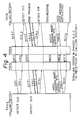
- Figs. 3 and 4 are diagrams of signaling systems in the phases B, C and D involved in the control means in the embodiment of the present invention, the former being a case of the facsimile transmission from the calling station and the latter a case of the facsimile reception by the same.
- a modem operational at a low speed of 300 to 2400 bps is available for transmission of control signals between the facsimile apparatus 4 and the FAX signal converting apparatus 3 and between the facsimile apparatus 5 and the FAX signal converting apparatus 4, while a high speed one available for transmission of training, TCF and message signals.
- the transmission speeds between the facsimile apparatus 2 and the FAX signal converting appartus 3 and between the facsimile apparatus 5 and the FAX signal converting appartus 4 are optional responsibly to the respective channel conditions and are not necessarily needed to be the same.
- control signals and message signals are transmitted between the FAX signal converting apparatuses 3 and 4 by subjecting those signals to the information and protocol conversions at need and successively permitting a high speed error-free modem provided with a powerful error control function to process them.
- the facsimile apparatus 5 sends out a digital identification signal DIS 2 therefrom to the FAX signal converting apparatus 4, which signal is converted therein to DIS 3 and again to a digital identification signal DIS 1 in the FAX signal converting apparatus 3, and detected by the facsimile apparatus 2 as the latter signal DIS 1.
- the facsimile apparatus 2 receives DIS 1 and sends sout a digital instruction signal DIS 1
- the FAX signal converting apparatus 3 detects it as the same signal DCS 1 for its mode selection while the FAX signal converting apparatus 4 detects it as DIS 2 for its mode selection.
- the facsimile apparatus 2 sends out training signals TRN 1 and TCF 1, and then the FAX signal converting apparatus 3 sends out a reception-ready confiramion signal CFR 1.
- the FAX signal converting apparatus 4 sends out training signals TRN 2 and TCF 2 to the facsimile apparatus 5, and then the facsimile apparatus 5 sends out a reception-ready confiramtion signal CFR 2 to the FAX signal converting apparatus 4.
- the facsimile apparatus 2 sends out a message signal MSG 1 inclusive of an image signal and further a post-message instruction signal PCM 1 such as a message end signal EOM and a procedure end signal EOP or a multipage signal MPS, etc., at the end of the message.
- the FAX signal converting apparatus 3 after the foregoing conversion sends out MSG 3 and PMC 3 by use of the error-free modem.
- the FAX signal converting apparatus 4 detects it and sends out it after its inverse conversion to the facsimile apparatus 5 as MSG 2 and PMC 2.
- the facsimile apparatus 2 after detection of the above signals sends out a message confirmation signal MCF 2 which is detected by the facsimile apparatus 2 as MCF 1.
- control procedure phase D thus completes as described above.
- the control advances to the phase E, and the facsimile apparatus 2 sends out channel interruption instructions which are detected by the FAX signal converting apparatuses 3, 4 and the facsimile apparatus 5 whereby the latter apparatuses 3, 4 and 5 start their release operation and after taking release guard becomes blanking for successive calls.
- the facsimile apparatus 5 sends out a digital identification signal DIS 2, and the facsimile apparatus 2 detects it as DIS 1. Then, the facsimile apparatus 2 sends out digital transmission instructions DIS 1 which are detected by the facsimile apparatus 5 as DIS 2.
- Group 4 is applicable to the standard facsimile apparatus, the control procedure between the standard facsimile apparatus and the FAX signal converting apparatus is needed to conform to CCITT Recommendations T70, T71 and others.
- the FAX signal converting apparatuses can be concentrated at a proper node in a communication network, e.g., on the boundary between subnetworks such as subscriber's switching office and an interrupted switching office or PSTN/PDN/ISDN, or in the vicinity of those subnetworks.
- FIG. 5 another embodiment of the present invention is illustrated wherein a facsimile apparatus including therein a special transmission control procedure is applied to a communication network inclusive of a mobile telephone.
- a mobile telephone set (control unit part) 21 TEL 3) is connected with a facsimile apparatus 22 (FAX 3) including therein the special transmission control procedure which apparatus is then connected with a mobile telephone (TRU) (radio part) 23.
- FAX facsimile apparatus 22
- the mobile telephone 23 is connected with a mobile telephone base cell (BS) 24 via antennas, which cell is then connected with a mobile telephone switching office (MTSO) 25, a FAX signal converting apparatus 26, a standard facsimile apparatus (FAX 4) 27, and a telephone set (TEL 4) 28, sucessively.
- BS mobile telephone base cell
- MTSO mobile telephone switching office
- FAX FAX signal converting apparatus
- TEL telephone set
- the FAX signal converting apparatus 26 may be integrally connected with the standard facsimile apparatus (SCAN) 27 for thereby serving together as a facsimile apparatus including both control procedures of the standard transmission control procedure and the special transmission control procedure.
- the facsimile apparatus also includes means to determine which control procedure should be employed upon a handshake between both sides of transmission and reception, for the purpose of assurance of stable facsimile communications less deteriorated in image quality independently of channel quality.
- Fig. 6 is a block diagram illustrating the facsimile apparatus (FAX 3) 22.
- the facsimile apparatus 22 includes a network control unit (UCU) 31, a standard transmission control procedure modem (MODEM (FAX)) 32, a special transmission control procedure modem (MODEM (E/F)) 33, a buffer memory (BUFFER) 34, a control unit (CONT) 35, an operator control panel (OPP), a document scanning unit (SCAN)) 37, an image signal processing unit (MSG) 38, a printing unit (PRINT) 39, a printing control unit (PRCON) 40, and a mechanism control unitl (MCON) 41.
- UCU network control unit
- MODEM FAX
- E/F special transmission control procedure modem
- BUFFER buffer memory
- CONT control unit
- OPP operator control panel
- SCAN document scanning unit
- MSG image signal processing unit
- PRINT printing unit
- PRCON printing control unit
- MCON mechanism control unitl
- the operation is as follows.
- the mechanism control unit 41 is operated under the control of the apparatus control unit 35 to start a series of read operation.
- the document scanning unit 37 provides a read result to the image signal processing unit 38 for converting it to an image signal, and the resulting image singal is sent to the apparatus control unit 35.
- the apparatus control unit 35 which includes therein a line memory and an image signal compressor operative under MH and MR systems, processes the read result in a predetermined manner and stores the same in the buffer memory 39 as a transmission message.
- the apparatus control unit 35 continues to take a handshake with the counterpart apparatus, thereby judging whether that apparatus is to conform to the standard transmission control procedure or the special one, for mode selection.
- the apparatus control unit 35 thereafter reads the foregoing message signal from the buffer memory 39, and accomplishes the successive facsimile communications utilizing either of the modems in conformity with the mode determined as such.
- the apparatus control unit 35 In reception, the apparatus control unit 35 after setting the associated communication channel selects either of the standard and special transmission control procedures through a handshake with the counterpart apparatus, and starts the facsimile communications.
- the buffer memory 34 stores in succession the received message signal therein.
- the apparatus control unit 35 thereafter drives a receiver mechansim through the mechanism control unit 41 to take out the received message from the buffer memeory 34 for demodulation of the image signal and conversion the same into a printing signal, and sends the resulting printing signal to the printing unit 39 for print-out thereof onto a predetermined sheet of paper.
- the method of facsimile communications of the present invention as described above, stable facsimile communications less deteriorated in image quality is assured even in facsimile communications mediated by a communication network inclusive of a mobile system network and an open-wire carrier channel both suffering from varieties of factors of disturbance.
- the methode allows the intact use of an inexpensed, mass-produced standard facsimile, thereby assuring error-free facsimile communications at a low cost.
- a facsimile apparatus associated with the present invention including both of a standard transmission control procedure and a special transmission control procedure provided with an error control function can also realize such error-free facsimile communications.
Landscapes
- Engineering & Computer Science (AREA)
- Multimedia (AREA)
- Signal Processing (AREA)
- Facsimiles In General (AREA)
- Communication Control (AREA)
- Facsimile Transmission Control (AREA)
- Data Exchanges In Wide-Area Networks (AREA)
Applications Claiming Priority (2)
| Application Number | Priority Date | Filing Date | Title |
|---|---|---|---|
| JP63069594A JPH01243748A (ja) | 1988-03-25 | 1988-03-25 | ファクシミリ通信方式並びにファクシミリ装置 |
| JP69594/88 | 1988-03-25 |
Publications (2)
| Publication Number | Publication Date |
|---|---|
| EP0334669A2 true EP0334669A2 (fr) | 1989-09-27 |
| EP0334669A3 EP0334669A3 (fr) | 1991-01-09 |
Family
ID=13407314
Family Applications (1)
| Application Number | Title | Priority Date | Filing Date |
|---|---|---|---|
| EP19890302953 Withdrawn EP0334669A3 (fr) | 1988-03-25 | 1989-03-23 | Procédé et appareil pour des communications fac-similés |
Country Status (4)
| Country | Link |
|---|---|
| US (1) | US5021890A (fr) |
| EP (1) | EP0334669A3 (fr) |
| JP (1) | JPH01243748A (fr) |
| CA (1) | CA1310740C (fr) |
Cited By (3)
| Publication number | Priority date | Publication date | Assignee | Title |
|---|---|---|---|---|
| EP0505989A3 (en) * | 1991-03-25 | 1992-11-25 | Tokyo Electric Co., Ltd. | Information communication apparatus |
| WO1994005114A1 (fr) * | 1992-08-17 | 1994-03-03 | Nokia Telecommunications Oy | Transmission par telecopie dans un reseau radiotelephonique cellulaire numerique |
| WO1996027975A1 (fr) * | 1995-03-06 | 1996-09-12 | Nokia Telecommunications Oy | Transmission par telecopie dans un systeme de communication mobile |
Families Citing this family (14)
| Publication number | Priority date | Publication date | Assignee | Title |
|---|---|---|---|---|
| KR950006030B1 (ko) * | 1990-10-19 | 1995-06-07 | 가부시끼가이샤 닛뽄곤락스 | 팩시밀리어댑터장치 |
| US5509050A (en) * | 1991-04-16 | 1996-04-16 | Quadphase Corporation | Facsimile radio communication system having multiple data speeds |
| IL103230A (en) * | 1991-12-16 | 1995-12-08 | Motorola Inc | Method and apparatus for reducing data loss in a mobile cellular system |
| US5208682A (en) * | 1992-04-23 | 1993-05-04 | Ricoh Company Ltd. | Method and apparatus for an auto handshake capable facsimile machine using digital sync fax protocols |
| EP0594185B1 (fr) * | 1992-10-22 | 2002-01-23 | Hitachi, Ltd. | Système de communication |
| US6323961B1 (en) | 1992-11-06 | 2001-11-27 | Michael I. Rackman | Facsimile machine for printing documents with selectively aligned edges |
| US5311607A (en) * | 1993-08-25 | 1994-05-10 | Crosby Peter A | Facsimile machine for printing documents all with corresponding edges aligned but without requiring scanning |
| US5953647A (en) * | 1995-12-18 | 1999-09-14 | Paradyne Corporation | Technique for sending faxes over cellular communications channels |
| US5920825A (en) * | 1995-12-18 | 1999-07-06 | Paradyne Corporation | Method and apparatus for bypassing a cellular modem pool during a fax transmission |
| US5752199A (en) * | 1995-12-18 | 1998-05-12 | Paradyne Corporation | Method and apparatus for sending faxes over analog cellular |
| US5920402A (en) * | 1995-12-18 | 1999-07-06 | Paradyne Corporation | Use of compression to improve the sending of faxes over analog cellular |
| JP2002199455A (ja) * | 2000-12-27 | 2002-07-12 | Matsushita Electric Ind Co Ltd | コードレス電話装置 |
| KR100433628B1 (ko) * | 2001-12-27 | 2004-05-31 | 주식회사 케이티 | FoIP에 있어서 네트워크 상태 적응형 오류 제어 방법 |
| US10348928B2 (en) | 2017-03-09 | 2019-07-09 | Hewlett-Packard Development Company, L.P. | Facsimile communication |
Family Cites Families (9)
| Publication number | Priority date | Publication date | Assignee | Title |
|---|---|---|---|---|
| JPS5816668B2 (ja) * | 1976-11-12 | 1983-04-01 | 富士通株式会社 | フアクシミリ電送方式 |
| JPS5497303A (en) * | 1978-01-19 | 1979-08-01 | Nec Corp | Signal transmission-reception system |
| JPS57104346A (en) * | 1980-12-19 | 1982-06-29 | Fujitsu Ltd | Modulation and demodulation device |
| JPS58175358A (ja) * | 1982-04-07 | 1983-10-14 | Canon Inc | フアクシミリ装置 |
| JPH0722324B2 (ja) * | 1983-08-30 | 1995-03-08 | 富士通株式会社 | データ伝送方式 |
| JPS60120635A (ja) * | 1983-12-05 | 1985-06-28 | Canon Inc | 通信装置 |
| JPS60160768A (ja) * | 1984-02-01 | 1985-08-22 | Hitachi Ltd | フアクシミリ接続装置 |
| JPS6265554A (ja) * | 1985-09-17 | 1987-03-24 | Toshiba Corp | フアクシミリの通信方法 |
| JPS62188443A (ja) * | 1986-02-14 | 1987-08-18 | Hitachi Ltd | 符号化方式 |
-
1988
- 1988-03-25 JP JP63069594A patent/JPH01243748A/ja active Pending
-
1989
- 1989-03-21 US US07/326,801 patent/US5021890A/en not_active Expired - Fee Related
- 1989-03-23 EP EP19890302953 patent/EP0334669A3/fr not_active Withdrawn
- 1989-03-23 CA CA000594705A patent/CA1310740C/fr not_active Expired - Fee Related
Cited By (7)
| Publication number | Priority date | Publication date | Assignee | Title |
|---|---|---|---|---|
| EP0505989A3 (en) * | 1991-03-25 | 1992-11-25 | Tokyo Electric Co., Ltd. | Information communication apparatus |
| US5297196A (en) * | 1991-03-25 | 1994-03-22 | Tokyo Electric Co., Ltd. | Facsimile apparatus adapted to communicate via an acoustic coupler |
| WO1994005114A1 (fr) * | 1992-08-17 | 1994-03-03 | Nokia Telecommunications Oy | Transmission par telecopie dans un reseau radiotelephonique cellulaire numerique |
| US5537458A (en) * | 1992-08-17 | 1996-07-16 | Nokia Telecommunications Oy | Facsimile transmission in a digital cellular radio network |
| WO1996027975A1 (fr) * | 1995-03-06 | 1996-09-12 | Nokia Telecommunications Oy | Transmission par telecopie dans un systeme de communication mobile |
| US5805301A (en) * | 1995-03-06 | 1998-09-08 | Nokia Telecommunications Oy | Facsimile transmission in a mobile communication system |
| CN1099206C (zh) * | 1995-03-06 | 2003-01-15 | 诺基亚电信公司 | 移动通信系统中的传真传输 |
Also Published As
| Publication number | Publication date |
|---|---|
| JPH01243748A (ja) | 1989-09-28 |
| US5021890A (en) | 1991-06-04 |
| CA1310740C (fr) | 1992-11-24 |
| EP0334669A3 (fr) | 1991-01-09 |
Similar Documents
| Publication | Publication Date | Title |
|---|---|---|
| US5021890A (en) | Method of and apparatus for facsimile communications | |
| JP4236377B2 (ja) | タンデム構造でアナログファックス呼をサポートするための装置および方法 | |
| CA2035318C (fr) | Systeme de telecopie mobile pouvant mettre un telecopieur en mode de travail automatiquement | |
| US5805678A (en) | Cordless subunit facsimile system | |
| GB2177572A (en) | Mobile radiotelephone systems | |
| EP0942586B1 (fr) | Dispositif de transmission de données et dispositif de réception de données | |
| US20040203741A1 (en) | Communication systems having a function that allows communication between mobile and non-mobile facsimile terminals using different communication protocols | |
| US6115142A (en) | Method and apparatus for supporting analog fax calls in a tandem configuration | |
| JP3351017B2 (ja) | 通信システム | |
| JP2675420B2 (ja) | 移動体におけるファクシミリ通信方法 | |
| KR100510562B1 (ko) | 탠덤 구성에서 아날로그 팩스 호출을 지원하기 위한 장치와 방법 | |
| JP2755384B2 (ja) | ファクシミリ通信方法 | |
| EP0844774A2 (fr) | Système de communication sans fil | |
| KR100202402B1 (ko) | 팩시밀리의 직접호출방법 | |
| JP2831843B2 (ja) | 移動体における通信方法 | |
| JPH01243778A (ja) | ファクシミリ伝送方法 | |
| JPH04137972A (ja) | ファクシミリ装置 | |
| KR100292090B1 (ko) | 팩시밀리에서자동송신접속성공률에따른자동재다이얼횟수자동조절방법 | |
| JPH07143301A (ja) | ファクシミリ装置 | |
| EP1526708A1 (fr) | Appareil et procédé de prise en charge d'appels de télécopie analogiques selon une configuration en tandem | |
| JPH06189103A (ja) | ファクシミリ装置 | |
| HK1077144A (en) | Apparatus and method for supporting analog fax calls in a tandem configuration | |
| JPH09149232A (ja) | 短縮手順通信機能を備えた通信端末装置 | |
| HK1029693B (en) | Apparatus and method for supporting analog fax calls in a tandem configuration | |
| JPH10290348A (ja) | 通信端末装置 |
Legal Events
| Date | Code | Title | Description |
|---|---|---|---|
| PUAI | Public reference made under article 153(3) epc to a published international application that has entered the european phase |
Free format text: ORIGINAL CODE: 0009012 |
|
| AK | Designated contracting states |
Kind code of ref document: A2 Designated state(s): DE FR GB IT SE |
|
| PUAL | Search report despatched |
Free format text: ORIGINAL CODE: 0009013 |
|
| AK | Designated contracting states |
Kind code of ref document: A3 Designated state(s): DE FR GB IT SE |
|
| 17P | Request for examination filed |
Effective date: 19901228 |
|
| 17Q | First examination report despatched |
Effective date: 19921124 |
|
| STAA | Information on the status of an ep patent application or granted ep patent |
Free format text: STATUS: THE APPLICATION HAS BEEN WITHDRAWN |
|
| 18W | Application withdrawn |
Withdrawal date: 19941111 |
|
| APAF | Appeal reference modified |
Free format text: ORIGINAL CODE: EPIDOSCREFNE |