EP0335031A2 - Verriegelungseinrichtung für eine Kopf-Arm-Vorrichtung bei einem Plattengerät - Google Patents
Verriegelungseinrichtung für eine Kopf-Arm-Vorrichtung bei einem Plattengerät Download PDFInfo
- Publication number
- EP0335031A2 EP0335031A2 EP88308033A EP88308033A EP0335031A2 EP 0335031 A2 EP0335031 A2 EP 0335031A2 EP 88308033 A EP88308033 A EP 88308033A EP 88308033 A EP88308033 A EP 88308033A EP 0335031 A2 EP0335031 A2 EP 0335031A2
- Authority
- EP
- European Patent Office
- Prior art keywords
- head
- pawl
- lock
- arm mechanism
- armature
- Prior art date
- Legal status (The legal status is an assumption and is not a legal conclusion. Google has not performed a legal analysis and makes no representation as to the accuracy of the status listed.)
- Withdrawn
Links
- 230000007246 mechanism Effects 0.000 title claims abstract description 75
- 125000006850 spacer group Chemical group 0.000 claims abstract description 16
- 238000004804 winding Methods 0.000 claims description 3
- 230000000452 restraining effect Effects 0.000 claims description 2
- 239000002245 particle Substances 0.000 description 3
- CWYNVVGOOAEACU-UHFFFAOYSA-N Fe2+ Chemical compound [Fe+2] CWYNVVGOOAEACU-UHFFFAOYSA-N 0.000 description 2
- 238000007790 scraping Methods 0.000 description 2
- 230000002411 adverse Effects 0.000 description 1
- 238000010586 diagram Methods 0.000 description 1
- 239000002184 metal Substances 0.000 description 1
- 238000010408 sweeping Methods 0.000 description 1
Images


Classifications
-
- G—PHYSICS
- G11—INFORMATION STORAGE
- G11B—INFORMATION STORAGE BASED ON RELATIVE MOVEMENT BETWEEN RECORD CARRIER AND TRANSDUCER
- G11B21/00—Head arrangements not specific to the method of recording or reproducing
- G11B21/16—Supporting the heads; Supporting the sockets for plug-in heads
- G11B21/22—Supporting the heads; Supporting the sockets for plug-in heads while the head is out of operative position
Definitions
- This invention relates to lock mechanisms for head-arm mechanisms of disk drives.
- lock mechanisms for disk drives have operated by one of two principles.
- One type of lock mechanism employs a fully mechanical device, usually operated manually by a lever or the like, which engages the arm to lock it in a retracted position.
- a second type employs a solenoid which is energised in one or the other position to lock or unlock the head-arm mechanism.
- the lock mechanism employing a solenoid requires energisation to maintain the head-arm mechanism in either a locked or unlocked position.
- the constant energisation of the solenoid generates heat within the disk drive, causing yet other problems.
- a third type of lock mechanism employing a mechanical lock operated by a solenoid In reality, these "hybrid" lock mechanisms exhibit the adverse characteristics of both the mechanical and solenoid lock mechanisms by requiring constant energisation in one or the other positions and by mechanical scraping of the parts.
- the present invention seeks to provide a locking mechanism for a head-arm mechanism employing a solenoid which is energised solely to move the lock mechanism from a locked to an unlocked position, and vice versa. At other times, the solenoid is not energised.
- the locking mechanism thus does not require mechanical leverage as in prior mechanical lock mechanisms, nor does it require electrical energisation of a solenoid to maintain a lock or unlock position.
- the present invention also seeks to provide a locking mechanism which dissipates as little heat as possible and does not contaminate the disk drive.
- a lock mechanism for a head-arm mechanism of a disk drive having a frame, said head-arm mechanism being supported by said frame and being movable between a lock position wherein said head-arm mechanism is restrained from movement and an unlock position
- said lock mechanism being characterised by comprising: bi-stable solenoid means mounted to said frame, said solenoid means having armature means having first and second positions, and winding means electrically energisable to move said armature means between its first and second positions; pawl means mounted to said armature means, said pawl means having a detent and being movable between first and second rest positions as said armature means is moved between its first and second positions, respectively; spacer means mounted to said head-arm mechanism, said detent of said pawl means engaging said spacer means when said head-arm mechanism is in its lock position and said pawl means is in its first rest position to restrain said head-arm mechanism to its lock position; and stop means mounted to said frame for engaging said paw
- Said bi-stable solenoid means may include a magnetic circuit including permanent magnet means arranged to bias said armature means to its first position when said pawl means is in its first rest position and biasing said armature means to its second position when said pawl means is in its second rest position.
- Said bi-stable solenoid means preferably is a rotary solenoid and said armature means comprises a rotor, said rotor being arranged to rotate between first and second rotational positions spaced apart by a predetermined angle, said stop means and said spacer means restraining rotational movement of the rotor through an angle smaller than said predetermined angle.
- Said rotor may be segmented into permanent magnet poles 60° apart and said stop means and said spacer means, in operation, restrain said pawl means from movement through an angle of less than 60°.
- Said pawl means preferably is restrained from movement to an angle less than about 40°.
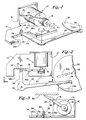
- the lock mechanism includes a bi-stable rotary solenoid 10 mounted on an upwardly extending arm 12 of a bracket 14.
- the bracket 14 is part of a housing (not shown) to which the magnetic disk 30 and a head-arm mechanism 24 are mounted.
- a shaft 16 of the solenoid 10 has a pawl 18 mounted thereto for rotary motion about an axis 20 of the solenoid 10.
- the underside of the pawl 18 includes a detent 86 having an engaging surface 22.
- the head-arm mechanism 24 is journalled to the housing for rotation about an axis 26 and carries a head 28 for sweeping across the surface of a magnetic disk 30 ( Figure 2), which in turn is journalled to the housing to rotate about an axis 32. As shown particularly in Figure 2, the head-arm mechanism 24 may be moved between radial postions illustrated at 24a and 24b.
- a stop arm 34 is fixedly mounted to the head-arm mechanism 24 to rotate about the axis 26 with the head-arm mechanism 24.
- the arm 34 carries a pin 36 (Figure 3) extending into a notch region 38 of the bracket 14.
- the pin 36 is arranged to engage edges 38a and 38b of the notch region 38 and to limit the rotation of the arm 34 and the headarm mechanism 24 about the axis 26 ( Figure 2).
- the edges 38a, 38b form limiting stops to the rotational travel of the arm 34 and the head-arm mechanism 24 thereby limiting the movement of the head-arm mechanism 24 to between the radial positions 24a, 24b.
- a spacer 39 is mounted to the arm 34 so that the detent 86 may engage the spacer 39 when the pin 36 is in a stop position against the edge 38a and the pawl 18 is moved by the solenoid 10 to the position shown in Figure 4C.
- the surface 84 of the spacer 39 is arranged to engage the edge of the detent 86 on the pawl, thereby limiting rotational movement of the pawl to a first rest position.
- Rotational movement of the pawl 18 is limited to a second rest position by a stop 80 ( Figure 3) on the housing.
- the pawl 18 is limited by the stop 80 and the spacer 39 to a rotational movement of between 30° and 40°, as hereinafter explained.
- the head-arm mechanism 24 In the operation of the lock mechanism, when it is desired to lock the head-arm mechanism into its first rest position, the head-arm mechanism 24 is moved to the radial position 24a so that the pin 36 bears against the edge 38a.
- the solenoid 10 is energised to move the pawl 18 to the first rest position illustrated in Figure 4C so that the surface 84 engages the detent 86 to limit travel of the pawl and the surface 22 of the detent engages the stop 39 to hold the pin 36 against the edge 38a in the position illustrated in Figure 4C.
- the arm 34 (and the head-arm mechanism 24) are rest-rained and locked in a first rest position.
- the solenoid 10 is again energised to move the pawl 18 to the second rest position illustrated in Figure 4A, thereby permitting the arm 34 to rotate about the axis 26 as the pin 36 moves in the notch portion 38 of the bracket 14.
- the head-arm mechanism 24 can rotate about the axis 26 as illustrated in Figure 2.
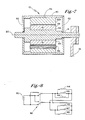
- the solenoid 10 comprises a housing 40 supporting a ferrous metal stator 42 therein. Coils 44 - 49 are wound in slots 50 of the stator 42. Each coil 44 - 49 is wound between succussive slots 50, spaced 60° apart, and surrounds one of six ferrous lands 52. Each slot 50 contains one half of each of two of the six coils. As shown in Figure 8, the coils 44, 46, 48 are wound opposite to the coils 43, 45, 49 so that successive lands 52 are oppositely polarised. Thus, depending upon the direction of current in the coils 44 - 49, alternate lands 52 will be energised at either a north magnetic pole as indicated in Figure 5, or at a south magnetic pole as indicated in Figure 6.
- the rotor of the solenoid 10 includes a shaft 54 to which the pawl 18 is affixed.
- a magnetic armature member 56 is fixed to the shaft 54.
- the shaft 54 is journalled to ends 60, 62 ( Figure 7) of the housing 40 to rotate about the axis 20.
- the armature member 56 is divided into six equal permanent magnet portions 64, 66, 68, 70, 72, 74, each encompassing 60° in circumference about the shaft 54. Magnetic portions 64, 66, 68 are permanent north magnetic poles, whereas alternate magnet portions 70, 72, 74 are permanent south magnetic poles.
- the armature member 56 will attempt to rotate from one angular position to another, such as from the position illustrated in Figure 5 to the position illustrated in Figure 6. It is preferred to limit rotation of the rotor to between about 30° and 40° so that the limit positions of the rotor position the centre of the magnetic portions between 10° and 15° of the centre of the lands.
- the stop 80 limits rotational movement of the pawl 18 to one angular position and the surface 86 of the pawl 18 engages the spacer 39 to limit movement of the pawl to the second angular position.
- each permanent magnetic pole on the rotor will continue to attract to the nearest land 52, maintaining the rotor in its stable position.
- the magnetic circuit formed by the permanent magnetic pole of the armature member 56 and the lands 52 bias the rotor to one or the other rest position defined by the limits of the stop 80 and spacer 39.
- the solenoid will rotate to its original position, as from Figure 6 to Figure 5.
- the lock mechanism described above is effective to lock the head-arm mechanism without employing mechanical leverage devices which create friction and contaminate the disk drive, or using a solenoid which is continuously energised to hold the lock mechanism in one position or the other.
- the lock mechanism does not appreciably dissipate heat into the disk drive due to continuous energisation, nor contaminate the disk drive due to physical scraping of parts.
- the lock mechanism is thus effective in operation and inexpensive to produce.
Landscapes
- Supporting Of Heads In Record-Carrier Devices (AREA)
- Moving Of Heads (AREA)
Applications Claiming Priority (2)
| Application Number | Priority Date | Filing Date | Title |
|---|---|---|---|
| US175448 | 1988-03-30 | ||
| US07/175,448 US4868695A (en) | 1988-03-30 | 1988-03-30 | Head/arm lock mechanism for a disk drive |
Publications (2)
| Publication Number | Publication Date |
|---|---|
| EP0335031A2 true EP0335031A2 (de) | 1989-10-04 |
| EP0335031A3 EP0335031A3 (de) | 1990-02-28 |
Family
ID=22640250
Family Applications (1)
| Application Number | Title | Priority Date | Filing Date |
|---|---|---|---|
| EP88308033A Withdrawn EP0335031A3 (de) | 1988-03-30 | 1988-08-31 | Verriegelungseinrichtung für eine Kopf-Arm-Vorrichtung bei einem Plattengerät |
Country Status (4)
| Country | Link |
|---|---|
| US (1) | US4868695A (de) |
| EP (1) | EP0335031A3 (de) |
| JP (1) | JPH01256083A (de) |
| AU (1) | AU2217088A (de) |
Cited By (1)
| Publication number | Priority date | Publication date | Assignee | Title |
|---|---|---|---|---|
| EP0832483A4 (de) * | 1995-06-07 | 1998-09-09 | Maxtor Corp | Monostabile aktive verriegelung für plattenantriebsbetätiger |
Families Citing this family (16)
| Publication number | Priority date | Publication date | Assignee | Title |
|---|---|---|---|---|
| US5012371A (en) * | 1989-02-22 | 1991-04-30 | Miniscribe Corporation | Disk drive crash stop/actuator latch |
| JPH0478074A (ja) * | 1990-07-12 | 1992-03-12 | Matsushita Electric Ind Co Ltd | ヘッドスライダロック装置 |
| US5208713A (en) * | 1991-05-07 | 1993-05-04 | Quantum Corporation | Bistable magnetic/electromagnetic latch for disk file actuator |
| US5231556A (en) * | 1991-06-06 | 1993-07-27 | Seagate Technology, Inc. | Self-holding latch assembly |
| TW209901B (de) * | 1992-01-27 | 1993-07-21 | Sony Co Ltd | |
| US5495376A (en) * | 1992-03-02 | 1996-02-27 | Hitachi Metals, Ltd. | Power loss actuated magnetic latch system for head-arm assembly |
| US5341259A (en) * | 1992-10-22 | 1994-08-23 | Quantum Corporation | Pivoting, dual state magnetic latch for disk file actuator |
| DE69413443T2 (de) * | 1993-04-02 | 1999-04-29 | Quantum Corp., Milpitas, Calif. | Aktive elektromagnetische Verriegelung für das Kopfstellglied eines Festplattenantriebs |
| US5523910A (en) * | 1994-05-02 | 1996-06-04 | Hewlett-Packard Company | Recording/reproducing device having a bypassing pole electromagnetic actuator latch of low power requirement |
| US5694271A (en) * | 1996-04-18 | 1997-12-02 | Seagate Technology, Inc. | Space efficient magnetic toggle latch assembly for a disc drive actuator |
| US5978179A (en) * | 1997-11-14 | 1999-11-02 | Castlewood Systems | Removable cartridge hard disk drive with an inner crash stop |
| US6917497B1 (en) * | 2001-02-16 | 2005-07-12 | Maxtor Corporation | Disk drive actuator arm latch assembly |
| DE202011004021U1 (de) * | 2011-03-16 | 2012-07-09 | Eto Magnetic Gmbh | Elektromagnetische Aktuatorvorrichtung |
| DE202012009830U1 (de) * | 2012-10-15 | 2012-11-15 | Bürkert Werke GmbH | Impulsmagnetventil |
| US9274329B2 (en) | 2013-04-08 | 2016-03-01 | Melles-Griot | Shutter with blade damping |
| US8851768B1 (en) | 2013-06-14 | 2014-10-07 | Melles-Griot | Shutter with power-free blade return |
Family Cites Families (11)
| Publication number | Priority date | Publication date | Assignee | Title |
|---|---|---|---|---|
| GB1419262A (en) * | 1972-11-02 | 1975-12-24 | Fluid Devices Ltd | Electromagnetic actuator |
| JPS505016A (de) * | 1973-03-24 | 1975-01-20 | ||
| US4484241A (en) * | 1982-05-17 | 1984-11-20 | International Business Machines Corporation | Automatic lock for head-carriage assembly in a disk file |
| US4523167A (en) * | 1982-12-27 | 1985-06-11 | Presto Lock, Inc. | Bistable electromagnetic latch |
| DE8312653U1 (de) * | 1983-04-29 | 1983-10-13 | Basf Ag, 6700 Ludwigshafen | Informationsspeicher mit positioniereinrichtung und hubmagnet dafuer |
| JPS6157359U (de) * | 1984-09-19 | 1986-04-17 | ||
| CN1003822B (zh) * | 1984-10-09 | 1989-04-05 | 三菱矿业水泥株式会社 | 电磁执行机构 |
| US4725907A (en) * | 1984-10-19 | 1988-02-16 | Seagate Technology | Carriage latch for a disc drive incorporating inertial lock-up |
| JPH0743901B2 (ja) * | 1985-11-30 | 1995-05-15 | 株式会社東芝 | 磁気記録再生装置のキヤリツジロツク機構 |
| US4786995A (en) * | 1986-11-06 | 1988-11-22 | Peripheral Technology, Inc | Automatic head retract system for disk drive |
| FR2606927B1 (fr) * | 1986-11-19 | 1991-09-13 | Telemecanique Electrique | Electro-aimant polarise bistable |
-
1988
- 1988-03-30 US US07/175,448 patent/US4868695A/en not_active Expired - Lifetime
- 1988-08-31 EP EP88308033A patent/EP0335031A3/de not_active Withdrawn
- 1988-09-13 AU AU22170/88A patent/AU2217088A/en not_active Abandoned
- 1988-09-16 JP JP63230197A patent/JPH01256083A/ja active Pending
Cited By (1)
| Publication number | Priority date | Publication date | Assignee | Title |
|---|---|---|---|---|
| EP0832483A4 (de) * | 1995-06-07 | 1998-09-09 | Maxtor Corp | Monostabile aktive verriegelung für plattenantriebsbetätiger |
Also Published As
| Publication number | Publication date |
|---|---|
| EP0335031A3 (de) | 1990-02-28 |
| AU2217088A (en) | 1989-10-05 |
| JPH01256083A (ja) | 1989-10-12 |
| US4868695A (en) | 1989-09-19 |
Similar Documents
| Publication | Publication Date | Title |
|---|---|---|
| EP0335031A2 (de) | Verriegelungseinrichtung für eine Kopf-Arm-Vorrichtung bei einem Plattengerät | |
| US5231556A (en) | Self-holding latch assembly | |
| EP0560167B1 (de) | Aktive magnetische Verriegelung für Plattengerät und Verfahren | |
| US5581424A (en) | Magnetic crash stop and latch in a disc drive | |
| KR940005552B1 (ko) | 광자기 디스크장치용 외부자계 반전장치 | |
| US3924146A (en) | Multiple linear motor positioning system | |
| JPS6113480A (ja) | 磁気デイスク記憶装置用の位置決め装置 | |
| US5038063A (en) | Rotary actuator with limited angular movement | |
| US5694271A (en) | Space efficient magnetic toggle latch assembly for a disc drive actuator | |
| US6956453B2 (en) | Bi-stable magnetic latch | |
| KR920009028A (ko) | 영구자석형 스테핑모터와 그 디텐트토크를 최소로 조정하는 방법 | |
| JPH03215154A (ja) | モータ | |
| US9281733B2 (en) | Shutter with bistable actuator having power-free magnetic blade return | |
| US5523910A (en) | Recording/reproducing device having a bypassing pole electromagnetic actuator latch of low power requirement | |
| EP0357014A3 (de) | Linearer Impulsmotor mit Mitteln zur Verriegelung seines Ankers | |
| JP2544063B2 (ja) | 磁気ディスク装置のキャリッジ・ロック方法及び磁気ディスク装置 | |
| US5753984A (en) | Apparatus and method for starting a single-phase variable reluctance motor | |
| JPH0615021U (ja) | アクチュエータ | |
| US3530318A (en) | Wobble coil stepping motor | |
| JPH0244490Y2 (de) | ||
| JPS6224303Y2 (de) | ||
| JPH0732753U (ja) | ハードディスクドライブのラッチ機構 | |
| JPH0253271A (ja) | デイスク駆動装置 | |
| JPH0347293Y2 (de) | ||
| JPS63174550A (ja) | 昇降機能付ステツパモ−タ |
Legal Events
| Date | Code | Title | Description |
|---|---|---|---|
| PUAI | Public reference made under article 153(3) epc to a published international application that has entered the european phase |
Free format text: ORIGINAL CODE: 0009012 |
|
| AK | Designated contracting states |
Kind code of ref document: A2 Designated state(s): DE FR GB |
|
| PUAL | Search report despatched |
Free format text: ORIGINAL CODE: 0009013 |
|
| AK | Designated contracting states |
Kind code of ref document: A3 Designated state(s): DE FR GB |
|
| STAA | Information on the status of an ep patent application or granted ep patent |
Free format text: STATUS: THE APPLICATION IS DEEMED TO BE WITHDRAWN |
|
| 18D | Application deemed to be withdrawn |
Effective date: 19900901 |