EP0335219A2 - Positiv arbeitendes strahlungsempfindliches Gemisch und daraus hergestelltes Aufzeichnungsmaterial - Google Patents
Positiv arbeitendes strahlungsempfindliches Gemisch und daraus hergestelltes Aufzeichnungsmaterial Download PDFInfo
- Publication number
- EP0335219A2 EP0335219A2 EP89104977A EP89104977A EP0335219A2 EP 0335219 A2 EP0335219 A2 EP 0335219A2 EP 89104977 A EP89104977 A EP 89104977A EP 89104977 A EP89104977 A EP 89104977A EP 0335219 A2 EP0335219 A2 EP 0335219A2
- Authority
- EP
- European Patent Office
- Prior art keywords
- radiation
- mol
- sensitive mixture
- sensitive
- binder
- Prior art date
- Legal status (The legal status is an assumption and is not a legal conclusion. Google has not performed a legal analysis and makes no representation as to the accuracy of the status listed.)
- Withdrawn
Links
- 239000000203 mixture Substances 0.000 title claims abstract description 63
- 230000005855 radiation Effects 0.000 title claims abstract description 62
- 239000000463 material Substances 0.000 title claims abstract description 23
- 239000011230 binding agent Substances 0.000 claims abstract description 38
- 150000001875 compounds Chemical class 0.000 claims abstract description 35
- 239000002253 acid Substances 0.000 claims abstract description 19
- 238000004519 manufacturing process Methods 0.000 claims abstract description 9
- 230000009471 action Effects 0.000 claims abstract description 7
- 230000009477 glass transition Effects 0.000 claims abstract description 7
- XLYOFNOQVPJJNP-UHFFFAOYSA-N water Substances O XLYOFNOQVPJJNP-UHFFFAOYSA-N 0.000 claims abstract description 7
- 239000003513 alkali Substances 0.000 claims abstract description 5
- 238000007645 offset printing Methods 0.000 claims abstract description 5
- 239000003960 organic solvent Substances 0.000 claims abstract description 5
- ISWSIDIOOBJBQZ-UHFFFAOYSA-N phenol group Chemical group C1(=CC=CC=C1)O ISWSIDIOOBJBQZ-UHFFFAOYSA-N 0.000 claims description 56
- RLSSMJSEOOYNOY-UHFFFAOYSA-N m-cresol Chemical compound CC1=CC=CC(O)=C1 RLSSMJSEOOYNOY-UHFFFAOYSA-N 0.000 claims description 22
- 238000002360 preparation method Methods 0.000 claims description 18
- 229920003986 novolac Polymers 0.000 claims description 16
- 229920005989 resin Polymers 0.000 claims description 12
- 239000011347 resin Substances 0.000 claims description 12
- 125000002496 methyl group Chemical group [H]C([H])([H])* 0.000 claims description 9
- 125000004178 (C1-C4) alkyl group Chemical group 0.000 claims description 6
- 125000001495 ethyl group Chemical group [H]C([H])([H])C([H])([H])* 0.000 claims description 6
- 238000000034 method Methods 0.000 claims description 6
- 125000001424 substituent group Chemical group 0.000 claims description 5
- 239000002318 adhesion promoter Substances 0.000 claims description 4
- 125000000999 tert-butyl group Chemical group [H]C([H])([H])C(*)(C([H])([H])[H])C([H])([H])[H] 0.000 claims description 4
- WSFSSNUMVMOOMR-NJFSPNSNSA-N methanone Chemical compound O=[14CH2] WSFSSNUMVMOOMR-NJFSPNSNSA-N 0.000 claims description 3
- 125000000217 alkyl group Chemical group 0.000 claims description 2
- 150000001728 carbonyl compounds Chemical class 0.000 claims description 2
- 230000002035 prolonged effect Effects 0.000 abstract 1
- -1 t-Butyl Chemical group 0.000 description 15
- WSFSSNUMVMOOMR-UHFFFAOYSA-N Formaldehyde Chemical compound O=C WSFSSNUMVMOOMR-UHFFFAOYSA-N 0.000 description 14
- 239000011248 coating agent Substances 0.000 description 12
- 238000000576 coating method Methods 0.000 description 12
- 229920001568 phenolic resin Polymers 0.000 description 11
- 150000002989 phenols Chemical class 0.000 description 11
- 239000005011 phenolic resin Substances 0.000 description 10
- KXGFMDJXCMQABM-UHFFFAOYSA-N 2-methoxy-6-methylphenol Chemical compound [CH]OC1=CC=CC([CH])=C1O KXGFMDJXCMQABM-UHFFFAOYSA-N 0.000 description 9
- 239000002904 solvent Substances 0.000 description 9
- 239000000758 substrate Substances 0.000 description 9
- ZWEHNKRNPOVVGH-UHFFFAOYSA-N 2-Butanone Chemical compound CCC(C)=O ZWEHNKRNPOVVGH-UHFFFAOYSA-N 0.000 description 8
- 229910052782 aluminium Inorganic materials 0.000 description 8
- XAGFODPZIPBFFR-UHFFFAOYSA-N aluminium Chemical compound [Al] XAGFODPZIPBFFR-UHFFFAOYSA-N 0.000 description 8
- JHIVVAPYMSGYDF-UHFFFAOYSA-N cyclohexanone Chemical compound O=C1CCCCC1 JHIVVAPYMSGYDF-UHFFFAOYSA-N 0.000 description 8
- 238000007639 printing Methods 0.000 description 7
- ZMXDDKWLCZADIW-UHFFFAOYSA-N N,N-Dimethylformamide Chemical compound CN(C)C=O ZMXDDKWLCZADIW-UHFFFAOYSA-N 0.000 description 6
- MUBZPKHOEPUJKR-UHFFFAOYSA-N Oxalic acid Chemical compound OC(=O)C(O)=O MUBZPKHOEPUJKR-UHFFFAOYSA-N 0.000 description 6
- HUMNYLRZRPPJDN-UHFFFAOYSA-N benzaldehyde Chemical compound O=CC1=CC=CC=C1 HUMNYLRZRPPJDN-UHFFFAOYSA-N 0.000 description 6
- 239000000470 constituent Substances 0.000 description 6
- LYCAIKOWRPUZTN-UHFFFAOYSA-N ethylene glycol Natural products OCCO LYCAIKOWRPUZTN-UHFFFAOYSA-N 0.000 description 6
- 238000010438 heat treatment Methods 0.000 description 6
- 150000001241 acetals Chemical class 0.000 description 5
- DNIAPMSPPWPWGF-UHFFFAOYSA-N monopropylene glycol Natural products CC(O)CO DNIAPMSPPWPWGF-UHFFFAOYSA-N 0.000 description 5
- DHKHKXVYLBGOIT-UHFFFAOYSA-N 1,1-Diethoxyethane Chemical compound CCOC(C)OCC DHKHKXVYLBGOIT-UHFFFAOYSA-N 0.000 description 4
- HIXDQWDOVZUNNA-UHFFFAOYSA-N 2-(3,4-dimethoxyphenyl)-5-hydroxy-7-methoxychromen-4-one Chemical compound C=1C(OC)=CC(O)=C(C(C=2)=O)C=1OC=2C1=CC=C(OC)C(OC)=C1 HIXDQWDOVZUNNA-UHFFFAOYSA-N 0.000 description 4
- TUAMRELNJMMDMT-UHFFFAOYSA-N 3,5-xylenol Chemical compound CC1=CC(C)=CC(O)=C1 TUAMRELNJMMDMT-UHFFFAOYSA-N 0.000 description 4
- VYPSYNLAJGMNEJ-UHFFFAOYSA-N Silicium dioxide Chemical compound O=[Si]=O VYPSYNLAJGMNEJ-UHFFFAOYSA-N 0.000 description 4
- 125000002915 carbonyl group Chemical group [*:2]C([*:1])=O 0.000 description 4
- 230000000052 comparative effect Effects 0.000 description 4
- 238000001035 drying Methods 0.000 description 4
- RTZKZFJDLAIYFH-UHFFFAOYSA-N ether Substances CCOCC RTZKZFJDLAIYFH-UHFFFAOYSA-N 0.000 description 4
- FFUAGWLWBBFQJT-UHFFFAOYSA-N hexamethyldisilazane Chemical compound C[Si](C)(C)N[Si](C)(C)C FFUAGWLWBBFQJT-UHFFFAOYSA-N 0.000 description 4
- 150000002576 ketones Chemical class 0.000 description 4
- 229920000642 polymer Polymers 0.000 description 4
- 239000010703 silicon Substances 0.000 description 4
- ZRYCRPNCXLQHPN-UHFFFAOYSA-N 3-hydroxy-2-methylbenzaldehyde Chemical compound CC1=C(O)C=CC=C1C=O ZRYCRPNCXLQHPN-UHFFFAOYSA-N 0.000 description 3
- QTBSBXVTEAMEQO-UHFFFAOYSA-N Acetic acid Chemical compound CC(O)=O QTBSBXVTEAMEQO-UHFFFAOYSA-N 0.000 description 3
- CSCPPACGZOOCGX-UHFFFAOYSA-N Acetone Chemical compound CC(C)=O CSCPPACGZOOCGX-UHFFFAOYSA-N 0.000 description 3
- XEKOWRVHYACXOJ-UHFFFAOYSA-N Ethyl acetate Chemical compound CCOC(C)=O XEKOWRVHYACXOJ-UHFFFAOYSA-N 0.000 description 3
- NBIIXXVUZAFLBC-UHFFFAOYSA-N Phosphoric acid Chemical compound OP(O)(O)=O NBIIXXVUZAFLBC-UHFFFAOYSA-N 0.000 description 3
- XUIMIQQOPSSXEZ-UHFFFAOYSA-N Silicon Chemical compound [Si] XUIMIQQOPSSXEZ-UHFFFAOYSA-N 0.000 description 3
- 230000008859 change Effects 0.000 description 3
- 150000002148 esters Chemical class 0.000 description 3
- 239000011888 foil Substances 0.000 description 3
- WGCNASOHLSPBMP-UHFFFAOYSA-N hydroxyacetaldehyde Natural products OCC=O WGCNASOHLSPBMP-UHFFFAOYSA-N 0.000 description 3
- QSHDDOUJBYECFT-UHFFFAOYSA-N mercury Chemical compound [Hg] QSHDDOUJBYECFT-UHFFFAOYSA-N 0.000 description 3
- 229910052751 metal Inorganic materials 0.000 description 3
- 239000002184 metal Substances 0.000 description 3
- QNGNSVIICDLXHT-UHFFFAOYSA-N para-ethylbenzaldehyde Natural products CCC1=CC=C(C=O)C=C1 QNGNSVIICDLXHT-UHFFFAOYSA-N 0.000 description 3
- LLHKCFNBLRBOGN-UHFFFAOYSA-N propylene glycol methyl ether acetate Chemical compound COCC(C)OC(C)=O LLHKCFNBLRBOGN-UHFFFAOYSA-N 0.000 description 3
- 229910052710 silicon Inorganic materials 0.000 description 3
- 239000007858 starting material Substances 0.000 description 3
- ARXJGSRGQADJSQ-UHFFFAOYSA-N 1-methoxypropan-2-ol Chemical compound COCC(C)O ARXJGSRGQADJSQ-UHFFFAOYSA-N 0.000 description 2
- QQOMQLYQAXGHSU-UHFFFAOYSA-N 2,3,6-Trimethylphenol Chemical compound CC1=CC=C(C)C(O)=C1C QQOMQLYQAXGHSU-UHFFFAOYSA-N 0.000 description 2
- OFEXCBKNNKUNBA-UHFFFAOYSA-N 2-(2-ethoxynaphthalen-1-yl)-4,6-bis(trichloromethyl)-1,3,5-triazine Chemical compound CCOC1=CC=C2C=CC=CC2=C1C1=NC(C(Cl)(Cl)Cl)=NC(C(Cl)(Cl)Cl)=N1 OFEXCBKNNKUNBA-UHFFFAOYSA-N 0.000 description 2
- XNWFRZJHXBZDAG-UHFFFAOYSA-N 2-METHOXYETHANOL Chemical compound COCCO XNWFRZJHXBZDAG-UHFFFAOYSA-N 0.000 description 2
- ZNQVEEAIQZEUHB-UHFFFAOYSA-N 2-ethoxyethanol Chemical compound CCOCCO ZNQVEEAIQZEUHB-UHFFFAOYSA-N 0.000 description 2
- QTWJRLJHJPIABL-UHFFFAOYSA-N 2-methylphenol;3-methylphenol;4-methylphenol Chemical compound CC1=CC=C(O)C=C1.CC1=CC=CC(O)=C1.CC1=CC=CC=C1O QTWJRLJHJPIABL-UHFFFAOYSA-N 0.000 description 2
- VVBLNCFGVYUYGU-UHFFFAOYSA-N 4,4'-Bis(dimethylamino)benzophenone Chemical compound C1=CC(N(C)C)=CC=C1C(=O)C1=CC=C(N(C)C)C=C1 VVBLNCFGVYUYGU-UHFFFAOYSA-N 0.000 description 2
- YEJRWHAVMIAJKC-UHFFFAOYSA-N 4-Butyrolactone Chemical compound O=C1CCCO1 YEJRWHAVMIAJKC-UHFFFAOYSA-N 0.000 description 2
- RGHHSNMVTDWUBI-UHFFFAOYSA-N 4-hydroxybenzaldehyde Chemical compound OC1=CC=C(C=O)C=C1 RGHHSNMVTDWUBI-UHFFFAOYSA-N 0.000 description 2
- IKHGUXGNUITLKF-UHFFFAOYSA-N Acetaldehyde Chemical compound CC=O IKHGUXGNUITLKF-UHFFFAOYSA-N 0.000 description 2
- KWOLFJPFCHCOCG-UHFFFAOYSA-N Acetophenone Chemical compound CC(=O)C1=CC=CC=C1 KWOLFJPFCHCOCG-UHFFFAOYSA-N 0.000 description 2
- HGINCPLSRVDWNT-UHFFFAOYSA-N Acrolein Chemical compound C=CC=O HGINCPLSRVDWNT-UHFFFAOYSA-N 0.000 description 2
- QGZKDVFQNNGYKY-UHFFFAOYSA-N Ammonia Chemical compound N QGZKDVFQNNGYKY-UHFFFAOYSA-N 0.000 description 2
- XKRFYHLGVUSROY-UHFFFAOYSA-N Argon Chemical compound [Ar] XKRFYHLGVUSROY-UHFFFAOYSA-N 0.000 description 2
- WKBOTKDWSSQWDR-UHFFFAOYSA-N Bromine atom Chemical compound [Br] WKBOTKDWSSQWDR-UHFFFAOYSA-N 0.000 description 2
- AFVFQIVMOAPDHO-UHFFFAOYSA-N Methanesulfonic acid Chemical compound CS(O)(=O)=O AFVFQIVMOAPDHO-UHFFFAOYSA-N 0.000 description 2
- NTIZESTWPVYFNL-UHFFFAOYSA-N Methyl isobutyl ketone Chemical compound CC(C)CC(C)=O NTIZESTWPVYFNL-UHFFFAOYSA-N 0.000 description 2
- UIHCLUNTQKBZGK-UHFFFAOYSA-N Methyl isobutyl ketone Natural products CCC(C)C(C)=O UIHCLUNTQKBZGK-UHFFFAOYSA-N 0.000 description 2
- PPBRXRYQALVLMV-UHFFFAOYSA-N Styrene Chemical compound C=CC1=CC=CC=C1 PPBRXRYQALVLMV-UHFFFAOYSA-N 0.000 description 2
- QAOWNCQODCNURD-UHFFFAOYSA-N Sulfuric acid Chemical compound OS(O)(=O)=O QAOWNCQODCNURD-UHFFFAOYSA-N 0.000 description 2
- WYURNTSHIVDZCO-UHFFFAOYSA-N Tetrahydrofuran Chemical compound C1CCOC1 WYURNTSHIVDZCO-UHFFFAOYSA-N 0.000 description 2
- FZWLAAWBMGSTSO-UHFFFAOYSA-N Thiazole Chemical compound C1=CSC=N1 FZWLAAWBMGSTSO-UHFFFAOYSA-N 0.000 description 2
- DTQVDTLACAAQTR-UHFFFAOYSA-N Trifluoroacetic acid Chemical compound OC(=O)C(F)(F)F DTQVDTLACAAQTR-UHFFFAOYSA-N 0.000 description 2
- 150000001299 aldehydes Chemical class 0.000 description 2
- 125000001931 aliphatic group Chemical group 0.000 description 2
- MWPLVEDNUUSJAV-UHFFFAOYSA-N anthracene Chemical compound C1=CC=CC2=CC3=CC=CC=C3C=C21 MWPLVEDNUUSJAV-UHFFFAOYSA-N 0.000 description 2
- 150000001491 aromatic compounds Chemical class 0.000 description 2
- 239000012965 benzophenone Substances 0.000 description 2
- 238000009835 boiling Methods 0.000 description 2
- GDTBXPJZTBHREO-UHFFFAOYSA-N bromine Substances BrBr GDTBXPJZTBHREO-UHFFFAOYSA-N 0.000 description 2
- 229910052794 bromium Inorganic materials 0.000 description 2
- 150000004649 carbonic acid derivatives Chemical class 0.000 description 2
- 238000009833 condensation Methods 0.000 description 2
- 230000005494 condensation Effects 0.000 description 2
- 229930003836 cresol Natural products 0.000 description 2
- 239000012954 diazonium Substances 0.000 description 2
- IJGRMHOSHXDMSA-UHFFFAOYSA-O diazynium Chemical compound [NH+]#N IJGRMHOSHXDMSA-UHFFFAOYSA-O 0.000 description 2
- 230000004069 differentiation Effects 0.000 description 2
- SBZXBUIDTXKZTM-UHFFFAOYSA-N diglyme Chemical compound COCCOCCOC SBZXBUIDTXKZTM-UHFFFAOYSA-N 0.000 description 2
- KPUWHANPEXNPJT-UHFFFAOYSA-N disiloxane Chemical class [SiH3]O[SiH3] KPUWHANPEXNPJT-UHFFFAOYSA-N 0.000 description 2
- 150000002170 ethers Chemical class 0.000 description 2
- 229910052736 halogen Inorganic materials 0.000 description 2
- 150000002366 halogen compounds Chemical class 0.000 description 2
- 150000002367 halogens Chemical class 0.000 description 2
- XMBWDFGMSWQBCA-UHFFFAOYSA-N hydrogen iodide Chemical class I XMBWDFGMSWQBCA-UHFFFAOYSA-N 0.000 description 2
- 238000002844 melting Methods 0.000 description 2
- 230000008018 melting Effects 0.000 description 2
- 229910052753 mercury Inorganic materials 0.000 description 2
- BDAGIHXWWSANSR-UHFFFAOYSA-N methanoic acid Natural products OC=O BDAGIHXWWSANSR-UHFFFAOYSA-N 0.000 description 2
- 150000007522 mineralic acids Chemical class 0.000 description 2
- 238000002156 mixing Methods 0.000 description 2
- 150000004866 oxadiazoles Chemical class 0.000 description 2
- 235000006408 oxalic acid Nutrition 0.000 description 2
- 150000002916 oxazoles Chemical class 0.000 description 2
- FDPIMTJIUBPUKL-UHFFFAOYSA-N pentan-3-one Chemical compound CCC(=O)CC FDPIMTJIUBPUKL-UHFFFAOYSA-N 0.000 description 2
- YNPNZTXNASCQKK-UHFFFAOYSA-N phenanthrene Chemical compound C1=CC=C2C3=CC=CC=C3C=CC2=C1 YNPNZTXNASCQKK-UHFFFAOYSA-N 0.000 description 2
- QCCDLTOVEPVEJK-UHFFFAOYSA-N phenylacetone Chemical compound CC(=O)CC1=CC=CC=C1 QCCDLTOVEPVEJK-UHFFFAOYSA-N 0.000 description 2
- XYFCBTPGUUZFHI-UHFFFAOYSA-O phosphonium Chemical compound [PH4+] XYFCBTPGUUZFHI-UHFFFAOYSA-O 0.000 description 2
- 238000011417 postcuring Methods 0.000 description 2
- BBEAQIROQSPTKN-UHFFFAOYSA-N pyrene Chemical compound C1=CC=C2C=CC3=CC=CC4=CC=C1C2=C43 BBEAQIROQSPTKN-UHFFFAOYSA-N 0.000 description 2
- 238000010992 reflux Methods 0.000 description 2
- 239000004065 semiconductor Substances 0.000 description 2
- 239000000377 silicon dioxide Substances 0.000 description 2
- 235000012239 silicon dioxide Nutrition 0.000 description 2
- 239000000126 substance Substances 0.000 description 2
- RWSOTUBLDIXVET-UHFFFAOYSA-O sulfonium Chemical compound [SH3+] RWSOTUBLDIXVET-UHFFFAOYSA-O 0.000 description 2
- 150000003557 thiazoles Chemical class 0.000 description 2
- 150000003918 triazines Chemical class 0.000 description 2
- 229920002554 vinyl polymer Polymers 0.000 description 2
- WYTZZXDRDKSJID-UHFFFAOYSA-N (3-aminopropyl)triethoxysilane Chemical compound CCO[Si](OCC)(OCC)CCCN WYTZZXDRDKSJID-UHFFFAOYSA-N 0.000 description 1
- DXBHBZVCASKNBY-UHFFFAOYSA-N 1,2-Benz(a)anthracene Chemical compound C1=CC=C2C3=CC4=CC=CC=C4C=C3C=CC2=C1 DXBHBZVCASKNBY-UHFFFAOYSA-N 0.000 description 1
- BGJSXRVXTHVRSN-UHFFFAOYSA-N 1,3,5-trioxane Chemical compound C1OCOCO1 BGJSXRVXTHVRSN-UHFFFAOYSA-N 0.000 description 1
- RYHBNJHYFVUHQT-UHFFFAOYSA-N 1,4-Dioxane Chemical compound C1COCCO1 RYHBNJHYFVUHQT-UHFFFAOYSA-N 0.000 description 1
- GOKIEMZASYETFM-UHFFFAOYSA-N 10-phenylacridin-9-one Chemical compound C12=CC=CC=C2C(=O)C2=CC=CC=C2N1C1=CC=CC=C1 GOKIEMZASYETFM-UHFFFAOYSA-N 0.000 description 1
- VZSRBBMJRBPUNF-UHFFFAOYSA-N 2-(2,3-dihydro-1H-inden-2-ylamino)-N-[3-oxo-3-(2,4,6,7-tetrahydrotriazolo[4,5-c]pyridin-5-yl)propyl]pyrimidine-5-carboxamide Chemical compound C1C(CC2=CC=CC=C12)NC1=NC=C(C=N1)C(=O)NCCC(N1CC2=C(CC1)NN=N2)=O VZSRBBMJRBPUNF-UHFFFAOYSA-N 0.000 description 1
- LBLYYCQCTBFVLH-UHFFFAOYSA-N 2-Methylbenzenesulfonic acid Chemical compound CC1=CC=CC=C1S(O)(=O)=O LBLYYCQCTBFVLH-UHFFFAOYSA-N 0.000 description 1
- POAOYUHQDCAZBD-UHFFFAOYSA-N 2-butoxyethanol Chemical compound CCCCOCCO POAOYUHQDCAZBD-UHFFFAOYSA-N 0.000 description 1
- SVONRAPFKPVNKG-UHFFFAOYSA-N 2-ethoxyethyl acetate Chemical compound CCOCCOC(C)=O SVONRAPFKPVNKG-UHFFFAOYSA-N 0.000 description 1
- ZRUOTKQBVMWMDK-UHFFFAOYSA-N 2-hydroxy-6-methylbenzaldehyde Chemical compound CC1=CC=CC(O)=C1C=O ZRUOTKQBVMWMDK-UHFFFAOYSA-N 0.000 description 1
- HXDLWJWIAHWIKI-UHFFFAOYSA-N 2-hydroxyethyl acetate Chemical compound CC(=O)OCCO HXDLWJWIAHWIKI-UHFFFAOYSA-N 0.000 description 1
- ZPSJGADGUYYRKE-UHFFFAOYSA-N 2H-pyran-2-one Chemical class O=C1C=CC=CO1 ZPSJGADGUYYRKE-UHFFFAOYSA-N 0.000 description 1
- JSGVZVOGOQILFM-UHFFFAOYSA-N 3-methoxy-1-butanol Chemical compound COC(C)CCO JSGVZVOGOQILFM-UHFFFAOYSA-N 0.000 description 1
- CCTFMNIEFHGTDU-UHFFFAOYSA-N 3-methoxypropyl acetate Chemical compound COCCCOC(C)=O CCTFMNIEFHGTDU-UHFFFAOYSA-N 0.000 description 1
- OSWFIVFLDKOXQC-UHFFFAOYSA-N 4-(3-methoxyphenyl)aniline Chemical compound COC1=CC=CC(C=2C=CC(N)=CC=2)=C1 OSWFIVFLDKOXQC-UHFFFAOYSA-N 0.000 description 1
- QTBSBXVTEAMEQO-UHFFFAOYSA-M Acetate Chemical compound CC([O-])=O QTBSBXVTEAMEQO-UHFFFAOYSA-M 0.000 description 1
- DJHGAFSJWGLOIV-UHFFFAOYSA-N Arsenic acid Chemical compound O[As](O)(O)=O DJHGAFSJWGLOIV-UHFFFAOYSA-N 0.000 description 1
- JBRZTFJDHDCESZ-UHFFFAOYSA-N AsGa Chemical compound [As]#[Ga] JBRZTFJDHDCESZ-UHFFFAOYSA-N 0.000 description 1
- OKTJSMMVPCPJKN-UHFFFAOYSA-N Carbon Chemical compound [C] OKTJSMMVPCPJKN-UHFFFAOYSA-N 0.000 description 1
- BVKZGUZCCUSVTD-UHFFFAOYSA-L Carbonate Chemical compound [O-]C([O-])=O BVKZGUZCCUSVTD-UHFFFAOYSA-L 0.000 description 1
- VYZAMTAEIAYCRO-UHFFFAOYSA-N Chromium Chemical compound [Cr] VYZAMTAEIAYCRO-UHFFFAOYSA-N 0.000 description 1
- XTHFKEDIFFGKHM-UHFFFAOYSA-N Dimethoxyethane Chemical compound COCCOC XTHFKEDIFFGKHM-UHFFFAOYSA-N 0.000 description 1
- 239000001856 Ethyl cellulose Substances 0.000 description 1
- ZZSNKZQZMQGXPY-UHFFFAOYSA-N Ethyl cellulose Chemical compound CCOCC1OC(OC)C(OCC)C(OCC)C1OC1C(O)C(O)C(OC)C(CO)O1 ZZSNKZQZMQGXPY-UHFFFAOYSA-N 0.000 description 1
- 229910001218 Gallium arsenide Inorganic materials 0.000 description 1
- UFHFLCQGNIYNRP-UHFFFAOYSA-N Hydrogen Chemical compound [H][H] UFHFLCQGNIYNRP-UHFFFAOYSA-N 0.000 description 1
- GPXJNWSHGFTCBW-UHFFFAOYSA-N Indium phosphide Chemical compound [In]#P GPXJNWSHGFTCBW-UHFFFAOYSA-N 0.000 description 1
- FXHOOIRPVKKKFG-UHFFFAOYSA-N N,N-Dimethylacetamide Chemical compound CN(C)C(C)=O FXHOOIRPVKKKFG-UHFFFAOYSA-N 0.000 description 1
- SECXISVLQFMRJM-UHFFFAOYSA-N N-Methylpyrrolidone Chemical compound CN1CCCC1=O SECXISVLQFMRJM-UHFFFAOYSA-N 0.000 description 1
- 229930040373 Paraformaldehyde Natural products 0.000 description 1
- NBBJYMSMWIIQGU-UHFFFAOYSA-N Propionic aldehyde Chemical compound CCC=O NBBJYMSMWIIQGU-UHFFFAOYSA-N 0.000 description 1
- 229910052581 Si3N4 Inorganic materials 0.000 description 1
- 239000004115 Sodium Silicate Substances 0.000 description 1
- 229910000831 Steel Inorganic materials 0.000 description 1
- 238000001015 X-ray lithography Methods 0.000 description 1
- HCHKCACWOHOZIP-UHFFFAOYSA-N Zinc Chemical compound [Zn] HCHKCACWOHOZIP-UHFFFAOYSA-N 0.000 description 1
- MUBKMWFYVHYZAI-UHFFFAOYSA-N [Al].[Cu].[Zn] Chemical compound [Al].[Cu].[Zn] MUBKMWFYVHYZAI-UHFFFAOYSA-N 0.000 description 1
- IKHGUXGNUITLKF-XPULMUKRSA-N acetaldehyde Chemical compound [14CH]([14CH3])=O IKHGUXGNUITLKF-XPULMUKRSA-N 0.000 description 1
- 235000011054 acetic acid Nutrition 0.000 description 1
- 150000007513 acids Chemical class 0.000 description 1
- 150000001346 alkyl aryl ethers Chemical class 0.000 description 1
- 125000000746 allylic group Chemical group 0.000 description 1
- ZIXLDMFVRPABBX-UHFFFAOYSA-N alpha-methylcyclopentanone Natural products CC1CCCC1=O ZIXLDMFVRPABBX-UHFFFAOYSA-N 0.000 description 1
- 229910000147 aluminium phosphate Inorganic materials 0.000 description 1
- 150000001408 amides Chemical class 0.000 description 1
- 229910021529 ammonia Inorganic materials 0.000 description 1
- 229940072049 amyl acetate Drugs 0.000 description 1
- PGMYKACGEOXYJE-UHFFFAOYSA-N anhydrous amyl acetate Natural products CCCCCOC(C)=O PGMYKACGEOXYJE-UHFFFAOYSA-N 0.000 description 1
- 150000004056 anthraquinones Chemical class 0.000 description 1
- 229910052786 argon Inorganic materials 0.000 description 1
- 229940000488 arsenic acid Drugs 0.000 description 1
- WURBFLDFSFBTLW-UHFFFAOYSA-N benzil Chemical compound C=1C=CC=CC=1C(=O)C(=O)C1=CC=CC=C1 WURBFLDFSFBTLW-UHFFFAOYSA-N 0.000 description 1
- RWCCWEUUXYIKHB-UHFFFAOYSA-N benzophenone Chemical compound C=1C=CC=CC=1C(=O)C1=CC=CC=C1 RWCCWEUUXYIKHB-UHFFFAOYSA-N 0.000 description 1
- 150000008366 benzophenones Chemical class 0.000 description 1
- DKPFZGUDAPQIHT-UHFFFAOYSA-N butyl acetate Chemical compound CCCCOC(C)=O DKPFZGUDAPQIHT-UHFFFAOYSA-N 0.000 description 1
- 229930188620 butyrolactone Natural products 0.000 description 1
- 229910052793 cadmium Inorganic materials 0.000 description 1
- BDOSMKKIYDKNTQ-UHFFFAOYSA-N cadmium atom Chemical compound [Cd] BDOSMKKIYDKNTQ-UHFFFAOYSA-N 0.000 description 1
- 239000003990 capacitor Substances 0.000 description 1
- 229910052799 carbon Inorganic materials 0.000 description 1
- BVKZGUZCCUSVTD-UHFFFAOYSA-N carbonic acid Chemical class OC(O)=O BVKZGUZCCUSVTD-UHFFFAOYSA-N 0.000 description 1
- 150000001733 carboxylic acid esters Chemical class 0.000 description 1
- 239000012876 carrier material Substances 0.000 description 1
- 229920003086 cellulose ether Polymers 0.000 description 1
- 239000003153 chemical reaction reagent Substances 0.000 description 1
- 239000003795 chemical substances by application Substances 0.000 description 1
- 229910052681 coesite Inorganic materials 0.000 description 1
- 238000001816 cooling Methods 0.000 description 1
- 150000001893 coumarin derivatives Chemical class 0.000 description 1
- 150000001907 coumarones Chemical class 0.000 description 1
- 229910052906 cristobalite Inorganic materials 0.000 description 1
- BGTOWKSIORTVQH-UHFFFAOYSA-N cyclopentanone Chemical compound O=C1CCCC1 BGTOWKSIORTVQH-UHFFFAOYSA-N 0.000 description 1
- 238000000151 deposition Methods 0.000 description 1
- 230000008021 deposition Effects 0.000 description 1
- 238000003618 dip coating Methods 0.000 description 1
- 239000000975 dye Substances 0.000 description 1
- 238000005516 engineering process Methods 0.000 description 1
- 125000003500 enol ether group Chemical group 0.000 description 1
- 150000002084 enol ethers Chemical class 0.000 description 1
- 229920001249 ethyl cellulose Polymers 0.000 description 1
- 235000019325 ethyl cellulose Nutrition 0.000 description 1
- 238000001704 evaporation Methods 0.000 description 1
- 230000008020 evaporation Effects 0.000 description 1
- GVEPBJHOBDJJJI-UHFFFAOYSA-N fluoranthrene Natural products C1=CC(C2=CC=CC=C22)=C3C2=CC=CC3=C1 GVEPBJHOBDJJJI-UHFFFAOYSA-N 0.000 description 1
- 150000008376 fluorenones Chemical class 0.000 description 1
- 235000019253 formic acid Nutrition 0.000 description 1
- 239000011521 glass Substances 0.000 description 1
- 238000007646 gravure printing Methods 0.000 description 1
- 239000001307 helium Substances 0.000 description 1
- 229910052734 helium Inorganic materials 0.000 description 1
- SWQJXJOGLNCZEY-UHFFFAOYSA-N helium atom Chemical compound [He] SWQJXJOGLNCZEY-UHFFFAOYSA-N 0.000 description 1
- MNWFXJYAOYHMED-UHFFFAOYSA-M heptanoate Chemical compound CCCCCCC([O-])=O MNWFXJYAOYHMED-UHFFFAOYSA-M 0.000 description 1
- MBAKFIZHTUAVJN-UHFFFAOYSA-I hexafluoroantimony(1-);hydron Chemical compound F.F[Sb](F)(F)(F)F MBAKFIZHTUAVJN-UHFFFAOYSA-I 0.000 description 1
- 239000001257 hydrogen Substances 0.000 description 1
- 229910052739 hydrogen Inorganic materials 0.000 description 1
- 150000004679 hydroxides Chemical class 0.000 description 1
- 125000002887 hydroxy group Chemical group [H]O* 0.000 description 1
- 238000003384 imaging method Methods 0.000 description 1
- AMGQUBHHOARCQH-UHFFFAOYSA-N indium;oxotin Chemical compound [In].[Sn]=O AMGQUBHHOARCQH-UHFFFAOYSA-N 0.000 description 1
- 229910052743 krypton Inorganic materials 0.000 description 1
- DNNSSWSSYDEUBZ-UHFFFAOYSA-N krypton atom Chemical compound [Kr] DNNSSWSSYDEUBZ-UHFFFAOYSA-N 0.000 description 1
- 238000007644 letterpress printing Methods 0.000 description 1
- 239000004973 liquid crystal related substance Substances 0.000 description 1
- FPYJFEHAWHCUMM-UHFFFAOYSA-N maleic anhydride Chemical compound O=C1OC(=O)C=C1 FPYJFEHAWHCUMM-UHFFFAOYSA-N 0.000 description 1
- VSQYNPJPULBZKU-UHFFFAOYSA-N mercury xenon Chemical compound [Xe].[Hg] VSQYNPJPULBZKU-UHFFFAOYSA-N 0.000 description 1
- 229910001507 metal halide Inorganic materials 0.000 description 1
- 150000005309 metal halides Chemical class 0.000 description 1
- 150000002739 metals Chemical class 0.000 description 1
- 229940098779 methanesulfonic acid Drugs 0.000 description 1
- 238000004377 microelectronic Methods 0.000 description 1
- 229910000403 monosodium phosphate Inorganic materials 0.000 description 1
- 235000019799 monosodium phosphate Nutrition 0.000 description 1
- 150000007524 organic acids Chemical class 0.000 description 1
- 235000005985 organic acids Nutrition 0.000 description 1
- 125000001181 organosilyl group Chemical group [SiH3]* 0.000 description 1
- GEVPUGOOGXGPIO-UHFFFAOYSA-N oxalic acid;dihydrate Chemical compound O.O.OC(=O)C(O)=O GEVPUGOOGXGPIO-UHFFFAOYSA-N 0.000 description 1
- 229920002866 paraformaldehyde Polymers 0.000 description 1
- 239000003504 photosensitizing agent Substances 0.000 description 1
- 239000000049 pigment Substances 0.000 description 1
- 238000001020 plasma etching Methods 0.000 description 1
- 239000002985 plastic film Substances 0.000 description 1
- 229920006255 plastic film Polymers 0.000 description 1
- 239000004014 plasticizer Substances 0.000 description 1
- 229920000058 polyacrylate Polymers 0.000 description 1
- 229920000151 polyglycol Polymers 0.000 description 1
- 239000010695 polyglycol Substances 0.000 description 1
- 229920000193 polymethacrylate Polymers 0.000 description 1
- 229920001289 polyvinyl ether Polymers 0.000 description 1
- 229920000036 polyvinylpyrrolidone Polymers 0.000 description 1
- 235000013855 polyvinylpyrrolidone Nutrition 0.000 description 1
- 150000003219 pyrazolines Chemical class 0.000 description 1
- 239000011541 reaction mixture Substances 0.000 description 1
- 230000009257 reactivity Effects 0.000 description 1
- 238000005096 rolling process Methods 0.000 description 1
- 150000003839 salts Chemical class 0.000 description 1
- 238000007650 screen-printing Methods 0.000 description 1
- 238000010517 secondary reaction Methods 0.000 description 1
- FZHAPNGMFPVSLP-UHFFFAOYSA-N silanamine Chemical compound [SiH3]N FZHAPNGMFPVSLP-UHFFFAOYSA-N 0.000 description 1
- 150000004760 silicates Chemical class 0.000 description 1
- HQVNEWCFYHHQES-UHFFFAOYSA-N silicon nitride Chemical compound N12[Si]34N5[Si]62N3[Si]51N64 HQVNEWCFYHHQES-UHFFFAOYSA-N 0.000 description 1
- 229910052814 silicon oxide Inorganic materials 0.000 description 1
- 239000002210 silicon-based material Substances 0.000 description 1
- AJPJDKMHJJGVTQ-UHFFFAOYSA-M sodium dihydrogen phosphate Chemical compound [Na+].OP(O)([O-])=O AJPJDKMHJJGVTQ-UHFFFAOYSA-M 0.000 description 1
- 235000019795 sodium metasilicate Nutrition 0.000 description 1
- NTHWMYGWWRZVTN-UHFFFAOYSA-N sodium silicate Chemical compound [Na+].[Na+].[O-][Si]([O-])=O NTHWMYGWWRZVTN-UHFFFAOYSA-N 0.000 description 1
- 229910052911 sodium silicate Inorganic materials 0.000 description 1
- PNGLEYLFMHGIQO-UHFFFAOYSA-M sodium;3-(n-ethyl-3-methoxyanilino)-2-hydroxypropane-1-sulfonate;dihydrate Chemical compound O.O.[Na+].[O-]S(=O)(=O)CC(O)CN(CC)C1=CC=CC(OC)=C1 PNGLEYLFMHGIQO-UHFFFAOYSA-M 0.000 description 1
- 239000007787 solid Substances 0.000 description 1
- 239000011877 solvent mixture Substances 0.000 description 1
- 238000004528 spin coating Methods 0.000 description 1
- 238000005507 spraying Methods 0.000 description 1
- 239000010959 steel Substances 0.000 description 1
- 229910052682 stishovite Inorganic materials 0.000 description 1
- 230000005469 synchrotron radiation Effects 0.000 description 1
- 150000003509 tertiary alcohols Chemical class 0.000 description 1
- YLQBMQCUIZJEEH-UHFFFAOYSA-N tetrahydrofuran Natural products C=1C=COC=1 YLQBMQCUIZJEEH-UHFFFAOYSA-N 0.000 description 1
- 150000004897 thiazines Chemical class 0.000 description 1
- DWWMSEANWMWMCB-UHFFFAOYSA-N tribromomethylsulfonylbenzene Chemical class BrC(Br)(Br)S(=O)(=O)C1=CC=CC=C1 DWWMSEANWMWMCB-UHFFFAOYSA-N 0.000 description 1
- 229910052905 tridymite Inorganic materials 0.000 description 1
- RYFMWSXOAZQYPI-UHFFFAOYSA-K trisodium phosphate Chemical compound [Na+].[Na+].[Na+].[O-]P([O-])([O-])=O RYFMWSXOAZQYPI-UHFFFAOYSA-K 0.000 description 1
- 239000000080 wetting agent Substances 0.000 description 1
- 229910052724 xenon Inorganic materials 0.000 description 1
- FHNFHKCVQCLJFQ-UHFFFAOYSA-N xenon atom Chemical compound [Xe] FHNFHKCVQCLJFQ-UHFFFAOYSA-N 0.000 description 1
- 229910052725 zinc Inorganic materials 0.000 description 1
- 239000011701 zinc Substances 0.000 description 1
Classifications
-
- G—PHYSICS
- G03—PHOTOGRAPHY; CINEMATOGRAPHY; ANALOGOUS TECHNIQUES USING WAVES OTHER THAN OPTICAL WAVES; ELECTROGRAPHY; HOLOGRAPHY
- G03C—PHOTOSENSITIVE MATERIALS FOR PHOTOGRAPHIC PURPOSES; PHOTOGRAPHIC PROCESSES, e.g. CINE, X-RAY, COLOUR, STEREO-PHOTOGRAPHIC PROCESSES; AUXILIARY PROCESSES IN PHOTOGRAPHY
- G03C1/00—Photosensitive materials
- G03C1/72—Photosensitive compositions not covered by the groups G03C1/005 - G03C1/705
- G03C1/725—Photosensitive compositions not covered by the groups G03C1/005 - G03C1/705 containing inorganic compounds
-
- G—PHYSICS
- G03—PHOTOGRAPHY; CINEMATOGRAPHY; ANALOGOUS TECHNIQUES USING WAVES OTHER THAN OPTICAL WAVES; ELECTROGRAPHY; HOLOGRAPHY
- G03F—PHOTOMECHANICAL PRODUCTION OF TEXTURED OR PATTERNED SURFACES, e.g. FOR PRINTING, FOR PROCESSING OF SEMICONDUCTOR DEVICES; MATERIALS THEREFOR; ORIGINALS THEREFOR; APPARATUS SPECIALLY ADAPTED THEREFOR
- G03F7/00—Photomechanical, e.g. photolithographic, production of textured or patterned surfaces, e.g. printing surfaces; Materials therefor, e.g. comprising photoresists; Apparatus specially adapted therefor
- G03F7/004—Photosensitive materials
- G03F7/0045—Photosensitive materials with organic non-macromolecular light-sensitive compounds not otherwise provided for, e.g. dissolution inhibitors
-
- G—PHYSICS
- G03—PHOTOGRAPHY; CINEMATOGRAPHY; ANALOGOUS TECHNIQUES USING WAVES OTHER THAN OPTICAL WAVES; ELECTROGRAPHY; HOLOGRAPHY
- G03F—PHOTOMECHANICAL PRODUCTION OF TEXTURED OR PATTERNED SURFACES, e.g. FOR PRINTING, FOR PROCESSING OF SEMICONDUCTOR DEVICES; MATERIALS THEREFOR; ORIGINALS THEREFOR; APPARATUS SPECIALLY ADAPTED THEREFOR
- G03F7/00—Photomechanical, e.g. photolithographic, production of textured or patterned surfaces, e.g. printing surfaces; Materials therefor, e.g. comprising photoresists; Apparatus specially adapted therefor
- G03F7/26—Processing photosensitive materials; Apparatus therefor
- G03F7/38—Treatment before imagewise removal, e.g. prebaking
Definitions
- the invention relates to a positive-working radiation-sensitive mixture, comprising a compound which forms an acid under the action of actinic radiation, a compound which is cleavable by acid and a binder.
- Positive-working radiation-sensitive mixtures in which an acid is formed by the action of actinic radiation on a photoinitiator and which then, in a secondary reaction, makes an acid-cleavable material soluble in an appropriate developer in the irradiated areas have been known for a long time.
- the acid-cleavable materials to be used are e.g. in EP-A-0 022 571; 0 006 626; 0 006 627 and 0 202 196; DE-A-26 10 842; 35 44 165 and 36 01 264; DE-C-23 06 248 and 27 18 254 and German patent applications P 37 30 783.5 and P 37 30 785.1.
- These radiation-sensitive mixtures containing acid-cleavable materials generally have binders which are insoluble in water, soluble in organic solvents and alkali, or at least swellable. These primarily include phenolic resins of the novolak type. Phenol-formaldehyde resins, cresol-formaldehyde resins, their mixed condensates and their mixtures, and phenol and cresol condensates with formaldehyde are mentioned.
- vinyl polymers such as polyvinyl acetals, polymethacrylates, polyacrylates, polyvinyl ethers, polyvinylpyrrolidones and styrene polymers, each modified if necessary by comonomers, by themselves or in a mixture with others, can also be used.
- the binders mentioned are also used in light-sensitive mixtures containing as light-sensitive compounds 1,2-naphthoquinone-2-diazide-4- or -5-sulfonic acid chloride or ester.
- the heat level i.e. the temperature resistance of the image structure as relatively uncritical.
- the resist structure was sufficiently dimensionally stable to maintain the the resolution to be achieved, which is predetermined by the light-sensitive system, no longer exists, because the binders known hitherto only have a melting point of 105 to 120 ° C. (capillary method according to DIN 53 181). However, their structural fidelity is already lost at temperatures of 70 ° C.
- the glass transition temperatures (Tg) of these binders are generally below 100 ° C.
- the object was therefore to provide a positive-working radiation-sensitive mixture which, on the one hand, produces high-resolution structures after exposure and development, and on the other hand, these structures have a constant shape even at higher temperatures.
- the solution to the problem consists in the provision of a positive-working radiation-sensitive mixture comprising a compound which forms an acid under the action of actinic radiation, a compound which is cleavable by acid, and a novolak binder which is insoluble in water and in organic Solvents and alkali is soluble or at least swellable, and characterized in that the novolak bandage medium has a glass transition temperature of at least 110 ° C.
- binders which have a glass transition temperature of at least 115 ° C., in particular at least 120 ° C.
- the binders mentioned have an RMW value (reduced average molecular weight) of 10 to 40, in particular 15 to 30.
- binders their mixture for the preparation up to 30 mol%, particularly preferably up to up to 20 mol%, contain a tri- or bireactive phenol of the general formula I or those which contain up to 15 mol%, particularly preferably up to 10 mol%, of a monoreactive phenol of the general formula II.
- the trireactive phenols include those which are substituted by R in positions 3, 5 or 3 and 5.
- the bireactive phenols are characterized by the fact that they are substituted in positions 2 or 4, positions 2 and 3, 3 and 4, 2 and 5 or in positions 2,3 and 5 as well as 3,4 and 5.
- Monoreactive phenols are distinguished by the fact that they have substituents in positions 2 and 4 or 2 and 6, 2,3 and 4, 2,3 and 6 as well as 2,4 and 5 or 2,3,4 and 5 and 2,3 , 5 and 6.
- the m-cresol is particularly preferred as a phenol substituted in the meta position.
- the substituents of the phenols of the general formulas I and II are preferably of the same type, the methyl group being particularly preferred.
- m-cresol resins ⁇ 96 mol%) (trireactive) and binders consisting of m-cresol and other tri- or bireactive compounds of the general formula I are very particularly preferred, including those in positions 2 and 3 or 3 and 5 or 2, 3 and 5 are substituted, including those which are substituted in positions 3 and 5.
- binders consisting of m-cresol and monoreactive phenols of the general formula II, those monoreactive phenols which are substituted in positions 2, 3 and 6 are preferred.
- binders which consist in particular of m-cresol resin and those which have two phenol constituents, one of which is in particular m-cresol
- systems composed of several phenol constituents, containing in particular m-cresol and further mono-, bi- or trireactive phenols , suitable.
- the systems consisting of three phenol constituents are to be mentioned here, whereby in addition to the main component, the phenol substituted in the m-position, the other components are preferably each assigned either to the mono-, bi- or trireactive phenols.
- the mixing ratios of these are such that more and more trireactive than bi- or monoreactive phenols or more bireactive than monoreactive phenols are present in the mixtures for the preparation of the binders.
- the binders contained in the radiation-sensitive mixtures according to the invention are formed by condensates tion of the phenol components described with carbonyl components.
- These include aliphatic aldehydes, in particular formaldehyde, acetaldehyde or propylaldehyde, and their derivatives, such as those of formaldehyde, paraformaldehyde and trioxane, as well as acrolein, benzaldehyde, 4-hydroxybenzaldehyde, acetone, methyl ethyl ketone, diethyl ketone and methyl isobutyl ketone, acetophenone, benzyl methyl ketone, etc.
- formaldehyde and acetaldehyde which can be used both alone and as a mixture with one another, are particularly preferred.
- the molar ratio of the carbonyl component (s) to the phenol component (s) used is 0.80 to 0.95 to 1 (initial).
- the optimum content depends on the reactivity of the phenol components used. If very reactive phenol components are used, the content of the carbonyl component can also be below 0.85 mol: 1 mol of phenol component. However, a ratio of 0.9 mol: 1 mol (carbonyl component: phenol component) is preferably used.
- the mixture for the preparation of the binders must contain an acid.
- acids such as maleic anhydride, oxalic acid, formic acid, acetic acid, trifluoroacetic acid, methanesulfonic acid, toluenesulfonic acid, and inorganic acids, such as sulfuric acid and phosphoric acid. Oxalic acid is preferred.
- Their content is about 0.01 to 6% by weight, in particular 1 to 4% by weight, based in each case on the phenol component in the mixture. If the much stronger inorganic acids are used, lower acid concentrations than specified can be selected.
- a solvent or solvent mixture is advantageous for the condensation, the boiling point of the solvent being between 120 and 200 ° C., in particular between 140 and 190 ° C.
- the following are mentioned e.g. Glycol ethers such as methyl glycol, ethyl glycol, butyl glycol, methoxybutanol, dimethylformamide, diethylene glycol dimethyl ether, ethyl glycol acetate, methyl propylene glycol acetate.
- Hydroxyl group-free solvents are preferably used, and are used in amounts of 0.2 to 1.0 part by weight per part by weight of phenol mixture.
- the amount of binder is generally 1 to 90, in particular 5 to 90% by weight, preferably 50 to 90% by weight, based on the total weight of the radiation-sensitive mixture.
- the radiation-sensitive mixture according to the invention a large number of compounds and mixtures thereof can be considered as components which preferably form or split off a strong acid when irradiated.
- the diazonium, phosphonium, sulfonium and iodonium compounds mentioned are generally used in the form of their salts which are soluble in organic solvents, mostly as a deposition product with complex acids such as borofluorohydroic acid, hexafluorophosphoric acid, hexafluoroantimonic acid and arsenic acid. Among other things these compounds are also mentioned in DE-A-36 01 264.
- the halogen compounds include, in particular, triazine derivatives which are derived from US Pat. Nos. 3,515,552, 3,536,489 and 3,779,778 and DE-C-27 18 259, 33 37 024, 33 33 450, 23 06 248, 22 43 621 and 12 98 414 are known. However, these can also be used in combination with other photoinitiators such as oxazoles, oxadiazoles or thiazoles, but also with one another in mixtures.
- this generic term also includes, in particular, aromatic compounds which have halogen, preferably bromine, at their core.
- aromatic compounds which have halogen, preferably bromine, at their core.
- halogen preferably bromine
- a representative of a combination with a thiazole is one with 2-benzoylmethylene-naphtho [1,2- ⁇ ] thiazole (DE-A-28 51 641 and DE-A-29 34 758).
- a mixture of one Trihalomethyl compound with N-phenylacridone is known from DE-A-26 10 842.
- ⁇ -halocarboxamides DE-A-27 18 200
- tribromomethyl-phenylsulfones DE-A-35 03 113
- triazine derivatives and aromatic compounds with halogen, in particular bromine are particularly preferred.
- these connections are only made when the split shorter-wave radiation.
- this includes electron or X-rays.
- polymers of this type can also be used.
- monomeric starters their content is in Range from 0.01 to 30 wt .-%, in particular from 0.4 to 20 wt .-%, based on the weight of the radiation-sensitive mixture.
- the binder containing the invention can be dispensed with.
- its content depending on its proportion in the content of the polymer in this mixture, can also exceed the range described for monomeric starters.
- Acid-cleavable compounds of type a) as components of radiation-sensitive mixtures are described in detail in EP-A-0 022 571 and DE-A-26 10 842; Mixtures containing compounds of type b) are shown in DE-C-23 06 248 and DE-C-27 18 254; Compounds of type c) are described in EP-A-0 006 626 and 0 006 627; Compounds of type d) are presented in EP-A 0 202 196; Compounds of type e) can be found in German patent application P 37 30 783.5, while compounds of type f) are dealt with in German patent applications P 37 30 785.1 and P 37 30 787.8. Compounds of type g) are, for. B. described in US-A-4 603 101, compounds of type h) z. See, for example, U.S. 4,491,628 and J.M. Fréchet et al., J. Imaging Sci. 30, 59-64 (1986).
- the content of acid-cleavable material in the radiation-sensitive mixture according to the invention should be 1 to 50% by weight, preferably 5 to 25% by weight, in each case based on the total weight of the layer.
- dyes, pigments, plasticizers, wetting agents and leveling agents but also polyglycols, cellulose ethers, e.g. Ethyl cellulose can be added to improve special requirements such as flexibility, adhesion and gloss.
- the radiation-sensitive mixture according to the invention is preferably used in solvents such as ethylene glycol, glycol ethers such as glycol monomethyl ether, glycol dimethyl ether, glycol monoethyl ether or propylene glycol monoalkyl ether, in particular propylene glycol methyl ether; aliphatic esters such as ethyl acetate, hydroxyethyl acetate, alkoxyethyl acetate, ⁇ -butyl acetate, propylene glycol monoalkyl ether acetate, in particular propylene glycol methyl ether acetate or amyl acetate; Ethers such as dioxane, ketones such as methyl ethyl ketone, methyl isobutyl ketone, cyclopentanone and Cyclohexanone; Dimethylformamide, dimethylacetamide, hexamethylphosphoric acid amide, N-methyl-pyrrolidone, butyrolactone, t
- the solutions formed with the other constituents of the radiation-sensitive mixture generally have a solids content of 5 to 60% by weight, preferably up to 50% by weight.
- a radiation-sensitive recording material consisting essentially of a substrate and the radiation-sensitive mixture applied thereon.
- Suitable substrates are all materials from which capacitors, semiconductors, multilayer printed circuits or integrated circuits can be made or manufactured.
- surfaces made of pure silicon and thermally oxidized and / or aluminum-coated silicon material may be mentioned, which may also be doped, including all other substrates customary in semiconductor technology, such as silicon nitride, gallium arsenide, indium phosphide.
- the substrates known from the production of liquid crystal displays such as glass, indium tin oxide; also metal plates and foils, for example made of aluminum, copper, zinc; Bimetal and tri-metal foils, but also not electrically conductive foils that are vapor-coated with metals, optionally with aluminum-coated SiO2 materials and paper.
- These substrates can be subjected to a temperature pretreatment, surface roughened, etched or to achieve desired properties, such as. B. increase in hydrophilicity, be treated with chemicals.
- the radiation-sensitive mixture can contain an adhesion promoter for better adhesion or this can also be present as an intermediate layer between the resist and the substrate.
- adhesion promoters of the aminosilane type come into play, e.g. 3-aminopropyl-triethoxysilane or hexamethyl-disilazane in question.
- supports that can be used for the production of photomechanical recording materials such as printing forms for letterpress printing, planographic printing, screen printing, gravure printing and relief copies are aluminum plates, optionally anodized, granular and / or silicated aluminum plates, zinc plates, steel plates, which may have been processed with chrome, as well as plastic films or paper.
- the recording material according to the invention is irradiated imagewise.
- Sources of actinic radiation are: metal halide lamps, carbon arc lamps, xenon lamps and mercury vapor lamps. Irradiation with high-energy radiation such as laser, electron or X-rays.
- Excimer lasers, argon lasers, krypton lasers and helium / cadmium lasers are mentioned in particular as lasers.
- the layer thickness varies depending on its area of application. It is between 0.1 and 100 ⁇ m, in particular between 0.3 and 10 ⁇ m.
- the invention further relates to a method for producing a radiation-sensitive recording material.
- the radiation-sensitive mixture can be applied to the substrate by spraying, flow coating, rolling, spin coating and dip coating.
- the solvent is then removed by evaporation, so that the radiation-sensitive layer remains on the surface of the substrate. If necessary, the removal of the solvent can be promoted by heating the layer to temperatures of up to 140 ° C.
- the mixture can also first be applied in the above-mentioned manner to an intermediate carrier, from which it is transferred to the final carrier material under pressure and elevated temperature.
- the layer is then irradiated imagewise.
- Actinic radiation is usually used, UV, X-ray or electron radiation being particularly preferred.
- UV lamps are used for the radiation, which emit radiation of a wavelength of 200 to 500 nm with an intensity of 0.5 to 60 mW / cm2.
- the radiation-sensitive layer is then exposed through development of an image pattern by treating the layer with a developing solution that dissolves or removes the irradiated areas of the material.
- alkaline reagents such as e.g. Silicates, metasilicates, hydroxides, hydrogen or dihydrogen phosphates, carbonates or hydrogen carbonates, in particular of alkali or ammonium ions, but also ammonia and the like are used.
- the content of these substances in the developer solution is generally 0.1 to 15% by weight, preferably 0.5 to 5% by weight, based on the weight of the developer solution.
- the developed resist structures are hardened if necessary. This is generally done by heating the resist structure on a hot plate to a temperature below the flow temperature and then exposing the entire area to UV light from a xenon mercury vapor lamp (range from 200 to 250 nm). As a result of this post-curing, the resist structures are crosslinked, so that the structures generally have a flow resistance up to temperatures of over 200 ° C.
- the post-curing can also be carried out without increasing the temperature by irradiation with UV light. This is especially true when high energy light is used, e.g. Electron radiation.
- the glass transition temperature (Tg in ° C.) of the novolak resin obtained in this way is determined using a differential calorimeter (DSC 1090 from Dupont) at a heating rate of 20 K / min. It results from the temperature of half the step height. The results are listed in Table I.
- the degree of condensation of the novolak resin is characterized by the RMW value, which is calculated from the relative viscosity of a 7% resin solution in cyclohexanone using the following equation:
- RMW value is calculated from the relative viscosity of a 7% resin solution in cyclohexanone using the following equation:
- t1 throughput time of the resin solution through the Ubbelohde viscometer t 1m throughput time of the solvent (cyclohexanone) through the Ubbelohde viscometer, C1 concentration of the resin in the solvent (cyclohexanone) in g / 100 ml of solution.
- novolak binders which are summarized in Table I, are produced and are characterized by their glass transition temperature and their RMW value. They are intended to explain the invention, but not to limit it.
- a coating solution is prepared containing 8.2 pbw of the phenolic resin from Preparation Example 1, 1.8 pbw of benzaldehyde diphenoxyethyl acetal according to Example 1 of German patent application P 37 30 787.8, 0.15 pbw of 2 (2-ethoxynaphth-1-yl) -4,6-bis-trichloromethyl-s-triazine in 25 pbw of propylene glycol methyl ether acetate.
- the coating solution is applied in a manner known per se to a 0.3 mm thick printing plate support made of aluminum.
- the aluminum support had previously been electrochemically roughened, anodized and hydrophilized with polyvinylphosphonic acid. After drying the layer at 90 ° C, a layer thickness of 1.5 microns is obtained.
- the offset printing plate produced in this way is covered with a copy template which contains a halftone wedge, microlines with a thickness between 4 and 75 ⁇ m and halftone dots with 0.5 to 5% area coverage. Subsequently, radiation from a high-pressure mercury lamp (5 kW) is irradiated for 20 s at a distance of 110 cm.
- a high-pressure mercury lamp (5 kW) is irradiated for 20 s at a distance of 110 cm.
- a coating solution is prepared which corresponds to that from Example 1, with the exception that 8.2 pbw of the novolak from Comparative Example HV is used instead of the phenolic resin used according to the invention.
- a coating solution is prepared containing 8.2 pbw of the phenolic resin from Preparation Example 1, 1.8 pbw of benzaldehyde diphenoxyethyl acetal according to Example 1 of German patent application P 37 30 787.8, 0.15 pbw of hexafluorotetrabromo-bisphenol A according to Example 1 of German patent application P 37 30 784.3 in 25 pbw of propylene glycol methyl ether acetate.
- the solution is spun onto a silicon wafer treated with an adhesion promoter (hexamethyl-disilazane) at 3,000 rpm. After drying at 85 ° C for 30 min in a forced air oven, a layer thickness of 1 ⁇ m is obtained.
- an adhesion promoter hexamethyl-disilazane
- a coating solution is prepared analogously to Example 3, with the difference that instead of the phenolic resin from Preparation Example 1, 8.2 pbw of phenolic resin from Preparation Example 2 are contained.
- a coating solution is prepared analogously to Example 3, with the difference that instead of the phenolic resin from Preparation Example 1, 8.2 pbw of phenolic resin from Preparation Example 3 is included.
- a coating solution is prepared analogously to example 3, with the difference that instead of the phenolic resin from preparation example 1, 8.2 pbw of the novolak from the comparison preparation example HV is used.
- Example 3 Following the procedure completely identical to that in Example 3, a resist pattern is obtained after development which corresponds to that of Example 3. However, if heating is carried out, the resist loses its contours from a temperature of 70 ° C. It therefore does not have sufficient stability for practical use, especially at elevated temperatures.
- a coating solution is prepared containing 4 pbw of the phenolic resin from Preparation Example 1 1 pbw of the bis-silylenol ether (I) according to German patent application P 37 30 783.5 and 0.1 pbw of 2 (2-ethoxy-naphth-1-yl) -4,6-bis-trichloromethyl-s-triazine in 85 gt butanone.
- the coating solution is applied in a manner known per se to a 0.3 mm thick printing plate support made of aluminum.
- the aluminum support had previously been electrochemically roughened, anodized and hydrophilized with polyvinylphosphonic acid. After drying the layer, a layer weight of 1.6 g / m2 is obtained.
- the offset printing plate produced in this way is covered with a copy template which contains a halftone wedge, microlines with a thickness between 4 and 75 ⁇ m and halftone dots with 0.5 to 5% area coverage. Subsequently, radiation from a high-pressure mercury lamp (5 kW) is irradiated for 20 s at a distance of 110 cm.
- the offset plate is developed using an alkaline developer with the following composition: 5.3 pbw of sodium metasilicate x 9 H2O, 3.4 pbw of trisodium orthophosphate x 12 H2O, 0.3 pbw of sodium dihydrogen phosphate and 136 gt demineralized water.
- a coating solution is prepared analogously to Example 7, with the exception that a polymeric silyl ether (compounds 1-8 from DE-A-36 01 264) is used instead of the silylenol ether used there.
Landscapes
- Physics & Mathematics (AREA)
- General Physics & Mathematics (AREA)
- Chemical & Material Sciences (AREA)
- Spectroscopy & Molecular Physics (AREA)
- Inorganic Chemistry (AREA)
- Engineering & Computer Science (AREA)
- Materials Engineering (AREA)
- Materials For Photolithography (AREA)
Abstract
Description
- Die Erfindung betrifft ein positiv arbeitendes strahlungsempfindliches Gemisch, enthaltend eine Verbindung, die unter Einwirkung von aktinischer Strahlung eine Säure bildet, eine Verbindung, die durch Säure spaltbar ist sowie ein Bindemittel.
- Positiv arbeitende strahlungsempfindliche Gemische, bei denen durch Einwirkung von aktinischer Strahlung auf einen Photoinitiator eine Säure gebildet wird und diese dann in einer Sekundärreaktion ein säurespaltbares Material in den bestrahlten Bereichen in einem entsprechenden Entwickler löslich macht, sind seit langem bekannt.
- Die zu verwendenden, durch Säure spaltbaren Materialien werden z.B. in den EP-A-0 022 571; 0 006 626; 0 006 627 und 0 202 196; den DE-A-26 10 842; 35 44 165 und 36 01 264; den DE-C-23 06 248 und 27 18 254 sowie den Deutschen Patentanmeldungen P 37 30 783.5 und P 37 30 785.1 genannt.
- Diese säurespaltbare Materialien enthaltenden strahlungsempfindlichen Gemische weisen in der Regel in Wasser unlösliche, in organischen Lösemitteln und Alkali lösliche, zumindest aber quellbare Bindemittel auf. Hierunter zählen vor allem Phenolharze vom Novolak-Typ. Genannt werden Phenol-Formaldehydharze, Kresol-Formaldehydharze, deren Mischkondensate und deren Mischungen sowie Phenol- und Kresolkondensate mit Formaldehyd.
- Daneben können auch Vinylpolymerisate wie Polyvinylacetale, Polymethacrylate, Polyacrylate, Polyvinylether, Polyvinylpyrrolidone sowie Styrolpolymerisate, jeweils ggf. durch Comonomere modifiziert, selbst oder in Mischung mit anderen, eingesetzt werden.
- Die genannten Bindemittel werden auch in lichtempfindlichen Gemischen enthaltend als lichtempfindliche Verbindungen 1,2-Naphthochinon-2-diazid-4- oder -5-sulfonsäure-chloride bzw. -ester, verwendet. In diesen, weniger lichtempfindlichen Systemen, erwies sich der Wärmestand, d.h. die Temperaturbeständigkeit der Bildstruktur als relativ unkritisch.
- Dagegen mußten nach Einführung der oben beschriebenen durch Säure spaltbaren Materialien in Kombination mit Verbindungen, die unter Einwirkung von Strahlung die Säure bilden und die eine sehr hohe Auflösung des bildmäßig belichteten Materials gewährleisten, auch die Anforderungen an die übrigen Bestandteile des strahlungsempfindlichen Gemisches in der Weise gestellt werden, daß nicht nur ein hochdifferenziertes Bild zur Erzielung von Mikrostrukturen durch Bestrahlung mit entsprechender aktinischer Strahlung erzeugt wird, sondern auch nach dem Entwickeln und den Folgeprozeßschritten, insbesondere bei erhöhter Temperatur (z.B. Plasmaätzschritte etc.), die Maßhaltigkeit der Resiststruktur gewährleistet wird. Mit den beschriebenen, bisher verwendeten Bindemitteln, insbesondere den Novolak-Harzen, war eine hinreichende Maßhaltigkeit der Resiststruktur zur Aufrechterhaltung der durch das lichtempfindliche System vorgegebene zu erreichende Auflösungsvermögen nicht mehr gegeben, denn die bisher bekannten Bindemittel weisen lediglich einen Schmelzpunkt von 105 bis 120° C auf (Kapillar-Methode nach DIN 53 181). Ihre Strukturtreue geht aber bereits bei Temperaturen von 70° C verloren. Die Glastemperaturen (Tg) dieser Bindemittel liegen im allgemeinen unter 100° C.
- Reine m-Kresol-Formaldehydharze zeigen dagegen in Kombination mit durch Säure spaltbaren Silyletherverbindungen, wie sie in der DE-A-35 44 165 beschrieben werden, in Folge einer wahrscheinlichen Nichtverträglichkeit beider Komponenten keine Entwicklerresistenz. Die gesamte Schicht löst sich fladig ab.
- Es bestand daher die Aufgabe, ein positiv arbeitendes strahlungsempfindliches Gemisch bereitzustellen, das einerseits hochauflösende Strukturen nach dem Belichten und Entwickeln erzeugt, andererseits diese Strukturen auch bei höheren Temperaturen Formkonstanz aufweisen.
- Die Lösung der Aufgabe besteht in der Bereitstellung eines positiv arbeitenden strahlungsempfindlichen Gemisches, enthaltend eine Verbindung, die unter Einwirkung von aktinischer Strahlung eine Säure bildet, eine Verbindung, die durch Säure spaltbar ist, sowie ein Novolak-Bindemittel, das in Wasser unlöslich, in organischen Lösemitteln und Alkali löslich oder zumindest quellbar ist, und dadurch gekennzeichnet, daß das Novolak-Binde mittel eine Glastemperatur von mindestens 110° C aufweist.
- Es war völlig überraschend, daß die beanspruchten Bindemittel auch in Mischung mit lichtempfindlichen Systemen, enthaltend eine unter Einwirkung von Strahlung eine Säure bildende Verbindung in Kombination mit einer durch Säure spaltbaren Verbindung, strukturtreue Bildkontraste liefern, denn diese Systeme sind im Vergleich zu herkömmlichen o-Chinondiazidsystemen als eher niedrig schmelzend bekannt.
- In dem erfindungsgemäß beanspruchten strahlungsempfindlichen Gemisch werden solche Bindemittel bevorzugt, die eine Glastemperatur von mindestens 115° C, insbesondere von mindestens 120° C aufweisen.
- Die genannten Bindemittel weisen einen RMW-Wert (reduziertes mittleres Molekulargewicht) von 10 bis 40, insbesondere von 15 bis 30 auf.
- Bevorzugt sind die Bindemittel, die aus einem Gemisch, das mindestens zu 50 Mol-% ein in meta-Position substituiertes Phenol enthält, entstehen, wobei als Substituenten (C₁-C₃)Alkyl, insbesondere Methyl, in Frage kommen. Hierunter wiederum sind insbesondere die Bindemittel zu nennen, deren Gemische zur Herstellung
- a) mindestens zu 60 Mol-% ein in meta-Position substituiertes Phenol enthalten und bis zu 40 Mol-% ein trioder bireaktives Phenol der allgemeinen Formel I
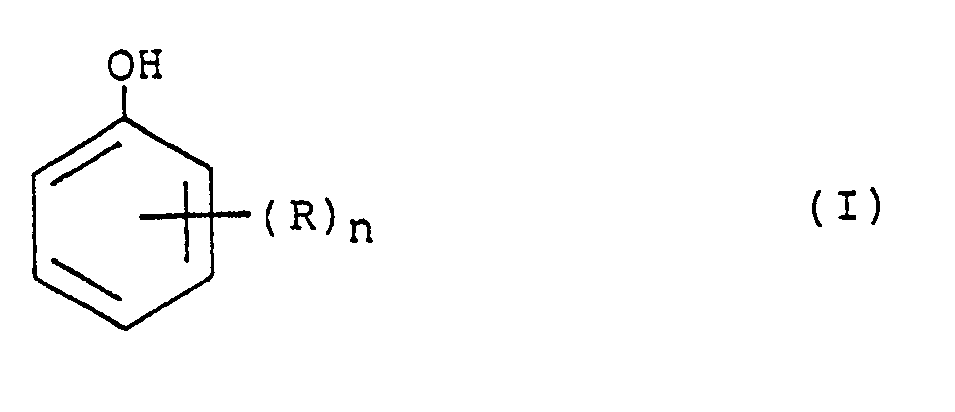
R (C₁-C₄)Alkyl, insbesondere Methyl, Ethyl und/oder t-Butyl und
n eine ganze Zahl von 1 bis 3, insbesondere 2 oder 3
bedeuten, oder
- b) mindestens zu 70 Mol-% das in meta-Position substituierte Phenol enthalten und bis zu 30 Mol-% ein monoreaktives Phenol der allgemeinen Formel II

R (C₁-C₄)Alkyl, insbesondere Methyl, Ethyl und/oder t-Butyl und
m eine ganze Zahl von 2 bis 4, insbesondere 3
bedeuten. - Insbesondere bevorzugt werden Bindemittel, deren Gemisch zur Herstellung bis zu 30 Mol-%, besonders bevorzugt bis zu 20 Mol-%, ein tri- oder bireaktives Phenol der allgemeinen Formel I enthalten oder solche, die bis zu 15 Mol-%, besonders bevorzugt bis zu 10 Mol-%, ein monoreaktives Phenol der allgemeinen Formel II enthalten.
- Zu den trireaktiven Phenolen zählen solche, die in den Positionen 3, 5 oder 3 und 5 durch R substituiert sind.
- Die bireaktiven Phenole weisen sich dadurch aus, daß sie in den Positionen 2 oder 4, den Positionen 2 und 3, 3 und 4, 2 und 5 oder in den Positionen 2,3 und 5 sowie 3,4 und 5 substituiert sind.
- Monoreaktive Phenole zeichnen sich dadurch aus, daß sie Substituenten in den Positionen 2 und 4 oder 2 und 6, 2,3 und 4, 2,3 und 6 sowie 2,4 und 5 oder 2,3,4 und 5 sowie 2,3,5 und 6 aufweisen.
- Besonders bevorzugt ist, als ein in meta-Position substituiertes Phenol, das m-Kresol. Die Substituenten der Phenole der allgemeinen Formeln I und II sind bevorzugt vom gleichen Typ, besonders bevorzugt ist die Methylgruppe zu nennen.
- Ganz besonders bevorzugt sind die reinen m-Kresol-Harze (≧96 Mol-%) (trireaktiv) sowie Bindemittel bestehend aus m-Kresol und weiteren tri- bzw. bireaktiven Verbindungen der allgemeinen Formel I, darunter wiederum diejenigen, die in den Positionen 2 und 3 bzw. 3 und 5 oder 2,3 und 5 substituiert sind, hierunter wieder diejenigen, die in Position 3 und 5 substituiert sind.
- Von den Bindemitteln, die aus m-Kresol und monoreaktiven Phenolen der allgemeinen Formel II bestehen, sind diejenigen monoreaktiven Phenole bevorzugt, die in den Positionen 2,3 und 6 substituiert sind.
- Neben den Bindemitteln, die insbesondere aus m-Kresolharz bestehen und solchen, die zwei Phenolbestandteile aufweisen, von denen eines insbesondere m-Kresol ist, sind auch Systeme aus mehreren Phenolbestandteilen, enthaltend insbesondere m-Kresol und weitere mono-, bi- oder trireaktive Phenole, geeignet. Insbesondere sind hierunter die Systeme aus drei Phenolbestandteilen zu nennen, wobei neben der Hauptkomponente, dem in m-Position substituierten Phenol, die anderen Komponenten bevorzugt jeweils entweder den mono-, bi- oder den trireaktiven Phenolen zuzuordnen sind. Entstammen diese anderen Komponenten unterschiedlich reaktiven Phenolen, so sind die Mischungsverhältnisse dieser dergestalt, daß immer mehr an trireaktiven als an bi- bzw. an monoreaktiven Phenolen oder mehr an bireaktiven als an monoreaktiven Phenolen in den Gemischen zur Herstellung der Bindemittel vorliegen.
- Es war völlig überraschend, daß derartige Gemische zur Herstellung der beschriebenen Bindemittel die erforderlichen Eigenschaften zur Gewährleistung der Maßhaltigkeit der diese Bindemittel enthaltenden erfindungsgemäßen strahlungsempfindlichen Gemische gewährleisten.
- Die in den erfindungsgemäßen strahlungsempfindlichen Gemischen enthaltenen Bindemittel entstehen durch Kondensa tion der beschriebenen Phenolkomponenten mit Carbonyl-Komponenten. Zu diesen zählen aliphatische Aldehyde, insbesondere Formaldehyd, Acetaldehyd oder Propylaldehyd, sowie deren Derivate, wie z.B. die des Formaldehyds, der Paraformaldehyd und das Trioxan, ebenso Acrolein, Benzaldehyd, 4-Hydroxy-benzaldehyd, Aceton, Methylethylketon, Diethylketon, Methyl-isobutyl-keton, Acetophenon, Benzylmethylketon, u.a.
- Von diesen sind besonders bevorzugt Formaldehyd und Acetaldehyd, die sowohl alleine als auch in Mischung miteinander eingesetzt werden können.
- Das Molverhältnis der Carbonylkomponente(n) zu der eingesetzten Phenolkomponente(n) beträgt 0,80 bis 0,95 zu 1 (Einstand). Der jeweils optimale Gehalt richtet sich nach der Reaktivität der verwendeten Phenolkomponenten. Werden sehr reaktive Phenolkomponenten benutzt, kann der Gehalt der Carbonylkomponente auch unter 0,85 Mol : 1 Mol Phenolkomponente betragen. Vorzugsweise wird aber ein Verhältnis von 0,9 Mol : 1 Mol (Carbonylkomponente : Phenolkomponente) eingesetzt.
- Zum Kondensieren der genannten Bestandteile muß das Gemisch zur Herstellung der Bindemittel eine Säure enthalten. Hierunter zählen sowohl organische Säuren, wie z.B. Maleinsäureanhydrid, Oxalsäure, Ameisensäure, Essigsäure, Trifluoressigsäure, Methansulfonsäure, Toluolsulfonsäure als auch anorganische Säuren, wie z.B. Schwefelsäure und Phosphorsäure. Bevorzugt ist die Oxalsäure.
- Ihr Gehalt liegt bei etwa 0,01 bis 6 Gew.-%, insbesondere bei 1 bis 4 Gew.-%, jeweils bezogen auf die Phenolkomponente in der Mischung. Sofern die wesentlich stärkeren anorganischen Säuren verwendet werden, können niedrigere Säurekonzentrationen als angegeben gewählt werden.
- Vorteilhaft für die Kondensation ist die Gegenwart eines Lösungsmittels oder Lösemittelgemisches, wobei der Siedepunkt des Lösemittels zwischen 120 und 200° C, insbesondere zwischen 140 und 190° C liegt. Genannt werden z.B. Glykolether wie Methylglykol, Ethylglykol, Butylglykol, Methoxybutanol, Dimethylformamid, Diethylenglykoldimethylether, Ethylglykolacetat, Methylpropylenglykolacetat. Vorzugsweise werden hydroxylgruppenfreie Lösemittel verwendet, und in Mengen von 0,2 bis 1,0 Gewichtsteilen pro Gewichtsteil Phenolgemisch eingesetzt.
- Die Menge des Bindemittels beträgt im allgemeinen 1 bis 90, insbesondere 5 bis 90 Gew.-%, vorzugsweise 50 bis 90 Gew.-%, bezogen auf das Gesamtgewicht des strahlungsempfindlichen Gemisches.
- Für das erfindungsgemäße strahlungsempfindliche Gemisch kommen als Komponenten, die beim Bestrahlen vorzugsweise eine starke Säure bilden bzw. abspalten, eine große Anzahl von Verbindungen und Mischungen derselben in Frage. Zu nennen sind Diazonium-, Phosphonium-, Sulfonium- und Iodonium-Salze, Halogenverbindungen, o-Chinondiazidsulfochloride und -ester sowie Organometall-Organohalogen-Kombinationen.
- Die genannten Diazonium-, Phosphonium-, Sulfonium- und Iodonium-Verbindungen werden in der Regel eingesetzt in Form ihrer in organischen Lösungsmitteln löslichen Salze, meist als Abscheidungsprodukt mit komplexen Säuren wie Borfluorwasserstoffsäure, Hexafluorphosphor-, Hexafluorantimon- und -arsensäure. U.a. werden diese Verbindungen auch in der DE-A-36 01 264 genannt.
- Unter die Halogenverbindungen zählen insbesondere Triazinderivate, die aus den US-A-3 515 552, 3 536 489 und 3 779 778 sowie den DE-C-27 18 259, 33 37 024, 33 33 450, 23 06 248, 22 43 621 und 12 98 414 bekannt sind. Diese können aber auch in Kombination mit anderen Photoinitiatoren wie Oxazolen, Oxadiazolen oder Thiazolen, aber auch untereinander in Mischungen eingesetzt werden.
- Es sind aber auch Oxazole, Oxadiazole, Thiazole oder 2-Pyrone bekannt, die Trichlor- oder Tribrommethylgruppen enthalten (DE-A-30 21 599, 30 21 590, 28 51 472, 29 49 396 sowie EP-A-0 135 348 und 0 135 863).
- Ebenso zählen unter diesen Oberbegriff insbesondere auch aromatische Verbindungen, die kernständiges Halogen, vorzugsweise Brom aufweisen. Solche Verbindungen sind aus der DE-A-26 10 842 bekannt oder werden in der deutschen Patentanmeldung P 37 30 784.3 beschrieben.
- Als Vertreter einer Kombination mit einem Thiazol sei eine mit 2-Benzoylmethylen-naphtho [1,2-α]thiazol genannt (DE-A-28 51 641 und DE-A-29 34 758). Ein Gemisch einer Trihalogenmethylverbindung mit N-Phenylacridon ist aus der DE-A-26 10 842 bekannt.
- Ebenso stehen α-Halogencarbonsäureamide (DE-A-27 18 200) oder Tribrommethyl-phenylsulfone (DE-A-35 03 113), die z.B. durch Benzophenon, Benzil oder Michlers Keton sensibilisiert werden können, zur Verfügung.
- In der Regel können aber alle beschriebenen licht- bzw. strahlungsempfindlichen Verbindungen durch Photosensibilisatoren in ihrer Effektivität unterstützt werden. Zu nennen sind z.B. Anthracen, Phenanthren, Pyren, 1,2-Benzanthren, Thiazine, Pyrazoline, Benzofurane, Benzophenone, Fluorenone, Anthrachinone sowie Cumarinderivate. Ihr Gehalt liegt bei 0,01 bis 5 Gew.-%, bezogen auf das Gewicht des strahlungsempfindlichen Gemisches.
- Besonders bevorzugt sind vor allem Triazinderivate sowie aromatische Verbindungen mit kernständigem Halogen, insbesondere Brom, aus der DE-A-26 10 842 sowie der deutschen Patentanmeldung P 37 30 784.3.
- Vorzugsweise werden diese Verbindungen erst bei energiereicher, d.h. kürzerwelliger Strahlung gespalten. Hierunter zählt vor allem neben UV-Strahlung Elektronen- oder Röntgenstrahlung.
- Neben monomeren strahlungsempfindlichen Verbindungen können auch Polymere dieser Art eingesetzt werden. Bei Verwendung von monomeren Startern liegt deren Gehalt im Bereich von 0,01 bis 30 Gew.-%, insbesondere von 0,4 bis 20 Gew.-%, bezogen auf das Gewicht der strahlungsempfindlichen Mischung.
- Werden polymere Starter verwendet, so kann ggf. z.T. auf das erfindungsgemäß enthaltende Bindemittel verzichtet werden. Dies hat zur Folge, daß dessen Gehalt in Abhängigkeit von seinem Anteil am Gehalt des Polymeren in dieser Mischung auch über den beschriebenen Bereich bei monomeren Startern hinausgehen kann. Insbesondere werden Gehalte von größer als 50 Gew.-% und bis zu 99 Gew.-%, abzüglich des Gehaltes der Verbindung, die durch Säure spaltbar ist, in Anspruch genommen.
- Als durch Säure spaltbares Material in dem erfindungsgemäßen strahlungsempfindlichen Gemisch haben sich vor allem folgende Verbindungsklassen bewährt:
- a) solche mit mindestens einer Orthocarbonsäureester- und bzw. oder Carbonsäureamidacetalgruppierung, wobei die Verbindungen auch polymeren Charakter haben und die genannten Gruppierungen als verknüpfende Elemente in der Hauptkette oder als seitenständige Substituenten auftreten können,
- b) Oligomer- oder Polymerverbindungen mit wiederkehrenden Acetal- und/oder Ketalgruppierungen in der Hauptkette,
- c) Verbindungen mit mindestens einer Enolether- oder N-Acyliminocarbonatgruppierung,
- d) cyclische Acetale oder Ketale von β-Ketoestern oder -amiden,
- e) Verbindungen mit Silylenolethergruppierungen und
- f) Monoacetale bzw. Monoketale, deren Aldehyd- bzw. Ketonkomponente eine Löslichkeit im Entwickler zwischen 0,1 und 100 g/l aufweisen,
- g) Ether auf Basis tertiärer Alkohole,
- h) Carbonsäureester und Carbonate tertiärer, allylischer oder benzylischer Alkohole.
- Durch Säure spaltbare Verbindungen des Typs a) als Komponenten strahlungsempfindlicher Gemische sind in der EP-A-0 022 571 und der DE-A-26 10 842 ausführlich beschrieben; Gemische, die Verbindungen des Typs b) enthalten, sind in der DE-C-23 06 248 und der DE-C-27 18 254 dargestellt; Verbindungen des Typs c) werden in den EP-A-0 006 626 und 0 006 627 beschrieben; Verbindungen des Typs d) werden in der EP-A 0 202 196 vorgestellt; Verbindungen des Typs e) findet man in der deutschen Patentanmeldung P 37 30 783.5, während Verbindungen vom Typ f) in den deutschen Patentanmeldungen P 37 30 785.1 und P 37 30 787.8 behandelt werden. Verbindungen vom Typ g) werden z. B. in der US-A-4 603 101 beschrieben, Verbindungen vom Typ h) z. B. in der US-A-4 491 628 und von J. M. Fréchet et al., J. Imaging Sci. 30, 59-64 (1986).
- Es können auch Mischungen der genannten säurespaltbaren Materialien eingesetzt werden. Bevorzugt ist allerdings ein säurespaltbares Material, welches einem der oben genannten Typen zuzuordnen ist. Besonders bevorzugt sind von den Materialien diejenigen, die mindestens eine durch Säure spaltbare C-O-C-Bindung aufweisen, sowie insbesondere solche, die den Typen a), b), f) und h) angehören. Unter Typ b) sind insbesondere die polymeren Acetale hervorzuheben; von den säurespaltbaren Materialien des Typs f) insbesondere diejenigen, deren Aldehyd- bzw. Ketonkomponente einen Siedepunkt von größer als 150° C, vorzugsweise größer als 200° C, aufweist.
- Der Gehalt an säurespaltbarem Material in dem erfindungsgemäßen strahlungsempfindlichen Gemisch sollte bei 1 bis 50 Gew.-%, vorzugsweise bei 5 bis 25 Gew.-%, jeweils bezogen auf das Gesamtgewicht der Schicht, liegen.
- Ferner können den erfindungsgemäßen strahlungsempfindlichen Gemischen ggf. Farbstoffe, Pigmente, Weichmacher, Netzmittel und Verlaufmittel, aber auch Polyglykole, Celluloseether, z.B. Ethylcellulose, zur Verbesserung spezieller Erfordernisse wie Flexibilität, Haftung und Glanz zugesetzt werden.
- Vorzugsweise wird das erfindungsgemäße strahlungsempfindliche Gemisch in Lösungsmitteln wie Ethylenglykol, Glykolethern wie Glykolmonomethylether, Glykoldimethylether, Glykolmonoethylether oder Propylenglykolmonoalkylether, insbesondere Propylenglykolmethylether; aliphatischen Estern wie Ethylacetat, Hydroxyethylacetat, Alkoxyethylacetat, δ-Butylacetat, Propylenglykolmonoalkyletheracetat, insbesondere Propylenglykolmethyletheracetat oder Amylacetat; Ethern wie Dioxan, Ketonen wie Methylethylketon, Methyliso- butylketon, Cyclopentanon und Cyclohexanon; Dimethylformamid, Dimethylacetamid, Hexamethylphosphorsäureamid, N-Methyl-pyrrolidon, Butyrolacton, Tetrahydrofuran, und in Mischungen derselben gelöst. Besonders bevorzugt werden Glykolether, aliphatische Ester sowie Ketone.
- Die mit den übrigen Bestandteilen des strahlungsempfindlichen Gemisches entstehenden Lösungen haben in der Regel einen Feststoffgehalt von 5 bis 60 Gew.-%, vorzugsweise bis 50 Gew.-%.
- Erfindungsgemäß wird ferner ein strahlungsempfindliches Aufzeichnungsmaterial beansprucht, im wesentlichen bestehend aus einem Substrat und dem darauf aufgetragenen strahlungsempfindlichen Gemisch.
- Als Substrate kommen alle Materialien in Frage, aus denen Kondensatoren, Halbleiter, mehrlagige gedruckte Schaltungen oder integrierte Schaltkreise bestehen bzw. hergestellt werden können. Insbesondere sind Oberflächen aus reinem Silicium und thermisch oxidiertem und/oder mit Aluminium beschichtetem Siliciummaterial zu nennen, die gegebenfalls auch dotiert sein können, einschließlich aller anderen in der Halbleitertechnologie üblichen Substrate wie beispielsweise Siliciumnitrid, Galliumarsenid, Indiumphosphid. Weiterhin kommen in Frage die aus der Flüssigkristalldisplay-Herstellung bekannten Substrate wie Glas, Indium-Zinnoxid; ferner Metallplatten und -folien, beispielsweise aus Aluminium, Kupfer, Zink; Bimetall-und Trimetallfolien, aber auch elektrisch nicht leitende Folien, die mit Metallen bedampft sind, gegebenenfalls mit Aluminium beschichtete SiO₂-Materialien und Papier. Diese Substrate können einer Temperatur-Vorbehandlung unterzogen werden, oberflächlich angerauht, angeätzt oder zur Erzielung erwünschter Eigenschaften, wie z. B. Erhöhung der Hydrophilie, mit Chemikalien behandelt sein.
- In einer besonderen Ausführungsform kann das strahlungsempfindliche Gemisch zur besseren Haftung einen Haftvermittler enthalten oder dieser kann auch zwischen dem Resist und dem Substrat als Zwischenschicht vorhanden sein. Bei Silicium- bzw. Siliciumdioxid-Substraten kommen hierfür Haftvermittler vom AminosilanTyp, wie z.B. 3-Aminopropyl-triethoxysilan oder Hexamethyl-disilazan in Frage.
- Beispiele für Träger, die zur Herstellung von photomechanischen Aufzeichnungsmaterialien wie Druckformen für den Hochdruck, den Flachdruck, den Siebdruck, den Tiefdruck sowie von Reliefkopien Verwendung finden können, sind Aluminiumplatten, ggf. anodisch oxidiert, gekörnte und/oder silikatisierte Aluminiumplatten, Zinkplatten, Stahlplatten, die ggf. mit Chrom bearbeitet wurden, sowie Kunststoffolien oder Papier.
- Das erfindungsgemäße Aufzeichnungsmaterial wird bildmäßig bestrahlt. Quellen aktinischer Strahlung sind: Metallhalogenidlampen, Kohlebogenlampen, Xenonlampen und Quecksilberdampflampen. Bevorzugt wird eine Bestrahlung mit energiereicher Strahlung wie Laser-, Elektronen- oder Röntgenstrahlung. Als Laser werden insbesondere Excimer-Laser, Argon-Laser, Krypton-Laser sowie Helium/Cadmium-Laser genannt.
- Die Schichtstärke variiert in Abhängigkeit von ihrem Einsatzgebiet. Sie beträgt zwischen 0,1 und 100 µm, insbesondere zwischen 0,3 und 10 µm.
- Gegenstand der Erfindung ist ferner ein Verfahren zur Herstellung eines strahlungsempfindlichen Aufzeichnungsmaterials. Das Auftragen des strahlungsempfindlichen Gemisches auf das Substrat kann durch Aufsprühen, Fließbeschichten, Walzen, Schleuderbeschichten und Tauchbeschichten erfolgen. Danach wird das Lösungsmittel durch Verdampfen entfernt, so daß auf der Oberfläche des Substrates die strahlungsempfindliche Schicht zurückbleibt. Die Entfernung des Lösemittels kann gegebenfalls durch Erhitzen der Schicht auf Temperaturen von bis zu 140° C gefördert werden. Das Gemisch kann aber auch zunächst auf obengenannte Weise auf einen Zwischenträger aufgetragen werden, von dem aus es unter Druck und erhöhter Temperatur auf das endgültige Trägermaterial übertragen wird.
- Anschließend wird die Schicht bildmäßig bestrahlt. Üblicherweise wird aktinische Strahlung verwendet, besonders bevorzugt sind UV-, Röntgen- oder Elektronenstrahlung. Zur Bestrahlung werden UV-Lampen verwendet, die Strahlung einer Wellenlänge von 200 bis 500 nm mit einer Intensität von 0,5 bis 60 mW/cm² aussenden. In der strahlungsempfindlichen Schicht wird anschließend durch Entwicklung ein Bildmuster freigelegt, indem die Schicht mit einer Entwicklungslösung behandelt wird, die die bestrahlten Bereiche des Materials löst bzw. entfernt.
- Als Entwickler werden Lösungen von alkalischen Reagenzien wie z.B. Silikaten, Metasilikaten, Hydroxiden, Hydrogen- bzw. Dihydrogenphosphaten, Carbonaten bzw. Hydrogencarbonaten, insbesondere von Alkali- oder Ammoniumionen, aber auch Ammoniak und dergleichen verwendet. Der Gehalt dieser Substanzen in der Entwicklerlösung beträgt im allgemeinen 0,1 bis 15 Gew.-%, vorzugsweise 0,5 bis 5 Gew.-%, bezogen auf das Gewicht der Entwicklerlösung.
- Die entwickelten Resiststrukturen werden ggf. nachgehärtet. Dies geschieht im allgemeinen dadurch, daß man die Resiststruktur auf einer hot-plate bis zu einer Temperatur unter der Fließtemperatur erhitzt und anschließend mit UV-Licht einer Xenon-Quecksilber-Dampflampe (Bereich von 200 bis 250 nm) ganzflächig belichtet. Durch diese Nachhärtung werden die Resiststrukturen vernetzt, so daß die Strukturen eine Fließbeständigkeit im allgemeinen bis zu Temperaturen von über 200° C aufweisen. Die Nachhärtung kann auch ohne Temperaturerhöhung unter Einstrahlung von UV-Licht erfolgen. Dies gilt insbesondere dann, wenn energiereiches Licht verwendet wird, z.B. Elektronenstrahlung.
- Die Herstellung der in den erfindungsgemäßen Gemischen enthaltenen Bindemittel erfolgt nach folgender allgemeiner Vorschrift:
3 Mol Kresolgemisch entsprechend den in der Beschreibung angegebenen Mischungsverhältnissen werden in einem Vierhalskolben mit Rückflußkühler und Rührer mit 180 g Diethylenglykoldimethylether gemischt, mit 6,6 g Oxalsäuredihydrat versetzt und auf etwa 100° C erwärmt. Zu diesem Gemisch tropft man entsprechend Tabelle I 37 %ige Formalinlösung (oder eine andere Carbonylverbindung) und hält das Reaktionsgemisch bis zum Verbrauch des Formaldehyds bei schwachem Rückfluß. Anschließend werden Wasser, Lösemittel und nicht umgesetzte Ausgangskomponenten zunächst unter Normaldruck bis 200° C, dann im Wasserstrahlvakuum bis 220° C abdestilliert. Das heiße Novolakharz wird in eine Kühlpfanne entleert und erkalten gelassen. - Die Glastemperatur (Tg in °C) des in dieser Weise gewonnenen Novolakharzes wird mit einem Differentialkalorimeter (DSC 1090 der Fa. Dupont) bei einer Heizrate von 20 K/min bestimmt. Sie ergibt sich aus der Temperatur der halben Stufenhöhe. Die Ergebnisse sind in Tabelle I aufgelistet.
- Der Kondensationsgrad des Novolakharzes wird durch den RMW-Wert charakterisiert, der sich aus der relativen Viskosität einer 7 %igen Harzlösung in Cyclohexanon nach folgender Gleichung errechnet:
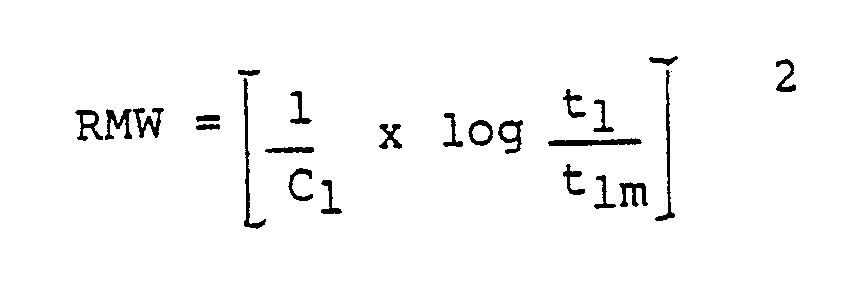
t₁ Durchlaufzeit der Harzlösung durch das Ubbelohde-Viskosimeter,
t1m Durchlaufzeit des Lösemittels (Cyclohexanon) durch das Ubbelohde-Viskosimeter,
C₁ Konzentration des Harzes im Lösemittel (Cyclohexanon) in g/100 ml Lösung. - Nach dem allgemeinen Herstellungsbeispiel werden folgende, in Tabelle I zusammengefaßte Novolak-Bindemittel hergestellt, die anhand ihrer Glastemperatur und ihres RMW-Wertes charakterisiert sind. Sie sollen die Erfindung erläutern, nicht jedoch auf diese beschränkend wirken. Als Vergleichsbeispiel (HV) wurde ein Kresol-Formaldehyd-Novolak mit einem Erweichungsbereich von 105 - 120° C gemäß dem zitierten Stand der Technik aufgenommen (Tg = 94° C).
Tabelle I Molverhältnisse (Einstand) m-Kresol : Formel I oder II : Formaldehyd Tg [°C] RMW-Wert H1 1,0 - 0,9 124 24,2 H2 0,8 3,5-Dimethylphenol 0,2 0,9 132 29,4 H3 0,9 2,3,6-Trimethylphenol 0,1 0,9 122 19,2 H4 0,8 3,5-Dimethylphenol 0,2 0,84 124 14,9 HV Kresol-Formaldehyd-Novolak mit Erweichungsbereich 105 - 120° C 94 17 - Die folgenden Anwendungsbeispiele sollen die Erfindung erläutern; nicht jedoch auf diese beschränkend wirken. In den Beispielen stehen Gewichtsteile (Gt) zu Volumenteilen (Vt) im Verhältnis g:cm³, Prozentangaben und Mengenverhältnisse sind, wenn nichts anderes angegeben ist, in Gewichtsteilen zu verstehen.
- Es wird eine Beschichtungslösung hergestellt, enthaltend
8,2 Gt des Phenolharzes aus Herstellungsbeispiel 1,
1,8 Gt Benzaldehyd-diphenoxyethylacetal gemäß Beispiel 1 der deutschen Patentanmeldung P 37 30 787.8,
0,15 Gt 2(2-Ethoxynaphth-1-yl)-4,6-bis-trichlormethyl-s-triazin in
25 Gt Propylenglykolmethyletheracetat. - Die Beschichtungslösung wird in an sich bekannter Weise auf einen aus Aluminium bestehenden 0,3 mm dicken Druckplattenträger aufgetragen. Der Aluminiumträger war vorher elektrochemisch aufgerauht, anodisiert und mit Polyvinylphosphonsäure hydrophiliert worden. Nach dem Trocknen der Schicht bei 90° C wird eine Schichtdicke von 1,5 µm erhalten.
- Die in dieser Weise hergestellte Offsetdruckplatte wird mit einer Kopiervorlage, die einen Halbtonkeil, Mikrolinien von einer Stärke zwischen 4 und 75 µm und Rasterpunkte von 0,5 bis 5 % Flächendeckung enthält, bedeckt. Anschließend wird mit Strahlung einer Quecksilberhochdrucklampe (5 kW) 20 s in einem Abstand von 110 cm bestrahlt.
- Die Entwicklung erfolgt mit 0,3 n KOH-Lösung. Man erhält eine positive Druckform mit hoher Auflösung. Die mit die ser Druckform erreichte Druckauflage fehlerfreier Druckexemplare beträgt 30.000.
- Es wird eine Beschichtungslösung hergestellt, die der aus Beispiel 1 entspricht, mit der Ausnahme, daß anstelle des erfindungsgemäß eingesetzten Phenolharzes, 8,2 Gt des Novolaks aus dem Vergleichsbeispiel HV verwendet wird.
- Nach Beschichtung, Trocknen, Bestrahlung und Entwicklung analog zu Beispiel 1 wird eine Druckform erhalten, die maximal 10.000 fehlerfreie Drucke liefert.
- Es wird eine Beschichtungslösung hergestellt, enthaltend
8,2 Gt des Phenolharzes aus Herstellungsbeispiel 1,
1,8 Gt Benzaldehyd-diphenoxyethylacetal gemäß Beispiel 1 der deutschen Patentanmeldung P 37 30 787.8,
0,15 Gt Hexafluortetrabrom-Bisphenol A gemäß Beispiel 1 der deutschen Patentanmeldung P 37 30 784.3 in
25 Gt Propylenglykolmethyletheracetat. - Die Lösung wird auf einen mit einem Haftvermittler (Hexamethyl-disilazan) behandelten Siliciumwafer bei 3.000 U/min aufgeschleudert. Nach der Trocknung bei 85° C für 30 min in einem Umluftofen wird eine Schichtdicke von 1 µm erhalten.
- Bildmäßig bestrahlt wird mit Synchrotron-Strahlung (BESSY, Berlin, Luftspalt 2 mm) einer Dosis von 35 mJ/cm² durch eine Gold-auf-Silicium-Maske. Den experimentellen Aufbau dieser Bestrahlungsvariante findet man bei A. Heuberger, "X-Ray Lithography", Microelectronic Engineering 3, 535-556 (1985). Entwickelt wird 60 s lang mit einer 0,4 n KOH-Lösung. Alle Details konnten fehlerfrei auf das Bild übertragen werden, das sich durch hohe Kantenstabilität und unverändert hohe Restschichtdicke der nicht bestrahlten Bildbereiche auszeichnet.
- Erwärmt man ein derart erhaltenes Resistmuster auf 100° C, so wird auch nach 30 min keine Veränderung der Kantenprofile beobachtet.
- Es wird eine Beschichtungslösung analog zu Beispiel 3 hergestellt, mit dem Unterschied, daß anstelle des Phenolharzes aus Herstellungsbeispiel 1, 8,2 Gt Phenolharz aus Herstellungsbeispiel 2 enthalten ist.
- Nach einer völlig mit der in Beispiel 3 identischen Vorgehensweise wird ein Resistmuster erhalten, das auch nach 30 min Erwärmung auf 100° C keine Veränderung der Kantenprofile erfährt.
- Es wird eine Beschichtungslösung analog zu Beispiel 3 hergestellt, mit dem Unterschied, daß anstelle des Phenolharzes aus Herstellungsbeispiel 1, 8,2 Gt Phenolharz aus Herstellungsbeispiel 3 enthalten ist.
- Nach völlig mit der in Beispiel 3 identischen Vorgehensweise wird ein Resistmuster erhalten, das auch nach 30 min Erwärmen auf 100° C keine Veränderung der Kantenprofile erfährt.
- Es wird eine Beschichtungslösung analog zu Beispiel 3 hergestellt, mit dem Unterschied, daß anstelle des Phenolharzes aus Herstellungsbeispiel 1, 8,2 Gt des Novolaks aus dem Vergleichsherstellungsbeispiel HV verwendet wird.
- Nach völlig mit der in Beispiel 3 identischen Vorgehensweise wird nach dem Entwickeln ein Resistmuster erhalten, das mit dem aus Beispiel 3 übereinstimmt. Wird allerdings erwärmt, so verliert der Resist bereits ab einer Temperatur von 70° C seine Konturen. Er weist demnach keine hinreichende Stabilität für die praktische Anwendung, insbesondere bei erhöhten Temperaturen, auf.
- Es wird eine Beschichtungslösung hergestellt, enthaltend
4 Gt des Phenolharzes aus Herstellungsbeispiel 1
1 Gt des Bis-Silylenolethers (I) gemäß der deutschen Patentanmeldung P 37 30 783.5 und
0,1 Gt 2(2-Ethoxy-naphth-1-yl)-4,6-bis-trichlormethyl-s-triazin in
85 Gt Butanon. - Die Beschichtungslösung wird in an sich bekannter Weise auf einen aus Aluminium bestehenden 0,3 mm dicken Druckplattenträger aufgetragen. Der Aluminiumträger war vorher elektrochemisch aufgerauht, anodisiert und mit Polyvinylphosphonsäure hydrophiliert worden. Nach dem Trocknen der Schicht wird ein Schichtgewicht von 1,6 g/m² erhalten.
- Die in dieser Weise hergestellte Offsetdruckplatte wird mit einer Kopiervorlage, die einem Halbtonkeil, Mikrolinien von einer Stärke zwischen 4 und 75 µm und Rasterpunkte von 0,5 bis 5 % Flächendeckung enthält, bedeckt. Anschließend wird mit Strahlung einer Quecksilberhochdrucklampe (5 kW) 20 s in einem Abstand von 110 cm bestrahlt. Die Entwicklung der Offsetplatte erfolgt mit einem alkalischen Entwickler der Zusammensetzung:
5,3 Gt Natriummetasilikat x 9 H₂O,
3,4 Gt Trinatriumorthophosphat x 12 H₂O,
0,3 Gt Natriumdihydrogenphosphat und
136 Gt vollentsalztes Wasser. - Nach einer Entwicklungsdauer von 60 s kann eine Druckform mit hoher Auflösung erhalten werden.
- Es wird eine Beschichtungslösung analog zu Beispiel 7 hergestellt, mit der Ausnahme, daß anstelle des dort eingesetzten Silylenolethers ein polymerer Silylether (Verbindungen 1-8 aus der DE-A-36 01 264) verwendet wird.
- Bei einer Bestrahlungsdauer von 20 s kann keine Differenzierung erzielt werden. Erst bei einer Erhöhung der Bestrahlungsdauer auf 260 s wird eine Differenzierung zwischen bestrahlten und unbestrahlten Schichtteilen beobachtet. Aber auch in diesem Fall erweist sich die Entwicklerresistenz als unzureichend. Das beobachtete fladige Ablösen läßt zudem auf eine Unverträglichkeit zwischen dem Bindemittel und dem Polysilylether schließen. Dieser Umstand erweist sich im Besonderen als auflösungsbegrenzend.
Claims (9)

R (C₁-C₄)Alkyl, insbesondere Methyl, Ethyl und/oder t-Butyl und
n eine ganze Zahl von 1 bis 3, insbesondere 2 oder 3
bedeuten, oder

R (C₁-C₄)Alkyl, insbesondere Methyl, Ethyl und/oder t-Butyl und
m eine ganze Zahl von 2 bis 4, insbesondere 3
bedeutet.
Applications Claiming Priority (2)
| Application Number | Priority Date | Filing Date | Title |
|---|---|---|---|
| DE3810632 | 1988-03-29 | ||
| DE3810632A DE3810632A1 (de) | 1988-03-29 | 1988-03-29 | Positiv arbeitendes strahlungsempfindliches gemisch und daraus hergestelltes aufzeichnungsmaterial |
Publications (2)
| Publication Number | Publication Date |
|---|---|
| EP0335219A2 true EP0335219A2 (de) | 1989-10-04 |
| EP0335219A3 EP0335219A3 (de) | 1991-06-12 |
Family
ID=6350961
Family Applications (1)
| Application Number | Title | Priority Date | Filing Date |
|---|---|---|---|
| EP19890104977 Withdrawn EP0335219A3 (de) | 1988-03-29 | 1989-03-20 | Positiv arbeitendes strahlungsempfindliches Gemisch und daraus hergestelltes Aufzeichnungsmaterial |
Country Status (4)
| Country | Link |
|---|---|
| EP (1) | EP0335219A3 (de) |
| JP (1) | JPH0210351A (de) |
| KR (1) | KR890015075A (de) |
| DE (1) | DE3810632A1 (de) |
Cited By (1)
| Publication number | Priority date | Publication date | Assignee | Title |
|---|---|---|---|---|
| EP0895127A3 (de) * | 1997-08-01 | 2000-01-26 | Mitsubishi Chemical Corporation | Photoresistzusammensetzung |
Families Citing this family (2)
| Publication number | Priority date | Publication date | Assignee | Title |
|---|---|---|---|---|
| JPH05249664A (ja) * | 1992-03-04 | 1993-09-28 | Fuji Photo Film Co Ltd | ポジ型感光性組成物 |
| JP4944703B2 (ja) * | 2007-08-20 | 2012-06-06 | 京セラミタ株式会社 | 画像形成装置 |
Family Cites Families (3)
| Publication number | Priority date | Publication date | Assignee | Title |
|---|---|---|---|---|
| CH621416A5 (de) * | 1975-03-27 | 1981-01-30 | Hoechst Ag | |
| CA1279430C (en) * | 1985-12-06 | 1991-01-22 | Takashi Kubota | High-molecular-weight soluble novolak resin and process for preparation thereof |
| EP0239423B1 (de) * | 1986-03-28 | 1996-03-20 | Japan Synthetic Rubber Co., Ltd. | Positiv arbeitende photoempfindliche Kunststoffzusammensetzung |
-
1988
- 1988-03-29 DE DE3810632A patent/DE3810632A1/de not_active Withdrawn
-
1989
- 1989-03-20 EP EP19890104977 patent/EP0335219A3/de not_active Withdrawn
- 1989-03-28 KR KR1019890003878A patent/KR890015075A/ko not_active Ceased
- 1989-03-29 JP JP1075248A patent/JPH0210351A/ja active Pending
Cited By (1)
| Publication number | Priority date | Publication date | Assignee | Title |
|---|---|---|---|---|
| EP0895127A3 (de) * | 1997-08-01 | 2000-01-26 | Mitsubishi Chemical Corporation | Photoresistzusammensetzung |
Also Published As
| Publication number | Publication date |
|---|---|
| EP0335219A3 (de) | 1991-06-12 |
| DE3810632A1 (de) | 1989-10-12 |
| JPH0210351A (ja) | 1990-01-16 |
| KR890015075A (ko) | 1989-10-28 |
Similar Documents
| Publication | Publication Date | Title |
|---|---|---|
| EP0417556B1 (de) | Positiv-arbeitendes strahlungsempfindliches Gemisch und daraus hergestelltes Aufzeichnungsmaterial | |
| EP0006627B1 (de) | Strahlungsempfindliches Gemisch und Verfahren zur Herstellung von Reliefbildern | |
| EP0312950B1 (de) | Positiv arbeitendes lichtempfindliches Gemisch, enthaltend einen Farbstoff, und daraus hergestelltes positiv arbeitendes lichtempfindliches Aufzeichnungsmaterial | |
| DE3730783A1 (de) | Positiv arbeitendes strahlungsempfindliches gemisch und daraus hergestelltes strahlungsempfindliches aufzeichnungsmaterial | |
| DE3686637T2 (de) | Novolakharz mit hohem molekulargewicht und verfahren zu dessen herstellung. | |
| EP0335220B1 (de) | Positiv arbeitendes lichtempfindliches Gemisch und daraus hergestelltes Aufzeichnungsmaterial mit hohem Wärmestand | |
| EP0251059B1 (de) | Strahlungsempfindliches Aufzeichnungsmaterial | |
| EP0349803B1 (de) | Strahlungshärtbares Gemisch und daraus hergestelltes strahlungsempfindliches Aufzeichnungsmaterial für hochenergetische Strahlung | |
| EP0302359A2 (de) | Positiv arbeitendes strahlungsempfindliches Gemisch | |
| DE3821585A1 (de) | Positiv arbeitendes strahlungsempfindliches gemisch und daraus hergestelltes strahlungsempfindliches aufzeichnungsmaterial fuer hochenergetische strahlung | |
| DE69121001T2 (de) | Positiv arbeitende Fotolackzusammensetzung | |
| EP0315748B1 (de) | Positiv arbeitendes strahlungsempfindliches Gemisch und daraus hergestelltes strahlungsempfindliches Aufzeichungsmaterial | |
| DE4125260A1 (de) | Oligomere verbindungen mit saeurelabilen schutzgruppen und damit hergestelltes positiv arbeitendes strahlungsempfindliches gemisch | |
| EP0312751B1 (de) | Positiv arbeitendes strahlungsempfindliches Gemisch und daraus hergestelltes strahlungsempfindliches Aufzeichnungsmaterial | |
| EP0290916B1 (de) | Strahlungsempfindliches Aufzeichnungsmaterial | |
| DE3716848A1 (de) | Verfahren zur bebilderung lichtempfindlichen materials | |
| DE4207264B4 (de) | Negativ arbeitendes strahlungsempfindliches Gemisch und damit hergestelltes Aufzeichnungsmaterial | |
| EP0510449B1 (de) | Durch Säure spaltbare Verbindungen, diese enthaltende positiv strahlungsempfindliche Zusammensetzung und damit hergestelltes positiv strahlungsempfindliches Aufzeichnungsmaterial | |
| EP0510447A2 (de) | Negativ arbeitendes strahlungsempfindliches Gemisch und damit hergestelltes strahlungsempfindliches Aufzeichnungsmaterial | |
| EP0474010B1 (de) | Entwicklerzusammensetzung für bestrahlte, strahlungsempfindliche, positiv und negativ arbeitende sowie umkehrbare reprographische Schichten und Verfahren zur Entwicklung solcher Schichten | |
| EP0337188B1 (de) | In wässrigem Alkali lösliche, Silanylgruppen in der Seitenkette enthaltende Bindemittel, Verfahren zu deren Herstellung sowie lichtempfindliches Gemisch, enthaltend diese Verbindungen | |
| DE4125258A1 (de) | Verbindungen mit saeurelabilen schutzgruppen und damit hergestelltes positiv arbeitendes strahlungsempfindliches gemisch | |
| EP0314037B1 (de) | Positiv arbeitendes lichtempfindliches Gemisch, enthaltend einen Farbstoff, und daraus hergestelltes positiv arbeitendes lichtempfindliches Aufzeichnungsmaterial | |
| EP0387623B1 (de) | Positiv arbeitendes strahlungsempfindliches Gemisch und daraus hergestelltes strahlungsempfindliches Aufzeichnungsmaterial für hochenergetische Strahlung | |
| EP0501308B1 (de) | Strahlungsempfindliche Polymere mit Naphthochinon-2-diazid-4-sulfonyl-Gruppen und deren Verwendung in einem positiv arbeitenden Aufzeichnungsmaterial |
Legal Events
| Date | Code | Title | Description |
|---|---|---|---|
| PUAI | Public reference made under article 153(3) epc to a published international application that has entered the european phase |
Free format text: ORIGINAL CODE: 0009012 |
|
| AK | Designated contracting states |
Kind code of ref document: A2 Designated state(s): AT BE CH DE ES FR GB IT LI NL SE |
|
| RTI1 | Title (correction) | ||
| 17P | Request for examination filed |
Effective date: 19901219 |
|
| PUAL | Search report despatched |
Free format text: ORIGINAL CODE: 0009013 |
|
| AK | Designated contracting states |
Kind code of ref document: A3 Designated state(s): AT BE CH DE ES FR GB IT LI NL SE |
|
| 17Q | First examination report despatched |
Effective date: 19940126 |
|
| STAA | Information on the status of an ep patent application or granted ep patent |
Free format text: STATUS: THE APPLICATION HAS BEEN WITHDRAWN |
|
| 18W | Application withdrawn |
Withdrawal date: 19940704 |