EP0335225A2 - Schädlingsbekämpfungsmittel - Google Patents
Schädlingsbekämpfungsmittel Download PDFInfo
- Publication number
- EP0335225A2 EP0335225A2 EP89105008A EP89105008A EP0335225A2 EP 0335225 A2 EP0335225 A2 EP 0335225A2 EP 89105008 A EP89105008 A EP 89105008A EP 89105008 A EP89105008 A EP 89105008A EP 0335225 A2 EP0335225 A2 EP 0335225A2
- Authority
- EP
- European Patent Office
- Prior art keywords
- compound
- phenyl
- alkyl
- formula
- substituted
- Prior art date
- Legal status (The legal status is an assumption and is not a legal conclusion. Google has not performed a legal analysis and makes no representation as to the accuracy of the status listed.)
- Granted
Links
- 0 CC(C(*)=C1**)=C(**C2=C(*)C=CCC2=*)CC1=* Chemical compound CC(C(*)=C1**)=C(**C2=C(*)C=CCC2=*)CC1=* 0.000 description 2
Classifications
-
- A—HUMAN NECESSITIES
- A01—AGRICULTURE; FORESTRY; ANIMAL HUSBANDRY; HUNTING; TRAPPING; FISHING
- A01N—PRESERVATION OF BODIES OF HUMANS OR ANIMALS OR PLANTS OR PARTS THEREOF; BIOCIDES, e.g. AS DISINFECTANTS, AS PESTICIDES OR AS HERBICIDES; PEST REPELLANTS OR ATTRACTANTS; PLANT GROWTH REGULATORS
- A01N55/00—Biocides, pest repellants or attractants, or plant growth regulators, containing organic compounds containing elements other than carbon, hydrogen, halogen, oxygen, nitrogen and sulfur
Definitions
- insecticidal and acaricidal agents are known, which are characterized by a content of a compound of the formula I.
- M carbon or silicon
- X CH2, O, S
- NR6, R1 (C2-C18) alkyl, (C5-C7) cycloalkyl, (C2-C8) alkenyl, phenyl, naphthyl, pyridyl, pyrimidyl, pyridazinyl, pyrazinyl, 1,2,4-triazinyl or 1,2,4,5 -Tetrazinyl, where all these substituents can be substituted one or more times
- R2, R3 independently of one another (C1-C3) alkyl
- X CH2 or oxygen
- R1 a group of the general formulas II to VIII wherein R7 and R8 independently of one another are bonded to a C atom from the group H, (C1-C4) alkyl, tri (C1-C4) alkylsilyl, halogen, nitro, cyano, (C2-C6) alkenyl, (C2 -C6) alkynyl, amino, (C3-C7) cycloalkyl, phenyl, phenoxy, (C1-C5) alkoxy, (C2-C4) alkenyloxy, (C2-C4) alkynyloxy, hydroxycarbonyl, (C1-C4) - Alkylthio, (C3-C7) cycloalkyloxy, (C1-C6) alkylcarbonyl, (C1-C4) alkoxycarbonyl, (C2-C4)
- R7 and R8 are particularly preferably hydrogen, halogen (C1-C4) alkyl, (C2-C6) alkenyl, C3-C7) cycloalkyl, (C1-C5) alkoxy, (C2-C4) alkenyloxy, (C1-C4) Alkylthio, (C1-C4) haloalkyl, (C1-C3) haloalkoxy or - 2 radicals R7 or R8 together - methylenedioxy, where R7 and R8 are especially oriented in the 3- or 4-position of the aromatic six-membered ring. Also preferred are compounds in which the sum of m and n is 1 or 2.
- R4 preferably represents hydrogen, fluorine, cyano or (C1-C4) alkyl, particularly preferably hydrogen.
- halogen preferably denotes fluorine or chlorine.
- the rest R20 in formula XIV is preferably CF3.
- the compound of the formula XVa is particularly preferred among the compounds of the formula XV (N, [N- (3,5-dichloro-4-) 1,1,2,3,3,3-hexafluoropropoxy) phenyl) carbamoyl] -2-chloro-benzcarboximidic acid ethyl ester)
- the compound flufenoxuron (XIII) has the formula
- the compounds of formula I can also be combined with two or more of the active ingredients listed.
- insecticidal and acaricidal activity of the active compound combinations according to the invention is significantly higher than was to be expected from the effects of the individual components.
- the application rates of the individual components can therefore be reduced by using these combinations. Their application therefore brings economic as well as ecological advantages.
- the agents according to the invention are suitable with good plant tolerance and favorable warm-blooded toxicity for controlling animal pests, in particular insects, arachnids and nematodes, particularly preferably for controlling insects and acarids, and their developmental stages which occur in agriculture, in forests, in the protection of stored goods and materials, and in the hygiene sector. They are effective against normally sensitive and resistant species as well as against all or individual stages of development.
- the pests mentioned above include: from the order of the Isopoda, for example Oniscus asellus, Armadillidium vulgare, Porcellio scaber. From the order of the Diplopoda, for example, Blaniulus guttulatus.
- Chilopoda for example, Geophilus carpophagus and Scutigera spec.
- Symphyla for example, Scutigerella immaculata.
- Thysanura for example Lepisma saccharina.
- Collembola for example Onychiurus armatus.
- Orthoptera for example Blatta orientalis, Periplaneta americana, Leucophaea maderae, Blattella germanica, Acheta domesticus, Gryllotalpa spp., Locusta migratoria migratorioides, Melanoplus differentialis, Schistocerca gregaria.
- Dermaptera For example, Forficula auricularia.
- Isoptera for example Reculitermes spp ..
- Anoplura for example Phylloxera vastatrix, Pemphigus spp., Pediculus humanus corporis, Haematopinus spp., Linognathus spp.
- Mallophaga for example Trichodectes spp., Damalinea spp.
- Thysanoptera for example Hercinothrips femoralis, Thrips tabaci.
- Heteroptera e.g.
- Eurygaster spp. Dysdercus intermedius, Piesma quadrata, Cimex lectularius, Rhodnius prolixus, Triatoma spp. From the order of the Homoptera, for example Aleurodes brassicae, Bemisia tabaci, Trialeurodes vaporariorum, Aphis gossypii, Brevicoryne brassicae, Cryptomyzus ribis, Doralis fabae, Doralis pomi, Eriosoma lanigerum, Hyalopterus arundinis, Macrosiphum avenae, Myzus spp., Phorodon humuli, Rhopalosiphum padi, Empoasca spp., Euscelis bilobatus, Nephotettix cincticeps, Lecanium corni, Saissetia oleaarvitella, Laataelellaidia, Laodelella phantom Ps
- Psylla spp From the order of the Lepidoptera, for example Pectinophora gossypiella, Bupalus piniarius, Cheimatobia brumata, Lithocolletis, blancardella, Hyponomeuta padella, Plutella maculipennis, Malacosoma neustria, Euproctis chrysorrhoea, Lymantria ssp.
- Siphonaptera for example Xenopsylla cheopis, Ceratophyllus spp.
- Arachnida for example Scorpio maurus, Latrodectus mactans.
- Acarina for example Acarus siro, Argas spp., Ornithodoros spp., Dermanyssus gallinae, Eriophyes ribis, Phyllocoptruta oleivora, Boophilus spp., Rhipicephalus spp., Amblyomma spp., Hyalomma spp., Ixodes spp., Psoroptes, Chorioptes spp., Sarcoptes spp., Tarsonemus spp., Bryobia praetiosa, Panonychus spp., Tetranychus spp.
- the active compound combinations according to the invention are particularly suitable for controlling Heliothis spp., Anthonomus spp. and Trichoplusia spp. and other feeding and sucking insects or spider mites (whitefly, Lepidoptera larvae) in cotton, as well as pests in fruit and butterflies in vegetable and viticulture.
- the agents according to the invention generally contain 1 to 99% by weight of the active ingredients.
- WP wettable powder
- EC emulsifiable concentrates
- SC aqueous solutions
- SC emulsions
- sprayable solutions Oil- or water-based dispersions
- SC suspoemulsions
- DP dusts
- mordants granules in the form of micro-, spray-, elevator- and adsorption granules
- WG water-dispersible granules
- ULV formulations microcapsules, waxes or bait.
- Spray powders are preparations which are uniformly dispersible in water and which, in addition to the active substance, contain not only a diluent or inert substance, but also wetting agents, for example polyoxethylated alkylphenols, polyoxethylated fatty alcohols, alkyl or Alkylphenol sulfonates and dispersants, for example sodium lignosulfonate, 2,2'-dinaphthylmethane-6,6'-disulfonic acid sodium, dibutylnaphthalene sulfonic acid sodium or oleylmethyl tauric acid sodium.
- wetting agents for example polyoxethylated alkylphenols, polyoxethylated fatty alcohols, alkyl or Alkylphenol sulfonates and dispersants, for example sodium lignosulfonate, 2,2'-dinaphthylmethane-6,6'-disulfonic acid sodium, dibuty
- Emulsifiable concentrates are prepared by dissolving the active ingredient in an organic solvent, for example butanol, cyclohexanone, dimethylformamide, xylene or else higher-boiling aromatics or hydrocarbons with the addition of one or more emulsifiers.
- organic solvent for example butanol, cyclohexanone, dimethylformamide, xylene or else higher-boiling aromatics or hydrocarbons.
- alkylarylsulfonic acid calcium salts such as Ca-dodecylbenzenesulfonate or nonionic emulsifiers such as fatty acid polyglycol esters, alkylaryl polyglycol ethers, fatty alcohol polyglycol ethers, propylene oxide-ethylene oxide condensation products, alkyl polyethers, sorbitan fatty acid or sorboxyl ester, polyoxyethylene ethoxylates, polyoxyethylene ethoxylate, polyoxyethylene ethoxylate.
- alkylarylsulfonic acid calcium salts such as Ca-dodecylbenzenesulfonate
- nonionic emulsifiers such as fatty acid polyglycol esters, alkylaryl polyglycol ethers, fatty alcohol polyglycol ethers, propylene oxide-ethylene oxide condensation products, alkyl polyethers, sorbitan fatty acid or sorboxyl ester, polyoxyethylene ethoxylates
- Dusts are obtained by grinding the active ingredient with finely divided solid substances, e.g. Talc, natural clays such as kaolin, bentonite, pyrophillite or diatomaceous earth.
- Granules can either be produced by spraying the active ingredient onto adsorbable, granulated inert material or by applying active ingredient concentrates using an adhesive, e.g. Polyvinyl alcohol, sodium polyacrylic acid or mineral oils, on the surface of carriers such as sand, kaolinite or granulated inert material.
- Suitable active ingredients can also be granulated in the manner customary for the production of fertilizer granules, if desired in a mixture with fertilizers.
- the active ingredient concentration in wettable powders is, for example, about 10 to 90% by weight, the remainder to 100% by weight consists of customary formulation components.
- the active substance concentration can be about 5 to 80 % By weight.
- Dust-like formulations usually contain 5 to 20 wt .-% of active ingredient, sprayable solutions about 2 to 20 wt .-%.
- the active ingredient content depends in part on whether the active compound is in liquid or solid form and which granulation aids, fillers, etc. are used.
- the active ingredient formulations mentioned optionally contain the customary adhesives, wetting agents, dispersants, emulsifiers, penetrants, solvents, fillers or carriers.
- the concentrates which are available in the commercially available form, may be diluted in a customary manner, e.g. for wettable powders, emulsifiable concentrates, dispersions and sometimes also for microgranules using water. Dust-like and granulated preparations as well as sprayable solutions are usually no longer diluted with other inert substances before use.
- the weight ratio of the compound of formula I to the combination partner in the agents according to the invention varies in the range between 20: 1 and 1:20, depending on the combination partner to be used.
- the application concentrations of the combinations can vary depending on the combination partner to be used, namely between 5 g and 300 g of active ingredient / ha, in particular between 20 g and 1000 g of active ingredient / ha.
- Field beans (Vicia faba) heavily infested with customer bean aphid (Aphis craccivora) were sprayed with equal amounts of differently concentrated active ingredients or mixtures thereof.
- Active ingredient Active ingredient ppm % Mortality Connection Ia 63.0 40 31.0 0 16.0 0 Compound IX 7.8 20th 3.9 0 2.0 0 Ia + IX 63.0 + 7.8 90 31.0 + 3.9 80 16.0 + 2.0 40 Triazophos 3.9 20th 2.0 0 Ia + triazophos 31.0 + 3.9 60 16.0 + 2.0 40 Deltamethrin 0.06 30th 0.03 15 Ia + deltamethrin 7.8 + 0.06 85 3.9 + 0.03 80
- Active ingredient Active ingredient ppm % Mortality Connection Ia 31.0 15 16.0 0 7.8 0 Triazophos 2.0 15 0.98 0 Ia + triazophos 16.0 + 2.0 60 7.8 + 0.98 40 Heptenophos 7.8 0 3.9 0 Ia + Heptenophos 31.0 + 7.8 75 16.0 + 3.9 50
Landscapes
- Life Sciences & Earth Sciences (AREA)
- Agronomy & Crop Science (AREA)
- Pest Control & Pesticides (AREA)
- Plant Pathology (AREA)
- Health & Medical Sciences (AREA)
- Engineering & Computer Science (AREA)
- Dentistry (AREA)
- General Health & Medical Sciences (AREA)
- Wood Science & Technology (AREA)
- Zoology (AREA)
- Environmental Sciences (AREA)
- Agricultural Chemicals And Associated Chemicals (AREA)
- Organic Low-Molecular-Weight Compounds And Preparation Thereof (AREA)
Abstract

M = Kohlenstoff oder Silicium,
X = CH₂, O, S, NR⁶,
R¹ = (C₂-C₁₈)Alkyl, (C₅-C₇)Cycloalkyl, (C₂-C₈)Alkenyl, Phenyl, Naphthyl, Pyridyl, Pyrimidyl, Pyradizinyl, Pyrazinyl, 1,2,4-Triazinyl oder 1,2,4,5-Tetrazinyl, wobei all diese Substituenten ein- oder mehrfach substituiert sein können,
R², R³ = unabhängig voneinander (C₁-C₃)Alkyl, (C₂-C₈) Alkenyl, Phenyl oder R² und R³ eine Alkylenkette, die - zusammen mit dem quartären Zentralatom (M) einen unsubstituierten oder fluor-substituierten Ring mit vier bis sechs Ringgliedern (für M = Si) oder mit drei bis sechs Ringgliedern (für M = C) ergibt,
R⁴ = -H, -CN, -CCl₃, -C≡CH, (C₁-C₄)Alkyl, F, -
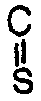
R⁵ = Pyridyl, Furyl, Thienyl, die alle substituiert sein können, Phthalimidyl, Di(C₁-C₄)-alkylmaleinimidyl, Thiophthalimidyl, Dihydrophthalimidyl, Tetrahydrophthalimidyl, substituiertes Phenyl oder R⁴ und R⁵ - zusammen mit dem sie verbrückenden Kohlenstoffatom - einen gegebenenfalls substituierten Indanyl-, Cyclopentenoyl- oder Cyclopentenyl-Rest ergeben und
R⁶ = H, (C₁-C₃)Alkyl oder Phenyl bedeuten,
in Kombination mit einer Verbindung aus der Gruppe Endosulfan (IX), Buprofezin (X), Cyromazine (XI), Flubenzimine (XII), Flufenoxuron (XIII), Deltamethrin (XIIIa), Triazophos (XIIIb), Heptenophos (XIIIc), oder einer Verbindung der Formel XIV

R₁₅, R₁₆, R₁₇, R₁₈ = unabhängig voneinander Wasserstoff oder Halogen,
R₁₉ = CH₃, CF₃ oder Halogen und
R₂₀ = (C₁-C₃)Haloalkyl bedeuten,
oder einer Verbindung der Formel XV
Description
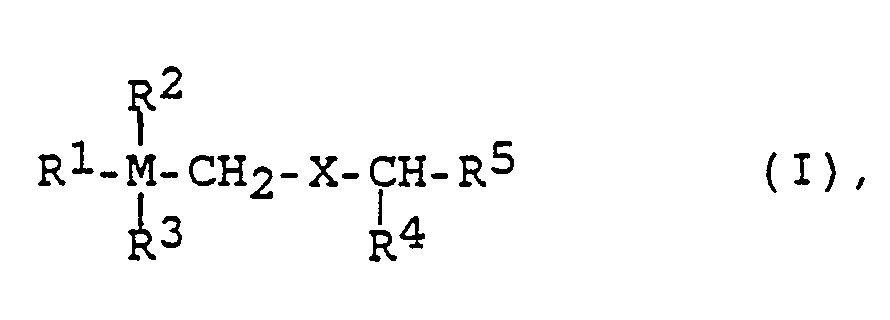
- Aus den EP-A 0249015 und 0224024 sind insektizide und akarizide Mittel bekannt, die gekennzeichnet sind durch einen Gehalt an einer Verbindung der Formel I

M = Kohlenstoff oder Silicium,
X = CH₂, O, S, NR⁶,
R¹ = (C₂-C₁₈)Alkyl, (C₅-C₇)Cycloalkyl, (C₂-C₈)Alkenyl, Phenyl, Naphthyl, Pyridyl, Pyrimidyl, Pyridazinyl, Pyrazinyl, 1,2,4-Triazinyl oder 1,2,4,5-Tetrazinyl, wobei all diese Substituenten ein- oder mehrfach substituiert sein können,
R², R³ = unabhängig voneinander (C₁-C₃)Alkyl, (C₂-C₈)Alkenyl, Phenyl oder R² und R³ eine Alkylenkette, die - zusammen mit dem quartären Zentralatom (M) einen unsubstituierten oder fluor-substituierten Ring mit vier bis sechs Ringgliedern (für M = Si) oder mit drei bis sechs Ringgliedern (für M = C) ergibt,
R⁴ = -H, -CN, -CCl₃, -C≡CH, (C₁-C₄)Alkyl, F, --NH₂,
R⁵ = Pyridyl, Furyl, Thienyl, die alle substituiert sein können, Phthalimidyl, Di(C₁-C₄)-alkylmaleinimidyl, Thiophthalimidyl, Dihydrophthalimidyl, Tetrahydrophthalimidyl, substituiertes Phenyl oder R⁴ und R⁵ - zusammen mit dem sie verbrückenden Kohlenstoffatom - einen gegebenenfalls substituierten Indanyl-, Cyclopentenoyl - oder Cyclopentenyl-Rest ergeben und
R⁶ = H, (C₁-C₃)Alkyl oder Phenyl bedeuten. - Dort sind ebenfalls Verfahren zur Herstellung der Verbindungen der Formel I beschrieben.
Bei den Verbindungen der Formel I bedeuten bevorzugt:
X = CH₂ oder Sauerstoff,
R¹ = eine Gruppe der allgemeinen Formeln II bis VIII
R⁷ und R⁸ unabhängig voneinander einen an ein C-Atom gebundenen Rest aus der Gruppe H, (C₁-C₄)-Alkyl, Tri(C₁-C₄)-alkylsilyl, Halogen, Nitro, Cyano, (C₂-C₆)Alkenyl, (C₂-C₆)-Alkinyl, Amino, (C₃-C₇)Cycloalkyl, Phenyl, Phenoxy, (C₁-C₅)-Alkoxy, (C₂-C₄)-Alkenyloxy, (C₂-C₄)Alkinyloxy, Hydroxycarbonyl, (C₁-C₄)-Alkylthio, (C₃-C₇)Cycloalkyloxy, (C₁-C₆)Alkylcarbonyl, (C₁-C₄)Alkoxycarbonyl, (C₂-C₄)-Alkenyloxycarbonyl, (C₃-C₅)Alkinyloxycarbonyl, (C₁-C₄)-Halogenalkyl, (C₁-C₄)-Alkoxy(C₁-C₄)alkyl, (C₁-C₃)-Halogenalkoxy, (C₁-C₃)Halogenalkylthio, Halogen(C₁-C₄)-alkoxy(C₁-C₄)alkyl, (C₁-C₄)-Alkylthio-(C₁-C₄)alkyl, (C₁-C₄)- Alkoxy(C₁-C₄)alkoxy, Halogen(C₁-C₄)alkoxy(C₁-C₄)alkoxy, (C₂-C₄)Alkenyloxy(C₁-C₄)-alkoxy, Halogen(C₂-C₄)alkenyloxy, (C₁-C₄)Alkoxy(C₁-C₄)-alkylthio, (C₁-C₄)Alkylthio(C₁-C₄)-alkoxy, (C₁-C₄)Alkylthio(C₁-C₄)alkylthio, Halogen(C₁-C₄) alkoxycarbonyl, Halogen(C₂-C₄)alkenyloxycarbonyl oder Di-(C₁-C₆alkyl)amino oder zwei Reste R⁷ oder R⁸ wenn sie ortho ständig zueinander orientiert sind zusammen einen Methylendioxy-, Ethylendioxy- oder (C₃-C₅)Alkylenrest bedeuten und m und n die Werte 0, 1 oder 2 annehmen können. Besonders bevorzugt stehen R⁷ und R⁸ für Wasserstoff, Halogen (C₁-C₄)Alkyl, (C₂-C₆)-Alkenyl, C₃-C₇)Cycloalkyl, (C₁-C₅)Alkoxy, (C₂-C₄)Alkenyloxy, (C₁-C₄)Alkylthio, (C₁-C₄)-Halogenalkyl, (C₁-C₃)Halogenalkoxy oder - 2 Reste R⁷ bzw. R⁸ zusammen - Methylendioxy, wobei R⁷ und R⁸ insbesondere in 3- oder 4-Stellung des aromatischen Sechsringes orientiert sind. Bevorzugt sind außerdem Verbindungen, bei denen die Summe aus m und n 1 oder 2 ergibt.
R² und R³ stehen bevorzugt für einen (C₁-C₃)Alkylrest wie Methyl, Ethyl, i-Propyl und n-Propyl oder bedeuten bevorzugt - für M=C- zusammen mit dem sie verknüpfenden Kohlenstoffatom einen unsubstituierten oder mono- oder difluorierten Cyclopropylring.
R⁴ steht bevorzugt für Wasserstoff, Fluor, Cyano oder (C₁-C₄)-Alkyl, besonders bevorzugt für Wasserstoff. - Als substituiertes Phenyl R⁵ steht bevorzugt ein Phenylrest der Formel (A)


p = eine ganze Zahl von 1 bis 5, insbesondere 1, 2 oder im Falle R⁹ = Fluor 5 und falls R⁹ der Gruppierung (B) entspricht, insbesondere 1 oder 2 und
q = 1 oder 2 bedeutet. - Von diesen Resten für R⁵ sind von besonderer Bedeutung Reste der Formel (A), worin R⁹ = H oder 4-Fluor und zusätzlich einen Rest der Formel (B) bedeutet, der in 3-Stellung des Phenylrestes von (A) orientiert ist.
- Für gegebenenfalls substituiertes Pyridyl R⁵ steht insbesondere eine mono- oder disubstituierte Pyridyl-Gruppe der allgemeinen Formel (C),

- Fur gegebenenfalls substituiertes Thienyl R⁵ oder Furyl R⁵ steht insbesondere ein Heterocyclus der allgemeinen Formel (D),

R¹³ = H, Halogen, (C₁-C₄)Alkyl, (C₁-C₄)Alkoxy, (C₁-C₄)-Halogenalkyl, CN oder NO₂,
R¹⁴ = gegebenenfalls substituiertes Benzyl, Propargyl, Allyl oder Phenoxy und
r = 1 oder 2
bedeutet. - Verbindungen mit substituierten Phenylresten für R⁵ sind für diese Erfindung von besonderer Wichtigkeit.
- Von diesen ist insbesondere die Verbindung der Formel Ia zu nennen

- Die Herstellung dieser Verbindung ist in der EP-A 0224024 beschrieben.
- Es wurden nun neue Kombinationen von Verbindungen der Formel I mit anderen ausgewählten Insektiziden oder Akariziden gefunden, bei denen überraschenderweise synergistische Wirkungen auftreten.
- Gegenstand der vorliegenden Erfindung sind daher Schädlingsbekämpfungsmittel, die mindestens eine Verbindung der Formel I in Kombination mit einer Verbindung aus der Gruppe Endosulfan (IX), Buprofezin (X), Cyromazine (XI), Flubenzimine (XII), Flufenoxuron (XIII), Deltamethrin (XIIIa), Triazophos (XIIIb), Heptenophos (XIIIc), oder einer Verbindung der Formel XIV

R₁₅, R₁₆, R₁₇, R₁₈ = unabhängig voneinander Wasserstoff oder Halogen,
R₁₉ = CH₃, CF₃ oder Halogen und
R₂₀ = (C₁-C₃)Haloalkyl bedeuten,
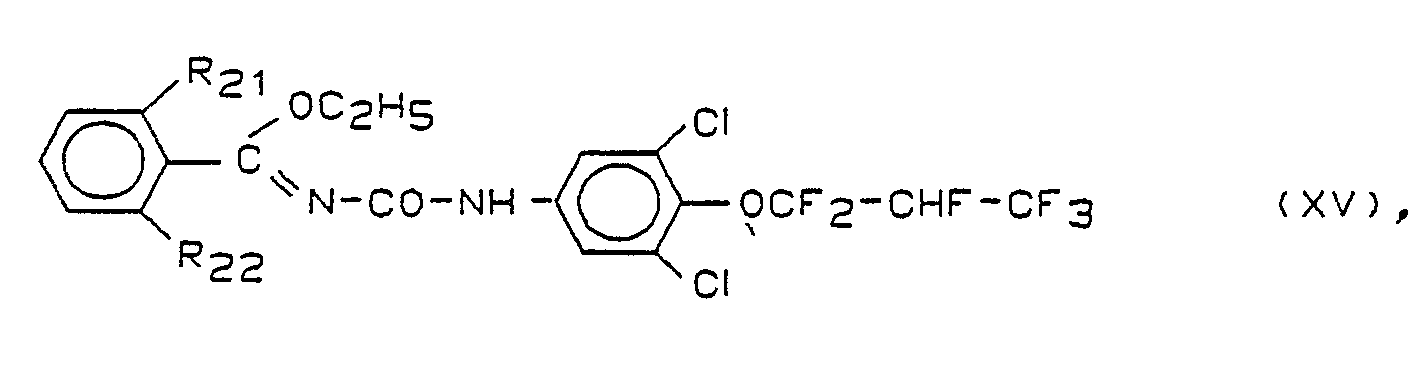
oder einer Verbindung der Formel XV
- Bei den Verbindungen der Formeln XIV und XV bedeutet Halogen bevorzugt Fluor oder Chlor. Der Rest R₂₀ in Formel XIV steht bevorzugt für CF₃.
- Besonders bevorzugt unter den Verbindungen der Formel XV ist die Verbindung der Formel XVa

- Die Verbindung Flufenoxuron (XIII) hat die Formel

- Die obengenannten Wirkstoffe der Formeln IX-XII und XIIIa-XIIIc, für die common names angegeben wurden, sind in CH.R. Worthing, S.B. Walker, The Pesticide Manual, 8th ed., British Crop Protection Council (1987) beschrieben.
- Die Verbindungen der Formel XIV sowie deren Herstellung sind in der EP-A 0243790 und die der Formel XV in der EP-A 0135894 beschrieben.
- Die Verbindung XIII (Flufenoxuron) ist beschrieben in Anderson, H. et al. Proceedings Vol. 1, S. 89-96, British Crop Prot. Conf. (1986).
- Erfindungsgemäß können die Verbindungen der Formel I auch mit zwei oder mehreren der aufgezählten Wirkstoffe kombiniert werden.
- Die insektizide und akarizide Wirksamkeit der erfindungsgemäßen Wirkstoffkombinationen liegt deutlich höher als von der Wirkungen der Einzelkomponenten zu erwarten war. Durch Anwandung dieser Kombinationen können daher die Aufwandmengen der Einzelkomponenten reduziert werden. Ihre Anwendung bringt demzufolge ökonomische wie auch ökologische Vorteile.
- Die erfindungsgemäßen Mittel eignen sich bei guter Pflanzenverträglichkeit und günstiger Warmblütertoxizität zur Bekämpfung von tierischen Schädlingen, insbesondere Insekten, Spinnentieren und Nematoden, besonders bevorzugt zur Bekämpfung von Insekten und Akariden, sowie deren Entwicklungsstadien, die in der Landwirtschaft, in Forsten, im Vorrats- und Materialschutz sowie auf dem Hygienesektor vorkommen. Sie sind gegen normal sensible und resistente Arten sowie gegen alle oder einzelne Entwicklungsstadien wirksam. Zu den oben erwähnten Schädlingen gehören:
aus der Ordnung der Isopoda z.B. Oniscus asellus, Armadillidium vulgare, Porcellio scaber.
Aus der Ordnung der Diplopoda z.B. Blaniulus guttulatus.
Aus der Ordnung der Chilopoda z.B. Geophilus carpophagus, Scutigera spec.
Aus der Ordnung der Symphyla z.B. Scutigerella immaculata.
Aus der Ordnung der Thysanura z.B. Lepisma saccharina.
Aus der Ordnung der Collembola z.B. Onychiurus armatus.
Aus der Ordnung der Orthoptera z.B. Blatta orientalis, Periplaneta americana, Leucophaea maderae, Blattella germanica, Acheta domesticus, Gryllotalpa spp., Locusta migratoria migratorioides, Melanoplus differentialis, Schistocerca gregaria.
Aus der Ordnung der Dermaptera z.B. Forficula auricularia.
Aus der Ordnung der Isoptera z.B. Reculitermes spp..
Aus der Ordnung der Anoplura z.B. Phylloxera vastatrix, Pemphigus spp., Pediculus humanus corporis, Haematopinus spp., Linognathus spp.
Aus der Ordnung der Mallophaga z.B. Trichodectes spp., Damalinea spp.
Aus der Ordnung der Thysanoptera z.B. Hercinothrips femoralis, Thrips tabaci.
Aus der Ordnung der Heteroptera z.B. Eurygaster spp., Dysdercus intermedius, Piesma quadrata, Cimex lectularius, Rhodnius prolixus, Triatoma spp.
Aus der Ordnung der Homoptera z.B. Aleurodes brassicae, Bemisia tabaci, Trialeurodes vaporariorum, Aphis gossypii, Brevicoryne brassicae, Cryptomyzus ribis, Doralis fabae, Doralis pomi, Eriosoma lanigerum, Hyalopterus arundinis, Macrosiphum avenae, Myzus spp., Phorodon humuli, Rhopalosiphum padi, Empoasca spp., Euscelis bilobatus, Nephotettix cincticeps, Lecanium corni, Saissetia oleae, Laodelphax striatellus, Nilaparvata lugens, Aonidiella aurantii, Aspidiotus hederae, Pseudococcus spp. Psylla spp.
Aus der Ordnung der Lepidoptera z.B. Pectinophora gossypiella, Bupalus piniarius, Cheimatobia brumata, Lithocolletis, blancardella, Hyponomeuta padella, Plutella maculipennis, Malacosoma neustria, Euproctis chrysorrhoea, Lymantria ssp. Bucculatrix thurberiella, Phyllocnistis citrella, Agrotis spp., Euxoa spp., Feltia spp., Earias insulana, Heliothis spp., Laphygma exigua, Mamestra brassicae, Panolis flammea, Prodenia litura, Spodoptera spp., Trichoplusia ni, Carpocapsa pomonella, Pieris spp., Chilo spp., Pyrausta nubilalis, Ephestia kuehniella, Galleria mellonella, Tineola bisselliella, Tinea pellionella, Hofmannophila pseudospretella, Cacoecia podana, Capua reticulana, Choristoneura fumiferana, Clysia ambiguella, Homona magnanima, Tortrix viridana.
Aus der Ordnung der Coleoptera z.B. Anobium punctatum, Rhizopertha dominica, Acanthoscelides obtectus, Hylotrupes bajulus, Agelastica alni, Leptinotarsa decemlineata, Phaedon cochleariae, Diabrotica spp., Psylliodes chrysocephala, Epilachna varivestis, Atomaria spp., Oryzaephilus surinamensis, Anthonomus spp., Sitophilus spp., Otiorrhynchus sulcatus, Cosmopolites sordidus, Ceuthorrhynchus assimilis, Hypera postica, Dermestes spp., Trogoderma spp., Anthrenus spp., Attagenus spp., Lyctus spp., Meligethes aeneus, Ptinus spp., Niptus hololeucus, Gibbium psylloides, Tribolium spp., Tenebrio molitor, Agriotes spp., Conoderus spp., Melolontha melolontha, Amphimallon solstitialis, Costelytra zealandica.
Aus der Ordnung der Hymenoptera z.B. Diprion spp., Hoplocampa spp., Lasius spp., Monomorium pharaonis, Vespa spp.
Aus der Ordnung der Diptera z.B. Aedes spp., Anopheles spp., Culex spp., Drosophila melanogaster, Musca spp., Pannia spp., Calliphora erythrocephala, Lucilia spp., Chrysomyia spp., Cuterebra spp., Gastrophilus spp., Hyppobosca spp., Stomoxys spp., Oestrus spp., Hypoderma spp., Tabanus spp., Tannia spp., Bibio hortulanus, Oscinella frit, Phorbia spp., Pegomyia hyoscyami, Ceratitis capitata, Dacus oleae, Tipula paludosa. - Aus der Ordnung der Siphonaptera z.B. Xenopsylla cheopis, Ceratophyllus spp.
Aus der Ordnung der Arachnida z.B. Scorpio maurus, Latrodectus mactans.
Aus der Ordnung der Acarina z.B. Acarus siro, Argas spp., Ornithodoros spp., Dermanyssus gallinae, Eriophyes ribis, Phyllocoptruta oleivora, Boophilus spp., Rhipicephalus spp., Amblyomma spp., Hyalomma spp., Ixodes spp., Psoroptes spp., Chorioptes spp., Sarcoptes spp., Tarsonemus spp., Bryobia praetiosa, Panonychus spp., Tetranychus spp. - Insbesondere eignen sich die erfindungsgemäßen Wirkstoffkombinationen zur Bekämpfung von Heliothis spp., Anthonomus spp. und Trichoplusia spp. und anderer fressender und saugender Insekten oder Spinnmilben (Weiße Fliege, Lepidoptera-Larven) in Baumwolle, sowie von Schädlingen im Obst- und Schmetterlingen in Gemüse- und Weinbau.
- Die erfindungsgemäßen Mittel enthalten die Wirkstoffe im allgemeinen zu 1 bis 99 Gew.-%.
- Sie können auf verschiedene Art formuliert werden, je nachdem wie es durch die biologischen und/oder chemisch-physikalischen Parameter vorgegeben ist. Als Formulierungsmöglichkeiten kommen daher infrage: Spritzpulver (WP), emulgierbare Konzentrate (EC), wäßrige Lösungen (SC), Emulsionen, versprühbare Lösungen, Dispersionen auf Öl- oder Wasserbasis (SC), Suspoemulsionen (SC), Stäubemittel (DP), Beizmittel, Granulate in Form von Mikro-, Sprüh-, Aufzugs- udn Adsorptionsgranulaten, wasserdispergierbare Granulate (WG), ULV-Formulierungen, Mikrokapseln, Wachse oder Köder.
- Diese einzelnen Formulierungstypen sind im Prinzip bekannt und werden beispielsweise beschrieben in Winnacker-Küchler, "Chemische Technologie", Band 7, C. Hauser Verlag München, 4. Aufl. 1986; van Falkenberg, "Pesticides Formulations", Marcel Dekker N.Y., 2nd Ed. 1972-73; K. Martens, "Spray Drying Handbook", 3rd Ed. 1979, G. Goodwin Ltd. London.
- Die notwendigen Formulierungshilfsmittel wie Inertmaterialien, Tenside, Lösungsmittel und weitere Zusatzstoffe sind ebenfalls bekannt und werden beispielsweise beschrieben in: Watkins, "Handbook of Insecticide Dust Diluents and Carriers", 2nd Ed., Darland Books, Caldwell N.J.; H.v.Olphen, "Introduction to Clay Colloid Chemistry", 2nd Ed., J. Wiley & Sons, N.Y.; Marschen, "Solvents Guide", 2nd Ed., Interscience, N.Y. 1950; McCutcheon's, "Detergents and Emulsifiers Annual", MC Publ. Corp., Ridgewood N.J.; Sisley and Wood, "Encyclopedia of Surface Active Agents", Chem. Publ. Co. Inc., N.Y. 1964; Schönfeldt, "Grenzflächenaktive Äthylenoxidaddukte", Wiss. Verlagsgesell., Stuttgart 1976; Winnacker-Küchler, "Chemische Technologie", Band 7, C. Hauser Verlag München, 4. Aufl. 1986.
- Auf der Basis dieser Formulierungen lassen sich auch Kombinationen mit anderen pestizid wirksamen Stoffen, Düngemitteln und/oder Wachstumsregulatoren herstellen, z.B. in Form einer Fertigformulierung oder als Tankmix. Spritzpulver sind in Wasser gleichmäßig dispergierbare Präparate, die neben dem Wirkstoff außer einem Verdünnungs- oder Inertstoff noch Netzmittel, z.B. polyoxethylierte Alkylphenole, polyoxethylierte Fettalkohole, Alkyl- oder Alkylphenol-sulfonate und Dispergiermittel, z.B. ligninsulfonsaures Natrium, 2,2′-dinaphthylmethan-6,6′-disulfonsaures Natrium, dibutylnaphthalin-sulfonsaures Natrium oder auch oleylmethyltaurinsaures Natrium enthalten. Emulgierbare Konzentrate werden durch Auflösen des Wirkstoffes in einem organischen Lösungsmittel, z.B. Butanol, Cyclohexanon, Dimethylformamid, Xylol oder auch höhersiedenden Aromaten oder Kohlenwasserstoffen unter Zusatz von einem oder mehreren Emulgatoren hergestellt. Als Emulgatoren können beispielsweise verwendet werden: Alkylarylsulfonsaure Calcium-Salze wie Ca-dodecylbenzolsulfonat oder nichtionische Emulgatoren wie Fettsäurepolyglykolester, Alkylarylpolyglykolether, Fettalkoholpolyglykolether, Propylenoxid-Ethylenoxid-Kondensationsprodukte, Alkylpolyether, Sorbitanfettsäureester, Polyoxyethylensorbitan-Fettsäureester oder Polyoxethylensorbitester.
- Stäubemittel erhält man durch Vermahlen des Wirkstoffes mit fein verteilten festen Stoffen, z.B. Talkum, natürlichen Tonen wie Kaolin, Bentonit, Pyrophillit oder Diatomeenerde. Granulate können entweder durch Verdüsen des Wirkstoffes auf adsoprtionsfähiges, granuliertes Inertmaterial hergestellt werden oder durch Aufbringen von Wirkstoffkonzentraten mittels Klebemittel, z.B. Polyvinylalkohol, polyacrylsaurem Natrium oder auch Mineralölen, auf die Oberfläche von Trägerstoffen wie Sand, Kaolinite oder von granuliertem Inertmaterial. Auch können geeignete Wirkstoffe in der für die Herstellung von Düngemittelgranulaten üblichen Weise - gewünschtenfalls in Mischung mit Düngemitteln - granuliert werden.
- In Spritzpulvern beträgt die Wirkstoffkonzentration z.B. etwa 10 bis 90 Gew.-%, der Rest zu 100 Gew.-% besteht aus üblichen Formulierungsbestandteilen. Bei emulgierbaren Konzentraten kann die Wirkstoffkonzentration etwa 5 bis 80 Gew.-% betragen. Staubförmige Formulierungen enthalten meistens 5 bis 20 Gew.-% an Wirkstoff, versprühbare Lösungen etwa 2 bis 20 Gew.-%. Bei Granulaten hängt der Wirkstoffgehalt zum Teil davon ab, ob die wirksame Verbindung flüssig oder fest vorliegt und welche Granulierhilfsmittel, Füllstoffe usw. verwendet werden.
- Daneben enthalten die genannten Wirkstofformulierungen gegebenenfalls die jeweils üblichen Haft-, Netz-, Dispergier-, Emulgier-, Penetrations-, Lösungsmittel, Füll- oder Trägerstoffe.
- Zur Anwendung werden die in handelsüblicher Form vorliegenden Konzentrate gegebenfalls in üblicher Weise verdünnt, z.B. bei Spritzpulvern, emulgierbaren Konzentraten, Dispersionen und teilweise auch bei Mikrogranulaten mittels Wasser. Staubförmige und granulierte Zubereitungen sowie versprühbare Lösungen werden vor der Anwendung üblicherweise nicht mehr mit weiteren inerten Stoffen verdünnt.
- Das Gewichtsverhältnis der Verbindung der Formel I zum Kombinationspartner variiert in den erfindungsgemäßen Mitteln je nach dem zu verwendenden Kombinationspartner im Bereich zwischen 20:1 und 1:20. Ebenso können die Anwendungskonzentrationen der Kombinationen in Abhängigkeit des zu verwendenden Kombinationspartners variieren und zwar zwischen 5 g bis 300 g Wirkstoff/ha, insbesondere zwischen 20 g und 1000 g Wirkstoff/ha.
- Die nachfolgenden Beispiele dienen zur Erläuterung der Erfindung.
-
- a) Ein Stäubemittel wird erhalten, indem man 10 Gew.-Teile Wirkstoff und 90 Gew.-Teile Talkum als Inertstoff mischt und in einer Schlagmühle zerkleinert.
- b) Ein in Wasser dispergierbares, benetzbares Pulver wird erhalten, indem man 25 Gew.-Teile Wirkstoff, 65 Gew.-Teile kaolinhaltigen Quarz als Inertstoff, 10 Gew.-Teile ligninsulfonsaures Kalium und 1 Gew.-Teil oleoylmethyltaurinsaures Natrium als Netz- und Dispergiermittel mischt und in einer Stiftmühle mahlt.
- c) Ein in Wasser leicht dispergierbares Dispersionskonzentrat stellt man her, indem man 40 Gew.- Teile Wirkstoff mit 7 Gew.-Teilen eines Sulfobernsteinsäurehalbesters, 2 Gew.-Teile eines Ligninsulfonsäure-Natriumsalzes und 51 Gew.-Teile Wasser mischt und in einer Reibkugelmühle auf eine Feinheit von unter 5 Mikron vermahlt.
- d) Ein emulgierbares Konzentrat läßt sich herstellen aus 15 Gew.-Teilen Wirkstoff, 75 Gew.-Teilen Cyclohexanon als Lösungsmittel und 10 Gew.-Teilen oxethyliertem Nonylphenol (10 AeO) als Emulgator.
- e) Ein Granulat läßt sich herstellen aus 2 bis 15 Gew.-Teilen Wirkstoff und einem inerten Granulatträgermaterial wie Attapulgit, Bimsgranulat und/oder Quarzsand. Zweckmäßigerweise verwendet man eine Suspension des Spritzpulvers aus Beispiel b) mit einem Feststoffanteil von 30 % und spritzt diese auf die Oberfläche eines Attapulgitgranulats, trocknet und vermischt innig. Dabei beträgt der Gewichtsanteil des Spritzpulvers ca. 5 % und der das inerten Trägermaterials ca. 95 % des fertigen Granulats.
- Larven des ägyptischen Baumwollwurms (Prodenia litura, LIII) wurden zusammen mit Blättern der Baumwolle mit gleichen Mengen verschieden konzentrierter Wirkstoffe - bzw. deren Mischungen besprüht.
Die so behandelten Larven wurden anschließend auf die getrockneten Blätter gesetzt. Der Effekt der Wirkstoffe bzw. der Wirkstoffgemische wurde 7 Tage nach Aufbewahrung bei Raumtemperatur (21-23°C) bewertet.Wirkstoff Wirkstoff ppm % Mortalität Verbindung Ia 31 100 16 100 7,8 60 3,9 0 2,0 0 1,0 0 Verbindung XVa 31 100 16 100 7,8 100 3,9 40 2,0 0 1,0 6 Ia + XVa 31 + 31 100 16 + 16 100 7,8 + 7,8 100 3,9 + 3,9 100 2,0 + 2,0 50 1,0 + 1,0 20 Wirkstoff Wirkstoff ppm % Mortalität Verbindung IX 500 100 250 60 125 50 63 30 31 10 I a + IX 31 + 500 100 16 + 250 100 7,8 + 125 100 3,9 + 63 100 2,0 + 32 40 Deltamethrin (XIIIa) 1,0 100 0,98 90 0,49 70 0,24 0 0,12 0 I a + Deltamethrin (XIIIa) 31 + 2,0 100 16 + 0,98 100 7,8 + 0,49 100 3,9 + 0,24 90 2,0 + 0,12 10 - Larven des Mehlkäfers (Tenebrio molitor LIII), sowie Stärke-Oblaten mit einem Durchmesser von 4 cm wurden gemeinsam mit einer gleichen Menge verschieden konzentrierter Wirkstoffe bzw. deren Mischungen gleichmäßig besprüht.
Die so behandelten Larven und Oblaten wurden anschließend in Petrischalen gegeben, diese verschlossen und 7 Tage bei Raumtemperatur (21-23°C) aufbewahrt. Danach wurde die Mortalität (in %) bestimmt.Wirkstoff Wirkstoff ppm % Mortalität Verbindung Ia 250 100 125 100 63 90 31 70 16 10 Verbindung XVa 125 80 63 40 31 10 16 0 8 0 Ia + XVa 250 + 125 100 125 + 63 100 63 + 31 100 31 + 16 90 16 + 8 40 - Mit Kundebohnenblattlaus (Aphis craccivora) stark besetzte Ackerbohnen (Vicia faba) wurden mit gleichen Mengen verschieden konzentrierter Wirkstoffe bzw. deren Mischungen besprüht.
- Die so behandelten Pflanzen wurden anschließend im Gewächshaus aufgestellt. Die Mortalität der Blattläuse wurde nach 3 Tagen bestimmt.
Wirkstoff Wirkstoff ppm % Mortalität Verbindung Ia 63,0 40 31,0 0 16,0 0 Verbindung IX 7,8 20 3,9 0 2,0 0 Ia + IX 63,0 + 7,8 90 31,0 + 3,9 80 16,0 + 2,0 40 Triazophos 3,9 20 2,0 0 Ia + Triazophos 31,0 + 3,9 60 16,0 + 2,0 40 Deltamethrin 0,06 30 0,03 15 Ia + Deltamethrin 7,8 + 0,06 85 3,9 + 0,03 80 - Mit Citrus-Schmierlaus (Pseudococcus citri) stark befallene Bohnenpflanzen (Phaseolus vulgaris) wurden mit gleichen Mengen verschieden konzentrierter Wirkstoffe bzw. deren Mischungen besprüht. Nach einer Standzeit von 7 Tagen im Gewächshaus bei 20-25°C erfolgte die Kontrolle.
Wirkstoff Wirkstoff ppm % Mortalität Verbindung Ia 31,0 15 16,0 0 7,8 0 Triazophos 2,0 15 0,98 0 Ia + Triazophos 16,0 + 2,0 60 7,8 + 0,98 40 Heptenophos 7,8 0 3,9 0 Ia + Heptenophos 31,0 + 7,8 75 16,0 + 3,9 50
Claims (7)
M = Kohlenstoff oder Silicium,
X = CH₂, O, S, NR⁶,
R¹ = (C₂-C₁₈)Alkyl, (C₅-C₇)Cycloalkyl, (C₂-C₈)Alkenyl, Phenyl, Naphthyl, Pyridyl, Pyrimidyl, Pyradizinyl, Pyrazinyl, 1,2,4-Triazinyl oder 1,2,4,5-Tetrazinyl, wobei all diese Substituenten ein- oder mehrfach substituiert sein können,
R², R³ = unabhängig voneinander (C₁-C₃)Alkyl, (C₂-C₈) Alkenyl, Phenyl oder R² und R³ eine Alkylenkette, die - zusammen mit dem quartären Zentralatom (M) einen unsubstituierten oder fluor-substituierten Ring mit vier bis sechs Ringgliedern (für M = Si) oder mit drei bis sechs Ringgliedern (für M = C) ergibt,
R⁴ = -H, -CN, -CCl₃, -C≡CH, (C₁-C₄)Alkyl, F, -
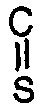
R⁵ = Pyridyl, Furyl, Thienyl, die alle substituiert sein können, Phthalimidyl, Di(C₁-C₄)-alkylmaleinimidyl, Thiophthalimidyl, Dihydrophthalimidyl, Tetrahydrophthalimidyl, substituiertes Phenyl oder R⁴ und R⁵ - zusammen mit dem sie verbrückenden Kohlenstoffatom - einen gegebenenfalls substituierten Indanyl-, Cyclopentenoyl- oder Cyclopentenyl-Rest ergeben und
R⁶ = H, (C₁-C₃)Alkyl oder Phenyl bedeuten,
in Kombination mit einer Verbindung aus der Gruppe Endosulfan (IX), Buprofezin (X), Cyromazine (XI), Flubenzimine (XII), Flufenoxuron (XIII), Deltamethrin (XIIIa), Triazophos (XIIIb), Heptenophos (XIIIc), oder einer Verbindung der Formel XIV

R₁₅, R₁₆, R₁₇, R₁₈ = unabhängig voneinander Wasserstoff oder Halogen,
R₁₉ = CH₃, CF₃ oder Halogen und
R₂₀ = (C₁-C₃)Haloalkyl bedeuten,
oder einer Verbindung der Formel XV
Applications Claiming Priority (2)
| Application Number | Priority Date | Filing Date | Title |
|---|---|---|---|
| DE3810378 | 1988-03-26 | ||
| DE3810378A DE3810378A1 (de) | 1988-03-26 | 1988-03-26 | Schaedlingsbekaempfungsmittel |
Publications (3)
| Publication Number | Publication Date |
|---|---|
| EP0335225A2 true EP0335225A2 (de) | 1989-10-04 |
| EP0335225A3 EP0335225A3 (en) | 1990-02-14 |
| EP0335225B1 EP0335225B1 (de) | 1995-06-07 |
Family
ID=6350814
Family Applications (1)
| Application Number | Title | Priority Date | Filing Date |
|---|---|---|---|
| EP89105008A Expired - Lifetime EP0335225B1 (de) | 1988-03-26 | 1989-03-21 | Schädlingsbekämpfungsmittel |
Country Status (6)
| Country | Link |
|---|---|
| EP (1) | EP0335225B1 (de) |
| JP (1) | JP2802315B2 (de) |
| AT (1) | ATE123378T1 (de) |
| DE (2) | DE3810378A1 (de) |
| ES (1) | ES2074449T3 (de) |
| ZA (1) | ZA892204B (de) |
Cited By (4)
| Publication number | Priority date | Publication date | Assignee | Title |
|---|---|---|---|---|
| WO1995024997A1 (de) * | 1994-03-17 | 1995-09-21 | Bayer Aktiengesellschaft | Insektizide wirkstoffkombinationen |
| EP0714604A1 (de) * | 1994-12-01 | 1996-06-05 | Mitsui Toatsu Chemicals, Incorporated | Eine Zusammensetzung mit insektiziden und akariziden Eigenschaften |
| EP0664081A3 (de) * | 1994-01-20 | 1996-10-02 | Hoechst Schering Agrevo Gmbh | Synergistische Kombinationen von Ammoniumsalzen. |
| WO1997002119A1 (de) * | 1995-07-06 | 1997-01-23 | Rütgers Organics Gmbh | Vorbeugende holzschutzmittel |
Family Cites Families (5)
| Publication number | Priority date | Publication date | Assignee | Title |
|---|---|---|---|---|
| DE2062348C3 (de) * | 1970-12-18 | 1980-10-09 | Bayer Ag, 5090 Leverkusen | 43-Bis-trifluormethylimino-Derivate von Thiazolidinen und Verfahren zur Herstellung solcher Verbindungen |
| US5135953A (en) * | 1984-12-28 | 1992-08-04 | Ciba-Geigy | Use of acyl urea compounds for controlling endoparasites and ectoparasites of warm-blooded animals |
| ES2016793B3 (es) * | 1985-10-26 | 1990-12-01 | Hoechst Ag | Nuevos derivados de silanos, procedimientos para su obtencion, productos que los contienen y su empleo como plaguicidas. |
| JPS62193268A (ja) * | 1986-02-20 | 1987-08-25 | Sharp Corp | ハイブリツド集積回路 |
| CN1025470C (zh) * | 1986-05-31 | 1994-07-20 | 赫彻斯特股份公司 | 含新型硅烷衍生物的农药,杀虫剂和杀螨剂组合物 |
-
1988
- 1988-03-26 DE DE3810378A patent/DE3810378A1/de not_active Withdrawn
-
1989
- 1989-03-21 ES ES89105008T patent/ES2074449T3/es not_active Expired - Lifetime
- 1989-03-21 EP EP89105008A patent/EP0335225B1/de not_active Expired - Lifetime
- 1989-03-21 DE DE58909275T patent/DE58909275D1/de not_active Expired - Fee Related
- 1989-03-21 AT AT89105008T patent/ATE123378T1/de active
- 1989-03-23 ZA ZA892204A patent/ZA892204B/xx unknown
- 1989-03-24 JP JP1070771A patent/JP2802315B2/ja not_active Expired - Lifetime
Cited By (4)
| Publication number | Priority date | Publication date | Assignee | Title |
|---|---|---|---|---|
| EP0664081A3 (de) * | 1994-01-20 | 1996-10-02 | Hoechst Schering Agrevo Gmbh | Synergistische Kombinationen von Ammoniumsalzen. |
| WO1995024997A1 (de) * | 1994-03-17 | 1995-09-21 | Bayer Aktiengesellschaft | Insektizide wirkstoffkombinationen |
| EP0714604A1 (de) * | 1994-12-01 | 1996-06-05 | Mitsui Toatsu Chemicals, Incorporated | Eine Zusammensetzung mit insektiziden und akariziden Eigenschaften |
| WO1997002119A1 (de) * | 1995-07-06 | 1997-01-23 | Rütgers Organics Gmbh | Vorbeugende holzschutzmittel |
Also Published As
| Publication number | Publication date |
|---|---|
| ZA892204B (en) | 1989-11-29 |
| ES2074449T3 (es) | 1995-09-16 |
| JP2802315B2 (ja) | 1998-09-24 |
| JPH01283203A (ja) | 1989-11-14 |
| DE58909275D1 (de) | 1995-07-13 |
| DE3810378A1 (de) | 1989-10-05 |
| ATE123378T1 (de) | 1995-06-15 |
| EP0335225B1 (de) | 1995-06-07 |
| EP0335225A3 (en) | 1990-02-14 |
Similar Documents
| Publication | Publication Date | Title |
|---|---|---|
| EP0354593B1 (de) | Schädlingsbekämpfungsmittel | |
| EP0668722B1 (de) | Synergistische mittel zur bekämpfung von insekten und akarina | |
| DE4401542A1 (de) | Synergistische Kombinationen von Ammoniumsalzen | |
| DE4445732A1 (de) | Neue synergistische Mittel zur Bekämpfung von Insekten und Akarina | |
| JPS6344139B2 (de) | ||
| DE3317824A1 (de) | Phosphorsaeureester | |
| EP0135894B1 (de) | Neue N-Carbamoylarylcarboximidsäureester, Verfahren zu ihrer Herstellung, sie enthaltende Mittel und ihre Verwendung als Schädlingsbekämpfungsmittel | |
| DE3602276A1 (de) | Schaedlingsbekaempfungsmittel | |
| DE4005114A1 (de) | Substituierte pyrazolinderivate | |
| EP0335225B1 (de) | Schädlingsbekämpfungsmittel | |
| DE3642452A1 (de) | Substituierte 4-amino-pyrimidine | |
| DE3739264A1 (de) | 2-chlor-1,3-thiazol-5-yl-methyl substituierte nitrogruppenhaltige imidazolidino-1,2,3,4-tetrahydropyrimidine bzw. hexahydropyrimidino-1,2,3,4-tetrahydropyrimidine | |
| US5139785A (en) | Pesticides | |
| DE4303658A1 (de) | Substituierte Tetrahydropyridazincarboxamide | |
| EP0029160A1 (de) | Neue Oxybenztriazolderivate, Verfahren zu ihrer Herstellung und ihre Verwendung als Synergisten in Schädlingsbekämpfungsmitteln | |
| DD144713A5 (de) | Schaedlingsbekaempfungsmittel | |
| EP0642303B1 (de) | Substituierte 2-arylpyrrole | |
| DE3912155A1 (de) | Schaedlingsbekaempfungsmittel auf basis von 2-halogenalkylthio-substituierten pyrimidin-derivaten | |
| EP0185282A2 (de) | Pyridyl-thionophosphorsäureester | |
| EP0311962A2 (de) | Pyridylphosphate, Verfahren zu ihrer Herstellung, sie enthaltende Mittel und ihre Verwendung als Schädlingsbekämpfungsmittel | |
| DD145493A5 (de) | Schaedlingsbekaempfungsmittel | |
| DE3729263A1 (de) | Thionophosphonsaeureester | |
| DE4200591A1 (de) | Herbizide, insektizide und akarizide mittel enthaltend fluorsubstituierte benzhydrazidoylhalogenide | |
| DE4117076A1 (de) | Substituierte 4-hetaryl-pyrazoline | |
| EP0115828A1 (de) | Substituierte Oximether |
Legal Events
| Date | Code | Title | Description |
|---|---|---|---|
| PUAI | Public reference made under article 153(3) epc to a published international application that has entered the european phase |
Free format text: ORIGINAL CODE: 0009012 |
|
| AK | Designated contracting states |
Kind code of ref document: A2 Designated state(s): AT BE CH DE ES FR GB GR IT LI NL SE |
|
| PUAL | Search report despatched |
Free format text: ORIGINAL CODE: 0009013 |
|
| AK | Designated contracting states |
Kind code of ref document: A3 Designated state(s): AT BE CH DE ES FR GB GR IT LI NL SE |
|
| 17P | Request for examination filed |
Effective date: 19900714 |
|
| 17Q | First examination report despatched |
Effective date: 19920513 |
|
| RAP1 | Party data changed (applicant data changed or rights of an application transferred) |
Owner name: HOECHST SCHERING AGREVO GMBH |
|
| GRAA | (expected) grant |
Free format text: ORIGINAL CODE: 0009210 |
|
| AK | Designated contracting states |
Kind code of ref document: B1 Designated state(s): AT BE CH DE ES FR GB GR IT LI NL SE |
|
| REF | Corresponds to: |
Ref document number: 123378 Country of ref document: AT Date of ref document: 19950615 Kind code of ref document: T |
|
| REF | Corresponds to: |
Ref document number: 58909275 Country of ref document: DE Date of ref document: 19950713 |
|
| ITF | It: translation for a ep patent filed | ||
| REG | Reference to a national code |
Ref country code: GR Ref legal event code: FG4A Free format text: 3016575 |
|
| REG | Reference to a national code |
Ref country code: ES Ref legal event code: FG2A Ref document number: 2074449 Country of ref document: ES Kind code of ref document: T3 |
|
| GBT | Gb: translation of ep patent filed (gb section 77(6)(a)/1977) |
Effective date: 19950821 |
|
| ET | Fr: translation filed | ||
| PGFP | Annual fee paid to national office [announced via postgrant information from national office to epo] |
Ref country code: FR Payment date: 19960216 Year of fee payment: 8 |
|
| PGFP | Annual fee paid to national office [announced via postgrant information from national office to epo] |
Ref country code: NL Payment date: 19960221 Year of fee payment: 8 |
|
| PGFP | Annual fee paid to national office [announced via postgrant information from national office to epo] |
Ref country code: GB Payment date: 19960223 Year of fee payment: 8 |
|
| PGFP | Annual fee paid to national office [announced via postgrant information from national office to epo] |
Ref country code: SE Payment date: 19960226 Year of fee payment: 8 |
|
| PGFP | Annual fee paid to national office [announced via postgrant information from national office to epo] |
Ref country code: AT Payment date: 19960227 Year of fee payment: 8 |
|
| PGFP | Annual fee paid to national office [announced via postgrant information from national office to epo] |
Ref country code: BE Payment date: 19960305 Year of fee payment: 8 |
|
| PGFP | Annual fee paid to national office [announced via postgrant information from national office to epo] |
Ref country code: ES Payment date: 19960315 Year of fee payment: 8 |
|
| PGFP | Annual fee paid to national office [announced via postgrant information from national office to epo] |
Ref country code: GR Payment date: 19960322 Year of fee payment: 8 |
|
| PLBE | No opposition filed within time limit |
Free format text: ORIGINAL CODE: 0009261 |
|
| STAA | Information on the status of an ep patent application or granted ep patent |
Free format text: STATUS: NO OPPOSITION FILED WITHIN TIME LIMIT |
|
| PGFP | Annual fee paid to national office [announced via postgrant information from national office to epo] |
Ref country code: DE Payment date: 19960523 Year of fee payment: 8 |
|
| 26N | No opposition filed | ||
| PGFP | Annual fee paid to national office [announced via postgrant information from national office to epo] |
Ref country code: CH Payment date: 19960612 Year of fee payment: 8 |
|
| PG25 | Lapsed in a contracting state [announced via postgrant information from national office to epo] |
Ref country code: GB Effective date: 19970321 Ref country code: AT Effective date: 19970321 |
|
| PG25 | Lapsed in a contracting state [announced via postgrant information from national office to epo] |
Ref country code: SE Effective date: 19970322 Ref country code: ES Free format text: LAPSE BECAUSE OF EXPIRATION OF PROTECTION Effective date: 19970322 |
|
| PG25 | Lapsed in a contracting state [announced via postgrant information from national office to epo] |
Ref country code: LI Effective date: 19970331 Ref country code: CH Effective date: 19970331 Ref country code: BE Effective date: 19970331 |
|
| BERE | Be: lapsed |
Owner name: HOECHST SCHERING AGREVO G.M.B.H. Effective date: 19970331 |
|
| PG25 | Lapsed in a contracting state [announced via postgrant information from national office to epo] |
Ref country code: GR Free format text: THE PATENT HAS BEEN ANNULLED BY A DECISION OF A NATIONAL AUTHORITY Effective date: 19970930 |
|
| PG25 | Lapsed in a contracting state [announced via postgrant information from national office to epo] |
Ref country code: NL Effective date: 19971001 |
|
| REG | Reference to a national code |
Ref country code: GR Ref legal event code: MM2A Free format text: 3016575 |
|
| GBPC | Gb: european patent ceased through non-payment of renewal fee |
Effective date: 19970321 |
|
| REG | Reference to a national code |
Ref country code: CH Ref legal event code: PL |
|
| PG25 | Lapsed in a contracting state [announced via postgrant information from national office to epo] |
Ref country code: FR Free format text: LAPSE BECAUSE OF NON-PAYMENT OF DUE FEES Effective date: 19971128 |
|
| NLV4 | Nl: lapsed or anulled due to non-payment of the annual fee |
Effective date: 19971001 |
|
| PG25 | Lapsed in a contracting state [announced via postgrant information from national office to epo] |
Ref country code: DE Effective date: 19971202 |
|
| EUG | Se: european patent has lapsed |
Ref document number: 89105008.0 |
|
| REG | Reference to a national code |
Ref country code: FR Ref legal event code: ST |
|
| REG | Reference to a national code |
Ref country code: ES Ref legal event code: FD2A Effective date: 19991201 |
|
| PG25 | Lapsed in a contracting state [announced via postgrant information from national office to epo] |
Ref country code: IT Free format text: LAPSE BECAUSE OF NON-PAYMENT OF DUE FEES;WARNING: LAPSES OF ITALIAN PATENTS WITH EFFECTIVE DATE BEFORE 2007 MAY HAVE OCCURRED AT ANY TIME BEFORE 2007. THE CORRECT EFFECTIVE DATE MAY BE DIFFERENT FROM THE ONE RECORDED. Effective date: 20050321 |