EP0335262B1 - Composés du type phosphite - Google Patents
Composés du type phosphite Download PDFInfo
- Publication number
- EP0335262B1 EP0335262B1 EP89105226A EP89105226A EP0335262B1 EP 0335262 B1 EP0335262 B1 EP 0335262B1 EP 89105226 A EP89105226 A EP 89105226A EP 89105226 A EP89105226 A EP 89105226A EP 0335262 B1 EP0335262 B1 EP 0335262B1
- Authority
- EP
- European Patent Office
- Prior art keywords
- tert
- butyl
- hydroxy
- phosphite
- phenyl
- Prior art date
- Legal status (The legal status is an assumption and is not a legal conclusion. Google has not performed a legal analysis and makes no representation as to the accuracy of the status listed.)
- Expired - Lifetime
Links
- 0 Cc1ccc(C)c(*)c1 Chemical compound Cc1ccc(C)c(*)c1 0.000 description 1
Images

Classifications
-
- C—CHEMISTRY; METALLURGY
- C09—DYES; PAINTS; POLISHES; NATURAL RESINS; ADHESIVES; COMPOSITIONS NOT OTHERWISE PROVIDED FOR; APPLICATIONS OF MATERIALS NOT OTHERWISE PROVIDED FOR
- C09K—MATERIALS FOR MISCELLANEOUS APPLICATIONS, NOT PROVIDED FOR ELSEWHERE
- C09K15/00—Anti-oxidant compositions; Compositions inhibiting chemical change
- C09K15/04—Anti-oxidant compositions; Compositions inhibiting chemical change containing organic compounds
- C09K15/32—Anti-oxidant compositions; Compositions inhibiting chemical change containing organic compounds containing two or more of boron, silicon, phosphorus, selenium, tellurium or a metal
- C09K15/322—Anti-oxidant compositions; Compositions inhibiting chemical change containing organic compounds containing two or more of boron, silicon, phosphorus, selenium, tellurium or a metal containing only phosphorus
-
- C—CHEMISTRY; METALLURGY
- C07—ORGANIC CHEMISTRY
- C07F—ACYCLIC, CARBOCYCLIC OR HETEROCYCLIC COMPOUNDS CONTAINING ELEMENTS OTHER THAN CARBON, HYDROGEN, HALOGEN, OXYGEN, NITROGEN, SULFUR, SELENIUM OR TELLURIUM
- C07F9/00—Compounds containing elements of Groups 5 or 15 of the Periodic Table
- C07F9/02—Phosphorus compounds
- C07F9/06—Phosphorus compounds without P—C bonds
- C07F9/08—Esters of oxyacids of phosphorus
- C07F9/141—Esters of phosphorous acids
- C07F9/145—Esters of phosphorous acids with hydroxyaryl compounds
-
- C—CHEMISTRY; METALLURGY
- C08—ORGANIC MACROMOLECULAR COMPOUNDS; THEIR PREPARATION OR CHEMICAL WORKING-UP; COMPOSITIONS BASED THEREON
- C08K—Use of inorganic or non-macromolecular organic substances as compounding ingredients
- C08K5/00—Use of organic ingredients
- C08K5/49—Phosphorus-containing compounds
- C08K5/51—Phosphorus bound to oxygen
- C08K5/52—Phosphorus bound to oxygen only
- C08K5/524—Esters of phosphorous acids, e.g. of H3PO3
- C08K5/526—Esters of phosphorous acids, e.g. of H3PO3 with hydroxyaryl compounds
Definitions
- This invention relates to novel phosphite compounds which are useful as stabilizing agents for organic materials. Since organic materials which consist of natural macromolecule, synthetic macromolecule, fats and oils, lubricants, working oil or so on are subject to oxidation and decrease in utility, various antioxidants have been devised and have been added to these organic materials. It is known that stabilizers such as hindered phenol, organic sulfur compounds, organic phosphorus compounds and aromatic amines have stabilizing effects when used singly or in combination. The above-mentioned stabilizing agents have their respective merits and are useful. In particular, phosphite compounds of organic phosphorus compounds are widely used as useful antioxidants.
- the above-mentioned known phosphite compounds have include, among others, the problem that since the phosphite compounds are susceptible to hydrolysis and thermal decomposition, sufficient stabilizing effect can not be desired and inconveniences such as corrosion and foul-smelling are apt to occur.
- Phosphite compounds having sterically bulky structure in the neighbourhood of the phosphite bond involve the problem that they are difficult to synthesize.
- tris(2,4,6-trisubstituted phenyl)phosphites have a bulky group such as tert-butyl group as the substituents at the 2- and 6- positions, they are difficult to synthesize and industrially less valuable.
- the object of the present invention is to provide phosphite compounds which are easy to synthesize, scarcely decompose and exhibit high stabilizing effects.
- Another object of the present invention is to provide stabilizing agents for organic materials comprising the novel phosphite compounds.
- straight- or branched-alkyl groups having 1 to 22 carbon atoms mention is made of methyl, ethyl, propyl, isopropyl, butyl, isobutyl, sec-butyl, tert-butyl, pentyl, isopentyl, neopentyl, tert-pentyl, hexyl, isohexyl, 1-methylpentyl, heptyl, octyl, 2-ethylhexyl, 1,1,3,3-tetramethylbutyl, nonyl, decyl, undecyl, dodecyl, tridecyl, tetradecyl, pentadecyl, hexadecyl, heptadecyl, octadecyl, nonadecyl, eicosyl and docosyl.
- the phenyl group may have substituent(s).
- substituent of the phenyl group there are mentioned alkyl groups and phenyl.
- alkyl group as the substituent mention is made of straight- and branched-alkyl groups having 1 to 4 carbon atoms (e.g. methyl, ethyl, propyl, isopropyl, butyl).
- the phenyl group may have 1 to 3 said substituents on the aromatic ring.
- the compounds of the formula (I) of the present invention have the following characteristics:
- the substituent at the 4-position of the phenyl nucleus is not a simple alkyl group such as methyl group, ethyl group, propyl group, butyl group, octyl group, nonyl group or dodecyl, but a group of the formula -(CH2) n -COOR2. That is, the structure of the substituent at the 4-position is not particularlly restrictive in the synthesis of the compound (I). Besides, the substituent is an important factor to impart necessary properties as a stabilizing agent such as solubility to organic compounds or organic materials to be stabilized, polymerlzation of the compound (I) and decomposition-resistance.
- the compounds (I) have no substituent at the 6-position. That is, the compounds substituted by sterically bulky group such as tert-butyl group at the 6-position, which are difficult to synthesize, are substantially distinguishable from the compounds (I).
- the reaction of the compound (II) with the compound (III) usually proceeds in a solvent such as benzene, toluene, hexane, heptane, diethyl ether, tetrahydrofuran, chloroform, carbon tetrachloride, dichloroethane, chlorotoluene or chlorobenzene in the presence of an amine such as pyridine, dimethylformamide, triethylamine, dimethylaniline and diethylaniline under cooling or at a temperature ranging from room temperature to the boiling point of the used solvent for 30 minutes to 24 hours.
- a solvent such as benzene, toluene, hexane, heptane, diethyl ether, tetrahydrofuran, chloroform, carbon tetrachloride, dichloroethane, chlorotoluene or chlorobenzene in the presence of an amine such as pyridine, dimethylformamide
- the reaction of the compound (II) with the compound (IV) usually proceeds in the presence of a base such as sodium hydroxide, potassium hydroxide or sodium methoxide in a solvent such as toluene, benzene, hexane, heptane, chlorotoluene or chlorobenzene at a temperature ranging from room temperature to 200°C for 1 hour to 24 hours.
- a base such as sodium hydroxide, potassium hydroxide or sodium methoxide
- a solvent such as toluene, benzene, hexane, heptane, chlorotoluene or chlorobenzene at a temperature ranging from room temperature to 200°C for 1 hour to 24 hours.
- the obtained objective compound (I) can be purified by a conventional means such as recrystallization and chromatography.
- the compound (II) can be produced by reacting the compound of the formula wherein each symbol is of the same definition as mentioned above [hereinafter referred to as compound (V)] with the compound of the formula R2-OH (VI) wherein R2 is as defined above [hereinafter referred to as compound (VI)] or by subjecting the compound of the formula wherein R3 is methyl or ethyl and R1 and n are as defined above [hereinafter referred to as compound (VII)] which can be obtained by the above-mentioned reaction with the use of the compound of the formula (VI) wherein R2 is methyl or ethyl, with the compound of the formula R4-OH (VIII) wherein R4 is the same group as R2 excluding methyl and ethyl [hereinafter referred to as compound (VIII)] to ester interchange reaction.
- the compound (II) can be produced by conducting elimination reaction for the tert-hydrocarbyl group of the compound of the formula wherein R5 stands for a tert-butyl group and the other symbols are as defined above [hereinafter referred to as compound (IX)] in the presence of an acidic substance.
- the esterification reaction of the compound (V) with the compound (VI) usually proceeds in the presence of an acid such as hydrochloric acid, sulfuric acid, perchloric acid or p-toluenesulfonic acid, a base such as sodium hydroxide, potassium hydroxide, sodium methoxide, a tin compound such as monobutyltin oxide, dibutyltin oxide, monobutyltin chloride or a phosphorus halide compound such as phosphorus trichloride or phosphorus oxychloride in a solvent such as benzene, toluene, hexane or heptane at a temperature ranging from room temperature to 200°C for 1 hour to 24 hours.
- an acid such as hydrochloric acid, sulfuric acid, perchloric acid or p-toluenesulfonic acid
- a base such as sodium hydroxide, potassium hydroxide, sodium methoxide
- a tin compound such as
- the ester interchange reaction of the compound (VII) with the compound (VIII) usually proceeds under the same conditions as the above-mentioned esterification reaction.
- the acidic substance usable for the elimination reaction of the tert-butyl group of the compound (IX) there can be mentioned inorganic acids such as sulfuric acid, hydrochloric acid and perchloric acid and organic acids such as trifluoroacetic acid, benzenesulfonic acid and p-toluenesulfonic acid.
- inorganic acids such as sulfuric acid, hydrochloric acid and perchloric acid
- organic acids such as trifluoroacetic acid, benzenesulfonic acid and p-toluenesulfonic acid.
- the reaction proceeds in a solvent such as dichloroethane, chloroform, benzene or toluene under cooling or at a temperature ranging from room temperature to the boiling point of the used solvent for 30 minutes to 24 hours.
- the compounds (I) of the present invention possess stabilizing action against organic materials, particularly antioxidant action, and are useful as antioxidants for preventing deterioration by oxidation of organic materials being macromolecular polymers, fats and oils, mineral oils themselves and those represented thereby.
- polyolefin polymers or copolymers thereof such as ⁇ -olefin polymers or methylene-vinyl acetate co-polymers and methylene-propylene copolymers exemplified by polyethylene, polypropylene, polybutene, poly-3-methylbutylene, halogen-containing synthetic resins such as poly(vinyl chloride), poly(vinyl fluoride), poly(vinylidene fluoride), poly(brominated ethylene), chlorinated rubber, vinyl chloride-vinyl acetate copolymers, vinyl chloride-methylene copolymers, vinyl chloride-propylene copolymers, vinyl chloride-styrene copolymers, vinyl chloride-isobutylene copolymers, vinyl chloride-vinylidene chloride copolymers, vinyl chloride-styrene-maleic acid anhydride terpolymers, vinyl chloride-sty
- the compounds (I) of the present invention are used as stabilizing agents for organic materials, they are used preferably together with hindered phenol compounds.
- hindered phenol compounds there may be mentioned 2,6-di-tert-butyl-4-methylphenol, 4-hydroxymethyl-2,6-di-tert-butylphenol, 2,6-di-tert-butyl-4-ethylphenol, butylhydroxyanisole, octadecyl 3-(4-hydroxy-3,5-di-tert-butylphenyl)propionate, distearyl (4-hydroxy-3-methyl-5-tert-butyl)benzylmalonate, propyl gallate, octyl gallate, dodecyl gallate, tocopherol, 2,2'-methylenebis(4-ethyl-6-tert-butylphenol), 4,4-methylenebis(2,6-di-tert-butylphenol), 4,4'-butylidenebis(6-tert-butyl-m-cresol), styrene phenol, N,N'-hexamethylene-bis(
- the compounds (I) of the present invention are added to the organic materials preferably in a proportion of 0.01 to 5 weight % relative to the organic materials.
- at least one of the compounds (I) is used in combination with at least one of hindered phenol compounds as the stabilizing agents, it can be incorporated into organic materials preferably in a proportion of 0.01 to 5 weight % relative to the organic materials, and the ratio of the compound (I) and the hindered phenol compounds may range from 10:1 to 1:5, preferably from 5:1 to 1:2.
- the compound (I) of the present invention is singly or in combination with a hindered phenol compound incorporated into organic materials by a method of mixing followed by treatment by processes such as kneading and extrusion.
- a thioalkanoate compound selected from the group consisting of dilauryl thiodipropionate, distearyl thiodipropionate, dimyristyl thiodipropionate and pentaerythritol tetrakis( ⁇ -laurylthiopropionate) can also be used together with the compounds of the present invention.
- the compound (I) of the present invention when used as stabilizing agents for organic materials, it can be used further in combination with salycylic acid, benzophenone, benzotriazole, cyanoacrylate, piperidine and nickel compound-light stabilizing agents exemplified by phenyl salycylate, p-tert-butyl salycylate, p-octylphenyl salycylate, 2,4-dihydroxybenzophenone, 2-hydroxy-4-acetoxyethoxybenzophenone, 2-hydroxy-4-methoxybenzophenone, 2,2'-dihydroxy-4,4'-methoxybenzophenone, 2-hydroxy-4-n-octyloxybenzophenone, 2-hydroxy-4-isooctyloxybenzophenone, 2-hydroxy-4-dodecyloxybenzophenone, di-sodium 2-hydroxy-4-octadecyloxybenzophenone, 2,2'-d
- MFR is one of indexes for molecular weight. The higher MFR is, the smaller the molecular weight is. That is, if MFR, and MFR4 are lower and the balance of MFR1 and MFR4 is small, it is meant that small is the decrease in molecular weight owing to oxidation and deterioration in the extruder. When the antioxidants are used, it is meant that the antioxidant effects thereof are great.
- Antioxidant MFR1 MFR4 Comparative example none 12.3 not less than 50 " 3,9-Bis(octadecyloxy)-2,4, 8,10-tetraoxa-3,9-phosphaspiro[5.5]undecane 0.1PHR 8.5 40
- Example of the present invention Tris[2-tert-butyl-4-(2-octadecyloxycarbonyl)ethylphenyl]phosphite 0.1PHR 7.0 27 Comparative example Tetrakis[3-(3,5-di-tert-butyl-4-hydroxyphenyl)propionyloxymethyl]methane 0.1PHR 5.2 11.7 3,9-Bis(octadexyloxy)-2,4, 8,10-tetraoxa-3,9-phosphaspiro[5.5]undecane 0.1PHR
- Example of the present invention Tetrakis[3-(3,5-di-tert-butyl-4-hydroxyphen
- the compounds a, b and c mean the following compounds respectively.
- thermofrec 8100 type manufactured by Rigaku The behaviours in weight-decrease of the compounds were measured.
Landscapes
- Chemical & Material Sciences (AREA)
- Organic Chemistry (AREA)
- Health & Medical Sciences (AREA)
- Life Sciences & Earth Sciences (AREA)
- Polymers & Plastics (AREA)
- Medicinal Chemistry (AREA)
- Chemical Kinetics & Catalysis (AREA)
- Biochemistry (AREA)
- General Health & Medical Sciences (AREA)
- Molecular Biology (AREA)
- Engineering & Computer Science (AREA)
- Materials Engineering (AREA)
- Compositions Of Macromolecular Compounds (AREA)
- Anti-Oxidant Or Stabilizer Compositions (AREA)
Claims (8)
- Dérivé de phosphite représenté par la formule

- Dérivé de phosphite selon la revendication 1, choisi dans le groupe comprenant le phosphite de tris(2-tert-butyl-4-(2-(méthoxycarbonyl)éthyl)phényle), le phosphite de tris-(2-tert-butyl-4-(2-(2-éthylhexyloxycarbonyl)éthyl)phényle), le phosphite de tris(2-tert-butyl-4-(2-(tridécyloxycarbonyl)éthyl)phényle), le phosphite de tris(2-tert-butyl-4-(2-(octadécyloxycarbonyl)éthyl)phényle), le phosphite de tris(2-tert-butyl-4-(2-docosyloxycarbonyl)éthyl)phényle), le phosphite de tris(2-tert-butyl-4-(2-(phénoxycarbonyl)éthyl)phényle) et le phosphite de tris(2-tert-butyl-4-(2-(dodécyloxycarbonyl)éthyl)phényle).
- Utilisation d'un dérivé de phosphite représenté par la formule
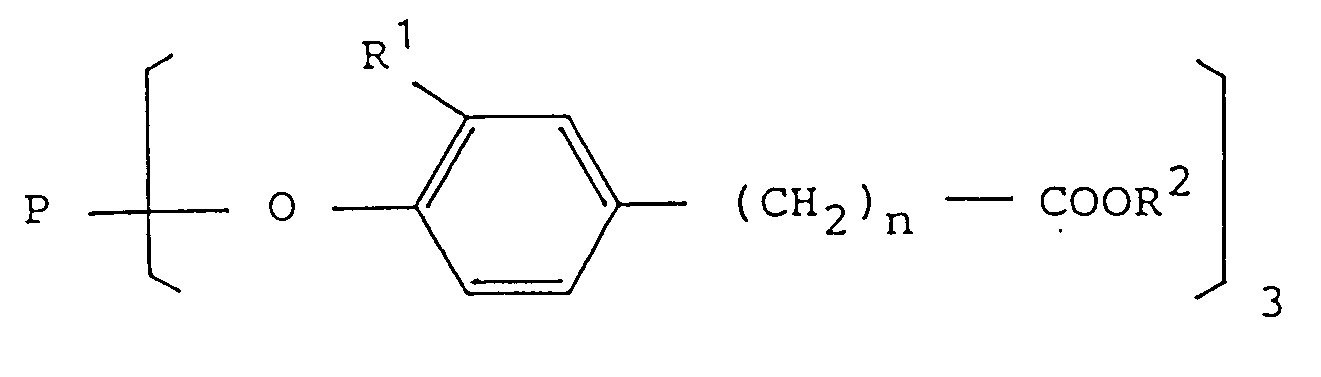
- Utilisation selon la revendication 3, dans laquelle le dérivé de phosphite est utilisé conjointement avec un composé phénolique comportant un encombrement stérique.
- Utilisation selon la revendication 4, dans laquelle ledit composé phénolique comportant un encombrement stérique est choisi dans le groupe comprenant le 2,6-di-tert-butyl-4-méthylphenol, le 4-hydroxyméthyl-2,6-di-tert-butylphénol, le 2,6-di-tert-butyl-4-éthylphénol, le butylhydroxyanisole, le 3-(4-hydroxy-3,5-di-tert-butylphényl)propionate d'octadécyle, le (4-hydroxy-3-méthyl-5-tert-butyl)benzylmalonate de distéaryle, le gallate de propyle, le gallate d'octyle, le gallate de dodécyle, le tocophérol, le 2,2'-méthylènebis(4-éthyl-6-tert-butylphénol), le 4,4-méthylènebis(2,6-di-tert-butylphénol), le 4,4'-butylidènebis(6-tert-butyl-m-crésol), le styrènephénol, le N,N'-hexaméthylènebis(3,5-di-tert-butyl-4-hydroxyhydrocinnamide), l'ester de l'acide 3,5-di-tert-butylhydroxybenzylphosphonique-aminoéthylique - calcium, le 1,1,3-tris(2-méthyl-4-hydroxy-5-tert-butylphényl)butane, le 1,3,5-triméthyl-2,4,6-tris(3,5-di-tert-butyl-4-hydroxybenzyl)benzène, le tétrakis(3-(3,5-di-tert-butyl-4-hydroxyphényl)propionyloxyméthyl)méthane, le 1,6-hexanediol-bis(3-(3,5-di-tert-butyl-4-hydroxyphényl)propionate, le 2,2'-dihydroxy-3,3'-dicyclohexyl-5,5'-diméthylphénylméthane, le 2,2'-méthylènebis(6-(1-méthylcyclohexyl)-p-crésol), l'acide 1,3,5-tris(4-tert-butyl-3-hydroxy-2,6-diméthylbenzyl)isocyanurique, la 1,3,5-tris(3,5-di-tert-butyl-4-hydroxybenzyl)-s-triazine-2,4,6-(1H,3H,5H)-trione, le bis(3-(3-tert-butyl-4-hydroxy-5-méthylphényl)propionate) de triéthylèneglycol, le 2,2'-oxamide bis(éthyl 3-(3,5-di-tert-butyl-4-hydroxyphényl)propionate), la 6-(4-hydroxy-3,5-di-tert-butylanilino)-2,4-dioctylthio-1,3,5-triazine, le bis(2-tert-butyl-4-méthyl-6-(2-hydroxy-3-tert-butyl-5-méthylbenzyl)phényl)téréphtalate, le 3,9-bis(2-(3-(3-tert-butyl-4-hydroxy-5-méthylphényl)propionyloxy)-1,1-diméthyléthyl)-2,4,8,10-tétraoxaspiro(5.5)undécane, le 3,9-bis(2-(3-(3,5-di-tert-butyl-4-hydroxyphényl)propionyloxy)-1,1-diméthyléthyl)-2,4,8,10-tétraoxaspiro(5.5)undécane et l'acide 3,9-bis(2-(3-(3,5-di-tert-butyl-4-hydroxyphényl)propionyloxy)-1,1-diméthyléthyl)-2,4,8,10-tétraoxaspiro(5.5)undécane.
- Utilisation selon la revendication 3, dans laquelle le dérivé de phosphite est utilisé conjointement avec un dérivé de thioalcanoate choisi parmi le thiopropionate de dilauryle, le thiodipropionate de distéaryle, le thiodipropionate de dimyristyle et le tétrakis(β-laurylthiopropionate) de pentaérythritol.
- Utilisation selon la revendication 3, dans laquelle le dérivé de phosphite est utilisé conjointement avec un agent stabilisant contre l'effet de la lumière.
- Utilisation selon la revendication 7, dans laquelle l'agent stabilisant contre l'effet de la lumière est choisi dans le groupe comprenant le salicylate de phényle, le salicylate de p-tert-butyle, le salicylate de p-octyphényle, la 2,4-dihydroxybenzophénone, la 2-hydroxy-4-acétoxyéthoxybenzophénone, la 2-hydroxy-4-méthoxybenzophénone, la 2,2'-dihydroxy-4,4'-méthoxybenzophénone, la 2-hydroxy-4-n-octyloxybenzophénone, la 2-hydroxy-4-isooctyloxybensophénone, la 2-hydroxy-4-dodécyloxybenzophénone, la 2-hydroxy-4-octadécyloxybenzophénone disodique, la 2,2'-dihydroxy-4,4'-diméthoxy-5,5'-disulfobenzophénone, la 2-hydroxy-4-(2-hydroxy-3-méthacryloxy)propoxybenzophénone, le 2-(2-hydroxy-5-méthylphényl)benzotriazole, le 2-(2-hydroxy-3,5-di-tert-butylphényl)benzotriazole, le 2-(2-hydroxy-3-tert-butyl-5-méthylphényl)-5-chlorobenzotriazole, le 2-(2-hydroxy-3,5-di-tert-butylphényl)-5-chlorobenzotriazole, le 2-(2-hydroxy-3,5-di-tert-butylphényl)benzotriazole, le 2-(2-hydroxy-5-tert-octylophényl)benzotriazole, le 3,5-di-tert-butyl-4-hydroxybenzoate de 2,4-di-tert-butylphényle, le 2-cyano-3,5-diphénylacrylate d'éthyle, la nickel(2,2-thiobis(4-tert-octyl-phénolate))-n-butylamine, le nickel bis(octyphénylsulfure), le nickel bis(o-éthyl(3,5-di-tert-butyl-4-hydroxybenzyl))phosphonate, le bis(2,2,6,6-tétraméthyl-4-pipéridine)sébacate, le bis(1,2,2,6,6-pentaméthyl-4-pipéridyl)-n-butyl-3,5-di-tert-butyl-4-hydroxybenzylmalonate, le tétrakis(2,2,6,6-tétraméthyl-4-pipéridyl)butane-1,2,3,4-tétracarboxylate, le poly((6-(1,1,3,3-tétraméthyl-4-pipéridyl)amino)-s-triazine-2,4-diyle), le ((2,2,6,6-tétraméthyl-4-pipéridyl)imino)hexaméthylène((2,2,6,6-tétraméthyl-4-pipéridyl)imino), le poly(6-morpholino-s-triazine-2,4-diyl)((2,2,6,6-tétraméthyl-4-pipéridyl)imino)-hexaméthylène((2,2,6,6-tétraméthyl-4-pipéridyl)imino), le produit de condensation de 1-hydroxyéthyl-2,2,6,6-tétraméthyl-4-pipéridinol/acide succinique, et le produit de condensation de chlorure cyanurique/tert-octylamine/1,6-bis-(2,2,6,6-tétraméthyl-4-pipéridylamino)hexane.
Applications Claiming Priority (2)
| Application Number | Priority Date | Filing Date | Title |
|---|---|---|---|
| JP63077622A JPH0699455B2 (ja) | 1988-03-29 | 1988-03-29 | ホスファイト化合物 |
| JP77622/88 | 1988-03-29 |
Publications (3)
| Publication Number | Publication Date |
|---|---|
| EP0335262A2 EP0335262A2 (fr) | 1989-10-04 |
| EP0335262A3 EP0335262A3 (fr) | 1991-01-02 |
| EP0335262B1 true EP0335262B1 (fr) | 1995-05-31 |
Family
ID=13639000
Family Applications (1)
| Application Number | Title | Priority Date | Filing Date |
|---|---|---|---|
| EP89105226A Expired - Lifetime EP0335262B1 (fr) | 1988-03-29 | 1989-03-23 | Composés du type phosphite |
Country Status (4)
| Country | Link |
|---|---|
| US (1) | US5077424A (fr) |
| EP (1) | EP0335262B1 (fr) |
| JP (1) | JPH0699455B2 (fr) |
| DE (1) | DE68922875T2 (fr) |
Families Citing this family (4)
| Publication number | Priority date | Publication date | Assignee | Title |
|---|---|---|---|---|
| US6995121B1 (en) | 2002-06-24 | 2006-02-07 | Seagate Technology Llc | Stability polymeric lubricants and thin film recording media comprising same |
| US6846542B1 (en) | 2002-09-30 | 2005-01-25 | Seagate Technology Llc | UV treatment for improving performance of lubricated thin film recording media and media obtained thereby |
| US10023739B2 (en) * | 2012-11-21 | 2018-07-17 | Stratasys, Inc. | Semi-crystalline build materials |
| CN107011149B (zh) * | 2017-04-26 | 2019-07-30 | 哈尔滨理工大学 | 3-叔丁基-4-羟基苯丙酸的制备方法 |
Family Cites Families (7)
| Publication number | Priority date | Publication date | Assignee | Title |
|---|---|---|---|---|
| US3558554A (en) * | 1966-06-09 | 1971-01-26 | Yoshitomi Pharmaceutical | Oxidatively stable polyolefin composition |
| CH613466A5 (en) * | 1975-02-20 | 1979-09-28 | Ciba Geigy Ag | Stabiliser system for polyolefins, comprising a symmetrical triaryl phosphite and a phenolic antioxidant |
| US4187212A (en) * | 1975-02-20 | 1980-02-05 | Ciba-Geigy Corporation | Stabilization systems from triarylphosphites and phenols |
| DE2733796A1 (de) * | 1976-07-30 | 1978-02-02 | Ciba Geigy Ag | Neue gehinderte phosphite |
| US4182704A (en) * | 1976-07-30 | 1980-01-08 | Ciba-Geigy Corporation | Hindered phenyl phosphites |
| US4163007A (en) * | 1976-07-30 | 1979-07-31 | Ciba-Geigy Corporation | New stabilizers |
| JPS594629A (ja) * | 1982-06-30 | 1984-01-11 | Dainippon Ink & Chem Inc | 安定化合成樹脂組成物 |
-
1988
- 1988-03-29 JP JP63077622A patent/JPH0699455B2/ja not_active Expired - Lifetime
-
1989
- 1989-03-17 US US07/326,038 patent/US5077424A/en not_active Expired - Fee Related
- 1989-03-23 DE DE68922875T patent/DE68922875T2/de not_active Expired - Fee Related
- 1989-03-23 EP EP89105226A patent/EP0335262B1/fr not_active Expired - Lifetime
Also Published As
| Publication number | Publication date |
|---|---|
| DE68922875D1 (de) | 1995-07-06 |
| US5077424A (en) | 1991-12-31 |
| JPH01249785A (ja) | 1989-10-05 |
| DE68922875T2 (de) | 1995-11-16 |
| EP0335262A2 (fr) | 1989-10-04 |
| EP0335262A3 (fr) | 1991-01-02 |
| JPH0699455B2 (ja) | 1994-12-07 |
Similar Documents
| Publication | Publication Date | Title |
|---|---|---|
| DE3850143T2 (de) | Antioxydante aromatische Fluorophosphite. | |
| EP0000544B1 (fr) | Résines thermoplastiques stabilisées contre la chaleur, contenant des composés ayant des liaisons phosphore-phosphore | |
| EP0516006B1 (fr) | Composés de 4,4'-biphénylènediphosphonite et leur utilisation | |
| US5288869A (en) | Pentaerythryl phosphonates and their use in self-extinguishing thermoplastic polymeric compositions | |
| JP2924357B2 (ja) | 亜リン酸エステル化合物、その製法および用途 | |
| JPS61165397A (ja) | ペンタエリスリトールジホスフイツト類、その製造方法及びその安定化剤としての使用 | |
| EP0684250B1 (fr) | Poly(pentaerythrityldiphosphonate) et son utilisation dans des compositions autoextinctrices | |
| US4929654A (en) | Cyclic phosphites and stabilized polymeric compositions | |
| US6653494B2 (en) | Processes for producing triaryl phosphite | |
| US4076690A (en) | Phosphonates, process for their manufacture and organic materials stabilized therewith | |
| US5077424A (en) | Phosphite compounds | |
| EP0414916B1 (fr) | Compose de phosphite et son application | |
| US4417071A (en) | Phenols useful as stabilizers | |
| JPH047754B2 (fr) | ||
| CH492740A (de) | Verfahren zur Herstellung von halogenierten Estern der Phosphorsäuren | |
| JP2662509B2 (ja) | 6−アリール−6H−ジベンゾ−〔c,e〕〔1,2〕−オキサホスホリンの製造方法 | |
| US4439564A (en) | 5-Membered cyclic phosphonates and compositions thereof | |
| EP0524640B1 (fr) | Arylesters de l'acide diarylphosphineux, procédé de leur préparation et leur utilisation pour stabiliser des matières synthétiques, en particulier des matières moulables polyoléfiniques | |
| KR0169086B1 (ko) | 신규한 아릴 포스포나이트, 그의 제조방법 및 플라스틱, 특히 폴리올레핀 성형 조성물을 안정화시키기 위한 그의 용도 | |
| US4424172A (en) | 5,5-Bis-(Bromomethyl)-2-hydroxy-2-oxo-1,3,2-dioxaphosphorinanes and process for preparing same | |
| US3116309A (en) | Heterocyclic compounds containing ring carbon, nitrogen and phosphorus or arsenic atoms and their preparation | |
| US5972248A (en) | Stabilizers based on 1-aza-2,2,6,6 tetramethybicyclo [3.1.0]hexane | |
| US5659060A (en) | Process for making aryl fluorophosphites useful as stabilizers | |
| KR19990047445A (ko) | 신규한 모노(2,2,6,6-테트라메틸 피페리딜) 디아릴 포스페이트화합물, 그의 제조방법 및 그를 포함하는 수지 조성물 | |
| US3850884A (en) | Bis-(beta-aminoacrylyl)derivatives used as heat stabilizers for chlorinated polymers |
Legal Events
| Date | Code | Title | Description |
|---|---|---|---|
| PUAI | Public reference made under article 153(3) epc to a published international application that has entered the european phase |
Free format text: ORIGINAL CODE: 0009012 |
|
| AK | Designated contracting states |
Kind code of ref document: A2 Designated state(s): DE FR GB IT NL |
|
| PUAL | Search report despatched |
Free format text: ORIGINAL CODE: 0009013 |
|
| AK | Designated contracting states |
Kind code of ref document: A3 Designated state(s): DE FR GB IT NL |
|
| 17P | Request for examination filed |
Effective date: 19901205 |
|
| 17Q | First examination report despatched |
Effective date: 19930825 |
|
| GRAA | (expected) grant |
Free format text: ORIGINAL CODE: 0009210 |
|
| AK | Designated contracting states |
Kind code of ref document: B1 Designated state(s): DE FR GB IT NL |
|
| PG25 | Lapsed in a contracting state [announced via postgrant information from national office to epo] |
Ref country code: IT Free format text: LAPSE BECAUSE OF FAILURE TO SUBMIT A TRANSLATION OF THE DESCRIPTION OR TO PAY THE FEE WITHIN THE PRE;WARNING: LAPSES OF ITALIAN PATENTS WITH EFFECTIVE DATE BEFORE 2007 MAY HAVE OCCURRED AT ANY TIME BEFORE 2007. THE CORRECT EFFECTIVE DATE MAY BE DIFFERENT FROM THE ONE RECORDED.SCRIBED TIME-LIMIT Effective date: 19950531 Ref country code: NL Free format text: LAPSE BECAUSE OF FAILURE TO SUBMIT A TRANSLATION OF THE DESCRIPTION OR TO PAY THE FEE WITHIN THE PRESCRIBED TIME-LIMIT Effective date: 19950531 Ref country code: FR Effective date: 19950531 |
|
| REF | Corresponds to: |
Ref document number: 68922875 Country of ref document: DE Date of ref document: 19950706 |
|
| EN | Fr: translation not filed | ||
| NLV1 | Nl: lapsed or annulled due to failure to fulfill the requirements of art. 29p and 29m of the patents act | ||
| PG25 | Lapsed in a contracting state [announced via postgrant information from national office to epo] |
Ref country code: GB Effective date: 19960323 |
|
| PLBE | No opposition filed within time limit |
Free format text: ORIGINAL CODE: 0009261 |
|
| STAA | Information on the status of an ep patent application or granted ep patent |
Free format text: STATUS: NO OPPOSITION FILED WITHIN TIME LIMIT |
|
| 26N | No opposition filed | ||
| GBPC | Gb: european patent ceased through non-payment of renewal fee |
Effective date: 19960323 |
|
| PGFP | Annual fee paid to national office [announced via postgrant information from national office to epo] |
Ref country code: DE Payment date: 19990423 Year of fee payment: 11 |
|
| PG25 | Lapsed in a contracting state [announced via postgrant information from national office to epo] |
Ref country code: DE Free format text: LAPSE BECAUSE OF NON-PAYMENT OF DUE FEES Effective date: 20010103 |