EP0335540B1 - Verfahren zum Reformieren einer dimethylbutanfreien Kohlenwasserstofffraktion - Google Patents
Verfahren zum Reformieren einer dimethylbutanfreien Kohlenwasserstofffraktion Download PDFInfo
- Publication number
- EP0335540B1 EP0335540B1 EP89302679A EP89302679A EP0335540B1 EP 0335540 B1 EP0335540 B1 EP 0335540B1 EP 89302679 A EP89302679 A EP 89302679A EP 89302679 A EP89302679 A EP 89302679A EP 0335540 B1 EP0335540 B1 EP 0335540B1
- Authority
- EP
- European Patent Office
- Prior art keywords
- fraction
- hydrocarbons
- reforming
- light
- dimethylbutanes
- Prior art date
- Legal status (The legal status is an assumption and is not a legal conclusion. Google has not performed a legal analysis and makes no representation as to the accuracy of the status listed.)
- Expired - Lifetime
Links
Images

Classifications
-
- C—CHEMISTRY; METALLURGY
- C10—PETROLEUM, GAS OR COKE INDUSTRIES; TECHNICAL GASES CONTAINING CARBON MONOXIDE; FUELS; LUBRICANTS; PEAT
- C10G—CRACKING HYDROCARBON OILS; PRODUCTION OF LIQUID HYDROCARBON MIXTURES, e.g. BY DESTRUCTIVE HYDROGENATION, OLIGOMERISATION, POLYMERISATION; RECOVERY OF HYDROCARBON OILS FROM OIL-SHALE, OIL-SAND, OR GASES; REFINING MIXTURES MAINLY CONSISTING OF HYDROCARBONS; REFORMING OF NAPHTHA; MINERAL WAXES
- C10G35/00—Reforming naphtha
- C10G35/04—Catalytic reforming
- C10G35/06—Catalytic reforming characterised by the catalyst used
- C10G35/095—Catalytic reforming characterised by the catalyst used containing crystalline alumino-silicates, e.g. molecular sieves
-
- C—CHEMISTRY; METALLURGY
- C10—PETROLEUM, GAS OR COKE INDUSTRIES; TECHNICAL GASES CONTAINING CARBON MONOXIDE; FUELS; LUBRICANTS; PEAT
- C10G—CRACKING HYDROCARBON OILS; PRODUCTION OF LIQUID HYDROCARBON MIXTURES, e.g. BY DESTRUCTIVE HYDROGENATION, OLIGOMERISATION, POLYMERISATION; RECOVERY OF HYDROCARBON OILS FROM OIL-SHALE, OIL-SAND, OR GASES; REFINING MIXTURES MAINLY CONSISTING OF HYDROCARBONS; REFORMING OF NAPHTHA; MINERAL WAXES
- C10G59/00—Treatment of naphtha by two or more reforming processes only or by at least one reforming process and at least one process which does not substantially change the boiling range of the naphtha
- C10G59/06—Treatment of naphtha by two or more reforming processes only or by at least one reforming process and at least one process which does not substantially change the boiling range of the naphtha plural parallel stages only
-
- C—CHEMISTRY; METALLURGY
- C10—PETROLEUM, GAS OR COKE INDUSTRIES; TECHNICAL GASES CONTAINING CARBON MONOXIDE; FUELS; LUBRICANTS; PEAT
- C10L—FUELS NOT OTHERWISE PROVIDED FOR; NATURAL GAS; SYNTHETIC NATURAL GAS OBTAINED BY PROCESSES NOT COVERED BY SUBCLASSES C10G OR C10K; LIQUIFIED PETROLEUM GAS; USE OF ADDITIVES TO FUELS OR FIRES; FIRE-LIGHTERS
- C10L1/00—Liquid carbonaceous fuels
- C10L1/04—Liquid carbonaceous fuels essentially based on blends of hydrocarbons
- C10L1/06—Liquid carbonaceous fuels essentially based on blends of hydrocarbons for spark ignition
Definitions
- the process of this invention provides for reforming of a hydrocarbon stream substantially free of dimethylbutanes.
- the improved process is beneficial for any of several purposes, including the upgrading of motor gas (mogas) pools, or enhancing the yield of aromatic compounds in petrochemical operations.
- Hydrocarbons can be subjected to a variety of processes, depending upon the product or products desired, and their intended purposes.
- a particularly significant process for treating hydrocarbons is that of reforming.
- the reforming process is generally applied to fractions in the C6-C11 range.
- the light fractions are unsuitable because they crack to lighter gases at reforming conditions; the heavier fractions cause higher coking rates (deposition of carbon on the catalyst), and therefore accelerate deactivation of the catalyst.
- a variety of reactions occur as part of the reforming process. Among such reactions are dehydrogenation, isomerization, and hydrocracking.
- the dehydrogenation reactions typically include dehydroisomerization of alkylcyclopentanes to aromatics, dehydrogenation of paraffins to olefins, dehydrogenation of cyclohexanes to aromatics, and dehydrocyclization of paraffins and olefins to aromatics. Reforming processes are especially useful in refinery operations for upgrading mogas pool octane value, and in petrochemical operations for enhancing aromatics yield, as well as producing hydrogen.
- catalysts are used for conducting the reforming of hydrocarbon streams.
- One means of categorizing the type of catalysts so used is by designating them as “monofunctional” and “bifunctional” catalysts.
- Monofunctional catalysts are those which accomplish all of the reforming reactions on one type of site - usually, a catalytically active metal site. These catalysts are monofunctional by virtue of lacking an acidic site for catalytic activity.
- Examples of monofunctional catalysts include the large pore zeolites, such as zeolites L, Y, and X and the naturally occurring faujasite and mordenite, wherein the exchangeable cation comprises a metal such as alkali or alkaline earth metal; such catalysts also comprise one or more Group VIII metals providing the catalytically active metal sites, with platinum being a preferred Group VIII metal. Exchange of the metallic exchangeable cation of the zeolite crystal with hydrogen will provide acidic sites, thereby rendering the catalyst bifunctional.
- a bifunctional catalyst is rendered bifunctional by virtue of including acidic sites for catalytic reactions, in addition to catalytically active metal sites.
- conventional bifunctional reforming catalysts include those which comprise metal oxide support acidified by a halogen, such as chloride, and a Group VIII metal.
- a preferred metal oxide is alumina, and a preferred Group VIII metal is platinum.
- Both bifunctional and monofunctional catalysts are equally well suited for reforming the naphthenes, or saturated cycloalkanes.
- Monofunctional catalysts are particularly suited for reforming the C6-C8 hydrocarbons, and bifunctional catalysts are better suited than monofunctional catalysts for reforming the C9+ hydrocarbons. It has been discovered that the presence of about 10 percent by volume or greater C9+ content in a hydrocarbon fraction significantly inhibits catalytic activity in monofunctional catalysts as described in US 4897177.
- the monofunctional catalysts are particularly suited for reforming the C6-C8 hydrocarbons.
- the presence of dimethylbutanes, the lowest-boiling of the C6 isomers, in the hydrocarbon fraction treated over monofunctional catalyst is commercially disadvantageous for two reasons.
- dimethylbutanes have the highest octane rating among the non-aromatic C6 hydrocarbons, and are therefore of the most value in the mogas pool. Subjecting dimethylbutanes to catalytic activity renders them unavailable for upgrading the value of the mogas pool to the extent that they are cracked.
- dimethylbutanes are removed from a hydrocarbons stream prior to reforming.
- the inventive process therefore provides benefits not taught or disclosed in the prior art.
- the terms “light fraction” and “heavy fraction” refer to the carbon number range of the hydrocarbons comprising the indicated fraction. These terms are used in a relative manner; a “heavy fraction” is defined in reference to the carbon number range of its corresponding "light” fraction, and visa versa.
- a "light" fraction may be a C6 fraction, a C7 fraction, a C8 fraction, a C6 - C7 fraction, a C7 - C8 fraction, a C6 - C8 fraction, or a fraction consisting essentially of C6 and C8 hydrocarbons.
- a light fraction comprises not more than about 10%, preferably not more than about 3%, more preferably not more than about 0.1%, and, most preferably, 0%, or essentially 0% by volume dimethylbutanes.
- a light fraction preferably comprises no more than about 10%, and, most preferably, no more than about 2% by volume C5- hydrocarbons. Also, a light fraction preferably comprises no more than about 5%, and, more preferably, about 2% by volume C9+ hydrocarbons.
- a "heavy" fraction comprises a range of hydrocarbons wherein the lowest carbon number compound is one carbon number higher than the highest carbon number compound of the corresponding light fraction.
- the corresponding heavy fraction is C7+.
- the corresponding heavy fraction is C8+.
- the light fraction is C8, C7 - C8, C6 - C8, or a fraction consisting essentially of C6 and C8 hydrocarbons, the corresponding heavy fraction is C9+.
- the C5- fraction is understood to include the C6 dimethylbutane isomers.
- particular fractions are not necessarily comprised exclusively of hydrocarbons within the indicated carbon number range of the fraction. Other hydrocarbons may also be present. Accordingly, a fraction of particular carbon number range may contain up to 15 percent by volume of hydrocarbons outside the designated hydrocarbon number range. A particular hydrocarbon fraction preferably contains not more than about 5%, and, most preferably, not more than about 3% by volume, of hydrocarbons outside the designated hydrocarbon range.
- first and second fractions When the hydrocarbon feed is separated into first and second fractions prior to the reforming steps, preferably at least 75%, more preferably 90%, and, most preferably, 95% by volume of the proportion of dimethylbutanes present in the hydrocarbon feed are separated out with the first fraction.
- the separation of the first and second fractions is desirably effected so that as much as 90-98% by volume, and even up to essentially 100% by volume of such dimethylbutanes are so separated, while much of the heavier C6 content of the hydrocarbon feed is included with the second fraction.
- the second fraction comprises not more than 3%, preferably about 1%, and, most preferably about 0% by volume of dimethylbutanes.
- the invention pertains to a reforming process in which a hydrocarbon fraction comprising not more than 10% by volume dimethylbutanes is reformed.
- This hydrocarbon fraction preferably comprises not more than 3%, more preferably not more than 0.1%, of dimethylbutanes and most preferably is substantially free of dimethylbutanes.
- this hydrocarbon fraction is a C6 fraction, a C7 fraction, a C8 fraction, a C6-C7 fraction, a C7-C8 fraction, a C6-C8 fraction, or a fraction consisting essentially of C6 and C8 hydrocarbons.
- the process can take place under reforming conditions, in the presence of a monofunctional catalyst.
- a monofunctional catalyst comprises a large-pore zeolite and at least one Group VIII metal.
- a suitable large-pore zeolite is zeolite L, and the Group VIII metal may be platinum.
- the monofunctional catalyst may further comprise an alkaline earth metal; preferred alkaline earth metals include magnesium, barium, strontium, and calcium.
- the invention further pertains to a process for reforming a hydrocarbon feed, which is preferably a C5-C11 hydrocarbon fraction.
- the hydrocarbon feed is separated into a first fraction and a second fraction, with the first fraction containing at least about 75% by volume of the proportion of dimethylbutanes present in the hydrocarbon feed.
- the second fraction preferably comprises not more than about 1%, and, most preferably, essentially 0% by volume dimethylbutanes. At least a portion of the second fraction is subjected to reforming in the presence of a reforming catalyst.
- the second fraction is separated into a light fraction and a heavy fraction.
- the light fraction comprises, by volume, not more than about 10%, preferably not more than about 3%, more preferably not more than about 0.1%, and, most preferably, no, or essentially no dimethylbutanes.
- the heavy fraction comprises a range of hydrocarbons wherein the lowest carbon number hydrocarbon is one carbon number higher than the highest carbon number hydrocarbon of the light fraction.
- the first fraction comprises C5-hydrocarbons and dimethylbutanes
- the second fraction is a C6+ fraction
- the light fraction may be a C6 fraction, a C7 fraction, a C8 fraction, a C6-C7 fraction, a C7-C8 fraction, a C6-C8 fraction, or a fraction consisting essentially of C6 and C8 hydrocarbons; preferably, the light fraction in this embodiment is C6-C8 fraction.
- the first fraction may be a C6- fraction, and the second fraction a C7+ fraction;
- the light fraction may be a C7 fraction, a C8 fraction, or a C7-C8 fraction.
- the light fraction is preferably a C7-C8 fraction.
- the monofunctional catalyst of the process of the invention preferably comprises a large-pore zeolite and at least one Group VIII metal.
- the large-pore zeolite is Zeolite L
- the Group VIII metal of the monofunctional catalyst is platinum.
- the monofunctional catalyst may further comprise an alkaline earth metal selected from the group consisting of calcium, barium, magnesium, and strontium.
- the indicated heavy fraction may also be reformed under reforming conditions; preferably, this reforming takes place in the presence of a bifunctional catalyst.
- this bifunctional catalyst comprises a Group VIII metal, and a metal oxide support provided with acidic sites.
- the preferred metal oxide support is alumina, and the preferred Group VIII metal of the bifunctional catalyst is platinum.
- the bifunctional catalyst may further comprise at least one promoter metal selected from the group consisting of rhenium, tin, germanium, iridium, tungsten, cobalt, rhodium, and nickel.
- the catalyst employed in reforming of the hydrocarbon light fraction is a monofunctional catalyst, providing a single type of reactive site for catalyzing the reforming process.
- this monofunctional catalyst comprises a large-pore zeolite charged with one or more Group VIII metals, e.g. platinum, palladium, iridium, ruthenium, rhodium, osmium, or nickel.
- Group VIII metals e.g. platinum, palladium, iridium, ruthenium, rhodium, osmium, or nickel.
- the preferred of these metals are the Group VIII noble metals, including rhodium, iridium, and, platinum. The most preferred such metal is platinum.
- Large-pore zeolites are defined as zeolites having an effective pore diameter of about 0.6-1.5 x 10 ⁇ 10 m (6-15 Angstroms).
- zeolites suitable for the monofunctional catalysts are zeolite X, zeolite Y, and zeolite L, as well as such naturally occuring zeolites as faujasite and mordenite.
- the most preferred large-pore zeolite is zeolite L.
- the exchangeable cation of the large-pore zeolite may be one or more metals selected from the group consisting of alkali metals and alkaline earth metals; the preferred alkali metal is potassium.
- the exchangeable cation comprises one or more alkali metals which can be partially or substantially fully exchanged with one or more alkaline earth metals; the preferred such alkaline earth metals are barium, strontium, magnesium, and calcium.
- Cation exchange may also be effected with zinc, nickel, manganese, cobalt, copper, lead, and cesium.
- alkaline earth metals are barium.
- the alkaline earth metal can be incorporated into the zeolite by synthesis or impregnation.
- the monofunctional catalyst may further comprise one or more of an inorganic oxide, which may be utilized as a carrier to bind the large-pore zeolite containing the Group VIII metal.
- an inorganic oxide include clays, alumina, and silica, the most preferred being alumina.
- the bifunctional catalyst of the inventive process is a conventional reforming catalyst, comprising a metal oxide support provided with acidic sites, and a Group VIII metal.
- Suitable metal oxides include alumina and silica, with alumina being preferred.
- the acidic sites are preferably provided by the presence of a halogen, such as chlorine.
- the preferred Group VIII metal is platinum.
- One or more additional promoter elements such as rhenium, tin, germanium, cobalt, nickel, iridium, rhodium, ruthenium, may also be included.
- Each of the monofunctional and bifunctional catalysts is utilized under reforming conditions conventional for the particular catalyst. Reformation with either or both of the catalysts is carried out in the presence of hydrogen.
- dimethylbutanes have the highest octane rating of any C6 isomer, and therefore have the most value for the purpose of upgrading the mogas pool.
- subjecting the dimethylbutanes to the monofunctional catalyst will result in the cracking of a large portion of these isomers to less valuable light gases.
- Table I comparatively illustrates yields obtained from subjecting a feed mixture of n-hexane, 3-methyl pentane, and methyl cyclopentane and a feed of 2,3-dimethylbutane to reforming conditions over a monofunctional catalyst comprising Zeolite-L with alumina binder and platinum (0.6 wt%). Both of these C6 isomers were reacted over monofunctional catalyst at a temperature of 510°C (950°F), under 690 kPa (100 psig) H2 partial pressure, at a space velocity of 2.5 WHSV, and a H2/oil molar ratio of 6.0.
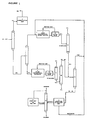
- Figs. 1 and 2 discussed below, illustrate the utilization of the process of the invention in petrochemical and refinery operations, respectively. It is noted that these two embodiments are provided merely by way of example, not limitation, and demonstrate two particular methods for utilizing the process of the invention.
- a crude oil stream is subjected to rough separation in a pipe still (not shown) to produce a naphtha feed stream, which is fed from the pipe still directly into distillation tower 1.
- the naphtha feed stream comprises a C5-C11 fraction of hydrocarbons, and contains 50% paraffins, 33% naphthenes, and 17% aromatics.
- Distillation tower 1 is a 50 tray distillation tower.
- the condenser, provided at the top of the tower, is operated at 49°C (120°F) and 310 kPa (45 psia), with a reflux ratio of about 0.8.
- the reboiler, provided at the bottom of distillation tower 1, is operated at 143°C (290°F), and at a pressure of 379 kPa (55 psia).
- this C5-C11 fraction is separated into a C5- fraction and a C6+ fraction.
- the C5-fraction contains 14% C6 hydrocarbons, with the remainder being C5- hydrocarbons.
- 10% of the C6 hydrocarbons are dimethylbutanes; the dimethylbutanes which split off with the C5- hydrocarbons in this fraction comprise 85% of the dimethylbutanes present in the C5-C11 fraction prior to this separation.
- This C5- fraction is removed overhead from distillation tower 1. This fraction may be blended directly into the mogas pool. Alternatively, this fraction may be sent to isomerization unit 2, wherein its octane value is upgraded, and may thereafter be sent to the mogas pool.
- distillation tower 3 which comprises 50 trays.
- the condenser at the top of the tower, is operated at 88°C (190 °F), at a pressure of 172 kPa (25 psia), and a reflux ratio of 2.5.
- the reboiler at the bottom of the tower, is operated at 160°C (320 °F) and 241 kPa (35 psia).
- the C6+ fraction is separated into a C6-C8 fraction and a C9+ fraction. Because, as discussed previously herein, excessive C9+ content interferes with the activity of the monofunctional catalyst, a sharp cut is made between the C8 and C9 hydrocarbons.
- the resultant C6-C8 fraction contains 1% C5-hydrocarbons, 28% C6 hydrocarbons, 32% C7 hydrocarbons, 35 % C8 hydrocarbons, and 4% C9+ hydrocarbons; the C9+ fraction contains 9% C8- hydrocarbons, 48% C7-C9 hydrocarbons, 29% C10 hydrocarbons, and 14% C11 hydrocarbons.
- reactor 4 contains the monofunctional reforming catalyst.
- the catalyst comprises potassium zeolite L, with 28% by weight alumina binder and 0.6% by weight platinum. Reforming is conducted in the presence of hydrogen gas; reactor 4 is operated at 454°-482°C (850°-900° F), 1.5 WHSV, 1103 kPa (160 psig), and a hydrogen to hydrocarbon mole ratio of 4.
- the product which results from this reforming contains 10% benzene, 14% toluene, 16% xylenes, 38% C5-C8 paraffins and naphthenes and the remainder light gases and hydrogen.
- the effluent from reactor 4 is fed into flash drum 5, operated at 43°C (110°F) and approximately 793 kPa (115 psig). Therein, a crude separation between C4- light gases and a C5+ fraction, with the C5+ fraction retaining about 2% of the C4-fraction, and further containing 98% or more of the effluent aromatics.
- a stream including the C4- fraction and hydrogen from flash drum 5 is recycled as needed to reactor 4; the excess of this stream is removed from the process system, with by-products being recovered therefrom.
- distillation tower 6 comprising 30 trays, functions as a reformate stabilizer.
- the condenser is operated at 88°C (190°F) and 689 kPa (100 psia); the reboiler, at 149°C (300°F) and 724 kPa (105 psia).
- the resultant C5+ fraction contains, by volume, 2% C5- hydrocarbons, 17% benzene, 22% toluene, 27% xylenes, and 32% C6-C8 paraffins and naphthenes.
- the C9+ fraction from distillation tower 3 is fed into conventional reformer 7, which contains a bifunctional catalyst comprising, by weight, 0.3% platinum, 0.3% rhenium, 0.8% chlorine, and 98.6% alumina.
- Reformer 7 is operated at 454°-527°C (850°-980°F), 1.5 WHSV, 207 kPa (300 psig), and a recycled gas rate of 2.0 kSCFH/Bbl of feed.
- reforming is conducted in the presence of hydrogen.
- Reformer 7 is operated at conditions predetermined to result in a product having an octane of 103.
- This product contains, by volume, 18% hydrogen, 21% C5- hydrocarbons, 1% benzene, 3% other C6 hydrocarbons (excluding benzene), 1% toluene, 2% other C7 hydrocarbons, 9% xylenes, 3% other C8 hydrocarbons, 39% C9+ aromatics, and 3% other C9+ hydrocarbons.
- This product is fed as effluent to flash drum 8 and distillation tower 9, which operate in the same manner with regard to reformer 7 as flash drum 5 and distillation tower 6 perform with reactor 4.
- flash drum 8 a crude separation is effected between the C4- light gases and a C5+ effluent; after this crude separation, the C5+ effluent retains about 2% of the C4- hydrocarbons.
- the C4- fraction thus separated is recycled with hydrogen, as needed, to reformer 7, with excess removed from the process system for recovery of valuable by-products.
- the C5+ effluent is fed from flash drum 8 into distillation tower 9, which comprises 30 trays.
- the condenser, in the top section of this tower, is operated at 88°C (190°F) and 689 kPa (100 psia); the reboiler, in the bottom section, is operated at 149°C (300°F) and 724 kPa (105 psia).
- the resultant C5+ fraction contains, by volume, 2% C4- hydrocarbons, 6% C5 hydrocarbons, 4% C6 hydrocarbons (excluding benzene), 1% benzene, 3% C7 hydrocarbons (excluding toluene), 2% toluene, 14% xylenes, 5% other C8 hydrocarbons, 4% other C9 hydrocarbon, 38% C9 aromatics, 1% C10+ hydrocarbons (excluding aromatics), and 20% C10+ aromatics.
- Example 1 pertains to petrochemical operations, wherein the objective is to maximize aromatics production.
- distillation tower 10 which comprises 30 trays.
- the top section of the this tower, the condenser, is operated at 127°C (260°F), and 207 kPa (30 psia); the bottom, the reboiler, at 221°C (430°F) and 345 kPa (50 psia).
- this C5+ effluent is separated into a C6-C8 fraction, which comprises substantially all of the desirable light aromatic components of the C5+ effluent, and a C9+ fraction.
- the indicated C6-C8 fraction comprises, by volume, 1% benzene, 26% toluene, 44% xylene, 2% C9+ aromatics, and 27% C6-C10+ non-aromatic hydrocarbons.
- the C9+ fraction comprises 1% xylenes, 64% C9 aromatics, 34% C10+ aromatics, and 1% other C9 hydrocarbons.
- This C9+ fraction is sent directly to the mogas pool for blending, and the C6-C8 fraction is combined with the C5+ effluent from distillation tower 6.
- This combined stream can be fed directly to aromatics extraction unit 12. More preferably, it is fed to distillation tower 11, comprising 25 trays.
- the condenser, in the upper section of tower 11, is operated at 93°C (200°F) and 207 kPa (30 psia) the reboiler, in the lower section, is operated at 149°C (300°F) and 241 kPa (35 psia).
- Distillation tower 11 is employed to remove the C6 paraffins from the feed to be provided to aromatics extraction unit 12, thereby concentrating the aromatics in this feed. Specifically, in distillation tower 11, a C6 paraffin and naphthene fraction, comprising, by volume, 1% dimethylbutane, 39% 2-methyl pentane, 51% 3-methyl pentane, 3% cyclohexane, and 6% methyl cyclopentane is separated from a higher-boiling fraction, comprising benzene through the C8 hydrocarbons.
- the C6 fraction from distillation tower 11 is particularly suitable as a feed for monofunctional catalyst reactor 4, and is recycled to this reactor.
- the fraction comprising benzene through C8 hydrocarbons, which largely comprises aromatics, is fed to aromatics extraction unit 12.
- Aromatics extraction unit 12 utilizes a solvent selective for aromatics, such as sulfolane, to extract the aromatics from the non-aromatics, the latter being primarily paraffins.
- the resulting non-aromatic raffinate is recycled to the feed entering monofunctional catalyst reactor 4, thereby enhancing aromatics yield.
- the aromatic extract from aromatics extraction unit 12 is fed to distillation tower 13, and separated therein into benzene, toluene and xylenes.
- Distillation tower 13 may be a single tower, or a series of towers, depending upon the purity of the products desired.
- distillation tower 13 comprises 40 trays.
- the condenser, at the top of the tower, is operated at 91°C (195°F) and 138 kPa (20 psia); benzene issues from the top of the tower.
- Toluene issues from the tower as a side stream at tray 21, which is operated at 124°C (255°F) and 172 kPa (25 psia).
- Xylene issues from the bottom of the tower, where the reboiler is located, and which is operated at 152°C (305°F) and 207 kPa (30 psia).
- distillation tower 13 is embodied as two towers in series, benzene issues from the top of the first tower in the series, and a mixture of toluene and xylenes issues from the bottom. This mixture is fed into the second tower in the series, with toluene taken off from the top of this tower, and xylenes from the bottom.
- the first tower in this series comprises 22 trays, with the condenser, at the top of the tower, being operated at 91°C (195°F) and 138 kPa (20 psia), and the reboiler at the bottom of the tower, being operated at 135°C (275°F) and 172 kPa (25 psia).
- the second tower comprises 20 trays, with the top of the tower being operated at 111°C (232°F) and 103 kPa (15 psia), and the bottom being operated at 141°C (285°F) and 172 kPa (25 psia).
- the toluene stream from distillation tower 13 may be fed to unit 14, which is either a toluene hydrodealkylation (TDA) unit, or a toluene disproportionation (TDP) unit.
- TDA toluene hydrodealkylation
- TDP toluene disproportionation
- the TDA unit produces 80% benzene and 20% light gases, i.e., methane and ethane.
- the TDP unit produces 50% benzene and 50% xylenes, primarily paraxylenes.
- the benzene produced in these units is fed into the benzene stream exiting overhead from distillation tower 13.
- Example 2 which demonstrates the application of the process of the invention to the enhancement of mogas octane pools in refinery operations, is described with reference to the flow diagram of Fig. 2, and the various hydrocarbon streams and units identified therein.
- the embodiment illustrated in Fig. 2 is substantially similar to that illustrated in Fig. 1.
- the primary difference is that the process used for enhancing mogas production is considerably simplified over that for maximizing aromatics yield; the former process lacks the aromatics extraction steps, which are included in the process solely for the purpose of maximizing the referred-to aromatics yield.
- One difference between the two embodiments of the process is the cut point utilized in distillation tower 1.
- the cut point in distillation tower 1 is raised, so that not only the dimethylbutanes, but a substantial portion of the other C6 isomers, are sent overhead as well.
- the overhead stream comprises, by volume, 3% n-butane, 9% i-butane, 17% n-pentane, 16% i-pentane, 1% cyclopentane, 17% n-hexane, 2% dimethyl butanes, 10% 2-methyl pentane, 8% 3-methyl pentane, 6% methyl cyclopentane, 5% cyclohexane, 5% benzene, and 1% C9 isomers.
- This stream is sent either directly to the mogas pool, or to isomerization unit 2.
- the bottoms stream from distillation tower 1 comprises primarily the C7+ hydrocarbons; specifically, this fraction comprises, by volume, 1% C6- hydrocarbons, 25% C7 hydrocarbons, 31% C8 hydrocarbons, 25% C9 hydrocarbons, 13% C10 hydrocarbons, 5% C11+ hydrocarbons.
- the light fraction resulting from distillation tower 3 in the embodiment of the Fig. 2 is a C7-C8 fraction.
- this fraction comprises, by volume, 2% C6-hydrocarbons, 44% C7 hydrocarbons, 49% C8 hydrocarbons, and 5% C9+ hydrocarbons.
- Processing units 4-9 are identical for the embodiments of both Figs. 1 and 2. However, in the refinery operation of Fig. 2, the C5+ effluent from distillation towers 6 and 9 is sent directly to the mogas pool, rather than to the aromatics extraction steps specified in the petrochemical operation illustrated in Fig. 1.
Landscapes
- Chemical & Material Sciences (AREA)
- Oil, Petroleum & Natural Gas (AREA)
- Engineering & Computer Science (AREA)
- Chemical Kinetics & Catalysis (AREA)
- General Chemical & Material Sciences (AREA)
- Organic Chemistry (AREA)
- Crystallography & Structural Chemistry (AREA)
- Production Of Liquid Hydrocarbon Mixture For Refining Petroleum (AREA)
- Organic Low-Molecular-Weight Compounds And Preparation Thereof (AREA)
- Catalysts (AREA)
Claims (13)
- Verfahren zum Reformieren eines Kohlenwasserstoffeinsatzmaterials, bei dem(a) das Kohlenwasserstoffeinsatzmaterial in eine erste Fraktion, die C₅₋-Kohlenwasserstoffe und Dimethylbutane umfaßt, und eine zweite Fraktion, die C₆₊-Kohlenwasserstoffe umfaßt, getrennt wird,(b) die zweite Fraktion in(i) eine leichte Fraktion, die nicht mehr als 10 Vol.% Dimethylbutane umfaßt, wobei die leichte Fraktion ausgewählt ist aus einer C₆-Fraktion, einer C₇-Fraktion, einer C₈-Fraktion, einer C₆- bis C₇-Fraktion, einer C₇- bis C₈-Fraktion, einer C₆- bis C₈-Fraktion und einer Fraktion, die im wesentlichen aus C₆- und C₈-Kohlenwasserstoffen besteht, und(ii) eine schwere Fraktion getrennt wird, und(c) die leichte Fraktion unter Reformierbedingungen in Gegenwart eines monofunktionalen Katalysators reformiert wird.
- Verfahren nach Anspruch 1, bei dem die erste Fraktion eine C₆₋-Fraktion und die zweite Fraktion eine C₇₊-Fraktion ist und Stufe (b) das Trennen der zweiten Fraktion in(i) eine leichte Fraktion, die nicht mehr als 10 Vol.% Dimethylbutane umfaßt, wobei die leichte Fraktion ausgewählt ist aus einer C₇-Fraktion, einer C₈-Fraktion und einer C₇- bis C₈-Fraktion, und(ii) eine schwere Fraktionumfaßt.
- Verfahren nach Anspruch 1 oder Anspruch 2, bei dem die leichte Fraktion nicht mehr als 3 Vol.% Dimethylbutane umfaßt.
- Verfahren nach Anspruch 3, bei dem die leichte Fraktion im wesentlichen frei von Dimethylbutanen ist.
- Verfahren nach einem der Ansprüche 1 bis 4, bei dem die leichte Fraktion eine C₆-Fraktion ist und nicht mehr als 1 Vol.% Dimethylbutan enthält.
- Verfahren nach einem der Ansprüche 1 bis 5, bei dem der monofunktionale Katalysator einen großporigen Zeolith mit einer Porengröße von 0,6 bis 1,5 x 10⁻¹⁰ m (6 bis 15 Å) und mindestens ein Gruppe-VIII-Metall umfaßt.
- Verfahren nach Anspruch 6, bei dem der großporige Zeolith Zeolith L ist und das Gruppe-VIII-Metall Platin ist.
- Verfahren nach Anspruch 6 oder Anspruch 7, bei dem der monofunktionale Katalysator außerdem ein Metall ausgewählt aus Magnesium, Cäsium, Calcium, Barium, Strontium, Zink, Nickel, Mangan, Kobalt, Kupfer und Blei umfaßt.
- Verfahren nach einem der Ansprüche 1 bis 8, bei dem das Kohlenwasserstoffeinsatzmaterial eine C₆- bis C₁₁-Fraktion ist.
- Verfahren nach einem der Ansprüche 1 bis 9, das außerdem das Reformieren der schweren Fraktion unter Reformierbedingungen in Gegenwart eines bifunktionalen Katalysators umfaßt.
- Verfahren nach Anspruch 10, bei dem der bifunktionale Katalysator ein Gruppe-VIII-Metall und einen Metalloxidträger, der mit sauren Stellen versehen ist, umfaßt.
- Verfahren nach Anspruch 11, bei dem der Metalloxidträger Aluminiumoxid ist und das Gruppe-VIII-Metall des bifunktionellen Katalysators Platin ist.
- Verfahren nach Anspruch 12, bei dem der bifunktionelle Katalysator außerdem mindestens ein Promotermetall ausgewählt aus Rhenium, Zinn, Germanium, Iridium, Wolfram, Kobalt, Rhodium und Nickel umfaßt.
Applications Claiming Priority (2)
| Application Number | Priority Date | Filing Date | Title |
|---|---|---|---|
| US17557088A | 1988-03-31 | 1988-03-31 | |
| US175570 | 1988-03-31 |
Publications (2)
| Publication Number | Publication Date |
|---|---|
| EP0335540A1 EP0335540A1 (de) | 1989-10-04 |
| EP0335540B1 true EP0335540B1 (de) | 1994-08-24 |
Family
ID=22640757
Family Applications (1)
| Application Number | Title | Priority Date | Filing Date |
|---|---|---|---|
| EP89302679A Expired - Lifetime EP0335540B1 (de) | 1988-03-31 | 1989-03-17 | Verfahren zum Reformieren einer dimethylbutanfreien Kohlenwasserstofffraktion |
Country Status (7)
| Country | Link |
|---|---|
| US (1) | US5849177A (de) |
| EP (1) | EP0335540B1 (de) |
| JP (1) | JP2787222B2 (de) |
| KR (1) | KR0136583B1 (de) |
| CA (1) | CA1333620C (de) |
| DE (1) | DE68917627T2 (de) |
| MY (1) | MY104420A (de) |
Cited By (1)
| Publication number | Priority date | Publication date | Assignee | Title |
|---|---|---|---|---|
| US6004452A (en) * | 1997-11-14 | 1999-12-21 | Chevron Chemical Company Llc | Process for converting hydrocarbon feed to high purity benzene and high purity paraxylene |
Families Citing this family (5)
| Publication number | Priority date | Publication date | Assignee | Title |
|---|---|---|---|---|
| JP2683508B2 (ja) * | 1995-01-23 | 1997-12-03 | インテヴェップ,エス.エイ. | パラフィンの転化触媒及びその製造方法 |
| WO1998058041A1 (en) * | 1997-06-16 | 1998-12-23 | Chevron Chemical Company Llc | Split-feed two-stage parallel aromatization for maximum para-xylene yield |
| KR100601258B1 (ko) * | 1998-12-09 | 2006-07-14 | 셰브론 필립스 케미컬 컴퍼니 엘피 | 다운스트림 디메틸부탄 제거를 수반하는 탈수소고리화 공정 |
| KR102948584B1 (ko) * | 2019-04-21 | 2026-04-06 | 셰브런 유.에스.에이.인크. | 개선된 개질 공정 |
| US11932817B1 (en) | 2023-02-13 | 2024-03-19 | Chevron Phillips Chemical Company Lp | AROMAX® process for improved selectivity and heavier feeds processing |
Citations (6)
| Publication number | Priority date | Publication date | Assignee | Title |
|---|---|---|---|---|
| US4456527A (en) * | 1982-10-20 | 1984-06-26 | Chevron Research Company | Hydrocarbon conversion process |
| US4458025A (en) * | 1982-09-20 | 1984-07-03 | Chevron Research Company | Method of zeolitic catalyst manufacture |
| US4579831A (en) * | 1983-03-29 | 1986-04-01 | Chevron Research Company | Method of zeolitic catalyst manufacture |
| US4650565A (en) * | 1982-09-29 | 1987-03-17 | Chevron Research Company | Dehydrocyclization process |
| US4652689A (en) * | 1985-05-15 | 1987-03-24 | Uop Inc. | Catalytic composite for conversion of hydrocarbons and the method of preparation and use thereof |
| US4721694A (en) * | 1982-08-06 | 1988-01-26 | Chevron Research Company | Platinum-barium-type L zeolite |
Family Cites Families (26)
| Publication number | Priority date | Publication date | Assignee | Title |
|---|---|---|---|---|
| CA895280A (en) * | 1972-03-14 | T. Mitsche Roy | Catalyst preparation and use | |
| US3005770A (en) * | 1956-01-25 | 1961-10-24 | Standard Oil Co | Process of reforming naphthas |
| US2944959A (en) * | 1958-02-26 | 1960-07-12 | Gulf Research Development Co | Process for upgrading a wide range gasoline |
| US3018244A (en) * | 1958-12-18 | 1962-01-23 | Kellogg M W Co | Combined isomerization and reforming process |
| BE598682A (de) * | 1959-12-30 | 1900-01-01 | ||
| US3644200A (en) * | 1968-12-23 | 1972-02-22 | Union Oil Co | Ammoniated zeolite catalysts |
| NL7017965A (de) * | 1969-12-17 | 1971-06-21 | ||
| US3783123A (en) * | 1970-03-09 | 1974-01-01 | Union Oil Co | Hydrocarbon conversion process |
| NL7016985A (de) * | 1970-11-19 | 1972-05-24 | ||
| US3753891A (en) * | 1971-01-15 | 1973-08-21 | R Graven | Split-stream reforming to upgrade low-octane hydrocarbons |
| US3761392A (en) * | 1972-05-08 | 1973-09-25 | Sun Oil Co Pennsylvania | Upgrading wide range gasoline stocks |
| FR2323664A1 (fr) * | 1975-09-10 | 1977-04-08 | Erap | Procede de deshydrocyclisation d'hydrocarbures aliphatiques |
| US4162212A (en) * | 1978-08-30 | 1979-07-24 | Chevron Research Company | Combination process for octane upgrading the low-octane C5 -C6 component of a gasoline pool |
| NZ203006A (en) * | 1982-02-01 | 1985-08-16 | Chevron Res | Catalysts containing type l zeolites:reforming hydrocarbonns |
| US4636298A (en) * | 1982-02-01 | 1987-01-13 | Chevron Research Company | Reforming process |
| US4401554A (en) * | 1982-07-09 | 1983-08-30 | Mobil Oil Corporation | Split stream reforming |
| US4448891A (en) * | 1982-09-28 | 1984-05-15 | Exxon Research & Engineering Co. | Zeolite L catalyst for reforming |
| US4645586A (en) * | 1983-06-03 | 1987-02-24 | Chevron Research Company | Reforming process |
| US4595668A (en) * | 1983-11-10 | 1986-06-17 | Exxon Research And Engineering Co. | Bound zeolite catalyst |
| CA1231699A (en) * | 1983-11-10 | 1988-01-19 | Samuel J. Tauster | Zeolite catalyst and process for using said catalyst |
| US4594145A (en) * | 1984-12-07 | 1986-06-10 | Exxon Research & Engineering Co. | Reforming process for enhanced benzene yield |
| US4747933A (en) * | 1987-03-27 | 1988-05-31 | Uop Inc. | Isomerization unit with integrated feed and product separation facilities |
| JPH083098B2 (ja) * | 1987-12-19 | 1996-01-17 | 出光興産株式会社 | 芳香族炭化水素の製造方法 |
| JPH083097B2 (ja) * | 1987-07-30 | 1996-01-17 | 出光興産株式会社 | 芳香族化合物の製造方法 |
| CA1300647C (en) * | 1987-07-30 | 1992-05-12 | Takashi Yamamoto | Process for production of aromatic hydrocarbons |
| US4897177A (en) * | 1988-03-23 | 1990-01-30 | Exxon Chemical Patents Inc. | Process for reforming a hydrocarbon fraction with a limited C9 + content |
-
1989
- 1989-03-17 EP EP89302679A patent/EP0335540B1/de not_active Expired - Lifetime
- 1989-03-17 CA CA000594111A patent/CA1333620C/en not_active Expired - Lifetime
- 1989-03-17 DE DE68917627T patent/DE68917627T2/de not_active Expired - Lifetime
- 1989-03-30 KR KR1019890004089A patent/KR0136583B1/ko not_active Expired - Fee Related
- 1989-03-30 MY MYPI89000401A patent/MY104420A/en unknown
- 1989-03-31 JP JP1081325A patent/JP2787222B2/ja not_active Expired - Lifetime
-
1995
- 1995-01-10 US US08/371,058 patent/US5849177A/en not_active Expired - Lifetime
Patent Citations (7)
| Publication number | Priority date | Publication date | Assignee | Title |
|---|---|---|---|---|
| US4721694A (en) * | 1982-08-06 | 1988-01-26 | Chevron Research Company | Platinum-barium-type L zeolite |
| US4458025A (en) * | 1982-09-20 | 1984-07-03 | Chevron Research Company | Method of zeolitic catalyst manufacture |
| US4650565A (en) * | 1982-09-29 | 1987-03-17 | Chevron Research Company | Dehydrocyclization process |
| US4456527A (en) * | 1982-10-20 | 1984-06-26 | Chevron Research Company | Hydrocarbon conversion process |
| US4456527B1 (de) * | 1982-10-20 | 1986-05-20 | ||
| US4579831A (en) * | 1983-03-29 | 1986-04-01 | Chevron Research Company | Method of zeolitic catalyst manufacture |
| US4652689A (en) * | 1985-05-15 | 1987-03-24 | Uop Inc. | Catalytic composite for conversion of hydrocarbons and the method of preparation and use thereof |
Non-Patent Citations (1)
| Title |
|---|
| Advances in catalysis,Vol.25, 1976, pages 150-155 * |
Cited By (1)
| Publication number | Priority date | Publication date | Assignee | Title |
|---|---|---|---|---|
| US6004452A (en) * | 1997-11-14 | 1999-12-21 | Chevron Chemical Company Llc | Process for converting hydrocarbon feed to high purity benzene and high purity paraxylene |
Also Published As
| Publication number | Publication date |
|---|---|
| CA1333620C (en) | 1994-12-20 |
| DE68917627T2 (de) | 1995-01-26 |
| EP0335540A1 (de) | 1989-10-04 |
| US5849177A (en) | 1998-12-15 |
| DE68917627D1 (de) | 1994-09-29 |
| KR890014415A (ko) | 1989-10-23 |
| MY104420A (en) | 1994-03-31 |
| JPH02147691A (ja) | 1990-06-06 |
| KR0136583B1 (ko) | 1998-04-24 |
| JP2787222B2 (ja) | 1998-08-13 |
Similar Documents
| Publication | Publication Date | Title |
|---|---|---|
| EP0334561B1 (de) | Verfahren zur Reformierung einer Kohlenwasserstofffraktion mit limitiertem C9+-Gehalt | |
| US4594145A (en) | Reforming process for enhanced benzene yield | |
| US5401386A (en) | Reforming process for producing high-purity benzene | |
| US4181599A (en) | Naphtha processing including reforming, isomerization and cracking over a ZSM-5-type catalyst | |
| US3928174A (en) | Combination process for producing LPG and aromatic rich material from naphtha | |
| US3761392A (en) | Upgrading wide range gasoline stocks | |
| US4975178A (en) | Multistage reforming with interstage aromatics removal | |
| US4190519A (en) | Combination process for upgrading naphtha | |
| KR101572702B1 (ko) | 고옥탄 가솔린의 생성 및 방향족기의 공생성을 최적화하기 위한 신규 시스템 | |
| US6051128A (en) | Split-feed two-stage parallel aromatization for maximum para-xylene yield | |
| KR20150070960A (ko) | 촉매 개질 방법 | |
| US4594144A (en) | Process for making high octane gasoline | |
| CA1103278A (en) | High severity reforming | |
| US4222854A (en) | Catalytic reforming of naphtha fractions | |
| US3699035A (en) | Production of gasoline by averaging and reforming | |
| USRE33323E (en) | Reforming process for enhanced benzene yield | |
| EP0335540B1 (de) | Verfahren zum Reformieren einer dimethylbutanfreien Kohlenwasserstofffraktion | |
| US3718576A (en) | Gasoline production | |
| US4333820A (en) | Recovery of normally gaseous hydrocarbons from net excess hydrogen in a catalytic reforming process | |
| US4615793A (en) | High density recycle gas for reforming process | |
| US5858209A (en) | Catalytic reforming process with increased aromatics yield | |
| US3650943A (en) | High octane unleaded gasoline production | |
| EP0993500B1 (de) | Zweistufige aromatisation für maximale para-xylen-ausbeute mit geteilter einspeisung | |
| US3821104A (en) | Production of high octane gasoline | |
| US3663426A (en) | Upgrading of reformate with a tellurium-faujasite catalyst |
Legal Events
| Date | Code | Title | Description |
|---|---|---|---|
| PUAI | Public reference made under article 153(3) epc to a published international application that has entered the european phase |
Free format text: ORIGINAL CODE: 0009012 |
|
| 17P | Request for examination filed |
Effective date: 19890417 |
|
| AK | Designated contracting states |
Kind code of ref document: A1 Designated state(s): BE DE FR GB IT LU NL |
|
| 17Q | First examination report despatched |
Effective date: 19900830 |
|
| GRAA | (expected) grant |
Free format text: ORIGINAL CODE: 0009210 |
|
| AK | Designated contracting states |
Kind code of ref document: B1 Designated state(s): BE DE FR GB IT LU NL |
|
| ITF | It: translation for a ep patent filed | ||
| REF | Corresponds to: |
Ref document number: 68917627 Country of ref document: DE Date of ref document: 19940929 |
|
| ET | Fr: translation filed | ||
| PG25 | Lapsed in a contracting state [announced via postgrant information from national office to epo] |
Ref country code: LU Free format text: LAPSE BECAUSE OF NON-PAYMENT OF DUE FEES Effective date: 19950331 |
|
| PLBI | Opposition filed |
Free format text: ORIGINAL CODE: 0009260 |
|
| PLAB | Opposition data, opponent's data or that of the opponent's representative modified |
Free format text: ORIGINAL CODE: 0009299OPPO |
|
| 26 | Opposition filed |
Opponent name: CHEVRON CHEMICAL COMPANY Effective date: 19950522 |
|
| R26 | Opposition filed (corrected) |
Opponent name: CHEVRON CHEMICAL COMPANY Effective date: 19950522 |
|
| NLR1 | Nl: opposition has been filed with the epo |
Opponent name: CHEVRON CHEMICAL COMPANY |
|
| NLR1 | Nl: opposition has been filed with the epo |
Opponent name: CHEVRON CHEMICAL COMPANY |
|
| PLBF | Reply of patent proprietor to notice(s) of opposition |
Free format text: ORIGINAL CODE: EPIDOS OBSO |
|
| PLBL | Opposition procedure terminated |
Free format text: ORIGINAL CODE: EPIDOS OPPC |
|
| PLBM | Termination of opposition procedure: date of legal effect published |
Free format text: ORIGINAL CODE: 0009276 |
|
| STAA | Information on the status of an ep patent application or granted ep patent |
Free format text: STATUS: OPPOSITION PROCEDURE CLOSED |
|
| 27C | Opposition proceedings terminated |
Effective date: 19970707 |
|
| NLR2 | Nl: decision of opposition | ||
| REG | Reference to a national code |
Ref country code: GB Ref legal event code: IF02 |
|
| PGFP | Annual fee paid to national office [announced via postgrant information from national office to epo] |
Ref country code: NL Payment date: 20080219 Year of fee payment: 20 Ref country code: GB Payment date: 20080211 Year of fee payment: 20 Ref country code: IT Payment date: 20080317 Year of fee payment: 20 |
|
| PGFP | Annual fee paid to national office [announced via postgrant information from national office to epo] |
Ref country code: DE Payment date: 20080331 Year of fee payment: 20 Ref country code: FR Payment date: 20080307 Year of fee payment: 20 |
|
| PGFP | Annual fee paid to national office [announced via postgrant information from national office to epo] |
Ref country code: BE Payment date: 20080403 Year of fee payment: 20 |
|
| BE20 | Be: patent expired |
Owner name: *EXXON CHEMICAL PATENTS INC. Effective date: 20090317 |
|
| REG | Reference to a national code |
Ref country code: GB Ref legal event code: PE20 Expiry date: 20090316 |
|
| NLV7 | Nl: ceased due to reaching the maximum lifetime of a patent |
Effective date: 20090317 |
|
| PG25 | Lapsed in a contracting state [announced via postgrant information from national office to epo] |
Ref country code: NL Free format text: LAPSE BECAUSE OF EXPIRATION OF PROTECTION Effective date: 20090317 |
|
| PG25 | Lapsed in a contracting state [announced via postgrant information from national office to epo] |
Ref country code: GB Free format text: LAPSE BECAUSE OF EXPIRATION OF PROTECTION Effective date: 20090316 |