EP0335688A2 - Lichtemittierende oder lichtempfangende Vorrichtung, Kapselungsstoff für lichtemittierende oder lichtempfangende Bauelemente und Verkapselungsverfahren - Google Patents
Lichtemittierende oder lichtempfangende Vorrichtung, Kapselungsstoff für lichtemittierende oder lichtempfangende Bauelemente und Verkapselungsverfahren Download PDFInfo
- Publication number
- EP0335688A2 EP0335688A2 EP89303104A EP89303104A EP0335688A2 EP 0335688 A2 EP0335688 A2 EP 0335688A2 EP 89303104 A EP89303104 A EP 89303104A EP 89303104 A EP89303104 A EP 89303104A EP 0335688 A2 EP0335688 A2 EP 0335688A2
- Authority
- EP
- European Patent Office
- Prior art keywords
- light
- emitting
- encapsulant
- liquid
- mold
- Prior art date
- Legal status (The legal status is an assumption and is not a legal conclusion. Google has not performed a legal analysis and makes no representation as to the accuracy of the status listed.)
- Granted
Links
Images
Classifications
-
- H—ELECTRICITY
- H10—SEMICONDUCTOR DEVICES; ELECTRIC SOLID-STATE DEVICES NOT OTHERWISE PROVIDED FOR
- H10H—INORGANIC LIGHT-EMITTING SEMICONDUCTOR DEVICES HAVING POTENTIAL BARRIERS
- H10H20/00—Individual inorganic light-emitting semiconductor devices having potential barriers, e.g. light-emitting diodes [LED]
- H10H20/80—Constructional details
- H10H20/85—Packages
- H10H20/852—Encapsulations
- H10H20/854—Encapsulations characterised by their material, e.g. epoxy or silicone resins
-
- H—ELECTRICITY
- H10—SEMICONDUCTOR DEVICES; ELECTRIC SOLID-STATE DEVICES NOT OTHERWISE PROVIDED FOR
- H10F—INORGANIC SEMICONDUCTOR DEVICES SENSITIVE TO INFRARED RADIATION, LIGHT, ELECTROMAGNETIC RADIATION OF SHORTER WAVELENGTH OR CORPUSCULAR RADIATION
- H10F19/00—Integrated devices, or assemblies of multiple devices, comprising at least one photovoltaic cell covered by group H10F10/00, e.g. photovoltaic modules
- H10F19/80—Encapsulations or containers for integrated devices, or assemblies of multiple devices, having photovoltaic cells
- H10F19/804—Materials of encapsulations
-
- H—ELECTRICITY
- H10—SEMICONDUCTOR DEVICES; ELECTRIC SOLID-STATE DEVICES NOT OTHERWISE PROVIDED FOR
- H10F—INORGANIC SEMICONDUCTOR DEVICES SENSITIVE TO INFRARED RADIATION, LIGHT, ELECTROMAGNETIC RADIATION OF SHORTER WAVELENGTH OR CORPUSCULAR RADIATION
- H10F77/00—Constructional details of devices covered by this subclass
- H10F77/50—Encapsulations or containers
-
- H—ELECTRICITY
- H10—SEMICONDUCTOR DEVICES; ELECTRIC SOLID-STATE DEVICES NOT OTHERWISE PROVIDED FOR
- H10H—INORGANIC LIGHT-EMITTING SEMICONDUCTOR DEVICES HAVING POTENTIAL BARRIERS
- H10H20/00—Individual inorganic light-emitting semiconductor devices having potential barriers, e.g. light-emitting diodes [LED]
- H10H20/01—Manufacture or treatment
- H10H20/036—Manufacture or treatment of packages
- H10H20/0362—Manufacture or treatment of packages of encapsulations
-
- H—ELECTRICITY
- H10—SEMICONDUCTOR DEVICES; ELECTRIC SOLID-STATE DEVICES NOT OTHERWISE PROVIDED FOR
- H10W—GENERIC PACKAGES, INTERCONNECTIONS, CONNECTORS OR OTHER CONSTRUCTIONAL DETAILS OF DEVICES COVERED BY CLASS H10
- H10W72/00—Interconnections or connectors in packages
- H10W72/50—Bond wires
- H10W72/551—Materials of bond wires
- H10W72/552—Materials of bond wires comprising metals or metalloids, e.g. silver
- H10W72/5522—Materials of bond wires comprising metals or metalloids, e.g. silver comprising gold [Au]
-
- H—ELECTRICITY
- H10—SEMICONDUCTOR DEVICES; ELECTRIC SOLID-STATE DEVICES NOT OTHERWISE PROVIDED FOR
- H10W—GENERIC PACKAGES, INTERCONNECTIONS, CONNECTORS OR OTHER CONSTRUCTIONAL DETAILS OF DEVICES COVERED BY CLASS H10
- H10W90/00—Package configurations
- H10W90/701—Package configurations characterised by the relative positions of pads or connectors relative to package parts
- H10W90/751—Package configurations characterised by the relative positions of pads or connectors relative to package parts of bond wires
- H10W90/756—Package configurations characterised by the relative positions of pads or connectors relative to package parts of bond wires between a chip and a stacked lead frame, conducting package substrate or heat sink
Definitions
- This invention relates to light-emitting or receiving devices (or parts) such as LED, laser diodes, and photosensors, and more particularly, to encapsulants having improved weatherability, chemical resistance, hardness, and optical properties and light-emitting or receiving devices using the same and having such improved properties.
- This invention further relates to an encapsulating method useful in the manufacture of light-emitting or receiving devices.
- the encapsulating method using epoxy resin has the following drawbacks.
- An object of the present invention is to overcome the above-mentioned problems of the prior art and to provide a light-emitting or receiving device having improved weatherability, chemical resistance, hardness, and optical properties.
- Another object of the present invention is to provide an encapsulant for light-emitting or receiving elements which is used to form light-emitting or receiving devices having the above-mentioned properties and characterized by a reduced curing time and good mold release.
- Another object of the present invention is to provide an encapsulating method suitable for the manufacture of a light-emitting or receiving device (or part) having improved weatherability, chemical resistance, hardness, and optical properties.
- a light-emitting or receiving device wherein a light-emitting or receiving element is encapsulated with a polymer of a polymerizable liquid composition comprising (a) a monomer or an oligomer or a mixture thereof containing a diallyl compound as an essential ingredient.
- an encapsulant for light-emitting or receiving elements comprising (a) a monomer or an oligomer or a mixture thereof containing a diallyl compound as an essential ingredient.
- a method for encapsulating a light-emitting or receiving element comprising placing a light-emitting or receiving element in a mold, casting an encapsulant [A] comprising (a) a monomer or an oligomer or a mixture thereof containing a diallyl compound as an essential ingredient into the mold, and polymerizing encapsulant [A].
- a method for encapsulating a light-emitting or receiving element comprising placing a light-emitting or receiving element in a mold, casting an encapsulant [A] comprising (a) a monomer or an oligomer or a mixture thereof containing a diallyl compound as an essential ingredient into the mold, and polymerizing encapsulant [A] while a liquid [C] having less solubility in encapsulant [A] and a lower density than encapsulant [A] is present on encapsulant [A].
- a method for encapsulating a light-emitting or receiving element comprising placing a light-emitting or receiving element in a mold, casting an encapsulant [A] comprising (a) a monomer or an oligomer or a mixture thereof containing a diallyl compound as an essential ingredient into the mold, and polymerizing encapsulant [A] while keeping the surface of encapsulant [A] in contact with an inert gas atmosphere having an oxygen concentration of up to 10/ 0 .
- the polymerizable liquid composition comprising (a) a monomer or an oligomer or a mixture thereof of a bis(allyl carbonate) of an aliphatic, cycloaliphatic or aromatic dihydric alcohol as an essential ingredient is preferred.
- the liquid [C] is preferred a liquid synthetic hydrocarbon polymer having a low molecular weight or a liquid hydrocarbon mixture or a mixture thereof.
- the monomer or oligomer or mixture thereof containing a diallyl compound as an essential ingredient used in the present disclosure encompasses a monomer alone, an oligomer alone, a mixture of a monomer and an oligomer, a mixture of two or more monomers, a mixture of two or more oligomers, and a mixture of at least one monomer and at least one oligomer.
- the polymer used in the present disclosure may be either a homopolymer or a copolymer.
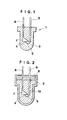
- FIG. 1 illustrates one preferred embodiment of the light-emitting or receiving device according to the present invention.
- the light-emitting or receiving device 1 may be any such device and is not particularly limited in shape or the like insofar as a light-emitting or receiving element 4, for example, a diode 4 (such as light-emitting diode or ultraviolet light-emitting diode) is encapsulated with a specific polymer 3.
- a diode 4 such as light-emitting diode or ultraviolet light-emitting diode
- lead frames 6 and 6 which project beyond the polymer 3 are provided on the upper surface of the polymer 3.
- One lead frame 6 is connected to a die bonding electrode 7 to which the light-emitting or receiving element 4 is secured.
- the other lead frame 6 is connected to a bonding wire 5 such as a gold wire.
- the bonding wire 5 is connected to the light-emitting or receiving element 4.
- a lower portion of the lead frames 6, die bonding electrode 7, and bonding wire 5 are sealed in the polymer 3.
- the light-emitting or receiving device of the present invention is characterized by encapsulation with a specific polymer, more particularly by encapsulation with a polymer of a polymerizable liquid composition (to be referred to as encapsulant A, hereinafter) comprising (a) a monomer or an oligomer or a mixture thereof containing a diallyl compound as an essential ingredient.
- encapsulant A a polymerizable liquid composition
- the encapsulant [A] prior to polymerization into the polymer with which the light-emitting or receiving device of the present invention is encapsulated is a polymerizable liquid composition comprising (a) a monomer or an oligomer or a mixture thereof containing a diallyl compound as an essential ingredient, preferably comprising (a) a monomer or an oligomer or a mixture thereof of a bis(allyl carbonate) of an aliphatic, cycloaliphatic or aromatic dihydric alcohol as an essential ingredient.
- diallyl compounds include a composition comprising (a') a monomer or an oligomer or a mixture thereof of a bis(allyl carbonate) of an aliphatic, cycloaliphatic or aromatic dihydric alcohol having the general formula: wherein R is a residue of a dihydric alcohol, and n has a value or an average value in the range of from 1 to 10, preferably from 2 to 10.
- Component (a') is preferably the reaction product of diallyl carbonate and a dihydric alcohol in a molar ratio of 4:1 or lower, more preferably in a molar ratio of 2:1.
- dihydric alcohol examples include ethylene glycol, 1,3-propanediol, 1,4-butanediol, 1,6-hexanediol, diethylene glycol, polyethylene glycol, dipropylene glycol, propylene glycol, neopentyl glycol, trimethylpentane diol, cyclohexane dimethanol, bis(hydroxymethyl)tricyclodecane, 2,7-norbornane diol, a,a'-xylene diol, 1,4-bis (hydroxyethoxybenzene), and 2,2-bis[4-(hydroxyethoxy)phenyi]propane alone and mixtures thereof.
- the encapsulant [A] of the present invention is preferably a liquid composition comprising components (a"), (b), and (c) shown below.
- Japanese Patent Application Kokai No. 59-140214 is incorporated herein by reference.
- the preferred composition comprises
- the preferred component (a") is the reaction product of diallyl carbonate and a dihydric alcohol in a molar ratio of 4:1 or lower, more preferably in a molar ratio of 2:1.
- the dihydric alcohol is preferably selected from the group consisting of ethylene glycol, 1,3-propanediol, 1,4-butanediol, 1,6-hexanediol, diethylene glycol, polyethylene glycol, dipropylene glycol, propylene glycol, neopentyl glycol, trimethylpentane diol, cyclohexane dimethanol, bis(hydroxymethyl)tricyclodecane, 2,7-norbornane diol, a,a'-xylene diol, 1,4-bis(hydroxyethoxybenzene), and 2,2-bis[4-(hydroxyethoxy)phenyl]propane.
- the preferred component (b) is the reaction product of diallyl carbonate and a di- or trihydric alcohol in a molar ratio of 6:1 or higher, more preferably in a molar ratio of 12:1.
- the di- or trihydric alcohol is preferably selected from the group consisting of ethylene glycol, 1,3-propanediol, 1,4-butanediol, 1,6-hexanediol, diethylene glycol, polyethylene glycol, dipropylene glycol, propylene glycol, neopentyl glycol, trimethylpentane diol, cyclohexane dimethanol, bis(hydroxymethyl)tricyclodecane, 2,7-norbornane diol, a,a'-xylene diol, 1,4-bis(hydroxyethoxybenzene), 2,2-bis[4-(hydroxyethoxy)phenyl]propane, trimethylol propane, and tri(hydroxyethyl) isocyan
- component (b) Also included in component (b) are diallyl phthalate, diallyl succinate, diallyl adipate, diallyl chlorendate, diallyl glycolate, diallyl naphthalene dicarboxylate, and triallyl mellitate.
- Component (c) is preferably selected from vinyl acetate, vinyl benzoate, methyl methacrylate, phenyl methacrylate, methyl acrylate, methyl maleate, maleic anhydride, and vinylidene chloride alone and mixtures thereof.
- diallyl compounds include
- the polymerizable liquid composition may contain another monomer and a filler in such amounts that they do not detract from the physical properties of the resulting polymer.
- a mono (meth)acrylic compound, di(meth)acrylic compound, or unsaturated carboxylic acid such as maleic anhydride may be added in an amount of up to 30 0 / 0 by weight
- a silane coupling agent such as vinyl triethoxysilane may be added in an amount of up to 10 0 / 0 by weight, based on the weight of the polymer.
- encapsulant [A] may further contain a polymerization initiator [B].
- the polymerization initiator [B] used in polymerizing encapsulant [A] may be any of photo polymerization initiators, thermal polymerization initiators, and photo and thermal polymerization initiators, and mixtures thereof.
- the photo polymerization initiators include electron beam and radiation polymerization initiators as well as photo polymerization initiators.
- a typical example of the photo polymerization initiator is 2-hydroxy-2-methyl-1-phenyl-propan-1-one.
- thermal polymerization initiators examples include peroxydicarbonates such as diisopropyl peroxydicarbonate, di-sec-butyl peroxydicarbonate, dicyclohexyl peroxydicarbonate, and tert-butyl perbenzoate; organic peroxides such as benzoyl peroxide, acetyl peroxide, tert-butyl hydroperoxide, cumene hydroperoxide, di-tert-butyl peroxide, tert-butyl peroxybenzoate, lauroyl peroxide, diisopropyl peroxydicarbonate, dimethyl ethyl ketone peroxide, and diacyl peroxide; and radical initiators such as azobisisobutyronitrile and azobismethylisovaleronitrile.
- peroxydicarbonates such as diisopropyl peroxydicarbonate, di-sec-butyl peroxydicarbonate, dicyclohexyl
- a typical example of the photo and thermal polymerization initiators is the compound of the following formula:
- Polymerization initiator [B] may be used to polymerize encapsulant [A] in an amount of 0.1 to 100/0 by weight, preferably 1 to 60/o by weight based on encapsulant [A].
- Encapsulant [A] may be used in semi-cured state or B stage if desired.
- the method for encapsulating the element 4 with encapsulant [A] is not particularly limited insofar as the method can form the polymer 3 (see FIG. 1) by placing the element 4 in a mold 2, filling the mold with encapsulant [A] 13, polymerizing encapsulant [A] as shown in FIG. 2.
- the following encapsulating method is preferred.
- Encapsulant [A] is polymerized in the mold while the surface of encapsulant [A] 13 in the mold is in contact with an inert gas atmosphere having an oxygen concentration of up to 1 0 / 0 , preferably up to 0.50/o, more preferably up to 0.01%.
- encapsulant [A] to be polymerized in the presence of a radical polymerization initiator is in contact with air, oxygen will consume active radicals so that the surface of the polymerizing encapsulant in contact with air may sometimes remain liquid or gel without reaching a sufficient molecular weight.
- the atmosphere under which polymerization is carried out should be an inert gas such as nitrogen and argon having an oxygen concentration of up to 1 0 / 0 , preferably up to 0.5 0 /o, more preferably up to 0.01%.
- Encapsulant [A] is polymerized in the mold while the surface of encapsulant [A] 13 in the mold is covered with a liquid [C] 8 having low solubility in encapsulant [A] 13 and a lower density than encapsulant [A] 13.
- Liquid [C] is not particularly limited as long as it is less soluble in encapsulant [A] and has a lower density than encapsulant [A].
- the density of liquid [C] is preferably from 0.7 to 1 g/cm 3 , more preferably from 0.8 to 0.95 g/cm 3 .
- Liquid [C] may be water, for example, which seals any opening to block oxygen. Water is suitable for polymerization at relatively low temperatures because of its high vapor pressure.
- Liquid [C] may also be a liquid synthetic hydrocarbon polymer having a low molecular weight or a liquid hydrocarbon mixture such as mineral oil.
- Examples of the synthetic hydrocarbon polymers include poly(a-olefin) oils such as polydecene-1, alkyl aromatic oils such as alkylbenzenes, polybutene oil or liquid polybutene, polyhexene, alkylnaphthene oils such as 2,4-dicyclohexyl-2-methylpentane oil, and ethylene-a-olefin random copolymer oils such as ethylene-propylene random copolymer oil.
- poly(a-olefin) oils such as polydecene-1
- alkyl aromatic oils such as alkylbenzenes
- polyhexene such as 2,4-dicyclohexyl-2-methylpentane oil
- ethylene-a-olefin random copolymer oils such as ethylene-propylene random copolymer oil.
- Preferred among them are those having a molecular weight of at least 500, more preferably from 1,000 to 10,000.
- ethylene-a-olefin random copolymer oils having a number average molecular weight (Mn) of from 500 to 5,000, especially from 1,500 to 3,000.
- liquid, low-molecular weight ethylene-a-olefin copolymers consisting of 30 to 70 mol O /o of ethylene units and 30 to 70 molO/o of a-olefin units and having a number average molecular weight (Mn) of from 1,000 to 5,000 and a Q value (weight average molecular weight/number average molecular weight) of up to 3.
- liquid [C] is a liquid polyolefin or the like
- the liquid itself exhibits mold release effect, considerably facilitating mold release operation.
- the liquid polyolefin may be readily removed with an organic solvent such as hexane, kerosene, and trichloroethylene.
- Encapsulant [A] is polymerized in the mold while the surface of encapsulant [A] in the mold is covered with liquid [C] and further with an inert gas atmosphere having an oxygen concentration of up to 1%. Better results are obtained from the combined use of encapsulating methods (1) and (2).
- Polymerization may be carried out under various conditions depending on the identity of polymerization initiator.
- the composition may be heated in a heating tank to a temperature of about 30 to 150° C, preferably about 40 to 120°C for about 1/2 to 72 hours, preferably about 1 to 4 hours, although the exact value will vary with the shape and size.
- polymerization may be carried out under a high-pressure mercury lamp with a power of 60 to 150 W/cm for about 1 minute to 2 hours, preferably 3 to 30 minutes at a temperature of about 40 to 120° C, preferably about 60 to 100°C.
- An assembly of a GaAlAs light-emitting diode with lead frames was set in a mold of polypropylene having an inner diameter of 5 mm and a depth of 10 mm.
- the mold was changed. with a homogeneously mixed liquid composition given below as encapsulant [A]-I.
- the mold was placed in a vacuum oven, which was purged with argon gas and then heated stepwise from 40°C to 90°C, completing polymerization in 3 hours.
- An assembly of a light-emitting diode with lead frames was set in a mold TPX O having an inner diameter of 5 mm and a depth of 10 mm as shown in FIG. 2.
- a composition given below as encapsulant [A]-II was cast into the mold and then covered with a layer of a liquid ethylene-propylene copolymer (Mn 2500, Q 2.0, specific gravity 0.846) having a thickness of about 2 mm.
- the mold was placed in an air oven, which was heated stepwise from 40°C from 90°C, completing polymerization in 3 hours.
- Example 2 The procedure of Example 2. was repeated except that encapsulant [A]-II was replaced by [A]-I, completing polymerization in 3 hours as in Example 2.
- An assembly of a light-emitting diode with lead frames was set in a mold of TPX® having an inner diameter of 5 mm and a depth of 10 mm as shown in FIG. 2.
- An epoxy resin of the light-emitting diode encapsulating grade was cast into the mold, the epoxy resin consisting of 100 parts of a major agent, Pelnox XN-1886-3 and 110 parts of a curing agent, Pelcure XV-2263 (manufactured by NIPPON PELNOX K.K.). The epoxy resin was cured at 120° C for 8 hours.
- Mold release was evaluated by removing the cured resin from the mold without using a mold release agent.
- encapsulants [A]-I and [A]-II were polymerized into plates of 3.0 mm thick by the same method as described for Examples 1-3 and Comparative Example 1 and measured for light transmittance using a spectrophotometer.
- Light transmittance measurement auto-recording spectrophotometer, model U-3400 of Hitachi, Ltd.
- the light transmittance and luminous power were measured before and after the above-mentioned weathering tests.
- a barrel portion of the encapsulant was measured for surface hardness by a similar method according to JIS K5401.
- the light-emitting or receiving device of the present invention which is encapsulated with a specific polymer has improved weatherability, chemical resistance, hardness, and optical properties such as transparency.
- the encapsulant of the present invention is used in light-emitting or receiving devices having the above-mentioned characteristics and has a reduced curing time and improved mold release after curing.
- the applications in which the light-emitting or receiving device of the present invention is utilized include light emitting devices such as LED, laser diodes, photosensors, photodiodes, and electroluminescence cells as well as light-receiving devices such as photodiodes.
- the encapsulating method of the present invention using a cover liquid can produce a light-emitting or receiving device with a high surface hardness.
- the device can be readily removed from the mold because the cover liquid has mold release property.
- the encapsulating method of the present invention using an inert gas atmosphere having an oxygen concentration of up to 1% can produce a light-emitting or receiving device with a high surface hardness at a low cost because the product and the mold need not be cleaned after molding.
Landscapes
- Addition Polymer Or Copolymer, Post-Treatments, Or Chemical Modifications (AREA)
- Photo Coupler, Interrupter, Optical-To-Optical Conversion Devices (AREA)
- Led Device Packages (AREA)
- Sealing Material Composition (AREA)
- Encapsulation Of And Coatings For Semiconductor Or Solid State Devices (AREA)
- Structures Or Materials For Encapsulating Or Coating Semiconductor Devices Or Solid State Devices (AREA)
Applications Claiming Priority (4)
| Application Number | Priority Date | Filing Date | Title |
|---|---|---|---|
| JP63078909A JPH01251745A (ja) | 1988-03-31 | 1988-03-31 | 発光または受光装置および発光または受光素子用封止剤 |
| JP63078910A JPH01251726A (ja) | 1988-03-31 | 1988-03-31 | 発光または受光素子の封止方法 |
| JP78910/88 | 1988-03-31 | ||
| JP78909/88 | 1988-03-31 |
Publications (3)
| Publication Number | Publication Date |
|---|---|
| EP0335688A2 true EP0335688A2 (de) | 1989-10-04 |
| EP0335688A3 EP0335688A3 (en) | 1990-07-18 |
| EP0335688B1 EP0335688B1 (de) | 1994-06-01 |
Family
ID=26419967
Family Applications (1)
| Application Number | Title | Priority Date | Filing Date |
|---|---|---|---|
| EP89303104A Expired - Lifetime EP0335688B1 (de) | 1988-03-31 | 1989-03-29 | Lichtemittierende oder lichtempfangende Vorrichtung, Kapselungsstoff für lichtemittierende oder lichtempfangende Bauelemente und Verkapselungsverfahren |
Country Status (7)
| Country | Link |
|---|---|
| US (1) | US5101264A (de) |
| EP (1) | EP0335688B1 (de) |
| KR (1) | KR920005318B1 (de) |
| CN (1) | CN1015583B (de) |
| AT (1) | ATE106610T1 (de) |
| AU (1) | AU608703B2 (de) |
| DE (1) | DE68915600T2 (de) |
Cited By (5)
| Publication number | Priority date | Publication date | Assignee | Title |
|---|---|---|---|---|
| EP0420629A1 (de) * | 1989-09-29 | 1991-04-03 | Mitsui Petrochemical Industries, Ltd. | Lichtemittierende oder lichtempfangende Vorrichtung und ihr Herstellungsverfahren |
| ES2042351A2 (es) * | 1991-04-05 | 1993-12-01 | Olmos Diaz Francisco | Sistema para la entrada de ordenes por pulsacion en equipos hermeticos. |
| ES2078165A2 (es) * | 1993-12-16 | 1995-12-01 | Diaz Francisco Olmos | Sistema para la entrada de ordenes por pulsacion en equipos hermeticos. |
| EP0769506A1 (de) * | 1995-10-03 | 1997-04-23 | Kureha Kagaku Kogyo Kabushiki Kaisha | Kunststoffdeckelmaterial für Packungen von Halbleiteranordnungen und Verfahren zu seiner Herstellung |
| US6903171B2 (en) | 1998-10-05 | 2005-06-07 | Promerus, Llc | Polymerized cycloolefins using transition metal catalyst and end products thereof |
Families Citing this family (8)
| Publication number | Priority date | Publication date | Assignee | Title |
|---|---|---|---|---|
| AU617447B2 (en) * | 1988-03-31 | 1991-11-28 | Mitsui Chemicals, Inc. | Process for preparing resins |
| US5514627A (en) * | 1994-01-24 | 1996-05-07 | Hewlett-Packard Company | Method and apparatus for improving the performance of light emitting diodes |
| US6507049B1 (en) * | 2000-09-01 | 2003-01-14 | General Electric Company | Encapsulants for solid state devices |
| JP5032017B2 (ja) * | 2005-10-28 | 2012-09-26 | 株式会社東芝 | 半導体発光素子及びその製造方法並びに半導体発光装置 |
| WO2011093188A1 (ja) | 2010-01-26 | 2011-08-04 | 日産化学工業株式会社 | ポジ型レジスト組成物及びマイクロレンズの製造方法 |
| DE102012108413A1 (de) * | 2012-09-10 | 2014-03-13 | Osram Opto Semiconductors Gmbh | Gehäuse für ein optoelektronisches Bauteil, Optoelektronisches Bauelement und Verfahren zur Herstellung des optoelektronischen Bauelements |
| CN106182584A (zh) * | 2016-08-18 | 2016-12-07 | 中国人民解放军海军医学研究所 | 用于封装水下设备的注塑方法 |
| ES2960434A1 (es) * | 2022-08-03 | 2024-03-04 | Quality Photonic Optics S L | Metodo para la fabricacion de optica embebida en componentes fotonicos |
Family Cites Families (6)
| Publication number | Priority date | Publication date | Assignee | Title |
|---|---|---|---|---|
| IT1130285B (it) * | 1980-03-05 | 1986-06-11 | Anic Spa | Procedimento per la sintesi di allil carbonati di alcoli poliidrici e loro derivati |
| JPS58186976A (ja) * | 1982-04-26 | 1983-11-01 | Tokuyama Soda Co Ltd | 発光ダイオ−ド |
| JPS598710A (ja) * | 1982-07-08 | 1984-01-18 | Mitsui Toatsu Chem Inc | 耐光性にすぐれた高屈折率レンズ用樹脂 |
| FR2549291B2 (fr) * | 1982-10-29 | 1986-05-09 | Radiotechnique Compelec | Procede d'encapsulation de composants electroniques par extrusion de matiere plastique et applications a la fabrication de voyants lumineux et a l'encapsulation de circuits electroniques |
| IT1160172B (it) * | 1983-01-13 | 1987-03-04 | Anic Spa | Composizione liquida polimerizzabile, atta a produrre polimeri con elevate caratteristiche ottiche e meccaniche e polimeri e manufatti ottenuti da detta composizione |
| JPS60103650A (ja) * | 1983-11-11 | 1985-06-07 | Toshiba Chem Corp | 発光ダイオ−ド |
-
1989
- 1989-03-28 US US07/329,566 patent/US5101264A/en not_active Expired - Fee Related
- 1989-03-29 DE DE68915600T patent/DE68915600T2/de not_active Expired - Fee Related
- 1989-03-29 AT AT89303104T patent/ATE106610T1/de not_active IP Right Cessation
- 1989-03-29 EP EP89303104A patent/EP0335688B1/de not_active Expired - Lifetime
- 1989-03-29 AU AU32223/89A patent/AU608703B2/en not_active Ceased
- 1989-03-31 CN CN89103278A patent/CN1015583B/zh not_active Expired
- 1989-03-31 KR KR1019890004220A patent/KR920005318B1/ko not_active Expired
Cited By (6)
| Publication number | Priority date | Publication date | Assignee | Title |
|---|---|---|---|---|
| EP0420629A1 (de) * | 1989-09-29 | 1991-04-03 | Mitsui Petrochemical Industries, Ltd. | Lichtemittierende oder lichtempfangende Vorrichtung und ihr Herstellungsverfahren |
| US5126826A (en) * | 1989-09-29 | 1992-06-30 | Mitsui Petrochemical Industries, Ltd. | Light-emitting or receiving device and method for preparing the same |
| ES2042351A2 (es) * | 1991-04-05 | 1993-12-01 | Olmos Diaz Francisco | Sistema para la entrada de ordenes por pulsacion en equipos hermeticos. |
| ES2078165A2 (es) * | 1993-12-16 | 1995-12-01 | Diaz Francisco Olmos | Sistema para la entrada de ordenes por pulsacion en equipos hermeticos. |
| EP0769506A1 (de) * | 1995-10-03 | 1997-04-23 | Kureha Kagaku Kogyo Kabushiki Kaisha | Kunststoffdeckelmaterial für Packungen von Halbleiteranordnungen und Verfahren zu seiner Herstellung |
| US6903171B2 (en) | 1998-10-05 | 2005-06-07 | Promerus, Llc | Polymerized cycloolefins using transition metal catalyst and end products thereof |
Also Published As
| Publication number | Publication date |
|---|---|
| KR920005318B1 (ko) | 1992-07-02 |
| AU608703B2 (en) | 1991-04-11 |
| US5101264A (en) | 1992-03-31 |
| CN1015583B (zh) | 1992-02-19 |
| KR890015397A (ko) | 1989-10-30 |
| AU3222389A (en) | 1989-10-05 |
| DE68915600D1 (de) | 1994-07-07 |
| EP0335688B1 (de) | 1994-06-01 |
| EP0335688A3 (en) | 1990-07-18 |
| ATE106610T1 (de) | 1994-06-15 |
| DE68915600T2 (de) | 1994-09-15 |
| CN1038547A (zh) | 1990-01-03 |
Similar Documents
| Publication | Publication Date | Title |
|---|---|---|
| EP0420629B1 (de) | Lichtemittierende oder lichtempfangende Vorrichtung und ihr Herstellungsverfahren | |
| US5101264A (en) | Light-emitting or receiving device with smooth and hard encapsulant resin | |
| KR101365834B1 (ko) | 광반도체 밀봉 재료 | |
| JP5798033B2 (ja) | アクリレート系組成物 | |
| US8648160B2 (en) | Optical semiconductor sealing material | |
| JP2007327031A (ja) | 樹脂組成物及びその硬化物を用いた光学部材 | |
| JP2006241462A (ja) | 光学材料用組成物、光学材料、その製造方法、およびそれを用いた液晶表示装置 | |
| JP2008177416A (ja) | 発光素子用封止材組成物、その硬化物および発光素子封止体 | |
| AU619815B2 (en) | Electronic parts, encapsulant for electronic parts, and encapsulating method | |
| JPH01251745A (ja) | 発光または受光装置および発光または受光素子用封止剤 | |
| JP2008205097A (ja) | 発光素子用封止材組成物、その硬化物および発光素子封止体 | |
| JPH01251726A (ja) | 発光または受光素子の封止方法 | |
| KR20140051958A (ko) | 아크릴레이트계 조성물 | |
| JP5810012B2 (ja) | 硬化性組成物、これを用いた半導体発光装置用封止材及び半導体発光装置 | |
| JPH0256956A (ja) | 電子部品、電子部品用封止剤および封止方法 | |
| JP2597640B2 (ja) | 樹脂の製造方法 | |
| TWI401305B (zh) | 封裝材料組成物及封裝材料之製造方法 |
Legal Events
| Date | Code | Title | Description |
|---|---|---|---|
| PUAI | Public reference made under article 153(3) epc to a published international application that has entered the european phase |
Free format text: ORIGINAL CODE: 0009012 |
|
| AK | Designated contracting states |
Kind code of ref document: A2 Designated state(s): AT BE CH DE ES FR GB GR IT LI LU NL SE |
|
| PUAL | Search report despatched |
Free format text: ORIGINAL CODE: 0009013 |
|
| AK | Designated contracting states |
Kind code of ref document: A3 Designated state(s): AT BE CH DE ES FR GB GR IT LI LU NL SE |
|
| 17P | Request for examination filed |
Effective date: 19900927 |
|
| 17Q | First examination report despatched |
Effective date: 19920806 |
|
| GRAA | (expected) grant |
Free format text: ORIGINAL CODE: 0009210 |
|
| AK | Designated contracting states |
Kind code of ref document: B1 Designated state(s): AT BE CH DE ES FR GB GR IT LI LU NL SE |
|
| PG25 | Lapsed in a contracting state [announced via postgrant information from national office to epo] |
Ref country code: NL Effective date: 19940601 Ref country code: LI Effective date: 19940601 Ref country code: GR Free format text: LAPSE BECAUSE OF FAILURE TO SUBMIT A TRANSLATION OF THE DESCRIPTION OR TO PAY THE FEE WITHIN THE PRESCRIBED TIME-LIMIT Effective date: 19940601 Ref country code: ES Free format text: THE PATENT HAS BEEN ANNULLED BY A DECISION OF A NATIONAL AUTHORITY Effective date: 19940601 Ref country code: CH Effective date: 19940601 Ref country code: BE Effective date: 19940601 Ref country code: AT Effective date: 19940601 |
|
| REF | Corresponds to: |
Ref document number: 106610 Country of ref document: AT Date of ref document: 19940615 Kind code of ref document: T |
|
| ITF | It: translation for a ep patent filed | ||
| REF | Corresponds to: |
Ref document number: 68915600 Country of ref document: DE Date of ref document: 19940707 |
|
| ET | Fr: translation filed | ||
| PG25 | Lapsed in a contracting state [announced via postgrant information from national office to epo] |
Ref country code: SE Effective date: 19940901 |
|
| REG | Reference to a national code |
Ref country code: CH Ref legal event code: PL |
|
| NLV1 | Nl: lapsed or annulled due to failure to fulfill the requirements of art. 29p and 29m of the patents act | ||
| PG25 | Lapsed in a contracting state [announced via postgrant information from national office to epo] |
Ref country code: LU Free format text: LAPSE BECAUSE OF NON-PAYMENT OF DUE FEES Effective date: 19950331 |
|
| PLBE | No opposition filed within time limit |
Free format text: ORIGINAL CODE: 0009261 |
|
| STAA | Information on the status of an ep patent application or granted ep patent |
Free format text: STATUS: NO OPPOSITION FILED WITHIN TIME LIMIT |
|
| 26N | No opposition filed | ||
| PGFP | Annual fee paid to national office [announced via postgrant information from national office to epo] |
Ref country code: FR Payment date: 19970313 Year of fee payment: 9 |
|
| PGFP | Annual fee paid to national office [announced via postgrant information from national office to epo] |
Ref country code: GB Payment date: 19970320 Year of fee payment: 9 |
|
| PGFP | Annual fee paid to national office [announced via postgrant information from national office to epo] |
Ref country code: DE Payment date: 19970404 Year of fee payment: 9 |
|
| PG25 | Lapsed in a contracting state [announced via postgrant information from national office to epo] |
Ref country code: GB Free format text: LAPSE BECAUSE OF NON-PAYMENT OF DUE FEES Effective date: 19980329 |
|
| PG25 | Lapsed in a contracting state [announced via postgrant information from national office to epo] |
Ref country code: FR Free format text: THE PATENT HAS BEEN ANNULLED BY A DECISION OF A NATIONAL AUTHORITY Effective date: 19980331 |
|
| GBPC | Gb: european patent ceased through non-payment of renewal fee |
Effective date: 19980329 |
|
| PG25 | Lapsed in a contracting state [announced via postgrant information from national office to epo] |
Ref country code: DE Free format text: LAPSE BECAUSE OF NON-PAYMENT OF DUE FEES Effective date: 19981201 |
|
| REG | Reference to a national code |
Ref country code: FR Ref legal event code: ST |
|
| PG25 | Lapsed in a contracting state [announced via postgrant information from national office to epo] |
Ref country code: IT Free format text: LAPSE BECAUSE OF NON-PAYMENT OF DUE FEES Effective date: 20050329 |