EP0337101B1 - Procédé pour la préparation d'olefines tertiaires - Google Patents
Procédé pour la préparation d'olefines tertiaires Download PDFInfo
- Publication number
- EP0337101B1 EP0337101B1 EP89103868A EP89103868A EP0337101B1 EP 0337101 B1 EP0337101 B1 EP 0337101B1 EP 89103868 A EP89103868 A EP 89103868A EP 89103868 A EP89103868 A EP 89103868A EP 0337101 B1 EP0337101 B1 EP 0337101B1
- Authority
- EP
- European Patent Office
- Prior art keywords
- alkyl
- process according
- cleavage
- bar
- particularly preferably
- Prior art date
- Legal status (The legal status is an assumption and is not a legal conclusion. Google has not performed a legal analysis and makes no representation as to the accuracy of the status listed.)
- Expired - Lifetime
Links
- 238000000034 method Methods 0.000 title claims description 16
- 238000002360 preparation method Methods 0.000 title claims description 4
- 239000003054 catalyst Substances 0.000 claims description 26
- 238000003776 cleavage reaction Methods 0.000 claims description 14
- 230000007017 scission Effects 0.000 claims description 14
- 150000005215 alkyl ethers Chemical class 0.000 claims description 10
- 239000011148 porous material Substances 0.000 claims description 8
- QAOWNCQODCNURD-UHFFFAOYSA-N Sulfuric acid Chemical compound OS(O)(=O)=O QAOWNCQODCNURD-UHFFFAOYSA-N 0.000 claims description 7
- 235000011149 sulphuric acid Nutrition 0.000 claims description 7
- 239000011347 resin Substances 0.000 claims description 6
- 229920005989 resin Polymers 0.000 claims description 6
- 239000007789 gas Substances 0.000 claims description 5
- 229920000642 polymer Polymers 0.000 claims description 5
- 125000006273 (C1-C3) alkyl group Chemical group 0.000 claims description 4
- CHRJZRDFSQHIFI-UHFFFAOYSA-N 1,2-bis(ethenyl)benzene;styrene Chemical compound C=CC1=CC=CC=C1.C=CC1=CC=CC=C1C=C CHRJZRDFSQHIFI-UHFFFAOYSA-N 0.000 claims description 4
- 239000001257 hydrogen Substances 0.000 claims description 4
- 229910052739 hydrogen Inorganic materials 0.000 claims description 4
- 125000004435 hydrogen atom Chemical class [H]* 0.000 claims description 4
- 239000011159 matrix material Substances 0.000 claims description 3
- 125000004178 (C1-C4) alkyl group Chemical group 0.000 claims description 2
- 239000007788 liquid Substances 0.000 claims description 2
- 125000002496 methyl group Chemical group [H]C([H])([H])* 0.000 claims description 2
- 239000007791 liquid phase Substances 0.000 claims 2
- BDHFUVZGWQCTTF-UHFFFAOYSA-N sulfonic acid Chemical group OS(=O)=O BDHFUVZGWQCTTF-UHFFFAOYSA-N 0.000 claims 2
- 239000012071 phase Substances 0.000 claims 1
- LCGLNKUTAGEVQW-UHFFFAOYSA-N Dimethyl ether Chemical compound COC LCGLNKUTAGEVQW-UHFFFAOYSA-N 0.000 description 26
- OKKJLVBELUTLKV-UHFFFAOYSA-N Methanol Chemical compound OC OKKJLVBELUTLKV-UHFFFAOYSA-N 0.000 description 12
- BZLVMXJERCGZMT-UHFFFAOYSA-N Methyl tert-butyl ether Chemical compound COC(C)(C)C BZLVMXJERCGZMT-UHFFFAOYSA-N 0.000 description 12
- HVZJRWJGKQPSFL-UHFFFAOYSA-N tert-Amyl methyl ether Chemical compound CCC(C)(C)OC HVZJRWJGKQPSFL-UHFFFAOYSA-N 0.000 description 9
- XLYOFNOQVPJJNP-UHFFFAOYSA-N water Chemical compound O XLYOFNOQVPJJNP-UHFFFAOYSA-N 0.000 description 9
- VQTUBCCKSQIDNK-UHFFFAOYSA-N Isobutene Chemical compound CC(C)=C VQTUBCCKSQIDNK-UHFFFAOYSA-N 0.000 description 7
- 150000001336 alkenes Chemical group 0.000 description 7
- 238000006243 chemical reaction Methods 0.000 description 7
- 238000006277 sulfonation reaction Methods 0.000 description 7
- MSXVEPNJUHWQHW-UHFFFAOYSA-N 2-methylbutan-2-ol Chemical compound CCC(C)(C)O MSXVEPNJUHWQHW-UHFFFAOYSA-N 0.000 description 6
- 239000000203 mixture Substances 0.000 description 6
- 229910001868 water Inorganic materials 0.000 description 6
- RTZKZFJDLAIYFH-UHFFFAOYSA-N Diethyl ether Chemical compound CCOCC RTZKZFJDLAIYFH-UHFFFAOYSA-N 0.000 description 5
- 150000001983 dialkylethers Chemical class 0.000 description 5
- UHOVQNZJYSORNB-UHFFFAOYSA-N Benzene Chemical compound C1=CC=CC=C1 UHOVQNZJYSORNB-UHFFFAOYSA-N 0.000 description 4
- 230000015572 biosynthetic process Effects 0.000 description 4
- 239000007795 chemical reaction product Substances 0.000 description 4
- 230000002378 acidificating effect Effects 0.000 description 3
- 125000003118 aryl group Chemical group 0.000 description 3
- 150000001768 cations Chemical class 0.000 description 3
- 238000004519 manufacturing process Methods 0.000 description 3
- JRZJOMJEPLMPRA-UHFFFAOYSA-N olefin Natural products CCCCCCCC=C JRZJOMJEPLMPRA-UHFFFAOYSA-N 0.000 description 3
- 239000002245 particle Substances 0.000 description 3
- 239000000047 product Substances 0.000 description 3
- 239000011541 reaction mixture Substances 0.000 description 3
- 125000000542 sulfonic acid group Chemical group 0.000 description 3
- 229910000831 Steel Inorganic materials 0.000 description 2
- 238000009835 boiling Methods 0.000 description 2
- 239000003795 chemical substances by application Substances 0.000 description 2
- 238000004821 distillation Methods 0.000 description 2
- 238000004817 gas chromatography Methods 0.000 description 2
- 238000011068 loading method Methods 0.000 description 2
- 239000000463 material Substances 0.000 description 2
- 239000010959 steel Substances 0.000 description 2
- 239000000758 substrate Substances 0.000 description 2
- NWUYHJFMYQTDRP-UHFFFAOYSA-N 1,2-bis(ethenyl)benzene;1-ethenyl-2-ethylbenzene;styrene Chemical compound C=CC1=CC=CC=C1.CCC1=CC=CC=C1C=C.C=CC1=CC=CC=C1C=C NWUYHJFMYQTDRP-UHFFFAOYSA-N 0.000 description 1
- PNEYBMLMFCGWSK-UHFFFAOYSA-N aluminium oxide Inorganic materials [O-2].[O-2].[O-2].[Al+3].[Al+3] PNEYBMLMFCGWSK-UHFFFAOYSA-N 0.000 description 1
- 239000011324 bead Substances 0.000 description 1
- 238000006555 catalytic reaction Methods 0.000 description 1
- 239000000919 ceramic Substances 0.000 description 1
- 230000000052 comparative effect Effects 0.000 description 1
- 238000011109 contamination Methods 0.000 description 1
- 238000010924 continuous production Methods 0.000 description 1
- 238000001816 cooling Methods 0.000 description 1
- 229910052593 corundum Inorganic materials 0.000 description 1
- 238000005336 cracking Methods 0.000 description 1
- 230000009849 deactivation Effects 0.000 description 1
- 230000007423 decrease Effects 0.000 description 1
- 238000005661 deetherification reaction Methods 0.000 description 1
- 239000008367 deionised water Substances 0.000 description 1
- 229910021641 deionized water Inorganic materials 0.000 description 1
- 230000001419 dependent effect Effects 0.000 description 1
- 238000007700 distillative separation Methods 0.000 description 1
- 238000001035 drying Methods 0.000 description 1
- 230000000694 effects Effects 0.000 description 1
- 238000000605 extraction Methods 0.000 description 1
- 238000010438 heat treatment Methods 0.000 description 1
- 229930195733 hydrocarbon Natural products 0.000 description 1
- 150000002430 hydrocarbons Chemical class 0.000 description 1
- 239000005457 ice water Substances 0.000 description 1
- 239000011261 inert gas Substances 0.000 description 1
- 238000011835 investigation Methods 0.000 description 1
- 239000003456 ion exchange resin Substances 0.000 description 1
- 229920003303 ion-exchange polymer Polymers 0.000 description 1
- 238000003808 methanol extraction Methods 0.000 description 1
- 238000012856 packing Methods 0.000 description 1
- 239000000376 reactant Substances 0.000 description 1
- 239000007787 solid Substances 0.000 description 1
- XTHPWXDJESJLNJ-UHFFFAOYSA-N sulfurochloridic acid Chemical compound OS(Cl)(=O)=O XTHPWXDJESJLNJ-UHFFFAOYSA-N 0.000 description 1
- 229910001845 yogo sapphire Inorganic materials 0.000 description 1
Classifications
-
- C—CHEMISTRY; METALLURGY
- C07—ORGANIC CHEMISTRY
- C07C—ACYCLIC OR CARBOCYCLIC COMPOUNDS
- C07C1/00—Preparation of hydrocarbons from one or more compounds, none of them being a hydrocarbon
- C07C1/20—Preparation of hydrocarbons from one or more compounds, none of them being a hydrocarbon starting from organic compounds containing only oxygen atoms as heteroatoms
-
- C—CHEMISTRY; METALLURGY
- C07—ORGANIC CHEMISTRY
- C07C—ACYCLIC OR CARBOCYCLIC COMPOUNDS
- C07C2531/00—Catalysts comprising hydrides, coordination complexes or organic compounds
- C07C2531/02—Catalysts comprising hydrides, coordination complexes or organic compounds containing organic compounds or metal hydrides
- C07C2531/06—Catalysts comprising hydrides, coordination complexes or organic compounds containing organic compounds or metal hydrides containing polymers
- C07C2531/08—Ion-exchange resins
- C07C2531/10—Ion-exchange resins sulfonated
Definitions
- the present invention relates to a process for the preparation of tertiary olefins by cleaving their alkyl ethers on special catalysts which very strongly suppress the formation of the undesired dialkyl ethers and at the same time have a long service life.
- All cleavage catalysts form the associated dialkyl ether from the alkanol released during the cleavage, which is more volatile than the underlying alkanol and thus accompanies and contaminates the tertiary olefin which is separated off as the top product by distillation.
- MTBE methyl tert-butyl ether
- TAME tert-amyl methyl ether
- Such polymer matrices can be prepared by known methods and equipped with known sulfonating agents (gaseous SO3, oleum, H2SO4, ClSO3H, etc.) with sulfonic acid groups.
- the sulfonation is preferably carried out with 80-100%, particularly preferably 85-95% H2SO4 at 20-180 ° C, preferably 80-120 ° C.
- the stated production conditions of the catalyst resins to be used according to the invention represent a selection from industrially carried out processes and are therefore simple, practical and inexpensive.
- the conditions of the sulfonation not only lead to sulfonation in the area of the surface, but the polymer particle is not sulfonated in the core area in the same way as on the surface; a significant sulfonation is thus achieved in an outer region which comprises approximately 1/3 to 1/2 particle radius.
- Sulfonation values of 1 to 2.5 meq / g, preferably 1.3 to 1.9 meq / g.
- the process according to the invention is carried out at 60-180 ° C. in the gas phase or in the bottom phase with subsequent distillative separation of tertiary olefin and alkanol (associated with little unreacted ether, which is recycled).
- the reaction temperature is primarily made dependent on the boiling points of the reactants.
- the upper range of 90-180 ° C., preferably 100-170 ° C., particularly preferably 100-160 ° C. applies in particular to the gas phase.
- the lower area applies in particular to the sump phase, which, however, can be expanded up to 180 ° C by working under pressure.
- a space velocity LHSV liquid hourly space velocity
- 1 catalyst preferably 2 - 20 l / h
- l particularly preferably 2-15 l / h. l set.
- inert material can be added to the catalyst particles or catalyst layers can be interrupted by inert layers.
- Inert materials are for example Al2O3, steel bodies, ceramic bodies, etc.
- the alkyl ethers to be cleaved are preferably those in which R1 and R3 are methyl, where R3 can additionally be hydrogen, and R2 is C1-C3-alkyl, particularly preferably C1-C2-alkyl.
- the alkyl ethers to be cleaved are furthermore preferably those in which R4 is C1-C3-alkyl, particularly preferably C1-C2-alkyl.
- the catalysts to be used according to the invention have a service life of several months with high selectivity for the production of tertiary olefins with very little formation of dialkyl ethers.
- the formation of the dimethyl ether (DME) from MTBE or TAME is given as an example, which, in conventional acidic cation exchangers, led to a content of 0.6-1% by weight of DME in the i-butene or i-amylene taken off as the top stream while the process according to the invention gives a content of less than 1000 ppm, often less than 500 ppm DME.
- a temperature-controlled continuous reactor was used as the alkyl ether cleavage reactor.
- the catalyst bed height was chosen so that the catalyst charge was 150 ml.
- the reactor was equipped with several temperature measuring points for temperature control.
- the reaction pressure set itself according to the pressure drop across the catalyst bed.
- the substrate was metered in via a piston pump and was heated to the reaction temperature in a preheater.
- the composition of the reaction product obtained at the reactor outlet was examined by gas chromatography.
- the service life of the catalyst according to Example 1 is extremely long. No deactivation was found during a test period of over 600 hours.
- a pressure column made of steel with an inner diameter of 50 mm and equipped with distillation and extraction devices was equipped with a bed of gap contact in the bottom circulation. Indirect sump heating was also part of the sump circulation.
- Three column sections of 1 meter each were mounted on the evaporator. The column had 20 practical trays and was designed for an operating pressure of up to 20 bar. Water was added to the top of the column, which is removed again in the middle; this water contained the major part of the methanol formed during the cleavage. The MTBE to be split was fed to the column via the bottom. The i-butene formed during the cleavage was removed from the top of the column.
- Example 5 The test was carried out as that described in Example 5, the gap contact used was that of Example 1.
Landscapes
- Chemical & Material Sciences (AREA)
- Organic Chemistry (AREA)
- Organic Low-Molecular-Weight Compounds And Preparation Thereof (AREA)
- Low-Molecular Organic Synthesis Reactions Using Catalysts (AREA)
Claims (8)

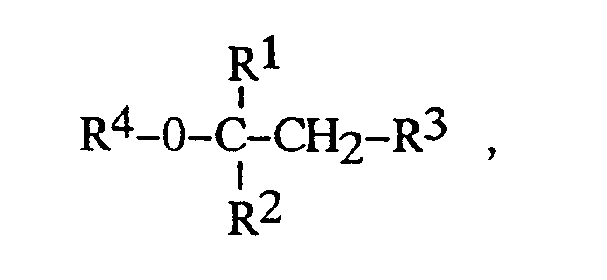
R¹, R², R³ et R⁴ représentent chacun, indépendamment les uns des autres, un groupe alkyle à chaîne droite ou ramifiée en C₁-C₄, R³ pouvant en outre représenter l'hydrogène, à température élevée sur des catalyseurs consistant en résines styrène-divinylbenzène portant des groupes acide sulfonique,
ce procédé se caractérisant en ce que l'on utilise en tant que catalyseur de telles résines à structure macroporeuse, dont la gangue polymère a une surface interne de 400 à 1 000 m²/g, un volume de pores (porosité) de 0,6 à 2,5 ml/g et un diamètre de pore moyen de 40 à 1 000 Å et en ce que l'on procède à la scission à des températures de 60 à 180°C en phase pied de colonne ou en phase gazeuse.
Applications Claiming Priority (2)
| Application Number | Priority Date | Filing Date | Title |
|---|---|---|---|
| DE3808498 | 1988-03-15 | ||
| DE3808498A DE3808498A1 (de) | 1988-03-15 | 1988-03-15 | Verfahren zur herstellung von tert.-olefinen |
Publications (2)
| Publication Number | Publication Date |
|---|---|
| EP0337101A1 EP0337101A1 (fr) | 1989-10-18 |
| EP0337101B1 true EP0337101B1 (fr) | 1992-07-08 |
Family
ID=6349711
Family Applications (1)
| Application Number | Title | Priority Date | Filing Date |
|---|---|---|---|
| EP89103868A Expired - Lifetime EP0337101B1 (fr) | 1988-03-15 | 1989-03-06 | Procédé pour la préparation d'olefines tertiaires |
Country Status (4)
| Country | Link |
|---|---|
| US (1) | US5012031A (fr) |
| EP (1) | EP0337101B1 (fr) |
| CA (1) | CA1321607C (fr) |
| DE (2) | DE3808498A1 (fr) |
Families Citing this family (6)
| Publication number | Priority date | Publication date | Assignee | Title |
|---|---|---|---|---|
| US6326995B1 (en) * | 1994-11-03 | 2001-12-04 | Synthonics Incorporated | Methods and apparatus for zooming during capture and reproduction of 3-dimensional images |
| US5817906A (en) * | 1995-08-10 | 1998-10-06 | Uop Llc | Process for producing light olefins using reaction with distillation as an intermediate step |
| US7553995B2 (en) * | 2007-09-11 | 2009-06-30 | Catalytic Distillation Technologies | Method of producing tertiary amyl ethyl ether |
| EP2219783B1 (fr) * | 2007-10-26 | 2017-10-11 | Purolite International, Ltd. | Catalyse régulée |
| US20090193710A1 (en) * | 2008-02-04 | 2009-08-06 | Catalytic Distillation Technologies | Process to produce clean gasoline/bio-ethers using ethanol |
| US8084659B2 (en) * | 2008-10-22 | 2011-12-27 | Lummus Technology, Inc. | Hexene upgrading |
Family Cites Families (5)
| Publication number | Priority date | Publication date | Assignee | Title |
|---|---|---|---|---|
| US4447668A (en) * | 1982-03-29 | 1984-05-08 | Chemical Research & Licensing Company | Process for producing high purity isoolefins and dimers thereof by dissociation of ethers |
| JPS5965025A (ja) * | 1982-09-03 | 1984-04-13 | デュオリト・アンテルナショナル・ソシエテ・アノニム | スルホン化された強酸性のイオン交換樹脂触媒を用いる可逆反応 |
| US4570026A (en) * | 1983-08-12 | 1986-02-11 | Petro-Tex Chemical Corporation | Production of isobutene from methyl tertiary butyl ether |
| US4629710A (en) * | 1984-12-20 | 1986-12-16 | Smith Jr Lawrence A | Resin catalysts and method of preparation |
| DE3610704A1 (de) * | 1986-03-29 | 1987-10-08 | Erdoelchemie Gmbh | Verfahren zur herstellung von tert.-olefinen |
-
1988
- 1988-03-15 DE DE3808498A patent/DE3808498A1/de not_active Withdrawn
-
1989
- 1989-03-06 DE DE8989103868T patent/DE58901794D1/de not_active Expired - Lifetime
- 1989-03-06 EP EP89103868A patent/EP0337101B1/fr not_active Expired - Lifetime
- 1989-03-07 US US07/320,262 patent/US5012031A/en not_active Expired - Fee Related
- 1989-03-13 CA CA000593472A patent/CA1321607C/fr not_active Expired - Fee Related
Non-Patent Citations (1)
| Title |
|---|
| APPLIED CATALYSIS, 38, 1988, pages 327-340, Elsevier Science Publishers B.V., Amsterdam * |
Also Published As
| Publication number | Publication date |
|---|---|
| EP0337101A1 (fr) | 1989-10-18 |
| US5012031A (en) | 1991-04-30 |
| DE58901794D1 (de) | 1992-08-13 |
| DE3808498A1 (de) | 1989-09-28 |
| CA1321607C (fr) | 1993-08-24 |
Similar Documents
| Publication | Publication Date | Title |
|---|---|---|
| DE69918017T2 (de) | Verfahren zur Herstellung eines Treibmittelbestandteils | |
| EP1894908B1 (fr) | Procédé de décomposition d' éther méthylique de l'alcool tertiobutylique | |
| EP1388528B1 (fr) | Procédé pour l'oligomérisation d'isobutène contenu dans des courants d'hydrocarbures contenant du n-butène | |
| EP1585712B1 (fr) | Procede de preparation d'oligomeres butene et de tert-butylethers a partir de flux c4 contenant de l'isobutene | |
| EP1900712B1 (fr) | Procédé de décomposition d'éther méthylique de l'alcool tertiobutylique | |
| DE60029132T2 (de) | Herstellung von phenol mittels reaktiver destillation | |
| EP0082937B1 (fr) | Procédé pour la préparation d'isobutène très pur, par déshydratation de tertiaire butanol | |
| EP1360160A1 (fr) | Procede de production de diisobutene de grande purete | |
| EP1900713A1 (fr) | Procédé de décomposition d'éther méthylique de l'alcool tertiobutylique | |
| DE69003030T2 (de) | Umwandlung von olefinen in ether. | |
| DE1142873B (de) | Verfahren zur Herstellung von 2- und bzw. oder 6-Alkylphenolen | |
| EP0068194B1 (fr) | Procédé pour la séparation de tert.-oléfines pures à partir de mélanges de hydrocarbures | |
| DE2521963C3 (de) | Verfahren zur Herstellung von Methyl-tert.-butylether | |
| DE3879150T2 (de) | Verfahren zur katalytischen Hydratation von Olefinen. | |
| DE68916035T2 (de) | Verfahren zur selektiven herstellung von 2,6-dialkylnaphthalenen. | |
| EP0337101B1 (fr) | Procédé pour la préparation d'olefines tertiaires | |
| EP1431264A1 (fr) | Procédé pour la préparation de tert.-butanol | |
| DE69318548T2 (de) | Zweistufenverfahren zur herstellung von äther aus tertiärem alkohol | |
| DE10020943A1 (de) | Verfahren zur Spaltung von Alkyl-tert.-alkylether zur Gewinnung von Iso-Olefinen und Alkanolen an sauren Katalysatoren | |
| DE3142461C2 (fr) | ||
| CH504392A (de) | Verfahren zur Alkylierung von aromatischen Verbindungen und Anwendung des Verfahrens | |
| DE3889096T2 (de) | Verfahren zur katalytischen Hydratation von Olefinen. | |
| DD263978A5 (de) | Verfahren zur herstellung von isopropylalkohol und tertiaeren c tief 4- bis c tief 5- alkoholen | |
| EP0198236A2 (fr) | Catalyseur et procédé de préparation d'oléfines tertiaires pures | |
| EP0257511B1 (fr) | Procédé pour la préparation de l'alcool isopropylique et d'alcools tertiaires en C4 à C5 |
Legal Events
| Date | Code | Title | Description |
|---|---|---|---|
| PUAI | Public reference made under article 153(3) epc to a published international application that has entered the european phase |
Free format text: ORIGINAL CODE: 0009012 |
|
| 17P | Request for examination filed |
Effective date: 19890306 |
|
| AK | Designated contracting states |
Kind code of ref document: A1 Designated state(s): DE FR GB IT |
|
| 17Q | First examination report despatched |
Effective date: 19910510 |
|
| GRAA | (expected) grant |
Free format text: ORIGINAL CODE: 0009210 |
|
| AK | Designated contracting states |
Kind code of ref document: B1 Designated state(s): DE FR GB IT |
|
| REF | Corresponds to: |
Ref document number: 58901794 Country of ref document: DE Date of ref document: 19920813 |
|
| GBT | Gb: translation of ep patent filed (gb section 77(6)(a)/1977) | ||
| ET | Fr: translation filed | ||
| ITF | It: translation for a ep patent filed | ||
| PLBE | No opposition filed within time limit |
Free format text: ORIGINAL CODE: 0009261 |
|
| STAA | Information on the status of an ep patent application or granted ep patent |
Free format text: STATUS: NO OPPOSITION FILED WITHIN TIME LIMIT |
|
| 26N | No opposition filed | ||
| PGFP | Annual fee paid to national office [announced via postgrant information from national office to epo] |
Ref country code: DE Payment date: 19980216 Year of fee payment: 10 |
|
| PGFP | Annual fee paid to national office [announced via postgrant information from national office to epo] |
Ref country code: GB Payment date: 19980225 Year of fee payment: 10 |
|
| PGFP | Annual fee paid to national office [announced via postgrant information from national office to epo] |
Ref country code: FR Payment date: 19980320 Year of fee payment: 10 |
|
| PG25 | Lapsed in a contracting state [announced via postgrant information from national office to epo] |
Ref country code: GB Free format text: LAPSE BECAUSE OF NON-PAYMENT OF DUE FEES Effective date: 19990306 |
|
| GBPC | Gb: european patent ceased through non-payment of renewal fee |
Effective date: 19990306 |
|
| PG25 | Lapsed in a contracting state [announced via postgrant information from national office to epo] |
Ref country code: FR Free format text: LAPSE BECAUSE OF NON-PAYMENT OF DUE FEES Effective date: 19991130 |
|
| REG | Reference to a national code |
Ref country code: FR Ref legal event code: ST |
|
| PG25 | Lapsed in a contracting state [announced via postgrant information from national office to epo] |
Ref country code: DE Free format text: LAPSE BECAUSE OF NON-PAYMENT OF DUE FEES Effective date: 20000101 |
|
| PG25 | Lapsed in a contracting state [announced via postgrant information from national office to epo] |
Ref country code: IT Free format text: LAPSE BECAUSE OF NON-PAYMENT OF DUE FEES;WARNING: LAPSES OF ITALIAN PATENTS WITH EFFECTIVE DATE BEFORE 2007 MAY HAVE OCCURRED AT ANY TIME BEFORE 2007. THE CORRECT EFFECTIVE DATE MAY BE DIFFERENT FROM THE ONE RECORDED. Effective date: 20050306 |