EP0337198A2 - Allyltriazole und diese enthaltende Fungizide - Google Patents
Allyltriazole und diese enthaltende Fungizide Download PDFInfo
- Publication number
- EP0337198A2 EP0337198A2 EP89105584A EP89105584A EP0337198A2 EP 0337198 A2 EP0337198 A2 EP 0337198A2 EP 89105584 A EP89105584 A EP 89105584A EP 89105584 A EP89105584 A EP 89105584A EP 0337198 A2 EP0337198 A2 EP 0337198A2
- Authority
- EP
- European Patent Office
- Prior art keywords
- alkyl
- plants
- formula
- phenyl
- radicals
- Prior art date
- Legal status (The legal status is an assumption and is not a legal conclusion. Google has not performed a legal analysis and makes no representation as to the accuracy of the status listed.)
- Withdrawn
Links
Classifications
-
- C—CHEMISTRY; METALLURGY
- C07—ORGANIC CHEMISTRY
- C07D—HETEROCYCLIC COMPOUNDS
- C07D231/00—Heterocyclic compounds containing 1,2-diazole or hydrogenated 1,2-diazole rings
- C07D231/02—Heterocyclic compounds containing 1,2-diazole or hydrogenated 1,2-diazole rings not condensed with other rings
- C07D231/10—Heterocyclic compounds containing 1,2-diazole or hydrogenated 1,2-diazole rings not condensed with other rings having two or three double bonds between ring members or between ring members and non-ring members
- C07D231/12—Heterocyclic compounds containing 1,2-diazole or hydrogenated 1,2-diazole rings not condensed with other rings having two or three double bonds between ring members or between ring members and non-ring members with only hydrogen atoms, hydrocarbon or substituted hydrocarbon radicals, directly attached to ring carbon atoms
-
- C—CHEMISTRY; METALLURGY
- C07—ORGANIC CHEMISTRY
- C07D—HETEROCYCLIC COMPOUNDS
- C07D233/00—Heterocyclic compounds containing 1,3-diazole or hydrogenated 1,3-diazole rings, not condensed with other rings
- C07D233/54—Heterocyclic compounds containing 1,3-diazole or hydrogenated 1,3-diazole rings, not condensed with other rings having two double bonds between ring members or between ring members and non-ring members
- C07D233/56—Heterocyclic compounds containing 1,3-diazole or hydrogenated 1,3-diazole rings, not condensed with other rings having two double bonds between ring members or between ring members and non-ring members with only hydrogen atoms or radicals containing only hydrogen and carbon atoms, attached to ring carbon atoms
-
- C—CHEMISTRY; METALLURGY
- C07—ORGANIC CHEMISTRY
- C07D—HETEROCYCLIC COMPOUNDS
- C07D249/00—Heterocyclic compounds containing five-membered rings having three nitrogen atoms as the only ring hetero atoms
- C07D249/02—Heterocyclic compounds containing five-membered rings having three nitrogen atoms as the only ring hetero atoms not condensed with other rings
- C07D249/08—1,2,4-Triazoles; Hydrogenated 1,2,4-triazoles
Definitions
- the present invention relates to new azole compounds, processes for their preparation and fungicides containing them.
- R1 or R2 mean for example: C1-C12-, in particular C1-C4-alkyl, for example methyl, ethyl, isopropyl, n-propyl, n-butyl, sec-butyl, tert-butyl, n-pentyl, neopentyl, hexyl , Octyl, decyl, dodecyl, trifluoromethyl, trichloromethyl, phenyl, halophenyl, 2-chlorophenyl, 2-fluorophenyl, 2-bromophenyl, 3-chlorophenyl, 3-bromophenyl, 3-fluorophenyl, 4-fluorophenyl, 4-chlorophenyl, 4-bromophenyl , 2,4-dichlorophenyl, 2,3-dichlorophenyl, 2,5-dichlorophenyl, 2,6-dichlorophenyl, 2-
- Acid addition salts are, for example, the salts with inorganic or organic acids, e.g. the hydrochlorides, bromides, sulfates, nitrates, phosphates, oxalates or dodecylbenzenesulfonates.
- the effectiveness of the salts is due to the cation, so that the anion i.a. can be chosen arbitrarily.
- the active ingredient salts according to the invention are prepared by reacting the allyltriazoles (I) with the acids.
- Metal complexes of active ingredients I or their salts can e.g. are formed with the metals copper, zinc, tin, manganese, iron, cobalt or nickel by reacting the allyl triazoles with corresponding metal salts, e.g. with copper sulfate, tin chloride, zinc sulfate.
- the compounds of formula I can be prepared, for example, by using a compound of formula II in which R1 and R2 have the meanings given above and L represents a nucleophilically substitutable leaving group (OH, halogen), with a compound of formula III in which Me represents a hydrogen atom, a metal atom (Na, K) or a trimethylsilyl group and X has the meaning given above.
- reaction a) takes place - if Me is a hydrogen atom - if appropriate in the presence of a solvent or diluent, if appropriate with the addition of an inorganic or organic base and if appropriate with the addition of a reaction accelerator at temperatures between 10 and 120 ° C.
- the preferred solvents and diluents include ketones such as acetone, methyl ethyl ketone or cyclohexanone, and nitriles such as Acetonitrile or propionitrile, alcohols such as methanol, ethanol, iso-propanol, n-butanol or glycol, esters such as ethyl acetate, methyl acetate or butyl acetate, ethers such as tetrahydrofuran, diethyl ether, dimethoxyethane, dioxane or diisopropyl ether, amides such as dimethyl methyl amide or dimethyl methylamide also dimethyl sulfoxide, sulfolane or corresponding mixtures.
- ketones such as acetone, methyl ethyl ketone or cyclohexanone
- nitriles such as Acetonitrile or propionitrile
- alcohols such as methanol,
- Suitable bases which can optionally also be used as acid-binding agents in the reaction, are, for example, alkali metal hydroxide such as lithium, sodium or potassium hydroxide, alkali metal carbonate such as sodium or casium carbonate or sodium, potassium or cesium hydrogen carbonate, pyridine or 4-dimethylaminopyridine.
- alkali metal hydroxide such as lithium, sodium or potassium hydroxide
- alkali metal carbonate such as sodium or casium carbonate or sodium
- potassium or cesium hydrogen carbonate pyridine or 4-dimethylaminopyridine.
- other common bases can also be used.
- reaction accelerators used are preferably metal halides such as sodium iodide or potassium iodide, quaternary ammonium salts such as tetrabutylammonium chloride, bromide, iodide or hydrogen sulfate, benzyltriethylammonium chloride or bromide or crown ethers such as 12-crown-4, 15-crown-5, 18-crown-6, Dibenzo-18-Krone-6 or Dicyclohexano-18-Krone-6 in question.
- metal halides such as sodium iodide or potassium iodide
- quaternary ammonium salts such as tetrabutylammonium chloride, bromide, iodide or hydrogen sulfate, benzyltriethylammonium chloride or bromide or crown ethers such as 12-crown-4, 15-crown-5, 18-crown-6, Dibenzo-18-K
- the reaction is generally carried out at temperatures between 20 and 150 ° C, without pressure or under pressure, continuously or batchwise.
- reaction a) is optionally carried out in the presence of a solvent or diluent and, if appropriate, with the addition of a strong inorganic or organic base at temperatures between -10 and 120 ° C.
- a solvent or diluent include amides such as dimethylformamide, diethylformamide, dimethylacetamide, diethylacetamide, N-methylpyrrolidone, hexamethylphosphoric triamide, sulfoxides such as dimethyl sulfoxide and sulfolane.
- Suitable bases which can optionally also be used as acid-binding agents in the reaction, are, for example, alkali hydrides such as lithium, sodium and potassium hydride, alkali amides such as sodium or potassium triphenylmethyl and naphthalene lithium, sodium or potassium.
- Suitable diluents for the reaction b) are polar organic solvents such as nitriles, for example acetonitrile, sulfoxides, for example dimethyl sulfoxide, formamides, for example dimethylformamide, ketones, for example acetone, ether, for example diethyl ether, tetrahydrofuran and in particular chlorinated hydrocarbons, for example methylene chloride and chloroform.
- polar organic solvents such as nitriles, for example acetonitrile, sulfoxides, for example dimethyl sulfoxide, formamides, for example dimethylformamide, ketones, for example acetone, ether, for example diethyl ether, tetrahydrofuran and in particular chlorinated hydrocarbons, for example methylene chloride and chloroform.
- the procedure is generally between 0 and 100 ° C, preferably at 20 to 80 ° C. In the presence of a solvent, it is expedient to work at the boiling point of the particular solvent.
- Compound II is prepared by using olefins of the formula IV halogenated or oxidized by known methods in the allyl position.
- Suitable halogenating reagents are N-chloro- and N-bromosuccinimide in halogenated hydrocarbons such as carbon tetrachloride, trichloroethane or methylene chloride at temperatures between 20 and 100 ° C.
- peresters such as tert-butyl perbenzoate or tert-butyl peracetic acid in the presence of a heavy metal salt such as e.g. Copper-I-chloride or copper-I-bromide. It works in inert solvents at temperatures between 10 and 100 ° C.
- the reactive esters which are reacted with III are prepared by generally known methods (Houben-Weyl-Müller, Methods of Organic Chemistry, Georg Thieme Verlag, Stuttgart, 1955, Volume 9, pages 388, 663, 671).
- esters are methanesulfonic acid esters, trifluoromethanesulfonic acid esters, 2,2,2-trifluoroethanesulfonic acid esters, nonafluorobutanesulfonic acid esters, 4-methylbenzenesulfonic acid esters, 4-bromobenzenesulfonic acid esters, 4-nitrobenzenesulfonic acid esters or benzenesulfonic acid esters.
- the compounds IV can be prepared according to generally known processes for olefin synthesis (Houben-Weyl-Müller, Methods of Organic Chemistry, Georg Thieme Verlag, Stuttgart, 1972, Vol. V, 1b).
- a solution of 4.9 g of triazole in 100 ml of N-methyl-pyrrolidone is mixed with 2.7 g of sodium hydroxide and heated to 50 ° C. for 30 minutes. After the reaction mixture was cooled to room temperature (20 ° C.), 20 g of E-1- (2-chlorophenyl) -2- (4-chlorobenzoyl) -3-bromopropene, which was dissolved in 100 ml of N-methylpyrrolidone, were added to the solution is slowly added dropwise and stirred for 12 hours at room temperature.
- Example 1 the compounds listed in the table can be prepared.
- the new compounds are distinguished by excellent activity against a broad spectrum of phytopathogenic fungi, in particular from the classes of the Ascomycetes and Basidiomycetes. Some of them are systemically effective and can be used as foliar and soil fungicides.
- the fungicidal compounds are particularly interesting for controlling a large number of fungi on various crop plants or their seeds, in particular wheat, rye, barley, oats, rice, corn, lawn, cotton, soybeans, coffee, sugar cane, fruit and ornamental plants in horticulture and viticulture as well as vegetables - such as cucumbers, beans and pumpkin plants -.
- the new compounds are particularly suitable for controlling the following plant diseases: Erysiphe graminis (powdery mildew) in cereals, Erysiphe cichoracearum and Sphaerotheca fuliginea on pumpkin plants, Podosphaera leucotricha on apples, Uncinula necator on vines, Puccinia species on cereals, Rhizoctonia species on cotton and lawn, Ustilago species on cereals and sugar cane, Venturia inaequalis (scab) on apples, Helminthosporium species on cereals, Septoria nodorum on wheat, Botrytis cinerea (gray mold) on strawberries, vines, Cercospora arachidicola on peanuts, Pseudocercosporella herpotrichoides on wheat, barley, Pyricularia oryzae on rice, Phytophthora infestans on potatoes and tomatoes, Fusarium and Verticillium species on different plants, Plasmopara viticola
- the compounds are applied by spraying or dusting the plants with the active compounds or by treating the seeds of the plants with the active compounds. It is used before or after the plants or seeds are infected by the fungi.
- the new substances can be converted into the customary formulations, such as solutions, emulsions, suspensions, dusts, powders, pastes and granules.
- the application forms depend entirely on the purposes; in any case, they should ensure a fine and uniform distribution of the active substance.
- the wording is in prepared in a known manner, for example by stretching the active ingredient with solvents and / or carriers, if appropriate using emulsifiers and dispersants, and if organic diluents are used, other organic solvents can also be used as auxiliary solvents.
- solvents such as aromatics (e.g. xylene), chlorinated aromatics (e.g. chlorobenzenes), paraffins (e.g.
- Carriers such as natural stone powder (eg kaolins, clays, talc, chalk) and synthetic stone powder (eg highly disperse silica, silicates); Emulsifiers, such as nonionic and anionic emulsifiers (for example polyoxyethylene fatty alcohol ethers, alkyl sulfonates and aryl sulfonates) and dispersants, such as lignin, leachate and methyl cellulose.
- Carriers such as natural stone powder (eg kaolins, clays, talc, chalk) and synthetic stone powder (eg highly disperse silica, silicates)
- Emulsifiers such as nonionic and anionic emulsifiers (for example polyoxyethylene fatty alcohol ethers, alkyl sulfonates and aryl sulfonates) and dispersants, such as lignin, leachate and methyl cellulose.
- the fungicidal compositions generally contain between 0.1 and 95, preferably between 0.5 and 90% by weight of active ingredient.
- the application rates are between 0.02 and 3 kg of active ingredient or more per hectare.
- the new compounds can also be used in material protection, e.g. against Paecilomyces variotii.
- agents or the ready-to-use preparations produced therefrom such as solutions, emulsions, suspensions, powders, dusts, pastes or granules, are used in a known manner, for example by spraying, atomizing, dusting, scattering, pickling or pouring.
- the agents according to the invention can also be present together with other active ingredients, such as Herbicides, insecticides, growth regulators and fungicides, or also mixed with fertilizers and applied. When mixed with fungicides, the fungicidal activity spectrum is enlarged in many cases.
- Fungicides that can be combined with the compounds according to the invention are, for example: Sulfur, Dithiocarbamates and their derivatives, such as Ferridimethyldithiocarbamate, Zinc dimethyldithiocarbamate, Zinc ethylene bisdithiocarbamate, Manganese ethylene bisdithiocarbamate, Manganese-zinc-ethylenediamine-bis-dithiocarbamate, Tetramethylthiuram disulfide, Ammonia complex of zinc (N, N-ethylene-bis-dithiocarbamate), Ammonia complex of zinc (N, N'-propylene-bis-dithiocarbamate), Zinc (N, N'-propylene-bis-dithiocarbamate), N, N'-polypropylene bis (thiocarbamoyl) disulfide; Nitroderivatives, such as Dinitro- (1-methylheptyl) phenylcrotonate, 2-sec-butyl-4,
- Leaves of pot vines of the "Müller Thurgau” variety were sprayed with an aqueous spray mixture which contained 80% (by weight) of active ingredient and 20% of emulsifier in the dry matter.
- the plants were placed in the greenhouse for 8 days after the spray coating had dried on. Only then were the leaves infected with a zoospore suspension of Plasmopara viticola (vine peronospora).
- the vines were then placed for 48 hours in a steam-saturated chamber at 24 ° C and then for 5 days in a greenhouse at temperatures between 20 and 30 ° C. After this time, the plants were again placed in the moist chamber for 16 hours to accelerate the sporangium carrier outbreak. Then the extent of the fungal outbreak on the undersides of the leaves was assessed.
Landscapes
- Chemical & Material Sciences (AREA)
- Organic Chemistry (AREA)
- Agricultural Chemicals And Associated Chemicals (AREA)
- Plural Heterocyclic Compounds (AREA)
- Thiazole And Isothizaole Compounds (AREA)
Abstract
Allyltriazole der allgemeinen Formel I

in welcher R₁ und R₂ Alkyl, Naphthyl, Biphenyl, Phenyl, Benzylphenyl, Benzyloxyphenyl, Thienyl, Furyl, Pyridyl, Norbornyl, Tetrahydropyranyl, Cycloalkyl oder Cycloalkenyl bedeuten, wobei diese Reste gegebenenfalls substituiert sind,
X, CH oder N bedeutet, sowie deren für Pflanzen verträgliche Säureadditionssalze und Metallkomplexe und diese Verbindungen enthaltende Fungizide.
in welcher R₁ und R₂ Alkyl, Naphthyl, Biphenyl, Phenyl, Benzylphenyl, Benzyloxyphenyl, Thienyl, Furyl, Pyridyl, Norbornyl, Tetrahydropyranyl, Cycloalkyl oder Cycloalkenyl bedeuten, wobei diese Reste gegebenenfalls substituiert sind,
X, CH oder N bedeutet, sowie deren für Pflanzen verträgliche Säureadditionssalze und Metallkomplexe und diese Verbindungen enthaltende Fungizide.
Description
- Die vorliegende Erfindung betrifft neue Azolverbindungen, Verfahren zu ihrer Herstellung und diese enthaltende Fungizide.
- Es ist bekannt, Triazolyl-butenol-Derivate, z.B. das 1-(1,2,4-Triazol-1-yl-methyl)-1-(4-chlorphenyl)-3-(2-chlorphenyl)-prop-2-en-1-ol als Fungizide zu verwenden (EP-52 424). Seine fungizide Wirkung ist jedoch ungenügend.
- Es wurde nun gefunden, daß Allyltriazole der allgemeinen Formel I

X, CH oder N bedeutet, und deren für Pflanzen verträgliche Säureadditionssalze oder Metallkomplexe
eine bessere fungizide Wirkung, insbesondere gegen Getreidekrankheiten, besitzen als bekannte Azolverbindungen. - R₁ bzw. R₂ bedeuten beispielsweise: C₁-C₁₂-, insbesondere C₁-C₄-Alkyl, z.B. Methyl, Ethyl, Isopropyl, n-Propyl, n-Butyl, sec-Butyl, tert.-Butyl, n-Pentyl, Neopentyl, Hexyl, Octyl, Decyl, Dodecyl, Trifluormethyl, Trichlormethyl, Phenyl, Halogenphenyl, 2-Chlorphenyl, 2-Fluorphenyl, 2-Bromphenyl, 3-Chlorphenyl, 3-Bromphenyl, 3-Fluorphenyl, 4-Fluorphenyl, 4-Chlorphenyl, 4-Bromphenyl, 2,4-Dichlorphenyl, 2,3-Dichlorphenyl, 2,5-Dichlorphenyl, 2,6-Dichlorphenyl, 2-Chlor-6-fluorphenyl, Alkoxyphenyl, 2-Methoxyphenyl, 3-Methoxyphenyl, 4-Methoxyphenyl, 2,4-Dimethoxyphenyl, Alkylphenyl, 4-Ethylphenyl, 4-Isopropylphenyl, 4-tert.-Butylphenyl, 4-tert.-Butyloxyphenyl, 2-Chlor-4-fluorphenyl, 2-Chlor-6-methylphenyl, 3,4-Dimethylphenyl, 3-Phenoxyphenyl, 4-Phenoxyphenyl, 3-Nitrophenyl, 4-Nitrophenyl, 3-Aminophenyl, 4-Aminophenyl, 2-Trifluoromethylphenyl, 3-Trifluoromethylphenyl, 4-Trifluoromethylphenyl, 4-Phenoxyphenyl, 4-Benzylphenyl, 4-Benzyloxyphenyl, 2-Thienyl, 3-Thienyl, 2-Furyl, 3-Pyridyl, 4-Pyridyl, Cyclopropyl, Cyclobutyl, Cyclopentyl, Cyclohexyl, Cyclooctyl, Cyclododecyl, Tetrahydropyranyl, 3-Cyclohexenyl, Norbornyl.
- Säureadditionssalze sind beispielsweise die Salze mit anorganischen oder organischen Säuren z.B. die Hydrochloride, Bromide, Sulfate, Nitrate, Phosphate, Oxalate oder Dodecylbenzolsulfonate. Die Wirksamkeit der Salze geht auf das Kation zurück, so daß das Anion i.a. beliebig gewählt werden kann. Die erfindungsgemäßen Wirkstoffsalze werden hergestellt durch Umsetzung der Allyltriazole (I) mit den Säuren.
- Metallkomplexe der Wirkstoffe I oder ihrer Salze können z.B. mit den Metallen Kupfer, Zink, Zinn, Mangan, Eisen, Kobalt oder Nickel gebildet werden, indem man die Allyltriazole mit entsprechenden Metallsalzen umsetzt, z.B. mit Kupfersulfat, Zinnchlorid, Zinksulfat.
- Die Verbindungen der Formel I können z.B. hergestellt werden, indem man eine Verbindung der Formel II
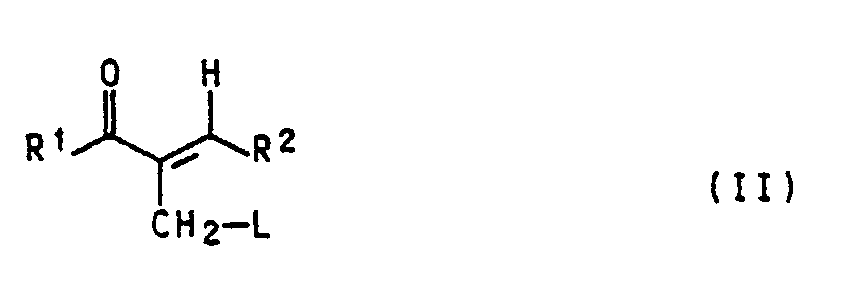

- Die Reaktion a) erfolgt - falls Me ein Wasserstoffatom bedeutet - gegebenenfalls in Gegenwart eines Lösungs- oder Verdünnungsmittels, gegebenenfalls unter Zusatz einer anorganischen oder organischen Base und gegebenenfalls unter Zusatz eines Reaktionsbeschleunigers bei Temperaturen zwischen 10 und 120°C. Zu den bevorzugten Lösungs- und Verdünnungsmitteln gehören Ketone wie Aceton, Methylethylketon oder Cyclohexanon, Nitrile wie Acetonitril oder Propionitril, Alkohole wie Methanol, Ethanol, iso-Propanol, n-Butanol oder Glycol, Ester wie Essigsäureethylester, Essigsäuremethylester oder Essigsäurebutylester, Ether wie Tetrahydrofuran, Diethylether, Dimethoxyethan, Dioxan oder Diisopropylether, Amide wie Dimethylformamid, Dimethylacetamid oder N-Methylpyrrolidon, ferner Dimethylsulfoxid, Sulfolan oder entsprechende Gemische.
- Geeignete Basen, die gegebenenfalls auch als säurebindende Mittel bei der Reaktion verwendet werden können, sind beispielsweise Alkalihydroxid wie Lithium-, Natrium- oder Kaliumhydroxid, Alkalicarbonate wie Natrium- oder Casiumcarbonat oder Natrium-, Kalium- oder Cäsiumhydrogencarbonat, Pyridin oder 4-Dimethylaminopyridin. Es können aber auch andere übliche Basen verwendet werden.
- Als Reaktionsbeschleuniger kommen vorzugsweise Metallhalogenide wie Natriumjodid, oder Kaliumjodid, quarternäre Ammoniumsalze wie Tetrabutylammoniumchlorid, -bromid, -jodid oder -hydrogensulfat, Benzyltriethylammoniumchlorid oder -bromid oder Kronenether wie 12-Krone-4, 15-Krone-5, 18-Krone-6, Dibenzo-18-Krone-6 oder Dicyclohexano-18-Krone-6 in Frage.
- Die Umsetzung wird im allgemeinen bei Temperaturen zwischen 20 und 150°C, drucklos oder unter Druck, kontinuierlich oder diskontinuierlich durchgeführt.
- Ist Me ein Metallatom wird die Reaktion a) gegebenenfalls in Gegenwart eines Lösungs- oder Verdünnungsmittels und gegebenenfalls unter Zusatz einer starken anorganischen oder organischen Base bei Temperaturen zwischen -10 und 120°C durchgeführt. Zu den bevorzugten Lösungs- und Verdünnungsmitteln gehören Amide wie Dimethylformamid, Diethylformamid, Dimethylacetamid, Diethylacetamid, N-Methylpyrrolidon, Hexamethylphosphortriamid, Sulfoxide wie Dimethylsulfoxid und Sulfolan.
- Geeignete Basen, die gegebenenfalls auch als säurebindende Mittel bei der Reaktion verwendet werden können, sind beispielsweise Alkalihydride wie Lithium-, Natrium- und Kaliumhydrid, Alkaliamide wie Natrium- oder Kalium-triphenylmethyl und Naphthalinlithium, -natrium oder -kalium.
- Für die Reaktion b) kommen als Verdünnungsmittel polare organische Lösungsmittel wie Nitrile, z.B. Acetonitril, Sulfoxide, z.B. Dimethylsulfoxid, Formamide, z.B. Dimethylformamid, Ketone, z.B. Aceton, Ether, z.B. Diethylether, Tetrahydrofuran und insbesondere Chlorkohlenwasserstoffe, z.B. Methylenchlorid und Chloroform, in Frage.
- Man arbeitet im allgemeinen zwischen 0 und 100°C, vorzugsweise bei 20 bis 80°C. Bei Anwesenheit eines Lösungsmittels wird zweckmäßigerweise beim Siedepunkt des jeweiligen Lösungsmittels gearbeitet.
- Die Verbindung II stellt man her, indem man Olefine der Formel IV

- Geeignete Halogenisierungsreagenzien sind N-Chlor- und N-Bromsuccinimid in halogenierten Kohlenwasserstoffen wie Tetrachlorkohlenstoff, Trichlorethan oder Methylenchlorid bei Temperaturen zwischen 20 und 100°C. Zur Allyloxidation verwendet man Perester wie Perbenzoesäure-tert.-butylester oder Peressigsäure-tert.-butylester in Anwesenheit eines Schwermetallsalzes wie z.B. Kupfer-I-chlorid oder Kupfer-I-bromid. Man arbeitet in inerten Lösungsmitteln bei Temperaturen zwischen 10 und 100°C.
- Während die so erhaltenen Allylhalogenide II (L=Halogen) gemäß Verfahren a) sofort umgesetzt werden können, überführt man die entsprechenden Allylalkohole II (L=0H) in reaktive Ester, die dann mit den Verbindungen III gemäß Verfahren a) umgesetzt werden.
- Die Darstellung der reaktiven Ester, die mit III umgesetzt werden, erfolgt nach allgemein bekannnten Methoden (Houben-Weyl-Müller, Methoden der organischen Chemie, Georg Thieme Verlag, Stuttgart, 1955, Band 9, Seiten 388, 663, 671). Solche Ester sind beispielweise Methansulfonsäureester, Trifluormethansulfonsäureester, 2,2,2-Trifluorethansulfonsäureester, Nonafluorbutansulfonsäureester, 4-Methylbenzolsulfonsäureester, 4-Brombenzolsulfonsäureester, 4-Nitrobenzolsulfonsäureester oder Benzolsulfonsäureester.
- Die Verbindungen IV lassen sich entsprechend allgemein bekannten Verfahren zur Olefinsynthese (Houben-Weyl-Müller, Methoden der organischen Chemie, Georg Thieme Verlag, Stuttgart, 1972, Bd. V, 1b) herstellen.
- Die folgenden Beispiele erläutern die Herstellung der Wirkstoffe.
- Zu einer Lösung von 50 g 2-Chlorbenzaldehyd in 200 ml Ethanol werden 5,85 g Natriumhydroxid in 40 ml Wasser gegeben. Das Reaktionsgemisch wird auf 10°C gekühlt und schnell 60 g 4-Chlorpropiophenon zugesetzt, wobei die Temperatur in der Lösung auf 30 bis 40°C ansteigt. Nach 10stündigem Rühren wird der farblosen Reaktionslösung 200 ml Wasser zugesetzt und die entstandene Emulsion mit Methyl-tert.-butylether ausgeschüttelt. Die organische Phase wird abgetrennt, über Natriumsulfat getrocknet und im Wasserstrahlvakuum eingeengt. Bei der anschließenden Destillation des verbleibenden Rückstandes werden bei 0,25 mbar und 127°C Übergangstemperatur 84 g (80 %) E-1-(2-Chlorphenyl)-2-(4-chlorbenzoyl)-propen, das aus Methyl-tert.-butylether/n-Hexan kristallisiert werden kann, erhalten. Fp.: 45 - 47°C.
- 84 g E-1-(2-Chlorphenyl)-2-(4-chlorbenzoyl)-propen werden in 200 ml Tetrachlorkohlenstoff gelöst und 52 g N-Bromsuccinimid zugesetzt. Nachdem 0,2 g Azobisisobutyronitril zugegeben wurde, erhitzt man die Reaktionslösung für vier Stunden unter Rückfluß. Das ausgefallene Succinimid wird abfiltriert und das verbleibende Filtrat mit Natriumcarbonat-Lösung (10 %ig) und Wasser gewaschen, über Natriumsulfat getrocknet und eingeengt. Man erhält 102 g (95 %) E-1-(2-Chlorphenyl)-2-(4-chlorbenzoyl)-3-brom-propen.
- Eine Lösung von 4,9 g Triazol in 100 ml N-Methyl-pyrrolidon wird mit 2,7 g Natriumhydroxid versetzt und für 30 Minuten auf 50°C erwärmt. Nachdem das Reaktionsgemisch auf Raumtemperatur (20°C) gekühlt wurde, wird der Lösung 20 g E-1-(2-Chlorphenyl)-2-(4-chlorbenzoyl)-3-brom-propen, das in 100 ml N-Methylpyrrolidon gelöst ist, langsam zugetropft und 12 Stunden bei Raumtemperatur gerührt. Anschließend wird 200 ml Wasser zugegeben und mehrmals mit Methyl-tert.-butylether extrahiert, die organische Phase zweimal mit Wasser gewaschen, über Natriumsulfat getrocknet und eingeengt. Der verbleibende Rückstand wird einer Chromatographie an Kieselgel mit n-Hexan/Essigester = 9:1 unterworfen, wobei 10,8 g (56 %) E-1-(2-Chlorphenyl)-2-(4-chlorbenzoyl)-3-(1,2,4-triazol-1-yl) propen erhalten werden, das aus Methyl-tert.-butylether/n-Hexan kristallisiert werden kann, Fp.: 89-93°C (Verbindung-Nr. 1).
- Entsprechend Beispiel 1 können die in der Tabelle aufgeführten Verbindungen hergestellt werden.


- Die neuen Verbindungen zeichnen sich, allgemein ausgedrückt, durch eine hervorragende Wirksamkeit gegen ein breites Spektrum von pflanzenpathogenen Pilzen, insbesondere aus der Klasse der Ascomyceten und Basidiomyceten, aus. Sie sind zum Teil systemisch wirksam und können als Blatt- und Bodenfungizide eingesetzt werden.
- Besonders interessant sind die fungiziden Verbindungen für die Bekämpfung einer Vielzahl von Pilzen an verschiedenen Kulturpflanzen oder ihren Samen, insbesondere Weizen, Roggen, Gerste, Hafer, Reis, Mais, Rasen, Baumwolle, Soja, Kaffee, Zuckerrohr, Obst und Zierpflanzen im Gartenbau, Weinbau sowie Gemüse - wie Gurken, Bohnen und Kürbisgewächse -.
- Die neuen Verbindungen sind insbesondere geeignet zur Bekämpfung folgender Pflanzenkrankheiten:
Erysiphe graminis (echter Mehltau) in Getreide,
Erysiphe cichoracearum und Sphaerotheca fuliginea an Kürbisgewächsen,
Podosphaera leucotricha an Äpfeln,
Uncinula necator an Reben,
Puccinia-Arten an Getreide,
Rhizoctonia-Arten an Baumwolle und Rasen,
Ustilago-Arten an Getreide und Zuckerrohr,
Venturia inaequalis (Schorf) an Äpfeln,
Helminthosporium-Arten an Getreide,
Septoria nodorum an Weizen,
Botrytis cinerea (Grauschimmel) an Erdbeeren, Reben,
Cercospora arachidicola an Erdnüssen,
Pseudocercosporella herpotrichoides an Weizen, Gerste,
Pyricularia oryzae an Reis,
Phytophthora infestans an Kartoffeln und Tomaten,
Fusarium- und Verticillium-Arten an verschiedenen Pflanzen,
Plasmopara viticola an Reben,
Alternaria-Arten an Gemüse und Obst. - Die Verbindungen werden angewendet, indem man die Pflanzen mit den Wirkstoffen besprüht oder bestäubt oder die Samen der Pflanzen mit den Wirkstoffen behandelt. Die Anwendung erfolgt vor oder nach der Infektion der Pflanzen oder Samen durch die Pilze.
- Die neuen Substanzen können in die üblichen Formulierungen übergeführt werden, wie Lösungen, Emulsionen, Suspensionen, Stäube, Pulver, Pasten und Granulate. Die Anwendungsformen richten sich ganz nach den Verwendungszwecken; sie sollen in jedem Fall eine feine und gleichmäßige Verteilung der wirksamen Substanz gewährleisten. Die Formulierungen werden in bekannter Weise hergestellt, z.B. durch Verstrecken des Wirkstoffs mit Lösungsmitteln und/oder Trägerstoffen, gegebenenfalls unter Verwendung von Emulgiermitteln und Dispergiermitteln, wobei im Falle der Benutzung von Wasser als Verdünnungsmittel auch andere organische Lösungsmittel als Hilfslösungsmittel verwendet werden können. Als Hilfsstoffe kommen dafür im wesentlichen in Frage: Lösungsmittel wie Aromaten (z.B. Xylol), chlorierte Aromaten (z.B. Chlorbenzole), Paraffine (z.B. Erdölfraktionen), Alkohole (z.B. Methanol, Butanol), Ketone (z.B. Cyclohexanon), Amine (z.B. Ethanolamin, Dimethylformamid) und Wasser; Trägerstoffe wie natürliche Gesteinsmehle (z.B. Kaoline, Tonerden, Talkum, Kreide) und synthetische Gesteinsmehle (z.B. hochdisperse Kieselsäure, Silikate); Emulgiermittel, wie nichtionogene und anionische Emulgatoren (z.B. Polyoxyethylen-Fettalkohol-Ether, Alkylsulfonate und Arylsulfonate) und Dispergiermittel, wie Lignin, Sulfitablaugen und Methylcellulose.
- Die fungiziden Mittel enthalten im allgemeinen zwischen 0,1 und 95, vorzugsweise zwischen 0,5 und 90 Gew.% Wirkstoff.
- Die Aufwandmengen liegen je nach Art des gewünschten Effektes zwischen 0,02 und 3 kg Wirkstoff oder mehr je ha. Die neuen Verbindungen können auch im Materialschutz eingesetzt werden, z.B. gegen Paecilomyces variotii.
- Die Mittel bzw. die daraus hergestellten gebrauchsfertigen Zubereitungen, wie Lösungen, Emulsionen, Suspensionen, Pulver, Stäube, Pasten oder Granulate werden in bekannter Weise angewendet, beispielsweiise durch Versprühen, Vernebeln, Verstäuben, Verstreuen, Beizen oder Gießen.
- Beispiele für solche Zubereitungen sind:
- I. Man vermischt 90 Gew.-Teile der Verbindung Nr. 1 mit 10 Gew.-Teilen N-Methyl-α-pyrrolidon und erhält eine Lösung, die zur Anwendung in Form kleinster Tropfen geeignet ist.
- II. 20 Gew.-Teile der Verbindung Nr. 4 werden in einer Mischung gelöst, die aus 80 Gew.-Teilen Xylol, 10 Gew.-Teilen des Anlagerungsproduktes von 8 bis 10 Mol Ethylenoxid an 1 Mol Ölsäure-N-monoethanolamid, 5 Gew.-Teilen Calciumsalz der Dodecylbenzolsulfonsäure und 5 Gew.-Teilen des Anlagerungsproduktes und 40 Mol Ethylenoxid an 1 Mol Ricinusöl besteht. Durch Ausgießen und feines Verteilen der Lösung in Wasser erhält man eine wäßrige Dispersion.
- III. 20 Gew.-Teile der Verbindung Nr. 5 werden in einer Mischung gelöst, die aus 40 Gew.-Teilen Cyclohexanon, 30 Gew.-Teilen Isobutanol, 20 Gew.-Teilen des Anlagerungsproduktes von 40 Mol Ethylenoxid an 1 Mol Ricinusöl besteht. Durch Eingießen und feines Verteilen der Lösung in Wasser erhält man eine wäßrige Dispersion.
- IV. 20 Gew.-Teile der Verbindung Nr. 1 werden in einer Mischung gelöst, die aus 25 Gew.-Teilen Cyclohexanol, 65 Gew.-Teilen einer Mineralölfraktion vom Siedepunkt 210 bis 280°C und 10 Gew.-Teilen des Anlagerungsproduktes von 40 Mol Ethylenoxid an 1 Mol Ricinusöl besteht. Durch Eingießen und feines Verteilen der Lösung in Wasser erhält man eine wäßrige Dispersion.
- V. 80 Gew.-Teile der Verbindung Nr. 4 werden mit 3 Gew.-Teilen des Natriumsalzes der Diisobutylnaphthalin-α-sulfonsäure, 10 Gew.-Teilen des Natriumsalzes einer Ligninsulfonsäure aus einer Sulfitablauge und 7 Gew.-Teilen pulverförmigem Kieselsäuregel gut vermischt und in einer Hammermühle vermahlen. Durch feines Verteilen der Mischung in Wasser erhält man eine Spritzbrühe.
- VI. 3 Gew.-Teile der Verbindung Nr. 5 werden mit 97 Gew.-Teilen feinteiligem Kaolin innig vermischt. Man erhält auf diese Weise ein Stäubemittel, das 3 Gew.% des Wirkstoffs enthält.
- VII. 30 Gew.-Teile der Verbindung Nr. 1 werden mit einer Mischung aus 92 Gew.-Teilen pulverförmigem Kieselsäuregel und 8 Gew.-Teilen Paraffinöl, das auf die Oberfläche dieses Kieselsäuregels gesprüht wurde, innig vermischt. Man erhält auf diese Weise eine Aufbereitung des Wirkstoffs mit guter Haftfähigkeit.
- VIII. 40 Gew.-Teile der Verbindung Nr. 4 werden mit 10 Gew.-Teilen Natriumsalz eines Phenolsulfonsäure-harnstoff-formaldehyd-Kondensates, 2 Gew.-Teilen Kieselgel und 48 Gew.-Teilen Wasser innig vermischt. Man erhält eine stabile wäßrige Dispersion. Durch Verdünnen mit Wasser erhält man eine wäßrige Dispersion.
- IX. 20 Gew.-Teile der Verbindung Nr. 5 werden mit 2 Gew.-Teilen Calciumsalz der Dodecylbenzolsulfonsäure, 8 Gew.-Teilen Fettalkoholpolyglykolether, 2 Gew.-Teilen Natriumsalz eines Phenolsulfonsäure-harnstoff-formaldehyd-Kondensats und 68 Gew.-Teilen eines paraffinischen Mineralöls innig vermischt. Man erhält eine stabile ölige Dispersion.
- Die erfindungsgemäßen Mittel können in diesen Anwendungsformen auch zusammen mit anderen Wirkstoffen vorliegen, wie z.B. Herbiziden, Insektiziden, Wachstumsregulatoren und Fungiziden, oder auch mit Düngemitteln vermischt und ausgebracht werden. Beim Vermischen mit Fungiziden erhält man dabei in vielen Fällen eine Vergrößerung des fungiziden Wirkungsspektrums.
- Die folgende Liste von Fungiziden, mit denen die erfindungsgemäßen Verbindungen kombiniert werden können, soll die Kombinationsmöglichkeiten erläutern, nicht aber einschränken.
- Fungizide, die mit den erfindungsgemäßen Verbindungen kombiniert werden können, sind beispielsweise:
Schwefel,
Dithiocarbamate und deren Derivate, wie
Ferridimethyldithiocarbamat,
Zinkdimethyldithiocarbamat,
Zinkethylenbisdithiocarbamat,
Manganethylenbisdithiocarbamat,
Mangan-Zink-ethylendiamin-bis-dithiocarbamat,
Tetramethylthiuramdisulfide,
Ammoniak-Komplex von Zink-(N,N-ethylen-bis-dithiocarbamat),
Ammoniak-Komplex von Zink-(N,N′-propylen-bis-dithiocarbamat),
Zink-(N,N′-propylen-bis-dithiocarbamat),
N,N′-Polypropylen-bis-(thiocarbamoyl)-disulfid;
Nitroderivate, wie
Dinitro-(1-methylheptyl)-phenylcrotonat,
2-sec-Butyl-4,6-dinitrophenyl-3,3-dimethylacrylat,
2-sec-Butyl-4,6-dinitrophenyl-isopropylcarbonat;
5-Nitro-isophthalsäure-di-isopropylester
heterocyclische Substanzen, wie
2-Heptadecyl-2-imidazolin-acetat,
2,4-Dichlor-6-(o-chloranilino)-s-triazin,
0,0-Diethyl-phthalimidophosphonothioat,
5-Amino-1-[bis-(dimethylamino)-phosphinyl]-3-phenyl-1,2,4-triazol,
2,3-Dicyano-1,4-dithioanthrachinon,
2-Thio-1,3-dithio-(4,5-b)-chinoxalin,
1-(Butylcarbamoyl)-2-benzimidazol-carbaminsäuremethylester,
2-Methoxycarbonylamino-benzimidazol,
2-(Furyl-(2))-benzimidazol,
2-(Thiazolyl-(4))-benzimidazol,
N-(1,1,2,2-Tetrachlorethylthio)-tetrahydrophthalimid,
N-Trichlormethylthio-tetrahydrophthalimid,
N-Trichlormethylthio-phthalimid,
N-Dichlorfluormethylthio-N′,N′-dimethyl-N-phenyl-schwefelsäurediamid,
5-Ethoxy-3-trichlormethyl-1,2,3-thiadiazol,
2-Rhodanmethylthiobenzthiazol,
1,4-Dichlor-2,5-dimethoxybenzol,
4-(2-Chlorphenylhydroazano)-3-methyl-5-isoxazolon,
Pyridin-2-thio-1-oxid,
8-Hydroxychinolin bzw. dessen Kupfersalz,
2,3-Dihydro-5-carboxanilido-6-methyl-1,4-oxathiin,
2,3-Dihydro-5-carboxanilido-6-methyl-1,4-oxathiin-4,4-dioxid,
2-Methyl-5,6-dihydro-4H-pyran-3-carbonsäure-anilin,
2-Methyl-furan-3-carbonsäureanilid,
2,5-Dimethyl-furan-3-carbonsäureanilid,
2,4,5-Trimethyl-furan-3-carbonsäureanilid,
2,5-Dimethyl-furan-3-carbonsäurecyclohexylamid,
N-Cyclohexyl-N-methoxy-2,5-dimethyl-furan-3-carbonsäureamid,
2-Methyl-benzoesäure-anilid,
2-Iod-benzoesäure-anilid,
N-Formyl-N-morpholin-2,2,2-trichlorethylacetal,
Piperazin-1,4-diylbis-(1-(2,2,2-trichlor-ethyl)-formamid,
1-(3,4-Dichloranilino)-1-formylamino-2,2,2-trichlorethan ,
2,6-Dimethyl-N-tridecyl-morpholin bzw. dessen Salze,
2,6-Dimethyl-N-cyclodedecyl-morpholin bzw. dessen Salze,
N-[3-(p-tert.-Butylphenyl)-2-methylpropyl]-cis-2,6-dimethylmorpholin,
N-[3-(p-tert.-Butylphenyl)-2-methylpropyl]-piperidin,
1-[2-(2,4-Dichlorphenyl)-4-ethyl-1,3-dioxolan-2-yl-ethyl]-1H-1,2,4-triazol
1-[2-(2,4-Dichlorphenyl)-4-n-propyl-1,3-dioxolan-2-yl-ethyl]-1H-1,2,4-triazol,
N-(n-Propyl)-N-(2,4,6-trichlorphenoxyethyl)-N′-imidazol-yl-harnstoff,
1-(4-Chlorphenoxy)-3,3-dimethyl-1-(1H-1,2,4-triazol-1-yl)-2-butanon,
1-(4-Chlorphenoxy)-3,3-dimethyl-1-(1H-1,2,4-triazol-1-yl)-2-butanol,
α-(2-Chlorphenyl)-α-(4-chlorphenyl)-5-pyrimidin-methanol,
5-Butyl-2-dimethylamino-4-hydroxy-6-methyl-pyrimidin,
Bis-(p-chlorphenyl)-3-pyridinmethanol,
1,2-Bis-(3-ethoxycarbonyl-2-thioureido)-benzol,
1,2-Bis-(3-methoxycarbonyl-2-thioureido)-benzol, sowie verschiedene Fungizide, wie
Dodecylguanidinacetat,
3-[3-(3,5-Dimethyl-2-oxycyclohexyl)-2-hydroxyethyl]-glutarimid,
Hexachlorbenzol,
DL-Methyl-N-(2,6-dimethyl-phenyl)-N-furoyl(2)-alaninat,
DL-N-(2,6-Dimethyl-phenyl)-N-(2′-methoxyacetyl)-alanin-methylester,
N-(2,6-Dimethylphenyl)-N-chloracetyl-D,L-2-aminobutyrolacton,
DL-N-(2,6-Dimethylphenyl)-N-(phenylacetyl)-alaninmethylester,
5-Methyl-5-vinyl-3-(3,5-dichlorphenyl)-2,4-dioxo-1,3-oxazolidin,
3-[3,5-Dichlorphenyl(-5-methyl-5-methoxymethyl]-1,3-oxazolidin-2,4-dion,
3-(3,5-Dichlorphenyl)-1-isopropylcarbamoylhydantoin,
N-(3,5-Dichlorphenyl)-1,2-dimethylcyclopropan-1,2-dicarbonsäureimid,
2-Cyano-[N-(ethylaminocarbonyl)-2-methoximino]-acetamid,
1-[2-(2,4-Dichlorphenyl)-pentyl]-1H-1,2,4-triazol,
2,4-Difluor-α-(1H-1,2,4-triazolyl-1-methyl)-benzhydrylalkohol,
N-(3-Chlor-2,6-dinitro-4-trifluormethyl-phenyl)-5-trifluormethyl-3--chlor-2-aminopyridin,
1-((bis-(4-Fluorphenyl)-methylsilyl)-methyl)-1H-1,2,4-triazol. - Als Vergleichswirkstoff wurde 1-(1,2,4-Triazol-1-ylmethyl)-1-(4-chlorphenyl)-3-(2-chlorphenyl)-prop-2-en-1-ol (A) - bekannt aus EP 52 424 - benutzt.
- Blätter von Topfreben der Sorte "Müller Thurgau" wurden mit wäßriger Spritzbrühe, die 80 % (Gew.%) Wirkstoff und 20 % Emulgiermittel in der Trockensubstanz enthielt, besprüht. Um die Wirkungsdauer der Wirkstoffe beurteilen zu können, wurden die Pflanzen nach dem Antrocknen des Spritzbelages 8 Tage im Gewächshaus aufgestellt. Erst dann wurden die Blätter mit einer Zoosporenaufschwemmung von Plasmopara viticola (Rebenperonospora) infiziert. Danach wurden die Reben zunächst für 48 Stunden in einer wasserdampfgesättigten Kammer bei 24°C und anschließend für 5 Tage in einem Gewächshaus mit Temperaturen zwischen 20 und 30°C aufgestellt. Nach dieser Zeit wurden die Pflanzen zur Beschleunigung des Sporangienträgerausbruches abermals für 16 Stunden in der feuchten Kammer aufgestellt. Dann erfolgte die Beurteilung des Ausmaßes des Pilzausbruches auf den Blattunterseiten.
- Das Ergebnis zeigt, daß die Wirkstoffe 1, 4 und 5 bei der Anwendung als 0,05 %ige Spritzbrühe eine bessere fungizide Wirkung (90 %) zeigen als der bekannte Wirkstoff A (40 %).
Claims (9)
1. Allyltriazole der allgemeinen Formel I

in welcher R₁ und R₂ gleich oder verschieden sind und C₁-C₁₂-Alkyl, Naphthyl, Biphenyl, Phenyl, Benzylphenyl, Benzyloxyphenyl, Thienyl, Furyl, Pyridyl, Norbornyl, Tetrahydropyranyl, C₃-C₁₂-Cycloalkyl oder C₃-C₁₂-Cycloalkenyl bedeuten, wobei diese Reste gegebenenfalls durch Halogen, Nitro, Phenoxy, Alkyl, Alkoxy, Amino oder Halogenalkyl mit jeweils 1 bis 4-C-Atomen substituiert sind,
X, CH oder N bedeutet, sowie deren für Pflanzen verträgliche Säureadditionssalze und Metallkomplexe.
X, CH oder N bedeutet, sowie deren für Pflanzen verträgliche Säureadditionssalze und Metallkomplexe.
2. Verbindungen der Formel I gemäß Anspruch 1, worin R₁ und R₂ die Phenylgruppe bedeutet, welche unsubstituiert ist oder durch einen oder zwei der Substituenten Fluor, Chlor, Brom oder Trifluormethylgruppe substituiert ist.
3. Verbindungen der Formel I gemäß Anspruch 1, worin die Substituenten in den Resten R₁ und R₂ Fluor oder Chlor bedeuten.
4. Verfahren zur Herstellung der Allyltriazole der Formel I gemäß Anspruch 1, dadurch gekennzeichnet, daß man eine Verbindung der Formel II

in welcher R₁ und R₂ die oben angegebenen Bedeutungen haben und L eine nucleophil substituierbare Abgangsgruppe darstellt, mit einer Verbindung der Formel III

in der Me ein Wasserstoffatom, ein Metallatom oder eine Trimethylsilylgruppe bedeutet und X die oben angegebene Bedeutung hat, zur Umsetzung bringt.
5. Fungizides Mittel, enthaltend ein Allyltriazol der allgemeinen Formel I

in welcher R₁ und R₂ gleich oder verschieden sind und C₁-C₁₂-Alkyl, Naphthyl, Biphenyl, Phenyl, Benzylphenyl, Benzyloxyphenyl, Thienyl, Furyl, Pyridyl, Norbornyl, Tetrahydropyranyl, C₃-C₁₂-Cycloalkyl oder C₃-C₁₂-Cycloalkenyl bedeuten, wobei diese Reste gegebenenfalls durch Halogen, Nitro, Phenoxy, Alkyl, Alkoxy, Amino oder Halogenalkyl mit jeweils 1 bis 4-C-Atomen substituiert sind,
X, CH oder N bedeutet, oder sein für Pflanzen verträgliches Säureadditionssalz oder Metallkomplex und einen inerten Zusatzstoff.
X, CH oder N bedeutet, oder sein für Pflanzen verträgliches Säureadditionssalz oder Metallkomplex und einen inerten Zusatzstoff.
6. Verfahren zur Bekämpfung von Pilzen, dadurch gekennzeichnet, daß man eine fungizid wirksame Menge eines Allyltriazols der allgemeinen Formel I

in welcher R₁ und R₂ gleich oder verschieden sind und C₁-C₁₂-Alkyl, Naphthyl, Biphenyl, Phenyl, Benzylphenyl, Benzyloxyphenyl, Thienyl, Furyl, Pyridyl, Norbornyl, Tetrahydropyranyl, C₃-C₁₂-Cycloalkyl oder C₃-C₁₂-Cycloalkenyl bedeuten, wobei diese Reste gegebenenfalls durch Halogen, Nitro, Phenoxy, Alkyl, Alkoxy, Amino oder Halogenalkyl mit jeweils 1 bis 4-C-Atomen substituiert sind,
X, CH oder N bedeutet, oder sein für Pflanzen verträgliches Säureadditionssalz oder Metallkomplex auf die Pilze oder auf durch Pilzbefall bedrohte Materialien, Flächen, Pflanzen oder Saatgüter einwirken läßt.
X, CH oder N bedeutet, oder sein für Pflanzen verträgliches Säureadditionssalz oder Metallkomplex auf die Pilze oder auf durch Pilzbefall bedrohte Materialien, Flächen, Pflanzen oder Saatgüter einwirken läßt.
7. 1-(2-Chlorphenyl)-2-(4-chlorbenzoyl)-3-(1,2,4-triazol-1-yl)-prop-1-en.
8. 1-(2,4-Dichlorphenyl)-2-(4-chlorbenzoyl)-3-(1,2,4-triazol-1-yl)-prop-1-en.
9. 1-(2-Fluorphenyl)-2-(4-chlorbenzoyl)-3-(1,2,4-triazol-1-yl)-prop-1-en.
Applications Claiming Priority (2)
| Application Number | Priority Date | Filing Date | Title |
|---|---|---|---|
| DE3812134 | 1988-04-12 | ||
| DE3812134A DE3812134A1 (de) | 1988-04-12 | 1988-04-12 | Allyltriazole und diese enthaltende fungizide |
Publications (2)
| Publication Number | Publication Date |
|---|---|
| EP0337198A2 true EP0337198A2 (de) | 1989-10-18 |
| EP0337198A3 EP0337198A3 (de) | 1991-04-03 |
Family
ID=6351808
Family Applications (1)
| Application Number | Title | Priority Date | Filing Date |
|---|---|---|---|
| EP19890105584 Withdrawn EP0337198A3 (de) | 1988-04-12 | 1989-03-30 | Allyltriazole und diese enthaltende Fungizide |
Country Status (5)
| Country | Link |
|---|---|
| EP (1) | EP0337198A3 (de) |
| JP (1) | JPH01305067A (de) |
| KR (1) | KR890016022A (de) |
| DE (1) | DE3812134A1 (de) |
| IL (1) | IL89627A (de) |
Family Cites Families (1)
| Publication number | Priority date | Publication date | Assignee | Title |
|---|---|---|---|---|
| DE3229274A1 (de) * | 1982-08-05 | 1984-02-09 | Bayer Ag, 5090 Leverkusen | Substituierte azolylvinyl-ketone und -carbinole |
-
1988
- 1988-04-12 DE DE3812134A patent/DE3812134A1/de not_active Withdrawn
-
1989
- 1989-03-15 IL IL89627A patent/IL89627A/xx unknown
- 1989-03-30 EP EP19890105584 patent/EP0337198A3/de not_active Withdrawn
- 1989-04-10 JP JP1088212A patent/JPH01305067A/ja active Pending
- 1989-04-12 KR KR1019890004864A patent/KR890016022A/ko not_active Withdrawn
Also Published As
| Publication number | Publication date |
|---|---|
| JPH01305067A (ja) | 1989-12-08 |
| DE3812134A1 (de) | 1989-10-26 |
| IL89627A0 (en) | 1989-09-10 |
| KR890016022A (ko) | 1989-11-28 |
| IL89627A (en) | 1993-04-04 |
| EP0337198A3 (de) | 1991-04-03 |
Similar Documents
| Publication | Publication Date | Title |
|---|---|---|
| EP0196038A2 (de) | Azolylmethyloxirane - ihre Herstellung und Verwendung als Pflanzenschutzmittel | |
| DE3907729A1 (de) | Trifluormethylphenylazolylmethyloxirane, verfahren zu ihrer herstellung und deren verwendung als pflanzenschutzmittel | |
| EP0352675A2 (de) | Substituierte Imidazolylmethyloxirane und substituierte Imidazolylpropene, ihre Herstellung und sie enthaltende Fungizide | |
| DE3806089A1 (de) | Azolylmethyloxirane und diese enthaltende fungizide | |
| EP0332073A1 (de) | Fungizide Imidazolylmethyloxirane | |
| DE3809069A1 (de) | Azolylmethylallylalkohole und diese enthaltende fungizide | |
| DE3825841A1 (de) | 1-halogen-1-azolypropene und -methyloxirane und diese enthaltende fungizide | |
| EP0164088A2 (de) | Azolylnitrile und diese enthaltende Fungizide | |
| DE4028392A1 (de) | Azolylmethyloxirane und diese enthaltende fungizide | |
| EP0330132A1 (de) | Azolylmethylcyloalkyloxirane, ihre Herstellung und Verwendung als Pflanzenschutzmittel | |
| EP0330016A2 (de) | Neue Azolylmethyloxirane und diese enthaltende Fungizide | |
| EP0346727A1 (de) | 1-Halogen-1-azolyl-ethan-derivate und diese enthaltende Fungizide | |
| EP0345639A1 (de) | Alpha-Hydroxy-azolylethyloxirane und diese enthaltende Fungizide | |
| EP0207411B1 (de) | O-substituierte 3-Oxypyridiniumsalze, Verfahren zu ihrer Herstellung und ihre Verwendung als Fungizide für den Pflanzenschutz | |
| DE3911059A1 (de) | 1-alkoxy-1-azolylmethyloxirane, verfahren zu ihrer herstellung und ihre verwendung als pflanzenschutzmittel | |
| DE4004317A1 (de) | Neue 3-substituierte pyridinmethanole und diese enthaltende fungizide | |
| DE4034337A1 (de) | Azolylmethylcyclohexanole und diese enthaltende fungizide | |
| DE4001618A1 (de) | Ungesaettigte cyclohexylessigsaeurederivate und diese enthaltende pflanzenschutzmittel | |
| DE3942333A1 (de) | Fungizide azolylmethyloxirane | |
| EP0385371B1 (de) | 1-Hydroxy-1,2,4-triazolverbindungen und diese enthaltende Fungizide | |
| DE3812134A1 (de) | Allyltriazole und diese enthaltende fungizide | |
| DE4034352A1 (de) | 1-halogen-1-azolylmethanderivate und diese enthaltende fungizide | |
| DE3923153A1 (de) | 1-halogen-vinylazole und diese enthaltende fungizide | |
| DE3930166A1 (de) | Azolylmethyloxirane und diese enthaltende fungizide | |
| EP0337199A1 (de) | Azolylalkene und diese enthaltende Fungizide |
Legal Events
| Date | Code | Title | Description |
|---|---|---|---|
| PUAI | Public reference made under article 153(3) epc to a published international application that has entered the european phase |
Free format text: ORIGINAL CODE: 0009012 |
|
| AK | Designated contracting states |
Kind code of ref document: A2 Designated state(s): AT BE CH DE ES FR GB GR IT LI NL SE |
|
| PUAL | Search report despatched |
Free format text: ORIGINAL CODE: 0009013 |
|
| 17P | Request for examination filed |
Effective date: 19901227 |
|
| AK | Designated contracting states |
Kind code of ref document: A3 Designated state(s): AT BE CH DE ES FR GB GR IT LI NL SE |
|
| STAA | Information on the status of an ep patent application or granted ep patent |
Free format text: STATUS: THE APPLICATION HAS BEEN WITHDRAWN |
|
| 18W | Application withdrawn |
Withdrawal date: 19930128 |