EP0337307A2 - Photorécepteur électrophotographique - Google Patents
Photorécepteur électrophotographique Download PDFInfo
- Publication number
- EP0337307A2 EP0337307A2 EP89106136A EP89106136A EP0337307A2 EP 0337307 A2 EP0337307 A2 EP 0337307A2 EP 89106136 A EP89106136 A EP 89106136A EP 89106136 A EP89106136 A EP 89106136A EP 0337307 A2 EP0337307 A2 EP 0337307A2
- Authority
- EP
- European Patent Office
- Prior art keywords
- electrophotographic photoreceptor
- weight
- layer
- carrier transport
- carrier
- Prior art date
- Legal status (The legal status is an assumption and is not a legal conclusion. Google has not performed a legal analysis and makes no representation as to the accuracy of the status listed.)
- Withdrawn
Links
- 0 *CCC1=CCCC1 Chemical compound *CCC1=CCCC1 0.000 description 5
- JMEXDHVWXAKQNQ-XYOKQWHBSA-N CC(CI)c1ccc(/C=C/Cc2cc(C(Cc3ccccc3)c3ccccc3)ccc2)cc1 Chemical compound CC(CI)c1ccc(/C=C/Cc2cc(C(Cc3ccccc3)c3ccccc3)ccc2)cc1 JMEXDHVWXAKQNQ-XYOKQWHBSA-N 0.000 description 1
- PAYRUJLWNCNPSJ-UHFFFAOYSA-N Nc1ccccc1 Chemical compound Nc1ccccc1 PAYRUJLWNCNPSJ-UHFFFAOYSA-N 0.000 description 1
Images

Classifications
-
- G—PHYSICS
- G03—PHOTOGRAPHY; CINEMATOGRAPHY; ANALOGOUS TECHNIQUES USING WAVES OTHER THAN OPTICAL WAVES; ELECTROGRAPHY; HOLOGRAPHY
- G03G—ELECTROGRAPHY; ELECTROPHOTOGRAPHY; MAGNETOGRAPHY
- G03G5/00—Recording-members for original recording by exposure, e.g. to light, to heat or to electrons; Manufacture thereof; Selection of materials therefor
- G03G5/02—Charge-receiving layers
- G03G5/04—Photoconductive layers; Charge-generation layers or charge-transporting layers; Additives therefor; Binders therefor
- G03G5/06—Photoconductive layers; Charge-generation layers or charge-transporting layers; Additives therefor; Binders therefor characterised by the photoconductive material being organic
- G03G5/0664—Dyes
- G03G5/0666—Dyes containing a methine or polymethine group
- G03G5/0668—Dyes containing a methine or polymethine group containing only one methine or polymethine group
Definitions
- the present invention relates to an electrophotographic photoreceptor. More particularly, the present invention relates to a novel electrophotographic photoreceptor having a light-sensitive layer that contains an organic photoconductive compound as a main component.
- Inorganic photoreceptors that have a light-sensitive layer based on inorganic photoconductive compounds such as selenium, zinc oxide and cadmium sulfide have been used extensively in electrophotography. However, the performance of inorganic photoreceptors has not been completely satisfactory in such aspects as sensitivity, heat stability, moisture resistance and durability. Photoreceptors using selenium are difficult to manufacture since selenium will crystallize for various causes such as heat and finger prints to deteriorate the performance of the photoreceptor. Cadmium sulfide or zinc oxide based photoreceptors have problems in terms of moisture resistance and durability.
- Electrophotographic photoreceptors using these carrier transport materials exhibit fairly good performance in electrophotography but they are still incapable of fully satisfying the requirements of practical use because their resistance to light, ozone or electrical load is so poor that their performance is unstable to experience deterioration and other problems in cyclic use. Therefore, it has been desired to devlop a carrier transport material that has an even better capability of carrier transport and which exhibits consistent performance in extended use.
- Carrier transport materials in a carrier transport layer are commonly employed in amounts ranging from 60 to 100 parts by weights per 100 parts by weight of a binder. This is because the intermolecular distance of a carrier transport material is important for the transport of carriers. If the concentration of a carrier transport material is less than 60 parts by weight per 100 parts by weight of a binder, the intermolecular distance of the carrier transport material is so much increased as to cause difficulty in carrier transport, which leads to significant decrease in sensitivity.
- a lower concentration of the carrier transport material in a carrier transport layer is effective for increasing the film strength of the transport layer and making it highly durable not only because it is scratch-proof but also because it can be used for an extended period without experiencing substantial surface wear by the action of a cleaning blade or a magnetic brush. Therefore, it has been desired to develop a carrier transport material that can be incorporated at a reduced concentration without causing a substantial decrease in sensitivity.
- An object, therefore, of the present invention is to provide an electrophotographic photoreceptor that contains a carrier transport material at a reduced concentration and which yet ensures a very high sensitivity and durability in a carrier transport layer.
- an electrophotographic photoreceptor having a light-sensitive layer formed on an electroconductive base, said light-sensitive layer containing at least one carrier transport material represented by the following general formula (I): where Ar 1 and Ar 2 each represents an aryl group, preferably a phenyl or naphthyl group; Ar 3 represents an arylene group, preferably a phenylene or naphthylene group; Ar 4 represents a p-phenylene group or a naphthylene group; R, and R 2 each represents an alkyl or aralkyl group.
- Ar 1 and Ar 2 each represents an aryl group, preferably a phenyl or naphthyl group
- Ar 3 represents an arylene group, preferably a phenylene or naphthylene group
- Ar 4 represents a p-phenylene group or a naphthylene group
- R, and R 2 each represents an alkyl or aralkyl group.
- a C, - 8 alkyl group preferably a C, - 8 alkyl group, a benzyl group or a phenethyl group; the groups listed above may have substituents, preferred examples of which include an alkyl group, an aralkyl group, an alkoxy group, a halogen atom, an aryl group, an aryloxy group, a cyano group, and a substituted amino group.
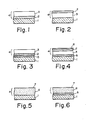
- Figs. 1 - 6 are schematic cross sections of various layer arrangements that can be adopted in the photoreceptor of the present invention.
- Fig. 7 is a graph showing the sensitivity vs carrier transport material content of a photoreceptor.
- the compound of the general formula (I) is used as a carrier transport material in a so-called “functionally separated” electrophotographic photoreceptor which employs different materials for carrier generation and transport thereof.
- the photoreceptor so fabricated offers the following advantages: it has good physical properties as a film; even if the carrier transport material is incorporated at a low concentration, the photoreceptor exhibits good electrophotographic characteristics in such aspects as change retention, sensitivity and residual potential; it will experience reduced fatigue deterioration during cyclic use; and it ensures consistent characteristics even if it is exposed to heat, ozone or light.
- the carrier transport material to be used in the present invention may be composed of either one or more compounds selected from those represented by the general formula (I). If desired, this carrier transport material may be combined with other carrier transport materials known in the art.
- carrier transport material of formula (I) which may be used with advantage in the present invention include but are not limited to those having the structural formulas noted below:
- the stilbene derivatives listed above can be readily synthesized by known methods, one of which is described in Organic Reactions, Vol. 25, p. 73, John & Willey & Sons, Inc. According to this method, a desired stilbene derivative can easily be obtained by condensing an aromatic aldehyde of the general formula (II) shown below with a dialkyl ester of phosphonic acid of the general formula (III) shown below in a solvent such as N,N-dimethylformamide in the presence of a base such as a sodium alkoxide: where Ar 1 , Ar 2 , Ar 3 , Ar4, R 1 and R 2 have the same meanings as defined in the general formula (I); and R 3 represents an alkyl or aryl group.
- N,N-Diphenylaminobenzaldehyde (5.5 g, or 0.02 moles) and diethyl p-diethylaminobenzylphosphonate (6.0 g, or 0.02 moles) were dissolved in N,N-dimethylformamide (70 ml).
- sodium hydride (1 g, or 0.04 moles) was slowly added, with the temperature in the reactor being held at 5°C or below. Thereafter, the reaction mixture was stirred for 1 h under cooling with ice, then for 5 h at room temperature.
- ice water 50 ml
- the resulting crystal was recovered by filtration and recrystallized twice with a mixed solvent of toluene-isopropyl alcohol (1:2).
- Azo pigments are preferred for use as carrier generation materials in the present invention but both inorganic and organic pigments can generally be used as long as they generate free carriers by absorbing light in the visible to infrared region.
- Illustrative inorganic pigments that may be used as charge generation materials include amorphous selenium, trigonal selenium, Se-As alloys, Se-Te alloys, and cadmium sulfide. Also usable are the organic pigments that may be frustrated by the following typical examples:
- the carrier transport materials used in the present invention are incapable of forming films by themselves, so they are combined with a variety of binders to form a light-sensitive layer.
- Any binders may be used in carrier generation and transport layers but preferred binders are hydrophobic, electrically insulating film-forming high-molecular weight polymers.
- Such high-molecular weight polymers include but are not limited to the following:
- binders may be used either on their own or as admixtures.
- the photoreceptor shown in Fig. 1 comprises an electroconductive base 1 which has formed thereon a light-sensitive layer 4 comprising a carrier generation layer 2 that contains a carrier generation material as a chief component and which is overlaid with a carrier transport layer 3 that contains a carrier transport material beased on the stilbene derivative represented by the general formula (I) specified herein.
- the order of superposition of the carrier generation layer 2 and the carrier transport layer 3 may be reversed as shown in Fig. 2.
- an intermediate layer 5 may be disposed between the light-sensitive layer 4 and the conductive base 1.
- a photoreceptor having most desirable electrophotographic characteristics can be obtained.
- Other modifications of the photoreceptor of the present invention are shown in Figs. 5 and 6; in the case shown in Fig. 5, a light-sensitive layer 4 having the fine particles of a carrier generation material 7 dispersed in a layer 6 that is based on the carrier transport material described herein is formed directly on the conductive base; or as in the case shown in Fig. 6, such a light-sensitive layer may be formed on the conductive base 1, with an intermediate layer 5 being interposed. And such a light-sensitive layer may be formed on a carrier transport layer.
- a protective layer 8 may optionally be formed on the light-sensitive layer 4 as shown in Fig. 4.
- the carrier transport layer 3 is advantageously placed on top of the carrier generation layer 2 because the carrier transport material in the layer 3 has a high capability for hole transport.
- the carrier generation layer 2 which is the other element of the dual light-sensitive layer 4 may be formed by one of the following methods either directly on the conductive base 1 or carrier transport layer 3 or with an intermediate layer such as an adhesive layer or a barrier layer interposed:
- the so formed carrier generation layer 2 preferably has a thickness of 0.01 - 5 u.m, with the range of 0.05 - 3 /.Lm being more preferred.
- the thickness of the carrier transport layer 3 may be adjusted to a suitable value depending on the need but is preferably within the range of 5 - 30 u.m.
- a binder is preferably used in the carrier transport layer 3 in an amount of 0.8 - 10 parts by weight per part by weight of the carrier transport material specified herein.
- a binder is preferably used in an amount not exceeding 5 parts by weight per part by weight of the carrier generation material.
- a binder is preferably used in an amount within the range of 0.5 to 10 parts by weight per part by weight of said carrier generation material and in an amount within the range of 0.5 to 10 parts by weight per part by weight of said carrier transport material, respectively.
- the light-sensitive layer in the photoreceptor of the present invention' may be double- or single-layered.
- one or more electron-accepting materials may be incorporated in the surface layer (i.e., carrier transport layer, carrier generation layer, single-layered light-sensitive layer, or protective layer) either alone or together with underlying layers for attaining various purposes such as improved sensitivity and reduced residual potential or fatigue due to cyclic use.
- the intermediate layer described above serves as an adhesive or barrier layer and may employ polyvinyl alcohol, ethyl cellulose, carboxymethyl cellulose, casein, etc. in addition to the binder resins listed above.
- Examples of the conductive base 1 used in the electrophotographic photoreceptor of the present invention include but are not limited to the following:
- the carrier transport layer, carrier generation layer and other constituent layers of the photoreceptor of the present invention may be formed by any method selected from among vapor-phase deposition techniques such as vacuum evaporation, sputtering and CVD, and from coating techniques such as dip coating, spray coating, blade coating and roll coating.
- vapor-phase deposition techniques such as vacuum evaporation, sputtering and CVD
- coating techniques such as dip coating, spray coating, blade coating and roll coating.
- the electrophotographic photoreceptor of the present invention shows good chargeability, sensitivity and image forming characteristics as will be demonstrated in the examples that follow.
- a particularly notable advantage of this photoreceptor is its very high durability and it will experience minimum fatigue deterioration even if it is used in electrophotography by a cyclic transfer process.
- a carrier transport material [Illustrative compound (1)] and 10 parts by weight of a polycarbonate resin ("Panlite L-1250") were dissolved in 80 parts by weight of 1,2-dichloroethane. The solution was coated on the carrier generation layer to form a carrier transport layer in a dry thickness of 16 um. In this way, a sample of the electrophotographic photoreceptor of the present invention was fabricated.
- the electrophotographic characteristics of this sample were measured dynamically with a paper analyzer Model EPA-8100 of Kawaguchi Electric Works Co., Ltd.
- the surface of the light-sensitive layer was charged with a negative voltage of 6 kV for 5 seconds to a surface potential V A ; then, the surface of the same light-sensitive layer was exposed to light from a tungsten lamp to attain an illuminance of 3.5 lux and the amount of exposure (sensitivity) necessary for the surface potential to be attenuated from -600 volts to -100 volts was determined; the surface potential (residual potential) V R that was left after exposure of 30 lux * sec was also determined. The same measurements were repeated 100 times and the results are shown in Table 1.
- a comparative sample (No. 1) of photoreceptor was prepared as in Example 1 except that a stilbene derivative represented by the structural formula shown below was-used as a carrier transport material. This comparative sample was subjected to the same measurements as those performed in Example 1.
- the photoreceptor sample of the present invention prepared in Example 1 was by far superior to the comparative sample No. 1 in terms of sensitivity, residual potential and stability in cyclic use.
- Example 2 Additional samples of the photoreceptor of the present invention were prepared as in Example 1 except that Illustrative compound Nos. 2, 4, 6, 8, 10, 12, 14, 16 and 18 were used as carrier transport materials. These samples were subjeoted to the same measurements as those performed in Example 1. The result are shown in Table 2 below.
- a conductive support was prepared by laminating a polyester film with an aluminum foil.
- a carrier generation material bisazo pigment represented by the stuructural formula shown below
- a polymethyl methacrylate resin "Dianal BR-80" of Mitsubishi Rayon Co., Ltd.
- a carrier transport material [Illustrative compound (8)] and 10 parts by weight of a polycarbonate resin ("Panlite K-1300" of TEIJIN LTD.) were dissolved in 100 parts by weight of 1,2-dichloroethane.
- the solution was coated in a dry thickness of 15 ⁇ m on the carrier generation layer to form a carrier transport layer. In this way, a sample of the electrophotographic photoreceptor of the present invention was fabricated.
- a comparative sample (No. 2) of photoreceptor was prepared as in Example 11 except that a stilbene derivative represented by the structural formula shown below was used as a carrier transport material. This comparative sample was subjected to the same measurements as those performed in Example 1. The results are shown in Table 3.
- the photoreceptor sample of the present invention prepared in Example 11 was by far superior to the comparative sample in terms of sensitivity, residual potential and stability in cyclic use.
- a carrier generation material bisazo pigment represented by the structural formula shown below
- a polycarbonate resin (“Panlite K-1300”)
- the dispersion was coated in a dry thickness of 0.4 u.m on the intermediate layer to form a carrier generation layer.
- a carrier transport material [3.5 parts by weight of Illustrative compound (5)] and 10 parts by weight of a polycarbonate resin ("Panlite K-1300") were dissolved in 100 parts by weight of tetrahydrofuran. The solution was coated on the carrier generation layer to form a carrier transport layer in a dry thickness of 17 ⁇ m. In this way, a sample of the electrophotographic photoreceptor of the present invention was fabricated.
- Example 12 Another sample of the photoreceptor of the present invention was prepared as in Example 12 except that a bisazo pigment represented by the structural formula shown below was used as a carrier generation material.
- ES-lec MF-10 vinyl chloride-vinyl acetate-maleic anhydride copolymer
- One part by weight of dibromoanthanthrone (“Monolight Red 2Y”) and one part by weight of a polycarbonate resin (“Panlite L-1250”) were added to 100 parts by weight of 1,2-dichloroethane and dispersed in a ball mill for 24 h.
- the dispersion was dip-coated on the intermediate layer to form a carrier generation layer in a thickness of 1 ⁇ m.
- a carrier transport material [Illustrative compound (2)] and 10 parts by weight of a polycarbonate resin having the structural formula shown below ("Z-200" of MITSUBISHI GAS CHEMICAL CO., INC.) were dissolved in 80 parts by weight of 1,2-dichloroethane: The solution was dip-coated on the carrier generation layer to form a carrier transport layer in a thickness of 17 4m. In this way, a sample of the electrophotographic photoreceptor of the present invention was fabricated.
- This photoreceptor was set in an electrophotographic copier "U- Bix 1550MR" for duplication of image. A faithful, high-contrast and good-gradation copy was obtained. The results were the same even after 5 x 10" copies were taken.
- a comparative sample (No. 3) of photoreceptor was prepared as in Example 14 except that a stilbene derivative having the structural formula shown below was used as a carrier transport material:
- This comparative sample was subjected to a copying test as in Example 14. In the initial stage, good copies were obtained but when 2 x 10 4 or more copies were taken, the fog problem became pronounced. Only a foggy and low-contrast image was obtained after copying 3 x 10⁴ copies.
- a carrier transport material [Illustrative compound (10)] and 10 parts by weight of a polycarbonate resin ("Panlite L-1250") were dissolved in 80 parts by weight of 1,2-dichloroethane. The solution was coated on the intermediate layer to form a carrier transport layer in a dry thickness of 15 u.m.
- a carrier generation material having the structural formula shown below 1.5 parts by weight of a carrier transport material [Illustrative compound (10)] and 2 parts by weight of a polycarbonate resin ("Panlite L-1250") were added to 100 parts by weight of 1,2-dichloroethane and dispersed in a ball mill for 24 h: The dispersion was coated on the carrier transport layer to form a layer having the fine particles of a carrier generation material dispersed in a layer that is based on the carrier transport material, in a dry thickness of 3 um. In this way, a sample of the electrophotographic photoreceptor of the present invention was fabricated.
- a comparative sample (No. 4) of photorecept was prepared as in Example 15 except that a stilbene derivative represented by the structural formula shown below was used as a carrier transport material
- the photoreceptor sample of the present invention exhibited far better characteristics than the comparative sample in terms of sensitivity and stability in cyclic use.
- ES-lec MF-10 vinyl chloride-vinyl acetate-maleic anhydride copolymer
- a carrier generation layer bisazo pigment represented by the structural formula shown below
- a polycarbonate resin (“Panlite L-1250”)
- the dispersion was coated on the intermediate layer to form a carrier generation layer in a dry thickness of 0.3 um.
- a carrier transport material [Illustrative compound (9)] and 10 parts by weight of a polycarbonate resin ("Panlite K-1300") were dissolved in 100 parts by weight of 1,2-dichloroethane and the solution was coated on the carrier generation layer to form a carrier transport layer in a dry thickness of 16 um. In this way, a sample of the electrophotographic photoreceptor of the present invention was fabricated.
- a carrier generation material having the structural formula shown below was added to 100 parts by weight of 1,2-dichloroethane and dispersed in a ball mill for 24 h.
- the dispersion was coated on an aluminum-evaporated polyester film to form a carrier generation layer in a thickness of 0.5 u.m.
- a carrier transport material [Illustrative compound (17)] and 10 parts by weight of a polycarbonate resin ("Panlite K-1300") were dissolved in 100 parts by weight of 1,2-dichloroethane.
- the solution was coated on the carrier generation layer to form a carrier transport layer in a thickness of 15 ⁇ m. In this way, a sample of the electrophotographic photoreceptor of the present invention was fabricated.
- a comparative sample (No. 5) of photoreceptor was prepared as in Example 17 except that 4.0 parts by weight of a stilbene derivative having the structural formula shown below was used as a carrier transport material:
- a carrier generation layer was formed as in Example 11 except that nonmetallic r-phthalocyanine (TOYO INK MFG. CO., LTD.) was used as a carrier generation material.
- nonmetallic r-phthalocyanine TOYO INK MFG. CO., LTD.
- a carrier transport material [Illustrative compound (14)] was added in different amounts (7.5, 6.0, 5.0, 4.0 and 3.0 parts by weight) and the mixtures were processed as in Example 11 and coated on the carrier generation layer to form carrier transport layers in a thickness of 20 ⁇ m.
- the so fabricated samples of the electrophotographic photoreceptor of the present invention were subjected to measurements of sensitivity as in Example 1. The results are shown in Fig. 7.
- Comparative samples of photoreceptor were prepared as in Example 18 except that a stilbene derivative having the structural formula shown below was used as a carrier transport material: These comparative samples were subjected to the same measurements as those performed in Example 18 and the results are also shown in Fig. 7.
- the electrophotographic photoreceptor of the present invention is far superior to the comparative samples in terms of sensitivity and stability in cyclic use.
- the advantage of the present invention is particularly notable in the low concentration range of a carrier transport material where it experiences a much smaller decrease in sensitivity than the comparative samples.
Landscapes
- Physics & Mathematics (AREA)
- General Physics & Mathematics (AREA)
- Photoreceptors In Electrophotography (AREA)
Applications Claiming Priority (2)
| Application Number | Priority Date | Filing Date | Title |
|---|---|---|---|
| JP63094065A JPH01263657A (ja) | 1988-04-14 | 1988-04-14 | 電子写真感光体 |
| JP94065/88 | 1988-04-14 |
Publications (1)
| Publication Number | Publication Date |
|---|---|
| EP0337307A2 true EP0337307A2 (fr) | 1989-10-18 |
Family
ID=14100119
Family Applications (1)
| Application Number | Title | Priority Date | Filing Date |
|---|---|---|---|
| EP89106136A Withdrawn EP0337307A2 (fr) | 1988-04-14 | 1989-04-07 | Photorécepteur électrophotographique |
Country Status (2)
| Country | Link |
|---|---|
| EP (1) | EP0337307A2 (fr) |
| JP (1) | JPH01263657A (fr) |
Cited By (4)
| Publication number | Priority date | Publication date | Assignee | Title |
|---|---|---|---|---|
| EP0535672A3 (en) * | 1991-10-02 | 1993-05-12 | Mitsubishi Kasei Corporation | Electrophotographic photoreceptor |
| EP0591010A1 (fr) * | 1992-10-02 | 1994-04-06 | Mita Industrial Co., Ltd. | Matériau organique photosensible pour électrophotographie |
| US5389480A (en) * | 1991-10-02 | 1995-02-14 | Mitsubishi Kasei Corporation | Electrophotographic photoreceptor |
| WO2005025441A1 (fr) | 2003-09-08 | 2005-03-24 | Dentaurum J.P. Winkelstroeter Kg | Element de fixation orthodontique |
-
1988
- 1988-04-14 JP JP63094065A patent/JPH01263657A/ja active Pending
-
1989
- 1989-04-07 EP EP89106136A patent/EP0337307A2/fr not_active Withdrawn
Cited By (5)
| Publication number | Priority date | Publication date | Assignee | Title |
|---|---|---|---|---|
| EP0535672A3 (en) * | 1991-10-02 | 1993-05-12 | Mitsubishi Kasei Corporation | Electrophotographic photoreceptor |
| US5389480A (en) * | 1991-10-02 | 1995-02-14 | Mitsubishi Kasei Corporation | Electrophotographic photoreceptor |
| EP0591010A1 (fr) * | 1992-10-02 | 1994-04-06 | Mita Industrial Co., Ltd. | Matériau organique photosensible pour électrophotographie |
| US5449580A (en) * | 1992-10-02 | 1995-09-12 | Mita Industrial Co., Ltd. | Organic photosensitive material for electrophotography |
| WO2005025441A1 (fr) | 2003-09-08 | 2005-03-24 | Dentaurum J.P. Winkelstroeter Kg | Element de fixation orthodontique |
Also Published As
| Publication number | Publication date |
|---|---|
| JPH01263657A (ja) | 1989-10-20 |
Similar Documents
| Publication | Publication Date | Title |
|---|---|---|
| US4666809A (en) | Electrophotographic photosensitive member | |
| US4092162A (en) | Nitrogen containing polymers aelements | |
| US4448868A (en) | Electrophotographic photoreceptor with hydrazone derivative | |
| JPH0746227B2 (ja) | 電子写真用感光体 | |
| JP2884353B2 (ja) | 電子写真感光体 | |
| EP0144791A2 (fr) | Photorécepteur | |
| EP0337307A2 (fr) | Photorécepteur électrophotographique | |
| US4396694A (en) | Organic electrophotographic sensitive materials | |
| JPH04225363A (ja) | 感光体 | |
| JP2811108B2 (ja) | 電子写真感光体 | |
| JP2707272B2 (ja) | 電子写真感光体 | |
| JP2811107B2 (ja) | 電子写真感光体 | |
| US5166022A (en) | Electrophotographic photoreceptor | |
| JP3148955B2 (ja) | 電子写真感光体 | |
| US4495261A (en) | Electrophotographic substituted p,p'-bisazo diphenyl acrylonitrile compounds for photoreceptors | |
| JPH01106070A (ja) | 電子写真感光体 | |
| JP2759285B2 (ja) | 電子写真感光体 | |
| JP2858152B2 (ja) | 電子写真感光体 | |
| JP2593087B2 (ja) | 電子写真感光体 | |
| JP3160779B2 (ja) | 電子写真感光体 | |
| JP2651592B2 (ja) | 電子写真感光体 | |
| JP2816064B2 (ja) | 電子写真感光体 | |
| JPH08320581A (ja) | 電子写真感光体 | |
| JP2651591B2 (ja) | 電子写真感光体 | |
| JP2852787B2 (ja) | 電子写真感光体 |
Legal Events
| Date | Code | Title | Description |
|---|---|---|---|
| PUAI | Public reference made under article 153(3) epc to a published international application that has entered the european phase |
Free format text: ORIGINAL CODE: 0009012 |
|
| AK | Designated contracting states |
Kind code of ref document: A2 Designated state(s): DE GB |
|
| STAA | Information on the status of an ep patent application or granted ep patent |
Free format text: STATUS: THE APPLICATION HAS BEEN WITHDRAWN |
|
| 18W | Application withdrawn |
Withdrawal date: 19900418 |
|
| R18W | Application withdrawn (corrected) |
Effective date: 19900418 |