EP0337586A2 - Identification de cellules NK et lymphocytes T cytotoxiques - Google Patents
Identification de cellules NK et lymphocytes T cytotoxiques Download PDFInfo
- Publication number
- EP0337586A2 EP0337586A2 EP89300107A EP89300107A EP0337586A2 EP 0337586 A2 EP0337586 A2 EP 0337586A2 EP 89300107 A EP89300107 A EP 89300107A EP 89300107 A EP89300107 A EP 89300107A EP 0337586 A2 EP0337586 A2 EP 0337586A2
- Authority
- EP
- European Patent Office
- Prior art keywords
- cells
- reagent
- leu
- lymphocytes
- react
- Prior art date
- Legal status (The legal status is an assumption and is not a legal conclusion. Google has not performed a legal analysis and makes no representation as to the accuracy of the status listed.)
- Granted
Links
Images
Classifications
-
- C—CHEMISTRY; METALLURGY
- C07—ORGANIC CHEMISTRY
- C07K—PEPTIDES
- C07K16/00—Immunoglobulins [IG], e.g. monoclonal or polyclonal antibodies
- C07K16/18—Immunoglobulins [IG], e.g. monoclonal or polyclonal antibodies against material from animals or humans
- C07K16/28—Immunoglobulins [IG], e.g. monoclonal or polyclonal antibodies against material from animals or humans against receptors, cell surface antigens or cell surface determinants
- C07K16/2803—Immunoglobulins [IG], e.g. monoclonal or polyclonal antibodies against material from animals or humans against receptors, cell surface antigens or cell surface determinants against the immunoglobulin superfamily
- C07K16/283—Immunoglobulins [IG], e.g. monoclonal or polyclonal antibodies against material from animals or humans against receptors, cell surface antigens or cell surface determinants against the immunoglobulin superfamily against Fc-receptors, e.g. CD16, CD32, CD64
-
- C—CHEMISTRY; METALLURGY
- C07—ORGANIC CHEMISTRY
- C07K—PEPTIDES
- C07K16/00—Immunoglobulins [IG], e.g. monoclonal or polyclonal antibodies
- C07K16/18—Immunoglobulins [IG], e.g. monoclonal or polyclonal antibodies against material from animals or humans
- C07K16/28—Immunoglobulins [IG], e.g. monoclonal or polyclonal antibodies against material from animals or humans against receptors, cell surface antigens or cell surface determinants
- C07K16/2803—Immunoglobulins [IG], e.g. monoclonal or polyclonal antibodies against material from animals or humans against receptors, cell surface antigens or cell surface determinants against the immunoglobulin superfamily
-
- C—CHEMISTRY; METALLURGY
- C07—ORGANIC CHEMISTRY
- C07K—PEPTIDES
- C07K16/00—Immunoglobulins [IG], e.g. monoclonal or polyclonal antibodies
- C07K16/18—Immunoglobulins [IG], e.g. monoclonal or polyclonal antibodies against material from animals or humans
- C07K16/28—Immunoglobulins [IG], e.g. monoclonal or polyclonal antibodies against material from animals or humans against receptors, cell surface antigens or cell surface determinants
- C07K16/2803—Immunoglobulins [IG], e.g. monoclonal or polyclonal antibodies against material from animals or humans against receptors, cell surface antigens or cell surface determinants against the immunoglobulin superfamily
- C07K16/2809—Immunoglobulins [IG], e.g. monoclonal or polyclonal antibodies against material from animals or humans against receptors, cell surface antigens or cell surface determinants against the immunoglobulin superfamily against the T-cell receptor (TcR)-CD3 complex
-
- Y—GENERAL TAGGING OF NEW TECHNOLOGICAL DEVELOPMENTS; GENERAL TAGGING OF CROSS-SECTIONAL TECHNOLOGIES SPANNING OVER SEVERAL SECTIONS OF THE IPC; TECHNICAL SUBJECTS COVERED BY FORMER USPC CROSS-REFERENCE ART COLLECTIONS [XRACs] AND DIGESTS
- Y10—TECHNICAL SUBJECTS COVERED BY FORMER USPC
- Y10S—TECHNICAL SUBJECTS COVERED BY FORMER USPC CROSS-REFERENCE ART COLLECTIONS [XRACs] AND DIGESTS
- Y10S436/00—Chemistry: analytical and immunological testing
- Y10S436/80—Fluorescent dyes, e.g. rhodamine
-
- Y—GENERAL TAGGING OF NEW TECHNOLOGICAL DEVELOPMENTS; GENERAL TAGGING OF CROSS-SECTIONAL TECHNOLOGIES SPANNING OVER SEVERAL SECTIONS OF THE IPC; TECHNICAL SUBJECTS COVERED BY FORMER USPC CROSS-REFERENCE ART COLLECTIONS [XRACs] AND DIGESTS
- Y10—TECHNICAL SUBJECTS COVERED BY FORMER USPC
- Y10S—TECHNICAL SUBJECTS COVERED BY FORMER USPC CROSS-REFERENCE ART COLLECTIONS [XRACs] AND DIGESTS
- Y10S530/00—Chemistry: natural resins or derivatives; peptides or proteins; lignins or reaction products thereof
- Y10S530/808—Materials and products related to genetic engineering or hybrid or fused cell technology, e.g. hybridoma, monoclonal products
- Y10S530/809—Fused cells, e.g. hybridoma
Definitions
- This invention relates to the fields of immunology and cell analysis and is particularly directed to techniques for distinguishing between classes of human lymphocytes.
- Lymphocytes are a subset of leukocytes (white blood cells). Within the lymphocyte population, at least two distinct cell types have been identified that are able to lyse other cells, including autologous malignant cells, autologous virus-infected cells, and allogeneic cells. These two predominant cytotoxic lymphocytes are cytotoxic T lymphocytes (CTL) and natural killer (NK) cells.
- CTL cytotoxic T lymphocytes
- NK natural killer
- CD3 is composed of at least three proteins of 20-30 kD that are non-covalently associated with the T-cell-antigen receptor (i.e., the structure responsible for antigen recognition). Numerous antibodies have been produced against CD3, including the anti-Leu-4 monoclonal antibody (commerically available from Becton Dickinson Monoclonal Center, Inc.). Most CTL lyse target cells (for example, virus-infected target cells) provided that the target cells express syngeneic major histocompatibility (MHC) antigens. Accordingly, such cells are subject to MHC restriction.
- MHC major histocompatibility
- NK cells differ from T lymphocytes in that most NK cells do not express either CD3 antigen or the T-cell-antigen receptor (see Lanier et al ., J. Immunol. (1986) 137 :2735). NK cells are also able to lyse certain tumor cells and virus-infected cells, but are not MHC restricted.
- T cells can be readily identified by their reactivity with anti-CD3 antibodies, there has been no simple and sensitive method for the identification or enumeration of NK cells using a single labeling reagent. It is well known that most NK cells express the CD16 antigen.
- CD16 is a 50-70 kD glycoprotein that is associated with a receptor for IgG. Numerous anti-bodies have been produced against CD16, including antiLeu-11a, VEP13, B73.1, L23 and others (Lanier et al ., J. Immunol. (1983) 131 :1789: Perussia et al ., J. Immunol. (1983) 130 :2133; Perussia et al ., J.
- CD16 cannot be detected on all NK cells, particularly NK cells that have been activated in culture. Moreover, in certain circumstances CD16 can also be expressed on T lymphocytes (Lanier et al ., J. Exp. Med. (1985) 162 :2089).
- NK cells express another glycoprotein on the plasma membrane that is identified by the anti-Leu-19 monoclonal antibody, an antibody commercially available from the Becton Dickinson Monoclonal Center, Inc.
- Anti-Leu-19 recognizes a glycoprotein of about 160 kD (GP160) that is also recognized by the NKH-1 monoclonal antibody (Lanier et al ., J. Immunol. (1986) 136 :4480).
- GP160 GP160
- NKH-1 monoclonal antibody Lanier et al ., J. Immunol. (1986) 136 :4480
- neither anti-Leu-19 nor NKH-1 react exclusively with NK cells but can also react with other non-lymphocyte cell types (Lanier et al ., J. Immunol. (1987) 138 :2019).
- Anti-Leu-19 also reacts with a unique minor subset of T lymphocytes, at least some of which kill without MHC restriction (Lanier et al ., J. Immunol. (1986) 136 :4480). Finally, the amount of the antigen recognized by anti-Leu-19 on the plasma membrane of NK cells is often low, making it difficult to precisely identify and enumerate the number of NK cells in a mixed cell population, such as blood or other tissues.
- the present invention provides a method for distinguishing between NK cells and cytotoxic T lymphocytes, which comprises contacting a sample containing lymphocytes with a first reagent comprising anti-CD3 and a first detectable label and a second reagent comprising a mixture of anti-CD16 and anti-GP160 both labeled with a second detectable label, and distinguishing cells that react with said first reagent from cells that react with said second reagent, whereby cells that react only with said first reagent are identified as T lymphocytes and cells that react only with said second reagent are identified as NK cells.
- Lymphocytes reacting with both reagents are identified as a unique subpopulation of T lymphocytes, some of which may mediate MHC unrestricted cytolysis.
- the two reagents are conjugated with different fluorophores, and the cells are detected by microscopy or flow cytometry.
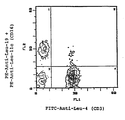
- the Figure is a graph showing the fluorescence of cells labeled with FITC-anti-Leu-4 (CD3) versus fluorescence of cells labeled with PE-anti-Leu-19 (GP160) plus PE-anti-Leu-11c (CD16).
- NK cells and cytotoxic T lymphocytes can be distinguished from one another on the basis of cell surface antigens. These cell surface antigens are recognized by the ability of labeled antibodies specific for these antigens to bind with the cell surfaces.
- T lymphocytes, NK cells, and certain other classes of cells can be recognized by the different manner in which the two reagents bind to the cells.
- the first reagent comprises an anti-CD3 antibody while the second reagent comprises a mixture of antibodies (anti-CD16 and anti-GP160).
- the two reagents are labeled with different detectable labels that allow them to be differentiated.
- Cells that react with the first reagent are identified as T lymphocytes
- cells that react solely with the second reagent are identified as NK cells
- cells that react with both reagents form a subset of T lymphocytes, some of which mediate non-MHC restricted cytotoxic functions.
- GP160 Cell surface antigens on lymphocytes and NK cells have been identified using several systems of nomenclature.
- the antigen identified as Leu-4 in this specification is also known as the CD3 antigen using the CD nomenclature for differentiation antigens.
- the Leu-11 antigen is known as CD16.
- the relationship of the antigen recognized by anti-Leu-19 to the CD cluster antigens has not been established, but the Leu-19 antigen appears to be the same as the antigen identified by the NKH-1 antibody.
- this third antigenic material is referred to as GP160.
- the CD and GP160 designations refer to the entire antigen and are more general than the Leu designations, which are derived from a series of monoclonal antibodies that recognize specific determinants on the antigens. In some instances in this discussion of the invention, reference is made to the Leu designations while in other instances the more general CD and GP160 designations are used. While in some instances it will be clear from the context that either the general or the specific case is intended, in many cases the two terms are used interchangeably.
- the Leu system of nomenclature arose from the use of monoclonal antibodies that reacted specifically with individual antigens present on the surface of cells.
- Anti-Leu-4 reacts with CD3, a complex of at least three proteins of 20-30 kD (Kan et al ., J. Immunol. (1983) 131 :536; Borst et al .,. J. Immunol. (1982) 128 :1560).
- Anti-Leu-11 specifically reacts with the CD16 antigen.
- CD16 is a 50,000-70,000 Dalton protein that is associated with the Fc receptor for IgG present on NK cells and neutrophils.
- Monoclonal antibodies useful in the practice of the present invention can be prepared by standard techniques as described below.
- Anti-Leu-11 can be produced by immunizing mice with human peripheral blood, low-buoyant-density lymphocytes or granulocytes and fusing the immune splenocytes with a myeloma cell line.
- the antigenic specificity for Leu-11 in the resulting hybridomas can be determined by competitive binding studies and immunoprecipitation of the CD16 antigen.
- Anti-Leu-19 can be prepared in a similar manner by immunizing mice with the KG1a cell line (Koeffler et al ., Blood (1980) 61 :1222), fusing the immune splenocytes with a myeloma cell line. and selecting cells that produce an antibody reactive with the NKH-1 antigen.
- Anti-Leu-4 can be produced by immunizing mice with human thymocytes or peripheral T lymphocytes, fusing the immune splenocytes with a myeloma cell line, and selecting cells that produce an antibody reactive with CD3.
- Antigenic specificity can be determined by competitive binding studies and immunoprecipitation of CD3 antigen (Beverley and Callard. Eur. J. Immunol. (1981) 11 :329; Kung et al ., Science (1979) 206 :347).
- the specific monoclonal antibodies set forth herein or their equivalent can be used in the practice of this invention.
- the monoclonal antibodies can belong to any of the classes or subclasses of antibodies, including IgA, IgD, IgE, IgG (subclasses 1-4, if human; 1, 2a, 2b, 3 if murine), or IgM.
- Actively binding fragments of the antibodies can be employed, such as Fab, F(ab′)2, or the like.
- the monoclonal antibodies can be prepared by any convenient means which provides immortalization of the B-lymphocyte genes encoding the antibody subunits or Fv, such as fusion between sensitized lymphocytes and a myeloma fusion partner; transformation, e.g., with EBV; or other immortalization technique.
- the genes can be isolated from a lymphocytic host expressing the antibodies and transferred to a more convenient host for expression in accordance with known genetic engineering techniques.
- the antibodies may be obtained from any convenient vertebrate source, such as rodent (e.g., mouse, rat), primate (e.g., human), lagomorpha, bovine, ovine, equine, porcine, etc.
- the antibodies are often prepared by fusing spleen or other tissue cells from a host with myeloma cells in accordance with known techniques or by transforming the spleen cells with an appropriate transforming vector to immortalize the cells.
- the cells can be cultured in a selective medium and screened to select antibodies that bind the designated antigens.
- the antibodies can be labeled using standard techniques.
- labels include radioisotopes, e.g.. 1H, 125I, 131I, and 14C: fluorescers, e.g., fluorescein, phycobiliproteins, rare earth chelates, and rho damine; enzyme substrates and inhibitors; enzymes, such as horseradish peroxidase, glucose oxidase, glucose-6-phosphate dehydrogenase, ⁇ -galactosidase, and acetylcholinesterase; or particles, e.g., dextran, agarose.
- fluorescers e.g., fluorescein, phycobiliproteins, rare earth chelates, and rho damine
- enzyme substrates and inhibitors enzymes, such as horseradish peroxidase, glucose oxidase, glucose-6-phosphate dehydrogenase, ⁇ -galacto
- fluorescent labels it is particularly preferred to use two different fluorescent labels as the first and second label used in the method of the invention.
- Use of different fluorescent labels allows easy detection and cell sorting by flow cytometry using automated equipment.
- a preferred pair of flurescent labels is fluorescein (conjugated from the isothiocyanate, FITC) and phycoerythrin (conjugated to the antibody with SPDP, which is N-succinimidyl-3-(2-pyridyldithio)propionate).
- FITC isothiocyanate
- SPDP is N-succinimidyl-3-(2-pyridyldithio)propionate
- Other suitable cross-linkers and coupling techniques for attaching fluorophores to antibodies can be used.
- Either fluorescein or phycoerythrin can be used as the first detectable label with the other being used as the second detectable label as long as one label is used with anti-Leu-4 and the other label used for both anti-Leu-11 and anti-Leu-19.
- the reaction medium is typically an aqueous suspension of cells containing a buffer that maintains the solution in the acceptable physiological range of parameters (e.g., temperature, pH, and osmolarity) for the particular type of cell being analyzed.
- T lymphocytes and NK cells are distinguished by their ability to bind with the two reagents. All cells which react with anti-Leu-4 are identified as T lymphocytes whether or not they also react with anti-Leu-11 and/or anti-Leu-19. Those cells which react with both anti-Leu-4 (Reagent 1) and anti-Leu-19 or anti-Leu-11 (Reagent 2) form a subset of T lymphocytes, some of which mediate non-MHC restricted cytotoxic function. Lymphoid cells which react with Reagent 2 (anti-Leu-11 and/or anti-Leu-19) but not with Reagent 1 (anti-Leu-4) are identified as NK cells.
- the method used to detect differences between the two cell types will naturally vary with the types of labels used.
- different radioactive labels can be distinguished by use of a differential radiation detector (e.g., a gamma counter capable of distinguishing isotopes based on their radiation spectrums).
- a differential radiation detector e.g., a gamma counter capable of distinguishing isotopes based on their radiation spectrums.
- Use of two different fluorescent labels is particularly preferred as fluorescent labels allow cells to be detected and if desired sorted automatically using flow cytometry.
- Fluorescence-activated cell sorters are commercially available flow cytometers and are capable of distinguishing between cells labeled in the manner described.
- the purpose of detecting the different cell types will be diagnostic.
- a new method of cancer therapy involves the combined use of in vivo interleukin-2 (IL-2) drug treatment and reinfusing the patient's autologous lymphocytes that have been activated in vitro with IL-2, often referred to as lymphokine-activated killer (LAK) cell and IL-2 therapy (Rosenberg et al ., N. Eng. J. Med. (1985) 313 :1485).
- LAK lymphokine-activated killer
- the invention also allows simultaneous detection of T lymphocytes, identified as cells stained with FITC but not PE, and the detection of unique T cells that express both (1) CD3 and (2) CD16 and/or GP160, which includes a population of T cells that mediate MHC unrestricted cytotoxicity.
- the invention is also useful in determining the immune status of patients, in that it permits simultaneous determination of the total numbers and percentages of NK and T cells. This can be compared to normal values in order to determine whether the proportions or absolute number of these cell types are normal or abnormal in certain disease states.
- Anti-Leu-11d monoclonal antibody was produced by a hybridoma cell line identified as L23.
- L23 was derived by immunizing BALB/c mice with human peripheral blood low buoyant density lymphocytes and fusing the immune spleenocytes with the SP2/0 myeloma cell line.
- the L23 hybridoma produces an IgG1, ⁇ MAb.
- An IgG2a isotype-switch variant designated L23b was selected by fluorescence-activated cell sorting by using fluorescein isothiocyanate (FITC)-conjugated goat anti-mouse IgG2a-specific antiserum (Southern Biotech, Birmingham, AL).
- the antigenic specificity was determined by competitive binding studies and immunoprecipitation of the CD16 antigen.
- Anti-Leu-19 an IgG1, ⁇ MAb, was produced by the My31 hybridoma cell line.
- My31 was derived by immunizing (C57BL/6 x BALB/c) F1 mice with the KG1a cell line (described in Koeffler et al ., Blood (1980) 61 :1222), fusing the immune splenocytes with the SP2/0 myeloma cell line and selecting for antigenic specificity using the indicated antigen.
- Anti-Leu-4 was produced by the SK7 hybridoma cell line.
- SK7 was derived by immunizing BALB/c mice with human thymocytes, fusing the immune splenocytes with the NS-1 myeloma cell line, and selecting for antibodies reactive with T lymphocytes.
- Purified antibody was normally stored in the presence of azide as an antibacterial. In order to remove the azide. which interferes with the coupling reaction, the antibody at about 1 mg/ml antibody con centration was dialyzed extensively into bicarbonate/carbonate buffer at pH 9.0-9.5. The resulting solution was mixed well and the pH checked to ensure that it was in the range from 9.0-9.5. A fresh stock solution of FITC was prepared containing an amount of fluorophore based on the total number of milligrams of antibody being labeled and the ratio of micrograms of FITC to milligrams of protein desired, typically around 100 ⁇ g/mg Ab.
- FITC was initially dissolved in DMSO (dimethylsulfoxide) in an amount selected to ensure that the amount of DMSO in the FITC solution initially added to the protein solution in the coupling step is less than 5% by volume.
- FITC in DMSO was added dropwise with stirring to the antibody solution until a final concentration of about 100 ⁇ g FITC per mg Ab was achieved.
- reaction tube was covered with foil or kept in the dark while incubating for 2 hours at room temperature.
- reaction mixture was passed through a desalting column to separate the conjugated antibody from the unconjugated FITC.
- the desalting gel used was a Sephadex G-25 medium equilibrated with 1X PBS at room temperature. The gel volume was approximately 5-10 times the volume of the reaction mixture.
- the conjugated antibody elutes in the first colored band. All of this band was collected and pooled. The pooled antibody was dialyzed into a buffer selected for the particular antibody for at least 104 volume changes while being protected from light. Sufficient NaN3 was added to achieve a final concentration of 0.1% NaN3 in the storage solution.
- Conjugation of monoclonal antibody with phycoerythrin can be performed as described by the standard method described by Hardy (Purification and coupling of fluorescent proteins for use in flow cytometry. In: Handbook of Experimental Immunology. 4th ed., Volume 1, Chapter 31, ed., L.A. Herzenberg et al ., Blackwell Scientific Publications, Oxford, UK, 1986).
- the ability of the first and second reagents of the invention to distinguish T cells from NK cells was compared to the use of more conventional methods for detecting T and NK cells.
- the present invention has several advantages compared to the more convention lengthyal methods of enumeration of T cells and NK cells:
- FIG. 1 An illustration of peripheral blood mononuclear cells stained with a first reagent of the invention (FITC conjugated anti-Leu-4 (CD16)) and a second reagent of the invention (consisting of a mixture of PE conjugated anti-Leu-11 (CD16) and PE conjugated anti-Leu-19) is presented in the Figure.
- Samples were analyzed by flow cytometry, and correlated fluorescence of the lymphocyte fraction of mononuclear cells is shown as a contour plot. The display is divided into quadrants.
- Unstained cells are present in the lower left quadrant, NK cells are present in the upper left quadrant (stained with PE anti-Leu-11 and/or Leu-19, but not FITC anti-Leu4), T cells are present in the lower right quadrant (stained with FITC anti-Leu-4, but not PE anti-Leu-11 or Leu-19), and the unique Leu-11 and/or Leu-19 positive T cells are present in the upper right quadrant (stained with both FITC and PE dyes).
Landscapes
- Health & Medical Sciences (AREA)
- Immunology (AREA)
- Chemical & Material Sciences (AREA)
- Organic Chemistry (AREA)
- Medicinal Chemistry (AREA)
- Life Sciences & Earth Sciences (AREA)
- General Health & Medical Sciences (AREA)
- Genetics & Genomics (AREA)
- Biochemistry (AREA)
- Molecular Biology (AREA)
- Proteomics, Peptides & Aminoacids (AREA)
- Biophysics (AREA)
- Micro-Organisms Or Cultivation Processes Thereof (AREA)
- Investigating Or Analysing Biological Materials (AREA)
- Medicines Containing Material From Animals Or Micro-Organisms (AREA)
- Preparation Of Compounds By Using Micro-Organisms (AREA)
- Peptides Or Proteins (AREA)
- Measuring Or Testing Involving Enzymes Or Micro-Organisms (AREA)
Priority Applications (1)
| Application Number | Priority Date | Filing Date | Title |
|---|---|---|---|
| AT89300107T ATE103391T1 (de) | 1988-01-06 | 1989-01-06 | Identifizierung von nk-zellen und cytotoxische t- lymphozyten. |
Applications Claiming Priority (2)
| Application Number | Priority Date | Filing Date | Title |
|---|---|---|---|
| US07/141,626 US4895796A (en) | 1988-01-06 | 1988-01-06 | Identification of NK cells and cytotoxic T lymphocytes |
| US141626 | 2002-05-06 |
Publications (3)
| Publication Number | Publication Date |
|---|---|
| EP0337586A2 true EP0337586A2 (fr) | 1989-10-18 |
| EP0337586A3 EP0337586A3 (en) | 1990-10-31 |
| EP0337586B1 EP0337586B1 (fr) | 1994-03-23 |
Family
ID=22496491
Family Applications (1)
| Application Number | Title | Priority Date | Filing Date |
|---|---|---|---|
| EP89300107A Expired - Lifetime EP0337586B1 (fr) | 1988-01-06 | 1989-01-06 | Identification de cellules NK et lymphocytes T cytotoxiques |
Country Status (6)
| Country | Link |
|---|---|
| US (1) | US4895796A (fr) |
| EP (1) | EP0337586B1 (fr) |
| JP (1) | JP2644029B2 (fr) |
| AT (1) | ATE103391T1 (fr) |
| DE (1) | DE68914016T2 (fr) |
| ES (1) | ES2053967T3 (fr) |
Cited By (1)
| Publication number | Priority date | Publication date | Assignee | Title |
|---|---|---|---|---|
| EP0603107A3 (fr) * | 1992-12-10 | 1995-05-10 | Univ Salamanca | Procédé de dosage quantitatif simultané, dans une seule mesure, des types principaux de lymphocytes humains et leurs sous-ensembles. |
Families Citing this family (8)
| Publication number | Priority date | Publication date | Assignee | Title |
|---|---|---|---|---|
| JP2666557B2 (ja) * | 1990-10-15 | 1997-10-22 | トヨタ自動車株式会社 | エバポパージシステムの故障診断装置 |
| US5340719A (en) * | 1990-11-23 | 1994-08-23 | Corporation Coulter | Method and apparatus for optically screening microscopic cells |
| JPH04311664A (ja) * | 1991-04-11 | 1992-11-04 | Toyota Motor Corp | 蒸発燃料回収装置 |
| US5245973A (en) * | 1991-04-18 | 1993-09-21 | Toyota Jidosha Kabushiki Kaisha | Failure detection device for evaporative fuel purge system |
| US5688690A (en) * | 1994-09-16 | 1997-11-18 | The Wistar Institute Of Anatomy And Biology | Human cytotoxic lymphocyte signal transduction surface protein (P38) and monoclonal antibodies thereto |
| WO2000075662A1 (fr) * | 1999-06-09 | 2000-12-14 | Ljl Biosystems, Inc. | Essais uur la signalisation cellulaire |
| AUPS159702A0 (en) * | 2002-04-09 | 2002-05-16 | Tong, Sun Wing | Molecular detection and assay by magneto-thermal biochip micro-assay |
| CN116298275A (zh) * | 2023-02-07 | 2023-06-23 | 广州市海珠区江海街社区卫生服务中心 | 噬血细胞性淋巴组织细胞增多症诊断标志物nk细胞亚群及其应用 |
Family Cites Families (9)
| Publication number | Priority date | Publication date | Assignee | Title |
|---|---|---|---|---|
| GB2057685B (en) * | 1979-03-19 | 1983-12-21 | Int Diagnostic Tech | Double tagged immunoassay |
| US4284412A (en) * | 1979-07-13 | 1981-08-18 | Ortho Diagnostics, Inc. | Method and apparatus for automated identification and enumeration of specified blood cell subclasses |
| JPS5745454A (en) * | 1980-09-02 | 1982-03-15 | Fuji Photo Film Co Ltd | Immunochemical measuring method for various minor components |
| US4599307A (en) * | 1983-07-18 | 1986-07-08 | Becton, Dickinson And Company | Method for elimination of selected cell populations in analytic cytology |
| US4599304A (en) * | 1983-10-07 | 1986-07-08 | Becton, Dickinson And Company | Method for monitoring activated cell subpopulations |
| US4772552A (en) * | 1984-04-23 | 1988-09-20 | Dana-Farber Cancer Institute, Inc. | Monoclonal antibody which recognizes a 200-220 KD antigen on natural killer cells |
| US4727020A (en) * | 1985-02-25 | 1988-02-23 | Becton, Dickinson And Company | Method for analysis of subpopulations of blood cells |
| CA1279008C (fr) * | 1985-10-11 | 1991-01-15 | Smith Kline & French Canada Ltd. | Methodes et reactifs pour etudier des sous-ensembles |
| JPS62274260A (ja) * | 1986-05-23 | 1987-11-28 | Nichirei:Kk | 新規多重免疫組織化学的染色法およびそれを用いた細胞染色用キツト |
-
1988
- 1988-01-06 US US07/141,626 patent/US4895796A/en not_active Expired - Lifetime
-
1989
- 1989-01-06 EP EP89300107A patent/EP0337586B1/fr not_active Expired - Lifetime
- 1989-01-06 DE DE68914016T patent/DE68914016T2/de not_active Expired - Lifetime
- 1989-01-06 JP JP64001139A patent/JP2644029B2/ja not_active Expired - Lifetime
- 1989-01-06 ES ES89300107T patent/ES2053967T3/es not_active Expired - Lifetime
- 1989-01-06 AT AT89300107T patent/ATE103391T1/de active
Cited By (2)
| Publication number | Priority date | Publication date | Assignee | Title |
|---|---|---|---|---|
| EP0603107A3 (fr) * | 1992-12-10 | 1995-05-10 | Univ Salamanca | Procédé de dosage quantitatif simultané, dans une seule mesure, des types principaux de lymphocytes humains et leurs sous-ensembles. |
| US5538855A (en) * | 1992-12-10 | 1996-07-23 | Universidad De Salamanca | Procedure for the simultaneous quantification, in a single measurement, of the major types of human lymphocytes and their subsets |
Also Published As
| Publication number | Publication date |
|---|---|
| EP0337586A3 (en) | 1990-10-31 |
| ATE103391T1 (de) | 1994-04-15 |
| EP0337586B1 (fr) | 1994-03-23 |
| ES2053967T3 (es) | 1994-08-01 |
| JPH026754A (ja) | 1990-01-10 |
| JP2644029B2 (ja) | 1997-08-25 |
| US4895796A (en) | 1990-01-23 |
| DE68914016D1 (de) | 1994-04-28 |
| DE68914016T2 (de) | 1994-08-04 |
Similar Documents
| Publication | Publication Date | Title |
|---|---|---|
| Meeker et al. | A unique human B lymphocyte antigen defined by a monoclonal antibody | |
| Nadler et al. | Characterization of a human B cell-specific antigen (B2) distinct from B1. | |
| Landay et al. | Characterization of a phenotypically distinct subpopulation of Leu-2+ cells that suppresses T cell proliferative responses. | |
| AU616182B2 (en) | Monoclonal antibody specific for the adhesion function domain of a phagocyte cell surface protein | |
| Lanier et al. | Expression of Leu-19 (NKH-1) antigen on IL 2-dependent cytotoxic and non-cytotoxic T cell lines. | |
| Hercend et al. | Expression of a 26,000-dalton glycoprotein on activated human T cells | |
| EP0025722B1 (fr) | Anticorps monoclonal contre les cellules T humaines cytotoxiques et suppressives et son procédé de préparation | |
| DeWolf et al. | DRw antisera react with activated T cells | |
| AU642364B2 (en) | Monoclonal antibody which distinguishes helper inducer and supressor inducer CE4+ lymphocytes | |
| AU678179B2 (en) | Methods for positive immunoselection of stem cells | |
| EP0337586B1 (fr) | Identification de cellules NK et lymphocytes T cytotoxiques | |
| Beckman et al. | Human lymphocyte markers defined by antibodies derived from somatic cell hybrids. II. A hybridoma secreting antibody against an antigen expressed by human B and null lymphocytes | |
| AU611407B2 (en) | Monoclonal antibody specific to neutrophils | |
| EP0203403A2 (fr) | Cellule T clonée capable de reconnaître des tumeurs et un récepteur antigénique de cellule T | |
| CA1271715A (fr) | Anticorps monoclonal | |
| US5085985A (en) | Monoclonal antibodies and their use in a method for monitoring subsets of activated T cells | |
| Drexler et al. | CD5-positive B cells after T cell depleted bone marrow transplantation | |
| Mérant et al. | Cross-species reactivity of seven monoclonal antibodies with equine lymphocytes by flow cytometry | |
| Taylor et al. | Lack of correlation between lymphocyte activating determinants and HLA-DR on acute leukaemias | |
| Pesando et al. | AFTR: a fifth human B-cell-specific surface antigen | |
| O'Connor et al. | Identification of a leukocyte alloantigen with a high-frequency expression in leukemia patients | |
| AU684806B2 (en) | Human cell adhesion protein AAMP-1 and uses thereof | |
| Duke | lymphocytic leukemia-derived cell lines, were provided by | |
| JPS6363556B2 (fr) | ||
| HLA-DR | Product No. F-1902 Lot 066H8815 |
Legal Events
| Date | Code | Title | Description |
|---|---|---|---|
| PUAI | Public reference made under article 153(3) epc to a published international application that has entered the european phase |
Free format text: ORIGINAL CODE: 0009012 |
|
| AK | Designated contracting states |
Kind code of ref document: A2 Designated state(s): AT BE CH DE ES FR GB GR IT LI NL SE |
|
| PUAL | Search report despatched |
Free format text: ORIGINAL CODE: 0009013 |
|
| AK | Designated contracting states |
Kind code of ref document: A3 Designated state(s): AT BE CH DE ES FR GB GR IT LI NL SE |
|
| 17P | Request for examination filed |
Effective date: 19901204 |
|
| 17Q | First examination report despatched |
Effective date: 19930204 |
|
| GRAA | (expected) grant |
Free format text: ORIGINAL CODE: 0009210 |
|
| AK | Designated contracting states |
Kind code of ref document: B1 Designated state(s): AT BE CH DE ES FR GB GR IT LI NL SE |
|
| REF | Corresponds to: |
Ref document number: 103391 Country of ref document: AT Date of ref document: 19940415 Kind code of ref document: T |
|
| ITF | It: translation for a ep patent filed | ||
| REF | Corresponds to: |
Ref document number: 68914016 Country of ref document: DE Date of ref document: 19940428 |
|
| ET | Fr: translation filed | ||
| REG | Reference to a national code |
Ref country code: ES Ref legal event code: FG2A Ref document number: 2053967 Country of ref document: ES Kind code of ref document: T3 |
|
| REG | Reference to a national code |
Ref country code: GR Ref legal event code: FG4A Free format text: 3012264 |
|
| PLBE | No opposition filed within time limit |
Free format text: ORIGINAL CODE: 0009261 |
|
| STAA | Information on the status of an ep patent application or granted ep patent |
Free format text: STATUS: NO OPPOSITION FILED WITHIN TIME LIMIT |
|
| EAL | Se: european patent in force in sweden |
Ref document number: 89300107.3 |
|
| 26N | No opposition filed | ||
| PGFP | Annual fee paid to national office [announced via postgrant information from national office to epo] |
Ref country code: AT Payment date: 19980114 Year of fee payment: 10 |
|
| PGFP | Annual fee paid to national office [announced via postgrant information from national office to epo] |
Ref country code: SE Payment date: 19980116 Year of fee payment: 10 |
|
| PGFP | Annual fee paid to national office [announced via postgrant information from national office to epo] |
Ref country code: CH Payment date: 19980121 Year of fee payment: 10 |
|
| PGFP | Annual fee paid to national office [announced via postgrant information from national office to epo] |
Ref country code: GR Payment date: 19980126 Year of fee payment: 10 |
|
| PGFP | Annual fee paid to national office [announced via postgrant information from national office to epo] |
Ref country code: NL Payment date: 19980128 Year of fee payment: 10 |
|
| PGFP | Annual fee paid to national office [announced via postgrant information from national office to epo] |
Ref country code: ES Payment date: 19980129 Year of fee payment: 10 |
|
| PGFP | Annual fee paid to national office [announced via postgrant information from national office to epo] |
Ref country code: BE Payment date: 19980320 Year of fee payment: 10 |
|
| PG25 | Lapsed in a contracting state [announced via postgrant information from national office to epo] |
Ref country code: AT Free format text: LAPSE BECAUSE OF NON-PAYMENT OF DUE FEES Effective date: 19990106 |
|
| PG25 | Lapsed in a contracting state [announced via postgrant information from national office to epo] |
Ref country code: ES Free format text: LAPSE BECAUSE OF NON-PAYMENT OF DUE FEES Effective date: 19990107 Ref country code: SE Free format text: LAPSE BECAUSE OF NON-PAYMENT OF DUE FEES Effective date: 19990107 |
|
| PG25 | Lapsed in a contracting state [announced via postgrant information from national office to epo] |
Ref country code: CH Free format text: LAPSE BECAUSE OF NON-PAYMENT OF DUE FEES Effective date: 19990131 Ref country code: GR Free format text: LAPSE BECAUSE OF NON-PAYMENT OF DUE FEES Effective date: 19990131 Ref country code: BE Free format text: LAPSE BECAUSE OF NON-PAYMENT OF DUE FEES Effective date: 19990131 Ref country code: LI Free format text: LAPSE BECAUSE OF NON-PAYMENT OF DUE FEES Effective date: 19990131 |
|
| BERE | Be: lapsed |
Owner name: BECTON DICKINSON AND CY Effective date: 19990131 |
|
| PG25 | Lapsed in a contracting state [announced via postgrant information from national office to epo] |
Ref country code: NL Free format text: LAPSE BECAUSE OF NON-PAYMENT OF DUE FEES Effective date: 19990801 |
|
| REG | Reference to a national code |
Ref country code: CH Ref legal event code: PL |
|
| REG | Reference to a national code |
Ref country code: ES Ref legal event code: FD2A Effective date: 20010503 |
|
| REG | Reference to a national code |
Ref country code: GB Ref legal event code: IF02 |
|
| PGFP | Annual fee paid to national office [announced via postgrant information from national office to epo] |
Ref country code: GB Payment date: 20080129 Year of fee payment: 20 Ref country code: IT Payment date: 20080129 Year of fee payment: 20 |
|
| PGFP | Annual fee paid to national office [announced via postgrant information from national office to epo] |
Ref country code: DE Payment date: 20080229 Year of fee payment: 20 Ref country code: FR Payment date: 20080117 Year of fee payment: 20 |
|
| REG | Reference to a national code |
Ref country code: GB Ref legal event code: PE20 Expiry date: 20090105 |
|
| PG25 | Lapsed in a contracting state [announced via postgrant information from national office to epo] |
Ref country code: GB Free format text: LAPSE BECAUSE OF EXPIRATION OF PROTECTION Effective date: 20090105 |