EP0337587A2 - MR-Abbildung mit Hilfe asymmetrischer HF-Anregungspulse und asymmetrische Synthese komplexkonjugierter SE-Daten zur Reduzierung der TE- und T2-Abklingzeit von NMR-Spin-Echo-Signalen - Google Patents
MR-Abbildung mit Hilfe asymmetrischer HF-Anregungspulse und asymmetrische Synthese komplexkonjugierter SE-Daten zur Reduzierung der TE- und T2-Abklingzeit von NMR-Spin-Echo-Signalen Download PDFInfo
- Publication number
- EP0337587A2 EP0337587A2 EP89300166A EP89300166A EP0337587A2 EP 0337587 A2 EP0337587 A2 EP 0337587A2 EP 89300166 A EP89300166 A EP 89300166A EP 89300166 A EP89300166 A EP 89300166A EP 0337587 A2 EP0337587 A2 EP 0337587A2
- Authority
- EP
- European Patent Office
- Prior art keywords
- nmr
- envelope
- pulse
- response
- asymmetric
- Prior art date
- Legal status (The legal status is an assumption and is not a legal conclusion. Google has not performed a legal analysis and makes no representation as to the accuracy of the status listed.)
- Granted
Links
Images



Classifications
-
- G—PHYSICS
- G01—MEASURING; TESTING
- G01R—MEASURING ELECTRIC VARIABLES; MEASURING MAGNETIC VARIABLES
- G01R33/00—Arrangements or instruments for measuring magnetic variables
- G01R33/20—Arrangements or instruments for measuring magnetic variables involving magnetic resonance
- G01R33/44—Arrangements or instruments for measuring magnetic variables involving magnetic resonance using nuclear magnetic resonance [NMR]
- G01R33/48—NMR imaging systems
- G01R33/483—NMR imaging systems with selection of signals or spectra from particular regions of the volume, e.g. in vivo spectroscopy
- G01R33/4833—NMR imaging systems with selection of signals or spectra from particular regions of the volume, e.g. in vivo spectroscopy using spatially selective excitation of the volume of interest, e.g. selecting non-orthogonal or inclined slices
-
- G—PHYSICS
- G01—MEASURING; TESTING
- G01R—MEASURING ELECTRIC VARIABLES; MEASURING MAGNETIC VARIABLES
- G01R33/00—Arrangements or instruments for measuring magnetic variables
- G01R33/20—Arrangements or instruments for measuring magnetic variables involving magnetic resonance
- G01R33/44—Arrangements or instruments for measuring magnetic variables involving magnetic resonance using nuclear magnetic resonance [NMR]
- G01R33/48—NMR imaging systems
- G01R33/54—Signal processing systems, e.g. using pulse sequences ; Generation or control of pulse sequences; Operator console
- G01R33/56—Image enhancement or correction, e.g. subtraction or averaging techniques, e.g. improvement of signal-to-noise ratio and resolution
- G01R33/561—Image enhancement or correction, e.g. subtraction or averaging techniques, e.g. improvement of signal-to-noise ratio and resolution by reduction of the scanning time, i.e. fast acquiring systems, e.g. using echo-planar pulse sequences
Definitions
- This invention is generally related to magnetic resonance imaging (MRI) utilizing nuclear magnetic resonance (NMR) phenomena. It is more particularly directed to apparatus and method for practicing MRI so as to reduce or minimize the time-to-echo TE, thereby reducing T2 decay of the NMR RF spin echo response (and thus simultaneously saving data acquisition time and enhancing the potential signal-to-noise ratio of the resulting MRI image).
- MRI magnetic resonance imaging
- NMR nuclear magnetic resonance
- MRI is now a widely accepted and commercially available technique for obtaining digitized visual images representing the internal structure of objects (such as the human body) having substantial populations of nuclei which are susceptible to NMR phenomena.
- the MRI process depends upon the fact that the NMR frequency of a given nucleus is directly proportional to the magnetic field superimposed at the location of that nucleus.
- NMR frequency of a given nucleus is directly proportional to the magnetic field superimposed at the location of that nucleus.
- a visual representation of the spatial distribution of NMR nuclei across a cross-section of an object under examination may be produced (e.g., for study by a trained physician).
- one or more NMR spin echo RF responses are elicited from an imaged object volume by using a succession of slice-selective NMR RF pulses having shaped envelopes.
- a slice-selective 90° RF nutation pulse may be utilized to selectively nutate NMR nuclei within a selected slice volume by substantially 90°.
- a slice-selective 180° RF nutation pulse is used to nutate those same nuclei by 180°.
- the thus nutated NMR nuclei within the selected slice come back into phase with one another so as to emit a characteristic "spin echo" RF response.
- the total elapsed time from the initial 90° nutation to the occurrence of the envelope peak of the spin echo is typically referred to as the "time-to-echo” or "TE".
- the amplitude of such spin echo response is reduced by an exponential decay commonly referred to as the "T2" NMR parameter of the NMR nuclei.
- T2 exponential decay
- the signal-to-noise ratio of the measured spin echo signal can be enhanced by reducing or minimizing TE.
- Such signal-to-noise ratio is, of course, also a function of the total time window over which the spin echo RF response signal is actually measured (e.g., typically by digitized complex-valued samples of the RF waveform taken at approximately 10 to 30 microsecond intervals).
- MRI magnetic resonance imaging
- Provost et al considered the asymmetrically sampled data merely to introduce a phase shift in the transform data which vanishes when the magnitude image is calculated. Actually, the Provost et al approach causes progressive loss of resolution as the asymmetry is increased. Provost et al do not consider the possibility of synthesizing the "missing" data so as to restore full resolution to the image.
- Asymmetric RF nutation pulse envelopes have also been proposed in the past for certain purposes. See, for example: Murdoch, et al, "Computer-Optimized Narrowband Pulses for Multislice Imaging", J. Mag. Res. 74 , 226 - 263 (1987); and Loaiza et al, "Selective Excitation Without Phase Distortion Using Self-Refocused Amplitude and Amplitude/Phase-Modulated Pulses", J. Mag. Res. 77 , 175 - 181 (1988).
- Murdoch et al propose asymmetric RF nutation pulses of a wide variety for the special purpose of achieving better slice volume definition (i.e. achieving NMR nutation/response from a slice volume having more precisely located "side walls").
- Loaiza et al also seek to minimize phase distortion without the need for separate phase correcting gradient pulses.
- RF nutation pulses e.g., a 90° nutation pulse
- asymmetric envelope while still achieving the requisite NMR nuclei nutation (providing that its amplitude is suitably adjusted).
- the asymmetry of the RF nutation pulse envelope(s) is properly directed, it facilitates a reduction in the minimum elapsed time interval between a succession of RF nutation pulses required to elicit a spin echo NMR RF response. It also facilitates reduced TE where gradient pulse reversals are used with a single RF pulse to recall an FID "spin echo".
- such asymmetry in one or more RF nutation pulses permits reduced or minimized TE with attendant reduction in T2 decay and enhancement of potential signal-to-noise ratio (which may, of course, be used in a tradeoff for improvement of other related NMR MRI parameters).
- the TE can be substantially reduced and signal-to-noise increased with all of the expected attendant advantages mentioned above.
- FIGURE 1 depicts the general architecture which may be employed in such a system.
- a human or animal subject (or other object) 10 is inserted along the z-axis of a static cyrogenic magnet which establishes a substantially uniform magnetic field directed along the z-axis within the portion of the object of interest. Gradients are then imposed within this z-axis directed magnetic field along the x,y or z axes by a set of x,y,z gradient amplifiers and coils 14. NMR RF signals are transmitted into the body 10 and NMR RF responses are received from the body 10 via RF coils 16 connected by a conventional transmit/receive switch 18 to an RF transmitter 20 and RF receiver 22.
- control computer system 24 which conventionally communicates with a data acquisition and display computer system 26.
- the latter computer 26 may also receive NMR RF responses via an analog-to-digital converter 28.
- a CRT display and keyboard unit 30 typically also is associated with the data acquisition and display computer 26.
- the MRI system of this invention will typically include RAM, ROM and/or other stored program media adapted (in accordance with the following descriptions) so as to generate sequence controls (either via computer 26 or directly in control computer 24) having an asymmetrical RF pulse envelope to permit reduced TE and asymmetrically located SE sampling windows (with associated asymmetric synthesis of conjugated SE data).
- sequence controls either via computer 26 or directly in control computer 24
- sequence controls having an asymmetrical RF pulse envelope to permit reduced TE and asymmetrically located SE sampling windows (with associated asymmetric synthesis of conjugated SE data).
- the resulting, partly synthesized (spin echo data) may then be conventionally processed (e.g., via multi-dimensional Fourier Transformation) into final high resolution NMR images.
- FIGURE 2 depicts a typical prior art data acquisition sequence.
- a single MRI data gathering scan or "study” involves a number N (e.g., 128 or 256) of successive data gathering cycles.
- N e.g. 128 or 256
- each of the N events comprising a single scan or "study” may actually comprise M single slice MRI data gathering cycles.
- a slice selection z-axis gradient pulse (and associated phase correction pulse) may be employed to selectively address a transmitted 90° RF nutation pulse into a slice volume centered about the center frequency of the transmitted RF signal and of sufficient magnitude and duration so as to nutate a substantial population of nuclei within the selected slice-volume by substantially 90°.
- a y-axis gradient pulse is employed (of magnitude ⁇ Q for this particular cycle and varying between maximum magnitudes of both polarities over the N data gathering cycles for that particular slice).
- a 180° RF NMR nutation pulse will be transmitted selectively to the same slice volume (via application of the appropriate z-axis gradient).
- a true spin echo signal SE evolves after a further similar elapsed time.
- a readout x-axis magnetic gradient is employed so as to provide spatial frequency encoding in the x-axis dimension. Additional spin echo responses can also be elicited by the use of additional 180° nutation pulses or suitable other techniques -- albeit they will of decayed amplitude due to the NMR T2 decay.
- the time-to-echo TE is depicted in FIGURE 2 as is the repetition time TR parameter.
- TE interacts with the T2 NMR exponential decay parameter to reduce signal amplitude.
- the TR interacts with the T1 NMR exponential recovery parameter so that one generally has to wait for substantial relaxation of previously excited nuclei before the next measurement cycle of the same volume can begin.
- each RF excitation pulse there is a slice selection G z magnetic gradient pulse switch "on” so as to selectively excite only the desired “slice” or “planar volume” (e.g., a slice of given relatively small thickness such as 5 or 10 millimeters through the object being imaged).
- x-axis phase encoding is achieved by applying an x-axis magnetic gradient during the readout procedure (typically each spin echo pulse is sampled every 30 microseconds or so with digitized sample point complex valued data being stored for later signal processing).
- the number of measurement cycles typically is equal to the number of desired lines of resolution along the y-axis in the final image (assuming that there is no data synthesis via conjugation processes).
- a measurement cycle is terminated with respect to a given "slice,” it is allowed to relax for a TR interval (usually on the order of relaxation time T1) while other "slices" are similarly addressed so as to obtain their spin echo responses.
- T1 relaxation time
- a sequence of N such y-axis phase encoded spin echo signals is then typically subjected to a two-dimensional Fourier Transformation process to result in an N x N array of pixel values for a resulting NMR image in a manner that is by now well understood in the art.
- the data set generated in a standard 2DFT NMR imaging sequence possesses a so-called Hermitian symmetry. This implies, in principle, that only one-half of a complete data set need be acquired since the other half can be derived subsequently through a simple operation of complex-conjugation mapping.
- Such data synthesis techniques are by now well-known in the art and are described, for example, in issued US patent number 4,728,893 - Feinberg (commonly assigned with the present application).
- phase error caused by an induced eddy current field (e.g., induced by the strong slice-selection gradient pulses G z ).
- the extra phase modulation of the eventual SE caused by remnant eddy current fields can be measured in one or more extra "calibration" cycle(s) (e.g., by avoiding phase encoding G y and readout G x gradients) with the phase of this resulting calibration data being used to correct the acquired image data set.
- extra "calibration" cycle(s) e.g., by avoiding phase encoding G y and readout G x gradients
- T2 decay over the SE sample window Another factor which degrades the symmetry somewhat is T2 decay over the SE sample window.
- this source of error is sufficiently small that it does not eliminate the benefits of data synthesis by conjugation techniques.
- both the 90° and 180° RF nutation pulses have envelopes which are symmetrically truncated sinc-like shapes.
- a truncated approximately sinc-shaped RF pulse envelope was used which extends for ten zero crossings (i.e. five to each side of the peak).
- the same envelope shape was used for both the 90° nutation pulse and the 180° nutation pulse -- except that the 180° nutation pulse has an amplitude which is twice that of the 90 degree nutation pulse.
- the duration of such pulses is inversely proportional to the thickness of the slice-volume which is being imaged.
- the duration of the required RF nutation pulses may be adversely long (e.g., meaning that the minimum TE time is correspondingly lengthened thus increasing the exponential loss of measured SE response due to T2 NMR relaxation effects).
- an asymmetrically shaped envelope is used for the 90° nutation pulse and a six (total) zero crossing 180° RF nutation pulse is used (with a symmetrically shaped sinc-like envelope).
- the necessary time between the 90° and 180° RF pulses e.g., for gradient phase refocusing and de-phasing
- the time interval TE can be provided while still decreasing the minimum time delay interval before 180° nutation -- and thus the time interval TE.
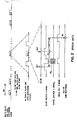
- the preferred exemplary embodiment utilizes asymmetric sampling of the spin echo. That is, the sampling window is asymmetrically situated with respect to the peak of the spin echo envelope.
- the asymmetric positioning of the sampling window itself permits the actual sampling window to be extended significantly in the direction away from the 180° pulse in FIGURE 3 so as to extend the total duration of the sampling window in accordance with prior art teachings such as Provost et al.
- synthesized data (using complex-conjugate synthesis) is asymmetrically generated as depicted in FIGURE 3 so as to fill in only the "missing" asymmetric portions of the asymmetrically sampled spin echo response data.
- a complete composite spin echo response data set is provided which appears to be symmetric -- albeit an asymmetric portion of this data set actually comprises synthesized data.
- FIGURE 4 Another examplary embodiment is depicted in FIGURE 4.
- known gradient reversal techniques are used to recall an FID-type of spin echo at a time TE after an initial RF nutation pulse (which may purposefully be kept to a relatively small nutation angle so as to facilitate short TR).
- an asymmetric G x gradient reversal and/or an asymmetric initial RF nutation pulse envelope may be used to reduce TE.
- asymmetric SE sampling coupled with asymmetric synthesis of the "missing" SE data may be employed as in the earlier described examplary embodiment.
- a subsequent slice selective 180 degree RF nutation pulse may be employed to recall the spin echo.
- the second spin echo may also be asymmetrically sampled -- but in an opposite direction (as shown in FIGURE 4) so as to minimize required TR.
- the asymmetrically synthesized data is similarly synthesized in an opposite time direction so as to "fill in” the missing SE data and to provide a complete composite data set representing a symmetrical SE.
- the first spin echo could be recalled with a 180 degree RF nutation pulse instead of a gradient reversal.
- the first and second spin echoes would constitute true spin echoes in even the most strict sense.
- asymmetric RF nutation pulses may find application in a diverse assortment of MRI systems employing many different types of NMR measurement sequences (including those which rely on FID rather than or in addition to SE responses and those using only single RF nutation pulses).
Landscapes
- Physics & Mathematics (AREA)
- Condensed Matter Physics & Semiconductors (AREA)
- General Physics & Mathematics (AREA)
- High Energy & Nuclear Physics (AREA)
- Health & Medical Sciences (AREA)
- Spectroscopy & Molecular Physics (AREA)
- Optics & Photonics (AREA)
- General Health & Medical Sciences (AREA)
- Nuclear Medicine, Radiotherapy & Molecular Imaging (AREA)
- Radiology & Medical Imaging (AREA)
- Engineering & Computer Science (AREA)
- Signal Processing (AREA)
- Magnetic Resonance Imaging Apparatus (AREA)
- Medicines Containing Antibodies Or Antigens For Use As Internal Diagnostic Agents (AREA)
Applications Claiming Priority (2)
| Application Number | Priority Date | Filing Date | Title |
|---|---|---|---|
| US18138688A | 1988-04-14 | 1988-04-14 | |
| US181386 | 1988-04-14 |
Publications (3)
| Publication Number | Publication Date |
|---|---|
| EP0337587A2 true EP0337587A2 (de) | 1989-10-18 |
| EP0337587A3 EP0337587A3 (de) | 1991-01-09 |
| EP0337587B1 EP0337587B1 (de) | 1995-03-29 |
Family
ID=22664067
Family Applications (1)
| Application Number | Title | Priority Date | Filing Date |
|---|---|---|---|
| EP89300166A Expired - Lifetime EP0337587B1 (de) | 1988-04-14 | 1989-01-10 | MR-Abbildung mit Hilfe asymmetrischer HF-Anregungspulse und asymmetrische Synthese komplexkonjugierter SE-Daten zur Reduzierung der TE- und T2-Abklingzeit von NMR-Spin-Echo-Signalen |
Country Status (4)
| Country | Link |
|---|---|
| EP (1) | EP0337587B1 (de) |
| JP (1) | JP2667706B2 (de) |
| AT (1) | ATE120547T1 (de) |
| DE (1) | DE68921909T2 (de) |
Cited By (1)
| Publication number | Priority date | Publication date | Assignee | Title |
|---|---|---|---|---|
| WO1991015754A1 (en) * | 1990-04-04 | 1991-10-17 | Timothy Paul Leslie Roberts | Magnetic resonance experiment and apparatus |
Families Citing this family (1)
| Publication number | Priority date | Publication date | Assignee | Title |
|---|---|---|---|---|
| JP3041689B2 (ja) | 1998-09-18 | 2000-05-15 | 技術研究組合医療福祉機器研究所 | 磁気共鳴イメージング装置 |
Family Cites Families (1)
| Publication number | Priority date | Publication date | Assignee | Title |
|---|---|---|---|---|
| JPS61272644A (ja) * | 1985-05-29 | 1986-12-02 | Yokogawa Electric Corp | 核磁気共鳴撮像装置 |
-
1989
- 1989-01-10 AT AT89300166T patent/ATE120547T1/de not_active IP Right Cessation
- 1989-01-10 DE DE68921909T patent/DE68921909T2/de not_active Expired - Fee Related
- 1989-01-10 EP EP89300166A patent/EP0337587B1/de not_active Expired - Lifetime
- 1989-04-14 JP JP1095065A patent/JP2667706B2/ja not_active Expired - Fee Related
Cited By (2)
| Publication number | Priority date | Publication date | Assignee | Title |
|---|---|---|---|---|
| WO1991015754A1 (en) * | 1990-04-04 | 1991-10-17 | Timothy Paul Leslie Roberts | Magnetic resonance experiment and apparatus |
| US5296809A (en) * | 1990-04-04 | 1994-03-22 | Roberts Timothy P L | Magnetic resonance experiment and apparatus |
Also Published As
| Publication number | Publication date |
|---|---|
| EP0337587B1 (de) | 1995-03-29 |
| DE68921909D1 (de) | 1995-05-04 |
| ATE120547T1 (de) | 1995-04-15 |
| EP0337587A3 (de) | 1991-01-09 |
| DE68921909T2 (de) | 1995-08-31 |
| JPH0213431A (ja) | 1990-01-17 |
| JP2667706B2 (ja) | 1997-10-27 |
Similar Documents
| Publication | Publication Date | Title |
|---|---|---|
| US6078176A (en) | Fast spin echo pulse sequence for diffusion weighted imaging | |
| US4521733A (en) | NMR Imaging of the transverse relaxation time using multiple spin echo sequences | |
| JP3529446B2 (ja) | Epi及びgrase mriにおける読み出し傾斜磁界極性の補正方法 | |
| US5770943A (en) | Method for measuring and compensating for spatially and temporally varying magnetic fields induced by eddy currents | |
| EP0337588B1 (de) | Bilderzeugung mittels magnetischer Resonanz mit Kompensation der unechten Frequenz-/Phasenverschiebungen infolge unerwünschte Magnetfeldänderungen während des Messverfahrens zur Bestimmung der magnetischen Kernresonanz-Daten | |
| US4970457A (en) | MRI compensated for spurious rapid variations in static magnetic field during a single MRI sequence | |
| US4684891A (en) | Rapid magnetic resonance imaging using multiple phase encoded spin echoes in each of plural measurement cycles | |
| US6559642B2 (en) | Calibration method for use with sensitivity encoding MRI acquisition | |
| EP1391746B1 (de) | Parallele Magnetresonanzbildgebung unter Verwendung von Navigator-Echosignalen | |
| EP1037067B1 (de) | Schnelle Spin-Echo-MRI-Methode ohne Verwendung der CPMG-Techniken | |
| EP0329299B1 (de) | Apparat und Verfahren zur Bilderzeugung mittels magnetischer Resonanz | |
| US4837513A (en) | MRI using asymmetric RF nutation pulses and asymmetric synthesis of complex conjugated SE data to reduce TE and T2 decay NMR spin echo responses | |
| US6028428A (en) | Multiband selective RF pulse construction for NMR measurement sequences | |
| EP0490528A1 (de) | Korrektur der magnetischen Kernresonanz-Messwerte ermittelt durch Echoplanar-Technik | |
| EP0634664A1 (de) | Vorabtastung mit einer schnellen Spinecho-Sequenz für ein Abbildgerät mit magnetischer Resonanz | |
| US5537039A (en) | Virtual frequency encoding of acquired NMR image data | |
| EP0515197A1 (de) | Erfassung von Mehrfachbildern durch schnelle Spinecho-Abtastungen der magnetischen Kernresonanz | |
| EP2008118B1 (de) | Trennung von metaboliten mit abbildung der chemischen verschiebung | |
| US7418286B2 (en) | Magnetic resonance imaging apparatus and magnetic resonance imaging method | |
| US6242916B1 (en) | Partial fourier acquistion of MR data over a limited field of view and image reconstruction | |
| US5162730A (en) | Method for operating a magnetic resonant imaging tomography apparatus | |
| US6933720B2 (en) | Sequence preconditioning for ultra-fast magnetic resonance imaging | |
| US5043665A (en) | Magnetic resonance imaging system | |
| EP0229228B1 (de) | Angrenzende Schichten in magnetischer Vielschicht-Resonanz-Abbildung (MRI) | |
| US20030055330A1 (en) | Sensitivity encoding MRI acquisition method |
Legal Events
| Date | Code | Title | Description |
|---|---|---|---|
| PUAI | Public reference made under article 153(3) epc to a published international application that has entered the european phase |
Free format text: ORIGINAL CODE: 0009012 |
|
| AK | Designated contracting states |
Kind code of ref document: A2 Designated state(s): AT BE CH DE ES FR GB GR IT LI LU NL SE |
|
| PUAL | Search report despatched |
Free format text: ORIGINAL CODE: 0009013 |
|
| AK | Designated contracting states |
Kind code of ref document: A3 Designated state(s): AT BE CH DE ES FR GB GR IT LI LU NL SE |
|
| 17P | Request for examination filed |
Effective date: 19901228 |
|
| 17Q | First examination report despatched |
Effective date: 19930408 |
|
| GRAA | (expected) grant |
Free format text: ORIGINAL CODE: 0009210 |
|
| AK | Designated contracting states |
Kind code of ref document: B1 Designated state(s): AT BE CH DE ES FR GB GR IT LI LU NL SE |
|
| PG25 | Lapsed in a contracting state [announced via postgrant information from national office to epo] |
Ref country code: IT Free format text: LAPSE BECAUSE OF FAILURE TO SUBMIT A TRANSLATION OF THE DESCRIPTION OR TO PAY THE FEE WITHIN THE PRESCRIBED TIME-LIMIT;WARNING: LAPSES OF ITALIAN PATENTS WITH EFFECTIVE DATE BEFORE 2007 MAY HAVE OCCURRED AT ANY TIME BEFORE 2007. THE CORRECT EFFECTIVE DATE MAY BE DIFFERENT FROM THE ONE RECORDED. Effective date: 19950329 Ref country code: ES Free format text: THE PATENT HAS BEEN ANNULLED BY A DECISION OF A NATIONAL AUTHORITY Effective date: 19950329 Ref country code: CH Effective date: 19950329 Ref country code: GR Free format text: LAPSE BECAUSE OF FAILURE TO SUBMIT A TRANSLATION OF THE DESCRIPTION OR TO PAY THE FEE WITHIN THE PRESCRIBED TIME-LIMIT Effective date: 19950329 Ref country code: LI Effective date: 19950329 Ref country code: BE Effective date: 19950329 Ref country code: AT Effective date: 19950329 |
|
| REF | Corresponds to: |
Ref document number: 120547 Country of ref document: AT Date of ref document: 19950415 Kind code of ref document: T |
|
| ET | Fr: translation filed | ||
| REF | Corresponds to: |
Ref document number: 68921909 Country of ref document: DE Date of ref document: 19950504 |
|
| PG25 | Lapsed in a contracting state [announced via postgrant information from national office to epo] |
Ref country code: SE Effective date: 19950629 |
|
| REG | Reference to a national code |
Ref country code: CH Ref legal event code: PL |
|
| PG25 | Lapsed in a contracting state [announced via postgrant information from national office to epo] |
Ref country code: LU Free format text: LAPSE BECAUSE OF NON-PAYMENT OF DUE FEES Effective date: 19960131 |
|
| PLBE | No opposition filed within time limit |
Free format text: ORIGINAL CODE: 0009261 |
|
| STAA | Information on the status of an ep patent application or granted ep patent |
Free format text: STATUS: NO OPPOSITION FILED WITHIN TIME LIMIT |
|
| 26N | No opposition filed | ||
| PGFP | Annual fee paid to national office [announced via postgrant information from national office to epo] |
Ref country code: FR Payment date: 19961216 Year of fee payment: 9 |
|
| PGFP | Annual fee paid to national office [announced via postgrant information from national office to epo] |
Ref country code: DE Payment date: 19961218 Year of fee payment: 9 |
|
| PGFP | Annual fee paid to national office [announced via postgrant information from national office to epo] |
Ref country code: GB Payment date: 19961220 Year of fee payment: 9 |
|
| PGFP | Annual fee paid to national office [announced via postgrant information from national office to epo] |
Ref country code: NL Payment date: 19961223 Year of fee payment: 9 |
|
| PG25 | Lapsed in a contracting state [announced via postgrant information from national office to epo] |
Ref country code: GB Free format text: LAPSE BECAUSE OF NON-PAYMENT OF DUE FEES Effective date: 19980110 |
|
| PG25 | Lapsed in a contracting state [announced via postgrant information from national office to epo] |
Ref country code: FR Free format text: THE PATENT HAS BEEN ANNULLED BY A DECISION OF A NATIONAL AUTHORITY Effective date: 19980131 |
|
| PG25 | Lapsed in a contracting state [announced via postgrant information from national office to epo] |
Ref country code: NL Free format text: LAPSE BECAUSE OF NON-PAYMENT OF DUE FEES Effective date: 19980801 |
|
| GBPC | Gb: european patent ceased through non-payment of renewal fee |
Effective date: 19980110 |
|
| NLV4 | Nl: lapsed or anulled due to non-payment of the annual fee |
Effective date: 19980801 |
|
| PG25 | Lapsed in a contracting state [announced via postgrant information from national office to epo] |
Ref country code: DE Free format text: LAPSE BECAUSE OF NON-PAYMENT OF DUE FEES Effective date: 19981001 |
|
| REG | Reference to a national code |
Ref country code: FR Ref legal event code: ST |