EP0337890B1 - Complexes à base d'anthraline et d'un stérol, leur procédé d'obtention et leur utilisation en thérapeutique et cosmétique - Google Patents
Complexes à base d'anthraline et d'un stérol, leur procédé d'obtention et leur utilisation en thérapeutique et cosmétique Download PDFInfo
- Publication number
- EP0337890B1 EP0337890B1 EP89401023A EP89401023A EP0337890B1 EP 0337890 B1 EP0337890 B1 EP 0337890B1 EP 89401023 A EP89401023 A EP 89401023A EP 89401023 A EP89401023 A EP 89401023A EP 0337890 B1 EP0337890 B1 EP 0337890B1
- Authority
- EP
- European Patent Office
- Prior art keywords
- anthralin
- complex
- mol
- cholesterol
- melting point
- Prior art date
- Legal status (The legal status is an assumption and is not a legal conclusion. Google has not performed a legal analysis and makes no representation as to the accuracy of the status listed.)
- Expired - Lifetime
Links
- NUZWLKWWNNJHPT-UHFFFAOYSA-N anthralin Chemical compound C1C2=CC=CC(O)=C2C(=O)C2=C1C=CC=C2O NUZWLKWWNNJHPT-UHFFFAOYSA-N 0.000 title claims abstract description 70
- 229960002311 dithranol Drugs 0.000 title claims abstract description 59
- 229930182558 Sterol Natural products 0.000 title claims description 14
- 150000003432 sterols Chemical class 0.000 title claims description 14
- 235000003702 sterols Nutrition 0.000 title claims description 14
- 239000002537 cosmetic Substances 0.000 title claims description 5
- 238000002360 preparation method Methods 0.000 title description 11
- 238000000034 method Methods 0.000 title description 6
- 239000003814 drug Substances 0.000 title description 2
- 238000002844 melting Methods 0.000 claims abstract description 26
- 230000008018 melting Effects 0.000 claims abstract description 26
- 239000000470 constituent Substances 0.000 claims abstract description 5
- HVYWMOMLDIMFJA-DPAQBDIFSA-N cholesterol Chemical compound C1C=C2C[C@@H](O)CC[C@]2(C)[C@@H]2[C@@H]1[C@@H]1CC[C@H]([C@H](C)CCCC(C)C)[C@@]1(C)CC2 HVYWMOMLDIMFJA-DPAQBDIFSA-N 0.000 claims description 27
- 239000000203 mixture Substances 0.000 claims description 16
- 235000012000 cholesterol Nutrition 0.000 claims description 14
- IJGRMHOSHXDMSA-UHFFFAOYSA-N Atomic nitrogen Chemical compound N#N IJGRMHOSHXDMSA-UHFFFAOYSA-N 0.000 claims description 8
- VYPSYNLAJGMNEJ-UHFFFAOYSA-N Silicium dioxide Chemical compound O=[Si]=O VYPSYNLAJGMNEJ-UHFFFAOYSA-N 0.000 claims description 8
- OILXMJHPFNGGTO-UHFFFAOYSA-N (22E)-(24xi)-24-methylcholesta-5,22-dien-3beta-ol Natural products C1C=C2CC(O)CCC2(C)C2C1C1CCC(C(C)C=CC(C)C(C)C)C1(C)CC2 OILXMJHPFNGGTO-UHFFFAOYSA-N 0.000 claims description 7
- XUGISPSHIFXEHZ-UHFFFAOYSA-N 3beta-acetoxy-cholest-5-ene Natural products C1C=C2CC(OC(C)=O)CCC2(C)C2C1C1CCC(C(C)CCCC(C)C)C1(C)CC2 XUGISPSHIFXEHZ-UHFFFAOYSA-N 0.000 claims description 7
- OQMZNAMGEHIHNN-UHFFFAOYSA-N 7-Dehydrostigmasterol Natural products C1C(O)CCC2(C)C(CCC3(C(C(C)C=CC(CC)C(C)C)CCC33)C)C3=CC=C21 OQMZNAMGEHIHNN-UHFFFAOYSA-N 0.000 claims description 7
- HZYXFRGVBOPPNZ-UHFFFAOYSA-N UNPD88870 Natural products C1C=C2CC(O)CCC2(C)C2C1C1CCC(C(C)=CCC(CC)C(C)C)C1(C)CC2 HZYXFRGVBOPPNZ-UHFFFAOYSA-N 0.000 claims description 7
- LGJMUZUPVCAVPU-UHFFFAOYSA-N beta-Sitostanol Natural products C1CC2CC(O)CCC2(C)C2C1C1CCC(C(C)CCC(CC)C(C)C)C1(C)CC2 LGJMUZUPVCAVPU-UHFFFAOYSA-N 0.000 claims description 7
- 235000016831 stigmasterol Nutrition 0.000 claims description 7
- 229940032091 stigmasterol Drugs 0.000 claims description 7
- BFDNMXAIBMJLBB-UHFFFAOYSA-N stigmasterol Natural products CCC(C=CC(C)C1CCCC2C3CC=C4CC(O)CCC4(C)C3CCC12C)C(C)C BFDNMXAIBMJLBB-UHFFFAOYSA-N 0.000 claims description 7
- INBGSXNNRGWLJU-UHFFFAOYSA-N 25epsilon-Hydroxycholesterin Natural products C1C=C2CC(O)CCC2(C)C2C1C1CCC(C(CCCC(C)(C)O)C)C1(C)CC2 INBGSXNNRGWLJU-UHFFFAOYSA-N 0.000 claims description 6
- 239000002674 ointment Substances 0.000 claims description 6
- MCKLJFJEQRYRQT-APGJSSKUSA-N 20-hydroxycholesterol Chemical compound C1C=C2C[C@@H](O)CC[C@]2(C)[C@@H]2[C@@H]1[C@@H]1CC[C@H]([C@@](C)(O)CCCC(C)C)[C@@]1(C)CC2 MCKLJFJEQRYRQT-APGJSSKUSA-N 0.000 claims description 5
- 239000002253 acid Substances 0.000 claims description 5
- INBGSXNNRGWLJU-ZHHJOTBYSA-N 25-hydroxycholesterol Chemical compound C1C=C2C[C@@H](O)CC[C@]2(C)[C@@H]2[C@@H]1[C@@H]1CC[C@H]([C@@H](CCCC(C)(C)O)C)[C@@]1(C)CC2 INBGSXNNRGWLJU-ZHHJOTBYSA-N 0.000 claims description 4
- 125000004432 carbon atom Chemical group C* 0.000 claims description 4
- XUGISPSHIFXEHZ-VEVYEIKRSA-N cholesteryl acetate Chemical compound C1C=C2C[C@@H](OC(C)=O)CC[C@]2(C)[C@@H]2[C@@H]1[C@@H]1CC[C@H]([C@H](C)CCCC(C)C)[C@@]1(C)CC2 XUGISPSHIFXEHZ-VEVYEIKRSA-N 0.000 claims description 4
- 150000001875 compounds Chemical class 0.000 claims description 4
- 150000002148 esters Chemical class 0.000 claims description 4
- 229910052757 nitrogen Inorganic materials 0.000 claims description 4
- 239000000843 powder Substances 0.000 claims description 4
- 239000000377 silicon dioxide Substances 0.000 claims description 4
- HCXVJBMSMIARIN-PHZDYDNGSA-N stigmasterol Chemical compound C1C=C2C[C@@H](O)CC[C@]2(C)[C@@H]2[C@@H]1[C@@H]1CC[C@H]([C@H](C)/C=C/[C@@H](CC)C(C)C)[C@@]1(C)CC2 HCXVJBMSMIARIN-PHZDYDNGSA-N 0.000 claims description 4
- 238000003756 stirring Methods 0.000 claims description 4
- 125000005907 alkyl ester group Chemical group 0.000 claims description 3
- 239000000945 filler Substances 0.000 claims description 3
- -1 polyvinyldimethylsiloxane Polymers 0.000 claims description 3
- 239000002562 thickening agent Substances 0.000 claims description 3
- 239000007762 w/o emulsion Substances 0.000 claims description 3
- 239000013543 active substance Substances 0.000 claims description 2
- 150000002170 ethers Chemical class 0.000 claims description 2
- 238000010438 heat treatment Methods 0.000 claims description 2
- 238000006317 isomerization reaction Methods 0.000 claims description 2
- 150000004702 methyl esters Chemical class 0.000 claims description 2
- 229920002379 silicone rubber Polymers 0.000 claims description 2
- IOWMKBFJCNLRTC-XWXSNNQWSA-N (24S)-24-hydroxycholesterol Chemical compound C1C=C2C[C@@H](O)CC[C@]2(C)[C@@H]2[C@@H]1[C@@H]1CC[C@H]([C@H](C)CC[C@H](O)C(C)C)[C@@]1(C)CC2 IOWMKBFJCNLRTC-XWXSNNQWSA-N 0.000 claims 1
- 238000004519 manufacturing process Methods 0.000 claims 1
- 201000004681 Psoriasis Diseases 0.000 abstract description 5
- 210000004761 scalp Anatomy 0.000 abstract description 3
- 201000004624 Dermatitis Diseases 0.000 abstract description 2
- 208000000260 Warts Diseases 0.000 abstract description 2
- 208000010668 atopic eczema Diseases 0.000 abstract description 2
- 230000004968 inflammatory condition Effects 0.000 abstract description 2
- 201000010153 skin papilloma Diseases 0.000 abstract description 2
- 239000000047 product Substances 0.000 description 9
- 229920001296 polysiloxane Polymers 0.000 description 7
- NBDWSJHVNDJYOS-QSHWPSJXSA-N (8s,9s,10r,13r,14s,17r)-10,13-dimethyl-17-[(2r)-pentan-2-yl]-2,3,4,7,8,9,11,12,14,15,16,17-dodecahydro-1h-cyclopenta[a]phenanthren-3-ol Chemical compound C1C=C2CC(O)CC[C@]2(C)[C@@H]2[C@@H]1[C@@H]1CC[C@H]([C@H](C)CCC)[C@@]1(C)CC2 NBDWSJHVNDJYOS-QSHWPSJXSA-N 0.000 description 5
- 239000000839 emulsion Substances 0.000 description 5
- 230000004927 fusion Effects 0.000 description 5
- 238000002156 mixing Methods 0.000 description 5
- 238000009472 formulation Methods 0.000 description 4
- 230000015556 catabolic process Effects 0.000 description 3
- 238000004455 differential thermal analysis Methods 0.000 description 3
- 239000001257 hydrogen Substances 0.000 description 3
- 229910052739 hydrogen Inorganic materials 0.000 description 3
- 239000003381 stabilizer Substances 0.000 description 3
- 239000003981 vehicle Substances 0.000 description 3
- 238000004458 analytical method Methods 0.000 description 2
- 125000004429 atom Chemical group 0.000 description 2
- 230000015572 biosynthetic process Effects 0.000 description 2
- QBPFLULOKWLNNW-UHFFFAOYSA-N chrysazin Chemical compound O=C1C2=CC=CC(O)=C2C(=O)C2=C1C=CC=C2O QBPFLULOKWLNNW-UHFFFAOYSA-N 0.000 description 2
- 239000003431 cross linking reagent Substances 0.000 description 2
- 238000006731 degradation reaction Methods 0.000 description 2
- 230000000694 effects Effects 0.000 description 2
- 239000011521 glass Substances 0.000 description 2
- 238000000265 homogenisation Methods 0.000 description 2
- 230000007794 irritation Effects 0.000 description 2
- 238000007254 oxidation reaction Methods 0.000 description 2
- 235000019271 petrolatum Nutrition 0.000 description 2
- 239000006069 physical mixture Substances 0.000 description 2
- YGSDEFSMJLZEOE-UHFFFAOYSA-N salicylic acid Chemical compound OC(=O)C1=CC=CC=C1O YGSDEFSMJLZEOE-UHFFFAOYSA-N 0.000 description 2
- 239000000126 substance Substances 0.000 description 2
- QTBSBXVTEAMEQO-UHFFFAOYSA-M Acetate Chemical compound CC([O-])=O QTBSBXVTEAMEQO-UHFFFAOYSA-M 0.000 description 1
- NLZUEZXRPGMBCV-UHFFFAOYSA-N Butylhydroxytoluene Chemical compound CC1=CC(C(C)(C)C)=C(O)C(C(C)(C)C)=C1 NLZUEZXRPGMBCV-UHFFFAOYSA-N 0.000 description 1
- 206010061218 Inflammation Diseases 0.000 description 1
- 208000012641 Pigmentation disease Diseases 0.000 description 1
- 206010054786 Skin burning sensation Diseases 0.000 description 1
- 238000002835 absorbance Methods 0.000 description 1
- 230000004913 activation Effects 0.000 description 1
- 239000003963 antioxidant agent Substances 0.000 description 1
- 230000003078 antioxidant effect Effects 0.000 description 1
- 125000002915 carbonyl group Chemical group [*:2]C([*:1])=O 0.000 description 1
- 239000003054 catalyst Substances 0.000 description 1
- 239000003795 chemical substances by application Substances 0.000 description 1
- 238000002512 chemotherapy Methods 0.000 description 1
- 150000001841 cholesterols Chemical class 0.000 description 1
- 238000000354 decomposition reaction Methods 0.000 description 1
- 238000007872 degassing Methods 0.000 description 1
- 235000014113 dietary fatty acids Nutrition 0.000 description 1
- 239000000539 dimer Substances 0.000 description 1
- 239000012153 distilled water Substances 0.000 description 1
- 230000009881 electrostatic interaction Effects 0.000 description 1
- 238000011156 evaluation Methods 0.000 description 1
- 238000013213 extrapolation Methods 0.000 description 1
- 239000000194 fatty acid Substances 0.000 description 1
- 229930195729 fatty acid Natural products 0.000 description 1
- 238000000227 grinding Methods 0.000 description 1
- 125000002887 hydroxy group Chemical group [H]O* 0.000 description 1
- 230000004054 inflammatory process Effects 0.000 description 1
- 230000010354 integration Effects 0.000 description 1
- 230000003993 interaction Effects 0.000 description 1
- 239000002085 irritant Substances 0.000 description 1
- 231100000021 irritant Toxicity 0.000 description 1
- 238000005259 measurement Methods 0.000 description 1
- 239000012528 membrane Substances 0.000 description 1
- 239000004570 mortar (masonry) Substances 0.000 description 1
- 230000003287 optical effect Effects 0.000 description 1
- 230000003647 oxidation Effects 0.000 description 1
- FJKROLUGYXJWQN-UHFFFAOYSA-N papa-hydroxy-benzoic acid Natural products OC(=O)C1=CC=C(O)C=C1 FJKROLUGYXJWQN-UHFFFAOYSA-N 0.000 description 1
- 230000035515 penetration Effects 0.000 description 1
- 230000000144 pharmacologic effect Effects 0.000 description 1
- 238000010587 phase diagram Methods 0.000 description 1
- 108091008695 photoreceptors Proteins 0.000 description 1
- 239000002798 polar solvent Substances 0.000 description 1
- 229940098458 powder spray Drugs 0.000 description 1
- 230000002035 prolonged effect Effects 0.000 description 1
- 230000001737 promoting effect Effects 0.000 description 1
- 238000012205 qualitative assay Methods 0.000 description 1
- 238000012207 quantitative assay Methods 0.000 description 1
- 230000005855 radiation Effects 0.000 description 1
- 229960004889 salicylic acid Drugs 0.000 description 1
- 239000012265 solid product Substances 0.000 description 1
- 230000003595 spectral effect Effects 0.000 description 1
- 238000001228 spectrum Methods 0.000 description 1
- 239000007921 spray Substances 0.000 description 1
- 230000006641 stabilisation Effects 0.000 description 1
- 238000011105 stabilization Methods 0.000 description 1
- 238000004073 vulcanization Methods 0.000 description 1
- XLYOFNOQVPJJNP-UHFFFAOYSA-N water Chemical compound O XLYOFNOQVPJJNP-UHFFFAOYSA-N 0.000 description 1
- 239000003871 white petrolatum Substances 0.000 description 1
- 230000002087 whitening effect Effects 0.000 description 1
Classifications
-
- C—CHEMISTRY; METALLURGY
- C07—ORGANIC CHEMISTRY
- C07J—STEROIDS
- C07J9/00—Normal steroids containing carbon, hydrogen, halogen or oxygen substituted in position 17 beta by a chain of more than two carbon atoms, e.g. cholane, cholestane, coprostane
-
- A—HUMAN NECESSITIES
- A61—MEDICAL OR VETERINARY SCIENCE; HYGIENE
- A61K—PREPARATIONS FOR MEDICAL, DENTAL OR TOILETRY PURPOSES
- A61K31/00—Medicinal preparations containing organic active ingredients
- A61K31/56—Compounds containing cyclopenta[a]hydrophenanthrene ring systems; Derivatives thereof, e.g. steroids
- A61K31/575—Compounds containing cyclopenta[a]hydrophenanthrene ring systems; Derivatives thereof, e.g. steroids substituted in position 17 beta by a chain of three or more carbon atoms, e.g. cholane, cholestane, ergosterol, sitosterol
-
- A—HUMAN NECESSITIES
- A61—MEDICAL OR VETERINARY SCIENCE; HYGIENE
- A61K—PREPARATIONS FOR MEDICAL, DENTAL OR TOILETRY PURPOSES
- A61K8/00—Cosmetics or similar toiletry preparations
- A61K8/18—Cosmetics or similar toiletry preparations characterised by the composition
- A61K8/30—Cosmetics or similar toiletry preparations characterised by the composition containing organic compounds
- A61K8/33—Cosmetics or similar toiletry preparations characterised by the composition containing organic compounds containing oxygen
- A61K8/34—Alcohols
- A61K8/347—Phenols
-
- A—HUMAN NECESSITIES
- A61—MEDICAL OR VETERINARY SCIENCE; HYGIENE
- A61K—PREPARATIONS FOR MEDICAL, DENTAL OR TOILETRY PURPOSES
- A61K8/00—Cosmetics or similar toiletry preparations
- A61K8/18—Cosmetics or similar toiletry preparations characterised by the composition
- A61K8/30—Cosmetics or similar toiletry preparations characterised by the composition containing organic compounds
- A61K8/63—Steroids; Derivatives thereof
-
- A—HUMAN NECESSITIES
- A61—MEDICAL OR VETERINARY SCIENCE; HYGIENE
- A61P—SPECIFIC THERAPEUTIC ACTIVITY OF CHEMICAL COMPOUNDS OR MEDICINAL PREPARATIONS
- A61P17/00—Drugs for dermatological disorders
-
- A—HUMAN NECESSITIES
- A61—MEDICAL OR VETERINARY SCIENCE; HYGIENE
- A61P—SPECIFIC THERAPEUTIC ACTIVITY OF CHEMICAL COMPOUNDS OR MEDICINAL PREPARATIONS
- A61P29/00—Non-central analgesic, antipyretic or antiinflammatory agents, e.g. antirheumatic agents; Non-steroidal antiinflammatory drugs [NSAID]
-
- A—HUMAN NECESSITIES
- A61—MEDICAL OR VETERINARY SCIENCE; HYGIENE
- A61Q—SPECIFIC USE OF COSMETICS OR SIMILAR TOILETRY PREPARATIONS
- A61Q19/00—Preparations for care of the skin
-
- A—HUMAN NECESSITIES
- A61—MEDICAL OR VETERINARY SCIENCE; HYGIENE
- A61Q—SPECIFIC USE OF COSMETICS OR SIMILAR TOILETRY PREPARATIONS
- A61Q3/00—Manicure or pedicure preparations
-
- A—HUMAN NECESSITIES
- A61—MEDICAL OR VETERINARY SCIENCE; HYGIENE
- A61Q—SPECIFIC USE OF COSMETICS OR SIMILAR TOILETRY PREPARATIONS
- A61Q5/00—Preparations for care of the hair
-
- A—HUMAN NECESSITIES
- A61—MEDICAL OR VETERINARY SCIENCE; HYGIENE
- A61K—PREPARATIONS FOR MEDICAL, DENTAL OR TOILETRY PURPOSES
- A61K2800/00—Properties of cosmetic compositions or active ingredients thereof or formulation aids used therein and process related aspects
- A61K2800/20—Chemical, physico-chemical or functional or structural properties of the composition as a whole
- A61K2800/28—Rubbing or scrubbing compositions; Peeling or abrasive compositions; Containing exfoliants
Definitions
- the present invention relates to complexes based on anthralin and a sterol, their process for obtaining and their use in therapeutics and cosmetics.
- the main indications are for the treatment of inflammatory conditions of the skin, nails and scalp, including the treatment of psoriasis, eczema and warts.
- anthralin or dithranol remains, despite its drawbacks, the treatment of choice given its results.
- anthralin essentially its lack of stability which causes the formation of brownish spots on the skin and clothing and its irritant power of the skin.
- Anthralin is in fact particularly unstable and degrades, giving by auto-oxidation of the dimer of anthralin (or 1,8-1 ′, 8′-tetrahydroxy-10,10 ′ dianthranone) and by oxidation of other products degradation including 1,8-dihydroxy 9,10-anthraquinone.
- Certain breakdown products are inactive in the chemotherapy of psoriasis and are mainly responsible for irritations and spots on the skin and clothing.
- anthralin by its chemical structure, has intramolecular hydrogen bonds between the hydroxyl groups 1,8 and the carbonyl in position 9.
- Maintaining hydrogen bonds would therefore be a means of improving the stability of anthralin. This has been achieved according to the present invention by the creation of electrostatic interactions in anthralin-sterol complexes. Examination of the spectra obtained by near infrared reflection seems to confirm the existence of these interactions.
- the sterol potentiates the effects of anthralin and acts on the inflammations of the skin.
- the subject of the present invention is therefore, as a new industrial product, a complex based on anthralin and a sterol, the complex having a melting point lower by 10 to 25 ° C. than that of the constituent of the complex melting at temperature. the lowest and the proportion of anthralin varying between 10 and 90 mol%.
- the proportions of anthralin in the complex can vary, depending on the cholesterol derivative, between 10 and 90 mol%, these proportions for each of the complexes being however liable to slight variations of the order of ⁇ 0.05 % M.
- the various complexes according to the invention are in the form of a powder more or less strongly colored in yellow and are characterized by their melting point which is 10 to 25 ° C lower than that of the constituent melting at the lowest temperature. .
- the melting points of the complexes mentioned above are the following: Anthralin-cholesterol: 132 ° ⁇ 2 ° C, Anthralin - 25-hydroxy-cholesterol: 157 ° ⁇ 2 ° C, Anthralin - stigmasterol: 150 ° ⁇ 2 ° C, Anthralin - cholesterol acetate: 102 ° ⁇ 2 ° C Anthralin - 20 - hydroxy-cholesterol: 118 ° ⁇ 2 ° C Anthralin - Methyl ester of (3-hydroxychol-5-ene) -24-oic acid: 126 ° ⁇ 2 ° C
- the melting point of the anthralin and the sterols of these complexes being the following: Anthralin: 176-180 ° C Cholesterol: 148-149 ° C 25-hydroxy-cholesterol: 178-180 ° C Stigmasterol: 170 ° C Cholesterol acetate: 115-116 ° C 20-hydroxy-cholesterol: 128-129 ° C (3-Hydroxychol-5-ene) -24-oic acid methyl ester: 143-144 ° C
- a sample, placed in a specific measurement cell is subjected, via an appropriate optical system, to infrared radiation of wavelengths varying, depending on the device, between 700 and 2600nm (InfraALYZER 450 model, 19 wavelengths selected by filters) and between 700 and 3800nm (InfraALYZER 500 model, monochromator using the entire spectral range).
- the light reflected by this sample is concentrated by an integration sphere and analyzed by an appropriate photoreceptor.
- the reference products are anthralin, the sterol concerned and their physical mixture with the molar proportions of the complex.
- the present invention also relates to the process for the preparation of the complexes as defined above.
- This process consists in heating, with stirring and under nitrogen, a mixture of anthralin and sterol, in the molar proportions mentioned above determined by differential thermal analysis, to a temperature close to that of the melting point of the compound which has the the highest melting temperature, generally from 5 to 10 ° C higher, to maintain this temperature for a time between approximately 10 and 20 minutes and to allow it to cool slowly to room temperature.
- the solid product obtained is then ground in the form of a powder.
- the present invention further relates to a pharmaceutical or cosmetic composition intended for the treatment of the skin, nails or scalp, this composition containing, as active substance, at least one anthralin-sterol complex as defined above in a proportion of between 0.5 and 10% by weight, in a pharmaceutically or cosmetically acceptable vehicle.
- compositions according to the invention are preferably ointments based on petroleum jelly, emulsions of the water-in-oil type or can also be in the form of a film in which the insoluble complex is dispersed or even in dry form. .
- the emulsions may contain, as thickening agent, an elastomeric silicone of the polyvinyldimethylsiloxane type combined with a silica filler.
- the elastomeric silicones can be represented by the following formula: in which: X represents OH and n is such that the viscosity of the elastomeric silicone associated with the silica filler is between approximately 650 and 1150 cps measured at 24 ° C. (contraves).
- elastomeric silicone As preferred elastomeric silicone, mention may in particular be made of the product sold by the company DOW CORNING CORPORATI0N under the name "DOW CORNING MDX-4-4210" which is in the form of a kit consisting on the one hand of a product base (silicone elastomer + silica) and on the other hand a crosslinking agent or vulcanization catalyst, the basic product, being alone used to constitute the thickening agent or else added to its crosslinking agent when the one wishes to obtain a formulation in the form of a film.
- DOW CORNING CORPORATI0N under the name "DOW CORNING MDX-4-4210” which is in the form of a kit consisting on the one hand of a product base (silicone elastomer + silica) and on the other hand a crosslinking agent or vulcanization catalyst, the basic product, being alone used to constitute the thickening agent or else added to its crosslinking agent when the one wishes to
- compositions can also contain an antioxidant of the salicylic acid or butylhydroxytoluene type in a proportion ⁇ to 0.5%.
- the formulations with the anthralin-cholesterol complex are effective and perfectly tolerated by the patients.
- the average time required to obtain skin whitening is 19.3 days for complexes and 27.1 days for hospital preparations.
- This ointment is prepared cold by mixing 5.68 g of the anthralin-cholesterol complex and 94.32 g of white petrolatum. After mixing and homogenization in a three-cylinder grinder, the ointment is then packaged in a tube or in a jar.
- the anthralin-cholesterol complex is then slowly dispersed in the emulsion obtained.
- This emulsion remains stable on storage, at room temperature, for a period of time greater than 12 months.
- This film is obtained according to the following process:
- the silicone base and its vulcanizing agent are mixed in a mortar, then the anthralin-cholesterol complex is slowly dispersed, while mixing using a spatula.
- a second glass plate is gradually applied to the previous one and the two plates are pressed against each other using an appropriate clamping system.
- a dry form can be obtained by mixing the following compounds:
Landscapes
- Health & Medical Sciences (AREA)
- Life Sciences & Earth Sciences (AREA)
- General Health & Medical Sciences (AREA)
- Animal Behavior & Ethology (AREA)
- Veterinary Medicine (AREA)
- Public Health (AREA)
- Chemical & Material Sciences (AREA)
- Epidemiology (AREA)
- Organic Chemistry (AREA)
- Medicinal Chemistry (AREA)
- Pharmacology & Pharmacy (AREA)
- Birds (AREA)
- Dermatology (AREA)
- Nuclear Medicine, Radiotherapy & Molecular Imaging (AREA)
- Chemical Kinetics & Catalysis (AREA)
- General Chemical & Material Sciences (AREA)
- Emergency Medicine (AREA)
- Pain & Pain Management (AREA)
- Bioinformatics & Cheminformatics (AREA)
- Rheumatology (AREA)
- Engineering & Computer Science (AREA)
- Steroid Compounds (AREA)
- Cosmetics (AREA)
- Medicinal Preparation (AREA)
- Pharmaceuticals Containing Other Organic And Inorganic Compounds (AREA)
- Acyclic And Carbocyclic Compounds In Medicinal Compositions (AREA)
- Organic Low-Molecular-Weight Compounds And Preparation Thereof (AREA)
- Compositions Of Macromolecular Compounds (AREA)
Description
- La présente invention a pour objet des complexes à base d'anthraline et d'un stérol, leur procédé d'obtention et leur utilisation en thérapeutique et cosmétique. Les principales indications concernent le traitement des affections inflammatoires de la peau, des ongles et du cuir chevelu, notamment le traitement du psoriasis, de l'eczéma et des verrues.
- Parmi les substances particulièrement actives dans le traitement du psoriasis, l'anthraline ou dithranol demeure, malgré ses inconvénients, le traitement de choix compte-tenu de ses résultats.
- Les principaux inconvénients de l'anthraline sont essentiellement son manque de stabilité qui provoque la formation de taches brunâtres sur la peau et les vêtements et son pouvoir irritant de la peau.
- L'anthraline est en effet particulièrement instable et se dégrade en donnant par auto-oxydation du dimère de l'anthraline (ou 1,8-1′,8′-tétrahydroxy-10,10′ dianthranone) et par oxydation d'autres produits de dégradation dont la 1,8-dihydroxy 9,10-anthraquinone.
- Certains produits de dégradation sont inactifs dans la chimiothérapie du psoriasis et sont essentiellement responsables des irritations et des taches de la peau et des vêtements.
- De nombreuses études ont été entreprises en vue d'améliorer la stabilité de l'anthraline et celles-ci on conduit à diverses propositions.
- Parmi ces propositions, on peut notamment citer l'utilisation d'agents stabilisants tels que ceux décrits dans les brevets US n°4.287.214 et 4.367.224 ou l'utilisation de certains véhicules notamment des esters d'acides gras tels que ceux décrits dans le brevet US 4.316.902 et les demandes de brevets français n°82.01327 et 84.13431 et anglais GB.A. 2 107 589.
- Ces diverses solutions se sont toutefois révélées à l'usage ne pas être totalement satisfaisantes, les agents stabilisants ne permettant pas une conservation prolongée dans le temps et les nouveaux véhicules ne favorisant pas une bonne pénétration de l'anthraline à travers la peau.
- Il résulte de ce qui précède que si l'on peut agir de façon satisfaisante sur la stabilité de l'anthraline, on doit pouvoir résoudre simultanément les problèmes soulevés par l'irritation et la formation des taches sur la peau et sur les vêtements.
- Après de nombreuses études, on vient de constater que la stabilisation recherchée de l'anthraline pouvait être obtenue en formant des complexes avec certains stérols.
- Il a en effet été montré que l'anthraline, de par sa structure chimique, possède des liaisons hydrogène intramoléculaires entre les groupements hydroxyles 1,8 et le carbonyle en position 9.
- Ces liaisons hydrogène agissent comme stabilisatrices de cette molécule. En effet, si elles sont supprimées, par exemple dans un solvant polaire, il se produit une activation de la position C₁₀ conduisant à une décomposition rapide de la molécule.
- Le maintien de liaisons hydrogène serait donc un moyen pour améliorer la stabilité de l'anthraline. Ceci a été atteint selon la présente invention par la création d'interactions électrostatiques dans des complexes anthraline-stérols. L'examen des spectres obtenus par réflexion dans le proche infra-rouge semble confirmer l'existence de ces interactions.
- Il s'est en effet avéré que les complexes selon l'invention présentaient une excellente stabilité dans le temps même lorsque le support n'était pas anhydre et que par ailleurs les propriétés pharmacologiques de l'anthraline étaient conservées et même renforcées.
- En ce qui concerne l'activité des complexes selon l'invention, il est par ailleurs possible que le stérol potentialise les effets de l'anthraline et agisse sur les inflammations de la peau.
- La présente invention a donc pour objet à titre de produit industriel nouveau un complexe à base d'anthraline et d'un stérol, le complexe ayant un point de fusion inférieur de 10 à 25°C à celui du constituant du complexe fondant à la température la plus basse et la proportion d'anthraline variant entre 10 et 90% molaire.
- Le stérol est de préférence choisi parmi:
- le cholestérol,
- les dérivés mono et polyhydroxylés ou carboxylés sur la chaîne latérale en C₁₇ du cholestérol et leurs alkyl-esters inférieurs (C₁-C₆) et notamment le 25-hydroxy-cholestérol, le 20-hydroxy-cholestérol et l'ester méthylique de l'acide (3-hydroxychol-5-ène)-24-oïque,
- les dérivés obtenus par isomérisation et/ou création d'insaturations dans la chaîne latérale en C₁₇ du cholestérol et notamment le stigmastérol, et
- les esters jusqu'à 12 atomes de carbone et éthers jusqu'à 6 atomes de carbone en position C₃ du cholestérol et notamment l'acétate de cholestérol.
- Comme indiqué ci-dessus les proportions d'anthraline dans le complexe peuvent varier, selon le dérivé du cholestérol, entre 10 et 90% molaire, ces proportions pour chacun des complexes étant toutefois susceptibles de faibles variations de l'ordre de ± 0,05%M.
- Parmi les différents complexes particulièrement préférés selon l'invention, on peut mentionner les suivants:
- (i) Anthraline (0,26%M) - cholestérol (0,74%M)
- (ii) Anthraline (0,70%M) - 25-hydroxy-cholestérol (0,30%M)
- (iii) Anthraline (0,30%M) - Stigmastérol (0,70%M)
- (iv) Anthraline (0,42%M) - Acétate de cholestérol (0,58%M)
- (v) Anthraline (0,17%M) - 20-hydroxy-cholestérol (0,83%M)
- (vi) Anthraline (0,35%M) - Ester méthylique de l'acide (3-hydroxychol-5-ène)-24-oïque (0,65%M)
- La détermination des proportions molaires pour chacun des complexes a été effectuée par analyse thermique différentielle à partir de la détermination d'un diagramme de phases binaires.
- Par extrapolation, on détermine les proportions exactes de chacun des constituants, le complexe ainsi défini apparaissant comme un produit pur lors de la détermination de sa pureté par analyse thermique différentielle.
- Les différents complexes selon l'invention se présentent sous forme d'une poudre plus ou moins fortement colorée en jaune et se caractérisent par leur point de fusion qui est inférieur de 10 à 25°C à celui du constituant fondant à la température la plus basse.
- A titre d'exemple les points de fusion des complexes cités ci-dessus sont les suivants:
Anthraline-cholestérol : 132° ± 2°C,
Anthraline - 25-hydroxy-cholestérol : 157° ± 2°C,
Anthraline - stigmastérol : 150° ± 2°C,
Anthraline - acétate de cholestérol: 102° ± 2°C
Anthraline - 20 - hydroxy-cholestérol : 118° ± 2°C
Anthraline - Ester méthylique de l'acide (3-hydroxychol-5-ène)-24-oïque : 126° ± 2°C - Le point de fusion de l'anthraline et des stérols de ces complexes étant les suivants:
Anthraline : 176-180°C
Cholestérol : 148-149°C
25-hydroxy-cholestérol: 178-180°C
Stigmastérol: 170°C
Acétate de cholestérol: 115-116°C
20-hydroxy-cholestérol: 128-129°C
Ester méthylique de l'acide (3-hydroxychol-5-ène)-24-oïque : 143-144°C - L'analyse des complexes selon l'invention, par réflexion dans le proche infra-rouge, sur un appareil InfraALYZER de la Société TECHNICON, a permis de distinguer sans ambiguité les complexes selon l'invention des différents mélanges physiques correspondants.
- Selon cette méthode d'analyse un échantillon, placé dans une cellule de mesure spécifique est soumis, par l'intermédiaire d'un système optique approprié, à un rayonnement infra-rouge de longueurs d'onde variant, selon l'appareil, entre 700 et 2600nm (modèle InfraALYZER 450, 19 longueurs d'onde sélectionnées par filtres) et entre 700 et 3800nm (modèle InfraALYZER 500, monochromateur utilisant toute la gamme spectrale). La lumière réfléchie par cet échantillon est concentrée par une sphère d'intégration et analysée par un photorécepteur approprié.
- A chaque longueur d'onde émise est associée une valeur d'absorbance par l'échantillon. Le traitement statistique de ces résultats permet de faire des dosages qualitatifs et quantitatifs des complexes considérés à la fois à l'état pur et en formulation.
- Pour chaque identification d'un complexe on utilise comme produits de référence l'anthraline, le stérol concerné et leur mélange physique aux proportions molaires du complexe.
- La présente invention a également pour objet le procédé de préparation des complexes tels que définis ci-dessus.
- Ce procédé consiste à chauffer, sous agitation et sous azote, un mélange d'anthraline et du stérol, dans les proportions molaires ci-dessus mentionnées déterminées par analyse thermique différentielle, à une température voisine de celle du point de fusion du composé qui a la température de fusion la plus élevée, généralement de 5 à 10°C supérieure, à maintenir cette température pendant un temps compris entre environ 10 et 20 minutes et à laissser refroidir lentement à la température ambiante. Le produit solide obtenu est alors broyé sous forme d'une poudre.
- La présente invention a en outre pour objet une composition pharmaceutique ou cosmétique destinée au traitement de la peau, des ongles ou du cuir chevelu, cette composition contenant, en tant que substance active, au moins un complexe anthraline-stérol tel que défini ci-dessus en une proportion comprise entre 0,5 et 10% en poids, dans un véhicule pharmaceutiquement ou cosmétiquement acceptable.
- Les compositions selon l'invention sont de préférence des onguents à base de vaseline, des émulsions du type eau-dans-l'huile ou peuvent également se présenter sous forme d'un film dans lequel le complexe insoluble est dispersé ou encore sous forme sèche.
- Les émulsions peuvent contenir comme agent épaississant un silicone élastomère du type polyvinyldiméthylsiloxane associé à une charge de silice.
- Les silicones élastomères peuvent être représentés par la formule suivante:

dans laquelle:
X représente OH et n est tel que la viscosité du silicone élastomère associé à la charge de silice soit comprise entre environ 650 et 1150cps mesurée à 24°C (contraves). - De tels produits sont notamment décrits dans le Brevet français BSM 8424M.
- Comme silicone élastomère préféré, on peut en particulier mentionner le produit vendu par la Société DOW CORNING CORPORATI0N sous la dénomination de "DOW CORNING MDX-4-4210" qui se présente sous forme d'un kit constitué d'une part d'un produit de base (silicone élastomère + silice) et d'autre part d'un agent de réticulation ou catalyseur de vulcanisation, le produit de base, étant seul utilisé pour constituer l'agent épaississant ou bien encore additionné à son agent de réticulation lorsque l'on souhaite obtenir formulation une sous forme d'un film.
- Ces compositions peuvent également contenir un anti-oxydant du type acide salicylique ou butylhydroxytoluène dans une proportion < à 0,5%.
- Dans une étude clinique d'évaluation du complexe anthraline-cholestérol dans le traitement du psoriasis, des onguents à 1,7 et à 5,7% de ce complexe ont été comparés à des préparations hospitalières d'anthraline ayant des concentrations équivalentes.
- Dans les conditions de l'étude, les formulations au complexe anthraline-cholestérol sont efficaces et parfaitement tolérées par les patients. Le temps moyen nécessaire pour obtenir un blanchiment de la peau est de 19,3 jours pour les complexes et de 27,1 jours pour les préparations hospitalières. La tolérance des formulations au complexe anthraline-cholestérol, meilleure que celle des préparations hospitalières, apparaît comme remarquable (absence de sensations de brûlures cutanées, pigmentation cutanée réduite et absence de taches sur la peau et les vêtements).
- On va maintenant donner à titre d'illustration et sans aucun caractère limitatif des exemples de préparation des complexes selon l'invention ainsi que des exemples de compositions pharmaceutiques et cosmétiques.
- On introduit dans un ballon, muni d'un agitateur et d'une arrivée d'azote, 10g (0,044mole) d'anthraline et 48,83g (0,126mole) de cholestérol en poudre. On porte lentement l'ensemble à 190°C et on maintient à cette température pendant 15mn. On laisse refroidir lentement jusqu'à température ambiante tout en maintenant l'agitation et le courant d'azote. Après broyage le complexe attendu se présente sous forme d'une poudre jaune dont le point de fusion est de 132° ± 2°C.
- Selon le même mode opératoire que celui décrit ci-dessus on a préparé les complexes suivants:
- (a) Anthraline (0,42M) - Acétate de cholestérol (0,58M)
Point de fusion = 102° ± 2°C, - (b) Anthraline (0,30M) - Stigmastérol (0,70M)
Point de fusion = 150° ± 2°C, - (c) Anthraline (0,70M) - 25-hydroxy-cholestérol (0,30M)
Point de fusion = 157° ± 2°C. - (d) Anthraline (0,17%M) -20-hydroxy-cholestérol (0,83%M)
Point de fusion = 118° ± 2°C - (e) Anthraline (0,35%M) -Ester méthylique de l'acide (3-hydroxychol-5-ène)-24-oïque (0.65% M)
Point de fusion = 126° ± 2°C -

- Cet onguent est préparé à froid par mélange de 5,68g du complexe anthraline-cholestérol et 94,32g de vaseline blanche. Après mélange et homogénéisation au broyeur tricylindrique, l'onguent est alors conditionné en tube ou en pot.
- On n'a observé aucune dégradation de la composition après stockage pendant 12 mois à 37°C.
-

- Après avoir mélangé le silicone élastomère avec le silicone volatil, on ajoute lentement sous agitation l'eau distillée de façon à obtenir une émulsion homogène.
- On disperse ensuite lentement le complexe anthraline-cholestérol dans l'émulsion obtenue.
- Cette émulsion reste stable au stockage, à température ambiante, pendant une période de temps supérieure à 12 mois.
-

- Ce film est obtenu selon le procédé suivant:
- On mélange dans un mortier le silicone base et son agent vulcanisant puis l'on disperse lentement le complexe anthraline-cholestérol, tout en mélangeant à l'aide d'une spatule.
- Après homogénéisation au tricylindre, on dépose environ 500mg de la préparation ainsi obtenue, sur une plaque de verre. On dégaze à la pompe à vide à membrane, puis on complète le dégazage à la pompe à palettes.
- Lorsque la préparation ne présente plus de bulles d'air, on applique progressivement une deuxième plaque de verre sur la précédente et on presse les deux plaques l'une contre l'autre à l'aide d'un système de serrage approprié.
- On place alors l'ensemble à l'étuve à 75°C pendant 45 minutes puis on laisse refroidir et décolle le film.
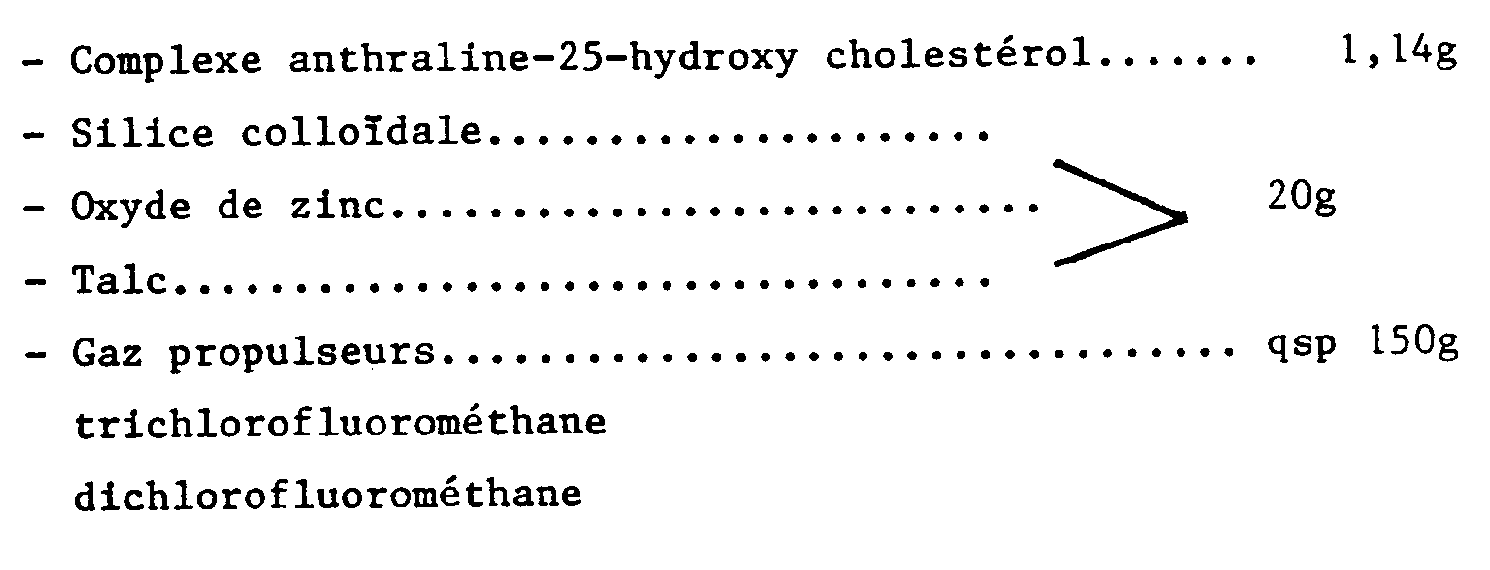
- Une forme sèche peut être obtenue en mélangeant les composés suivants:


- La préparation d'un spray sec peut être obtenue à partir des composés suivants:
Claims (14)
Priority Applications (1)
| Application Number | Priority Date | Filing Date | Title |
|---|---|---|---|
| AT89401023T ATE73816T1 (de) | 1988-04-14 | 1989-04-13 | Komplexe des anthralins mit einem sterol, verfahren zu deren herstellung sowie deren verwendung in der therapie und kosmetik. |
Applications Claiming Priority (2)
| Application Number | Priority Date | Filing Date | Title |
|---|---|---|---|
| LU87201 | 1988-04-14 | ||
| LU87201A LU87201A1 (fr) | 1988-04-14 | 1988-04-14 | Complexes a base d'anthraline et d'un sterol,leur procede d'obtention et leur utilisation en therapeutique et cosmetique |
Publications (2)
| Publication Number | Publication Date |
|---|---|
| EP0337890A1 EP0337890A1 (fr) | 1989-10-18 |
| EP0337890B1 true EP0337890B1 (fr) | 1992-03-18 |
Family
ID=19731045
Family Applications (1)
| Application Number | Title | Priority Date | Filing Date |
|---|---|---|---|
| EP89401023A Expired - Lifetime EP0337890B1 (fr) | 1988-04-14 | 1989-04-13 | Complexes à base d'anthraline et d'un stérol, leur procédé d'obtention et leur utilisation en thérapeutique et cosmétique |
Country Status (10)
| Country | Link |
|---|---|
| US (1) | US4961922A (fr) |
| EP (1) | EP0337890B1 (fr) |
| JP (1) | JP2621976B2 (fr) |
| AT (1) | ATE73816T1 (fr) |
| CA (1) | CA1315774C (fr) |
| DE (2) | DE337890T1 (fr) |
| DK (1) | DK178489A (fr) |
| ES (1) | ES2017064A4 (fr) |
| GR (1) | GR900300162T1 (fr) |
| LU (1) | LU87201A1 (fr) |
Families Citing this family (7)
| Publication number | Priority date | Publication date | Assignee | Title |
|---|---|---|---|---|
| FR2663850B1 (fr) * | 1990-07-02 | 1994-01-14 | Gird Galderma | Composition pharmaceutique ou cosmetique contenant en association un retinouide et un sterol. |
| FR2705030A1 (fr) * | 1993-05-11 | 1994-11-18 | Biodev | Utilisation de composés stéroliques pour la fabrication d'un médicament anti-inflammatoire. |
| DE19834812A1 (de) * | 1998-08-01 | 2000-02-03 | Beiersdorf Ag | Verwendung von Sterolderivaten in kosmetischen und dermatologischen Zubereitungen zur Stärkung der Barrierefunktion der Haut |
| WO2005020928A2 (fr) | 2003-08-29 | 2005-03-10 | The Regents Of The University Of California | Agents et procedes permettant d'ameliorer la formation osseuse a l'aide d'oxysterols combines a des proteines morphogeniques osseuses |
| CN101951915A (zh) | 2007-12-03 | 2011-01-19 | 加利福尼亚大学董事会 | 用于刺猬蛋白信号、骨诱导、抗脂肪形成和wnt信号的激活的氧固醇 |
| WO2013169399A1 (fr) | 2012-05-07 | 2013-11-14 | The Regents Of The University Of California | Oxy133, un analogue de l'oxystérol, induisant l'ostéo-genèse et la signalisation hedgehog et inhibant l'adipogenèse |
| US9683009B2 (en) | 2013-05-02 | 2017-06-20 | The Regents Of The University Of California | Bone-selective osteogenic oxysterol-bone targeting agents |
Family Cites Families (4)
| Publication number | Priority date | Publication date | Assignee | Title |
|---|---|---|---|---|
| DE3239183A1 (de) * | 1981-10-23 | 1983-05-05 | L'Oreal, 75008 Paris | Wasserfreies, oxydationsstabiles mittel zur behandlung der haut |
| GB2143433A (en) * | 1983-06-20 | 1985-02-13 | Hariprasad Manibhai Patel | Methotrexate ointment |
| FR2569561B1 (fr) * | 1984-08-30 | 1990-05-18 | Oreal | Composition stable d'anthraline dans des triglycerides d'acides gras satures d'origine vegetale ayant de 6 a 12 atomes de carbone |
| US4743597A (en) * | 1986-01-27 | 1988-05-10 | Javitt Norman B | Composition comprising an oxygenated cholesterol and use thereof for topical treatment of diseases |
-
1988
- 1988-04-14 LU LU87201A patent/LU87201A1/fr unknown
-
1989
- 1989-04-13 CA CA000596601A patent/CA1315774C/fr not_active Expired - Fee Related
- 1989-04-13 DE DE198989401023T patent/DE337890T1/de active Pending
- 1989-04-13 EP EP89401023A patent/EP0337890B1/fr not_active Expired - Lifetime
- 1989-04-13 US US07/337,800 patent/US4961922A/en not_active Expired - Fee Related
- 1989-04-13 DE DE8989401023T patent/DE68900996D1/de not_active Expired - Fee Related
- 1989-04-13 JP JP1096198A patent/JP2621976B2/ja not_active Expired - Lifetime
- 1989-04-13 DK DK178489A patent/DK178489A/da not_active Application Discontinuation
- 1989-04-13 ES ES89401023T patent/ES2017064A4/es active Pending
- 1989-04-13 AT AT89401023T patent/ATE73816T1/de not_active IP Right Cessation
-
1991
- 1991-09-27 GR GR90300162T patent/GR900300162T1/el unknown
Also Published As
| Publication number | Publication date |
|---|---|
| DK178489A (da) | 1989-10-15 |
| CA1315774C (fr) | 1993-04-06 |
| ES2017064A4 (es) | 1991-01-01 |
| JPH02204498A (ja) | 1990-08-14 |
| US4961922A (en) | 1990-10-09 |
| DK178489D0 (da) | 1989-04-13 |
| DE68900996D1 (de) | 1992-04-23 |
| LU87201A1 (fr) | 1989-11-14 |
| DE337890T1 (de) | 1990-12-20 |
| EP0337890A1 (fr) | 1989-10-18 |
| GR900300162T1 (en) | 1991-09-27 |
| ATE73816T1 (de) | 1992-04-15 |
| JP2621976B2 (ja) | 1997-06-18 |
Similar Documents
| Publication | Publication Date | Title |
|---|---|---|
| EP0436650B1 (fr) | Phases lamellaires lipidiques hydratees ou liposomes a base d'ecdysteroides | |
| EP0332478B1 (fr) | Liposomes contenant des extraits de Scutellaria | |
| CA1294554C (fr) | Composition cosmetique pour la coloration de la peau renfermant de l'aldehyde mesotartrique et une ou plusieurs hydroxyquinones et procede decoloration de la peau avec cette composition | |
| FR2761595A1 (fr) | Compositions comprenant des santalines, santarubines pour la coloration artificielle de la peau et utilisations | |
| EP0646371B1 (fr) | Composition cosmétique ou pharmaceutique, anhydre et à base de rétinol | |
| FR2631235A1 (fr) | Compositions de cyclosporine pour application topique | |
| FR2799759A1 (fr) | Composition, notamment cosmetique, comprenant une sapogenine | |
| CA2352605A1 (fr) | Compositions comprenant des composes du type sel de flavylium non substitues en position 3 pour la coloration de la peau et utlisations | |
| FR2657256A1 (fr) | Nouvelles preparations cosmetiques contenant un extrait de tourteaux de tournesol (helianthus annuus). | |
| JP2000159678A (ja) | 皮膚外用剤組成物 | |
| CA1315774C (fr) | Complexes a base d'anthraline et d'un sterol, leur procede d'obtention et leur utilisation en therapeutique et cosmetique | |
| FR2692783A1 (fr) | Compositions à base de fractions insaponifiables d'huiles de germe de blé et de sésame, et leurs utilisations notamment en cosmétologie et en qualité de complément alimentaire. | |
| FR2491333A1 (fr) | Compositions pharmaceutiques administrables par voie topique et contenant des steroides anti-inflammatoires | |
| EP1172090B1 (fr) | Compositions pour la coloration de la peau comprenant la dihydroxyacétone et un sel de flavylium non substitué en position 3 | |
| CA2277691A1 (fr) | Procede de photostabilisation de filtres solaires derives du dibenzoylmethane, compositions cosmetiques filtrantes photostabilisees ainsi obtenues et leurs utilisations | |
| JPH053454B2 (fr) | ||
| EP1432414A1 (fr) | Utilisation du tazarotene pour la preparation d'un vernis a ongles pour le traitement et/ou la prevention du psoriasis et un vernis a ongles le contenant | |
| FR2701478A1 (fr) | Dérivés de vitamine E contenant de l'azote quaternaire et procédés pour leur préparation. | |
| CA2173815C (fr) | Utilisation d'un compose hydrofluorocarbone dans une emulsion, emulsion et composition comprenant un tel compose | |
| EP0496649A1 (fr) | Extraits de feuilles d'Hamamélis, leur préparation et leurs applications | |
| EP0223671A1 (fr) | Médicament à action synergétique anti-inflammatoire à base d'un corticostéroide et d'un beta-agoniste | |
| Phetmung et al. | Development of cosmetic cream containing a pharmaceutical cocrystal of salicylic and phenylalanine | |
| EP0925781B1 (fr) | Composition dépigmentante | |
| WO2009156677A2 (fr) | Nouvelles compositions dépigmentantes anhydre comprenant un dérivé phénolique solubilisé | |
| EP0753341B1 (fr) | Utilisation de composés hydrofluorocarbonés à fonction thioester dans des émulsions, applications cosmétiques ou dermatologiques |
Legal Events
| Date | Code | Title | Description |
|---|---|---|---|
| PUAI | Public reference made under article 153(3) epc to a published international application that has entered the european phase |
Free format text: ORIGINAL CODE: 0009012 |
|
| AK | Designated contracting states |
Kind code of ref document: A1 Designated state(s): AT BE CH DE ES FR GB GR IT LI NL SE |
|
| 17P | Request for examination filed |
Effective date: 19900309 |
|
| ITCL | It: translation for ep claims filed |
Representative=s name: MODIANO & ASSOCIATI S.R.L. |
|
| GBC | Gb: translation of claims filed (gb section 78(7)/1977) | ||
| TCNL | Nl: translation of patent claims filed | ||
| TCAT | At: translation of patent claims filed | ||
| DET | De: translation of patent claims | ||
| RAP1 | Party data changed (applicant data changed or rights of an application transferred) |
Owner name: CENTRE INTERNATIONAL DE RECHERCHES DERMATOLOGIQUES |
|
| 17Q | First examination report despatched |
Effective date: 19910523 |
|
| GRAA | (expected) grant |
Free format text: ORIGINAL CODE: 0009210 |
|
| AK | Designated contracting states |
Kind code of ref document: B1 Designated state(s): AT BE CH DE ES FR GB GR IT LI NL SE |
|
| PG25 | Lapsed in a contracting state [announced via postgrant information from national office to epo] |
Ref country code: NL Effective date: 19920318 Ref country code: GR Free format text: LAPSE BECAUSE OF FAILURE TO SUBMIT A TRANSLATION OF THE DESCRIPTION OR TO PAY THE FEE WITHIN THE PRESCRIBED TIME-LIMIT Effective date: 19920318 Ref country code: AT Effective date: 19920318 |
|
| REF | Corresponds to: |
Ref document number: 73816 Country of ref document: AT Date of ref document: 19920415 Kind code of ref document: T |
|
| PG25 | Lapsed in a contracting state [announced via postgrant information from national office to epo] |
Ref country code: ES Free format text: LAPSE BECAUSE OF NON-PAYMENT OF DUE FEES Effective date: 19920414 |
|
| GBT | Gb: translation of ep patent filed (gb section 77(6)(a)/1977) | ||
| REF | Corresponds to: |
Ref document number: 68900996 Country of ref document: DE Date of ref document: 19920423 |
|
| ITF | It: translation for a ep patent filed | ||
| REG | Reference to a national code |
Ref country code: GB Ref legal event code: 711B |
|
| NLV1 | Nl: lapsed or annulled due to failure to fulfill the requirements of art. 29p and 29m of the patents act | ||
| REG | Reference to a national code |
Ref country code: GB Ref legal event code: 711H |
|
| PLBE | No opposition filed within time limit |
Free format text: ORIGINAL CODE: 0009261 |
|
| STAA | Information on the status of an ep patent application or granted ep patent |
Free format text: STATUS: NO OPPOSITION FILED WITHIN TIME LIMIT |
|
| 26N | No opposition filed | ||
| EAL | Se: european patent in force in sweden |
Ref document number: 89401023.0 |
|
| PGFP | Annual fee paid to national office [announced via postgrant information from national office to epo] |
Ref country code: SE Payment date: 19990406 Year of fee payment: 11 |
|
| PGFP | Annual fee paid to national office [announced via postgrant information from national office to epo] |
Ref country code: FR Payment date: 19990409 Year of fee payment: 11 |
|
| PGFP | Annual fee paid to national office [announced via postgrant information from national office to epo] |
Ref country code: CH Payment date: 19990413 Year of fee payment: 11 |
|
| PGFP | Annual fee paid to national office [announced via postgrant information from national office to epo] |
Ref country code: GB Payment date: 19990415 Year of fee payment: 11 |
|
| PGFP | Annual fee paid to national office [announced via postgrant information from national office to epo] |
Ref country code: DE Payment date: 19990419 Year of fee payment: 11 |
|
| REG | Reference to a national code |
Ref country code: ES Ref legal event code: FD2A Effective date: 19990301 |
|
| PGFP | Annual fee paid to national office [announced via postgrant information from national office to epo] |
Ref country code: BE Payment date: 19990614 Year of fee payment: 11 |
|
| PG25 | Lapsed in a contracting state [announced via postgrant information from national office to epo] |
Ref country code: GB Free format text: LAPSE BECAUSE OF NON-PAYMENT OF DUE FEES Effective date: 20000413 |
|
| PG25 | Lapsed in a contracting state [announced via postgrant information from national office to epo] |
Ref country code: SE Free format text: LAPSE BECAUSE OF NON-PAYMENT OF DUE FEES Effective date: 20000414 |
|
| PG25 | Lapsed in a contracting state [announced via postgrant information from national office to epo] |
Ref country code: LI Free format text: LAPSE BECAUSE OF NON-PAYMENT OF DUE FEES Effective date: 20000430 Ref country code: CH Free format text: LAPSE BECAUSE OF NON-PAYMENT OF DUE FEES Effective date: 20000430 Ref country code: BE Free format text: LAPSE BECAUSE OF NON-PAYMENT OF DUE FEES Effective date: 20000430 |
|
| BERE | Be: lapsed |
Owner name: CENTRE INTERNATIONAL DE RECHERCHES DERMATOLOGIQUES Effective date: 20000430 |
|
| GBPC | Gb: european patent ceased through non-payment of renewal fee |
Effective date: 20000413 |
|
| EUG | Se: european patent has lapsed |
Ref document number: 89401023.0 |
|
| REG | Reference to a national code |
Ref country code: CH Ref legal event code: PL |
|
| PG25 | Lapsed in a contracting state [announced via postgrant information from national office to epo] |
Ref country code: FR Free format text: LAPSE BECAUSE OF NON-PAYMENT OF DUE FEES Effective date: 20001229 |
|
| PG25 | Lapsed in a contracting state [announced via postgrant information from national office to epo] |
Ref country code: DE Free format text: LAPSE BECAUSE OF NON-PAYMENT OF DUE FEES Effective date: 20010201 |
|
| REG | Reference to a national code |
Ref country code: FR Ref legal event code: ST |
|
| PG25 | Lapsed in a contracting state [announced via postgrant information from national office to epo] |
Ref country code: IT Free format text: LAPSE BECAUSE OF NON-PAYMENT OF DUE FEES;WARNING: LAPSES OF ITALIAN PATENTS WITH EFFECTIVE DATE BEFORE 2007 MAY HAVE OCCURRED AT ANY TIME BEFORE 2007. THE CORRECT EFFECTIVE DATE MAY BE DIFFERENT FROM THE ONE RECORDED. Effective date: 20050413 |