EP0338294A2 - Dauerkalender - Google Patents
Dauerkalender Download PDFInfo
- Publication number
- EP0338294A2 EP0338294A2 EP89105571A EP89105571A EP0338294A2 EP 0338294 A2 EP0338294 A2 EP 0338294A2 EP 89105571 A EP89105571 A EP 89105571A EP 89105571 A EP89105571 A EP 89105571A EP 0338294 A2 EP0338294 A2 EP 0338294A2
- Authority
- EP
- European Patent Office
- Prior art keywords
- calendar
- weekdays
- months
- calendars
- year
- Prior art date
- Legal status (The legal status is an assumption and is not a legal conclusion. Google has not performed a legal analysis and makes no representation as to the accuracy of the status listed.)
- Granted
Links
- 230000003442 weekly effect Effects 0.000 claims abstract description 26
- XLYOFNOQVPJJNP-UHFFFAOYSA-N water Substances O XLYOFNOQVPJJNP-UHFFFAOYSA-N 0.000 claims abstract description 15
- PEDCQBHIVMGVHV-UHFFFAOYSA-N Glycerine Chemical compound OCC(O)CO PEDCQBHIVMGVHV-UHFFFAOYSA-N 0.000 claims abstract description 9
- 230000008093 supporting effect Effects 0.000 claims abstract description 9
- 239000000123 paper Substances 0.000 claims description 35
- 230000002354 daily effect Effects 0.000 claims description 19
- 229920002799 BoPET Polymers 0.000 claims description 7
- 239000005041 Mylar™ Substances 0.000 claims description 7
- 239000011230 binding agent Substances 0.000 claims description 6
- 230000007246 mechanism Effects 0.000 claims description 4
- 230000009977 dual effect Effects 0.000 claims description 3
- 230000003203 everyday effect Effects 0.000 claims description 3
- 239000007787 solid Substances 0.000 claims description 3
- 239000004033 plastic Substances 0.000 claims description 2
- 229920003023 plastic Polymers 0.000 claims description 2
- VVQNEPGJFQJSBK-UHFFFAOYSA-N Methyl methacrylate Chemical compound COC(=O)C(C)=C VVQNEPGJFQJSBK-UHFFFAOYSA-N 0.000 claims 1
- 229920005372 Plexiglas® Polymers 0.000 claims 1
- 239000011324 bead Substances 0.000 claims 1
- 230000000694 effects Effects 0.000 claims 1
- 239000002184 metal Substances 0.000 claims 1
- 125000006850 spacer group Chemical group 0.000 claims 1
- 230000004308 accommodation Effects 0.000 abstract 1
- 230000004888 barrier function Effects 0.000 abstract 1
- 230000000875 corresponding effect Effects 0.000 description 3
- 230000004438 eyesight Effects 0.000 description 1
- 238000007373 indentation Methods 0.000 description 1
- 238000000034 method Methods 0.000 description 1
- 238000005096 rolling process Methods 0.000 description 1
- 238000000926 separation method Methods 0.000 description 1
Images




Classifications
-
- G—PHYSICS
- G09—EDUCATION; CRYPTOGRAPHY; DISPLAY; ADVERTISING; SEALS
- G09D—RAILWAY OR LIKE TIME OR FARE TABLES; PERPETUAL CALENDARS
- G09D3/00—Perpetual calendars
- G09D3/04—Perpetual calendars wherein members bearing the indicia are movably mounted in the calendar
Definitions
- the Present invention is titled perpetual blind calendars, series 2 and abbreviated as (PBC2) and deals with a variety of advanced, and improved perpetual calendars, and combined calendars using basically two or more units with at least one unit mobile with respect to the others with large scale displays using common variable symbols of One Letter Alphabet (OLA) system.
- PBC2 perpetual blind calendars
- OLA One Letter Alphabet
- the present invention is an improvement to my previous invention Patent No. 1,233,447 and deals with a variety of advanced and improved perpetual calendars using; a) calendars with 3 units, mobile with respect to each other, with one unit representing the weekdays, one unit representing January and February and one unit representing the remaining ten months of the year March to December, b) calendars with 2 units one representing the weekdays on a belt mounted on the second unit representing the twelve months of the year, c) calendars using weekdays represented on belts and other belt or belts representing the twelve months of the year, d) calendars made of concentric transparent tubes, one representing the weekdays and the other representing the twelve months of the year, e) circular calendars using one ring or disc to display the weekdays and another to display the twelve months of the year, f) short moon calendars using a plurality of belts one to represent the weekdays and others to represent groups of the months of the year, g) combined calendars combining gregorian
- the prior art uses mainly disposable calendars hinging basically around the seven days weekly unit and since the number of days in the months differs from one month to the other, and since said numbers are not divisible by seven, it makes it difficult but not impossible to produce re-usable calendars hinging on the seven days weekly unit.
- the present invention deals with perpetual, single, multiple, solar gregorian and moon calendars, with yearly, monthly calendars combined with weekly/daily agendas, with numbered weekdays and months in rectangular, tubular or circular shapes, etc.; a) with yearly and monthly calendars comprising a minimum of two units, one mobile with respect to the other and with one representing the weekdays and the other representing the year or the month, displayed on flat strips, on continuous belts, on circular discs or rings, etc., with surface laminated or superimposed transparent disposable or erasable papers, films or the like, for writing notes, appointments, etc., over the appropriate dates, b) with weekly/daily planning calendars marked on the main board with superimposed transparent disposable or erasable paper unrolling from one roll and rolling into another on the opposite sides of the calendar, c) with multi calendars using yearly, monthly and weekly/daily agendas made compact and mounted on the same board with cursors and a large display of the actual day and
- PBC2 Perpetual Blind Calendar Series 2 and abbreviated as (PBC2) deals with a variety of improved and advanced perpetual calendars and related issues, described hereinafter as follows:
- FIG. 1 shows a three parallel piece calendar comprising: A - A strip No. 1, displaying a number of consecutive weekdays equal to the number of days in the longest month in the calendar system under consideration plus 12.
- the number of consecutive weekdays for rectangular calendars is generally thirty one plus twelve equals forty three.
- B A strip No. 2, showing the month of January and the month of February placed in their constant relation with respect to the weekdays, along two parallel rows representing; the month of January with 1 to 31 consecutive numbers and the month of February with 1 to 29 consecutive numbers occupying the same number of equal divisions, having the same width of the weekdays divisions shown in No. 1.
- C Ten rows, No. 3 showing the remaining 10 months of the year placed parallel to each other in the same constant position to each other with relation to the weekdays. 7-1-2 The three sections of the calendar are separated at the separation lines No. 4.
- the three sections of the calendar are generally provided with holes, holding points or the like, like No. 5.
- a tie like No. 6, is passed through certain calculated holes to join the three sections in their desired position with relation to the weekdays and to each other. 7-1-3
- B - For years where the number of days in one or more months is changed from the previous year, the same operation described in (A) has to be repeated after every variable month.
- the present calendar shown in Fig. 1 is made of three sections to allow the re-setting of the 12 months in one operation at the beginning of the year.
- the tie No. 6 is detached from both sections No. 1 and No. 2, and re-attached through different holes on both sections to have January and March fall in the right alignment with regard to the weekdays and the remaining months of the year would automatically fall in place with relation to the weekdays.
- 7-1-4 A cursor like No. 9, is mounted on a rail over the weekdays and stretches to the end of the 12 months, to indicate the current weekday and its date.
- the current weekday is seen in between the strings of the said cursor and its date on the row representing the current month, underlined by an indicator mounted in between the strings of the said cursor.
- Everyday the said cursor is slid by one day's division to show the new day and its date.
- the calendar is provided also with holding points like No. 7, made in the form of holes, horse shoes, pins or the like, to be used as holding points for coloured cords or strings like No. 8, (see Fig. 2a) spread in between the said holding points to display the actual date at the largest scale possible.
- the upper edge of the calendar is provided with hanging holes, holding points, etc., at the opposite far ends keeping the central part of the top edge free, for the operation of the cursor.
- FIG. 2 shows a perpetual calendar comprising two main sections: A - A strip No. la showing the same number of consecutive weekdays as in Fig. 1, occupying the same number of equal divisions. Said strip is made in the form of a continuous belt, folded around, in the present case of the Gregorian calendar, at the opposite edges of 37 divisions of the same size as the weekdays divisions, through opposite slots like No. 12. B - A section No.
- the said large scale weekdays strip is folded over at the opposite sides of 7 divisions, equal to the said weekdays divisions, and passed through two opposite slots like No. 12 and folds back behind the main plate to have its opposite ends joined with each other, to form a continuous belt.
- B - A section like No. 13 parallel to the weekdays strip and marked with 31 consecutive numbers, 1 to 31; occupying 31 divisions equal to the weekdays divisions, and placed in parallel rows; 4 rows of 7 divisions each, and 3 additional divisions at the beginning of the fifth row.
- the divisions are arbitrarily marked as if the 1st of a month of 31 days falls on a Sunday, i.e., that the 1st, the 8th,the 15th, the 22nd, and the 29th of the month are aligned, with the 1st day of the week, occupying each the 1st division of each of the 5 rows.
- Such paper could be replaced each month or that they could be of durable transparent, erasable papers, mylar film or the like, that they could be wiped with water and reused month after month.
- B The same mylar film described in A or the like, is laminated over the surface of the whole calendar, resulting in one plate calendar with waterproof surface that could be marked with water soluble ink and wiped out with water to make room for a new writing every month.
- C The main calendar plate itself is made of synthetic water resistant film on which it would be possible to write with a water soluble ink and wipe it out with water without affecting the original printing of the calendar.
- the main calendar plate is printed on the back of a transparent film, mylar or the like, leaving the front face of the calendar free for writing with water soluble ink, that could be wiped out and repeated without affecting the printing of the calendar itself.
- the calendar assembly is provided with a perpetual agenda made of multi diary markings like No. 16, with writing provisions using: A - Chassis mounted at the opposite sides of the said diary markings, to accomodate a roll of transparent paper like No. 17, on one side, unrolling to another pin like No. 18, on the opposite side with the transparent paper passing over the diary markings , to be used for daily planning, appointments, or the like, marked on the transparent paper, using the calendar marking underneath as a guideline for daily handwriting.
- the diary marking is made on a detached board that is slipped in between the pages of a multi sheet transparent blank diary, (not shown) joined with a binder fastened on the board of the main calendar, resulting in a perpetual agenda attached to the main calendar plate.
- C - A set of accordion folded transparent papers or films used as a diary that could fold and unfold again on the opposite sides in the same way as the word processor unfolds and folds the papers fed to it, to allow for easy revision of notes by unfolding the accordion papers at any time.
- a - A wall calendar comprising; a yearly calendar, a monthly calendar and a weekly/daily agenda, together with a cursor to indicate the actual day and its date and holding points to display the weekday and its date at a large scale by means of coloured ties distributed in between the main holding points, along the lines of the letters or numbers to be displayed.
- a perpetual calendar/agenda having the weekly/daily schedule presented at the inner face of a general type folder, of an average two folds of 9" by 12" or the like, with an additional outer fold at its left, representing generally the monthly perpetual calendar and an opposite outer fold at its right side, representing a perpetual yearly calendar or the like, with the whole assembly, folded, perforated with long slots and installed on a ring binder with blank transparent waterproof folders inserted on the binder inside the weekly/daily calendar, using the printing underneath as guides, printed only with the names of the 7 days of the week, without their dates and with the serial numbers of the weeks of the year from 2 to 52.
- D - A pocket calendar comprising; a reduced, yearly, monthly calendar together with a weekly/daily agenda generally showing the yearly calendar on one fold, the monthly calendar on another fold plus Monday, Tuesday, Wednesday schedules on 3 reversed front folds with Thursday schedule at the back of Wednesday, Friday at the back of Tuesday, and Saturday, Sunday together at the back of Monday, or the like, folded altogether usually in accordion shape, resulting in a credit card size pocket calendar.
- E - A desk calendar made of a reduced form of the type shown in B) and C), comprising; the perpetual calendar plate with its upper and lower edges connected to 2 different drums, joined together through their central shafts by means of 2 opposite plates or the like, allowing the rollers to move in one direction or the other,unrolling with them, the calendar plate to show the upper or lower sections of the said calendar.
- C - The strips containing the weekdays are generally made of non-stretchable films, synthetic papers, tyvec, polyart 2, or the like, to resist handling and pulling through the calendar life.
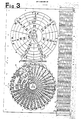
- FIG. 3 See Fig. 3 - Fig. 3 shows: 7-3-1 A circular disc or ring like No. 1c, having a minimum of 35 consecutive weekdays occupying 35 equal divisions on the periphery of the said disc filling the 360 degrees of the circle. 7-3-2 A smaller circular disc or ring, like No. 3c, having the 12 months of the year placed in their constant relation with respect to the weekdays, on 12 concentric rows, divided, each of which with a number of divisions equal to the number of days in the months it represents, with each division occupying the same number of degrees occupied by a weekday division.
- the discs 1c, 3c are pivoted around a central pin No. 19, and are fixed to each other by pressure from the central pin, or by means of an eccentric short pin No. 21, or the like passing through corresponding holes No. 20.
- the joining pin No. 21 has a protruding edge at its base and the holes No. 20, are cut to accommodate said edge so that by inserting the said pin and rotating it, the said protruding edge would prevent the pin from falling down. 7-3-3
- the pin No. 21 is taken out and one of the discs is rotated to have the 1st of January come in line with the weekday on which it begins and the remaining 11 months would automatically fall in place with regard to the weekdays.
- the present calendar shows an additional similar circular monthly calendar comprising: A - A disc or ring No. 11a having 7 consecutive weekdays occupying 7 equal divisions filling the 360 degrees of the circle, around the periphery of the said disc. B - A smaller disc or ring No. 13a, having 31 numbers occupying 31 divisions, each of which occupies 360 degrees divided by 7, placed in 5 concentric rows; 7 divisions on each of the outer 4 rings and 3 divisions at the beginning of the innermost ring, or the like.
- the numbers are arbitrarily aligned 1 to 7 on the first row, 8 to 14 on the second row, 15 to 21 on the third row, 22 to 28 on the 4th row, and 29 to 31 on the 5th row. This setting, places the numbers 1, 8, 15, 22, 29, all in line with Sunday for example.
- the discs 11a and 13a are provided with corresponding holes No. 20a and a pin No. 21a, used to fasten the discs to each other as already described for the discs 1c and 3c. 7-3-5
- the pin 21a is removed and one of the discs is rotated to have the first of the new month come in line with the weekday on which it begins, and the remaining 31 days would automatically fall in place with respect to the weekdays, then the pin 21a is put back in place to fasten the two discs together for the month.
- the central pins of the two calendars, No. 19, No. 19a are joined with a cord made in the form of a belt to be used as a double triangular cursor, like No. 22.
- the two arms of said belt are separated and passed through a multi holes tubular section, like No. 23, or the like, that separates them; a) on the yearly calendar, by 360 degrees over thirty five and b) on the monthly calendar by 360 degrees over seven. This allows to show one weekday sector on the yearly calendar and a corresponding larger sector on the monthly calendar.
- the said cursor is provided at its opposite sides with slotted plates or the like, like No. 24, 24a, sliding along the arms of the said cursor to indicate the current date.
- Everyday the yearly calendar is rotated by 360 degrees over thirty five to show the following day in between the arms of the said cursor on the yearly calendar and its date underlined by the indicator No. 24 positioned under the row representing the current month.
- the large scale disc No. 13a showing the 31 days of the month is laminated with a waterproof film or provided with slots and indentations to hold circular transparent papers like No. 14a, cut in a circular shape and placed over the said disc to be used for writing notes and appointments on the transparent paper, guided by the daily divisions shown under the transparent paper, said paper could be replaced once a month or it could be made of permanent laminated waterproof transparent paper, mylar or the like that could be erased at the end of the month and made available for the following month.
- the dual calendar is provided with a pulley No. 25 on the yearly calendar and a smaller pulley No. 25a on the monthly calendar which pulleys are operated by different means, like:
- a - By joining the pulleys with a belt like No. 26 to transfer the movement from one to the other and a crank like No. 27 is mounted at the center of one of the pulleys for the operation of the calendar as a whole.
- B - By means of chains and sprockets.
- C By means of a chain or cable wrapped around the opposite pulleys with counter weights at their opposite ends hanging down from the said pulleys.
- the pulleys are proportioned so that one pulley turns 360 degrees over seven, while the other one turns 360 degrees over thirty five, to have both calendars rotate by one weekday division each, with a simple turning of the crank.
- Said pulleys are made idle for adjustment when needed.
- the calendar is provided with a weekly/daily planner as described for Fig. 2, and with holding means to display the current weekday at a large scale one weekday and its date using the One Letter Alphabet (OLA) system.
- OVA One Letter Alphabet
- FIG. 4 See Fig. 4 - Fig. 4 shows: 7-4-1 A strip No. 1a the same as described on Fig. 2. 7-4-2 A section No. 3c made in the same way as section 3a described on Fig. 2 with the difference that the section 3c is made in the form of a belt folded around a board, chassis or the like, like No. 28 and passed through slots like No. 12a where it could be rotated to bring the current month to be closer to the weekdays strip for better identification of each day and its date.
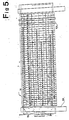
- FIG. 5 See Fig. 5 - Fig 5 shows: 7-5-1
- a perpetual calendar comprising a minimum of 2 concentric, tubular, transparent sections: A - An outer tubular section No. 1c having 43 consecutive weekdays occupying 43 equal divisions.
- B An internal transparent tube No. 3c having the 12 consecutive months of the year placed in parallel rows in the same way described on Fig. 2 with a difference that on Fig. 5 the rows follow the curvature of the tubular section. 7-5-2
- the tubular sections are supported by a chassis like No. 29 and are provided with a knob like No. 30 to allow the rotation of one tube with respect to the other to keep the current month always close to the weekdays strip.
- the tubular calendar is provided with a cursor No. 31, in the form of a sleeve with a window, around the outer tubular section. Said cursor is slid once a day to show the new day and its date.
Landscapes
- Physics & Mathematics (AREA)
- General Physics & Mathematics (AREA)
- Engineering & Computer Science (AREA)
- Theoretical Computer Science (AREA)
- Electromechanical Clocks (AREA)
- Calculators And Similar Devices (AREA)
- Electric Clocks (AREA)
- Laminated Bodies (AREA)
- Primary Cells (AREA)
- Silicates, Zeolites, And Molecular Sieves (AREA)
- Management, Administration, Business Operations System, And Electronic Commerce (AREA)
- Diaphragms For Electromechanical Transducers (AREA)
- Cell Separators (AREA)
Applications Claiming Priority (2)
| Application Number | Priority Date | Filing Date | Title |
|---|---|---|---|
| CA564569 | 1988-04-20 | ||
| CA000564569A CA1277834C (en) | 1988-04-20 | 1988-04-20 | Multi perpetual calendars (mpc) |
Publications (3)
| Publication Number | Publication Date |
|---|---|
| EP0338294A2 true EP0338294A2 (de) | 1989-10-25 |
| EP0338294A3 EP0338294A3 (de) | 1992-01-02 |
| EP0338294B1 EP0338294B1 (de) | 1996-09-25 |
Family
ID=4137872
Family Applications (1)
| Application Number | Title | Priority Date | Filing Date |
|---|---|---|---|
| EP89105571A Expired - Lifetime EP0338294B1 (de) | 1988-04-20 | 1989-03-29 | Dauerkalender |
Country Status (11)
| Country | Link |
|---|---|
| US (1) | US5026095A (de) |
| EP (1) | EP0338294B1 (de) |
| JP (1) | JPH0243595A (de) |
| CN (1) | CN1017759B (de) |
| AT (1) | ATE143522T1 (de) |
| AU (1) | AU628318B2 (de) |
| BR (1) | BR8901939A (de) |
| CA (1) | CA1277834C (de) |
| DE (1) | DE68927239D1 (de) |
| IL (1) | IL89598A (de) |
| IN (1) | IN176509B (de) |
Cited By (1)
| Publication number | Priority date | Publication date | Assignee | Title |
|---|---|---|---|---|
| GB2480320A (en) * | 2010-05-14 | 2011-11-16 | Gary Banks | Multi-year calendar |
Families Citing this family (13)
| Publication number | Priority date | Publication date | Assignee | Title |
|---|---|---|---|---|
| US5135260A (en) * | 1991-03-27 | 1992-08-04 | Jerzy Irlik | Calendar with multi layered structure |
| AU625046B3 (en) * | 1991-10-31 | 1992-04-29 | John Lawrence Slocomb | Variable period diary |
| DK170689B1 (da) * | 1992-07-15 | 1995-12-04 | Peter Helge Aa Katballe | Evighedskalender |
| DE4235006A1 (de) * | 1992-10-16 | 1994-04-21 | Linde Ag | Verfahren zum Auftrennen eines im wesentlichen aus Wasserstoff, Methan und C¶3¶/C¶4¶-Kohlenwasserstoffen bestehenden Einsatzstromes |
| US5387011A (en) * | 1993-09-27 | 1995-02-07 | Nextech Incorporated | System and method for scheduling a meeting |
| US5983200A (en) * | 1996-10-09 | 1999-11-09 | Slotznick; Benjamin | Intelligent agent for executing delegated tasks |
| WO1998030963A1 (en) * | 1997-01-14 | 1998-07-16 | Benjamin Slotznick | System for calculating occasion dates and converting between different calendar systems, and intelligent agent for using same |
| CA2313427C (en) | 2000-07-28 | 2002-06-11 | A. Daniel Brophy | Personal organization tool |
| USD476361S1 (en) | 2002-06-05 | 2003-06-24 | Frederick E. Lester | Millennium calendar |
| US7924657B2 (en) * | 2006-05-03 | 2011-04-12 | Liebowitz Daniel | Apparatus and method for time management and instruction |
| CN101817272B (zh) * | 2010-04-14 | 2013-08-07 | 北京联合大学 | 一种视障人专用挂历 |
| JP2019126992A (ja) * | 2018-01-25 | 2019-08-01 | 隆光 森▲崎▼ | 日記 |
| US11830384B2 (en) | 2020-10-09 | 2023-11-28 | Bianhua Connects Llc | Never-ending calendar |
Family Cites Families (21)
| Publication number | Priority date | Publication date | Assignee | Title |
|---|---|---|---|---|
| US1608411A (en) * | 1926-11-23 | Theopiiil joseph mateju | ||
| US1233447A (en) * | 1915-07-09 | 1917-07-17 | John C Carpenter | Speed-controlling mechanism for motor-vehicles. |
| US1389676A (en) * | 1920-07-13 | 1921-09-06 | Andrew J Mcdade | Calendar |
| CH102999A (fr) * | 1922-08-17 | 1924-01-16 | Demaurex M A | Calendrier perpétuel. |
| US1933812A (en) * | 1931-11-05 | 1933-11-07 | Krug Emil | Perpetual calendar of the roller type |
| US2400268A (en) * | 1943-09-29 | 1946-05-14 | Donald L Skene | Calendar |
| US3514884A (en) * | 1967-06-09 | 1970-06-02 | Angelo G Passariello | Combination calendar and room deodorant |
| GB1222556A (en) * | 1968-03-23 | 1971-02-17 | Albert Alexander Dickson | Improvements in or relating to calendars |
| DE2012169A1 (de) * | 1969-03-17 | 1970-10-08 | Ostav racionalizace ve stavebnictvi, Prag | Digital-Analysator der Beziehungen zwischen vier veränderlichen Kalender-Größen |
| AU7110174A (en) * | 1974-07-11 | 1976-01-15 | Horny J | Perpetual calendars |
| US3983649A (en) * | 1975-05-19 | 1976-10-05 | Ellis Dale S | Reminder card rack |
| CS209671B1 (en) * | 1978-11-20 | 1981-12-31 | Karel Kolar | Universal circular calender |
| US4251935A (en) * | 1979-03-20 | 1981-02-24 | Wright Marvin A | Perpetual calendar |
| IT8035659V0 (it) * | 1980-03-24 | 1980-03-24 | Masillo Guido | Regolo-calendario |
| US4351123A (en) * | 1981-01-22 | 1982-09-28 | Cross Carroll N | Display mount and method |
| DE3439529A1 (de) * | 1984-10-29 | 1986-04-30 | Jochen 7900 Ulm Claussen-Finks | Variabler monatskalender mit wochentagsangaben |
| GB2178560A (en) * | 1985-07-08 | 1987-02-11 | Tan Hua Yong | Perpetual calendars |
| AU606862B2 (en) * | 1986-04-21 | 1991-02-21 | Ralph Haber Hoyeck | One letter alphabet (OLA) |
| US4793634A (en) * | 1986-12-22 | 1988-12-27 | Paul Alloggiamento | Original perpetual diary calendar |
| US4828290A (en) * | 1988-01-11 | 1989-05-09 | Harris Gary J | Perpetual calendar which utilizes seven month tables and methods of constructing and using the same |
| US4813707A (en) * | 1988-03-11 | 1989-03-21 | Habib Mohammed K | Perpetual calendar |
-
1988
- 1988-04-20 CA CA000564569A patent/CA1277834C/en not_active Expired
-
1989
- 1989-02-02 AU AU29596/89A patent/AU628318B2/en not_active Ceased
- 1989-03-14 IL IL89598A patent/IL89598A/xx not_active IP Right Cessation
- 1989-03-29 EP EP89105571A patent/EP0338294B1/de not_active Expired - Lifetime
- 1989-03-29 AT AT89105571T patent/ATE143522T1/de not_active IP Right Cessation
- 1989-03-29 DE DE68927239T patent/DE68927239D1/de not_active Expired - Lifetime
- 1989-04-20 BR BR898901939A patent/BR8901939A/pt unknown
- 1989-04-20 JP JP1099028A patent/JPH0243595A/ja active Pending
- 1989-04-20 CN CN89102603A patent/CN1017759B/zh not_active Expired
-
1990
- 1990-05-22 US US07/526,539 patent/US5026095A/en not_active Expired - Fee Related
-
1993
- 1993-02-12 IN IN86CA1993 patent/IN176509B/en unknown
Cited By (2)
| Publication number | Priority date | Publication date | Assignee | Title |
|---|---|---|---|---|
| GB2480320A (en) * | 2010-05-14 | 2011-11-16 | Gary Banks | Multi-year calendar |
| GB2480320B (en) * | 2010-05-14 | 2012-06-06 | Gary Banks | Calendar |
Also Published As
| Publication number | Publication date |
|---|---|
| US5026095A (en) | 1991-06-25 |
| EP0338294B1 (de) | 1996-09-25 |
| IN176509B (de) | 1996-06-29 |
| EP0338294A3 (de) | 1992-01-02 |
| JPH0243595A (ja) | 1990-02-14 |
| DE68927239D1 (de) | 1996-10-31 |
| CN1017759B (zh) | 1992-08-05 |
| AU2959689A (en) | 1989-10-26 |
| IL89598A0 (en) | 1989-09-10 |
| AU628318B2 (en) | 1992-09-17 |
| CA1277834C (en) | 1990-12-18 |
| IL89598A (en) | 1991-11-21 |
| CN1038893A (zh) | 1990-01-17 |
| BR8901939A (pt) | 1989-11-28 |
| ATE143522T1 (de) | 1996-10-15 |
Similar Documents
| Publication | Publication Date | Title |
|---|---|---|
| CA1277834C (en) | Multi perpetual calendars (mpc) | |
| US4669754A (en) | Agenda system | |
| US4794711A (en) | Perpetual engagement calender and wallet | |
| CA2746057C (en) | Project planner | |
| US6877262B2 (en) | Perpetual calendar | |
| US3696532A (en) | Perpetual appointment reminder | |
| US5374083A (en) | Variable period diary | |
| US4863193A (en) | Multi-year calendar | |
| US4531314A (en) | Calendar | |
| US1611538A (en) | Perpetual calendar | |
| US4709493A (en) | Clock with calendar notepad | |
| EP0264549A2 (de) | Dauerkalender für Blinde | |
| US5125688A (en) | Calendrical device | |
| US4241526A (en) | Perpetual calendar | |
| US2134138A (en) | Memorandum book | |
| US1819429A (en) | Appointment book | |
| US2584810A (en) | Perpetual calendar | |
| US5657561A (en) | Multi-year calendar device | |
| US2815596A (en) | Continuous calendar | |
| US1214935A (en) | Calendar. | |
| US2341599A (en) | Perpetual calendar | |
| GB2178560A (en) | Perpetual calendars | |
| US3116941A (en) | Time card blotter | |
| US1123754A (en) | Date-calculating device. | |
| US1792232A (en) | Calendar |
Legal Events
| Date | Code | Title | Description |
|---|---|---|---|
| PUAI | Public reference made under article 153(3) epc to a published international application that has entered the european phase |
Free format text: ORIGINAL CODE: 0009012 |
|
| AK | Designated contracting states |
Kind code of ref document: A2 Designated state(s): AT BE CH DE ES FR GB GR IT LI LU NL SE |
|
| 17P | Request for examination filed |
Effective date: 19901227 |
|
| PUAL | Search report despatched |
Free format text: ORIGINAL CODE: 0009013 |
|
| AK | Designated contracting states |
Kind code of ref document: A3 Designated state(s): AT BE CH DE ES FR GB GR IT LI LU NL SE |
|
| 17Q | First examination report despatched |
Effective date: 19930415 |
|
| RAP1 | Party data changed (applicant data changed or rights of an application transferred) |
Owner name: KARRASCH, GISELA |
|
| RAP1 | Party data changed (applicant data changed or rights of an application transferred) |
Owner name: HOYECK, RALPH HABER |
|
| GRAH | Despatch of communication of intention to grant a patent |
Free format text: ORIGINAL CODE: EPIDOS IGRA |
|
| GRAA | (expected) grant |
Free format text: ORIGINAL CODE: 0009210 |
|
| GRAH | Despatch of communication of intention to grant a patent |
Free format text: ORIGINAL CODE: EPIDOS IGRA |
|
| AK | Designated contracting states |
Kind code of ref document: B1 Designated state(s): AT BE CH DE ES FR GB GR IT LI LU NL SE |
|
| PG25 | Lapsed in a contracting state [announced via postgrant information from national office to epo] |
Ref country code: IT Free format text: LAPSE BECAUSE OF FAILURE TO SUBMIT A TRANSLATION OF THE DESCRIPTION OR TO PAY THE FEE WITHIN THE PRE;WARNING: LAPSES OF ITALIAN PATENTS WITH EFFECTIVE DATE BEFORE 2007 MAY HAVE OCCURRED AT ANY TIME BEFORE 2007. THE CORRECT EFFECTIVE DATE MAY BE DIFFERENT FROM THE ONE RECORDED.SCRIBED TIME-LIMIT Effective date: 19960925 Ref country code: AT Effective date: 19960925 Ref country code: BE Effective date: 19960925 Ref country code: CH Effective date: 19960925 Ref country code: LI Effective date: 19960925 Ref country code: GR Free format text: LAPSE BECAUSE OF FAILURE TO SUBMIT A TRANSLATION OF THE DESCRIPTION OR TO PAY THE FEE WITHIN THE PRESCRIBED TIME-LIMIT Effective date: 19960925 Ref country code: ES Free format text: THE PATENT HAS BEEN ANNULLED BY A DECISION OF A NATIONAL AUTHORITY Effective date: 19960925 Ref country code: FR Effective date: 19960925 Ref country code: NL Free format text: LAPSE BECAUSE OF FAILURE TO SUBMIT A TRANSLATION OF THE DESCRIPTION OR TO PAY THE FEE WITHIN THE PRESCRIBED TIME-LIMIT Effective date: 19960925 |
|
| REF | Corresponds to: |
Ref document number: 143522 Country of ref document: AT Date of ref document: 19961015 Kind code of ref document: T |
|
| REF | Corresponds to: |
Ref document number: 68927239 Country of ref document: DE Date of ref document: 19961031 |
|
| PG25 | Lapsed in a contracting state [announced via postgrant information from national office to epo] |
Ref country code: SE Effective date: 19961225 |
|
| PG25 | Lapsed in a contracting state [announced via postgrant information from national office to epo] |
Ref country code: DE Effective date: 19961228 |
|
| EN | Fr: translation not filed | ||
| NLV1 | Nl: lapsed or annulled due to failure to fulfill the requirements of art. 29p and 29m of the patents act | ||
| REG | Reference to a national code |
Ref country code: CH Ref legal event code: PL |
|
| PG25 | Lapsed in a contracting state [announced via postgrant information from national office to epo] |
Ref country code: GB Effective date: 19970329 |
|
| PG25 | Lapsed in a contracting state [announced via postgrant information from national office to epo] |
Ref country code: LU Free format text: LAPSE BECAUSE OF NON-PAYMENT OF DUE FEES Effective date: 19970331 |
|
| PLBE | No opposition filed within time limit |
Free format text: ORIGINAL CODE: 0009261 |
|
| STAA | Information on the status of an ep patent application or granted ep patent |
Free format text: STATUS: NO OPPOSITION FILED WITHIN TIME LIMIT |
|
| 26N | No opposition filed | ||
| GBPC | Gb: european patent ceased through non-payment of renewal fee |
Effective date: 19970329 |