EP0338526A2 - Magnetischer Aufzeichnungsträger - Google Patents
Magnetischer Aufzeichnungsträger Download PDFInfo
- Publication number
- EP0338526A2 EP0338526A2 EP89106999A EP89106999A EP0338526A2 EP 0338526 A2 EP0338526 A2 EP 0338526A2 EP 89106999 A EP89106999 A EP 89106999A EP 89106999 A EP89106999 A EP 89106999A EP 0338526 A2 EP0338526 A2 EP 0338526A2
- Authority
- EP
- European Patent Office
- Prior art keywords
- magnetic
- atoms
- powder
- recording medium
- magnetic metal
- Prior art date
- Legal status (The legal status is an assumption and is not a legal conclusion. Google has not performed a legal analysis and makes no representation as to the accuracy of the status listed.)
- Granted
Links
Images


Classifications
-
- G—PHYSICS
- G11—INFORMATION STORAGE
- G11B—INFORMATION STORAGE BASED ON RELATIVE MOVEMENT BETWEEN RECORD CARRIER AND TRANSDUCER
- G11B5/00—Recording by magnetisation or demagnetisation of a record carrier; Reproducing by magnetic means; Record carriers therefor
- G11B5/62—Record carriers characterised by the selection of the material
- G11B5/68—Record carriers characterised by the selection of the material comprising one or more layers of magnetisable material homogeneously mixed with a bonding agent
- G11B5/70—Record carriers characterised by the selection of the material comprising one or more layers of magnetisable material homogeneously mixed with a bonding agent on a base layer
- G11B5/714—Record carriers characterised by the selection of the material comprising one or more layers of magnetisable material homogeneously mixed with a bonding agent on a base layer characterised by the dimension of the magnetic particles
-
- G—PHYSICS
- G11—INFORMATION STORAGE
- G11B—INFORMATION STORAGE BASED ON RELATIVE MOVEMENT BETWEEN RECORD CARRIER AND TRANSDUCER
- G11B5/00—Recording by magnetisation or demagnetisation of a record carrier; Reproducing by magnetic means; Record carriers therefor
- G11B5/62—Record carriers characterised by the selection of the material
- G11B5/68—Record carriers characterised by the selection of the material comprising one or more layers of magnetisable material homogeneously mixed with a bonding agent
- G11B5/70—Record carriers characterised by the selection of the material comprising one or more layers of magnetisable material homogeneously mixed with a bonding agent on a base layer
- G11B5/706—Record carriers characterised by the selection of the material comprising one or more layers of magnetisable material homogeneously mixed with a bonding agent on a base layer characterised by the composition of the magnetic material
- G11B5/70605—Record carriers characterised by the selection of the material comprising one or more layers of magnetisable material homogeneously mixed with a bonding agent on a base layer characterised by the composition of the magnetic material metals or alloys
- G11B5/70615—Record carriers characterised by the selection of the material comprising one or more layers of magnetisable material homogeneously mixed with a bonding agent on a base layer characterised by the composition of the magnetic material metals or alloys containing Fe metal or alloys
-
- G—PHYSICS
- G11—INFORMATION STORAGE
- G11B—INFORMATION STORAGE BASED ON RELATIVE MOVEMENT BETWEEN RECORD CARRIER AND TRANSDUCER
- G11B5/00—Recording by magnetisation or demagnetisation of a record carrier; Reproducing by magnetic means; Record carriers therefor
- G11B5/62—Record carriers characterised by the selection of the material
- G11B5/68—Record carriers characterised by the selection of the material comprising one or more layers of magnetisable material homogeneously mixed with a bonding agent
- G11B5/70—Record carriers characterised by the selection of the material comprising one or more layers of magnetisable material homogeneously mixed with a bonding agent on a base layer
- G11B5/712—Record carriers characterised by the selection of the material comprising one or more layers of magnetisable material homogeneously mixed with a bonding agent on a base layer characterised by the surface treatment or coating of magnetic particles
-
- Y—GENERAL TAGGING OF NEW TECHNOLOGICAL DEVELOPMENTS; GENERAL TAGGING OF CROSS-SECTIONAL TECHNOLOGIES SPANNING OVER SEVERAL SECTIONS OF THE IPC; TECHNICAL SUBJECTS COVERED BY FORMER USPC CROSS-REFERENCE ART COLLECTIONS [XRACs] AND DIGESTS
- Y10—TECHNICAL SUBJECTS COVERED BY FORMER USPC
- Y10S—TECHNICAL SUBJECTS COVERED BY FORMER USPC CROSS-REFERENCE ART COLLECTIONS [XRACs] AND DIGESTS
- Y10S428/00—Stock material or miscellaneous articles
- Y10S428/90—Magnetic feature
-
- Y—GENERAL TAGGING OF NEW TECHNOLOGICAL DEVELOPMENTS; GENERAL TAGGING OF CROSS-SECTIONAL TECHNOLOGIES SPANNING OVER SEVERAL SECTIONS OF THE IPC; TECHNICAL SUBJECTS COVERED BY FORMER USPC CROSS-REFERENCE ART COLLECTIONS [XRACs] AND DIGESTS
- Y10—TECHNICAL SUBJECTS COVERED BY FORMER USPC
- Y10T—TECHNICAL SUBJECTS COVERED BY FORMER US CLASSIFICATION
- Y10T428/00—Stock material or miscellaneous articles
- Y10T428/25—Web or sheet containing structurally defined element or component and including a second component containing structurally defined particles
- Y10T428/256—Heavy metal or aluminum or compound thereof
- Y10T428/257—Iron oxide or aluminum oxide
Definitions
- the present invention relates to a magnetic recording medium such as a magnetic tape, magnetic sheet, and magnetic disk.
- the higher density and higher S/N ratio of recent magnetic recording medium such as a magnetic tape requires increasingly finer-sized magnetic powder.
- the S/N ratio of a magnetic recording medium is proportional to the square root of a number of magnetic particles in a specific amount of recording material that is responsible for recording and reproducing data. Therefore, if a specific weight of magnetic powder is employed for coating, a powder of smaller particle size is more advantageous in improving the S/N ratio. Additionally, using finer magnetic particles for improving the BET value of the magnetic powder accordingly results in smooth-surfaced magnetic layer, and, also, smaller spacing loss, this in turn is advantageous in attaining higher electromagnetic conversion properties. Using magnetic metal powder enables further enhanced high-density recording, thereby improves the performance of the magnetic recording medium.
- the magnetic metal powder has large saturated magnetization and large coersive force, and therefore, excels in characteristics for high-density recording material.
- its high surface activity incurs the following two problems:
- the magnetic metal powder when allowed to stand in air, gradually develops deterioration in magnetic property due to progressive oxidation.
- the object of the invention is to provide a magnetic recording medium that is capable of high density recording; has excellent electromagnetic conversion properties including S/N ratio; whose magnetic powder has good dispersibility and good corrosion resistance; and that has good durability.
- the object of the invention can be accomplished by a magnetic recording medium comprising a binder and magnetic metal powder dispersed in the binder wherein the magnetic metal powder has a specific surface area of not less than 45 m2/g, and comprises iron atoms and aluminum atoms in a ratio (Fe atoms: Al atoms) of from 100:1 to 100:20 in terms of the number of atoms, and the abundance ratio of iron atoms to aluminum atoms (Fe atoms: Al atoms) in the superficial portion of individual particles of the magnetic powder is from 30:70 to 70:30 in terms of the number of atoms.
- the magnetic metal powder has a specific surface area of not less than 45 m2/g, and comprises iron atoms and aluminum atoms in a ratio (Fe atoms: Al atoms) of from 100:1 to 100:20 in terms of the number of atoms, and the abundance ratio of iron atoms to aluminum atoms (Fe atoms: Al atoms) in the superficial portion of
- the aluminum atoms present in the superficial oportion of individual particles of the magnetic metal powder are in a state of bounded with oxygen atoms.
- the present invention provides a recording medium that is capable of high density recording and has an excellent S/N ratio and other properties. It is more preferable that the magnetic metal powder has a specific surface area within the range of from 50m2/g to 70m2/g.
- a magnetic metal powder contains both iron atoms and aluminum atoms in specific amounts, wherein the invention specifies the abundance ratio of iron atoms to aluminum atoms both present in the surface region of individual magnetic metal particles.
- the abundance ratio of iron atoms to aluminum atoms is limited to 100:1 to 100:20, thereby a sufficient amount of iron atoms is incorporated into individual particles, so that iron series magnetic powder of good electrical properties is provided. At the same time, a sufficient amonut of aluminum atoms is lilewise incorporated, so that corrosion resistance properties of aluminum atoms are positively provided.
- the particularly preferable abundance ratio of iron atoms to aluminum atoms is 100:1 to 100:8.
- the present invention limits the abundance ratio, in terms of number of atoms, of iron atoms to aluminum atoms in the superficial portion of individual magnetic metal particles to 30:70 to 70:30, thereby a sufficient amount of aluminum atoms is incorporated into the superficial portion, so that corrosion resistance action of aluminum atoms is positively provided and thereby oxidation of magnetic powder is inhibited and dispersibility of the particles is improved.
- the abundance ratio of iron atoms in the surface region of individual particles is greater than the above-mentioned range, corrosion resistance and dispersibility of magnetic powder are insufficient.
- the abundance ratio of iron atoms is smaller than the above-mentioned range, polar groups in aliphatic acid and binder are more readily adsorbed, resulting in poor pot life of a resultabt magnetic coating solution.
- aluminum atoms present in the surface region of individual magnetic metal particles are coupled with oxygen atoms, so that the amount active sites in individual magnetic metal particles is further smaller, thereby surface activity is inhibited. Accordingly, corrosion resistance and dispersibility of magnetic metal powder are further improved, resulting in a much durable magnetic recording medium.
- the "superfical portion” according to the invention is defined as “superfical portion of magnetic particles, not deeper than approx. 100 ⁇ from the surface toward core, where the depth is analyzed by ESCA (electron spectroscopy for chemical analysis).
- Magnetic metal powder obtained by a dry reducing process is preferable used in the invention, where iron oxide is reduced with hydrogen or the like.
- the examples of a magnetic metal powder type of the invention are Fe-Al, Fe-Al-Zn and Fe-Al-Co.
- the magnetic metal powder of the invention is prepared according to the following process, for example.
- An iron hydroxide such as ⁇ -FeOOH and ⁇ -FeOOH or an iron oxide such as ⁇ -Fe2O3, ⁇ -Fe2O3 and Fe3O4 is reduced using H2 or the like at a high temperature.
- a ferrous salt compound such as FeSO4 and FeCl2 is allowed to react with an alkali such as NaOH, thereby o-FeOOH is generated.
- the so-obtained ⁇ -FeOOH is reduced using, for example, H2 or, otherwise, the ⁇ -FeOOH is converted into a-Fe2O3, thereby ether of which is reduced using, for example, H2 at a high temperature to obtain magnetic metal powder.
- an Al compound such as sodium aluminate can be added in accordance with a specific requirement. This explanation also applies to a case where in conjunction with Al, a compound other than that of Fe is added.
- the iron atoms in the superficial portion of the magnetic metal particle is in an oxidized state defined as FeOx (4/3 ⁇ x ⁇ 3/2).
- the iron atoms present in the surface region of individual is in the oxidized state defined as FeO x (4/3 ⁇ x ⁇ 3/2), thereby the iron atoms in the above-mentioned surface region remain as stable iron oxide. Therefore, oxidation of the magnetic metal powder is inhibited, and, accordingly, corrosion resistance is improved. Meanwhile, when intact iron atoms are present in the superficial portion of individual particles of magnetic metal powder, these atoms serve as active sites, thereby resultant particle aggregation causes loss in dispersibility as well as solvation by iron atoms, further resulting in deteriorated durability of a magnetic recording medium. According to the invention, such particle aggregation as well as solvation are prevented, thereby dispersibility is improved, and amount of residual solvent remaining in a magnetic recording medium is smaller, and, as a result, the durability of a similar recording medium can be improved.
- the specific surface area mentioned above is expressed in BET value, and which means a surface area per unit weight, and is a physical unit totally different from average grain size. Accordingly, with two types of powder having a common average grain size, one type can have a larger specific surface area, while the other can have a smaller specific surface area.
- powder In measuring a specific surface area, powder is, for example, first subjected to deaeration with heating at approximately 250°C for 30 to 60 minutes, thereby what have been adsorbed on powder particles are eliminated, and then, the powder is introduced into a measuring apparatus, and measurement based on nitrogen adsorption is performed at a liquid nitrogen temperature (-195°C) with the initial nitrogen pressure of 0.5 kg/m2 (measurement technique for specific surface area known as BET technique, for details, refer to Journal of American Chemical Society, 60 309 (1938).
- a measurement apparatus applicable to measuring the specific surface area (BET value) is "powder measurement apparatus, Countersorb, manufactured jointly by Yuasa Battery Co., Ltd. and Yuasa Ionics Co., Ltd.
- a binder useful in the present invention is one whose average molecular weight being approx. 10000 to 200000, and the examples of which include a urethane resin, a vinyl chloride-vinyl acetate copolymer, a vinyl chloride-vinilidene chloride copolymer, a vinyl chloride-acrylnitrile copolymer, a butadiene-acrylnitrile copolymer, a polyamide resin, a polyvinyl butyral, cellulose derivatives such as cellulose acetate butylate, cellulose diacetate, cellulose triacetate, cellulose propionate, and nitrocellulose, a styrene-butadiene copolymer, polyester resin, various synthetic rubbers, a phenol resin, an epoxy resin, a urea resin, a melamine resin, a phenoxy resin, silicone resin, an acryl-based reactive resin, a mixture of high-molecular polyester resin and isocyanate prepolymer, a mixture of
- These resins are preferably those having a hydrophilic polar group such as -SO3M, -COOM, and -PO(OM′)2; wherein M represents a hydrogen atom, or an alkali metal atom such as lithium, potassium, and sodium, and M′ represents a hydrogen atom, or an alkali metal atom such as lithium, potassium, and sodium, or a hydrocarbon residue.
- a hydrophilic polar group such as -SO3M, -COOM, and -PO(OM′)2
- M represents a hydrogen atom, or an alkali metal atom such as lithium, potassium, and sodium
- M′ represents a hydrogen atom, or an alkali metal atom such as lithium, potassium, and sodium, or a hydrocarbon residue.
- Useful binders especially vinyl chloride-based copolymers, can be obtained by subjecting, to copolymerization, a vinyl chloride monomer and a copolymeriable monomer that contains sulfonic or phosphoric alkali salt, as well as, according to a specific requirement, another copolymeric monomer.
- the intended copolymer is readily synthesized owing to vinyl synthesis. Furthermore, since copolymeric units are arbitrarily selected, optimum properties for the resultant copolymer can be attained.
- the metal in the above-mentioned sulfonic or phosphoric salt is an alkali metal (especially, sodium, potassium, and lithium).
- the most advantageous is potassium because of its solubility, reactivity and resultant yield.
- the copolymeriable monomer subjected to copolymerization is a known polymeriable monomer, and the examples of which include various vinyl esters, vinilidene chloride, acrylnitrile, methacrylnitrile, styrene, acrylic acid, methacrylic acid, various acrylic acid esters, methacrylic acid esters, ethylene, propylene, isobutene, butadiene, isoprene, vinyl ether, aryl ether, aryl ester, acrylamide, methacrylamide, maleic acid, and maleic acid ester.
- binders are prepared by polymerization such as emulsification polymerization, solution polymerization, suspension polymerization, and mass polymerization.
- polymerization such as emulsification polymerization, solution polymerization, suspension polymerization, and mass polymerization.
- known methods are performed according to a specific requirement, and the examples of such methods include intermittent or continuous addition of a molecular weight adjuster, polymerization initiator and monomers.
- the preferred monomer percentage in the above-mentioned acid salt in a binder of the invention is 0.01 to 30 mol%.
- a salt of excessively high monomer percentage results in poor solubility of a binder in a solvent, or readily causes gelation.
- a salt of excessively small monomer percentage causes failure in attaining intended properties.
- the vinyl chloride based copolymer above preferably contains an epoxy group or hydroxy group.
- a conventional vinyl chloride based copolymer (for example, VAGH manufactured by U.C.C.) comprises the following copolymeric units. :each represents a copolymeric unit wherein a CH3CO-O- group does not seem to promote crosslinking reaction of the binder with a hardener or the like. Therefore, it is preferable to replace CH3CO with an epoxy group such as
- One preferred copolymer is one that has the following units: wherein X represents a monomer unit containing an alkali metal salt of a sulfo group or phospho group.
- a binder particularly preferably incorporates at least a urethane resin, and, further preferably, also incorporates a vinyl chloride copolymer, an epoxy resin especially, a phenoxy resin, a polyester resin, or a nitrocellulose resin (these resins are hereinafter referred to as another (other) resin(s)).
- the proportion of another resin is 90 to 10 wt parts, or, preferably, 80 to 20 wt parts.
- a proportion of another resin, exceeding 90 wt parts results in too vulnerable a coated layer whose durability being significantly poor, and, at the same time, a coated layer does not stably adhere to a support of a magnetic recording medium.
- a proportion of another resin, less than 10 wt parts results in more frequently falling-off of magnetic powder.
- Incorporating carbon black into a magnetic layer further improves traveling properties and electromagnetic conversion properties of a magnetic recording medium, and, this arrangement also marginally improves the dispersibility of binder resins, and further decreases an amount of residual solvent in a magnetic recording layer.
- Carbon black for light-shielding grade can further enhance the degree of light-shielding.
- the examples of applicable carbon black of light-shielding grade include Raven 2000 (specific surface area, 1190 m2/g, grain size 18 m ⁇ ), Raven 2100, Raven 1170, and Raven 1000, each manufactured by Columbian Carbon; and #100, #75, #40, #35, and #30, each manufactured by Mitsubishi Chemical Industries Ltd.
- electrical conductive carbon black examples include Conductex 975 (BET value, hereinafter referred to as BET, 250 m2/g; DBP oil absorption, hereinafter referred to as DBP, 170 ml/100 g; grain size, 24 m ⁇ ), Conductex 900 (BET, 125 m2/g; grain size, 27 m ⁇ ), Conductex 40-220 (grain size, 20 ⁇ m), Conductex SC (BET, 220 m2/g; DBP, 115 ml/100 g; grain size, 20 m), each manufactured by Columbian Carbon; Vulcan XC-72 (specific surface area, 254 m2/g; grain size, 30 m ⁇ ), and Vulcan P (BET, 143 m2/g; DBP, 118 m l/100 g; grain size, 20 m ⁇ ), Raven 1040, Raven 420, Black Pearls 2000 (grain size, 15 m ⁇ ), each manufactured by Cabot; and #44 of Mitsubishi Chemical Industries Ltd.
- BET Conductex 9
- the examples of other applicable carbon blacks include Vulcan 9 (BET, 140 m2/g; DBP, 114 ml/100 g; grain size, 19 m ⁇ ) manufactured by Cabot; #80 of Asahi Carbon (BET, 117 m2/g; DBP, 113 ml/100 g; grain size, 23 m ⁇ ); HS100 of DENKI KAGAKU (BET, 32 m2/g; DBP, 180 ml/100 g; grain size, 53 m ⁇ ); #22B (BET, 55 m2/g; DBP, 131 ml/100 g; grain size, 40 m ⁇ ), #20B (BET, 56 m2/g; DBP, 115 ml/100 g; grain size, 40 m ⁇ ), and #3500 (BET, 47 m2/g; DBP, 187 ml/100 g; grain size, 40 m ⁇ ), each manufactured by Mitsubishi Chemical Industries Ltd.
- the examples further include CF-9, #4000, and MA-600 of Mitsubishi Chemical Industries Ltd.; Black Pearls L, Monarck 800, Black Pearls 700, Black Pearls 1000, Black Pearls 880, Black Pearls 900, Black Pearls 1300, Black Pearls 2000, and Sterling V, each manufactured by Cabot; Raven 410, Raven 3200, Raven 420, Raven 450, Raven 825, Raven 1255, Raven 1035, Raven 1000, Raven 2000, Raven 5000, and Ketchen Black FC, each manufactured by Columbian Carbon.
- a polyisocyanate based hardener to improve durability of a magnetic recording medium, to a magnetic coating solution containing a binder can be added a polyisocyanate based hardener.
- a polyisocyanate based hardener include conventional hardeners, for example, bivalent isocyanates such as trilenediisocyanate, diphenylmethanediisocyante, and hexanediisocyanate; trivalent isocyanates such as Coronate L (Japan Polyurethane Co.), and Desmodur L (Bayer); a urethane polymer having on its both ends isocyanate groups; and other polyisocyanates that can be used as a hardener.
- the amount of polyisocyanate based hardener is 5 to 80 wt parts per total amount of binder.
- a magnetic recording medium of the invention comprises, for example, as shown in FIG. 1, a non-magnetic support 1 of polyethylene terephthalate or the like disposed thereon a magnetic layer 2, and on the other face of the support 1 is provided, according to a specific requirement, a back coating layer (BC layer) 3. As shown in FIG. 2, an over-coating layer (OC layer) 4 may be additionally formed on the magnetic layer 2 of the magnetic recording medium in FIG. 1.
- the magnetic recording medium either in FIG. 1 or FIG. 2 may have or may not have a subbing layer (unshown) between the magnetic layer 2 and the support 1.
- the support may be subjected to corona discharge treatment.
- the magnetic layer 2 can contain a fatty acid and/or fatty acid ester as a lubricant, in addition to a magnetic metal powder and a binder each mentioned above.
- a fatty acid and/or fatty acid ester as a lubricant, in addition to a magnetic metal powder and a binder each mentioned above.
- Lubrication action is further enhanced by carbon black, and thereby still image durability, traveling stability and S/N ratio are further improved.
- the preferred amount of fatty acid added is within a range of 0.2 to 10 wt parts, in particular, 0.5 to 8.0 wt parts per 100 wt parts of magnetic powder.
- the amount of fatty acid is lower than this range, the dispersibility of the magnetic powder is smaller, and the traveling properties of the recording medium tends to become poor; if the amount is higher than this range, the fatty acid tends to be eluted from a medium, and the output level tends to be lower.
- the preferred amount of fatty acid ester added is within a range of 0.1 to 10 wt parts, in particular, 0.2 to 8.5 wt parts per 100 wt parts of magnetic powder. If the amount of fatty acid ester is lower than this range, the improvement on the traveling properties is less significant; if the amount is higher than this range, fatty acid ester tends to be eluted from the medium, and the output level tends to be lower.
- the preferred weight ratio of fatty acid to fatty acid ester 10/90 to 90/10 Fatty acid also has dispersing property, and it can contribute to decreasing amount of a low molecular dispersing agent used. Therefore, a better Young's modulus of the magnetic recording medium can be expected.
- the fatty acids applicable to this purpose may be either monobasic or dibasic types.
- the preferred fatty acids independently have 6 to 30, particularly, 12 to 22 carbon atoms.
- the typical such fatty acids are as follows:
- fatty acid ester examples are as follows:
- the magnetic layer may contain other lubricants such as silicone oil that is either carboxylic acid modified or ester modified; and graphite, fluorocarbon, molybdenum disulfide, tungsten disulfide, fatty acid amide and ⁇ -olefine oxide.
- the magnetic layer may also incorporate non-magnetic abrasive particles, and the examples of this abrasive include ⁇ -alumina, chromium oxide, titanium oxide, ⁇ -iron oxide, silicon oxide, silicon nitride, silicon carbide, zirconium oxide, zinc oxide, cerium oxide, magnesium oxide, and boron nitride.
- the preferred average particle size of such an abrasive is 0.6 ⁇ m, in particular, not more than 0.3 ⁇ m.
- the preferred Moh's hardness of such an abrasive is not less than 5.
- the magnetic layer may further contain a charge controlling agent such as graphite, and a dispersing agent such as powder lecithin and phosphoric ester, as well as carbon black.
- a charge controlling agent such as graphite
- a dispersing agent such as powder lecithin and phosphoric ester, as well as carbon black.
- the preferred average particle size of non-magnetic powder the back coating layer may contain is 10 to 1000 m ⁇ . This range of particle size means not too fine particles, and hence effect by addition is satisfactory.
- non-magnetic powder examples include silicon oxide, silicon carbide, calcium carbide, zinc oxide, ⁇ -Fe2O3, talc, caolin, calcium sulfate, boron nitride, zinc fluoride, molybdenum dioxide, calcium carbonate, and barium sulfate.
- Other useful non-magnetic powder include organic powder whose types being benzoguanamine resin, and melamine resin, as well as phthalacyanine dye. Such organic powder can be used in conjunction with the previously mentioned inorganic powder.
- each magnetic layer was formed on a 10 ⁇ m thick polyethylene terephthalate base film serving as a support.
- the iron-Al content ratio in individual magnetic metal particles as well as abundance ratio of both atom types are summarized in Table 1.
- the abundance ratio was measured, according to the ESCA, by determining an abundance ratio at an analysis depth of approx. 100A and less from the surface toward inside.
- the Fe-Al content ratio was measured by an X ray spectroscopy.
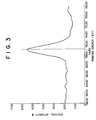
- FIG. 3 graphically shows the degrees of oxidation of aluminum atoms in the superficial portion of individual magnetic particles.
- the vertical axis corresponds with a spectral intensity measured with a counter, while the horizontal axis corresponds with cohesive energy (eV).
- the peak level of the binding energy shown is at 76.8 eV, whereas according to a handbook, non-oxidized pure aluminum has peak binding energy of 72.7 eV in contrast with the peak level of aluminum oxide, i.e. 76.8 eV.
- the wide magnetic films respectively having a magnetic layer and BC layer of prescribed thicknesses were prepared and rolled up.
- a respective magnetic film was cut into 8 mm width tapes to form the video tapes specified in Table 1 (each video tape corresponding with the identification number of example or comparative example).
- the "parts" in the second row and below in Table 1 are in parts by weight.
- the threshold level of the high-pass filter was 4.2 MHz; that of the low-pass filter was 10 KHz.
- the VTR used was an 8 mm video deck.
- the sample tape was allowed to stand for 1 week under the conditions of 60°C, and 80%RH, and then the saturated magnetization was measured.
- the residual magnetization is represented by percentage of the saturated magnetization after aging of the initial saturated magnetization.
- a sample tape was allowed to run on a videotape deck for 2000 hours under the conditions of 40°C, and 80%RH, in order to evaluate clogging of the magnetic head.
- each magnetic layer was formed on a 10 ⁇ m thick polyethylene terephthalate base film serving as a support.
- the Al content in these magnetic metal powders was commonly 5 atomic %.
- the degree of oxidation above was measured, according to the ESCA, by determining a binding energy at an analysis depth of approx. 1000A and less from the surface toward inside.
- the ratio of iron atoms present was measured by an X ray spectroscopy.
- FIG. 4 graphically shows the degrees of oxidation of iron atoms at the superficial portion of individual magnetic particles.
- the vertical axis corresponds with a spectral intensity measured with a counter
- the horizontal axis corresponds with binding energy (eV)
- eV binding energy
- the wide magnetic films respectively having a magnetic layer and BC layer of prescribed thicknesses were prepared and rolled up.
- a respective magnetic film was cut into 8 mm width tapes to form the video tapes specified in Table 2 (each video tape corresponding with the identification number of example or comparative example).
- the "parts" in the second row and below in FIG. 4 are in parts by weight; “Ex No.” means an example of the invention, while “Com No.” means a comparative example.
Landscapes
- Engineering & Computer Science (AREA)
- Metallurgy (AREA)
- Paints Or Removers (AREA)
- Magnetic Record Carriers (AREA)
Applications Claiming Priority (4)
| Application Number | Priority Date | Filing Date | Title |
|---|---|---|---|
| JP63100918A JP2649941B2 (ja) | 1988-04-22 | 1988-04-22 | 磁気記録媒体 |
| JP100918/88 | 1988-04-22 | ||
| JP107213/88 | 1988-04-28 | ||
| JP10721388A JPH01277322A (ja) | 1988-04-28 | 1988-04-28 | 磁気記録媒体 |
Publications (3)
| Publication Number | Publication Date |
|---|---|
| EP0338526A2 true EP0338526A2 (de) | 1989-10-25 |
| EP0338526A3 EP0338526A3 (en) | 1990-10-31 |
| EP0338526B1 EP0338526B1 (de) | 1993-12-22 |
Family
ID=26441858
Family Applications (1)
| Application Number | Title | Priority Date | Filing Date |
|---|---|---|---|
| EP89106999A Expired - Lifetime EP0338526B1 (de) | 1988-04-22 | 1989-04-19 | Magnetischer Aufzeichnungsträger |
Country Status (3)
| Country | Link |
|---|---|
| US (1) | US5045390A (de) |
| EP (1) | EP0338526B1 (de) |
| DE (1) | DE68911569T2 (de) |
Cited By (2)
| Publication number | Priority date | Publication date | Assignee | Title |
|---|---|---|---|---|
| EP0959461A1 (de) * | 1998-05-21 | 1999-11-24 | Sony Corporation | Magnetischer Aufzeichnungsträger und dessen Herstellungsverfahren |
| EP0566378B2 (de) † | 1992-04-14 | 2001-05-09 | Konica Corporation | Magnetisches Aufzeichnungsmedium |
Families Citing this family (2)
| Publication number | Priority date | Publication date | Assignee | Title |
|---|---|---|---|---|
| JPH05347017A (ja) * | 1992-04-14 | 1993-12-27 | Konica Corp | 磁気記録媒体 |
| US5527603A (en) † | 1992-10-13 | 1996-06-18 | Konica Corporation | Magnetic recording medium |
Family Cites Families (8)
| Publication number | Priority date | Publication date | Assignee | Title |
|---|---|---|---|---|
| JPS5975608A (ja) * | 1982-10-25 | 1984-04-28 | Fuji Photo Film Co Ltd | 強磁性粉末及びその製造方法 |
| JPS59203224A (ja) * | 1983-05-02 | 1984-11-17 | Fuji Photo Film Co Ltd | 磁気記録媒体 |
| JPS61107537A (ja) * | 1984-10-31 | 1986-05-26 | Fuji Photo Film Co Ltd | 磁気記録媒体 |
| EP0238069B1 (de) * | 1986-03-20 | 1993-02-10 | Hitachi Maxell Ltd. | Magnetischer Aufzeichnungsträger |
| JPH0760520B2 (ja) * | 1986-07-09 | 1995-06-28 | 日立マクセル株式会社 | 磁性粉およびこれを用いた磁気記録媒体 |
| DE3631194A1 (de) * | 1986-09-13 | 1988-03-24 | Bayer Ag | Magnetische eisenoxidpigmente sowie verfahren zu ihrer herstellung |
| US4801505A (en) * | 1986-10-20 | 1989-01-31 | Fuji Photo Film Co., Ltd. | Magnetic recording medium |
| JPH01247503A (ja) * | 1988-03-30 | 1989-10-03 | Tdk Corp | 磁性粒子およびその製造方法 |
-
1989
- 1989-04-17 US US07/339,496 patent/US5045390A/en not_active Expired - Lifetime
- 1989-04-19 DE DE89106999T patent/DE68911569T2/de not_active Expired - Fee Related
- 1989-04-19 EP EP89106999A patent/EP0338526B1/de not_active Expired - Lifetime
Cited By (3)
| Publication number | Priority date | Publication date | Assignee | Title |
|---|---|---|---|---|
| EP0566378B2 (de) † | 1992-04-14 | 2001-05-09 | Konica Corporation | Magnetisches Aufzeichnungsmedium |
| EP0959461A1 (de) * | 1998-05-21 | 1999-11-24 | Sony Corporation | Magnetischer Aufzeichnungsträger und dessen Herstellungsverfahren |
| US6165581A (en) * | 1998-05-21 | 2000-12-26 | Sony Corporation | Magnetic recording medium apparatus |
Also Published As
| Publication number | Publication date |
|---|---|
| DE68911569T2 (de) | 1994-05-11 |
| EP0338526B1 (de) | 1993-12-22 |
| EP0338526A3 (en) | 1990-10-31 |
| DE68911569D1 (de) | 1994-02-03 |
| US5045390A (en) | 1991-09-03 |
Similar Documents
| Publication | Publication Date | Title |
|---|---|---|
| US4992330A (en) | Magnetic recording medium | |
| KR0165106B1 (ko) | 자기기록매체 | |
| US5151323A (en) | Magnetic recording medium and manufacturing method thereof | |
| KR0155992B1 (ko) | 자기 기록 매체 | |
| EP0338526B1 (de) | Magnetischer Aufzeichnungsträger | |
| US4460653A (en) | Magnetic recording medium | |
| JPH048855B2 (de) | ||
| US5084342A (en) | Magnetic recording medium | |
| EP0312977B1 (de) | Magnetischer Aufzeichnungsträger | |
| US4835049A (en) | Magnetic recording medium | |
| US5116658A (en) | Magnetic recording medium | |
| JP3463174B2 (ja) | 磁気記録媒体の製造方法 | |
| US5061516A (en) | Production method for magnetic recording medium | |
| KR910006152B1 (ko) | 자기 기록 매체 | |
| US5156916A (en) | Magnetic recording medium comprising a polyurethane binder having a polar group and containing iron carbide | |
| JP2665671B2 (ja) | 磁気記録媒体 | |
| JP2649941B2 (ja) | 磁気記録媒体 | |
| JP2512315B2 (ja) | 磁気記録媒体 | |
| JP2631523B2 (ja) | 磁気記録媒体 | |
| JP2627635B2 (ja) | 磁気記録媒体 | |
| JP2696330B2 (ja) | 磁気記録媒体 | |
| EP0352757B1 (de) | Magnetischer Aufzeichnungsträger | |
| JPH01277322A (ja) | 磁気記録媒体 | |
| JP2649942B2 (ja) | 磁気記録媒体 | |
| JPH01196724A (ja) | 磁気記録媒体 |
Legal Events
| Date | Code | Title | Description |
|---|---|---|---|
| PUAI | Public reference made under article 153(3) epc to a published international application that has entered the european phase |
Free format text: ORIGINAL CODE: 0009012 |
|
| AK | Designated contracting states |
Kind code of ref document: A2 Designated state(s): DE FR GB |
|
| PUAL | Search report despatched |
Free format text: ORIGINAL CODE: 0009013 |
|
| AK | Designated contracting states |
Kind code of ref document: A3 Designated state(s): DE FR GB |
|
| 17P | Request for examination filed |
Effective date: 19901215 |
|
| 17Q | First examination report despatched |
Effective date: 19930223 |
|
| GRAA | (expected) grant |
Free format text: ORIGINAL CODE: 0009210 |
|
| RBV | Designated contracting states (corrected) |
Designated state(s): DE |
|
| AK | Designated contracting states |
Kind code of ref document: B1 Designated state(s): DE |
|
| REF | Corresponds to: |
Ref document number: 68911569 Country of ref document: DE Date of ref document: 19940203 |
|
| PLBI | Opposition filed |
Free format text: ORIGINAL CODE: 0009260 |
|
| 26 | Opposition filed |
Opponent name: BASF AKTIENGESELLSCHAFT, LUDWIGSHAFEN Effective date: 19940913 |
|
| PLBO | Opposition rejected |
Free format text: ORIGINAL CODE: EPIDOS REJO |
|
| APAC | Appeal dossier modified |
Free format text: ORIGINAL CODE: EPIDOS NOAPO |
|
| APAE | Appeal reference modified |
Free format text: ORIGINAL CODE: EPIDOS REFNO |
|
| APAC | Appeal dossier modified |
Free format text: ORIGINAL CODE: EPIDOS NOAPO |
|
| PLBN | Opposition rejected |
Free format text: ORIGINAL CODE: 0009273 |
|
| STAA | Information on the status of an ep patent application or granted ep patent |
Free format text: STATUS: OPPOSITION REJECTED |
|
| 27O | Opposition rejected |
Effective date: 19970306 |
|
| APAH | Appeal reference modified |
Free format text: ORIGINAL CODE: EPIDOSCREFNO |
|
| PGFP | Annual fee paid to national office [announced via postgrant information from national office to epo] |
Ref country code: DE Payment date: 20060413 Year of fee payment: 18 |
|
| PG25 | Lapsed in a contracting state [announced via postgrant information from national office to epo] |
Ref country code: DE Free format text: LAPSE BECAUSE OF NON-PAYMENT OF DUE FEES Effective date: 20071101 |