EP0338755A2 - Verfahren zur Herstellung von perfluorierten Copolymeren - Google Patents
Verfahren zur Herstellung von perfluorierten Copolymeren Download PDFInfo
- Publication number
- EP0338755A2 EP0338755A2 EP89303796A EP89303796A EP0338755A2 EP 0338755 A2 EP0338755 A2 EP 0338755A2 EP 89303796 A EP89303796 A EP 89303796A EP 89303796 A EP89303796 A EP 89303796A EP 0338755 A2 EP0338755 A2 EP 0338755A2
- Authority
- EP
- European Patent Office
- Prior art keywords
- copolymer
- monomer
- tfe
- ratio
- fluorine
- Prior art date
- Legal status (The legal status is an assumption and is not a legal conclusion. Google has not performed a legal analysis and makes no representation as to the accuracy of the status listed.)
- Granted
Links
Images

Classifications
-
- C—CHEMISTRY; METALLURGY
- C08—ORGANIC MACROMOLECULAR COMPOUNDS; THEIR PREPARATION OR CHEMICAL WORKING-UP; COMPOSITIONS BASED THEREON
- C08F—MACROMOLECULAR COMPOUNDS OBTAINED BY REACTIONS ONLY INVOLVING CARBON-TO-CARBON UNSATURATED BONDS
- C08F214/00—Copolymers of compounds having one or more unsaturated aliphatic radicals, each having only one carbon-to-carbon double bond, and at least one being terminated by a halogen
- C08F214/18—Monomers containing fluorine
- C08F214/26—Tetrafluoroethene
- C08F214/262—Tetrafluoroethene with fluorinated vinyl ethers
-
- C—CHEMISTRY; METALLURGY
- C08—ORGANIC MACROMOLECULAR COMPOUNDS; THEIR PREPARATION OR CHEMICAL WORKING-UP; COMPOSITIONS BASED THEREON
- C08F—MACROMOLECULAR COMPOUNDS OBTAINED BY REACTIONS ONLY INVOLVING CARBON-TO-CARBON UNSATURATED BONDS
- C08F8/00—Chemical modification by after-treatment
- C08F8/18—Introducing halogen atoms or halogen-containing groups
- C08F8/20—Halogenation
- C08F8/22—Halogenation by reaction with free halogens
Definitions
- the present invention relates to a process for the preparation of a perfluorinated copolymer.
- TFE-PFAVE copolymer A tetrafluoroethylene/perfluoroalkylvinyl ether copolymer (hereinafter referred to as "TFE-PFAVE copolymer”) obtained by copolymerizing tetrafluoroethylene (hereinafter referred to as "TFE”) with a perfluoroalkylvinyl ether (hereinafter referred to as "PFAVE”) is excellent in the melt-moldability over a homopolymer of TFE while retaining high heat resistance and chemical resistance. Accordingly, this copolymer is widely used in various fields, for example, as linings and hoses in the chemical industry, electric wire coverings in the electric and electronic industries, and other molded articles.
- PFAVE used as the starting material is ordinarily prepared by reacting a dimer of hexafluoropropene oxide with an alkali metal salt and thermally decomposing the reaction product, and this synthesis of PFAVE includes many steps and yields are low at some of these steps. Therefore, the overall yield is low, and PFAVE is expensive.
- the utilization ratio of PFAVE that is, the ratio of the units of PFAVE present in the bonded state in the copolymer to the amount of PFAVE charged at the polymerization, is very low.
- the utilization ratio of PFAVE to the charged amount is only several to 30%. Therefore, a special method or step is necessary for recovering expensive PFAVE.
- the TFE-PFAVE copolymer obtained by the copolymerization of TFE with PFAVE contains at molecule ends -COOH, -CH 2 0H or -COF groups derived from a polymerization initiator or a chain transfer agent or formed by the termination of radicals on the growing chain, and since these terminal groups are thermally unstable and are oxidized or thermally decomposed by heat applied at the molding step to cause generation of hydrogen fluoride or inclusion of bubbles in a molded article. Therefore, corrosion of a molding machine is often caused and the ratio of defective molded articles is increased by inclusion of bubbles.
- a molded article of a TFE-PFAVE copolymer is frequently used for the production of semiconductors where a high purity is required, but problems caused by minute amounts of impurities such as hydrogen fluoride are recently discussed [Proceeding of Annual Technical Meeting of Institute of Environmental Science (32nd meeting), 1986, pages 397-407].
- Another object of the present invention is to provide a process for preparing a TFE-PFAVE copolymer which is advantageous over a TFE-PFAVE copolymer obtained by copolymerizing a TFE monomer with a PFAVE monomer, in that generation of a corrosive gas such as hydrogen fluoride gas by thermal decomposition is controlled.
- R stands for an alkyl radical or a fluorinated alkyl radical
- II fluorine-containing alkylvinyl ether
- the pressure of TFE (I) in the gas phase zone in a polymerization vessel is adjusted to a predetermined level within a range of from 1 to 100 kg/cm 2 G and the polymerization is carried out.
- the ratio between the units of the monomer (I) and the units of the monomer (II) in the obtained perfluorinated copolymer can be controlled to a predetermined ratio. Namely, a copolymer having a monomer unit ratio substantially equal to the starting monomer ratio can be obtained.
- the content of the units of TFE (I) be 99.5 to 50 mole% and the content of the units of the fluorine-containing alkylvinyl ether (II) be 0.5 to 50 mole%.
- a copolymer in which the content of the units of the monomer (II) is lower than 0.5 mole% gives only a perfluorinated copolymer poor in the moldability. If the content of the units of the monomer (II) exceeds 50 mole%, the perfluorination becomes difficult, and the physical properties of the perfluorinated copolymer obtained by the fluorination are somewhat degraded.
- One of the monomers to be copolymerized in the present invention is TFE (I), and the other monomer is a fluorine-containing alkylvinyl ether (II).
- TFE TFE
- II fluorine-containing alkylvinyl ether
- Any of the monomers represented by the above-mentioned formula (II) can be used as the monomer (II) without any limitation.
- the monomer (II) the following monomers can be mentioned:
- n is an integer of 0 to 10 and t is in the range of from 2n to 2n + 1 is preferred and a compound represented by the following formula:
- the fluorine-containing alkylvinyl ether (II) used in the present invention can be prepared according to a known process.
- any of polymerization means where the polymerization is carried out in the state where the monomers (I) and (II) are dissolved in an organic solvent can be used as the copolymerization process without any limitation in the present invention.
- TFE as the monomer (I) is gaseous in many cases, it is preferred that TFE be supplied under pressure in a gas phase zone of a polymerization vessel.
- the kind of the solvent used in the present invention is not particularly critical, but chlorofluorocarbons and perfluoro compounds are preferably used.
- fluorine type solvents such as trichlorotrifluoroethane, dichlorotetrafluoroethane, trichlorofluoromethane, dichlorodifluoromethane, perfluorocyclohexane, perfluorocyclobutane, perfluorotributylamine, perfluorotriamylamine and perfluoropolyether are preferably used.
- a deoxidized organic solvent and a fluorine-containing alkylvinyl ether are charged into a pressure vessel equipped with a stirrer and a thermometer.
- the amounts added of these components are selected so that difficult stirring caused by increase of the viscosity with the advance of the polymerization and difficult maintenance of the polymerization caused by failure to remove polymerization heat because of insufficient stirring can be prevented.
- the fluorine-containing alkylvinyl ether be added in an amount of 0.1 to 30 parts by weight, especially 1 to 10 parts by weight, per 100 parts by weight of the organic solvent. Distilled water can further be added.
- the content in the reaction vessel is cooled and solidified and the deaeration operation is repeated.
- TFE is supplied to the gas phase zone in the reaction vessel.
- a radical initiator dissolved in the organic solvent is supplied as the polymerization initiator, and the pressure of TFE is elevated to a predetermined level and the polymerization temperature is maintained.
- the polymerization time depends on the pressure of TFE, the amount added of the radical initiator and the like, but a copolymer is sufficiently formed if the polymerization is carried out for scores of minutes to ten and several hours.
- dialkyl peroxides diacyl peroxides, peroxydicarbonates and azo type initiators can be used as the polymerization initiator.
- a fluorine-containing or perfluoro-type radical initiator is generally preferred.
- diacyl peroxides represented by the following formulae: wherein Z stands for -H, -F or -Cl and y is an integer of from 1 to 5, and wherein Z and y are as defined above, and q is an integer of from 0 to 3.
- the amount used of the radical initiator depends on the solvent used and the polymerization conditions, especially the polymerization temperature. In general, however, the radical initiator is added in an amount of 0.5 to 20 mole%, preferably 1 to 10 mole%, based on the fluorine-containing alkylvinyl ether collectively at the time of the charging or intermittently.
- the radical initiator be further added in the midway.
- the polymerization is sufficiently advanced if the pressure of TFE is in the range of from 1 to 100 kg/cm 2 G, but it is preferred that the pressure of TFE be in the range of from 1 to 30 kg/cm 2 G. If the pressure of TFE is low, a copolymer having a low content of TFE is obtained. If the pressure of TFE is high, the content of TFE increases and the speed of formation of the copolymer becomes high. Of course, even if the pressure exceeds the lower limit or upper limit, the polymerization is advanced. However, if the pressure is too high, the equipment cost increases.
- the polymerization temperature is tentatively determined based on the decomposition rate of the used radical initiator as one criterion, but in general, the polymerization temperature is about 0 to about 100°C, preferably about 5 to about 80 C. If a fluorine-containing or perfluoro-type diacryl peroxide having a high decomposition rate even at a low temperature is used, it is preferred that the polymerization temperature is 5 to 6û ⁇ O. In order to adjust the molecular weight, an organic compound such as methanol or methyl ether, methane, ethane can be added as the chain transfer agent, if necessary.
- a fluoroolefin such as hexafluoropropene, chlorotrifluoroether or vinylidene fluoride can be added to TFE so as to improve the properties of the obtained copolymer. It is generally preferred that this compound be added in an amount of up to 5 mole% based on TFE.
- the formed copolymer is separated from the organic solvent (and water) in the polymerization mixture and recovered.
- water can be easily separated from the copolymer by filtration, since the copolymer is dispersed at a high concentration in the organic solvent, it is sometimes impossible to recover the copolymer by filtration.
- the polymer can be recovered by using a centrifugal separator or by drying the copolymer under a reduced pressure.
- the fluorine-containing alkylvinyl ether used in the present invention is easily copolymerized with TFE, and if the pressure of TFE at the polymerization is 1 kg/c M 2 G or higher, substantially all of the fluorine-containing alkylvinyl ether is copolymerized in a short time, and the fluorine-containing alkylvinyl ether is not substantially detected in the organic solvent used for the polymerization. Accordingly, the step of recovering the fluorine-containing alkylvinyl ether is not necessary in the present invention. This is one of the advantages of the copolymerization process of the present invention.
- the separated copolymer is dried and fluorinated.
- the fluorination method customarily adopted for fluorination of a solid or powder for example, a method disclosed in J. Poly. Sci. Part A-1, Vol. 10, page 2129 (1972), can be adopted, but in the present invention, the fluorination method using fluorine gas is preferably adopted in the present invention.
- the fluorination method using fluorine gas includes a liquid phase method in which the copolymer is suspended in a solvent having a low reactivity with fluorine, such as carbon tetrachloride or chlorofluoroethane, and fluorine, diluted with an inert gas according to need, is passed through the suspension to effect the fluorination, and a so-called gas phase method in which fluorine, diluted with an inert gas according to need, is directly contacted with the copolymer to effect the fluorination directly.
- the gas phase method is preferred because the apparatus can be simplified.
- the copolymer is charged in a reaction vessel formed of a material having a high resistance to corrosion by fluorine, and fluorine gas diluted with about 10 to about 100%, preferably about 50 to about 100%. of an inert gas such as nitrogen or He is supplied and the fluorination is carried out continuously or batchwise at a temperature of room temperature to 200 C, preferably 50 to 100°C, under a pressure of 1 to 20 kg/cm2G for several to about 100 hours, preferably about 5 to about 30 hours, under vibration or agitation for attaining a good contact.
- fluorine gas diluted with about 10 to about 100%, preferably about 50 to about 100%.
- an inert gas such as nitrogen or He
- the fluorine-containing alkylvinyl ether used in the present invention since the fluorine-containing alkylvinyl ether used in the present invention has a very high polymerizability, the copolymerization with TFE is very easily advanced, and almost all of the fluorine-containing alkylvinyl ether charged in the reaction vessel is used for the polymerization. Accordingly, after termination of the polymerization, the unreacted fluorine-containing alkylvinyf ether need not be recovered.
- the monomer composition in the obtained copolymer is greatly different from the composition of the charged monomers, and control of the monomer composition in the copolymer is very difficult.
- the monomer composition in the copolymer can be very easily controlled.
- the perfluorinated copolymer obtained according to the process of the present invention' is different from the conventional TFE-PFAVE copolymer obtained by the copolymerization of TFE and PFAVE in that the copolymer of the present invention has no unstable group at the ends of the molecule chain. Accordingly, in the perfluorinated copolymer obtained according to the process of the present invention, the amount of hydrogen fluoride generated by heat is very small. Of course, excellent properties of the TFE-PFAVE copolymer, such as excellent heat stability and chemical resistance, are retained in the copolymer of the present invention.
- the fluorine-containing alkylvinyl ether used as the starting material in the present invention is cheaper than PFAVE used as the starting material for the conventional TFE-PFAVE copolymer. Therefore, the process of the present invention is advantageous in the cost.
- a stainless steel reactor having an inner capacity of 140 cc and being rotatable by a motor was charged with 35 g of the copolymer, and the interior of the reactor was deaerated and fluorine having a concentration of about 100% was introduced under a pressure of 8 kg / c M 2 G into the reactor. Then, the reactor was immersed in an oil bath maintained at 85°C. and the fluorination was carried out with stirring for 15 hours. The gas in the reactor was replaced by nitrogen, and the fluorinated copolymer was taken out and heated under a reduced pressure in an oven maintained at 150 C for 20 hours to obtain about 35 g of a white copolymer. When the obtained copolymer was analyzed by FT-IR, it was found that the copolymer contained 2.9 mole% of the units of and no CH-bond was present.
- Fluorine-containing copolymers differing in the monomer composition were synthesized by using the same polymerization apparatus and process as described in Example 1. The adopted conditions, the monomer conversions and the analysis values of the obtained copolymers are shown in Table 1.
- a 500 cc stainless steel reactor equipped with a stirrer and a condenser was charged with 15 g of the powdery copolymer and 300 g of perfluorotributylamine, and the inner atmosphere of the reactor was replaced by nitrogen. Then, fluorine diluted to 80% by volume by He was introduced at a flow rate of 10 cc/min and discharged through the condenser. The temperature in the reactor was maintained at 150°C and reaction was continued for 15 hours while introducing fluorine.
- the powder was recovered by filtration, washed with trichlorotrifluoroethane and dried under a reduced pressure at 150 C for 15 hours to obtain 14.5 g of a fluorinated copolymer.
- IR and Py-GC/MS analysis of the obtained copolymer it was confirmed that the copolymer contained 2.5 mole% of the units of and the CH-bond and CCl-bond were not substantially contained.
- the same stainless steel reactor as used in Example 1 was charged with 10 g of the obtained copolymer, and fluorine gas diluted to 75% with He was sealed under a pressure of 5 kg/c M 2 G in the stainless steel reactor and the fluorination was carried out at 85° C for 20 hours.
- Polymerization was carried out at 70 °C under a TFE pressure of 3 kg/cm 2 G for 2 hours, but the pressure was not substantially reduced. Therefore, the TFE pressure was increased to 6 kg/cm 2 G and the polymerization was further carried out for 8 hours. The TFE pressure was released.
- the fluorination of the obtained copolymer was carried out by using the same process, conditions and apparatus as adopted in Example 1 to obtain a fluorinated copolymer in which the content of the monomer units of was 1.6 mole% and the CH-bond was not substantially contained.
- each of the unfluorinated and fluorinated copolymers obtained in Examples 1 through 8 and Comparative Example 1 was compressed at 350° C to obtain a sheet having a thickness of 1 to 2 mm.
- the chemical resistance characteristics were determined. Namely, each sheet was immersed in H 2 SO 4, HN0 3 , 50% NaOH, CH 3 COOH, PhCH 3 or PhNH 2 at 100° C, in CCl 4 at 77°C, in CFCt2CF2C at 40°C or in H 2 0 2 at room temperature for 7 days, and the change (%) of the weight was determined.
- Table 4 The obtained results are shown in Table 4.
- copolymerization between tetrafluoroethylene and 2,2,3,3,3-pentafluoropropyltrifluorovinyl ether was carried out by using Flon 113 as the solvent and (C 2 F 5 COO) ⁇ 2 as the polymerization initiator.
- the concentration of the polymerization initiator was 0.3 to 1 mole% (based on the total monomers), and the polymerization was carried out at a polymerization temperature of 20° C and a monomer conversion of 5 to 20 mole%.
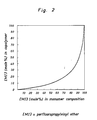
- the copolymerization composition curve was determined according to the Fineman-Ross method. The obtained results are shown in Fig. 1.
- copolymerization was carried out in the same manner as described in Example 1 except that 5.0 g of perfluoropropylvinyl ether was used instead of the hydrofluoroalkyltrifluorovinyl ether.
- TFE was introduced under a pressure of 3.0 kg/c M 2 G and the polymerization was carried out at 25. C for 110 minutes.
- the copolymer was obtained only in an amount of 1.5 g.
- the solvent was analyzed, it was found that substantially all of the perfluoropropylvinyl ether was left in Flon 113.
- the copolymer contained 2.9 mole% of the perfluoropropylvinyl ether units.
- the melting point was 308 to 332° C, and by the thermobalance analysis, it was confirmed that the copolymer decomposed at a temperature of about 430 ° C.
Landscapes
- Chemical & Material Sciences (AREA)
- Health & Medical Sciences (AREA)
- Chemical Kinetics & Catalysis (AREA)
- Medicinal Chemistry (AREA)
- Polymers & Plastics (AREA)
- Organic Chemistry (AREA)
- General Chemical & Material Sciences (AREA)
- Addition Polymer Or Copolymer, Post-Treatments, Or Chemical Modifications (AREA)
Applications Claiming Priority (2)
| Application Number | Priority Date | Filing Date | Title |
|---|---|---|---|
| JP9265788 | 1988-04-16 | ||
| JP92657/88 | 1988-04-16 |
Publications (3)
| Publication Number | Publication Date |
|---|---|
| EP0338755A2 true EP0338755A2 (de) | 1989-10-25 |
| EP0338755A3 EP0338755A3 (de) | 1991-04-03 |
| EP0338755B1 EP0338755B1 (de) | 1993-06-23 |
Family
ID=14060540
Family Applications (1)
| Application Number | Title | Priority Date | Filing Date |
|---|---|---|---|
| EP89303796A Expired - Lifetime EP0338755B1 (de) | 1988-04-16 | 1989-04-17 | Verfahren zur Herstellung von perfluorierten Copolymeren |
Country Status (3)
| Country | Link |
|---|---|
| US (1) | US4948844A (de) |
| EP (1) | EP0338755B1 (de) |
| DE (1) | DE68907258T2 (de) |
Cited By (11)
| Publication number | Priority date | Publication date | Assignee | Title |
|---|---|---|---|---|
| US5134211A (en) * | 1990-01-31 | 1992-07-28 | E. I. Du Pont De Nemours And Company | Hydroxy containing fluorovinyl compounds and polymers thereof |
| WO1994018246A1 (en) * | 1993-02-12 | 1994-08-18 | E.I. Du Pont De Nemours And Company | Fluorination of radiation crosslinked perfluoroelastomers |
| US5910552A (en) * | 1996-04-24 | 1999-06-08 | Nippon Mektron, Limited | Fluorine-containing copolymer elastomer process for producing the same and composition containing the same |
| EP0976706A1 (de) * | 1998-07-31 | 2000-02-02 | Ausimont S.p.A. | Hydro-fluoroalkylvinylether sowie deren Herstellungsverfahren |
| EP1256592A1 (de) * | 2001-05-07 | 2002-11-13 | Ausimont S.p.A. | Amorphe perfluorierte Polymere |
| US6489419B1 (en) * | 1995-12-21 | 2002-12-03 | 3M Innovative Properties Company | Non-free flowable molding powders of modified polytetrafluoroethylenes |
| US6963013B2 (en) | 2000-04-21 | 2005-11-08 | Solvay Solexis Sp.A. | Method of making fluorovinyl ethers and polymers obtainable therefrom |
| US7160967B2 (en) | 2000-04-21 | 2007-01-09 | Solvey Solexis S.P.A. | Fluorovinyl ethers and polymers obtainable therefrom |
| US7534845B2 (en) | 2000-04-21 | 2009-05-19 | Solvay Solexis S.P.A. | Fluorovinyl ethers and polymers obtainable therefrom |
| WO2018237297A1 (en) * | 2017-06-23 | 2018-12-27 | Dupont-Mitsui Fluorochemicals Co. Ltd | Melt processible fluororesin molded article |
| EP4299638A3 (de) * | 2017-06-23 | 2024-03-20 | Chemours-Mitsui Fluoroproducts Co., Ltd. | Schmelzverarbeitbarer fluorharzformkörper |
Families Citing this family (18)
| Publication number | Priority date | Publication date | Assignee | Title |
|---|---|---|---|---|
| IT1227066B (it) * | 1988-09-15 | 1991-03-14 | Ausimont Spa | Alchilenici. gomme poliuretaniche reticolabili, contenenti blocchi poliossiperfluoro |
| US5182342A (en) * | 1992-02-28 | 1993-01-26 | E. I. Du Pont De Nemours And Company | Hydrofluorocarbon solvents for fluoromonomer polymerization |
| US5830962A (en) * | 1995-02-15 | 1998-11-03 | E. I. Du Pont De Nemours And Company | Fluorinated ion-exchange polymers and intermediates therefor |
| US5536754A (en) * | 1995-02-15 | 1996-07-16 | E. I. Du Pont De Nemours And Company | Fluorinated ion-exchange polymers and intermediates therefor |
| US6462228B1 (en) | 1997-12-22 | 2002-10-08 | 3M Innovative Properties Company | Process for preparation of fluorinated sulfinates |
| JP4214378B2 (ja) * | 2001-03-30 | 2009-01-28 | 旭硝子株式会社 | 含フッ素重合体及びその誘導体の製造方法 |
| EP1572752B1 (de) * | 2002-12-20 | 2014-08-13 | ExxonMobil Chemical Patents Inc. | Polymerisationsverfahren |
| US7425601B2 (en) * | 2002-12-20 | 2008-09-16 | Exxonmobil Chemical Patents Inc. | Polymers with new sequence distributions |
| US7723447B2 (en) * | 2002-12-20 | 2010-05-25 | Exxonmobil Chemical Patents Inc. | Polymerization processes |
| CA2510847C (en) * | 2002-12-20 | 2010-07-13 | Exxonmobil Chemical Patents Inc. | Polymers with new sequence distributions |
| WO2006009951A1 (en) * | 2004-06-21 | 2006-01-26 | Exxonmobil Chemical Patents Inc. | Polymer recovery method |
| US7414100B2 (en) * | 2004-06-21 | 2008-08-19 | Exxonmobil Chemical Patents Inc. | Polymerization process |
| US7981984B2 (en) * | 2004-06-21 | 2011-07-19 | Exxonmobil Chemical Patents Inc. | Polymerization process |
| WO2006009945A1 (en) | 2004-06-21 | 2006-01-26 | Exxonmobil Chemical Patents Inc. | Impact copolymers |
| US7799882B2 (en) * | 2005-06-20 | 2010-09-21 | Exxonmobil Chemical Patents Inc. | Polymerization process |
| US20070088143A1 (en) * | 2005-10-19 | 2007-04-19 | Ming-Hong Hung | Alpha, alpha-dihydrofluorovinyl ethers, homopolymers and copolymers thereof |
| WO2010113864A1 (ja) * | 2009-03-31 | 2010-10-07 | ダイキン工業株式会社 | 安定化フルオロポリマーの製造方法 |
| US11905350B2 (en) | 2019-09-09 | 2024-02-20 | Compact Membrane Systems, Inc. | Gas permeable fluoropolymers and ionomers |
Family Cites Families (4)
| Publication number | Priority date | Publication date | Assignee | Title |
|---|---|---|---|---|
| US3159609A (en) * | 1956-10-26 | 1964-12-01 | Du Pont | Copolymers of perfluorovinyl ethers |
| US3528954A (en) * | 1967-10-30 | 1970-09-15 | Du Pont | Process for homopolymerization of tetrafluoroethylene and copolymerization of same with fluoro co-monomers in the solvent 1,1,2 - trichloro - 1,2,2 - trifluoroethane |
| US4743658A (en) * | 1985-10-21 | 1988-05-10 | E. I. Du Pont De Nemours And Company | Stable tetrafluoroethylene copolymers |
| US4714756A (en) * | 1985-10-23 | 1987-12-22 | E. I. Du Pont De Nemours And Company | Process for preparing melt processible tetrafluoroethylene copolymer granules |
-
1989
- 1989-04-14 US US07/338,209 patent/US4948844A/en not_active Expired - Lifetime
- 1989-04-17 EP EP89303796A patent/EP0338755B1/de not_active Expired - Lifetime
- 1989-04-17 DE DE89303796T patent/DE68907258T2/de not_active Expired - Fee Related
Cited By (15)
| Publication number | Priority date | Publication date | Assignee | Title |
|---|---|---|---|---|
| US5134211A (en) * | 1990-01-31 | 1992-07-28 | E. I. Du Pont De Nemours And Company | Hydroxy containing fluorovinyl compounds and polymers thereof |
| WO1994018246A1 (en) * | 1993-02-12 | 1994-08-18 | E.I. Du Pont De Nemours And Company | Fluorination of radiation crosslinked perfluoroelastomers |
| US6489419B1 (en) * | 1995-12-21 | 2002-12-03 | 3M Innovative Properties Company | Non-free flowable molding powders of modified polytetrafluoroethylenes |
| US5910552A (en) * | 1996-04-24 | 1999-06-08 | Nippon Mektron, Limited | Fluorine-containing copolymer elastomer process for producing the same and composition containing the same |
| EP0976706A1 (de) * | 1998-07-31 | 2000-02-02 | Ausimont S.p.A. | Hydro-fluoroalkylvinylether sowie deren Herstellungsverfahren |
| US7160967B2 (en) | 2000-04-21 | 2007-01-09 | Solvey Solexis S.P.A. | Fluorovinyl ethers and polymers obtainable therefrom |
| US6963013B2 (en) | 2000-04-21 | 2005-11-08 | Solvay Solexis Sp.A. | Method of making fluorovinyl ethers and polymers obtainable therefrom |
| EP1997795A1 (de) | 2000-04-21 | 2008-12-03 | Solvay Solexis S.p.A. | Fluorvinylether und daraus hergestellte Polymere |
| US7534845B2 (en) | 2000-04-21 | 2009-05-19 | Solvay Solexis S.P.A. | Fluorovinyl ethers and polymers obtainable therefrom |
| US6809166B2 (en) | 2001-05-07 | 2004-10-26 | Solvay Solexis S.P.A. | Amorphous perfluorinated copolymers |
| US6936668B2 (en) | 2001-05-07 | 2005-08-30 | Solvay Solexis S.P.A. | Amorphous perfluorinated copolymers |
| EP1256592A1 (de) * | 2001-05-07 | 2002-11-13 | Ausimont S.p.A. | Amorphe perfluorierte Polymere |
| WO2018237297A1 (en) * | 2017-06-23 | 2018-12-27 | Dupont-Mitsui Fluorochemicals Co. Ltd | Melt processible fluororesin molded article |
| EP4299638A3 (de) * | 2017-06-23 | 2024-03-20 | Chemours-Mitsui Fluoroproducts Co., Ltd. | Schmelzverarbeitbarer fluorharzformkörper |
| US11964417B2 (en) | 2017-06-23 | 2024-04-23 | Chemours-Mitsui Fluoroproducts Co., Ltd. | Melt processible fluororesin molded article |
Also Published As
| Publication number | Publication date |
|---|---|
| US4948844A (en) | 1990-08-14 |
| DE68907258T2 (de) | 1993-09-30 |
| DE68907258D1 (de) | 1993-07-29 |
| EP0338755A3 (de) | 1991-04-03 |
| EP0338755B1 (de) | 1993-06-23 |
Similar Documents
| Publication | Publication Date | Title |
|---|---|---|
| EP0338755B1 (de) | Verfahren zur Herstellung von perfluorierten Copolymeren | |
| US5939502A (en) | Nonaqueous polymerization of fluoromonomers | |
| US4743658A (en) | Stable tetrafluoroethylene copolymers | |
| JP3469577B2 (ja) | フルオロモノマーの重合用ヒドロフルオロカーボン溶媒 | |
| EP0690880B1 (de) | Fluorhaltige polymere, ihre herstellung und ihre verwendung | |
| RU2070558C1 (ru) | Способ получения пероксидированных перфторполиэфиров | |
| EP1141047B1 (de) | Fluoromonomerpolymerisation | |
| EP0662096B1 (de) | Jod enthaltende kettenübertragungsmittel für die polymerisation von fluormonomeren | |
| US5618894A (en) | Nonaqueous polymerization of fluoromonomers | |
| US2952669A (en) | Polymerization of perfluorocarbon polymers | |
| EP0813548B1 (de) | Nichtwässrige polymerisation von fluormonomeren | |
| US3366610A (en) | Perhalogenated epoxy olefin monomers and polymers | |
| EP0673951A1 (de) | Suspensions(co)polymerisationsverfahren zur Herstellung von wasserstofhältigen thermoplastischen Fluorpolymeren | |
| EP0957113B1 (de) | Nichtwässerige Polymerisation von Fluormonomeren | |
| JPH072815B2 (ja) | パーフルオロ化共重合体の製造方法 | |
| JPH06128335A (ja) | 含フッ素共重合体の製造方法 | |
| JP3040378B2 (ja) | 含フッ素ランダム共重合体の製造方法 | |
| JP2512610B2 (ja) | 含フッ素共重合体の製造方法 | |
| JPH072816B2 (ja) | 含フッ素ランダム共重合体及びその製造方法 | |
| JP2025518558A (ja) | ハロ(アルキルビニル)エーテルモノマーを製造する方法およびハロ(アルキルビニル)エーテルモノマーで製造されるフッ素化ポリマー | |
| JPH08253535A (ja) | 含フッ素ランダム共重合体 |
Legal Events
| Date | Code | Title | Description |
|---|---|---|---|
| PUAI | Public reference made under article 153(3) epc to a published international application that has entered the european phase |
Free format text: ORIGINAL CODE: 0009012 |
|
| AK | Designated contracting states |
Kind code of ref document: A2 Designated state(s): DE FR GB IT NL |
|
| PUAL | Search report despatched |
Free format text: ORIGINAL CODE: 0009013 |
|
| AK | Designated contracting states |
Kind code of ref document: A3 Designated state(s): DE FR GB IT NL |
|
| 17P | Request for examination filed |
Effective date: 19910430 |
|
| 17Q | First examination report despatched |
Effective date: 19920907 |
|
| GRAA | (expected) grant |
Free format text: ORIGINAL CODE: 0009210 |
|
| AK | Designated contracting states |
Kind code of ref document: B1 Designated state(s): DE FR GB IT NL |
|
| ITF | It: translation for a ep patent filed | ||
| ET | Fr: translation filed | ||
| REF | Corresponds to: |
Ref document number: 68907258 Country of ref document: DE Date of ref document: 19930729 |
|
| PLBE | No opposition filed within time limit |
Free format text: ORIGINAL CODE: 0009261 |
|
| STAA | Information on the status of an ep patent application or granted ep patent |
Free format text: STATUS: NO OPPOSITION FILED WITHIN TIME LIMIT |
|
| 26N | No opposition filed | ||
| PGFP | Annual fee paid to national office [announced via postgrant information from national office to epo] |
Ref country code: FR Payment date: 20000411 Year of fee payment: 12 |
|
| PGFP | Annual fee paid to national office [announced via postgrant information from national office to epo] |
Ref country code: GB Payment date: 20000412 Year of fee payment: 12 |
|
| PGFP | Annual fee paid to national office [announced via postgrant information from national office to epo] |
Ref country code: DE Payment date: 20000417 Year of fee payment: 12 |
|
| PGFP | Annual fee paid to national office [announced via postgrant information from national office to epo] |
Ref country code: NL Payment date: 20000428 Year of fee payment: 12 |
|
| PG25 | Lapsed in a contracting state [announced via postgrant information from national office to epo] |
Ref country code: GB Free format text: LAPSE BECAUSE OF NON-PAYMENT OF DUE FEES Effective date: 20010417 |
|
| PG25 | Lapsed in a contracting state [announced via postgrant information from national office to epo] |
Ref country code: FR Free format text: THE PATENT HAS BEEN ANNULLED BY A DECISION OF A NATIONAL AUTHORITY Effective date: 20010430 |
|
| PG25 | Lapsed in a contracting state [announced via postgrant information from national office to epo] |
Ref country code: NL Free format text: LAPSE BECAUSE OF NON-PAYMENT OF DUE FEES Effective date: 20011101 |
|
| GBPC | Gb: european patent ceased through non-payment of renewal fee |
Effective date: 20010417 |
|
| NLV4 | Nl: lapsed or anulled due to non-payment of the annual fee |
Effective date: 20011101 |
|
| PG25 | Lapsed in a contracting state [announced via postgrant information from national office to epo] |
Ref country code: DE Free format text: LAPSE BECAUSE OF NON-PAYMENT OF DUE FEES Effective date: 20020201 |
|
| REG | Reference to a national code |
Ref country code: FR Ref legal event code: ST |
|
| PG25 | Lapsed in a contracting state [announced via postgrant information from national office to epo] |
Ref country code: IT Free format text: LAPSE BECAUSE OF NON-PAYMENT OF DUE FEES;WARNING: LAPSES OF ITALIAN PATENTS WITH EFFECTIVE DATE BEFORE 2007 MAY HAVE OCCURRED AT ANY TIME BEFORE 2007. THE CORRECT EFFECTIVE DATE MAY BE DIFFERENT FROM THE ONE RECORDED. Effective date: 20050417 |