EP0339421A2 - Farbmittel - Google Patents
Farbmittel Download PDFInfo
- Publication number
- EP0339421A2 EP0339421A2 EP89106823A EP89106823A EP0339421A2 EP 0339421 A2 EP0339421 A2 EP 0339421A2 EP 89106823 A EP89106823 A EP 89106823A EP 89106823 A EP89106823 A EP 89106823A EP 0339421 A2 EP0339421 A2 EP 0339421A2
- Authority
- EP
- European Patent Office
- Prior art keywords
- cyclo
- obtainable
- diisocyanate
- aliphatic
- colorants
- Prior art date
- Legal status (The legal status is an assumption and is not a legal conclusion. Google has not performed a legal analysis and makes no representation as to the accuracy of the status listed.)
- Withdrawn
Links
- 0 CC1(C)C*(C)(C)CC(CC=C)C1 Chemical compound CC1(C)C*(C)(C)CC(CC=C)C1 0.000 description 5
Classifications
-
- C—CHEMISTRY; METALLURGY
- C09—DYES; PAINTS; POLISHES; NATURAL RESINS; ADHESIVES; COMPOSITIONS NOT OTHERWISE PROVIDED FOR; APPLICATIONS OF MATERIALS NOT OTHERWISE PROVIDED FOR
- C09B—ORGANIC DYES OR CLOSELY-RELATED COMPOUNDS FOR PRODUCING DYES, e.g. PIGMENTS; MORDANTS; LAKES
- C09B43/00—Preparation of azo dyes from other azo compounds
- C09B43/12—Preparation of azo dyes from other azo compounds by acylation of amino groups
- C09B43/136—Preparation of azo dyes from other azo compounds by acylation of amino groups with polyfunctional acylating agents
- C09B43/155—Preparation of azo dyes from other azo compounds by acylation of amino groups with polyfunctional acylating agents with di- or poly-isocyanates
-
- C—CHEMISTRY; METALLURGY
- C08—ORGANIC MACROMOLECULAR COMPOUNDS; THEIR PREPARATION OR CHEMICAL WORKING-UP; COMPOSITIONS BASED THEREON
- C08G—MACROMOLECULAR COMPOUNDS OBTAINED OTHERWISE THAN BY REACTIONS ONLY INVOLVING UNSATURATED CARBON-TO-CARBON BONDS
- C08G18/00—Polymeric products of isocyanates or isothiocyanates
- C08G18/06—Polymeric products of isocyanates or isothiocyanates with compounds having active hydrogen
- C08G18/28—Polymeric products of isocyanates or isothiocyanates with compounds having active hydrogen characterised by the compounds used containing active hydrogen
- C08G18/30—Low-molecular-weight compounds
- C08G18/32—Polyhydroxy compounds; Polyamines; Hydroxyamines
- C08G18/3225—Polyamines
- C08G18/3228—Polyamines acyclic
-
- C—CHEMISTRY; METALLURGY
- C08—ORGANIC MACROMOLECULAR COMPOUNDS; THEIR PREPARATION OR CHEMICAL WORKING-UP; COMPOSITIONS BASED THEREON
- C08G—MACROMOLECULAR COMPOUNDS OBTAINED OTHERWISE THAN BY REACTIONS ONLY INVOLVING UNSATURATED CARBON-TO-CARBON BONDS
- C08G18/00—Polymeric products of isocyanates or isothiocyanates
- C08G18/06—Polymeric products of isocyanates or isothiocyanates with compounds having active hydrogen
- C08G18/28—Polymeric products of isocyanates or isothiocyanates with compounds having active hydrogen characterised by the compounds used containing active hydrogen
- C08G18/30—Low-molecular-weight compounds
- C08G18/32—Polyhydroxy compounds; Polyamines; Hydroxyamines
- C08G18/3225—Polyamines
- C08G18/3234—Polyamines cycloaliphatic
-
- C—CHEMISTRY; METALLURGY
- C08—ORGANIC MACROMOLECULAR COMPOUNDS; THEIR PREPARATION OR CHEMICAL WORKING-UP; COMPOSITIONS BASED THEREON
- C08G—MACROMOLECULAR COMPOUNDS OBTAINED OTHERWISE THAN BY REACTIONS ONLY INVOLVING UNSATURATED CARBON-TO-CARBON BONDS
- C08G18/00—Polymeric products of isocyanates or isothiocyanates
- C08G18/06—Polymeric products of isocyanates or isothiocyanates with compounds having active hydrogen
- C08G18/70—Polymeric products of isocyanates or isothiocyanates with compounds having active hydrogen characterised by the isocyanates or isothiocyanates used
- C08G18/72—Polyisocyanates or polyisothiocyanates
- C08G18/80—Masked polyisocyanates
- C08G18/8003—Masked polyisocyanates masked with compounds having at least two groups containing active hydrogen
- C08G18/8054—Masked polyisocyanates masked with compounds having at least two groups containing active hydrogen with compounds of C08G18/38
-
- C—CHEMISTRY; METALLURGY
- C09—DYES; PAINTS; POLISHES; NATURAL RESINS; ADHESIVES; COMPOSITIONS NOT OTHERWISE PROVIDED FOR; APPLICATIONS OF MATERIALS NOT OTHERWISE PROVIDED FOR
- C09B—ORGANIC DYES OR CLOSELY-RELATED COMPOUNDS FOR PRODUCING DYES, e.g. PIGMENTS; MORDANTS; LAKES
- C09B69/00—Dyes not provided for by a single group of this subclass
- C09B69/10—Polymeric dyes; Reaction products of dyes with monomers or with macromolecular compounds
-
- Y—GENERAL TAGGING OF NEW TECHNOLOGICAL DEVELOPMENTS; GENERAL TAGGING OF CROSS-SECTIONAL TECHNOLOGIES SPANNING OVER SEVERAL SECTIONS OF THE IPC; TECHNICAL SUBJECTS COVERED BY FORMER USPC CROSS-REFERENCE ART COLLECTIONS [XRACs] AND DIGESTS
- Y10—TECHNICAL SUBJECTS COVERED BY FORMER USPC
- Y10S—TECHNICAL SUBJECTS COVERED BY FORMER USPC CROSS-REFERENCE ART COLLECTIONS [XRACs] AND DIGESTS
- Y10S534/00—Organic compounds -- part of the class 532-570 series
- Y10S534/01—Mixtures of azo compounds
Definitions
- the invention relates to colorants, processes for their preparation and their use, in particular for the migration-resistant coloring of polymers.
- Inorganic and organic pigments as well as so-called built-in dyes are used to color migration-resistant polymers. In addition to problems when incorporating these colorants into the polymeric material, their migration stability is unsatisfactory in many cases.
- the new colorants are obtainable in that a dye which is free of ionic groups and has ⁇ 2 NH2 groups, which is preferably arranged in this way are that they do not participate in the mesomerism of the chromophore, with such an amount of a (cyclo) aliphatic diisocyanate, optionally in the presence of an organic solvent, with addition that the reaction product still contains at least two free -NCO groups, and man then reacting this reaction product with a (cyclo) aliphatic diamine, optionally in the presence of an organic solvent, with addition.
- the amino group-containing dye can belong to a wide variety of dye classes, e.g. the triphenylmethane, oxazine, dioxazine, thiazine, nitro, coumarin, quinophthalone, benzodifuranone, perylene, naphthalimide, phthalocyanine, but especially the azo or anthraquinone series.
- dye classes e.g. the triphenylmethane, oxazine, dioxazine, thiazine, nitro, coumarin, quinophthalone, benzodifuranone, perylene, naphthalimide, phthalocyanine, but especially the azo or anthraquinone series.
- the following dyes are preferably used: 1.
- R and R1 are:
- Examples of X are: Individual examples of dyes of the formula I are: Rg) - Xe) - Rg) Rg) - Xd) - Rg) Rc) - Xc) - Rc) Rc) - Xe) - Rc) Rd) - Xa) - Rd) Ra) - Xa) - Ra) Rc) - Xa) - Rc) Rf) - Xe) - Rf) Rf) - Xa) - Rf) Ri) - Xf) - Ri) Rg) - Xa) - Rg) Rh) - Xa) - Rh) Rg) - Xc) - Rg) Rg) - Xh) - Rg) Re) - Xc) - Re) Rf) - Xb) - Rf) Ra) - Xb) - Ra) Rh
- ⁇ 2 NH2 groups containing monoazo dyes preferably the benzene-azo-benzene, benzene-azo-pyrazolone, benzene-azo-acetoacetic arylide or benzene-azo-naphthalene series, for example: 3.
- Anthraquinone dyes containing ⁇ 2 NH2 groups for example:
- dyes are e.g. also the dyes known from "Color Index” with the Constitution Nos. 11245, 11255, 11275, 11285, 11290, 11300, 11310, 11330, 11335, 11365, 21000, 21010, 21020, 21030, 62025, 62030, 63020, 64500, 73315, 73320, 73330.
- the dyes which can be used according to the invention are known from the literature or can be prepared analogously to dyes known from the literature.
- Preferred (cyclo) aliphatic diisocyanates are: Diisocyanates of the formula OCN-R7-NCO in the R7 denotes a (cyclo) aliphatic radical with 2 to 24 carbon atoms. Examples include: 3-isocyanatomethyl-3,5,5-trimethylcyclohexyl isocyanate, 1,2-ethylene diisocyanate, 1,2-propylene diisocyanate, 1,2-butylene diisocyanate, 1,3-butylene diisocyanate, tetramethylene diisocyanate, hexamethylene diisocyanate, octamethylene diisocyanate, 2,4,4-trimethylhexamethylene diisocyanate, nonamethylene diisocyanate, 2,2,4-trimethylhexamethylene diisocyanate, decamethylene diisocyanate, 1,12-dodecane diisocyanate, 2,11-dodecane diisocyanate, isocyanates of the formula in which R
- diisocyanates which can be used according to the invention are known from the literature or can be prepared analogously to processes known from the literature.
- Preferred (cyclo) aliphatic diamines are: Diamines of the formula H2N-R11-NH2 in which R11 denotes a (cyclo) aliphatic radical having 2 to 24 carbon atoms.
- diamines which can be used according to the invention are known from the literature or can be prepared analogously to processes known from the literature.
- Particularly suitable solvents for the addition reaction between the amino-containing dye and the diisocyanate or between the prepolymer containing NCO groups and the diamine are esters, e.g. Ethyl acetate and butyl acetate, and ketones, e.g. Acetone and especially methyl ethyl ketone.
- 1 val of the dye (based on reactive NH2 groups) is preferably reacted with ⁇ 2 val of the diisocyanate.
- the reaction of the prepolymer addition product with the (cyclo) aliphatic diamine can take place either with an excess of NCO groups or with an excess of NH2 groups. Is preferably carried out at an NCO-: NH2 equivalent ratio of 1.2: 1-1: 1.2, particularly preferably at about 1: 1.
- reaction product thus obtained contains unreacted NCO groups
- these can, if desired, be reacted, for example by reaction with monofunctional alcohols, such as methanol, ethanol or i-propanol
- monofunctional alcohols such as methanol, ethanol or i-propanol
- reaction product obtained in the reaction of the prepolymer addition product with the diamine contains NH2 groups
- these can be reacted if desired, for example by reaction with monofunctional isocyanates such as methyl isocyanate.
- prepolymeric addition products still have free NCO groups, these stand for corresponding reactions, e.g. for (poly) addition of diamines and / or (poly) glycols. If the prepolymeric addition products still have free NH2 groups, they also stand for corresponding reactions, e.g. for addition to compounds containing NCO groups or to epoxides for chain extension or for crosslinking reactions.
- the preparation of the reaction product containing NCO groups and its further reaction are preferably carried out in a solvent. It is also preferred to work at room temperature.
- colorant In some cases it is advisable to clean the colorant by means of a solvent treatment before it is used for coloring, in order to free it from unreacted or only partially reacted dyes and / or starting products.
- This treatment can take place, for example, by washing or extracting.
- Particularly suitable solvents are those mentioned above in the preparation of the colorant.
- cleaning can also be carried out with the medium which is the cause of the migration tendency in this case by (dissolving) unreacted color body parts. So it may be advisable to use colorants that are used to color soft made plastics (PVC) are intended to be cleaned before use by treatment with a plasticizer, eg dibutyl phthalate.
- the solvents used in the preparation of the dyes or in their purification, for example by washing or extraction, can be used again for the same purposes, so that they are used in a cycle, which is particularly preferred for ecological reasons.
- the optionally cleaned colorants can be used as such or in the form of preparations for coloring and pigmenting a wide variety of substrates, in particular organic macromolecular substances.
- the colorants according to the invention are suitable for a wide variety of pigment applications. So they can be used for the production of very real pigmented systems, such as mixtures with other substances, preparations, paints, printing inks, colored paper and colored macromolecular substances. Mixture with other substances can be understood to mean, for example, those with inorganic white pigments such as titanium dioxide (rutile) or with cement. Preparations are, for example, flush pastes with organic liquids or doughs and fine doughs with water, dispersants and, if appropriate, preservatives teln.
- paint stands for example for physically or oxidatively drying lacquers, stoving lacquers, reaction lacquers, two-component lacquers, emulsion paints for weatherproof coatings and glue paints.
- Printing inks are to be understood as those for paper, textile and tin printing.
- the macromolecular substances can be of natural origin, such as rubber, can be obtained by chemical modification, such as acetyl cellulose, cellulose butyrate or viscose, or can be produced synthetically, such as polymers, polyadducts and polycondensates.
- Plastic masses such as polyvinyl chloride, polyvinyl acetate, polyvinyl propionate, polyolefins, for example polyethylene or polyamides, superpolyamides, polymers and copolymers of acrylic esters, methacrylic esters, acrylonitrile, acrylamide, butadiene, styrene, and polyurethanes and polycarbonates may be mentioned.
- the substances pigmented with the claimed products can be in any form.
- the colorants according to the invention are preferably used for coloring paints, coatings and laminations based on PUR fabrics, for example made of textile, leather, foamed and compact plastics, wood, metal, in particular according to DE-OS 26 37 115 (US-PS 4 108 842) known processes of PUR reactive painting.
- the powder obtained is washed out with methyl ethyl ketone and suction filtered until the colorant is free of soluble, ie unreacted, starting dye.
- the colorants obtained have the hues given in the table below.
- the solutions obtained according to 2a) and 2b) are quickly combined at room temperature with vigorous stirring. Immediately after the addition has ended, the batch is poured onto a glass plate or into a metal dish. After the exothermic reaction is complete, the solidified and then air-dried mass is pulverized in a mortar. The powder obtained is washed out with methyl ethyl ketone and suction filtered until the colorant is free of soluble, ie unreacted, starting dye.
- the colorants obtained have the hues given in the table below.
- the coating of split leather by the reverse process can e.g. be carried out according to Example 1 of DE-OS 26 37 115.
Landscapes
- Chemical & Material Sciences (AREA)
- Organic Chemistry (AREA)
- Health & Medical Sciences (AREA)
- Chemical Kinetics & Catalysis (AREA)
- Medicinal Chemistry (AREA)
- Polymers & Plastics (AREA)
- Polyurethanes Or Polyureas (AREA)
- Paints Or Removers (AREA)
- Inks, Pencil-Leads, Or Crayons (AREA)
Abstract
Farbmittel, die dadurch erhältlich sind, daß man einen Farbstoff, der frei von ionischen Gruppen ist und ≧2 NH₂-Gruppen besitzt, die vorzugsweise so angeordnet sind, daß sie sich nicht an der Mesomerie des Chromophors beteiligen, mit einer solchen Menge eines (cyclo)aliphatischen Diisocyanats, gegebenenfalls in Gegenwart eines organischen Lösungsmittels, unter Addition umsetzt, daß das Reaktionsprodukt noch mindestens zwei freie -NCO-Gruppen enthält, und man anschließend dieses Reaktionsprodukt mit einem (cyclo)aliphatischem Diamin, gegebenenfalls in Gegenwart eines organischen Lösungsmittels, unter Addition umsetzt eignen sich zur Färbung und Pigmentierung makromolekularer Stoffe, insbesondere zur Farbgebung von Lackierungen, Beschichtungen und Kaschierungen auf PUR-Basis.
Description
- Die Erfindung betrifft Farbmittel, Verfahren zu ihrer Herstellung und ihre Verwendung, insbesondere zur migrationsechten Färbung von Polymeren.
- Zur migrationsechten Einfärbung von Polymeren finden anorganische und organische Pigmente sowie sogenannte Einbaufarbstoffe Verwendung. Neben Problemen bei der Einarbeitung dieser Farbmittel in das polymere Material ist ihre Migrationsstabilität in vielen Fällen unbefriedigend.
- Überraschenderweise wurde nun gefunden, daß sich die im folgenden beschriebenen neuen Farbmittel problemlos in Polymere einarbeiten lassen, migrationsechte Färbungen gewährleisten und je nach Anwendungsgebiet weitere Vorteile gegenüber bekannten Farbmitteln haben.
- Die neuen Farbmittel sind dadurch erhältlich, daß man einen Farbstoff, der frei von ionischen Gruppen ist und ≧2 NH₂-Gruppen besitzt, die vorzugsweise so angeordnet sind, daß sie sich nicht an der Mesomerie des Chromophors beteiligen, mit einer solchen Menge eines (cyclo)aliphatischen Diisocyanats, gegebenenfalls in Gegenwart eines organischen Lösungsmittels, unter Addition umsetzt, daß das Reaktionsprodukt noch mindestens zwei freie -NCO-Gruppen enthält, und man anschließend dieses Reaktionsprodukt mit einem (cyclo)aliphatischen Diamin, gegebenenfalls in Gegenwart eines organischen Lösungsmittels, unter Addition umsetzt.
- Der aminogruppenhaltige Farbstoff kann den verschiedensten Farbstoffklassen angehören, z.B. der Triphenylmethan-, Oxazin-, Dioxazin-, Thiazin-, Nitro-, Cumarin-, Chinophthalon-, Benzodifuranon-, Perylen-, Naphthalimid-, Phthalocyanin-, insbesondere aber der Azo- oder Anthrachinon-Reihe.
- Die folgenden Farbstoffe werden bevorzugt eingesetzt:
1. Polyazofarbstoffe der Formel
R-N=N-X-N=N-R₁ I
in der
R, R₁ einen substituierten Phenyl-, substituierten Naphthyl- oder substituierten 5-Hydroxypyrazol-4-yl-Rest und
X ein Brückenglied bezeichnen, wobei die Farbstoffe ≧2 NH₂-Gruppen enthalten.
Beispiele für R und R₁ sind:

Rg) - Xe) - Rg) Rg) - Xd) - Rg) Rc) - Xc) - Rc) Rc) - Xe) - Rc) Rd) - Xa) - Rd) Ra) - Xa) - Ra) Rc) - Xa) - Rc) Rf) - Xe) - Rf) Rf) - Xa) - Rf) Ri) - Xf) - Ri) Rg) - Xa) - Rg) Rh) - Xa) - Rh) Rg) - Xc) - Rg) Rg) - Xh) - Rg) Re) - Xc) - Re) Rf) - Xb) - Rf) Ra) - Xb) - Ra) Rh) - Xd) - Rh) Rh) - Xe) - Rh) Rg) - Xb) - Rg) Rg) - Xg) - Rb) Rk) - Xa) - Rk)
2. ≧2 NH₂-Gruppen enthaltende Monoazofarbstoffe, vorzugsweise der Benzol-azo-benzol-, Benzol-azo-pyrazolon-, Benzol-azo-acetessigarylid- oder Benzol-azo-naphthalin-Reihe, z.B.:


3. Anthrachinonfarbstoffe, die ≧2 NH₂-Gruppen enthalten, z.B.:
- Als Beispiel für einen Phthalocyaninfarbstoff sei

- Weitere besonders geeignete Farbstoffe sind z.B. auch die aus "Colour Index" bekannten Farbstoffe mit den Constitution Nos. 11245, 11255, 11275, 11285, 11290, 11300, 11310, 11330, 11335, 11365, 21000, 21010, 21020, 21030, 62025, 62030, 63020, 64500, 73315, 73320, 73330.
- Die erfindungsgemäß einsetzbaren Farbstoffe sind literaturbekannt oder in Analogie zu literaturbekannten Farbstoffen herstellbar.
- Als (cyclo)aliphatische Diisocyanate kommen vorzugsweise in Betracht:
Diisocyanate der Formel
OCN-R⁷-NCO
in der R⁷ einen (cyclo)aliphatischen Rest mit 2 bis 24 C-Atomen bezeichnet. Beispielhaft seien genannt: 3-Isocyanatomethyl-3,5,5-trimethylcyclohexylisocyanat, 1,2-Ethylendiisocyanat, 1,2-Propylendiisocyanat, 1,2-Butylendiisocyanat, 1,3-Butylendiisocyanat, Tetramethylendiisocyanat, Hexamethylendiisocyanat, Octamethylen diisocyanat, 2,4,4-Trimthylhexamethylendiisocyanat, Nonamethylendiisocyanat, 2,2,4-Trimethylhexamethylendiisocyanat, Decamethylendiisocyanat, 1,12-Dodecandiisocyanat, 2,11-Dodecandiisocyanat, Isocyanate der Formel
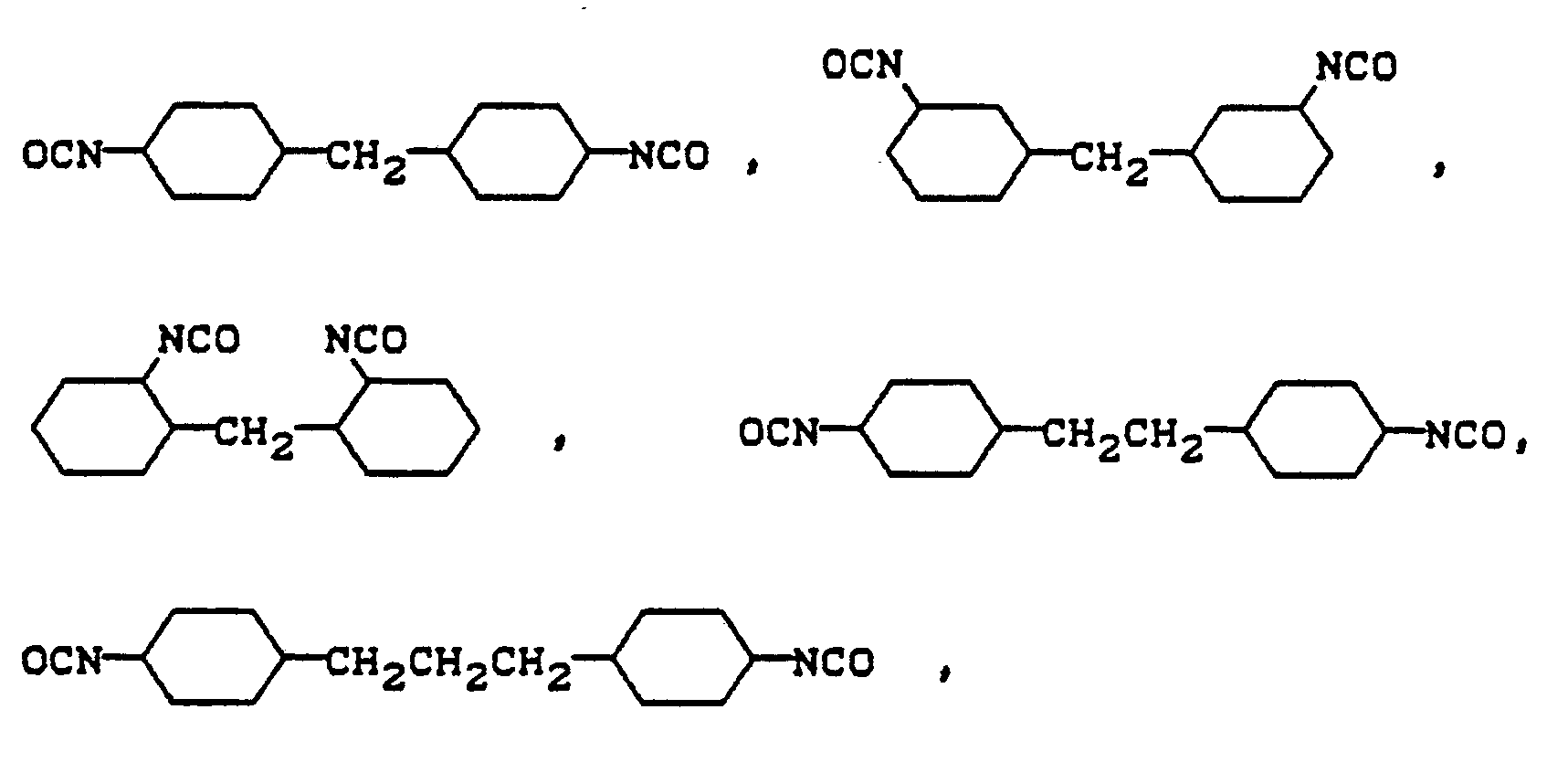

R⁹, R¹⁰ Wasserstoff, Methyl, Ethyl bezeichnen,
z.B. das Diisocyanat der Formel
- Die erfindungsgemäß einsetzbaren Diisocyanate sind literaturbekannt oder in Analogie zu literaturbekannten Verfahren herstellbar.
- Als (cyclo)aliphatische Diamine kommen vorzugsweise in Betracht:
Diamine der Formel
H₂N-R¹¹-NH₂
in der R¹¹ einen (cyclo)aliphatischen Rest mit 2 bis 24 C-Atomen bezeichnet. - Vorzugsweise werden solche Diamine eingesetzt, die man sich durch Ersatz der NCO-Gruppen der vorstehend aufgeführten Diisocyanate durch Aminogruppen abgeleitet denken kann.
- Besonders bevorzugt sind:
H₂N-(CH₂)₆-NH₂
- Die erfindungsgemäß einsetzbaren Diamine sind literaturbekannt oder können in Analogie zu literaturbekannten Verfahren hergestellt werden.
- Als Lösungsmittel für die Additionsreaktion zwischen dem aminogruppenhaltigen Farbstoff und dem Diisocyanat bzw. zwischen dem NCO-Gruppen enthaltenden Prepolymer und dem Diamin eignen sich insbesondere Ester, z.B. Ethylacetat und Butylacetat, und Ketone, z.B. Aceton und besonders Methylethylketon.
- Vorzugsweise wird zur Herstellung des NCO-Gruppen enthaltenden Reaktionsprodukts 1 Val des Farbstoffs (bezogen auf reaktionsfähige NH₂-Gruppen) mit ≧2 Val des Diisocyanats umgesetzt.
- Die Umsetzung des prepolymeren Additionsprodukts mit dem (cyclo)aliphatischen Diamin kann sowohl bei einem Überschuß an NCO-Gruppen wie auch mit einem Überschuß an NH₂-Gruppen erfolgen. Bevorzugt arbeitet man bei einem NCO-:NH₂-Äquivalentverhältnis von 1,2:1-1:1,2, besonders bevorzugt bei etwa 1:1. Für den Fall, daß das so erhaltene Reaktionsprodukt nicht umgesetzte NCO-Gruppen enthält, kann man diese gewünschtenfalls, z.B. durch Reaktion mit monofunktionellen Alkoholen, wie Methanol, Ethanol, i-Propanol abreagieren lassen; für den Fall, daß das bei der Umsetzung des prepolymeren Additionsprodukts mit dem Diamin erhaltene Reaktionsprodukt NH₂-Gruppen enthält, kann man diese gewünschtenfalls, z.B. durch Reaktion mit monofunktionellen Isocyanaten, wie Methylisocyanat, abreagieren lassen.
- Wenn die prepolymeren Additionsprodukte noch über freie NCO-Gruppen verfügen, so stehen diese für entsprechende Umsetzungen, z.B. zur (Poly)Addition von Diaminen und/oder (Poly)Glykolen zur Verfügung. Verfügen die prepolymeren Additionsprodukte noch über freie NH₂-Gruppen, so stehen diese ebenfalls für entsprechende Reaktionen, z.B. zur Addition an NCO-gruppenhaltige Verbindungen oder an Epoxide zur Kettenverlängerung oder für Vernetzungsreaktionen zur Verfügung.
- Die Herstellung des NCO-Gruppen enthaltenden Reaktionsproduktes sowie dessen weitere Umsetzung werden vorzugsweise in einem Lösungsmittel durchgeführt. Ebenso ist es bevorzugt, bei Raumtemperatur zu arbeiten. Das erhaltene Farbmittel wird, gegebenenfalls nach Entfernung des Lösungsmittels, z.B. durch Filtrieren oder Abdunsten, isoliert,
- In manchen Fällen empfiehlt es sich, das Farbmittel vor seiner Verwendung zur Farbgebung durch eine Lösungsmittelbehandlung zu reinigen, um es von nicht oder nur teilweise umgesetzten Farbstoffen und/oder Ausgangsprodukten zu befreien. Diese Behandlung kann z.B. durch Waschen oder Extrahieren erfolgen. Als Lösungsmittel eignen sich insbesondere die oben bei der Herstellung des Farbmittels erwähnten. In besonderen Fällen kann die Reinigung auch mit dem Medium erfolgen, das durch (An)Lösen nicht ausreagierter Farbkörperanteile Ursache der Migrationstendenz in diesem Falle ist. So kann es sich empfehlen, Farbmittel, die zur Einfärbung von weich gemachten Kunststoffen (PVC) vorgesehen sind, vor ihrem Einsatz durch Behandlung mit einem Kunststoffweichmacher, z.B. Dibutylphthalat, zu reinigen. Die bei der Herstellung der Farbstoffe oder bei ihrer Reinigung, z.B. durch Wäsche oder Extraktion, verwendeten Lösungsmittel können nach Rektifikation erneut für die gleichen Zwecke eingesetzt werden, so daß sie in einem, insbesondere aus ökologischen Gründen bevorzugten Kreisprozeß Verwendung finden. Die, gegebenenfalls gereinigten, Farbmittel können als solche oder in Form von Zubereitungen zur Färbung und Pigmentierung der verschiedenartigsten Substrate, insbesondere organische makromolekulare Stoffe, Verwendung finden.
- Die erfindungsgemäßen Farbmittel eignen sich aufgrund ihrer Licht- und Migrationsechtheit für die verschiedensten Pigmentapplikationen. So können sie zur Herstellung von sehr echt pigmentierten Systemen, wie Mischung mit anderen Stoffen, Zubereitungen, Anstrichmitteln, Druckfarben, gefärbtem Papier und gefärbten makromolekularen Stoffen verwendet werden. Unter Mischung mit anderen Stoffen können z.B. solche mit anorganischen Weißpigmenten wie Titandioxid (Rutil) oder mit Zement verstanden werden. Zubereitungen sind z.B. Flushpasten mit organischen Flüssigkeiten oder Teige und Feinteige mit Wasser, Dispergiermitteln und gegebenenfalls Konservierungsmit teln. Die Bezeichnung Anstrichmittel steht z.B. für physikalisch oder oxidativ trocknende Lacke, Einbrennlacke, Reaktionslacke, Zweikomponentenlacke, Dispersionsfarben für wetterfeste Überzüge und Leimfarben. Unter Druckfarben sind solche für den Papier-, Textil- und Blechdruck zu verstehen. Die makromolekularen Stoffe können natürlichen Ursprungs sein wie Kautschuk, durch chemische Modifikation erhalten werden wie Acetylcellulose, Cellulosebutyrat oder Viskose oder synthetisch erzeugt werden wie Polymerisate, Polyadditionsprodukte und Polykondensate. Genannt seien plastische Massen wie Polyvinylchlorid, Polyvinylacetat, Polyvinylpropionat, Polyolefine, z.B. Polyethylen oder Polyamide, Superpolyamide, Polymerisate und Mischpolymerisate aus Acrylester, Methacrylestern, Acrylnitril, Acrylamid, Butadien, Styrol sowie Polyurethane und Polycarbonate. Die mit den beanspruchten Produkten pigmentierten Stoffe können in beliebiger Form vorliegen.
- Die erfindungsgemäßen Farbmittel werden vorzugsweise zur Farbgebung von Lackierungen, Beschichtungen und Kaschierungen auf PUR-Basis von Flächengebilden, z.B. aus Textil, Leder, geschäumten und kompakten Kunststoffen, Holz, Metall, insbesondere nach dem aus der DE-OS 26 37 115 (US-PS 4 108 842) bekannten Verfahren der PUR-Reaktivlackierung verwendet.
- In diesem Beispielteil kommen die folgenden Farbstoffe vor, die aus schreibtechnischen Gründen in den Tabellen durch die angegebenen Großbuchstaben abgekürzt werden:


-
- a) 100 g 3-Isocyanatomethyl-3,5,5-trimethylcyclohexylisocyanat werden in 300 g Methylethylketon gelöst. Zu dieser Lösung gibt man 0,45 Val jeweils eines der unter 1.1.-1.11. aufgeführten Aminofarbstoffe und rührt den Ansatz 30 Min. bei Raumtemperatur.
- b) Parallel dazu bereitet man eine Lösung, die 0,425 Val des unter 1.1.-1.11. zu dem entsprechenden Farbstoff angegebenen Diamins in X g Methylethylketon enthält, wobei das Diamin in der Ketiminform vorliegt.

- Die nach 1a) und 1b) erhaltenen Lösungen werden bei Raumtemperatur unter intensivem Rühren schnell zusammengegeben. Sofort nach Beendigung der Zugabe wird der Ansatz auf eine Glasplatte oder in eine Blechschale gegossen. Nach dem Abschluß der exothermen Reaktion wird die erstarrte und anschließend luftgetrocknete Masse im Mörser pulverisiert.
- Das erhaltene Pulver wird mit Methylethylketon ausgewaschen und abgenutscht, bis das Farbmittel frei ist von löslichem, d.h. nicht umgesetztem Ausgangsfarbstoff. Die erhaltenen Farbmittel haben die in der folgenden Tabelle angegebenen Farbtöne.

-
- a) 100 g des Diisocyanats der Formel

- b) Parallel dazu bereitet man eine Lösung, die 0,28 Val des unter 2.1.-2.5. zu dem entsprechenden Farbstoff angegebenen Diamins in Methylethylketon enthält, wobei das Diamin in der Ketiminform vorliegt.
- Die nach 2a) und 2b) erhaltenen Lösungen werden bei Raumtemperatur unter intensivem Rühren schnell zusammengegeben. Sofort nach Beendigung der Zugabe wird der Ansatz auf eine Glasplatte oder in eine Blechschale gegossen. Nach Abschluß der exothermen Reaktion wird die erstarrte und anschließend luftgetrocknete Masse im Mörser pulverisiert. Das erhaltene Pulver wird mit Methylethylketon ausgewaschen und abgenutscht bis das Farbmittel frei ist von löslichem, d.h. nicht umgesetztem Ausgangsfarbstoff. Die erhaltenen Farbmittel haben die in der folgenden Tabelle angegebenen Farbtöne.

- In Analogie zu den Beispielen 1a) und 2a) wird Hexamethylendiisocyanat mit den unter 3.1.-3.3. angegebenen Farbstoffen zum NCO-Gruppen enthaltenden Prepolymeren umgesetzt. Diese werden in Analogie zu den Beispielen 1b) bzw. 2b) mit den in der folgenden Tabelle angegebenen Diaminen 3.1.-3.3. zu Farbmitteln umgesetzt, deren Farbton in der Tabelle angegeben ist.

- In Analogie zu den Beispielen 1a) und 2a) wird das Diisocyanat der Formel


-
a) 300 g 3-Isocyanatomethyl-3,5,5-trimethylcyclohexylisocyanat werden in 800 g Methylethylketon gelöst. Zu dieser Lösung gibt man 1,2 Val der unter 5.1.-5.9. angegebenen Farbstoffe und rührt den Ansatz 30 Min. bei Raumtemperatur. Anschließend gibt man 213 g des Diamins der Formel
Farbstoff Farbton 5.1 A rotbraun 5.2 B blauviolett 5.3 C blau 5.4 D rotbraun 5.5 E blauschwarz 5.6 F rotviolett 5.7 G gelb 5.8 H violett 5.9 I gelbbraun
b) Zur Herstellung einer Pigmentzubereitung werden 250 g der nach 5.1.-5.9. erhaltenen Farbmittel unter Zusatz von 400 g der 80 gew.-%igen Lösung in Essigester eines Prepolymers, das durch Umsetzung von 0,74 Mol 3-Isocyanatomethyl-3,5,5-trimethylcyclohexylisocyanat, 0,06 Mol des Trimerisationsproduktes aus 2 Mol 2,4-Toluylendiisocyanat und 1 Mol Hexamethylendiisocyanat und 0,36 Mol eines Hydroxyl-Polyesters aus Adipinsäure, Neopentylglykol und Hexandiol-1,6 mit einer Hydroxylzahl von 66 und einem MG von 1700 hergestellt worden ist, sowie 350 g Methoxypropylacetat in einer Perlmühle gemahlen.
c) Zwecks Herstellung einer pigmentierten reaktiven PUR-Beschichtung setzt man 100 g einer ca. 80 gew.-%igen toluolischen Lösung eines Prepolymer, das durch Umsetzung von 0,78 Mol eines Gemischs aus 2,4- und 2,6-Toluylendiisocyanat, 0,07 Mol des Trimerisationsprodukts aus 2 Mol 2,4-Toluylendiisocyanat und 1 Mol Hexamethylendiisocyanat und 0,37 Mol eines Hydroxyl-Polyesters aus Adipinsäure, Neopentylglykol und Hexandiol-1,6 mit einer Hydroxylzahl von 66 und einem MG von 1700 hergestellt worden ist, mit 4,4 g des mit Methylethylketon blockierten Amins der Formel
- Die Beschichtung von Spaltleder nach dem Umkehrverfahren kann z.B. gemäß Beispiel 1 der DE-OS 26 37 115 durchgeführt werden.
Claims (10)
1. Farbmittel, die dadurch erhältlich sind, daß man einen Farbstoff, der frei von ionischen Gruppen ist und ≧2 NH₂-Gruppen besitzt, die vorzugsweise so angeordnet sind, daß sie sich nicht an der Mesomerie des Chromophors beteiligen, mit einer solchen Menge eines (cyclo)aliphatischen Diisocyanats, gegebenenfalls in Gegenwart eines organischen Lösungsmittels, unter Addition umsetzt, daß das Reaktionsprodukt noch mindestens zwei freie NCO-Gruppen enthält, und man anschließend dieses Reaktionsprodukt mit einem (cyclo)aliphatischem Diamin, gegebenenfalls in Gegenwart eines organischen Lösungsmittels, unter Addition umsetzt.
2. Farbmittel gemäß Anspruch 1, dadurch gekennzeichnet, daß sie nach der Herstellung durch eine Lösungsmittelbehandlung von nicht oder nur teilweise umgesetzten Farbstoffen und/oder Ausgangsprodukten befreit worden sind.
3. Farbmittel gemäß den Ansprüchen 1 oder 2, die dadurch erhältlich sind, daß man einen Farbstoff der Azo- oder Anthrachinon-Reihe einsetzt.
4. Farbmittel gemäß einem oder mehreren der Ansprüche 1-3, dadurch erhältlich, daß man ein (cyclo)aliphatisches Diisocyanat der Formel
OCN-R⁷-NCO
in der R⁷ einen (cyclo)aliphatischen Rest mit 2-24 C-Atomen bezeichnet, einsetzt.
OCN-R⁷-NCO
in der R⁷ einen (cyclo)aliphatischen Rest mit 2-24 C-Atomen bezeichnet, einsetzt.
5. Farbmittel gemäß einem oder mehreren der Ansprüche 1-4, dadurch erhältlich, daß man ein (cyclo)aliphatisches Diisocyanat aus der Gruppe

einsetzt.
6. Farbmittel gemäß einem oder mehreren der Ansprüche 1-5, dadurch erhältlich, daß man ein (cyclo)aliphatisches Diamin der Formel
H₂N-R¹¹-NH₂
in der R¹¹ einen (cyclo)aliphatischen Rest mit 2-24 C-Atomen bezeichnet, einsetzt.
H₂N-R¹¹-NH₂
in der R¹¹ einen (cyclo)aliphatischen Rest mit 2-24 C-Atomen bezeichnet, einsetzt.
7. Farbmittel gemäß einem oder mehreren der Ansprüche 1-6, dadurch erhältlich, daß man ein (cyclo)aliphatisches Diamin aus der Gruppe

einsetzt.
8. Farbmittel gemäß einem oder mehreren der Ansprüche 1-7, dadurch erhältlich, daß man als Lösungsmittel für die Additionsreaktion zwischen dem Farbstoff und dem Diisocyanat und/oder für die Additionsreaktion zwischen dem NCO-Gruppen enthaltenden Prepolymer und dem Diamin einen Ester oder ein Keton, vorzugsweise Methylethylketon, einsetzt.
9. Verwendung der Farbmittel gemäß einem oder mehreren der Ansprüche 1-8 als solche oder in Form von Zubereitungen zur Färbung und Pigmentierung makromolekularer Stoffe.
10 Verwendung der Farbmittel gemäß einem oder mehreren der Ansprüche 1-8 als solche oder in Form von Zubereitungen zur Farbgebung von Lackierungen, Beschichtungen und Kaschierungen auf PUR-Basis.
Applications Claiming Priority (2)
| Application Number | Priority Date | Filing Date | Title |
|---|---|---|---|
| DE3814531A DE3814531A1 (de) | 1988-04-29 | 1988-04-29 | Farbmittel |
| DE3814531 | 1988-04-29 |
Publications (2)
| Publication Number | Publication Date |
|---|---|
| EP0339421A2 true EP0339421A2 (de) | 1989-11-02 |
| EP0339421A3 EP0339421A3 (de) | 1991-11-06 |
Family
ID=6353200
Family Applications (1)
| Application Number | Title | Priority Date | Filing Date |
|---|---|---|---|
| EP19890106823 Withdrawn EP0339421A3 (de) | 1988-04-29 | 1989-04-17 | Farbmittel |
Country Status (4)
| Country | Link |
|---|---|
| US (1) | US4978747A (de) |
| EP (1) | EP0339421A3 (de) |
| JP (1) | JPH01313570A (de) |
| DE (1) | DE3814531A1 (de) |
Cited By (3)
| Publication number | Priority date | Publication date | Assignee | Title |
|---|---|---|---|---|
| EP0455175A3 (en) * | 1990-05-02 | 1992-03-04 | Taenaka Mining Co. Ltd. | Modified melanin |
| WO1997013816A1 (en) * | 1995-10-06 | 1997-04-17 | Coates Brothers Plc | Hot melt ink jet vehicle |
| EP1184399A3 (de) * | 2000-08-29 | 2003-10-01 | Degussa AG | Neue Polyharnstoffe auf der Basis von IPDI, HDI, deren Isocyanurate und Aminen |
Family Cites Families (6)
| Publication number | Priority date | Publication date | Assignee | Title |
|---|---|---|---|---|
| US2022935A (en) * | 1931-03-19 | 1935-12-03 | Gen Aniline Works Inc | Asymmetrical ureas and their production |
| GB377278A (en) * | 1931-04-22 | 1932-07-22 | Arthur Carpmael | The manufacture of ureas |
| GB727996A (en) * | 1951-08-01 | 1955-04-13 | Bayer Ag | Pigment dyestuffs of the anthraquinone series |
| BE637190A (de) * | 1963-05-06 | |||
| US3660458A (en) * | 1969-01-21 | 1972-05-02 | Olin Mathieson | Process for preparing aromatic isocyanates from aromatic azo and/or aromatic azoxy compounds |
| FR2442257A1 (fr) * | 1978-11-21 | 1980-06-20 | Ugine Kuhlmann | Composes structurellement colores reticulables, leur preparation et leur utilisation dans des compositions pour revetements |
-
1988
- 1988-04-29 DE DE3814531A patent/DE3814531A1/de not_active Withdrawn
-
1989
- 1989-04-13 US US07/337,497 patent/US4978747A/en not_active Expired - Fee Related
- 1989-04-17 EP EP19890106823 patent/EP0339421A3/de not_active Withdrawn
- 1989-04-28 JP JP1107942A patent/JPH01313570A/ja active Pending
Cited By (3)
| Publication number | Priority date | Publication date | Assignee | Title |
|---|---|---|---|---|
| EP0455175A3 (en) * | 1990-05-02 | 1992-03-04 | Taenaka Mining Co. Ltd. | Modified melanin |
| WO1997013816A1 (en) * | 1995-10-06 | 1997-04-17 | Coates Brothers Plc | Hot melt ink jet vehicle |
| EP1184399A3 (de) * | 2000-08-29 | 2003-10-01 | Degussa AG | Neue Polyharnstoffe auf der Basis von IPDI, HDI, deren Isocyanurate und Aminen |
Also Published As
| Publication number | Publication date |
|---|---|
| EP0339421A3 (de) | 1991-11-06 |
| JPH01313570A (ja) | 1989-12-19 |
| DE3814531A1 (de) | 1989-11-09 |
| US4978747A (en) | 1990-12-18 |
Similar Documents
| Publication | Publication Date | Title |
|---|---|---|
| WO2008055566A2 (de) | Universelle stir-in pigmente | |
| DE2041033A1 (de) | Stoffmischung | |
| DE2259435B2 (de) | ||
| DE2426172A1 (de) | Verfahren zum faerben von polyurethankunststoffen | |
| DE1114317B (de) | Verfahren zur Herstellung gefaerbter, gegebenenfalls verschaeumter Polyurethankunststoffe | |
| DE3586731T2 (de) | Harzfarbstoffe und harzfaerbung. | |
| DE2425810A1 (de) | Poly(urethan)harnstoff-farbpulver | |
| DE2820419A1 (de) | Feucht aushaertender polyurethan- decklack mit verbesserter glanzbestaendigkeit | |
| DE3814531A1 (de) | Farbmittel | |
| DE2144718A1 (de) | Dispergiermittel | |
| EP0395955B1 (de) | Pigmentpräparationen | |
| EP0224687B1 (de) | Metallkomplexpigmente | |
| DE4112326A1 (de) | Oligourethan(harnstoffe) als pigmentbindemittel in organischem medium | |
| EP0612747B1 (de) | Nitroxylgruppen enthaltende Diketopyrrolopyrrole | |
| DE2340443A1 (de) | Verfahren zur herstellung von gefaerbtem polyurethan | |
| DE4236709A1 (de) | Pigment- und Rußpräparationen (Farbmittelpräparationen zum Färben von Kunststoffen) | |
| DE2426171C3 (de) | Verfahren zum Färben von Polyurethankunststoffen | |
| DE2518892A1 (de) | Iminoisoindolinonpigmente und verfahren zu deren herstellung | |
| DE602004005017T2 (de) | Zusammensetzung aus isocyanaten, ihre verwendung zur herstellung von klebstoffen, und die damit hergestellten aromatischen klebefugen | |
| EP1023486A1 (de) | Bioabbaubare bindemittel für die färberei | |
| DE2933777B2 (de) | Verfahren zur Verhinderung der Farbwanderung in Formteilen aus Polyoxymethylenharzen | |
| DE2116036C3 (de) | Verfahren zum Färben von Polyurethanen und Polyharnstoff-Polyurethanen | |
| DE1794263B2 (de) | Verfahren zur zurichtung von leder oder synthetischen lederaustauschmaterialien | |
| AT372687B (de) | Verfahren zum faerben von waermehaertbaren harzen | |
| EP1616925A1 (de) | Wässriges Mehrkomponentensystem, Verfahren zu seiner Herstellung und seine Verwendung |
Legal Events
| Date | Code | Title | Description |
|---|---|---|---|
| PUAI | Public reference made under article 153(3) epc to a published international application that has entered the european phase |
Free format text: ORIGINAL CODE: 0009012 |
|
| 17P | Request for examination filed |
Effective date: 19890417 |
|
| AK | Designated contracting states |
Kind code of ref document: A2 Designated state(s): CH DE FR GB IT LI |
|
| PUAL | Search report despatched |
Free format text: ORIGINAL CODE: 0009013 |
|
| AK | Designated contracting states |
Kind code of ref document: A3 Designated state(s): CH DE FR GB IT LI |
|
| STAA | Information on the status of an ep patent application or granted ep patent |
Free format text: STATUS: THE APPLICATION HAS BEEN WITHDRAWN |
|
| 18W | Application withdrawn |
Withdrawal date: 19920123 |