EP0339452A2 - Polymere Titanphosphate, Verfahren zu ihrer Herstellung und ihre Verwendung zur Aktivierung von Metalloberflächen vor einer Zinkphosphatierung - Google Patents
Polymere Titanphosphate, Verfahren zu ihrer Herstellung und ihre Verwendung zur Aktivierung von Metalloberflächen vor einer Zinkphosphatierung Download PDFInfo
- Publication number
- EP0339452A2 EP0339452A2 EP89106997A EP89106997A EP0339452A2 EP 0339452 A2 EP0339452 A2 EP 0339452A2 EP 89106997 A EP89106997 A EP 89106997A EP 89106997 A EP89106997 A EP 89106997A EP 0339452 A2 EP0339452 A2 EP 0339452A2
- Authority
- EP
- European Patent Office
- Prior art keywords
- titanium
- reaction
- alkali metal
- range
- phosphates
- Prior art date
- Legal status (The legal status is an assumption and is not a legal conclusion. Google has not performed a legal analysis and makes no representation as to the accuracy of the status listed.)
- Granted
Links
- JUWGUJSXVOBPHP-UHFFFAOYSA-B titanium(4+);tetraphosphate Chemical class [Ti+4].[Ti+4].[Ti+4].[O-]P([O-])([O-])=O.[O-]P([O-])([O-])=O.[O-]P([O-])([O-])=O.[O-]P([O-])([O-])=O JUWGUJSXVOBPHP-UHFFFAOYSA-B 0.000 title claims abstract description 26
- 238000000034 method Methods 0.000 title claims description 46
- 230000008569 process Effects 0.000 title claims description 31
- 229910052725 zinc Inorganic materials 0.000 title claims description 30
- 239000011701 zinc Substances 0.000 title claims description 30
- HCHKCACWOHOZIP-UHFFFAOYSA-N Zinc Chemical compound [Zn] HCHKCACWOHOZIP-UHFFFAOYSA-N 0.000 title claims description 29
- 229910052751 metal Inorganic materials 0.000 title claims description 17
- 239000002184 metal Substances 0.000 title claims description 17
- 230000004913 activation Effects 0.000 title description 14
- 229920000642 polymer Polymers 0.000 title description 3
- 239000002253 acid Substances 0.000 claims abstract description 35
- 238000006243 chemical reaction Methods 0.000 claims abstract description 35
- 239000008139 complexing agent Substances 0.000 claims abstract description 31
- 150000007513 acids Chemical class 0.000 claims abstract description 25
- LCKIEQZJEYYRIY-UHFFFAOYSA-N Titanium ion Chemical class [Ti+4] LCKIEQZJEYYRIY-UHFFFAOYSA-N 0.000 claims abstract description 16
- 229910000318 alkali metal phosphate Inorganic materials 0.000 claims abstract description 15
- -1 titanium (IV) compound Chemical class 0.000 claims abstract description 15
- XLYOFNOQVPJJNP-UHFFFAOYSA-N water Substances O XLYOFNOQVPJJNP-UHFFFAOYSA-N 0.000 claims abstract description 12
- 239000002245 particle Substances 0.000 claims abstract description 10
- 239000011541 reaction mixture Substances 0.000 claims abstract description 8
- 229910052783 alkali metal Inorganic materials 0.000 claims abstract description 6
- 230000003213 activating effect Effects 0.000 claims description 38
- 239000003795 chemical substances by application Substances 0.000 claims description 26
- XEEYBQQBJWHFJM-UHFFFAOYSA-N Iron Chemical compound [Fe] XEEYBQQBJWHFJM-UHFFFAOYSA-N 0.000 claims description 20
- 239000010936 titanium Substances 0.000 claims description 16
- RTAQQCXQSZGOHL-UHFFFAOYSA-N Titanium Chemical compound [Ti] RTAQQCXQSZGOHL-UHFFFAOYSA-N 0.000 claims description 13
- 229910052719 titanium Inorganic materials 0.000 claims description 13
- 239000007787 solid Substances 0.000 claims description 11
- HGINCPLSRVDWNT-UHFFFAOYSA-N Acrolein Chemical compound C=CC=O HGINCPLSRVDWNT-UHFFFAOYSA-N 0.000 claims description 10
- 229910052742 iron Inorganic materials 0.000 claims description 10
- 125000003178 carboxy group Chemical group [H]OC(*)=O 0.000 claims description 9
- 238000002360 preparation method Methods 0.000 claims description 9
- 229910000831 Steel Inorganic materials 0.000 claims description 8
- BNIILDVGGAEEIG-UHFFFAOYSA-L disodium hydrogen phosphate Chemical compound [Na+].[Na+].OP([O-])([O-])=O BNIILDVGGAEEIG-UHFFFAOYSA-L 0.000 claims description 8
- 239000010959 steel Substances 0.000 claims description 8
- PTFCDOFLOPIGGS-UHFFFAOYSA-N Zinc dication Chemical compound [Zn+2] PTFCDOFLOPIGGS-UHFFFAOYSA-N 0.000 claims description 5
- 229910052782 aluminium Inorganic materials 0.000 claims description 5
- XAGFODPZIPBFFR-UHFFFAOYSA-N aluminium Chemical compound [Al] XAGFODPZIPBFFR-UHFFFAOYSA-N 0.000 claims description 5
- 239000006185 dispersion Substances 0.000 claims description 5
- 229910000680 Aluminized steel Inorganic materials 0.000 claims description 4
- 229910001335 Galvanized steel Inorganic materials 0.000 claims description 4
- 125000004432 carbon atom Chemical group C* 0.000 claims description 4
- RXCBCUJUGULOGC-UHFFFAOYSA-H dipotassium;tetrafluorotitanium;difluoride Chemical compound [F-].[F-].[F-].[F-].[F-].[F-].[K+].[K+].[Ti+4] RXCBCUJUGULOGC-UHFFFAOYSA-H 0.000 claims description 4
- 238000001035 drying Methods 0.000 claims description 4
- 239000008397 galvanized steel Substances 0.000 claims description 4
- 229910052736 halogen Inorganic materials 0.000 claims description 4
- 150000002367 halogens Chemical class 0.000 claims description 4
- 229910052739 hydrogen Inorganic materials 0.000 claims description 4
- 239000001257 hydrogen Substances 0.000 claims description 4
- 159000000000 sodium salts Chemical class 0.000 claims description 4
- 238000001694 spray drying Methods 0.000 claims description 4
- SMZOUWXMTYCWNB-UHFFFAOYSA-N 2-(2-methoxy-5-methylphenyl)ethanamine Chemical compound COC1=CC=C(C)C=C1CCN SMZOUWXMTYCWNB-UHFFFAOYSA-N 0.000 claims description 3
- NIXOWILDQLNWCW-UHFFFAOYSA-N 2-Propenoic acid Natural products OC(=O)C=C NIXOWILDQLNWCW-UHFFFAOYSA-N 0.000 claims description 3
- OAICVXFJPJFONN-UHFFFAOYSA-N Phosphorus Chemical compound [P] OAICVXFJPJFONN-UHFFFAOYSA-N 0.000 claims description 3
- 125000002887 hydroxy group Chemical group [H]O* 0.000 claims description 3
- 229910052698 phosphorus Inorganic materials 0.000 claims description 3
- 239000011574 phosphorus Substances 0.000 claims description 3
- 125000004178 (C1-C4) alkyl group Chemical group 0.000 claims description 2
- UFHFLCQGNIYNRP-UHFFFAOYSA-N Hydrogen Chemical compound [H][H] UFHFLCQGNIYNRP-UHFFFAOYSA-N 0.000 claims description 2
- CIUQDSCDWFSTQR-UHFFFAOYSA-N [C]1=CC=CC=C1 Chemical class [C]1=CC=CC=C1 CIUQDSCDWFSTQR-UHFFFAOYSA-N 0.000 claims description 2
- 229910001413 alkali metal ion Inorganic materials 0.000 claims description 2
- 125000004122 cyclic group Chemical group 0.000 claims description 2
- 150000002431 hydrogen Chemical group 0.000 claims description 2
- 125000002924 primary amino group Chemical group [H]N([H])* 0.000 claims description 2
- 229920006395 saturated elastomer Polymers 0.000 claims description 2
- SCZMHJCEJAGXRV-UHFFFAOYSA-K titanium(4+);phosphate Chemical compound [Ti+4].[O-]P([O-])([O-])=O SCZMHJCEJAGXRV-UHFFFAOYSA-K 0.000 claims description 2
- 150000001875 compounds Chemical class 0.000 claims 1
- 150000004680 hydrogen peroxides Chemical class 0.000 claims 1
- 239000000047 product Substances 0.000 description 26
- DBVJJBKOTRCVKF-UHFFFAOYSA-N Etidronic acid Chemical compound OP(=O)(O)C(O)(C)P(O)(O)=O DBVJJBKOTRCVKF-UHFFFAOYSA-N 0.000 description 13
- 230000000052 comparative effect Effects 0.000 description 11
- 229910019142 PO4 Inorganic materials 0.000 description 9
- HEMHJVSKTPXQMS-UHFFFAOYSA-M Sodium hydroxide Chemical compound [OH-].[Na+] HEMHJVSKTPXQMS-UHFFFAOYSA-M 0.000 description 9
- 235000021317 phosphate Nutrition 0.000 description 8
- 239000007921 spray Substances 0.000 description 8
- MHAJPDPJQMAIIY-UHFFFAOYSA-N Hydrogen peroxide Chemical compound OO MHAJPDPJQMAIIY-UHFFFAOYSA-N 0.000 description 7
- 238000004519 manufacturing process Methods 0.000 description 7
- NBIIXXVUZAFLBC-UHFFFAOYSA-K phosphate Chemical compound [O-]P([O-])([O-])=O NBIIXXVUZAFLBC-UHFFFAOYSA-K 0.000 description 7
- 239000010452 phosphate Substances 0.000 description 6
- 239000000243 solution Substances 0.000 description 6
- 239000000725 suspension Substances 0.000 description 6
- 230000007797 corrosion Effects 0.000 description 5
- 238000005260 corrosion Methods 0.000 description 5
- 229910000397 disodium phosphate Inorganic materials 0.000 description 5
- 235000019800 disodium phosphate Nutrition 0.000 description 5
- LRXTYHSAJDENHV-UHFFFAOYSA-H zinc phosphate Chemical compound [Zn+2].[Zn+2].[Zn+2].[O-]P([O-])([O-])=O.[O-]P([O-])([O-])=O LRXTYHSAJDENHV-UHFFFAOYSA-H 0.000 description 5
- 229910000165 zinc phosphate Inorganic materials 0.000 description 5
- NBIIXXVUZAFLBC-UHFFFAOYSA-N Phosphoric acid Chemical compound OP(O)(O)=O NBIIXXVUZAFLBC-UHFFFAOYSA-N 0.000 description 4
- GWEVSGVZZGPLCZ-UHFFFAOYSA-N Titan oxide Chemical compound O=[Ti]=O GWEVSGVZZGPLCZ-UHFFFAOYSA-N 0.000 description 4
- 230000000694 effects Effects 0.000 description 4
- 238000005406 washing Methods 0.000 description 4
- QTBSBXVTEAMEQO-UHFFFAOYSA-N Acetic acid Chemical compound CC(O)=O QTBSBXVTEAMEQO-UHFFFAOYSA-N 0.000 description 3
- OKTJSMMVPCPJKN-UHFFFAOYSA-N Carbon Chemical compound [C] OKTJSMMVPCPJKN-UHFFFAOYSA-N 0.000 description 3
- DGAQECJNVWCQMB-PUAWFVPOSA-M Ilexoside XXIX Chemical compound C[C@@H]1CC[C@@]2(CC[C@@]3(C(=CC[C@H]4[C@]3(CC[C@@H]5[C@@]4(CC[C@@H](C5(C)C)OS(=O)(=O)[O-])C)C)[C@@H]2[C@]1(C)O)C)C(=O)O[C@H]6[C@@H]([C@H]([C@@H]([C@H](O6)CO)O)O)O.[Na+] DGAQECJNVWCQMB-PUAWFVPOSA-M 0.000 description 3
- 229910020491 K2TiF6 Inorganic materials 0.000 description 3
- 239000007864 aqueous solution Substances 0.000 description 3
- 238000004140 cleaning Methods 0.000 description 3
- 238000007654 immersion Methods 0.000 description 3
- 239000000463 material Substances 0.000 description 3
- 239000012528 membrane Substances 0.000 description 3
- 238000006116 polymerization reaction Methods 0.000 description 3
- 239000011148 porous material Substances 0.000 description 3
- 229910052708 sodium Inorganic materials 0.000 description 3
- 239000011734 sodium Substances 0.000 description 3
- 239000008399 tap water Substances 0.000 description 3
- 235000020679 tap water Nutrition 0.000 description 3
- ALRHLSYJTWAHJZ-UHFFFAOYSA-N 3-hydroxypropionic acid Chemical compound OCCC(O)=O ALRHLSYJTWAHJZ-UHFFFAOYSA-N 0.000 description 2
- XTEGARKTQYYJKE-UHFFFAOYSA-M Chlorate Chemical compound [O-]Cl(=O)=O XTEGARKTQYYJKE-UHFFFAOYSA-M 0.000 description 2
- PXHVJJICTQNCMI-UHFFFAOYSA-N Nickel Chemical compound [Ni] PXHVJJICTQNCMI-UHFFFAOYSA-N 0.000 description 2
- ABLZXFCXXLZCGV-UHFFFAOYSA-N Phosphorous acid Chemical compound OP(O)=O ABLZXFCXXLZCGV-UHFFFAOYSA-N 0.000 description 2
- CDBYLPFSWZWCQE-UHFFFAOYSA-L Sodium Carbonate Chemical compound [Na+].[Na+].[O-]C([O-])=O CDBYLPFSWZWCQE-UHFFFAOYSA-L 0.000 description 2
- QAOWNCQODCNURD-UHFFFAOYSA-N Sulfuric acid Chemical compound OS(O)(=O)=O QAOWNCQODCNURD-UHFFFAOYSA-N 0.000 description 2
- 239000000654 additive Substances 0.000 description 2
- 229910000147 aluminium phosphate Inorganic materials 0.000 description 2
- 239000002585 base Substances 0.000 description 2
- 230000008901 benefit Effects 0.000 description 2
- 125000002915 carbonyl group Chemical group [*:2]C([*:1])=O 0.000 description 2
- 230000008859 change Effects 0.000 description 2
- 239000007795 chemical reaction product Substances 0.000 description 2
- 238000010276 construction Methods 0.000 description 2
- 239000013078 crystal Substances 0.000 description 2
- 239000001177 diphosphate Substances 0.000 description 2
- 238000004070 electrodeposition Methods 0.000 description 2
- 239000012535 impurity Substances 0.000 description 2
- 229910001463 metal phosphate Inorganic materials 0.000 description 2
- BDAGIHXWWSANSR-UHFFFAOYSA-N methanoic acid Natural products OC=O BDAGIHXWWSANSR-UHFFFAOYSA-N 0.000 description 2
- 239000000203 mixture Substances 0.000 description 2
- 150000003009 phosphonic acids Chemical class 0.000 description 2
- 150000003013 phosphoric acid derivatives Chemical class 0.000 description 2
- 239000000376 reactant Substances 0.000 description 2
- JHJLBTNAGRQEKS-UHFFFAOYSA-M sodium bromide Chemical compound [Na+].[Br-] JHJLBTNAGRQEKS-UHFFFAOYSA-M 0.000 description 2
- 239000007858 starting material Substances 0.000 description 2
- 239000004408 titanium dioxide Substances 0.000 description 2
- OSWFIVFLDKOXQC-UHFFFAOYSA-N 4-(3-methoxyphenyl)aniline Chemical compound COC1=CC=CC(C=2C=CC(N)=CC=2)=C1 OSWFIVFLDKOXQC-UHFFFAOYSA-N 0.000 description 1
- BTBUEUYNUDRHOZ-UHFFFAOYSA-N Borate Chemical compound [O-]B([O-])[O-] BTBUEUYNUDRHOZ-UHFFFAOYSA-N 0.000 description 1
- OYPRJOBELJOOCE-UHFFFAOYSA-N Calcium Chemical compound [Ca] OYPRJOBELJOOCE-UHFFFAOYSA-N 0.000 description 1
- IOVCWXUNBOPUCH-UHFFFAOYSA-M Nitrite anion Chemical compound [O-]N=O IOVCWXUNBOPUCH-UHFFFAOYSA-M 0.000 description 1
- 229910001297 Zn alloy Inorganic materials 0.000 description 1
- NIWQQYJSLXQOCI-UHFFFAOYSA-L [O--].[K+].[Ti+4].[O-]C(=O)C([O-])=O Chemical compound [O--].[K+].[Ti+4].[O-]C(=O)C([O-])=O NIWQQYJSLXQOCI-UHFFFAOYSA-L 0.000 description 1
- 239000012190 activator Substances 0.000 description 1
- 239000013543 active substance Substances 0.000 description 1
- 230000000996 additive effect Effects 0.000 description 1
- 239000000853 adhesive Substances 0.000 description 1
- 230000001070 adhesive effect Effects 0.000 description 1
- 125000003172 aldehyde group Chemical group 0.000 description 1
- 150000001299 aldehydes Chemical class 0.000 description 1
- 150000001340 alkali metals Chemical class 0.000 description 1
- 229910052784 alkaline earth metal Inorganic materials 0.000 description 1
- 238000005275 alloying Methods 0.000 description 1
- 238000004873 anchoring Methods 0.000 description 1
- 239000007900 aqueous suspension Substances 0.000 description 1
- FFBHFFJDDLITSX-UHFFFAOYSA-N benzyl N-[2-hydroxy-4-(3-oxomorpholin-4-yl)phenyl]carbamate Chemical compound OC1=C(NC(=O)OCC2=CC=CC=C2)C=CC(=C1)N1CCOCC1=O FFBHFFJDDLITSX-UHFFFAOYSA-N 0.000 description 1
- 230000033228 biological regulation Effects 0.000 description 1
- 238000009835 boiling Methods 0.000 description 1
- 239000006227 byproduct Substances 0.000 description 1
- 229910052791 calcium Inorganic materials 0.000 description 1
- 239000011575 calcium Substances 0.000 description 1
- 239000011203 carbon fibre reinforced carbon Substances 0.000 description 1
- 150000001768 cations Chemical class 0.000 description 1
- 239000012459 cleaning agent Substances 0.000 description 1
- 229910017052 cobalt Inorganic materials 0.000 description 1
- 239000010941 cobalt Substances 0.000 description 1
- GUTLYIVDDKVIGB-UHFFFAOYSA-N cobalt atom Chemical compound [Co] GUTLYIVDDKVIGB-UHFFFAOYSA-N 0.000 description 1
- 238000002425 crystallisation Methods 0.000 description 1
- 230000008025 crystallization Effects 0.000 description 1
- 230000007547 defect Effects 0.000 description 1
- 238000005238 degreasing Methods 0.000 description 1
- 239000008367 deionised water Substances 0.000 description 1
- 229910021641 deionized water Inorganic materials 0.000 description 1
- 238000010612 desalination reaction Methods 0.000 description 1
- 239000003599 detergent Substances 0.000 description 1
- 238000007598 dipping method Methods 0.000 description 1
- 239000002270 dispersing agent Substances 0.000 description 1
- 238000009826 distribution Methods 0.000 description 1
- 238000005516 engineering process Methods 0.000 description 1
- 230000002349 favourable effect Effects 0.000 description 1
- 239000000706 filtrate Substances 0.000 description 1
- 238000001914 filtration Methods 0.000 description 1
- 235000019253 formic acid Nutrition 0.000 description 1
- 238000001027 hydrothermal synthesis Methods 0.000 description 1
- 230000006872 improvement Effects 0.000 description 1
- 239000003112 inhibitor Substances 0.000 description 1
- 230000002401 inhibitory effect Effects 0.000 description 1
- 230000005764 inhibitory process Effects 0.000 description 1
- 239000003999 initiator Substances 0.000 description 1
- 238000005342 ion exchange Methods 0.000 description 1
- JEIPFZHSYJVQDO-UHFFFAOYSA-N iron(III) oxide Inorganic materials O=[Fe]O[Fe]=O JEIPFZHSYJVQDO-UHFFFAOYSA-N 0.000 description 1
- 238000004898 kneading Methods 0.000 description 1
- 239000004922 lacquer Substances 0.000 description 1
- 238000002156 mixing Methods 0.000 description 1
- 239000000178 monomer Substances 0.000 description 1
- 229910052759 nickel Inorganic materials 0.000 description 1
- 238000010899 nucleation Methods 0.000 description 1
- 230000006911 nucleation Effects 0.000 description 1
- 239000003921 oil Substances 0.000 description 1
- 239000007800 oxidant agent Substances 0.000 description 1
- 230000001590 oxidative effect Effects 0.000 description 1
- 239000003973 paint Substances 0.000 description 1
- HWGNBUXHKFFFIH-UHFFFAOYSA-I pentasodium;[oxido(phosphonatooxy)phosphoryl] phosphate Chemical compound [Na+].[Na+].[Na+].[Na+].[Na+].[O-]P([O-])(=O)OP([O-])(=O)OP([O-])([O-])=O HWGNBUXHKFFFIH-UHFFFAOYSA-I 0.000 description 1
- 239000000049 pigment Substances 0.000 description 1
- 230000008092 positive effect Effects 0.000 description 1
- 239000000843 powder Substances 0.000 description 1
- 238000011085 pressure filtration Methods 0.000 description 1
- 239000002994 raw material Substances 0.000 description 1
- 230000009467 reduction Effects 0.000 description 1
- 239000012266 salt solution Substances 0.000 description 1
- 150000003839 salts Chemical class 0.000 description 1
- 239000013535 sea water Substances 0.000 description 1
- 229910000029 sodium carbonate Inorganic materials 0.000 description 1
- FQENQNTWSFEDLI-UHFFFAOYSA-J sodium diphosphate Chemical compound [Na+].[Na+].[Na+].[Na+].[O-]P([O-])(=O)OP([O-])([O-])=O FQENQNTWSFEDLI-UHFFFAOYSA-J 0.000 description 1
- 235000019832 sodium triphosphate Nutrition 0.000 description 1
- 239000003381 stabilizer Substances 0.000 description 1
- 239000000126 substance Substances 0.000 description 1
- 235000019818 tetrasodium diphosphate Nutrition 0.000 description 1
- 229910000349 titanium oxysulfate Inorganic materials 0.000 description 1
- XJDNKRIXUMDJCW-UHFFFAOYSA-J titanium tetrachloride Chemical compound Cl[Ti](Cl)(Cl)Cl XJDNKRIXUMDJCW-UHFFFAOYSA-J 0.000 description 1
- HDUMBHAAKGUHAR-UHFFFAOYSA-J titanium(4+);disulfate Chemical compound [Ti+4].[O-]S([O-])(=O)=O.[O-]S([O-])(=O)=O HDUMBHAAKGUHAR-UHFFFAOYSA-J 0.000 description 1
- 239000001226 triphosphate Substances 0.000 description 1
- 235000019819 trisodium diphosphate Nutrition 0.000 description 1
- MLIKYFGFHUYZAL-UHFFFAOYSA-K trisodium;hydron;phosphonato phosphate Chemical compound [Na+].[Na+].[Na+].OP([O-])(=O)OP([O-])([O-])=O MLIKYFGFHUYZAL-UHFFFAOYSA-K 0.000 description 1
Classifications
-
- C—CHEMISTRY; METALLURGY
- C01—INORGANIC CHEMISTRY
- C01B—NON-METALLIC ELEMENTS; COMPOUNDS THEREOF; METALLOIDS OR COMPOUNDS THEREOF NOT COVERED BY SUBCLASS C01C
- C01B25/00—Phosphorus; Compounds thereof
- C01B25/16—Oxyacids of phosphorus; Salts thereof
- C01B25/26—Phosphates
- C01B25/38—Condensed phosphates
- C01B25/40—Polyphosphates
-
- C—CHEMISTRY; METALLURGY
- C23—COATING METALLIC MATERIAL; COATING MATERIAL WITH METALLIC MATERIAL; CHEMICAL SURFACE TREATMENT; DIFFUSION TREATMENT OF METALLIC MATERIAL; COATING BY VACUUM EVAPORATION, BY SPUTTERING, BY ION IMPLANTATION OR BY CHEMICAL VAPOUR DEPOSITION, IN GENERAL; INHIBITING CORROSION OF METALLIC MATERIAL OR INCRUSTATION IN GENERAL
- C23C—COATING METALLIC MATERIAL; COATING MATERIAL WITH METALLIC MATERIAL; SURFACE TREATMENT OF METALLIC MATERIAL BY DIFFUSION INTO THE SURFACE, BY CHEMICAL CONVERSION OR SUBSTITUTION; COATING BY VACUUM EVAPORATION, BY SPUTTERING, BY ION IMPLANTATION OR BY CHEMICAL VAPOUR DEPOSITION, IN GENERAL
- C23C22/00—Chemical surface treatment of metallic material by reaction of the surface with a reactive liquid, leaving reaction products of surface material in the coating, e.g. conversion coatings, passivation of metals
- C23C22/78—Pretreatment of the material to be coated
- C23C22/80—Pretreatment of the material to be coated with solutions containing titanium or zirconium compounds
Definitions
- the invention relates to polymeric titanium phosphates with increased effectiveness for the activation of metal surfaces made of iron or steel, zinc or galvanized steel as well as aluminum or aluminized steel before phosphating the surfaces mentioned with phosphating baths containing zinc ions, in particular before a so-called low zinc phosphating, in which the ratio of zinc to phosphate ions in the treatment solution is less than 1:12.
- the materials commonly used for body construction conventionally iron or steel sheets, have recently been phosphated increasingly electrolytically zinc-coated or hot-dip galvanized steel or materials with a surface made of zinc alloys which contain, for example, iron, nickel, cobalt or aluminum as alloying partners. Corrosion-inhibiting phosphating of such surfaces is common not only in automobile construction, but also in the manufacture of household appliances such as washing machines or refrigerators.
- the workpieces are cleaned, rinsed and activated in order to achieve a thin and uniform phosphate layer during phosphating, which is known to be a prerequisite for good corrosion protection.
- high zinc phosphating processes it was possible to remove adhering oils, greases and other impurities, also from mechanical processing, from the metal surface in one process step and at the same time to activate it for the subsequent step of zinc phosphating.
- Corresponding treatment baths are described, for example, in the context of processes for pretreating metal surfaces before phosphating in DE-PS 2 951 600 and DE-PS 3 213 649.
- the activation of the metal surface has the following goals: Increase in the nucleation rate and thus the number of crystal nuclei in the starting phase of zinc phosphating, which leads to a layer refinement; by forming crystals as close together as possible, the porosity of the desired zinc phosphate layer is reduced. This results in a uniform and closed zinc phosphate layer over the entire metal surface with a low basis weight (specified in grams of metal phosphate per m2 metal surface), whereby low basis weights have proven to be favorable as an adhesive base for paints. Reduction of the minimum phosphating time, ie the time until the metal surface is completely covered with a closed zinc phosphating layer.
- Titanium (IV) phosphates generally form when aqueous Ti (IV) salt solutions are reacted with soluble phosphates or phosphoric acid.
- products with activating properties are only obtained under special manufacturing conditions, which are described in more detail in the Jernstedt publications mentioned above.
- the main manufacturing parameters are: Reaction of suitable titanium components with phosphate components, in particular alkali metal phosphates, in the case of a high excess of phosphate with addition of water at a temperature above 70 ° C., Use of titanyl sulfate, potassium hexafluorotitanate, titanium tetrachloride, titanium dioxide, potassium titanium oxide oxalate or titanium disulfate as titanium components, Use of mono-, di- or trisodium diphosphate, pentasodium triphosphate or tetrasodium diphosphate or mixtures thereof as phosphate components, If necessary, adjust the pH (7 to 8) with sodium carbonate, sodium hydroxide or sulfuric acid.
- phosphate components in particular alkali metal phosphates
- U.S. Patent 2,310,239 describes that even if constant reaction conditions are maintained, the quality, i.e. the desired activating effect of the titanium phosphates is subject to large fluctuations from batch to batch.
- a number of the following patent specifications offer solutions. Examples include: DE-PS 1 144 565 (change in the order of addition of raw materials and regulation of the pH before the reaction) and DE-PS 2 931 799 (titanium dioxide digested with molten sodium hydroxide is used).
- the state-of-the-art production processes for activating titanium phosphates lead to products of fluctuating quality, which in particular only allow the activation baths to have a short service life.
- An improvement is sought in EP-A-0 180 523 in that the addition of phosphonic acids when preparing the activating bath means that the fully salted water that is normally required can be dispensed with and cheaper tap water can be used.
- the concentration of the phosphonic acid in the ready-to-use activating bath should be at least 10 ppm, preferably at least 50 ppm.
- the object of the present invention is to provide polymeric titanium phosphates that are possible have the smallest possible grain size, ie have the smallest possible particle size distribution.
- Another object of the present invention is to provide such polymeric titanium (IV) phosphates which have an increased effectiveness for the activation of metal surfaces before phosphating with phosphating baths containing zinc ions.
- polymeric titanium (IV) phosphates which are obtainable by the reaction of titanium (IV) compounds with alkali metal phosphates and which are characterized in that at least 95% by weight of the polymeric particles have a particle diameter of less have than 200 nm.
- Titanium (IV) compounds to be used according to the invention are described in particular in US Pat. No. 2,310,239.
- the alkali metal phosphates to be reacted with the titanium (IV) compounds under the conditions of a hydrothermal reaction at a pH in the range from 6 to 122 are mentioned in DE-OS 37 31 049 and correspond to the general formulas (I) to (III) , M m H 3-m PO4 (I) M p H n + 2-p P n O 3n + 1 (II) and (M q H 1-q PO3) r (III) in which M represents an alkali metal and m 0, 1, 2 or 3, n 2, 3 or 4, p 0, 1, 2 ..., n + 2 and q 0 or 1 and r is an integer from 2 to 20.
- the reaction can be carried out advantageously in a kneader, especially if the solids content in the reaction mixture is high.
- a reaction temperature of 80 ° C is sufficient, but can also be exceeded without damaging the product.
- the preparation can advantageously be carried out in a stirred kettle at boiling temperature under atmospheric pressure with subsequent spray drying.
- the increased effectiveness of the activating agents produced according to the invention is particularly evident in a bath capacity which is significantly increased in comparison with standard products and which permits a longer service life of the activating baths.
- the activating titanium phosphates are used as an aqueous solution or dispersion, they are preferably put on the market in powder form for reasons of economy.
- Another object of the present invention relates to the process for the preparation of such polymeric titanium (IV) phosphates, which is characterized in that the aqueous preparation from titanium (IV) compound, alkali metal phosphate and water is a titanium (IV) complexing agent essentially before or during the reaction in a substoichiometric amount, based on the titanium (IV) content, is added.
- the process is characterized in that dipotassium hexafluorotitanate is used as the titanium (IV) compound and disodium hydrogenphosphate is used as the alkali metal phosphate, the atomic ratio of titanium to phosphorus being 1:20 to 1:60 and preferably 1:25 to 1 : 40 is.
- the atomic ratios of titanium to phosphorus can also be used to the same extent for other, less preferred reactions.
- a complexing agent (a) Poly (aldehydocarboxylic acids) or their alkali metal salts, obtainable by the reaction of hydrogen peroxide, acrolein and acrylic acid with a viscosity number in the range from 5 to 50 ml / g, an acid number in the range from 450 to 670, an acid equivalent weight in the range from 125 to 70, - a pour point of less than 0 ° C and - A carboxyl group content in the range of 55 to 90 mol% and - A molecular weight in the range of 1,000 to 20,000 and or (b) 1,1-diphosphonic acids of the general formula (IV) in which R for an unsubstituted or in a para position with halogen, amino, hydroxy or C1 ⁇ 4-alkyl groups, preferably with C1 or NH2, substituted phenyl radical, a straight-chain or branched-chain or cyclic, saturated or mono- or poly
- 1,1-diphosphonic acids of the general formula (IV) as complexing agents in the processes of the present invention, where R is an unbranched alkyl radical having 1 to 6 carbon atoms.
- the sodium salts are preferably used as alkali metal salts in the poly (aldehydocarboxylic acids) and the 1,1-diphosphonic acids, so that in the general formula (IV) M stands for sodium.
- a preferred embodiment of the present invention is that the complexing agent is used in an amount of 0.05 to 0.7 mol per mol of titanium.
- the complexing agent is used in an amount of 0.1 to 0.6 mol per mol of titanium.
- a further preferred embodiment of the process according to the invention consists in adding up to 30% by weight of the total amount of complexing agent before or during the reaction of the titanium (IV) compound with alkali metal phosphate and the remaining amount after a first drying to a residual moisture content of 10 to 20% incorporated into the reaction mixture.
- the reaction of titanium (IV) compound with alkali metal phosphate can usually be carried out in a kneader to dryness or in a stirred kettle with subsequent spray drying.
- a further preferred embodiment of the present invention consists in carrying out the reaction of titanium (IV) compounds with alkali metal phosphate at temperatures in the range from 75 ° C. to 120 ° C. in a kneader to dryness or in a stirred kettle with subsequent spray drying .
- the process is particularly preferred if the reaction is carried out at temperatures in the range from 80 ° C. to 100 ° C.
- the process according to the invention allows a large variation in the solids content during the reaction. Accordingly, a further preferred embodiment of the process according to the invention is that the solids content in the reaction is in the range from 30 to 85%. A particularly preferred embodiment of the present invention is that the solids content of the reaction in a kneader is in the range from 75 to 85%. When reacting in a stirred tank, it is particularly preferred that the solids content is in the range from 30 to 40%.
- the polymeric titanium (IV) phosphates of the present invention have a particle diameter of less than 200 nm. Accordingly, these titanium (IV) phosphates are excellently suitable for producing activating agents based on these polymeric titanium phosphates for the activation of metal surfaces made of iron, steel, zinc, galvanized iron or steel, aluminum or aluminized steel before phosphating with phosphating baths containing zinc ions, especially before a so-called low zinc phosphating.
- Such activating agents are usually used by adjusting solids contents in the range from 0.001 to 10% by weight of the activating titanium phosphates according to the invention with water directly for activating metal surfaces before zinc phosphating.
- the present invention further relates to the use of the polymeric titanium (IV) phosphates according to the invention with a particle diameter of less than 200 nm in the form of aqueous dispersions as activating agents for metal surfaces made of iron, steel, zinc, galvanized iron or galvanized steel, Aluminum and / or aluminized steel before phosphating with phosphating baths containing zinc ions.
- Another preferred embodiment of the present invention consists in the use of polymeric titanium (IV) phosphates according to the present invention in the form of aqueous dispersions as activating agents prior to the low zinc phosphating.
- the poly (aldehydocarboxylic acids) used according to the invention are commercially available and are available from Forma Degussa AG, Frankfurt, for example under the names POC OS 20, POC HS 0010, POC HS 2020, POC HS 5060, POC HS 65120 and POC AS 0010, POC AS 2020, POC AS 5060 or POC AS 65120.
- the HS designation relates to the acid form and the AS designation relates to the sodium salt form of the poly (aldehydocarboxylic acids). They can be produced using a special process developed by Degussa, the "oxidative polymerization" of acrolein.
- Acrolein is treated alone or as a mixture with acrylic acid in aqueous solution with hydrogen peroxide.
- the H2O2 acts as an initiator of the polymerization and as a molecular weight regulator.
- some of the aldehyde groups of acrolein are oxidized to carboxyl groups by hydrogen peroxide. This creates polymers with pendant aldehyde and carboxyl groups, namely the poly (aldehydocarboxylic acids).
- the poly (aldehydocarboxylic acids) described above and on their possible uses can be found in the Degussa AG company publication entitled "POC-Environmentally Friendly Polycarboxylic Acids with Many Possible Applications” (printed notice: CH 215-3-3-582 Vol).
- the poly (aldehydocarboxylic acids) can be used, for example, as hardness stabilizers with regard to the inhibition of the crystallization of calcium and other alkaline earth metal salts, as deposit inhibitors in seawater desalination, as dispersants for aqueous pigment dispersions with high solids content and as builders for detergents and cleaning agents.
- DE-PS 10 71 339 production
- DE-OS 19 04 940 complexing agent
- DE-OS 19 04 941 polyoxycarboxylic acids
- DE-PS 19 42 556 Complexing agent
- DE-OS 21 54 737 rust protection treatment
- DE-OS 23 30 260 and DE-PS 23 57 036 production.
- the free poly (aldehydocarboxylic acids) can be neutralized with lyes to the corresponding salts, e.g. with NaOH to sodium poly (aldehydocarboxylates).
- the carboxyl and carbonyl content and the average molecular weight of the various poly (aldehydocarboxylic acid) qualities can be varied by selecting the reaction conditions.
- the general formula (V) represents the basic structure of the poly (aldehydocarboxylic acids) to be used according to the invention.
- the poly (aldehydocarboxylic acids) are predominantly poly) aldehydocarboxylic acids linked linearly via carbon-carbon bonds) with many carboxyl and a few carbonyl side groups and hydroxyl end groups.
- Their chemical constitution is characterized in particular by the general formula (V).
- the average degrees of polymerization are characterized by the viscosity numbers. These are usually between 5 to 50 ml / g, based on 100% solids, measured as a 2% solution in 0.1 N NaBr at 25 ° C. and pH 10 in an Ubbelohde viscometer, capillary Oa.
- the spatial linkage of the monomer units can be assumed to be atactic, the order of the linkage to be statistical.
- the carboxyl group content expressed in mol% COOH, can be calculated from the acid number (DIN 53402) of the dried polymers.
- the acid number of aqueous poly is unsuitable for calculating the molar percent COOH because the technical qualities are small amounts of formic acid, Acetic acid and ⁇ -hydroxypropionic acid contained as by-products.
- the sodium poly (aldehydocarboxylates) must be converted into the H form by ion exchange before the acid number is determined.
- the titanium (IV) phosphates according to the invention are distinguished from the conventional activating agents - also from the products produced according to the above-mentioned EP-PS 180 523 by subsequent mixing with phosphonic acids in high concentration - in that the addition of small amounts of special complexing agents before or a product is formed during the reaction, which can be filtered quickly in application concentrations of 0.2% by weight when filtered through a membrane filter with a pore size of 200 nm and contains more than 95% by weight of the amount of titanium used in the filtrate.
- HEDP 1-hydroxyethane-1,1-diphosphonic acid
- aqueous preparation of a product according to the invention and a comparison product is subjected to pressure filtration through a membrane filter (filter diameter 100 mm, pore size 200 nm), two liters of the first-mentioned preparation can be filtered in a few minutes.
- the amount of titanium remaining on the filter is about 1% of that amount used.
- the suspension of the comparison product takes several hours for the filtration.
- about 80% of the titanium present remains on the filter; subsequent addition of phosphonic acid to the application suspension, as described in EP-PS 180 523, does not change this.
- the application-technical advantage of the polymeric titanium (IV) phosphates - in addition to the effect of giving almost water-clear activation baths - lies in a significantly increased bath service life, i.e. Bath capacity (expressed in activated area per unit volume of the activation bath) and thus in a more economical and safe application.
- Examples 1 to 9 and for Comparative Examples 1 and 2 a normal zinc phosphating method according to Table 1 was used, which clearly shows the influence of the activating agent on the basis weight and morphology of the zinc phosphate layer and allows the yields (bath capacities) of the ready-to-use activating solutions to be compared .
- Examples 10 to 12 were carried out with a low zinc phosphating process with spray application according to Table 3.
- the surfaces of steel coupons (material St 1405 m, dimensions 10 cm x 20 cm, approx. 1 mm thickness) were measured using a standardized immersion phosphating process phosphated according to Table 1. The process was selected so that the influence of the polymeric titanium (IV) phosphates as activating agent on basis weights and morphology of the zinc phosphate layer as well as the capacity of the activating aqueous preparations under standard conditions becomes clear. Experience has shown that the results presented in the examples can be generalized in their tendency and are therefore also valid for other zinc phosphating processes.
- Weight per unit area means the mass per unit area of the metal phosphate layer in grams per square meter, which is determined in accordance with DIN 50 492.
- two liters of a 0.2% strength by weight aqueous preparation of the activating agent were loaded with test sheets, which were then phosphated. Initially and then after every tenth test sheet, the middle area was weight of four successive test sheets. The average values calculated from this are given in Table 2.
- the baths were considered exhausted when ten sheets in a row showed defects or coarsely crystalline areas during the zinc phosphating.
- the bath capacity is given in m2 of activatable area per 2 l of activating bath.
- HEDP 1-hydroxyethane-1,1-diphosphonic acid
- VE demineralized
- Examples 1 to 3 differ in the amount of 1-hydroxyethane-1,1-diphosphonic acid (HEDP) added.
- HEDP 1-hydroxyethane-1,1-diphosphonic acid
- examples 4 to 7 other 1,1-diphosphonic acids were used as complexing agents.
- Example 3 An activating agent was produced as described above for Example 3, a commercially available poly (aldehydocarboxylic acid) in the form of the sodium salt - POC OS 20 from Forma Degussa AG, Frankfurt - being used as the complexing agent instead of the HEDP.
- the amounts of the reactants used were (in the order given in Example 3): 171.4 g demineralized water; 370.5 g Na2HPO4; 28.6 g K2TiF6; 2.0 g POC OS 20; 183.3 g Na2HPO4; 7.9 g POC OS 20. Results: see table 2.
- Example 1 shows an activating agent free of complexing agents provides an acceptable basis weight, but has only a low bath capacity.
- the bath capacity is increased to over 400% with partially improved (i.e. lower) basis weights.
- example 1 demonstrates the advantage of a small addition of complexing agent (0.12 mol per mole of Ti) before the start of the reaction
- examples 2 and 3 show the positive effect of further addition of the complexing agent after intermediate drying of the product (to 10 to 20% Residual moisture).
Landscapes
- Chemical & Material Sciences (AREA)
- Organic Chemistry (AREA)
- Inorganic Chemistry (AREA)
- General Chemical & Material Sciences (AREA)
- Chemical Kinetics & Catalysis (AREA)
- Engineering & Computer Science (AREA)
- Materials Engineering (AREA)
- Mechanical Engineering (AREA)
- Metallurgy (AREA)
- Polymers With Sulfur, Phosphorus Or Metals In The Main Chain (AREA)
- Dental Preparations (AREA)
- Chemical Treatment Of Metals (AREA)
Abstract
Description
- Die Erfindung betrifft polymere Titanphosphate mit erhöhter Wirksamkeit für die Aktivierung von Metalloberflächen aus Eisen oder Stahl, Zink oder verzinktem Stahl sowie Aluminium oder aluminiertem Stahl vor einer Phosphatierung der genannten Oberflächen mit Zinkionen enthaltenden Phosphatierbädern, insbesondere vor einer sogenannten Niedrigzink-Phosphatierung, bei der das Verhältnis von Zink- zu Phosphationen in der Behandlungslösung kleiner als 1 : 12 ist.
- Verfahren zur Erzeugung von Phosphatschichten auf Eisen- oder Stahloberflächen mit Hilfe phosphorsaurer Lösungen, die verschiedene mehrwertige Metallkationen sowie beschleunigend wirkende Zusätze (z.B. Oxidationsmittel) enthalten, sind seit langem bewährter Stand der Technik. Solche Verfahren werden insbesondere in der Automobilindustrie eingesetzt, um einen verbesserten Korrosionsschutz der Automobilkarossen zu erzielen. Die phosphatierten Oberflächen werden anschließend lackiert, bevorzugt durch kathodische Elektrotauchlackierung.
- Phosphatiert werden die üblichen für den Karosseriebau verwendeten Werkstoffe, herkömmlicherweise Eisen- oder Stahlbleche, in jüngerer Zeit auch zunehmend elektrolytisch ver zinkter oder feuerverzinkter Stahl oder Werkstoffe mit einer Oberfläche aus Zinklegierungen, welche als Legierungspartner beispielsweise Eisen, Nickel, Kobalt oder Aluminium enthalten. Ein korrosionsinhibierende Phosphatierung solcher Oberflächen ist nicht nur im Automobilbau, sondern auch bei der Herstellung von Haushaltsgeräten wie Waschmaschinen oder Kühlschränken üblich.
- Vor der oben genannten Behandlung werden die Werkstücke gereinigt, gespült und aktiviert, um bei der Phosphatierung eine dünne und gleichmäßige Phosphatschicht zu erzielen, die bekannterweise eine Voraussetzung für einen guten Korrosionsschutz bildet. In den lange Zeit üblichen "Hochzink-Phosphatierverfahren" war es möglich, die Metalloberfläche in einem Verfahrensschritt von anhaftenden Ölen, Fetten sowie anderen, auch aus der mechanischen Bearbeitung herrührenden Verunreinigungen zu befreien und gleichzeitig für den folgenden Schritt der Zinkphosphatierung zu aktivieren. Entsprechende Behandlungsbäder sind beispielsweise im Rahmen von Verfahren zur Vorbehandlung von Metalloberflächen vor dem Phosphatieren in der DE-PS 2 951 600 und der DE-PS 3 213 649 beschrieben.
- In jüngster Zeit werden jedoch zunehmend sogenannte "Niedrigzink-Phosphatierverfahren" eingesetzt, wie sie beispielsweise in der DE-PS 2 232 067 angegeben sind. Diese führen in Verbindung mit der üblicherweise nachfolgenden Elektrotauchlackierung zu einem deutlich verbesserten Korrosionsschutz. Allerdings reagieren diese Verfahren viel empfindlicher auf Änderungen der Verfahrensparameter und auf Verunreinigungen, die mit den zu beschichtenden Blechen in das Phosphatierbad eingetragen werden. Damit kommt dem Schritt der Aktivierung der Metalloberfläche eine viel größere Bedeutung als bislang zu. Besonders hat es sich als vorteilhaft erwiesen, die Aktivierung in einem getrennten Verfahrensschritt dem Reinigungs und Entfettungsschritt nachzuschalten. Dies trifft insbesondere dann zu, wenn die Phosphatierung nach dem Niedrigzink-Verfahren in einem Tauchvorgang erfolgt, ist aber auch gleichermaßen für die Zinkphosphatierung nach einem Spritz- oder kombinierten Spritztauchverfahren sowie Tauchspritzverfahren bedeutsam.
- Die Aktivierung der Metalloberfläche hat folgende Ziele:
Erhöhung der Keimbildungsgeschwindigkeit und damit der Zahl der Kristallkeime in der Startphase der Zinkphosphatierung, was zu einer Schichtverfeinerung führt; durch die Bildung möglichst dicht nebeneinanderliegender Kristalle wird die Porosität der angestrebten Zinkphosphatschicht verringert. Hieraus resultiert eine gleichmäßige und geschlossene Zinkphosphatschicht über die gesamte Metalloberfläche bei geringem Flächengewicht (angegeben in Gramm Metallphosphat pro m² Metalloberfläche), wobei sich als Haftgrund für Lacke geringe Flächengewichte als günstig erwiesen haben.
Reduzierung der Mindestphosphatierzeit, d.h. der Zeit bis zur vollständigen Bedeckung der Metalloberfläche mit einer geschlossenen Zinkphosphatierschicht. - Diese Wirkungen des Aktivierungsmittels führen letztlich dazu, daß über die feinteiligen und dichten, gut auf dem Metallgrund haftenden Zinkphosphatschichten eine gute Verankerung der aufzubringenden Lackschichten und somit guter Korrosionsschutz als Hauptziel der Zinkphosphatierung erreicht werden.
- In der Praxis haben sich als wirksame Aktiviermittel mit den geforderten Eigenschaften ausschließlich polymeres Titan(IV)phosphat enthaltende Produkte bewährt, wie sie bereits von Jernstedt, beispielsweise in den US-PSen 2 456 947 und 2 310 239, beschrieben wurden. Diese Aktivierungsmittel werden heutzutage bevorzugt in einem gesonderten Spülbad direkt vor der Zinkphosphatierung eingesetzt, können aber auch vorab einem - allenfalls mild alkalischen - Reinigerbad zugegeben werden.
- Titan(IV)phosphate bilden sich zwar generell bei der Umsetzung von wäßrigen Ti(IV)-Salzlösungen mit löslichen Phosphaten oder Phosphorsäure. Produkte mit aktivierenden Eigenschaften werden jedoch nur unter besonderen Herstellungsbedingungen erhalten, die unter anderem in den oben angeführten Schriften von Jernstedt genauer beschrieben sind. Wesentliche Herstellungsparameter dabei sind:
Umsetzung geeigneter Titankomponenten mit Phosphatkomponenten, insbeonsdere Alkalimetallphosphate, bei hohem Phosphatüberschuß unter Wasserzusatz bei einer Temperatur oberhalb 70 °C,
Verwendung von Titanylsulfat, Kaliumhexafluorotitanat, Titantetrachlorid, Titandioxid, Kaliumtitanoxidoxalat oder Titandisulfat als Titankomponenten,
Verwendung von Mono-, Di- oder Trinatriumdiphosphat, Pentanatriumtriphosphat oder Tetranatriumdiphosphat oder deren Gemische als Phosphatkomponenten,
erforderlichenfalls Einstellung des pH-Wertes (7 bis 8) mit Natriumcarbonat, Natriumhydroxid oder Schwefelsäure. - Um den hohen Anforderungen der Anwender, insbesondere aus der Automobilindustrie, gerecht zu werden, dürfen als Aktivierungsmittel nur solche Titanphosphate zur Anwendung kommen, die mit gleichbleibender Qualität hergestellt werden können und somit eine zuverlässige Aktivierleistung bei hoher Badkapazität (ausgedrückt als aktivierbare Fläche pro Volumeneinheit des gebrauchsfertigen Aktivierbades) aufweisen.
- In der US-PS 2 310 239 ist beschrieben, daß selbst bei Einhaltung konstanter Reaktionsbedingungen die Qualität, d.h. die erwünschte aktivierende anwendungstechnische Wirkung der Titanphosphate, von Charge zu Charge starken Schwankungen unterworfen sei. Eine vielzahl nachfolgender Patentschriften bietet Lösungsansätze an. Beispielhaft seien angeführt: DE-PS 1 144 565 (Änderung der Reihenfolge der Rohstoffzugabe und Regulierung des pH-Wertes vor der Umsetzung) und DE-PS 2 931 799 (als Titankomponente wird mit geschmolzenem Natriumhydroxid aufgeschlossenes Titandioxid eingesetzt).
- Die dem Stand der Technik entsprechenden Herstellungsverfahren für aktivierende Titanphosphate führen zu Produkten schwankender Qualität, die insbesondere nur kurze Standzeiten der Aktivierbäder ermöglichen. Eine Verbesserung wird in der EP-A- 0 180 523 dadurch angestrebt, daß durch Zusatz von Phosphonsäuren beim Ansetzen des Aktivierbades auf das überlicherweise erforderliche vollensalzte Wasser verzichtet und auf billigeres Leitungswasser zurückgegriffen werden kann. Dabei soll die Konzentration der Phosphonsäure im gebrauchsfertigen Aktivierbad mindestens 10 ppm, vorzugsweise mindestens 50 ppm, betragen.
- Die Aufgabe der vorliegenden Erfindung besteht darin, polymere Titanphosphate zur Verfügung zu stellen, die eine mög lichst geringe Korngröße aufweisen, d.h. eine möglichst geringe Teilchengrößenverteilung besitzen. Eine weitere Aufgabe der vorliegenden Erfindung besteht darin, derartige polymere Titan(IV)-Phosphate zur Verfügung zu stellen, die eine erhöhte Wirksamkeit für die Aktivierung von Metalloberflächen vor einer Phosphatierung mit Zinkionen enthaltenden Phosphatierbädern aufweisen.
- Die vorgenannten Aufgaben werden gelöst durch polymere Titan(IV)-Phosphate, die erhältlich sind durch die Umsetzung von Titan(IV)-Verbindungen mit Alkalimetallphosphaten, und die dadurch gekennzeichnet sind, daß wenigstens 95 Gew.-% der polymeren Teilchen einen Teilchendurchmesser von weniger als 200 nm aufweisen.
- Erfindungsgemäß zu verwendende Titan(IV)-Verbindungen sind insbesondere in der US-PS 2 310 239 beschrieben.
- Die mit den Titan(IV)-Verbindungen unter den Bedingungen einer hydrothermalen Umsetzung bei einem pH-Wert im Bereich von 6 bis 122 umzusetzenden Alkalimetallphosphate werden in der DE-OS 37 31 049 genannt und entsprechen den allgemeinen Formeln (I) bis (III),
MmH3-mPO₄ (I)
MpHn+2-pPnO3n+1 (II) und
(MqH1-qPO₃)r (III)
in denen
M für ein Alkalimetall steht und
m 0, 1, 2 oder 3,
n 2, 3 oder 4,
p 0, 1, 2 ..., n+2 und
q 0 oder 1 und
r eine ganze Zahl von 2 bis 20 bedeuten. - Überraschenderweise wurde gefunden, daß die Zugabe spezieller Komplexbildner in geringer Menge während der zu polymerem Titanphosphat führenden Reaktion - wobei das Stoffemengenverhältnis Komplexbildner zu Titan unter 1,0 liegen soll - zu aktivierenden Produkten mit deutlich verbesserten anwendungstechnischen Eigenschaften führt. Dabei kann es besonders vorteilhaft sein, nur eine Teilmenge des Komplexbildners vor dem Beginn der Umsetzung (n der Praxis zusammen mit der Titan-Ausgangsverbindung) zum Reaktionsgemisch zu geben, den Rest nach einem ersten Antrocken des Reaktionsproduktes zuzugeben und fertig zu trocken.
- Die Umsetzung kann vor allem bei hohem Festoffgehalt im Reaktionsgemisch vorteilhaft in einem Kneter geschehen. Dabei ist eine Reaktionstemperatur von 80 °C ausreichend, kann aber auch ohne Produktschädigung überschritten werden. Insbesondere bei weniger hoch konzentrierten Reaktionsgemischen kann die Herstellung vorteilhaft in einem Rührkessel bei Siedetemperatur unter Normaldruck mit nachfolgender Sprühtrocknung erfolgen. Die gesteigerte Wirksamkeit der erfindungsgemäß hergestellten Aktiviermittel zeigt sich besonders in einer im Vergleich zu Standardprodukten deutlich gesteigerten Badkapazität, die eine verlängerte Standzeit der Aktivierbäder erlaubt.
- Die aktivierenden Titanphosphate kommen zwar als wäßrige Lösung oder Dispersion zur Anwendung, werden jedoch aus Gründen der Wirtschaftlichkeit bevorzugt in Pulverform in Verkehr gebracht.
- Ein weiterer Gegenstand der vorliegenden Erfindung betrifft das Verfahren zur Herstellung von derartigen polymeren Titan(IV)-Phosphaten, das dadurch gekennzeichnet, ist, daß man der wäßrigen Zubereitunhg aus Titan(IV)-Verbindung, Alkalimetallphosphat und Wasser einen Titan(IV)-Komplexbildner im wesentlichen vor oder während der Umsetzung in unterstöchiometrischer Menge, bezogen auf den Titan(IV)-Gehalt, zugibt.
- Gemäß einer bevorzugten Ausführungsform der vorliegenden Erfindung ist das Verfahren dadurch gekennzeichnet, daß man als Titan(IV)-Verbindung Dikaliumhexafluorotitanat und als Alkalimetallphosphat Dinatriumhydrogenphosphat einsetzt, wobei das Atomverhältnis von Titan zu Phosphor 1 : 20 bis 1 : 60 und vorzugsweise 1 : 25 bis 1 : 40 beträgt. Die Atomverhältnisse von Titan zu Phosphor können in gleichen Maße auch für andere, weniger bevorzugte Umsetzungen eingesetzt werden.
- Eine weitere bevorzugte Ausführungsform der vorliegenden Erfindung ist dadurch gekennzeichnet, daß man als Komplexbildner
(a) Poly(aldehydocarbonsäuren) oder deren Alkalimetallsalze, erhältlich durch die Umsetzung von Wasserstoffperoxid, Acrolein und Acrylsäure mit
- einer Viskositätszahl im Bereich von 5 bis 50 ml/g,
- einer Säurezahl im Bereich von 450 bis 670,
- einem Säureäquivalentgewicht im Bereich von 125 bis 70,
- einem Stockpunkt von weniger als 0 °C und
- einem Gehalt an Carboxylgruppen im Bereich von 55 bis 90 Mol-% und
- einem Molekulargewicht im Bereich von 1 000 bis 20 000
und/oder
(b) 1,1-Diphosphonsäuren der allgemeinen Formel (IV)
R für einen unsubstituierten oder einen in Parastellung mit Halogen-, Amino-, Hydroxy- oder C₁₋₄-Alkylgruppen, vorzugsweise mit C1 oder NH₂, substituierten Phenylrest, einen geradkettigen oder verzweigtkettigen oder cyclischen, gesättigten oder einfach oder mehrfach ungesättigten Alkylrest mit 1 bis 10 C-Atomen,
X für Wasserstoff, Hydroxy, Halogen oder Amino und
M₁ und M₂ jeweils unabhängig voneinander für Wasserstoff und/oder das Äquivalent eines Alkalimetallions stehen,
einsetzt. - Insbesondere bevorzugt werden als Komplexbildner in den Verfahren der vorliegenden Erfindung 1,1-Diphosphonsäuren der allgemeinen Formel (IV), wobei R für einen unverzweigten Alkylrest mit 1 bis 6 C-Atomen steht, eingesetzt.
- Vorzugsweise werden in den Poly(aldehydocarbonsäuren) und den 1,1-Diphosphonsäuren als Alkalimetallsalze jeweils die Natriumsalze eingesetzt, so daß in der allgemeinen Formal (IV) M für natrium steht.
- Während allgemein eine unterstöchiometrische Menge von Komplexbildner, bezogen auf die Menge an Titan, eingesetzt wird, besteht eine bevorzugte Ausführungsform der vorliegenden Erfindung darin, daß man den Komplexbildner in einer Menge von 0,05 bis 0,7 Mol pro Mol Titan einsetzt.
- Gemäß einer bevorzugten Ausführungsform wird der Komplexbildner in einer Menge von 0,1 bis 0,6 Mol pro Mol Titan eingesetzt.
- Eine weitere bevorzugte Ausführungsform des erfindungsgemäßen Verfahrens besteht darin, daß man bis zu 30 Gew.-% der Gesamtmenge an Komplexbildner vor oder während der Umsetzung der Titan(IV)-Verbindung mit Alkalimetallphosphat zugibt und die restliche Menge nach einem ersten Antrocken auf eine Restfeuchte von 10 bis 20 % in die Reaktionsmischung einarbeitet. Die Umsetzung von Titan(IV)-Verbindung mit Alkalimetallphosphat kann üblicherweise in einem Kneter bis zu Trockne oder in einem Rührkessel bei anschließender Sprühtrocknung durchgeführt werden. Demgemäß besteht eine weitere bevorzugte Ausführungsform der vorliegenden Erfindung darin, daß man die Umsetzung von Titan(IV)-Verbindungen mit Alkalimetallphosphat bei Temperaturen im Bereich von 75 °C bis 120 °C in einem Kneter bis zur Trockne oder in einem Rührkessel bei anschließender Sprühtrocknung durchführt.
- Inbesondere bevorzugt ist das Verfahren, wenn man die Umsetzung bei Temperaturen im Bereich von 80 °C bis 100 °C durchführt.
- Das erfindungsgemäße Verfahren erlaubt eine große Variation des Feststoffgehaltes bei der Umsetzung. Demgemäß besteht eine weitere bevorzugte Ausführungsform des erfindungsgemäßen Verfahrens darin, daß der Feststoffgehalt bei der Umsetzung im Bereich von 30 bis 85 % liegt. Eine insbeonsdere bevorzugte Ausführungsform der vorliegenden Erfindung besteht darin, daß der Feststoffgehalt der Umsetzung in einem Kneter im Bereich von 75 bis 85 % liegt. Bei der Umsetzung in einem Rührkessel wird insbesondere bevorzugt, daß der Feststoffgehalt im Bereich von 30 bis 40 % liegt.
- Die polymeren Titan(IV)-Phosphate der vorliegenden Erfindung weisen einen Teilchendurchmesser von weniger als 200 nm auf. Dementsprechend sind diese Titan(IV)-Phosphate ausgezeichnet geeignet zur Herstellung von Aktivierungsmitteln auf der Basis dieser polymeren Titanphosphate für die Aktivierung von Metalloberflächen aus Eisen, Stahl, Zink, verzinktem Eisen oder Stahl, Aluminium oder aluminiertem Stahl vor der Phosphatierung mit Zinkionen enthaltenden Phosphatierbädern, insbesondere vor einer sogenannten Niedrigzinkphosphatierung.
- Derartige Aktivierungsmittel werden üblicherweise durch Einstellen von Feststoffgehalten im Bereich von 0,001 bis 10 Gew.-% der erfindungsgemäßen aktivierenden Titanphosphate mit Wasser unmittelbar zur Aktivierung von Metalloberflächen vor einer Zinkphosphatierung eingesetzt.
- Demgemäß besteht ein weiterer Gegenstand der vorliegenden Erdindung in der Verwendung der erfindungsgemäßen polymeren Titan(IV)-Phosphate mit einem Teilchendurchmesser von weniger als 200 nm in Form von wäßrigen Dispersionen als Aktivierungsmittel von Metalloberflächen aus Eisen, Stahl, Zink, verzinktem Eisen oder verzinktem Stahl, Aluminium und/oder aluminiertem Stahl vor der Phosphatierung mit Zinkionen enthaltenden Phosphatierbädern.
- Eine weitere bevorzugte Ausführungsform der vorliegenden Erfindung besteht in der Verwendung von polymeren Titan(IV)-Phosphaten gemäß der vorliegenden Erfindung in Form von wäßrigen Dispersionen als Aktivierungsmittel vor der Niedrigzinkphosphatierung.
- Die erfindungsgemäß eingesetzten Poly(aldehydocarbonsäuren) sind im Handel erhältlich und werden von der Forma Degussa AG, Frankfurt, beispielsweise unter den Bezeichnungen POC OS 20, POC HS 0010, POC HS 2020, POC HS 5060, POC HS 65120 sowie POC AS 0010, POC AS 2020, POC AS 5060 oder POC AS 65120 vertrieben. Hierbei betrifft die Kennzeichnung HS die Säureform und die Kennzeichnung AS die Natriumsalz-Form der Poly(aldehydocarbonsäuren). Sie können nach einem speziellen, bei der Firma Degussa entwickelten Verfahren, der "oxidativen Polymerisation" von Acrolein hergestellt werden. Dabei wird Acrolein allein oder im Gemisch mit Acrylsäure in wäßriger Lösung mit Wasserstoffperoxid behandelt. Das H₂O₂ wirkt hierbei als Initiator der Polymerisation und als Molekulargewichtsregler. Gleichzeitig wird durch Wasserstoffperoxid ein Teil der Aldehydgruppen des Acroleins zu Carboxylgruppen oxidiert. So entstehen Polymere mit seitenständigen Aldehyd- und Carboxylgruppen, nämlich die Poly(aldehydocarbonsäuren).
- Angaben über die vorstehend beschriebene Herstellung der Poly(aldehydocarbonsäuren) sowie über deren Verwendungsmöglichkeiten finden sich in der Firmenschrift der Degussa AG mit dem Titel "POC-Umweltfreundliche Polycarbonsäuren mit vielfältigen Anwendungsmöglichkeiten" (Druckvermerk: CH 215-3-3-582 Vol). Hiernach lassen sich die Poly(aldehydocarbonsäuren) beispielsweise als Härtestabilisatoren bezüglich der Inhibierung der Kristallisation von Calcium- und anderen Erdalkalimetallsalzen, als Belagverhinderer bei der Meerwasserentsalzung, als Dispergiermittel für feststoffreiche wäßrige Pigmentdispersionen sowie als Gerüststoff (Builder) für Wasch- und Reinigungsmittel verwenden. In dieser Firmenschrift finden sich ferner Angaben über diesbezüglich relevante Patentliteratur, beispielsweise DE-PS 10 71 339 (Herstellung), DE-OS 19 04 940 (Komplexbildner), DE-OS 19 04 941 (Polyoxycarbonsäuren), DE-PS 19 42 556 (Komplexbildner), DE-OS 21 54 737 (Rostschutzbehandlung), DE-OS 23 30 260 sowie DE-PS 23 57 036 (Herstellung).
- Die freien Poly(aldehydocarbonsäuren) können mit Laugen zu den entsprechenden Salzen neutralisiert werden, z.B. mit NaOH zu Matrium-poly(aldehydocarboxylaten).
- Durch Wahl der Reaktionsbedingungen können Carboxyl- und Carbonylgehalt sowie das mittlere Molekulargewicht der verschiedenen Poly(aldehydocarbonsäure)-Qualitäten variiert werden. Die allgemeine Formel (V) gibt den grundlegenden Aufbau der erfindungsgemäß zu verwendenden Poly(aldehydocarbonsäuren) wieder.

- Die Poly(aldehydocarbonsäuren) sind überwiegend linear über Kohlenstoff-Kohlenstoffbindungen verknüpfte Poly)aldehydocarbonsäuren) mit vielen Carboxyl- und wenigen Carbonyl-Seitengruppen sowie Hydroxyl-Endgruppen. Ihre chemische Konstitution wird insbesondere durch die allgemeine Formel (V) charakterisiert.
- Die mittleren Polymerisationsgrade werden durch die Viskositätzahlen gekennzeichnet. Diese liegen üblicherweise zwischen 5 bis 50 ml/g, bezogen auf 100 %igen Feststoff, gemessen als 2 %ige Lösung in 0,1 N NaBr bei 25 °C und pH 10 in einen Ubbelohde Viskosimeter, Kapillare Oa. Die räumliche Verknüpfung der Monomerbausteine kann als ataktisch, die Reihenfolge der Verknüpfung als statistisch angenommen werden.
- Der Gehalt an Carboxylgruppen, ausgedrückt in Mol-% COOH, kann aus der Säurezahl (DIN 53402) der getrockneten Polymeren berechnet, werden. Die Säurezahl wäßriger Poly(aldehydocarbonsäuren) ist zur Berechnung der Molprozente COOH ungeeignet, da die technischen Qualitäten geringe Mengen Ameisensäure, Essigsäure und β-Hydroxypropionsäure als Nebenprodukte enthalten.
- Die Natrium-poly(aldehydocarboxylate) müssen vor der Säurezahlbestimmung durch Ionenaustausch in die H-Form überführt werden.
- Die erfindungsgemäßen Titan(IV)-Phosphate zeichnen sich gegenüber den herkömmlichen Aktivierungsmitteln - auch den gemäß oben erwähnter EP-PS 180 523 mittels nachträglichem Aufmischen mit Phosphonsäuren in hoher Konzentration hergestellten Produkten - dadurch aus, daß durch die Zugabe kleiner Mengen spezieller Komplexbildner vor bzw. während der Umsetzung ein Produkt entsteht, das in Anwendungskonzentrationen von 0,2 Gew.-% bei Filtration durch ein Membranfilter der Porenweite 200 nm rasch filtrierbar ist und im Filtrat mehr als 95 Gew.% der eingesetzten Titanmenge enthält.
- Werden beispielsweise zu eine wäßrigen Reaktionsmischung aus Dikaliumhexafluorotitanat und Dinatriumhydrogenphosphat (Molverhältnis 1 : 33) vor dem Kneten bei 80 °C 0,12 Mol 1-Hydroxyethan-1,1-diphosphonsäure (= HEDP) pro Mol Ti zugegeben, erhält man nach dem Trocknen ein Aktivierungsmittel, das bei einer Anwendungskonzentration von 0,2 Gew.-% eine fast klare wäßrige (kolloide) Lösung liefert, während ohne diesen Komplexbildnerzusatz hergestellte Produkte eine milchig-trübe Suspension ergeben.
- Unterwirft man die 0,2 %ige wäßrige Zubereitung eines erfindungsgemäßen Produktes und eines Vergleichsproduktes einer Druckfiltration durch ein Membranfilter (Filterdurchmesser 100 mm, Porenweite 200 nm), so lassen sich zwei Liter der erstgenannten Zubereitung in wenigen Minuten filtrieren. Die auf dem Filter verbleibende Titanmenge beträgt etwa 1 % der eingesetzten Menge. Die Suspension des Vergleichsproduktes benötigt für die Filtration mehrere Stunden. Hier verbleiben auf dem Filter etwa 80 % des vorliegenden Titans; nachträgliche Zugabe von Phosphonsäure zur Anwendungssuspension, wie in der EP-PS 180 523 beschrieben, ändert hieran nichts.
- Die vorstehenden Ergebnisse unterstreichen den überraschenden Befund, daß bei der erfindungsgemäßen unterstöchiometrischen Zugabe des Komplexbildners vor bzw. während der Umsetzungsreaktion zum Aktiviermittel durch Beteiligung des Komplexbildners am Reaktionsverlauf ein qualitativ anderes Produkt entsteht als bei den gemäß dem Stand der Technik hergestellten polymeren Titan(IV)-Phosphaten, wobei das erfindungsgemäße Produkt dadurch gekennzeichnet ist, daß eine Anwendungssuspension durch ein Membranfilter der Porenweite 200 nm praktisch rückstandsfrei filtrierbar ist.
- Wie die nachstehenden Beispiele näher erläutern, leigt der anwendungstechnische Vorteil der polymeren Titan (IV)-Phosphate - neben dem Effekt, fast wasserklare Aktivierbäder zu ergeben - in einer wesentlich gesteigerten Badstandzeit, d.h. Badkapazität (ausgedrückt in aktivierter Fläche pro Volumeneinheit des Aktivierbades) und damit in eienr wirtschaftlicheren und sichereren Anwendung.
- Für die Beispiele 1 bis 9 und für die Vergleichsbeispiele 1 und 2 wurde ein Normalzink-Phosphatierverfahren gemäß Tabelle 1 angewandt, das den Einfluß des Aktiviermittels auf Flächengewicht und Morphologie der Zinkphosphatschicht deutlich macht und es erlaubt, die Ergiebigkeiten (Badkapazitäten) der gebrauchsfertigen Aktivierlösungen zu vergleichen. Um die Übertragbarkeit der Ergebnisse auf andere Phosphatiertechni ken zu bestätigen, wurden die Beispiele 10 bis 12 mit einem Niedrigzink-Phosphatierverfahren mit Spritzapplikation gemäß Tabelle 3 durchgeführt.
- Um die aktivierende Wirkung der erfindungsgemäß hergestellten polymeren Titan(IV)-Phosphate und zum Vergleich herangezogener Produkte zu bestimmen, wurden die Oberflächen von Stahlcoupons (Werkstoff St 1405 m, Abmessungen 10 cm x 20 cm, ca. 1 mm Dicke) mittels eines standardisierten Tauchphosphatierverfahrens gemäß Tabelle 1 phosphatiert. Das Verfahren wurde so ausgewählt, daß der Einfluß der polymeren Titan(IV)-Phosphate als Aktiviermittel auf Flächengewichte und Morphologie der Zinkphosphatschicht sowie die Kapazität der aktivierenden wäßrigen Zubereitungen unter Standardbedingungen deutlich wird. Die in den Beispielen dargelegten Befunde lassen sich erfahrungsgemäß in ihrer Tendenz verallgemeinern und sind somit auch für andere Zinkphosphatierverfahren gültig. Dies wird durch die Beispiele 10 bis 12 (Tabelle 4) gezeigt, für die ein Niedrigzink-Phosphatierverfahren mit Spritzapplikation gemäß Tabelle 3 angewandt wurde. Wie im Vergleichsbeispiel 2 gezeigt wird, ist die Badkapazität eines Vergleichsproduktes, bei dem in die Anwendungssuspension nachträglich HEDP zugegeben wurde, deutlich geringer als diejenige der erfindungsgemäßen Produkte.
- Unter "Flächengewicht" wird die flächenbezogene Masse der Metallphosphatschicht in Gramm pro Quadratmeter verstanden, die gemäß DIN 50 492 ermittelt wird. Zur Bestimmung der Badkapazität wurden jeweils zwei Liter einer 0,2 gew.-%igen wäßrigen Zubereitung des Aktiviermittels mit Prüfblechen belastet, die anschließend phosphatiert wurden. Anfänglich und dann nach jedem zehnten Probeblech wurde das mittlere Flä chengewicht von vier aufeinanderfolgenden Probeblechen bestimmt. Die hieraus berechneten Durchschnittswerte sind in Tabelle 2 angegeben. Die Bäder galten als erschöpft, wenn zehn Bleche hintereinander bei der Zinkphosphatierung Fehlstellen oder grobkristallin Bereiche aufwiesen. Die Badkapazität wird in m² aktivierbare Fläche pro 2 l Aktivierbad angegeben.
- Zur Herstellung der Aktiviermittel wurden die Ausgangsverbindungen in den in Tabelle 2 angegebenen Mengenverhältnissen ungesetzt. Typischerweise wurde dabei so verfahren, wie hier für Beispiel 3 näher beschrieben wird. Die 1-Hydroxyethan1,1-diphosphonsäure (HEDP) wurde dabei als 60 gew.-%ige wäßrige Lösung (TurpinalR SL/Henkel KGaA, Düsseldorf) eingesetzt, die folgenden Mengenangaben beziehen sich auf Wirksubstanz:
- In einem Laborkneter mit Sigma-Schaufeln wurden 171,4 g vollentsalztes (VE)- Wasser bei 80 °C vorgelegt und mit 366 g (= 2/3 der Gesamtmenge) Na₂HPO₄ vermischt. Danach wurden 28.6 g K₂TiF₆ und 2,9 g HEDP zugegeben und 15 Minuten verknetet.
- Anschließende wurde die Restmenge (183,3 g) Na₂HPO₄ zugefügt und das Produkt bis zum Antrocknen verknetet. Nun wurden weitere 11,5 g HEDP zugefügt und die Reaktionsmischung bis zur Trockne geknetet.
- Die Beispiele 1 bis 3 unterscheiden sich in der zugesetzten Menge an 1-Hydroxyethan-1,1-diphosphonsäure (HEDP). In den Beispielen 4 bis 7 wurden andere 1,1-Diphosphonsäuren als Komplexbildner eingesetzt.
- Die Ergebnisse sind in der nachstehenden Tabelle 2 zusammengefaßt
- Eine wäßrige Suspension aus 30,93 % Na₂HPO₄, 1,59 % K₂TiF₆ und 0,4 % HEDP (Rest zu 100 % - Wasser) wurde bei 100 °C im Rührkolben eine Stunde lang gerührt, danach wurden weitere 0,41 % HEDP zugesetzt und das Reaktionsprodukt sprühgetrocknet. Das so erhaltene erfindungsgemäße Aktiviermittel hatte eine Badkapazität von 4,12 m² bei einem mittleren Flächengewicht von 2,1 g/m². Ergebnisse: siehe Tabelle 2.
- Es wurde ein Aktiviermittel, wie vorstehend für Beispiel 3 beschrieben, hergestellt, wobei als Komplexbildner anstelle der HEDP eine handelsübliche Poly(aldehydocarbonsäure) in Form des Natriumsalzes - POC OS 20 der Forma Degussa AG, Frankfurt - Verwendung fand. Die eingesetzten Mengen der Reaktanten waren (in der in Beispiel 3 angegebenen Reihenfolge):
171,4 g VE-Wasser; 370,5 g Na₂HPO₄; 28,6 g K₂TiF₆; 2,0 g POC OS 20; 183,3 g Na₂HPO₄; 7,9 g POC OS 20.
Ergebnisse: siehe Tabelle 2. - Es wurde ein Aktiviermittel, wie vorstehend für Beispiel 3 beschrieben, hergestellt, wobei jedoch kein Komplexbildner zugesetzt wurde.
Die eingesetzten Mengen der Reaktanten sowie die Ergebnisse sind gleichfalls in Tabelle 2 zusammengefaßt. - Zu einer Anwendungssuspension des Vergleichsproduktes aus Vergleichbeispiel 1 wurden 0,5 % (bezogen auf eingesetztes Aktiviermittel) HEDP nachträglich, d.h. ohne Umsetzung zugegeben: Die Badkapazität betrug 2,4 m² für 2 l Aktivierbad und liegt damit etwas höher als für das Produkt aus Vergleichbeispiel 1, aber deutlich niedriger als für das - weniger Komplexbildner enthaltende - erfindungsgemäße Produkt aus Beispiel 1.
- Die Ergebnisse der anwendungstechnischen Prüfungen der Beispiele 1 bis 9 und Vergleichsbeispiele 1 und 2 sind in Tabelle 2 aufgeführt. Wie Vergleichsbeispiel 1 zeigt, liefert ein komplexbildnerfreies Aktiviermittel zwar akzeptable Flächengewicht, weist jedoch nur eine geringe Badkapazität auf. Bei den erfindungsgemäßen Produkten aus Beispielen 1 bis 9 ist die Badkapazität bei teilweise verbesserten (d.h. niedrigeren) Flächengewichten auf über 400 % gesteigert. Beispiel 1 belegt gegenüber Vergleichbeispiel 1 den Vorteil einer geringen Zugabe Komplexbildner (0,12 Mol pro Mol Ti) vor Beginn der Umsetzung, Beispiele 2 und 3 zeigen den positiven Effekt einer weiteren Zugabe des Komplexbildners nach einer Zwischentrocknung des Produktes (auf 10 bis 20 % Restfeuchte).
- Phosphatierung im Niedrigzink-Phosphatierverfahren mit Spritzapplikation gemäß Tabelle 3; Ergebnisse siehe Tabelle 4.


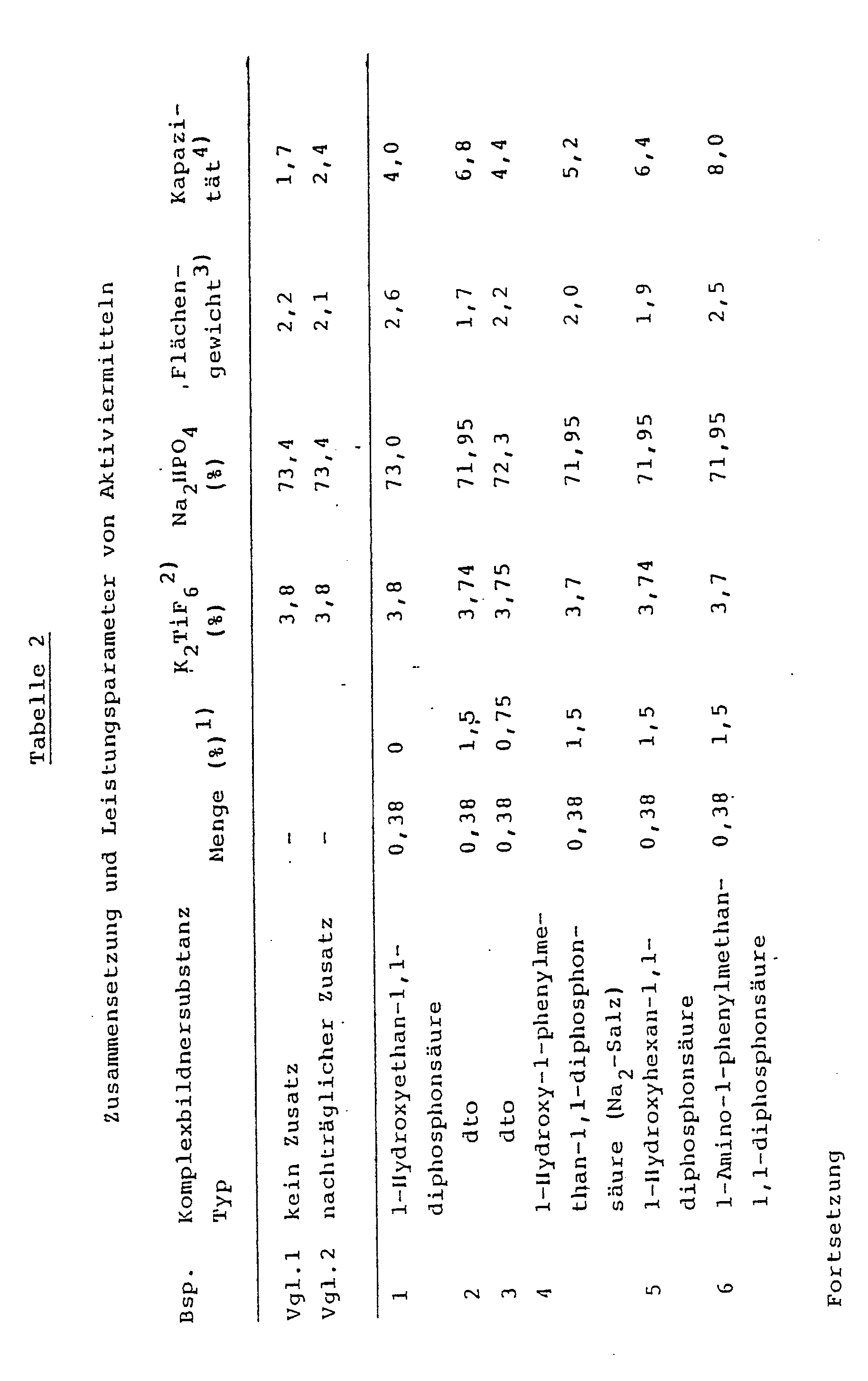

Tabelle 3 Prozeßablauf zur Abprüfung der Aktivierung in Verbindung mit einem "Niedrigzink"-Phosphatierverfahren GRANODINER SP 2500/Spritzapplikation Stufe Prozeß Produkt Konz. (Gew.-%) Temp. (°C) Behandlungszeit (min) 1 Vorreinigen RIDOLINER C 12501) 0,5 60 0,5 2 Reinigen RIDOLINER C 12501) 0,5 55 2,0 3 Spülen Leitungswasser2) - 30 0,5 4 Aktivieren s. Tabelle 4 0,1 25 1,0 5 Phosphatieren GRANODINER SP 25003) 4,2 52 1,5 6 Spülen Leitungswasser2) - 35 0,5 7 Spülen vollentsalztes Wasser - 20 0,5 8 Trocknen Warmluft - 75 10 1) mittelalkalischer phosphat/borathaltiger Spritz/Tauchreiniger der Fa. Collardin, Köln 2) Stadtwasser mit 28 °d 3) chlorat/nitritbeschleunigtes "Niedrigzink"-Phosphatierungsmittel der Fa. Collardin, Köln Tabelle 4 Leistungsparameter von Aktiviermitteln in einem Niedrigzink-Phosphatierverfahren1) Die Aktivierungswirkung des Standardproduktes wird als 100 % gesetzt. Beispiel Produkt2) in vollentsalztem Wasser Flächengewicht (g/m²) Aktivierungswirkung (%) Vergleich Standard 3,66 100 10 1 1,64 223 11 5 2,19 167 12 4 2,33 157 1) Tabelle 3 2) Beispielnummer aus Tabelle 2
Claims (16)
(a) Poly(aldehydocarbonsäuren) oder deren Alkalimetallsalze, erhältlich durch die Umsetzung von Wasserstoffperoxide, Acrolein und Acrylsäure mit
- einer Viskositätszahl im Bereich von 5 bis 50 ml/g,
- einer Säurezahl im Bereich von 450 bis 670,
- einem Säureäquivalentgewicht im Bereich von 125 bis 70,
- einem Stockpunkt von weniger als 0°C und
- einem Gehalt an Carboxylgruppen im Bereich von 55 bis 90 Mol-% und
- einem Molekulargewicht im Bereich von 1 000 bis 20 000
und/oder
(b) 1,1-Diphosphonsäuren der allgemeinen Formel (IV)

R für einen unsubstituierten oder einen in Parastellung mit Halogen-, Amino-, Hydroxy- oder C₁₋₄-Alkylgruppen, vorzugsweise mit C1 oder NH₂, substituierten Phenylrest, einen geradkettigen oder verzweigtkettigen oder cyclischen, gesättigten oder einfach oder mehrfach ungesättigten Alkylrest mit 1 bis 10 C-Atomen,
X für Wasserstoff, Hydroxy, Halogen oder Amino und
M₁ und M₂ jeweils unabhängig voneinander für Wasserstoff und/oder das Äquivalent eines Alkalimetallions stehen,
einsetzt.
Applications Claiming Priority (2)
| Application Number | Priority Date | Filing Date | Title |
|---|---|---|---|
| DE3814287A DE3814287A1 (de) | 1988-04-28 | 1988-04-28 | Polymere titanphosphate, verfahren zu ihrer herstellung und ihre verwendung zur aktivierung von metalloberflaechen vor einer zinkphosphatierung |
| DE3814287 | 1988-04-28 |
Publications (3)
| Publication Number | Publication Date |
|---|---|
| EP0339452A2 true EP0339452A2 (de) | 1989-11-02 |
| EP0339452A3 EP0339452A3 (de) | 1991-06-12 |
| EP0339452B1 EP0339452B1 (de) | 1993-12-15 |
Family
ID=6353039
Family Applications (1)
| Application Number | Title | Priority Date | Filing Date |
|---|---|---|---|
| EP89106997A Expired - Lifetime EP0339452B1 (de) | 1988-04-28 | 1989-04-19 | Polymere Titanphosphate, Verfahren zu ihrer Herstellung und ihre Verwendung zur Aktivierung von Metalloberflächen vor einer Zinkphosphatierung |
Country Status (6)
| Country | Link |
|---|---|
| US (1) | US4957568A (de) |
| EP (1) | EP0339452B1 (de) |
| JP (1) | JPH01317108A (de) |
| AU (1) | AU610386B2 (de) |
| BR (1) | BR8902021A (de) |
| DE (2) | DE3814287A1 (de) |
Cited By (3)
| Publication number | Priority date | Publication date | Assignee | Title |
|---|---|---|---|---|
| EP0707664A4 (de) * | 1993-06-15 | 1996-02-09 | Henkel Corp | Auflösungs- und konservierungsstabile aktivierungszusammensetzung mit titanphosphat |
| WO1996008588A1 (en) * | 1994-09-12 | 1996-03-21 | Ppg Industries, Inc. | Liquid rinse conditioner for phosphate conversion coatings |
| WO2010031779A1 (de) * | 2008-09-16 | 2010-03-25 | Sachtleben Chemie Gmbh | Verfahren zur herstellung von titan-iv-phosphat |
Families Citing this family (5)
| Publication number | Priority date | Publication date | Assignee | Title |
|---|---|---|---|---|
| US6551417B1 (en) * | 2000-09-20 | 2003-04-22 | Ge Betz, Inc. | Tri-cation zinc phosphate conversion coating and process of making the same |
| US20060086282A1 (en) * | 2004-10-25 | 2006-04-27 | Zhang Jun Q | Phosphate conversion coating and process |
| US8632754B2 (en) * | 2009-08-03 | 2014-01-21 | Mcneil-Ppc, Inc. | Tooth sensitivity treatment compositions |
| US9060947B2 (en) * | 2009-08-03 | 2015-06-23 | Mcneil-Ppc, Inc. | Tooth sensitivity treatment compositions |
| CN113117634A (zh) * | 2021-05-27 | 2021-07-16 | 广州大学 | 一种重金属吸附剂及其制备方法和应用 |
Family Cites Families (39)
| Publication number | Priority date | Publication date | Assignee | Title |
|---|---|---|---|---|
| US2331196A (en) * | 1941-08-22 | 1943-10-05 | Westinghouse Electric & Mfg Co | Protective phosphate coating |
| US2342738A (en) * | 1941-09-17 | 1944-02-29 | Westinghouse Electric & Mfg Co | Corrosion resistant coating for metal surfaces |
| US2322349A (en) * | 1941-10-25 | 1943-06-22 | Westinghouse Electric & Mfg Co | Corrosion resistant coating for metal surfaces |
| IT429344A (de) * | 1941-10-25 | 1900-01-01 | ||
| US2329065A (en) * | 1942-03-06 | 1943-09-07 | Westinghouse Electric & Mfg Co | Corrosion resistant coating for metal surfaces |
| US2456947A (en) * | 1944-12-21 | 1948-12-21 | Westinghouse Electric Corp | Corrosion resistant coating for metal surfaces |
| US2490062A (en) * | 1949-01-21 | 1949-12-06 | Westinghouse Electric Corp | Cleaning and activating compositions and use thereof in producing protective phosphate coatings on metal surfaces |
| NL214342A (de) * | 1956-02-07 | |||
| US2874081A (en) * | 1956-08-02 | 1959-02-17 | Parker Rust Proof Co | Pretreatment solution for phosphate coating, method of preparing the same and process of treating metal surfaces |
| US3141804A (en) * | 1961-07-18 | 1964-07-21 | Foils Packaging Corp | Dielectric heat sealing |
| US3425876A (en) * | 1965-10-26 | 1969-02-04 | Amchem Prod | Phosphate coating process |
| US3510365A (en) * | 1966-11-30 | 1970-05-05 | Hooker Chemical Corp | Process of pretreating ferrous metal surfaces before phosphatizing |
| DE1904940C2 (de) * | 1969-02-01 | 1982-07-22 | Degussa Ag, 6000 Frankfurt | Verwendung von Carboxyl- bzw. Carboxylat- und Hydroxylgruppen aufweisenden Polymeren als Komplexbildner |
| US3728163A (en) * | 1970-05-25 | 1973-04-17 | Balm Paints Ltd | Alkaline liquids for cleaning metals |
| US3847663A (en) * | 1970-07-24 | 1974-11-12 | Lubrizol Corp | Cleaning of metals with compositions containing alkali metal silicate and chloride |
| CA960944A (en) * | 1970-11-19 | 1975-01-14 | Dulux Australia Ltd. | Grain-refining compounds |
| US3864139A (en) * | 1970-12-04 | 1975-02-04 | Amchem Prod | Pretreatment compositions and use thereof in treating metal surfaces |
| AU453193B2 (en) * | 1971-05-10 | 1974-09-05 | Dulux Australia Ltd | Metal pretreatment solution and process |
| BE789347A (fr) * | 1971-09-30 | 1973-01-15 | Amchem Prod | Procédés et compositions pour le traitement de surface ferreuses et de zinc |
| DE2154737A1 (de) * | 1971-11-04 | 1973-05-24 | Degussa | Mittel und verfahren zur rostschutzbehandlung |
| US3795548A (en) * | 1972-01-10 | 1974-03-05 | Oxy Metal Finishing Corp | Procedure for surface treatment of iron and steel |
| DE2330260A1 (de) * | 1973-06-14 | 1975-01-16 | Degussa | Verfahren zur herstellung von polycarboxylaten mit verbesserter biologischer abbaubarkeit |
| NL157021B (nl) * | 1973-11-15 | 1978-06-15 | Degussa | Werkwijze ter bereiding van polycarboxylaten met verbeterde biologische afbreekbaarheid. |
| US3996074A (en) * | 1975-08-28 | 1976-12-07 | Monsanto Company | Method for improving hydrolytic stability of the bond between steel surfaces and organic adhesives |
| US4152176A (en) * | 1978-08-07 | 1979-05-01 | R. O. Hull & Company, Inc. | Method of preparing titanium-containing phosphate conditioner for metal surfaces |
| US4351735A (en) * | 1978-12-19 | 1982-09-28 | R.G.B. Laboratories Inc. | Mineral enrichment composition and method of preparing same |
| DE2907094A1 (de) * | 1979-02-23 | 1980-09-04 | Metallgesellschaft Ag | Phosphatierungsloesungen |
| IT1120363B (it) * | 1979-05-29 | 1986-03-19 | Fosfa Col S A S Di A Dal Pane | Procedimento per preparare un prodotto attivatore dei processi di fosfatazione e prodotto ottenuto con lo stesso procedimento |
| DE2951600A1 (de) * | 1979-12-21 | 1981-07-02 | Gerhard Collardin GmbH, 5000 Köln | Verfahren zur vorbehandlung von metalloberflaechen vor dem phosphatieren |
| US4427459A (en) * | 1982-01-25 | 1984-01-24 | Pennwalt Corporation | Phosphate conversion coatings for metals with reduced coating weights and crystal sizes |
| DE3213649A1 (de) * | 1982-04-14 | 1983-10-27 | Gerhard Collardin GmbH, 5000 Köln | Verfahren zum reinigen und entfetten sowie aktivieren von metalloberflaechen |
| AU2448684A (en) * | 1983-03-02 | 1984-09-06 | Parker Chemical Company | Metal treatment before phosphate coating |
| US4497667A (en) * | 1983-07-11 | 1985-02-05 | Amchem Products, Inc. | Pretreatment compositions for metals |
| JPS6039170A (ja) * | 1983-08-10 | 1985-02-28 | Toyota Motor Corp | リン酸塩皮膜化成処理前の鋼板表面調整方法及び表面調整用水溶液 |
| FR2572422B1 (fr) * | 1984-10-31 | 1993-03-05 | Produits Ind Cie Fse | Bain d'activation et d'affinage perfectionne pour procede de phosphatation au zinc et concentre correspondant |
| JPS61257481A (ja) * | 1985-05-10 | 1986-11-14 | Nippon Parkerizing Co Ltd | りん酸塩皮膜化成処理用水性表面調整液 |
| US4698269A (en) * | 1986-05-08 | 1987-10-06 | Narusch Jr Michael J | Sintered, corrosion-resistant powdered metal product and its manufacture |
| DE3635343A1 (de) * | 1986-10-17 | 1988-04-28 | Metallgesellschaft Ag | Verfahren zur erzeugung von phosphatueberzuegen |
| DE3731049A1 (de) * | 1987-09-16 | 1989-03-30 | Henkel Kgaa | Verfahren zur herstellung von aktivierenden titanphosphaten fuer die zinkphosphatierung |
-
1988
- 1988-04-28 DE DE3814287A patent/DE3814287A1/de not_active Withdrawn
-
1989
- 1989-04-19 DE DE89106997T patent/DE58906393D1/de not_active Expired - Fee Related
- 1989-04-19 EP EP89106997A patent/EP0339452B1/de not_active Expired - Lifetime
- 1989-04-27 AU AU33785/89A patent/AU610386B2/en not_active Ceased
- 1989-04-28 JP JP1111910A patent/JPH01317108A/ja active Pending
- 1989-04-28 BR BR898902021A patent/BR8902021A/pt unknown
- 1989-04-28 US US07/345,063 patent/US4957568A/en not_active Expired - Fee Related
Cited By (4)
| Publication number | Priority date | Publication date | Assignee | Title |
|---|---|---|---|---|
| EP0707664A4 (de) * | 1993-06-15 | 1996-02-09 | Henkel Corp | Auflösungs- und konservierungsstabile aktivierungszusammensetzung mit titanphosphat |
| EP0853140A1 (de) * | 1993-06-15 | 1998-07-15 | Henkel Corporation | Schnell auflösende, feste, Titanphosphate enthaltende Aktivierungszusammensetzung |
| WO1996008588A1 (en) * | 1994-09-12 | 1996-03-21 | Ppg Industries, Inc. | Liquid rinse conditioner for phosphate conversion coatings |
| WO2010031779A1 (de) * | 2008-09-16 | 2010-03-25 | Sachtleben Chemie Gmbh | Verfahren zur herstellung von titan-iv-phosphat |
Also Published As
| Publication number | Publication date |
|---|---|
| AU610386B2 (en) | 1991-05-16 |
| EP0339452A3 (de) | 1991-06-12 |
| US4957568A (en) | 1990-09-18 |
| DE3814287A1 (de) | 1989-11-09 |
| JPH01317108A (ja) | 1989-12-21 |
| DE58906393D1 (de) | 1994-01-27 |
| AU3378589A (en) | 1989-11-02 |
| BR8902021A (pt) | 1989-12-05 |
| EP0339452B1 (de) | 1993-12-15 |
Similar Documents
| Publication | Publication Date | Title |
|---|---|---|
| EP0015020B2 (de) | Verfahren zur Oberflächenbehandlung von Metallen sowie dessen Anwendung auf die Behandlung von Aluminiumoberflächen | |
| DE69936529T2 (de) | Konditionieren einer metalloberfläche vor der phosphatierung | |
| EP0454211B1 (de) | Verfahren zum Aufbringen von Phosphatüberzügen auf Metalloberflächen | |
| EP3802915B1 (de) | Wässrige dispersion zur aktivierung einer metalloberfläche und verfahren zu dessen phosphatierung | |
| EP1390564A2 (de) | Verfahren zur beschichtung von metallischen oberflächen und verwendung der derart beschichteten substrate | |
| DE69404663T2 (de) | Vorspülung für die phosphatierung von oberflächen aus metall | |
| EP0339452B1 (de) | Polymere Titanphosphate, Verfahren zu ihrer Herstellung und ihre Verwendung zur Aktivierung von Metalloberflächen vor einer Zinkphosphatierung | |
| EP0340530B1 (de) | Titanfreie Aktivierungsmittel, Verfahren zu ihrer Herstellung und ihre Verwendung zur Aktivierung von Metalloberflächen vor einer Zinkphosphatierung | |
| EP2893054B1 (de) | Verfahren zur korrosionsschützenden oberflächenbehandlung von metallischen bauteilen in serie | |
| DE2538347B2 (de) | Zinkphosphatlösung zur Ausbildung von Zinkphosphatschichten auf Metallen | |
| EP1060290B1 (de) | Wässrige lösung und verfahren zur phosphatierung metallischer oberflächen | |
| DE69418042T2 (de) | Konservierungsstabile aktivierungszusammensetzung mit titanphosphat | |
| KR20020060058A (ko) | 인산염 처리용 수성 표면 조정제 및 표면 조정방법 | |
| DE69513036T3 (de) | Flüssiges Aktivierungsmittel für Phosphat-Konversionsüberzügen | |
| DE69730711T2 (de) | Mangan-phosphat-umwandlungsbeschichtungzusammensetzung und verfahren zur verwendung bei mässigen temperaturen | |
| EP0307839A1 (de) | Verfahren zur Herstellung von aktivierenden Titanphosphaten für die Zinkphosphatierung | |
| EP0759097B1 (de) | Herstellung phosphathaltiger aktiviermittel für die phosphatierung unter einsatz von mikrowellen | |
| EP3428314B1 (de) | Zusammensetzung und verfahren zur passivierung verzinkter bauteile | |
| EP0340529B1 (de) | Hartwasserstabilisierender Zusatz zu Aktivierungsmitteln für die Zinkphosphatierung | |
| DE4012796A1 (de) | Verfahren zur herstellung von aktivierungsmitteln fuer die zinkphosphatierung | |
| DE3814391A1 (de) | Aktivierung von metalloberflaechen vor einer zinkphosphatierung | |
| DE2931712C2 (de) | Verfahren zur Herstellung einer Titanverbindung zur Aktivierung von Phosphatisierungs-Prozessen | |
| DE3731089A1 (de) | Mittel und verfahren zur aktivierung von metalloberflaechen vor einer zinkphosphatierung | |
| DEP0049430DA (de) | Verfahren zur Erzeugung von Schutzschichten auf Aluminium und Aluminiumlegierungen |
Legal Events
| Date | Code | Title | Description |
|---|---|---|---|
| PUAI | Public reference made under article 153(3) epc to a published international application that has entered the european phase |
Free format text: ORIGINAL CODE: 0009012 |
|
| AK | Designated contracting states |
Kind code of ref document: A2 Designated state(s): AT BE DE ES FR GB IT NL SE |
|
| PUAL | Search report despatched |
Free format text: ORIGINAL CODE: 0009013 |
|
| AK | Designated contracting states |
Kind code of ref document: A3 Designated state(s): AT BE DE ES FR GB IT NL SE |
|
| 17P | Request for examination filed |
Effective date: 19910525 |
|
| 17Q | First examination report despatched |
Effective date: 19920506 |
|
| GRAA | (expected) grant |
Free format text: ORIGINAL CODE: 0009210 |
|
| AK | Designated contracting states |
Kind code of ref document: B1 Designated state(s): DE |
|
| REF | Corresponds to: |
Ref document number: 58906393 Country of ref document: DE Date of ref document: 19940127 |
|
| PLBE | No opposition filed within time limit |
Free format text: ORIGINAL CODE: 0009261 |
|
| STAA | Information on the status of an ep patent application or granted ep patent |
Free format text: STATUS: NO OPPOSITION FILED WITHIN TIME LIMIT |
|
| 26N | No opposition filed | ||
| PGFP | Annual fee paid to national office [announced via postgrant information from national office to epo] |
Ref country code: DE Payment date: 20010409 Year of fee payment: 13 |
|
| PG25 | Lapsed in a contracting state [announced via postgrant information from national office to epo] |
Ref country code: DE Free format text: LAPSE BECAUSE OF NON-PAYMENT OF DUE FEES Effective date: 20021101 |