EP0339912A2 - Procédé pour séparer des circuits intégrés formés dans un substrat - Google Patents
Procédé pour séparer des circuits intégrés formés dans un substrat Download PDFInfo
- Publication number
- EP0339912A2 EP0339912A2 EP89304072A EP89304072A EP0339912A2 EP 0339912 A2 EP0339912 A2 EP 0339912A2 EP 89304072 A EP89304072 A EP 89304072A EP 89304072 A EP89304072 A EP 89304072A EP 0339912 A2 EP0339912 A2 EP 0339912A2
- Authority
- EP
- European Patent Office
- Prior art keywords
- trench
- layer
- etch
- wafer
- trenches
- Prior art date
- Legal status (The legal status is an assumption and is not a legal conclusion. Google has not performed a legal analysis and makes no representation as to the accuracy of the status listed.)
- Granted
Links
Images




Classifications
-
- B—PERFORMING OPERATIONS; TRANSPORTING
- B41—PRINTING; LINING MACHINES; TYPEWRITERS; STAMPS
- B41J—TYPEWRITERS; SELECTIVE PRINTING MECHANISMS, i.e. MECHANISMS PRINTING OTHERWISE THAN FROM A FORME; CORRECTION OF TYPOGRAPHICAL ERRORS
- B41J2/00—Typewriters or selective printing mechanisms characterised by the printing or marking process for which they are designed
- B41J2/005—Typewriters or selective printing mechanisms characterised by the printing or marking process for which they are designed characterised by bringing liquid or particles selectively into contact with a printing material
- B41J2/01—Ink jet
- B41J2/135—Nozzles
- B41J2/16—Production of nozzles
- B41J2/1621—Manufacturing processes
- B41J2/1626—Manufacturing processes etching
- B41J2/1628—Manufacturing processes etching dry etching
-
- B—PERFORMING OPERATIONS; TRANSPORTING
- B41—PRINTING; LINING MACHINES; TYPEWRITERS; STAMPS
- B41J—TYPEWRITERS; SELECTIVE PRINTING MECHANISMS, i.e. MECHANISMS PRINTING OTHERWISE THAN FROM A FORME; CORRECTION OF TYPOGRAPHICAL ERRORS
- B41J2/00—Typewriters or selective printing mechanisms characterised by the printing or marking process for which they are designed
- B41J2/005—Typewriters or selective printing mechanisms characterised by the printing or marking process for which they are designed characterised by bringing liquid or particles selectively into contact with a printing material
- B41J2/01—Ink jet
- B41J2/135—Nozzles
- B41J2/16—Production of nozzles
- B41J2/1601—Production of bubble jet print heads
-
- B—PERFORMING OPERATIONS; TRANSPORTING
- B41—PRINTING; LINING MACHINES; TYPEWRITERS; STAMPS
- B41J—TYPEWRITERS; SELECTIVE PRINTING MECHANISMS, i.e. MECHANISMS PRINTING OTHERWISE THAN FROM A FORME; CORRECTION OF TYPOGRAPHICAL ERRORS
- B41J2/00—Typewriters or selective printing mechanisms characterised by the printing or marking process for which they are designed
- B41J2/005—Typewriters or selective printing mechanisms characterised by the printing or marking process for which they are designed characterised by bringing liquid or particles selectively into contact with a printing material
- B41J2/01—Ink jet
- B41J2/135—Nozzles
- B41J2/16—Production of nozzles
- B41J2/1621—Manufacturing processes
- B41J2/1623—Manufacturing processes bonding and adhesion
-
- B—PERFORMING OPERATIONS; TRANSPORTING
- B41—PRINTING; LINING MACHINES; TYPEWRITERS; STAMPS
- B41J—TYPEWRITERS; SELECTIVE PRINTING MECHANISMS, i.e. MECHANISMS PRINTING OTHERWISE THAN FROM A FORME; CORRECTION OF TYPOGRAPHICAL ERRORS
- B41J2/00—Typewriters or selective printing mechanisms characterised by the printing or marking process for which they are designed
- B41J2/005—Typewriters or selective printing mechanisms characterised by the printing or marking process for which they are designed characterised by bringing liquid or particles selectively into contact with a printing material
- B41J2/01—Ink jet
- B41J2/135—Nozzles
- B41J2/16—Production of nozzles
- B41J2/1621—Manufacturing processes
- B41J2/1626—Manufacturing processes etching
- B41J2/1629—Manufacturing processes etching wet etching
-
- B—PERFORMING OPERATIONS; TRANSPORTING
- B41—PRINTING; LINING MACHINES; TYPEWRITERS; STAMPS
- B41J—TYPEWRITERS; SELECTIVE PRINTING MECHANISMS, i.e. MECHANISMS PRINTING OTHERWISE THAN FROM A FORME; CORRECTION OF TYPOGRAPHICAL ERRORS
- B41J2/00—Typewriters or selective printing mechanisms characterised by the printing or marking process for which they are designed
- B41J2/005—Typewriters or selective printing mechanisms characterised by the printing or marking process for which they are designed characterised by bringing liquid or particles selectively into contact with a printing material
- B41J2/01—Ink jet
- B41J2/135—Nozzles
- B41J2/16—Production of nozzles
- B41J2/1621—Manufacturing processes
- B41J2/164—Manufacturing processes thin film formation
- B41J2/1642—Manufacturing processes thin film formation thin film formation by CVD [chemical vapor deposition]
-
- H—ELECTRICITY
- H10—SEMICONDUCTOR DEVICES; ELECTRIC SOLID-STATE DEVICES NOT OTHERWISE PROVIDED FOR
- H10D—INORGANIC ELECTRIC SEMICONDUCTOR DEVICES
- H10D62/00—Semiconductor bodies, or regions thereof, of devices having potential barriers
- H10D62/10—Shapes, relative sizes or dispositions of the regions of the semiconductor bodies; Shapes of the semiconductor bodies
- H10D62/117—Shapes of semiconductor bodies
-
- H—ELECTRICITY
- H10—SEMICONDUCTOR DEVICES; ELECTRIC SOLID-STATE DEVICES NOT OTHERWISE PROVIDED FOR
- H10P—GENERIC PROCESSES OR APPARATUS FOR THE MANUFACTURE OR TREATMENT OF DEVICES COVERED BY CLASS H10
- H10P50/00—Etching of wafers, substrates or parts of devices
- H10P50/60—Wet etching
- H10P50/64—Wet etching of semiconductor materials
- H10P50/642—Chemical etching
-
- B—PERFORMING OPERATIONS; TRANSPORTING
- B41—PRINTING; LINING MACHINES; TYPEWRITERS; STAMPS
- B41J—TYPEWRITERS; SELECTIVE PRINTING MECHANISMS, i.e. MECHANISMS PRINTING OTHERWISE THAN FROM A FORME; CORRECTION OF TYPOGRAPHICAL ERRORS
- B41J2202/00—Embodiments of or processes related to ink-jet or thermal heads
- B41J2202/01—Embodiments of or processes related to ink-jet heads
- B41J2202/13—Heads having an integrated circuit
-
- Y—GENERAL TAGGING OF NEW TECHNOLOGICAL DEVELOPMENTS; GENERAL TAGGING OF CROSS-SECTIONAL TECHNOLOGIES SPANNING OVER SEVERAL SECTIONS OF THE IPC; TECHNICAL SUBJECTS COVERED BY FORMER USPC CROSS-REFERENCE ART COLLECTIONS [XRACs] AND DIGESTS
- Y10—TECHNICAL SUBJECTS COVERED BY FORMER USPC
- Y10S—TECHNICAL SUBJECTS COVERED BY FORMER USPC CROSS-REFERENCE ART COLLECTIONS [XRACs] AND DIGESTS
- Y10S438/00—Semiconductor device manufacturing: process
- Y10S438/928—Front and rear surface processing
Definitions
- This invention relates to large scale semiconductor arrays and, more particularly, to aligning a plurality of integrated circuit semiconductor chips into a linear or two-dimensional array.
- a further problem with known dicing techniques is that chips to be aligned are not the same height, and a slight lateral misalignment results since the aligned surfaces are at an angle to each other. Chip misalignment can result from wafer-to-wafer variations.
- the present invention is directed towards forming large-area arrays by butting together a plurality of integrated circuit chips using special techniques. Accordingly the present invention provides a method of separating from each other plural integrated circuits formed contemporaneously on the same substrate (chip).
- US-A- 4,612,554 discloses an ink jet printhead apparatus comprising two identical parts, and a method for producing the same.
- a plurality of V-shaped grooves are anisotropically etched on each part of the apparatus between a linear array of heating elements. The grooves allow the structures to be mated in an automatically self-aligned manner.
- US-A- 4,604,161 teaches a method for fabricating an image sensor array.
- An active surface of an array chip is etched to form a V-shaped groove which marks an array end.
- a groove is then cut into the opposite inactive surface with a centerline parallel to, but offset from, the centerline of the V-shaped groove. Forcible fracturing of the chip along the ⁇ 111 ⁇ crystalline plane between the grooves produces a straight array end for butting against the end of a like array.
- JP-A- 60-157236 discloses a method of dicing a semiconductor substrate. A first full-cut or half-cut is made into one side of the semiconductor substrate with a first blade. Then, another cut is made into the other side of the semiconductor substrate, opposite the first cut, with a blade wider than the first blade.
- US-A- 4,589,952 discloses a method of making trenches having substantially vertical sidewalls in a silicon substrate, wherein a thick photoresist layer, a silicon nitride layer and a thin photoresist layer are sequentially formed on the surface of the substrate and reactive ion etched to form the trenches.
- US-A- 4,542,397 discloses the formation of large scale arrays from integrated chips on a wafer, which is characterized as having a parallelogrammatic like geometry.
- a wafer 10 of semiconductor material has two opposed surfaces 12 and 14.
- wafer 10 is silicon with a ⁇ 100> axial orientation.
- the technique disclosed below is applicable in principle for most crystalline materials and is not restricted to silicon.
- Chips 20 may be identical to, or different from, each other depending upon the particular application.
- chips 20 comprise a plurality of identical circuits which can be individually assembled to form a full page thermal ink jet printing device.
- Each chip 20 contains an array of electronic sensing or printing elements and necessary associated circuitry to enable interconnection off the chip.
- each chip 20 is formed with transistor drive logic and resistive heater elements integrated therein. Following the appropriate processing steps, the chips 20 are separated and then bonded together to form, for example, a resistive plate which together has a channel plate, comprise a full page thermal ink jet printhead.
- FIG. 3 shows a sectional view of the circled area from Figure 2, the circled area extending on both sides of one of the separation lines 16. It is understood that the following description pertains to chip separation processing along all of the lines 16, 18.
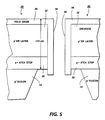
- a p+ layer 30 is formed in wafer 10, approximately 10 ⁇ m below the surface. Layer 30, approximately 2-3 ⁇ m thick, will be used as an orientation-dependent etch stop when the wafer is etched from the back as will be seen. Layer 30 is formed beneath a lightly doped p- layer 32 approximately 10 ⁇ m thick.
- the first process step is to etch vertical trenches 34 in the wafer surface by a reactive ion etching process. This technique is distinguished by a high degree of directional (anisotropic) etching so that almost vertical sidewalls can be formed.
- Trench 34 is typically 2-3 ⁇ m wide and about 10 ⁇ m deep extending through layers 32 and 30.
- Trench 34 is oxidized and then filled with a low pressure CVD polysilicon forming field oxide layers 36 and polysilicon plug 38.
- a normal wafer fabrication sequence is now implemented to form logic and sensor or printing elements of the completed circuit.
- the chip is passivated with PSG followed by coating of top and bottom surfaces with a plasma-enhanced Si3N4 coating 40,42 respectively ( Figure 4).
- the PSG is patterned to expose bonding pads before deposition of the plasma nitride.
- the plasma nitride on the back of the wafer is patterned and aligned using an IR aligner.
- the plasma nitride coating protects the completed circuitry from attack by orientation dependent etch, (dotted lines) which is shown as terminating at p+ layer 30.
- the front side of the wafer can alternatively be protected by being clamped against silicone or ethyelene-propylene elastomeric material with 'Teflon' or stainless steel.
- the etching is made through an ODE etch mask whose alignment with trench 34 is not critical so long as some latitude is designed into the mask.
- the ODE etch is interrupted so that a short wet oxide etch (buffered oxide etchant) can be used to etch through the oxide layer 44 at the bottom of the trench ( Figure 3).
- the wafer is then replaced in the ODE solution to etch away polysilicon block 38.
- Figure 5 shows the wafer at this point with two adjoining chips 20 being separated as a result of retrench 34 being met by the ODE etch.
- a second method can be used to form the chips described with reference to Figures 3-5.
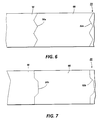
- trench 34 as shown in these figures, is formed with planar butting edges 50, 52.
- the edges can be formed with an irregular, wedge-shaped contour.
- the countoured edges are formed by using an appropriate photomask to expose the resist.
- Each edge 50a, 52a and 50b, 52b is separately matched with the associated butting edge so that the two butted edges will fit together in tongue and groove fashion. This modification allows precise alignment in both x and y directions and ensures side-to-side as well as end-to-end alignment.
- p-/p+ wafers are useful starting material for advanced CMOS chips, including high density memory.
- the resistivity of the p+ layer must be high enough so that it is etched in the ODE etchant at the same rate as the p- wafer. In practice, a resistivity of 0.01ohm cm is appropriate.
- p- layer 32 ( Figure 3) and restrict the p+ layer 30 to areas immediately adjacent the trench butt edge surfaces.
- p+ layer 60 is formed by diffusion through a mask which exposes only the areas adjacent the edges of trenches 62.
- p- layer 32 is not required and the p+ layer 60 is restricted to the areas shown adjacent the trench edges.
- a two ⁇ m SiO2 mask 70 is deposited on the top surface of the wafer.
- a trench 72 ( Figure 2) 3 ⁇ m wide and 10 ⁇ m deep, generally following lines 16 and 18, is formed (etched) by a reactive ion etching process.
- the SiO2 mask 70 is then stripped and wafer 14 is reoxidized. If trench 72 has been made with 3 ⁇ m or less width, a 2 ⁇ m thermal oxidation will close over the top of the trench allowing subsequent processing on the wafer surface without the interference of an etch trench ( Figure 10).
- a via etch removes the SiO2 near the trench; a resist layer 74 is reapplied and imaged and a final SiO2 etch removes the SiO2 from the trench ( Figure 11).
- the purpose of the via etch is to provide a bare silicon substrate for the resist to protect the integrated chip circuitry and avoid severe undercutting of the chip passivating SiO2 during the trench SiO2 etch.
- a side view of the processed wafer shows the vertical trenches 72.
- Grooves 74 having centerlines offset from the centerlines of the trenches, are formed by known dicing techniques. Wafer 14 is then subjected to a fracturing force at each of the trenches 72 causing separation as indicated by the dotted lines.
- the separated chips 20, assuming they tested satisfactorily, are butted together as shown in Figure 13.
- Butting surfaces 84a, 84b have flat vertical edges instead of the sharp edges characterized in the prior art. Thus variations in two butting chips 20 do not result in any lateral displacement.
- FIG. 14 A still further embodiment is shown in Figures 14 and 15.
- the grooves 40 are formed to intersect trenches 72.
- precise butting surfaces 84c, 84d are produced without the possible damage attendant upon the fracture technique of the Figures 12 and 13 embodiment.
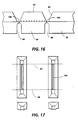
- FIG. 16 shows an enlarged partial cross section having an upper wafer 90 and a lower wafer 92.
- Upper wafer 90 has formed thereon a plurality of channel plates 94, while sandwich 92 has integrally formed therein a plurality of resistor heater plates 96.
- the channel plates 94 are fabricated so that, in the separation areas, the channel plates are not connected to each other, the connections being at the front and back of the channel die, in areas that can be easily cut away by a dicing saw after the heater and channel plates are firmly adhesively bonded. When this is done, it only remains to form dice cuts 98 ( Figure 17) along the back of the heater wafer down to the reactive ion etching trenches 100 to free the sandwich die from the wafer.
- the chips may be precisely butted together, or aligned by any of several known techniques.
- the chips 20 may be aligned by means of a robot vacuum, operating under a closed loop optical pattern recognition system.
Landscapes
- Engineering & Computer Science (AREA)
- Manufacturing & Machinery (AREA)
- Particle Formation And Scattering Control In Inkjet Printers (AREA)
- Dicing (AREA)
- Drying Of Semiconductors (AREA)
- Weting (AREA)
Applications Claiming Priority (2)
| Application Number | Priority Date | Filing Date | Title |
|---|---|---|---|
| US07/185,600 US4822755A (en) | 1988-04-25 | 1988-04-25 | Method of fabricating large area semiconductor arrays |
| US185600 | 1988-04-25 |
Publications (3)
| Publication Number | Publication Date |
|---|---|
| EP0339912A2 true EP0339912A2 (fr) | 1989-11-02 |
| EP0339912A3 EP0339912A3 (en) | 1990-02-07 |
| EP0339912B1 EP0339912B1 (fr) | 1994-10-26 |
Family
ID=22681669
Family Applications (1)
| Application Number | Title | Priority Date | Filing Date |
|---|---|---|---|
| EP89304072A Expired - Lifetime EP0339912B1 (fr) | 1988-04-25 | 1989-04-24 | Procédé pour séparer des circuits intégrés formés dans un substrat |
Country Status (4)
| Country | Link |
|---|---|
| US (1) | US4822755A (fr) |
| EP (1) | EP0339912B1 (fr) |
| JP (1) | JPH01313956A (fr) |
| DE (1) | DE68918982T2 (fr) |
Cited By (4)
| Publication number | Priority date | Publication date | Assignee | Title |
|---|---|---|---|---|
| EP0442280A3 (en) * | 1990-02-14 | 1995-12-27 | Draper Lab Charles S | Method and apparatus for semiconductor chip transducer |
| EP1136269A3 (fr) * | 2000-03-21 | 2001-10-04 | Nec Corporation | Tête d'impression par jet d'encre comportant une pluralité d'unités et son procédé de fabrication |
| EP1148544A1 (fr) * | 2000-04-19 | 2001-10-24 | Infineon Technologies AG | Méthode d'amincissement d'un substrat |
| EP1138491A3 (fr) * | 2000-03-21 | 2002-03-06 | Nec Corporation | Tête d'impression à jet d'encre avec chambre à pression améliorée et son procédé de fabrication |
Families Citing this family (55)
| Publication number | Priority date | Publication date | Assignee | Title |
|---|---|---|---|---|
| US5067233A (en) * | 1989-07-24 | 1991-11-26 | Grumman Aerospace Corporation | Method of forming an integrated circuit module |
| US4966862A (en) * | 1989-08-28 | 1990-10-30 | Cree Research, Inc. | Method of production of light emitting diodes |
| US5053836A (en) * | 1989-11-21 | 1991-10-01 | Eastman Kodak Company | Cleaving of diode arrays with scribing channels |
| US4997792A (en) * | 1989-11-21 | 1991-03-05 | Eastman Kodak Company | Method for separation of diode array chips during fabrication thereof |
| US4997793A (en) * | 1989-11-21 | 1991-03-05 | Eastman Kodak Company | Method of improving cleaving of diode arrays |
| US5000811A (en) | 1989-11-22 | 1991-03-19 | Xerox Corporation | Precision buttable subunits via dicing |
| US4961821A (en) * | 1989-11-22 | 1990-10-09 | Xerox Corporation | Ode through holes and butt edges without edge dicing |
| DE4012080A1 (de) * | 1990-04-14 | 1991-10-17 | Bosch Gmbh Robert | Verfahren zum aufbau von mikromechanischen sensoren |
| US5041190A (en) * | 1990-05-16 | 1991-08-20 | Xerox Corporation | Method of fabricating channel plates and ink jet printheads containing channel plates |
| US5272114A (en) * | 1990-12-10 | 1993-12-21 | Amoco Corporation | Method for cleaving a semiconductor crystal body |
| DE4114660C2 (de) * | 1991-05-06 | 1997-09-18 | Telefunken Microelectron | Verfahren zur Herstellung glaspassivierter Halbleiterbauelemente |
| US5192959A (en) * | 1991-06-03 | 1993-03-09 | Xerox Corporation | Alignment of pagewidth bars |
| US5160403A (en) * | 1991-08-09 | 1992-11-03 | Xerox Corporation | Precision diced aligning surfaces for devices such as ink jet printheads |
| US5198054A (en) * | 1991-08-12 | 1993-03-30 | Xerox Corporation | Method of making compensated collinear reading or writing bar arrays assembled from subunits |
| US5221397A (en) * | 1992-11-02 | 1993-06-22 | Xerox Corporation | Fabrication of reading or writing bar arrays assembled from subunits |
| DE4317721C1 (de) * | 1993-05-27 | 1994-07-21 | Siemens Ag | Verfahren zur Vereinzelung von Chips aus einem Wafer |
| US5580831A (en) * | 1993-07-28 | 1996-12-03 | Fujitsu Limited | Sawcut method of forming alignment marks on two faces of a substrate |
| JPH07186388A (ja) * | 1993-11-22 | 1995-07-25 | Xerox Corp | 大規模配列インク・ジェット・プリントヘッドおよびその製造方法 |
| US5691248A (en) * | 1995-07-26 | 1997-11-25 | International Business Machines Corporation | Methods for precise definition of integrated circuit chip edges |
| US5915370A (en) * | 1996-03-13 | 1999-06-29 | Micron Technology, Inc. | Saw for segmenting a semiconductor wafer |
| US5882532A (en) * | 1996-05-31 | 1999-03-16 | Hewlett-Packard Company | Fabrication of single-crystal silicon structures using sacrificial-layer wafer bonding |
| US5940685A (en) * | 1996-10-28 | 1999-08-17 | The United States Of America As Represented By The Secretary Of The Air Force | Fabrication of UV-sensitive back illuminated CCD image sensors |
| EP0948808A4 (fr) | 1996-10-29 | 2000-05-10 | Trusi Technologies Llc | Circuits integres et procedes de fabrication correspondants |
| US6448153B2 (en) * | 1996-10-29 | 2002-09-10 | Tru-Si Technologies, Inc. | Thinning and dicing of semiconductor wafers using dry etch, and obtaining semiconductor chips with rounded bottom edges and corners |
| US6882030B2 (en) | 1996-10-29 | 2005-04-19 | Tru-Si Technologies, Inc. | Integrated circuit structures with a conductor formed in a through hole in a semiconductor substrate and protruding from a surface of the substrate |
| US6498074B2 (en) | 1996-10-29 | 2002-12-24 | Tru-Si Technologies, Inc. | Thinning and dicing of semiconductor wafers using dry etch, and obtaining semiconductor chips with rounded bottom edges and corners |
| US6290861B1 (en) * | 1997-07-15 | 2001-09-18 | Silverbrook Research Pty Ltd | Method of manufacture of a conductive PTFE bend actuator vented ink jet printer |
| US5972781A (en) * | 1997-09-30 | 1999-10-26 | Siemens Aktiengesellschaft | Method for producing semiconductor chips |
| US6339881B1 (en) * | 1997-11-17 | 2002-01-22 | Xerox Corporation | Ink jet printhead and method for its manufacture |
| US6013540A (en) * | 1998-05-01 | 2000-01-11 | Lucent Technologies, Inc. | Laser diode with substrate-side protection |
| US6033489A (en) * | 1998-05-29 | 2000-03-07 | Fairchild Semiconductor Corp. | Semiconductor substrate and method of making same |
| US6449831B1 (en) | 1998-06-19 | 2002-09-17 | Lexmark International, Inc | Process for making a heater chip module |
| US6131263A (en) * | 1998-10-26 | 2000-10-17 | Lucent Technologies Inc. | Method and apparatus for releasing laser bars after facet coating |
| US6425971B1 (en) * | 2000-05-10 | 2002-07-30 | Silverbrook Research Pty Ltd | Method of fabricating devices incorporating microelectromechanical systems using UV curable tapes |
| US6402301B1 (en) | 2000-10-27 | 2002-06-11 | Lexmark International, Inc | Ink jet printheads and methods therefor |
| US6629756B2 (en) | 2001-02-20 | 2003-10-07 | Lexmark International, Inc. | Ink jet printheads and methods therefor |
| US6982184B2 (en) * | 2001-05-02 | 2006-01-03 | Silverbrook Research Pty Ltd | Method of fabricating MEMS devices on a silicon wafer |
| DE10122839B4 (de) * | 2001-05-11 | 2007-11-29 | Qimonda Ag | Verfahren zum Vereinzeln von Halbleiterstrukturen sowie zum Vereinzeln vorbereitetes Halbleitersubstrat |
| US6679587B2 (en) * | 2001-10-31 | 2004-01-20 | Hewlett-Packard Development Company, L.P. | Fluid ejection device with a composite substrate |
| US6902867B2 (en) * | 2002-10-02 | 2005-06-07 | Lexmark International, Inc. | Ink jet printheads and methods therefor |
| US20050023260A1 (en) * | 2003-01-10 | 2005-02-03 | Shinya Takyu | Semiconductor wafer dividing apparatus and semiconductor device manufacturing method |
| DE102005046479B4 (de) * | 2005-09-28 | 2008-12-18 | Infineon Technologies Austria Ag | Verfahren zum Spalten von spröden Materialien mittels Trenching Technologie |
| JP2012510384A (ja) * | 2008-12-02 | 2012-05-10 | オセ−テクノロジーズ ビーブイ | インクジェットプリントヘッドの製造方法 |
| US8118405B2 (en) * | 2008-12-18 | 2012-02-21 | Eastman Kodak Company | Buttable printhead module and pagewide printhead |
| US10038304B2 (en) | 2009-02-17 | 2018-07-31 | Trilumina Corp. | Laser arrays for variable optical properties |
| US20130223846A1 (en) | 2009-02-17 | 2013-08-29 | Trilumina Corporation | High speed free-space optical communications |
| US8995485B2 (en) | 2009-02-17 | 2015-03-31 | Trilumina Corp. | High brightness pulsed VCSEL sources |
| US8995493B2 (en) | 2009-02-17 | 2015-03-31 | Trilumina Corp. | Microlenses for multibeam arrays of optoelectronic devices for high frequency operation |
| US10244181B2 (en) | 2009-02-17 | 2019-03-26 | Trilumina Corp. | Compact multi-zone infrared laser illuminator |
| EP2517321B1 (fr) * | 2009-12-19 | 2021-04-14 | Lumentum Operations LLC | Système de combinaison de réseaux de lasers pour sorties numériques |
| US8979338B2 (en) | 2009-12-19 | 2015-03-17 | Trilumina Corp. | System for combining laser array outputs into a single beam carrying digital data |
| EP2434528A1 (fr) * | 2010-09-28 | 2012-03-28 | Nederlandse Organisatie voor toegepast -natuurwetenschappelijk onderzoek TNO | Support actif pour le transport d'une tranche et procédé de libération |
| US11095365B2 (en) | 2011-08-26 | 2021-08-17 | Lumentum Operations Llc | Wide-angle illuminator module |
| JP2015177061A (ja) * | 2014-03-14 | 2015-10-05 | 株式会社東芝 | 半導体装置の製造方法および半導体装置 |
| US10336074B1 (en) | 2018-01-18 | 2019-07-02 | Rf Printing Technologies | Inkjet printhead with hierarchically aligned printhead units |
Family Cites Families (21)
| Publication number | Priority date | Publication date | Assignee | Title |
|---|---|---|---|---|
| US3689389A (en) * | 1969-12-16 | 1972-09-05 | Bell Telephone Labor Inc | Electrochemically controlled shaping of semiconductors |
| JPS5124190B2 (fr) * | 1971-08-28 | 1976-07-22 | ||
| JPS4934280A (fr) * | 1972-07-28 | 1974-03-29 | ||
| JPS5245879A (en) * | 1975-10-09 | 1977-04-11 | Sanyo Electric Co Ltd | Method of dividing semiconductor element |
| JPS5325350A (en) * | 1976-08-23 | 1978-03-09 | Hitachi Ltd | Dicing method of semiconductor substrates |
| JPS5591138A (en) * | 1978-12-27 | 1980-07-10 | Nec Corp | Die forming of semiconductor device |
| US4295924A (en) * | 1979-12-17 | 1981-10-20 | International Business Machines Corporation | Method for providing self-aligned conductor in a V-groove device |
| US4358340A (en) * | 1980-07-14 | 1982-11-09 | Texas Instruments Incorporated | Submicron patterning without using submicron lithographic technique |
| US4409319A (en) * | 1981-07-15 | 1983-10-11 | International Business Machines Corporation | Electron beam exposed positive resist mask process |
| JPS58171832A (ja) * | 1982-03-31 | 1983-10-08 | Toshiba Corp | 半導体装置の製造方法 |
| DE3275447D1 (en) * | 1982-07-03 | 1987-03-19 | Ibm Deutschland | Process for the formation of grooves having essentially vertical lateral silicium walls by reactive ion etching |
| JPS60157236A (ja) * | 1984-01-25 | 1985-08-17 | Matsushita Electric Ind Co Ltd | ダイシング法 |
| US4542397A (en) * | 1984-04-12 | 1985-09-17 | Xerox Corporation | Self aligning small scale integrated circuit semiconductor chips to form large area arrays |
| US4526631A (en) * | 1984-06-25 | 1985-07-02 | International Business Machines Corporation | Method for forming a void free isolation pattern utilizing etch and refill techniques |
| JPS6167243A (ja) * | 1984-09-10 | 1986-04-07 | Matsushita Electric Ind Co Ltd | ダイシング法 |
| JPS61216338A (ja) * | 1985-03-20 | 1986-09-26 | Sanyo Electric Co Ltd | 半導体装置の製造方法 |
| US4604161A (en) * | 1985-05-02 | 1986-08-05 | Xerox Corporation | Method of fabricating image sensor arrays |
| US4612554A (en) * | 1985-07-29 | 1986-09-16 | Xerox Corporation | High density thermal ink jet printhead |
| US4661201A (en) * | 1985-09-09 | 1987-04-28 | Cts Corporation | Preferential etching of a piezoelectric material |
| US4670092A (en) * | 1986-04-18 | 1987-06-02 | Rockwell International Corporation | Method of fabricating a cantilever beam for a monolithic accelerometer |
| US4729971A (en) * | 1987-03-31 | 1988-03-08 | Microwave Semiconductor Corporation | Semiconductor wafer dicing techniques |
-
1988
- 1988-04-25 US US07/185,600 patent/US4822755A/en not_active Expired - Lifetime
-
1989
- 1989-04-17 JP JP1097247A patent/JPH01313956A/ja active Granted
- 1989-04-24 EP EP89304072A patent/EP0339912B1/fr not_active Expired - Lifetime
- 1989-04-24 DE DE68918982T patent/DE68918982T2/de not_active Expired - Lifetime
Cited By (6)
| Publication number | Priority date | Publication date | Assignee | Title |
|---|---|---|---|---|
| EP0442280A3 (en) * | 1990-02-14 | 1995-12-27 | Draper Lab Charles S | Method and apparatus for semiconductor chip transducer |
| EP1136269A3 (fr) * | 2000-03-21 | 2001-10-04 | Nec Corporation | Tête d'impression par jet d'encre comportant une pluralité d'unités et son procédé de fabrication |
| EP1138491A3 (fr) * | 2000-03-21 | 2002-03-06 | Nec Corporation | Tête d'impression à jet d'encre avec chambre à pression améliorée et son procédé de fabrication |
| US6502921B2 (en) | 2000-03-21 | 2003-01-07 | Fuji Xerox Co., Ltd. | Ink jet head having a plurality of units and its manufacturing method |
| EP1148544A1 (fr) * | 2000-04-19 | 2001-10-24 | Infineon Technologies AG | Méthode d'amincissement d'un substrat |
| WO2001082369A1 (fr) * | 2000-04-19 | 2001-11-01 | Infineon Technologies Ag | Procede pour amincir un substrat |
Also Published As
| Publication number | Publication date |
|---|---|
| DE68918982T2 (de) | 1995-04-27 |
| JPH0532905B2 (fr) | 1993-05-18 |
| DE68918982D1 (de) | 1994-12-01 |
| EP0339912B1 (fr) | 1994-10-26 |
| US4822755A (en) | 1989-04-18 |
| JPH01313956A (ja) | 1989-12-19 |
| EP0339912A3 (en) | 1990-02-07 |
Similar Documents
| Publication | Publication Date | Title |
|---|---|---|
| EP0339912B1 (fr) | Procédé pour séparer des circuits intégrés formés dans un substrat | |
| EP0359417B1 (fr) | Fabrication de structures en silicium par attaques successives d'une face unique | |
| US4961821A (en) | Ode through holes and butt edges without edge dicing | |
| US5620614A (en) | Printhead array and method of producing a printhead die assembly that minimizes end channel damage | |
| US5160403A (en) | Precision diced aligning surfaces for devices such as ink jet printheads | |
| JP2806576B2 (ja) | 大型アレー半導体デバイスを製造する方法 | |
| US5201987A (en) | Fabricating method for silicon structures | |
| US4814296A (en) | Method of fabricating image sensor dies for use in assembling arrays | |
| US5925924A (en) | Methods for precise definition of integrated circuit chip edges | |
| US4622574A (en) | Semiconductor chip with recessed bond pads | |
| US5196378A (en) | Method of fabricating an integrated circuit having active regions near a die edge | |
| US6968617B2 (en) | Methods of fabricating fluid ejection devices | |
| CN101386228B (zh) | 通孔形成方法、喷墨头和硅衬底 | |
| EP1241009A3 (fr) | Technique de gravure de canal d'alimentation en encre pour une tête d'impression à jet d'encre thermique entièrement intégrée | |
| US6457811B1 (en) | Self-aligned interconnect and method for producing same | |
| US5045142A (en) | Stand-off structure for flipped chip butting | |
| JP4217434B2 (ja) | スルーホールの形成方法及びこれを用いたインクジェットヘッド | |
| EP1195808B1 (fr) | Méthode de fabrication d'une couche mince de dispositifs semi-conducteurs autoportée et de réalisation d'un circuit intégré à trois dimensions | |
| US7543917B2 (en) | Integrated circuit and method for manufacturing | |
| JP4046645B2 (ja) | 半導体デバイス及びその製造方法 | |
| JP2001347673A (ja) | インクジェットヘッド構造、インクジェットヘッドの製造方法及び画像形成装置 | |
| JP2012210818A (ja) | スルーホールの形成方法、インクジェットヘッド及びシリコン基板 |
Legal Events
| Date | Code | Title | Description |
|---|---|---|---|
| PUAI | Public reference made under article 153(3) epc to a published international application that has entered the european phase |
Free format text: ORIGINAL CODE: 0009012 |
|
| AK | Designated contracting states |
Kind code of ref document: A2 Designated state(s): DE FR GB IT |
|
| PUAL | Search report despatched |
Free format text: ORIGINAL CODE: 0009013 |
|
| AK | Designated contracting states |
Kind code of ref document: A3 Designated state(s): DE FR GB IT |
|
| 17P | Request for examination filed |
Effective date: 19900711 |
|
| 17Q | First examination report despatched |
Effective date: 19930716 |
|
| GRAA | (expected) grant |
Free format text: ORIGINAL CODE: 0009210 |
|
| AK | Designated contracting states |
Kind code of ref document: B1 Designated state(s): DE FR GB IT |
|
| REF | Corresponds to: |
Ref document number: 68918982 Country of ref document: DE Date of ref document: 19941201 |
|
| ET | Fr: translation filed | ||
| ITF | It: translation for a ep patent filed | ||
| PLBE | No opposition filed within time limit |
Free format text: ORIGINAL CODE: 0009261 |
|
| STAA | Information on the status of an ep patent application or granted ep patent |
Free format text: STATUS: NO OPPOSITION FILED WITHIN TIME LIMIT |
|
| 26N | No opposition filed | ||
| REG | Reference to a national code |
Ref country code: GB Ref legal event code: IF02 |
|
| PGFP | Annual fee paid to national office [announced via postgrant information from national office to epo] |
Ref country code: FR Payment date: 20080312 Year of fee payment: 20 Ref country code: DE Payment date: 20080502 Year of fee payment: 20 |
|
| PGFP | Annual fee paid to national office [announced via postgrant information from national office to epo] |
Ref country code: IT Payment date: 20080428 Year of fee payment: 20 |
|
| PGFP | Annual fee paid to national office [announced via postgrant information from national office to epo] |
Ref country code: GB Payment date: 20080430 Year of fee payment: 20 |
|
| REG | Reference to a national code |
Ref country code: GB Ref legal event code: PE20 Expiry date: 20090423 |
|
| PG25 | Lapsed in a contracting state [announced via postgrant information from national office to epo] |
Ref country code: GB Free format text: LAPSE BECAUSE OF EXPIRATION OF PROTECTION Effective date: 20090423 |