EP0340435A2 - Akustischer Apparat - Google Patents
Akustischer Apparat Download PDFInfo
- Publication number
- EP0340435A2 EP0340435A2 EP89104934A EP89104934A EP0340435A2 EP 0340435 A2 EP0340435 A2 EP 0340435A2 EP 89104934 A EP89104934 A EP 89104934A EP 89104934 A EP89104934 A EP 89104934A EP 0340435 A2 EP0340435 A2 EP 0340435A2
- Authority
- EP
- European Patent Office
- Prior art keywords
- vibrator
- resonator
- resonance
- motional
- drive
- Prior art date
- Legal status (The legal status is an assumption and is not a legal conclusion. Google has not performed a legal analysis and makes no representation as to the accuracy of the status listed.)
- Withdrawn
Links
Images









Classifications
-
- H—ELECTRICITY
- H04—ELECTRIC COMMUNICATION TECHNIQUE
- H04R—LOUDSPEAKERS, MICROPHONES, GRAMOPHONE PICK-UPS OR LIKE ACOUSTIC ELECTROMECHANICAL TRANSDUCERS; ELECTRIC HEARING AIDS; PUBLIC ADDRESS SYSTEMS
- H04R1/00—Details of transducers, loudspeakers or microphones
- H04R1/20—Arrangements for obtaining desired frequency or directional characteristics
- H04R1/22—Arrangements for obtaining desired frequency or directional characteristics for obtaining desired frequency characteristic only
- H04R1/28—Transducer mountings or enclosures modified by provision of mechanical or acoustic impedances, e.g. resonator, damping means
- H04R1/2807—Enclosures comprising vibrating or resonating arrangements
- H04R1/283—Enclosures comprising vibrating or resonating arrangements using a passive diaphragm
- H04R1/2834—Enclosures comprising vibrating or resonating arrangements using a passive diaphragm for loudspeaker transducers
-
- H—ELECTRICITY
- H04—ELECTRIC COMMUNICATION TECHNIQUE
- H04R—LOUDSPEAKERS, MICROPHONES, GRAMOPHONE PICK-UPS OR LIKE ACOUSTIC ELECTROMECHANICAL TRANSDUCERS; ELECTRIC HEARING AIDS; PUBLIC ADDRESS SYSTEMS
- H04R3/00—Circuits for transducers
- H04R3/04—Circuits for transducers for correcting frequency response
Definitions
- the present invention relates to an acoustic apparatus comprising a resonator or using a resonator as an acoustic radiation member.
- a speaker system as one type of acoustic apparatus is arranged such that a speaker unit (vibrator) is disposed in a cabinet and is driven by an amplifier (AMP).
- a speaker unit vibrator
- AMP amplifier
- reproduction characteristics of the speaker system low-frequency reproduction characteristics are mainly determined by the volume of the cabinet.
- a dynamic direct radiator speaker dynamic cone speaker
- a direct sound is radiated from the front surface of the diaphragm, and acoustic waves are also radiated from its rear surface.
- the phase of the acoustic waves from the front and rear surfaces are opposite to each other. Therefore, if a difference in propagation distance of the acoustic waves from the front and rear surfaces to a listener is almost an odd multiple of a half wavelength, sound pressures from these surfaces are in phase with each other, and are superposed.
- the sound from the rear surface does not reach the listener or does not adversely influence the direct radiation sound from the front surface.
- the direct radiation speaker employs a baffle.
- a baffle for shielding communication of sounds from the front and rear surface of the diaphragm a plane baffle, back-opening cabinet type baffle, closed baffle, and the like are known.
- a phase inversion type (bass-reflex type) baffle is known. (In this specification, these baffles are referred to as first to fourth prior arts, respectively.)
- the plane baffle, back-opening baffle and closed baffle are designed such that radiation sounds from the rear surface of the diaphragm do not reach a listener in front of the speaker system as unnecessary sounds.
- the apparatus (cabinet) will inevitably be made large in size, and even if it is made so to a certain feasible extent, its low-frequency reproduction characteristics will be insufficient.
- the phase of the backward sound is inverted by the opening port, so that, in particular, a bass range of a direct radiation sound from the front surface of the diaphragm is compensated for.
- the resonance system which is originally very hard to deal with is undesirably formed on the two portions, i.e., the diaphragm and the opening port.
- the optimal condition of the system must be very critically set while taking the mutual dependency condition of these two resonance systems.
- the cabinet undesirably becomes bulky in order to improve the low-frequency reproduction characteristics.
- an acoustic apparatus comprising a resonator partitioned into two chambers A and B by a partition wall, and a dynamic electroacoustic transducer (dynamic speaker) serving as a vibrator and being attached to a hole formed in the partition wall.
- a dynamic electroacoustic transducer dynamic speaker
- opening ducts are provided respectively to the chambers A and B, and resonance acoustic waves are radiated outwards from these ducts.
- the chambers A and B respectively have resonance frequencies f oa (Hz) and f ob (Hz) determined by the volumes of cavities (i.e. the volumes of chambers A and B), the dimensions of the opening ducts, and the like.
- an acoustic apparatus comprising a resonance chamber defined by a cabinet, a first dynamic electro-acoustic transducer (speaker) serving as a vibrator and being attached to the resonance chamber, and an opening, formed in the resonance chamber, for radiating outwards a resonance acoustic wave.
- a second dynamic electro-acoustic transducer (speaker) is separately provided to said cabinet, so that an acoustic wave is directly radiated outwards therefrom.
- a resonance phenomenon occurs in the resonance chamber due to the vibration of the diaphragm of the first speaker. Therefore, separately from the direct radiation by the second speaker, acoustic reproduction is made from the opening to have a peak sound pressure near a resonance frequency f o inherent in the resonance chamber.
- the vibrator undesirably causes a decrease in resonance Q value of the resonator serving as an acoustic radiation member.
- the speaker as the vibrator has an inherent internal impedance Z v , and the internal impedance becomes to an element which damps the resonance of the resonator.
- the resonance Q value becomes low, radiation capability of the resonance acoustic wave becomes inevitably low, and the presence of the resonator in the acoustic apparatus becomes meaningless.
- the opening duct must be elongated. Accordingly, the acoustic resistance (mechanical resistance) of the opening duct is inevitably increased, and the resonance Q value is decreased further. For this reason, the acoustic radiation capability is further decreased due to the decrease in the resonance Q value, and the acoustic apparatus is not suitable for a practical use.
- any of the conventional apparatuses does not have sufficient resonance radiation capability. If a certain level of capability is to be maintained, the resulting cabinet will inevitablly be made extremely large in size.
- the present invention has been made in consideration of the above situation, and has for its first object to provide an acoustic apparatus which can appropriately and independently set a volume of a cabinet or the like constituting the acoustic apparatus and low-frequency reproduction characteristics, and can remove or reduce a mutual dependency condition of a vibrator and a resonator.
- the acoustic apparatus in a first aspect of the present invention comprises a resonator having a passive diaphragm serving as a resonance radiation unit for radiating an acoustic wave by resonance, a vibrator provided for the resonator, and a vibrator drive means for driving the vibrator.
- the vibrator has an active diaphragm comprising a direct radiator portion for directly radiating an acoustic wave outwards and a resonator driver portion for driving the resonator.
- the vibrator drive means has a drive control means for controlling the drive condition so as to cancel the atmospheric counteraction of said resonator at the time of driving of the resonator by the vibrator.
- the resonator is driven by the resonator driver portion of the active diaphragm constituting the vibrator. Therefore, an acoustic wave is directly radiated outwards from the direct radiator portion of the active diaphragm, and an acoustic wave by resonance is radiated outwards from the passive diaphragm serving as the resonance radiation unit of the resonator.
- the vibrator has an inherent internal impedance
- the vibrator drive means has the drive control means for controlling the drive condition so as to cancel the atmospheric counteraction of the resonator to the vibrator at the time of driving of the resonator by the vibrator. Therefore, in case that the vibrator drive means comprises a means for equivalently generating a negative impedance component in the output impedance, said internal impedance can be apparently reduced (or preferably invalidated) by the operation of the drive control means.
- the vibrator comprises a series circuit constituted by the internal impedance and an equivalent motional impedance contributing to practical vibration.
- a motional signal represents the voltage applied to the equivalent motional impedance, its differential or integral output, or the like, and corresponds to the real movement of diaphragm of the vibrator, e.g. velocity, acceleration, deviation (or amplitude), or the like of the vibration. Accordingly, in case that a motional feedback means is provided in the vibrator drive means, the motional signal is detected and negatively fed back to the input side of the vibrator drive means.
- the drive condition of the vibrator drive means is brought under follow-up control so that a signal in an amount corresponding to drive input is always correctly transmitted as the voltage applied to the equivalent motional impedance, or its deferential or integral voltage.
- the vibrator drive means equivalently appears to directly and linearly drive the equivalent motional impedance itself of the vibrator, whereby the internal impedance inherent in the vibrator existing between the vibrator drive means and the equivalent motional impedance of the vibrator is apparently reduced, as in a case where a negative impedance generating means is substituted for the motional feedback means.
- the vibrator when a means for generating a negative impedance is arranged or when a motional feedback means is arranged in the vibrator drive means, the vibrator is now an element responsive to only an electrical drive signal input, and will not function as a resonance system. At the same time, the volume of the resonator is no longer a factor which influences low-frequency reproduction capability of the vibrator. Thus, if the cabinet is rendered compact, bass reproduction without including distortion due to a transient response of the vibrator can be realized.
- the resonance frequency of the resonator may be easily lowered by increasing the equivalent mass of the passive diaphragm, and a decrease in an acoustic radiation capabilities which is caused by lowering the resonance frequency can be slight in term of sound pressure level as compared with such decrease which is caused by increasing an air equivalent mass.
- the vibrator (active diaphragm) provided for the resonator will not cause a decrease of the resonance Q value. If the equivalent mass of the passive diaphragm is made heavier to lower the resonance frequency, there is remarkably appeared an effect that the decrease in acoustic radiation capabilities is slight. As a result, sufficient acoustic radiation capabilities of the resonator can be realized.
- the passive diaphragm does not need any magnetic circuit for driving the passive diaphragm.
- the stroke width can be arbitrarily decreased by increasing the caliber or diameter of the passive diaphragm, the acoustic apparatus according to the present invention can be suitably minimized toward the depth.
- so-called thin shaped cabinet can be readily realized.
- the compact size and super-bass (heavy bass) reproduction can be simultaneously achieved, and designing can be facilitated.
- the acoustic apparatus in a second aspect of the present invention comprises a resonator having a passive diaphragm serving as a resonance radiation unit for radiating an acoustic wave by resonance, a vibrator provided for the resonator, and a vibrator drive means for driving the vibrator.
- the vibrator has an active diaphragm comprising a resonator driver portion for driving the resonator.
- the vibrator drive means has a drive control means for controlling the drive condition so as to cancel the atmospheric counteraction of said resonator at the time of driving of the resonator by the vibrator.
- the resonator is driven by the resonator driver portion of the active diaphragm constituting the vibrator. Therefore, an acoustic wave by resonance is radiated outwards from the passive diaphragm serving as the resonance radiation unit of the resonator.
- the vibrator has an inherent internal impedance, and the vibrator is driven so as to cancel the atmospheric counteraction of the resonator at the time of driving of the resonator. For this reason, the active diaphragm equivalently becomes an wall of the resonator, and the presence of the vibrator is invalidated when viewed from the resonator. Therefore, the internal impedance inherent in the vibrator is no longer a factor which causes a decrease in resonance Q value of the resonator. For this reason, when the drive control means comprises a means for generating a negative impedance or a motional feedback means, the resonance Q value of the resonator can be extremely high.
- the acoustic resistance of the resonator is increased if the resonator is rendered compact and the resonance frequency is lowered, according to the present invention, even in a case wherein the resonance Q value becomes very small in a conventional drive method, the resonance Q value is not decreased by the presence of the vibrator.
- the resonance frequency of the resonator may be easily lowered by increasing the equivalent mass of the passive diaphragm, and a decrease in acoustic radiation capabilities which is caused by lowering the resonance frequency can be slight in term of sound pressure level as compared with such a decrease which is caused by increasing an air equivalent mass.
- the passive diaphragm does not need any magnetic circuit for driving the passive diaphragm.
- the stroke width can be arbitrarily decreased by increasing the diameter of the passive diaphragm, the acoustic apparatus according to the present invention can be suitably minimized toward the depth.
- so-called thin shaped cabinet can be readily realized.
- Figs. 1(a) and 1(b) show a basic arrangement of a first embodiment of the present invention.
- a resonator 10 having a passive diaphragm 11 serving as a resonance radiation unit is used.
- a resonance phenomenon is caused by a closed cavity (hollow drum) 14 formed in the body portion 15 of the resonator 10, and the passive diaphragm 11 attached to the body portion 15 with the fringe portion 12.
- a vibrator 20 constituted by an active diaphragm 21 and a transducer 22 is attached to the body portion 15 of the resonator 10.
- the transducer 22 is connected to a vibrator driver 30, which comprises a negative impedance generator unit 31 for equivalently generating a negative impedance component (-Z0) in the output impedance.
- Fig. 1(b) shows an arrangement of an electric equivalent circuit of the acoustic apparatus shown in Fig. 1(a).
- a parallel resonance circuit Z1 corresponds to an equivalent motional impedance of the vibrator 20
- r o designates an equivalent resistance of a vibration system
- S o an equivalent stiffness of the vibration system
- m o an equivalent mass of the vibration system.
- a series resonance circuit Z2 corresponds to an equivalent motional impedance of the resonator 10 comprising a series circuit constituted by the cavity of the resonator 10 expressed as a circuit Z2′, and the passive diaphragm 11 and the fringe portion 12 expressed as a circuit Z2 ⁇
- r c ′ designates an equivalent resistance of the cavity of the resonator 10
- r c ⁇ designates an equivalent resistance of the fringe portion 12.
- reference symbol A denotes a force coefficient.
- the vibrator is a dynamic direct radiation speaker
- A Bl where B is the magnetic flux density in the magnetic gap, and l is the length of the voice coil conductor.
- Z v designates an inherent internal impedance of the transducer 22.
- the transducer 22 When a drive signal is supplied from the vibrator driver 30 having a negative impedance drive function to the transducer 22 of the vibrator 20, the transducer 22 electromechanical converts the drive signal so as to reciprocally drive the active diaphragm 21 forward and backward (in the right and left directions in the Figure), the active diaphragm 21 mechanical-acoustic converts this reciprocal motion. Since the vibrator driver 30 has the negative impedance drive function, the internal impedance inherent in the transducer 22 is effectively decreased (ideally invalidated). Therefore, the transducer 22 drives the active diaphragm 21 faithfully in response to the drive signal from the vibrator driver 30, and independently supplies a drive energy to the resonator 10.
- the front surface side (the left surface side in the Figure) of the active diaphragm 21 serves as a direct radiator portion for directly radiating acoustic waves to the outside
- the rear surface side (the right surface side in the Figure) of the active diaphragm 21 serves as a resonance driver portion for driving the resonator 10.
- an acoustic wave is directly radiated from the active diaphragm 21, and air in the resonator 10 as well as the passive diaphragm 11 and the fringe portion 12 is resonated, so that a super-bass acoustic wave having a sufficient sound pressure is resonated and radiated from the passive diaphragm 11 as the resonance radiation unit.
- the resonance frequency f op is set to be lower than the reproduction frequency range of the vibrator 20, and the Q value is set to be an appropriate level, so that sound pressure-frequency characteristics shown in, e.g., Fig. 2 can be obtained.
- the two ends of the parallel resonance circuit Z1 formed by the equivalent motional impedance are short-circuited with a zero impedance in an AC manner. Therefore, the parallel resonance circuit Z1 is substantially no longer a resonance circuit. More specifically, the vibrator 20 linearly responds to a drive signal input in real time, and faithfully electroacoustic converts an electric signal (drive signal) without a transient response. In the vibrator 20, the concept of a lowest resonance frequency f o which is obtained when the vibrator is simply mounted on the resonator 10 is not applicable.
- a value corresponding to the lowest resonance frequency f o of the vibrator 20 refers to a concept wherein the above-mentioned concept of the resonance is not substantially applicable any longer.
- the vibrator 20 and the resonator 10 are independent of each other, and the vibrator 20 and the passive diaphragm 11 are also independent of each other. For this reason, the vibrator 20 functions independently of the volume of the resonator 10, the design specifications of the passive diaphragm 11, the fringe portion 12, and the like (i.e., independently of the equivalent motional impedance of the passive resonance system).
- the parallel and series resonance circuits Z1 and Z2 are present as resonance systems independently of each other. Therefore, when the resonator 10 is designed to be compact in order to minimize the system, or when the passive diaphragm is designed to be enlarged in order to lower the resonance frequency of the passive resonance system, the design of the unit vibration system is not influenced at all, and the value corresponding to the lowest resonance frequency f o of the unit vibration system and the like are not influenced at all, either. For this reason, easy designing free from the mutual dependency condition is allowed.
- the unit vibration system Z1 does not effectively function as a resonance system, if the drive signal input is zero volt, the active diaphragm 21 becomes a part of the wall of the resonator 10. As a result, the presence of the active diaphragm 21 can be ignored when the passive resonance system is considered.
- the passive resonance system is the only resonance system, and exhibits single-humped characteristics similar to those of the closed baffle.
- the vibrator 20 equivalently forming the parallel resonance circuit Z1 becomes a speaker which is driven by a current source given by E v /(A2/r o ) which is determined by the input voltage E v and a resistance A2/r o of the parallel resonance circuit Z1.
- the active diaphragm 21 can be in a perfectly damped state. More specifically, for a counteraction caused by driving the active diaphragm 21, control is made to overcome the counteraction by increasing/decreasing the drive current.
- the passive resonance system constituted by the resonator 10, the passive diaphragm 11 and the fringe portion 12 will be examined below.
- the two ends of the series resonance circuit Z2 are also short-circuited with zero ohm in an AC manner.
- the significance of the resonance system is not lost at all.
- the Q value of the resonance system becomes extremely large (if approximate to an ideal state Q ⁇ ).
- a driving operation of a virtual acoustic source (speaker) constituted by the resonator 10 the passive diaphragm 11 and the fringe portion 12 is achieved by a displacement (vibration) of the active diaphragm 21 in practice, it is considered for the equivalent circuit that a drive energy is supplied from the drive source E v in parallel with the vibrator 20. For this reason, by setting the resonance frequency and the resonance Q value in the resonator independently of the vibrator, super-bass reproduction with a sufficient sound pressure can be achieved by a compact system.
- the design specifications of the resonantor 10 and the passive diaphragm 11 are not influenced by the design specifications of the vibrator 20. Therefore, easy designing free from the mutual dependency condition is allowed.
- Z2 value approximates 0 near the resonance frequency f op of the passive diaphragm 11 (in a state wherein the passive resonance system causes resonance) (however, Z2 is damped by a resistance component in practice), and hence, the current I2 can be flowed by a voltage of a very small amplitude.
- the acoustic radiation power seen in terms of sound pressure levels will decrease at a rate of about 6 dB/oct with the decrease of the resonance frequency f op , and, thus, such an apparent increase in said value would not be an appreciably remarkable effect from the standpoint of overall judgement.
- a resonator in which the passive diaphragm is replaced by an equivalent mass constituted by air, the mass corresponding to said passive diaphragm.
- a resonator is one in which is used a Helmholtz resonator having an opening duct port such as a bass-reflex type speaker cabinet.
- the opening duct port is modified in dimension and shape to increase the equivalent mass in order to lower the resonance frequency.
- the port must be narrowed or lengthened thereby necessarily increasing air resistance with an attendant great increase in said equivalent resistance whereby both the Q value and acoustic radiation capability lower at a further greater rate than a case wherein said passive diaphragm is used.
- the internal impedance inherent in the vibrator will necessarily come to be the damping resistance of a resonance circuit as long as the driver constitution for this vibrator is of a usual type (simple voltage driving type), and the value of this damping resistance is far great as compared with the magnitude of said equivalent resistance, resulting in that the Q value of the resonator is extremely lowered.
- the aforesaid negative impedance drive or the following motional feedback drive is carried out.
- the internal impedance inherent in the vibrator is apparently decreased and will not serve as a damping element even if the resonator is provided with the vibrator.
- the active diaphragm of the vibrator has been converted into the wall of the resonator.
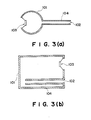
- the resonance radiator unit is realized by an opening port 102 formed in a a Helmholtz resonator 101 as indicated in Figs. 3(a) and 3(b).
- a vibrator 103 is designed to be driven by a vibrator drive means generating negative impedance.
- a duct 104 will have to be lengthened while keeping the cross-sectional area of the opening port 102 at a fixed level, necessarily resulting in that the duct 104 greatly protrudes from the Helmholtz resonator 101 as shown in Fig. 3(a) or the duct 104 extends far into the inside of the Helmholtz resonator 101 as indicated in Fig. 3(b).
- the opening port 102 is inevitably small in area, it is excellent in sound source concentration but it is contrary to the users' general concept that a woofer has a great caliber. Thus, such a cabinet may not be fully satisfactory.
- this invention can overcome the problems raised in the invention of said prior Japanese application.
- the resonator is not limited to one shown in Fig. 1(a).
- the shape of the cavity or body portion is not limited to a sphere but can be a rectangular prism or cube, and the volume of the resonator is not particularly limited.
- vibrator electroacoustic transducer
- dynamic type electromagnetic type
- piezoelectric type piezoelectric type
- electrostatic type vibrators can be adopted.
- Fig. 4 shows the basic arrangement of such a means.
- an output from an amplifier 131 having a gain A is supplied to a load Z L corresponding to a speaker 132.
- a current i flowing through the load Z L is detected, and the detected current is positively fed back to the amplifier 131 through a feedback circuit 133 having a transmission gain ⁇ .
- Z S is the impedance of a sensor for detecting a current. Note that embodiments corresponding to such circuits are disclosed in Japanese Patent Publication Nos. sho 59-51771 and sho 54-33704.
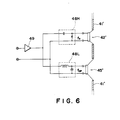
- Fig. 5 is a diagram of a concrete example wherein the present invention is applied to a rectangular-prism cabinet.
- a hole is formed in the front surface of a rectangular-prism cabinet 41, and a dynamic direct radiation speaker 42 is mounted therein.
- the speaker 42 is constituted by a conical active diaphragm 43, and a dynamic transducer 44 arranged near the top of the cone.
- a passive diaphragm 45 in the shape of cone is attached below the speaker 42 in the cabinet 41, and constitutes a virtual woofer characterizing the present invention.
- a driver circuit 46 has a servo circuit 47 for effecting a negative resistance driving, and the dynamic transducer 44 is driven by the output from the servo circuit 47.
- the dynamic transducer 44 has a voice coil DC resistance R v as an inherent internal impedance, while the driver circuit 46 has an equivalent negative resistance component (-R v ) in the output impedance. Therefore, the resistance R v is substantially invalidated.
- Reference symbols R M , L M and C M denote motional impedances obtained when the speaker 42 is electrically equivalently expressed
- reference symbols R c and L c denote impedances obtained when the cabinet 41 is electrically equivalently expressed
- reference symbols R p , L p and C p denote motional impedances obtained when the passive diaphragm 45 is electrically equivalently expressed.
- a middle/high range speaker 42′ formed by the speaker 42 and a virtual woofer 45′ equivalently formed by the passive diaphragm 45 are equivalent to a state wherein they are mounted on a closed cabinet 41′ having an infinite volume, so that very excellent bass reproduction characteristics can be realized.
- the middle/high range speaker 42′ is connected to a conventional amplifier 49 (which is not subjected to active servo drive) through an equivalently formed high-pass filter (HPF) 48H.
- HPF high-pass filter
- the woofer 45′ is connected to the amplifier 49 through an equivalently formed low-pass filter (LPF) 48L.
- LPF low-pass filter
- HPF 48H and the LPF 48L are equivalently formed, the arrangement of the driver circuit can be simplified.
- HPF and LPF must be connected to inputs of a tweeter (high range speaker) and a woofer, respectively. Since these filters must have capacitances and inductances, the cost of the driver tends to be increased, and the volume of the filters occupied in the driver circuit tends to be also increased. In addition, their designs must be separately performed. In this invention, since these filters are equivalently formed, these prior art problems can be solved.
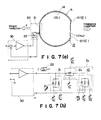
- a vibrator driver 30 comprises a motional feedback (MFB) unit for detecting, by using any appropriate method, motional signal corresponding to movement of the active diaphragm 21 and negatively feeding back the signal to the input side of the driver 30.
- MFB motional feedback
- the constitution of an electric equivalent circuit of the acoustic apparatus, which is shown in Fig. 7(b), is quite the same as that of the first embodiment.
- the original impedance equivalent circuit of the vibrator 20 is composed of a series circuit wherein said equivalent motional impedance Z M and the inherent internal impedance Z v of the transducer 22 are included, as viewed from electric equivalency.
- the motional signal S M to be detected from the equivalent motional impedance Z M includes the voltage across the equivalent motional impedance, the differential output or integral output thereof; these factors so included correspond respectively to the vibration velocity, vibration acceleration and vibration displacement (amplitude) of the active diaphragm 21.
- the motional feedback constitution or arrangement provided in the vibrator driver 30 has a motional signal detecting unit 24 for detecting as the motional signal an amount corresponding to any one of said factors, and a motional signal S M so detected is negatively fed back through a feedback unit 25 to the input side of the vibrator driver 30.
- the transducer 22 electro-mechanical converts the drive signal so as to reciprocally drive the active diaphragm 21 forward and backward (in the right and left directions in the Figure), the active diaphragm 21 mechanical-acoustic converts this reciprocal motion. Since the vibrator driver 30 has a motional feedback unit, if the amount of negative feedback is extremely large, the condition of driving the vibrator driver 30 is brought under follow-up control so that a signal in an amount corresponding to the drive input is always correctly transmitted as the terminal voltage across said equivalent motional impedance, the differential voltage and integral voltage of said terminal voltage.
- the vibrator driver 30 is apparently become equivalent to subjecting the equivalent motional impedance itself of the vibrator 20 directly to linear, integral or differential driving, and the internal impedance inherent in the transducer 22 is effectively invalidated. Therefore, the transducer 22 drives the active diaphragm 21 faithfully in response to the drive signal from the vibrator driver 30, and independently supplies a drive energy to the resonator 10. For this reason, as in the first embodiment, sound pressure-frequency characteristics shown in, e.g., Fig. 2 can be obtained.
- the second embodiment of the invention is characteristic of so-called excessive compensation being not caused at all.
- the motional feedback is follow-up controlled so that a signal in an amount corresponding to the drive input is correctly transmitted to the equivalent motional impedance side, thereby to apparently invalidate the internal impedance.
- the reduction or invalidation of the internal impedance is realized by detecting a motional signal corresponding to the movement of the diaphragm and putting the drive condition under negative feedback control so that said signal always corresponds to the the drive input, and the magnitude of the internal impedance is reduced to 1/ ⁇ when the amount of negative feedback is ⁇ .
- the internal impedance is completely cancelled under an ideal condition wherein said ⁇ is infinitely great, and there cannot, in principle, be caused excessive compensation which exhibits negative impedance as a whole due to cancellations excessively caused.
- said internal impedance will not greatly vary in the degree of reduction and invalidation thereof if the ⁇ is great to a certain extent; for this reason, unlike the first embodiment, it is not necessary at all to change the degree of motional feedback (that is, to effect temperature compensation).
- the system of detecting the motional signal includes a system of detecting displacement, a system of detecting velocity or a system of detecting acceleration, and the detecting unit has a constitution by which a motional signal is detected in an electric circuit manner from the output of a vibrator driver or from the diaphragm of a vibrator.
- the displacement detecting system is such that there is obtained a motional signal in an amount corresponding to the amplitude of a diaphragm, that is, corresponding to the integral output of the voltage across an equivalent motional impedance.
- the displacement detecting system is exemplified by a capacity-variable MFB speaker.
- the velocity detecting system is such that there is obtained the velocity of a diaphragm, that is a motional signal in an amount corresponding to the differential output of the voltage across an equivalent motional impedance, and is known as a detection coil type MFB speaker.
- the acceleration detecting system is such that there is obtained a motional signal in an amount corresponding to the acceleration of a diaphragm, that is, an amount corresponding to the voltage across an equivalent motional impedance itself, and is known as a piezo-electric MFB loudspeaker.
- the amplitude-corresponding, velocity-corresponding and acceleration-corresponding motional signals detected as mentioned above may be converted to one another by the use of a differential circuit or integral circuit. Therefore, irrespective of the fact that which one of the three detecting systems is used, signals corresponding to amplitude, velocity and acceleration can be fed back singly or in suitable combination.
- Fig. 9 there will be explained an example of bridge-type motional feedback as a system which detects the motional signal by the electrically constituted detecting means and negatively feeds it back.
- Fig. 9 is a circuit concerned.
- a band pass filter (BPF) circuit 220 allows a signal V i to be inputted thereto from an input terminal 209 and outputs a signal (V i + V M ).
- This circuit enables the voltage wave form of the input signal Vi to be accurately transmitted to between both the ends of the motional impedance of the speaker 223.
- An amplifier unit 221 is composed of a voltage amplifier 221a having a large open-loop-gain, and transistors 221b and 221c which compose a capability stage.
- the output terminal of the amplifier unit 221 is connected to one terminal of the speaker 223, and one surface of the diaphragm of the speaker 223 serves as a direct radiator portion for radiating acoustic waves directly to the outside, while the other surface serves as a resonator driver portion.
- a resonator (not shown) having a passive diaphragm is provided.
- the speaker 223, resistors 224 to 226 and 231, and capacitor 227 together constitute a bridge circuit 232 for detecting the motional voltage V M .
- the combined resistance of the resistors 224 to 226 within the bridge circuit 232 represented by ( ⁇ R v + ⁇ R s /2 + ⁇ R s /2), is set to be sufficiently larger than that (R v + R s ) of the resistors 228 and 231, and the resistance R s of resistor 231 is set to be sufficiently smaller than the resistance R v of the resistor 228.
- the bridge circuit 232, the amplifiers 234 and 237, the resistors 235, 236, 238 and 239, and the capacitor 240 together constitute a bridge amplifier unit 241.
- This bridge amplifier unit 241 corresponds to a detecting means for detecting motional voltage applied to the equivalent motional impedance and outputting a motional signal.
- the motional voltage V M of the speaker 223 can be obtained from the output voltage V4 of the bridge amplifier 234 with accuracy.
- the BPF circuit 220 the signal level of predetermined frequency components of the input signal V i is raised. More specifically, the internal impedance inherent in the speaker 223 is apparently invalidated due to the motional feedback drive being effected, resulting in that the speaker 223 behaves in such a manner as Q 0 thereby to lower the sound pressure characteristic at the value neighborhood corresponding to the lowest resonance frequency f o ; to compensate for said lowering, the signal level in the pertinent frequency band is raised.
- This signal (V i + V M ) is amplified by the amplifier 221a within the amplifier unit 221. Then, the amplified signal is supplied to the speaker 223, whereby the speaker 223 will be driven to exhibit approximately flat sound pressure characteristics.
- the motional voltage V M is produced between both the terminals of the equivalent circuit 230 of the speaker 223.
- the motional voltage V M is detected by the bridge amplifier unit 241, and the detected motional voltage V M is supplied to the inverting input terminal of the amplifier 221a via the capacitor 242. Since a capacitor 227 corresponding to the internal inductance of the speaker 223 is provided in the detection bridge, the motional voltage is far more correctly detected by this detection bridge than by a conventional one, whereby the motional voltage V M is correctly fed back in an extremely large amount of feedback to the amplifier unit 221.
- the vibration system of the speaker 223 does substantially not serve as a resonance system, and the diaphragm of the speaker 223 becomes equivalent to the wall surface of a resonator (not shown) resulting in that energy is supplied to this resonance system independently of the vibration system of the speaker 223.
- the Q value of the resonator will not decrease at all even if the speaker 223 is provided along by the resonator, resulting in that the acoustic wave radiation capability of said resonator is sufficiently enhanced.
- Methods for detecting motional signals are not limited to those mentioned and various modified one are useful.
- Detection using semiconductors can be carried out, for example, by inserting a magnetism-sensitive semiconductor element (Japanese Utility Model Publication No. sho 44-28472) or by providing a hall element in front of the pole piece of a speaker (Japanese Pat. Appln. Laid-Open No. sho 49-102324).
- Detection using piezo-electric effects can be carried out, for example, by providing a piezo-electric element in front of the cone paper of a cone speaker (Japanese Utility Model Publication No. sho 41-20247).
- electrostatic detection of the amplitude of a diaphragm is carried out by, for example, providing a bobbin movable electrode between an internal fixed electrode and an external fixed electrode (Japanese Patent Publication No. sho 54-36486).
- Fig. 10 is a diagram of arrangement of a concrete example wherein the present invention is applied to a rectangular-prism cabinet.
- a passive diaphragm in a shape of flat plate is disposed, in a manner that it can be movable forwards and backwards, below a dynamic direct radiation speaker 42 attached to the front surface of a rectangular-prism cabinet 41, and constitutes a virtual woofer characterizing the present invention.
- a driver circuit 46 has a driver unit 47a having a large-open-loop gain, a detecting unit 47b for detecting the motional voltage applied to the equivalent motional impedance of the dynamic transducer 44, a feedback unit 47c for effecting a predetermined conversion on the output of the detecting unit 47b, and a subtracter 47d for negatively feeding back the motional signal outputted from the feedback unit 47c.
- the dynamic transducer 44 is driven by the output of the driver circuit 46.
- the dynamic transducer 44 has a voice coil DC resistance R v as an inherent internal impedance, which can be apparently invalidated by the feedback driving of the driver circuit 46.
- a middle/high range speaker formed by the speaker 42 and a virtual woofer equivalently formed by the passive diaphragm 45 are equivalent to a state wherein they are mounted on a closed cabinet having an infinite volume.
- the middle/high range speaker is connected to a conventional amplifier (which is not subjected to active servo drive) through an equivalently formed high-pass filter (HPF).
- HPF high-pass filter
- LPF low-pass filter
- sound pressure-frequency characteristics of the vibrator and the resonator as a whole can be arbitrarily set by increasing/decreasing an input signal level to an amplifier. Since both the vibrator and the resonator have sufficient acoustic radiation capabilities, the input signal level need only be adjusted, so that the sound pressure-frequency characteristics of the overall apparatus can be easily realized by wide-range uniform reproduction. In the circuit shown in Fig. 9, such adjusting is realized e.g. by the BPF circuit 220.
- the resonator is driven by the resonator driver portion of the active diaphragm whereby an acoustic wave is directly radiated outwards from the direct radiator portion of the active diaphragm, and an acoustic wave caused by resonance is radiated outwards from the passive diaphragm serving as the resonance radiation unit of the resonator.
- the vibrator has an inherent internal impedance
- the vibrator drive means for driving the vibrator has a drive control means for controlling the drive condition so as to cancel the atmospheric counteraction of the resonator at the time of driving of the resonator by the vibrator. Therefore, when the vibrator drive means comprises a means for equivalently generating a negative impedance component in the output impedance or when the vibrator drive means comprises a motional feedback means for detecting a motional signal corresponding to vibration deviation, velocity or acceleration of the motional impedance of the vibrator and negatively feeding back said motional signal to the input side of said vibrator drive means, said internal impedance inherent in the vibrator can be apparently reduced.
- the vibrator becomes an element responsive to only an electrical drive signal input, and does not function as a resonance system.
- the volume of the resonator is no longer a factor which influences low-frequency reproduction capabilities of the vibrator.
- the resonance frequency of the resonator can be easily lowered by increasing the equivalent mass of the passive diaphragm, and a decrease in acoustic radiation capabilities which is caused by increasing the equivalent mass of the passive diaphragm can be slight as compared with such a decrease which is caused by increasing an air equivalent mass. This enable a miniaturized (especially thinned) cabinet to be used and its caliber to be optionally designed.
- the compact size and super-bass (heavy bass) reproduction can be simultaneously achieved, and designing can be facilitated.
- the acoustic apparatus of the present invention can be widely applied to sound sources of electronic or electric musical instruments, and the like as well as audio speaker systems.
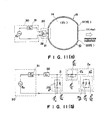
- Figs. 11(a) and 11(b) show a basic arrangement of a third embodiment of the present invention.
- a resonator 10 having a passive diaphragm 11 serving as a resonance radiation unit is used.
- a resonance phenomenon is caused by a closed cavity (hollow drum) 14 formed in a body portion 15 and the passive diaphragm 11 attached to the body portion 15 with the fringe portion 12.
- the resonance frequency f op is given by equation (1) as described above.
- a vibrator 20 constituted by an active diaphragm 21 and a transducer 22 is attached to the body portion 15 of the resonator 10.
- the transducer 22 is connected to a vibrator driver 30, which comprises a negative impedance generator unit 31 for equivalently generating a negative impedance component (-Z0) in the output impedance.
- acoustic apparatus indicated in Fig. 11(a) is quite the same as that indicated in Fig. 1(a) except that the former is lacking in a portion corresponding to the direct radiator portion of the active diaphragm 21.
- said portion corresponding to the direct radiator portion constitutes a second resonance driver portion like the back face of the diaphragm of the speaker of the conventional apparatus mentioned above as the fifth prior art or is tightly closed by a cabinet like the back face of the diaphragm of the first speaker of the conventional apparatus mentioned above as the sixth prior art.
- Fig. 11(b) shows the electric equivalent circuit of the acoustic apparatus of Fig. 11(a). The circuit is the same as that of Fig. 1(b).
- the transducer 22 When a drive signal is supplied from the vibrator driver 30 having a negative impedance drive function to the transducer 22 of the vibrator 20, the transducer 22 electric-mechanical converts the drive signal so as to reciprocally drive the active diaphragm 21 forward and backward (in the right and left directions in the Figure). Since the vibrator driver 30 has the negative impedance drive function, the internal impedance inherent in the transducer 22 is effectively decreased (ideally invalidated). Therefore, the transducer 22 drives the active diaphragm 21 faithfully in response to the drive signal from the vibrator driver 30, and independently supplies a drive energy to the resonator 10.
- the front surface side (the right surface side in the Figure) of the active diaphragm 21 receives an atmospheric counteraction from air in the cavity of the resonator 10, and the vibrator driver 30 drives the vibrator 20 so as to cancel the counteraction.
- the internal impedance Z v inherent in the transducer 22 of the vibrator 20 is equivalently invalidated.
- the active diaphragm 21 becomes an equivalent wall of the resonator 10, and the resonance Q value ideally becomes infinite. For this reason, air in the resonator 10, and the passive diaphragm 11 and the fringe portion 12 are resonated, so that an acoustic wave having a sufficient sound pressure is radiated from the passive diaphragm serving as the resonance radiation unit.
- the resonance frequency f op is set in a predetermined frequency range, and the resonance Q value is set to be an appropriate level, sound pressure-frequency characteristics shown in, e.g., Fig. 12 can be obtained.
- a dotted characteristic curve in the Figure represents an example of frequency characteristics of the vibrator itself.
- a parallel resonance circuit Z1 consisting of the equivalent motional impedance of the vibrator 20 and a series resonance circuit Z2 consisting of the equivalent motional impedance of the resonator 10 are respectively short-circuited with zero impedance in an AC (alternate current) manner.
- the parallel resonance circuit Z1 and the series resonance circuit Z2 become to be present as resonance systems independently of each other.
- the resonator 10 is designed to be compact in order to reduce the size of the system, or when the passive diaphragm 11 is designed to be enlarged in order to lower the resonance frequency of the passive resonance system, the design of the unit vibration system is not influenced at all, and the value corresponding to the lowest resonance frequency f o is not influenced at all, either. For this reason, easy designing of a vibrator and a resonator free from the mutual dependency condition is allowed.
- the two circuits come under a condition of Z1 » Z2 in the neighborhood of resonance frequency f op , the resonator 10 is driven by a large current and a small-amplitude voltage. Therefore, the transducer 22 connected in parallel therewith is also driven by the small-amplitude voltage, and hence, the active diaphragm 21 performs a small-amplitude operation.
- the active diaphragm 21 performs the small-amplitude operation, a nonlinear distortion which usually occurs in a large-amplitude operation of a dynamic cone speaker can be effectively eliminated in, particularly, a super-bass range.
- the resonance Q value of the passive resonance system will apparently increase in accordance with the formula (10).
- the acoustic radiation power seen in terms of sound pressure levels will decrease at a rate of about 6 dB/oct with the decrease of the resonance frequency f op , and, thus, such an apparent increase in said value would not be an appreciably remarkable effect from the standpoint of overall judgement.
- a resonator in which the passive diaphragm is replaced by an equivalent mass constituted by air, the mass corresponding to said passive diaphragm.
- a resonator is one in which is used a Helmholtz resonator having an opening duct port such as a bass-reflex type speaker cabinet.
- the opening duct port is modified in dimension and shape to increase the equivalent mass in order to lower the resonance frequency.
- the port must be narrowed or lengthened thereby necessarily increasing air resistance with an attendant great increase in said equivalent resistance whereby both the Q value and acoustic radiation capability lower at a further greater rate than a case wherein said passive diaphragm is used.
- the internal impedance inherent in the vibrator will necessarily come to be the damping resistance of a resonance circuit as long as the driver constitution for this vibrator is of a usual type (simple voltage driving type), and the value of this damping resistance is far great as compared with the magnitude of said equivalent resistance, resulting in that the Q value of the resonator is extremely lowered.
- the aforesaid negative impedance drive or the following motional feedback drive is carried out.
- the internal impedance inherent in the vibrator is apparently decreased and will not serve as a damping element even if the resonator is provided with the vibrator.
- the active diaphragm of the vibrator has been converted into the wall of the resonator.
- the resonance radiator unit is realized by an opening port 102 formed in a a Helmholtz resonator 101 as indicated in Figs. 13(a) and 13(b). Further, a vibrator 103 is designed to be driven by a vibrator drive means generating negative impedance.
- a duct 104 will have to be lengthened while keeping the cross-sectional area of the opening port 102 at a fixed level, necessarily resulting in that the duct 104 greatly protrudes from the Helmholtz resonator 101 as shown in Fig. 13(a) or the duct 104 extends far into the inside of the Helmholtz resonator 101 as indicated in Fig. 13(b).
- the opening port 102 is inevitably small in area, it is excellent in sound source concentration but it is contrary to the users' general concept that a woofer has a great caliber. Thus, such a cabinet may not be fully satisfactory.
- this invention can overcome the problems raised in the invention of said prior Japanese application.
- the shape of the cavity portion may be, for example, spheric, rectangular in section or cubic.
- the vibrators which may be used include dynamic type, electromagnetic type, piezoelectric type, and electrostatic type vibrators.
- Fig. 14 is a diagram of a concrete example wherein the present invention is applied to a rectangular-prism cabinet.
- a hole is formed in the rear surface of a rectangular-prism cabinet 41, and a dynamic direct radiation speaker 42 is mounted therein.
- the speaker 42 is constituted by a conical active diaphragm 43, and a dynamic transducer 44 arranged near the top of the cone.
- a passive diaphragm 45 in the shape of cone is mounted on the front surface of the cabinet 41, and constitutes a virtual woofer characterizing the present invention.
- a driver circuit 46 has a servo circuit 47 for effecting a negative resistance driving, and the dynamic transducer 44 is driven by the output from the servo circuit 47.
- the dynamic transducer 44 has a voice coil DC resistance R v as an inherent internal impedance, while the driver circuit 46 has an equivalent negative resistance component (-R v ) in the output impedance, so that the resistance R v can be substantially invalidated by the negative resistance component.
- Reference symbols R M , L M and C M denote motional impedances obtained when the speaker 42 is electrically equivalently expressed
- reference symbols R c and L c denote impedances obtained when the cabinet 41 is electrically equivalently expressed
- reference symbols R p , L p and C p denote motional impedances obtained when the passive diaphragm 45 is electrically equivalently expressed.
- a virtual speaker 45′ equivalently formed by the passive diaphragm 45 is equivalent to a state wherein it is mounted on a closed cabinet 41′ having an infinite volume.
- the speaker 45′ is connected to a conventional amplifier 49 (which is not subjected to active servo drive) through an equivalently formed low-pass filter (LPF) 48.
- LPF low-pass filter
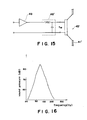
- sound pressure-frequency characteristics of the sound wave radiated from the passive diaphragm 45 can be controlled not only by adjusting its equivalent mass but also by increasing/decreasing the input signal level of the amplifier. For example, an acoustic wave radiation having a frequency dependency shown in Fig. 16.
- a resonator comprises first and second resonators 51a and 51b, which have passive diaphragms 52a and 52b which are movable right and left directions, respectively.
- a hole is formed in a partition wall 53 between the resonators 51a and 52b, and a dynamic speaker 54 is mounted therein.
- the speaker 54 is driven by a drive controller 30 equivalently having a negative output impedance (-R v ) and is not influenced by atmospheric counteractions from the first and second resonators 51a and 51b, and its active diaphragm equivalently becomes a part of wall surfaces of these resonators.
- resonance systems A and B have independent resonance frequencies f opa and f opb , respectively.
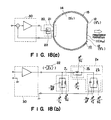
- a vibrator driver 30 comprises a motional feedback (MFB) unit for detecting, by using any appropriate method, motional signal corresponding to movement of the active diaphragm 21 and negatively feeding back the signal to the input side of the driver 30.
- MFB motional feedback
- the constitution of an electric equivalent circuit of the acoustic apparatus is quite the same as that shown in Figs. 7(b) and 8 for explaining the third embodiment.
- the original impedance equivalent circuit of the vibrator 20 is composed of a series circuit wherein said equivalent motional impedance Z M and the inherent internal impedance Z v of the transducer 22 are included, as viewed from electric equivalency.
- the motional signal S M to be detected from the equivalent motional impedance Z M includes the voltage across the equivalent motional impedance, the differential output or integral output thereof; these factors so included correspond respectively to the vibration velocity, vibration acceleration and vibration displacement (amplitude) of the active diaphragm 21.
- the motional feedback constitution or arrangement provided in the vibrator driver 30 has a motional signal detecting unit 24 for detecting as the motional signal an amount corresponding to any one of said factors, and a motional signal S M so detected is negatively fed back through a feedback unit 25 to the input side of the vibrator driver 30.
- the transducer 22 electro-mechanical converts the drive signal so as to reciprocally drive the active diaphragm 21 forward and backward (in the right and left directions in the Figure). Since the vibrator driver 30 has a motional feedback unit, if the amount of negative feedback is extremely large, the condition of driving the vibrator driver 30 is brought under follow-up control so that a signal in an amount corresponding to the drive input is always correctly transmitted as the terminal voltage across said equivalent motional impedance, the differential voltage and integral voltage of said terminal voltage. In other words, motional voltages applied to the equivalent motional impedance are controlled so that they correspond to the drive input in a relation of 1:1.
- the vibrator driver 30 is apparently become equivalent to subjecting the equivalent motional impedance itself of the vibrator 20 directly to linear, integral or differential driving, and the internal impedance inherent in the transducer 22 is effectively invalidated. Therefore, the transducer 22 drives the active diaphragm 21 faithfully in response to the drive signal from the vibrator driver 30, and independently supplies a drive energy to the resonator 10.
- the front surface side (the right surface side in the Figure) of the active diaphragm 21 serves as a resonance driver portion for driving the resonator 10, and is effected an atmospheric counteraction from air in the cavity of the resonator 10.
- the vibrator driver 30 drives the vibrator 20 by the motional feedback operation so as to cancel the atmospheric counteraction.
- the diaphragm 21 becomes an equivalent wall of the resonator 10, and the resonance Q value ideally becomes infinite. Accordingly, as in the third embodiment, by adjusting an equivalent mass of the passive diaphragm 11, sound pressure-frequency characteristics shown in, e.g., Fig. 12 can be obtained.
- the constitution of the vibrator driver 30 of the fourth embodiment is quite the same as that of the second embodiment and, therefore, the same explanation may apply to the fourth embodiment.
- the fourth embodiment of the invention is also characteristic of so-called excessive compensation being not caused at all. Therefore, in this embodiment, an extremely large amount of negative feedback may be effected, so that the internal impedance (R v , L v ) is almost completely invalidated whereby there can be realized a bass reproduction entirely without including distortions caused by the transient response of the vibration system.
- the same flat sound pressure-frequency characteristics as conventional can finally be realized and, further, said characteristics can be extended to a lower region depending on the contents of said drive input level control.
- the shape of the cavity portion may be, for example, spheric, rectangular in section or cubic.
- the vibrators which may be used include dynamic type, electro-magnetic type, piezoelectric type, and electrostatic type vibrators. Motional feedback and motional signal detection may also be effected by the use of the system indicated above in the explanation about the second embodiment.
- Fig. 19 is a diagram of a concrete example wherein this invention is applied to a rectangle-prismatic shaped cabinet.
- a dynamic speaker 42 is mounted on the rear surface of a rectangle-prismatic shaped cabinet 41, and on its opposite side, a conical shaped passive diaphragm 45 is disposed whereby the passive diaphragm 45 forms a virtual woofer characterizing the present invention.
- a driver circuit 46 has a driver unit 47a having a large-open-loop gain, a detecting unit 47b for detecting the motional voltage applied to the equivalent motional impedance of the dynamic transducer 44 of the speaker 42, a feedback unit 47c for effecting a predetermined conversion on the output of the detecting unit 47b, and a subtracter 47d for negatively feeding back the motional signal outputted from the feedback unit 47c to the input side of the driver circuit 46.
- the dynamic transducer 44 is driven by the output of the driver circuit 46.
- the dynamic transducer 44 has a voice coil DC resistance R v as an inherent internal impedance, which can be apparently invalidated by the feedback driving of the driver circuit 46.
- a virtual speaker 45′ equivalently formed by the passive diaphragm 45 is equivalent to a state wherein it is mounted on a closed cabinet 41′ having an infinite volume.
- the virtual speaker 45′ is equivalently connected to a conventional amplifier 49 (which is not subjected to active servo drive) through an equivalently formed low-pass filter (LPF).
- LPF low-pass filter
- sound pressure-frequency characteristics of the resonator can be arbitrarily set by increasing/decreasing an input signal level according to the signal frequency by the amplifier.
- such adjustment is realized by e.g. the BPF circuit 220.
- a vibrator having an active diaphragm for driving a resonator has an inherent internal impedance. Since the vibrator is driven so that the atmospheric counteraction caused from the resonator is canceled, the active diaphragm equivalently becomes the wall of the resonator and the presence of the vibrator is invalidated from the standpoint of the resonator. Accordingly, the internal impedance inherent in the vibrator does not constitute a factor which reduces the resonance Q value of the resonator. For this reason, the resonance Q value is extremely heightened and this is true when negative impedance drive is carried out or when motional feedback drive is effected.
- the acoustic resistance as the resonator is increased by using a miniaturized resonator and lowering the resonance frequency; therefore, the resonance Q value will not be lowered according to this invention even in a case where the resonance Q value is greatly lessened according to the usual drive system.
- the resonance frequency of the resonator may be easily lowered by increasing the equivalent mass of the passive diaphragm, and a decrease in acoustic radiation capabilities which is caused by increasing the equivalent mass of the passive diaphragm and lowering the resonance frequency is slight as compared with such a decrease which is caused by increasing the air mass.
- This enables a miniaturized (especially thinned) cabinet to be used and its caliber to be optionally designed, resulting in that the cabinet has satisfactory acoustic radiation capabilities although it is a small-sized one.
Landscapes
- Physics & Mathematics (AREA)
- Engineering & Computer Science (AREA)
- Acoustics & Sound (AREA)
- Signal Processing (AREA)
- Health & Medical Sciences (AREA)
- Otolaryngology (AREA)
- Circuit For Audible Band Transducer (AREA)
- Obtaining Desirable Characteristics In Audible-Bandwidth Transducers (AREA)
Applications Claiming Priority (4)
| Application Number | Priority Date | Filing Date | Title |
|---|---|---|---|
| JP81032/88 | 1988-04-01 | ||
| JP8103288A JPH01253396A (ja) | 1988-04-01 | 1988-04-01 | 音響装置 |
| JP81033/88 | 1988-04-01 | ||
| JP8103388A JPH01253397A (ja) | 1988-04-01 | 1988-04-01 | 音響装置 |
Publications (2)
| Publication Number | Publication Date |
|---|---|
| EP0340435A2 true EP0340435A2 (de) | 1989-11-08 |
| EP0340435A3 EP0340435A3 (de) | 1991-04-24 |
Family
ID=26422072
Family Applications (1)
| Application Number | Title | Priority Date | Filing Date |
|---|---|---|---|
| EP19890104934 Withdrawn EP0340435A3 (de) | 1988-04-01 | 1989-03-20 | Akustischer Apparat |
Country Status (2)
| Country | Link |
|---|---|
| US (1) | US5009280A (de) |
| EP (1) | EP0340435A3 (de) |
Cited By (4)
| Publication number | Priority date | Publication date | Assignee | Title |
|---|---|---|---|---|
| WO1991001074A1 (de) * | 1989-07-13 | 1991-01-24 | Stark, Henric | Lautsprecherbox |
| WO1997009849A1 (en) * | 1995-09-02 | 1997-03-13 | New Transducers Limited | Loudspeakers with panel-form acoustic radiating elements |
| WO2009136228A1 (en) * | 2008-05-09 | 2009-11-12 | Sony Ericsson Mobile Communications Ab | Vibration generator for electronic device having speaker driver and counterweight |
| EP3257264A4 (de) * | 2015-02-13 | 2019-01-02 | Keyofd Aktiebolag | Lautsprechergehäuse mit einer abgedichteten akustischen aufhängungskammer |
Families Citing this family (7)
| Publication number | Priority date | Publication date | Assignee | Title |
|---|---|---|---|---|
| GB2261136B (en) * | 1990-06-08 | 1995-02-15 | Simon Paul Carrington | Loudspeaker with an oscillator having a coiled tubular chamber |
| TW200829053A (en) * | 2006-12-21 | 2008-07-01 | Global Target Entpr Inc | Thin-film type sound source output apparatus |
| US8224009B2 (en) * | 2007-03-02 | 2012-07-17 | Bose Corporation | Audio system with synthesized positive impedance |
| USD605169S1 (en) * | 2007-08-31 | 2009-12-01 | Sony Corporation | Headphone |
| KR20100019642A (ko) * | 2008-08-11 | 2010-02-19 | 삼성전자주식회사 | 스피커장치 및 이를 구비하는 영상표시장치 |
| US8401207B2 (en) | 2009-03-31 | 2013-03-19 | Harman International Industries, Incorporated | Motional feedback system |
| KR101952906B1 (ko) * | 2017-12-20 | 2019-02-28 | 부전전자 주식회사 | 복수 진동판을 가진 음향기기 |
Family Cites Families (11)
| Publication number | Priority date | Publication date | Assignee | Title |
|---|---|---|---|---|
| BE720115A (de) * | 1968-08-29 | 1969-02-03 | ||
| US3821473A (en) * | 1969-06-20 | 1974-06-28 | J Mullins | Sound reproduction system with driven and undriven speakers and motional feedback |
| US3821423A (en) * | 1971-12-28 | 1974-06-28 | Jamin C N V | Hollow article made of chocolate |
| US3984635A (en) * | 1975-03-11 | 1976-10-05 | Electro Acoustical Labs, Inc. | Low range loudspeaker system |
| US4180706A (en) * | 1976-04-30 | 1979-12-25 | Bang & Olufsen A/S | Loudspeaker motional feedback system |
| FR2369767A1 (fr) * | 1976-10-29 | 1978-05-26 | Thomson Csf | Enceinte electroacoustique asservie |
| US4287389A (en) * | 1978-10-30 | 1981-09-01 | Gamble George W | High-fidelity speaker system |
| GB2037534B (en) * | 1978-11-08 | 1983-02-16 | Holliman G | Loudspeakers |
| US4618025A (en) * | 1980-09-15 | 1986-10-21 | Sherman Dan R | Acoustical ducting for speakers and enclosures |
| US4549631A (en) * | 1983-10-24 | 1985-10-29 | Bose Corporation | Multiple porting loudspeaker systems |
| US5031221A (en) * | 1987-06-02 | 1991-07-09 | Yamaha Corporation | Dynamic loudspeaker driving apparatus |
-
1989
- 1989-03-20 EP EP19890104934 patent/EP0340435A3/de not_active Withdrawn
- 1989-03-24 US US07/328,473 patent/US5009280A/en not_active Expired - Lifetime
Cited By (5)
| Publication number | Priority date | Publication date | Assignee | Title |
|---|---|---|---|---|
| WO1991001074A1 (de) * | 1989-07-13 | 1991-01-24 | Stark, Henric | Lautsprecherbox |
| WO1997009849A1 (en) * | 1995-09-02 | 1997-03-13 | New Transducers Limited | Loudspeakers with panel-form acoustic radiating elements |
| WO2009136228A1 (en) * | 2008-05-09 | 2009-11-12 | Sony Ericsson Mobile Communications Ab | Vibration generator for electronic device having speaker driver and counterweight |
| US8150072B2 (en) | 2008-05-09 | 2012-04-03 | Sony Ericsson Mobile Communications Ab | Vibration generator for electronic device having speaker driver and counterweight |
| EP3257264A4 (de) * | 2015-02-13 | 2019-01-02 | Keyofd Aktiebolag | Lautsprechergehäuse mit einer abgedichteten akustischen aufhängungskammer |
Also Published As
| Publication number | Publication date |
|---|---|
| US5009280A (en) | 1991-04-23 |
| EP0340435A3 (de) | 1991-04-24 |
Similar Documents
| Publication | Publication Date | Title |
|---|---|---|
| US5009281A (en) | Acoustic apparatus | |
| US4943956A (en) | Driving apparatus | |
| US5313525A (en) | Acoustic apparatus with secondary quarterwave resonator | |
| US4997057A (en) | Method and apparatus of expanding acoustic reproduction range | |
| EP0336303A2 (de) | Akustischer Apparat | |
| EP0347775B1 (de) | Tasteninstrument | |
| US5010977A (en) | Acoustic apparatus with plural resonators having different resonance frequencies | |
| EP0322686B1 (de) | Akustischer Apparat | |
| JPS5961209A (ja) | 電気信号を音響信号に変換する装置 | |
| US5009280A (en) | Acoustic apparatus | |
| EP0322679B1 (de) | Akustischer Apparat | |
| JPH0241098A (ja) | 電気/電子楽器 | |
| JP2976284B2 (ja) | スピーカシステムの低音増強装置 | |
| JP2558981B2 (ja) | 低音再生装置 | |
| JPH01253397A (ja) | 音響装置 | |
| JPH01253396A (ja) | 音響装置 | |
| JP2737930B2 (ja) | 電子楽器 | |
| JP2737922B2 (ja) | 音響装置 | |
| JP2558978B2 (ja) | 低音再生装置 | |
| JPH062387Y2 (ja) | スピ−カシステム | |
| JPH01296798A (ja) | 駆動装置およびその制御情報収納体 | |
| JPH01254097A (ja) | 音響装置 | |
| JPH01319792A (ja) | 電子楽器 | |
| JPH01229598A (ja) | 音響装置 | |
| JPH0728471B2 (ja) | 駆動装置 |
Legal Events
| Date | Code | Title | Description |
|---|---|---|---|
| PUAI | Public reference made under article 153(3) epc to a published international application that has entered the european phase |
Free format text: ORIGINAL CODE: 0009012 |
|
| AK | Designated contracting states |
Kind code of ref document: A2 Designated state(s): DE FR GB SE |
|
| 17P | Request for examination filed |
Effective date: 19900202 |
|
| PUAL | Search report despatched |
Free format text: ORIGINAL CODE: 0009013 |
|
| AK | Designated contracting states |
Kind code of ref document: A3 Designated state(s): DE FR GB SE |
|
| 16A | New documents despatched to applicant after publication of the search report | ||
| 17Q | First examination report despatched |
Effective date: 19930719 |
|
| STAA | Information on the status of an ep patent application or granted ep patent |
Free format text: STATUS: THE APPLICATION IS DEEMED TO BE WITHDRAWN |
|
| 18D | Application deemed to be withdrawn |
Effective date: 19931129 |