EP0340620A2 - Verfahren zur Herstellung plattenförmiger Verbundstoffe - Google Patents
Verfahren zur Herstellung plattenförmiger Verbundstoffe Download PDFInfo
- Publication number
- EP0340620A2 EP0340620A2 EP89107567A EP89107567A EP0340620A2 EP 0340620 A2 EP0340620 A2 EP 0340620A2 EP 89107567 A EP89107567 A EP 89107567A EP 89107567 A EP89107567 A EP 89107567A EP 0340620 A2 EP0340620 A2 EP 0340620A2
- Authority
- EP
- European Patent Office
- Prior art keywords
- mixture
- particles
- water
- gypsum
- cellulose
- Prior art date
- Legal status (The legal status is an assumption and is not a legal conclusion. Google has not performed a legal analysis and makes no representation as to the accuracy of the status listed.)
- Granted
Links
Images
Classifications
-
- C—CHEMISTRY; METALLURGY
- C04—CEMENTS; CONCRETE; ARTIFICIAL STONE; CERAMICS; REFRACTORIES
- C04B—LIME, MAGNESIA; SLAG; CEMENTS; COMPOSITIONS THEREOF, e.g. MORTARS, CONCRETE OR LIKE BUILDING MATERIALS; ARTIFICIAL STONE; CERAMICS; REFRACTORIES; TREATMENT OF NATURAL STONE
- C04B28/00—Compositions of mortars, concrete or artificial stone, containing inorganic binders or the reaction product of an inorganic and an organic binder, e.g. polycarboxylate cements
- C04B28/02—Compositions of mortars, concrete or artificial stone, containing inorganic binders or the reaction product of an inorganic and an organic binder, e.g. polycarboxylate cements containing hydraulic cements other than calcium sulfates
- C04B28/04—Portland cements
-
- C—CHEMISTRY; METALLURGY
- C04—CEMENTS; CONCRETE; ARTIFICIAL STONE; CERAMICS; REFRACTORIES
- C04B—LIME, MAGNESIA; SLAG; CEMENTS; COMPOSITIONS THEREOF, e.g. MORTARS, CONCRETE OR LIKE BUILDING MATERIALS; ARTIFICIAL STONE; CERAMICS; REFRACTORIES; TREATMENT OF NATURAL STONE
- C04B18/00—Use of agglomerated or waste materials or refuse as fillers for mortars, concrete or artificial stone; Treatment of agglomerated or waste materials or refuse, specially adapted to enhance their filling properties in mortars, concrete or artificial stone
- C04B18/04—Waste materials; Refuse
- C04B18/18—Waste materials; Refuse organic
- C04B18/24—Vegetable refuse, e.g. rice husks, maize-ear refuse; Cellulosic materials, e.g. paper, cork
-
- C—CHEMISTRY; METALLURGY
- C04—CEMENTS; CONCRETE; ARTIFICIAL STONE; CERAMICS; REFRACTORIES
- C04B—LIME, MAGNESIA; SLAG; CEMENTS; COMPOSITIONS THEREOF, e.g. MORTARS, CONCRETE OR LIKE BUILDING MATERIALS; ARTIFICIAL STONE; CERAMICS; REFRACTORIES; TREATMENT OF NATURAL STONE
- C04B40/00—Processes, in general, for influencing or modifying the properties of mortars, concrete or artificial stone compositions, e.g. their setting or hardening ability
- C04B40/0028—Aspects relating to the mixing step of the mortar preparation
-
- C—CHEMISTRY; METALLURGY
- C04—CEMENTS; CONCRETE; ARTIFICIAL STONE; CERAMICS; REFRACTORIES
- C04B—LIME, MAGNESIA; SLAG; CEMENTS; COMPOSITIONS THEREOF, e.g. MORTARS, CONCRETE OR LIKE BUILDING MATERIALS; ARTIFICIAL STONE; CERAMICS; REFRACTORIES; TREATMENT OF NATURAL STONE
- C04B2111/00—Mortars, concrete or artificial stone or mixtures to prepare them, characterised by specific function, property or use
- C04B2111/00474—Uses not provided for elsewhere in C04B2111/00
- C04B2111/00612—Uses not provided for elsewhere in C04B2111/00 as one or more layers of a layered structure
-
- Y—GENERAL TAGGING OF NEW TECHNOLOGICAL DEVELOPMENTS; GENERAL TAGGING OF CROSS-SECTIONAL TECHNOLOGIES SPANNING OVER SEVERAL SECTIONS OF THE IPC; TECHNICAL SUBJECTS COVERED BY FORMER USPC CROSS-REFERENCE ART COLLECTIONS [XRACs] AND DIGESTS
- Y02—TECHNOLOGIES OR APPLICATIONS FOR MITIGATION OR ADAPTATION AGAINST CLIMATE CHANGE
- Y02W—CLIMATE CHANGE MITIGATION TECHNOLOGIES RELATED TO WASTEWATER TREATMENT OR WASTE MANAGEMENT
- Y02W30/00—Technologies for solid waste management
- Y02W30/50—Reuse, recycling or recovery technologies
- Y02W30/91—Use of waste materials as fillers for mortars or concrete
Definitions
- the invention relates to a method for producing plate-shaped composite materials according to the preamble of patent claim 1.
- the invention has for its object to provide a method of the type mentioned in such a way that it avoids the use of expensive synthetic resins, with the elimination of environmental problems and neutralization of substances interfering with the setting plate-like products will keep, which have a particularly good weather resistance, have a high linear stability and can be manufactured with such strength with minimal pressing time that problem-free handling is possible immediately after the pressing process.
- the pressing process should be able to be carried out using both single-day and multi-day presses without the need to use clamping stands, but also in continuously operating belt presses.
- the water required for the setting process is introduced essentially only in the form of surface water, and preferably only in the form of surface water, and thus the particles present in the finished product preferably in the form of chips are practically free of water except for a chemically bound water content of approx. 12% to 15%, so that the chip shape is no longer changed by the release of water through diffusion and / or capillary activity from the inside of the chip.
- the finished product is surprisingly small-pored and therefore a particularly good weather resistance is achieved, since penetration of water, or penetration of water to the shavings from the outside, is practically impossible through moist air, rain or the like and the result is a kind of sealed rock arrangement.
- Another major advantage is that due to working with a minimum of water and, above all, avoiding excess physically distributed moisture in the material to be pressed, no evaporation problem arises during the pressing process.
- the gypsum component in the first phase i.e. in the phase involving the formation of fleece, which takes place at around room temperature, has a retarding effect, but after the sudden increase in temperature inside the press, both the gypsum component and the mineral components, and in particular the metal-containing compounds, have an accelerating effect, with the result that surprisingly extremely short Press times and at the same time high initial strength of the plates can be achieved.
- the dry mixture formed in the cold mixing process leads to a comparatively low pH value, which has the consequence that negative effects on the lignocellulose and / or cellulose-containing constituents, which in particular could lead to a weakening or embrittlement of these constituents, are largely eliminated.
- Another advantage is that shortly after the mixing of all components or shortly after spreading a certain hardening process of the fleece begins, which however leads to a still unstable primary structure, which is homogeneously and continuously distributed throughout the composite system, but does not yet stiffen the scattered fleece at room temperature.
- a temperature increase is preferably carried out at about 80 o C, and at this temperature it is possible already min at a pressing time of at most 10 degrees. and even less, to obtain sheets with sufficiently high initial strength and of high quality.
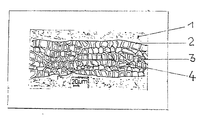
- the cement-mortar coating 1 has a thickness of approximately 100 ⁇ m, and this coating borders an edge zone 2 comprising cell layers.
- the late wood tracheids (cell cavities) which do not contain any water released according to the invention are identified by the reference number 3. These cell cavities are in known methods in which with a wood moisture content of more than 30% to 100% is worked, fully saturated with so-called free water, the presence of which can lead to the difficulties already described and is avoided according to the invention.
- Reference number 4 denotes the cell walls in which water is only in bound form if the wood moisture is less than 30%, as is essential for the invention.
- the ratio of the weight percentages between lignocellulosic and / or cellulosic particles as well as binders and additives can be chosen to be about 1: 2.75, whereas in the case of known processes much less favorable relations had to be accepted.
- the mixture moisture is about 30 to 40% by weight.
- the following raw materials are required for 1 m3 plates: Aggregates approx. 280 kg binder approx. 770 kg Chemicals approx. 50 kg water approx. 400 kg.
- the process according to the invention can thus be used to produce inorganically bound plate-shaped materials, in particular in a single-stranded manner, all types of materials containing lignocellulose and / or cellulose being able to be used as organic constituents and, for example, when using a multi-daylight press, plates with a thickness can be used without problems between 6 mm and 32 mm can be produced without a maximum pressing time of 15 min. is exceeded.
- the air-conditioned plates produced in this way typically have the following elastomechanical and physical properties: Flexural strength 10 - 18 N / mm2 Bulk density 1000 - 1450 kg / m3 Transverse tensile strength 0.35 - 0.65% 2 hours. Swelling of thickness 0.8% 24h Swelling of thickness 1.8% Length change due to moisture 0.15% Thickness tolerance 0.1 - 0.5 mm
- class A2 When it comes to fire behavior, class A2 can be easily achieved, especially by adding other inorganic materials.
- the environmental friendliness of the method according to the invention also results from the fact that a substantial proportion of the materials used can be formed from so-called recycling materials, such as rea gypsum and bio-wood mass including bark.
Landscapes
- Chemical & Material Sciences (AREA)
- Engineering & Computer Science (AREA)
- Ceramic Engineering (AREA)
- Structural Engineering (AREA)
- Organic Chemistry (AREA)
- Materials Engineering (AREA)
- Chemical Kinetics & Catalysis (AREA)
- Civil Engineering (AREA)
- Environmental & Geological Engineering (AREA)
- Inorganic Chemistry (AREA)
- Curing Cements, Concrete, And Artificial Stone (AREA)
- Producing Shaped Articles From Materials (AREA)
- Laminated Bodies (AREA)
- Dry Formation Of Fiberboard And The Like (AREA)
- Battery Electrode And Active Subsutance (AREA)
- Panels For Use In Building Construction (AREA)
Abstract
Description
- Die Erfindung betrifft ein Verfahren zur Herstellung plattenförmiger Verbundwerkstoffe nach dem Oberbegriff des Patentanspruchs 1.
- Aus der DE-PS 34 06 895 ist ein Verfahren bekannt, mit dem es zwar möglich ist, auch Hölzer zu verwenden, die größere Mengen löslicher Inhaltsstoffe, insbesondere Zucker und phenolische Verbindungen an das jeweils in der Mischung enthaltene Wasser abgeben, und dabei eine chemische Zerstörung oder Schwächung der Holzfasern zu vermeiden; nachteilig ist jedoch der erforderliche Zeitaufwand bei der Fertigung dieser Holzfaser-Formkörper. Außerdem ergibt sich nur eine geringe Anfangsfestigkeit solcher Formkörper unmittelbar nach der unter einer gewissen Erwärmung vor sich gehenden Druckausübung.
- Der Erfindung liegt die Aufgabe zugrunde, ein Verfahren der eingangs angegebenen Art in der Weise auszubilden, daß unter Vermeidung des Einsatzes teuerer Kunstharze, unter Ausschaltung von Umweltproblemen sowie unter Neutralisation von die Abbindung störenden Substanzen plattenförmige Produkte er halten werden, die eine besonders gute Wetterfestigkeit besitzen, eine hohe lineare Stabilität aufweisen und bei minimaler Preßzeit mit solcher Festigkeit gefertigt werden können, daß unmittelbar nach dem Preßvorgang eine problemfreie Handhabung möglich ist. Außerdem soll der Preßvorgang sowohl unter Verwendung von Einetagen- als auch Mehretagenpressen ohne die Notwendigkeit der Benutzung von Spanngerüsten, aber auch in kontinuierlich arbeitenden Bandpressen durchführbar sein.
- Diese Aufgabe wird nach der Erfindung im wesentlichen durch die Merkmale des kennzeichnenden Teils des Anspruchs 1 gelöst.
- Bevorzugte Weiterbildungen der Erfindung sind durch die Unteransprüche gekennzeichnet.
- Durch entsprechende Wahl der Anteile an Portlandzement und Gips lassen sich dabei vorwiegend zement- oder gipsgebundene plattenförmige Verbundwerkstoffe herstellen.
- Für das Verfahren nach der Erfindung ist es von wesentlicher Bedeutung, daß das für den Abbindevorgang erforderliche Wasser im wesentlichen nur in Form von Oberflächenwasser, und zwar vorzugsweise ausschließlich in Form von Oberflächenwasser eingebracht wird und somit die im fertigen Produkt vorzugsweise in Form von Spänen vorliegenden Teilchen bis auf einen chemisch gebundenen Wassergehalt von ca. 12 % bis 15 % praktisch frei von Wasser sind, so daß die Spanform nicht mehr durch Abgabe von Wasser durch Diffusions- und/oder Kapimllaraktivitäten aus dem Spaninneren verändert wird. Dies führt zu einem sehr dichten Gesteinsgefüge im fertigen Produkt, womit Toleranzprobleme, herrührend von einer Linearausdehnung des fertigen Produktes, vermieden werden. Eine Folge des erfindungsgemäßen Verfahrens ist auch, daß das fertige Produkt überraschend kleinporig ist und daher eine besonders gute Wetterfestigkeit erreicht wird, da ein Eindringen von Wasser, bzw. ein Vordringen von Wasser zu den Spänen von außen durch feuchte Luft, Regen oder dergleichen praktisch nicht möglich ist und im Ergebnis eine Art versiegelte Gesteinsanordnung erhalten wird.
Ein weiterer wesentlicher Vorteil besteht darin, daß aufgrund des Arbeitens mit einem Minimum an Wasser und vor allem der Vermeidung von überschüssig physikalisch verteilter Feuchtigkeit im zu verpressenden Gut während des Preßvorgangs keinerlei Entdampfungsproblem entsteht. - Wesentlich für das Verfahren nach der Erfindung ist darüber hinaus, daß der Gipsbestandteil in der ersten Phase, d.h. in der die Vliesbildung umfassenden, sich bei etwa Raumtemperatur abspielenden Phase verzögernd wirkt, daß aber nach der sprunghaften Temperaturerhöhung innerhalb der Presse sowohl die Gipskomponente als auch die mineralischen Komponenten und insbesondere auch die metallhaltigen Verbindungen beschleunigend wirken, was zur Folge hat, daß überraschend extrem kurze Preßzeiten und gleichzeitig hohe Anfangsfestigkeiten der Platten erzielt werden.
- Die im Kaltmischvorgang gebildete Trockenmischung führt zu einem vergleichsweise niedrigen ph-Wert, was zur Folge hat, daß negative Auswirkungen auf die lignozellulose und/oder zellulosehaltigen Bestandteile, die insbesondere zu einer Schwächung oder Versprödung dieser Bestandteile führen könnten, weitestgehend ausgeschaltet werden.
- Vorteilhaft wirkt sich auch aus, daß bereits kurz nach der Vermischung aller Bestandteile, bzw. kurz nach dem Streuen des Vlieses ein gewisser Erhärtungsvorgang einsetzt, der zu einer allerdings noch unstabilen Primärstruktur führt, die homogen und durchgehend im gesamten Verbundsystem verteilt ist, jedoch bei Raumtemperatur noch nicht zu einer Versteifung des gestreuten Vlieses führt.
- Die dabei langsam verlaufenden Reaktionen, die sich über eine Zeitspanne bis zu 30 und auch 45 min. erstrecken können, werden schlagartig beschleunigt, wenn in der Presse eine Erhöhung der Hydratationstemperatur auf bis etwa 80oC erfolgt. Da die dabei auftretenden Kristallisationsreaktionen unter einer starken Volumenzunahme verlaufen, wird das zunächst lockere, dann aber unter Preßdruck verdichtete Gefüge mit einem starren Hydratphasengefüge ausgefüllt, wodurch ein äußerst kompaktes Verbundsystem entsteht.
- In der Presse wird bevorzugt eine Temperaturerhöhung auf etwa 80oC vorgenommen, und bei dieser Temperatur gelingt es bereits bei einer Preßzeit von höchstens 10 min. und sogar noch weniger, Platten mit ausreichend hoher Anfangsfestigkeit und von hoher Qualität zu erhalten.
- In der einzigen Figur der Zeichnung ist schematisch ein Fichte-Holzspan mit beidseitiger Zementbeschichtung in einem Zustand dargestellt, wie er sich beim Verfahren nach der Erfindung ergibt.
- Die Zement-Mörtel-Beschichtung 1 besitzt dabei eine Stärke von etwa 100 µm, und diese Beschichtung grenzt an eine Zellschichten umfassende Randzone 2.
Mit dem Bezugszeichen 3 sind die Spätholztracheiden (Zellhohlräume) gekennzeichnet, die gemäß der Erfindung kein freiwerdendes Wasser enthalten. Diese Zellhohlräume sind bei bekannten Verfahren, bei denen mit einer Holzfeuchte von mehr als 30 % bis zu 100 % gearbeitet wird, voll mit sogenanntem freien Wasser gesättigt, dessen Vorhandensein zu den bereits geschilderten Schwierigkeiten führen kann und erfindungsgemäß vermieden ist.
Mit dem Bezugszeichen 4 sind die Zellwände bezeichnet, in denen sich Wasser nur in gebundener Form befindet, wenn die Holzfeuchte weniger als 30 % beträgt, wie dies für die Erfindung wesentlich ist. - Von in der Praxis bedeutsamem Vorteil ist es auch, daß das Verhältnis der Gewichtsprozente zwischen lignozellulosehaltigen und/oder zellulosehaltigen Teilchen sowie Bindemitteln und Zuschlagstoffen etwa 1:2,75 gewählt werden kann, während bei bekannten Verfahren wesentlich ungünstigere Relationen in Kauf genommen werden mußten. Die Mischungsfeuchte beträgt dabei ca. 30 bis 40 Gew.%. Für 1 m³ Platten benötigt man also in etwa folgende Rohstoffe:
Zuschlagstoffe ca. 280 kg Bindemittel ca. 770 kg Chemikalien ca. 50 kg Wasser ca. 400 kg. - Nach dem Verfahren gemäß der Erfindung lassen sich somit anorganisch gebundene plattenförmige Werkstoffe, insbesondere in einsträngiger Weise herstellen, wobei als organische Bestandteile alle Arten von lignozellulose-und/oder zellulosehaltigen Materialien Verwendung finden kö`nnen und beispielsweise bei Einsatz einer Mehretagenpresse problemlos Platten mit einer Dicke zwischen 6 mm und 32 mm hergestellt werden können, ohne daß dabei eine maximale Preßzeit von 15 min. überschritten wird.
- Die auf diese Weise hergestellten, nach der Entnahme aus der Presse noch entsprechend gereiften und klimatisierten Platten weisen typischerweise folgende elastomechanischen und physikalischen Eigenschaften auf:
Biegefestigkeit 10 - 18 N/mm² Rohdichte 1000 - 1450 kg/m³ Querzugfestigkeit 0,35 - 0,65 % 2Std. Dickenquellung 0,8 % 24Std. Dickenquellung 1,8 % Feuchtebedingte Längenänderung 0,15 % Dickentoleranz 0,1 - 0,5 mm - Beim Brandverhalten kann insbesondere durch Zusatz weiterer anorganischer Materialien ohne weiteres die Klasse A2 erreicht werden.
- Das Zusammenspiel der einzelnen Komponenten im Sinne einer zunächst von einer Grundverfestigung begleiteten Verzögerung des Abbindeprozesses und einer unter dem Einfluß erhöhter Preßtemperaturen erfolgenden starken Beschleunigung des Abbindeprozesses stellt die Voraussetzung für den Einsatz sogenannter Kurztaktverfahren dar, die mittels Ein- und Mehretagenpressen sowie kontinuierlich arbeitender Bandpressen durchführbar sind, in jedem Falle aber zu einer beträchtlichen Steigerung der Wirtschaftlichkeit führen.
- Die Umweltfreundlichkeit des Verfahrens nach der Erfindung resultiert auch daraus, daß ein wesentlicher Anteil der verwendeten Materialien von sogenannten Recycling-Materialien gebildet sein kann, wie z.B. Rea-Gips und Bioholzmasse einschließlich Rinde.
- Für die Wirtschaftlichkeit einer nach dem erfindungsgemäßen Verfahren arbeitenden Anlage ist von Bedeutung, daß durch entsprechende Festlegung der Anteile von Zement und Gips in der gleichen Anlage je nach Wahl sowohl Zementplatten als auch Gipsplatten gefertigt werden können.
Claims (19)
dadurch gekennzeichnet,
daß auf die Oberfläche von trockenen bzw. getrockneten lignozellulosehaltigen und/oder zellulosehaltigen Teilchen Wasser aufgebracht wird und diese Teilchen bei Umgebungstemperatur nach so kurzer Zeit mit einem Bindemittelgemisch vermengt werden, daß das sich an der Teilchenoberfläche befindende Wasser vor jeglichem bzw. einem merkbaren Eindringen in die Teilchen von dem Gemisch aufgenommen wird, daß dann eine Überführung des Gemenges in Vliesform erfolgt, und
daß anschließend unter schneller Erhöhung der Vliestemperatur auf etwa 50o bis 90oC ein Verpressen des Vlieses während einer relativ kurzen Zeitspanne vorgenommen wird.
Priority Applications (1)
| Application Number | Priority Date | Filing Date | Title |
|---|---|---|---|
| AT89107567T ATE94518T1 (de) | 1988-05-05 | 1989-04-26 | Verfahren zur herstellung plattenfoermiger verbundstoffe. |
Applications Claiming Priority (2)
| Application Number | Priority Date | Filing Date | Title |
|---|---|---|---|
| DE3815393 | 1988-05-05 | ||
| DE3815393A DE3815393A1 (de) | 1988-05-05 | 1988-05-05 | Verfahren zur herstellung plattenfoermiger verbundstoffe |
Publications (3)
| Publication Number | Publication Date |
|---|---|
| EP0340620A2 true EP0340620A2 (de) | 1989-11-08 |
| EP0340620A3 EP0340620A3 (en) | 1990-12-12 |
| EP0340620B1 EP0340620B1 (de) | 1993-09-15 |
Family
ID=6353746
Family Applications (1)
| Application Number | Title | Priority Date | Filing Date |
|---|---|---|---|
| EP19890107567 Expired - Lifetime EP0340620B1 (de) | 1988-05-05 | 1989-04-26 | Verfahren zur Herstellung plattenförmiger Verbundstoffe |
Country Status (5)
| Country | Link |
|---|---|
| EP (1) | EP0340620B1 (de) |
| JP (1) | JP2881693B2 (de) |
| AT (1) | ATE94518T1 (de) |
| DE (2) | DE3815393A1 (de) |
| ES (1) | ES2045241T3 (de) |
Cited By (5)
| Publication number | Priority date | Publication date | Assignee | Title |
|---|---|---|---|---|
| DE4037865A1 (de) * | 1990-11-28 | 1992-06-11 | Theodor Hufer Gmbh | Schalldaemm-verbundplatte und daraus hergestellter boden-, wand- und deckenbelag |
| FR2682413A1 (fr) * | 1991-10-10 | 1993-04-16 | Biallais Carrieres | Bloc de beton leger a granulats de verre cellulaire et cendres volantes. |
| EP0742087A1 (de) | 1995-05-10 | 1996-11-13 | Schwörer Haus GmbH & Co. | Verfahren zum Herstellen von Flachpressplatten in einem kontinuierlichen Prozess |
| WO2019068829A1 (en) * | 2017-10-06 | 2019-04-11 | Etex Services Nv | IMPROVED FIBROCIMENT PRODUCTS AND METHODS OF PRODUCTION THEREFOR |
| US12227456B2 (en) | 2017-10-06 | 2025-02-18 | Etex Services Nv | Fiber cement products and methods for the production thereof |
Families Citing this family (5)
| Publication number | Priority date | Publication date | Assignee | Title |
|---|---|---|---|---|
| JPH0688823B2 (ja) * | 1990-01-23 | 1994-11-09 | ニチハ株式会社 | 無機質成形板およびその製造方法 |
| DE4190153T1 (de) * | 1990-01-23 | 1992-03-12 | Nichiha Kk | Anorganische platte und verfahren zur herstellung derselben |
| RU2266816C2 (ru) * | 2003-05-20 | 2005-12-27 | Виктор Григорьевич Матвиенко | Способ изготовления плит |
| DE102015109823A1 (de) * | 2015-06-19 | 2016-12-22 | Institut Für Holztechnologie Dresden Gemeinnützige Gmbh | Verfahren und Temperier- und Pressvorrichtung zur Herstellung von anorganisch gebundenen Holzwerkstoffplatten |
| RU2695387C1 (ru) * | 2018-09-03 | 2019-07-23 | Федеральное государственное бюджетное образовательное учреждение высшего образования "Вятский государственный университет" (ВятГУ) | Способ декорирования фасадов |
Family Cites Families (9)
| Publication number | Priority date | Publication date | Assignee | Title |
|---|---|---|---|---|
| US3764357A (en) * | 1970-03-30 | 1973-10-09 | A Bowles | Method of preparing lightweight concrete and plaster and the lightweight concrete and plaster thus prepared |
| DE2354485A1 (de) * | 1972-11-02 | 1974-05-16 | California Cement Shake Co | Verfahren und vorrichtung zum herstellen von zementplatten |
| FI64129C (fi) * | 1980-05-30 | 1983-10-10 | Partek Ab | Framstaellning av en byggnadsplatta enligt upprullningsfoerfarandet |
| DE3406895C2 (de) * | 1984-02-25 | 1987-05-14 | Simatupang, Maruli H., Dr., 2057 Reinbek | Zementgebundener Holzfaser-Formkörper und Verfahren zu dessen Herstellung |
| DE3429682A1 (de) * | 1984-08-11 | 1986-02-20 | Rigips GmbH, 3452 Bodenwerder | Leichtbaumaterial unter verwendung von kalziumsulfathalbhydrat als bindemittel |
| FI69270C (fi) * | 1984-09-21 | 1986-01-10 | Metsaeliiton Teollisuus Oy | Brandbestaendiga traekompositer speciellt inredningsskivor ochfoerfarande foer framstaellning av dessa |
| DE3620154A1 (de) * | 1985-07-25 | 1987-01-29 | Bauakademie Ddr | Verfahren zum herstellen hochfester gipsbauteile |
| DE3604099A1 (de) * | 1986-02-11 | 1987-08-13 | Gyproc Gmbh Baustoffproduktion | Gipskarton-holzplatte und verfahren zu ihrer herstellung |
| DE3608581A1 (de) * | 1986-03-14 | 1987-09-17 | Rigips Gmbh | Bauteile, insbesondere platten aus gips |
-
1988
- 1988-05-05 DE DE3815393A patent/DE3815393A1/de not_active Ceased
- 1988-10-13 JP JP25607888A patent/JP2881693B2/ja not_active Expired - Fee Related
-
1989
- 1989-04-26 DE DE89107567T patent/DE58905588D1/de not_active Expired - Fee Related
- 1989-04-26 AT AT89107567T patent/ATE94518T1/de not_active IP Right Cessation
- 1989-04-26 ES ES89107567T patent/ES2045241T3/es not_active Expired - Lifetime
- 1989-04-26 EP EP19890107567 patent/EP0340620B1/de not_active Expired - Lifetime
Cited By (6)
| Publication number | Priority date | Publication date | Assignee | Title |
|---|---|---|---|---|
| DE4037865A1 (de) * | 1990-11-28 | 1992-06-11 | Theodor Hufer Gmbh | Schalldaemm-verbundplatte und daraus hergestellter boden-, wand- und deckenbelag |
| FR2682413A1 (fr) * | 1991-10-10 | 1993-04-16 | Biallais Carrieres | Bloc de beton leger a granulats de verre cellulaire et cendres volantes. |
| EP0742087A1 (de) | 1995-05-10 | 1996-11-13 | Schwörer Haus GmbH & Co. | Verfahren zum Herstellen von Flachpressplatten in einem kontinuierlichen Prozess |
| WO2019068829A1 (en) * | 2017-10-06 | 2019-04-11 | Etex Services Nv | IMPROVED FIBROCIMENT PRODUCTS AND METHODS OF PRODUCTION THEREFOR |
| US12227456B2 (en) | 2017-10-06 | 2025-02-18 | Etex Services Nv | Fiber cement products and methods for the production thereof |
| US12371373B2 (en) | 2017-10-06 | 2025-07-29 | Etex Services Nv | Fiber cement products and methods for the production thereof |
Also Published As
| Publication number | Publication date |
|---|---|
| EP0340620B1 (de) | 1993-09-15 |
| DE3815393A1 (de) | 1989-11-16 |
| JP2881693B2 (ja) | 1999-04-12 |
| DE58905588D1 (de) | 1993-10-21 |
| ATE94518T1 (de) | 1993-10-15 |
| EP0340620A3 (en) | 1990-12-12 |
| JPH01291902A (ja) | 1989-11-24 |
| ES2045241T3 (es) | 1994-01-16 |
Similar Documents
| Publication | Publication Date | Title |
|---|---|---|
| EP0019207B1 (de) | Verfahren zum Herstellen von Gipsbauteilen | |
| EP2208594B1 (de) | Verfahren zur Herstellung einer brandhemmenden Holzwerkstoffplatte | |
| DD142537A5 (de) | Verfahren zur herstellung eines flammhemmenden als formkoerper ausgefuehrten bauelementes aus lignocelluloseteilchen | |
| DE1528300A1 (de) | Feuerhemmendes Verbundholzprodukt und Verfahren zur Herstellung von feuerhemmenden Verbundholzprodukten | |
| EP0258734A2 (de) | Bauplatte im Schichtenaufbau und Verfahren zu ihrer Herstellung | |
| DE4135144C2 (de) | Verfahren zur Herstellung eines gehärteten, faserverstärkten Schlacke/Gibs/Zement-Leichtbauprodukts | |
| DE1471355A1 (de) | Verfahren zur Herstellung von Bauelementen aus im wesentlichen Borke und Zement,sowie nach diesem Verfahren hergestelltes Bauelement | |
| EP0340620B1 (de) | Verfahren zur Herstellung plattenförmiger Verbundstoffe | |
| DE2805523B2 (de) | Verfahren zur Herstellung von Gipsbauteilen | |
| EP0172207B1 (de) | Verfahren zur herstellung zementgebundener holzfaser-formkörper | |
| DE69807261T2 (de) | Hydraulisch gebundene, geschäumte formkörper und verfahren zu dessen herstellung | |
| DE2726279A1 (de) | Verfahren zur herstellung von flaechigen produkten, insbesondere wellplatten oder anderen profilplatten | |
| DE102004022227A1 (de) | Verfahren zur Herstellung einer anorganisch gebundenen Platte aus geschichtet angeordneten Flachspanstreifen aus Holz | |
| DE3523115C2 (de) | ||
| DE29517538U1 (de) | Verbundbaustoff für den Lehmbau | |
| DE3611080C1 (en) | Building components and process for their preparation and also of mixtures for repairing buildings and wooden parts | |
| DE3115077C2 (de) | Verfahren zum Herstellen von Platten | |
| DE4232760C1 (de) | Gipsgebundene Formkörper, insbesondere Gips-Faserplatten, und Verfahren zu deren Herstellung | |
| EP0742087B1 (de) | Verfahren zum Herstellen von Flachpressplatten in einem kontinuierlichen Prozess | |
| DE2550857C3 (de) | Verfahren zur Herstellung von magnesiazementgebundenen Holzspanplatten | |
| DE812779C (de) | Verfahren zur Herstellung von Bauelementen | |
| DE3225707A1 (de) | Formmasse aus hydraulischen bindemitteln und polymerfibrillen | |
| EP1070026B1 (de) | Baustoff, verfahren zur herstellung eines baustoffes und bauelement | |
| DE3711496C2 (de) | ||
| DE2227679A1 (de) | Formkoerper und verfahren zu seiner herstellung |
Legal Events
| Date | Code | Title | Description |
|---|---|---|---|
| PUAI | Public reference made under article 153(3) epc to a published international application that has entered the european phase |
Free format text: ORIGINAL CODE: 0009012 |
|
| AK | Designated contracting states |
Kind code of ref document: A2 Designated state(s): AT BE CH DE ES FR GB GR IT LI LU NL SE |
|
| PUAL | Search report despatched |
Free format text: ORIGINAL CODE: 0009013 |
|
| AK | Designated contracting states |
Kind code of ref document: A3 Designated state(s): AT BE CH DE ES FR GB GR IT LI LU NL SE |
|
| 17P | Request for examination filed |
Effective date: 19901228 |
|
| 17Q | First examination report despatched |
Effective date: 19911204 |
|
| GRAA | (expected) grant |
Free format text: ORIGINAL CODE: 0009210 |
|
| AK | Designated contracting states |
Kind code of ref document: B1 Designated state(s): AT BE CH DE ES FR GB GR IT LI LU NL SE |
|
| REF | Corresponds to: |
Ref document number: 94518 Country of ref document: AT Date of ref document: 19931015 Kind code of ref document: T |
|
| ITF | It: translation for a ep patent filed | ||
| REF | Corresponds to: |
Ref document number: 58905588 Country of ref document: DE Date of ref document: 19931021 |
|
| ET | Fr: translation filed | ||
| GBT | Gb: translation of ep patent filed (gb section 77(6)(a)/1977) |
Effective date: 19931208 |
|
| REG | Reference to a national code |
Ref country code: ES Ref legal event code: FG2A Ref document number: 2045241 Country of ref document: ES Kind code of ref document: T3 |
|
| REG | Reference to a national code |
Ref country code: GR Ref legal event code: FG4A Free format text: 3010036 |
|
| PLBI | Opposition filed |
Free format text: ORIGINAL CODE: 0009260 |
|
| EPTA | Lu: last paid annual fee | ||
| 26 | Opposition filed |
Opponent name: SCHWOERER HAUS GMBH & CO Effective date: 19940615 |
|
| NLR1 | Nl: opposition has been filed with the epo |
Opponent name: SCHWOERER HAUS GMBH & CO |
|
| EAL | Se: european patent in force in sweden |
Ref document number: 89107567.3 |
|
| PGFP | Annual fee paid to national office [announced via postgrant information from national office to epo] |
Ref country code: FR Payment date: 19950317 Year of fee payment: 7 |
|
| PGFP | Annual fee paid to national office [announced via postgrant information from national office to epo] |
Ref country code: LU Payment date: 19950401 Year of fee payment: 7 |
|
| PGFP | Annual fee paid to national office [announced via postgrant information from national office to epo] |
Ref country code: GB Payment date: 19950407 Year of fee payment: 7 |
|
| PGFP | Annual fee paid to national office [announced via postgrant information from national office to epo] |
Ref country code: AT Payment date: 19950420 Year of fee payment: 7 |
|
| PGFP | Annual fee paid to national office [announced via postgrant information from national office to epo] |
Ref country code: SE Payment date: 19950421 Year of fee payment: 7 |
|
| PGFP | Annual fee paid to national office [announced via postgrant information from national office to epo] |
Ref country code: ES Payment date: 19950428 Year of fee payment: 7 Ref country code: GR Payment date: 19950428 Year of fee payment: 7 |
|
| PGFP | Annual fee paid to national office [announced via postgrant information from national office to epo] |
Ref country code: NL Payment date: 19950430 Year of fee payment: 7 |
|
| PGFP | Annual fee paid to national office [announced via postgrant information from national office to epo] |
Ref country code: BE Payment date: 19950510 Year of fee payment: 7 |
|
| PGFP | Annual fee paid to national office [announced via postgrant information from national office to epo] |
Ref country code: CH Payment date: 19950519 Year of fee payment: 7 |
|
| PGFP | Annual fee paid to national office [announced via postgrant information from national office to epo] |
Ref country code: DE Payment date: 19950613 Year of fee payment: 7 |
|
| PLBO | Opposition rejected |
Free format text: ORIGINAL CODE: EPIDOS REJO |
|
| PG25 | Lapsed in a contracting state [announced via postgrant information from national office to epo] |
Ref country code: GB Effective date: 19960426 Ref country code: AT Effective date: 19960426 Ref country code: LU Free format text: LAPSE BECAUSE OF NON-PAYMENT OF DUE FEES Effective date: 19960426 |
|
| PG25 | Lapsed in a contracting state [announced via postgrant information from national office to epo] |
Ref country code: SE Effective date: 19960427 Ref country code: ES Free format text: LAPSE BECAUSE OF NON-PAYMENT OF DUE FEES Effective date: 19960427 |
|
| PG25 | Lapsed in a contracting state [announced via postgrant information from national office to epo] |
Ref country code: LI Effective date: 19960430 Ref country code: CH Effective date: 19960430 Ref country code: BE Effective date: 19960430 Ref country code: DE Free format text: LAPSE BECAUSE OF NON-PAYMENT OF DUE FEES Effective date: 19960430 |
|
| PLBN | Opposition rejected |
Free format text: ORIGINAL CODE: 0009273 |
|
| STAA | Information on the status of an ep patent application or granted ep patent |
Free format text: STATUS: OPPOSITION REJECTED |
|
| 27O | Opposition rejected |
Effective date: 19960404 |
|
| NLR2 | Nl: decision of opposition | ||
| BERE | Be: lapsed |
Owner name: BISON-WERKE BAHRE & GRETEN G.M.B.H. & CO. K.G. Effective date: 19960430 |
|
| PG25 | Lapsed in a contracting state [announced via postgrant information from national office to epo] |
Ref country code: GR Free format text: THE PATENT HAS BEEN ANNULLED BY A DECISION OF A NATIONAL AUTHORITY Effective date: 19961031 |
|
| PG25 | Lapsed in a contracting state [announced via postgrant information from national office to epo] |
Ref country code: NL Effective date: 19961101 |
|
| REG | Reference to a national code |
Ref country code: GR Ref legal event code: MM2A Free format text: 3010036 |
|
| REG | Reference to a national code |
Ref country code: CH Ref legal event code: PL |
|
| GBPC | Gb: european patent ceased through non-payment of renewal fee |
Effective date: 19960426 |
|
| PG25 | Lapsed in a contracting state [announced via postgrant information from national office to epo] |
Ref country code: FR Effective date: 19961227 |
|
| NLV4 | Nl: lapsed or anulled due to non-payment of the annual fee |
Effective date: 19961101 |
|
| EUG | Se: european patent has lapsed |
Ref document number: 89107567.3 |
|
| REG | Reference to a national code |
Ref country code: FR Ref legal event code: ST |
|
| REG | Reference to a national code |
Ref country code: ES Ref legal event code: FD2A Effective date: 19990301 |
|
| PG25 | Lapsed in a contracting state [announced via postgrant information from national office to epo] |
Ref country code: IT Free format text: LAPSE BECAUSE OF NON-PAYMENT OF DUE FEES;WARNING: LAPSES OF ITALIAN PATENTS WITH EFFECTIVE DATE BEFORE 2007 MAY HAVE OCCURRED AT ANY TIME BEFORE 2007. THE CORRECT EFFECTIVE DATE MAY BE DIFFERENT FROM THE ONE RECORDED. Effective date: 20050426 |
|
| PG25 | Lapsed in a contracting state [announced via postgrant information from national office to epo] |
Ref country code: DE Free format text: LAPSE BECAUSE OF NON-PAYMENT OF DUE FEES Effective date: 20020517 |
|
| PLAB | Opposition data, opponent's data or that of the opponent's representative modified |
Free format text: ORIGINAL CODE: 0009299OPPO |