EP0341420A2 - Fil et procédé pour le fabriquer - Google Patents
Fil et procédé pour le fabriquer Download PDFInfo
- Publication number
- EP0341420A2 EP0341420A2 EP89106097A EP89106097A EP0341420A2 EP 0341420 A2 EP0341420 A2 EP 0341420A2 EP 89106097 A EP89106097 A EP 89106097A EP 89106097 A EP89106097 A EP 89106097A EP 0341420 A2 EP0341420 A2 EP 0341420A2
- Authority
- EP
- European Patent Office
- Prior art keywords
- yarn
- approximately
- granular particles
- particles
- component
- Prior art date
- Legal status (The legal status is an assumption and is not a legal conclusion. Google has not performed a legal analysis and makes no representation as to the accuracy of the status listed.)
- Granted
Links
Images
Classifications
-
- D—TEXTILES; PAPER
- D06—TREATMENT OF TEXTILES OR THE LIKE; LAUNDERING; FLEXIBLE MATERIALS NOT OTHERWISE PROVIDED FOR
- D06M—TREATMENT, NOT PROVIDED FOR ELSEWHERE IN CLASS D06, OF FIBRES, THREADS, YARNS, FABRICS, FEATHERS OR FIBROUS GOODS MADE FROM SUCH MATERIALS
- D06M11/00—Treating fibres, threads, yarns, fabrics or fibrous goods made from such materials, with inorganic substances or complexes thereof; Such treatment combined with mechanical treatment, e.g. mercerising
- D06M11/32—Treating fibres, threads, yarns, fabrics or fibrous goods made from such materials, with inorganic substances or complexes thereof; Such treatment combined with mechanical treatment, e.g. mercerising with oxygen, ozone, ozonides, oxides, hydroxides or percompounds; Salts derived from anions with an amphoteric element-oxygen bond
- D06M11/36—Treating fibres, threads, yarns, fabrics or fibrous goods made from such materials, with inorganic substances or complexes thereof; Such treatment combined with mechanical treatment, e.g. mercerising with oxygen, ozone, ozonides, oxides, hydroxides or percompounds; Salts derived from anions with an amphoteric element-oxygen bond with oxides, hydroxides or mixed oxides; with salts derived from anions with an amphoteric element-oxygen bond
- D06M11/46—Oxides or hydroxides of elements of Groups 4 or 14 of the Periodic Table; Titanates; Zirconates; Stannates; Plumbates
-
- D—TEXTILES; PAPER
- D02—YARNS; MECHANICAL FINISHING OF YARNS OR ROPES; WARPING OR BEAMING
- D02G—CRIMPING OR CURLING FIBRES, FILAMENTS, THREADS, OR YARNS; YARNS OR THREADS
- D02G1/00—Producing crimped or curled fibres, filaments, yarns, or threads, giving them latent characteristics
- D02G1/16—Producing crimped or curled fibres, filaments, yarns, or threads, giving them latent characteristics using jets or streams of turbulent gases, e.g. air, steam
- D02G1/164—Producing crimped or curled fibres, filaments, yarns, or threads, giving them latent characteristics using jets or streams of turbulent gases, e.g. air, steam in the presence of a liquid, e.g. a crimp finish
-
- D—TEXTILES; PAPER
- D02—YARNS; MECHANICAL FINISHING OF YARNS OR ROPES; WARPING OR BEAMING
- D02G—CRIMPING OR CURLING FIBRES, FILAMENTS, THREADS, OR YARNS; YARNS OR THREADS
- D02G3/00—Yarns or threads, e.g. fancy yarns; Processes or apparatus for the production thereof, not otherwise provided for
- D02G3/44—Yarns or threads characterised by the purpose for which they are designed
- D02G3/46—Sewing-cottons or the like
Definitions
- the present invention relates to a thread, in particular a sewing thread, with the features of the preamble of claim 1, two methods for producing the sewing thread with the features of the preamble of claims 11 and 19, and a nozzle for carrying out the method with the features of the preamble of the claim 27.
- Swirled yarns which consist of at least two yarn components, one yarn component forming the core, which is also called the core, and the other yarn component forming the sheath, have long been known.
- such intermingled yarns are produced by feeding the core material with a certain advance, for example between about 1% and about 5%, together with the sheath material to a nozzle and swirling it together by an air stream, the sheath material usually being compared to the core material with a much higher lead in the nozzle.
- the air flow hitting the yarn causes the individual filaments of the soul and / or sheath material, for example with the formation of loops, loops u.
- swirled and confused so that the resulting finished yarn forms a closed yarn structure due to this swirling or confusion, without this necessarily necessitating twisting of the two components.
- intermingled single yarns which do not have the core-sheath structure described above.
- the multifilament yarn consisting of individual filaments is fed to the nozzle with a certain advance and swirled over an air stream in such a way that the individual filaments are confused with themselves, so that a yarn which is closed per se results.
- the mechanical-technological properties are then considerably deteriorated, which can be expressed, for example, in the case of a sewing thread in a reduced strength, a deterioration in the force-elongation ratio and / or in an increase in the frequency of thread breakage during sewing.
- the present invention has for its object to provide a yarn of the type specified, which has a particularly low frequency of yarn breakage during processing.
- the yarn designed according to the invention which is used in particular as a sewing thread, consists of at least one first yarn component designed as a core and at least one second yarn component intermingled with the first yarn component, the second yarn component being arranged predominantly in relation to finished yarn in the outer region thereof.
- Grain-like particles are arranged in the spaces between the threads and / or on the outside of the thread.
- the grain-like particles have a grain diameter of between approximately 4 ⁇ m and approximately 400 ⁇ m. Your concentration is between about 0.02% by weight and about 20% by weight, each based on the weight of the yarn.
- the mechanical-technological properties and the processing behavior are considerably improved in comparison with a conventionally designed, equivalent yarn which does not have such granular particles.
- This is expressed, for example, in that the yarn strength is improved by approximately 15% compared to the standard yarn described above, while at the same time the elasticity is improved in the yarn according to the invention.
- the frequency of thread breakage of a conventional yarn with the same structure compared to the yarn according to the invention by a factor of between 3 and about 8 is higher.
- the grain-like particles which are stored on the outside of the finished yarn and / or in the spaces between the yarns and are arranged so as to be movable relative to the individual filaments of the yarn, the friction between the individual filaments of the yarn and / or the friction of the outer yarn areas
- the yarn according to the invention also has a higher interlacing in comparison to a conventional yarn produced under otherwise the same conditions, to which the property improvements mentioned above are also attributed.
- these particles can generate electrostatic charges at synthe table yarns reduce, which in turn improves the processing properties of the yarn according to the invention.
- a particularly suitable embodiment of the yarn according to the invention has granular particles in a concentration between about 0.2% by weight and about 0.4% by weight.
- a very fine titer i.e. for yarns in a titer range between approximately 100 dtex and approximately 300 dtex
- the aforementioned concentration range of granular particles is sufficient to achieve the desired improvement in processing properties, the increase in strength and the increase in elongation behavior. This is particularly true when the grain-like particles are predominantly or exclusively arranged on the surface of the finished yarn and the diameter of the particles is approximately in a range between 10 ⁇ m and approximately 100 ⁇ m.
- titers i.e.
- Titers in the range between approximately 500 dtex and approximately 800 dtex may require higher concentrations of granular particles, these concentrations usually being in a range between approximately 0.5% by weight and approximately 4% by weight.
- concentrations in the order of magnitude between approximately 5% by weight and approximately 15% by weight may be required in order to achieve the above-mentioned favorable properties, with all of the above-mentioned yarns, the particle concentration for the respective yarn depends on the number of filaments, the distribution of the particles over the yarn cross-section and the particle diameter.
- Such embodiments have particularly good mechanical properties and advantageous processing behavior of the yarn according to the invention, in which the granular particles have a grain diameter between approximately 20 ⁇ m and approximately 100 ⁇ m.
- Such relatively small particles are particularly effective in reducing the friction described above and also have good adhesion to the yarn, so that unwanted dusting does not occur when processing the yarn.
- both the embodiment of the yarn according to the invention, in which the particles are predominantly or exclusively arranged in the outer region of the yarn, and also those embodiments in which the particles are evenly distributed over the yarn cross section are claimed.
- the last-mentioned embodiments in particular are suitable for those yarns which have a relatively high number of filament threads, i.e. between about 80 filaments and about 200 filaments, have a relatively fine titer, for example between about 100 dtex and about 300 dtex.
- the desired improvement in properties depends crucially on the fact that the friction between the filaments is effectively reduced, which is achieved by embedding the particles in the spaces between the filaments.
- Another advantageous embodiment of the yarn according to the invention provides that the grain-like particles are embedded in a finish applied to the yarn.
- the finish supports the effect of the grain-like particles in reducing friction, while the finish improves the adhesion of the grain-like particles to the yarn or the individual filaments processed therein.
- the avivage affects the The mobility of the particles relative to the individual filaments or the yarn is only slight, so that the positive properties of the particles described above are additionally reinforced in such an embodiment of the yarn according to the invention.
- the distribution of the finish the same statements apply as were made above for the distribution of the particles.
- the yarn according to the invention preferably has a core-sheath structure, the core consisting of a multifilament yarn, for example one with a titer between approximately 100 dtex and approximately 500 dtex, in particular with a titer between approximately 150 dtex and approximately 300 dtex.
- the number of filaments of such a core material can vary between approximately 50 threads and approximately 500 threads, in particular between approximately 100 threads and approximately 300 threads, depending on the particular field of use of the yarn.
- the core material described above has one or more multifilament yarns, the titer and number of filaments of which correspond approximately to half the titer and the number of filaments of the core material.
- the grain-like particles those particles that have a certain hardness and Wi resistance to mechanical stress.
- Inorganic particles such as talc, kieselguhr and aluminum oxide are particularly suitable.
- the yarn according to the invention can be processed wherever a high mechanical load on the yarn occurs during processing and / or high strength and excellent elasticity behavior of the yarn is required.
- the use of the yarn according to the invention as a sewing thread brings considerable advantages compared to a correspondingly designed conventional thread, as will be demonstrated below by the exemplary embodiments.
- such a sewing thread preferably has the core-shell structure described above, although embodiments are also conceivable in which the sewing thread consists of interwoven individual filaments of a single multifilament thread with particles arranged therein and / or attached to the outside.
- the arrangement of the particles the distribution, their size, their concentration and their chemical structure, the same applies as has been described above for the core-sheath yarn designed according to the invention.
- the particles may accumulate in the outer region of the yarn, since the yarn according to the invention is usually produced as described below and only afterwards is colored. During the dyeing of the yarn according to the invention, the particles in the outer yarn area can accumulate, particularly in the case of very open yarns, but such an enrichment does not cause any undesirable side effects.
- the yarn according to the invention can also have a twist, for example in the range between one twist / m and approximately 1000 twists / m, preferably between approximately 100 twists / m and approximately 600 twists / m.
- a twist for example in the range between one twist / m and approximately 1000 twists / m, preferably between approximately 100 twists / m and approximately 600 twists / m.
- Such a twisted embodiment is particularly suitable for those applications in which the yarn is exposed to extremely high mechanical loads, as is the case, for example, with yarns used in large-scale manufacturing.
- the rotation also improves the yarn composite, while the particles preferably arranged on the outside of such a twisted yarn considerably reduce the friction occurring during processing, so that the yarn breakage frequency is significantly reduced.
- the present invention is also based on the object of providing a method of the type specified, with which the yarns described above can be produced with special consideration of a uniform yarn titer.
- the method according to the invention is based on the basic idea, not, as in the state of the art Technique of wetting the first yarn component that forms the soul with water alone before swirling. Instead, in the process according to the invention, grain-like particles are added to the water with which the first yarn component is wetted, the grain-like particles having a specific weight greater than 1 g / cm 3. The first yarn component is thus wetted with an aqueous dispersion or suspension of the granular particles.
- the method according to the invention has a number of advantages.
- the yarns produced by this process are distinguished by a particularly uniform titer, which is attributed to the fact that the flow conditions in the nozzle are optimized and / or evened out by the additional particle flow in the swirl chamber.
- the particle flow causes any matting of the first yarn component to be loosened, which in turn improves the yarn uniformity.
- the particle flow also prevents the deposit of dissolved or lubricated preparations and additives in the nozzle, so that undesirable and uncontrollable changes in the dimension of the nozzle due to deposits or lubrication do not occur in the process according to the invention during production, which on the one hand causes the flow conditions in the nozzle can also be kept constant over a longer production period and, on the other hand, undesirable Knot formation and / or capillary or yarn breaks can be prevented.
- the yarns described above can be produced by the method according to the invention over a longer period without interruption and without necessary cleaning of the nozzle, so that no significant downtimes for cleaning the nozzle and / or the reinsertion of the nozzle can be achieved in the method according to the invention Yarns occur when yarn breaks occur.
- the method according to the invention thus permits the economical production of improved yarns, this preferably being manifested in improved mechanical-technological properties and in a higher mechanical strength of the yarns during processing.
- Grain-like particles whose specific weight is between approximately 1 g / cm 3 and approximately 6 g / cm 3, in particular between approximately 2 g / cm 3 and approximately 4.5 g / cm 3, are preferably used in the process according to the invention, it being particularly advantageous has proven to vary the specific weight of the granular particles depending on the yarn to be processed.
- the hardness of the particle particles used is also important for the desired effects.
- the granular particles should not be so soft that they are destroyed during the swirling and on the other hand they should still have a certain softness in order not to cause unwanted capillary injuries and / or undesirable damage to the nozzle.
- Grain-like particles are usually used which have a hardness on the Mohs hardness scale of between approximately 1 and approximately 7, in particular between approximately 4 and approximately 6 1/2, but also the hardness, as already explained above for the density of the grain-like particles, depends on the yarn used and its number of filaments.
- the grain size of the particles used can also vary in a range between approximately 4 ⁇ m and approximately 400 ⁇ m, in particular for the production of yarns with an average titer between approximately 300 dtex and approximately 600 dtex grain-like particles with a grain diameter between approximately 20 ⁇ m and approximately 100 ⁇ m can be used.
- particles with a grain size of between approximately 20 ⁇ m and approximately 50 ⁇ m are preferred, and in the case of the coarser titers of the individual filaments or of the finished yarn preferably also larger grain-like particles, for example, those in a range between approximately 150 ⁇ m and approximately 250 ⁇ m can be used.
- the concentration of the granular particles in the aqueous suspension or dispersion depends on the type of wetting of the first yarn component. If the first yarn component is wetted by immersion in an aqueous suspension or dispersion of the granular particles, the concentration is usually in a range between approximately 45 g granular particles / l and approximately 150 g particles / l, preferably a concentration range between approximately 30 g Particle / l and about 60 g particle / l is selected.
- particle concentrations between about 10 g / l and about 200 g / l, preferably between about 50 g / l and about 150 g / l, are preferably used .
- a further embodiment of the process according to the invention provides that surfactants and / or dispersing agents or suspending agents are added to the aqueous suspension or dispersion of the granular particles.
- the surfactants or dispersing and suspending agents known per se from textile chemistry can be used here, preference being given to using low-foaming products and / or the known antifoaming agents, for example based on organosilicon compounds.
- anionic surfactants or dispersing and / or suspending agents based on organic sulfates and sulfonates for example alkyl sulfates, alkysulfonates and / or alkylarylsulfates or sulfonates, the concentration of the above products preferably being in a range between 1 g / l and about 4 g / l.
- the dispersion or suspension is constantly moved. This can be done, for example, by stirring the dispersion or suspension or by irradiating it with ultrasonic waves.
- a particularly good distribution and a stable dispersion or suspension are obtained by generating a turbulent flow in the dispersion or suspension, which can be achieved very well, for example, by blowing in air.
- the yarn components are usually intermingled at a fluid pressure between approximately 6 bar and approximately 15 bar, preferably between approximately 8 bar and approximately 10 bar. Either steam or air can be used as the fluid, the latter leading to particularly good results.
- a fluid pressure between approximately 6 bar and approximately 15 bar, preferably between approximately 8 bar and approximately 10 bar.
- Either steam or air can be used as the fluid, the latter leading to particularly good results.
- the yarn components of the starting material are fed to a nozzle and there through the turbulent fluid flow swirls, the fluid flow additionally having, for example, air and / or steam, also particles.
- the fluid flow that is fed to the nozzle is either a mist consisting of finely divided water droplets with a diameter between approximately 40 ⁇ m and approximately 600 ⁇ m with granular particles dispersed or suspended therein, and / or one Dust of the granular particles alone is added, the granular particles having a grain size between approximately 4 ⁇ m and approximately 400 ⁇ m.
- the granular particles are not supplied directly by the first yarn component, but rather by the fluid flows supplied to the nozzle, which leads to a further intensification of the intermingling of the yarns.
- the first yarn component is wetted with the particle-containing dispersion or suspension
- the particles adhering to the yarn during the air or steam flow during the relatively short stay of the yarn in the nozzle does not have to be accelerated there, but instead is already supplied to the nozzle as accelerated particles.
- a mist is supplied to the fluid flow, which is produced from an aqueous dispersion or suspension of the granular particles, the concentration of the granular particles being between approximately 30 g / l and approximately 300 g / l, preferably between about 60 g / l and about 200 g / l.
- the concentration of the granular particles being between approximately 30 g / l and approximately 300 g / l, preferably between about 60 g / l and about 200 g / l.
- the supply of a mist in which the particles are dispersed or suspended has the advantage that the mechanical stress on the yarn and the nozzle is reduced by the lubrication or sliding action caused by the water is, so that the supply of a dust to the fluid flow is preferably used when using particularly soft particles, when using special nozzles, which will be described below, and / or with relatively coarse-titer yarns.
- the fluid throughput (air or steam) is in a range between about 4 m3 / h and about 15 m3 / h, preferably between about 5 m3 / h and 8 m3 / h.
- Another object of the present invention is to provide a nozzle for carrying out the method.
- the nozzle has at least a first inlet opening for the yarn, a second inlet opening for the fluid flow, an outlet opening for the swirled yarn and a swirl chamber, at least the inner walls of the swirl chamber and the inner walls of the outlet opening being made of ceramic.
- ceramic in particular not only has the required hardness and resistance to the particle flow impinging in the swirl chamber and the outlet opening, but at the same time brings about a constant flow profile in the nozzle due to its closed surface, which leads to a particularly reproducible yarn.
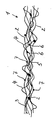
- a yarn denoted overall by 1 which consists of a large number of individual capillaries 2 realized with one another.
- the individual capillaries are either swirled together in a knot-like manner, as can be seen at the point denoted by 3.
- the yarn also has protruding loops 4 and confused areas 5.
- Grain-like particles 6 are arranged in the spaces between the individual capillaries 2 and are freely movable in a certain area relative to the individual capillaries.
- Particles 7 adhere to the outside of the yarn and, like the particles 6, can also be moved within a certain range relative to the individual capillaries 2 or to the yarn 1.
- the particles 6 and 7 shown in the figure are titanium dioxide particles with a grain size of 60 ⁇ m. Their concentration is 0.2% by weight, based on the weight of the yarn.
- a sewing thread with a titer of 285 dtex is produced by interlacing a first thread component serving as a soul, which was a polyester multifilament thread with a titer of 180 dtex and an elementary thread count of 40 filaments.
- the first yarn component was interlaced with a second component (effect or sheath component), the titer of the second yarn component being 50 dtex with a number of filaments of 24 filaments.
- a conventionally designed, commercially available nozzle was used as the nozzle, which bore the type designation T341 and is offered by the Heberlein company.
- Air was fed to the nozzle as a fluid stream at a pressure of 10.5 bar, the air throughput being 8 m 3 / h. After intermingling, the yarn was drawn off at a speed of 500 m / min.
- the first thread component of the sewing thread was wetted before immersion by immersing it in water, the immersion distance being about 2 cm.
- the conventionally produced and designated sewing thread No. 1 was dyed and finished according to the known methods and served as a reference material for the subsequent mechanical-technological measurements and for industrial sewing tests.
- a No. 2 sewing thread was prepared under the conditions described above, the No. 2 sewing thread being treated with an aqueous suspension of 30 g / l barium sulfate before intermingling.
- the barium sulfate had a particle size of 80 ⁇ m. Otherwise, the manufacturing conditions corresponded to embodiment 1.
- a sewing thread No. 3 was produced in accordance with working example 1, however, in deviation from this, the first thread component was wetted with a dispersion of 60 g / l of titanium dioxide with a particle size of 20 ⁇ m before the intermingling.
- a sewing thread No. 4 was produced under the conditions described in exemplary embodiment 1, but in deviation from this the first thread component was not wetted with water before the intermingling. Instead, 15% by volume of a mist, which was prepared from an aqueous dispersion of 100 g / l barium sulfate, was added to the air stream.
- the sewing threads 1 to 4 described above were first examined microscopically. It was found that the degree of interlacing of the sewing threads increased steadily from sewing thread No. 1 to sewing thread No. 4.
- Comparative industrial sewing tests showed that the frequency of yarn breakage when sewing yarns 2 to 4 was significantly lower compared to yarn 1 (conventionally produced yarn).
- An orientative, statistical evaluation of the thread break frequency showed that, based on sewing thread No. 1, the thread break frequency with sewing thread No. 2 was 20%, the thread break frequency with sewing thread No. 3 was 30%, and the thread break frequency with sewing thread No. 4 was 50% lower.
- the frequency of yarn breakage when rubbing sewing thread against sewing thread was determined on a specially developed measuring device.
- one end of the sewing thread was clamped in a clamp, then the sewing thread was placed in a loop, the loop over movable rollers was kept open and then the yarn was moved under a load of 50 g in such a way that a point-like abrasion of yarn on yarn occurred at the loop.
- the scrubbing tests were carried out until the yarn broke, the number of movement cycles until the break being measured.
- the conventionally produced sewing thread 1 broke after 200 movement cycles. Sewing thread 2 broke at 450 movement cycles, while 3,600 movement cycles were required for sewing thread and 4,750 movement cycles for sewing thread were required to break.
- the aqueous dispersion or suspension of the granular particles can be applied by spraying the thread with the dispersion or suspension or by immersing the thread in the dispersion or suspension.
- a special wetting device for applying the aqueous dispersion or suspension, through which the yarn is passed.
- This wetting device has a wetting head which can be brought into contact with the yarn and by means of which the dispersion or suspension are applied to the yarn in a kind of splashing technique.
- Such wetting devices are known and are widely used and are offered, for example, by the Herberlein company under the system name Hema Wet Nozzle.
Landscapes
- Engineering & Computer Science (AREA)
- Textile Engineering (AREA)
- Mechanical Engineering (AREA)
- Physics & Mathematics (AREA)
- Fluid Mechanics (AREA)
- Yarns And Mechanical Finishing Of Yarns Or Ropes (AREA)
- Chemical Or Physical Treatment Of Fibers (AREA)
- Treatments For Attaching Organic Compounds To Fibrous Goods (AREA)
Applications Claiming Priority (2)
| Application Number | Priority Date | Filing Date | Title |
|---|---|---|---|
| DE3816318A DE3816318C1 (fr) | 1988-05-13 | 1988-05-13 | |
| DE3816318 | 1988-05-13 |
Publications (3)
| Publication Number | Publication Date |
|---|---|
| EP0341420A2 true EP0341420A2 (fr) | 1989-11-15 |
| EP0341420A3 EP0341420A3 (en) | 1990-12-27 |
| EP0341420B1 EP0341420B1 (fr) | 1994-06-01 |
Family
ID=6354287
Family Applications (1)
| Application Number | Title | Priority Date | Filing Date |
|---|---|---|---|
| EP89106097A Expired - Lifetime EP0341420B1 (fr) | 1988-05-13 | 1989-04-07 | Fil et procédé pour le fabriquer |
Country Status (3)
| Country | Link |
|---|---|
| EP (1) | EP0341420B1 (fr) |
| AT (1) | ATE106463T1 (fr) |
| DE (2) | DE3816318C1 (fr) |
Cited By (1)
| Publication number | Priority date | Publication date | Assignee | Title |
|---|---|---|---|---|
| CN119246404A (zh) * | 2024-08-27 | 2025-01-03 | 中国海洋大学 | 超高频高速pcb用低介电玻璃纤维脱粉性能测试装置及测试方法 |
Families Citing this family (1)
| Publication number | Priority date | Publication date | Assignee | Title |
|---|---|---|---|---|
| DE102013100613A1 (de) * | 2013-01-22 | 2014-07-24 | Boockmann Gmbh | Textiler Materialstrang sowie Verfahren zu seiner Herstellung |
Family Cites Families (9)
| Publication number | Priority date | Publication date | Assignee | Title |
|---|---|---|---|---|
| CA957214A (en) * | 1970-12-24 | 1974-11-05 | Teijin Limited | Conjugate fiber |
| DE2140517A1 (de) * | 1971-08-12 | 1973-04-12 | Zwirnerei & Naehfadenfab | Naehfaden |
| US3823449A (en) * | 1971-12-27 | 1974-07-16 | Akzona Inc | Apparatus for interlacing yarns |
| DE3048650C2 (de) * | 1980-12-23 | 1987-01-22 | Fraunhofer-Gesellschaft zur Förderung der angewandten Forschung e.V., 8000 München | Verfahren zur Präparation von Nähgarnen aus Synthesefasern |
| DE3202555A1 (de) * | 1982-01-27 | 1983-08-04 | Juan San Cristobal s/n Artes Barcelona Vilanova Grau | Verfahren zum herstellen von strahlungsundurchlaessigem fadenmaterial |
| DE3341995A1 (de) * | 1982-11-24 | 1984-05-24 | Hasso von 4000 Düsseldorf Blücher | Garn mit spezifischen eigenschaften |
| ATE28909T1 (de) * | 1983-07-04 | 1987-08-15 | Akzo Nv | Mit schmierenden partikeln impraegniertes aromatisches polyamidgarn, verfahren zur herstellung dieses garnes und dasselbe enthaltendes dichtungsmaterial oder seil. |
| DE3712863A1 (de) * | 1986-04-16 | 1987-11-26 | Ackermann Goeggingen Ag | Naehfaden |
| DE3720237A1 (de) * | 1987-06-15 | 1989-01-05 | Amann & Soehne | Verfahren zum herstellen von luftblastexturiertem naehgarn |
-
1988
- 1988-05-13 DE DE3816318A patent/DE3816318C1/de not_active Expired
-
1989
- 1989-04-07 DE DE58907737T patent/DE58907737D1/de not_active Expired - Fee Related
- 1989-04-07 EP EP89106097A patent/EP0341420B1/fr not_active Expired - Lifetime
- 1989-04-07 AT AT89106097T patent/ATE106463T1/de not_active IP Right Cessation
Cited By (1)
| Publication number | Priority date | Publication date | Assignee | Title |
|---|---|---|---|---|
| CN119246404A (zh) * | 2024-08-27 | 2025-01-03 | 中国海洋大学 | 超高频高速pcb用低介电玻璃纤维脱粉性能测试装置及测试方法 |
Also Published As
| Publication number | Publication date |
|---|---|
| DE58907737D1 (de) | 1994-07-07 |
| EP0341420A3 (en) | 1990-12-27 |
| ATE106463T1 (de) | 1994-06-15 |
| EP0341420B1 (fr) | 1994-06-01 |
| DE3816318C1 (fr) | 1989-11-30 |
Similar Documents
| Publication | Publication Date | Title |
|---|---|---|
| AT511638B1 (de) | Hochfestes cellulosisches filament, dessen verwendung sowie verfahren zu seiner herstellung | |
| DE69412795T2 (de) | Faser | |
| DE1061953B (de) | Voluminoeses Schlingengarn sowie Verfahren und Vorrichtung zu seiner Herstellung | |
| EP0494852A2 (fr) | Procédé pour la fabrication d'objets cellulosiques | |
| DE60208643T2 (de) | Brechen von Fasern im Streckverfahren | |
| DE60009079T2 (de) | Garn und verfahren zur herstellung eines garnes mit superabsorbierenden fasern | |
| DE901332C (de) | Verfahren zur Herstellung von kuenstlichen, nichtmattierten Gebilden aus linearen Polymerisaten, vorzugsweise Polyhexamethylenadipinsaeureamid | |
| EP0625600A1 (fr) | Dispositif pour le traitement d'un moins un fil multifilament | |
| DE1296737B (de) | Verfahren zum Herstellen von Faeden und Fasern aus Regeneratcellulose | |
| DE2312465B2 (de) | Webverfahren für Wasserstrahl-Webmaschinen | |
| EP0341420B1 (fr) | Fil et procédé pour le fabriquer | |
| WO2016066621A1 (fr) | Procédé et dispositif de production de produits semi-finis en fibres de carbone | |
| EP3006608B1 (fr) | Fibres filaments de cellulose régénérée ignifuges | |
| DE4020553C2 (de) | Verfahren zur Herstellung von Rußfilterkerzen | |
| DE10220508A1 (de) | Verfahren und Vorrichtung zur Behandlung eines Fadens | |
| DE3406048C2 (de) | Vorrichtung zur Herstellung eines texturierten Fadens | |
| EP1095176A1 (fr) | Fils d'elasthane et procede permettant de les produire | |
| DE3527415A1 (de) | Vorrichtung zur luftverwirbelung und zum bauschen von endlos- und stapelfasergarnen | |
| EP0323986B1 (fr) | Procede de pre-entrelacement d'un fil alimenteur synthetique multifilament et fil ainsi produit | |
| DD246129A1 (de) | Transportelement zur herstellung eines durch faserstoffverwirbelung verfestigten vliesstoffes | |
| DE1921221A1 (de) | Naehmaschinenfaden | |
| DE1660542A1 (de) | Verbesserung der Behandlungen von multifilen endlosen Spinnfaeden und Spinnfaeden mit kontrolliert labilem Zusammenhalt der Elementarfaeden | |
| WO2025036794A1 (fr) | Procédé d'entrelacement de fils | |
| DE3941737A1 (de) | Verfahren und vorrichtung zum texturieren glatter filamentgarne | |
| DD268487A1 (de) | Glasseidehaltiger faden und verfahren zu dessen herstellung |
Legal Events
| Date | Code | Title | Description |
|---|---|---|---|
| PUAI | Public reference made under article 153(3) epc to a published international application that has entered the european phase |
Free format text: ORIGINAL CODE: 0009012 |
|
| AK | Designated contracting states |
Kind code of ref document: A2 Designated state(s): AT BE CH DE ES FR GB GR IT LI LU NL SE |
|
| PUAL | Search report despatched |
Free format text: ORIGINAL CODE: 0009013 |
|
| AK | Designated contracting states |
Kind code of ref document: A3 Designated state(s): AT BE CH DE ES FR GB GR IT LI LU NL SE |
|
| 17P | Request for examination filed |
Effective date: 19901211 |
|
| 17Q | First examination report despatched |
Effective date: 19920928 |
|
| GRAA | (expected) grant |
Free format text: ORIGINAL CODE: 0009210 |
|
| AK | Designated contracting states |
Kind code of ref document: B1 Designated state(s): AT BE CH DE ES FR GB GR IT LI LU NL SE |
|
| PG25 | Lapsed in a contracting state [announced via postgrant information from national office to epo] |
Ref country code: GR Free format text: LAPSE BECAUSE OF FAILURE TO SUBMIT A TRANSLATION OF THE DESCRIPTION OR TO PAY THE FEE WITHIN THE PRESCRIBED TIME-LIMIT Effective date: 19940601 Ref country code: ES Free format text: THE PATENT HAS BEEN ANNULLED BY A DECISION OF A NATIONAL AUTHORITY Effective date: 19940601 Ref country code: NL Effective date: 19940601 Ref country code: BE Effective date: 19940601 Ref country code: IT Free format text: LAPSE BECAUSE OF FAILURE TO SUBMIT A TRANSLATION OF THE DESCRIPTION OR TO PAY THE FEE WITHIN THE PRE;WARNING: LAPSES OF ITALIAN PATENTS WITH EFFECTIVE DATE BEFORE 2007 MAY HAVE OCCURRED AT ANY TIME BEFORE 2007. THE CORRECT EFFECTIVE DATE MAY BE DIFFERENT FROM THE ONE RECORDED.SCRIBED TIME-LIMIT Effective date: 19940601 |
|
| REF | Corresponds to: |
Ref document number: 106463 Country of ref document: AT Date of ref document: 19940615 Kind code of ref document: T |
|
| GBT | Gb: translation of ep patent filed (gb section 77(6)(a)/1977) |
Effective date: 19940607 |
|
| REF | Corresponds to: |
Ref document number: 58907737 Country of ref document: DE Date of ref document: 19940707 |
|
| PG25 | Lapsed in a contracting state [announced via postgrant information from national office to epo] |
Ref country code: SE Effective date: 19940901 |
|
| ET | Fr: translation filed | ||
| NLV1 | Nl: lapsed or annulled due to failure to fulfill the requirements of art. 29p and 29m of the patents act | ||
| PLBE | No opposition filed within time limit |
Free format text: ORIGINAL CODE: 0009261 |
|
| STAA | Information on the status of an ep patent application or granted ep patent |
Free format text: STATUS: NO OPPOSITION FILED WITHIN TIME LIMIT |
|
| PG25 | Lapsed in a contracting state [announced via postgrant information from national office to epo] |
Ref country code: AT Effective date: 19950407 |
|
| PG25 | Lapsed in a contracting state [announced via postgrant information from national office to epo] |
Ref country code: LI Effective date: 19950430 Ref country code: CH Effective date: 19950430 Ref country code: LU Free format text: LAPSE BECAUSE OF NON-PAYMENT OF DUE FEES Effective date: 19950430 |
|
| 26N | No opposition filed | ||
| REG | Reference to a national code |
Ref country code: CH Ref legal event code: PL |
|
| REG | Reference to a national code |
Ref country code: GB Ref legal event code: IF02 |
|
| PGFP | Annual fee paid to national office [announced via postgrant information from national office to epo] |
Ref country code: GB Payment date: 20040407 Year of fee payment: 16 |
|
| PGFP | Annual fee paid to national office [announced via postgrant information from national office to epo] |
Ref country code: FR Payment date: 20040428 Year of fee payment: 16 |
|
| PGFP | Annual fee paid to national office [announced via postgrant information from national office to epo] |
Ref country code: DE Payment date: 20040430 Year of fee payment: 16 |
|
| PG25 | Lapsed in a contracting state [announced via postgrant information from national office to epo] |
Ref country code: GB Free format text: LAPSE BECAUSE OF NON-PAYMENT OF DUE FEES Effective date: 20050407 |
|
| PG25 | Lapsed in a contracting state [announced via postgrant information from national office to epo] |
Ref country code: DE Free format text: LAPSE BECAUSE OF NON-PAYMENT OF DUE FEES Effective date: 20051101 |
|
| GBPC | Gb: european patent ceased through non-payment of renewal fee |
Effective date: 20050407 |
|
| PG25 | Lapsed in a contracting state [announced via postgrant information from national office to epo] |
Ref country code: FR Free format text: LAPSE BECAUSE OF NON-PAYMENT OF DUE FEES Effective date: 20051230 |
|
| REG | Reference to a national code |
Ref country code: FR Ref legal event code: ST Effective date: 20051230 |