EP0344903A2 - Convertisseur de violation de la règle du code pour un code (d,k) - Google Patents
Convertisseur de violation de la règle du code pour un code (d,k) Download PDFInfo
- Publication number
- EP0344903A2 EP0344903A2 EP89303928A EP89303928A EP0344903A2 EP 0344903 A2 EP0344903 A2 EP 0344903A2 EP 89303928 A EP89303928 A EP 89303928A EP 89303928 A EP89303928 A EP 89303928A EP 0344903 A2 EP0344903 A2 EP 0344903A2
- Authority
- EP
- European Patent Office
- Prior art keywords
- code
- bit
- channel
- zeros
- ones
- Prior art date
- Legal status (The legal status is an assumption and is not a legal conclusion. Google has not performed a legal analysis and makes no representation as to the accuracy of the status listed.)
- Withdrawn
Links
- 238000013519 translation Methods 0.000 title claims description 9
- 238000000034 method Methods 0.000 claims description 5
- 238000012986 modification Methods 0.000 abstract description 4
- 230000004048 modification Effects 0.000 abstract description 4
- 230000005540 biological transmission Effects 0.000 abstract 1
- 230000003247 decreasing effect Effects 0.000 abstract 1
- 230000007704 transition Effects 0.000 description 8
- 238000010586 diagram Methods 0.000 description 3
- 230000005291 magnetic effect Effects 0.000 description 3
- 238000004891 communication Methods 0.000 description 2
- 238000010276 construction Methods 0.000 description 2
- 238000013459 approach Methods 0.000 description 1
- 230000009977 dual effect Effects 0.000 description 1
- 238000005516 engineering process Methods 0.000 description 1
- 230000001747 exhibiting effect Effects 0.000 description 1
- 238000009432 framing Methods 0.000 description 1
- 238000013507 mapping Methods 0.000 description 1
- 230000003287 optical effect Effects 0.000 description 1
- 238000005457 optimization Methods 0.000 description 1
- 239000007787 solid Substances 0.000 description 1
- 238000006467 substitution reaction Methods 0.000 description 1
- 238000012546 transfer Methods 0.000 description 1
Images


Classifications
-
- H—ELECTRICITY
- H03—ELECTRONIC CIRCUITRY
- H03M—CODING; DECODING; CODE CONVERSION IN GENERAL
- H03M5/00—Conversion of the form of the representation of individual digits
- H03M5/02—Conversion to or from representation by pulses
- H03M5/04—Conversion to or from representation by pulses the pulses having two levels
- H03M5/14—Code representation, e.g. transition, for a given bit cell depending on the information in one or more adjacent bit cells, e.g. delay modulation code, double density code
- H03M5/145—Conversion to or from block codes or representations thereof
Definitions
- the present invention relates to traversed (d, k) code translation by means of which error propogation can be reduced, particularly data encoded in the traversed code is recorded.
- RLL run-length-limited encoding
- Codes for recording media and communications using this general arrangement are referred to as (d,k) run-length-limited codes.
- Such codes convert unconstrained data into a (d,k) constrained channel set of signals.
- Such codes are encoded from m unconstrained bits which are mapped into n constrained bits, where m is less than n.
- the ratio m/n is referred to as the coding rate. It is obviously desirable to maximise this rate.
- Information density is defined as (m/n)(d+1).
- Increasing the coding rate occurs at the expense of look ahead resulting in increasing error propagation within the channel encoded bits or groups. For example, a single-bit error introduced into the encoded channel code stream can result in a predetermined number of subsequent bits (unconstrained bits) being also erroneous before the encoding algorithm enables the channel code bits to be self-correcting.
- the Franaszek USP 3,689,899, discloses two d,k codes which are 1,8 and 2,7. These codes are variable-length fixed-rate state-independent block codes.
- the coding rate of the 1,8 code was set to be 2/3 with a code dictionary of sixteen code words having lengths varying from three to nine channel bits, all in multiples of three channel bits.
- the Franaszek 2,7 code has a coding rate of 1/2 with a dictionary of seven channel words varying in length from two channel bits to eight channel bits in multiples of two channel bits.
- Another reference showing a 1,7 code is "Efficient Code for Digital Magnetic Recording", by Franaszek in the IBM Technical Disclosure Bulletin , Vol. 23, No. 9, February 1981 on page 4375.
- the Eggenberger et al. patent, USP 4,115,768, avoids the grouping requirement of the Franaszek codes.
- This patent shows a 2,7 d,k code which avoids the framing requirements.
- the information density of the 1,7 and 2,7 d,k codes are respectively 1.3 and 1.5. If a 3,7 code is employed, then an information density of 1.6 is found while a 4,20 code results in an information density value of 2.0.
- the present invention seeks to provide enhanced d,k coding, suitable for use on a recorded medium, having a higher information density yet exhibiting a shorter error propagation than prior d,k codes.
- the present invention provides a code translation device for transferring data between two differently coded binary representations thereof, one such being a (d, k) constrained code, the other code being unconstrained, characterised in that the "d" constraint is traversed - violated - by bit inversion adjacent a naturally coded singleton bit of the opposite denomination to reduce error propogation.
- the present invention equally provides a method of code translation transferring data between two differently coded binary representations thereof, one such being a (d, k) constrained code, the other code being unconstrained, characterised in that the "d" constraint is traversed - violated - by bit inversion adjacent a naturally coded singleton bit of the opposite denomination to reduce error propogation.
- a d,k code is modified such that each of the singleton binary ones in the channel encoded signals is made into a string of j binary ones where j is two or greater. Immediately adjacent binary zeros to the singleton binary one are reversed in sign to become binary ones. This change violates the minimum d value where ever a singleton one occurs within a d,k code. This substitution limits error propagation. All other predetermined characteristics of the d,k code may be maintained.
- unconstrained data is received over line 10 in the illustrated embodiment.
- the unconstrained data is received two bits at a time.
- the m/n encoder 11 encodes each of the two-bit unconstrained data bits into a code of five channel bits giving a rate of 2 to 5.
- a part of the encoder 11 is a modified d,k encoder illustrated in the present application for encoding into a 3,7 or a 4,20 d,k channel code format.
- a usual 3,7 d,k encoder results in a dictionary of six channel code groups of five bits each, but in modifying the d,k encoder, the dictionary is expanded to ten channel code groups.
- the output signals of encoder 11 travel through a channel 12 which may include a record medium.
- the channel outputs its signals either during a media readback or from a communication channel to a modified d,k decoder which includes an n to m decoding translation by decoder 13.
- Decoder 13 outputs two bits at a time of the unconstrained data over line 14.
- the encoder 11 and decoder 13 combine the logic of m to n encoding and decoding with the modified d,k encoding and decoding.
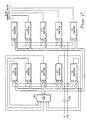
- the encoder 11 is best seen in Figure 2.
- the two input data bits X1 and X2 are received over the pair of lines 10.
- encoder is constructed as a sequential state machine.
- Encoder elements D1-D5 encode the machine states as will be later described.
- the encoded machine states are then stored in register AREG 20.
- AREG 20 outputs the current machine state to all of the encoders D1-D5 for generating the ensuing machine states.
- Each cycle of the sequential state machine combines the input data X1,X2 with the current machine state as stored in AREG 20.
- the five-bit channel byte or group is generated in the encoders Y1-Y5.
- the two input unconstrained data bits X1,X2 are applied to all of the encoders Y1-Y5 and mixed therein with the output of AREG 20 to produce a sliding block output set of channel bits for each of the two input X1,X2 unconstrained data bits.
- Table 1 below shows the state transitions for the Figure 2 illustrated encoder when encoding a modified 3,7 d,k code.
- ENCODING STATE TRANSITIONS (3,7,m) DATA INPUT 00 01 10 11 CS NS/output NS/output NS/output NS/output 1 4/10011 5/10011 6/10011 7/10011 2 1/10001 8/10000 16/10000 17/10000 3 2/10001 3/10001 15/10000 7/10000 4 4/00011 5/00011 6/00011 7/00011 5 5/00000 16/00000 19/00000 20/00000 6 4/00110 2/00001 3/00001 1/00001 7 6/00110 7/00110 8/00110 9/00110 8 4/01100 10/01100 11/01100 12/01100 9 17/00000 13/01100 14/01100 7/01100 10 1/11001 1/00001 2/11001 3/11001 11 7/11000 2/00001 3/00001 15/11000 12
- the current state CS represents the numerical contents of AREG 20.
- the next state, NS, in each of the four columns represents the next state signals as supplied by the encoders D1-D5 to AREG 20 to be used in the ensuing encoding cycle.
- the output channel byte is represented in binary form in each of the four columns.
- the machine operation varies with the two-bit unconstrained data input as indicated in the columns headed by 00, 01, 10 and 11 respectively. As an example, when the current state is 1 with the data input of 01, then the next state is 5 with an output byte Y1-Y5 of 10011.
- the modification of the 3,7 d,k code is readily ascertained from the state transition Table 1. Wherever two zeros occur in a row, they are always adjacent to binary ones.
- One of those binary ones is the binary one substituted for a binary zero to get a doublet of binary ones rather than a singleton binary one.
- the leading binary zero (left-most zero) is one of such added binary ones. That is, all transitions from any of the other states to state one has a binary one in the trailing or right-most position.
- the next state is state one.
- the numerical contents of the output byte from state six is 00001, resulting normally in a 3,7 encoding of a singleton one.
- all of the possible output bits have a left-most binary one which is the substituted binary one for the normal reoccurring binary zero in such code groups. Examination of the state transition table for the 3,7 code will find other examples of modifications to a normal 3,7 d,k code wherein singleton binary ones were converted to a doublet of binary ones producing the traversal or constraint violation of the present invention.
- the current state CS is the numerical contents of AREG 20.
- the value NS of the state transition table corresponds to the output signals of the encoders D1-D5 for generating the next successive numerical contents of AREG 20.
- the output values shown in binary form represent the five-bit channel bits of Figure 2.
- the decimal indicated numbers for the machine states are binary encoded. In one embodiment binary encoded numbers for states one through twenty were one less than the decimal notation; five bits of binary zeros represented by machine state one. State two is represented by a binary one preceded by four zeros, and so forth.
- the Figure 2 illustrated encoder can be implemented in solid state logic such as in an integrated circuit chip, programmable logic array, microcode and other forms of technology useful for manipulating digital signals.
- the construction of the electronics or optics is in accordance with the numerical values set forth in the state transition Table 1 for the 3,7 code. It should be noted that the substituted extra one to create a doublet of binary ones will always be to the right of a singleton binary one in Table 1 shown above. The binary one can be inserted in an advance or preceding position as well.
- the modification of a 3,7 code is by mapping into the 3,7 code from a channel code combination of 010 to 011.
- the ten five-bit code groups making up the dictionary of the illustrated modified 3,7 code are 10011, 10001, 10000, 00011, 00000, 00110, 01100, 11001, 11000 and 00001.
- a decoder for the encoded channel bits is shown in Figure 3.
- Lines 31-35 inclusive, respectively, carry the channel bits generated respectfully by the encoders Y1-Y5 of Figure 2.
- a set of four-bit shift registers 37, 38, 39, 40, 41 respectively received the lines 31-35 signals.
- Decoder 46 generates the output signals X1 and X2 on the dual line 14. Construction of the logic decoder 46 is set forth in Table 2 below.
- the channel code group bit patterns are denominated in decimal.
- a blank in any column signifies a "don't care" value.
- Columns S signify the suffix group and P signifies the postfix group for the decode groups, respectively.
- the representation of unconstrained data in the constrained encoding is shown in Figure 6.
- the group 50 represents the output of the Y1-Y5 encoders for the currently received input unconstrained data bits received over line 10.
- the interpretation of that channel group or bit is somewhat effected by the immediately preceding group of bits 51.
- the last two bits of the preceding channel group 51, as represented by numeral 52 are used in the representation of the unconstrained data bits.
- two channel groups or bits are used in the decoding of a group 50.
- Such groups are respectively called the suffix S53 which is the channel bit following the group 50 and a postfix P54 which immediately follows suffix 53.
- the decode of group 50 ( Figure 6), etc. are shown as subtables.
- the output data is shown in the left-hand column in binary form.
- the numerical contents of the group 50 is a subheading in Table 2, such as group 19, group 17, etc.
- the column S are the decimal representation of the contents of a suffix 53 used in decoding the data.
- Column P has a postfix 54 contents represented in decimal notation.
- the grouping decode X1 only the right-most bit of the group 51 is used as a prefix.
- Column G contains a value of group 50, column S the value of suffix 53 and the column P the value of postfix 54 all in decimal notation.
- the prefix is 10 with the X indicating the three left-most or preceding bits of group 51 are don't cares.
- Figure 4 illustrates the logic circuit used in encoder D1 for setting the next state A1 of AREG 20.
- the inputs on the left side of the figure correspond to the values contained in the AREG five stages or bit positions A1 through A5 with the data inputs X1 and X2.
- a bar above the alphanumeric notation indicates negation condition whereas the alphanumeric notation without a bar indicates "as written.” Since the logic is self-explanatory, it is not further described.
- the other encoders D2 through D5 are similarly constructed using the information contained in the table for the state transitions. Of course, logic simplification can be employed.
- Figure 5 indicates the operation of a decoder Y1 using the same notation as set forth in Figure 4.
- the encoders Y2 through Y5 are similarly constructed. Also, the decoders in the decode logic broken up on a bit-by-bit basis are shown for the encoder with the logic of operation being derived from the decoding tables set forth above.
- the decoder logic 46 receives inputs from all of the bit positions in all of the shift registers. Four channel bit groups are in the shift register at each given time for decoding. In the Table 2 indicated decode groups, the bits in the left-most three positions are used in the decoding while the numerical contents of the fourth position are ignored. For example, bits 1, 2, 3, 4, 5 correspond to the first received channel byte; 6-10 to the second; 11-15 to the third; and 16-20 to the fourth received channel byte.
- decoding group 19 of Table 2 the numerical value 19 is in bit positions 1-5; the suffix group S is in bit positions 6-10 and the postfix group P is in bit positions 11-15.
- the prefix decoding finds the prefix either in bit 5 or in bits 4 and 5 depending on whether there are one or two prefix bits.
- the group byte is then in bits 6-10, the suffix S in bits 11-15, while the postfix P is in bits 16-20. It is the decoding of all of the bit positions that determines whether or not a prefix is being decoded or a group is being decoded as set forth in the Table 2.
- the logic of the decoder 46 is in accordance with the Table 2 presentation.
- the present invention can be applied to d,k codes other than 3,7.
- a higher information density d,k code is the 4,20 recording code.
- Table 3 shows a modified 4,20 encode dictionary constructed in accordance with the present invention. TABLE 3 CHANNEL GROUP VALUES FOR A 4,20 MODIFIED d,k CODE BINARY DECIMAL 00000 0 00001 1 00011 3 00111 7 01110 14 10000 16 10001 17 10011 19 11000 24 11001 25 11100 28
- Table 4 shows the encoding state transition table in decimal notation for the 4,20 modified d,k code.
- Table 4 The arrangement of Table 4 is the same as used in Table 1.
- Table 5 shows the decode in decimal notation with the binary data output in the left-hand column, the decode groups being headers for the various subportions of the tables, the S column being the suffix column and the P column being the postfix column.
- the decode logic 46 for a 4,20 code can be constructed using the values in Table 5.
Landscapes
- Engineering & Computer Science (AREA)
- Theoretical Computer Science (AREA)
- Signal Processing For Digital Recording And Reproducing (AREA)
- Compression, Expansion, Code Conversion, And Decoders (AREA)
Applications Claiming Priority (2)
| Application Number | Priority Date | Filing Date | Title |
|---|---|---|---|
| US07/200,322 US4882583A (en) | 1988-05-31 | 1988-05-31 | Modified sliding block code for limiting error propagation |
| US200322 | 1998-11-25 |
Publications (2)
| Publication Number | Publication Date |
|---|---|
| EP0344903A2 true EP0344903A2 (fr) | 1989-12-06 |
| EP0344903A3 EP0344903A3 (fr) | 1990-09-12 |
Family
ID=22741229
Family Applications (1)
| Application Number | Title | Priority Date | Filing Date |
|---|---|---|---|
| EP19890303928 Withdrawn EP0344903A3 (fr) | 1988-05-31 | 1989-04-20 | Convertisseur de violation de la règle du code pour un code (d,k) |
Country Status (3)
| Country | Link |
|---|---|
| US (1) | US4882583A (fr) |
| EP (1) | EP0344903A3 (fr) |
| JP (1) | JPH0652620B2 (fr) |
Families Citing this family (25)
| Publication number | Priority date | Publication date | Assignee | Title |
|---|---|---|---|---|
| JPH02154361A (ja) * | 1988-12-05 | 1990-06-13 | Mitsubishi Electric Corp | 磁気ディスク装置 |
| US5486828A (en) * | 1989-04-06 | 1996-01-23 | Canon Kabushiki Kaisha | Coding/decoding method and apparatus therefor |
| US5144304A (en) * | 1989-07-17 | 1992-09-01 | Digital Equipment Corporation | Data and forward error control coding techniques for digital signals |
| US5034741A (en) * | 1990-03-22 | 1991-07-23 | United Technologies Corporation | Variable length bit patterns for data representation |
| US5537382A (en) * | 1994-11-22 | 1996-07-16 | Optex Corporation | Partial response coding for a multi-level optical recording channel |
| US5663722A (en) * | 1995-05-12 | 1997-09-02 | Optex Corporation | M=10 (3,6) runlength limited code for multi-level data |
| US5657014A (en) * | 1995-05-12 | 1997-08-12 | Optex Corporation | M=7 (3,7) runlength limited code for multi-level data |
| US5668546A (en) * | 1995-05-12 | 1997-09-16 | Optex Corporation | M=6 (3,6) runlength limited code for multi-level data |
| US5659310A (en) * | 1995-05-12 | 1997-08-19 | Optex Corporation | M=5 (0,2) runlength limited code for multi-level data |
| US5757293A (en) * | 1995-05-12 | 1998-05-26 | Optex Corporation | M=8 (1,2) runlength limited code for multi-level data |
| US5680128A (en) * | 1995-05-12 | 1997-10-21 | Optex Corporation | M=6(3,8) runlength limited code for multi-level data |
| US5748117A (en) * | 1995-05-12 | 1998-05-05 | Optex Corporation | M=8 (1,3) runlength limited code for multi-level data |
| US5659311A (en) * | 1995-05-12 | 1997-08-19 | Optex Corporation | M=6 (2,4) runlength limited code for multi-level data |
| US5675330A (en) * | 1995-05-12 | 1997-10-07 | Optex Corporation | M=5(4,11)runlength limited code for multi-level data |
| US5663723A (en) * | 1995-05-12 | 1997-09-02 | Optex Corporation | M=7 (1,3) runlength limited code for multi-level data |
| US5670956A (en) * | 1995-05-12 | 1997-09-23 | Optex Corporation | M=5 (3,7) runlength limited code for multi-level data |
| US5748118A (en) * | 1995-05-12 | 1998-05-05 | Optex Corporation | M=7 (3,8) runlength limited code for multi-level data |
| US5682154A (en) * | 1995-05-12 | 1997-10-28 | Optex Corporation | M=4 (1,2) runlength limited code for multi-level data |
| US5781130A (en) * | 1995-05-12 | 1998-07-14 | Optex Corporation | M-ary (d,k) runlength limited coding for multi-level data |
| US5682155A (en) * | 1995-05-12 | 1997-10-28 | Optex Corporation | M=6(4,11) runlength limited code for multi-level data |
| WO1997050179A1 (fr) * | 1996-06-24 | 1997-12-31 | Etom Technologies Corporation | Code limite par longueur de ligne de type m=10 (2,10), d=3.75 pour donnees a plusieurs niveaux |
| KR20010013152A (ko) * | 1998-03-31 | 2001-02-26 | 요트.게.아. 롤페즈 | 코드화된 데이터를 수정하는 방법 및 데이터 수정 어셈블리 |
| EP1671217B1 (fr) * | 2003-10-11 | 2007-12-26 | Spans Logic Inc. | Mecanisme de memoire et de puissance efficace pour table de recherche rapide |
| US7483585B2 (en) * | 2004-12-01 | 2009-01-27 | Ati Technologies Ulc | Image compression using variable bit size run length encoding |
| US7676725B1 (en) | 2006-02-27 | 2010-03-09 | The United States Of America As Represented By The Director, National Security Agency | Method of code generation that minimizes error propagation |
Family Cites Families (14)
| Publication number | Priority date | Publication date | Assignee | Title |
|---|---|---|---|---|
| BE755003A (fr) * | 1969-08-27 | 1971-02-01 | Begy Societe Europ De Bas Sans | Procede de fabrication d'articles imprimes, notamment de bonneterie |
| DE2508706C2 (de) * | 1974-05-02 | 1984-10-11 | International Business Machines Corp., Armonk, N.Y. | Schaltungsanordnung zur Codierung von Datenbitfolgen |
| US4146909A (en) * | 1977-11-21 | 1979-03-27 | International Business Machines Corporation | Sync pattern encoding system for run-length limited codes |
| FR2466913A1 (fr) * | 1979-10-01 | 1981-04-10 | Thomson Csf | Procede et dispositif de codage de donnees binaires, dispositifs de decodage des donnees codees et systemes de transmission comportant de tels dispositifs |
| FR2507035B1 (fr) * | 1981-06-02 | 1988-09-16 | Thomson Csf | Procede de codage de donnees binaires et dispositif de transmission de signal video numerise mettant en oeuvre un tel procede |
| NL8201411A (nl) * | 1982-04-02 | 1983-11-01 | Philips Nv | Werkwijze voor het optekenen van een digitaal informatiesignaal op een registratiedrager met een stralingsgevoelige informatielaag, een inrichting hiervoor en een optische registratiedrager voorzien van een dergelijk digitaal informatiesignaal. |
| US4413251A (en) * | 1981-07-16 | 1983-11-01 | International Business Machines Corporation | Method and apparatus for generating a noiseless sliding block code for a (1,7) channel with rate 2/3 |
| US4502036A (en) * | 1981-09-25 | 1985-02-26 | Mitsubishi Denki Kabushiki Kaisha | Encoding and decoding systems for binary data |
| US4463344A (en) * | 1981-12-31 | 1984-07-31 | International Business Machines Corporation | Method and apparatus for generating a noiseless sliding block code for a (2,7) channel with rate 1/2 |
| US4488142A (en) * | 1981-12-31 | 1984-12-11 | International Business Machines Corporation | Apparatus for encoding unconstrained data onto a (1,7) format with rate 2/3 |
| US4567464A (en) * | 1983-01-28 | 1986-01-28 | International Business Machines Corporation | Fixed rate constrained channel code generating and recovery method and means having spectral nulls for pilot signal insertion |
| JPS62298234A (ja) * | 1986-06-13 | 1987-12-25 | インタ−ナショナル ビジネス マシ−ンズ コ−ポレ−ション | 非対称ランレングス制限コ−ド化方法 |
| US4833470A (en) * | 1986-07-15 | 1989-05-23 | Matsushita Electric Industrial Co., Ltd. | Code conversion apparatus |
| US4870414A (en) * | 1988-03-18 | 1989-09-26 | International Business Machines Corporation | Even mark modulation coding method |
-
1988
- 1988-05-31 US US07/200,322 patent/US4882583A/en not_active Expired - Lifetime
-
1989
- 1989-04-20 EP EP19890303928 patent/EP0344903A3/fr not_active Withdrawn
- 1989-05-12 JP JP1117598A patent/JPH0652620B2/ja not_active Expired - Lifetime
Also Published As
| Publication number | Publication date |
|---|---|
| JPH0652620B2 (ja) | 1994-07-06 |
| EP0344903A3 (fr) | 1990-09-12 |
| JPH02203476A (ja) | 1990-08-13 |
| US4882583A (en) | 1989-11-21 |
Similar Documents
| Publication | Publication Date | Title |
|---|---|---|
| US4882583A (en) | Modified sliding block code for limiting error propagation | |
| EP0070387B1 (fr) | Méthode et appareil pour générer un code de bloc glissant, sans bruit, pour un canal avec un taux de 2/3 | |
| US4486739A (en) | Byte oriented DC balanced (0,4) 8B/10B partitioned block transmission code | |
| US4786890A (en) | Method and apparatus for implementing a PRML code | |
| US4463344A (en) | Method and apparatus for generating a noiseless sliding block code for a (2,7) channel with rate 1/2 | |
| US5781133A (en) | Method and apparatus for implementing run length limited codes | |
| KR100488634B1 (ko) | m-비트정보워드들의계열을변조신호로변환하는방법,기록캐리어를제조하는방법,부호화장치,장치,기록장치,신호,및기록캐리어 | |
| US5047767A (en) | Apparatus utilizing a four state encoder for encoding and decoding A sliding block (1,7) code | |
| US4985700A (en) | Variable-length coding/decoding device | |
| US5099237A (en) | Method and apparatus for providing maximum rate modulation or compression encoding and decoding | |
| JPH036699B2 (fr) | ||
| GB2305582A (en) | Channel encoding and decoding for eight to fourteen modulation using merging bits | |
| JPS6217418B2 (fr) | ||
| KR20010015164A (ko) | 데이터 부호화 장치 및 방법 | |
| Horiguchi et al. | An optimization of modulation codes in digital recording | |
| JP3306271B2 (ja) | 符号化方法、符号化回路、及び復号回路 | |
| CN1307721A (zh) | 将二进制序列可逆变换为比率为2/3(1,k)游程受限的编码序列 | |
| WO2000055974A1 (fr) | CODAGE/DECODAGE DE MOTS SOURCE A n-BITS EN MOTS BINAIRES A m-BITS, ET VICE VERSA, DE MANIERE A OBTENIR UNE CONVERSION A INVERSION DE PARITE | |
| JPH02119434A (ja) | 符合化回路及び復合化回路 | |
| KR100282846B1 (ko) | Mtr 조건을 만족하는 인코더 및 디코더 | |
| JPH01221926A (ja) | 可変長符号変換方法 | |
| JPS61227431A (ja) | 符号変換装置 | |
| JPH01221918A (ja) | 可変長符号変換装置 | |
| JPS61230679A (ja) | 2値デ−タ系列の記録方法 | |
| JPH01221919A (ja) | 可変長符号変換方法 |
Legal Events
| Date | Code | Title | Description |
|---|---|---|---|
| PUAI | Public reference made under article 153(3) epc to a published international application that has entered the european phase |
Free format text: ORIGINAL CODE: 0009012 |
|
| AK | Designated contracting states |
Kind code of ref document: A2 Designated state(s): DE FR GB |
|
| 17P | Request for examination filed |
Effective date: 19900326 |
|
| PUAL | Search report despatched |
Free format text: ORIGINAL CODE: 0009013 |
|
| AK | Designated contracting states |
Kind code of ref document: A3 Designated state(s): DE FR GB |
|
| STAA | Information on the status of an ep patent application or granted ep patent |
Free format text: STATUS: THE APPLICATION HAS BEEN WITHDRAWN |
|
| 17Q | First examination report despatched |
Effective date: 19920827 |
|
| 18W | Application withdrawn |
Withdrawal date: 19920912 |