EP0345326B1 - Transmission de donnees en periode d'image active - Google Patents
Transmission de donnees en periode d'image active Download PDFInfo
- Publication number
- EP0345326B1 EP0345326B1 EP89900617A EP89900617A EP0345326B1 EP 0345326 B1 EP0345326 B1 EP 0345326B1 EP 89900617 A EP89900617 A EP 89900617A EP 89900617 A EP89900617 A EP 89900617A EP 0345326 B1 EP0345326 B1 EP 0345326B1
- Authority
- EP
- European Patent Office
- Prior art keywords
- data
- video signal
- picture
- additional data
- signal
- Prior art date
- Legal status (The legal status is an assumption and is not a legal conclusion. Google has not performed a legal analysis and makes no representation as to the accuracy of the status listed.)
- Revoked
Links
- 230000005540 biological transmission Effects 0.000 title description 19
- 238000000034 method Methods 0.000 claims abstract description 16
- 238000006243 chemical reaction Methods 0.000 claims description 7
- 238000012360 testing method Methods 0.000 description 10
- 230000006735 deficit Effects 0.000 description 7
- 238000010586 diagram Methods 0.000 description 3
- 230000000694 effects Effects 0.000 description 3
- 238000001914 filtration Methods 0.000 description 2
- 238000000059 patterning Methods 0.000 description 2
- 238000007493 shaping process Methods 0.000 description 2
- 238000001228 spectrum Methods 0.000 description 2
- 101150071746 Pbsn gene Proteins 0.000 description 1
- 230000002238 attenuated effect Effects 0.000 description 1
- 239000002131 composite material Substances 0.000 description 1
- 238000013461 design Methods 0.000 description 1
- 238000002474 experimental method Methods 0.000 description 1
- 230000036039 immunity Effects 0.000 description 1
- 238000003780 insertion Methods 0.000 description 1
- 230000037431 insertion Effects 0.000 description 1
- 238000011835 investigation Methods 0.000 description 1
- 230000005236 sound signal Effects 0.000 description 1
- 230000007704 transition Effects 0.000 description 1
- 230000000007 visual effect Effects 0.000 description 1
Images



Classifications
-
- H—ELECTRICITY
- H04—ELECTRIC COMMUNICATION TECHNIQUE
- H04N—PICTORIAL COMMUNICATION, e.g. TELEVISION
- H04N11/00—Colour television systems
- H04N11/06—Transmission systems characterised by the manner in which the individual colour picture signal components are combined
- H04N11/12—Transmission systems characterised by the manner in which the individual colour picture signal components are combined using simultaneous signals only
- H04N11/14—Transmission systems characterised by the manner in which the individual colour picture signal components are combined using simultaneous signals only in which one signal, modulated in phase and amplitude, conveys colour information and a second signal conveys brightness information, e.g. NTSC-system
- H04N11/16—Transmission systems characterised by the manner in which the individual colour picture signal components are combined using simultaneous signals only in which one signal, modulated in phase and amplitude, conveys colour information and a second signal conveys brightness information, e.g. NTSC-system the chrominance signal alternating in phase, e.g. PAL-system
- H04N11/167—Transmission systems characterised by the manner in which the individual colour picture signal components are combined using simultaneous signals only in which one signal, modulated in phase and amplitude, conveys colour information and a second signal conveys brightness information, e.g. NTSC-system the chrominance signal alternating in phase, e.g. PAL-system a resolution-increasing signal being multiplexed to the PAL-system signal, e.g. PAL-PLUS-system
-
- H—ELECTRICITY
- H04—ELECTRIC COMMUNICATION TECHNIQUE
- H04N—PICTORIAL COMMUNICATION, e.g. TELEVISION
- H04N7/00—Television systems
- H04N7/007—Systems with supplementary picture signal insertion during a portion of the active part of a television signal, e.g. during top and bottom lines in a HDTV letter-box system
-
- H—ELECTRICITY
- H04—ELECTRIC COMMUNICATION TECHNIQUE
- H04N—PICTORIAL COMMUNICATION, e.g. TELEVISION
- H04N7/00—Television systems
- H04N7/015—High-definition television systems
-
- H—ELECTRICITY
- H04—ELECTRIC COMMUNICATION TECHNIQUE
- H04N—PICTORIAL COMMUNICATION, e.g. TELEVISION
- H04N7/00—Television systems
- H04N7/08—Systems for the simultaneous or sequential transmission of more than one television signal, e.g. additional information signals, the signals occupying wholly or partially the same frequency band, e.g. by time division
- H04N7/087—Systems for the simultaneous or sequential transmission of more than one television signal, e.g. additional information signals, the signals occupying wholly or partially the same frequency band, e.g. by time division with signal insertion during the vertical blanking interval only
- H04N7/088—Systems for the simultaneous or sequential transmission of more than one television signal, e.g. additional information signals, the signals occupying wholly or partially the same frequency band, e.g. by time division with signal insertion during the vertical blanking interval only the inserted signal being digital
Definitions
- This invention relates to the transmission of additional data in the active picture period of video transmissions for example such as broadcast television transmission.
- Digitally assisted television has been proposed which uses additional data transmitted with a video signal to enhance the display at the receiver and thereby produce, for example, a high definition television (HDTV) picture or some other enhanced display.
- HDTV high definition television
- HDTV receivers will typically operate with a larger aspect ratio, namely the ratio of picture width to picture height, than that used with conventional receivers operating, for example, on 625 lines. Since conventional receivers are not compatible with a full bandwidth HDTV signal a method of transmitting signals which can be received on both types of receiver is needed.
- US-A-4672425 proposes transmitting data in the active picture period of a conventional transmission and using this data to produce an extended aspect ratio picture on a non-conventional receiver.
- the data is at a level which would be visible when viewed on a conventional receiver.
- conventional receivers are modified with circuitry to switch the display to constant levels of luminance of chrominance in the picture areas which contain additional data.
- a method of transmitting extended aspect ratio pictures in a video signal comprising the steps of, providing a video signal in which picture information occupies a smaller number of lines than the number required to fill the visible area of a conventional receiver, inserting additional data into at least some of the lines not used for picture information, the data being at a sufficiently low level to be substantially invisible when viewed on a conventional receiver, and transmitting the picture information and data as a conventional video signal.
- a method of transmitting additional data in a video signal comprising the steps of providing a video signal in which picture information occupies less than the whole visible area of a conventional receiver, inserting additional data into at least part of the area not used for picture information, the data being at a sufficiently low level to be substantially invisible when viewed on a conventional receiver, and transmitting the picture information and data as a conventional video signal.
- the present invention also provides apparatus to transmit additional data in a video signal comprising means to provide a first video signal with a first number of lines, means to convert the signal to a second video signal on a reduced number of lines together with data relating to the difference between the two signals, first storage means coupled to a second video signal output of the conversion nears, second storage nears coupled to a data output of the conversion means, combining means coupled to the outputs of the first and second storage means and with an output coupled to the input of a transmitter means, to combine the stored video and data, the data being at a sufficiently low level to be substantially invisible when viewed on a conventional receiver, and control means coupled to the first and second storage means and having a timing information input, to determine whether video signal information from the first storage means or data from the second storage means is available at the combining means inputs.
- Another aspect of the invention provides apparatus to receive a video signal containing additional data within the active picture area, the data being at a sufficiently low level to be substantially invisible when viewed on a conventional receiver, the apparatus comprising input nears to receive the said video signal, switching means responsive to the received signal to switch between a picture output and a data output, storage means to store received picture information under the control of timing information within the said picture information, conversion means coupled to an output of the storage means and to the data output of the switching means to receive picture information from the storage means and to enhance that picture information by generating additional lines of video signal relating to the received additional data, and display means to display the enhanced picture.
- the lines in the blank areas 2 and 4 would now be free to carry other data such as DATV data. However, these free lines are in the visible picture area of a conventional receiver.
- the format used for teletext information might be considered.
- the teletext data levels with respect to black level are shown in Figure 2(a). With standard one volt video the logic levels used for teletext are OV and 0.46V with respect to black level. Thus, if this format is used to transmit data in the blank areas 2 and 4 of a conventional screen, unacceptable patterning will occur.
- the invention therefore aims to provide data formats which would appear black on a conventional receiver.
- the levels should preferably be mostly at or below black level.
- the signals should also not interfere with the receiver synchronising circuits.
- One method of ensuring this is to make sure that the sync. circuits see the data as a line of black. This is done by positioning the data levels above and below black so that the mean level is black. This means, however, that the level will go above black level at times.
- the gamma characteristic of the television tube will, however, ensure that no excessive visibility of the data occurs, provided the data amplitude is not too great.
- Black level Mean level of digital signal.
- 2v Total peak to peak amplitude of data waveform.
- Figure 2(b) shows the total available voltage swing of 0.6V available for the DATV data; however, if the signal is to remain invisible the total swing cannot be used.
- the bit-rate used determines the data capacity provided by each television line, as well as the required channel filtering and required signal to noise ratio. Before specifying the bit rate it is, therefore, ideally necessary to know the required data capacity as well as the service area and the number of lines available for data transmission. The latter is, of course, set by the aspect ratio of the picture. In addition the precise relationship between bit rate and line frequency will have a significant bearing on the appearance of the data if it should be visible. For the purpose of this embodiment a bit rate of around 5.5 MBit/sec is used for NRZ (Non Return to Zero) transmission since with 100% cosine filtering This will conveniently fit within the 5.5 MHz vision bandwidth. Some "Fine-Tuning" has been undertaken to try to minimise the visibility of the data on the screen.
- Bi-Phase transmission has two transmission bits to transmit each data bit but ensures that the mean of the transmission bits is automatically zero.
- the spectrum of the data signal has a bearing on its visibility. Furthermore, low frequency components around line frequency may cause shifting of the DC level across a line between clamping pulses. This could give rise to a visible streaking effect as well as a reduction of eye-height, and possible sync problems. For this reason several types of data spectrum have been tested:
- All four data signals have been inserted at several values of peak to peak amplitude in an experimental arrangement.
- the mean DC level of the signal was set to black level and tests have been carried out at other D.C. levels to enable the amplitude of the signal to be set higher.
- the above figures relate to a conventional 625/50 PAL signal as is broadcast in the United Kingdom, having a line period of 64 us.
- FIG. 4 shows the experimental set-up used.
- a video source 8 and the appropriate data signal 10 are applied to a video switch 12.
- a switching control unit 14 generates appropriate switching signals so that the data is switched into the video waveform as required.
- the data is generated by a pseudo-random binary sequence generator circuit 16 which produces a square-wave "Boxcar” output after passing through attenuators 15. This is suitably low-pass filtered by a 5.5 MHz group-delay corrected filter 18.
- the data shaping is not a precise cosine law.
- An approximate shaping is achieved using a simple transversal filter 20 with a delay selected expertimentally to produce an optimum eye display when viewed on an oscilloscope.
- the composite video/data waveform is passed through an amplifier 21 to a television modulator 22 and modulated to channel E64 and then attenuated by an attenuator 26 the output of which is then fed at a level of -42 dBm to a Ferguson TX10 receiver uhf input. Sound signals 24 are also fed into the modulator so that any impairment to the sound from the receiver can be assessed.
- a number of adjustments allow the experimental conditions to be varied as appropriate.
- the positions on the screen of the transitions between data and picture are adjustable by means of "Picture Top” and “Picture Bottom” controls 28 and 30 on the switching control unit.
- the PRBS generator provides controls 32, 34 and 36 for the data amplitude, sequence length, and data type (NRZ or Bi-Phase) respectively.
- a variable DC offset 38 is provided to enable the mean DC level of the data to be varied after passing through a differential amplifier 40.
- NRZ or Bi-phase data can therefore, be inserted into television lines with a peak to peak amplitude of 0.3 V with no impairment to existing sound or vision although it is slightly visible.
- the above tests were, however, conducted in a darkened room. In normal lighting conditions the 0.3 V data waveform is virtually invisible, and Bi-phase data is still invisible at 0.4 V peak to peak.
- the optimum form of the data transmitted in the picture area depends on the requirements of the transmission system on which it is to be used. If the mean DC level of the signal is not allowed to fall below black level, as would be the case in a normal TV line, a peak to peak data amplitude of 0.1 V is recommended. If the noise immunity of such signals is found to be insufficient the amplitude of the signal could be increased although this would result in it being visible on some receivers. An amplitude of around 0.3 V is about the maximum before the data signals become annoying in normal viewing conditions. NRZ data can be used in this case, there is no advantage with using Bi-Phase.
- the limit of service area criterion of 64 dB (uV/m) for band 4 and 70 dB(uv/m) for band 5 should achieve a picture to noise ratio of at least 34 dB depending on the receiver. This then implies a margin of about 6 dB in favour of the DATV signal.
- the video signal used by such a transmitter should ideally be generated from an HDTV video signal. It should then be down-converted to reduce the number of active lines to less than the 576 active lines of a conventional 625 line video signal, for example 450 active lines.
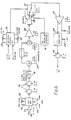
- FIG. 5 a block diagram of a proposed transmitter embodying the invention is shown.
- An HDTV camera 42 produces an HDTV signal which forms the input to a standards down-converter processor 44.
- This processor has two outputs. The first output produces picture information on a reduced number of lines (e.g. less than 576 active picture lines for reception on conventional 625 line receivers) and this forms the input to a frame store 46.
- the second output produces digital assistance data for use by HDTV receivers to regenerate the HDTV signal. This data is read into a digital buffer 48.
- TV timing and synchronising waveforms form the input to a controller 50 for the transmitter.
- the clock outputs of the controller enable and disable buffer 48.
- the output data of the digital buffer is coded by a coder 52 which converts it to a form suitable for transmission in the active picture period.
- This data and the picture data output by the frame store are then combined in an adder 54, the combination resulting in either output of picture data or output of coded digital assistance data. This is determined by the enabling and disabling of the frame store 46 and digital buffer 48 output by the controller 50 clock.
- the output signal is the input to a transmitter 53.
- the timing information supplied to the controller 50 is conventional 625 line timing information.
- the controller preferably enables and disables the outputs of the frame store 46 and the digital buffer 48 so that a picture for reception on a conventional receiver is transmitted in the letterbox type format illustrated in Figure 1 and the DATV data invisibly occupies the blank arts of the screen.
- FIG. 6 An HDTV receiver which is compatible with a signal transmitted by the system in Figure 5 is shown in Figure 6.
- the receiver has conventional front end circuitry 54 receiving the signal.
- the output of this circuitry forms the inputs to a data/video switch 56 under the control of a data/video detector 58 which is also connected to the output of the front end circuitry.
- the data/video switch When a signal is received, the data/video switch automatically switches between data and video outputs as either data or video respectively is detected in the incoming signal by the data/video detector 58.
- the picture output of the data/video switch 56 forms the input to a frame store 60 and also supplies timing information to a write controller 62, the output of which controls the storing of picture lines in the frame store 60.
- the data output of the data/video switch forms one of the inputs to a standards up-converter 64, the other input being the output of the frame store 60.
- a clock output from the standards up-converter 64 is used to enable the output of the frame store to release picture information for up-conversion to an HDTV signal with the DATV data. This HDTV signal can then be viewed on an HDTV display 66.
- the above method of transmitting and receiving additional data with extended aspect ratio receivers is intended to be used with any transmission standard.
- the main advantage is that pictures can be transmitted over the same transmission channels as are currently in use and can still be received on conventional receivers.
Landscapes
- Engineering & Computer Science (AREA)
- Multimedia (AREA)
- Signal Processing (AREA)
- Television Systems (AREA)
Abstract
Claims (14)
- Un procédé de transmission d'une donnée additionnelle dans un signal vidéo comprenant les étapes consistant à produire un signal vidéo dans lequel une information d'image occupe moins de la totalité de la zone visible d'un récepteur classique, produire une donnée additionnelle, insérer la donnée additionnelle dans au moins une partie de la zone visible qui n'est pas utilisées pour l'information d'image, transmettre l'information d'image et la donnée sous la forme d'une signal vidéo classique caractérisé en ce que la donnée est produite et insérée dans la zone visible à un niveau suffisamment bas pour être sensiblement invisible lorsqu'elle est vue sur un récepteur classique.
- Un procédé selon la revendication 1 caractérisé en ce que la donnée additionnelle est insérée entre des périodes consécutives de suppression de lignes.
- Un procédé selon la revendication 1 ou 2, caractérisé en ce que le niveau moyen en courant continu de la donnée additionnelle est sensiblement au niveau du noir.
- Un procédé selon la revendication 3 caractérisé en ce que le rapport entre les amplitudes de pic à pic de la donnée additionnelle et du signal vidéo n'est pas supérieur à 0,3:1.
- Un procédé selon les revendications 1 ou 2, caractérisé en ce que le niveau moyen en courant continu de la donnée additionnelle est inférieur au niveau du noir.
- Un procédé selon la revendication 5 caractérisé en ce que la donnée additionnelle est du type sans retour à zéro.
- Un procédé selon la revendication 1 ou 2 caractérisé en ce que la donnée additionnelle est du type biphasé.
- Un procédé selon une revendication précédente quelconque, caractérisé en ce que la donnée additionnelle est une donnée numérique.
- Un procédé selon une revendication précédente quelconque caractérisé en ce que la donnée additionnelle est une donnée servant à améliorer la qualité d'affichage sur des récepteurs de télévision à haute définition (ou HDTV).
- Appareil de transmission d'une donnée additionnelle dans un signal vidéo comprenant un moyen de production (42) d'un premier signal vidéo pourvu d'un premier nombre de lignes, un moyen de conversion (44) du signal en un deuxième signal vidéo, sur un nombre réduit de lignes, accompagné d'une donnée concernant la différence entre les deux signaux, un premier moyen de mémorisation (46) couplé à une sortie de signal vidéo du moyen de conversion, un deuxième moyen de mémorisation (48, 52) couplé à une sortie de donnée du moyen de conversion, un moyen de combinaison (54) couplé aux sorties du premier et du deuxième moyens de mémorisation et dont une sortie est couplée à l'entrée d'un moyen transmetteur (53) afin de combiner le signal vidéo et la donnée mémorisés, et un moyen de commande (50) couplé au premier et au deuxième moyens de mémorisation et possédant une information d'entrée de synchronisation afin de déterminer si une information de signal vidéo, venant du premier moyen de mémorisation, ou de donnée, venant du deuxième moyen de mémorisation, est disponible à l'entrée du moyen de combinaison, caractérisé en ce que la donnée est combinée avec le signal vidéo à un niveau suffisamment bas pour être sensiblement invisible lorsqu'elle est vue sur un récepteur classique.
- Appareil selon la revendication 10, dans lequel le premier signal vidéo est un signal de télévision à haute définition (HDTV).
- Appareil selon la revendication 10 ou 11 dans lequel la donnée concernant la différence entre les deux signaux est une donnée d'assistance numérique.
- Appareil selon la revendication 10, 11 ou 12 dans lequel le signal transmis est un signal vidéo à 625 lignes.
- Appareil de réception d'un signal vidéo classique contenant une donnée additionnelle à l'intérieur de la zone active d'image, l'appareil comprenant un moyen d'entrée (54) pour recevoir ledit signal vidéo, un moyen commutateur (56) sensible au signal reçu pour commuter entre une sortie d'image et une sortie de donnée, un moyen de mémorisation (60) pour mémoriser l'information d'image reçue sous la commande d'une information de synchronisation avec ladite information d'image, un moyen de conversion (64) couplé à une sortie du moyen de mémorisation et à la sortie de donnée du moyen commutateur afin de recevoir une information d'image venant du moyen de mémorisation et d'améliorer cette information d'image en engendrant des lignes additionnelles du signal vidéo concernant la donnée additionnelle reçue, et un moyen d'affichage (66) servant à afficher l'image améliorée caractérisé en ce que la donnée reçue est à un niveau suffisamment bas pour être sensiblement invisible lorsqu'elle est vue sur un récepteur classique et que le moyen commutateur est sensible à la donnée à un tel niveau.
Priority Applications (1)
| Application Number | Priority Date | Filing Date | Title |
|---|---|---|---|
| AT89900617T ATE102422T1 (de) | 1987-12-07 | 1989-06-22 | Datenuebertragung in aktiver bildperiode. |
Applications Claiming Priority (4)
| Application Number | Priority Date | Filing Date | Title |
|---|---|---|---|
| GB8728530 | 1987-12-07 | ||
| GB878728530A GB8728530D0 (en) | 1987-12-07 | 1987-12-07 | Data transmission in active picture period |
| GB8729000 | 1987-12-11 | ||
| GB8729000A GB2213342B (en) | 1987-12-07 | 1987-12-11 | Data transmission in active picture period |
Publications (2)
| Publication Number | Publication Date |
|---|---|
| EP0345326A1 EP0345326A1 (fr) | 1989-12-13 |
| EP0345326B1 true EP0345326B1 (fr) | 1994-03-02 |
Family
ID=26293167
Family Applications (1)
| Application Number | Title | Priority Date | Filing Date |
|---|---|---|---|
| EP89900617A Revoked EP0345326B1 (fr) | 1987-12-07 | 1989-06-22 | Transmission de donnees en periode d'image active |
Country Status (5)
| Country | Link |
|---|---|
| US (1) | US5075773A (fr) |
| EP (1) | EP0345326B1 (fr) |
| JP (1) | JPH02502508A (fr) |
| DE (1) | DE3888169T2 (fr) |
| WO (1) | WO1989005555A1 (fr) |
Families Citing this family (68)
| Publication number | Priority date | Publication date | Assignee | Title |
|---|---|---|---|---|
| DE3841173C1 (en) * | 1988-12-07 | 1989-11-16 | Institut Fuer Rundfunktechnik Gmbh, 8000 Muenchen, De | Compatible television transmission system |
| JP2712674B2 (ja) * | 1989-12-18 | 1998-02-16 | 松下電器産業株式会社 | ワイドテレビジョン信号の伝送方法 |
| DE3942570A1 (de) * | 1989-12-22 | 1991-07-04 | Inst Rundfunktechnik Gmbh | Verfahren zum uebertragen von digitalen informationen, insbesondere toninformationen, in einem fernsehkanal |
| DE4020066A1 (de) * | 1990-06-23 | 1992-01-09 | Inst Rundfunktechnik Gmbh | System zur uebertragung und decodierung biphasecodierter, einem videosignal in dessen vertikaler austastluecke beigefuegter daten, insbesondere fuer vps |
| EP0496578A3 (en) * | 1991-01-22 | 1993-09-22 | Matsushita Electric Industrial Co., Ltd. | Extended definition television system |
| US5278649A (en) * | 1991-01-22 | 1994-01-11 | Matsushita Electric Corporation Of America | Method and apparatus for transmission of signals for an extended definition television system |
| DE4112712A1 (de) * | 1991-04-18 | 1992-10-22 | Inst Rundfunktechnik Gmbh | Verfahren zum uebertragen einer digitalen zusatzinformation in einer zeile eines fernsehsignals |
| US5200822A (en) * | 1991-04-23 | 1993-04-06 | National Broadcasting Company, Inc. | Arrangement for and method of processing data, especially for identifying and verifying airing of television broadcast programs |
| US5831679A (en) * | 1991-06-14 | 1998-11-03 | Wavephore, Inc. | Network for retrieval and video transmission of information |
| US5327237A (en) * | 1991-06-14 | 1994-07-05 | Wavephore, Inc. | Transmitting data with video |
| US5559559A (en) * | 1991-06-14 | 1996-09-24 | Wavephore, Inc. | Transmitting a secondary signal with dynamic injection level control |
| US5387941A (en) * | 1991-06-14 | 1995-02-07 | Wavephore, Inc. | Data with video transmitter |
| US5617148A (en) * | 1991-06-14 | 1997-04-01 | Wavephore, Inc. | Filter by-pass for transmitting an additional signal with a video signal |
| US5410360A (en) * | 1991-06-14 | 1995-04-25 | Wavephore, Inc. | Timing control for injecting a burst and data into a video signal |
| JPH0822057B2 (ja) * | 1992-04-21 | 1996-03-04 | 松下電器産業株式会社 | テレビジョン信号処理方法および処理装置 |
| US6301369B2 (en) | 1992-07-31 | 2001-10-09 | Digimarc Corporation | Image marking to permit later identification |
| US5721788A (en) | 1992-07-31 | 1998-02-24 | Corbis Corporation | Method and system for digital image signatures |
| US5408270A (en) * | 1993-06-24 | 1995-04-18 | Massachusetts Institute Of Technology | Advanced television system |
| US6122403A (en) * | 1995-07-27 | 2000-09-19 | Digimarc Corporation | Computer system linked by using information in data objects |
| US6614914B1 (en) | 1995-05-08 | 2003-09-02 | Digimarc Corporation | Watermark embedder and reader |
| US5748763A (en) | 1993-11-18 | 1998-05-05 | Digimarc Corporation | Image steganography system featuring perceptually adaptive and globally scalable signal embedding |
| US6580819B1 (en) | 1993-11-18 | 2003-06-17 | Digimarc Corporation | Methods of producing security documents having digitally encoded data and documents employing same |
| US6983051B1 (en) | 1993-11-18 | 2006-01-03 | Digimarc Corporation | Methods for audio watermarking and decoding |
| US7171016B1 (en) | 1993-11-18 | 2007-01-30 | Digimarc Corporation | Method for monitoring internet dissemination of image, video and/or audio files |
| US6424725B1 (en) | 1996-05-16 | 2002-07-23 | Digimarc Corporation | Determining transformations of media signals with embedded code signals |
| US5862260A (en) * | 1993-11-18 | 1999-01-19 | Digimarc Corporation | Methods for surveying dissemination of proprietary empirical data |
| US6757406B2 (en) | 1993-11-18 | 2004-06-29 | Digimarc Corporation | Steganographic image processing |
| US6449377B1 (en) | 1995-05-08 | 2002-09-10 | Digimarc Corporation | Methods and systems for watermark processing of line art images |
| US6516079B1 (en) | 2000-02-14 | 2003-02-04 | Digimarc Corporation | Digital watermark screening and detecting strategies |
| USRE40919E1 (en) * | 1993-11-18 | 2009-09-22 | Digimarc Corporation | Methods for surveying dissemination of proprietary empirical data |
| US6611607B1 (en) | 1993-11-18 | 2003-08-26 | Digimarc Corporation | Integrating digital watermarks in multimedia content |
| US5832119C1 (en) * | 1993-11-18 | 2002-03-05 | Digimarc Corp | Methods for controlling systems using control signals embedded in empirical data |
| US5822436A (en) | 1996-04-25 | 1998-10-13 | Digimarc Corporation | Photographic products and methods employing embedded information |
| US5768426A (en) | 1993-11-18 | 1998-06-16 | Digimarc Corporation | Graphics processing system employing embedded code signals |
| ATE287176T1 (de) * | 1993-11-18 | 2005-01-15 | Digimarc Corp | Video mit versteckten in-band digitalen daten |
| US5841886A (en) * | 1993-11-18 | 1998-11-24 | Digimarc Corporation | Security system for photographic identification |
| US5748783A (en) * | 1995-05-08 | 1998-05-05 | Digimarc Corporation | Method and apparatus for robust information coding |
| US6408082B1 (en) | 1996-04-25 | 2002-06-18 | Digimarc Corporation | Watermark detection using a fourier mellin transform |
| JP2554450B2 (ja) * | 1993-12-16 | 1996-11-13 | 日本テレビ放送網株式会社 | フレームシンクロナイザおよびこれを使用した信号切り替え装置 |
| US6522770B1 (en) | 1999-05-19 | 2003-02-18 | Digimarc Corporation | Management of documents and other objects using optical devices |
| US6968057B2 (en) | 1994-03-17 | 2005-11-22 | Digimarc Corporation | Emulsion products and imagery employing steganography |
| AU2390895A (en) * | 1994-04-20 | 1995-11-16 | Shoot The Moon Products, Inc. | Method and apparatus for nesting secondary signals within a television signal |
| USRE44685E1 (en) | 1994-04-28 | 2013-12-31 | Opentv, Inc. | Apparatus for transmitting and receiving executable applications as for a multimedia system, and method and system to order an item using a distributed computing system |
| US6560349B1 (en) | 1994-10-21 | 2003-05-06 | Digimarc Corporation | Audio monitoring using steganographic information |
| US6721440B2 (en) | 1995-05-08 | 2004-04-13 | Digimarc Corporation | Low visibility watermarks using an out-of-phase color |
| US6760463B2 (en) | 1995-05-08 | 2004-07-06 | Digimarc Corporation | Watermarking methods and media |
| US6728390B2 (en) | 1995-05-08 | 2004-04-27 | Digimarc Corporation | Methods and systems using multiple watermarks |
| US7486799B2 (en) | 1995-05-08 | 2009-02-03 | Digimarc Corporation | Methods for monitoring audio and images on the internet |
| US5771073A (en) * | 1995-06-07 | 1998-06-23 | Massachusetts Institute Of Technology | Advanced television system using a different encoding technique for non-image areas |
| US6788800B1 (en) | 2000-07-25 | 2004-09-07 | Digimarc Corporation | Authenticating objects using embedded data |
| US6965682B1 (en) | 1999-05-19 | 2005-11-15 | Digimarc Corp | Data transmission by watermark proxy |
| US6577746B1 (en) | 1999-12-28 | 2003-06-10 | Digimarc Corporation | Watermark-based object linking and embedding |
| US6829368B2 (en) | 2000-01-26 | 2004-12-07 | Digimarc Corporation | Establishing and interacting with on-line media collections using identifiers in media signals |
| US6189030B1 (en) | 1996-02-21 | 2001-02-13 | Infoseek Corporation | Method and apparatus for redirection of server external hyper-link references |
| US6381341B1 (en) | 1996-05-16 | 2002-04-30 | Digimarc Corporation | Watermark encoding method exploiting biases inherent in original signal |
| US5903231A (en) * | 1996-12-16 | 1999-05-11 | Vidicast Ltd. | System for encoding base N data using a multi-level coding scheme |
| US6122010A (en) * | 1996-12-16 | 2000-09-19 | Vidicast Ltd. | Television signal data transmission system |
| RU2154354C1 (ru) * | 1997-06-20 | 2000-08-10 | Матсусита Электрик Индастриал Ко., Лтд. | Способ передачи цифровых данных и устройство для его осуществления |
| US7054463B2 (en) | 1998-01-20 | 2006-05-30 | Digimarc Corporation | Data encoding using frail watermarks |
| US6625297B1 (en) | 2000-02-10 | 2003-09-23 | Digimarc Corporation | Self-orienting watermarks |
| US7027614B2 (en) | 2000-04-19 | 2006-04-11 | Digimarc Corporation | Hiding information to reduce or offset perceptible artifacts |
| US6804377B2 (en) | 2000-04-19 | 2004-10-12 | Digimarc Corporation | Detecting information hidden out-of-phase in color channels |
| US7057666B2 (en) * | 2000-10-24 | 2006-06-06 | Harris Corporation | System and method for encoding information into a video signal |
| JP2002262246A (ja) * | 2001-03-05 | 2002-09-13 | Mitsubishi Electric Corp | 出力情報制御装置及び出力情報制御方法 |
| US8400569B2 (en) * | 2004-11-30 | 2013-03-19 | Broadcom Corporation | Video system and method supporting display of different size pictures |
| JP4561482B2 (ja) * | 2005-06-01 | 2010-10-13 | 株式会社日立製作所 | 映像表示装置 |
| EP2107806A1 (fr) * | 2008-03-31 | 2009-10-07 | Harman Becker Automotive Systems GmbH | Transmission de vidéo et informations supplémentaires utilisant le domaine de transmission d'image d'un signal de transmission |
| RU2441321C1 (ru) * | 2010-07-26 | 2012-01-27 | Федеральное государственное унитарное предприятие "Главный радиочастотный центр" (ФГУП "ГРЧЦ") | Способ мобильного узкополосного цифрового мультимедийного радиовещания |
Family Cites Families (10)
| Publication number | Priority date | Publication date | Assignee | Title |
|---|---|---|---|---|
| JPS56157871U (fr) * | 1980-04-25 | 1981-11-25 | ||
| GB2132444A (en) * | 1982-12-22 | 1984-07-04 | Phillips Electronic And Associ | Television transmission system |
| US4556906A (en) * | 1983-11-15 | 1985-12-03 | Rca Corporation | Kinescope blanking scheme for wide-aspect ratio television |
| US4613903A (en) * | 1984-04-06 | 1986-09-23 | North American Philips Corporation | High-resolution television transmission system |
| FR2567349B1 (fr) * | 1984-07-03 | 1986-12-12 | Labo Electronique Physique | Systeme de television de type mac adapte a la diffusion d'images au format 5/3, dispositif d'interface entre ce systeme et les recepteurs au format 4/3, et recepteur de television equipe d'un tel dispositif |
| GB8602644D0 (en) * | 1986-02-04 | 1986-03-12 | British Broadcasting Corp | Video systems |
| WO1987005769A1 (fr) * | 1986-03-19 | 1987-09-24 | British Broadcasting Corporation | Mesurage du mouvement d'images tv |
| US4855827A (en) * | 1987-07-21 | 1989-08-08 | Worlds Of Wonder, Inc. | Method of providing identification, other digital data and multiple audio tracks in video systems |
| IT1215909B (it) * | 1988-02-18 | 1990-02-22 | Rai Radiotelevisione Italiana | Procedimento di generazione e trasmissione di segnali televisivi a colori ad alta definizione compatibile con gli standardattuali e procedimento e apparecchiatura di ricezione didetti segnali. |
| US4959717A (en) * | 1989-05-12 | 1990-09-25 | Faroudja Y C | Method for masking picture reinforcement signals carried within the vertical interval |
-
1988
- 1988-12-05 WO PCT/GB1988/001059 patent/WO1989005555A1/fr not_active Ceased
- 1988-12-05 US US07/382,641 patent/US5075773A/en not_active Expired - Fee Related
- 1988-12-05 DE DE3888169T patent/DE3888169T2/de not_active Revoked
- 1988-12-05 JP JP1500387A patent/JPH02502508A/ja active Pending
-
1989
- 1989-06-22 EP EP89900617A patent/EP0345326B1/fr not_active Revoked
Also Published As
| Publication number | Publication date |
|---|---|
| EP0345326A1 (fr) | 1989-12-13 |
| DE3888169D1 (de) | 1994-04-07 |
| WO1989005555A1 (fr) | 1989-06-15 |
| DE3888169T2 (de) | 1994-06-09 |
| US5075773A (en) | 1991-12-24 |
| JPH02502508A (ja) | 1990-08-09 |
Similar Documents
| Publication | Publication Date | Title |
|---|---|---|
| EP0345326B1 (fr) | Transmission de donnees en periode d'image active | |
| US5831679A (en) | Network for retrieval and video transmission of information | |
| US4701783A (en) | Technique for encoding and decoding video with improved separation of chrominance and luminance | |
| US5410360A (en) | Timing control for injecting a burst and data into a video signal | |
| WO1992022984A1 (fr) | Transmission de donnees par signal video | |
| WO1990009081A1 (fr) | Systeme de television a definition amelioree compatible avec un recepteur | |
| CA2144641A1 (fr) | Amelioration de la transmission de donnees par les emetteurs video | |
| US4458268A (en) | Sync displacement scrambling | |
| US4646135A (en) | System for allowing two television programs simultaneously to use the normal bandwidth for one program by chrominance time compression and luminance bandwidth reduction | |
| ES2010626A6 (es) | Sistema de television de pantalla ancha y definicion ampliada, en el que se usan varios canales de transmision de senales. | |
| US4335402A (en) | Information transmission during first-equalizing pulse interval in television | |
| US4516151A (en) | Color slow scan video signal translation | |
| US4847676A (en) | Color television system | |
| GB2213342A (en) | Digital assistance data transmission in active picture period | |
| EP0124222B1 (fr) | Système de télévision en couleur à balayage lent compatible avec la télévision en noir et blanc | |
| EP0451205B1 (fr) | Systeme de transmission de television compatible avec les normes classiques de television | |
| US5202755A (en) | Encoding system of a simulcast high definition television and method thereof | |
| GB2250889A (en) | Receiver for DATV data transmitted in active picture period | |
| EP0510973A1 (fr) | Dispositif de traitement de signal de télévision | |
| US5278649A (en) | Method and apparatus for transmission of signals for an extended definition television system | |
| US4984067A (en) | HDNTSC signal transmission and reception with time and frequency multiplexing | |
| US4811095A (en) | Arrangement for displaying multiplexed analog components on a conventional TV monitor | |
| GB2213341A (en) | Transmitting digitally assisted television data signals | |
| JPS60192A (ja) | Secam方式のカラ−・テレビジヨン信号の受信装置における処理システム | |
| JPS5948595B2 (ja) | カラ−テレビジヨン信号伝送方式 |
Legal Events
| Date | Code | Title | Description |
|---|---|---|---|
| PUAI | Public reference made under article 153(3) epc to a published international application that has entered the european phase |
Free format text: ORIGINAL CODE: 0009012 |
|
| AK | Designated contracting states |
Kind code of ref document: A1 Designated state(s): AT BE CH DE FR IT LI LU NL SE |
|
| 17P | Request for examination filed |
Effective date: 19891214 |
|
| 17Q | First examination report despatched |
Effective date: 19920327 |
|
| GRAA | (expected) grant |
Free format text: ORIGINAL CODE: 0009210 |
|
| AK | Designated contracting states |
Kind code of ref document: B1 Designated state(s): AT BE CH DE FR IT LI LU NL SE |
|
| REF | Corresponds to: |
Ref document number: 102422 Country of ref document: AT Date of ref document: 19940315 Kind code of ref document: T |
|
| ITF | It: translation for a ep patent filed | ||
| REF | Corresponds to: |
Ref document number: 3888169 Country of ref document: DE Date of ref document: 19940407 |
|
| ET | Fr: translation filed | ||
| PGFP | Annual fee paid to national office [announced via postgrant information from national office to epo] |
Ref country code: FR Payment date: 19940930 Year of fee payment: 7 |
|
| PG25 | Lapsed in a contracting state [announced via postgrant information from national office to epo] |
Ref country code: AT Effective date: 19941201 |
|
| PLBI | Opposition filed |
Free format text: ORIGINAL CODE: 0009260 |
|
| PG25 | Lapsed in a contracting state [announced via postgrant information from national office to epo] |
Ref country code: SE Effective date: 19941206 |
|
| PG25 | Lapsed in a contracting state [announced via postgrant information from national office to epo] |
Ref country code: LU Free format text: LAPSE BECAUSE OF NON-PAYMENT OF DUE FEES Effective date: 19941231 Ref country code: LI Free format text: LAPSE BECAUSE OF NON-PAYMENT OF DUE FEES Effective date: 19941231 Ref country code: CH Free format text: LAPSE BECAUSE OF NON-PAYMENT OF DUE FEES Effective date: 19941231 Ref country code: BE Effective date: 19941231 |
|
| 26 | Opposition filed |
Opponent name: LOEWE OPTA GMBH Effective date: 19941201 |
|
| EAL | Se: european patent in force in sweden |
Ref document number: 89900617.5 |
|
| PGFP | Annual fee paid to national office [announced via postgrant information from national office to epo] |
Ref country code: DE Payment date: 19950222 Year of fee payment: 7 |
|
| NLR1 | Nl: opposition has been filed with the epo |
Opponent name: LOEWE OPTA GMBH |
|
| BERE | Be: lapsed |
Owner name: BRITISH BROADCASTING CORP. Effective date: 19941231 |
|
| PG25 | Lapsed in a contracting state [announced via postgrant information from national office to epo] |
Ref country code: NL Effective date: 19950701 |
|
| REG | Reference to a national code |
Ref country code: CH Ref legal event code: PL |
|
| NLV4 | Nl: lapsed or anulled due to non-payment of the annual fee |
Effective date: 19950701 |
|
| EUG | Se: european patent has lapsed |
Ref document number: 89900617.5 |
|
| RDAG | Patent revoked |
Free format text: ORIGINAL CODE: 0009271 |
|
| STAA | Information on the status of an ep patent application or granted ep patent |
Free format text: STATUS: PATENT REVOKED |
|
| 27W | Patent revoked |
Effective date: 19950911 |