EP0345648B1 - Polyamides thermoplastiques façonnables - Google Patents
Polyamides thermoplastiques façonnables Download PDFInfo
- Publication number
- EP0345648B1 EP0345648B1 EP89109958A EP89109958A EP0345648B1 EP 0345648 B1 EP0345648 B1 EP 0345648B1 EP 89109958 A EP89109958 A EP 89109958A EP 89109958 A EP89109958 A EP 89109958A EP 0345648 B1 EP0345648 B1 EP 0345648B1
- Authority
- EP
- European Patent Office
- Prior art keywords
- manner
- polyamides
- acid
- amine
- polyamides according
- Prior art date
- Legal status (The legal status is an assumption and is not a legal conclusion. Google has not performed a legal analysis and makes no representation as to the accuracy of the status listed.)
- Expired - Lifetime
Links
- 239000004952 Polyamide Substances 0.000 title claims description 52
- 229920002647 polyamide Polymers 0.000 title claims description 52
- 229920000642 polymer Polymers 0.000 claims description 35
- 150000001875 compounds Chemical class 0.000 claims description 29
- 239000000178 monomer Substances 0.000 claims description 29
- 150000001412 amines Chemical class 0.000 claims description 24
- QMKYBPDZANOJGF-UHFFFAOYSA-N benzene-1,3,5-tricarboxylic acid Chemical compound OC(=O)C1=CC(C(O)=O)=CC(C(O)=O)=C1 QMKYBPDZANOJGF-UHFFFAOYSA-N 0.000 claims description 16
- 150000004985 diamines Chemical class 0.000 claims description 15
- 150000001732 carboxylic acid derivatives Chemical class 0.000 claims description 14
- 239000000203 mixture Substances 0.000 claims description 12
- 150000001413 amino acids Chemical class 0.000 claims description 10
- 238000006068 polycondensation reaction Methods 0.000 claims description 10
- 239000002253 acid Substances 0.000 claims description 9
- 150000001991 dicarboxylic acids Chemical class 0.000 claims description 9
- WPYMKLBDIGXBTP-UHFFFAOYSA-N benzoic acid Chemical compound OC(=O)C1=CC=CC=C1 WPYMKLBDIGXBTP-UHFFFAOYSA-N 0.000 claims description 8
- 230000001588 bifunctional effect Effects 0.000 claims description 8
- PAFZNILMFXTMIY-UHFFFAOYSA-N cyclohexylamine Chemical compound NC1CCCCC1 PAFZNILMFXTMIY-UHFFFAOYSA-N 0.000 claims description 8
- 150000003951 lactams Chemical class 0.000 claims description 8
- KKEYFWRCBNTPAC-UHFFFAOYSA-N Terephthalic acid Chemical compound OC(=O)C1=CC=C(C(O)=O)C=C1 KKEYFWRCBNTPAC-UHFFFAOYSA-N 0.000 claims description 7
- -1 cyclic diamine Chemical class 0.000 claims description 7
- 239000000155 melt Substances 0.000 claims description 7
- 235000014113 dietary fatty acids Nutrition 0.000 claims description 6
- 229930195729 fatty acid Natural products 0.000 claims description 6
- 239000000194 fatty acid Substances 0.000 claims description 6
- 150000004665 fatty acids Chemical class 0.000 claims description 6
- 125000003277 amino group Chemical group 0.000 claims description 5
- NAQMVNRVTILPCV-UHFFFAOYSA-N hexane-1,6-diamine Chemical compound NCCCCCCN NAQMVNRVTILPCV-UHFFFAOYSA-N 0.000 claims description 5
- 239000005711 Benzoic acid Substances 0.000 claims description 4
- WNLRTRBMVRJNCN-UHFFFAOYSA-N adipic acid Chemical compound OC(=O)CCCCC(O)=O WNLRTRBMVRJNCN-UHFFFAOYSA-N 0.000 claims description 4
- 235000010233 benzoic acid Nutrition 0.000 claims description 4
- 125000004432 carbon atom Chemical group C* 0.000 claims description 4
- POULHZVOKOAJMA-UHFFFAOYSA-N dodecanoic acid Chemical compound CCCCCCCCCCCC(O)=O POULHZVOKOAJMA-UHFFFAOYSA-N 0.000 claims description 4
- JBKVHLHDHHXQEQ-UHFFFAOYSA-N epsilon-caprolactam Chemical compound O=C1CCCCCN1 JBKVHLHDHHXQEQ-UHFFFAOYSA-N 0.000 claims description 4
- QQVIHTHCMHWDBS-UHFFFAOYSA-N isophthalic acid Chemical compound OC(=O)C1=CC=CC(C(O)=O)=C1 QQVIHTHCMHWDBS-UHFFFAOYSA-N 0.000 claims description 4
- JHWNWJKBPDFINM-UHFFFAOYSA-N Laurolactam Chemical compound O=C1CCCCCCCCCCCN1 JHWNWJKBPDFINM-UHFFFAOYSA-N 0.000 claims description 3
- 125000000217 alkyl group Chemical group 0.000 claims description 3
- 150000002148 esters Chemical class 0.000 claims description 3
- 230000003301 hydrolyzing effect Effects 0.000 claims description 3
- QFGCFKJIPBRJGM-UHFFFAOYSA-N 12-[(2-methylpropan-2-yl)oxy]-12-oxododecanoic acid Chemical compound CC(C)(C)OC(=O)CCCCCCCCCCC(O)=O QFGCFKJIPBRJGM-UHFFFAOYSA-N 0.000 claims description 2
- 239000005639 Lauric acid Substances 0.000 claims description 2
- 239000000654 additive Substances 0.000 claims description 2
- 235000011037 adipic acid Nutrition 0.000 claims description 2
- 239000001361 adipic acid Substances 0.000 claims description 2
- QCTBMLYLENLHLA-UHFFFAOYSA-N aminomethylbenzoic acid Chemical compound NCC1=CC=C(C(O)=O)C=C1 QCTBMLYLENLHLA-UHFFFAOYSA-N 0.000 claims description 2
- 125000000484 butyl group Chemical group [H]C([*])([H])C([H])([H])C([H])([H])C([H])([H])[H] 0.000 claims description 2
- 125000001495 ethyl group Chemical group [H]C([H])([H])C([H])([H])* 0.000 claims description 2
- 125000001449 isopropyl group Chemical group [H]C([H])([H])C([H])(*)C([H])([H])[H] 0.000 claims description 2
- 125000002496 methyl group Chemical group [H]C([H])([H])* 0.000 claims description 2
- NGKIIKNJVVBNNE-UHFFFAOYSA-N 11-methyldodecan-1-amine Chemical compound CC(C)CCCCCCCCCCN NGKIIKNJVVBNNE-UHFFFAOYSA-N 0.000 claims 1
- ISKQADXMHQSTHK-UHFFFAOYSA-N [4-(aminomethyl)phenyl]methanamine Chemical compound NCC1=CC=C(CN)C=C1 ISKQADXMHQSTHK-UHFFFAOYSA-N 0.000 claims 1
- GHWVXCQZPNWFRO-UHFFFAOYSA-N butane-2,3-diamine Chemical compound CC(N)C(C)N GHWVXCQZPNWFRO-UHFFFAOYSA-N 0.000 claims 1
- 150000007942 carboxylates Chemical class 0.000 claims 1
- VKIRRGRTJUUZHS-UHFFFAOYSA-N cyclohexane-1,4-diamine Chemical compound NC1CCC(N)CC1 VKIRRGRTJUUZHS-UHFFFAOYSA-N 0.000 claims 1
- JMLPVHXESHXUSV-UHFFFAOYSA-N dodecane-1,1-diamine Chemical compound CCCCCCCCCCCC(N)N JMLPVHXESHXUSV-UHFFFAOYSA-N 0.000 claims 1
- 239000000206 moulding compound Substances 0.000 claims 1
- 230000001105 regulatory effect Effects 0.000 claims 1
- 239000000126 substance Substances 0.000 claims 1
- 150000003839 salts Chemical class 0.000 description 13
- 230000015572 biosynthetic process Effects 0.000 description 11
- 125000003178 carboxy group Chemical group [H]OC(*)=O 0.000 description 10
- 229920002292 Nylon 6 Polymers 0.000 description 9
- 238000006116 polymerization reaction Methods 0.000 description 9
- 230000000052 comparative effect Effects 0.000 description 8
- 238000009833 condensation Methods 0.000 description 8
- 230000005494 condensation Effects 0.000 description 8
- IJGRMHOSHXDMSA-UHFFFAOYSA-N Atomic nitrogen Chemical compound N#N IJGRMHOSHXDMSA-UHFFFAOYSA-N 0.000 description 6
- 0 CN(**)*N*** Chemical compound CN(**)*N*** 0.000 description 6
- 238000004519 manufacturing process Methods 0.000 description 6
- 229920000299 Nylon 12 Polymers 0.000 description 5
- 238000001746 injection moulding Methods 0.000 description 5
- 239000012778 molding material Substances 0.000 description 5
- OFOBLEOULBTSOW-UHFFFAOYSA-N Malonic acid Chemical compound OC(=O)CC(O)=O OFOBLEOULBTSOW-UHFFFAOYSA-N 0.000 description 4
- SJEYSFABYSGQBG-UHFFFAOYSA-M Patent blue Chemical compound [Na+].C1=CC(N(CC)CC)=CC=C1C(C=1C(=CC(=CC=1)S([O-])(=O)=O)S([O-])(=O)=O)=C1C=CC(=[N+](CC)CC)C=C1 SJEYSFABYSGQBG-UHFFFAOYSA-M 0.000 description 4
- 239000000980 acid dye Substances 0.000 description 4
- 238000004458 analytical method Methods 0.000 description 4
- WGQKYBSKWIADBV-UHFFFAOYSA-N benzylamine Chemical compound NCC1=CC=CC=C1 WGQKYBSKWIADBV-UHFFFAOYSA-N 0.000 description 4
- 238000006243 chemical reaction Methods 0.000 description 4
- 238000002474 experimental method Methods 0.000 description 4
- 238000009472 formulation Methods 0.000 description 4
- 125000000524 functional group Chemical group 0.000 description 4
- 238000000034 method Methods 0.000 description 4
- 150000007513 acids Chemical class 0.000 description 3
- 238000010923 batch production Methods 0.000 description 3
- 229920006037 cross link polymer Polymers 0.000 description 3
- 238000004132 cross linking Methods 0.000 description 3
- 238000010586 diagram Methods 0.000 description 3
- 150000003949 imides Chemical group 0.000 description 3
- 238000002844 melting Methods 0.000 description 3
- 230000008018 melting Effects 0.000 description 3
- 229910052757 nitrogen Inorganic materials 0.000 description 3
- 230000008569 process Effects 0.000 description 3
- 239000012899 standard injection Substances 0.000 description 3
- UFWIBTONFRDIAS-UHFFFAOYSA-N Naphthalene Chemical compound C1=CC=CC2=CC=CC=C21 UFWIBTONFRDIAS-UHFFFAOYSA-N 0.000 description 2
- 238000007872 degassing Methods 0.000 description 2
- 230000000694 effects Effects 0.000 description 2
- 230000002349 favourable effect Effects 0.000 description 2
- 239000007863 gel particle Substances 0.000 description 2
- 229920002521 macromolecule Polymers 0.000 description 2
- OETHQSJEHLVLGH-UHFFFAOYSA-N metformin hydrochloride Chemical compound Cl.CN(C)C(=N)N=C(N)N OETHQSJEHLVLGH-UHFFFAOYSA-N 0.000 description 2
- 150000002763 monocarboxylic acids Chemical class 0.000 description 2
- BDJRBEYXGGNYIS-UHFFFAOYSA-N nonanedioic acid Chemical compound OC(=O)CCCCCCCC(O)=O BDJRBEYXGGNYIS-UHFFFAOYSA-N 0.000 description 2
- FBUKVWPVBMHYJY-UHFFFAOYSA-N nonanoic acid Chemical compound CCCCCCCCC(O)=O FBUKVWPVBMHYJY-UHFFFAOYSA-N 0.000 description 2
- 125000001997 phenyl group Chemical group [H]C1=C([H])C([H])=C(*)C([H])=C1[H] 0.000 description 2
- 230000009467 reduction Effects 0.000 description 2
- 238000007142 ring opening reaction Methods 0.000 description 2
- CXMXRPHRNRROMY-UHFFFAOYSA-N sebacic acid Chemical compound OC(=O)CCCCCCCCC(O)=O CXMXRPHRNRROMY-UHFFFAOYSA-N 0.000 description 2
- ABVVEAHYODGCLZ-UHFFFAOYSA-N tridecan-1-amine Chemical compound CCCCCCCCCCCCCN ABVVEAHYODGCLZ-UHFFFAOYSA-N 0.000 description 2
- OBETXYAYXDNJHR-SSDOTTSWSA-M (2r)-2-ethylhexanoate Chemical compound CCCC[C@@H](CC)C([O-])=O OBETXYAYXDNJHR-SSDOTTSWSA-M 0.000 description 1
- WRIDQFICGBMAFQ-UHFFFAOYSA-N (E)-8-Octadecenoic acid Natural products CCCCCCCCCC=CCCCCCCC(O)=O WRIDQFICGBMAFQ-UHFFFAOYSA-N 0.000 description 1
- HASUJDLTAYUWCO-UHFFFAOYSA-N 2-aminoundecanoic acid Chemical compound CCCCCCCCCC(N)C(O)=O HASUJDLTAYUWCO-UHFFFAOYSA-N 0.000 description 1
- LQJBNNIYVWPHFW-UHFFFAOYSA-N 20:1omega9c fatty acid Natural products CCCCCCCCCCC=CCCCCCCCC(O)=O LQJBNNIYVWPHFW-UHFFFAOYSA-N 0.000 description 1
- QSBYPNXLFMSGKH-UHFFFAOYSA-N 9-Heptadecensaeure Natural products CCCCCCCC=CCCCCCCCC(O)=O QSBYPNXLFMSGKH-UHFFFAOYSA-N 0.000 description 1
- 101100117236 Drosophila melanogaster speck gene Proteins 0.000 description 1
- KCXVZYZYPLLWCC-UHFFFAOYSA-N EDTA Chemical compound OC(=O)CN(CC(O)=O)CCN(CC(O)=O)CC(O)=O KCXVZYZYPLLWCC-UHFFFAOYSA-N 0.000 description 1
- 229920000571 Nylon 11 Polymers 0.000 description 1
- 239000005642 Oleic acid Substances 0.000 description 1
- ZQPPMHVWECSIRJ-UHFFFAOYSA-N Oleic acid Natural products CCCCCCCCC=CCCCCCCCC(O)=O ZQPPMHVWECSIRJ-UHFFFAOYSA-N 0.000 description 1
- 239000005643 Pelargonic acid Substances 0.000 description 1
- 229910000831 Steel Inorganic materials 0.000 description 1
- GKXVJHDEWHKBFH-UHFFFAOYSA-N [2-(aminomethyl)phenyl]methanamine Chemical compound NCC1=CC=CC=C1CN GKXVJHDEWHKBFH-UHFFFAOYSA-N 0.000 description 1
- 238000010521 absorption reaction Methods 0.000 description 1
- 230000009471 action Effects 0.000 description 1
- 230000000996 additive effect Effects 0.000 description 1
- 150000001298 alcohols Chemical class 0.000 description 1
- 150000003973 alkyl amines Chemical class 0.000 description 1
- OBETXYAYXDNJHR-UHFFFAOYSA-N alpha-ethylcaproic acid Natural products CCCCC(CC)C(O)=O OBETXYAYXDNJHR-UHFFFAOYSA-N 0.000 description 1
- MRNZSTMRDWRNNR-UHFFFAOYSA-N bis(hexamethylene)triamine Chemical compound NCCCCCCNCCCCCCN MRNZSTMRDWRNNR-UHFFFAOYSA-N 0.000 description 1
- GGAUUQHSCNMCAU-UHFFFAOYSA-N butane-1,2,3,4-tetracarboxylic acid Chemical compound OC(=O)CC(C(O)=O)C(C(O)=O)CC(O)=O GGAUUQHSCNMCAU-UHFFFAOYSA-N 0.000 description 1
- 150000001735 carboxylic acids Chemical class 0.000 description 1
- 230000008859 change Effects 0.000 description 1
- 229920001577 copolymer Polymers 0.000 description 1
- 230000003111 delayed effect Effects 0.000 description 1
- 238000009826 distribution Methods 0.000 description 1
- 238000005516 engineering process Methods 0.000 description 1
- 239000000835 fiber Substances 0.000 description 1
- 239000003365 glass fiber Substances 0.000 description 1
- SYECJBOWSGTPLU-UHFFFAOYSA-N hexane-1,1-diamine Chemical compound CCCCCC(N)N SYECJBOWSGTPLU-UHFFFAOYSA-N 0.000 description 1
- 239000012535 impurity Substances 0.000 description 1
- 229910052500 inorganic mineral Inorganic materials 0.000 description 1
- 150000002500 ions Chemical class 0.000 description 1
- QXJSBBXBKPUZAA-UHFFFAOYSA-N isooleic acid Natural products CCCCCCCC=CCCCCCCCCC(O)=O QXJSBBXBKPUZAA-UHFFFAOYSA-N 0.000 description 1
- 239000011707 mineral Substances 0.000 description 1
- 238000002156 mixing Methods 0.000 description 1
- 150000002762 monocarboxylic acid derivatives Chemical class 0.000 description 1
- 230000006855 networking Effects 0.000 description 1
- MGFYIUFZLHCRTH-UHFFFAOYSA-N nitrilotriacetic acid Chemical compound OC(=O)CN(CC(O)=O)CC(O)=O MGFYIUFZLHCRTH-UHFFFAOYSA-N 0.000 description 1
- ZQPPMHVWECSIRJ-KTKRTIGZSA-N oleic acid Chemical compound CCCCCCCC\C=C/CCCCCCCC(O)=O ZQPPMHVWECSIRJ-KTKRTIGZSA-N 0.000 description 1
- 239000004033 plastic Substances 0.000 description 1
- 229920003023 plastic Polymers 0.000 description 1
- 229920002959 polymer blend Polymers 0.000 description 1
- 229920000098 polyolefin Polymers 0.000 description 1
- 238000002360 preparation method Methods 0.000 description 1
- 230000006798 recombination Effects 0.000 description 1
- 238000005215 recombination Methods 0.000 description 1
- 238000000518 rheometry Methods 0.000 description 1
- 125000000467 secondary amino group Chemical group [H]N([*:1])[*:2] 0.000 description 1
- 238000007086 side reaction Methods 0.000 description 1
- FZHAPNGMFPVSLP-UHFFFAOYSA-N silanamine Chemical compound [SiH3]N FZHAPNGMFPVSLP-UHFFFAOYSA-N 0.000 description 1
- 239000000243 solution Substances 0.000 description 1
- 239000010959 steel Substances 0.000 description 1
- 238000003756 stirring Methods 0.000 description 1
- 239000000758 substrate Substances 0.000 description 1
- 229920006345 thermoplastic polyamide Polymers 0.000 description 1
- 150000003628 tricarboxylic acids Chemical class 0.000 description 1
- XLYOFNOQVPJJNP-UHFFFAOYSA-N water Chemical compound O XLYOFNOQVPJJNP-UHFFFAOYSA-N 0.000 description 1
Images




Classifications
-
- C—CHEMISTRY; METALLURGY
- C08—ORGANIC MACROMOLECULAR COMPOUNDS; THEIR PREPARATION OR CHEMICAL WORKING-UP; COMPOSITIONS BASED THEREON
- C08G—MACROMOLECULAR COMPOUNDS OBTAINED OTHERWISE THAN BY REACTIONS ONLY INVOLVING UNSATURATED CARBON-TO-CARBON BONDS
- C08G69/00—Macromolecular compounds obtained by reactions forming a carboxylic amide link in the main chain of the macromolecule
- C08G69/48—Polymers modified by chemical after-treatment
-
- C—CHEMISTRY; METALLURGY
- C08—ORGANIC MACROMOLECULAR COMPOUNDS; THEIR PREPARATION OR CHEMICAL WORKING-UP; COMPOSITIONS BASED THEREON
- C08G—MACROMOLECULAR COMPOUNDS OBTAINED OTHERWISE THAN BY REACTIONS ONLY INVOLVING UNSATURATED CARBON-TO-CARBON BONDS
- C08G69/00—Macromolecular compounds obtained by reactions forming a carboxylic amide link in the main chain of the macromolecule
- C08G69/02—Polyamides derived from amino-carboxylic acids or from polyamines and polycarboxylic acids
- C08G69/04—Preparatory processes
-
- C—CHEMISTRY; METALLURGY
- C08—ORGANIC MACROMOLECULAR COMPOUNDS; THEIR PREPARATION OR CHEMICAL WORKING-UP; COMPOSITIONS BASED THEREON
- C08G—MACROMOLECULAR COMPOUNDS OBTAINED OTHERWISE THAN BY REACTIONS ONLY INVOLVING UNSATURATED CARBON-TO-CARBON BONDS
- C08G69/00—Macromolecular compounds obtained by reactions forming a carboxylic amide link in the main chain of the macromolecule
- C08G69/02—Polyamides derived from amino-carboxylic acids or from polyamines and polycarboxylic acids
- C08G69/08—Polyamides derived from amino-carboxylic acids or from polyamines and polycarboxylic acids derived from amino-carboxylic acids
- C08G69/14—Lactams
- C08G69/16—Preparatory processes
-
- C—CHEMISTRY; METALLURGY
- C08—ORGANIC MACROMOLECULAR COMPOUNDS; THEIR PREPARATION OR CHEMICAL WORKING-UP; COMPOSITIONS BASED THEREON
- C08G—MACROMOLECULAR COMPOUNDS OBTAINED OTHERWISE THAN BY REACTIONS ONLY INVOLVING UNSATURATED CARBON-TO-CARBON BONDS
- C08G69/00—Macromolecular compounds obtained by reactions forming a carboxylic amide link in the main chain of the macromolecule
- C08G69/02—Polyamides derived from amino-carboxylic acids or from polyamines and polycarboxylic acids
- C08G69/36—Polyamides derived from amino-carboxylic acids or from polyamines and polycarboxylic acids derived from amino acids, polyamines and polycarboxylic acids
Definitions
- GB-PS 750 629 describes the production of polyamides from dicarboxylic acids and diamines as main components, in particular PA-66, which contain trimesic acid in an amount of 0.3 to 3.8 mol% condensed with an equivalent amount of diamine.
- GB-PS 749 479 describes the production of polyamides from diamines and dicarboxylic acids as main components, in particular PA-66, which contain bishexamethylene triamine in combination with a dicarboxylic acid, preferably in an equivalent amount.
- the task of these two known processes is to increase the melt viscosity of the polyamides.
- BE-PS 641 630 according to which the monofunctional building blocks for improving the dyeability with acid dyes additionally contain secondary amino groups.
- DE-OS 2 732 329 describes polycaprolactam and copolymers containing salts from diamines and dicarboxylic acids, for example from hexamethylenediamine and terephthalic acid (Example 2) and triamines of the structure H 2 NR-NH-R-NH 2 in the monomer mixture.
- the examples show that equimolar amounts of triamine and additional carboxylic acid are used in each case (Examples 1 and 2C).
- formulations which contain a monomer mixture of salts of diamines and dicarboxylic acids tend to form crosslinked structures, which can be seen from the formation of gel particles and deposits on the reaction vessel.
- DE-OS 24 06 491 relates to bicomponent fibers composed essentially of polycaprolactam.
- pure PA-6 is spun with PA-6 copolyamide, which contains about 10 to 20% by weight of the salt of dimerized fatty acid and diaminohexane as co-component.
- the low molar fraction of trimerized fatty acid mentioned is an ever-present impurity in the production of the dimerized fatty acid and has nothing to do with the curling behavior. However, it can affect polymer quality by forming gel particles.
- DE-OS 37 14 607 describes lactam polyamides in the preparation of which 0.2 to 2, preferably 0.3 to 1.0% by weight of a-amino- E- caprolactam in combination with an approximately equivalent amount of dicarboxylic acid is also used as a polymerization accelerator.
- This special polyamide building block contains the functionalities -COOH and -NH 2 in an equivalent ratio of 1: 2.
- the -COOH groups which are missing for complete condensation of all end groups are deliberately added. Crosslinked polymer components can thus also be formed. For this reason, the proportion of this polymer additive must also be limited to the very low value of less than 2, preferably 0.3 to 1,% by weight.
- the invention was therefore based on the object of producing high-molecular, branched-chain polyamides of good quality which can be produced reproducibly in many successive batches and which have at least 50% by weight of polymer chains with more than one branch.
- thermoplastic polyamides no longer have the disadvantages of the prior art described.
- a molar ratio of component a) to component b) of at least 1 is maintained if component a) is trifunctional and component b) is bifunctional, and of at least 2 if component a) and component b) is trifunctional are.
- An essential feature of this invention is that only amino acids and lactams may be used as basic monomers.
- the additional chain building blocks determine the structure of the polymer chains, i.e. their degree of branching, their average molecular weight and the nature of their chain ends have a significant role in determining and must therefore be used in a defined molar ratio that is relevant to the invention.
- the polyamides are obtainable in such a way that monofunctional compounds c) with a functionality corresponding to components a) are used in a molar proportion which does not exceed a).
- the polyamides according to the invention are preferably further obtained in such a way that monofunctional compounds c) with the end groups corresponding to b) are used in a maximum molar fraction, which is calculated according to the following formula where m a ) and m b ) are the molar proportions of the compounds a) and b) (expressed in ⁇ mol / g of polymer) and f a ) and f b ) are the functionalities of the compounds.
- the polyamides are obtainable in such a way that monomeric compounds corresponding to a) and b) are used and the conditions according to claims 4 and 5 are in each case observed for the corresponding monofunctional compounds c).
- FIGs 1 and 3 also clearly show why, according to the prior art, where salts are used as monomers (with), for example the functional groups are neutralized by salt formation (for example the trimesic acid with diaminohexane), the formation of crosslinked fractions is always observed.
- compounds with a condensable and a sterically shielded amino group are like to choose, where x is 0 to 12 and y is 2 to 12 and R 1, R 2 , R 3 and R 4 are identical or different alkyl groups having 1 to 4 carbon atoms, in particular methyl groups. In the context of this invention, these are considered to be monofunctional.
- thermoplastically processable polyamides can be produced reproducibly in a wide range of their properties when a combined control system according to the present invention Invention is used, led to novel polyamides with a diverse range of properties. For example, the flow resistance can be increased by the new chain structure.
- copoylamides are prepared from, for example, 6-lactam and m-aminoundecanoic or m-aminododecanoic acid using the chain structure control according to the invention
- the melting point and the type and concentration of the end groups can be predetermined by the mixing ratio of the basic monomers and by the targeted choice of the regulator system.
- the adhesion to a wide variety of substrates can be specifically adapted to practical requirements.
- An increased concentration of -COOH also allows better adhesion to glass fibers and minerals that carry an aminosilane layer.
- polymer blends too, it is often advantageous to have a defined high concentration of functional groups available which, for example by ion binding, formation of addition compounds or chemical reaction, for example of -NH 2 with NCO-, can impart the compatibility of the polymer phases.
- component c the dyeability with acid dyes can also be varied in a targeted manner. If the regulator system is selected so that short linear polymer molecules are also formed in a defined molar fraction, polymerisation can be carried out over long batch sequences in the batch process, for example, without any deposits appearing on the wall of the polycondensation vessel or without partially crosslinked, sticky products, as has hitherto been the case was.
- the polyamides according to the invention are prepared by the methods known for this, preferably in a batch process. Since the components corresponding to a), b) and, if appropriate, c) are first built into the growing polymer chains and, during the degassing phase, these pre-formed segments gradually join to form the final structure, the duration of the degassing phase can be significantly extended. However, this can be reduced again by applying a vacuum and constantly renewing the surface as well as favorable temperature control. If, according to the usual case, lactams are used as monomers, on the other hand the ring opening reaction is significantly accelerated as a result of the presence of the branching components with their functional end groups. The choice of the branching and monofunctional components must of course also be based on the monomers to be used.
- Suitable basic monomers are all lactams and amino acids suitable for polyamide production, such as, for example, caprolactam, enantlactam, laurolactam, dodecalactam and the corresponding amino acid and aminoundecanoic acid and p- (aminomethyl) benzoic acid.
- Components a) of the present invention must have at least 3 functional groups of the same type (-NH 2 or -COOH). It should be readily soluble in the melt of the monomers or should be able to be brought into solution by salt formation with component b) and / or c). It should be noted that dicarboxylic acids with -COOH groups in the ortho position, for example on the benzene ring, result in the usual polycondensation reaction in the formation of imides, which reduces the number of chain branches formed.
- Suitable components a) are: trimesic acid, trimerized fatty acids (made from oleic acid) with 50 to 60, in particular 54 carbon atoms, naphthalene polycarboxylic acids, for example naphthalene-1.3.5.7.-tetracarboxylic acid, the acid or its ester of the structure where Me represents the -CH 3 group.
- trimesic acid trimerized fatty acids (made from oleic acid) with 50 to 60, in particular 54 carbon atoms
- naphthalene polycarboxylic acids for example naphthalene-1.3.5.7.-tetracarboxylic acid
- Me represents the -CH 3 group.
- esters of polycarboxylic acids with short-chain alcohols can of course be used.
- Amines with 3 condensable groups -NH 2 or -NH- are for example or wherein x, y and z are each 1 to 15 and R is an ethyl, butyl or isopropyl group.
- bifunctional compounds which have only one type of functional end group can be used.
- dicarboxylic acids such as adipic acid, azelaic acid, sebacic acid, dodecanedioic acid, terephthalic acid, isophthalic acid, and dimerized fatty acids and diamines such as, for example, hexanediamine, xylylenediamine, m- and p-aminodicyclohexylmethane and corresponding, alkyl-substituted products.
- Suitable monofunctional compounds are the customary monoamines and monocarboxylic acids, such as, for example, benzoic acid, pelargonic acid, lauric acid, 2-ethylhexanoic acid, cyclohexylamine, alkylamines, such as, for example, tridecylamine, and benzylamine.
- Monofunctional amines within the meaning of the invention which relate to the hydrolytic condensation ability of the amino group, are also amines which, in addition to a free amino group, have a sterically shielded amino group, such as the amines where x is 0 to 12, in particular 0, and y is 2 to 12, in particular 3, and R 1 to R 4 are identical or different alkyl groups having 1 to 4 carbon atoms.
- the following amine is particularly preferred: The following examples illustrate the invention.
- the monomers and the additional components are weighed into a condensation tube.
- the mixture is melted under nitrogen and polycondensed while stirring and gradually increasing the temperature.
- Comparative example 3 shows that, owing to the low solubility of trimesic acid, no completely clear polymer melt results.
- TMS isic acid
- a diamine By combining isic acid (TMS) with a diamine with only one polycondensation-capable amine function, salt formation can occur and a clear polymer melt results.
- diamines can be benzylamine, cyclohexylamine or tridecylamine.
- Examples Nos. 7 and 8 are examples according to the invention.
- trifunctional component a namely N-TEA
- AZ as component b
- monoamine as component c
- linear polymer chains are produced in a predetermined concentration.
- Comparative tests 19 and 20 are also included in the comparison of the mechanical values. Comparative test 19 corresponds to a polyamide 12 standard injection molding material and comparative test 20 corresponds to a polyamide 6 standard injection molding material.
- a comparison of the mechanical properties shows in particular an increase in the yield stress and a reduction in the elongation at break. These changes in the basic mechanical behavior are clearly evident in PA-12. With PA-6 they are also clearly visible, especially when dry, but are then reduced by the moisture absorption.
- Table 2d also shows the results of comparative tests 19 and 20.
- the mechanical tests according to comparative test 19 are carried out on test specimens made of standard polyamide 12 injection molding material and comparative test 20 is carried out accordingly using standard polyamide 6 injection molding material.
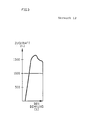
- FIGS. 1 to 4 show some force-strain diagrams of the products according to the invention.
- the KD behavior of the standard injection molding materials made of PA-6 and PA-12 are shown at the same time. All KD diagrams comply with the DIN 53455 standard, measured at 23 ° C and an expansion rate of 50 mm per minute.
- the KD diagrams of the products according to the invention clearly show the increased strength in the area of the pour point.
- the examples also show that the course of the KD curve changes with increasing branching density so that the drop in strength after the "pour point" is reduced. At With higher branching densities and degrees of polymerization, there is no longer any drop (example 16), so that there is no longer any defined pour point.
- the products according to the invention are therefore used wherever greater strength with little elongation is required, which is often the case in practice.
Landscapes
- Chemical & Material Sciences (AREA)
- Health & Medical Sciences (AREA)
- Chemical Kinetics & Catalysis (AREA)
- Medicinal Chemistry (AREA)
- Polymers & Plastics (AREA)
- Organic Chemistry (AREA)
- Life Sciences & Earth Sciences (AREA)
- Proteomics, Peptides & Aminoacids (AREA)
- General Chemical & Material Sciences (AREA)
- Polyamides (AREA)
- Compositions Of Macromolecular Compounds (AREA)
Claims (18)





Applications Claiming Priority (2)
| Application Number | Priority Date | Filing Date | Title |
|---|---|---|---|
| DE3819427 | 1988-06-07 | ||
| DE3819427 | 1988-06-07 |
Publications (4)
| Publication Number | Publication Date |
|---|---|
| EP0345648A2 EP0345648A2 (fr) | 1989-12-13 |
| EP0345648A3 EP0345648A3 (en) | 1990-09-05 |
| EP0345648B1 true EP0345648B1 (fr) | 1995-09-06 |
| EP0345648B2 EP0345648B2 (fr) | 2000-04-05 |
Family
ID=6356071
Family Applications (1)
| Application Number | Title | Priority Date | Filing Date |
|---|---|---|---|
| EP89109958A Expired - Lifetime EP0345648B2 (fr) | 1988-06-07 | 1989-06-01 | Polyamides thermoplastiques façonnables |
Country Status (4)
| Country | Link |
|---|---|
| EP (1) | EP0345648B2 (fr) |
| JP (1) | JP3084284B2 (fr) |
| DE (2) | DE58909415D1 (fr) |
| ES (1) | ES2076172T5 (fr) |
Cited By (6)
| Publication number | Priority date | Publication date | Assignee | Title |
|---|---|---|---|---|
| US5917004A (en) * | 1996-07-09 | 1999-06-29 | Ems-Inventa Ag | Weather-resistant polyamides and method of their production |
| US6037421A (en) * | 1997-09-30 | 2000-03-14 | Solutia Inc. | Functionalized polymers |
| US6150496A (en) * | 1998-02-13 | 2000-11-21 | Basf Corporation | Inherently light-and-heat-stabilized polyamide and method of making the same |
| EP0869987B1 (fr) * | 1995-12-29 | 2002-07-31 | Rhodia Engineering Plastics Srl | Composition contenant un polyamide et procede de fabrication de celle-ci |
| DE19537614C3 (de) * | 1995-10-09 | 2003-10-02 | Inventa Ag | Polycaprolactam mit neuartiger Kettenregelung |
| US9611355B2 (en) | 2008-03-14 | 2017-04-04 | 3D Systems, Inc. | Powder compositions and methods of manufacturing articles therefrom |
Families Citing this family (24)
| Publication number | Priority date | Publication date | Assignee | Title |
|---|---|---|---|---|
| DE59502905D1 (de) | 1994-04-15 | 1998-08-27 | Basf Ag | Inhärent licht- und hitzestabilisierte polyamide |
| EP0682057A1 (fr) * | 1994-05-09 | 1995-11-15 | Dsm N.V. | Procédé d'amélioration des caractéristiques de mise en oeuvre de compositions polymères, compositions ainsi obtenues |
| DE19543161A1 (de) * | 1995-11-18 | 1997-05-22 | Basf Ag | Verfahren zur Herstellung von verzweigten Polyamiden |
| FR2743077B1 (fr) * | 1995-12-29 | 1998-02-20 | Nyltech Italia | Polyamide et un procede de fabrication de celui-ci, et des compositions le contenant |
| BE1010330A3 (nl) * | 1996-06-06 | 1998-06-02 | Dsm Nv | Vezels van sterk vertakt polyamide. |
| US6051312A (en) * | 1996-06-06 | 2000-04-18 | Dsm Nv | Fibers of strongly branched polyamide |
| DE19654179A1 (de) * | 1996-12-23 | 1998-06-25 | Basf Ag | H-förmige Polyamide |
| NL1010819C2 (nl) * | 1998-12-16 | 2000-06-19 | Dsm Nv | Intrinsiek gelvrij random vertakt polyamide. |
| DE19859929A1 (de) * | 1998-12-23 | 2000-06-29 | Bayer Ag | Verfahren zur Herstellung von verzweigten Polyamiden |
| EP1078949A1 (fr) | 1999-08-26 | 2001-02-28 | Bayer Aktiengesellschaft | Ramification de polyamides à l'aide d'esters d'acide carboxylique |
| DE19957663A1 (de) | 1999-11-30 | 2001-05-31 | Basf Ag | Verfahren zur kontinuierlichen Herstellung von Copolyamiden, die auf einem Lactam (I), einem Diamin (II) und einer Dicarbonsäure (III) basieren |
| DE10002948A1 (de) * | 2000-01-25 | 2001-07-26 | Degussa | Leichtfließende transparente Polyamid-Formmasse |
| DE10033544A1 (de) | 2000-07-11 | 2002-01-24 | Basf Ag | Kontinuierliches Verfahren zur Herstellung von Polyamiden aus Aminonitrilen |
| AU2003225425A1 (en) | 2002-04-15 | 2003-10-27 | Dsm Ip Assets B.V. | Multilayer blown film and process for production thereof |
| DE10251294B4 (de) * | 2002-11-04 | 2007-05-16 | Ems Chemie Ag | Polyamidformmasse und deren Verwendung |
| FR2851252B1 (fr) * | 2003-02-14 | 2007-03-09 | Rhodianyl | Composition comprenant une matrice polymerique et un additif fonctionnalise et articles realises a partir de cette composition |
| DE102004006955A1 (de) | 2004-02-12 | 2005-09-01 | Basf Ag | Kontinuierliches Verfahren zur Herstellung von Polyamiden |
| DE602006004042D1 (de) * | 2005-06-17 | 2009-01-15 | Dsm Ip Assets Bv | Intrinsisches, gelfreies, nach dem zufallsprinzip verzweigtes polyamid |
| FR2899232B1 (fr) * | 2006-03-31 | 2008-05-16 | Rhodia Recherches & Tech | Polyamide de haute fluidite |
| BRPI0709434B1 (pt) * | 2006-03-31 | 2021-01-05 | Performance Polyamides, Sas | poliamida,composição e artigo |
| DE102008043863A1 (de) | 2007-11-19 | 2009-05-20 | Basf Se | Teilaromatische Polyamide mit hyperverzweigten Polyoxazolinen |
| WO2012115216A1 (fr) * | 2011-02-24 | 2012-08-30 | 日産化学工業株式会社 | Polyamide aromatique et composition de formation de film le contenant |
| JP6815247B2 (ja) * | 2016-04-08 | 2021-01-20 | 日本曹達株式会社 | ポリアミドの製造方法 |
| EP3351581A1 (fr) * | 2017-01-18 | 2018-07-25 | SABIC Global Technologies B.V. | Poly (amides) réticulés dynamiquement préparés par incorporation de polyamines/sels d'ammonium à l'état solide |
Family Cites Families (4)
| Publication number | Priority date | Publication date | Assignee | Title |
|---|---|---|---|---|
| HU165832B (fr) * | 1973-02-20 | 1974-11-28 | ||
| JPS502791A (fr) * | 1973-05-11 | 1975-01-13 | ||
| DE2732329A1 (de) * | 1977-07-16 | 1979-02-01 | Basf Ag | Hoeherviskose polyamide |
| CA1225179A (fr) * | 1983-12-12 | 1987-08-04 | James D. Gabbert | Copolymeres de nylon reticules |
-
1989
- 1989-06-01 DE DE58909415T patent/DE58909415D1/de not_active Expired - Lifetime
- 1989-06-01 DE DE3917927A patent/DE3917927C2/de not_active Expired - Fee Related
- 1989-06-01 EP EP89109958A patent/EP0345648B2/fr not_active Expired - Lifetime
- 1989-06-01 ES ES89109958T patent/ES2076172T5/es not_active Expired - Lifetime
- 1989-06-07 JP JP01143213A patent/JP3084284B2/ja not_active Expired - Lifetime
Cited By (6)
| Publication number | Priority date | Publication date | Assignee | Title |
|---|---|---|---|---|
| DE19537614C3 (de) * | 1995-10-09 | 2003-10-02 | Inventa Ag | Polycaprolactam mit neuartiger Kettenregelung |
| EP0869987B1 (fr) * | 1995-12-29 | 2002-07-31 | Rhodia Engineering Plastics Srl | Composition contenant un polyamide et procede de fabrication de celle-ci |
| US5917004A (en) * | 1996-07-09 | 1999-06-29 | Ems-Inventa Ag | Weather-resistant polyamides and method of their production |
| US6037421A (en) * | 1997-09-30 | 2000-03-14 | Solutia Inc. | Functionalized polymers |
| US6150496A (en) * | 1998-02-13 | 2000-11-21 | Basf Corporation | Inherently light-and-heat-stabilized polyamide and method of making the same |
| US9611355B2 (en) | 2008-03-14 | 2017-04-04 | 3D Systems, Inc. | Powder compositions and methods of manufacturing articles therefrom |
Also Published As
| Publication number | Publication date |
|---|---|
| DE3917927A1 (de) | 1989-12-14 |
| EP0345648A3 (en) | 1990-09-05 |
| ES2076172T5 (es) | 2000-07-01 |
| JPH0264128A (ja) | 1990-03-05 |
| EP0345648B2 (fr) | 2000-04-05 |
| DE58909415D1 (de) | 1995-10-12 |
| JP3084284B2 (ja) | 2000-09-04 |
| DE3917927C2 (de) | 1997-12-18 |
| EP0345648A2 (fr) | 1989-12-13 |
| ES2076172T3 (es) | 1995-11-01 |
Similar Documents
| Publication | Publication Date | Title |
|---|---|---|
| EP0345648B2 (fr) | Polyamides thermoplastiques façonnables | |
| DE69817361T2 (de) | Thermoplastisches copolyamid, formmasse aus diesem | |
| EP0693515B1 (fr) | Procédé de préparation de précondensats de (co)polyamides semiaromatiques thermoplastiques semicristallins ou amorphes | |
| EP1120443B1 (fr) | Composition de polyamide transparente de faible viscosité | |
| DE60209560T2 (de) | Thermoplastische zusammensetzung, welche einen hyperverzweigten polymer enthält, und daraus hergestellte gegenstände | |
| DE69622749T3 (de) | Polyamid enthaltende zusammensetzung und verfahren zu ihrer herstellung | |
| EP0818491B1 (fr) | Polaymides résistant aux imtempéries et leur méthode de préparation | |
| DE69117087T2 (de) | Verfahren zur Herstellung von Polyetheramiden aus Aminmischungen | |
| DE1645414A1 (de) | Verfahren zur Herstellung von Polyamiden | |
| DE102005023419B4 (de) | Polyamid-Oligomere und deren Verwendung | |
| DE3689568T2 (de) | Polyamidharz und seine Herstellung. | |
| DE69709096T2 (de) | Fasern aus stark verzweigten polyamiden | |
| DE60038573T2 (de) | Polyamid-kettenverlängerungsverfahren | |
| DE69903197T3 (de) | Intrinsisch gelfreies, zuffällig verzweigtes polyamid | |
| WO2017005812A1 (fr) | Fabrication d'un polyamide contenant 2,5-bis(aminométhyl)furane | |
| EP0012931B1 (fr) | Copolyamides à base d'un mélange d'amines cycloaliphatiques et objets moulés préparés à partir de ces copolyamides | |
| EP0849746A1 (fr) | Composition de résine thermoplastique | |
| EP0688808B1 (fr) | Procédé pour la préparation de polyamide-6 à haut poids moléculaire | |
| DE69213455T2 (de) | Copolyadipinamid das Trimethylhexamethylenadipinamideinheiten enthält und daraushergestelte Produkte | |
| DE69213457T2 (de) | Copolyadipinamid, das Ethyltetramethylenadipinamid- Einheiten enthält und daraus hergestellte Produkte | |
| EP0288894B1 (fr) | Polyamides modifiés par de l'alpha-amino-epsilon-caprolactame | |
| DE2454118C2 (de) | Verfahren zur Herstellung eines hydrophilen Blockcopolymeren und dessen Verwendung | |
| DE3909215A1 (de) | Polyetheramid-schmelzklebstoffe | |
| DE3043114C2 (fr) | ||
| DE69307319T2 (de) | Verfahren zur herstellung von kettenverlängerte polymeren und pfropf- und blockcopolymeren |
Legal Events
| Date | Code | Title | Description |
|---|---|---|---|
| PUAI | Public reference made under article 153(3) epc to a published international application that has entered the european phase |
Free format text: ORIGINAL CODE: 0009012 |
|
| AK | Designated contracting states |
Kind code of ref document: A2 Designated state(s): CH DE ES FR GB IT LI |
|
| PUAL | Search report despatched |
Free format text: ORIGINAL CODE: 0009013 |
|
| AK | Designated contracting states |
Kind code of ref document: A3 Designated state(s): CH DE ES FR GB IT LI |
|
| 17P | Request for examination filed |
Effective date: 19901224 |
|
| 17Q | First examination report despatched |
Effective date: 19920518 |
|
| GRAA | (expected) grant |
Free format text: ORIGINAL CODE: 0009210 |
|
| AK | Designated contracting states |
Kind code of ref document: B1 Designated state(s): CH DE ES FR GB IT LI |
|
| PG25 | Lapsed in a contracting state [announced via postgrant information from national office to epo] |
Ref country code: IT Free format text: LAPSE BECAUSE OF FAILURE TO SUBMIT A TRANSLATION OF THE DESCRIPTION OR TO PAY THE FEE WITHIN THE PRE;WARNING: LAPSES OF ITALIAN PATENTS WITH EFFECTIVE DATE BEFORE 2007 MAY HAVE OCCURRED AT ANY TIME BEFORE 2007. THE CORRECT EFFECTIVE DATE MAY BE DIFFERENT FROM THE ONE RECORDED.SCRIBED TIME-LIMIT Effective date: 19950906 |
|
| ET | Fr: translation filed | ||
| REF | Corresponds to: |
Ref document number: 58909415 Country of ref document: DE Date of ref document: 19951012 |
|
| REG | Reference to a national code |
Ref country code: ES Ref legal event code: FG2A Ref document number: 2076172 Country of ref document: ES Kind code of ref document: T3 |
|
| GBT | Gb: translation of ep patent filed (gb section 77(6)(a)/1977) |
Effective date: 19951016 |
|
| PLBI | Opposition filed |
Free format text: ORIGINAL CODE: 0009260 |
|
| PLBQ | Unpublished change to opponent data |
Free format text: ORIGINAL CODE: EPIDOS OPPO |
|
| PLBF | Reply of patent proprietor to notice(s) of opposition |
Free format text: ORIGINAL CODE: EPIDOS OBSO |
|
| 26 | Opposition filed |
Opponent name: BASF AKTIENGESELLSCHAFT, LUDWIGSHAFEN Effective date: 19960607 |
|
| PLBF | Reply of patent proprietor to notice(s) of opposition |
Free format text: ORIGINAL CODE: EPIDOS OBSO |
|
| PLBF | Reply of patent proprietor to notice(s) of opposition |
Free format text: ORIGINAL CODE: EPIDOS OBSO |
|
| PLBQ | Unpublished change to opponent data |
Free format text: ORIGINAL CODE: EPIDOS OPPO |
|
| PLAB | Opposition data, opponent's data or that of the opponent's representative modified |
Free format text: ORIGINAL CODE: 0009299OPPO |
|
| PLBF | Reply of patent proprietor to notice(s) of opposition |
Free format text: ORIGINAL CODE: EPIDOS OBSO |
|
| R26 | Opposition filed (corrected) |
Opponent name: BASF AKTIENGESELLSCHAFT, LUDWIGSHAFEN Effective date: 19960607 |
|
| PLAW | Interlocutory decision in opposition |
Free format text: ORIGINAL CODE: EPIDOS IDOP |
|
| PLAW | Interlocutory decision in opposition |
Free format text: ORIGINAL CODE: EPIDOS IDOP |
|
| PUAH | Patent maintained in amended form |
Free format text: ORIGINAL CODE: 0009272 |
|
| STAA | Information on the status of an ep patent application or granted ep patent |
Free format text: STATUS: PATENT MAINTAINED AS AMENDED |
|
| 27A | Patent maintained in amended form |
Effective date: 20000405 |
|
| AK | Designated contracting states |
Kind code of ref document: B2 Designated state(s): CH DE ES FR GB IT LI |
|
| GBTA | Gb: translation of amended ep patent filed (gb section 77(6)(b)/1977) | ||
| REG | Reference to a national code |
Ref country code: CH Ref legal event code: AEN Free format text: AUFRECHTERHALTUNG DES PATENTES IN GEAENDERTER FORM |
|
| ET3 | Fr: translation filed ** decision concerning opposition | ||
| REG | Reference to a national code |
Ref country code: ES Ref legal event code: DC2A Kind code of ref document: T5 Effective date: 20000517 |
|
| REG | Reference to a national code |
Ref country code: GB Ref legal event code: IF02 |
|
| REG | Reference to a national code |
Ref country code: CH Ref legal event code: PUE Owner name: EMS-PATENT AG Free format text: EMS-INVENTA AG, ZUERICH,#ZUSTELLADRESSE#7013 DOMAT/EMS (CH) -TRANSFER TO- EMS-PATENT AG#REICHENAUERSTRASSE#7013 DOMAT/EMS (CH) |
|
| REG | Reference to a national code |
Ref country code: GB Ref legal event code: 732E |
|
| REG | Reference to a national code |
Ref country code: FR Ref legal event code: CA Ref country code: FR Ref legal event code: TP Ref country code: FR Ref legal event code: CD |
|
| PGFP | Annual fee paid to national office [announced via postgrant information from national office to epo] |
Ref country code: ES Payment date: 20080627 Year of fee payment: 20 Ref country code: CH Payment date: 20080513 Year of fee payment: 20 |
|
| PGFP | Annual fee paid to national office [announced via postgrant information from national office to epo] |
Ref country code: DE Payment date: 20080620 Year of fee payment: 20 |
|
| PGFP | Annual fee paid to national office [announced via postgrant information from national office to epo] |
Ref country code: FR Payment date: 20080613 Year of fee payment: 20 |
|
| PGFP | Annual fee paid to national office [announced via postgrant information from national office to epo] |
Ref country code: GB Payment date: 20080620 Year of fee payment: 20 |
|
| REG | Reference to a national code |
Ref country code: CH Ref legal event code: PL |
|
| REG | Reference to a national code |
Ref country code: GB Ref legal event code: PE20 Expiry date: 20090531 |
|
| REG | Reference to a national code |
Ref country code: ES Ref legal event code: FD2A Effective date: 20090602 |
|
| PG25 | Lapsed in a contracting state [announced via postgrant information from national office to epo] |
Ref country code: ES Free format text: LAPSE BECAUSE OF EXPIRATION OF PROTECTION Effective date: 20090602 |
|
| PG25 | Lapsed in a contracting state [announced via postgrant information from national office to epo] |
Ref country code: GB Free format text: LAPSE BECAUSE OF EXPIRATION OF PROTECTION Effective date: 20090531 |