EP0345687A2 - Extrudiereinrichtung - Google Patents
Extrudiereinrichtung Download PDFInfo
- Publication number
- EP0345687A2 EP0345687A2 EP89110127A EP89110127A EP0345687A2 EP 0345687 A2 EP0345687 A2 EP 0345687A2 EP 89110127 A EP89110127 A EP 89110127A EP 89110127 A EP89110127 A EP 89110127A EP 0345687 A2 EP0345687 A2 EP 0345687A2
- Authority
- EP
- European Patent Office
- Prior art keywords
- throttle
- perforated
- sectional area
- flow cross
- screw
- Prior art date
- Legal status (The legal status is an assumption and is not a legal conclusion. Google has not performed a legal analysis and makes no representation as to the accuracy of the status listed.)
- Granted
Links
Images

Classifications
-
- B—PERFORMING OPERATIONS; TRANSPORTING
- B29—WORKING OF PLASTICS; WORKING OF SUBSTANCES IN A PLASTIC STATE IN GENERAL
- B29C—SHAPING OR JOINING OF PLASTICS; SHAPING OF MATERIAL IN A PLASTIC STATE, NOT OTHERWISE PROVIDED FOR; AFTER-TREATMENT OF THE SHAPED PRODUCTS, e.g. REPAIRING
- B29C48/00—Extrusion moulding, i.e. expressing the moulding material through a die or nozzle which imparts the desired form; Apparatus therefor
- B29C48/25—Component parts, details or accessories; Auxiliary operations
- B29C48/36—Means for plasticising or homogenising the moulding material or forcing it through the nozzle or die
- B29C48/50—Details of extruders
- B29C48/76—Venting, drying means; Degassing means
-
- B—PERFORMING OPERATIONS; TRANSPORTING
- B29—WORKING OF PLASTICS; WORKING OF SUBSTANCES IN A PLASTIC STATE IN GENERAL
- B29C—SHAPING OR JOINING OF PLASTICS; SHAPING OF MATERIAL IN A PLASTIC STATE, NOT OTHERWISE PROVIDED FOR; AFTER-TREATMENT OF THE SHAPED PRODUCTS, e.g. REPAIRING
- B29C48/00—Extrusion moulding, i.e. expressing the moulding material through a die or nozzle which imparts the desired form; Apparatus therefor
- B29C48/25—Component parts, details or accessories; Auxiliary operations
- B29C48/92—Measuring, controlling or regulating
-
- B—PERFORMING OPERATIONS; TRANSPORTING
- B29—WORKING OF PLASTICS; WORKING OF SUBSTANCES IN A PLASTIC STATE IN GENERAL
- B29C—SHAPING OR JOINING OF PLASTICS; SHAPING OF MATERIAL IN A PLASTIC STATE, NOT OTHERWISE PROVIDED FOR; AFTER-TREATMENT OF THE SHAPED PRODUCTS, e.g. REPAIRING
- B29C2948/00—Indexing scheme relating to extrusion moulding
- B29C2948/92—Measuring, controlling or regulating
- B29C2948/92009—Measured parameter
- B29C2948/92019—Pressure
-
- B—PERFORMING OPERATIONS; TRANSPORTING
- B29—WORKING OF PLASTICS; WORKING OF SUBSTANCES IN A PLASTIC STATE IN GENERAL
- B29C—SHAPING OR JOINING OF PLASTICS; SHAPING OF MATERIAL IN A PLASTIC STATE, NOT OTHERWISE PROVIDED FOR; AFTER-TREATMENT OF THE SHAPED PRODUCTS, e.g. REPAIRING
- B29C2948/00—Indexing scheme relating to extrusion moulding
- B29C2948/92—Measuring, controlling or regulating
- B29C2948/92009—Measured parameter
- B29C2948/92209—Temperature
-
- B—PERFORMING OPERATIONS; TRANSPORTING
- B29—WORKING OF PLASTICS; WORKING OF SUBSTANCES IN A PLASTIC STATE IN GENERAL
- B29C—SHAPING OR JOINING OF PLASTICS; SHAPING OF MATERIAL IN A PLASTIC STATE, NOT OTHERWISE PROVIDED FOR; AFTER-TREATMENT OF THE SHAPED PRODUCTS, e.g. REPAIRING
- B29C2948/00—Indexing scheme relating to extrusion moulding
- B29C2948/92—Measuring, controlling or regulating
- B29C2948/92323—Location or phase of measurement
- B29C2948/92361—Extrusion unit
- B29C2948/9238—Feeding, melting, plasticising or pumping zones, e.g. the melt itself
-
- B—PERFORMING OPERATIONS; TRANSPORTING
- B29—WORKING OF PLASTICS; WORKING OF SUBSTANCES IN A PLASTIC STATE IN GENERAL
- B29C—SHAPING OR JOINING OF PLASTICS; SHAPING OF MATERIAL IN A PLASTIC STATE, NOT OTHERWISE PROVIDED FOR; AFTER-TREATMENT OF THE SHAPED PRODUCTS, e.g. REPAIRING
- B29C2948/00—Indexing scheme relating to extrusion moulding
- B29C2948/92—Measuring, controlling or regulating
- B29C2948/92504—Controlled parameter
- B29C2948/9258—Velocity
- B29C2948/9259—Angular velocity
-
- B—PERFORMING OPERATIONS; TRANSPORTING
- B29—WORKING OF PLASTICS; WORKING OF SUBSTANCES IN A PLASTIC STATE IN GENERAL
- B29C—SHAPING OR JOINING OF PLASTICS; SHAPING OF MATERIAL IN A PLASTIC STATE, NOT OTHERWISE PROVIDED FOR; AFTER-TREATMENT OF THE SHAPED PRODUCTS, e.g. REPAIRING
- B29C2948/00—Indexing scheme relating to extrusion moulding
- B29C2948/92—Measuring, controlling or regulating
- B29C2948/92504—Controlled parameter
- B29C2948/92704—Temperature
-
- B—PERFORMING OPERATIONS; TRANSPORTING
- B29—WORKING OF PLASTICS; WORKING OF SUBSTANCES IN A PLASTIC STATE IN GENERAL
- B29C—SHAPING OR JOINING OF PLASTICS; SHAPING OF MATERIAL IN A PLASTIC STATE, NOT OTHERWISE PROVIDED FOR; AFTER-TREATMENT OF THE SHAPED PRODUCTS, e.g. REPAIRING
- B29C2948/00—Indexing scheme relating to extrusion moulding
- B29C2948/92—Measuring, controlling or regulating
- B29C2948/92819—Location or phase of control
- B29C2948/92857—Extrusion unit
- B29C2948/92876—Feeding, melting, plasticising or pumping zones, e.g. the melt itself
-
- B—PERFORMING OPERATIONS; TRANSPORTING
- B29—WORKING OF PLASTICS; WORKING OF SUBSTANCES IN A PLASTIC STATE IN GENERAL
- B29C—SHAPING OR JOINING OF PLASTICS; SHAPING OF MATERIAL IN A PLASTIC STATE, NOT OTHERWISE PROVIDED FOR; AFTER-TREATMENT OF THE SHAPED PRODUCTS, e.g. REPAIRING
- B29C2948/00—Indexing scheme relating to extrusion moulding
- B29C2948/92—Measuring, controlling or regulating
- B29C2948/92819—Location or phase of control
- B29C2948/92857—Extrusion unit
- B29C2948/92876—Feeding, melting, plasticising or pumping zones, e.g. the melt itself
- B29C2948/92885—Screw or gear
-
- B—PERFORMING OPERATIONS; TRANSPORTING
- B29—WORKING OF PLASTICS; WORKING OF SUBSTANCES IN A PLASTIC STATE IN GENERAL
- B29C—SHAPING OR JOINING OF PLASTICS; SHAPING OF MATERIAL IN A PLASTIC STATE, NOT OTHERWISE PROVIDED FOR; AFTER-TREATMENT OF THE SHAPED PRODUCTS, e.g. REPAIRING
- B29C2948/00—Indexing scheme relating to extrusion moulding
- B29C2948/92—Measuring, controlling or regulating
- B29C2948/92819—Location or phase of control
- B29C2948/92952—Drive section, e.g. gearbox, motor or drive fluids
-
- B—PERFORMING OPERATIONS; TRANSPORTING
- B29—WORKING OF PLASTICS; WORKING OF SUBSTANCES IN A PLASTIC STATE IN GENERAL
- B29C—SHAPING OR JOINING OF PLASTICS; SHAPING OF MATERIAL IN A PLASTIC STATE, NOT OTHERWISE PROVIDED FOR; AFTER-TREATMENT OF THE SHAPED PRODUCTS, e.g. REPAIRING
- B29C48/00—Extrusion moulding, i.e. expressing the moulding material through a die or nozzle which imparts the desired form; Apparatus therefor
- B29C48/03—Extrusion moulding, i.e. expressing the moulding material through a die or nozzle which imparts the desired form; Apparatus therefor characterised by the shape of the extruded material at extrusion
Definitions
- the invention relates to an extrusion device with an extrusion screw for conveying a flowable mass to an outlet, a throttle being located along the screw, through which the flowable mass flows, and with a degassing section connected downstream of the throttle.
- a first section of the extrusion screw (seen in the direction of conveyance), the plasticizing of a mass takes place, ie the mass becomes fluid by heating. During this plasticizing process, gases (water vapor and other gases) are produced, which are then discharged from the device in the degassing section. So that the degassing section is in a depressurized zone, a throttle is connected upstream of the degassing section.
- the through-flow cross-sectional area of the at least one spiral passage of the screw is blocked off by a transverse wall, this transverse wall being provided with a plurality of overflow channels.
- the plasticized mass made flowable in the first section of the screw mentioned above must pass through this multitude of overflow channels each having a very small cross-sectional area, which means a strong restriction of the flow of the mass.
- This flowable mass is here in a variety of divided small strands that have a large surface area, so that good degassing occurs in the downstream depressurized degassing section.
- a disadvantage of this known extrusion device is that the throughput of the device (flow rate per unit of time) can only be changed by the speed of the extrusion screw, or a different screw with a different pitch must be used.
- the known device cannot satisfy if only a low throughput (amount at the outlet) is required during an extrusion process, because then a backflow of the plasticized mass from the outlet back to the degassing section can take place, which is then no longer depressurized, so that degassing is not possible without plasticized mass also escaping here. If you want to avoid this in the known device, you would have to screw the screw in the area between the outlet and degassing train very long. Both the provision of several screws and a very long screw length are disadvantageous.
- the aim now is to create an extrusion device with which the aforementioned disadvantages can be avoided.
- the extrusion device according to the invention is characterized in that the flow cross-sectional area of the throttle is adjustable.
- the extrusion device has an extrusion screw 1 for conveying a flowable mass, not shown, to an outlet 2, which is not shown in FIG. 1, but is on the left-hand side.
- the direction of flow of the mass thus takes place in the direction of an arrow 3.
- a throttle 4 which is flowed through by the flowable mass.
- the throttle 4 is followed by a degassing section 5.
- the screw 1 runs in a housing which comprises the components 6-9.
- the worm 1 is single-start or multi-start, that is to say it has at least one feed helix 10.
- the through-flow cross-sectional area of a spiral passage results from the distance between adjacent flanks of two turns and between the core diameter of the screw and the inner surface of the surrounding housing.
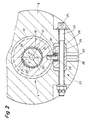
- Each perforated disc 12 and 13 is designed as a disc ring and have inner lateral surfaces 19 with the same diameter, which corresponds to the inner diameter of the housing parts 6-9.
- the flow cross-sectional areas of the two perforated disks 12, 13 are formed by trough-shaped, radial depressions 20 and 21 on their inner lateral surfaces 19. It can be seen from FIG. 1 that these radial depressions 20 of the perforated disk 12 have the housing part 7 expanded too conically; this conical extension is not shown in the sectional view according to FIG. 2.
- the housing part 7 has a similar conical widening of its inner lateral surface, so that the flowable mass is not deflected with sharp edges when it enters the throttle 4. It can also be seen from FIG.
- each of the perforated disks 12, 13 has the same through-flow cross-sectional area on the common end-face contact surface. Furthermore, each flow cross-sectional area of each perforated disc 12, 13 is unchangeable.
- the channels 20 are at a gap to the channels 21, so that the entire through-flow cross-sectional area of the perforated disk 12 is blocked by the perforated disk 13. This means that the flow cross-sectional areas of the two perforated disks 12, 13 do not overlap in any way. So there is no flow of flowable mass at all.
- the throttle 4 has become a barrier.
- approximately half of the channels 20 are covered by the perforated disk 13 located behind them, so that only approximately half of the cross-sectional areas of all channels 20 are available as flow-through cross-sectional areas.
- the throttle 4 has then about its middle position between the two end positions "completely closed” and "fully open”. The flow cross-sectional area of the throttle 4 is thus variably adjustable between these two end positions.
- the flow cross-sectional area of the throttle 4 is also changed continuously.
- This rotation of the perforated disc 12 can be done in very different ways. In the illustrated embodiment, only one of many possibilities is shown.
- This actuating device comprises a rotatable threaded spindle 23, which can be rotated continuously using a handle 24. On the threaded spindle 23 a nut 25 is seated, which is guided displaceably in a link 26 of the housing part 8.
- the nut 25 carries a pointer 27 which, on a scale (not shown), indicates the respective displacement dimension of the nut 25 and thus the dimension of the respective overlap of the channels 20, 21 and thus the flow cross-sectional area of the throttle 4 which is set in each case.
- the pointer 27 is thus in a cutout 28 of the housing part 8.
- In the nut 25 there is a self-aligning bearing 29 in which a pin 30 is guided.
- This pin 30 is located at the other end in a blind hole of the perforated disk 12.
- the extrusion device described works in the following manner. With a given throughput of the flowable mass at outlet 2, the through-flow cross-sectional area of throttle 4 and the speed of rotation of screw 1 are determined in such a way that in the first region of screw 1 mentioned at the beginning optimal plasticization of the mass takes place. If a correction is necessary here, the speed of the screw 1 can be increased and the flow cross-sectional area of the throttle can be reduced.
- the extrusion screw 1 in this extrusion device according to the invention can be selected to be relatively short, since a backflow from the outlet 2 back to the degassing section 5 can be avoided in a simple manner by reducing the through-flow cross-sectional area of the throttle 4 accordingly.
- the extrusion device explained can be regulated in an advantageous manner.
- the pressure of the plasticized mass at the outlet 2 can be measured.
- the temperature of the mass during plasticization that is to say in the first section 31 of the extrusion screw.
- the pressure at outlet 2 can also be measured.
- the temperature of the mass can be regulated during the plasticizing process, since this temperature is a measure of the optimal plasticizing.
- the controlled system is therefore between the plasticizing region 31 and the outlet 2. The controlled variable would then be the temperature of the mass in the region 31.
- This temperature of the mass in the region 31 can be measured with a sensor.
- the actuator can be the threaded spindle 23 or an element for changing the speed of the screw 1.
- the manipulated variable would then be the angle of rotation of the perforated disk 12 or the speed of the screw.
- Interfering variables would be a temperature change in the mass in the plasticizing area 31 and an increase in pressure in the degassing section 5 or at the outlet 2.
Landscapes
- Engineering & Computer Science (AREA)
- Mechanical Engineering (AREA)
- Extrusion Moulding Of Plastics Or The Like (AREA)
- Seal Device For Vehicle (AREA)
- Processing And Handling Of Plastics And Other Materials For Molding In General (AREA)
- Formation And Processing Of Food Products (AREA)
Abstract
Description
- Die Erfindung betrifft eine Extrudiereinrichtung, mit einer Extrudierschnecke zum Fördern einer fliessfähigen Masse zu einem Auslass, wobei sich entlang der Schnecke eine Drossel befindet, die von der fliessfähigen Masse durchströmt wird, und mit einem der Drossel nachgeschalteten Entgasungsabschnitt.
- In einem ersten Abschnitt der Extrudierschnekke (in Förderrichtung gesehen) findet das Plastifizieren einer Masse statt, d.h. ein Fliessfähigmachen der Masse durch Erwärmung. Bei diesem Plastifizieren entstehen Gase (Wasserdampf und andere Gase), die dann im Entgasungsabschnitt aus der Einrichtung abgeleitet werden. Damit sich der Entgasungsabschnitt in einer drucklosen Zone befindet, wird dem Entgasungsabschnitt eine Drossel vorgeschaltet. Bei einer bekannten Einrichtung wird die Durchström-Querschnittsfläche des zumindest einen Wendelganges der Schnecke durch eine Querwand abgesperrt, wobei diese Querwand mit einer Vielzahl von Ueberströmrinnen versehen ist. Die im vorerwähnten ersten Abschnitt der Schnecke fliessfähig gemachte (plastifizierte) Masse muss durch diese Vielzahl von jeweils eine sehr geringe Querschnittsfläche aufweisenden Ueberströmrinnen hindurchgehen, was eine starke Drosselung der Strömung der Masse bedeutet. Diese fliessfähige Masse wird hierbei in eine Vielzahl von kleinen Strängen unterteilt, die insgesamt eine grosse Oberfläche aufweisen, so dass hierdurch ein gutes Entgasen im nachgeschalteten drucklosen Entgasungsabschnitt eintritt. Ein Nachteil dieser bekannten Extrudiereinrichtung ist darin zu sehen, dass der Durchsatz der Einrichtung (Durchströmmenge pro Zeiteinheit) nur durch die Drehzahl der Extrudierschnecke verändert werden kann, oder es muss eine andere Schnecke mit einer anderen Steigung verwendet werden. Da die zu fördernde Masse, wie z.B. Gummi, ein schlechter Wärmeleiter ist, muss die Wärmeübertragung im erwähnten ersten Abschnitt der Schnecke zum Durchführen des Plastifizierens durch Konvektion (Wärmeübergang) erfolgen. Das bedeutet, dass die fliessfähig zu machende Masse möglichst viel entlang einer zu beheizenden Wandung (Schnecke und Gehäuse) bewegt werden muss, um auf diese Weise die Wärme mitführen zu können. Diese Wärmeübertragung durch Konvektion setzt nun aber eine gewisse Mindestdrehzahl der Schnecke voraus. Damit also ein genügendes Plastifizieren in diesem ersten Abschnitt der Schnecke stattfindet, kann die Drehzahl der Schnecke nicht beliebig verringert werden, so dass hierdurch der Durchsatz nicht beliebig verringert werden kann. Sogar wenn die Drehzahl der Schnecke gerade so niedrig gewählt wird, dass ein genügendes Plastifizieren im erwähnten ersten Abschnitt der Schnecke stattfindet, kann die bekannte Einrichtung nicht befriedigen, wenn bei einem Extrudiervorgang nur ein geringer Durchsatz (Menge am Auslass) benötigt wird, da nämlich dann ein Rückstau der plastifizierten Masse vom Auslass zurück bis zum Entgasungsabschnitt stattfinden kann, der dann nicht mehr drucklos ist, so dass kein Entgasen möglich ist, ohne dass hier auch plastifizierte Masse austritt. Möchte man dies bei der bekannten Einrichtung unbedingt vermeiden, müsste man die Schnecke im Bereich zwischen Auslass und Entgasungsab schnitt sehr lang ausbilden. Sowohl ein Bereitstellen von mehreren Schnecken als auch eine sehr lange Schnekkenlänge sind nachteilig.
- Es wird nunmehr die Schaffung einer Extrudiereinrichtung bezweckt, mit der die vorerwähnten Nachteile vermieden werden können.
- Die erfindungsgemässe Extrudiereinrichtung ist dadurch gekennzeichnet, dass die Durchström-Querschnittsfläche der Drossel veränderlich einstellbar ist.
- In der Zeichnung ist ein Ausführungsbeispiel des Erfindungsgegenstandes dargestellt. Es zeigen:
- Figur 1 einen Teil der Extrudiereinrichtung im Längsschnitt, und
- Figur 2 einen Querschnitt nach der Linie II-II in Figur 1, wobei eine gegenüber dem Gehäuse bewegliche Lochscheibe in drei verschiedenen Stellungen bezüglich einer am Gehäuse festgelegten Lochscheibe dargestellt ist.
- Die Extrudiereinrichtung hat eine Extrudierschnecke 1 zum Fördern einer nicht dargestellten fliessfähigen Masse zu einem in Figur 1 nicht dargestellten, aber auf der linken Seite liegenden Auslass 2. Die Förderrichtung der Masse erfolgt also in Richtung eines Pfeiles 3. Entlang der Schnecke 1 befindet sich eine Drossel 4, die von der fliessfähigen Masse durchströmt wird. Der Drossel 4 ist ein Entgasungsabschnitt 5 nachgeschaltet. Die Schnecke 1 läuft in einem Gehäuse, das die Bauteile 6-9 umfasst. Die Schnecke 1 ist eingängig oder mehrgängig, weist also zumindest eine Förderwendel 10 auf. Die Durchström-Querschnittsfläche eines Wendelganges ergibt sich durch den Abstand zwischen benachbarten Flanken zweier Windungen und zwischen dem Kerndurchmesser der Schnecke und der inneren Mantelfläche des umgebenden Gehäuses. Aus Figur 1 ist ersichtlich, wie durch eine Querwand 11 die Durchström-Querschnittsfläche des Wendelganges abgesperrt wird. Hierdurch wird also die Förderung der fliessfähig gemachten Masse durch die Schnecke unterbrochen. An dieser Stelle erfolgt die Strömung der fliessfähigen Masse ausschliesslich über die Drossel 4, die aus zwei in ihren Ebenen gegeneinander bewegbaren Lochscheiben 12 und 13 besteht. Die Lochscheibe 13 ist am Gehäuseteil 8 durch einen Stift 14 unbeweglich festgelegt und die andere Lochscheibe 12 ist um ihre Längsachse, die mit der Drehachse 15 zusammenfällt, drehbar gelagert. Die beiden Lochscheiben 12, 13 liegen mit je einer ihrer Stirnflächen abdichtend aneinander an. Beide Lochscheiben 12, 13 liegen zwischen den beiden Gehäuseteilen 7, 8. Zur Abdichtung von aneinanderliegenden Stirnflächen dienen O-Ringe 16, 17, 18. Die beiden Lochscheiben 12, 13 sind auswechselbar an den Gehäuseteilen 7 und 8 gelagert.
- Jede Lochscheibe 12 und 13 ist als Scheibenring ausgebildet und haben innere Mantelflächen 19 mit gleichem Durchmesser, der dem Innendurchmesser der Gehäuseteile 6-9 entspricht. Die Durchström-Querschnittsflächen der beiden Lochscheiben 12, 13 sind durch rinnenförmige, radiale Vertiefungen 20 und 21 an ihren inneren Mantelflächen 19 gebildet. Aus Figur 1 ist ersichtlich, dass diese radialen Vertiefungen 20 der Lochscheibe 12 dem Gehäuseteil 7 zu konisch erweitert sind; diese konische Erweiterung ist in der Schnittdarstellung nach Figur 2 nicht dargestellt. Der Gehäuseteil 7 weist eine gleichartige konische Erweiterung seiner inneren Mantelfläche auf, damit die fliessfähige Masse beim Eintritt in die Drossel 4 nicht scharfkantig umgelenkt wird. Aus Figur 1 ist weiterhin ersichtlich, dass die radialen Vertiefungen 21 der Lochscheibe 13 eine Tiefenerstreckung haben, die parallel zur Drehachse 15 verläuft. Anschliessend an diese Vertiefungen 21 ist dann auch noch der daran anschliessende Gehäuseteil 8 mit einer geringen konischen Erweiterung seiner inneren Mantelfläche versehen, damit die fliessfähige Masse wiederum ohne scharfe Umlenkung in die Durchström-Querschnittsfläche des Wendelganges eintreten kann. An der gemeinsamen stirnseitigen Anlagefläche hat jede der Lochscheiben 12, 13 die gleiche Durchström-Querschnittsfläche. Weiterhin ist jede Durchström-Querschnittsfläche von jeder Lochscheibe 12, 13 unveränderlich. Wird die Lochscheibe 12 aber gegenüber der Lochscheibe 13 um die Drehachse 15 gedreht, so kommen ihre Durchström-Querschnittsflächen einander mehr oder weniger zur Dekkung oder überdecken sich überhaupt nicht. In Figur 2 sind nur in schematischer Darstellung drei verschiedene Stellungen der beiden Lochscheiben 12, 13 zueinander dargestellt. Im Sektor A liegen die rinnenförmigen radialen Vertiefungen 20, 21 der Lochscheiben 12, 13, also die Durchström-Querschnittsflächen beider Lochscheiben deckungsgleich hintereinander, so dass also die Drossel 4 die grösste Durchström-Querschnittsfläche aufweist. Diese Durchström-Querschnittsfläche besteht somit aus allen Querschnittsflächen aller Rinnen 20. Im Sektor B stehen die Rinnen 20 auf Lücke zu den Rinnen 21, so dass also die gesamte Durchström-Querschnittsfläche der Lochscheibe 12 durch die Lochscheibe 13 abgesperrt ist. Das bedeutet also, dass sich die Durchström-Querschnittsflächen der beiden Lochscheiben 12, 13 in keiner Weise überdecken. Es findet also überhaupt keine Durchströmung an fliessfähiger Masse statt. Die Drossel 4 ist zu einer Absperrung geworden. Im Sektor C wird etwa die Hälfte der Rinnen 20 durch die dahinterliegende Lochscheibe 13 abgedeckt, so dass also nur etwa die Hälfte der Querschnittsflächen aller Rinnen 20 als Durchström-Querschnittsfläche zur Verfügung steht. Die Drossel 4 hat also dann etwa ihre Mittelstellung zwischen den beiden Endstellungen "ganz geschlossen" und "ganz geöffnet". Die Durchström-Querschnittsfläche der Drossel 4 ist somit zwischen diesen beiden Endstellungen veränderlich einstellbar. Wenn die Lochscheibe 12 stufenlose gegenüber der Lochscheibe 13 um die Drehachse 15 verdreht wird, so wird auch die Durchström-Querschnittsfläche der Drossel 4 stufenlos verändert. Dieses Verdrehen der Lochscheibe 12 kann auf sehr verschiedene Art erfolgen. Beim dargestellten Ausführungsbeispiel wird nur eine von vielen Möglichkeiten gezeigt. Es ist eine aus dem Gehäuseteil 8 nach aussen ragende Stellvorrichtung 22 vorhanden. Diese Stellvorrichtung umfasst eine drehbare Gewindespindel 23, die über eine Handhabe 24 stufenlos gedreht werden kann. Auf der Gewindespindel 23 sitzt eine Mutter 25, die in einer Kulisse 26 des Gehäuseteils 8 verschiebbar geführt ist. Die Mutter 25 trägt einen Zeiger 27, der an einer nicht dargestellten Skala das jeweilige Verschiebemass der Mutter 25 und damit das Mass der jeweiligen Ueberdeckung der Rinnen 20, 21 und damit die jeweils eingestellte Durchström-Querschnittsfläche der Drossel 4 anzeigt. Der Zeiger 27 liegt hierbei also in einem Ausschnitt 28 des Gehäuseteils 8. In der Mutter 25 befindet sich ein Pendellager 29, in der ein Stift 30 verschiebbar geführt ist. Dieser Stift 30 sitzt andererends in einem Sackloch der Lochscheibe 12. Bei Verdrehung der Gewindespindel 23 wird auf diese Weise die Lochscheibe 12 stufenlos in der einen oder anderen Drehrichtung verstellt, so dass die Durchström-Querschnittsfläche der Drossel 4 auf diese Weise stufenlos veränderlich ist.
- Mit der erläuterten Extrudiereinrichtung wird auf folgende Weise gearbeitet. Bei einem vorgegebenen Durchsatz der fliessfähigen Masse am Auslass 2 wird dann die Durchström-Querschnittsfläche der Drossel 4 und die Drehzahl der Schnecke 1 bestimmt, und zwar so, dass im eingangs erwähnten ersten Bereich der Schnecke 1 ein optimales Plastifizieren der Masse stattfindet. Falls hier eine Korrektur nötig ist, kann die Drehzahl der Schnecke 1 erhöht werden und die Durchström-Querschnittsfläche der Drossel kann verringert werden. Die Extrudierschnecke 1 kann bei dieser erfindungsgemässen Extrudiereinrichtung verhältnismässig kurz gewählt werden, da auf einfache Weise ein Rückstau vom Auslass 2 zurück bis zum Entgasungsabschnitt 5 vermieden werden kann, indem die Durchström-Querschnittsfläche der Drossel 4 entsprechend verringert wird. Ein weiterer Vorteil der Extrudiereinrichtung ist darin zu sehen, dass die beiden Lochscheiben bei Verschleiss leicht ausgewechselt werden können. Diese die Drossel bildenden Bauteile unterliegen also einem erhöhten Verschleiss, so dass nunmehr nicht mehr wie bei bekannten Einrichtungen die gesamte Schnecke ausgewechselt werden muss. Die erläuterte Extrudiereinrichtung kann in vorteilhafter Weise geregelt werden. Gemessen werden können zum Beispiel der Druck der plastifizierten Masse am Ausgang 2. Weiterhin die Temperatur der Masse beim Plastifizieren, also etwa im ersten Abschnitt 31 der Extrudierschnecke. Weiterhin kann der Druck am Ausgang 2 gemessen werden. So kann z.B. die Temperatur der Masse beim Plastifiziervorgang geregelt werden, da diese Temperatur ein Mass für das optimale Plastifizieren darstellt. Die Regelstrecke liegt also zwischen dem Plastifizierungsbereich 31 und dem Auslass 2. Die Regelgrösse wäre dann die Temperatur der Masse im Bereich 31. Mit einem Fühler kann diese Temperatur der Masse im Bereich 31 gemessen werden. Das Stellglied kann die Gewindespindel 23 oder ein Organ zum Verändern der Drehzahl der Schnecke 1 sein. Die Stellgrösse wäre dann der Drehwinkel der Lochscheibe 12 bzw. die Drehzahl der Schnecke. Störgrössen wäre eine Temperaturänderung der Masse im Plastifizierbereich 31 und ein Druckanstieg im Entgasungsabschnitt 5 oder am Ausgang 2.
Claims (8)
Applications Claiming Priority (2)
| Application Number | Priority Date | Filing Date | Title |
|---|---|---|---|
| CH2224/88A CH674960A5 (de) | 1988-06-10 | 1988-06-10 | |
| CH2224/88 | 1988-06-10 |
Publications (3)
| Publication Number | Publication Date |
|---|---|
| EP0345687A2 true EP0345687A2 (de) | 1989-12-13 |
| EP0345687A3 EP0345687A3 (de) | 1991-01-09 |
| EP0345687B1 EP0345687B1 (de) | 1995-04-05 |
Family
ID=4228773
Family Applications (1)
| Application Number | Title | Priority Date | Filing Date |
|---|---|---|---|
| EP89110127A Expired - Lifetime EP0345687B1 (de) | 1988-06-10 | 1989-06-05 | Extrudiereinrichtung |
Country Status (7)
| Country | Link |
|---|---|
| US (1) | US4964729A (de) |
| EP (1) | EP0345687B1 (de) |
| JP (1) | JP2663174B2 (de) |
| AT (1) | ATE120687T1 (de) |
| CH (1) | CH674960A5 (de) |
| DE (1) | DE58909150D1 (de) |
| ES (1) | ES2012330A4 (de) |
Cited By (1)
| Publication number | Priority date | Publication date | Assignee | Title |
|---|---|---|---|---|
| US6206560B1 (en) | 1998-05-01 | 2001-03-27 | Paul Meyer | Throttling means for extruders of the transfermix type |
Families Citing this family (1)
| Publication number | Priority date | Publication date | Assignee | Title |
|---|---|---|---|---|
| US5641227A (en) * | 1995-04-27 | 1997-06-24 | Geyer; Paul | Extrusion and refining apparatus and method |
Family Cites Families (13)
| Publication number | Priority date | Publication date | Assignee | Title |
|---|---|---|---|---|
| GB663329A (en) * | 1949-08-23 | 1951-12-19 | Edwards And Jones Ltd | Improvements in and relating to machines for de-airing plastic materials |
| DE1024902B (de) * | 1954-02-11 | 1958-02-27 | Buehler Ag Geb | Vorrichtung zur Entlueftung von in Schneckenpressen komprimierten Massen |
| US3158900A (en) * | 1962-06-12 | 1964-12-01 | Nrm Corp | Extruder |
| DE1554751B1 (de) * | 1966-09-10 | 1971-01-07 | Kestermann Maschf Rolf | Schnecken-Strangpresse |
| CH523138A (fr) * | 1970-05-08 | 1972-05-31 | Sig Schweiz Industrieges | Extrudeuse |
| DE2243039C3 (de) * | 1972-09-01 | 1980-08-14 | Werner & Pfleiderer, 7000 Stuttgart | Kontinuierlich arbeitender Schnekkenknetmischer |
| DE2245570A1 (de) * | 1972-09-16 | 1974-04-04 | Krupp Gmbh | Schneckenextruder |
| US4260264A (en) * | 1979-05-21 | 1981-04-07 | The Japan Steel Works Ltd. | Biaxial vent extruder |
| DE3026842C2 (de) * | 1980-07-16 | 1984-02-16 | Hermann Berstorff Maschinenbau Gmbh, 3000 Hannover | Doppelschnecken-Entgasungsextruder für thermoplastische Materialien |
| DD158014A1 (de) * | 1981-04-07 | 1982-12-22 | Plast Elastverarb Ingbetrieb | Vorrichtung zum entfernen gasfoermiger bestandteile aus polymeren werkstoffen |
| US4408887A (en) * | 1981-12-07 | 1983-10-11 | Kishihiro Yamaoka | Continuous kneader |
| FR2550922A1 (fr) * | 1983-08-26 | 1985-03-01 | Creusot Loire | Procede et installation de preparation d'une pate de chocolat |
| JPS62231719A (ja) * | 1986-04-01 | 1987-10-12 | Kobe Kikai Kk | ゴム材料の押出装置 |
-
1988
- 1988-06-10 CH CH2224/88A patent/CH674960A5/de not_active IP Right Cessation
-
1989
- 1989-06-05 ES ES89110127T patent/ES2012330A4/es active Pending
- 1989-06-05 DE DE58909150T patent/DE58909150D1/de not_active Expired - Fee Related
- 1989-06-05 EP EP89110127A patent/EP0345687B1/de not_active Expired - Lifetime
- 1989-06-05 AT AT89110127T patent/ATE120687T1/de not_active IP Right Cessation
- 1989-06-07 JP JP1145030A patent/JP2663174B2/ja not_active Expired - Lifetime
- 1989-06-09 US US07/364,800 patent/US4964729A/en not_active Expired - Fee Related
Cited By (1)
| Publication number | Priority date | Publication date | Assignee | Title |
|---|---|---|---|---|
| US6206560B1 (en) | 1998-05-01 | 2001-03-27 | Paul Meyer | Throttling means for extruders of the transfermix type |
Also Published As
| Publication number | Publication date |
|---|---|
| JPH0230511A (ja) | 1990-01-31 |
| DE58909150D1 (de) | 1995-05-11 |
| CH674960A5 (de) | 1990-08-15 |
| US4964729A (en) | 1990-10-23 |
| EP0345687A3 (de) | 1991-01-09 |
| JP2663174B2 (ja) | 1997-10-15 |
| EP0345687B1 (de) | 1995-04-05 |
| ATE120687T1 (de) | 1995-04-15 |
| ES2012330A4 (es) | 1990-03-16 |
Similar Documents
| Publication | Publication Date | Title |
|---|---|---|
| DE2249328B1 (de) | Extruder mit verstellbarer drosseleinrichtung | |
| DE2834043C2 (de) | ||
| CH630285A5 (de) | Vorrichtung zum kontinuierlichen mischen fliessfaehiger materialien. | |
| DE1604371A1 (de) | Vorrichtung zum fortlaufenden Behandeln von plastischem Material,insbesondere Kautschuk | |
| DE2624589B2 (de) | Extrudiermaschine für thermoplastische Kunststoffe | |
| EP0517118B1 (de) | Vorrichtung zum Plastifizieren von Kunststoff | |
| EP0962299A1 (de) | Schmelzeventil | |
| DE4400069C1 (de) | Einstellbare Drossel mit flachem Kanalquerschnitt | |
| DE7234116U (de) | Vorrichtung zur unterstuetzung der entstehung von turbulenz | |
| DE102010049020B4 (de) | Vorrichtung zum Kühlen von auf einer Förderstrecke geförderten Metallbändern oder -blechen | |
| EP0266639B1 (de) | Vorrichtung zur Durchflusssteuerung | |
| EP0345687B1 (de) | Extrudiereinrichtung | |
| DE2243618A1 (de) | Durch einen drehantrieb betaetigbares steuerventil, insbesondere zur regelung des durchflusses eines fluessigen oder gasfoermigen mediums bei waermeaustauschern, vorzugsweise fuer klimaanlagen von kraftfahrzeugen | |
| CH664704A5 (en) | Double-shafted kneading and mixing machine - inserts plates into element gaps to adjust kneading intensity | |
| EP3393751A1 (de) | Extruder mit umlenkelement zum gezielten anströmen von lochplattenbereichen | |
| EP1123664A1 (de) | Vorrichtung zum Behandeln von Feststoffen | |
| DE2152644B2 (de) | Scher- und mischteil zum einbau zwischen zwei schneckenabschnitte eines einschneckenextruders | |
| DE2852046A1 (de) | Extruder | |
| DE2833057C2 (de) | Schneckenmischer und Verfahren zu seinem Betrieb | |
| DE1175868B (de) | Kombinierte Schneckenstrangpresse und Trockner fuer Kunststoffe | |
| EP4185449B1 (de) | Mehrwegeventileinheit für kunststoffschmelzen und andere mittel- bis hochviskose flüssigkeiten | |
| DE2734477C3 (de) | Durchfluß-Volumen-Messer | |
| DE2623079A1 (de) | Regelventil mit scheibenfoermiger drosselung | |
| DE19528283C2 (de) | Vorrichtung zum Regeln eines Volumenstromes | |
| AT102467B (de) | Regelbares Ventil. |
Legal Events
| Date | Code | Title | Description |
|---|---|---|---|
| PUAI | Public reference made under article 153(3) epc to a published international application that has entered the european phase |
Free format text: ORIGINAL CODE: 0009012 |
|
| AK | Designated contracting states |
Kind code of ref document: A2 Designated state(s): AT BE DE ES GB IT NL SE |
|
| ITCL | It: translation for ep claims filed |
Representative=s name: ING. C. GREGORJ S.P.A. |
|
| GBC | Gb: translation of claims filed (gb section 78(7)/1977) | ||
| TCNL | Nl: translation of patent claims filed | ||
| PUAL | Search report despatched |
Free format text: ORIGINAL CODE: 0009013 |
|
| AK | Designated contracting states |
Kind code of ref document: A3 Designated state(s): AT BE DE ES GB IT NL SE |
|
| 17P | Request for examination filed |
Effective date: 19910705 |
|
| 17Q | First examination report despatched |
Effective date: 19920630 |
|
| GRAA | (expected) grant |
Free format text: ORIGINAL CODE: 0009210 |
|
| AK | Designated contracting states |
Kind code of ref document: B1 Designated state(s): AT BE DE ES GB IT NL SE |
|
| PG25 | Lapsed in a contracting state [announced via postgrant information from national office to epo] |
Ref country code: NL Free format text: LAPSE BECAUSE OF FAILURE TO SUBMIT A TRANSLATION OF THE DESCRIPTION OR TO PAY THE FEE WITHIN THE PRESCRIBED TIME-LIMIT Effective date: 19950405 Ref country code: BE Effective date: 19950405 |
|
| REF | Corresponds to: |
Ref document number: 120687 Country of ref document: AT Date of ref document: 19950415 Kind code of ref document: T |
|
| REF | Corresponds to: |
Ref document number: 58909150 Country of ref document: DE Date of ref document: 19950511 |
|
| ITF | It: translation for a ep patent filed | ||
| PG25 | Lapsed in a contracting state [announced via postgrant information from national office to epo] |
Ref country code: SE Effective date: 19950705 |
|
| PG25 | Lapsed in a contracting state [announced via postgrant information from national office to epo] |
Ref country code: ES Free format text: LAPSE BECAUSE OF FAILURE TO SUBMIT A TRANSLATION OF THE DESCRIPTION OR TO PAY THE FEE WITHIN THE PRESCRIBED TIME-LIMIT Effective date: 19950716 |
|
| GBT | Gb: translation of ep patent filed (gb section 77(6)(a)/1977) |
Effective date: 19950707 |
|
| NLV1 | Nl: lapsed or annulled due to failure to fulfill the requirements of art. 29p and 29m of the patents act | ||
| PLBE | No opposition filed within time limit |
Free format text: ORIGINAL CODE: 0009261 |
|
| STAA | Information on the status of an ep patent application or granted ep patent |
Free format text: STATUS: NO OPPOSITION FILED WITHIN TIME LIMIT |
|
| 26N | No opposition filed | ||
| REG | Reference to a national code |
Ref country code: GB Ref legal event code: 732E |
|
| PGFP | Annual fee paid to national office [announced via postgrant information from national office to epo] |
Ref country code: GB Payment date: 19990602 Year of fee payment: 11 |
|
| PGFP | Annual fee paid to national office [announced via postgrant information from national office to epo] |
Ref country code: AT Payment date: 19990614 Year of fee payment: 11 |
|
| PG25 | Lapsed in a contracting state [announced via postgrant information from national office to epo] |
Ref country code: GB Free format text: LAPSE BECAUSE OF NON-PAYMENT OF DUE FEES Effective date: 20000605 Ref country code: AT Free format text: LAPSE BECAUSE OF NON-PAYMENT OF DUE FEES Effective date: 20000605 |
|
| GBPC | Gb: european patent ceased through non-payment of renewal fee |
Effective date: 20000605 |
|
| PGFP | Annual fee paid to national office [announced via postgrant information from national office to epo] |
Ref country code: DE Payment date: 20010620 Year of fee payment: 13 |
|
| PG25 | Lapsed in a contracting state [announced via postgrant information from national office to epo] |
Ref country code: DE Free format text: LAPSE BECAUSE OF NON-PAYMENT OF DUE FEES Effective date: 20030101 |
|
| PG25 | Lapsed in a contracting state [announced via postgrant information from national office to epo] |
Ref country code: IT Free format text: LAPSE BECAUSE OF NON-PAYMENT OF DUE FEES;WARNING: LAPSES OF ITALIAN PATENTS WITH EFFECTIVE DATE BEFORE 2007 MAY HAVE OCCURRED AT ANY TIME BEFORE 2007. THE CORRECT EFFECTIVE DATE MAY BE DIFFERENT FROM THE ONE RECORDED. Effective date: 20050605 |