EP0346088A1 - Elektrode und Verfahren zu deren Herstellung - Google Patents
Elektrode und Verfahren zu deren Herstellung Download PDFInfo
- Publication number
- EP0346088A1 EP0346088A1 EP89305731A EP89305731A EP0346088A1 EP 0346088 A1 EP0346088 A1 EP 0346088A1 EP 89305731 A EP89305731 A EP 89305731A EP 89305731 A EP89305731 A EP 89305731A EP 0346088 A1 EP0346088 A1 EP 0346088A1
- Authority
- EP
- European Patent Office
- Prior art keywords
- electrode
- graphite
- range
- electrode according
- production
- Prior art date
- Legal status (The legal status is an assumption and is not a legal conclusion. Google has not performed a legal analysis and makes no representation as to the accuracy of the status listed.)
- Granted
Links
- 238000000034 method Methods 0.000 title claims description 17
- 238000004519 manufacturing process Methods 0.000 title claims description 15
- OKTJSMMVPCPJKN-UHFFFAOYSA-N Carbon Chemical compound [C] OKTJSMMVPCPJKN-UHFFFAOYSA-N 0.000 claims abstract description 89
- 229910002804 graphite Inorganic materials 0.000 claims abstract description 89
- 239000010439 graphite Substances 0.000 claims abstract description 89
- 239000000203 mixture Substances 0.000 claims abstract description 40
- 239000011229 interlayer Substances 0.000 claims abstract description 29
- 239000011149 active material Substances 0.000 claims abstract description 9
- 239000000758 substrate Substances 0.000 claims description 20
- 150000002430 hydrocarbons Chemical class 0.000 claims description 19
- PXHVJJICTQNCMI-UHFFFAOYSA-N Nickel Chemical compound [Ni] PXHVJJICTQNCMI-UHFFFAOYSA-N 0.000 claims description 12
- 238000002441 X-ray diffraction Methods 0.000 claims description 11
- 238000005229 chemical vapour deposition Methods 0.000 claims description 11
- XEEYBQQBJWHFJM-UHFFFAOYSA-N Iron Chemical compound [Fe] XEEYBQQBJWHFJM-UHFFFAOYSA-N 0.000 claims description 10
- 238000006243 chemical reaction Methods 0.000 claims description 7
- 229910052759 nickel Inorganic materials 0.000 claims description 6
- 239000007858 starting material Substances 0.000 claims description 6
- 239000000956 alloy Substances 0.000 claims description 5
- 229910045601 alloy Inorganic materials 0.000 claims description 5
- 229910017052 cobalt Inorganic materials 0.000 claims description 5
- 239000010941 cobalt Substances 0.000 claims description 5
- GUTLYIVDDKVIGB-UHFFFAOYSA-N cobalt atom Chemical compound [Co] GUTLYIVDDKVIGB-UHFFFAOYSA-N 0.000 claims description 5
- 229910052742 iron Inorganic materials 0.000 claims description 5
- 229910052751 metal Inorganic materials 0.000 claims description 5
- 239000002184 metal Substances 0.000 claims description 5
- 150000002739 metals Chemical class 0.000 claims description 5
- 239000011248 coating agent Substances 0.000 claims description 4
- 238000000576 coating method Methods 0.000 claims description 4
- 229920000049 Carbon (fiber) Polymers 0.000 claims description 3
- 239000004917 carbon fiber Substances 0.000 claims description 3
- 239000006253 pitch coke Substances 0.000 claims description 3
- 238000000151 deposition Methods 0.000 claims description 2
- UHOVQNZJYSORNB-UHFFFAOYSA-N Benzene Chemical compound C1=CC=CC=C1 UHOVQNZJYSORNB-UHFFFAOYSA-N 0.000 description 18
- 239000007770 graphite material Substances 0.000 description 16
- 238000007599 discharging Methods 0.000 description 15
- WHXSMMKQMYFTQS-UHFFFAOYSA-N Lithium Chemical compound [Li] WHXSMMKQMYFTQS-UHFFFAOYSA-N 0.000 description 11
- ATUOYWHBWRKTHZ-UHFFFAOYSA-N Propane Chemical compound CCC ATUOYWHBWRKTHZ-UHFFFAOYSA-N 0.000 description 10
- 229910052744 lithium Inorganic materials 0.000 description 8
- 230000000052 comparative effect Effects 0.000 description 5
- 239000001294 propane Substances 0.000 description 5
- YXFVVABEGXRONW-UHFFFAOYSA-N Toluene Chemical compound CC1=CC=CC=C1 YXFVVABEGXRONW-UHFFFAOYSA-N 0.000 description 3
- 229910052783 alkali metal Inorganic materials 0.000 description 3
- 150000001340 alkali metals Chemical class 0.000 description 3
- 230000007423 decrease Effects 0.000 description 3
- 238000009826 distribution Methods 0.000 description 3
- 239000002019 doping agent Substances 0.000 description 3
- 238000005979 thermal decomposition reaction Methods 0.000 description 3
- XNMQEEKYCVKGBD-UHFFFAOYSA-N 2-butyne Chemical compound CC#CC XNMQEEKYCVKGBD-UHFFFAOYSA-N 0.000 description 2
- UFWIBTONFRDIAS-UHFFFAOYSA-N Naphthalene Chemical compound C1=CC=CC2=CC=CC=C21 UFWIBTONFRDIAS-UHFFFAOYSA-N 0.000 description 2
- ZLMJMSJWJFRBEC-UHFFFAOYSA-N Potassium Chemical compound [K] ZLMJMSJWJFRBEC-UHFFFAOYSA-N 0.000 description 2
- MWPLVEDNUUSJAV-UHFFFAOYSA-N anthracene Chemical compound C1=CC=CC2=CC3=CC=CC=C3C=C21 MWPLVEDNUUSJAV-UHFFFAOYSA-N 0.000 description 2
- ZUOUZKKEUPVFJK-UHFFFAOYSA-N diphenyl Chemical compound C1=CC=CC=C1C1=CC=CC=C1 ZUOUZKKEUPVFJK-UHFFFAOYSA-N 0.000 description 2
- 229910052700 potassium Inorganic materials 0.000 description 2
- 239000011591 potassium Substances 0.000 description 2
- UWTUEMKLYAGTNQ-OWOJBTEDSA-N (e)-1,2-dibromoethene Chemical group Br\C=C\Br UWTUEMKLYAGTNQ-OWOJBTEDSA-N 0.000 description 1
- CTQNGGLPUBDAKN-UHFFFAOYSA-N O-Xylene Chemical compound CC1=CC=CC=C1C CTQNGGLPUBDAKN-UHFFFAOYSA-N 0.000 description 1
- -1 alicyclic hydrocarbons Chemical class 0.000 description 1
- 150000001338 aliphatic hydrocarbons Chemical class 0.000 description 1
- HSFWRNGVRCDJHI-UHFFFAOYSA-N alpha-acetylene Natural products C#C HSFWRNGVRCDJHI-UHFFFAOYSA-N 0.000 description 1
- 150000004945 aromatic hydrocarbons Chemical class 0.000 description 1
- 230000015572 biosynthetic process Effects 0.000 description 1
- 235000010290 biphenyl Nutrition 0.000 description 1
- 239000004305 biphenyl Substances 0.000 description 1
- JRXXLCKWQFKACW-UHFFFAOYSA-N biphenylacetylene Chemical group C1=CC=CC=C1C#CC1=CC=CC=C1 JRXXLCKWQFKACW-UHFFFAOYSA-N 0.000 description 1
- 125000004432 carbon atom Chemical group C* 0.000 description 1
- 230000003247 decreasing effect Effects 0.000 description 1
- 230000007812 deficiency Effects 0.000 description 1
- 239000008151 electrolyte solution Substances 0.000 description 1
- 125000002534 ethynyl group Chemical group [H]C#C* 0.000 description 1
- 239000006260 foam Substances 0.000 description 1
- YUWFEBAXEOLKSG-UHFFFAOYSA-N hexamethylbenzene Chemical compound CC1=C(C)C(C)=C(C)C(C)=C1C YUWFEBAXEOLKSG-UHFFFAOYSA-N 0.000 description 1
- 229930195733 hydrocarbon Natural products 0.000 description 1
- MHCFAGZWMAWTNR-UHFFFAOYSA-M lithium perchlorate Chemical compound [Li+].[O-]Cl(=O)(=O)=O MHCFAGZWMAWTNR-UHFFFAOYSA-M 0.000 description 1
- 229910001486 lithium perchlorate Inorganic materials 0.000 description 1
- 238000002156 mixing Methods 0.000 description 1
- 238000002360 preparation method Methods 0.000 description 1
- RUOJZAUFBMNUDX-UHFFFAOYSA-N propylene carbonate Chemical compound CC1COC(=O)O1 RUOJZAUFBMNUDX-UHFFFAOYSA-N 0.000 description 1
- 239000008096 xylene Substances 0.000 description 1
Images

Classifications
-
- H—ELECTRICITY
- H01—ELECTRIC ELEMENTS
- H01M—PROCESSES OR MEANS, e.g. BATTERIES, FOR THE DIRECT CONVERSION OF CHEMICAL ENERGY INTO ELECTRICAL ENERGY
- H01M4/00—Electrodes
- H01M4/02—Electrodes composed of, or comprising, active material
- H01M4/36—Selection of substances as active materials, active masses, active liquids
- H01M4/58—Selection of substances as active materials, active masses, active liquids of inorganic compounds other than oxides or hydroxides, e.g. sulfides, selenides, tellurides, halogenides or LiCoFy; of polyanionic structures, e.g. phosphates, silicates or borates
- H01M4/583—Carbonaceous material, e.g. graphite-intercalation compounds or CFx
- H01M4/587—Carbonaceous material, e.g. graphite-intercalation compounds or CFx for inserting or intercalating light metals
-
- C—CHEMISTRY; METALLURGY
- C23—COATING METALLIC MATERIAL; COATING MATERIAL WITH METALLIC MATERIAL; CHEMICAL SURFACE TREATMENT; DIFFUSION TREATMENT OF METALLIC MATERIAL; COATING BY VACUUM EVAPORATION, BY SPUTTERING, BY ION IMPLANTATION OR BY CHEMICAL VAPOUR DEPOSITION, IN GENERAL; INHIBITING CORROSION OF METALLIC MATERIAL OR INCRUSTATION IN GENERAL
- C23C—COATING METALLIC MATERIAL; COATING MATERIAL WITH METALLIC MATERIAL; SURFACE TREATMENT OF METALLIC MATERIAL BY DIFFUSION INTO THE SURFACE, BY CHEMICAL CONVERSION OR SUBSTITUTION; COATING BY VACUUM EVAPORATION, BY SPUTTERING, BY ION IMPLANTATION OR BY CHEMICAL VAPOUR DEPOSITION, IN GENERAL
- C23C16/00—Chemical coating by decomposition of gaseous compounds, without leaving reaction products of surface material in the coating, i.e. chemical vapour deposition [CVD] processes
- C23C16/22—Chemical coating by decomposition of gaseous compounds, without leaving reaction products of surface material in the coating, i.e. chemical vapour deposition [CVD] processes characterised by the deposition of inorganic material, other than metallic material
- C23C16/26—Deposition of carbon only
-
- H—ELECTRICITY
- H01—ELECTRIC ELEMENTS
- H01M—PROCESSES OR MEANS, e.g. BATTERIES, FOR THE DIRECT CONVERSION OF CHEMICAL ENERGY INTO ELECTRICAL ENERGY
- H01M4/00—Electrodes
- H01M4/02—Electrodes composed of, or comprising, active material
- H01M4/13—Electrodes for accumulators with non-aqueous electrolyte, e.g. for lithium-accumulators; Processes of manufacture thereof
- H01M4/133—Electrodes based on carbonaceous material, e.g. graphite-intercalation compounds or CFx
-
- H—ELECTRICITY
- H01—ELECTRIC ELEMENTS
- H01M—PROCESSES OR MEANS, e.g. BATTERIES, FOR THE DIRECT CONVERSION OF CHEMICAL ENERGY INTO ELECTRICAL ENERGY
- H01M4/00—Electrodes
- H01M4/86—Inert electrodes with catalytic activity, e.g. for fuel cells
- H01M4/96—Carbon-based electrodes
-
- Y—GENERAL TAGGING OF NEW TECHNOLOGICAL DEVELOPMENTS; GENERAL TAGGING OF CROSS-SECTIONAL TECHNOLOGIES SPANNING OVER SEVERAL SECTIONS OF THE IPC; TECHNICAL SUBJECTS COVERED BY FORMER USPC CROSS-REFERENCE ART COLLECTIONS [XRACs] AND DIGESTS
- Y02—TECHNOLOGIES OR APPLICATIONS FOR MITIGATION OR ADAPTATION AGAINST CLIMATE CHANGE
- Y02E—REDUCTION OF GREENHOUSE GAS [GHG] EMISSIONS, RELATED TO ENERGY GENERATION, TRANSMISSION OR DISTRIBUTION
- Y02E60/00—Enabling technologies; Technologies with a potential or indirect contribution to GHG emissions mitigation
- Y02E60/10—Energy storage using batteries
-
- Y—GENERAL TAGGING OF NEW TECHNOLOGICAL DEVELOPMENTS; GENERAL TAGGING OF CROSS-SECTIONAL TECHNOLOGIES SPANNING OVER SEVERAL SECTIONS OF THE IPC; TECHNICAL SUBJECTS COVERED BY FORMER USPC CROSS-REFERENCE ART COLLECTIONS [XRACs] AND DIGESTS
- Y02—TECHNOLOGIES OR APPLICATIONS FOR MITIGATION OR ADAPTATION AGAINST CLIMATE CHANGE
- Y02E—REDUCTION OF GREENHOUSE GAS [GHG] EMISSIONS, RELATED TO ENERGY GENERATION, TRANSMISSION OR DISTRIBUTION
- Y02E60/00—Enabling technologies; Technologies with a potential or indirect contribution to GHG emissions mitigation
- Y02E60/30—Hydrogen technology
- Y02E60/50—Fuel cells
Definitions
- This invention relates to an electrode and more particularly to an electrode for secondary batteries in which alkali metals such as lithium, potassium, or the like are used as a dopant. It also relates to a method for the production of such an electrode.
- the graphite electrode As an electrode for conventional secondary batteries in which alkali metals such as lithium, potassium, or the like are used as a dopant, the graphite electrode is well known in which a graphite material having an interlayer spacing of from 0.337 to 0.355 nm is used as an active material for the said electrode (U.S.S.N. 030,886).
- the graphite material has a structure which is constituted of hexagonal net faces made of carbon atoms, which are spread and stacked over the entire region.
- hexagonal net faces made of carbon atoms, which are spread and stacked over the entire region.
- their interlayer spacing is equal to 0.3354 nm.
- the hexagonal net faces are stacked in a less regular manner, their interlayer spacing increases gradually with increasing irregularity.
- the graphite material used for conventional electrodes has a distribution of interlayer spacings in the narrow region within the abovementioned range.
- the electrode of this invention which overcomes the above-discussed and numerous other disadvantages and deficiencies of the prior art, comprises a graphite composition as an active material, wherein the graphite composition is composed of high-crystalline graphite having interlayer spacings in the range of 0.3354 to 0.3400 nm and low-crystalline graphite having interlayer spacings in the range of 0.343 to 0.355 nm.
- the diffraction intensity ratio ranges from 0.03 to 0.50.
- the graphite composition is directly deposited on an electrode substrate by chemical vapor deposition.
- the electrode substrate is made of iron, cobalt, nickel, or an alloy containing at least one of these metals.
- the high-crystalline graphite mentioned above is carbon fibers heat-treated at high temperatures and the low-crystalline graphite is pitch coke.
- the method for the production of the electrode mentioned above comprises disposing an electrode substrate within a reaction chamber for chemical vapor deposition, supplying a hydrocarbon compound as a starting material to the reaction chamber, thermally decomposing the hydrocarbon compound at a certain temperature to form a graphite composition, and directly depositing the graphite composition on the electrode substrate.
- the hydrocarbon compound has a molecular weight equal to or less than 150.
- the electrode substrate is made of iron, cobalt, nickel or an alloy containing at least one of these metals.
- the feed rate of the hydrocarbon compound is in the range of 0.05 to 15 mol/hr.
- the number density of molecules of the hydrocarbon compound is in the range of 2.0 x 10²¹ to 2.6 x 10²² molecules/l.
- the flow rate of the hydrocarbon compound is in the range of 0.5 to 70 cm/min.
- the temperature is in the range of 450 o to 1300 o C.
- the temperature is in the range of 700 o to 1200 o C.
- the coating of the graphite composition directly deposited on the electrode substrate has a thickness in the range of 1 to 300 ⁇ m.
- the invention disclosed herein makes possible the objectives of (1) providing an electrode in which a graphite composition composed of high-crystalline graphite and low-crystalline graphite is used as an active material, so that the charging-discharging capacity at lower electric potentials is significantly increased in comparison with conventional electrodes having only one kind of a graphite material; (2) providing an electrode which can be combined with an appropriate counter electrode to produce a battery with the improved capacity and lifetime because of its large charging-discharging capacity at lower electric potentials; and (3) providing a method for the production of an electrode in which a graphite composition as an active material is directly deposited on an electrode substrate by chemical vapor deposition, so that the manufacturing processes can be simplified, thereby allowing a low production cost.
- the electrode of this invention comprises a graphite composition which is composed of graphite materials with different interlayer spacings as an active material.
- the interlayer spacings are usually measured by X-ray diffraction and determined on the basis of the values of 2 ⁇ corresponding to the respective diffraction peaks.
- the interlayer spacings in the range of 0.3354 to 0.3400 nm is not necessarily intended to mean that the high-crystalline graphite has a distribution of interlayer spacings throughout this range.
- the high-crystalline graphite may contain at least one component having an interlayer spacing in this range. The same is true for the interlayer spacings in the range of 0.343 to 0.355 nm.
- the low-crystalline graphite may contain at least one component having an interlayer spacing in this range.
- these graphite materials may have a continuous distribution of interlayer spacings over the respective ranges mentioned above, as observed in the X-ray diffraction profile.
- the ratios inside this range are desirable because the charging-discharging capacity at lower electric potentials in the range of 0 to +0.5 V based on that of a lithium reference electrode is increased by a factor of about 1.4 to 1.7 as compared with the conventional graphite electrodes.
- the ratios greater than 0.9 are undesirable because the proportion of low-crystalline graphite increases, so that the charging-discharging capacity is increased over a wide range of electric potentials including higher portions, whereas the flatness of charging-discharging curves becomes poor.
- the ratios less than 0.03 are also undesirable because the proportion of high-crystalline graphite increases, so that the flatness of charging-discharging curves is satisfactory, whereas the charging-discharging capacity decreases over a wide range of electric potentials including higher portions.
- the ratios outside the range mentioned above are further undesirable because of a decrease in the charging-discharging capacity at lower electric potentials.
- the interlayer spacing of the graphite is an excellent measure of the crystallinity of the graphite, and the half-height peak widths in the X-ray diffraction profile will actually decrease with decreasing the interlayer spacing of the graphite.
- the degree of crystallinity of the graphite can be adequately determined according to the magnitude of the interlayer spacing as mentioned above.
- the graphite composition of this invention which is composed of graphite materials with different interlayer spacings, can be prepared by any of various methods well known in the art. Of these methods, preferred is a method in which the graphite composition is directly deposited on an electrode substrate by chemical vapor deposition using a hydrocarbon compound as a starting material. Preferably, to form the graphite composition with high efficiency, the chemical vapor deposition is performed under the conditions:
- the starting material for the graphite composition is a hydrocarbon compound, which preferably has a molecular weight equal to or less than 150.
- the hydrocarbon compounds which can be used in this invention include aliphatic hydrocarbons, aromatic hydrocarbons, alicyclic hydrocarbons, and the like. Examples of these hydrocarbon compounds are benzene, toluene, xylene, naphthalene, anthracene, hexamethylbenzene, 1,2-dibromoethylene, 2-butyne, propane, acetylene, biphenyl, diphenylacetylene, and substitutional derivatives thereof.
- the thickness of the coating of graphite composition directly deposited on the electrode substrate is suitably in the range of 1 to 300 ⁇ m.
- the electrode substrate which is preferably made of iron, cobalt, nickel, or an alloy containing at least one of these metals and employed in the abovementioned chemical vapor deposition, can be used as a current-collector of the graphite electrode because of its electric conductivity.
- the preparation of the graphite composition as an active material and the formation of the graphite electrode can be conducted at a time, which is most preferable for practical use.
- the electrode substrate can be of any form such as that of a plate, foam, net, or the like.
- the graphite composition of this invention can also be prepared by blending the low-crystalline graphite such as pitch coke and the high-crystalline graphite such as carbon fibers heat-treated at high temperature in a power form, and then baking the blended mixture.
- the electrode of this invention produced as mentioned above can be employed as an electrode for various batteries and peferably as a negative electrode for secondary batteries in which alkali metals are used as a dopant.
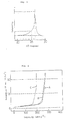
- Figure 1 shows an X-ray diffraction profile with the CuK ⁇ ways of a graphite composition of the electrode, which was prepared as follows: An electrode substrate made of nickel was disposed within the reaction chamber for chemical vapor deposition. When benzene was supplied as a starting material to the reaction chamber, the benzene was thermally decomposed within the reaction chamber to form the graphite composition, which was then directly deposited on the electrode substrate for growth, resulting in a graphite electrode. The coating of the graphite composition directly deposited on the electrode substrate had the thickness of 90 ⁇ m.
- the chemical vapor deposition mentioned above was performed under these conditions: the feed rate of benzene was 1.5 mol/hr; the number density of benzene molecules was 1.0 x 10²² molecules/l, the flow rate of benzene was 1.5 cm/min, and the temperature for thermal decomposition was 950 o C.
- the ratio of the diffraction intensity of the low-crystalline graphite to the diffraction intensity of the high-crystalline graphite was 0.18.
- the graphite electrode obtained was used as a test sample electrode A.
- the test sample electrode A was immersed in an electrolytic bath, which was provided with lithium electrodes as a counter electrode and a reference electrode, and a charge-discharge test, in which the test sample electrode A was doped or dedoped with lithium atoms, was carried out.
- the electrolytic bath contained an electrolytic solution of propylene carbonate containing 1-M lithium perchlorate.
- the Curve A in Figure 2 shows changes in the electric potential of the test sample electrode A based on that of the lithium reference electrode when the test sample electrode A was discharged, which clearly indicates that the discharging capacity of the graphite electrode of this example is much improved at electric potentials less than about 1 volt over the conventional graphite electrode of the comparative example below, and thus the discharging characteristics of the graphite electrode of this example are extremely satisfactory.
- Figure 3 shows an X-ray diffraction profile with the CuK ⁇ rays of graphite composition of the electrode, which was prepared in the same manner as in Example 1, except that propane was used as the starting material and the chemical vapor deposition was performed under the conditions: the feed rate of propane was 2.2 mol/hr, the number density of propane molecules was 1.5 x 10²² molecules/l , the flow rate of propane was 0.7 cm/min, and the temperature for thermal decomposition was 900 o C.
- the graphite composition obtained in this way was a mixture of high-crystalline graphite and low-crystalline graphite.
- the graphite electrode obtained was used as a test sample electrode B, and a charge-discharge test, in which the test sample electrode B was doped or dedoped with lithium atoms, was carried out in the same manner as in Example 1.
- the Curve B in Figure 2 shows changes in the electric potential of the test sample electrode B based on that of the lithium reference electrode when the test sample electrode B was discharged, which clearly indicates that the discharging capacity of the graphite electrode of this example is very large at electric potentials less than about 1 volt, and thus the discharging characteristics of the graphite electrode of this example are extremely satisfactory.
- Figure 4 shows an X-ray diffraction profile with the CuK ⁇ rays of the graphite material of a conventional electrode.
- the conventional graphite electrode was used as a test sample electrode C, and a charge-discharge test, in which the test sample electrode C was doped or dedoped with lithium atoms, was carried out in the same manner as in Example 1.
- the Curve C in Figure 2 shows changes in the electric potential of the test sample electrode C based on that of the lithium reference electrode when the test sample electrode C was discharged, which clearly indicates that compared to the graphite electrodes of the above-mentioned examples, the graphite electrode of this comparative example has a small discharging capacity at lower electric potentials and is not suitable for use as an electrode.
Landscapes
- Chemical & Material Sciences (AREA)
- Chemical Kinetics & Catalysis (AREA)
- General Chemical & Material Sciences (AREA)
- Electrochemistry (AREA)
- Engineering & Computer Science (AREA)
- Materials Engineering (AREA)
- Inorganic Chemistry (AREA)
- Mechanical Engineering (AREA)
- Metallurgy (AREA)
- Organic Chemistry (AREA)
- Battery Electrode And Active Subsutance (AREA)
- Secondary Cells (AREA)
- Carbon And Carbon Compounds (AREA)
Priority Applications (2)
| Application Number | Priority Date | Filing Date | Title |
|---|---|---|---|
| EP95202529A EP0717456A3 (de) | 1988-06-08 | 1989-06-07 | Elektrode und Verfahren zur Herstellung |
| EP00200483A EP1014462A3 (de) | 1988-06-08 | 1989-06-07 | Verfahren zur Herstellung eines Graphite-Werkstoffs zur Verwendung als Negativelektrode in einem nichtwässrigen Akkumulator |
Applications Claiming Priority (2)
| Application Number | Priority Date | Filing Date | Title |
|---|---|---|---|
| JP63141374A JP2718696B2 (ja) | 1988-06-08 | 1988-06-08 | 電 極 |
| JP141374/88 | 1988-06-08 |
Related Child Applications (1)
| Application Number | Title | Priority Date | Filing Date |
|---|---|---|---|
| EP95202529.4 Division-Into | 1995-09-19 |
Publications (2)
| Publication Number | Publication Date |
|---|---|
| EP0346088A1 true EP0346088A1 (de) | 1989-12-13 |
| EP0346088B1 EP0346088B1 (de) | 1997-11-12 |
Family
ID=15290510
Family Applications (3)
| Application Number | Title | Priority Date | Filing Date |
|---|---|---|---|
| EP95202529A Ceased EP0717456A3 (de) | 1988-06-08 | 1989-06-07 | Elektrode und Verfahren zur Herstellung |
| EP89305731A Expired - Lifetime EP0346088B1 (de) | 1988-06-08 | 1989-06-07 | Elektrode und Verfahren zu deren Herstellung |
| EP00200483A Ceased EP1014462A3 (de) | 1988-06-08 | 1989-06-07 | Verfahren zur Herstellung eines Graphite-Werkstoffs zur Verwendung als Negativelektrode in einem nichtwässrigen Akkumulator |
Family Applications Before (1)
| Application Number | Title | Priority Date | Filing Date |
|---|---|---|---|
| EP95202529A Ceased EP0717456A3 (de) | 1988-06-08 | 1989-06-07 | Elektrode und Verfahren zur Herstellung |
Family Applications After (1)
| Application Number | Title | Priority Date | Filing Date |
|---|---|---|---|
| EP00200483A Ceased EP1014462A3 (de) | 1988-06-08 | 1989-06-07 | Verfahren zur Herstellung eines Graphite-Werkstoffs zur Verwendung als Negativelektrode in einem nichtwässrigen Akkumulator |
Country Status (4)
| Country | Link |
|---|---|
| US (2) | US4978600A (de) |
| EP (3) | EP0717456A3 (de) |
| JP (1) | JP2718696B2 (de) |
| DE (1) | DE68928437T2 (de) |
Cited By (13)
| Publication number | Priority date | Publication date | Assignee | Title |
|---|---|---|---|---|
| WO1990013924A3 (en) * | 1989-05-11 | 1991-04-18 | Moli Energy Ltd | Carbonaceous electrodes for lithium cells |
| EP0541889A1 (de) * | 1991-11-12 | 1993-05-19 | Sanyo Electric Co., Limited. | Lithium-Sekundärbatterie |
| EP0555080A1 (de) * | 1992-02-04 | 1993-08-11 | Sharp Kabushiki Kaisha | Kohlenstoff-Verbund-Elektrodenmaterial |
| EP0573266A1 (de) * | 1992-06-01 | 1993-12-08 | Kabushiki Kaisha Toshiba | Verfahren zur Herstellung von Kohlenstoffhaltigem Material für negative Elektroden und Lithium-Sekundärbatterien, die dieses enthält |
| EP0643431A4 (de) * | 1992-05-25 | 1995-05-24 | Nippon Steel Corp | Material für die negative elektrode einer lithiumsekundärzelle, deren herstellen und lithiumsekundärzelle. |
| EP0612117A3 (en) * | 1993-02-16 | 1996-07-17 | Sharp Kk | Nonaqueous secondary battery. |
| US5686138A (en) * | 1991-11-12 | 1997-11-11 | Sanyo Electric Co., Ltd. | Lithium secondary battery |
| US5776610A (en) * | 1993-02-03 | 1998-07-07 | Sharp Kabushiki Kaisha | Carbon composite electrode material and method of making thereof |
| US5780820A (en) * | 1995-03-08 | 1998-07-14 | Matsushita Electric Industrial Co., Ltd. | Film-like heater made of high crystalline graphite film |
| EP0810680A3 (de) * | 1996-05-27 | 1998-08-05 | SANYO ELECTRIC Co., Ltd. | Kohlenstoffelektrode und Batterie mit nichtwässrigen Elektrolyten |
| EP1026762A1 (de) * | 1999-02-08 | 2000-08-09 | Wilson Greatbatch Ltd. | Elektrodenkomponente hergestellt durch chemische Dampfphasenabscheidung und Verfahren zur Herstellung |
| WO2005008811A1 (en) * | 2003-07-22 | 2005-01-27 | Byd Company Limited | Negative electrodes for rechargeable batteries |
| EP2397442A3 (de) * | 2010-06-17 | 2013-03-13 | Samsung SDI Co., Ltd. | Kristallines kohlenstoffhaltiges Material mit gesteuerter Zwischenschichtbeabstandung und Herstellungsverfahren dafür |
Families Citing this family (12)
| Publication number | Priority date | Publication date | Assignee | Title |
|---|---|---|---|---|
| JP2592152B2 (ja) * | 1989-12-19 | 1997-03-19 | シャープ株式会社 | 非水系リチウム二次電池用炭素電極の製造方法 |
| JP3019421B2 (ja) * | 1990-12-28 | 2000-03-13 | ソニー株式会社 | 非水電解質二次電池 |
| JPH04308670A (ja) * | 1991-04-05 | 1992-10-30 | Sanyo Electric Co Ltd | 二次電池 |
| DE4310321C2 (de) * | 1992-03-31 | 1995-07-06 | Ricoh Kk | Nicht-wässrige Sekundärbatterie |
| JP3129087B2 (ja) * | 1994-07-06 | 2001-01-29 | 松下電器産業株式会社 | グラファイト層状体 |
| US5900336A (en) * | 1995-01-25 | 1999-05-04 | Ricoh Company, Ltd. | Negative electrode for lithium secondary battery and lithium secondary battery using the negative electrode |
| US5750288A (en) * | 1995-10-03 | 1998-05-12 | Rayovac Corporation | Modified lithium nickel oxide compounds for electrochemical cathodes and cells |
| KR100269923B1 (ko) * | 1998-03-10 | 2000-10-16 | 김순택 | 리튬 계열 이차 전지의 음극용 활물질의 제조 방법 |
| CN100448328C (zh) * | 2005-06-20 | 2008-12-31 | 磐石市闽星炭素有限责任公司 | 一种超高功率石墨电极的生产方法 |
| JP5401035B2 (ja) * | 2007-12-25 | 2014-01-29 | 日立ビークルエナジー株式会社 | リチウムイオン二次電池 |
| JP6777059B2 (ja) * | 2017-11-15 | 2020-10-28 | トヨタ自動車株式会社 | 非水電解質二次電池の製造方法 |
| TWI768560B (zh) | 2020-11-25 | 2022-06-21 | 五鼎生物技術股份有限公司 | 生化試片 |
Citations (14)
| Publication number | Priority date | Publication date | Assignee | Title |
|---|---|---|---|---|
| US3725110A (en) * | 1969-11-13 | 1973-04-03 | Ducommun Inc | Process of coating articles with pyrolytic graphite and coated articles made in accordance with the process |
| US3844837A (en) * | 1972-07-07 | 1974-10-29 | Us Navy | Nonaqueous battery |
| US4048953A (en) * | 1974-06-19 | 1977-09-20 | Pfizer Inc. | Apparatus for vapor depositing pyrolytic carbon on porous sheets of carbon material |
| US4264686A (en) * | 1978-09-01 | 1981-04-28 | Texas Instruments Incorporated | Graphite felt flowthrough electrode for fuel cell use |
| EP0165047A2 (de) * | 1984-06-12 | 1985-12-18 | Mitsubishi Chemical Corporation | Mittels Pyrolyse hergestelltes Pseudo-Graphit als Elektrodenmaterial |
| EP0201038A1 (de) * | 1985-04-30 | 1986-11-12 | Toshiba Battery Co., Ltd. | Sekundärbatterie mit nichtwässrigem Lösungsmittel |
| EP0205856A2 (de) * | 1985-05-10 | 1986-12-30 | Asahi Kasei Kogyo Kabushiki Kaisha | Sekundärbatterie |
| US4645713A (en) * | 1985-01-25 | 1987-02-24 | Agency Of Industrial Science & Technology | Method for forming conductive graphite film and film formed thereby |
| EP0239410A2 (de) * | 1986-03-27 | 1987-09-30 | Sharp Kabushiki Kaisha | Elektrode und damit versehene Batterie |
| US4707423A (en) * | 1982-06-10 | 1987-11-17 | Celanese Corporation | Electric storage battery and process for the manufacture thereof |
| EP0248386A2 (de) * | 1986-06-02 | 1987-12-09 | The Electrosynthesis Company, Inc. | Fluorierte Kohlenstoffe und Verfahren zu deren Herstellung |
| EP0249331A1 (de) * | 1986-05-13 | 1987-12-16 | Mitsubishi Gas Chemical Company, Inc. | Herstellungsmetthode einer Sekundärbatterie |
| EP0251677A2 (de) * | 1986-06-24 | 1988-01-07 | Sharp Kabushiki Kaisha | Elektroden aus Graphiteinlagerungsverbindungen für wiederaufladbare Batterien und Herstellungsverfahren hierfür |
| EP0273562A2 (de) * | 1986-11-11 | 1988-07-06 | Sharp Kabushiki Kaisha | Verfahren zur Herstellung einer Kohlenstoffelektrode |
Family Cites Families (4)
| Publication number | Priority date | Publication date | Assignee | Title |
|---|---|---|---|---|
| US3088687A (en) | 1959-08-25 | 1963-05-07 | Lockheed Aircraft Corp | Endless loop tape magazine |
| JPS6016806A (ja) * | 1983-07-06 | 1985-01-28 | Koa Sekiyu Kk | 炭素成形体の製造方法 |
| EP0201696B1 (de) * | 1985-03-20 | 1991-03-13 | Sharp Kabushiki Kaisha | Herstellung von Kohlenstoffschichten |
| JP2556840B2 (ja) * | 1986-03-27 | 1996-11-27 | シャープ株式会社 | 非水リチウム2次電池用負極 |
-
1988
- 1988-06-08 JP JP63141374A patent/JP2718696B2/ja not_active Expired - Lifetime
-
1989
- 1989-06-07 US US07/362,505 patent/US4978600A/en not_active Expired - Lifetime
- 1989-06-07 DE DE68928437T patent/DE68928437T2/de not_active Expired - Lifetime
- 1989-06-07 EP EP95202529A patent/EP0717456A3/de not_active Ceased
- 1989-06-07 EP EP89305731A patent/EP0346088B1/de not_active Expired - Lifetime
- 1989-06-07 EP EP00200483A patent/EP1014462A3/de not_active Ceased
-
1990
- 1990-09-11 US US07/580,608 patent/US5080930A/en not_active Expired - Lifetime
Patent Citations (14)
| Publication number | Priority date | Publication date | Assignee | Title |
|---|---|---|---|---|
| US3725110A (en) * | 1969-11-13 | 1973-04-03 | Ducommun Inc | Process of coating articles with pyrolytic graphite and coated articles made in accordance with the process |
| US3844837A (en) * | 1972-07-07 | 1974-10-29 | Us Navy | Nonaqueous battery |
| US4048953A (en) * | 1974-06-19 | 1977-09-20 | Pfizer Inc. | Apparatus for vapor depositing pyrolytic carbon on porous sheets of carbon material |
| US4264686A (en) * | 1978-09-01 | 1981-04-28 | Texas Instruments Incorporated | Graphite felt flowthrough electrode for fuel cell use |
| US4707423A (en) * | 1982-06-10 | 1987-11-17 | Celanese Corporation | Electric storage battery and process for the manufacture thereof |
| EP0165047A2 (de) * | 1984-06-12 | 1985-12-18 | Mitsubishi Chemical Corporation | Mittels Pyrolyse hergestelltes Pseudo-Graphit als Elektrodenmaterial |
| US4645713A (en) * | 1985-01-25 | 1987-02-24 | Agency Of Industrial Science & Technology | Method for forming conductive graphite film and film formed thereby |
| EP0201038A1 (de) * | 1985-04-30 | 1986-11-12 | Toshiba Battery Co., Ltd. | Sekundärbatterie mit nichtwässrigem Lösungsmittel |
| EP0205856A2 (de) * | 1985-05-10 | 1986-12-30 | Asahi Kasei Kogyo Kabushiki Kaisha | Sekundärbatterie |
| EP0239410A2 (de) * | 1986-03-27 | 1987-09-30 | Sharp Kabushiki Kaisha | Elektrode und damit versehene Batterie |
| EP0249331A1 (de) * | 1986-05-13 | 1987-12-16 | Mitsubishi Gas Chemical Company, Inc. | Herstellungsmetthode einer Sekundärbatterie |
| EP0248386A2 (de) * | 1986-06-02 | 1987-12-09 | The Electrosynthesis Company, Inc. | Fluorierte Kohlenstoffe und Verfahren zu deren Herstellung |
| EP0251677A2 (de) * | 1986-06-24 | 1988-01-07 | Sharp Kabushiki Kaisha | Elektroden aus Graphiteinlagerungsverbindungen für wiederaufladbare Batterien und Herstellungsverfahren hierfür |
| EP0273562A2 (de) * | 1986-11-11 | 1988-07-06 | Sharp Kabushiki Kaisha | Verfahren zur Herstellung einer Kohlenstoffelektrode |
Non-Patent Citations (1)
| Title |
|---|
| CHEMICAL ABSTRACTS, vol. 103, no. 4, July 1985, page 149, abstract no. 25029z, Columbus, Ohio, US; & JP-A-60 36 315 (TORAY INDUSTRIES, INC.) 25-02-1985 * |
Cited By (22)
| Publication number | Priority date | Publication date | Assignee | Title |
|---|---|---|---|---|
| WO1990013924A3 (en) * | 1989-05-11 | 1991-04-18 | Moli Energy Ltd | Carbonaceous electrodes for lithium cells |
| US5028500A (en) * | 1989-05-11 | 1991-07-02 | Moli Energy Limited | Carbonaceous electrodes for lithium cells |
| US5882818A (en) * | 1991-11-12 | 1999-03-16 | Sanyo Electric Co., Ltd. | Lithium secondary battery |
| US5993997A (en) * | 1991-11-12 | 1999-11-30 | Sanyo Electric Co., Ltd | Lithium secondary battery |
| US5686138A (en) * | 1991-11-12 | 1997-11-11 | Sanyo Electric Co., Ltd. | Lithium secondary battery |
| EP0541889A1 (de) * | 1991-11-12 | 1993-05-19 | Sanyo Electric Co., Limited. | Lithium-Sekundärbatterie |
| US5595838A (en) * | 1992-02-04 | 1997-01-21 | Sharp Kabushiki Kaisha | Method for manufacturing carbon composite electrode material |
| EP0555080A1 (de) * | 1992-02-04 | 1993-08-11 | Sharp Kabushiki Kaisha | Kohlenstoff-Verbund-Elektrodenmaterial |
| US5851697A (en) * | 1992-05-25 | 1998-12-22 | Nippon Steel Corporation | Negative electrode material for lithium secondary cell, method for its production, and lithium secondary cell |
| EP0643431A4 (de) * | 1992-05-25 | 1995-05-24 | Nippon Steel Corp | Material für die negative elektrode einer lithiumsekundärzelle, deren herstellen und lithiumsekundärzelle. |
| US5622793A (en) * | 1992-05-25 | 1997-04-22 | Nippon Steel Corporation | Method for preparing negative electrode material for a lithium secondary cell |
| EP0573266A1 (de) * | 1992-06-01 | 1993-12-08 | Kabushiki Kaisha Toshiba | Verfahren zur Herstellung von Kohlenstoffhaltigem Material für negative Elektroden und Lithium-Sekundärbatterien, die dieses enthält |
| US5340670A (en) * | 1992-06-01 | 1994-08-23 | Kabushiki Kaisha Toshiba | Lithium secondary battery and method of manufacturing carbonaceous material for negative electrode of the battery |
| US5776610A (en) * | 1993-02-03 | 1998-07-07 | Sharp Kabushiki Kaisha | Carbon composite electrode material and method of making thereof |
| EP0612117A3 (en) * | 1993-02-16 | 1996-07-17 | Sharp Kk | Nonaqueous secondary battery. |
| US5780820A (en) * | 1995-03-08 | 1998-07-14 | Matsushita Electric Industrial Co., Ltd. | Film-like heater made of high crystalline graphite film |
| EP0810680A3 (de) * | 1996-05-27 | 1998-08-05 | SANYO ELECTRIC Co., Ltd. | Kohlenstoffelektrode und Batterie mit nichtwässrigen Elektrolyten |
| US5888671A (en) * | 1996-05-27 | 1999-03-30 | Sanyo Electric Co., Ltd. | Non-aqueous electrolyte battery |
| EP1026762A1 (de) * | 1999-02-08 | 2000-08-09 | Wilson Greatbatch Ltd. | Elektrodenkomponente hergestellt durch chemische Dampfphasenabscheidung und Verfahren zur Herstellung |
| WO2005008811A1 (en) * | 2003-07-22 | 2005-01-27 | Byd Company Limited | Negative electrodes for rechargeable batteries |
| EP2397442A3 (de) * | 2010-06-17 | 2013-03-13 | Samsung SDI Co., Ltd. | Kristallines kohlenstoffhaltiges Material mit gesteuerter Zwischenschichtbeabstandung und Herstellungsverfahren dafür |
| US8894964B2 (en) | 2010-06-17 | 2014-11-25 | Samsung Sdi Co., Ltd. | Crystalline carbonaceous material with controlled interlayer spacing and method of preparing same |
Also Published As
| Publication number | Publication date |
|---|---|
| JP2718696B2 (ja) | 1998-02-25 |
| EP0346088B1 (de) | 1997-11-12 |
| US4978600A (en) | 1990-12-18 |
| JPH01311565A (ja) | 1989-12-15 |
| EP0717456A2 (de) | 1996-06-19 |
| EP0717456A3 (de) | 1996-10-16 |
| EP1014462A3 (de) | 2002-06-26 |
| DE68928437T2 (de) | 1998-03-12 |
| EP1014462A2 (de) | 2000-06-28 |
| US5080930A (en) | 1992-01-14 |
| DE68928437D1 (de) | 1997-12-18 |
Similar Documents
| Publication | Publication Date | Title |
|---|---|---|
| EP0346088B1 (de) | Elektrode und Verfahren zu deren Herstellung | |
| US4968527A (en) | Method for the manufacture of pyrolytic graphite with high crystallinity and electrodes with the same for rechargeable batteries | |
| EP0239410B1 (de) | Elektrode und damit versehene Batterie | |
| US5344726A (en) | Carbon anode for secondary battery | |
| EP2088221B1 (de) | Material für die Negativelektrode einer Sekundärbatterie mit nichtwässrigem Elektrolyt, Herstellungsverfahren, Lithiumionensekundärbatterie und elektrochemischer Kondensator | |
| Zhao et al. | Atomic layer deposition of ZnO–SnO2 composite thin film: the influence of structure, composition and crystallinity on lithium-ion battery performance | |
| EP1323783B1 (de) | Leitfähiges Siliziumoxidpulver, dessen Herstellung, und negatives Elektrodenmaterial für nicht-wässrige Elektrolyt-Sekundärbatterie | |
| US20090311606A1 (en) | Negative electrode material, making method, lithium ion secondary battery, and electrochemical capacitor | |
| EP0612117A2 (de) | Nichtwässrige Sekundärbatterie | |
| US5595838A (en) | Method for manufacturing carbon composite electrode material | |
| EP2991141A1 (de) | Silikonhaltiges material, negativelektrode mit nichtwässrigem elektrolyten für eine sekundärbatterie und verfahren zur herstellung davon sowie sekundärbatterie mit nichtwässrigem elektrolyten und verfahren zur herstellung davon | |
| JPH0213423B2 (de) | ||
| EP0434402B1 (de) | Verfahren zur Herstellung einer Kohlenstoffelektrode | |
| EP0419090B1 (de) | Kohlenstoffelektrode | |
| JPS63121265A (ja) | 二次電池 | |
| US5776610A (en) | Carbon composite electrode material and method of making thereof | |
| JP3532115B2 (ja) | 非水系二次電池 | |
| RU2133527C1 (ru) | Пироуглеродсодержащий материал для анода литий-ионного аккумулятора и способ его изготовления | |
| JP3158047B2 (ja) | 電極及び電極の製造方法 | |
| JP3238197B2 (ja) | リチウム二次電池 | |
| JPH07282797A (ja) | 非水系二次電池 | |
| JPH0554909A (ja) | 二次電池 | |
| AL MAMUN | Study on Electrode Materials for Lithium-Ion Batteries by Neutron Scattering and X-ray Diffraction | |
| JP2643035C (de) |
Legal Events
| Date | Code | Title | Description |
|---|---|---|---|
| PUAI | Public reference made under article 153(3) epc to a published international application that has entered the european phase |
Free format text: ORIGINAL CODE: 0009012 |
|
| AK | Designated contracting states |
Kind code of ref document: A1 Designated state(s): DE FR GB |
|
| 17P | Request for examination filed |
Effective date: 19900531 |
|
| 17Q | First examination report despatched |
Effective date: 19920131 |
|
| APAB | Appeal dossier modified |
Free format text: ORIGINAL CODE: EPIDOS NOAPE |
|
| GRAG | Despatch of communication of intention to grant |
Free format text: ORIGINAL CODE: EPIDOS AGRA |
|
| GRAH | Despatch of communication of intention to grant a patent |
Free format text: ORIGINAL CODE: EPIDOS IGRA |
|
| GRAH | Despatch of communication of intention to grant a patent |
Free format text: ORIGINAL CODE: EPIDOS IGRA |
|
| GRAA | (expected) grant |
Free format text: ORIGINAL CODE: 0009210 |
|
| AK | Designated contracting states |
Kind code of ref document: B1 Designated state(s): DE FR GB |
|
| XX | Miscellaneous (additional remarks) |
Free format text: TEILANMELDUNG 95202529.4 EINGEREICHT AM 19/09/95. |
|
| REF | Corresponds to: |
Ref document number: 68928437 Country of ref document: DE Date of ref document: 19971218 |
|
| ET | Fr: translation filed | ||
| PLBE | No opposition filed within time limit |
Free format text: ORIGINAL CODE: 0009261 |
|
| STAA | Information on the status of an ep patent application or granted ep patent |
Free format text: STATUS: NO OPPOSITION FILED WITHIN TIME LIMIT |
|
| 26N | No opposition filed | ||
| REG | Reference to a national code |
Ref country code: GB Ref legal event code: IF02 |
|
| APAH | Appeal reference modified |
Free format text: ORIGINAL CODE: EPIDOSCREFNO |
|
| PGFP | Annual fee paid to national office [announced via postgrant information from national office to epo] |
Ref country code: DE Payment date: 20080612 Year of fee payment: 20 |
|
| PGFP | Annual fee paid to national office [announced via postgrant information from national office to epo] |
Ref country code: FR Payment date: 20080617 Year of fee payment: 20 |
|
| PGFP | Annual fee paid to national office [announced via postgrant information from national office to epo] |
Ref country code: GB Payment date: 20080611 Year of fee payment: 20 |
|
| REG | Reference to a national code |
Ref country code: GB Ref legal event code: PE20 Expiry date: 20090606 |
|
| PG25 | Lapsed in a contracting state [announced via postgrant information from national office to epo] |
Ref country code: GB Free format text: LAPSE BECAUSE OF EXPIRATION OF PROTECTION Effective date: 20090606 |