EP0346332B1 - Procede et appareil d'extraction de caprolactame - Google Patents
Procede et appareil d'extraction de caprolactame Download PDFInfo
- Publication number
- EP0346332B1 EP0346332B1 EP88900178A EP88900178A EP0346332B1 EP 0346332 B1 EP0346332 B1 EP 0346332B1 EP 88900178 A EP88900178 A EP 88900178A EP 88900178 A EP88900178 A EP 88900178A EP 0346332 B1 EP0346332 B1 EP 0346332B1
- Authority
- EP
- European Patent Office
- Prior art keywords
- liquid mixture
- caprolactam
- steam
- organic material
- superheated steam
- Prior art date
- Legal status (The legal status is an assumption and is not a legal conclusion. Google has not performed a legal analysis and makes no representation as to the accuracy of the status listed.)
- Expired
Links
- JBKVHLHDHHXQEQ-UHFFFAOYSA-N epsilon-caprolactam Chemical compound O=C1CCCCCN1 JBKVHLHDHHXQEQ-UHFFFAOYSA-N 0.000 title claims abstract description 134
- 238000000034 method Methods 0.000 title claims abstract description 25
- 239000000203 mixture Substances 0.000 claims abstract description 53
- 239000007788 liquid Substances 0.000 claims abstract description 48
- 239000011368 organic material Substances 0.000 claims abstract description 34
- 238000002156 mixing Methods 0.000 claims abstract description 28
- 239000006200 vaporizer Substances 0.000 claims abstract description 28
- 229910010272 inorganic material Inorganic materials 0.000 claims abstract description 8
- 239000011147 inorganic material Substances 0.000 claims abstract description 8
- 238000000926 separation method Methods 0.000 claims abstract description 8
- 230000000593 degrading effect Effects 0.000 claims abstract description 5
- 239000000463 material Substances 0.000 claims description 10
- 238000004132 cross linking Methods 0.000 claims description 5
- 235000014113 dietary fatty acids Nutrition 0.000 claims description 4
- 229930195729 fatty acid Natural products 0.000 claims description 4
- 239000000194 fatty acid Substances 0.000 claims description 4
- 150000004665 fatty acids Chemical class 0.000 claims description 4
- 230000003068 static effect Effects 0.000 claims description 4
- 239000003209 petroleum derivative Substances 0.000 claims description 3
- 239000011364 vaporized material Substances 0.000 claims description 2
- 241000269627 Amphiuma means Species 0.000 claims 1
- 238000011084 recovery Methods 0.000 description 5
- 239000003039 volatile agent Substances 0.000 description 5
- 238000009834 vaporization Methods 0.000 description 4
- 230000008016 vaporization Effects 0.000 description 4
- 239000004952 Polyamide Substances 0.000 description 3
- 230000015556 catabolic process Effects 0.000 description 3
- 238000006731 degradation reaction Methods 0.000 description 3
- 229920002647 polyamide Polymers 0.000 description 3
- 230000005587 bubbling Effects 0.000 description 2
- -1 coprolactam Substances 0.000 description 2
- 238000004821 distillation Methods 0.000 description 2
- 238000005187 foaming Methods 0.000 description 2
- 239000012535 impurity Substances 0.000 description 2
- 238000004519 manufacturing process Methods 0.000 description 2
- 239000012452 mother liquor Substances 0.000 description 2
- 235000021355 Stearic acid Nutrition 0.000 description 1
- 230000004888 barrier function Effects 0.000 description 1
- 230000015572 biosynthetic process Effects 0.000 description 1
- 230000000052 comparative effect Effects 0.000 description 1
- 238000009833 condensation Methods 0.000 description 1
- 230000005494 condensation Effects 0.000 description 1
- 239000013078 crystal Substances 0.000 description 1
- 238000002425 crystallisation Methods 0.000 description 1
- 230000008025 crystallization Effects 0.000 description 1
- 230000007423 decrease Effects 0.000 description 1
- 238000009792 diffusion process Methods 0.000 description 1
- 230000000694 effects Effects 0.000 description 1
- 239000003925 fat Substances 0.000 description 1
- 230000010006 flight Effects 0.000 description 1
- 239000012530 fluid Substances 0.000 description 1
- 230000007062 hydrolysis Effects 0.000 description 1
- 238000006460 hydrolysis reaction Methods 0.000 description 1
- 150000003951 lactams Chemical class 0.000 description 1
- QIQXTHQIDYTFRH-UHFFFAOYSA-N octadecanoic acid Chemical compound CCCCCCCCCCCCCCCCCC(O)=O QIQXTHQIDYTFRH-UHFFFAOYSA-N 0.000 description 1
- OQCDKBAXFALNLD-UHFFFAOYSA-N octadecanoic acid Natural products CCCCCCCC(C)CCCCCCCCC(O)=O OQCDKBAXFALNLD-UHFFFAOYSA-N 0.000 description 1
- 229920000642 polymer Polymers 0.000 description 1
- 239000010909 process residue Substances 0.000 description 1
- 238000007670 refining Methods 0.000 description 1
- 229920006395 saturated elastomer Polymers 0.000 description 1
- 238000007655 standard test method Methods 0.000 description 1
- 239000007858 starting material Substances 0.000 description 1
- 238000001256 steam distillation Methods 0.000 description 1
- 239000008117 stearic acid Substances 0.000 description 1
- 238000006467 substitution reaction Methods 0.000 description 1
- 238000003786 synthesis reaction Methods 0.000 description 1
- 239000010409 thin film Substances 0.000 description 1
- 238000005406 washing Methods 0.000 description 1
- 239000002699 waste material Substances 0.000 description 1
- 239000002351 wastewater Substances 0.000 description 1
- XLYOFNOQVPJJNP-UHFFFAOYSA-N water Substances O XLYOFNOQVPJJNP-UHFFFAOYSA-N 0.000 description 1
- 239000003643 water by type Substances 0.000 description 1
Images


Classifications
-
- C—CHEMISTRY; METALLURGY
- C07—ORGANIC CHEMISTRY
- C07D—HETEROCYCLIC COMPOUNDS
- C07D201/00—Preparation, separation, purification or stabilisation of unsubstituted lactams
- C07D201/16—Separation or purification
Definitions
- This invention relates to a method and improved apparatus for recovering a volatile organic material from a liquid mixture of organic and inorganic materials. More particularly, the present invention is a method and improved apparatus for recovering epsilon-caprolactam or other heat-sensitive materials from organic and inorganic process residues by mixing the arterial to be processed with superheated steam in a pipeline prior to entry into a vaporizer.
- Epsilon-caprolactam hereinafter generally called “caprolactam” or “lactam,” is a valuable starting material for production of synthetic linear polyamides having utility in the form of filaments, extruded articles-molded articles, etc.
- a very high purity caprolactam is required to assure good quality in polyamides produced therefrom.
- Crude caprolactam is purified by crystallization or by distillation. Crystals of purified caprolactam are recovered, and an aqueous mother liquor containing various impurities is separated. To this mother liquor other caprolactam-containing streams are added from other parts of the production process, e.g., regenerated caprolactam from the depolymerization of polyamide waste, wash waters from polymer chip washing, and waste waters from spills. These streams are combined in diluted form. Standard distillation of the combined streams leaves a liquid mixture of organic and inorganic materials containing 40 to 60 percent caprolactam and 40 to 60 percent heavy residues.
- a steam distillation recovery method is taught by US-A-4,582,642.
- a liquid mixture containing about 50 percent caprolactam is charged to a vessel, and superheated steam is sparged (350°C.) from beneath a pool of the liquid mixture.
- Caprolactam-steam vapors produced are passed to a partial condenser from which a caprolactam-rich condensate is removed.
- This method has several undesirable results.
- the processed fluid is heated for a long period of time, on the order of eight to nine hours, which results in cross-linking; this degrades the desirable organic by producing volatile color bodies which are entrained by the organic.
- Sparging also causes bumping of the vessel (vaporizer) which can result in carryover of the tar-like residues into the desired product. Also sparging causes excessive condensation of moisture in the tar-like residue leaving the vessel (bottoms); this causes foaming of the residue which makes it difficult to handle and decreases its ability to solidify.
- the present invention was developed to overcome these disadvantages of the prior art. It also has utility in the recovery of volatile organic materials.
- the method of recovering a volatile, heat-sensitive organic material from a liquid mixture of organic and inorganic materials comprises the steps of:
- the steam and vaporized, heat-sensitive material such as coprolactam, fatty acid or petroleum derivative, may be condensed with on without previous separation by a rectifying system.
- the superheated steam is at a temperature of 400 to 600°C, more preferably 450 to 550°C, and is preferably fed at a rate of 0.5 to 2.0 times that of the liquid mixture, or as needed by the energy balance of the system. For a given volatile material, an energy balance is established between temperature, feed ratio and rate. The key is vaporization of the volatile material without degradation.
- the amount of volatile organic material that is vaporized is at least 80, preferably 90, percent.
- degradation the organic materials is meant two things: that cross-linking or other types of degradation, such as splitting of molecules, occurs and/or that other, undesirable volatiles are stripped which in caprolactam will be seen as color or permanganate number.
- the liquid mixture preferably comprises 25 to 70, more preferably 40 to 60 weight percent caprolactam, and the method is most preferably directed to the recovery of caprolactam.
- the preferred embodiment of the present invention provides an improved method for recovering caprolactam from a liquid mixture of organic and inorganic materials wherein the liquid mixture is fed through a pipe to a vaporizer.
- the improvement comprises:
- the liquid mixture comprising 25 to 70 weight percent of caprolactam; the liquid mixture and the superheated steam have a contact time of 0.01 to 0.10 seconds; and the superheat steam is at a temperature of 450 to 550°C.
- the apparatus of the present invention represents an improvement in a system that comprises a pipe for feeding the liquid mixture of organic and inorganic materials into a vaporizor which further comprises an exhaust for removal of the vaporized heat-sensitive organic material, and an outlet for the discharge of unvaporized residues.
- the improvement comprises means for introducing superheated steam into the pipe, and means for mixing the superheated steam with the liquid mixture in the pipe for 0.005 to 1.0 second, so that at least 80 percent of the volatile heat-sensitive organic material is vaporized without degrading the heat-sensitive organic material or without stripping the undesireable volatiles, and the heat-sensitive material feeds with the steam and remaining liquid mixture into the vaporizer for separation.
- the system preferably further comprises a baffle which is located inside the vaporizer such that the vaporized material, the steam and the remaining liquid mixture discharge from the pipe to impinge upon the baffle.
- the mixing means may be any mixing device which creates turbulent flow characteristics and a high flow rate in the pipe.
- the mixing must be such that the dynamic ,effect of the highly turbulent steam stream provides an almost instantaneous heat transfer into the liquid feed, thus providing the heat of vaporization to the lighter volatile compound.
- the mixing device may be a simple pipe or bundle of pipes where the flow has turbulent characteristics; a pipe or bundle of pipes provided with static mixer elements; a channel spiral accompanied by high flow rate; venturi mixers combined with pipes, etc.
- this invention offers several other advantages over the prior art.
- the short contact time (milli-seconds) between the liquid mixture and the superheated steam reduces degradation and cross-linking, and results in less volatile color-body formation. No "bumping" occurs to vibrate the vessel; gross carryover of residue is thus eliminated.
- the residues exiting the bottom of the vessel contain minimum moisture, reducing foaming tendencies and thus, making them easier to handle and solidify.
- This invention may be used in any caprolactam producing plant to recover product from residues. However, it may also be used in other organic syntheses where heat-sensitive organics are to be recovered.
- fatty acids such as stearic acid, or a mixture of fatty acids (saturated and unsaturated) can be recovered from raw product obtained by hydrolysis of fats.
- heavy volatile petroleum derivatives can be recovered from tail streams, tar-like residues of refining processes.
- Figure 1 is a vertical cross-section of the recovery system of the present invention with mixing eductor 11;
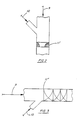
- Figure 2 is a cross-section of the introductory portion of Figure 1 wherein venturi 11′ is the mixing device;
- Figure 3 is a similar view wherein static mixing elements 11 ⁇ form the mixing device;
- Figure 4 is a view similar to Figure 1 and wherein the system utilizes channel spiral 11′′′ as the mixing device.
- the vaporized caprolactam and steam mixture then undergo separation in a conventional . rectifying system, e.g. a packed tower or partial condenser or similar concentrating system, unshown.
- the vaporized caprolactam and steam mixture could be condensed and the condensate recycled into the main process stream.
- pipe 17 may have an upward deflection with baffle 15 placed above its exit end, as shown in phantom.
- FIG. 4 An alternate embodiment of the present invention is shown in Figure 4 where channel spiral 11′′′ is used as the mixing device in lieu of mixing eductor 11.
- the depicted spiral which has 6 flights, provides an excellent turbulent flow path for the mixed steam and liquid feed.
- the key advantage to the present invention is the almost instantaneous transfer of heat into the liquid feed, thus providing the heat of vaporization to the lighter, volatile compound, caprolactam.
- the superheated motive steam is mixed with the materials to be treated in a pipe, a very thin film is produced on the wall of the pipe where the steam and liquid run together.
- the highly turbulent steam provides continuous eddies and thus an extensive exposure of the molecules to a continuously renewed surface, from which the volatile (caprolactam) moves into the gas phase by diffusion.
- less than one second contact time is required to efficiently remove (by vaporization) caprolactam from the feed mixture as compared to the approximately eight to nine hours (with lower efficiency) of the prior art.
- Examples 1-3 the average of data collected in a commercial plant over a period of several months is presented.
- Feed containing about 60 weight percent caprolactam was charged to a vaporizer at a rate of 5000 1b/h (0.63 kg/s) and at a temperature (preheated) of 140°C. This feed was introduced beneath the surface of pooled residue.
- Superheated steam at a temperature of 540°C was fed at a rate of 5000 1b/h (0.63 kg/s) to the same vaporizer. The steam was distributed by a sparge ring located beneath the surface of pooled residue.
- the residue, which was removed at a rate of 2000 1b/h (0.25 kg/s) was at a temperature of about 200 to 210°C in Example 1 and about 220 to 235°C in Example 2.
- Example 1 the amount of caprolactam in the residue removed from the vaporizer was 29 to 30 weight percent. Color of the recovered caprolactam was 1500 to 2200 units.
- Example 2 the amount of caprolactam in the residue removed from the vaporizer was 8 to 23 weight percent.
- the color of the recovered caprolactam was 5000 to 6500 units.
- Feed containing about 60 weight percent caprolactam was fed to mixing eductor 11 at a rate of 5800 1b/h (0.73 kg/s) and at a temperature (preheated) of 140°C.
- Superheated steam at 540°C was fed to mixing eductor 11 at a rate of 5500 1b/h (0.70 kg/s).
- the steam/feed mixture was at a temperature of 226°C.
- the mixture flashed into vaporizer 12 where about 90 percent by weight of the caprolactam from the feed mixture was removed through overhead line 13 with the steam.
- Less than 500 1b/h (0.06 kg/s) of superheated steam (540°C) was distributed by a sparge ring located beneath the surface of pooled residue.
- the residue exited vaporizer 12 at a rate of about 2000 1b/h (0.25 kg/s) and at a temperature of about 226°C.
- the residence or holdup time amount of residue in vaporizer 12 were, respectively, 2.4 hours and 14,100 1b (6,387 kg).
- Contact time between the feed mixture and superheated steam was approximately 0.08 second.
- the caprolactam-steam mixture was removed from vaporizer 12 and separated as in Examples 1 and 2.
- the weight percent caprolactam in the residue removed from vaporizer 12 was about 10.5. Color of the recovered caprolactam was 1900 to 2000 units.
- the amount of crude caprolactam required to make 1000 pounds (454 kg) of virgin caprolactam was approximately 1009 pounds (458.1 kg).
- Example 3 when comparating Example 3 with either of Example 1 or 2, one can see the tremendous advantage of the present system. Although the color of the recovered caprolactam was comparable in Examples 1 and 3, the percent caprolactam in residue was significantly higher in Example 1. With respect to Example 2, the color of the recovered caprolactam was approximately double that of Example 3. This is an indication of higher degree of impurities in Example 2.
- Example 3 requires 8 pounds (3.6 kg) less of crude caprolactam to make 1000 pounds (454 kg) of virgin caprolactam. For every 100,000,000 pounds (45400 tonnes) per year produced, this represents a savings of 800,000 pounds (363.2 tonnes) of caprolactam, quite a significant number.
- Example 3 The procedure of Example 3 was repeated with the changes shown in Table 1 (and no sparge ring). Table 1 also indicates percent caprolactam recovered as well as the color of the recovered caprolactam.
- Example 7 With reference to Table 1, it can be seen that the efficiency of caprolactam recovery increases with the steam feed to liquid mixture feed ratio. With reference to Example 5, a reduced rate of flow improved product quality (low color recovered) but the caprolactam content of the residue was high. Extreme stripping with a high steam feed to liquid mixture feed ratio (Example 7) reduced the caprolactam content in the residue; however the color of the recovered caprolactam was worse.
- Example 3 The procedure of Example 3 is repeated in each of Examples 8,9 and 10 with the substitution of venturi mixer 11′, static mixing elements 11 ⁇ , and channel spiral 11′′′, respectively. Excellent efficiencies and purity are obtained.
Landscapes
- Chemical & Material Sciences (AREA)
- Organic Chemistry (AREA)
- Vaporization, Distillation, Condensation, Sublimation, And Cold Traps (AREA)
Abstract
Claims (13)
Applications Claiming Priority (2)
| Application Number | Priority Date | Filing Date | Title |
|---|---|---|---|
| US06/945,117 US4764607A (en) | 1986-12-22 | 1986-12-22 | Method for recovering caprolactam |
| US945117 | 1986-12-22 |
Publications (2)
| Publication Number | Publication Date |
|---|---|
| EP0346332A1 EP0346332A1 (fr) | 1989-12-20 |
| EP0346332B1 true EP0346332B1 (fr) | 1991-10-23 |
Family
ID=25482638
Family Applications (1)
| Application Number | Title | Priority Date | Filing Date |
|---|---|---|---|
| EP88900178A Expired EP0346332B1 (fr) | 1986-12-22 | 1987-11-19 | Procede et appareil d'extraction de caprolactame |
Country Status (5)
| Country | Link |
|---|---|
| US (1) | US4764607A (fr) |
| EP (1) | EP0346332B1 (fr) |
| JP (1) | JPH0791263B2 (fr) |
| DE (1) | DE3774136D1 (fr) |
| WO (1) | WO1988004651A1 (fr) |
Families Citing this family (5)
| Publication number | Priority date | Publication date | Assignee | Title |
|---|---|---|---|---|
| DE4322953A1 (de) * | 1993-07-09 | 1995-01-12 | Basf Ag | Verfahren zur Gewinnung von Caprolactam und eines Alkalimetallcarbonats aus Destillationsrückständen, die bei der Reinigung von Caprolactam anfallen |
| DE4443125A1 (de) * | 1994-12-03 | 1996-06-05 | Basf Ag | Verfahren zur Herstellung von Caprolactam |
| US5656757A (en) * | 1995-08-10 | 1997-08-12 | Alliedsignal Inc. | Monomer recovery from multi-component materials |
| DE19648747A1 (de) * | 1996-11-25 | 1998-05-28 | Basf Ag | Verfahren zur Rückgewinnung von Caprolactam und seinen Oligomeren aus wässrigen Polycaprolactam-Extrakten |
| DE19753377B4 (de) * | 1997-12-02 | 2008-07-10 | Lurgi Zimmer Gmbh | Verfahren zur Herstellung von ε-Caprolactam aus Extraktwasser der PA-6-Synthese |
Family Cites Families (6)
| Publication number | Priority date | Publication date | Assignee | Title |
|---|---|---|---|---|
| FR981888A (fr) * | 1948-03-02 | 1951-05-30 | Chemicke Zd Y Na Slovensku | Procédé pour isoler les lactames |
| US2758491A (en) * | 1951-12-06 | 1956-08-14 | Aircraft Marine Prod Inc | Crimping dies for electrical connectors |
| US3485820A (en) * | 1966-08-15 | 1969-12-23 | Vickers Zimmer Ag | Process for the purification of epsilon-caprolactam |
| DE2135085C3 (de) * | 1971-07-14 | 1981-12-03 | Basf Ag, 6700 Ludwigshafen | Verfahren zur Wiedergewinnung von Caprolactam aus einem Gemisch, das Caprolactam und dessen Oligomere enthält |
| US4107160A (en) | 1977-08-24 | 1978-08-15 | Zimmer Aktiengesellschaft | Continuous process for the recovery of caprolactam |
| US4582642A (en) * | 1984-06-27 | 1986-04-15 | Allied Corporation | Recovery of caprolactam from process residues |
-
1986
- 1986-12-22 US US06/945,117 patent/US4764607A/en not_active Expired - Lifetime
-
1987
- 1987-11-19 DE DE8888900178T patent/DE3774136D1/de not_active Expired - Lifetime
- 1987-11-19 JP JP63500459A patent/JPH0791263B2/ja not_active Expired - Lifetime
- 1987-11-19 WO PCT/US1987/003030 patent/WO1988004651A1/fr not_active Ceased
- 1987-11-19 EP EP88900178A patent/EP0346332B1/fr not_active Expired
Also Published As
| Publication number | Publication date |
|---|---|
| US4764607A (en) | 1988-08-16 |
| EP0346332A1 (fr) | 1989-12-20 |
| JPH0791263B2 (ja) | 1995-10-04 |
| JPH02501307A (ja) | 1990-05-10 |
| WO1988004651A1 (fr) | 1988-06-30 |
| DE3774136D1 (de) | 1991-11-28 |
Similar Documents
| Publication | Publication Date | Title |
|---|---|---|
| US4314077A (en) | Method for the production of urea and purification of water | |
| US4783242A (en) | Distillation system and process | |
| EP0850219B1 (fr) | Recuperation de caprolactame a partir de materiaux de rebut contenant du nylon-6 | |
| US5399751A (en) | Method for recovering carboxylic acids from aqueous solutions | |
| JPS589681B2 (ja) | 高沸点感熱性物質の連続的分離方法 | |
| US4140585A (en) | Reflux return system | |
| US3267131A (en) | Product separation and recovery in adiponitrile manufacture | |
| EP0270953B1 (fr) | Procédé pour la préparation d'acide alcanesulfonique sec | |
| US4764607A (en) | Method for recovering caprolactam | |
| US3886187A (en) | Continuous manufacture of propylene oxide from propylene chlorohydrine | |
| US20240182664A1 (en) | Method For The Depolymerization Of Polycaprolactam Processing Waste To Form Caprolactam | |
| US3514484A (en) | Method for the decomposition of urea synthesis effluent | |
| US4125595A (en) | Process for the production of very pure bromine | |
| US3629316A (en) | Process for the manufacture of adiponitrile | |
| EP0424436B1 (fr) | Procede de production d'oxime anhydre a partir d'une solution aqueuse | |
| GB2072025A (en) | Method and apparatus for the continuous thermal separation of liquid thermally unstable mixtures | |
| DE4303086C2 (de) | Verfahren zur Herstellung von reinem 1,2-Dichlorethan durch Oxichlorierung | |
| US4582642A (en) | Recovery of caprolactam from process residues | |
| US3993671A (en) | Method for the continuous dehydration of maleic acid | |
| US4195032A (en) | Process for continuously working up solutions of the type accumulating in the phosgenation of monoamines | |
| US3493469A (en) | Distillation and decanting system for separating components | |
| US3859278A (en) | Process for separating lactams | |
| US3625835A (en) | Process for the recovery of cyclohexanone oxime by plural stage, vacuum distillation per a | |
| US4406836A (en) | Method for condensing fatty acids | |
| US3451900A (en) | Adiponitrile recovery by multistage vacuum distillation |
Legal Events
| Date | Code | Title | Description |
|---|---|---|---|
| PUAI | Public reference made under article 153(3) epc to a published international application that has entered the european phase |
Free format text: ORIGINAL CODE: 0009012 |
|
| 17P | Request for examination filed |
Effective date: 19890530 |
|
| AK | Designated contracting states |
Kind code of ref document: A1 Designated state(s): BE DE IT NL |
|
| 17Q | First examination report despatched |
Effective date: 19900817 |
|
| RAP1 | Party data changed (applicant data changed or rights of an application transferred) |
Owner name: ALLIED-SIGNAL INC. |
|
| ITF | It: translation for a ep patent filed | ||
| GRAA | (expected) grant |
Free format text: ORIGINAL CODE: 0009210 |
|
| AK | Designated contracting states |
Kind code of ref document: B1 Designated state(s): BE DE IT NL |
|
| REF | Corresponds to: |
Ref document number: 3774136 Country of ref document: DE Date of ref document: 19911128 |
|
| PLBE | No opposition filed within time limit |
Free format text: ORIGINAL CODE: 0009261 |
|
| STAA | Information on the status of an ep patent application or granted ep patent |
Free format text: STATUS: NO OPPOSITION FILED WITHIN TIME LIMIT |
|
| 26N | No opposition filed | ||
| PGFP | Annual fee paid to national office [announced via postgrant information from national office to epo] |
Ref country code: NL Payment date: 19980914 Year of fee payment: 12 |
|
| PGFP | Annual fee paid to national office [announced via postgrant information from national office to epo] |
Ref country code: DE Payment date: 19981125 Year of fee payment: 12 |
|
| PGFP | Annual fee paid to national office [announced via postgrant information from national office to epo] |
Ref country code: BE Payment date: 19981211 Year of fee payment: 12 |
|
| PG25 | Lapsed in a contracting state [announced via postgrant information from national office to epo] |
Ref country code: BE Free format text: LAPSE BECAUSE OF NON-PAYMENT OF DUE FEES Effective date: 19991130 |
|
| BERE | Be: lapsed |
Owner name: ALLIED-SIGNAL INC. Effective date: 19991130 |
|
| PG25 | Lapsed in a contracting state [announced via postgrant information from national office to epo] |
Ref country code: NL Free format text: LAPSE BECAUSE OF NON-PAYMENT OF DUE FEES Effective date: 20000601 |
|
| NLV4 | Nl: lapsed or anulled due to non-payment of the annual fee |
Effective date: 20000601 |
|
| PG25 | Lapsed in a contracting state [announced via postgrant information from national office to epo] |
Ref country code: DE Free format text: LAPSE BECAUSE OF NON-PAYMENT OF DUE FEES Effective date: 20000901 |
|
| PG25 | Lapsed in a contracting state [announced via postgrant information from national office to epo] |
Ref country code: IT Free format text: LAPSE BECAUSE OF NON-PAYMENT OF DUE FEES Effective date: 20051119 |