EP0347471A1 - Reseau de cellules solaires pour la commande de portes mosfet - Google Patents
Reseau de cellules solaires pour la commande de portes mosfet Download PDFInfo
- Publication number
- EP0347471A1 EP0347471A1 EP89900913A EP89900913A EP0347471A1 EP 0347471 A1 EP0347471 A1 EP 0347471A1 EP 89900913 A EP89900913 A EP 89900913A EP 89900913 A EP89900913 A EP 89900913A EP 0347471 A1 EP0347471 A1 EP 0347471A1
- Authority
- EP
- European Patent Office
- Prior art keywords
- solar cell
- cell array
- amorphous silicon
- mosfet
- cells
- Prior art date
- Legal status (The legal status is an assumption and is not a legal conclusion. Google has not performed a legal analysis and makes no representation as to the accuracy of the status listed.)
- Withdrawn
Links
Images



Classifications
-
- H—ELECTRICITY
- H10—SEMICONDUCTOR DEVICES; ELECTRIC SOLID-STATE DEVICES NOT OTHERWISE PROVIDED FOR
- H10F—INORGANIC SEMICONDUCTOR DEVICES SENSITIVE TO INFRARED RADIATION, LIGHT, ELECTROMAGNETIC RADIATION OF SHORTER WAVELENGTH OR CORPUSCULAR RADIATION
- H10F10/00—Individual photovoltaic cells, e.g. solar cells
- H10F10/10—Individual photovoltaic cells, e.g. solar cells having potential barriers
- H10F10/17—Photovoltaic cells having only PIN junction potential barriers
- H10F10/172—Photovoltaic cells having only PIN junction potential barriers comprising multiple PIN junctions, e.g. tandem cells
-
- H—ELECTRICITY
- H03—ELECTRONIC CIRCUITRY
- H03K—PULSE TECHNIQUE
- H03K17/00—Electronic switching or gating, i.e. not by contact-making and –breaking
- H03K17/51—Electronic switching or gating, i.e. not by contact-making and –breaking characterised by the components used
- H03K17/78—Electronic switching or gating, i.e. not by contact-making and –breaking characterised by the components used using opto-electronic devices, i.e. light-emitting and photoelectric devices electrically- or optically-coupled
-
- H—ELECTRICITY
- H03—ELECTRONIC CIRCUITRY
- H03K—PULSE TECHNIQUE
- H03K17/00—Electronic switching or gating, i.e. not by contact-making and –breaking
- H03K17/51—Electronic switching or gating, i.e. not by contact-making and –breaking characterised by the components used
- H03K17/78—Electronic switching or gating, i.e. not by contact-making and –breaking characterised by the components used using opto-electronic devices, i.e. light-emitting and photoelectric devices electrically- or optically-coupled
- H03K17/785—Electronic switching or gating, i.e. not by contact-making and –breaking characterised by the components used using opto-electronic devices, i.e. light-emitting and photoelectric devices electrically- or optically-coupled controlling field-effect transistor switches
-
- H—ELECTRICITY
- H10—SEMICONDUCTOR DEVICES; ELECTRIC SOLID-STATE DEVICES NOT OTHERWISE PROVIDED FOR
- H10F—INORGANIC SEMICONDUCTOR DEVICES SENSITIVE TO INFRARED RADIATION, LIGHT, ELECTROMAGNETIC RADIATION OF SHORTER WAVELENGTH OR CORPUSCULAR RADIATION
- H10F19/00—Integrated devices, or assemblies of multiple devices, comprising at least one photovoltaic cell covered by group H10F10/00, e.g. photovoltaic modules
- H10F19/30—Integrated devices, or assemblies of multiple devices, comprising at least one photovoltaic cell covered by group H10F10/00, e.g. photovoltaic modules comprising thin-film photovoltaic cells
- H10F19/31—Integrated devices, or assemblies of multiple devices, comprising at least one photovoltaic cell covered by group H10F10/00, e.g. photovoltaic modules comprising thin-film photovoltaic cells having multiple laterally adjacent thin-film photovoltaic cells deposited on the same substrate
-
- H—ELECTRICITY
- H10—SEMICONDUCTOR DEVICES; ELECTRIC SOLID-STATE DEVICES NOT OTHERWISE PROVIDED FOR
- H10F—INORGANIC SEMICONDUCTOR DEVICES SENSITIVE TO INFRARED RADIATION, LIGHT, ELECTROMAGNETIC RADIATION OF SHORTER WAVELENGTH OR CORPUSCULAR RADIATION
- H10F19/00—Integrated devices, or assemblies of multiple devices, comprising at least one photovoltaic cell covered by group H10F10/00, e.g. photovoltaic modules
- H10F19/30—Integrated devices, or assemblies of multiple devices, comprising at least one photovoltaic cell covered by group H10F10/00, e.g. photovoltaic modules comprising thin-film photovoltaic cells
- H10F19/31—Integrated devices, or assemblies of multiple devices, comprising at least one photovoltaic cell covered by group H10F10/00, e.g. photovoltaic modules comprising thin-film photovoltaic cells having multiple laterally adjacent thin-film photovoltaic cells deposited on the same substrate
- H10F19/35—Structures for the connecting of adjacent photovoltaic cells, e.g. interconnections or insulating spacers
-
- Y—GENERAL TAGGING OF NEW TECHNOLOGICAL DEVELOPMENTS; GENERAL TAGGING OF CROSS-SECTIONAL TECHNOLOGIES SPANNING OVER SEVERAL SECTIONS OF THE IPC; TECHNICAL SUBJECTS COVERED BY FORMER USPC CROSS-REFERENCE ART COLLECTIONS [XRACs] AND DIGESTS
- Y02—TECHNOLOGIES OR APPLICATIONS FOR MITIGATION OR ADAPTATION AGAINST CLIMATE CHANGE
- Y02E—REDUCTION OF GREENHOUSE GAS [GHG] EMISSIONS, RELATED TO ENERGY GENERATION, TRANSMISSION OR DISTRIBUTION
- Y02E10/00—Energy generation through renewable energy sources
- Y02E10/50—Photovoltaic [PV] energy
- Y02E10/548—Amorphous silicon PV cells
Definitions
- the present invention relates to a MOSFET gate driving solar cell array used in a semiconductor relay for driving a MOSFET by inputting an electromotive force generated by a solar cell upon reception of an optical beam to the gate of the MOSFET.
- Designated at reference numeral .20 is a light emitting diode (which will be shortly referred to as the "LED") for emitting a light when supplied with a control current by a control circuit 21.
- Numeral 22 designates solar cells for generating an output voltage upon reception of the light of the LED 20.
- the output voltage of the solar cells 22 is supplied to the gate of a MOSFET 23 so that the MOSFET 23 has its source and drain turned on or off.
- reference numeral 24 designates a discharge resistor.
- the solar cells 22 used here have such a structure as is shown in section in Fig. 9.
- oxide insulating films 26 to make individual cells independent. Each cell is constructed by laying a single- or polycrystalline p-type silicon semiconductor layers 27 and n-type silicon semiconductor layers 28 over the oxide insulating film 26, and the adjoining cells are connec- ted in series.
- the oxide insulating film 26 has to be formed to separate the cells because it is made of the crystalline silicon substrate, and has to be formed with the semiconductor layers by using a number of mask patterns.
- the solar cells are accompanied by a problem that their fabrication process is so complicated that it is difficult to accomplish their integration and to form them in a thin film form and that their fabrication cost is high.
- the present invention has been conceived in view of the above-specified problem to provide a MOSFET gate driving solar cell array to be used with a semiconductor relay including solar cells for generating an electromotive force in response to the light of a light emitting diode and a MOSFET having its gate supplied with the output voltage of said solar cells, which array comprises a multiplicity of amorphous silicon semiconductor cells connected in series.
- the output voltage of the solar cell array having the multiple amorphous silicon semiconductor cells connected in series is fed to the gate of the MOSFET to construct the semiconductor relay.
- Figs. 1 and2 are perspective views for describing a MOSFET gate driving solar cell array according to the present invention
- Fig. is a section for describing the MOSFET gate driving solar cell array according to the present invention
- Fig. 4 is a section for describing the MOSFET gate driving solar cell array according to the present invention
- Fig. 5 is a schematic circuit diagram showing a semiconductor relay using the MOSFET gate driving solar cell array according to the present invention
- Fig. 6 is a top plan view for describing an example for fabricating the MOSFET gate driving solar cell array according to the present invention
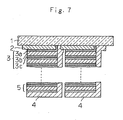
- Fig. 7 is a section for describing an example for fabricating another MOSFET gate driving solar cell array according to the present invention
- Fig. 8 is a schematic circuit diagram showing the example of the prior art
- Fig. 9 is a section for describing the example of the prior art.
- Figs. 1 and 2 are perspective views for describing solar cell arrays in general use, respectively.
- Designated at reference numeral 1 is an insulating substrate, which is made of a transparent material such as glass and arranged at the light receiving side of a solar cell.
- the insulating substrate 1 is sequentially overlaid by a lower electrode 2 which is made of a transparent, conductive film such as indium-tin oxide (which will be shortly referred to as the "ITO") or tin dioxide (i.e., Sn0 2 j, an amorphous silicon semiconductor layer 3 and an upper electrode 4 made of a metal such as aluminum.
- a transparent, conductive film such as indium-tin oxide (which will be shortly referred to as the "ITO") or tin dioxide (i.e., Sn0 2 j, an amorphous silicon semiconductor layer 3 and an upper electrode 4 made of a metal such as aluminum.
- the insulating substrate, the upper electrode, the amorphous silicon semiconductor layer and the lower electrode may likewise be laminated on the back of the above-specified light receiving face to form a light receiving face at the opposite side of the insulating substrate.
- the lower electrodes 2 and the upper electrodes of a plurality of adjoining unit cells 5 are connected in series.
- the lower electrodes 2 and the upper electrodes 4 are led out and connected at the longitudinal leading ends of the unit cells 5.
- those electrodes 2 and 4 are connected at the longitudinal sides of the unit cells 5.
- Fig. 3 The structure of the integrated portion of the solar cell array shown in Fig. 2, for example, is shown in Fig. 3.
- the lower electrode 2 is formed over the insulating substrate 1 disposed at the light receiving side of the solar cell array under consideration and is divided by an etching process or by means of a laser beam to form unit cells having a small area.
- the amorphous silicon semiconductor layer 3 which is also divided into unit cells of small area like the transparent electrode 2 by means of a laser beam or the like.
- the upper electrode 4 is formed by an electron beam evaporation and is divided into unit cells by a chemical etching process.
- the solar cell array can be fabricated with ease and at a low cost, because it thus uses the amorphous silicon semiconductor.
- the structure shown in section in Fig. 4 is used for further enhancing the energy transformation efficiency.
- a PIN heterojunction type amorphous silicon semiconductor layer in which a p-type amorphous silicon carbide 3a, an i-type amorphous silicon 3b and an n-type amorphous silicon 3c are sequentially laminated from the light receiving side of the amorphous semiconductor layer 3.
- MOSFET MOS type field effect transistor
- Numeral 6 designates a LED for emitting a light according to the control current of a control circuit 7.
- Numeral 8 designates a relay circuit which is composed of: solar cells 9 for generating an electromotive force in response to the light of the aforementioned LED 6; and a MOSFET 10 having its gate supplied with the output voltage of the solar cells 9.
- reference numeral 11 designates a discharge resistor.
- the solar cells 9 When the control current is generated in the control circuit 7 so that the LED 6 emits a light, the solar cells 9 generate their electromotive force in response to the light. Then, the MOSFET 10 is turned on since it is supplied at its gate with the output voltage of the solar cell 9.
- the MOSFET 10 is turned on or off in response to the output voltage of the solar cells 9.
- the gate voltage for turning on the existing MOSFET is 3 to 4 V or more. If the electromotive force of each of the solar cells made of the amorphous silicon semiconductor is 0.5 V, a voltage of 3 V is generated if six unit cells are connected in series and is accepted as sufficient for driving the gate of the MOSFET.
- Fig. 6 is a top plan view for describing an example of forming the MOSFET gate driving solar cell array according to the present invention.
- This example is prepared by arraying twenty four unit cells 5 in series over the insulating substrate having a size of 3 mm x 4 mm, and the lower electrode 2 and the upper electrode 4 of the adjoining unit cells are connected in series with each other at an electrode connecting portion 12.
- a lower electrode lead-out portion 13 and an upper electrode lead-out portion 14 for providing the overall electrode portions.
- the circuit shown in Fig. 5 was constructed by making use of the solar cell array described above, in case the LED 6 emitted a light of 0.5 mW/cm and in case the discharge resistor 11 connected had a resistance of 1 Mega Ohms, the solar cells 9 generated an output voltage of 10 V or higher so that the MOSFET 10 operated to a remarkably excellent manner.
- the shown example was exemplified by connecting the twenty four unit cells in series.
- the array over the insulating substrate is arbitrary. If, moreover, at least six steps are included in the series connection, the MOSFET 10 can operate to a satisfactory extent. Therefore, the number of steps should not be limited to six but can be arbitrarily selected.
- Fig. 7 is a section for describing another embodiment of the MOSFET gate driving solar cell array according to the present invention.
- a lower electrode 2 which is made of a transparent, conductive film of the ITO or Sn0 2 .
- amorphous silicon semiconductor layers 3a, 3b and 3c which in turn form a unit cell 5.
- the amorphous silicon semiconductor layers to be used here is constructed, as shown in Fig. 4, of a PIN heterojunction type amorphous silicon semiconductor layer which is formed by laminating the p-type amorphous silicon carbide 3a, the i-type amorphous silicon 3b and the n-type amorphous silicon 3c from the light receiving face.
- the amorphous silicon semiconductor layer 3 is overlaid by a similar amorphous silicon semiconductor layer 3 such that twelve unit cells 5 are connected in series.
- upper electrodes 4 which are made of a metal such as aluminum so that the electromotive force of the twelve series amorphous silicon semiconductor layers 3 may be led out therethrough.
- two sets of twelve unit cells 5 connected in series are connected so that they may generate an output voltage as high as that generated by the structure of Fig. 6 having the twenty four unit cells connected in series.
- the MOSFET gate driving solar cell array shown in Fig. 7 can be small-sized because it can generate a similar power with a smaller area than that of Fig. 6.
- the MOSFET gate driving solar cell array has the structure thus far described and uses the amorphous silicon semiconductor layer so that it can be fabricated without difficulty and provided at a low cost.
- the solar cell array thus fabricated can be easily integrated and connected in series at multiple steps and can supply the gate voltage of the MOSFET.
- the laminated structure can be made thin so that the semiconductor relay to be assembled with the solar cell array of the present invention can be small-sized.
Landscapes
- Electronic Switches (AREA)
- Photo Coupler, Interrupter, Optical-To-Optical Conversion Devices (AREA)
- Photovoltaic Devices (AREA)
Abstract
Applications Claiming Priority (2)
| Application Number | Priority Date | Filing Date | Title |
|---|---|---|---|
| JP334937/87 | 1987-12-28 | ||
| JP62334937A JPH0271566A (ja) | 1987-10-28 | 1987-12-28 | Mos型fetゲート駆動用太陽電池アレイ |
Publications (2)
| Publication Number | Publication Date |
|---|---|
| EP0347471A1 true EP0347471A1 (fr) | 1989-12-27 |
| EP0347471A4 EP0347471A4 (en) | 1992-01-08 |
Family
ID=18282898
Family Applications (1)
| Application Number | Title | Priority Date | Filing Date |
|---|---|---|---|
| EP19890900913 Withdrawn EP0347471A4 (en) | 1987-12-28 | 1988-12-26 | Solar cell array for driving mosfet gates |
Country Status (2)
| Country | Link |
|---|---|
| EP (1) | EP0347471A4 (fr) |
| WO (1) | WO1989006439A1 (fr) |
Cited By (1)
| Publication number | Priority date | Publication date | Assignee | Title |
|---|---|---|---|---|
| EP2442448A1 (fr) * | 2010-10-13 | 2012-04-18 | E.G.O. Elektro-Gerätebau GmbH | Commutation destinée à allumer et/ou éteindre un consommateur électrique |
Families Citing this family (1)
| Publication number | Priority date | Publication date | Assignee | Title |
|---|---|---|---|---|
| US7034470B2 (en) * | 2002-08-07 | 2006-04-25 | Eastman Kodak Company | Serially connecting OLED devices for area illumination |
Family Cites Families (6)
| Publication number | Priority date | Publication date | Assignee | Title |
|---|---|---|---|---|
| JPS4841281U (fr) * | 1971-09-17 | 1973-05-25 | ||
| JPS56152278A (en) * | 1980-04-28 | 1981-11-25 | Sanyo Electric Co Ltd | Device for generating photo-electromotive force |
| JPS58115872A (ja) * | 1981-12-28 | 1983-07-09 | Kanegafuchi Chem Ind Co Ltd | 可撓性光起電力装置 |
| FR2590750B1 (fr) * | 1985-11-22 | 1991-05-10 | Telemecanique Electrique | Dispositif de commutation de puissance a semi-conducteurs et son utilisation a la realisation d'un relais statique en courant alternatif |
| US4804866A (en) * | 1986-03-24 | 1989-02-14 | Matsushita Electric Works, Ltd. | Solid state relay |
| JPS6351681A (ja) * | 1986-08-20 | 1988-03-04 | Agency Of Ind Science & Technol | 半導体装置 |
-
1988
- 1988-12-26 WO PCT/JP1988/001330 patent/WO1989006439A1/fr not_active Ceased
- 1988-12-26 EP EP19890900913 patent/EP0347471A4/en not_active Withdrawn
Cited By (2)
| Publication number | Priority date | Publication date | Assignee | Title |
|---|---|---|---|---|
| EP2442448A1 (fr) * | 2010-10-13 | 2012-04-18 | E.G.O. Elektro-Gerätebau GmbH | Commutation destinée à allumer et/ou éteindre un consommateur électrique |
| US9312854B2 (en) | 2010-10-13 | 2016-04-12 | E.G.O. Elektro-Gerätebau GmbH | Circuit for switching-on and/or switching-off an electrical load |
Also Published As
| Publication number | Publication date |
|---|---|
| EP0347471A4 (en) | 1992-01-08 |
| WO1989006439A1 (fr) | 1989-07-13 |
Similar Documents
| Publication | Publication Date | Title |
|---|---|---|
| US4517403A (en) | Series connected solar cells and method of formation | |
| US5133809A (en) | Photovoltaic device and process for manufacturing the same | |
| US4461922A (en) | Solar cell module | |
| CN100454584C (zh) | 透光性薄膜太阳能电池模块及其制造方法 | |
| KR100430452B1 (ko) | 발광 장치 및 그 제조 방법 | |
| US4849029A (en) | Energy conversion structures | |
| US7095050B2 (en) | Voltage-matched, monolithic, multi-band-gap devices | |
| US4879251A (en) | Method of making series-connected, thin-film solar module formed of crystalline silicon | |
| JP2001168369A (ja) | 球状半導体素子を用いた発電装置および球状半導体素子を用いた発光装置 | |
| US20050139252A1 (en) | Photovoltaic systems and methods | |
| EP2214208A2 (fr) | Module de cellule solaire et son procédé de fabrication | |
| JP5137563B2 (ja) | 横型構成電気光学デバイス | |
| EP0347471A1 (fr) | Reseau de cellules solaires pour la commande de portes mosfet | |
| US5047090A (en) | Semiconductor device | |
| JP2000223727A (ja) | 薄膜太陽電池とその製造方法 | |
| JPH0271566A (ja) | Mos型fetゲート駆動用太陽電池アレイ | |
| JP2002124689A (ja) | アモルファスシリコン太陽電池モジュール、それを用いた電力用太陽光発電システム及び建材一体型太陽電池モジュール | |
| JP4261169B2 (ja) | 透光性薄膜太陽電池及び透光性薄膜太陽電池モジュールの製造方法 | |
| EP0911880A3 (fr) | Pile solaire intégrée à couches minces et méthode de fabrication | |
| JPH0650997Y2 (ja) | 透光性太陽電池 | |
| JP2002124690A (ja) | 薄膜太陽電池及びその製造方法 | |
| US5144395A (en) | Optically driven semiconductor device | |
| JPS61199672A (ja) | 光起電力装置 | |
| JPH07297436A (ja) | 薄膜太陽電池サブモジュールおよび薄膜太陽電池モジュール | |
| US20110220173A1 (en) | Active solar concentrator with multi-junction devices |
Legal Events
| Date | Code | Title | Description |
|---|---|---|---|
| PUAI | Public reference made under article 153(3) epc to a published international application that has entered the european phase |
Free format text: ORIGINAL CODE: 0009012 |
|
| 17P | Request for examination filed |
Effective date: 19890914 |
|
| AK | Designated contracting states |
Kind code of ref document: A1 Designated state(s): CH DE FR GB IT LI NL |
|
| RIN1 | Information on inventor provided before grant (corrected) |
Inventor name: NAKAYAMA, TAKEHISA Inventor name: MURAKAMI, SATORU Inventor name: YOSHIDA, EIICHI Inventor name: TAWADA, YOSHIHISA Inventor name: YAMAGUCHI, MINORI Inventor name: ZENKI, TOMOYOSHI |
|
| A4 | Supplementary search report drawn up and despatched |
Effective date: 19911121 |
|
| AK | Designated contracting states |
Kind code of ref document: A4 Designated state(s): CH DE FR GB IT LI NL |
|
| 17Q | First examination report despatched |
Effective date: 19940419 |
|
| STAA | Information on the status of an ep patent application or granted ep patent |
Free format text: STATUS: THE APPLICATION IS DEEMED TO BE WITHDRAWN |
|
| 18D | Application deemed to be withdrawn |
Effective date: 19940830 |