EP0347500B1 - Verfahren zur Herstellung von Äthylbiphenylen - Google Patents
Verfahren zur Herstellung von Äthylbiphenylen Download PDFInfo
- Publication number
- EP0347500B1 EP0347500B1 EP88305770A EP88305770A EP0347500B1 EP 0347500 B1 EP0347500 B1 EP 0347500B1 EP 88305770 A EP88305770 A EP 88305770A EP 88305770 A EP88305770 A EP 88305770A EP 0347500 B1 EP0347500 B1 EP 0347500B1
- Authority
- EP
- European Patent Office
- Prior art keywords
- polyethylbenzenes
- biphenyl
- ethylene
- mole
- moles
- Prior art date
- Legal status (The legal status is an assumption and is not a legal conclusion. Google has not performed a legal analysis and makes no representation as to the accuracy of the status listed.)
- Expired - Lifetime
Links
Images
Classifications
-
- C—CHEMISTRY; METALLURGY
- C07—ORGANIC CHEMISTRY
- C07C—ACYCLIC OR CARBOCYCLIC COMPOUNDS
- C07C15/00—Cyclic hydrocarbons containing only six-membered aromatic rings as cyclic parts
- C07C15/12—Polycyclic non-condensed hydrocarbons
-
- C—CHEMISTRY; METALLURGY
- C07—ORGANIC CHEMISTRY
- C07C—ACYCLIC OR CARBOCYCLIC COMPOUNDS
- C07C6/00—Preparation of hydrocarbons from hydrocarbons containing a different number of carbon atoms by redistribution reactions
- C07C6/08—Preparation of hydrocarbons from hydrocarbons containing a different number of carbon atoms by redistribution reactions by conversion at a saturated carbon-to-carbon bond
- C07C6/12—Preparation of hydrocarbons from hydrocarbons containing a different number of carbon atoms by redistribution reactions by conversion at a saturated carbon-to-carbon bond of exclusively hydrocarbons containing a six-membered aromatic ring
- C07C6/126—Preparation of hydrocarbons from hydrocarbons containing a different number of carbon atoms by redistribution reactions by conversion at a saturated carbon-to-carbon bond of exclusively hydrocarbons containing a six-membered aromatic ring of more than one hydrocarbon
-
- C—CHEMISTRY; METALLURGY
- C07—ORGANIC CHEMISTRY
- C07C—ACYCLIC OR CARBOCYCLIC COMPOUNDS
- C07C6/00—Preparation of hydrocarbons from hydrocarbons containing a different number of carbon atoms by redistribution reactions
- C07C6/08—Preparation of hydrocarbons from hydrocarbons containing a different number of carbon atoms by redistribution reactions by conversion at a saturated carbon-to-carbon bond
- C07C6/12—Preparation of hydrocarbons from hydrocarbons containing a different number of carbon atoms by redistribution reactions by conversion at a saturated carbon-to-carbon bond of exclusively hydrocarbons containing a six-membered aromatic ring
Definitions
- This invention relates to a method of making ethylbiphenyls which are useful as heat transfer fluids.
- Ethylbiphenyls are made by the ethylation of biphenyl; for example, Japanese Patent Publication No. 15,945-1972 (US Patent No. 3,636,179) discloses a method of making ethylbiphenyls by the catalytic transalkylation of biphenyl and ethylated benzenes containing ethylbenzenes, diethylbenzenes, triethylbenzenes, and tetraethylbenzenes in the presence of dissolved AlCl3.
- An object of this invention is to provide a method of making ethylbiphenyls which as effective as the Friedel-Crafts reaction using the conventional AlCl3 catalyst, generates no acidic waste water, requires no costly materials for the reaction equipment, and uses reusable catalysts of a long life.
- Another object of this invention is to provide a method of making ethylbiphenyls which can be practiced on a continuous basis in a fixed-bed flow reactor.
- Still another object of this invention is to provide a method of making ethylbiphenyls which prolongs the life of a solid acid catalyst to an industrially viable extent by the transethylation of biphenyl or by a combination of the ethylation and transethylation of biphenyl in the presence of such solid acid catalyst.
- This invention thus relates to a method of making ethylbiphenyls which applies a solid acid as catalyst to the ethylation of biphenyl with polyethylbenzenes or with ethylene and polyethylbenzenes.
- the solid acid catalysts useful for this invention are silica-alumina, preferably a silica-alumina mixture having a mole ratio silica/alumina of 2000 to 0.2, and Y zeolite, known as exceedingly strong solid acids.
- the catalysts should preferably have from 0.1 mole to 3 moles of acid sites per Kg, each mole of the acid sites showing heat of adsorption of ammonia of 85 kilojoules or more. Industrially sufficient conversion is difficult to obtain with acid sites of 0.1 mole per Kg or less while carbonaceous deposits from faster and the catalyst reduce its activity faster with acid sites of 3 moles per Kg or more.
- the reaction temperature is set in the range of from 130 to 380°C, preferably from 150 to 350°C, and more preferably from 200 to 320°C. Secondary reactions begin to accompany the ethylation above 380°C while the convertion is not sufficiently high below 130°C.
- the reaction pressure is from ambient to 30 kg/cm2 ⁇ G, preferably from 2 to 20 kg/cm2 ⁇ G. A pressure above 30kg/cm2 ⁇ G is allowable, but is not necessary.
- the optimal reaction time or contact time varies with the reaction temperature chosen.
- a batch reaction should preferably run from 1 to 3 hours, and a continuous reaction should preferably run a weight hourly space velocity of from 0.5 to 3 kg/kg ⁇ hr. An unnecessarily long reaction time will cause the undesirable deethylation of the reaction products.
- the quantity of feed polyethylbenzenes in the production of monoethylbiphenyls is chosen so that from 0.3 to 4 moles, preferably from 0.5 to 2 moles of the ethyl groups or (ethyl group + ethylene) is present per each mole of (biphenyl ring + benzene ring). More biphenyl would remain unchanged if this mole ratio fell below 0.3 while less monoethylbiphenyls and more polyethylbiphenyls would form if the ratio exceeded 4.
- the intended product is diethylbiphenyls or higher polyethyldiphenyls
- from 1 to 4 moles, preferably from 1.5 to 3 moles of the ethyl group of (ethyl group + ethylene) should be present per each mole of (biphenyl ring + benzene ring).
- the ethyl groups and biphenyls thereof are taken into account as well.
- the feed polyethylbenzenes prefferably contain from 1.5 to 4 moles, preferably from 2 to 3 moles, of the ethyl group per mole of benzene ring.
- a larger quantity of ethylene forms more carbonaceous deposits on the catalyst and shortens the catalyst life.
- the method of this invention can be practiced in a flow or batch mode.
- a fixed-bed flow reactor is suitable for large-scale production and a batch reactor for small-scale one. In either case, the catalyst can be separated readily from the reaction products.
- the reaction equipment may be constructed of stainless steel equivalent to SUS 304 and requires no acid-resistant glass lining.
- the spent catalyst separated after the reaction is reused with or without regeneration in the usual manner by firing at 500 °C or so in a stream of air diluted with nitrogen.
- the method of this invention for making ethylbiphenyls with the use of solid acid catalysts differs markedly from the conventional method using the AlCl3 catalyst and offers advantages of industrial significance in that it generates no acidic waste water, requires no costly construction material for the equipment, and permits reuse of the catalyst.
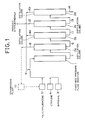
- Figure 1 is the flowsheet for Example 7 in which ethylbiphenyls are manufactured continuously in a flow reactor embodying the method of this invention.
- Biphenyl (BP), polyethylbenzenes (PEB), and a silica-alumina catalyst (0.46 mole per Kg of acid sites with heat of adsorption of ammonia of 8.5 kilojoules per mole or more) were introduced into a pressure reactor equipped with a stirred and allowed to react under the conditions shown in Table 1. After completion of the reaction, the reaction mixture was filtered to separate the silica-alumina catalyst from the reaction products. The composition by weight of the compounds containing biphenyl ring in the reaction products is shown in Table 2.
- the polyethylbenzenes used as feed were by-products in the manufacture of ethylbenzene.
- a fixed-bed pressure flow reactor was filled with Y zeolite (acid sites, 1.19 mole per Kg) and a mixture of biphenyl and diethylbenzenes at a mole ratio of 1:4 was fed at 250°C and a liquid hourly space velocity of 1l/l. hr.
- the effluents from the reactor accumulated over a period from the 24th to 32nd hour and those from 64th to 72 nd hour after the start of the reaction were analyzed and the results are shown in Table 3.
- fixed-bed pressure flow reactor 1 was filled with the silica-alumina catalyst, same as the one used in Example 1, and the product line thereafter was connected to distillation columns 2a, 2b, 2c, and 2d in series.
- the feeds, biphenyl 3, ethylene 4, and polyethylbenzene 5, were charged to reactor 1 together with recycle stream 6 which is a mixture of recycle stream 6a from the top of distillation column 2b and recycle stream 6b from the top of distillation column 2d.
- the reaction was carried out at 300°C and a weight hourly space velocity of 2 Kg/Kg ⁇ hr.
- the mole ratio of (ethyl groups + ethylene) to (biphenyl rings + benzene rings) was 1.16 in reactor 1.
- Reaction mixture 7 flowing through the reactor and emerging from the bottom thereof was charged to distillation column 2a, and top fraction 8 and bottom fraction 9 were taken out from the top and the bottom of distillation column 2a respectively.
- Top fraction 8 was sent to ethylbenzene plant 10 where it is a supply source of polyethylbenzene 5.
- Fraction 13 was then charged to distillation column 2d and recycle stream 6b was taken out from the top while residue 14 was taken out from the bottom.
- recycle stream 6b is withdrawn from the side of distillation column 2d and the triethylbiphenyl is taken out from the top.
Landscapes
- Chemical & Material Sciences (AREA)
- Organic Chemistry (AREA)
- Chemical Kinetics & Catalysis (AREA)
- Organic Low-Molecular-Weight Compounds And Preparation Thereof (AREA)
- Low-Molecular Organic Synthesis Reactions Using Catalysts (AREA)
- Catalysts (AREA)
Claims (8)
- Verfahren zur Herstellung von Ethylbiphenylen, das die Umsetzung von Biphenyl mit Polyethylbenzolen oder mit Ethylen und Polyethylbenzolen in Gegenwart eines festen sauren Katalysators umfaßt, wobei der feste saure Katalysator zumindest einer aus der Gruppe, bestehend aus Siliciumdioxid-Aluminiumoxid und Y-Zeolith, ist.
- Verfahren gemäß Anspruch 1, worin Biphenyl mit Ethylen und Polyethylbenzolen umgesetzt wird, wobei für jedes Mol Ethylgruppe in den Polyethylbenzolen zwei Mole oder weniger an Ethylen vorliegen.
- Verfahren gemäß Anspruch 1 oder 2, worin die Reaktionstemperatur 130 bis 380°C beträgt.
- Verfahren gemäß einem der vorhergehenden Ansprüche, worin die Polyethylbenzole in derartigen Mengen verwendet werden, daß 0,3 bis 4 Mol Ethylgruppen je Mol (Biphenylring + Benzolring) vorliegen.
- Verfahren gemäß einem der Ansprüche 1 bis 4, worin die Polyethylbenzole und Ethylen in derartigen Mengen vorliegen, daß 0,3 bis 4 Mole (Ethylgruppen + Ethylen) je Mol (Biphenylring + Benzolring) vorliegen.
- Verfahren gemäß einem der vorhergehenden Ansprüche, worin der feste saure Katalysator 0,1 bis 3,0 Mol saure Stellen besitzt, wobei diese sauren Stellen eine Adsorptionswärme von Ammoniak von 85 Kilojoules je Mol oder mehr aufweisen.
- Verfahren gemäß einem der vorhergehenden Ansprüche, das die kontinuierliche Zufuhr von Biphenyl und Polyethylbenzolen oder Biphenyl, Ethylen und Polyethylbenzolen zu einem Festbettströmungsreaktor, der mit einem festen sauren Katalysator bepackt ist, wobei der feste saure Katalysator zumindest einer aus der Gruppe, bestehend aus Siliciumdioxid-Aluminiumoxid und Y-Zeolith ist, die kontinuierliche Zufuhr der aus dem Reaktor abgezogenen Reaktionsmischung zu einer Destillationsapparatur, die Gewinnung einer hauptsächlich Ethylbiphenyle und Diethylbiphenyle oder zusätzlich Triethylbiphenyle als Produkte enthaltenden Fraktion und die Zufuhr einer hauptsächlich das gewonnene Biphenyl und die gewonnenen Diethylbenzole enthaltenden Fraktion und einer hauptsächlich Triethylbiphenyle und Tetraethylbiphenyle enthaltenden Fraktion oder einer hauptsächlich Tetraethylbiphenyle enthaltenden Fraktion zu dem Reaktor als Recyclisierungsrohmaterialien umfaßt.
- Verfahren gemäß Anspruch 7, worin die Destillationsapparatur aus mehreren in Reihe verbundenen Destillationskolonnen besteht.
Priority Applications (1)
| Application Number | Priority Date | Filing Date | Title |
|---|---|---|---|
| DE19883883529 DE3883529T2 (de) | 1988-06-24 | 1988-06-24 | Verfahren zur Herstellung von Äthylbiphenylen. |
Applications Claiming Priority (1)
| Application Number | Priority Date | Filing Date | Title |
|---|---|---|---|
| JP61307825A JPH0674222B2 (ja) | 1986-12-25 | 1986-12-25 | エチルビフエニル類の製造方法 |
Publications (2)
| Publication Number | Publication Date |
|---|---|
| EP0347500A1 EP0347500A1 (de) | 1989-12-27 |
| EP0347500B1 true EP0347500B1 (de) | 1993-08-25 |
Family
ID=17973660
Family Applications (1)
| Application Number | Title | Priority Date | Filing Date |
|---|---|---|---|
| EP88305770A Expired - Lifetime EP0347500B1 (de) | 1986-12-25 | 1988-06-24 | Verfahren zur Herstellung von Äthylbiphenylen |
Country Status (3)
| Country | Link |
|---|---|
| EP (1) | EP0347500B1 (de) |
| JP (1) | JPH0674222B2 (de) |
| KR (1) | KR920009789B1 (de) |
Families Citing this family (2)
| Publication number | Priority date | Publication date | Assignee | Title |
|---|---|---|---|---|
| JP2805091B2 (ja) * | 1989-08-31 | 1998-09-30 | 三井化学株式会社 | 4―メチルジフェニル及び4,4’―ジメチルジフェニルの製造方法 |
| KR102389129B1 (ko) * | 2019-12-16 | 2022-04-21 | 한국건설기술연구원 | 조류 바이오매스를 활용한 퇴비화 장치 |
Citations (1)
| Publication number | Priority date | Publication date | Assignee | Title |
|---|---|---|---|---|
| GB1350893A (en) * | 1970-06-30 | 1974-04-24 | Ici Ltd | Alkylation of aromatic compounds |
Family Cites Families (1)
| Publication number | Priority date | Publication date | Assignee | Title |
|---|---|---|---|---|
| DE3681493D1 (de) * | 1985-04-22 | 1991-10-24 | Ici Plc | Alkylierungsverfahren. |
-
1986
- 1986-12-25 JP JP61307825A patent/JPH0674222B2/ja not_active Expired - Lifetime
-
1988
- 1988-06-24 EP EP88305770A patent/EP0347500B1/de not_active Expired - Lifetime
- 1988-06-24 KR KR1019880007655A patent/KR920009789B1/ko not_active Expired
Patent Citations (1)
| Publication number | Priority date | Publication date | Assignee | Title |
|---|---|---|---|---|
| GB1350893A (en) * | 1970-06-30 | 1974-04-24 | Ici Ltd | Alkylation of aromatic compounds |
Also Published As
| Publication number | Publication date |
|---|---|
| JPH0674222B2 (ja) | 1994-09-21 |
| JPS63162632A (ja) | 1988-07-06 |
| KR920009789B1 (ko) | 1992-10-22 |
| KR900000316A (ko) | 1990-01-30 |
| EP0347500A1 (de) | 1989-12-27 |
Similar Documents
| Publication | Publication Date | Title |
|---|---|---|
| JPH10511942A (ja) | 液相アルキル化及び気相アルキル交換反応を用いてエチルベンゼンを製造する連続的方法 | |
| EP0413717B1 (de) | Verfahren zur alkylierung von benzol in einem bewegtbett | |
| JP2663302B2 (ja) | アルキルベンゼンの製造 | |
| AU745785B2 (en) | Process to alkylate an aromatic with a dilute stream comprising propylene and ethylene | |
| BR0209512B1 (pt) | processo integrado para a preparação de compostos aromáticos substituìdos com alquila e alquenila. | |
| EP0347500B1 (de) | Verfahren zur Herstellung von Äthylbiphenylen | |
| EP0873291B1 (de) | Verfahren zur herstellung von ethylbenzol oder von cumol | |
| US4943553A (en) | Method of making ethylbiphenyls | |
| EP0440637A1 (de) | Verfahren zur transalkylierung von polyalkylbenzolen | |
| US4431854A (en) | Continuous preparation of ethylbenzene in a heterogeneous-phase reaction | |
| KR950008881B1 (ko) | 촉매 슬러리의 존재하에서의 알킬기 전이반응 | |
| JPH1135498A (ja) | クメンの製造方法 | |
| US3200163A (en) | Alkylation-transalkylation process | |
| US2787648A (en) | Alkylation of aromatic hydrocarbons | |
| DE3883529T2 (de) | Verfahren zur Herstellung von Äthylbiphenylen. | |
| EP0405508A2 (de) | Verfahren zur Herstellung von Pyromellithsäureanhydrid | |
| JPH0639433B2 (ja) | イソプロピル化ナフタレン類の製造方法 | |
| EP0165215B1 (de) | Verfahren zur Herstellung von Benzol und Cumol | |
| JPH0639424B2 (ja) | テトラエチルベンゼンの製造方法 | |
| JPH0643349B2 (ja) | ジイソプロピルナフタレンの製造方法 | |
| JPH0784395B2 (ja) | エチルベンゼンの製造方法 | |
| JPH061728A (ja) | ジアルキルナフタレンの異性化法 | |
| JPH0639425B2 (ja) | テトラエチルベンゼンの製造方法 | |
| JPH06145077A (ja) | 2,6−ジエチルナフタレンの製造方法 | |
| CS261891B2 (cs) | Způsob využití tepla plynné fáze z hlavy druhé frakcionační kolony při získání alkylaromatického uhlovodíku z výtoku opouštějícího alkylační zónu pro alkylaci benzenu nebo toluenu |
Legal Events
| Date | Code | Title | Description |
|---|---|---|---|
| PUAI | Public reference made under article 153(3) epc to a published international application that has entered the european phase |
Free format text: ORIGINAL CODE: 0009012 |
|
| AK | Designated contracting states |
Kind code of ref document: A1 Designated state(s): BE DE FR GB NL |
|
| 17P | Request for examination filed |
Effective date: 19900414 |
|
| 17Q | First examination report despatched |
Effective date: 19911129 |
|
| GRAA | (expected) grant |
Free format text: ORIGINAL CODE: 0009210 |
|
| AK | Designated contracting states |
Kind code of ref document: B1 Designated state(s): BE DE FR GB NL |
|
| PG25 | Lapsed in a contracting state [announced via postgrant information from national office to epo] |
Ref country code: NL Effective date: 19930825 Ref country code: FR Effective date: 19930825 Ref country code: BE Effective date: 19930825 |
|
| REF | Corresponds to: |
Ref document number: 3883529 Country of ref document: DE Date of ref document: 19930930 |
|
| EN | Fr: translation not filed | ||
| NLV1 | Nl: lapsed or annulled due to failure to fulfill the requirements of art. 29p and 29m of the patents act | ||
| PLBE | No opposition filed within time limit |
Free format text: ORIGINAL CODE: 0009261 |
|
| STAA | Information on the status of an ep patent application or granted ep patent |
Free format text: STATUS: NO OPPOSITION FILED WITHIN TIME LIMIT |
|
| 26N | No opposition filed | ||
| PGFP | Annual fee paid to national office [announced via postgrant information from national office to epo] |
Ref country code: GB Payment date: 19970616 Year of fee payment: 10 |
|
| PGFP | Annual fee paid to national office [announced via postgrant information from national office to epo] |
Ref country code: DE Payment date: 19970630 Year of fee payment: 10 |
|
| PG25 | Lapsed in a contracting state [announced via postgrant information from national office to epo] |
Ref country code: GB Free format text: LAPSE BECAUSE OF NON-PAYMENT OF DUE FEES Effective date: 19980624 |
|
| GBPC | Gb: european patent ceased through non-payment of renewal fee |
Effective date: 19980624 |
|
| PG25 | Lapsed in a contracting state [announced via postgrant information from national office to epo] |
Ref country code: DE Free format text: LAPSE BECAUSE OF NON-PAYMENT OF DUE FEES Effective date: 19990401 |