EP0350159A1 - Verfahren zum Betrieb eines Ionenfallenmassenspektrometers - Google Patents
Verfahren zum Betrieb eines Ionenfallenmassenspektrometers Download PDFInfo
- Publication number
- EP0350159A1 EP0350159A1 EP19890305618 EP89305618A EP0350159A1 EP 0350159 A1 EP0350159 A1 EP 0350159A1 EP 19890305618 EP19890305618 EP 19890305618 EP 89305618 A EP89305618 A EP 89305618A EP 0350159 A1 EP0350159 A1 EP 0350159A1
- Authority
- EP
- European Patent Office
- Prior art keywords
- voltage
- ions
- mass
- supplementary
- ion trap
- Prior art date
- Legal status (The legal status is an assumption and is not a legal conclusion. Google has not performed a legal analysis and makes no representation as to the accuracy of the status listed.)
- Withdrawn
Links
- 238000005040 ion trap Methods 0.000 title claims abstract description 25
- 238000000034 method Methods 0.000 title claims abstract description 20
- 150000002500 ions Chemical class 0.000 claims abstract description 57
- 238000001819 mass spectrum Methods 0.000 description 6
- 230000007935 neutral effect Effects 0.000 description 5
- 238000010894 electron beam technology Methods 0.000 description 4
- 230000033001 locomotion Effects 0.000 description 4
- 230000000153 supplemental effect Effects 0.000 description 4
- 238000004458 analytical method Methods 0.000 description 3
- 239000003153 chemical reaction reagent Substances 0.000 description 3
- 238000010586 diagram Methods 0.000 description 3
- 239000007789 gas Substances 0.000 description 3
- 230000035945 sensitivity Effects 0.000 description 3
- XKRFYHLGVUSROY-UHFFFAOYSA-N Argon Chemical compound [Ar] XKRFYHLGVUSROY-UHFFFAOYSA-N 0.000 description 2
- 238000013467 fragmentation Methods 0.000 description 2
- 238000006062 fragmentation reaction Methods 0.000 description 2
- CKAPSXZOOQJIBF-UHFFFAOYSA-N hexachlorobenzene Chemical compound ClC1=C(Cl)C(Cl)=C(Cl)C(Cl)=C1Cl CKAPSXZOOQJIBF-UHFFFAOYSA-N 0.000 description 2
- 238000001228 spectrum Methods 0.000 description 2
- 229910052786 argon Inorganic materials 0.000 description 1
- 238000006243 chemical reaction Methods 0.000 description 1
- 150000001875 compounds Chemical class 0.000 description 1
- 238000001514 detection method Methods 0.000 description 1
- 238000010494 dissociation reaction Methods 0.000 description 1
- 230000005593 dissociations Effects 0.000 description 1
- 230000000694 effects Effects 0.000 description 1
- 230000005686 electrostatic field Effects 0.000 description 1
- 230000005284 excitation Effects 0.000 description 1
- 238000002474 experimental method Methods 0.000 description 1
- 239000012634 fragment Substances 0.000 description 1
- 238000002290 gas chromatography-mass spectrometry Methods 0.000 description 1
- 239000001307 helium Substances 0.000 description 1
- 229910052734 helium Inorganic materials 0.000 description 1
- SWQJXJOGLNCZEY-UHFFFAOYSA-N helium atom Chemical compound [He] SWQJXJOGLNCZEY-UHFFFAOYSA-N 0.000 description 1
- 230000010355 oscillation Effects 0.000 description 1
- 230000000717 retained effect Effects 0.000 description 1
- 238000004885 tandem mass spectrometry Methods 0.000 description 1
- 229910052724 xenon Inorganic materials 0.000 description 1
- FHNFHKCVQCLJFQ-UHFFFAOYSA-N xenon atom Chemical compound [Xe] FHNFHKCVQCLJFQ-UHFFFAOYSA-N 0.000 description 1
Images


Classifications
-
- H—ELECTRICITY
- H01—ELECTRIC ELEMENTS
- H01J—ELECTRIC DISCHARGE TUBES OR DISCHARGE LAMPS
- H01J49/00—Particle spectrometers or separator tubes
- H01J49/26—Mass spectrometers or separator tubes
- H01J49/34—Dynamic spectrometers
- H01J49/42—Stability-of-path spectrometers, e.g. monopole, quadrupole, multipole, farvitrons
- H01J49/4205—Device types
- H01J49/424—Three-dimensional ion traps, i.e. comprising end-cap and ring electrodes
-
- H—ELECTRICITY
- H01—ELECTRIC ELEMENTS
- H01J—ELECTRIC DISCHARGE TUBES OR DISCHARGE LAMPS
- H01J49/00—Particle spectrometers or separator tubes
- H01J49/26—Mass spectrometers or separator tubes
- H01J49/34—Dynamic spectrometers
- H01J49/42—Stability-of-path spectrometers, e.g. monopole, quadrupole, multipole, farvitrons
- H01J49/426—Methods for controlling ions
- H01J49/427—Ejection and selection methods
- H01J49/4275—Applying a non-resonant auxiliary oscillating voltage, e.g. parametric excitation
-
- H—ELECTRICITY
- H01—ELECTRIC ELEMENTS
- H01J—ELECTRIC DISCHARGE TUBES OR DISCHARGE LAMPS
- H01J49/00—Particle spectrometers or separator tubes
- H01J49/26—Mass spectrometers or separator tubes
- H01J49/34—Dynamic spectrometers
- H01J49/42—Stability-of-path spectrometers, e.g. monopole, quadrupole, multipole, farvitrons
- H01J49/426—Methods for controlling ions
- H01J49/427—Ejection and selection methods
- H01J49/429—Scanning an electric parameter, e.g. voltage amplitude or frequency
Definitions
- This invention relates to a method of operating an ion trap mass spectrometer.
- Ion trap mass spectrometers or quadrupole ion stores have been known for many years and described by a number of authors. They are devices in which ions are formed and contained within a physical structure by means of hyperbolic electrostatic RF and/or DC fields. In general, RF and/or DC voltages are applied to hyperbolic or spheric electrode structures which define the trapping volume into which the trapping fields extend.
- the structure generally comprises a ring electrode with spaced end caps.
- Mass storage is generally achieved by operating the trap electrodes with values of RF voltage V and its frequency f, DC voltage U and device size r0 such that ions having their mass-to-charge ratios (M/Z) within a finite range are stably trapped within the electrostatic fields.
- the aforementioned parameters are sometimes referred to as the scanning parameters and have a fixed relationship to the mass-to-charge ratios of the charged ions.
- the characteristic frequencies can be determined by a tuned circuit which couples to the oscillating motions of the ions within the trap. Such a method has been difficult to implement and yields poor resolution and limited mass range.
- US-A-4540884 there is described a method of operating an ion trap in the mass selective instability mode.
- the mass selection is achieved by simultaneously trapping ions within a mass range of interest and then scanning the applied RF and/or DC voltages or the frequency of the RF voltage to sequentially render unstable trapped ions of consecutive specific masses.
- the unstable ions flow out through apertures in an end cap to a high gain electron multiplier to provide signals indicative of the ion mass.
- a method of operating an ion trap mass spectrometer to render ions within a predetermined range of mass-to-charge ratios trapped in a three-dimensional trapping field generated by a fundamental RF voltage sequentially unstable comprising the steps of varying the fundamental RF voltage to eject ions of sequential mass-to-charge ratios; and simultaneously applying a supplementary AC voltage at a lower frequency to generate a supplementary field whereby the ions of sequential mass-to-charge ratios are more effectively ejected.
- the suplemental voltage is set at a frequency lower, for example about half, the frequency of the RF voltage, the sensitivity and resolution of the ion trap mass spectrometer can be significantly improved when the ion trap is operated in the mass-selective instability mode.
- the invention provides a method of operating an ion trap mass spectrometer, which permits the storage of a large number of ions to improved sensitivity while providing the good resolution.
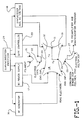
- a three-dimensional ion trap mass spectrometer is schematically illustrated in Figure 1.
- the ion trap includes a ring electrode 11 and two spaced end caps 12 and 13 facing each other.
- the ring electrode and end caps define a trapping volume 14 having a radius r0 and a vertical dimension z0.
- An RF voltage generator 16 is connected to the ring electrode 11 to supply a radio frequency voltage v sin t (the fundamental voltage) between the end caps and the ring electrode which provides the quadrupole filed for trapping ions within the ion storage volume 14.
- a DC voltage U from power supply 17 may also be applied to the trap electrodes.
- a supplementary AC voltage generator 18 is coupled to the end caps 12 and 13 to supply a voltage v2 sin t.
- Means are provided for projecting an ionizing electron beam into the ion volume 16.
- the electron source comprises a filament 21 fed by a filament power supply, not shown, and a cylindrical electron gate electrode 22 having a control voltage applied by gate controller 23 to turn the electron beam on and off as desired for ionizing sample within the trapping volume.
- the end cap 12 includes an axial aperture 24 through which the electron beam projects.
- the opposite end cap 13 is perforated 26 to allow unstable ions in the fields of the ion trap to exit and be detected by the electron multiplier 27.
- Conversion dynode 28 is disposed to receive the ejected ions and operates as described in US-A-4423324.
- the output signal is amplified and applied to processor 29 which not only serves to process the signal and provide a mass spectrum, but also controls operation of the RF, DC and supplemental voltage power supplies and the gate controller to perform an analysis.
- EI and CI scans are shown in Figure 2A-2B.
- the EI scan is shown by a solid line while the CI scan is shown by the dotted line.
- the fundamental RF voltage and DC voltage applied to the ring electrode is selected to store only sample ions of a mass range of interest, A.
- the sample is introduced in the trapping volume and electron gate voltage is applied to permit the electron beam to enter the volume and ionize the sample.
- the RF voltage is then ramped to the point B to select the mass range of interest and then the voltage is increased, C, to scan.
- the scan spectrum is shown in Figure 2C.
- the voltages are fixed for the period A′ during which the reagent is ionized with reagent ions.
- the voltage is increased, B′, and the reagent ions then react with neutral sample molecules and form sample ions.
- the voltage is increased, C′, to select the low mass for start of the scan.
- the voltage is ramped, D′, to provide the scan spectrum shown in Figure D.
- ions are formed in the trap volume 16 while maintaining DC and RF voltages so as to store the selected mass range.
- the trapping voltages are then reduced in such a way that only stable ions of interest are retained at which time a dissociation step is carried on in which the ions of interest are caused to collide with a gas or surface so as to fragment. Since the ions to be fragmented may or may not have sufficient energy to undergo fragmentation by collision with the gas or surface, it may be necessary to pump energy into the ions of interest to cause them to collide with energetic or excited neutral species so the system will contain enough energy to cause fragmentation of the ions of interest. The fragmented ions are then swept from the trap by varying the RF voltage and a scan of the mass spectra is obtained.
- Excited neutrals of Argon of Xenon may be introduced from a gun, pulsed at a proper time.
- a discharge source may be used.
- a laser pulse may be used to pump energy into the system either through ions or through the neutral species.
- the scanning step in which the ions become sequentially unstable, leave the trap volume and are detected, is accompanied by the application of a supplemental AC voltage to generate fields in the axial direction.
- the supplemental voltage is applied to both of the end caps or to one of the end caps while the other end cap is grounded.
- the supplemental AC voltage is preferably selected to have a frequency which is approximately one-half the frequency of the fundamental RF voltage and which causes the trapped ions near the instability boundary to oscillate in the axial direction. This oscillation is the characteristic frequency of ion motion in the z or axial direction and close to the point where the ions become unstable during the mass scan.
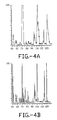
- Figure 4A shows part of the mass spectrum for FC 43, a calibration compound with prominent peaks at m/z 69 and m/z 100. Other mass peaks originate from background in a mass spectrometer. Filament emission current for the experiment was set at 30 microamps and the ionization time was 1.5 msec. A helium buffer gas was present at a pressure of approximately 1 x 10 ⁇ 3 torr. The lack of resolution and peak broadening indicates that the ejection of some ions at a given m/z is extended. That is, some ions are ejected too late and are not resolved from ions of subsequent m/z value.
- Figure 4B shows the mass spectrum acquired with the exitation voltage turned on during the mass scan at a fixed frequency of 530 KHz and a fixed amplitude of 5 volts. It is noted that the resolution is much improved and that the resolution improvement is observed over the entire mass range of the ion trap.
- the data shown in Figure 4B was for the exitation voltage being applied only during the analysis scan. Similar results were obtained with the exitation voltage continuously applied.
- the new scanning mode has been characterised across a wide range of frequencies and amplitudes. Amplitudes were between 1 and 10 volts, frequency between 300 KHz and 600 KHZ.
- 5A shows the mass spectrum of m/z 284, a characteristic ion, from a GC/MS run of a 10 pg hexachlorobenzene sample in the prior mode of ion trap operation.
- Figure 5B is the mass spectrum of same sample using the new mode of operation.
Landscapes
- Chemical & Material Sciences (AREA)
- Analytical Chemistry (AREA)
- Electron Tubes For Measurement (AREA)
- Other Investigation Or Analysis Of Materials By Electrical Means (AREA)
Applications Claiming Priority (2)
| Application Number | Priority Date | Filing Date | Title |
|---|---|---|---|
| US20278488A | 1988-06-03 | 1988-06-03 | |
| US202784 | 1988-06-03 |
Publications (1)
| Publication Number | Publication Date |
|---|---|
| EP0350159A1 true EP0350159A1 (de) | 1990-01-10 |
Family
ID=22751247
Family Applications (1)
| Application Number | Title | Priority Date | Filing Date |
|---|---|---|---|
| EP19890305618 Withdrawn EP0350159A1 (de) | 1988-06-03 | 1989-06-05 | Verfahren zum Betrieb eines Ionenfallenmassenspektrometers |
Country Status (2)
| Country | Link |
|---|---|
| EP (1) | EP0350159A1 (de) |
| JP (1) | JPH02103856A (de) |
Cited By (12)
| Publication number | Priority date | Publication date | Assignee | Title |
|---|---|---|---|---|
| EP0512700A1 (de) * | 1991-04-30 | 1992-11-11 | Finnigan Corporation | Verfahren zum Betrieb eines Ionenfalle-Massenspektrometers im hochauflösenden Modus |
| DE4142869C1 (de) * | 1991-12-23 | 1993-05-19 | Bruker - Franzen Analytik Gmbh, 2800 Bremen, De | |
| DE4142871C1 (de) * | 1991-12-23 | 1993-05-19 | Bruker - Franzen Analytik Gmbh, 2800 Bremen, De | |
| DE4142870A1 (de) * | 1991-12-23 | 1993-06-24 | Bruker Franzen Analytik Gmbh | Verfahren und vorrichtung fuer phasenrichtiges messen der ionen aus ionenfallen-massenspektrometern |
| GB2267385A (en) * | 1992-05-29 | 1993-12-01 | Finnigan Corp | Ion trap mass spectrometer method |
| US5381007A (en) * | 1991-02-28 | 1995-01-10 | Teledyne Mec A Division Of Teledyne Industries, Inc. | Mass spectrometry method with two applied trapping fields having same spatial form |
| US5436445A (en) * | 1991-02-28 | 1995-07-25 | Teledyne Electronic Technologies | Mass spectrometry method with two applied trapping fields having same spatial form |
| US5451782A (en) * | 1991-02-28 | 1995-09-19 | Teledyne Et | Mass spectometry method with applied signal having off-resonance frequency |
| US6121610A (en) * | 1997-10-09 | 2000-09-19 | Hitachi, Ltd. | Ion trap mass spectrometer |
| GB2423631A (en) * | 2005-02-07 | 2006-08-30 | Bruker Daltonic Gmbh | Ion fragmentation by reaction with excited neutral particles |
| RU2372686C2 (ru) * | 2004-05-26 | 2009-11-10 | Вэриэн, Инк. | Линейная ионная ловушка и способ управления движением иона с использованием асимметричного удерживающего поля |
| US9202660B2 (en) | 2013-03-13 | 2015-12-01 | Teledyne Wireless, Llc | Asymmetrical slow wave structures to eliminate backward wave oscillations in wideband traveling wave tubes |
Families Citing this family (1)
| Publication number | Priority date | Publication date | Assignee | Title |
|---|---|---|---|---|
| US5623144A (en) * | 1995-02-14 | 1997-04-22 | Hitachi, Ltd. | Mass spectrometer ring-shaped electrode having high ion selection efficiency and mass spectrometry method thereby |
Citations (5)
| Publication number | Priority date | Publication date | Assignee | Title |
|---|---|---|---|---|
| US2950389A (en) * | 1957-12-27 | 1960-08-23 | Siemens Ag | Method of separating ions of different specific charges |
| EP0113207A2 (de) * | 1982-12-29 | 1984-07-11 | Finnigan Corporation | Verfahren zur Bestimmung der Masse einer Probe durch eine Quadrupol-Ionentrappe |
| EP0202943A2 (de) * | 1985-05-24 | 1986-11-26 | Finnigan Corporation | Steuerungsverfahren für eine Ionenfalle |
| EP0262928A2 (de) * | 1986-10-01 | 1988-04-06 | Finnigan Corporation | Quadrupol-Massenspektrometer und Verfahren zum Betrieb desselben |
| US4749860A (en) * | 1986-06-05 | 1988-06-07 | Finnigan Corporation | Method of isolating a single mass in a quadrupole ion trap |
-
1989
- 1989-06-02 JP JP1140952A patent/JPH02103856A/ja active Pending
- 1989-06-05 EP EP19890305618 patent/EP0350159A1/de not_active Withdrawn
Patent Citations (5)
| Publication number | Priority date | Publication date | Assignee | Title |
|---|---|---|---|---|
| US2950389A (en) * | 1957-12-27 | 1960-08-23 | Siemens Ag | Method of separating ions of different specific charges |
| EP0113207A2 (de) * | 1982-12-29 | 1984-07-11 | Finnigan Corporation | Verfahren zur Bestimmung der Masse einer Probe durch eine Quadrupol-Ionentrappe |
| EP0202943A2 (de) * | 1985-05-24 | 1986-11-26 | Finnigan Corporation | Steuerungsverfahren für eine Ionenfalle |
| US4749860A (en) * | 1986-06-05 | 1988-06-07 | Finnigan Corporation | Method of isolating a single mass in a quadrupole ion trap |
| EP0262928A2 (de) * | 1986-10-01 | 1988-04-06 | Finnigan Corporation | Quadrupol-Massenspektrometer und Verfahren zum Betrieb desselben |
Non-Patent Citations (1)
| Title |
|---|
| International Journal of Mass Spectrometry and Ion Processes, Vol. 60, No. 1, September 1984, pages 85-98, Elsevier, Amsterdam, NL, G.C. STAFFORD et al.: "Recent improvements in and analytical applications of advanced ion trap technology", page 85, lines 13-21; page 90, "Mass analysis by mass selective instability"; figure 1; page 92, lines 36-38. * |
Cited By (23)
| Publication number | Priority date | Publication date | Assignee | Title |
|---|---|---|---|---|
| US5679951A (en) * | 1991-02-28 | 1997-10-21 | Teledyne Electronic Technologies | Mass spectrometry method with two applied trapping fields having same spatial form |
| US5864136A (en) * | 1991-02-28 | 1999-01-26 | Teledyne Electronic Technologies | Mass spectrometry method with two applied trapping fields having the same spatial form |
| US5436445A (en) * | 1991-02-28 | 1995-07-25 | Teledyne Electronic Technologies | Mass spectrometry method with two applied trapping fields having same spatial form |
| US5561291A (en) * | 1991-02-28 | 1996-10-01 | Teledyne Electronic Technologies | Mass spectrometry method with two applied quadrupole fields |
| US5381007A (en) * | 1991-02-28 | 1995-01-10 | Teledyne Mec A Division Of Teledyne Industries, Inc. | Mass spectrometry method with two applied trapping fields having same spatial form |
| US5451782A (en) * | 1991-02-28 | 1995-09-19 | Teledyne Et | Mass spectometry method with applied signal having off-resonance frequency |
| EP0512700A1 (de) * | 1991-04-30 | 1992-11-11 | Finnigan Corporation | Verfahren zum Betrieb eines Ionenfalle-Massenspektrometers im hochauflösenden Modus |
| DE4142869C1 (de) * | 1991-12-23 | 1993-05-19 | Bruker - Franzen Analytik Gmbh, 2800 Bremen, De | |
| DE4142871C1 (de) * | 1991-12-23 | 1993-05-19 | Bruker - Franzen Analytik Gmbh, 2800 Bremen, De | |
| GB2263193B (en) * | 1991-12-23 | 1995-05-03 | Bruker Franzen Analytik Gmbh | Method and device for obtaining mass spectra |
| GB2263193A (en) * | 1991-12-23 | 1993-07-14 | Bruker Franzen Analytik Gmbh | Ion trap mass spectrometers |
| GB2263191A (en) * | 1991-12-23 | 1993-07-14 | Bruker Franzen Analytik Gmbh | Ion trap mass spectrometers |
| DE4142870A1 (de) * | 1991-12-23 | 1993-06-24 | Bruker Franzen Analytik Gmbh | Verfahren und vorrichtung fuer phasenrichtiges messen der ionen aus ionenfallen-massenspektrometern |
| GB2263191B (en) * | 1991-12-23 | 1995-08-30 | Bruker Franzen Analytik Gmbh | Method and device for recording mass spectra |
| GB2267385A (en) * | 1992-05-29 | 1993-12-01 | Finnigan Corp | Ion trap mass spectrometer method |
| FR2691835A1 (fr) * | 1992-05-29 | 1993-12-03 | Finnigan Corp | Procédé d'utilisation d'un spectromètre de masse à piège à ions. |
| GB2267385B (en) * | 1992-05-29 | 1995-12-13 | Finnigan Corp | Method of detecting the ions in an ion trap mass spectrometer |
| US6121610A (en) * | 1997-10-09 | 2000-09-19 | Hitachi, Ltd. | Ion trap mass spectrometer |
| RU2372686C2 (ru) * | 2004-05-26 | 2009-11-10 | Вэриэн, Инк. | Линейная ионная ловушка и способ управления движением иона с использованием асимметричного удерживающего поля |
| GB2423631A (en) * | 2005-02-07 | 2006-08-30 | Bruker Daltonic Gmbh | Ion fragmentation by reaction with excited neutral particles |
| US7476853B2 (en) | 2005-02-07 | 2009-01-13 | Bruker Daltonik Gmbh | Ion fragmentation by reaction with neutral particles |
| GB2423631B (en) * | 2005-02-07 | 2009-07-01 | Bruker Daltonik Gmbh | Ion fragmentation by reaction with neutral particles |
| US9202660B2 (en) | 2013-03-13 | 2015-12-01 | Teledyne Wireless, Llc | Asymmetrical slow wave structures to eliminate backward wave oscillations in wideband traveling wave tubes |
Also Published As
| Publication number | Publication date |
|---|---|
| JPH02103856A (ja) | 1990-04-16 |
Similar Documents
| Publication | Publication Date | Title |
|---|---|---|
| US4736101A (en) | Method of operating ion trap detector in MS/MS mode | |
| US5679951A (en) | Mass spectrometry method with two applied trapping fields having same spatial form | |
| JP3064422B2 (ja) | 同一の空間形状を持つ2つの捕捉場を用いる質量分析方法 | |
| US5075547A (en) | Quadrupole ion trap mass spectrometer having two pulsed axial excitation input frequencies and method of parent and neutral loss scanning and selected reaction monitoring | |
| US5466931A (en) | Mass spectrometry method using notch filter | |
| EP0529885B1 (de) | Multipol-Einlassvorrichtung für Ionenfalle | |
| EP0215615B1 (de) | Betriebsverfahren einer Quadrupolionenfalle | |
| US5128542A (en) | Method of operating an ion trap mass spectrometer to determine the resonant frequency of trapped ions | |
| US5381006A (en) | Methods of using ion trap mass spectrometers | |
| JPH095298A (ja) | 四重極イオントラップ内の選択イオン種を検出する方法 | |
| US5196699A (en) | Chemical ionization mass spectrometry method using notch filter | |
| US5610397A (en) | Mass spectrometry method using supplemental AC voltage signals | |
| US5206507A (en) | Mass spectrometry method using filtered noise signal | |
| JPH02103856A (ja) | イオントラップ型質量分析計の操作方法 | |
| US20020162958A1 (en) | Ion trap mass spectrometer and spectrometry | |
| EP0575777A2 (de) | Verfahren zur Verwendung eines Massenspektrometers | |
| EP0852390B1 (de) | Verfahren zum Betreiben eines Ionenfallen-Massenspektrometers |
Legal Events
| Date | Code | Title | Description |
|---|---|---|---|
| PUAI | Public reference made under article 153(3) epc to a published international application that has entered the european phase |
Free format text: ORIGINAL CODE: 0009012 |
|
| AK | Designated contracting states |
Kind code of ref document: A1 Designated state(s): CH DE FR GB IT LI NL SE |
|
| 17P | Request for examination filed |
Effective date: 19900130 |
|
| 17Q | First examination report despatched |
Effective date: 19920820 |
|
| STAA | Information on the status of an ep patent application or granted ep patent |
Free format text: STATUS: THE APPLICATION IS DEEMED TO BE WITHDRAWN |
|
| 18D | Application deemed to be withdrawn |
Effective date: 19930302 |