EP0512700A1 - Verfahren zum Betrieb eines Ionenfalle-Massenspektrometers im hochauflösenden Modus - Google Patents
Verfahren zum Betrieb eines Ionenfalle-Massenspektrometers im hochauflösenden Modus Download PDFInfo
- Publication number
- EP0512700A1 EP0512700A1 EP92303394A EP92303394A EP0512700A1 EP 0512700 A1 EP0512700 A1 EP 0512700A1 EP 92303394 A EP92303394 A EP 92303394A EP 92303394 A EP92303394 A EP 92303394A EP 0512700 A1 EP0512700 A1 EP 0512700A1
- Authority
- EP
- European Patent Office
- Prior art keywords
- mass
- ions
- field
- supplementary
- trap
- Prior art date
- Legal status (The legal status is an assumption and is not a legal conclusion. Google has not performed a legal analysis and makes no representation as to the accuracy of the status listed.)
- Granted
Links
- 238000005040 ion trap Methods 0.000 title claims abstract description 44
- 238000000034 method Methods 0.000 title claims abstract description 37
- 150000002500 ions Chemical class 0.000 claims abstract description 115
- 238000001514 detection method Methods 0.000 claims description 6
- 238000001228 spectrum Methods 0.000 description 16
- 238000001819 mass spectrum Methods 0.000 description 14
- 229910052724 xenon Inorganic materials 0.000 description 10
- FHNFHKCVQCLJFQ-UHFFFAOYSA-N xenon atom Chemical compound [Xe] FHNFHKCVQCLJFQ-UHFFFAOYSA-N 0.000 description 10
- 238000004458 analytical method Methods 0.000 description 8
- 230000003247 decreasing effect Effects 0.000 description 8
- 238000004949 mass spectrometry Methods 0.000 description 6
- 238000000926 separation method Methods 0.000 description 6
- 238000010586 diagram Methods 0.000 description 5
- 238000010894 electron beam technology Methods 0.000 description 5
- RVZRBWKZFJCCIB-UHFFFAOYSA-N perfluorotributylamine Chemical compound FC(F)(F)C(F)(F)C(F)(F)C(F)(F)N(C(F)(F)C(F)(F)C(F)(F)C(F)(F)F)C(F)(F)C(F)(F)C(F)(F)C(F)(F)F RVZRBWKZFJCCIB-UHFFFAOYSA-N 0.000 description 5
- 238000003795 desorption Methods 0.000 description 4
- 230000008859 change Effects 0.000 description 3
- 230000008878 coupling Effects 0.000 description 3
- 238000010168 coupling process Methods 0.000 description 3
- 238000005859 coupling reaction Methods 0.000 description 3
- 230000007423 decrease Effects 0.000 description 3
- 238000000132 electrospray ionisation Methods 0.000 description 3
- 238000002474 experimental method Methods 0.000 description 3
- 230000003993 interaction Effects 0.000 description 3
- 108090000765 processed proteins & peptides Proteins 0.000 description 3
- 238000004885 tandem mass spectrometry Methods 0.000 description 3
- IJGRMHOSHXDMSA-UHFFFAOYSA-N Atomic nitrogen Chemical compound N#N IJGRMHOSHXDMSA-UHFFFAOYSA-N 0.000 description 2
- 101500024733 Equus caballus Angiotensin-1 Proteins 0.000 description 2
- 238000004252 FT/ICR mass spectrometry Methods 0.000 description 2
- 230000001133 acceleration Effects 0.000 description 2
- 150000001413 amino acids Chemical class 0.000 description 2
- 238000013459 approach Methods 0.000 description 2
- 230000008901 benefit Effects 0.000 description 2
- NCMHKCKGHRPLCM-UHFFFAOYSA-N caesium(1+) Chemical compound [Cs+] NCMHKCKGHRPLCM-UHFFFAOYSA-N 0.000 description 2
- 238000000451 chemical ionisation Methods 0.000 description 2
- 238000011161 development Methods 0.000 description 2
- 239000012634 fragment Substances 0.000 description 2
- 238000013467 fragmentation Methods 0.000 description 2
- 238000006062 fragmentation reaction Methods 0.000 description 2
- 239000007789 gas Substances 0.000 description 2
- 239000001307 helium Substances 0.000 description 2
- 229910052734 helium Inorganic materials 0.000 description 2
- SWQJXJOGLNCZEY-UHFFFAOYSA-N helium atom Chemical compound [He] SWQJXJOGLNCZEY-UHFFFAOYSA-N 0.000 description 2
- 239000002245 particle Substances 0.000 description 2
- 230000009467 reduction Effects 0.000 description 2
- 230000035945 sensitivity Effects 0.000 description 2
- 241000894007 species Species 0.000 description 2
- 239000000126 substance Substances 0.000 description 2
- 241000871495 Heeria argentea Species 0.000 description 1
- 230000002547 anomalous effect Effects 0.000 description 1
- 230000002238 attenuated effect Effects 0.000 description 1
- 230000006399 behavior Effects 0.000 description 1
- 150000001875 compounds Chemical class 0.000 description 1
- 230000001419 dependent effect Effects 0.000 description 1
- 238000010494 dissociation reaction Methods 0.000 description 1
- 230000005593 dissociations Effects 0.000 description 1
- 230000005684 electric field Effects 0.000 description 1
- 238000000119 electrospray ionisation mass spectrum Methods 0.000 description 1
- 230000005686 electrostatic field Effects 0.000 description 1
- 230000005284 excitation Effects 0.000 description 1
- 230000002349 favourable effect Effects 0.000 description 1
- 238000004896 high resolution mass spectrometry Methods 0.000 description 1
- 230000006872 improvement Effects 0.000 description 1
- 238000010884 ion-beam technique Methods 0.000 description 1
- 238000000752 ionisation method Methods 0.000 description 1
- 238000002955 isolation Methods 0.000 description 1
- 238000005372 isotope separation Methods 0.000 description 1
- 238000004811 liquid chromatography Methods 0.000 description 1
- 230000007246 mechanism Effects 0.000 description 1
- 229910052757 nitrogen Inorganic materials 0.000 description 1
- 230000010355 oscillation Effects 0.000 description 1
- 238000000734 protein sequencing Methods 0.000 description 1
- 108090000623 proteins and genes Proteins 0.000 description 1
- 102000004169 proteins and genes Human genes 0.000 description 1
- 230000000717 retained effect Effects 0.000 description 1
Images








Classifications
-
- H—ELECTRICITY
- H01—ELECTRIC ELEMENTS
- H01J—ELECTRIC DISCHARGE TUBES OR DISCHARGE LAMPS
- H01J49/00—Particle spectrometers or separator tubes
- H01J49/26—Mass spectrometers or separator tubes
- H01J49/34—Dynamic spectrometers
- H01J49/42—Stability-of-path spectrometers, e.g. monopole, quadrupole, multipole, farvitrons
- H01J49/4205—Device types
- H01J49/424—Three-dimensional ion traps, i.e. comprising end-cap and ring electrodes
-
- H—ELECTRICITY
- H01—ELECTRIC ELEMENTS
- H01J—ELECTRIC DISCHARGE TUBES OR DISCHARGE LAMPS
- H01J49/00—Particle spectrometers or separator tubes
- H01J49/26—Mass spectrometers or separator tubes
- H01J49/34—Dynamic spectrometers
- H01J49/42—Stability-of-path spectrometers, e.g. monopole, quadrupole, multipole, farvitrons
- H01J49/426—Methods for controlling ions
- H01J49/427—Ejection and selection methods
- H01J49/429—Scanning an electric parameter, e.g. voltage amplitude or frequency
Definitions
- This invention relates to a method of operating an ion trap mass spectrometer in a wide mass range high resolution mode.
- Ion trap mass spectrometers or quadrupole ion stores
- quadrupole ion stores have been known for many years and described by several authors. They are devices in which ions are formed and contained within a physical structure by means of electrostatic fields such as r.f., DC and a combination thereof.
- electrostatic fields such as r.f., DC and a combination thereof.
- a quadrupole electric field provides an ion storage region by the use of a hyperbolic electrode structure or a spherical electrode structure which provides an equivalent quadrupole trapping field.
- the storage of ions in an ion trap is achieved by operating trap electrodes with values of r.f. voltage V and associated frequency f, DC voltage U, and device size r0 and z0 such that ions having mass-to-charge ratios within a finite range are stably trapped inside the device.
- the aforementioned parameters are sometimes referred to as trapping parameters and from these one can determine the range of mass-to-charge ratios that will permit stable trajectories and the trapping of ions.
- the component of ion motion along the axis of the trap may be described as an oscillation containing innumerable frequency components, the first component (or secular frequency) being the most important and of the lowest frequency, and each higher frequency component contributing less than its predecessor.
- trapped ions of a particular mass-to-charge ratio will oscillate with a distinct secular frequency that can be determined from the trapping parameters by calculation.
- these secular frequencies were determined by a frequency-tuned circuit which coupled to the oscillating motion of the ions within the trap and allowed the determination of the mass-to-charge ratio of the trapped ions (from the known relationship between the trapping parameters, the frequency, and the m/z) and also the relative ion abundances (from the intensity of the signal).
- the mass-selective instability mode of operation was very successful, a newer method of operation, the "mass-selective instability mode with resonance ejection" (described in U.S. Patent No. 4,736,101) proved to have certain advantages such as the ability to record mass spectra containing a greater range in abundances of the trapped ions.
- a supplementary field is applied across the end cap electrodes and the magnitude of the r.f. field is scanned to bring ions of successively increasing m/z into resonance with the supplementary field whereby they are ejected and detected to provide a mass spectrum.
- Commercially-produced ion trap mass spectrometers based on this mode of operation have recently become available, and these instruments have been successfully applied to an even wider variety of problems in chemical analysis than their predecessors.
- ion trap mass spectrometer as compared to other types of instruments, such as sector (including three-and four-sector) instruments or Fourier transform-ion cyclotron resonance instruments, is the constraint of always operating at a relatively low resolution.
- One embodiment of the present invention provides a method of mass analyzing a sample including the steps of defining a trap volume with a three-dimensional substantially quadrupole field for trapping ions within a predetermined range of mass-to-charge ratios, forming or injecting ions within said trap volume such that those within said predetermined mass-to-charge ratio range are trapped within said trap volume, applying a supplementary AC field superimposed on said three-dimensional quadrupole field to form combined fields, scanning said combined fields to eject ions of consecutive mass-to-charge ratio from said trap volume for detection characterized in that said supplementary field has an amplitude just sufficient to eject said ions and that said supplementary field has a beta value below 0.891 and that said combined fields are scanned at a rate so that a length of time corresponding to 200 cycles or more of the supplementary r.f. field passes per consecutive mass-to-charge unit.
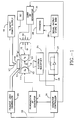
- FIG. 1 There is shown in Figure 1 at 10 a three-dimensional ion trap which includes a ring electrode 11 and two end caps 12 and 13 facing each other.
- a radio frequency voltage generator 14 is connected to the ring electrode 11 to supply an r.f. voltage V sin ⁇ t (the fundamental voltage) between the end caps and the ring electrode which provides a substantially quadrupole field for trapping ions within the ion storage region or volume 16.
- the field required for trapping is formed by coupling the r.f. voltage between the ring electrode 11 and the two end-cap electrodes 12 and 13 which are common mode grounded through coupling transformer 32 as shown.
- a supplementary r.f. generator 35 is coupled to the end caps 22,23 to supply a radio frequency voltage V2 sin ⁇ 2t between the end caps.
- a filament 17 which is fed by a filament power supply 18 is disposed which can provide an ionizing electron beam for ionizing the sample molecules introduced into the ion storage region 16.
- a cylindrical gate lens 19 is powered by a filament lens controller 21. This lens gates the electron beam on and off as desired.
- End cap 12 includes an aperture through which the electron beam projects.
- ions can be formed externally of the trap and injected into the trap by a mechanism similar to that used to inject electrons.
- the external source of ions would replace the filament 17 and ions, instead of electrons, are gated into the trap volume 16 by the gate lens 19.
- the appropriate potential and polarity are used on gate lens 19 in order to focus ions through the aperture in end-cap 12 and into the trap.
- the external ionization source can employ, for example, electron ionization, chemical ionization, cesium ion desorption, laser desorption, electrospray, thermospray ionization, particle beam, and any other type of ion source.
- the external ion source region is differentially pumped with respect to the trapping region.
- the opposite end cap 13 is perforated 23 to allow unstable ions in the fields of the ion trap to exit and be detected by an electron multiplier 24 which generates an ion signal on line 26.
- An electrometer 27 converts the signal on line 26 from current to voltage. The signal is summed and stored by the unit 28 and processed in unit 29.
- Controller 31 is connected to the fundamental r.f. generator 14 to allow the magnitude and/or frequency of the fundamental r.f. voltage to be scanned to bring successive ions towards resonance with the supplementary field applied across the end caps for providing mass selection.
- the controller 31 is also connected to the supplementary r.f. generator 35 to allow the magnitude and/or frequency of the supplementary r.f. voltage to be controlled.
- the controller on line 32 is connected to the filament lens controller 21 to gate into the trap the ionizing electron beam or an externally formed ion beam only at time periods other than the scanning interval. Mechanical details of ion traps have been shown, for example, U.S. Patent 2,939,952 and more recently in U.S. Patent 4,540,884 assigned to the present assignee.
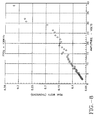
- the symmetric fields in the ion trap 10 lead to the well known stability diagram shown in Figure 2.
- the values of a and q must be within the stability envelope if it is to be trapped within the quadrupole fields of the ion trap device.
- V2 r.f. voltage
- the ions are thereby sequentially brought toward resonance, oscillate along the axis of the trap with increased amplitude, and are ejected through perforations in an end-cap electrode to be detected by an external ion detector.
- This sequential ejection of ions according to their m/z value allows the determination of the m/z of the ions.
- the supplementary voltage, V2 might be applied to only one of the end caps.
- the r.f. voltage, V may be applied to the two end caps while the supplementary voltage, V2, is applied to the ring electrode.
- the r.f. voltage might remain constant during the mass analysis while the DC voltage is increased (or decreased) to successively bring ions toward resonance.
- the frequency of the supplementary voltage might be scanned to successively bring ions into resonance. More elaborate schemes are possible which all have the characteristic of successively bringing ions of increasing (or decreasing) m/z towards a resonance point in order to cause ejection, ion detection, and the determination of the ions' m/z values.
- the method of increasing resolution in an ion trap mass spectrometer described herein applies to all scans referred to as the combination of mass-selective instability with resonance ejection.
- R m/ ⁇ m
- m the mass of interest
- ⁇ m the peak width in mass units at some specified peak height.
- Sector (magnetic and electric) based mass spectrometers have the quality of constant resolution throughout their mass range and hence the definition.
- quadrupole-field based mass spectrometers such as linear quadrupole mass analyzers and quadrupole ion traps, produce constant peak width ( ⁇ (m/z)) throughout their mass range and thus show resolution that increases with m/z value. Consequently, in the discussion that follows, both terms, "peak width” and “resolution” are used, but the distinction and the properties of the instrument with respect to both, should be recognized.
- Mass spectra are usually presented as a plot of abundance vs m/z, but since there has been no unit for mass-to-charge ratio, the m/z value of a particular ion is often given in daltons (especially in oral presentations). Indeed, many mass spectrometrists argue that the dimensionality of m/z is in fact mass, with m being given in daltons and z being a dimensionless number of charges. Others argue that the dimensionality of m/z is in fact mass/charge.
- This unit is chosen so that the axis of a mass spectrum may still be labeled as "m/z", and the term and entrenched symbol "m/z” may still be used for other purposes, but the quantity will be referred to as “thomsons” rather than “m/z units” (which may still be used) or “daltons” (which should be discouraged).
- thomsons rather than “m/z units” (which may still be used) or “daltons” (which should be discouraged).
- the quadrupole ion trap operated in the mass-selective instability mode has thus far only been able to achieve so called "unit” or near unit resolution (as with the conventional linear quadrupole mass analyzer).
- This term is somewhat confusing given the definition of resolution; it indicates that peak width is one thomson wide (at the baseline of intensity or 0.5 thomsons at full width half maximum, FWHM throughout the normal mass range (thomson range) of the instrument. This resolution is sufficient to separate singly charged ions of consecutive masses that are nominally one dalton apart.
- linear quadrupole analyzers are typically operated in such a manner as to give constant peak width (in thomsons), operation at too high a resolution reduces the signal to an unusably low level.
- the determination of the mass requires a determination of both the thomsons of the measured ion and the number of charges on the measured ion. Since such complex ions exist as a population of ions with isotope peaks separated by integral mass values, the number of charges on each ion can be determined by measuring the thomsons between successive mass peaks: doubly charged ions yield peaks at every 1/2 thomson, triply-charged ions yield peaks at every 1/3 thomson, and so on. This requires resolution that is typically not attainable on conventional linear quadrupole instruments, although the required resolution is not generally as large as that required for the separation of isobars.
- the invention described here allows high resolutions (narrow peak widths) to be achieved in a quadrupole ion trap operated in the mass-selective instability mode with resonance ejection. Both applications discussed above will be demonstrated.
- the commonly-used scan rate was chosen to provide unit resolution with a relatively rapid scan.
- Previous workers, when modifying trapping parameters (such as the trap dimension r0) attempted to return the "scan rate", expressed in terms of thomsons/second, to a value similar to that used in the standard mode of operation of the commercial instrument (5000 thomsons/second) in the hope of restoring unit resolution.
- substantially slower scanning would not yield substantially greater resolution, as is the case with the mass-selective instability mode of operation.
- the frequency of the supplementary field is also an important parameter for achieving optimum resolution.
- one of the ⁇ lines shown in the diagram of Figure 2 is selected there by determining ⁇ z-eject .
- ⁇ z-eject As described earlier, as the r.f. voltage is increased, ions of successively increasing m/z approach the ⁇ z-eject and are brought toward resonance where by their amplitude of motion increases and they are ejected from the ion trap.
- As the lower value ⁇ lines are selected less r.f. voltage amplitude is required to bring an ion of given m/z into resonance.
- the thomson range which can be scanned out is limited by the maximum value of r.f. voltage which can be applied. Therefore resonant excitation at lower values of ⁇ increases the thomson range of the instrument.
- the supplementary field frequency will also affect the scan rate in units of thomsons/second of the instrument.
- the lower the ⁇ z-eject the higher the thomson range and the higher the scan rate in terms of thomsons/second.
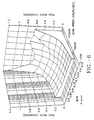
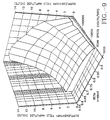
- Figure 6 shows a three-dimensional plot of peak width (in thomsons) of m/z 129 of xenon as a function of scan rate (log r.f.volts/sec) and ⁇ z-eject (supplementary frequency) which shows experimental data which support the statements made in the above discussion.
- peak width continues to decrease with decreasing scan speeds, when using appropriate supplementary field frequencies.
- Each data point in this plot was obtained using the supplementary field amplitude that produced the narrowest peak width.
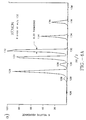
- Figure 4b shows the full isotope cluster of xenon at a scan speed of 1/20 the normal scan speed, i.e., 3210 volts/second, using resonance ejection at a ⁇ z-eject of 0.733 (403017 Hz) and an amplitude of 4.5 volts (peak-to peak, across the end-cap electrodes).
- the peak-width of m/z 132 at FWHM has been reduced to approximately 0.073 thomsons, and therefore giving a resolution of approximately 1800.
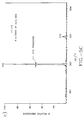
- Figure 4c shows a portion of the xenon isotope spectrum including the abundant isotopes of m/z 131 and 132 under conditions of 1/100 the scan speed (640 volts/second) using a resonance frequency at a ⁇ z-eject of 0.661(363543 Hz) and an amplitude of 4.6 volts.
- the peak-width of the m/z 132 peak at FWHM is shown to be approximately 0.035 thomsons, giving a resolution of approximately 3800 at this m/z.
- Figure 5 shows data using the higher m/z 502 and 503 peaks of the mass spectrum of perfluorotributylamine (FC-43) ionized by using an external electron ionization source.
- Figure 5a shows the mass spectrum that was acquired by using a normal scan speed of 64000 volts/second and resonance ejection at a ⁇ z-eject of 0.945454 (520000 Hz) and an amplitude of 6.0 volts, indicating typical peak-widths and resolution (1700) under standard operating conditions.
- Figure 5b shows the same mass spectrum at a scan speed of 640 volts/second, a supplementary frequency at a ⁇ z-eject of 0.852042 Hz, (468623 Hz) and an amplitude of 1.1 volts.
- the inset shows that by increasing the gain and the number of scans averaged, m/z 504 may also be observed.
- the peak-width of m/z 502 is approximately 0.030 thomsons (FWHM), and thus the resolution is approximately 17000. This peak-width is comparable to the peak-width seen in Figure 4c and demonstrates the constant peak-width in thomsons produced by the ion trap throughout the thomson range and, therefore, its increasing resolution with increasing m/z.
- the scan rate has been attenuated by a factor of 200 to 320 volts/second, with a supplementary field frequency at a ⁇ z-eject of 0.848405 (466623 Hz) and an amplitude of 0.58 volts.
- the peak-width at FWHM of m/z 502 is approximately 0.015 thomsons, and thus the resolution is 33000.
- Figure 10 shows an example of the separation of isobars using the increased resolution obtainable by the method described here.
- the scan rate has been slowed by a factor of 500 to 128 volts/second with a ⁇ z-eject 0.709091 (390000 Hz) and amplitude of 2.2 volts.
- This spectrum shows the 131 xenon isotope resolved from that of a fragment ion (C3F5) of the compound perfluorotributylamine, both having nominal m/z values of 131.
- the measured peak widths are approximately 0.045 thomsons at FWHM.
- the next isotope of xenon at m/z 132 and the C13 containing ion (13C12C2F5) can also be observed.
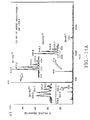
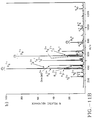
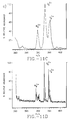
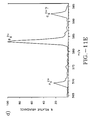
- Figures 11c-11e show small sections of the daughter spectrum (indicated in Figure 11b) that have been obtained using a scan speed of 3140 volts/second and ⁇ z-eject of 0.844311. Again, the resolution achieved readily allows the identification of charge states for these daughter ions by using the mass separation of the isotopes and therefore, simplifies sequence ion assignments in the daughter ion mass spectrum.
Landscapes
- Chemical & Material Sciences (AREA)
- Analytical Chemistry (AREA)
- Electron Tubes For Measurement (AREA)
- Other Investigation Or Analysis Of Materials By Electrical Means (AREA)
Applications Claiming Priority (4)
| Application Number | Priority Date | Filing Date | Title |
|---|---|---|---|
| US69380891A | 1991-04-30 | 1991-04-30 | |
| US693808 | 1991-04-30 | ||
| US849970 | 1992-03-12 | ||
| US07/849,970 US5182451A (en) | 1991-04-30 | 1992-03-12 | Method of operating an ion trap mass spectrometer in a high resolution mode |
Publications (2)
| Publication Number | Publication Date |
|---|---|
| EP0512700A1 true EP0512700A1 (de) | 1992-11-11 |
| EP0512700B1 EP0512700B1 (de) | 1996-06-12 |
Family
ID=27105243
Family Applications (1)
| Application Number | Title | Priority Date | Filing Date |
|---|---|---|---|
| EP92303394A Expired - Lifetime EP0512700B1 (de) | 1991-04-30 | 1992-04-15 | Verfahren zum Betrieb eines Ionenfalle-Massenspektrometers im hochauflösenden Modus |
Country Status (5)
| Country | Link |
|---|---|
| US (1) | US5182451A (de) |
| EP (1) | EP0512700B1 (de) |
| JP (1) | JP2729007B2 (de) |
| CA (1) | CA2066893C (de) |
| DE (1) | DE69211420T2 (de) |
Cited By (2)
| Publication number | Priority date | Publication date | Assignee | Title |
|---|---|---|---|---|
| GB2263193A (en) * | 1991-12-23 | 1993-07-14 | Bruker Franzen Analytik Gmbh | Ion trap mass spectrometers |
| WO1998026445A1 (en) * | 1996-12-10 | 1998-06-18 | Varian Associates, Inc. | Method of operating an ion trap mass spectrometer |
Families Citing this family (20)
| Publication number | Priority date | Publication date | Assignee | Title |
|---|---|---|---|---|
| US5451782A (en) * | 1991-02-28 | 1995-09-19 | Teledyne Et | Mass spectometry method with applied signal having off-resonance frequency |
| DE4142869C1 (de) * | 1991-12-23 | 1993-05-19 | Bruker - Franzen Analytik Gmbh, 2800 Bremen, De | |
| US5397894A (en) * | 1993-05-28 | 1995-03-14 | Varian Associates, Inc. | Method of high mass resolution scanning of an ion trap mass spectrometer |
| EP0765190B1 (de) * | 1993-06-28 | 1999-12-29 | Shimadzu Corporation | Quadrupol mit einem von der resonanzfrequenz abweichenden angelegten signal |
| US5532140A (en) * | 1994-03-23 | 1996-07-02 | The United States Of America As Represented By The Secretary Of The Army | Method and apparatus for suspending microparticles |
| US5623144A (en) * | 1995-02-14 | 1997-04-22 | Hitachi, Ltd. | Mass spectrometer ring-shaped electrode having high ion selection efficiency and mass spectrometry method thereby |
| US6528784B1 (en) | 1999-12-03 | 2003-03-04 | Thermo Finnigan Llc | Mass spectrometer system including a double ion guide interface and method of operation |
| CA2340150C (en) * | 2000-06-09 | 2005-11-22 | Micromass Limited | Methods and apparatus for mass spectrometry |
| GB2364168B (en) * | 2000-06-09 | 2002-06-26 | Micromass Ltd | Methods and apparatus for mass spectrometry |
| US20020115056A1 (en) | 2000-12-26 | 2002-08-22 | Goodlett David R. | Rapid and quantitative proteome analysis and related methods |
| GB0305796D0 (en) | 2002-07-24 | 2003-04-16 | Micromass Ltd | Method of mass spectrometry and a mass spectrometer |
| US7473892B2 (en) * | 2003-08-13 | 2009-01-06 | Hitachi High-Technologies Corporation | Mass spectrometer system |
| JP4515819B2 (ja) * | 2003-08-13 | 2010-08-04 | 株式会社日立ハイテクノロジーズ | 質量分析システム |
| US7656236B2 (en) * | 2007-05-15 | 2010-02-02 | Teledyne Wireless, Llc | Noise canceling technique for frequency synthesizer |
| US8334506B2 (en) | 2007-12-10 | 2012-12-18 | 1St Detect Corporation | End cap voltage control of ion traps |
| US8179045B2 (en) * | 2008-04-22 | 2012-05-15 | Teledyne Wireless, Llc | Slow wave structure having offset projections comprised of a metal-dielectric composite stack |
| US7973277B2 (en) * | 2008-05-27 | 2011-07-05 | 1St Detect Corporation | Driving a mass spectrometer ion trap or mass filter |
| GB201103854D0 (en) * | 2011-03-07 | 2011-04-20 | Micromass Ltd | Dynamic resolution correction of quadrupole mass analyser |
| US9111735B1 (en) * | 2013-01-30 | 2015-08-18 | Bruker Daltonik Gmbh | Determination of elemental composition of substances from ultrahigh-resolved isotopic fine structure mass spectra |
| US9202660B2 (en) | 2013-03-13 | 2015-12-01 | Teledyne Wireless, Llc | Asymmetrical slow wave structures to eliminate backward wave oscillations in wideband traveling wave tubes |
Citations (3)
| Publication number | Priority date | Publication date | Assignee | Title |
|---|---|---|---|---|
| EP0113207A2 (de) * | 1982-12-29 | 1984-07-11 | Finnigan Corporation | Verfahren zur Bestimmung der Masse einer Probe durch eine Quadrupol-Ionentrappe |
| EP0321819A2 (de) * | 1987-12-23 | 1989-06-28 | Bruker-Franzen Analytik GmbH | Verfahren zur massenspektroskopischen Untersuchung eines Gasgemisches und Massenspektrometer zur Durchführung dieses Verfahrens |
| EP0350159A1 (de) * | 1988-06-03 | 1990-01-10 | Finnigan Corporation | Verfahren zum Betrieb eines Ionenfallenmassenspektrometers |
Family Cites Families (5)
| Publication number | Priority date | Publication date | Assignee | Title |
|---|---|---|---|---|
| EP0202943B2 (de) * | 1985-05-24 | 2004-11-24 | Thermo Finnigan LLC | Steuerungsverfahren für eine Ionenfalle |
| US4686367A (en) * | 1985-09-06 | 1987-08-11 | Finnigan Corporation | Method of operating quadrupole ion trap chemical ionization mass spectrometry |
| US4749860A (en) * | 1986-06-05 | 1988-06-07 | Finnigan Corporation | Method of isolating a single mass in a quadrupole ion trap |
| US4771172A (en) * | 1987-05-22 | 1988-09-13 | Finnigan Corporation | Method of increasing the dynamic range and sensitivity of a quadrupole ion trap mass spectrometer operating in the chemical ionization mode |
| JPS63313460A (ja) * | 1987-06-16 | 1988-12-21 | Shimadzu Corp | イオントラップ型質量分析装置 |
-
1992
- 1992-03-12 US US07/849,970 patent/US5182451A/en not_active Expired - Lifetime
- 1992-04-15 EP EP92303394A patent/EP0512700B1/de not_active Expired - Lifetime
- 1992-04-15 DE DE69211420T patent/DE69211420T2/de not_active Expired - Lifetime
- 1992-04-23 CA CA002066893A patent/CA2066893C/en not_active Expired - Lifetime
- 1992-04-30 JP JP4111018A patent/JP2729007B2/ja not_active Expired - Fee Related
Patent Citations (3)
| Publication number | Priority date | Publication date | Assignee | Title |
|---|---|---|---|---|
| EP0113207A2 (de) * | 1982-12-29 | 1984-07-11 | Finnigan Corporation | Verfahren zur Bestimmung der Masse einer Probe durch eine Quadrupol-Ionentrappe |
| EP0321819A2 (de) * | 1987-12-23 | 1989-06-28 | Bruker-Franzen Analytik GmbH | Verfahren zur massenspektroskopischen Untersuchung eines Gasgemisches und Massenspektrometer zur Durchführung dieses Verfahrens |
| EP0350159A1 (de) * | 1988-06-03 | 1990-01-10 | Finnigan Corporation | Verfahren zum Betrieb eines Ionenfallenmassenspektrometers |
Non-Patent Citations (1)
| Title |
|---|
| INTERNATIONAL JOURNAL OF MASS SPECTROMETRY AND ION PROCESSES. vol. 106, 15 May 1991, AMSTERDAM NL pages 79 - 115; R. E. KAISER ET AL: 'OPERATION OF A QUADRUPOLE ION TRAP SPECTROMETER TO ACHIEVE HIGH MASS / CHARGE RATIOS' * |
Cited By (4)
| Publication number | Priority date | Publication date | Assignee | Title |
|---|---|---|---|---|
| GB2263193A (en) * | 1991-12-23 | 1993-07-14 | Bruker Franzen Analytik Gmbh | Ion trap mass spectrometers |
| GB2263193B (en) * | 1991-12-23 | 1995-05-03 | Bruker Franzen Analytik Gmbh | Method and device for obtaining mass spectra |
| WO1998026445A1 (en) * | 1996-12-10 | 1998-06-18 | Varian Associates, Inc. | Method of operating an ion trap mass spectrometer |
| AU721973B2 (en) * | 1996-12-10 | 2000-07-20 | Agilent Technologies, Inc. | Method of operating an ion trap mass spectrometer |
Also Published As
| Publication number | Publication date |
|---|---|
| JP2729007B2 (ja) | 1998-03-18 |
| JPH05121042A (ja) | 1993-05-18 |
| DE69211420D1 (de) | 1996-07-18 |
| CA2066893C (en) | 2002-11-19 |
| US5182451A (en) | 1993-01-26 |
| CA2066893A1 (en) | 1992-10-31 |
| EP0512700B1 (de) | 1996-06-12 |
| DE69211420T2 (de) | 1996-10-10 |
Similar Documents
| Publication | Publication Date | Title |
|---|---|---|
| EP0512700B1 (de) | Verfahren zum Betrieb eines Ionenfalle-Massenspektrometers im hochauflösenden Modus | |
| EP0215615B1 (de) | Betriebsverfahren einer Quadrupolionenfalle | |
| US7642509B2 (en) | Top-down protein analysis in mass spectrometers with ion traps | |
| US4771172A (en) | Method of increasing the dynamic range and sensitivity of a quadrupole ion trap mass spectrometer operating in the chemical ionization mode | |
| US4736101A (en) | Method of operating ion trap detector in MS/MS mode | |
| US4818869A (en) | Method of isolating a single mass or narrow range of masses and/or enhancing the sensitivity of an ion trap mass spectrometer | |
| JP4463978B2 (ja) | 四重極イオンガイド中でイオンを選択的に衝突誘発解離する方法および装置 | |
| US5128542A (en) | Method of operating an ion trap mass spectrometer to determine the resonant frequency of trapped ions | |
| US6147348A (en) | Method for performing a scan function on quadrupole ion trap mass spectrometers | |
| EP1463090B1 (de) | Massenspektrometrie und ionenfallenmassenspektrometer | |
| JPH07146283A (ja) | イオントラップ質量分析計の使用方法 | |
| Schwartz et al. | High resolution parent‐ion selection/isolation using a quadrupole ion‐trap mass spectrometer | |
| EP0575777B1 (de) | Verfahren zur Verwendung eines Massenspektrometers | |
| US5451782A (en) | Mass spectometry method with applied signal having off-resonance frequency | |
| US8198583B2 (en) | Fragmentation of analyte ions by collisions in RF ion traps | |
| US6838665B2 (en) | Ion trap type mass spectrometer | |
| EP0765190B1 (de) | Quadrupol mit einem von der resonanzfrequenz abweichenden angelegten signal | |
| GB2459953A (en) | Fragmentation of analyte ions in RF ion traps |
Legal Events
| Date | Code | Title | Description |
|---|---|---|---|
| PUAI | Public reference made under article 153(3) epc to a published international application that has entered the european phase |
Free format text: ORIGINAL CODE: 0009012 |
|
| AK | Designated contracting states |
Kind code of ref document: A1 Designated state(s): CH DE FR GB IT LI NL SE |
|
| 17P | Request for examination filed |
Effective date: 19921120 |
|
| 17Q | First examination report despatched |
Effective date: 19950222 |
|
| GRAH | Despatch of communication of intention to grant a patent |
Free format text: ORIGINAL CODE: EPIDOS IGRA |
|
| GRAA | (expected) grant |
Free format text: ORIGINAL CODE: 0009210 |
|
| AK | Designated contracting states |
Kind code of ref document: B1 Designated state(s): CH DE FR GB IT LI NL SE |
|
| PG25 | Lapsed in a contracting state [announced via postgrant information from national office to epo] |
Ref country code: IT Free format text: LAPSE BECAUSE OF FAILURE TO SUBMIT A TRANSLATION OF THE DESCRIPTION OR TO PAY THE FEE WITHIN THE PRE;WARNING: LAPSES OF ITALIAN PATENTS WITH EFFECTIVE DATE BEFORE 2007 MAY HAVE OCCURRED AT ANY TIME BEFORE 2007. THE CORRECT EFFECTIVE DATE MAY BE DIFFERENT FROM THE ONE RECORDED.SCRIBED TIME-LIMIT Effective date: 19960612 Ref country code: CH Effective date: 19960612 Ref country code: NL Free format text: LAPSE BECAUSE OF FAILURE TO SUBMIT A TRANSLATION OF THE DESCRIPTION OR TO PAY THE FEE WITHIN THE PRESCRIBED TIME-LIMIT Effective date: 19960612 Ref country code: LI Effective date: 19960612 |
|
| REF | Corresponds to: |
Ref document number: 69211420 Country of ref document: DE Date of ref document: 19960718 |
|
| ET | Fr: translation filed | ||
| PG25 | Lapsed in a contracting state [announced via postgrant information from national office to epo] |
Ref country code: SE Effective date: 19960912 |
|
| NLV1 | Nl: lapsed or annulled due to failure to fulfill the requirements of art. 29p and 29m of the patents act | ||
| REG | Reference to a national code |
Ref country code: CH Ref legal event code: PL |
|
| PLBQ | Unpublished change to opponent data |
Free format text: ORIGINAL CODE: EPIDOS OPPO |
|
| PLBI | Opposition filed |
Free format text: ORIGINAL CODE: 0009260 |
|
| PLBF | Reply of patent proprietor to notice(s) of opposition |
Free format text: ORIGINAL CODE: EPIDOS OBSO |
|
| 26 | Opposition filed |
Opponent name: BRUKER-FRANZEN ANALYTIK GMBH Effective date: 19970312 |
|
| PLBF | Reply of patent proprietor to notice(s) of opposition |
Free format text: ORIGINAL CODE: EPIDOS OBSO |
|
| PLBF | Reply of patent proprietor to notice(s) of opposition |
Free format text: ORIGINAL CODE: EPIDOS OBSO |
|
| PLBO | Opposition rejected |
Free format text: ORIGINAL CODE: EPIDOS REJO |
|
| PLBN | Opposition rejected |
Free format text: ORIGINAL CODE: 0009273 |
|
| STAA | Information on the status of an ep patent application or granted ep patent |
Free format text: STATUS: OPPOSITION REJECTED |
|
| 27O | Opposition rejected |
Effective date: 19981203 |
|
| REG | Reference to a national code |
Ref country code: GB Ref legal event code: 732E |
|
| REG | Reference to a national code |
Ref country code: GB Ref legal event code: IF02 |
|
| PGFP | Annual fee paid to national office [announced via postgrant information from national office to epo] |
Ref country code: FR Payment date: 20090414 Year of fee payment: 18 |
|
| REG | Reference to a national code |
Ref country code: FR Ref legal event code: ST Effective date: 20101230 |
|
| PGFP | Annual fee paid to national office [announced via postgrant information from national office to epo] |
Ref country code: DE Payment date: 20110421 Year of fee payment: 20 |
|
| PGFP | Annual fee paid to national office [announced via postgrant information from national office to epo] |
Ref country code: GB Payment date: 20110421 Year of fee payment: 20 |
|
| REG | Reference to a national code |
Ref country code: DE Ref legal event code: R071 Ref document number: 69211420 Country of ref document: DE |
|
| REG | Reference to a national code |
Ref country code: DE Ref legal event code: R071 Ref document number: 69211420 Country of ref document: DE |
|
| REG | Reference to a national code |
Ref country code: GB Ref legal event code: PE20 Expiry date: 20120414 |
|
| PG25 | Lapsed in a contracting state [announced via postgrant information from national office to epo] |
Ref country code: FR Free format text: LAPSE BECAUSE OF NON-PAYMENT OF DUE FEES Effective date: 20100430 Ref country code: DE Free format text: LAPSE BECAUSE OF EXPIRATION OF PROTECTION Effective date: 20120416 |
|
| PG25 | Lapsed in a contracting state [announced via postgrant information from national office to epo] |
Ref country code: GB Free format text: LAPSE BECAUSE OF EXPIRATION OF PROTECTION Effective date: 20120414 |