EP0350194A2 - Contrôle du potentiel électrocinétique par traitement avec des agents redox - Google Patents
Contrôle du potentiel électrocinétique par traitement avec des agents redox Download PDFInfo
- Publication number
- EP0350194A2 EP0350194A2 EP89306501A EP89306501A EP0350194A2 EP 0350194 A2 EP0350194 A2 EP 0350194A2 EP 89306501 A EP89306501 A EP 89306501A EP 89306501 A EP89306501 A EP 89306501A EP 0350194 A2 EP0350194 A2 EP 0350194A2
- Authority
- EP
- European Patent Office
- Prior art keywords
- accordance
- solid
- reagent
- capillary
- treatment
- Prior art date
- Legal status (The legal status is an assumption and is not a legal conclusion. Google has not performed a legal analysis and makes no representation as to the accuracy of the status listed.)
- Granted
Links
Images



Classifications
-
- G—PHYSICS
- G01—MEASURING; TESTING
- G01N—INVESTIGATING OR ANALYSING MATERIALS BY DETERMINING THEIR CHEMICAL OR PHYSICAL PROPERTIES
- G01N30/00—Investigating or analysing materials by separation into components using adsorption, absorption or similar phenomena or using ion-exchange, e.g. chromatography or field flow fractionation
- G01N30/02—Column chromatography
- G01N30/50—Conditioning of the sorbent material or stationary liquid
-
- G—PHYSICS
- G01—MEASURING; TESTING
- G01N—INVESTIGATING OR ANALYSING MATERIALS BY DETERMINING THEIR CHEMICAL OR PHYSICAL PROPERTIES
- G01N27/00—Investigating or analysing materials by the use of electric, electrochemical, or magnetic means
- G01N27/26—Investigating or analysing materials by the use of electric, electrochemical, or magnetic means by investigating electrochemical variables; by using electrolysis or electrophoresis
- G01N27/416—Systems
- G01N27/447—Systems using electrophoresis
- G01N27/44704—Details; Accessories
- G01N27/44752—Controlling the zeta potential, e.g. by wall coatings
Definitions
- This invention relates to electrokinetic phenomena. and in particular to solid phases and components used in electrophoresis and chromatography.
- Solid elements are included in electrophoretic and chromatographic systems for a variety of reasons, including their use as sites for the partitioning of solutes and as retaining walls for housing a separation medium. Solid elements may thus take the form of particles, porous or otherwise, capillary tubes, plates to hold a slab, and other configurations.
- Examples of chromatographic systems using solid elements are affinity chromatography, reversed phase chromatography, ion exchange chromatography, size exclusion chromatography, and the various forms of electrophoresis, including gel electrophoresis, open-tube electrophoresis, isotachophoresis (also referred to as displacement electrophoresis) and isoelectric focusing.
- the solid element plays an active role in the partitioning, and in other cases a passive role.
- the solid element contributes to the bulk flow of solutes through the separation medium through electroendosmosis (also referred to as electroosmotic flow, as it is herein), while in other cases such flow is considered to be an interference.
- Each type of separatory system has its own particular utility.
- Capillary electrophoresis in its various forms, for example, is significant among electrophoretic systems in general due to a number of advantages which it offers.
- it is useful in operations where high speed and efficiency are important. This is because its narrow bore columns promote rapid heat dissipation from the column interior to its surroundings. A high voltage may thus be applied without causing excessive Joule heating. Samples having components which separate only under high voltage can thus be partitioned in such tubes.
- the small volume of separation medium used in comparison to other electrophoretic systems lends itself to very small sample sizes.
- capillary electrophoresis The most common types of capillary electrophoresis are gel electrophoresis, isoelectric focusing, isotachophor esis (also referred to as "displacement” electrophoresis) and free zone electrophoresis, with or without electroosmotic bulk flow.
- Wall effects are a major consideration in capillary electrophoresis as well as forms of chromatography.
- capillary electrophoresis there is a high ratio of wall surface area to the volume of the separation medium, and high proximity of the wall to the components being partitioned.
- electrokinetic potential is relied on to produce an electroosmotic bulk flow as an integral part of the partition mechanism.
- Other systems rely primarily on electrophoretic mobility. Electroosmotic flow in such systems interferes with the partitioning, and where present it is sought to be suppressed or eliminated.
- a combination of electrophoretic mobility and electroosmotic flow is used, at a ratio which is experimentally derived to provide the cleanest and most efficient separation.
- the magnitude of the electrokinetic potential in any electrophoretic system, and hence the degree of electroosmotic flow, are dependent on the surface characteristics of the solid element, which is vulnerable to the various materials which come in contact with it during each separation. These include carrier fluids, buffers, partitioning reagents retained with the carrier, and the solutes sought to be separated. Chemical reactions between these substances and the wall of the solid element, as well as entrapment or retention of these substances by the wall, tend to change the electrical characteristics of the wall, thus affecting the electrokinetic potential. These unwanted interactions with the wall also interfere with the partitioning effect which occurs within the bulk of the separation medium.
- the changes accumulate with repeated runs, resulting in a loss of reproducibility and, in some cases, to a loss of the partitioning effect itself.
- the loss of reproducibility is a particularly serious problem in automated systems where a series of samples are injected and partitioned automatically in sequence.
- a redox reagent i.e., a reagent which promotes either reduction or oxidation on species with which it comes into contact.
- a redox reagent i.e., a reagent which promotes either reduction or oxidation on species with which it comes into contact.
- the choice between oxidation and reduction will depend on the effect sought to be achieved, i.e., the surface electrical character sought to be restored.
- oxidizing agents decrease the electrokinetic potential whereas reducing agents increase the electrokinetic potential. The effects are accomplished presumably through modification of surface SiOH groups.
- oxidizing agents would be used when the desired driving force is electrophoretic mobility only, and reducing agents would be used when electroendosmotic flow is the desired driving force (or "pump") for the system.
- the oxidizing or reducing reagent may serve either a restorative function or a maintenance function, depending on whether it is used as a treatment between runs, or added as a system component during the actual separation.
- Electroosmotic flow can occur in tubes ranging from a few microns in diameter to several thousand. Those of most interest for purposes of the present invention will generally fall within the range of about 2 microns to about 500 microns in diameter.
- Oxidizing agents which may be used in accordance with the present invention include any of the large number of agents known to those skilled in analytical chemistry, organic synthesis, and biotechnology, preferably those which are soluble in polar solvents such as water.
- Examples include peroxides, permanganates, and chromates. Specific examples within these groups include quaternary ammonium compounds, such as benzyltriethylammonium permanganate and bis(benzyltriethylammonium) dichromate, hydrogen peroxide and sodium peroxide.
- a broad range of reducing agents may be used. Examples include metal hydrides, boryl hydrides and urates, as well as biochemical reducing agents such as dithiothreitol and dithioerythritol.
- Treatment is most conveniently achieved by contacting the reagents in a polar solution with the solid element, either by flushing it with the solution or adding the reagents to the buffer solutions or other solutions used during the actual separation, or both.
- concentration in the solvent is not critical and may vary widely, although in most cases, concentration ranging from about 25 mM to about 250 mM will provide the best results. Similar concentrations may be used when the reagent is an additive during the separation.
- the duration of the treatment will generally be governed by the degree necessary to restore the solid element surface to the desired state. This will depend on the frequency of the treatment, and other predictable parameters such as the concentration of the oxidizing or reducing agent in the treatment solution, and the temperature at which the treatment is performed.
- a flush using about 5 to about 50 capillary volumes will generally be effective.
- the degree in manner of flushing or other methods of contact which will be most appropriate for any given system will be apparent to those skilled in the art.
- a desorbing agent may also be included in the treatment solution. This will be particularly useful where surface contamination or modification is caused by entrapment or deposition of mobile species during electrophoretic runs.
- the deposited or entrapped species may be either the solutes sought to be separated in the run or other pollutants present in the solutions.
- Suitable desorption agents are those which are active in such functions as denaturing the contaminating species, dissociating the species from themselves or from the surface, or preventing nonspecific binding in general. Selection of the appropriate desorption agent in any given circumstance will depend on the nature of the sample and species to be separated and their stability or reactivity in the presence of desorption agents of particular types, such as neutral or charged agents, etc. Examples of suitable desorption agents, depending on the system, are urea and guanidine.
- the invention is of particular interest to various types of electrophoretic separations occurring in capillary tubes, as stated above.
- Primary examples include gel electrophoresis, isoelectric focusing, isotachophoresis and free zone electrophoresis.
- Additional components contributing to the overall partitioning effect may be included, in accordance with techniques well known to those skilled in the art. For example, the formation of micelles with sodium dodecyl sulfate may be used to enhance the partitioning effect.
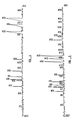
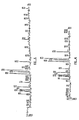
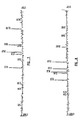
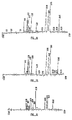
- Samples from a mixture of nucleic acid components were repeatedly injected into a fused silica capillary and subjected to electrophoresis, with varying pre-run flushes and additives to the electrolyte.
- Fused silica contains surface hydroxyl groups which are responsible for the electroosmotic effect.
- the mixture composition at an individual component concentration of 5 ⁇ 10 ⁇ 4 M was as follows: Uridine Uracil Cytidine Cytosine Thymidine Thymine 2-Azidocytidine Adenosine Thymidine monophosphate Deoxycytidine monophosphate Cytidine monophosphate 3-Azidothymidine
- the system parameters were as follows: Capillary fused silica, 77 micron I.D., 69 mm length, 55 cm to detector Detection 260 nm, direct capillary optical path Voltage 22,500 V Current 138 ⁇ A Temperature 15 °C Electrolyte 0.025 M phosphate, pH 6.86, 0.2 M SDS Sample Injection 5 to 10 nanoliters
- the variables from run to run were as follows: Run No.
Landscapes
- Health & Medical Sciences (AREA)
- Life Sciences & Earth Sciences (AREA)
- Chemical & Material Sciences (AREA)
- Immunology (AREA)
- Analytical Chemistry (AREA)
- Biochemistry (AREA)
- General Health & Medical Sciences (AREA)
- General Physics & Mathematics (AREA)
- Physics & Mathematics (AREA)
- Pathology (AREA)
- Molecular Biology (AREA)
- Chemical Kinetics & Catalysis (AREA)
- Electrochemistry (AREA)
- Treatment Of Liquids With Adsorbents In General (AREA)
- Sampling And Sample Adjustment (AREA)
- Investigating Or Analysing Biological Materials (AREA)
Applications Claiming Priority (2)
| Application Number | Priority Date | Filing Date | Title |
|---|---|---|---|
| US215834 | 1988-07-06 | ||
| US07/215,834 US4997536A (en) | 1988-07-06 | 1988-07-06 | Control of electrokinetic potential by treatment with redox agents |
Publications (3)
| Publication Number | Publication Date |
|---|---|
| EP0350194A2 true EP0350194A2 (fr) | 1990-01-10 |
| EP0350194A3 EP0350194A3 (fr) | 1991-10-09 |
| EP0350194B1 EP0350194B1 (fr) | 1995-03-29 |
Family
ID=22804593
Family Applications (1)
| Application Number | Title | Priority Date | Filing Date |
|---|---|---|---|
| EP89306501A Expired - Lifetime EP0350194B1 (fr) | 1988-07-06 | 1989-06-27 | Contrôle du potentiel électrocinétique par traitement avec des agents redox |
Country Status (4)
| Country | Link |
|---|---|
| US (1) | US4997536A (fr) |
| EP (1) | EP0350194B1 (fr) |
| JP (1) | JPH0266444A (fr) |
| DE (1) | DE68921937T2 (fr) |
Cited By (1)
| Publication number | Priority date | Publication date | Assignee | Title |
|---|---|---|---|---|
| WO1996036872A1 (fr) * | 1995-05-19 | 1996-11-21 | Iowa State University Research Foundation, Inc. | Systeme d'electrophorese capillaire multiplexe |
Families Citing this family (11)
| Publication number | Priority date | Publication date | Assignee | Title |
|---|---|---|---|---|
| US5089106A (en) * | 1986-10-21 | 1992-02-18 | Northeastern University | High performance capillary gel electrophoresis |
| US5302264A (en) * | 1992-09-02 | 1994-04-12 | Scientronix, Inc. | Capillary eletrophoresis method and apparatus |
| US6001229A (en) * | 1994-08-01 | 1999-12-14 | Lockheed Martin Energy Systems, Inc. | Apparatus and method for performing microfluidic manipulations for chemical analysis |
| US5611903A (en) * | 1995-03-22 | 1997-03-18 | Analis S. A. | Capillary electrophoresis method using initialized capillary and polyanion-containing buffer and chemical kit therefor |
| US5989399A (en) * | 1996-09-04 | 1999-11-23 | The Research Foundation Of State University Of New York | Effective surface treatment for a new separation medium in electrophoresis |
| US6537432B1 (en) | 1998-02-24 | 2003-03-25 | Target Discovery, Inc. | Protein separation via multidimensional electrophoresis |
| US6818112B2 (en) | 1999-04-20 | 2004-11-16 | Target Discovery, Inc. | Protein separation via multidimensional electrophoresis |
| US6764817B1 (en) | 1999-04-20 | 2004-07-20 | Target Discovery, Inc. | Methods for conducting metabolic analyses |
| US6758953B2 (en) | 1999-10-28 | 2004-07-06 | Nathan A. Thomas | Multistage electrophoresis apparatus and method of use for the separation and purification of cells, particles and solutes |
| US6929729B2 (en) * | 2000-01-27 | 2005-08-16 | Spectrumedix Llc | Method for conducting capillary zone electrophoresis |
| US20070272556A1 (en) * | 2003-05-22 | 2007-11-29 | Kane Thomas E | Electrophoresis Capillaries Having Reduced Amounts of -Oh |
Family Cites Families (6)
| Publication number | Priority date | Publication date | Assignee | Title |
|---|---|---|---|---|
| US3909380A (en) * | 1974-07-19 | 1975-09-30 | Komline Sanderson Eng Corp | Reference pattern zeta potential measurement apparatus and method therefor |
| US3960499A (en) * | 1975-02-18 | 1976-06-01 | Miles Laboratories, Inc. | Biological test apparatus |
| US4680201A (en) * | 1985-10-30 | 1987-07-14 | Stellan Hjerten | Coating for electrophoresis tube |
| US4690749A (en) * | 1985-12-16 | 1987-09-01 | Universities Space Research Association | Polymer-coated surfaces to control surface zeta potential |
| US4865707A (en) * | 1986-10-21 | 1989-09-12 | Northeastern University | Capillary gel electrophoresis columns |
| US4865706A (en) * | 1986-10-21 | 1989-09-12 | Northeastern University | High performance microcapillary gel electrophoresis |
-
1988
- 1988-07-06 US US07/215,834 patent/US4997536A/en not_active Expired - Lifetime
-
1989
- 1989-06-27 EP EP89306501A patent/EP0350194B1/fr not_active Expired - Lifetime
- 1989-06-27 DE DE68921937T patent/DE68921937T2/de not_active Expired - Fee Related
- 1989-07-05 JP JP1172101A patent/JPH0266444A/ja active Pending
Cited By (3)
| Publication number | Priority date | Publication date | Assignee | Title |
|---|---|---|---|---|
| WO1996036872A1 (fr) * | 1995-05-19 | 1996-11-21 | Iowa State University Research Foundation, Inc. | Systeme d'electrophorese capillaire multiplexe |
| US5695626A (en) * | 1995-05-19 | 1997-12-09 | Iowa State University Research Foundation | Capillaries for use in a multiplexed capillary electrophoresis system |
| US5741411A (en) * | 1995-05-19 | 1998-04-21 | Iowa State University Research Foundation | Multiplexed capillary electrophoresis system |
Also Published As
| Publication number | Publication date |
|---|---|
| JPH0266444A (ja) | 1990-03-06 |
| US4997536A (en) | 1991-03-05 |
| DE68921937D1 (de) | 1995-05-04 |
| DE68921937T2 (de) | 1995-08-03 |
| EP0350194B1 (fr) | 1995-03-29 |
| EP0350194A3 (fr) | 1991-10-09 |
Similar Documents
| Publication | Publication Date | Title |
|---|---|---|
| Burton et al. | Analysis of B6 vitamers by micellar electrokinetic capillary chromatography with laser-excited fluorescence detection | |
| Tagliaro et al. | A brief introduction to capillary electrophoresis | |
| Weinberger | Practical capillary electrophoresis | |
| Li | Capillary electrophoresis: principles, practice and applications | |
| Wright et al. | Behavior and use of nonaqueous media without supporting electrolyte in capillary electrophoresis and capillary electrochromatography | |
| US5074982A (en) | Suppression of electroosmosis with hydrolytically stable coatings | |
| Bushey et al. | Effects of methanol‐modified mobile phase on the separation of isotopically substituted compounds by micellar electrokinetic capillary chromatography | |
| EP0350194A2 (fr) | Contrôle du potentiel électrocinétique par traitement avec des agents redox | |
| Xu | Tutorial: capillary electrophoresis | |
| US5578179A (en) | Method and silicate composition for conditioning silica surfaces | |
| Gilges et al. | CZE separations of basic proteins at low pH in fused silica capillaries with surfaces modified by silane derivatization and/or adsorption of polar polymers | |
| Dolnik et al. | Capillary zone electrophoresis of oligonucleotides: Factors affecting separation | |
| CA2059008A1 (fr) | Colonnes capillaires desactivees pour electrophorese capillaire | |
| US5366601A (en) | Method for separating ionic species using capillary electrophoresis | |
| US5143753A (en) | Suppression of electroosmosis with hydrolytically stable coatings | |
| Iki et al. | Electrostatic and hydrodynamic separation of DNA fragments in capillary tubes | |
| Altria | Fundamentals of capillary electrophoresis theory | |
| Carabias-Martínez et al. | Capillary zone electrophoresis in nonaqueous solvents in the presence of ionic additives | |
| Huang et al. | Charged surface coatings for capillary electrophoresis | |
| Hogan et al. | Indirect fluorometric detection of tryptic digests separated by capillary zone electrophoresis | |
| JPH06288984A (ja) | 電気泳動装置および電気泳動キャピラリ管の処理方法 | |
| AU641607B2 (en) | Capillary gels formed by spatially progressive polymerization using migrating initiator | |
| Foret et al. | Ionic boundaries in biological capillary electrophoresis | |
| Wright et al. | Silver (I)‐Mediated Separations by Nonaqueous Capillary Electrophoresis: Nonaqueous Argentation Electrophoresis | |
| Ye et al. | Capillary electrophoresis as a method for determining dissociation constants of aldohexose isomers |
Legal Events
| Date | Code | Title | Description |
|---|---|---|---|
| PUAI | Public reference made under article 153(3) epc to a published international application that has entered the european phase |
Free format text: ORIGINAL CODE: 0009012 |
|
| AK | Designated contracting states |
Kind code of ref document: A2 Designated state(s): CH DE FR GB IT LI SE |
|
| 17P | Request for examination filed |
Effective date: 19901227 |
|
| PUAL | Search report despatched |
Free format text: ORIGINAL CODE: 0009013 |
|
| AK | Designated contracting states |
Kind code of ref document: A3 Designated state(s): CH DE FR GB IT LI SE |
|
| 17Q | First examination report despatched |
Effective date: 19940520 |
|
| GRAA | (expected) grant |
Free format text: ORIGINAL CODE: 0009210 |
|
| AK | Designated contracting states |
Kind code of ref document: B1 Designated state(s): CH DE FR GB IT LI SE |
|
| PG25 | Lapsed in a contracting state [announced via postgrant information from national office to epo] |
Ref country code: IT Free format text: LAPSE BECAUSE OF FAILURE TO SUBMIT A TRANSLATION OF THE DESCRIPTION OR TO PAY THE FEE WITHIN THE PRE;WARNING: LAPSES OF ITALIAN PATENTS WITH EFFECTIVE DATE BEFORE 2007 MAY HAVE OCCURRED AT ANY TIME BEFORE 2007. THE CORRECT EFFECTIVE DATE MAY BE DIFFERENT FROM THE ONE RECORDED.SCRIBED TIME-LIMIT Effective date: 19950329 Ref country code: LI Effective date: 19950329 Ref country code: CH Effective date: 19950329 |
|
| REF | Corresponds to: |
Ref document number: 68921937 Country of ref document: DE Date of ref document: 19950504 |
|
| PG25 | Lapsed in a contracting state [announced via postgrant information from national office to epo] |
Ref country code: SE Effective date: 19950629 Ref country code: GB Effective date: 19950629 |
|
| REG | Reference to a national code |
Ref country code: CH Ref legal event code: PL |
|
| ET | Fr: translation filed | ||
| PLBE | No opposition filed within time limit |
Free format text: ORIGINAL CODE: 0009261 |
|
| STAA | Information on the status of an ep patent application or granted ep patent |
Free format text: STATUS: NO OPPOSITION FILED WITHIN TIME LIMIT |
|
| GBPC | Gb: european patent ceased through non-payment of renewal fee |
Effective date: 19950629 |
|
| PG25 | Lapsed in a contracting state [announced via postgrant information from national office to epo] |
Ref country code: FR Effective date: 19960229 |
|
| PG25 | Lapsed in a contracting state [announced via postgrant information from national office to epo] |
Ref country code: DE Effective date: 19960301 |
|
| 26N | No opposition filed | ||
| REG | Reference to a national code |
Ref country code: FR Ref legal event code: ST |