EP0351647A2 - 2,2-Difluorcyclopropyl-Derivate - Google Patents
2,2-Difluorcyclopropyl-Derivate Download PDFInfo
- Publication number
- EP0351647A2 EP0351647A2 EP89112304A EP89112304A EP0351647A2 EP 0351647 A2 EP0351647 A2 EP 0351647A2 EP 89112304 A EP89112304 A EP 89112304A EP 89112304 A EP89112304 A EP 89112304A EP 0351647 A2 EP0351647 A2 EP 0351647A2
- Authority
- EP
- European Patent Office
- Prior art keywords
- carbon atoms
- formula
- alkyl
- diluent
- halogen
- Prior art date
- Legal status (The legal status is an assumption and is not a legal conclusion. Google has not performed a legal analysis and makes no representation as to the accuracy of the status listed.)
- Granted
Links
- 0 *C(C1)(C1(F)F)*=C Chemical compound *C(C1)(C1(F)F)*=C 0.000 description 8
Classifications
-
- C—CHEMISTRY; METALLURGY
- C07—ORGANIC CHEMISTRY
- C07D—HETEROCYCLIC COMPOUNDS
- C07D231/00—Heterocyclic compounds containing 1,2-diazole or hydrogenated 1,2-diazole rings
- C07D231/02—Heterocyclic compounds containing 1,2-diazole or hydrogenated 1,2-diazole rings not condensed with other rings
- C07D231/10—Heterocyclic compounds containing 1,2-diazole or hydrogenated 1,2-diazole rings not condensed with other rings having two or three double bonds between ring members or between ring members and non-ring members
- C07D231/12—Heterocyclic compounds containing 1,2-diazole or hydrogenated 1,2-diazole rings not condensed with other rings having two or three double bonds between ring members or between ring members and non-ring members with only hydrogen atoms, hydrocarbon or substituted hydrocarbon radicals, directly attached to ring carbon atoms
-
- A—HUMAN NECESSITIES
- A01—AGRICULTURE; FORESTRY; ANIMAL HUSBANDRY; HUNTING; TRAPPING; FISHING
- A01N—PRESERVATION OF BODIES OF HUMANS OR ANIMALS OR PLANTS OR PARTS THEREOF; BIOCIDES, e.g. AS DISINFECTANTS, AS PESTICIDES OR AS HERBICIDES; PEST REPELLANTS OR ATTRACTANTS; PLANT GROWTH REGULATORS
- A01N43/00—Biocides, pest repellants or attractants, or plant growth regulators containing heterocyclic compounds
- A01N43/64—Biocides, pest repellants or attractants, or plant growth regulators containing heterocyclic compounds having rings with three nitrogen atoms as the only ring hetero atoms
- A01N43/647—Triazoles; Hydrogenated triazoles
- A01N43/653—1,2,4-Triazoles; Hydrogenated 1,2,4-triazoles
-
- C—CHEMISTRY; METALLURGY
- C07—ORGANIC CHEMISTRY
- C07C—ACYCLIC OR CARBOCYCLIC COMPOUNDS
- C07C211/00—Compounds containing amino groups bound to a carbon skeleton
- C07C211/33—Compounds containing amino groups bound to a carbon skeleton having amino groups bound to carbon atoms of rings other than six-membered aromatic rings
- C07C211/34—Compounds containing amino groups bound to a carbon skeleton having amino groups bound to carbon atoms of rings other than six-membered aromatic rings of a saturated carbon skeleton
- C07C211/37—Compounds containing amino groups bound to a carbon skeleton having amino groups bound to carbon atoms of rings other than six-membered aromatic rings of a saturated carbon skeleton being further substituted by halogen atoms or by nitro or nitroso groups
-
- C—CHEMISTRY; METALLURGY
- C07—ORGANIC CHEMISTRY
- C07C—ACYCLIC OR CARBOCYCLIC COMPOUNDS
- C07C233/00—Carboxylic acid amides
- C07C233/57—Carboxylic acid amides having carbon atoms of carboxamide groups bound to carbon atoms of rings other than six-membered aromatic rings
- C07C233/58—Carboxylic acid amides having carbon atoms of carboxamide groups bound to carbon atoms of rings other than six-membered aromatic rings having the nitrogen atoms of the carboxamide groups bound to hydrogen atoms or to carbon atoms of unsubstituted hydrocarbon radicals
-
- C—CHEMISTRY; METALLURGY
- C07—ORGANIC CHEMISTRY
- C07C—ACYCLIC OR CARBOCYCLIC COMPOUNDS
- C07C265/00—Derivatives of isocyanic acid
- C07C265/10—Derivatives of isocyanic acid having isocyanate groups bound to carbon atoms of rings other than six-membered aromatic rings
-
- C—CHEMISTRY; METALLURGY
- C07—ORGANIC CHEMISTRY
- C07C—ACYCLIC OR CARBOCYCLIC COMPOUNDS
- C07C31/00—Saturated compounds having hydroxy or O-metal groups bound to acyclic carbon atoms
- C07C31/34—Halogenated alcohols
- C07C31/44—Halogenated alcohols containing saturated rings
-
- C—CHEMISTRY; METALLURGY
- C07—ORGANIC CHEMISTRY
- C07C—ACYCLIC OR CARBOCYCLIC COMPOUNDS
- C07C45/00—Preparation of compounds having >C = O groups bound only to carbon or hydrogen atoms; Preparation of chelates of such compounds
- C07C45/40—Preparation of compounds having >C = O groups bound only to carbon or hydrogen atoms; Preparation of chelates of such compounds by oxidation with ozone; by ozonolysis
-
- C—CHEMISTRY; METALLURGY
- C07—ORGANIC CHEMISTRY
- C07C—ACYCLIC OR CARBOCYCLIC COMPOUNDS
- C07C45/00—Preparation of compounds having >C = O groups bound only to carbon or hydrogen atoms; Preparation of chelates of such compounds
- C07C45/45—Preparation of compounds having >C = O groups bound only to carbon or hydrogen atoms; Preparation of chelates of such compounds by condensation
-
- C—CHEMISTRY; METALLURGY
- C07—ORGANIC CHEMISTRY
- C07C—ACYCLIC OR CARBOCYCLIC COMPOUNDS
- C07C45/00—Preparation of compounds having >C = O groups bound only to carbon or hydrogen atoms; Preparation of chelates of such compounds
- C07C45/61—Preparation of compounds having >C = O groups bound only to carbon or hydrogen atoms; Preparation of chelates of such compounds by reactions not involving the formation of >C = O groups
- C07C45/63—Preparation of compounds having >C = O groups bound only to carbon or hydrogen atoms; Preparation of chelates of such compounds by reactions not involving the formation of >C = O groups by introduction of halogen; by substitution of halogen atoms by other halogen atoms
-
- C—CHEMISTRY; METALLURGY
- C07—ORGANIC CHEMISTRY
- C07C—ACYCLIC OR CARBOCYCLIC COMPOUNDS
- C07C45/00—Preparation of compounds having >C = O groups bound only to carbon or hydrogen atoms; Preparation of chelates of such compounds
- C07C45/61—Preparation of compounds having >C = O groups bound only to carbon or hydrogen atoms; Preparation of chelates of such compounds by reactions not involving the formation of >C = O groups
- C07C45/67—Preparation of compounds having >C = O groups bound only to carbon or hydrogen atoms; Preparation of chelates of such compounds by reactions not involving the formation of >C = O groups by isomerisation; by change of size of the carbon skeleton
- C07C45/68—Preparation of compounds having >C = O groups bound only to carbon or hydrogen atoms; Preparation of chelates of such compounds by reactions not involving the formation of >C = O groups by isomerisation; by change of size of the carbon skeleton by increase in the number of carbon atoms
- C07C45/70—Preparation of compounds having >C = O groups bound only to carbon or hydrogen atoms; Preparation of chelates of such compounds by reactions not involving the formation of >C = O groups by isomerisation; by change of size of the carbon skeleton by increase in the number of carbon atoms by reaction with functional groups containing oxygen only in singly bound form
- C07C45/71—Preparation of compounds having >C = O groups bound only to carbon or hydrogen atoms; Preparation of chelates of such compounds by reactions not involving the formation of >C = O groups by isomerisation; by change of size of the carbon skeleton by increase in the number of carbon atoms by reaction with functional groups containing oxygen only in singly bound form being hydroxy groups
-
- C—CHEMISTRY; METALLURGY
- C07—ORGANIC CHEMISTRY
- C07C—ACYCLIC OR CARBOCYCLIC COMPOUNDS
- C07C45/00—Preparation of compounds having >C = O groups bound only to carbon or hydrogen atoms; Preparation of chelates of such compounds
- C07C45/61—Preparation of compounds having >C = O groups bound only to carbon or hydrogen atoms; Preparation of chelates of such compounds by reactions not involving the formation of >C = O groups
- C07C45/67—Preparation of compounds having >C = O groups bound only to carbon or hydrogen atoms; Preparation of chelates of such compounds by reactions not involving the formation of >C = O groups by isomerisation; by change of size of the carbon skeleton
- C07C45/68—Preparation of compounds having >C = O groups bound only to carbon or hydrogen atoms; Preparation of chelates of such compounds by reactions not involving the formation of >C = O groups by isomerisation; by change of size of the carbon skeleton by increase in the number of carbon atoms
- C07C45/72—Preparation of compounds having >C = O groups bound only to carbon or hydrogen atoms; Preparation of chelates of such compounds by reactions not involving the formation of >C = O groups by isomerisation; by change of size of the carbon skeleton by increase in the number of carbon atoms by reaction of compounds containing >C = O groups with the same or other compounds containing >C = O groups
- C07C45/74—Preparation of compounds having >C = O groups bound only to carbon or hydrogen atoms; Preparation of chelates of such compounds by reactions not involving the formation of >C = O groups by isomerisation; by change of size of the carbon skeleton by increase in the number of carbon atoms by reaction of compounds containing >C = O groups with the same or other compounds containing >C = O groups combined with dehydration
-
- C—CHEMISTRY; METALLURGY
- C07—ORGANIC CHEMISTRY
- C07C—ACYCLIC OR CARBOCYCLIC COMPOUNDS
- C07C47/00—Compounds having —CHO groups
- C07C47/28—Saturated compounds having —CHO groups bound to carbon atoms of rings other than six—membered aromatic rings
- C07C47/353—Saturated compounds having —CHO groups bound to carbon atoms of rings other than six—membered aromatic rings containing halogen
-
- C—CHEMISTRY; METALLURGY
- C07—ORGANIC CHEMISTRY
- C07C—ACYCLIC OR CARBOCYCLIC COMPOUNDS
- C07C47/00—Compounds having —CHO groups
- C07C47/38—Unsaturated compounds having —CHO groups bound to carbon atoms of rings other than six—membered aromatic rings
- C07C47/457—Unsaturated compounds having —CHO groups bound to carbon atoms of rings other than six—membered aromatic rings containing halogen
-
- C—CHEMISTRY; METALLURGY
- C07—ORGANIC CHEMISTRY
- C07C—ACYCLIC OR CARBOCYCLIC COMPOUNDS
- C07C47/00—Compounds having —CHO groups
- C07C47/38—Unsaturated compounds having —CHO groups bound to carbon atoms of rings other than six—membered aromatic rings
- C07C47/47—Unsaturated compounds having —CHO groups bound to carbon atoms of rings other than six—membered aromatic rings containing ether groups, groups, groups, or groups
-
- C—CHEMISTRY; METALLURGY
- C07—ORGANIC CHEMISTRY
- C07C—ACYCLIC OR CARBOCYCLIC COMPOUNDS
- C07C49/00—Ketones; Ketenes; Dimeric ketenes; Ketonic chelates
- C07C49/29—Saturated compounds containing keto groups bound to rings
- C07C49/327—Saturated compounds containing keto groups bound to rings containing halogen
-
- C—CHEMISTRY; METALLURGY
- C07—ORGANIC CHEMISTRY
- C07C—ACYCLIC OR CARBOCYCLIC COMPOUNDS
- C07C49/00—Ketones; Ketenes; Dimeric ketenes; Ketonic chelates
- C07C49/527—Unsaturated compounds containing keto groups bound to rings other than six-membered aromatic rings
- C07C49/567—Unsaturated compounds containing keto groups bound to rings other than six-membered aromatic rings containing halogen
-
- C—CHEMISTRY; METALLURGY
- C07—ORGANIC CHEMISTRY
- C07C—ACYCLIC OR CARBOCYCLIC COMPOUNDS
- C07C49/00—Ketones; Ketenes; Dimeric ketenes; Ketonic chelates
- C07C49/527—Unsaturated compounds containing keto groups bound to rings other than six-membered aromatic rings
- C07C49/577—Unsaturated compounds containing keto groups bound to rings other than six-membered aromatic rings containing ether groups, groups, groups, or groups
-
- C—CHEMISTRY; METALLURGY
- C07—ORGANIC CHEMISTRY
- C07C—ACYCLIC OR CARBOCYCLIC COMPOUNDS
- C07C61/00—Compounds having carboxyl groups bound to carbon atoms of rings other than six-membered aromatic rings
- C07C61/15—Saturated compounds containing halogen
-
- C—CHEMISTRY; METALLURGY
- C07—ORGANIC CHEMISTRY
- C07D—HETEROCYCLIC COMPOUNDS
- C07D233/00—Heterocyclic compounds containing 1,3-diazole or hydrogenated 1,3-diazole rings, not condensed with other rings
- C07D233/54—Heterocyclic compounds containing 1,3-diazole or hydrogenated 1,3-diazole rings, not condensed with other rings having two double bonds between ring members or between ring members and non-ring members
- C07D233/56—Heterocyclic compounds containing 1,3-diazole or hydrogenated 1,3-diazole rings, not condensed with other rings having two double bonds between ring members or between ring members and non-ring members with only hydrogen atoms or radicals containing only hydrogen and carbon atoms, attached to ring carbon atoms
-
- C—CHEMISTRY; METALLURGY
- C07—ORGANIC CHEMISTRY
- C07D—HETEROCYCLIC COMPOUNDS
- C07D249/00—Heterocyclic compounds containing five-membered rings having three nitrogen atoms as the only ring hetero atoms
- C07D249/02—Heterocyclic compounds containing five-membered rings having three nitrogen atoms as the only ring hetero atoms not condensed with other rings
- C07D249/08—1,2,4-Triazoles; Hydrogenated 1,2,4-triazoles
-
- C—CHEMISTRY; METALLURGY
- C07—ORGANIC CHEMISTRY
- C07C—ACYCLIC OR CARBOCYCLIC COMPOUNDS
- C07C2601/00—Systems containing only non-condensed rings
- C07C2601/02—Systems containing only non-condensed rings with a three-membered ring
Definitions
- the present invention relates to new 2,2-difluorocyclopropyl derivatives, several processes for their preparation and their use as intermediates for the synthesis of compounds with fungicidal activity.
- R represents alkyl, optionally substituted aryl or optionally substituted aralkyl and X represents hydroxymethyl, 2-hydroxyethyl, isocyanato, amino, amino hydrohalide or the rest of the formula -CO-R1, wherein R1 represents hydrogen, hydroxy, alkoxy, alkyl, halogen or amino, found.
- the 2,2-difluorocyclopropyl-hydroxyethyl which can be prepared from the 2,2-difluorocyclopropyl derivatives of the formula (I) according to the invention show azoles have a better fungicidal activity than 1- (4-chlorophenoxy) -2-cyclopropyl-3- (1,2,4-triazol-1-yl) propan-2-ol, 1- (4-chlorophenyl) -1- (1-chloro-cycloprop-1-yl) -2- (1,2,4-triazol-1-yl) -ethan-1-ol and 1- (4-chlorophenyl) -1- [1- (2, 4-dichlorophenoxy) -cycloprop-1-yl] -2- (1,2,4-triazol-1-yl) -ethan-1-ol, which are constitutionally similar, previously known active substances with the same direction of action.
- the 2,2-difluorocyclopropyl derivatives according to the invention are generally defined by the formula (I).
- R represents alkyl having 1 to 4 carbon atoms or phenyl, which can be monosubstituted to triple, identical or differently substituted by halogen, alkyl having 1 to 4 carbon atoms, alkoxy having 1 to 4 carbon atoms, alkylthio having 1 to 4 carbon atoms, haloalkyl 1 or 2 carbon atoms and 1 to 5 identical or different halogen atoms, haloalkoxy with 1 or 2 carbon atoms and 1 to 5 identical or different halogen atoms, haloalkylthio with 1 or 2 carbon atoms and 1 to 5 identical or different halogen atoms, alkoximinomethyl with 1 to 4 carbon atoms in Alkyl part and 1 to 4 carbon atoms in the alkoxy part, optionally by alkyl with 1 or 2 carbon atoms and / or halogen substituted
- R represents methyl, ethyl, isopropyl, tert-butyl, or phenyl which is optionally monosubstituted or disubstituted, identically or differently, by fluorine, chlorine or methyl, or represents benzyl which is monosubstituted or disubstituted in the phenyl part, identically or differently can be due to fluorine, chlorine and / or methyl
- X represents hydroxymethyl, 2-hydroxymethyl, isocyanato, amino, amino hydrochloride, hydrobromide or hydroiodide or represents the rest of the formula -CO-R1, wherein R1 represents hydrogen, hydroxy, alkoxy having 1 to 4 carbon atoms, alkyl having 1 to 4 carbon atoms, chlorine, bromine, iodine or amino.
- R represents methyl, ethyl, optionally mono- or disubstituted by fluorine, chlorine and / or methyl-substituted phenyl or benzyl
- X represents hydroxymethyl, 2-hydroxyethyl, isocyanato, amino, amino hydrochloride, hydrobromide or hydroiodide or represents the rest of the formula -CO-R1, wherein R1 represents hydrogen, hydroxy, methoxy, ethoxy, isopropoxy, n-butoxy, methyl, ethyl, isopropyl, n-butyl, chlorine, bromine, iodine or amino.
- Formula (II) provides a general definition of the vinylcyclopropane derivatives required as starting materials when carrying out process (a) according to the invention.
- R preferably represents those radicals which have already been mentioned for R in connection with the description of the substances of the formula (I) according to the invention.
- the vinylcyclopropane derivatives of the formula (II) are known or can be prepared by processes which are known in principle (cf. Liebigs Ann. Chem. 710 , 17-35 (1967) and Chem. Ber. 109 , 2351-2369 (1976)).
- oxidizing agents which are suitable for cleaving olefinic double bonds are suitable as strong oxidizing agents when carrying out the process (a, variant .alpha.).
- Potassium permanganate can preferably be used.
- Suitable diluents for carrying out variant ⁇ of process (a) according to the invention are all solvents customary for such reactions. Water can preferably be used.
- the temperatures can be varied within a certain range. In general, temperatures between 0 ° C and 60 ° C, preferably between 10 ° C and 50 ° C.
- Suitable reducing agents for carrying out the process according to the invention are all reducing agents customary for such ozonolysis.
- Triphenylphosphine, trimethylphosphite, dimethyl sulfide and hydrogen are preferably usable in the presence of a catalyst.
- Suitable diluents for carrying out the process according to the invention are all solvents customary for such ozonolysis.
- Alcohols such as methanol or ethanol, can preferably be used.
- reaction temperatures can be carried out when carrying out the process according to the invention (a, variant ß) vary within a certain range. In general, temperatures between - 80 ° C and -20 ° C, preferably between -80 ° C and - 40 ° C.
- ozone is passed through the reaction mixture until the reaction has ended.
- the processing takes place according to usual methods. In general, the procedure is to add an excess of reducing agent and initially continue to stir while cooling. After warming to room temperature, the mixture is diluted with water, extracted with an organic solvent which is sparingly soluble in water, the combined organic phases are dried and distilled.
- the diborane required to carry out the process (a, variant ⁇ ) is generally freshly produced, e.g. by reacting boron trifluoride etherate with sodium borohydride in the presence of an inert organic diluent, e.g. Diglyme.
- the diborane produced in this way is directly implemented further.
- Suitable diluents for carrying out the first stage of the process according to the invention are all inert organic solvents which are customary for such reactions.
- ethers such as diethyl ether, dioxane or tetrahydrofuran can be used.
- the process is optionally carried out under a protective gas atmosphere, preferably under nitrogen or under argon.
- reaction temperatures can be varied within a certain range both in the first and in the second stage. In general, temperatures between 0 ° C and 60 ° C, preferably between 10 ° C and 50 ° C.
- a stoichiometric amount or a deficit of diborane is generally employed per mol of vinylcyclopropane derivative of the formula (II).
- the procedure is generally such that excess vinylcyclopropane derivative of the formula (II) and solvent are removed under reduced pressure. The backlog will be implemented immediately.
- Suitable diluents for carrying out the second stage of the process according to the invention are preferably ethers, such as diethyl ether, tetrahydrofuran and dioxane.
- the strong oxidizing agents used in carrying out the second stage of the invention Process (a, variant ⁇ ) all usual strong oxidizing agents in question.
- Hydrogen peroxide can preferably be used.
- the hydrogen peroxide can be carried out in the form of dilute aqueous solutions and in the presence of aqueous alkali metal solution, such as e.g. aqueous sodium hydroxide solution can be used.
- aqueous alkali metal solution such as e.g. aqueous sodium hydroxide solution
- the procedure is generally such that the product obtained from the first stage is taken up in a solvent and successively in each case with an excess of aqueous alkali metal hydroxide solution and aqueous hydrogen peroxide solution or a similar oxidizing agent.
- Working up is generally carried out by extracting several times with an organic solvent which is sparingly soluble in water, drying the combined organic phases and distilling under reduced pressure.
- Formula (Ia) provides a general definition of the 2,2-difluorocyclopropyl derivatives required as starting materials when carrying out process (b) according to the invention.
- R preferably has those meanings which have preferably been mentioned for this radical in connection with the description of the substances of the formula (I) according to the invention.
- the 2,2-difluorocyclopropyl derivatives of the formula (Ia) can be prepared by the process (a, variant ⁇ ) according to the invention.
- Suitable halogenating agents for carrying out the process (b, variant ⁇ ) are all those substances which are suitable for converting acids into acid halides.
- Thionyl chloride, sulfuryl chloride, phosphorus trichloride, thionyl bromide and sulfuryl bromide can preferably be used.
- the acid fluorides and acid iodides can be prepared from the corresponding bromides or chlorides by customary methods.
- Suitable diluents for carrying out the process (b, variant ⁇ ) according to the invention are all inert organic solvents which are customary for such reactions.
- the respective halogenating agent is preferably also used as a diluent.
- reaction temperatures can be varied within a substantial range when carrying out the process (b, variant ⁇ ). In general, temperatures between 0 ° C and 150 ° C, preferably between 20 ° C and 80 ° C.
- Lithium aluminum hydride is preferably considered as a complex hydride when carrying out process (b, variant ⁇ ).
- Suitable diluents for carrying out process (b, variant ⁇ ) according to the invention are preferably ether, white diethyl ether, dioxane or tetrahydrofuran.
- reaction temperatures can be varied within a substantial range when carrying out the process (b, variant ⁇ ). In general, temperatures between -10 ° C and + 100 ° C, preferably between 10 ° C and 70 ° C.
- an excess of complex hydride is generally employed per mol of 2,2-difluorocyclopropyl derivative of the formula (Ia).
- the processing takes place according to usual methods. In general, the procedure is such that hydrolysis is carried out gently by adding water and dilute inorganic acid, then extraction is carried out with a solvent, and the combined organic phases are dried and distilled.
- Formula (III) provides a general definition of the organometallic compounds required as reaction components when carrying out process (b, variant ⁇ ).
- R2 is preferably alkyl of 1 to 6 carbon atoms.
- organometallic compounds of the formula (III) are generally known compounds of organic chemistry.
- Suitable diluents for carrying out the process according to the invention are all inert organic solvents which are customary for such reactions.
- Ethers such as diethyl ether, dioxane or tetrahydrofuran can preferably be used.
- reaction temperatures can be varied within a substantial range when carrying out the process (b, variant ⁇ ). In general, temperatures between -100 ° C and + 50 ° C, preferably between -78 ° C and 0 ° C.
- the process is carried out under a protective gas atmosphere, e.g. under argon or nitrogen.
- 1 mol of 2,2-difluorocyclopropyl derivative of the formula (Ia) is generally from 1.5 to 3.0 mol, preferably 2.0 mol, of organometallic compound Formula (III).
- the processing he follows according to usual methods. In general, the procedure is such that the reaction mixture is poured onto ice and inorganic acid, the organic phase is separated off, the aqueous phase is extracted with a water-immiscible organic solvent, and the combined organic phases are dried and distilled.
- Formula (Ib) provides a general definition of the 2,2-difluorocyclopropyl derivatives required as starting materials when carrying out process (c, variant ⁇ ).
- R preferably has those meanings which have already been mentioned for the radical R in connection with the description of the substances of the formula (I) according to the invention.
- Hal preferably represents fluorine, chlorine or bromine.
- the 2,2-difluorocyclopropyl derivatives of the formula (Ib) can be prepared by the process (b, variant ⁇ ) according to the invention.
- Suitable reagents for the transfer of azide groups when carrying out the process (c, variant ⁇ ) according to the invention are all substances customary for such reactions.
- Trimethylsilyl azide can preferably be used.
- Suitable diluents for carrying out the process (c, variant ⁇ ) according to the invention are both in the preparation of the compounds of the formula (Ic) and in their thermal decomposition, all inert organic solvents customary for such reactions.
- Ali are preferably usable phatic or aromatic hydrocarbons, such as hexane, benzene, xylene or toluene.
- reaction temperatures can be varied within a substantial range when carrying out the process (c, variant ⁇ ).
- the preparation of the compounds of the formula (Ic) is carried out at temperatures between 0 ° C. and 30 ° C., preferably between 5 ° C. and 25 ° C.
- the subsequent thermal decomposition of the compounds of the formula (Ic) is generally carried out between 20 ° C. and 120 ° C., preferably between 25 ° C. and 100 ° C.
- R3 is preferably alkyl of 1 to 6 carbon atoms.
- the alcohols of the formula (IV) are generally known compounds of organic chemistry.
- Suitable catalysts for carrying out the process according to the invention are all reaction accelerators which are customary for the preparation of esters from acids or acid halides.
- Inorganic acids such as sulfuric acid, or else strong organic acids, such as p-toluenesulfonic acid, can preferably be used.
- Inorganic bases such as sodium hydroxide or organic bases such as pyridine or tertiary amines can also be used.
- Suitable diluents for carrying out the process according to the invention are all organic solvents which are customary for such reactions.
- Alcohol of the formula (IV) used in excess also preferably acts as a solvent.
- reaction temperatures can be varied within a substantial range when carrying out the process (c, variant ⁇ ). In general, temperatures between 0 ° C and 150 ° C, preferably between 20 ° C and 140 ° C.
- Suitable diluents for carrying out the process according to the invention are all inert organic solvents which are customary for such reactions.
- Ethers such as diethyl ether, dioxane and tetrahydrofuran can preferably be used.
- reaction temperatures can also be varied within a certain range when carrying out the process (c, variant ⁇ ). In general, temperatures between 0 ° C and 60 ° C, preferably between 10 ° C and 40 ° C.
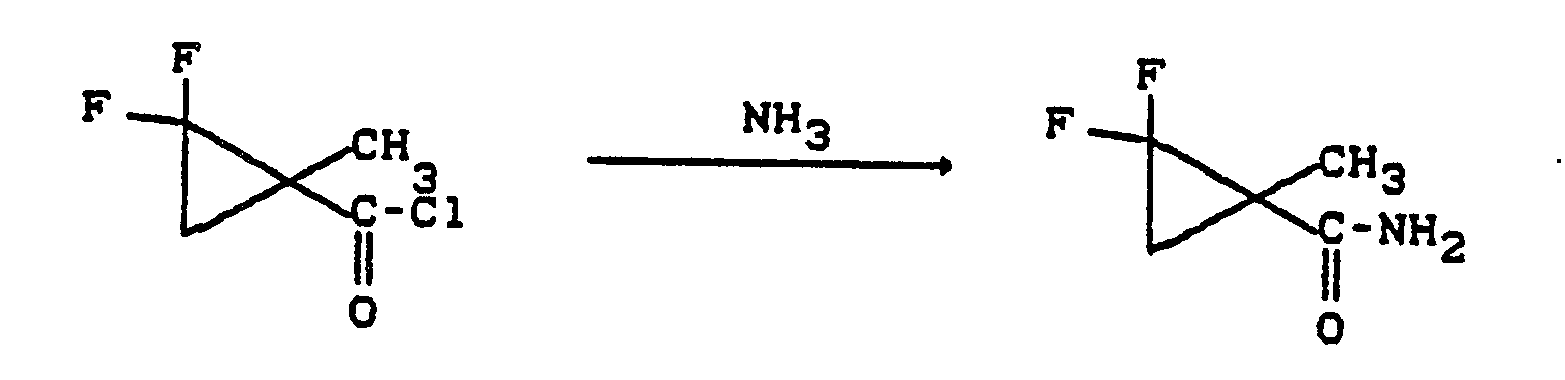
- 2,2-difluorocyclopropyl derivatives of the formula (Ib) are reacted with an excess of ammonia.
- the procedure is such that the 2,2-difluorocyclopropyl derivative of the formula (Ib) is initially introduced in solution and ammonia gas is introduced until it is saturated.
- the processing takes place according to usual methods. In general, the procedure is such that the reaction mixture is concentrated under reduced pressure and the product which remains is stirred with water, suction filtered and dried.
- Cyclopropyl derivatives are generally defined by the formula (Id).
- R preferably has those meanings which have already been mentioned for the radical R in connection with the description of the substances of the formula (I) according to the invention.
- the 2,2-difluorocyclopropyl derivatives of the formula (Id) can be prepared by the process (c, variant ⁇ ) according to the invention.
- Suitable hydrohalic acids for carrying out process (d) according to the invention are preferably hydrochloric acid, hydrobromic acid or hydroiodic acid in the form of their aqueous solutions.
- Suitable diluents for carrying out process (d) according to the invention are all organic solvents customary for such reactions.
- Aliphatic or aromatic hydrocarbons such as hexane, benzene, toluene or xylene, can preferably be used.
- reaction temperatures can be varied within a certain range when carrying out process (d) according to the invention. In general, temperatures between 0 ° C and 150 ° C, preferably between 10 ° C and 100 ° C.
- bases of the compounds of the formula (Ie) are added, if appropriate in the presence of a diluent.
- the bases are preferably aqueous alkali metal solutions, such as sodium hydroxide solution or potassium hydroxide solution. Inert organic solvents or water can be considered as diluents.
- reaction temperatures can be varied within a substantial range in the preparation of the free amines by process (d) according to the invention. In general, temperatures between -10 ° C and + 50 ° C, preferably between 0 ° C and + 30 ° C.
- the compounds of the formula (Ie) are reacted with an excess of base.
- the processing takes place according to usual methods. In general, the procedure is such that the reaction mixture, if appropriate after prior reaction with water, is mixed with a water which is not very miscible with water extracted ganic solvent, the combined organic phases dried and concentrated and the remaining residue distilled.
- the 2,2-difluorocyclopropyl derivatives of the formula (I) according to the invention are suitable as intermediates for the synthesis of crop protection agents, in particular for the preparation of substances with fungicidal activity.
- the other 2,2-difluorocyclopropyl derivatives of the formula (I) can be used in a corresponding manner as intermediates for the synthesis of crop protection agents, in particular substances with a fungicidal activity.
- the 2,2-difluorocyclopropyl-hydroxyethyl-triazoles of the formula (V) and the hydroxalkynyl-azolyl derivatives of the formula (XVII) have a strong microbicidal action and can be used as fungicides.
- Fungicides are used in crop protection to combat Plasmodiophoromycetes, Oomycetes, Chytridiomycetes, Zygomycetes, Ascomycetes, Basidiomycetes, Deuteromycetes.
- Xanthomonas species such as Xanthomonas oryzae
- Pseudomonas species such as Pseudomonas lachrymans
- Erwinia species such as Erwinia amylovora
- Pythium species such as Pythium ultimum
- Phytophthora species such as Phytophthora infestans
- Pseudoperonospora species such as Pseudoperonospora humuli or Pseudoperonospora cubense
- Plasmopara species such as Plasmopara viticola
- Peronospora species such as Peronospora pisi or P.
- brassicae Erysiphe species, such as Erysiphe graminis; Sphaerotheca species, such as Sphaerotheca fuliginea; Podosphaera species, such as Podosphaera leucotricha; Venturia species, such as Venturia inaequalis; Pyrenophora species, such as Pyrenophora teres or P.
- Drechslera Syn: Helminthosporium
- Cochliobolus species such as Cochliobolus sativus
- Drechslera Syn: Helminthosporium
- Uromyces species such as Uromyces appendiculatus
- Puccinia species such as Puccinia recondita
- Tilletia species such as Tilletia caries
- Ustilago species such as Ustilago nuda or Ustilago avenae
- Pellicularia species such as Pellicularia sasakii
- Pyricularia species such as Pyricularia oryzae
- Fusarium species such as Fusarium culmorum
- Botrytis species such as Botrytis cinerea
- Septoria species such as Septoria nodorum
- Leptosphaeria species such as Leptosphaeria nodorum
- Cercospora species such as Botrytis cinerea
- Septoria species such as
- the active compounds of the formulas (V) and (XVII) are particularly suitable for combating cereal diseases, such as Erysiphe graminis, Puccinia recondita, Cochliobolus sativus, Pyrenophora teres, Leptospaeria nodorum and barley mildew; also from rice diseases such as Pyricularia oryzae and Pellicularia sasakii; as well as of Venturia species and cucumber mildew.
- cereal diseases such as Erysiphe graminis, Puccinia recondita, Cochliobolus sativus, Pyrenophora teres, Leptospaeria nodorum and barley mildew
- rice diseases such as Pyricularia oryzae and Pellicularia sasakii
- the substances also have a very good in vitro effect.
- the active compounds of the formulas (V) and (XVII) can be converted into the customary formulations, such as solutions, emulsions, suspensions, powders, foams, pastes, granules, aerosols, very fine encapsulations in polymeric substances and in coating compositions for seeds, and ULV formulations .
- formulations are prepared in a known manner, for example by mixing the active ingredients with extenders, that is to say liquid solvents, pressurized liquefied gases and / or solid carriers, optionally using surface-active agents, that is to say emulsifiers and / or dispersants and / or foam-generating agents. If water is used as an extender, organic solvents can, for example, also be used as auxiliary solvents.
- extenders that is to say liquid solvents, pressurized liquefied gases and / or solid carriers, optionally using surface-active agents, that is to say emulsifiers and / or dispersants and / or foam-generating agents.
- surface-active agents that is to say emulsifiers and / or dispersants and / or foam-generating agents.
- organic solvents can, for example, also be used as auxiliary solvents.
- liquid solvents aromatics, such as xylene, toluene, or alkylnaphthalenes, chlorinated aromatics or chlorinated aliphatic hydrocarbons, such as chlorobenzenes, chlorethylenes or methylene chloride, aliphatic hydrocarbons, such as cyclohexane or paraffins, for example petroleum fractions, alcohols, such as butanol or glycol as well as their ethers and esters, ketones such as acetone, methyl ethyl ketone, methyl isobutyl ketone or cyclohexanone, strongly polar solvents such as dimethylformamide and dimethyl sulfoxide, and water;
- Liquefied gaseous extenders or carriers mean liquids which are at normal temperature and under normal pressure are gaseous, for example aerosol propellants, such as halogenated hydrocarbons and butane, propane, nitrogen and carbon dioxide;
- Solid carrier materials are suitable: for example natural rock powders
- Adhesives such as carboxymethylcellulose, natural and synthetic polymers in the form of powders, granules or latices, such as gum arabic, polyvinyl alcohol, polyvinyl acetate, and also natural phospholipids, such as cephalins and lecithins, and synthetic phospholipids can be used in the formulations.
- Other additives can be mineral and vegetable oils.
- Dyes such as inorganic pigments, e.g. Iron oxide, titanium oxide, ferrocyan blue and organic dyes such as alizarin, azo and metal phthalocyanine dyes and trace nutrients such as salts of iron, manganese, boron, copper, cobalt, molybdenum and zinc can be used.
- the formulations generally contain between 0.1 and 95 percent by weight of active compound, preferably between 0.5 and 90%.
- the active compounds of the formulas (V) and (XVII) can be present in the formulations in a mixture with other known active compounds, such as fungicides, insecticides, acaricides and herbicides, and also mixtures with fertilizers and other growth regulators.
- the active compounds of the formulas (V) and (XVII) can be used as such, in the form of their formulations or the use forms prepared therefrom, such as ready-to-use solutions, emulsifiable concentrates, emulsions, foams, suspensions, wettable powders, pastes, soluble powders, dusts and granules . They are used in the customary manner, for example by watering, spraying, atomizing, scattering, dusting, foaming, brushing, etc. It is also possible to apply the active ingredients by the ultra-low-volume process or to prepare the active ingredient or the active ingredient itself to inject the soil. The seeds of the plants can also be treated.
- the application rate of active ingredients of the formulas (V) and (XVII) can be varied within a substantial range, depending on the type of application.
- the active substance concentrations in the treatment of parts of plants in the use forms are generally between 1 and 0.0001% by weight, preferably between 0.5 and 0.001%.
- amounts of active ingredient of 0.001 to 50 g per kilogram of seed, preferably 0.01 to 10 g are generally required.
- active ingredient concentrations of 0.00001 to 0.1% by weight, preferably 0.0001 to 0.02% are required at the site of action.
- Ozone is passed into a solution of 30 g (0.25 mol) of 2,2-difluoro-1-methyl-1-vinyl-cyclopropane in 250 ml of methanol at -78 ° C. with stirring.
- a solution of 50 g (0.4 mol) of trimethyl phosphite in 50 ml of methanol is then added dropwise and the mixture is left to stir at -78 ° C. for a further hour.
- the reaction mixture is then slowly warmed to room temperature and then poured onto water.
- the resulting mixture is extracted several times with diethyl ether, dried like combined organic phases and distilled under reduced pressure.
- a mixture of 13 g of dimethyl sulfide and 4.8 g of dimethyl sulfate is first stirred at room temperature for 2 hours and then with 18 ml of tert-butanol and with 8.9 g of [2- (4-chlorophenyl) ethyn-1-yl] - (2,2-difluoro-1-methylcycloprop-1-yl) ketone added.
- the mixture is stirred at room temperature for 30 minutes, cooled to 10 ° C. and a solution of 4.5 g of potassium tert-butoxide in 32 ml of tert-butanol is added dropwise with stirring over the course of one hour.
- the reaction mixture is stirred for a further 3 hours at 10 ° C.
- active compound 1 part by weight of active compound is mixed with the stated amounts of solvent and emulsifier and the concentrate is diluted with water to the desired concentration.
- the plants are placed in a greenhouse at a temperature of approx. 20 ° C and a relative humidity of approx. 80% in order to promote the development of mildew pustules.
- Evaluation is carried out 7 days after the inoculation.
- Solvent 100 parts by weight of dimethylformamide Emulsifier: 0.025 part by weight of alkylaryl polyglycol ether
- active compound 1 part by weight of active compound is mixed with the stated amounts of solvent and emulsifier and the concentrate is diluted with water to the desired concentration.
- the plants are placed in a greenhouse at a temperature of approx. 20 ° C and a relative humidity of approx. 80% in order to promote the development of rust pustules.
- Evaluation is carried out 10 days after the inoculation.
- active compound 1 part by weight of active compound is mixed with the stated amounts of solvent and emulsifier and the concentrate is diluted with water to the desired concentration.
- the plants are then placed in a greenhouse at 20 ° C. and a relative humidity of approx. 70%.
- Evaluation is carried out 12 days after the inoculation.
- active compound 1 part by weight of active compound is mixed with the stated amounts of solvent and emulsifier and the concentrate is diluted with water to the desired concentration.
- the plants are placed in a greenhouse at a temperature of approx. 20 ° C and a relative humidity of approx. 80% in order to promote the development of mildew pustules.
- Evaluation is carried out 7 days after the inoculation.
- active compound 1 part by weight of active compound is mixed with the stated amounts of solvent and emulsifier and the concentrate is diluted with water to the desired concentration.
- the plants are then placed in the greenhouse under intensive exposure for 9 days at 20 to 22 ° C. and a relative atmospheric humidity of 70 to 80%.
- Evaluation is carried out 10 days after the inoculation.
- active compound 1 part by weight of active compound is mixed with the stated amount of solvent and the concentrate is diluted to the desired concentration with water and the stated amount of emulsifier.
- the disease infestation is evaluated 4 days after the inoculation.
Landscapes
- Chemical & Material Sciences (AREA)
- Organic Chemistry (AREA)
- Chemical Kinetics & Catalysis (AREA)
- Life Sciences & Earth Sciences (AREA)
- Agronomy & Crop Science (AREA)
- Pest Control & Pesticides (AREA)
- Plant Pathology (AREA)
- Health & Medical Sciences (AREA)
- Engineering & Computer Science (AREA)
- Dentistry (AREA)
- General Health & Medical Sciences (AREA)
- Wood Science & Technology (AREA)
- Zoology (AREA)
- Environmental Sciences (AREA)
- Organic Low-Molecular-Weight Compounds And Preparation Thereof (AREA)
- Agricultural Chemicals And Associated Chemicals (AREA)
Abstract
Description
- Die vorliegende Erfindung betrifft neue 2,2-Difluorcyclopropyl-Derivate, mehrere Verfahren zu deren Herstellung und deren Verwendung als Zwischenprodukte zur Synthese von Verbindungen mit fungizider Wirksamkeit.
- Es sind bereits bestimmte Cyclopropyl-Derivate und deren Verwendung als Zwischenprodukte zur Herstellung von Azolyl-Derivaten mit fungiziden Eigenschaften bekannt (vgl. EP-OS 0 040 345 und EP-OS 0 180 136). So lassen sich 1-(4-Chlorphenoxy)-2-cyclopropyl-3-(1,2,4-triazol-1-yl)-propan-2-ol, 1-(4-Chlorphenyl)-1-(1-chlor-cycloprop-1-yl)-2-(1,2,4-triazol-1-yl)-ethan-1-ol und 1-(4-Chlorphenyl)-1-[1-(2,4-dichlorphenoxy)-cycloprop-1-yl]-2-(1,2,4-triazol-1-yl)-ethan-1-ol aus entsprechenden Cyclopropyl-Derivaten herstellen und zur Bekämpfung von Pilzen verwenden. Die Wirksamkeit dieser Stoffe ist gut, läßt aber bei niedrigen Aufwandmengen in manchen Fällen zu wünschen übrig.
- Es wurden nun neue 2,2-Difluorcyclopropyl-Derivate der Formel

R für Alkyl, gegebenenfalls substituiertes Aryl oder gegebenenfalls substituiertes Aralkyl steht und
X für Hydroxymethyl, 2-Hydroxyethyl, Isocyanato, Amino, Amino-hydrohalogenid oder den Rest der Formel -CO-R¹ steht, worin
R¹ für Wasserstoff, Hydroxy, Alkoxy, Alkyl, Halogen oder Amino steht,
gefunden. - Weiterhin wurde gefunden, daß sich 2,2-Difluorcyclopropyl-Derivate der Formel (I) herstellen lassen, indem man
- a) Vinylcyclopropan-Derivate der Formel

R die oben angegebene Bedeutung hat,
entweder- α) mit einem starken Oxidationsmittel in Gegenwart eines Verdünnungsmittels umsetzt,
oder - ß) mit Ozon in Gegenwart eines Verdünnungsmittels sowie mit einem Reduktionsmittel umsetzt,
oder - γ) zunächst in einer ersten Stufe mit Diboran in Gegenwart eines Verdünnungsmittels umsetzt und das dabei entstehende Produkt danach in einer zweiten Stufe mit einem starken Oxidationsmittel in Gegenwart eines Verdünnungsmittels umsetzt,
- α) mit einem starken Oxidationsmittel in Gegenwart eines Verdünnungsmittels umsetzt,
- b) 2,2-Difluorocyclopropyl-Derivate der Formel

R die oben angegebene Bedeutung hat
entweder- α) mit einem Halogenierungsmittel gegebenenfalls in Gegenwart eines Verdünnungsmittels umsetzt,
oder - ß) mit einem komplexen Hydrid in Gegenwart eines Verdünnungsmittels umsetzt,
oder - γ) mit metallorganischen Verbindungen der Formel
R²-Li (III)
in welcher
R² für Alkyl steht,
in Gegenwart eines Verdünnungsmittels umsetzt,
oder
- α) mit einem Halogenierungsmittel gegebenenfalls in Gegenwart eines Verdünnungsmittels umsetzt,
- c) 2,2-Difluorcyclopropyl-Derivate der Formel

R die oben angegebene Bedeutung hat und
Hal für Halogen steht,
entweder- α) mit einem Azidgruppen übertragenden Reagenz in Gegenwart eines Verdünnungsmittels umsetzt und die dabei entstehenden Verbindungen der Formel

R die oben angegebene Bedeutung hat,
in Gegenwart eines Verdünnungsmittels thermisch zersetzt,
oder - ß) mit Alkoholen der Formel
R³-OH (IV)
in welcher
R³ für Alkyl steht,
gegebenenfalls in Gegenwart eines Katalysators sowie gegebenenfalls in Gegenwart eines Verdünnungsmittels umsetzt,
oder - γ) mit Ammoniak gegebenenfalls in Gegenwart eines Verdünnungsmittels umsetzt,
oder
- α) mit einem Azidgruppen übertragenden Reagenz in Gegenwart eines Verdünnungsmittels umsetzt und die dabei entstehenden Verbindungen der Formel
- d) 2,2-Difluorcyclopropyl-Derivate der Formel

R die oben angegebene Bedeutung hat
mit Halogenwasserstoff-Säure in Gegenwart eines Verdünnungsmittels umsetzt und gegebenenfalls die dabei entstehenden Verbindungen der Formel
R die oben angegebene Bedeutung hat und
Hal′ für Halogen steht,
mit Basen gegebenenfalls in Gegenwart eines Verdünnungsmittels umsetzt. - Schließlich wurde gefunden, daß sich die neuen 2,2-Difluorcyclopropyl-Derivate der Formel (I) sehr gut als Zwischenprodukte zur Herstellung von 2,2-Difluorcyclopropyl-hydroxyethyl-azolen mit fungizider Wirksamkeit verwenden lassen.
- Überraschenderweise zeigen die aus den erfindungsgemäßen 2,2-Difluorcyclopropyl-Derivaten der Formel (I) herstellbaren 2,2-Difluorcyclopropyl-hydroxyethyl azole eine bessere fungizide Wirksamkeit als 1-(4-Chlorphenoxy)-2-cyclopropyl-3-(1,2,4-triazol-1-yl)-propan-2-ol, 1-(4-Chlorphenyl)-1-(1-chlor-cycloprop-1-yl)-2-(1,2,4-triazol-1-yl)-ethan-1-ol und 1-(4-Chlorphenyl)-1-[1-(2,4-dichlorphenoxy)-cycloprop-1-yl]-2-(1,2,4-triazol-1-yl)-ethan-1-ol, welches konstitutionell ähnliche, vorbekannte Wirkstoffe gleicher Wirkungsrichtung sind.
- Die erfindungsgemäßen 2,2-Difluorcyclopropyl-Derivate sind durch die Formel (I) allgemein definiert. Bevorzugt sind diejenigen Verbindungen, in denen
R für Alkyl mit 1 bis 4 Kohlenstoffatomen oder für Phenyl steht, das einfach bis dreifach, gleichartig oder verschieden substituiert sein kann durch Halogen, Alkyl mit 1 bis 4 Kohlenstoffatomen, Alkoxy mit 1 bis 4 Kohlenstoffatomen, Alkylthio mit 1 bis 4 Kohlenstoffatomen, Halogenalkyl mit 1 oder 2 Kohlenstoffatomen und 1 bis 5 gleichen oder verschiedenen Halogenatomen, Halogenalkoxy mit 1 oder 2 Kohlenstoffatomen und 1 bis 5 gleichen oder verschiedenen Halogenatomen, Halogenalkylthio mit 1 oder 2 Kohlenstoffatomen und 1 bis 5 gleichen oder verschiedenen Halogenatomen, Alkoximinomethyl mit 1 bis 4 Kohlenstoffatomen im Alkylteil und 1 bis 4 Kohlenstoffatomen im Alkoxyteil, gegebenenfalls durch Alkyl mit 1 oder 2 Kohlenstoffatomen und/oder Halogen substituiertes Phenoximinoalkyl mit 1 bis 4 Kohlenstoffatomen im Alkylteil, gegebenenfalls durch Alkyl mit 1 oder 2 Kohlenstoffatomen und/oder Halogen substituiertes Phenyl und/oder gegebenenfalls durch Alkyl mit 1 oder 2 Kohlenstoffatomen und/oder Halogen substituiertes Phenoxy,
oder
R für Benzyl steht das im Phenylteil einfach bis dreifach, gleichartig oder verschieden substituiert sein kann durch Halogen, Alkyl mit 1 bis 4 Kohlenstoffatomen, Alkoxy mit 1 bis 4 Kohlenstoffatomen, Alkylthio mit 1 bis 4 Kohlenstoffatomen, Halogenalkyl mit 1 oder 2 Kohlenstoffatomen und 1 bis 5 gleichen oder verschiedenen Halogenatomen, Halogenalkoxy mit 1 oder 2 Kohlenstoffatomen und 1 bis 5 gleichen oder verschiedenen Halogenatomen, Halogenalkylthio mit 1 oder 2 Kohlenstoffatomen und 1 bis 5 gleichen oder verschiedenen Halogenatomen, Alkoximinoalkyl mit 1 bis 4 Kohlenstoffatomen im Alkylteil und 1 bis 4 Kohlenstoffatomen im Alkoxyteil, gegebenenfalls durch Alkyl mit 1 oder 2 Kohlenstoffatomen und/oder Halogen substituiertes Phenoximinoalkyl mit 1 bis 4 Kohlenstoffatomen im Alkylteil, gegebenenfalls durch Alkyl mit 1 oder 2 Kohlenstoffatomen und/oder Halogen substituiertes Phenyl oder gegebenenfalls durch Alkyl mit 1 oder 2 Kohlenstoffatomen und/oder Halogen substituiertes Phenoxy,
und
X für Hydroxymethyl, 2-Hydroxyethyl, Isocyanato, Amino, Amino-hydrochlorid, -hydrobromid oder -hydroiodid steht oder für den Rest der Formel -COR¹ steht, worin
R¹ für Wasserstoff, Hydroxy, Alkoxy mit 1 bis 6 Kohlenstoffatomen, Alkyl mit 1 bis 6 Kohlenstoffatomen, Chlor, Brom, Iod oder Amino steht. - Besonders bevorzugt sind diejenigen 2,2-Difluorcyclopropyl-Derivate der Formel (I),
in denen
R für Methyl, Ethyl, Isopropyl, tert.-Butyl steht, oder für gegebenenfalls einfach bis zweifach, gleich oder verschieden durch Fluor, Chlor oder Methyl substituiertes Phenyl steht, oder für Benzyl steht, das im Phenylteil einfach oder zweifach, gleichartig oder verschieden substituiert sein kann durch Fluor, Chlor und/oder Methyl,
und
X für Hydroxymethyl, 2-Hydroxymethyl, Isocyanato, Amino, Amino-hydrochlorid, -hydrobromid oder -hydroiodid steht oder für den Rest der Formel -CO-R¹ steht, worin
R¹ für Wasserstoff, Hydroxy, Alkoxy mit 1 bis 4 Kohlenstoffatomen, Alkyl mit 1 bis 4 Kohlenstoffatomen, Chlor, Brom, Iod oder Amino steht. - Ganz besonders bevorzugt sind diejenigen 2,2-Difluorcyclopropyl-Derivate der Formel (I),
in denen
R für Methyl, Ethyl, gegebenenfalls einfach oder zweifach durch Fluor, Chlor und/oder Methyl substituiertes Phenyl oder Benzyl steht,
und
X für Hydroxymethyl, 2-Hydroxyethyl, Isocyanato, Amino, Amino-hydrochlorid, -hydrobromid oder -hydroiodid steht oder für den Rest der Formel -CO-R¹ steht, worin
R¹ für Wasserstoff, Hydroxy, Methoxy, Ethoxy, Isopropoxy, n-Butoxy, Methyl, Ethyl, Isopropyl, n-Butyl, Chlor, Brom, Iod oder Amino steht. - Verwendet man 2,2-Difluor-1-methyl-1-vinyl-cyclopropan als Ausgangsstoff und Kaliumpermanganat als Oxidationsmittel, so kann der Verlauf des erfindungsgemäßen Verfahrens (a, Variante α) durch das folgende Formelschema veranschaulicht werden:

- Verwendet man 2,2-Difluor-1-methyl-1-vinyl-cyclopropan als Ausgangsstoff und Ozon als Reaktionskomponente, so kann der Verlauf des erfindungsgemäßen Verfahrens (a, Variante ß) durch das folgende Formeschema veranschaulicht werden:

- Verwendet man 2,2-Difluor-1-methyl-1-vinyl-cyclopropan als Ausgangsstoff und Diboran sowie anschließend Wasserstoffperoxid als Reaktionskomponenten, so kann der Verlauf des erfindungsgemäßen Verfahrens (a, Variante γ) durch das folgende Formelschema veranschaulicht werden:

- Verwendet man 2,2-Difluor-1-methyl-1-cyclopropancarbonsäure als Ausgangsstoff und Thionylchlorid als Halogenierungsmittel, so kann der Verlauf des erfindungsgemäßen Verfahrens (b, Variante α) durch das folgende Formeschema veranschaulicht werden:

- Verwendet man 2,2-Difluor-1-methyl-1-cyclopropancarbonsäure als Ausgangsstoff und Lithiumaluminiumhydrid als komplexes Hydrid, so kann der Verlauf des erfindungsgemäßen Verfahrens (b, Variante ß) durch das folgende Formelschema veranschaulicht werden:

- Verwendet man 2,2-Difluor-1-methyl-cyclopropancarbonsäure als Ausgangsstoff und Methyl-lithium als metall organische Verbindung, so kann der Verlauf des erfindungsgemäßen Verfahrens (b, Variante γ) durch das folgende Formeschema veranschaulicht werden:

- Verwendet man 2,2-Difluor-1-methyl-1-cyclopropancarbonsäure als Ausgangsstoff und Trimethylsilylazid als Reaktionskomponente, so kann der Verlauf des erfindungsgemäßen Verfahrens (c, Variante α) durch das folgende Formelschema veranschaulicht werden:

- Verwendet man 2,2-Difluor-1-methyl-cyclopropan-carbonsäurechlorid als Ausgangsstoff und Ethanol als Reaktionskomponente, so kann der Verlauf des erfindungsgemäßen Verfahrens (c, Variante ß) durch das folgende Formelschema veranschaulicht werden:

- Verwendet man 2,2-Difluor-1-methyl-1-cyclopropan-carbonsäure-chlorid als Ausgangsstoff und Ammoniak als Reaktionskomponente, so kann der Verlauf des erfindungsgemäßen Verfahrens (c, Variante γ) durch das folgende Formelschema veranschaulicht werden:
- Verwendet man 2,2-Difluor-1-methyl-cyclopropyl-isocyanat-als Ausgangsstoff und konzentrierte Salzsäure als Reaktionskomponente, so kann der Verlauf des erfindungsgemäßen Verfahrens (d) durch das folgende Formelschema veranschaulicht werden:

- Die bei der Durchführung des erfindungsgemäßen Verfahrens (a) als Ausgangsstoffe benötigten Vinylcyclopropan-Derivate sind durch die Formel (II) allgemein definiert. In dieser Formel steht R vorzugsweise für diejenigen Reste, die bereits im Zusammenhang mit der Beschreibung der erfindungsgemäßen Stoffe der Formel (I) vorzugsweise für R genannt wurden.
- Die Vinylcyclopropan-Derivate der Formel (II) sind bekannt oder lassen sich nach prinzipiell bekannten Verfahren herstellen (vgl. Liebigs Ann. Chem. 710, 17-35 (1967) und Chem. Ber. 109, 2351-2369 (1976)).
- Als starke Oxidationsmittel kommen bei der Durchführung des erfindungsgemäßen Verfahrens (a, Variante α) alle diejenigen Oxidationsmittel in Betracht, die zur Spaltung von olefinischen Doppelbindungen geeignet sind. Vorzugsweise verwendbar ist Kaliumpermanganat.
- Als Verdünnungsmittel kommen bei der Durchführung der Variante α des erfindungsgemäßen Verfahrens (a) alle für derartige Umsetzungen üblichen Lösungsmittel in Frage. Vorzugsweise verwendbar ist Wasser.
- Die Temperaturen können bei der Durchführung des erfindungsgemäßen Vefahrens (a, Variante α) innerhalb eines bestimmten Bereiches variiert werden. Im allgemeinen arbeitet man bei Temperaturen zwiscne 0°C und 60°C, vorzugsweise zwischen 10°C und 50°C.
- Bei der Durchführung des erfindungsgemäßen Verfahrens (a, Variante α) arbeitet man ebenso wie bei den anderen in dieser Anmeldung beschriebenen Verfahren im allgemeinen unter Normaldruck. Es ist jedoch jeweils auch möglich, unter erhöhtem oder vermindertem Druck zu arbeiten.
- Bei der Durchführung des erfindungsgemäßen Verfahrens (a, Variante α) setzt man auf 1 Mol an Vinylcyclopropan-Derivat der Formel (II) im allgemeinen 2 bis 3 Mol an starkem Oxidationsmittel ein. Die Aufarbeitung erfolgt nach üblichen Methoden.
- Als Reduktionsmittel kommen bei der Durchführung des erfindungsgemäßen Verfahrens (a, Variante ß) alle für derartige Ozonolysen üblichen Reduktionsmittel in Frage. Vorzugsweise verwendbar sind Triphenylphosphin, Trimethylphosphit, Dimethylsulfid und Wasserstoff in Gegenwart eines Katalysators.
- Als Verdünnungsmittel kommen bei der Durchführung des erfindungsgemäßen Verfahrens (a, Variante ß) alle für derartige Ozonolysen üblichen Solventien in Betracht. Vorzugsweise verwendbar sind Alkohole, wie Methanol oder Ethanol.
- Die Reaktionstemperaturen lassen sich bei der Durchführung des erfindungsgemäßen Verfahrens (a, Variante ß) innerhalb eines bestimmten Bereiches variieren. Im allgemeinen arbeitet man bei Temperaturen zwischen - 80°C und -20°C, vorzugsweise zwischen -80°C und - 40°C.
- Bei der Durchführung des erfindungsgemäßen Verfahrens (a, Variante ß) leitet man Ozon durch das Reaktionsgemisch bis zur Beendigung der Umsetzung. Die Aufarbeitung erfolgt nach üblichen Methoden. Im allgemeinen geht man so vor, daß man eine Überschuß an Reduktionsmittel hinzugibt und zunächst weiter unter Kühlung rührt. Nach dem Erwärmen auf Raumtemperatur verdünnt man mit Wasser, extrahiert mit einem in Wasser wenig löslichen organischen Solvens, trocknet die vereinigten organischen Phasen und destilliert.
- Das bei der Durchführung des erfindungsgemäßen Verfahrens (a, Variante γ) benötigte Diboran wird im allgemeinen frisch erzeugt, z.B. durch Umsetzung von Bortrifluorid-etherat mit Natriumborhydrid in Gegenwart eines inerten organischen Verdünnungsmittels, wie z.B. Diglyme. Das so erzeugte Diboran wird direkt weiter umgesetzt.
- Als Verdünnungsmittel kommen bei der Durchführung der ersten Stufe des erfindungsgemäßen Verfahrens (a, Variante γ) alle für derartige Umsetzungen üblichen inerten organischen Solventien in Frage. Vorzugsweise verwendbar sind Ether, wie Diethylether, Dioxan oder Tetrahydrofuran.
- Bei der Durchführung der ersten Stufe des erfindungsgemäßen Verfahrens (a, Variante γ) arbeitet man gegebenenfalls unter Schutzgasatmosphäre, vorzugsweise unter Stickstoff oder unter Argon.
- Die Reaktionstemperaturen können bei der Durchführung des erfindungsgemäßen Verfahrens (a, Variante γ) sowohl in der ersten als auch in der zweiten Stufe innerhalb eines bestimmten Breiches variiert werden. Im allgemeinen arbeitet man bei Temperaturen zwischen 0°C und 60°C, vorzugsweise zwischen 10°C und 50°C.
- Bei der Durchführung der ersten Stufe des erfindungsgemäßen Verfahrens (a, Variante γ) setzt man auf 1 Mol an Vinylcyclopropan-Derivat der Formel (II) im allgemeinen eine stöchiometrische Menge oder auch einen Unterschuß an Diboran ein. Nach beendeter Umsetzung geht man im allgemeinen so vor, daß man überschüssiges Vinylcyclopropan-Derivat der Formel (II) und Lösungsmittel unter vermindertem Druck entfernt. Der Rückstand wird direkt weiter umgesetzt.
- Als Verdünnungsmittel kommen auch bei der Durchführung der zweiten Stufe des erfindungsgemäßen Verfahrens (a, Variante γ) vorzugsweise Ether, wie Diethylether, Tetrahydrofuran und Dioxan in Frage.
- Als starke Oxidationsmittel kommen bei der Durchführung der zweiten Stufe des erfindungsgemäßen Verfahrens (a, Variante γ) alle üblichen starken Oxidationsmittel in Frage. Vorzugsweise verwendbar ist Wasserstoffperoxid.
- Das Wasserstoffperoxid kann bei der Durchführung des erfindungsgemäßen Verfahrens (a, Variante γ) in Form von verdünnten wäßrigen Lösungen und in Gegenwart von wäßriger Alkalilauge, wie z.B. wäßriger Natronlauge, eingesetzt werden.
- Bei der Durchführung der zweiten Stufe des erfindungsgemäßen Verfahrens (a, Variante γ) geht man im allgemeinen so vor, daß man das aus der ersten Stufe erhaltene Produkt in einem Lösungsmittel aufnimmt und nacheinander jeweils mit einem Überschuß an wäßriger Alkalilauge und wäßriger Wasserstoffperoxid-Lösung oder einem ähnlichen Oxidationsmittel versetzt. Zur Aufarbeitung geht man im allgemeinen so vor, daß man mehrfach mit einem in Wasser wenig löslichen organischen Lösungsmittel extrahiert, die vereinigten organischen Phasen trocknet und unter vermindertem Druck destilliert.
- Die bei der Durchführung des erfindungsgemäßen Verfahrens (b) als Ausgangsstoffe benötigten 2,2-Difluorcyclopropyl-Derivate sind durch die Formel (Ia) allgemein definiert. In dieser Formel hat R vorzugsweise diejenigen Bedeutungen, die bereits im Zusammenhang mit der Beschreibung der erfindungsgemäßen Stoffe der Formel (I) vorzugsweise für diesen Rest genannt wurden.
- Die 2,2-Difluorcyclopropyl-Derivate der Formel (Ia) lassen sich nach dem erfindungsgemäßen Verfahren (a, Variante α) herstellen.
- Als Halogenierungsmittel kommen bei der Durchführung des erfindungsgemäßen Verfahrens (b, Variante α) alle diejenigen Stoffe in Frage, die zur Umwandlung von Säuren in Säurehalogenide geeignet sind. Vorzugsweise verwendbar sind Thionylchlorid, Sulfurylchlorid, Phosphortrichlorid, Thionylbromid und Sulfurylbromid. Die Säurefluoride und Säureiodide lassen sich aus den entsprechenden Bromiden oder Chloriden nach üblichen Methoden herstellen.
- Als Verdünnungsmittel kommen bei der Durchführung des erfindungsgemäßen Verfahrens (b, Variante α) alle für derartige Reaktionen üblichen inerten organischen Solventien in Betracht. Vorzugsweise wird das jeweilige Halogenierungsmittel gleichzeitig auch als Verdünnungsmittel benutzt.
- Die Reaktionstemperaturen können bei der Durchführung des erfindungsgemäßen Verfahrens (b, Variante α) innerhalb eines größeren Bereiches variiert werden. Im allgemeinen arbeitet man bei Temperaturen zwischen 0°C und 150°C, vorzugsweise zwischen 20°C und 80°C.
- Bei der Durchführung des erfindungsgemäßen Verfahrens (b, Variante α) setzt man auf 1 Mol 2,2-Difluorocyclopropyl-Derivat der Formel (Ia) 1 bis 2 Äquivalente oder auch einen größeren Überschuß an Halogenierungsmittel ein. Die Aufarbeitung erfolgt nach üblichen Methoden. Zur Herstellung von Säureiodiden setzt man Säurebromide mit Kaliumiodid um; während Säurefluoride aus anderen Säurehalogeniden durch Umsetzung mit Fluoriden, wie z.B. Natriumfluorid, Kaliumfluorid, Cäsiumfluorid oder Ammoniumfluorid, oder durch Umsetzung mit Fluorwasserstoffsäure zugänglich sind.
- Als komplexes Hydrid kommt bei der Durchführung des erfindungsgemäßen Verfahrens (b, Variante ß) vorzugsweise Lithiumaluminiumhydrid in Betracht.
- Als Verdünnungsmittel kommen bei der Durchführung des erfindungsgemäßen Verfahrens (b, Variante ß) vorzugsweise Ether, wei Diethylether, Dioxan oder Tetrahydrofuran, in Frage.
- Die Reaktionstemperaturen können bei der Durchführung des erfindungsgemäßen Verfahrens (b, Variante ß) innerhalb eines größeren Bereiches variiert werden. Im allgemeinen arbeitet man bei Temperaturen zwischen -10°C und +100°C, vorzugsweise zwischen 10°C und 70°C.
- Bei der Durchführung des erfindungsgemäßen Verfahrens (b, Variante ß) setzt man auf 1 Mol an 2,2-Difluorcyclopropyl-Derivat der Formel (Ia) im allgemeinen einen Überschuß an komplexem Hydrid ein. Die aufarbeitung erfolgt nach üblichen Methoden. Im allgemeinen geht man in der Weise vor, daß man durch Zugabe von Wasser und verdünnter anorganischer Säure schonend hydrolysiert, dann mit einem Solvens extrahiert, die vereinigten organischen Phasen trocknet und destilliert.
- Die bei der Durchführung des erfindungsgemäßen Verfahrens (b, Variante γ) als Reaktionskomponenten benötigten metallorganischen Verbindungen sind durch die Formel (III) allgemein definiert. In dieser Formel steht R² vorzugsweise für Alkyl mit 1 bis 6 Kohlenstoffatomen.
- Die metallorganischen Verbindungen der Formel (III) sind allgemein bekannte Verbindungen der organischen Chemie.
- Als Verdünnungsmittel kommen bei der Durchführung des erfindungsgemäßen Verfahrens (b, Variante γ) alle für derartige Umsetzungen üblichen inerten organischen Solventien in Frage. Vorzugsweise verwendbar sind Ether, wie Diethylether, Dioxan oder Tetrahydrofuran.
- Die Reaktionstemperaturen können bei der Durchführung des erfindungsgemäßen Verfahrens (b, Variante γ) innerhalb eines größeren Bereiches variiert werden. Im allgemeinen arbeitet man bei Temperaturen zwischen -100°C und +50°C, vorzugsweise zwischen -78°C und 0°C.
- Bei der Durchführung des erfindungsgemäßen Verfahrens (b, Variante γ) arbeitet man unter Schutzgasatmosphäre, wie z.B. unter Argon oder Stickstoff.
- Bei der Durchführung des erfindungsgemäßen Verfahrens (b, Variante γ) setzt man auf 1 Mol an 2,2-Difluorcyclopropyl-Derivat der Formel (Ia) im allgemeinen 1,5 bis 3,0 Mol, vorzugsweise 2,0 Mol an metallorganischer Verbindung der Formel (III) ein. Die Aufarbeitung er folgt nach üblichen Methoden. Im allgemeinen geht man so vor, daß man das Reaktionsgemisch auf Eis und anorganische Säure gibt, die organische Phase abtrennt, die wäßrige Phase mit einem mit Wasser wenig mischbaren organischen Lösungsmittel extrahiert, die vereinigten organischen Phasen trocknet und destilliert.
- Die bei der Durchführung des erfindungsgemäßen Verfahrens (c, Variante α) als Ausgangsstoffe benötigten 2,2-Difluorcyclopropyl-Derivate sind durch die Formel (Ib) allgemein definiert. In dieser Formel hat R vorzugsweise diejenigen Bedeutungen, die bereits im Zusammenhang mit der Beschreibung der erfindungsgemäßen Stoffe der Formel (I) vorzugsweise für den Rest R genannt wurden. Hal steht vorzugsweise für Fluor, Chlor oder Brom.
- Die 2,2-Difluorcyclopropyl-Derivate der Formel (Ib) lassen sich nach dem erfindungsgemäßen Verfahren (b, Variante α) herstellen.
- Als Reagenzien zur Übertragung von Azid-Gruppen kommen bei der Durchführung des erfindungsgemäßen Verfahrens (c, Variante α) alle für derartige Umsetzungen üblichen Stoffe in Betracht. Vorzugsweise verwendbar ist Trimethylsilylazid.
- Als Verdünnungsmittel kommen bei der Durchführung des erfindungsgemäßen Verfahrens (c, Variante α) sowohl bei der Herstellung der Verbindungen der Formel (Ic) als auch bei deren thermischer Zersetzung alle für derartige Umsetzungen übliche inerten organischen Solventien in Frage. Vorzugsweise verwendbar sind ali phatische oder aromatische Kohlenwasserstoffe, wie Hexan, Benzol, Xylol oder Toluol.
- Die Reaktionstemperaturen können bei der Durchführung des erfindungsgemäßen Verfahrens (c, Variante α) innerhalb eines größeren Bereiches variiert werden. Im allgemeinen arbeitet man bei der Herstellung der Verbindungen der Formel (Ic) bei Temperaturen zwischen 0°C und 30°C, vorzugsweise zwischen 5°C und 25°C. Bei der anschließenden thermischen Zersetzung der Verbindungen der Formel (Ic) arbeitet man im allgemeinen zwischen 20°C und 120°C, vorzugsweise zwischen 25°C und 100°C.
- Bei der Durchführung des erfindungsgemäßen Verfahrens (c, Variante α) setzt man auf 1 Mol an 2,2-Difluorcyclopropyl-Derivat der Formel (Ib) vorzugsweise 1 bis 1,5 Mol an einem Azidgruppen übertragenden Reagenz ein. Das dabei intermediär entstehende Produkt der Formel (Ic) wird ohne Isolierung durch langsame Steigerung der Temperatur des Reaktionsgemisches thermisch zersetzt. Die anschließende Aufarbeitung erfolgt nach üblichen Methoden. Im allgemeinen geht man so vor, daß man das Reaktionsgemisch einer fraktionierten Destillation unterwirft.
- Die bei der Durchführung des erfindungsgemäßen Verfahrens (c, Variante ß) als Reaktionskomponenten be nötigten Alkohole sind durch die Formel (IV) allgemein definiert. In dieser Formel steht R³ vorzugsweise für Alkyl mit 1 bis 6 Kohlenstoffatomen.
- Die Alkohole der Formel (IV) sind allgemein bekannte Verbindungen der organischen Chemie.
- Als Katalysatoren kommen bei der Durchführung des erfindungsgemäßen Verfahrens (c, Variante ß) alle für die Herstellung von Estern aus Säuren oder Säurehalogeniden üblichen Reaktionsbeschleuniger in Frage. Vorzugsweise verwendbar sind anorganische Säuren, wie Schwefelsäure, oder auch starke organische Säuren, wie p-Toluolsulfonsäure. Ebenfalls verwendbar sind anorganische Basen, wie Natriumhydroxid, oder auch organische Basen, wie Pyridin oder tertiäre Amine.
- Als Verdünnungsmittel kommen bei der Durchführung des erfindungsgemäßen Verfahrens (c, Variante ß) alle für derartige Umsetzungen üblichen organischen Solventien in Betracht. Vorzugsweise fungiert im Überschuß eingesetzter Alkohol der Formel (IV) auch als Lösungsmittel.
- Die Reaktionstemperaturen können bei der Durchführung des erfindungsgemäßen Verfahrens (c, Variante ß) innerhalb eines größeren Bereiches variiert werden. Im allgemeinen arbeitet man bei Temperaturen zwischen 0°C und 150°C, vorzugsweise zwischen 20°C und 140°C.
- Bei der Durchführung des erfindungsgemäßen Verfahrens (c, Variante ß) setzt man auf 1 Mol an 2,2-Difluorcyclopropyl-Derivat der Formel (Ib) vorzugsweise 1 bis 3 Mol oder auch einen größeren Überschuß an Alkohol der Formel (IV) sowie eine katalytische Menge an Reaktionsbeschleuniger ein. Die Aufarbeitung erfolgt nach üblichen Methoden.
- Als Verdünnungsmittel kommen bei der Durchführung des erfindungsgemäßen Verfahrens (c, Variante γ) alle für derartige Umsetzungen üblichen inerten organischen Solventien in Frage. Vorzugsweise verwendbar sind Ether, wie Diethylether, Dioxan und Tetrahydrofuran.
- Die Reaktionstemperaturen können auch bei der Durchführung des erfindungsgemäßen Verfahrens (c, Variante γ) innerhalb eines bestimmten Bereiches variiert werden. Im allgemeinen arbeitet man bei Temperaturen zwischen 0°C und 60°C, vorzugsweise zwischen 10°C und 40°C.
- Bei der Durchführung des erfindungsgemäßen Verfahrens (c, Variante γ) setzt man 2,2-Difluorcyclopropyl-Derivate der Formel (Ib) mit einem Überschuß an Ammoniak um. Zweckmäßigerweise geht man dabei so vor, daß man das 2,2-Difluorcyclopropyl-Derivat der Formel (Ib) in Lösung vorlegt und bis zur Sättigung Ammoniak-Gas einleitet. Die Aufarbeitung erfolgt nach üblichen Methoden. Im allgemeinen geht man so vor, daß man das Reaktionsgemisch unter vermindertem Druck einengt und das dabei verbleibende Produkt mit Wasser verrührt, absaugt und trocknet.
- Die bei der Durchführung des erfindungsgemäßen Verfahrens (d) als Ausgangsstoffe benötigten 2,2-Difluor cyclopropyl-Derivate sind durch die Formel (Id) allgemein definiert. In dieser Formel hat R vorzugsweise diejenigen Bedeutungen, die bereits im Zusammenhang mit der Beschreibung der erfindungsgemäßen Stoffe der Formel (I) vorzugsweise für den Rest R genannt wurden.
- Die 2,2-Difluorcyclopropyl-Derivate der Formel (Id) lasen sich nach dem erfindungsgemäßen Verfahren (c, Variante α) herstellen.
- Als Halogenwasserstoffsäuren kommen bei der Durchführung des erfindungsgemäßen Verfahrens (d) vorzugsweise Chlorwasserstoffsäure, Bromwasserstoffsäure oder Iodwasserstoffsäure in Form ihrer wäßrigen Lösungen in Betracht.
- Als Verdünnungsmittel kommen bei der Durchführung des erfindungsgemäßen Verfahrens (d) alle für derartige Umsetzungen üblichen organischen Solventien in Frage, Vorzugsweise verwendbar sind aliphatische oder aromatische Kohlenwassertoffe, wie Hexan, Benzol, Toluol oder Xylol.
- die Reaktionstemperaturen können bei der Durchführung des erfindungsgemäßen Verfahrens (d) innerhalb eines bestimmten Breiches variiert werden. Im allgemeinen arbeitet man bei Temperaturen zwischen 0°C und 150°C, vorzugsweise zwischen 10°C und 100°C.
- Bei der Durchführung des erfindungsgemäßen Verfahrens (d) setzt man auf 1 Mol an 2,2-Difluorcyclopropyl-Derivat der Formel (Id) vorzugsweise 1 bis 5 Mol an Halogenwasserstoffsäure in Form einer wäßrigen Lösung ein. Die Aufarbeitung erfolgt nach üblichen Methoden. Im allgemeinen geht man in der Weise vor, daß man das Reaktionsgemisch unter vermindertem Druck einengt und den verbleibenden Rückstand gegebenenfalls nach üblichen Methoden reinigt.
- Sofern bei der Durchführung des erfindungsgemäßen Verfahrens (d) die Herstellung der freien Amine beabsichtigt ist, versetzt man die Verbindungen der Formel (Ie) mit Basen gegebenenfalls in Gegenwart eines Verdünnungsmittels. Als Basen kommen hierbei vorzugsweise wäßrige Alkalilaugen, wie Natronlauge oder Kalilauge in Frage. Als Verdünnungsmittel kommen inerte organischen Solventien oder Wasser in Betracht.
- Die Reaktionstemperaturen können bei der Herstellung der freien Amine nach dem erfindungsgemäßen Verfahren (d) innerhalb eines größeren Bereiches variiert werden. Im allgemeinen arbeitet man bei Temperaturen zwischen -10°C und +50°C, vorzugsweise zwischen 0°C und +30°C.
- Bei der Herstellung der freien Amine nach dem erfindungsgemäßen Verfahren (d) setzt man die Verbindungen der Formel (Ie) mit einem Überschuß an Base um. Die Aufarbeitung erfolgt nach üblichen Methoden. Im allgemeinen geht man in der Weise vor, daß man das Reaktionsgemisch gegebenenfalls nach vorherigem Umsetzen mit Wasser mit einem mit Wasser wenig mischbaren or ganischen Solvens extrahiert, die vereinigten organischen Phasen trocknet und einengt und den verbleibenden Rückstand destilliert.
- Die erfindungsgemäßen 2,2-Difluorcyclopropyl-Derivate der Formel (I) eignen sich als Zwischenprodukte zur Synthese von Pflanzenschutzmitteln, insbesondere zur Herstellung von Stoffen mit fungizider Wirksamkeit.
- So lassen sich z.B. 2,2-Difluorcyclopropyl-hydroxyethyl-triazole der Formel

R die oben angegebene Bedeutung hat,
Ar für gegebenenfalls substituiertes Aryl steht und
Y für die Gruppierungen -OCH₂-, -SCH₂-, -CH₂-CH₂-oder -CH=CH- steht,
herstellen, indem man - (e) Methyl-cyclopropyl-ketone der Formel

R die oben angegebene Bedeutung hat,
mit Chlorierungsmitteln oder Bromierungsmitteln, wie Sulfurylchlorid,Sulfurylbromid oder Brom, in Gegenwart eins Verdünnungsmittels, wie Methylenchlorid, Chloroform oder Tetrachlorkohlenstoff, bei Temperaturen zwischen -10°C und +60°C, vorzugsweise zwischen 0°C und 40°C, umsetzt und die dabei entstehenden Halogenketone der Formel
R die oben angegebene Bedeutung hat
und
Hal˝ für Chlor oder Brom steht,
mit Verbindungen der Formel
Ar-Z-H (VII)
in welcher
Ar die oben angegebene Bedeutung hat und
Z für Sauerstoff oder Schwefel steht,
in Gegenwart eines Säurebindemittels und gegebenenfalls in Gegenwart eines Verdünnungsmittels bei Temperaturen zwischen 0°C und 150°C, vorzugsweise zwischen 20°C und 130°C, umsetzt und die dabei entstehenden Cyclopropyl-ketone der Formel
Ar, R und Z die oben angegebene Bedeutung haben,
entweder
α) mit Dimethyloxosulfonium-methylid der Formel
ß) mit Dimethylsulfonium-methylid der Formel

Ar, R und Z die oben angegebene Bedeutung haben,
mit 1,2,4-Triazol der Formel
oder indem man - f) Methyl-cyclopropyl-ketone der Formel

R die oben angegebene Bedeutung hat,
mit Aldehyden der Formel
Ar-CHO (XIII)
in welcher
Ar die oben angegebene Bedeutung hat,
in Gegenwart eines Katalystors, wie Natriumhydroxid oder Kaliumhydroxid, sowie in Gegenwart eines Verdünnungsmittels, wie Methanol, Ethanol, Isopropanol, n-Butanol oder tert.-Butanol, bei Temperaturen zwischen 0°C und 100°C, vorzugsweise zwischen 10°C und 80°C, umsetzt und gegebenenfalls die dabei entstehenden Cyclopropyl-ketone der Formel
R und Ar die oben angegebene Bedeutung haben,
in Gegenwart eines Hydrierkatalysators und in Gegenwart eines Verdünnungsmittels mit Wasserstoff hydriert und schließlich die so erhaltenen Cyclopropyl-ketone der Formel
Ar und R die oben angegebenen Bedeutungen haben und
Z¹ für die Gruppierungen -CH=CH- oder -CH₂-CH₂-steht,
α) mit Dimethyloxosulfonium-methylid der Formel
ß) mit Dimethylsulfonium-methylid der Formel

Ar, R und Z¹ die oben angegebene Bedeutung haben,
mit 1,2,4-Triazol der Formel
Weiterhin lassen sich Hydroxyalkinyl-azolyl-Derivate der Formel
Ar und R die oben angegebene Bedeutung haben,
herstellen, indem man - g) 2,2-Difluorcyclopropyl-Derivate der Formel

R und Hal die oben angegebene Bedeutung haben,
mit Acetyl-Derivaten der Formel
Ar-C≡CH (XVIII)
in welcher
Ar die oben angegebene Bedeutung hat,
in Gegenwart eines Katalysators, wie Kupfer-(I)-bromid, und in Gegenwart eines Säurebindemittels, wie Natriumhydroxid oder Kaliumhydroxid, und in Gegenwart eines Verdünnungsmittels, wie Toluol, bei Temperaturen zwischen 0°C und 150°C, vorzugsweise zwischen 20°C und 120°C, umsetzt und die dabei entstehenden Cyclopropylketone der Formel
Ar und R die oben angegebene Bedeutung haben,
mit Dimethylsulfonium-methylid der Formel

Ar und R die oben angegebene Bedeutung haben,
mit 1,2,4-Triazol der Formel
- Die übrigen 2,2-Difluorcyclopropyl-Derivate der Formel (I) lassen sich in entsprechender Weise als Zwischenprodukte zur Synthese von Pflanzenschutzmitteln, insbesondere von Stoffen mit fungizider Wirksamkeit verwenden.
- Die 2,2-Difluorcyclopropyl-hydroxyethyl-triazole der Formel (V) und die Hydroxalkinyl-azolyl-Derivate der Formel (XVII) weisen eine starke mikrobizide Wirkung auf und können als Fungizide eingesetzt werden.
- Fungizide werden im Pflanzenschutz eingesetzt zur Bekämpfung von Plasmodiophoromycetes, Oomycetes, Chytridiomycetes, Zygomycetes, Ascomycetes, Basidiomycetes, Deuteromycetes.
- Beispielhaft aber nicht begrenzend seien einige Erreger von pilzlichen und bakteriellen Erkrankungen, die unter die oben aufgezählten Oberbegriffe fallen, genannt;
Xanthomonas-Arten, wie Xanthomonas oryzae;
Pseudomonas-Arten, wie Pseudomonas lachrymans;
Erwinia-Arten, wie Erwinia amylovora;
Pythium-Arten, wie Pythium ultimum;
Phytophthora-Arten, wie Phytophthora infestans;
Pseudoperonospora-Arten, wie Pseudoperonospora humuli oder Pseudoperonospora cubense;
Plasmopara-Arten, wie Plasmopara viticola;
Peronospora-Arten, wie Peronospora pisi oder P. brassicae;
Erysiphe-Arten, wie Erysiphe graminis;
Sphaerotheca-Arten, wie Sphaerotheca fuliginea;
Podosphaera-Arten, wie Podosphaera leucotricha;
Venturia-Arten, wie Venturia inaequalis;
Pyrenophora-Arten, wie Pyrenophora teres oder P. graminea;
(Konidienform: Drechslera, Syn: Helminthosporium);
Cochliobolus-Arten, wie Cochliobolus sativus;
(Konidienform: Drechslera, Syn: Helminthosporium);
Uromyces-Arten, wie Uromyces appendiculatus;
Puccinia-Arten, wie Puccinia recondita;
Tilletia-Arten, wie Tilletia caries;
Ustilago-Arten, wie Ustilago nuda oder Ustilago avenae;
Pellicularia-Arten, wie Pellicularia sasakii;
Pyricularia-Arten, wie Pyricularia oryzae;
Fusarium-Arten, wie Fusarium culmorum;
Botrytis-Arten, wie Botrytis cinerea;
Septoria-Arten, wie Septoria nodorum;
Leptosphaeria-Arten, wie Leptosphaeria nodorum;
Cercospora-Arten, wie Cercospora canescens;
Alternaria-Arten, wie Alternaria brassicae;
Pseudocercosporella-Arten, wie Pseudocercosporella herpotrichoides. - Die gute Pflanzenverträglichkeit der Wirkstoffe der Formeln (V) und (XVII) in den zur Bekämpfung von Pflanzenkrankheiten notwendigen Konzentrationen erlaubt eine Behandlung von oberirdischen Pflanzenteilen, von Pflanz- und Saatgut und des Bodens.
- Die Wirkstoffe der Formeln (V) und (XVII) eignen sich insbesondere zur Bekämpfung von Getreidekrankheiten, wie Erysiphe graminis, Puccinia recondita, Cochliobolus sativus, Pyrenophora teres, Leptospaeria nodorum und Gerstenmehltau; ferner von Reiskranheiten, wie Pyricularia oryzae und Pellicularia sasakii; sowie von Venturia-Arten und Gurkenmehltau. Die Stoffe besitzen außerdem eine sehr gute in-vitro-Wirkung.
- Die Wirkstoffe der Formeln (V) und (XVII) können in die üblichen Formulierungen übergeführt werden, wie Lösungen, Emulsionen, Suspensionen, Pulver, Schäume, Pasten, Granulate, Aerosole, Feinstverkapselungen in polymeren Stoffen und in Hüllmassen für Saatgut, sowie ULV-Formulierungen.
- Diese Formulierungen werden in bekannter Weise hergestellt, z.B. durch Vermischen der Wirkstoffe mit Streckmitteln, also flüssigen Lösungsmitteln, unter Druck stehenden verflüssigten Gasen und/oder festen Trägerstoffen, gegebenenfalls unter Verwendung von oberflächenaktiven Mitteln, also Emulgiermitteln und/oder Dispergiermitteln und/oder schaumerzeugenden Mitteln. Im Falle der Benutzung von Wasser als Streckmittel können z.B. auch organische Lösungsmittel als Hilfslösungsmittel verwendet werden. Als flüssige Lösungsmittel kommen im wesentlichen in Frage: Aromaten, wie Xylol, Toluol, oder Alkylnaphthaline, chlorierte Aromaten oder chlorierte aliphatische Kohlenwasserstoffe, wie Chlorbenzole, Chlorethylene oder Methylenchlorid, aliphatische Kohlenwasserstoffe, wie Cyclohexan oder Paraffine, z.B. Erdölfraktionen, Alkohole, wie Butanol oder Glycol sowie deren Ether und Ester, Ketone, wie Aceton, Methylethylketon, Methylisobutylketon oder Cyclohexanon, stark polare Lösungsmittel, wie Dimethylformamid und Dimethylsulfoxid, sowie Wasser; mit verflüssigten gasförmigen Streckmitteln oder Träger stoffen sind solche Flüssigkeiten gemeint, welche bei normaler Temperatur und unter Normaldruck gasförmig sind, z.B. Aerosol-Treibgase, wie Halogenkohlenwasserstoffe sowie Butan, Propan, Stickstoff und Kohlendioxid; als feste Trägerstoffe kommen in Frage: z.B. natürliche Gesteinsmehle, wie Kaoline, Tonerden, Talkum, Kreide, Quarz, Attapulgit, Montmorillonit oder Diatomeenerde und synthetische Gesteinsmehle, wie hochdisperse Kieselsäure, Aluminiumoxid und Silikate; als feste Trägerstoffe für Granulate kommen in Frage: z.B. gebrochene und fraktionierte natürliche Gesteine wie Calcit, Marmor, Bims, Sepiolith, Dolomit sowie synthetische Granulate aus anorganischen und organischen Mehlen sowie Granulate aus organischem Material wie Sägemehl, Kokosnußschalen, Maiskolben und Tabakstengel; als Emulgier und/oder schaumerzeugende Mittel kommen in Frage: z.B. nichtionogene und anionische Emulgatoren, wie Polyoxyethylen-Fettsäure-Ester, Polyoxyethylen-Fettalkohol-Ether, z.B. Alkylarylpolyglykol-Ether, Alkylsulfonate, Alkylsulfate, Arylsulfonate sowie Eiweißhydrolysate; als Dispergiermittel kommen in Frage: z.B. Lignin-Sulfitablaugen und Methylcellulose.
- Es können in den Formulierungen Haftmittel wie Carboxy-methylcellulose, natürliche und synthetische pulverige, körnige oder latexförmige Polymere verwendet werden, wie Gummiarabicum, Polyvinylalkohol, Polyvinylacetat, sowie natürliche Phospholipide, wie Kephaline und Lecithine, und synthetische Phospholipide. Weitere Additive können mineralische und vegetabile Öle sein.
- Es können Farbstoffe wie anorganische Pigmente, z.B. Eisenoxid, Titanoxid, Ferrocyanblau und organische Farbstoffe, wie Alizarin-, Azo- und Metallphthalocyaninfarbstoffe und Spurennährstoffe wie Salze von Eisen, Mangan, Bor, Kupfer, Kobalt, Molybdän und Zink verwendet werden.
- Die Formulierungen enthalten im allgemeinen zwischen 0,1 und 95 Gewichtsprozent Wirkstoff, vorzugsweise zwischen 0,5 und 90 %.
- Die Wirkstoffe der Formeln (V) und (XVII) können in den Formulierungen in Mischung mit anderen bekannten Wirkstoffen vorliegen wie Fungizide, Insektizide, Akarizide und Herbizide sowie Mischungen mit Düngemitteln und anderen Wachstumsregulatoren.
- Die Wirkstoffe der Formeln (V) und (XVII) können als solche, in Form ihrer Formulierungen oder den daraus bereiteten Anwendungsformen wie gebrauchsfertige Lösungen, emulgierbare Konzentrate, Emulsionen, Schäume, Suspensionen, Spritzpulver, Pasten, lösliche Pulver, Stäubemittel und Granulate, angewendet werden. Die Anwendung geschieht in üblicher Weise, z.B. durch Gießen, Verspritzen, Versprühen, Verstreuen, Verstäuben, Verschäumen, Bestreichen usw.. Es ist ferner möglich, die Wirkstoffe nach dem Ultra-Low-Volume-Verfahren auszubringen oder die Wirkstoffzubereitung oder den Wirkstoff selbst in den Boden zu injizieren. Es kann auch das Saatgut der Pflanzen behandelt werden.
- Die Aufwandmenge an Wirkstoffen der Formeln (V) und (XVII) kann je nach Art der Applikation in einem größeren Bereich variiert werden. So liegen die Wirkstoffkonzentrationen bei der Behandlung von Pflanzenteilen in den Anwendungsformen im allgemeinen zwischen 1 und 0,0001 Gew.-%, vorzugsweise zwischen 0,5 und 0,001 %. Bei der Saatgutbehandlung werden im allgemeinen Wirkstoffmengen von 0,001 bis 50 g je Kilogramm Saatgut, vorzugsweise 0,01 bis 10 g, benötigt. Bei Behandlung des Bodens sind Wirkstoffkonzentrationen von 0,00001 bis 0,1 Gew.-%, vorzugsweise von 0,0001 bis 0,02 %, am Wirkungsort erforderlich.
- Die Herstellung der erfindungsgemäßen 2,2-Difluorcyclopropyl-Derivate der Formel (I) und deren Verwendung als Zwischenprodukte zur Synthese von Stoffen mit fungizider Wirksamkeit geht aus den folgenden Beispielen hervor.
-

- 840 g (7,12 Mol) 2,2-Difluor-1-methyl-1-vinyl-cyclopropan in 10 l Wasser werden portionweise mit 2,3 kg (14,47 Mol) Kaliumpermanganat vesetzt. Man läßt 36 Stunden bei Raumtemperatur rühren, filtriert von Braunstein ab und wäscht gut mit Wasser nach. Das Filtrat wird mit konzentrierter Salzsäure sauer gestellt und mit Dichlormethan extrahiert. Nach dem Trocknen oder organischen Phase wird das Lösungsmittel unter vermindertem Druck entfernt und der Rückstand destilliert.
- Man erhält so 750 g (77 % der Theorie) 2,2-Difluor-1-methylcyclopropancarbonsäure vom Schmelzpunkt 59-61°C.
-

- In eine Lösung von 30 g (0,25 Mol) 2,2-Difluor-1-methyl-1-vinyl-cyclopropan in 250 ml Methanol wird bei -78°C unter Rühren Ozon eingeleitet. Danach tropft man eine Lösung von 50 g (0,4 Mol) Trimethylphosphit in 50 ml Methanol hinzu und läßt noch eine Stunde bei -78°C weiterrühren. Anschließend wird das Reaktionsgemisch langsam auf Raumtemperatur erwärmt und dann auf Wasser gegossen. Man extrahiert das entstehende Gemisch mehrfach mit Diethylether, trocknet wie vereinigten organischen Phasen und destilliert unter vermindertem Druck. Auf diese Weise erhält man 9,2 g (31 % der Theorie) an 2,2-Difluor-1-methyl-cyclopropancarboxaldehyd in Form einer Flüssigkeit vom Siedepunkt 110-112°C/200 Torr.
-

- Aus 6,7 g (0,18 Mol) Natriumborhydrid und 33 g (0,23 Mol) Bortrifluorid-Etherat in 130 ml Diglyme werden 0,23 Mol Diboran erzeugt, die mit Hilfe eines Stickstoffstromes bei Raumtemperatur unter Rühren in eine Lösung von 30 g (0,25 Mol) 2,2-Difluor-1-methyl-1-vinyl-cyclopropan in 300 ml trockenem Diethylether eingeleitet werden. Das Reaktionsgemisch wird noch eine Stunde bei Raumtemperatur gerührt und durch Abziehen des Lösungsmittels und des überschüssigen Alkens unter vermindertem Druck eingeengt. Der verbleibende Rückstand wird in 50 ml Diethylether aufgenommen und mit 130 ml 10 %iger wäßriger Natronlauge versetzt. In dieses Gemisch werden bei Raumtemperatur unter Rühren 134 ml einer 30 %igen wäßrigen Wasserstoffperoxid-Lösung eingetropft. Man läßt noch eine Stunde bei Raumtemperatur rühren, extrahiert mehrfach mit Diethylether, trocknet die vereinigten organischen Phasen und destilliert unter vermindertem Druck. Auf diese Weise erhält man 13 g (55 % der Theorie) an 2-(2,2-Difluor-1-methyl-cyclopropyl)-ethanol in Form einer Flüssigkeit vom Siedepunkt 65-67°C/20 Torr.
-

- Ein Gemisch aus 250 g (1,8 Mol) 2,2-Difluor-1-methylcyclopropancarbonsäure und 700 ml Thionylchlorid wird in einer Destillationsapparatur unter Rühren langsam erhitzt, wobei zuerst überschüssiges Thionylchlorid und dann das gewünschte Produkt überdestilliert. Man erhält auf diese Weise 215 g (77 % der Theorie) an 2,2-Difluor-1-methyl-cyclopropan-carbonsäurechlorid in Form einer Flüssigkeit vom Siedepunkt 121-122°C.
-

- Zu einer Suspension von 25 g (0,66 Mol) Lithiumaluminiumhydrid in 250 ml trockenem Diethylether wird bei Raumtemperatur unter Rühren eine Lösung von 50 g (0,35 Mol) 2,2-Difluor-1-methyl-cyclopropan-carbonsäure in 50 ml Diethylether getropft. Anschließend erhitzt man 4 Stunden unter Rückfluß, läßt dann auf Raumtemperatur abkühlen und hydrolysiert vorsichtig durch langsame Zugabe von Wasser und konzentrierter Salzsäure. Man extrahiert das entstehende Gemisch mehrfach mit Diethylether, trocknet die vereinigten organischen Phasen und destilliert über eine Vigreux-Kolonne. Auf diese Weise erhält man 34,5 g (77 % der Theorie) an 2,2-Difluor-1-methyl-cyclopropyl-methanol in Form einer Flüssigkeit vom Siedepunkt 136-139°C.
-
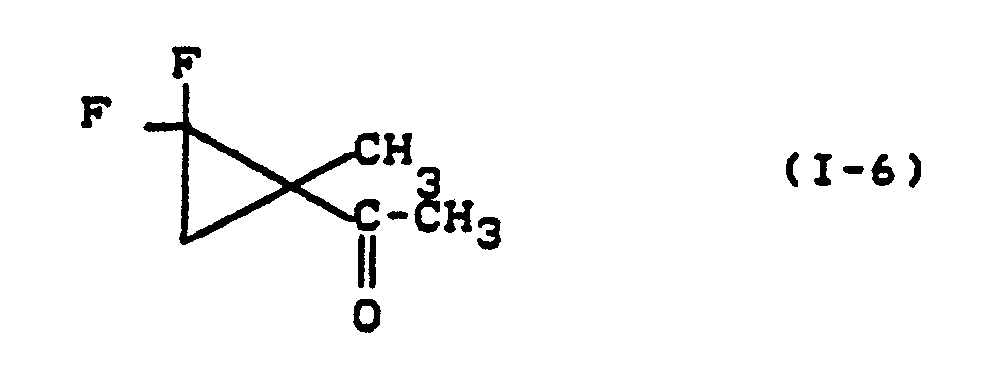
- Zu 34 g (0,25 Mol) 2,2-Difluor-1-methylcyclopropancarbonsäure in 250 ml trockenem Diethylether tropft man unter Rühren bei -78°C unter Stickstoff 333 ml einer 1,5-molaren Methyllithiumlösung (0,5 Mol). Man rührt noch eine Stunde bei -78°C nach, erwärmt dann auf 0°C und gießt die Reaktionslösung auf 500 g Eis und 50 ml konzentrierter Salzsäure. Die organische Phase wird abgetrennt und die wäßrige Phase mit Ether extrahiert. Die vereinigten organischen Phasen werden über Natriumsulfat getrocknet, das Lösungsmittel abdestilliert und das Produkt wird unter leicht vermindertem Druck destilliert.
- Man erhält 21 g (63 % der Theorie) 2,2-Difluor-1-methylcyclopropylmethylketon vom Siedepunkt 58-60°C/60 mbar.
-
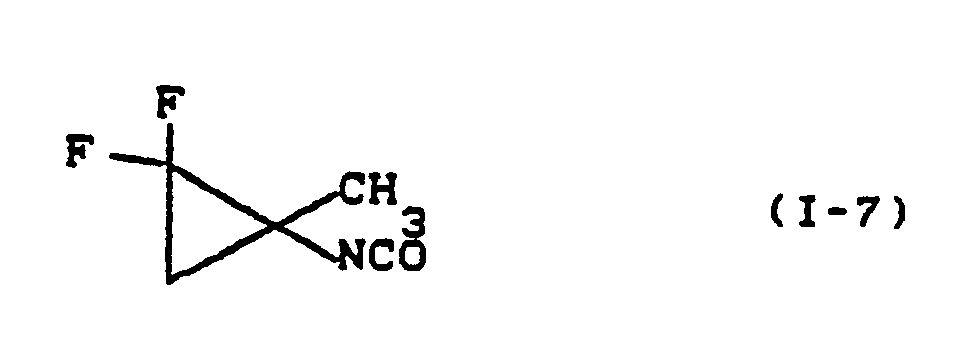
- Zu einer Lösung von 28 g (0,24 Mol) Trimethylsilylazid in 120 ml Toluol werden bei 20°C unter Rühren innerhalb von 10 Minuten 30,9 g (0,2 Mol) 2,2-Difluor-1-methyl-cyclopropan-carbonsäurechlorid hinzugetropft. Anschließend wird die Temperatur des Reaktionsgemisches unter Rühren innerhalb von 3 Stunden auf 90°C gesteigert. Es wird so lange gerührt, bis die Gasentwicklung beendet ist. Der Fortgang der Reaktion wird IR-spektroskopisch verfolgt, indem durch Entnahme von Proben von Zeit zu Zeit die Abnahme der Azidbande bei 2130 cm⁻¹ ermittelt wird. Nach beendeter Umsetzung wird destilliert. Man erhält auf diese Weise 12,5 g (47 % der Theorie) an 2,2-Difluor-1-methyl-cyclopropyl-isocyanat in Form einer Flüssigkeit vom Siedepunkt 95-97°C.
-

- Unter Rühren bei 20°C werden 35 ml Ethanol zu 15,45 g (0,1 Mol) 2,2-Difluor-1-methyl-cyclopropan-carbonsäurechlorid getropft. Nach Zugabe von 2 Tropfen konzentrierter Schwefelsäure wird das Reaktionsgemisch noch eine Stunde unter Rückfluß erhitzt. Anschließend wird überschüssiges Ethanol abdestilliert, der Rückstand getrocknet und bei Normaldruck destilliert. Man erhält auf diese Weise 14,2 g (87 % der Theorie) an 2,2-Difluor-1-methyl-cyclopropan-carbonsäure-ethylester in Form einer Flüssigkeit vom Siedepunkt 141-143°C.
-

- In eine Lösung von 15,45 g (0,1 Mol) 2,2-Difluor-1-methyl-cyclopropan-carbonsäurechlorid in 80 ml Dioxan wird 90 Minuten lang unter Rühren bei 20 bis 30°C Ammoniak-Gas eingeleitet. Anschließend wird die entstehende Suspension im Wasserstrahlvakuum bis zur Trockne eingeengt. Der verbleibende Rückstand wird mit 50 ml Wasser verrührt, abgesaugt und getrocknet. Man erhält auf diese Weise 11 g (81 % der Theorie) an 2,2-Difluor-1-methyl-cyclopropyl-carbonsäure-amid in Form einer Festsubstanz vom Schmelzpunkt 125-127°C.
-

- Eine Lösung von 13 g (0,1 Mol) 2,2-Difluor-1-methyl-cyclopropyl-isocyanat in 100 ml Toluol wird mit 50 ml konzentrierter Salzsäure versetzt und 16 Stunden bei Raumtemperatur gerührt. Anschließend erhitzt man das Reaktionsgemisch noch eine Stunde auf 50°C und zieht dann das Lösungsmittel unter vermindertem Druck vollständig ab. Es verbleiben 9 g (63 % der Theorie) an 2,2-Difluor-1-methyl-cyclopropylamin-hydrochlorid in Form einer Festsubstanz vom Schmelzpunkt 140-142°C (Zersetzung).
-

- In ein Gemisch aus 7,2 g (0,05 Mol) 2,2-Difluor-1-methyl-cyclopropylamin-hydrochlorid und 20 ml Wasser werden bei 0 bis 5°C unter Rühren 12 g (0,06 Mol) 20 %ige wäßrige Natronlauge getropft. Das Reaktionsgemisch wird zweimal mit Diethylether extrahiert, die vereinigten organischen Phasen werden über Magnesiumsulfat getrocknet und unter vermindertem Druck eingeengt. Der verbleibende Rückstand wird unter vermindertem Druck destilliert. Man erhält auf diese Weise 3,9 g (73 % der Theorie) an 2,2-Difluor-1-methyl-cyclopropylamin in Form einer Flüssigkeit vom Siedepunkt 25-30°C/15 mbar.
-

- Zur Lösung von 12,5 g (0,09 Mol) 1-Acetyl-1-methyl-2,2-difluor-cyclopropan in 50 ml Methanol tropft man unter Rühren bei 20°C eine Lösung von 4,7 ml (0,09 Mol) Brom in 30 ml Methylenchlorid. Nach vollständiger Entfärbung gießt man das Reaktionsgemisch in 200 ml Wasser und extrahiert mit Methylenchlorid. Nach dem Einengen unter vermindertem Druck erhält man 20 g (GC-Gehalt 47 %; 47 % der Theorie) rohes 1-Bromacetyl-1-methyl-2,2-difluorcyclopropan, das ohne weitere Reinigung direkt umgesetzt wird.

- 6 g (0,028 Mol) 1-Bromacetyl-1-methyl-2,2-difluorcyclopropan werden in 30 ml Aceton unter Zusatz von 4,4 g (0,032 Mol) Kaliumcarbonat und 4,1 g (0,032 Mol) 4-Chlorphenol 16 Stunden unter Rühren unter Rückfluß erhitzt. Man verdünnt mit Wasser, extrahiert das Produkt mit Methylenchlorid, wäscht die organische Phase einmal mit verdünnter Natronlauge, dann mit Wasser und engt unter vermindertem Druck ein.
- Man erhält 6 g 1-(4-Chlorphenoxyacetyl)-1-methyl-2,2-difluorcyclopropan als Rohprodukt mit einem Gehalt (GC) von 66 % (54,4 % der Theorie).

- Zur Lösung von 30 ml (0,04 Mol) einer 1,36 molaren Lösung von Trimethylsulfonium-methylsulfat in Acetonitril fügt man 2,4 g (0,044 Mol) Natriummethylat hinzu und rührt 30 Minuten bei Raumtemperatur. Dann setzt man 5,8 g (0,022 Mol) 1-(4-Chlorphenoxyacetyl)-1-methyl-2,2-difluorcyclopropan zu und läßt 16 Stunden bei 20°C rühren. Man gießt das Reaktionsgemisch in 200 ml Wasser, extrahiert mit Methylenchlorid, wäscht die organische Phase mit Wasser und engt die organische Phase ein.
- Man erhält 4,3 g (GC-Gehalt von 73 %; 71,6 % der Theorie) 2-(4-Chlorphenoxymethyl)-2-(2,2-difluor-1-methylcyclopropyl)-oxiran als zähes Harz, das direkt weiter umgesetzt wird.
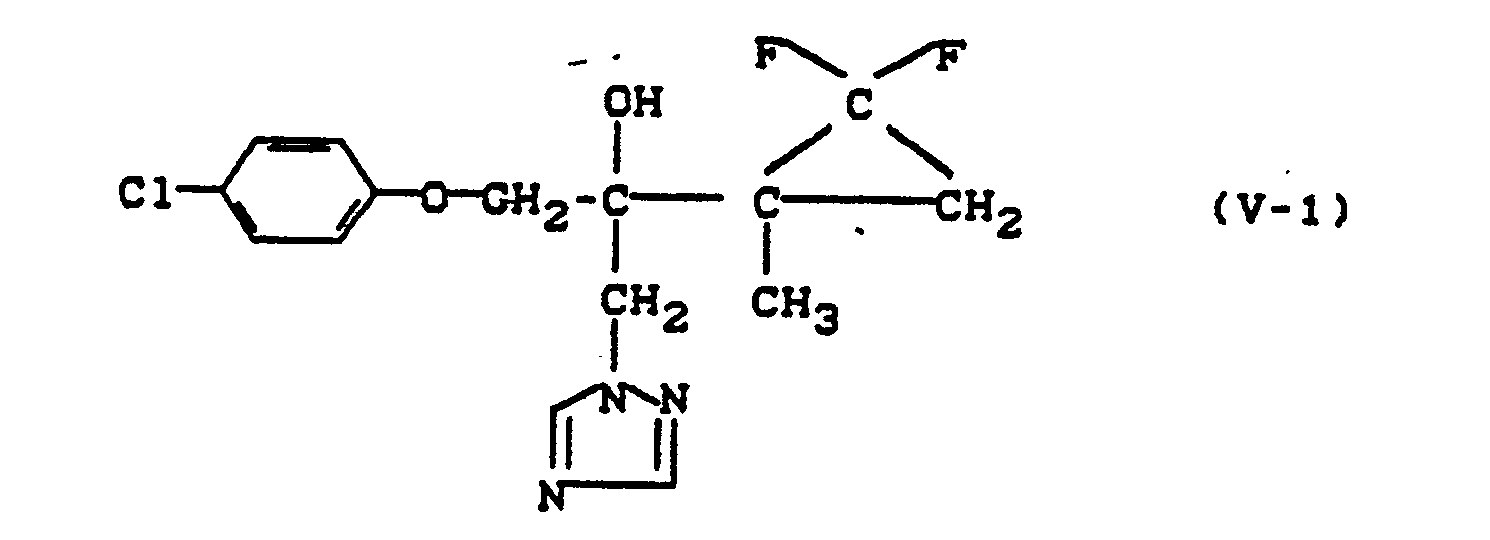
- 4,2 g (0,015 Mol) 2-(4-Chlorphenoxymethyl)-2-(2,2-difluor-1-methylcyclopropyl)-oxiran, 2,1 g (0,03 Mol) 1,2,4-Triazol und 4,2 g (0,03 Mol) Kaliumcarbonat werden in 30 ml Dimethylformamid 16 Stunden bei 90°C gerührt.
- Nach dem Entfernen des Lösungsmittels an der Ölpumpe wird der Rückstand mit Wasser/Methylenchlorid verrührt, die organische Phase abgetrennt und eingeengt. Der Rückstand wird mittels Säulenchromatographie (Chloroform/Essigester = 4:1) an Kieselgel gereinigt.
- Man erhält 2,3 g (44,6 % der Theorie) 1-(4-Chlorphenoxy)-2-(2,2-difluor-1-methylcyclopropyl)-2-hydroxy-3-(1,2,4-triazol-1-yl)-propan vom Schmelzpunkt 110°C.
-

- 15 g (0,11 Mol) 1-Acetyl-2,2-difluor-1-methylcyclopropan in 20 ml 10%-iger methanolischer Natronlauge werden unter Rühren mit einer Lösung von 15,5 g (0,11 Mol) p-Chlorbenzaldehyd in 20 ml Methanol bei 20°C versetzt. Nach 15 Minuten fügt man weitere 40 ml 10 %-ige methanolische Natronlauge zu und rührt weitere 16 Stunden bei Raumtemperatur. Man gießt das Reaktionsgemisch in Wasser, extrahiert mit Methylenchlorid, wäscht die organische Phase mit Wasser und engt unter vermindertem Druck ein.
- Man erhält 25 g (88 % der Theorie) rohes (2,2-Difluor-1-methylcyclopropyl)-[2-(4-chlorphenyl)-ethen-1-yl]keton als Öl, das direkt weiter umgesetzt wird.

- 41 ml (0,06 Mol) einer 1,46-molaren Lösung von Trimethylsulfoniummethylsulfat in Acetonitril werden mit 3,6 g (0,066 Mol) Natriummethylat versetzt und 30 Minuten bei Raumtemperatur gerührt. Anschließend fügt man eine Lösung von 10 g (0,039 Mol) (2,2-Difluor-1-methyl-cyclopropyl)-[ 2-(4-chlorphenyl)-ethen-1-yl]keton in 100 ml Acetonitril hinzu und rührt 16 Stunden bei Raumtemperatur. Man gießt dann das Reaktionsgemisch in Wasser, extrahiert mit Methylenchlorid, wäscht die organische Phase zweimal mit Wasser und engt die organische Phase unter vermindertem Druck ein.
- Man erhält 6,8 g (GC-Gehalt 38 %; 24 % der Theorie) 2-(2,2-Difluor-1-methylcyclopropyl)-2-[2-(4-chlorphenyl)-ethen-1-yl]-oxiran, das ohne weitere Reinigung direkt umgesetzt wird.

- Zur Lösung von 3,3 g (0,048 Mol) 1,2,4-Triazol in 30 ml Dimethylformamid fügt man portionsweise 1,4 g (0,048 Mol) 80 %iges Natriumhydrid und rührt 30 Minuten bei 20-30°C. Anschließend setzt man 6,6 g (0,024 Mol) 2-(2,2-Difluor-1-methyl-cyclopropyl)-2-[2-(4-chlorphenyl)-ethen-1-yl]-oxiran zu und läßt 16 Stunden bei 90°C rühren. Man gießt das Reaktionsgemisch dann auf Wasser, extrahiert mit Methylenchlorid, engt die organische Phase unter vermindertem Druck ein und reinigt den Rückstand durch Chromatographie an Kieselgel (Chloroform/Essigester = 4:1).
- Man erhält 2,4 g (29,6 % der Theorie) 1-(4-Chlorphenyl)-3-(2,2-difluor-1-methylcyclopropyl)-3-hydroxy-4-(1,2,4-triazol-1-yl)-but-1-en vom Schmelzpunkt 131°C.
- Nach dem in den Beispielen 12 und 13 angegebenen Methoden sowie gemäß den in der Beschreibung offenbarten Verfahren werden auch die in der folgenden Tabelle aufgeführten Stoffe der Formel (V) erhalten.


-

- Ein Gemisch aus 10,1 g (0,1 Mol) Triethylamin, 1,4 g (0,01 Mol) Kupfer-(I)-bromid und 55 ml Toluol wird mit 13,7 g (0,1 Mol) p-Chlorphenyl-acetylen versetzt und 30 Minuten bei Raumtemperatur unter Argon gerührt. Nach dem Erhitzen des Reaktionsgemisches auf 55°C werden 15,5 g (0,1 Mol) 1-Methyl-2,2-difluor-cyclopropancarbonsäurechlorid zugetropft. Danach wird 8 Stunden bei 90°C gerührt, dann abgekühlt und filtriert.Das Filtrat wird nacheinander mit verdünnter, wäßriger Salzsäure und Wasser gewaschen und unter vermindertem Druck eingeengt. Es verbleiben 19,2 g eines dunklen Öles, das im Kugelrohr destilliert wird. Bei 0,1 mbar und einer Manteltemperatur von 120°C geht ein gelbes Öl über, das beim Stehen erstarrt. Man erhält 8,4 g (33 % der Theorie) an [2-(4-Chlorphenyl)-ethin-1-yl]-(2,2-difluor-2-methylcycloprop-1-yl)-keton vom Schmelzpunkt 67-68°C.

- Ein Gemisch aus 13 g Dimethylsulfid und 4,8 g Dimethylsulfat wird zunächst 2 Stunden bei Raumtemperatur gerührt und dann mit 18 ml tert.-Butanol sowie mit 8,9 g [2-(4-Chlorphenyl)-ethin-1-yl]-(2,2-difluor-1-methylcycloprop-1-yl)-keton versetzt. Man rührt 30 Minuten bei Raumtemperatur, kühlt auf 10°C ab und tropft unter Rühren innerhalb von einer Stunde eine Lösung von 4,5 g Kalium-tert.-butylat in 32 ml tert.-Butanol hinzu. Das Reaktionsgemisch wird noch 3 Stunden bei 10°C nachgerührt und dann durch Abziehen des Verdünnungsmittels unter vermindertem Druck eingeengt. Man nimmt den Rückstand in Methylenchlorid auf, wäscht dreimal mit Wasser, trocknet und engt erneut unter vermindertem Druck ein. Es verbleiben 6,4 g (68 % der Theorie) an 2-[2-(4-Chlorphenyl)-ethin-1-yl]-2-(2,2-difluor-1-methyl-cycloprop-1-yl)-oxiran in Form eines Öles, das ohne zusätzliche Reinigung weiter umgesetzt wird.

- In ein Gemisch aus 0,9 g (0,013 Mol) 1,2,4-Triazol, 1,8 g (0,013 Mol) gemahlenem Kaliumcarbonat und 30 ml Acetonitril werden bei Raumtemperatur unter Rühren 3,5 g 2-[2-(4-Chlorphenyl)-ethin-1-yl]-2-(2,2-difluor-1-methyl-cycloprop-1-yl)-oxiran gegeben. Das Gemisch wird 8 Stunden unter Rückfluß erhitzt, dann abgekühlt, mit Wasser verdünnt und dreimal mit Methylenchlorid extrahiert. Die vereinigten organischen Phasen werden mit Wasser gewaschen, dann getrocknet und unter vermindertem Druck eingeengt. Man erhält auf diese Weise 3,8 g eines dunklen Öles, das durch Säulenchromatographie (Petrolether/Essigester = 2:1) an Kieselgel gereinigt wird. Es verbleiben 2,1 g (48 % der Theorie) an 1-(4-Chlorphenyl)-3-(2,2-difluor-1-methyl-cycloprop-1-yl)-4-(1,2,4-triazol-1-yl)-but-1-in-3-ol in Form einer Festsubstanz vom Schmelzpunkt 113-115°C.
- In den folgenden Verwendungsbeispielen wurden die Verbindungen der nachstehend angegebenen Formeln als Vergleichssubstanzen eingesetzt:

- Lösungsmittel: 100 Gewichtsteile Dimethylformamid
Emulgator: 0,25 Gewichtsteile Alkylarylpolyglykolether - Zur Herstellung einer zweckmäßigen Wirkstoffzubereitung vermischt man 1 Gewichtsteil Wirkstoff mit den angegebenen Mengen Lösungsmittel und Emulgator und verdünnt das Konzentrat mit Wasser auf die gewünschte Konzentration.
- Zur Prüfung auf protektive Wirksamkeit besprüht man junge Pflanzen mit der Wirkstoffzubereitung taufeucht. Nach Antrocknen des Spritzbelages werden die Pflanzen mit Sporen von Erysiphe graminis f.sp.tritici bestäubt.
- Die Pflanzen werden in einem Gewächshaus bei einer Temperatur von ca. 20 °C und einer relativen Luftfeuchtigkeit von ca. 80 % aufgestellt, um die Entwicklung von Mehltaupusteln zu begünstigen.
- 7 Tage nach der Inokulation erfolgt die Auswertung.
- In diesem Test zeigen die Verbindungen (V-1), (V-2), (V-3) und (V-4) eine wesentlich bessere Wirksamkeit als die Vergleichssubstanzen (B) und (C).
- Lösungsmittel: 100 Gewichtsteile Dimethylformamid
Emulgator: 0,025 Gewichtsteile Alkylarylpolyglykolether - Zur Herstellung einer zweckmäßigen Wirkstoffzubereitung vermischt man 1 Gewichtsteil Wirkstoff mit den angegebenen Mengen Lösungsmittel und Emulgator und verdünnt das Konzentrat mit Wasser auf die gewünschte Konzentration.
- Zur Prüfung auf protektive Wirksamkeit werden junge Pflanzen mit einer Sporensuspension von Puccinia recondita in einer 0,1 %igen wäßrigen Agarlösung inokuliert. Nach Antrocknen besprüht man die Pflanzen mit der Wirkstoffzubereitung taufeucht. Die Pflanzen verbleiben 24 Stunden bei 20 °C und 100 % rel. Luftfeuchtigkeit in einer Inkubationskabine.
- Die Pflanzen werden in einem Gewächshaus bei einer Temperatur von ca. 20 °C und einer relativen Luftfeuchtigkeit von ca. 80 % aufgestellt, um die Entwicklung von Rostpusteln zu begünstigen.
- 10 Tage nach derInokulation erfolgt die Auswertung.
- In diesem Test zeigen die Verbindungen (V-1), (V-2), (V-3), (V-4) und (V-5) eine wesentlich bessere Wirksamkeit als die Vergleichssubstanz (A).
- Lösungsmittel: 4,7 Gewichtsteile Aceton
Emulgator: 0,3 Gewichtsteile Alkylarylpolyglykolether - Zur Herstellung einer zweckmäßigen Wirkstoffzubereitung vermischt man 1 Gewichtsteil Wirkstoff mit den angegebenen Mengen Lösungsmittel und Emulgator und verdünnt das Konzentrat mit Wasser auf die gewünschte Konzentration.
- Zur Prüfung auf protektive Wirksamkeit bespritzt man junge Pflanzen mit der Wirkstoffzubereitung bis zur Tropfnässe. Nach Antrocknen des Spritzbelages werden die Pflanzen mit einer wäßrigen Konidiensuspension des Apfelschorferregers (Venturia inaequalis) inokuliert und verbleiben dann 1 Tag bei 20 °C und 100 % relativer Luftfeuchtigkeit in einer Inkubationskabine.
- Die Pflanzen werden dann im Gewächshaus bei 20 °C und einer relativen Luftfeuchtigkeit von ca. 70 % aufgestellt.
- 12 Tage nach der Inokulation erfolgt die Auswertung.
- In diesem Test zeigen die Verbindungen (V-1), (V-2) und (V-5) eine wesentlich bessere Wirksamkeit als die Vergleichssubstanz (C).
- Lösungsmittel: 100 Gewichtsteile Dimethylformamid
Emulgator: 0,25 Gewichtsteile Alkylarylpolyglykolether - Zur Herstellung einer zweckmäßigen Wirkstoffzubereitung vermischt man 1 Gewichtsteil Wirkstoff mit den angegebenen Mengen Lösungsmittel und Emulgator und verdünnt das Konzentrat mit Wasser auf die gewünschte Konzentration.
- Zur Prüfung auf protektive Wirksamkeit besprüht man junge Pflanzen mit der Wirkstoffzubereitung taufeucht. Nach Antrocknen des Spritzbelages werden die Pflanzen mit Sporen von Erysiphe graminis f.sp.hordei bestäubt.
- Die Pflanzen werden in einem Gewächshaus bei einer Temperatur von ca. 20°C und einer relativen Luftfeuchtigkeit von ca. 80 % aufgestellt, um die Entwicklung von Mehltaupusteln zu begünstigen.
- 7 Tage nach der Inokulation erfolgt die Auswertung.
- In diesem Test zeigt die Verbindung (XVII-1) eine wesentlich bessere Wirkung als die Vergleichssubstanz (D).
- Lösungsmittel: 4,7 Gewichtsteile Aceton
Emulgator: 0,3 Gewichtsteile Alkylarylpolyglykolether - Zur Herstellung einer zweckmäßigen Wirkstoffzubereitung vermischt man 1 Gewichtsteil Wirkstoff mit den angegebenen Mengen Lösungsmittel und Emulgator und verdünnt das Konzentrat mit Wasser auf die gewünschte Konzentration.
- Zur Prüfung auf protektive Wirksamkeit bespritzt man junge Pflanzen mit der Wirkstoffzubereitung bis zur Tropfnässe. Nach Antrocknen des Spritzbelages werden die Pflanzen mit einer wäßrigen Uredosporensuspension des Bohnenrosterregers (Uromyces appendiculatus) inokuliert und verbleiben 1 Tag in einer dunklen Feuchtkammer bei 20 bis 22°C und 100 % relativer Luftfeuchtigkeit.
- Die Pflanzen werden dann unter intensiver Belichtung für 9 Tage bei 20 bis 22°C und einer relativen Luftfeuchtigkeit von 70 bis 80 % im Gewächshaus aufgestellt.
- 10 Tage nach der Inokulation erfolgt die Auswertung.
- In diesem Test zeigt die Verbindung (XVII-1) eine bessere Wirksamkeit als die Vergleichssubstanz (D).
- Lösungsmittel: 12,5 Gewichtsteile Aceton
Emulgator: 0,3 Gewichtsteile Alkylarylpolyglkyolether - Zur Herstellung einer zweckmäßigen Wirkstoffzubereitung vermischt man 1 Gewichtsteil Wirkstoff mit der angegebenen Menge Lösungsmittel und verdünnt das Konzentrat mit Wasser und der angegebenen Menge Emulgator auf die gewünschte Konzentration.
- Zur Prüfung auf protektive Wirksamkeit bespritzt man junge Reispflanzen mit der Wirkstoffzubereitung bis zur Tropfnässe. Nach dem Abtrocknen des Spritzbelages werden die Pflanzen mit einer wäßrigen Sporensuspension von Pyricularia oryzae inokuliert. Anschließend werden die Pflanzen in einem Gewächshaus bei 100 % rel. Luftfeuchtigkeit und 25°C aufgestellt.
- 4 Tage nach der Inokulation erfolgt die Auswertung des Krankheitsbefalles.
- In diesem Test zeigt die Verbindung (XVII-1) eine wesentlich bessere Wirksmkeit als die Vergleichssubstanz (D).
Claims (3)

R für Alkyl, gegebenenfalls substituiertes Aryl oder gegebenenfalls substituiertes Aralkyl steht und
X für Hydroxymethyl, 2-Hydroxyethyl, Isocyanato, Amino, Amino-hydrohalogenid oder den Rest der Formel -CO-R¹ steht, worin
R¹ für Wasserstoff, Hydroxy, Alkoxy, Alkyl, Halogen oder Amino steht.
R für Alkyl mit 1 bis 4 Kohlenstoffatomen oder für Phenyl steht, das einfach bis dreifach, gleichartig oder verschieden substituiert sein kann durch Halogen, Alkyl mit 1 bis 4 Kohlenstoffatomen, Alkoxy mit 1 bis 4 Kohlenstoffatomen, Alkylthio mit 1 bis 4 Kohlenstoffatomen, Halogenalkyl mit 1 oder 2 Kohlenstoffatomen und 1 bis 5 gleichen oder verschiedenen Halogenatomen, Halogenalkoxy mit 1 oder 2 Kohlenstoffatomen und 1 bis 5 gleichen oder verschiedenen Halogenatomen, Halogenalkylthio mit 1 oder 2 Kohlenstoffatomen und 1 bis 5 gleichen oder verschiedenen Halogenatomen, Alkoximinomethyl mit 1 bis 4 Kohlenstoffatomen im Alkylteil und 1 bis 4 Kohlenstoffatomen im Alkoxyteil, gegebenenfalls durch Alkyl mit 1 oder 2 Kohlenstoffatomen und/oder Halogen substituiertes Phenoximinoalkyl mit 1 bis 4 Kohlenstoffatomen im Alkylteil, gegebenenfalls durch Alkyl mit 1 oder 2 Kohlenstoffatomen und/oder Halogen substituiertes Phenyl und/oder gegebenenfalls durch Alkyl mit 1 oder 2 Kohlenstoffatomen und/oder Halogen substituiertes Phenoxy,
oder
R für Benzyl steht, das im Phenylteil einfach bis dreifach, gleichartig oder verschieden substituiert sein kann durch Halogen, Alkyl mit 1 bis 4 Kohlenstoffatomen, Alkoxy mit 1 bis 4 Kohlenstoffatomen, Alkylthio mit 1 bis 4 Kohlenstoffatomen, Halogenalkyl mit 1 oder 2 Kohlenstoffatomen und 1 bis 5 gleichen oder verschiedenen Halogenatomen, Halogenalkoxy mit 1 oder 2 Kohlenstoffatomen und 1 bis 5 gleichen oder verschiedenen Halogenatomen, Halogenalkylthio mit 1 oder 2 Kohlenstoffatomen und 1 bis 5 gleichen oder verschiedenen Halogenatomen, Alkoximinoalkyl mit 1 bis 4 Kohlenstoffatomen im Alkylteil und 1 bis 4 Kohlenstoffatomen im Alkoxyteil, gegebenenfalls durch Alkyl mit 1 oder 2 Kohlenstoffatomen und/oder Halogen substituiertes Phenoximinoalkyl mit 1 bis 4 Kohlenstoffatomen im Alkylteil, gegebenenfalls durch Alkyl mit 1 oder 2 Kohlenstoffatomen und/oder Halgoen substituiertes Phenyl oder gegebenenfalls durch Alkyl mit 1 oder 2 Kohlenstoffatomen und/oder Halogen substituiertes Phenoxy,
X für Hydroxymethyl, 2-Hydroxyethyl, Isocyanato, Amino, Amino-hydrochlorid, -hydrobromid oder -hydroiodid steht oder für den Rest der Formel -CO-R¹ steht, worin
R¹ für Wasserstoff, Hydroxy, Alkoxy mit 1 bis 4 Kohlenstoffatomen, Alkyl mit 1 bis 4 Kohlenstoffatomen, Chlor, Brom, Iod oder Amino steht.

R für Alkyl, gegebenenfalls substituiertes Aryl oder gegebenenfalls substituiertes Aralkyl steht und
X für Hydroxymethyl, 2-Hydroxyethyl, Isocyanato, Amino, Amino-hydrohalogenid oder den Rest der Formel -CO-R¹ steht, worin
R¹ für Wasserstoff, Hydroxy, Alkoxy, Alkyl, Halogen oder Amino steht,
dadurch gekennzeichnet, daß man
a) Vinylcyclopropan-Derivate der Formel

R die oben angegebene Bedeutung hat,
entweder
α) mit einem starken Oxidationsmittel in Gegenwart eines Verdünnungsmittels umsetzt,
oder
ß) mit Ozon in Gegenwart eines Verdünnungsmittels sowie mit einem Reduktionsmittel umsetzt,
oder
γ) zunächst in einer ersten Stufe mit Diboran in Gegenwart eines Verdünnungsmittels umsetzt und das dabei entstehende Produkt danach in einer zweiten Stufe mit einem starken Oxidationsmittel in Gegenwart eines Verdünnungsmittels umsetzt,
oder
b) 2,2-Difluorcyclopropyl-Derivate der Formel
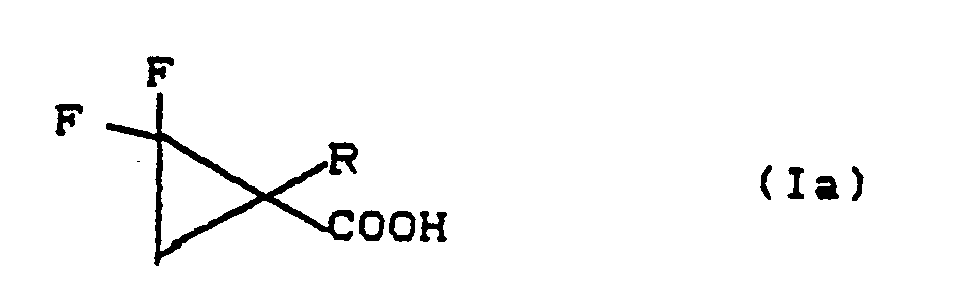
R die oben angegebene Bedeutung hat
entweder
α) mit einem Halogenierungsmittel gegebenenfalls in Gegenwart eines Verdünnungsmittels umsetzt
oder
ß) mit einem komplexen Hydrid in Gegenwart eines Verdünnungsmittels umsetzt,
oder
γ) mit metallorganischen Verbindungen der Formel
R²-Li (III)
in welcher
R² für Alkyl steht,
in Gegenwart eines Verdünnungsmittels umsetzt,
oder
c) 2,2-Difluorcyclopropyl-Derivate der Formel

R die oben angegebene Bedeutung hat und
Hal für Halogen steht,
entweder
α) mit einem Azidgruppen übertragenden Reagenz in Gegenwart eines Verdünnungsmittels umsetzt und die dabei entstehenden Verbindungen der Formel

R die oben angegebene Bedeutung hat,
in Gegenwart eines Verdünnungsmittels thermisch zersetzt,
oder
ß) mit Alkoholen der Formel
R³-OH (IV)
in welcher
R³ für Alkyl steht,
gegebenenfalls in Gegenwart eines Katalysators sowie gegebenenfalls in Gegenwart eines Verdünnungsmittels umsetzt,
oder
γ) mit Ammoniak gegebenenfalls in Gegenwart eines Verdünnungsmittels umsetzt,
oder
d) 2,2-Difluorcyclopropyl-Derivate der Formel

R die oben angegebene Bedeutung hat
mit Halogenwasserstoff-Säure in Gegenwart eines Verdünnungsmittels umsetzt und gegebenenfalls die dabei entstehenden Verbindungen der Formel

R die oben angegebene Bedeutung hat und
Hal′ für Halogen steht,
mit Basen gegebenenfalls in Gegenwart eines Verdünnungsmittels umsetzt.
Applications Claiming Priority (2)
| Application Number | Priority Date | Filing Date | Title |
|---|---|---|---|
| DE3824432 | 1988-07-19 | ||
| DE3824432A DE3824432A1 (de) | 1988-07-19 | 1988-07-19 | 2,2-difluorcyclopropyl-derivate |
Publications (3)
| Publication Number | Publication Date |
|---|---|
| EP0351647A2 true EP0351647A2 (de) | 1990-01-24 |
| EP0351647A3 EP0351647A3 (en) | 1990-08-08 |
| EP0351647B1 EP0351647B1 (de) | 1992-12-30 |
Family
ID=6359001
Family Applications (1)
| Application Number | Title | Priority Date | Filing Date |
|---|---|---|---|
| EP89112304A Expired - Lifetime EP0351647B1 (de) | 1988-07-19 | 1989-07-06 | 2,2-Difluorcyclopropyl-Derivate |
Country Status (4)
| Country | Link |
|---|---|
| US (1) | US5095147A (de) |
| EP (1) | EP0351647B1 (de) |
| JP (1) | JP2921862B2 (de) |
| DE (2) | DE3824432A1 (de) |
Cited By (4)
| Publication number | Priority date | Publication date | Assignee | Title |
|---|---|---|---|---|
| EP0351646A3 (de) * | 1988-07-19 | 1991-07-03 | Bayer Ag | Hydroxyalkinyl-azolyl-Derivate |
| EP0351649A3 (de) * | 1988-07-19 | 1991-11-21 | Bayer Ag | 2,2-Dihalogencyclopropyl-hydroxy-ethyltriazole |
| EP0436348A3 (en) * | 1990-01-04 | 1991-12-11 | Imperial Chemical Industries Plc | Fungicides |
| WO2011070742A1 (en) * | 2009-12-08 | 2011-06-16 | Kureha Corporation | Azole derivatives and methods for producing the same, intermediate compounds for the derivatives and methods for producing the same, and agro-horticultural agents and industrial material protecting agents containing the derivatives |
Families Citing this family (2)
| Publication number | Priority date | Publication date | Assignee | Title |
|---|---|---|---|---|
| DE69230349T2 (de) * | 1991-03-05 | 2000-07-27 | Ajinomoto Co., Inc. | Cyclopropanderivat |
| AU2007202168A1 (en) | 2007-05-15 | 2008-12-11 | Pioneer Waste Management Holdings Trust Pty Limited | Putrescible organic waste treatment |
Family Cites Families (5)
| Publication number | Priority date | Publication date | Assignee | Title |
|---|---|---|---|---|
| US3462453A (en) * | 1966-07-26 | 1969-08-19 | Pennsalt Chemicals Corp | Halogenated organic compounds |
| GB1331706A (en) * | 1971-04-23 | 1973-09-26 | Shell Int Research | Cyclopropane derivatives and biologicall active compositions thereof |
| US4220591A (en) * | 1975-11-26 | 1980-09-02 | Commonwealth Scientific And Industrial Research Organization | Insecticidal esters |
| DE3509546A1 (de) * | 1985-03-16 | 1986-09-25 | Bayer Ag, 5090 Leverkusen | 7-amino-1-(subst.cyclopropyl)-1,4-dihydro-4-oxo-3-chinolincarbonsaeuren, verfahren zu ihrer herstellung sowie diese enthaltende antibakterielle mittel |
| DE3740840A1 (de) * | 1987-11-27 | 1989-06-08 | Schering Ag | 2,2-difluorcyclopropylethanderivate, verfahren zu ihrer herstellung und ihre verwendung als schaedlingsbekaempfungsmittel |
-
1988
- 1988-07-19 DE DE3824432A patent/DE3824432A1/de not_active Withdrawn
-
1989
- 1989-07-06 DE DE8989112304T patent/DE58903154D1/de not_active Expired - Fee Related
- 1989-07-06 EP EP89112304A patent/EP0351647B1/de not_active Expired - Lifetime
- 1989-07-14 JP JP1180614A patent/JP2921862B2/ja not_active Expired - Fee Related
-
1991
- 1991-04-26 US US07/692,825 patent/US5095147A/en not_active Expired - Lifetime
Cited By (5)
| Publication number | Priority date | Publication date | Assignee | Title |
|---|---|---|---|---|
| EP0351646A3 (de) * | 1988-07-19 | 1991-07-03 | Bayer Ag | Hydroxyalkinyl-azolyl-Derivate |
| EP0351649A3 (de) * | 1988-07-19 | 1991-11-21 | Bayer Ag | 2,2-Dihalogencyclopropyl-hydroxy-ethyltriazole |
| US5097050A (en) * | 1988-07-19 | 1992-03-17 | Bayer Aktiengesellschaft | Aryl-alkinyl halocycloalkyl oxiranes |
| EP0436348A3 (en) * | 1990-01-04 | 1991-12-11 | Imperial Chemical Industries Plc | Fungicides |
| WO2011070742A1 (en) * | 2009-12-08 | 2011-06-16 | Kureha Corporation | Azole derivatives and methods for producing the same, intermediate compounds for the derivatives and methods for producing the same, and agro-horticultural agents and industrial material protecting agents containing the derivatives |
Also Published As
| Publication number | Publication date |
|---|---|
| JPH0288535A (ja) | 1990-03-28 |
| DE3824432A1 (de) | 1990-03-22 |
| EP0351647A3 (en) | 1990-08-08 |
| EP0351647B1 (de) | 1992-12-30 |
| US5095147A (en) | 1992-03-10 |
| JP2921862B2 (ja) | 1999-07-19 |
| DE58903154D1 (de) | 1993-02-11 |
Similar Documents
| Publication | Publication Date | Title |
|---|---|---|
| EP0564810B1 (de) | Fungizide Azolylmethyl-fluorcycloproplylderivate | |
| EP0440950B1 (de) | Halogenallyl-azolyl-Derivate | |
| EP0461502B1 (de) | Azolyl-propanol-Derivate | |
| EP0470466A2 (de) | Halogenalkyl-azolyl-Derivate | |
| EP0291797A2 (de) | Hydroxyalkyl-azolyl-Derivate | |
| EP0297352B1 (de) | (Azolyl-vinyl)-phenol-alkenylether | |
| EP0351647B1 (de) | 2,2-Difluorcyclopropyl-Derivate | |
| EP0351650B1 (de) | Fluorcyclopropyl-Derivate | |
| EP0470463B1 (de) | Halogenalkyl-azolyl-Derivate | |
| EP0291795B1 (de) | Hydroxyalkyl-triazolyl-Derivate | |
| EP0269916A1 (de) | Saccharin-Salze von substituierten Hydroxypropylaminen | |
| EP0226916A2 (de) | 1,4-Disubstituierte 1-Azolyl-3,3-dimethyl-butan-2-on- und -ol-Derivate | |
| EP0203440A2 (de) | Dichlorcyclopropylalkyl-hydroxyalkyl-azol-Derivate | |
| EP0405267A1 (de) | Hydroxyethyl-cyclopropyl-azolyl-Derivate | |
| EP0353558B1 (de) | Halogenvinyl-azol-Derivate | |
| EP0057864A2 (de) | 2-Azolylmethyl-1,3-dioxolan- und -dioxan-Derivate, Verfahren zu ihrer Herstellung und ihre Verwendung als Fungizide | |
| EP0405240B1 (de) | Verwendung von substituierten Bis-azolyl-Derivaten zur Bekämpfung von Pilzen im Pflanzenschutz | |
| EP0307791A1 (de) | Bisazolyl-hydroxyalkyl-Derivate | |
| EP0351646A2 (de) | Hydroxyalkinyl-azolyl-Derivate | |
| EP0338344A2 (de) | Substituierte Triazolylmethylcarbinole | |
| EP0565961A2 (de) | Ethyl-triazolyl-Derivate | |
| EP0438686A2 (de) | Triazolylmethyl-cyclopropyl-Derivate | |
| EP0384246A2 (de) | Cyclopropyl-hydroxyethyl-azolyl-Derivate | |
| EP0296452A1 (de) | Azolylmethyl-cyclopropyl-carbinol-Derivate | |
| EP0351649A2 (de) | 2,2-Dihalogencyclopropyl-hydroxy-ethyltriazole |
Legal Events
| Date | Code | Title | Description |
|---|---|---|---|
| PUAI | Public reference made under article 153(3) epc to a published international application that has entered the european phase |
Free format text: ORIGINAL CODE: 0009012 |
|
| 17P | Request for examination filed |
Effective date: 19890706 |
|
| AK | Designated contracting states |
Kind code of ref document: A2 Designated state(s): BE CH DE FR GB IT LI NL |
|
| PUAL | Search report despatched |
Free format text: ORIGINAL CODE: 0009013 |
|
| AK | Designated contracting states |
Kind code of ref document: A3 Designated state(s): BE CH DE FR GB IT LI NL |
|
| 17Q | First examination report despatched |
Effective date: 19920103 |
|
| GRAA | (expected) grant |
Free format text: ORIGINAL CODE: 0009210 |
|
| AK | Designated contracting states |
Kind code of ref document: B1 Designated state(s): BE CH DE FR GB IT LI NL |
|
| ITF | It: translation for a ep patent filed | ||
| ET | Fr: translation filed | ||
| REF | Corresponds to: |
Ref document number: 58903154 Country of ref document: DE Date of ref document: 19930211 |
|
| GBT | Gb: translation of ep patent filed (gb section 77(6)(a)/1977) |
Effective date: 19930120 |
|
| PLBE | No opposition filed within time limit |
Free format text: ORIGINAL CODE: 0009261 |
|
| STAA | Information on the status of an ep patent application or granted ep patent |
Free format text: STATUS: NO OPPOSITION FILED WITHIN TIME LIMIT |
|
| 26N | No opposition filed | ||
| REG | Reference to a national code |
Ref country code: GB Ref legal event code: IF02 |
|
| PGFP | Annual fee paid to national office [announced via postgrant information from national office to epo] |
Ref country code: DE Payment date: 20030618 Year of fee payment: 15 |
|
| PGFP | Annual fee paid to national office [announced via postgrant information from national office to epo] |
Ref country code: NL Payment date: 20030630 Year of fee payment: 15 |
|
| PGFP | Annual fee paid to national office [announced via postgrant information from national office to epo] |
Ref country code: GB Payment date: 20030709 Year of fee payment: 15 |
|
| PGFP | Annual fee paid to national office [announced via postgrant information from national office to epo] |
Ref country code: CH Payment date: 20030725 Year of fee payment: 15 |
|
| PGFP | Annual fee paid to national office [announced via postgrant information from national office to epo] |
Ref country code: FR Payment date: 20030728 Year of fee payment: 15 |
|
| PGFP | Annual fee paid to national office [announced via postgrant information from national office to epo] |
Ref country code: BE Payment date: 20030731 Year of fee payment: 15 |
|
| PG25 | Lapsed in a contracting state [announced via postgrant information from national office to epo] |
Ref country code: GB Free format text: LAPSE BECAUSE OF NON-PAYMENT OF DUE FEES Effective date: 20040706 |
|
| PG25 | Lapsed in a contracting state [announced via postgrant information from national office to epo] |
Ref country code: LI Free format text: LAPSE BECAUSE OF NON-PAYMENT OF DUE FEES Effective date: 20040731 Ref country code: CH Free format text: LAPSE BECAUSE OF NON-PAYMENT OF DUE FEES Effective date: 20040731 Ref country code: BE Free format text: LAPSE BECAUSE OF NON-PAYMENT OF DUE FEES Effective date: 20040731 |
|
| BERE | Be: lapsed |
Owner name: *BAYER A.G. Effective date: 20040731 |
|
| PG25 | Lapsed in a contracting state [announced via postgrant information from national office to epo] |
Ref country code: NL Free format text: LAPSE BECAUSE OF NON-PAYMENT OF DUE FEES Effective date: 20050201 Ref country code: DE Free format text: LAPSE BECAUSE OF NON-PAYMENT OF DUE FEES Effective date: 20050201 |
|
| GBPC | Gb: european patent ceased through non-payment of renewal fee |
Effective date: 20040706 |
|
| REG | Reference to a national code |
Ref country code: CH Ref legal event code: PL |
|
| PG25 | Lapsed in a contracting state [announced via postgrant information from national office to epo] |
Ref country code: FR Free format text: LAPSE BECAUSE OF NON-PAYMENT OF DUE FEES Effective date: 20050331 |
|
| NLV4 | Nl: lapsed or anulled due to non-payment of the annual fee |
Effective date: 20050201 |
|
| REG | Reference to a national code |
Ref country code: FR Ref legal event code: ST |
|
| PG25 | Lapsed in a contracting state [announced via postgrant information from national office to epo] |
Ref country code: IT Free format text: LAPSE BECAUSE OF NON-PAYMENT OF DUE FEES;WARNING: LAPSES OF ITALIAN PATENTS WITH EFFECTIVE DATE BEFORE 2007 MAY HAVE OCCURRED AT ANY TIME BEFORE 2007. THE CORRECT EFFECTIVE DATE MAY BE DIFFERENT FROM THE ONE RECORDED. Effective date: 20050706 |
|
| BERE | Be: lapsed |
Owner name: *BAYER A.G. Effective date: 20040731 |