EP0351656A1 - Récipient avec sa fermeture - Google Patents
Récipient avec sa fermeture Download PDFInfo
- Publication number
- EP0351656A1 EP0351656A1 EP89112339A EP89112339A EP0351656A1 EP 0351656 A1 EP0351656 A1 EP 0351656A1 EP 89112339 A EP89112339 A EP 89112339A EP 89112339 A EP89112339 A EP 89112339A EP 0351656 A1 EP0351656 A1 EP 0351656A1
- Authority
- EP
- European Patent Office
- Prior art keywords
- closure
- container
- rim
- skirt
- neck
- Prior art date
- Legal status (The legal status is an assumption and is not a legal conclusion. Google has not performed a legal analysis and makes no representation as to the accuracy of the status listed.)
- Granted
Links
Images


Classifications
-
- B—PERFORMING OPERATIONS; TRANSPORTING
- B65—CONVEYING; PACKING; STORING; HANDLING THIN OR FILAMENTARY MATERIAL
- B65D—CONTAINERS FOR STORAGE OR TRANSPORT OF ARTICLES OR MATERIALS, e.g. BAGS, BARRELS, BOTTLES, BOXES, CANS, CARTONS, CRATES, DRUMS, JARS, TANKS, HOPPERS, FORWARDING CONTAINERS; ACCESSORIES, CLOSURES, OR FITTINGS THEREFOR; PACKAGING ELEMENTS; PACKAGES
- B65D41/00—Caps, e.g. crown caps or crown seals, i.e. members having parts arranged for engagement with the external periphery of a neck or wall defining a pouring opening or discharge aperture; Protective cap-like covers for closure members, e.g. decorative covers of metal foil or paper
- B65D41/02—Caps or cap-like covers without lines of weakness, tearing strips, tags, or like opening or removal devices
- B65D41/16—Snap-on caps or cap-like covers
- B65D41/17—Snap-on caps or cap-like covers push-on and twist-off
Definitions
- the invention relates to a container with its closure, the container comprising a neck surmounted by a rim forming an opening of said container while the closure comprises a relatively flexible skirt and carrying inside means for hooking to said rim.
- Patent CH 565682 already relates to a container with closure.
- unlocking the closure requires the implementation of a fairly high rotational force and the deformation of the skirt in four places, said skirt further comprising internal bosses to facilitate its deformation.
- Patent GB 2 063 226 also relates to a container with its closure, in which the neck of the container has, evenly distributed on its periphery, protruding parts cooperating with internal hooks of the skirt of the closure to lock the assembly.
- the opening of the container is circular, which makes access to the product quite difficult.
- the present invention aims to find a safe opening system, more easily unlockable, easy to handle and not requiring too much stress on the closure and allowing good accessibility of the packaged product.
- the invention relates to a container with its closure in which the rim and the neck have the shape substantially of an ellipse and the closure a substantially rectangular shape allowing to cover the elliptical opening, the rotation of the closure relative to the container allowing the two attachment means located in the skirt on the width side of the closure to disengage from the rim and to the two attachment means located in the skirt side length of the closure to be unlocked by deformation of the skirt against the flange and the neck substantially elliptical, at their minor axis.
- the neck follows the outline of the rim constituting the opening of the container and also has a substantially elliptical configuration. This configuration thus makes it possible to deform the skirt only in two places during unlocking.
- the container according to the invention can be used for the packaging of any granular or powdered product, in particular soluble coffee.
- the container is preferably made of glass or equivalent product and the closure is made of a deformable plastic, such as polypropylene, polyethylene, etc.
- Unlocking is further facilitated if the rim of the container makes an angle between 60 and 75 ° with the bottom of the container. Indeed, when the hooking tabs are unlocked, they slide on the rim and the return of the skirt to its normal position thus gives a kind of acceleration on closing which is thus very easily released from the container.
- the rim of the container normally has the shape of an ellipse having an eccentricity of between 1.04 and 2, preferably between 1.5 and 2.
- the rim advantageously comprises a continuous attachment system, that is to say over its entire periphery.
- the unlocking ramps are provided on the neck, at its intersection with the medians of the ellipse. These ramps are therefore four in number. They allow at the bottom of the closure skirt to be deformed, which facilitates unlocking.
- the two hooking means in the skirt on the length side are shorter than those in the skirt on the width side.
- the container (1) of substantially rectangular section with rounded angles comprises a bottom (2), side walls (3) and a neck (4).
- This neck has the shape of an ellipse and includes a rim (5) for locking the closure, said rim forming an opening of said container.
- the closure (6) also has a substantially rectangular section and comprises a bottom (9), a skirt (10), four hooking lugs (7) and lugs (8) for maintaining the cardboard on the bottom of the closure, said tabs being the inside of the skirt (10).
- the cardboard serves to maintain a minimum entry of oxygen into the container.
- Fig 4 the closure (6) is hung on the container (1).
- the hooking tabs (7) are snapped onto the flange (5) having a continuous hooking system.
- the cardboard (11) held in place by the tabs (8) presses on the upper edge (12) of the neck.
- Fig 5 shows schematically what is happening.
- the arrows indicate the movement of the hanging tabs.
- What hinders movement is the elliptical rim of the container.
- the skirt in zone A is therefore not deformed.
- the tabs are released simply by rotating the closure.
- the lugs in zone B cannot rotate freely, but abut against the elliptical rim. In this area, the skirt is deformed until the hooking tabs can pass over the edge (5).
- the closure (6) has the same configuration as in Fig 4, but the container (13) has in the areas (c) (Fig 5) unlocking ramps.
- the bottom of the neck follows the contour of the shoulder (15) of the container, which generates a slope varying by about 20 ° for said neck.
- the neck thus makes an angle of approximately 90 ° with the bottom of the container in zones A and B and an angle of approximately 70 ° in zone C.
- the bottom of the skirt (10) cooperates when the closure is turned (6) with the ramp (14). There is therefore a double deformation of the skirt of the closure: at the level of the ramp (14) and at the level of the elliptical rim (5). This further promotes unlocking when the container is opened.
Landscapes
- Engineering & Computer Science (AREA)
- Mechanical Engineering (AREA)
- Closures For Containers (AREA)
- Table Devices Or Equipment (AREA)
- Glass Compositions (AREA)
- Devices For Use In Laboratory Experiments (AREA)
- Medical Preparation Storing Or Oral Administration Devices (AREA)
- Pens And Brushes (AREA)
- Medicines Containing Material From Animals Or Micro-Organisms (AREA)
Abstract
Description
- L'invention concerne un récipient avec sa fermeture, le récipient comportant un col surmonté d'un rebord formant ouverture dudit récipient tandis que la fermeture comporte une jupe relativement souple et portant à l'intérieur des moyens d'accrochage audit rebord.
- Le brevet CH 565682 concerne déjà un récipient avec fermeture. Dans ce système, le déverrouillage de la fermeture nécessite la mise en oeuvre d'une force de rotation assez élevée et la déformation de la jupe en quatre endroits, ladite jupe comportant en outre des bossages internes pour faciliter sa déformation.
- Le brevet GB 2 063 226 concerne également un récipient avec sa fermeture, dans lequel le col du récipient présente uniformément répartie sur sa périphérie des parties faisant saillie coopérant avec des crochets internes de la jupe de la fermeture pour verrouiller l'ensemble. Dans ce système ainsi que dans celui du brevet CH précité, l'ouverture du récipient est circulaire ce qui rend l'accès au produit assez malaisé.
- La présente invention a pour but de trouver un système d'ouverture sûr, plus facilement déverrouillable, d'un maniement aisé et ne nécessitant pas une trop grande sollicitation de la fermeture et permettant une bonne accessibilité du produit conditionné.
- L'invention concerne un récipient avec sa fermeture dans lequel le rebord et le col ont la forme sensiblement d'une ellipse et la fermeture une forme sensiblement rectangulaire permettant de coiffer l'ouverture elliptique, la rotation de la fermeture par rapport au récipient permettant aux deux moyens d'accrochage situés dans la jupe côté largeur de la fermeture de se dégager du rebord et aux deux moyens d'accrochage situés dans la jupe côté longueur de la fermeture d'être déverrouillés par déformation de la jupe contre le rebord et le col sensiblement elliptiques, au niveau de leur petit axe.
- Le col suit le contour du rebord constituant l'ouverture du récipient et a également une configuration sensiblement elliptique. Cette configuration permet ainsi de ne déformer la jupe qu'à deux endroits lors du déverrouillage.
- Le récipient selon l'invention est utilisable pour le conditionnement de tout produit granuleux ou en poudre, en particulier du café soluble. Le récipient est de préférence en verre ou produit équivalent et la fermeture est en une matière plastique déformable, telle que polypropylène, polyéthylène...
- Le déverrouillage est encore facilité si le rebord du récipient fait avec le fond du récipient un angle compris entre 60 et 75°. En effet, au moment ou les pattes d'accrochage sont déverrouillées, elles glissent sur le rebord et le retour de la jupe dans sa position normale donne ainsi une sorte d'accélération à la fermeture qui se dégage ainsi très aisément du récipient.
- Le rebord du récipient a normalement la forme d'une ellipse ayant une excentricité comprise entre 1,04 et 2, de préférence entre 1,5 et 2.
- Le rebord comporte de manière avantageuse un système d'accrochage continu, c'est-à-dire sur toute sa périphérie.
- Dans un but d'amélioration du déverrouillage, on prévoit sur le col, au niveau de son intersection avec les médianes de l'ellipse, des rampes de déverrouillage. Ces rampes sont donc au nombre de quatre. Elles permettent au bas de la jupe de la fermeture d'être déformé, ce qui facilite le déverrouillage.
- Dans le même but, on prévoit les deux moyens d'accrochage dans la jupe côté longueur plus courts que ceux dans la jupe côté largeur.
- La suite de la description est faite en référence aux dessins sur lesquels :
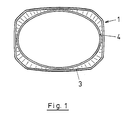
- Fig 1 est une vue de dessus du récipient,
- Fig 2 est une vue latérale du récipient,
- Fig 3 est une vue de dessous de la fermeture,
- Fig 4 est une coupe partielle selon l'axe du récipient et de la fermeture, cette dernière en position accrochée et
- Fig 5 est une représentation schématique du déverrouillage de la fermeture.
- Fig 6 est une coupe partielle identique à celle de la Fig 4 selon la ligne VI-VI de la Fig 5 avec un récipient avec rampes de déverrouillage.
- Le récipient (1) de section sensiblement rectangulaire à angles arrondis comprend un fond (2), des parois latérales (3) et un col (4). Ce col a la forme d'une ellipse et comprend un rebord (5) pour le verrouillage de la fermeture, ledit rebord formant ouverture dudit récipient.
- En référence à la Fig 3, la fermeture (6) a également une section sensiblement rectangulaire et comprend un fond (9), une jupe (10), quatre pattes d'accrochage (7) et des pattes (8) pour le maintien de la cartonnette sur le fond de la fermeture, lesdites pattes étant à l'intérieur de la jupe (10). La cartonnette sert à maintenir une entrée minimale d'oxygène dans le récipient.
- Sur la Fig 4, la fermeture (6) est accrochée sur le récipient (1). Les pattes d'accrochage (7) sont encliquetées sur le rebord (5) présentant un système d'accrochage continu. La cartonnette (11) maintenue en place par les pattes (8) appuie sur le rebord supérieur (12) du col.
- Pour déverrouiller, on tourne la fermeture et la Fig 5 indique schématiquement ce qui se passe. Les flèches indiquent le déplacement des pattes d'accrochage. On voit que ce qui fait obstacle au déplacement, c'est le rebord elliptique du récipient. Pour les pattes d'accrochage situées en position A, on voit que la configuration elliptique ne fait pas obstacle à leur déplacement. La jupe dans la zone A n'est donc pas déformée. Les pattes sont libérées du simple fait de la rotation de la fermeture. Par contre, les pattes d'accrochage dans la zone B ne peuvent pas tourner librement, mais butent contre le rebord elliptique. Dans cette zone-là, la jupe est déformée jusqu'à ce que les pattes d'accrochage peuvent passer sur le rebord (5).
- Dans la forme de réalisation de la Fig 6, la fermeture (6) a la même configuration que dans la Fig 4, mais le récipient (13) présente dans les zones (c) (Fig 5) des rampes de déverrouillage. Le bas du col suit le contour de l'épaulement (15) du récipient, ce qui engendre une pente variant d'environ 20° pour ledit col. Le col fait ainsi un angle d'environ 90° avec le fond du récipient dans les zones A et B et un angle d'environ 70° dans la zone C. Le bas de la jupe (10) coopère lorsqu'on tourne la fermeture (6) avec la rampe (14). On a donc une double déformation de la jupe de la fermeture: au niveau de la rampe (14) et au niveau du rebord elliptique (5). Ceci favorise encore le déverrouillage au moment de l'ouverture du récipient.
- Le fait d'avoir une ouverture elliptique du récipient donne donc un système sûr et un dégagement aisé de la fermeture. Cette configuration est en outre très avantageuse car permettant un accès plus facile lorsqu'on veut se servir, par exemple du café soluble avec une cuillère.
Claims (7)
Priority Applications (1)
| Application Number | Priority Date | Filing Date | Title |
|---|---|---|---|
| AT89112339T ATE77326T1 (de) | 1988-07-22 | 1989-07-06 | Behaelter mit verschluss. |
Applications Claiming Priority (2)
| Application Number | Priority Date | Filing Date | Title |
|---|---|---|---|
| CH2822/88 | 1988-07-22 | ||
| CH2822/88A CH677220A5 (fr) | 1988-07-22 | 1988-07-22 |
Publications (2)
| Publication Number | Publication Date |
|---|---|
| EP0351656A1 true EP0351656A1 (fr) | 1990-01-24 |
| EP0351656B1 EP0351656B1 (fr) | 1992-06-17 |
Family
ID=4242372
Family Applications (1)
| Application Number | Title | Priority Date | Filing Date |
|---|---|---|---|
| EP89112339A Expired - Lifetime EP0351656B1 (fr) | 1988-07-22 | 1989-07-06 | Récipient avec sa fermeture |
Country Status (14)
| Country | Link |
|---|---|
| US (1) | US4967921A (fr) |
| EP (1) | EP0351656B1 (fr) |
| JP (1) | JP2744810B2 (fr) |
| AT (1) | ATE77326T1 (fr) |
| AU (1) | AU624561B2 (fr) |
| BR (1) | BR8903615A (fr) |
| CA (1) | CA1328834C (fr) |
| CH (1) | CH677220A5 (fr) |
| DE (1) | DE68901821T2 (fr) |
| DK (1) | DK166489B1 (fr) |
| ES (1) | ES2032632T3 (fr) |
| MX (1) | MX171278B (fr) |
| PT (1) | PT91230B (fr) |
| ZA (1) | ZA895151B (fr) |
Families Citing this family (14)
| Publication number | Priority date | Publication date | Assignee | Title |
|---|---|---|---|---|
| GB9207987D0 (en) * | 1992-04-10 | 1992-05-27 | Smithkline Beecham Plc | Novel container and closure |
| US5326564A (en) * | 1992-11-25 | 1994-07-05 | Elizabeth Arden Co., Division Of Conopco, Inc. | Resealable cosmetic product |
| FR2760724B1 (fr) * | 1997-03-14 | 1999-04-30 | Oreal | Recipient de type a capsule montee par claquage |
| US6114165A (en) * | 1997-07-23 | 2000-09-05 | Cai; Xuejun | Universal tissue culture flask |
| WO2001019696A1 (fr) | 1999-09-14 | 2001-03-22 | Smithkline Beecham Corporation | Dispositif de fermeture d'un recipient |
| US6854613B2 (en) * | 2003-05-09 | 2005-02-15 | Drug Plastics & Glass Company, Inc. | Container and child-resistant closure system |
| US8051999B2 (en) * | 2008-03-05 | 2011-11-08 | CVS Pharmacy, Inc. a Rhode Island corporation | Threadable closure with split securing walls and locking notches |
| US8079483B2 (en) * | 2008-09-11 | 2011-12-20 | Rexam Healthcare Packaging Inc. | Closure with stopping mechanism |
| US8123058B2 (en) | 2008-09-11 | 2012-02-28 | Rexam Healthcare Packaging Inc. | Closure with stopping mechanism |
| MX2011002176A (es) | 2011-02-25 | 2012-08-30 | Tricorbraun S De R L De C V | Sistema de cierre de 1/4 de vuelta para un envase. |
| MX2018003457A (es) * | 2015-09-21 | 2018-06-12 | Johnson & Son Inc S C | Accesorio y sistema para mezclar y dispensar un producto quimico y diluyente. |
| USD809097S1 (en) | 2016-09-21 | 2018-01-30 | S. C. Johnson & Son, Inc. | Dispenser with container |
| IL270334B2 (en) | 2017-05-01 | 2024-12-01 | Cr Packaging Llc | Modular system for efficient packaging inventory and transportation |
| CN111629974B (zh) * | 2017-11-30 | 2023-02-28 | 葛兰素史克消费者保健控股(美国)有限责任公司 | 具有衬垫保持结构的容器帽 |
Citations (3)
| Publication number | Priority date | Publication date | Assignee | Title |
|---|---|---|---|---|
| FR2241463A1 (fr) * | 1973-08-24 | 1975-03-21 | Nestle Sa | |
| CH613907A5 (en) * | 1977-01-10 | 1979-10-31 | Migros | Closure device for a vessel |
| GB2063226A (en) * | 1979-11-13 | 1981-06-03 | Ug Closures & Plastics Ltd | Closure |
Family Cites Families (5)
| Publication number | Priority date | Publication date | Assignee | Title |
|---|---|---|---|---|
| GB1387262A (en) * | 1971-05-20 | 1975-03-12 | Beecham Group Ltd | Bottle closure |
| JPS641248Y2 (fr) * | 1981-05-01 | 1989-01-12 | ||
| JPS628942U (fr) * | 1985-07-02 | 1987-01-20 | ||
| JPH0637949Y2 (ja) * | 1986-06-16 | 1994-10-05 | 豊國樹脂工業株式會社 | キャップの緩み止め構造 |
| US4795056A (en) * | 1988-03-31 | 1989-01-03 | Gerber Products Company | Microwave dish cover |
-
1988
- 1988-07-22 CH CH2822/88A patent/CH677220A5/fr not_active IP Right Cessation
-
1989
- 1989-07-05 AU AU37885/89A patent/AU624561B2/en not_active Expired
- 1989-07-06 EP EP89112339A patent/EP0351656B1/fr not_active Expired - Lifetime
- 1989-07-06 AT AT89112339T patent/ATE77326T1/de not_active IP Right Cessation
- 1989-07-06 ES ES198989112339T patent/ES2032632T3/es not_active Expired - Lifetime
- 1989-07-06 DE DE8989112339T patent/DE68901821T2/de not_active Expired - Lifetime
- 1989-07-06 ZA ZA895151A patent/ZA895151B/xx unknown
- 1989-07-10 CA CA000605184A patent/CA1328834C/fr not_active Expired - Lifetime
- 1989-07-18 US US07/381,481 patent/US4967921A/en not_active Expired - Lifetime
- 1989-07-20 DK DK359389A patent/DK166489B1/da not_active IP Right Cessation
- 1989-07-20 MX MX016868A patent/MX171278B/es unknown
- 1989-07-20 PT PT91230A patent/PT91230B/pt not_active IP Right Cessation
- 1989-07-21 JP JP1190357A patent/JP2744810B2/ja not_active Expired - Lifetime
- 1989-07-21 BR BR898903615A patent/BR8903615A/pt not_active IP Right Cessation
Patent Citations (3)
| Publication number | Priority date | Publication date | Assignee | Title |
|---|---|---|---|---|
| FR2241463A1 (fr) * | 1973-08-24 | 1975-03-21 | Nestle Sa | |
| CH613907A5 (en) * | 1977-01-10 | 1979-10-31 | Migros | Closure device for a vessel |
| GB2063226A (en) * | 1979-11-13 | 1981-06-03 | Ug Closures & Plastics Ltd | Closure |
Also Published As
| Publication number | Publication date |
|---|---|
| ATE77326T1 (de) | 1992-07-15 |
| DE68901821D1 (de) | 1992-07-23 |
| DK359389A (da) | 1990-01-23 |
| CA1328834C (fr) | 1994-04-26 |
| AU624561B2 (en) | 1992-06-11 |
| US4967921A (en) | 1990-11-06 |
| DK359389D0 (da) | 1989-07-20 |
| EP0351656B1 (fr) | 1992-06-17 |
| JPH0272059A (ja) | 1990-03-12 |
| PT91230B (pt) | 1995-07-03 |
| ZA895151B (en) | 1990-04-25 |
| ES2032632T3 (es) | 1993-02-16 |
| JP2744810B2 (ja) | 1998-04-28 |
| MX171278B (es) | 1993-10-15 |
| BR8903615A (pt) | 1990-03-13 |
| CH677220A5 (fr) | 1991-04-30 |
| DE68901821T2 (de) | 1992-12-17 |
| AU3788589A (en) | 1990-01-25 |
| DK166489B1 (da) | 1993-06-01 |
| PT91230A (pt) | 1990-02-08 |
Similar Documents
| Publication | Publication Date | Title |
|---|---|---|
| EP0351656B1 (fr) | Récipient avec sa fermeture | |
| EP0872432B1 (fr) | Dispositif de verrouillage du couvercle d'un bac et bac ainsi équipé | |
| EP0219442B1 (fr) | Emballage pour aliments | |
| FR2605294A1 (fr) | Capuchon de distribution selon deux modes pour recipient | |
| FR2798120A1 (fr) | Dispositif automatique par gravite de verrouillage/ deverrouillage du couvercle d'un bac et bac equipe d'un tel dispositif | |
| FR2544695A1 (fr) | Recipient de securite resistant aux enfants | |
| FR2666076A1 (fr) | Conteneur comprenant un verrou de couvercle. | |
| FR2511346A1 (fr) | Couvercle inviolable a emboitement pour recipient de section polygonale | |
| EP4026785B1 (fr) | Dispositif de bouchage comprenant un bouchon articulé sur une base | |
| CA2231168A1 (fr) | Verseur a bouchage pour des recipients, notamment pour des boites de conditionnement de liquides | |
| FR2587188A1 (fr) | Corbeille a papier et bride adaptee a la fixation de la corbeille | |
| FR2778172A1 (fr) | Emballage metallique a capsule de securite | |
| WO1995032903A1 (fr) | Recipient avec couvercle | |
| FR2644366A1 (fr) | Perfectionnement aux couvercles d'obturation d'appareils a rotors de centrifugation | |
| EP0366508B1 (fr) | Poignée de crémone à dispositif de verrouillage intégré, notamment pour véhicule | |
| FR2669896A1 (fr) | Emballage metallique constitue d'un recipient a ouverture totale et d'un couvercle a fermeture hermetique. | |
| FR2698614A1 (fr) | Dispositif de bouchage comprenant un bouchon et une ceinture d'inviolabilité. | |
| EP1440916B1 (fr) | Dispositif de fermeture d'un trou d'homme de citerne et citerne munie de celui-ci | |
| FR2677106A1 (fr) | Bouteille a gaz. | |
| FR2521530A1 (fr) | Dispositif de fermeture et de manutention d'un recipient et procede de fabrication dudit dispositif | |
| EP1015327A2 (fr) | Conditionnement pour produit alimentaire, notamment pour patisserie et produit laitier | |
| FR2715381A1 (fr) | Récipient muni d'une capsule de fermeture inviolable. | |
| EP0765817B1 (fr) | Dispositif de bouchage de sécurité pour flacons poudreurs ou pots | |
| FR2584855A1 (fr) | Conteneur pour dechets radioactifs de moyenne ou faible activite | |
| EP0937656A1 (fr) | Dispositif de conditionnement, notamment pour aliments, tels que crudités, mini-légumes ou autres, accompagnés d'un assaisonnement |
Legal Events
| Date | Code | Title | Description |
|---|---|---|---|
| PUAI | Public reference made under article 153(3) epc to a published international application that has entered the european phase |
Free format text: ORIGINAL CODE: 0009012 |
|
| 17P | Request for examination filed |
Effective date: 19890706 |
|
| AK | Designated contracting states |
Kind code of ref document: A1 Designated state(s): AT BE CH DE ES FR GB IT LI LU NL SE |
|
| 17Q | First examination report despatched |
Effective date: 19911021 |
|
| GRAA | (expected) grant |
Free format text: ORIGINAL CODE: 0009210 |
|
| ITF | It: translation for a ep patent filed | ||
| AK | Designated contracting states |
Kind code of ref document: B1 Designated state(s): AT BE CH DE ES FR GB IT LI LU NL SE |
|
| REF | Corresponds to: |
Ref document number: 77326 Country of ref document: AT Date of ref document: 19920715 Kind code of ref document: T |
|
| GBT | Gb: translation of ep patent filed (gb section 77(6)(a)/1977) | ||
| REF | Corresponds to: |
Ref document number: 68901821 Country of ref document: DE Date of ref document: 19920723 |
|
| REG | Reference to a national code |
Ref country code: ES Ref legal event code: FG2A Ref document number: 2032632 Country of ref document: ES Kind code of ref document: T3 |
|
| PLBE | No opposition filed within time limit |
Free format text: ORIGINAL CODE: 0009261 |
|
| STAA | Information on the status of an ep patent application or granted ep patent |
Free format text: STATUS: NO OPPOSITION FILED WITHIN TIME LIMIT |
|
| 26N | No opposition filed | ||
| EPTA | Lu: last paid annual fee | ||
| EAL | Se: european patent in force in sweden |
Ref document number: 89112339.0 |
|
| PGFP | Annual fee paid to national office [announced via postgrant information from national office to epo] |
Ref country code: LU Payment date: 19990715 Year of fee payment: 11 |
|
| PG25 | Lapsed in a contracting state [announced via postgrant information from national office to epo] |
Ref country code: LU Free format text: LAPSE BECAUSE OF NON-PAYMENT OF DUE FEES Effective date: 20000706 |
|
| REG | Reference to a national code |
Ref country code: GB Ref legal event code: IF02 |
|
| PGFP | Annual fee paid to national office [announced via postgrant information from national office to epo] |
Ref country code: CH Payment date: 20080912 Year of fee payment: 20 Ref country code: ES Payment date: 20080821 Year of fee payment: 20 Ref country code: DE Payment date: 20080711 Year of fee payment: 20 |
|
| PGFP | Annual fee paid to national office [announced via postgrant information from national office to epo] |
Ref country code: FR Payment date: 20080718 Year of fee payment: 20 Ref country code: IT Payment date: 20080730 Year of fee payment: 20 Ref country code: NL Payment date: 20080703 Year of fee payment: 20 Ref country code: AT Payment date: 20080711 Year of fee payment: 20 |
|
| PGFP | Annual fee paid to national office [announced via postgrant information from national office to epo] |
Ref country code: GB Payment date: 20080709 Year of fee payment: 20 |
|
| PGFP | Annual fee paid to national office [announced via postgrant information from national office to epo] |
Ref country code: SE Payment date: 20080709 Year of fee payment: 20 |
|
| REG | Reference to a national code |
Ref country code: CH Ref legal event code: PL |
|
| REG | Reference to a national code |
Ref country code: GB Ref legal event code: PE20 Expiry date: 20090705 |
|
| PGFP | Annual fee paid to national office [announced via postgrant information from national office to epo] |
Ref country code: BE Payment date: 20090126 Year of fee payment: 20 |
|
| NLV7 | Nl: ceased due to reaching the maximum lifetime of a patent |
Effective date: 20090706 |
|
| EUG | Se: european patent has lapsed | ||
| REG | Reference to a national code |
Ref country code: ES Ref legal event code: FD2A Effective date: 20090707 |
|
| PG25 | Lapsed in a contracting state [announced via postgrant information from national office to epo] |
Ref country code: ES Free format text: LAPSE BECAUSE OF EXPIRATION OF PROTECTION Effective date: 20090707 |
|
| PG25 | Lapsed in a contracting state [announced via postgrant information from national office to epo] |
Ref country code: GB Free format text: LAPSE BECAUSE OF EXPIRATION OF PROTECTION Effective date: 20090705 Ref country code: NL Free format text: LAPSE BECAUSE OF EXPIRATION OF PROTECTION Effective date: 20090706 |