EP0351875A2 - Masse zur Herstellung eines im nahen IR absorbierenden Materials und die Masse oder das Material enthaltender Formkörper - Google Patents
Masse zur Herstellung eines im nahen IR absorbierenden Materials und die Masse oder das Material enthaltender Formkörper Download PDFInfo
- Publication number
- EP0351875A2 EP0351875A2 EP89113451A EP89113451A EP0351875A2 EP 0351875 A2 EP0351875 A2 EP 0351875A2 EP 89113451 A EP89113451 A EP 89113451A EP 89113451 A EP89113451 A EP 89113451A EP 0351875 A2 EP0351875 A2 EP 0351875A2
- Authority
- EP
- European Patent Office
- Prior art keywords
- lead
- copper
- compound
- heat treatment
- phenylthiobenzamide
- Prior art date
- Legal status (The legal status is an assumption and is not a legal conclusion. Google has not performed a legal analysis and makes no representation as to the accuracy of the status listed.)
- Withdrawn
Links
Images

Classifications
-
- G—PHYSICS
- G11—INFORMATION STORAGE
- G11B—INFORMATION STORAGE BASED ON RELATIVE MOVEMENT BETWEEN RECORD CARRIER AND TRANSDUCER
- G11B7/00—Recording or reproducing by optical means, e.g. recording using a thermal beam of optical radiation by modifying optical properties or the physical structure, reproducing using an optical beam at lower power by sensing optical properties; Record carriers therefor
- G11B7/24—Record carriers characterised by shape, structure or physical properties, or by the selection of the material
- G11B7/241—Record carriers characterised by shape, structure or physical properties, or by the selection of the material characterised by the selection of the material
- G11B7/242—Record carriers characterised by shape, structure or physical properties, or by the selection of the material characterised by the selection of the material of recording layers
- G11B7/244—Record carriers characterised by shape, structure or physical properties, or by the selection of the material characterised by the selection of the material of recording layers comprising organic materials only
- G11B7/249—Record carriers characterised by shape, structure or physical properties, or by the selection of the material characterised by the selection of the material of recording layers comprising organic materials only containing organometallic compounds
-
- C—CHEMISTRY; METALLURGY
- C08—ORGANIC MACROMOLECULAR COMPOUNDS; THEIR PREPARATION OR CHEMICAL WORKING-UP; COMPOSITIONS BASED THEREON
- C08K—Use of inorganic or non-macromolecular organic substances as compounding ingredients
- C08K5/00—Use of organic ingredients
- C08K5/36—Sulfur-, selenium-, or tellurium-containing compounds
- C08K5/39—Thiocarbamic acids; Derivatives thereof, e.g. dithiocarbamates
-
- G—PHYSICS
- G11—INFORMATION STORAGE
- G11B—INFORMATION STORAGE BASED ON RELATIVE MOVEMENT BETWEEN RECORD CARRIER AND TRANSDUCER
- G11B7/00—Recording or reproducing by optical means, e.g. recording using a thermal beam of optical radiation by modifying optical properties or the physical structure, reproducing using an optical beam at lower power by sensing optical properties; Record carriers therefor
- G11B7/24—Record carriers characterised by shape, structure or physical properties, or by the selection of the material
- G11B7/241—Record carriers characterised by shape, structure or physical properties, or by the selection of the material characterised by the selection of the material
- G11B7/242—Record carriers characterised by shape, structure or physical properties, or by the selection of the material characterised by the selection of the material of recording layers
- G11B7/244—Record carriers characterised by shape, structure or physical properties, or by the selection of the material characterised by the selection of the material of recording layers comprising organic materials only
Definitions
- This invention relates to a near-IR absorbent mass which contains at least one thioamide compound and at least one compound from the group of copper compounds and lead compounds, and a near-IR absorbent material, and to a shaped body which contains this mass or this material.
- the materials absorbing in the near IR have been specially developed in recent years. These materials are widely used in practice, e.g. as photosensitive materials in which a semiconductor laser with a wavelength in the near IR range, etc. is used as a light source; as information recording materials such as optical recording disks; as optical materials such as filters and films for the near IR, etc; as light-heat conversion recording materials in combination with the heat sensitive materials.
- a well-known in the near IR absorbing materials are a chromium-cobalt complex in Japanese Patent Publication No. 42269/1985; a thiol-nickel complex in JO-LS No. 21294/1985; an anthraquinone derivative in JO-LS No. 115958/1986; a new squarylium compound with a maximum wavelength of 700-800 nm in JO-LS No. 2.18551 / 1986.
- nitroso compounds in "Near IR absorbing dye” (Kagakukogyo 43, May 1959) nitroso compounds, their metal complexes, polymethine dyes (cyanine dyes), thiol-cobalt complexes, thiol-platinum complexes, thio-palladium complexes, phthalocyanine dyes, triarylmethane dyes, diimmonium dyes, immonium , Naphthoquinone dyes and the like.
- the previous organic type absorbing materials in the near IR have the disadvantages that the durability is inferior; that is, the initial properties deteriorate under the influence of environmental conditions or over time.
- the complex-type materials absorbing in the near IR are superior in durability, but they have the disadvantages that because of the absorption of the visible light, the materials are highly colored, so that the materials are used only to a limited extent. Every material has one Absorption maximum at a certain wavelength, but has almost no absorption capacity at other wavelengths. In the case of a recording material in which the above material is used and if, for example, a laser light with a wavelength in the near IR is used as the light source, it is necessary for the laser wavelength to match the absorption maximum of the material.
- the possible combinations in which the laser wavelength and the absorption material wavelength match are very small. Furthermore, such combinations are practically non-existent, taking into account the absorbency, durability, color, cost, etc. of the recording material. These materials are therefore used only to a limited extent.
- the invention is based on the first object of creating a near IR absorbing material with less coloration, high durability and uniform absorption in the near IR range of 700-2000 nm wavelength.
- the invention is based on the second object, a mass from which a near IR absorbent material can be easily created to create.
- the invention is based on the third object of providing a shaped body which contains a material which absorbs in the near IR or a mass which absorbs in the near IR.
- the mass absorbing in the near IR contains both at least one thioamide compound from the group of the general formula (I) and also a compound from the group of copper and lead compounds (wherein R1 and R2 each represent a hydrogen atom, an alkyl, alkenyl, cycloalkyl, aryl, aralkyl group, or a monovalent radical of a 5- or 6-membered ring, or R2 represents an alkoxy group, each group being substituted by at least one Substituents can be substituted, and R1 and R2 together can form a ring).
- R1 and R2 each represent a hydrogen atom, an alkyl, alkenyl, cycloalkyl, aryl, aralkyl group, or a monovalent radical of a 5- or 6-membered ring, or R2 represents an alkoxy group, each group being substituted by at least one Substituents can be substituted, and R1 and R2 together can form a ring).
- the near IR absorbing material according to the invention comprises the reaction product obtained by the heat treatment of the composition according to the invention.
- the shaped body according to the invention comprises the mass according to the invention or the material according to the invention.
- the copper compound according to the invention is a copper compound of the formula (II) (R - X) n C u (II) wherein R is a hydrogen atom, an alkyl, cycloalkyl, aryl, aralkyl group or a heterocyclic radical (where each group or the radical can be substituted by at least one substituent), X -COO, -SO4, -SO3, -PO4, or -O, and n is an integer from 1 to 4.
- the lead compound according to the invention is a lead compound of the formula (III) (R - X) n Pb (III) wherein R is a hydrogen atom, an alkyl, cycloalkyl, aryl, aralkyl group or a heterocyclic radical (where each group or the radical can be substituted by at least one substituent), X -COO, -SO4, -SO3, -PO4, or -O, and n is an integer from 1 to 4.
- alkyl, alkenyl, alkoxy etc. can be straight-chain or branched.
- alkyl is C1-C30 alkyl, especially C1-C25 alkyl. Examples are methyl, ethyl, n- and i-propyl, butyl, stearyl or behenyl.
- Cycloalkyl is preferably cyclopentyl or cyclohexyl.
- Aryl is preferably phenyl or naphthyl
- aralkyl is preferably phenyl-C1-C4-alkyl, such as benzyl or phenylethyl.
- Alkenyl is preferably C2-C6-alkenyl, especially C2-C4-alkenyl.
- the heterocyclic radicals are preferably 5- or 6-membered rings with one or more oxygen, sulfur or nitrogen heteroatoms, such as thiazolyl, thienyl, furyl, pyrrolidinyl, pyrrolyl, morpholinyl, piperazinyl, piperidinyl or pyridinyl. If R1 and R2 or R2 and R3 together form a ring, they are preferably ethylene, propylene or butylene.
- Preferred substituents of the radicals present in the formulas I, II and III are straight-chain or branched C1-C18 alkyl (such as methyl, ethyl, n- and i-propyl, n-, i- and t-butyl, dodecyl etc.), C1-C4 alkoxy, hydroxy, halogen (F, Cl, Br, J), nitro, amino, phenyl, cyclopentyl, cyclohexyl, benzoyl, acetyl.
- C1-C18 alkyl such as methyl, ethyl, n- and i-propyl, n-, i- and t-butyl, dodecyl etc.
- C1-C4 alkoxy hydroxy
- halogen F, Cl, Br, J
- nitro amino, phenyl, cyclopentyl, cyclohexyl, benzoyl, acety
- the mixture of a thioamide compound of the general formula (I) and at least one compound from the group of the compounds of the general formula (II), the compounds of the general formula (III), copper and lead acetylacetonates, chlorophyll copper and lead and chlorophyllin copper and lead almost no near IR light.
- the heated part strongly absorbs the near IR light.
- the heated part does not pick up light in the visible wavelength range and produces a latent image (a pattern created by heating).
- the material according to the invention which is obtained by the heat treatment of the mixture containing a mixture of thioamide compound and copper and / or lead compound, the Strongly absorbing light in the near-IR range, it can be used in the manufacture of a near-IR light detector and in the manufacture of the means for the laser beam recording system.
- the strength of the absorption in the near IR can be adjusted by the type and the mixing ratio of thioamide compound and copper and / or lead compound, heating temperature and time, etc.
- composition of the invention is prepared by mixing the thioamide compound and the copper and / or lead compound in a suitable mixing ratio, or by combining the thioamide compound, the copper and / or lead compound, a binder, cellulose, wood pulp, thermoplastic resin powder, etc. and optionally additives such as dyes, etc. are mixed.
- composition according to the invention can be prepared by dissolving the mixture of all raw materials in a suitable solvent or a suitable dispersion, or by dissolving all raw materials except for binder, dye, etc. in a solvent in which binder, colorant, etc. are dispersed or dissolved.
- the mass can be, for example, a coating mass, filler, etc.
- the mixing ratio, the mass content in the molded body and the addition amount of other substances are determined such that the thioamide compound and the copper and / or lead compound are brought into contact as solids or as a melt or as a mixture of solid and melt when heated.
- the shaped body is produced by producing a film, a sheet or a rod from cellulose, bolt ground, fiber, thermoplastic resin, etc. in a known manner, for example by weaving, sheet formation, heat-forming, etc., and if necessary treating it further.
- the heat method for achieving absorption ability in the near IR is not particularly limited. All heat processes which involve the transfer of thermal energy for the purpose of achieving the absorption capacity in the near IR due to the reaction of the thioamide compound according to the invention with the copper or lead compound according to the invention can be used according to the invention.
- the heating can be carried out, for example, with the aid of an electrical heating device, Film extruder, etc., thermal head, semiconductor laser, IR lamp and the like.
- the heat treatment is carried out under any atmosphere, for example air atmosphere, inert gas atmosphere, etc., usually under an air atmosphere,
- the heating temperature is usually 40-400 ° C, preferably 50-350 ° C.
- the heating time is in the range of a few milliseconds to a few ten minutes.
- Uniform mixing by a mixer, e.g. Whisk, by stirring and swirling is preferred, because this leads to a uniform heat transfer and a high reaction rate due to the increasing contact frequency of the materials.
- the mixing ratio of thioamide compound, copper and / or lead compound differs depending on the type of these compounds, but 0.01-50 parts by weight, preferably 0.1-10 parts by weight of the thioamide compound, based on 1 part by weight of the Copper and / or lead compound are generally used.
- the mixture of the thioamide compound of the general formula (I) and at least one compound from the group of copper and lead hydroxide, copper compound of the general formula (II), lead compound of the general formula (III), copper and lead acetylacetonate , Chlorophyll copper and lead, and chlorophyllin copper and lead after heat treatment near IR light evenly over the entire range of 700 - 2000 nm. The reason for the above fact is not clear.
- neither the thioamide compound nor the above copper and / or lead compound absorbs near IR light strongly and uniformly over the entire range of 700-2000 nm after heat treatment.
- the mixture of the thioamide compound of the general formula (I) and the above copper and / or lead compound without heat treatment likewise does not strongly and uniformly absorb near IR light. Therefore, it is believed that when the mixture is heat-treated, a reaction occurs between the thioamide compound represented by the general formula (I) and the above copper and / or lead compound, thereby forming a complex.
- the thioamide compounds and copper compounds Nos. 1, 3 and 5 of Table 1 were wet-ground in an attritor to a particle size of approximately 3 ⁇ .
- This coating composition was applied in a coating amount of 5 g / m2 on a high-quality paper with a weight of 60 g / m2 by means of the Meyerbar device and dried.
- a recording sheet was obtained. All of the recording sheets obtained are white to pale blue, and turn pale green when touched with a metal plate from a surface temperature of 150 ° C for 5 seconds.
- the absorption values of the near IR light at 800, 900, 1000, 1500 and 2000 nm wavelength are on average more than 80% and are therefore high.
- the heat sensitive printing was carried out by a heat sensitive bar code printer (BW-100T, manufactured by Mekano System Co., Ltd.). In each case, a pale green bar code pattern was printed on each of the sheets.
- This pattern is readable by means of a bar code slip reader (MS-Ba-Dec 230, manufactured by Mekano System Co., Ltd.), in which the light of a Semiconductor laser was used as a reading light source.
- MS-Ba-Dec 230 manufactured by Mekano System Co., Ltd.
- the pale-colored powder product obtained was fixed in a certain thickness on high-quality paper.
- the reflectance of the surface was measured with the spectrophotometer (UVID EC-590, manufactured by Japan Spectroscopic Co., Ltd.) with respect to the reflection spectrum of the near IR range in the wavelength range of 800 - 2500 nm.
- UVID EC-590 manufactured by Japan Spectroscopic Co., Ltd.
- the absorption capacity in the near IR is represented as the average value of the absorption values, this absorption value being the difference between 100% and the reflectance at the wavelength of 800, 900, 1000, 1500 and 2000 nm.
- Dist shows an average value of at least 80%, ⁇ one Average of at least 60%, ⁇ an average of at least 30%, and X an average of less than 30%.
- the material with an average value of at least 30% means a near IR absorbing material according to the invention.
- the near IR absorption capabilities of the materials according to the invention in Nos. 1-23 of Table 1 show an average value of at least 60%.
- Example 2 Each of the thioamide compounds or copper compounds in Table 2 was heat-treated under the same conditions as in Example 2 and applied to the production of the product.
- the near IR reflection spectrum of a product obtained was measured, and the near IR absorbance was evaluated in the same manner as in Example 2. All absorption capabilities in the near IR are less than 30%, as can be seen from Table 2.
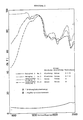
- FIG. 1 The change in absorbency in the near IR in the separate heat treatment of the individual components, the mixture without heat treatment, and the mixture of one
- the thioamide compound according to the invention and a copper compound according to the invention after heat treatment is illustrated in FIG. 1.
- N-phenylthiobenzamide is used as the thioamide compound and copper p-chlorobenzoate as the copper compound.
- the solutions of the above compositions were individually milled to a particle size of 1 micron in an attritor.
- the solutions were mixed together in the ratio shown in Table 3 to obtain a coating composition.
- the coating composition obtained was applied in a coating amount of 3.0 g / m2 (solid content) to a high-class paper of 50 g / m2 and dried to obtain a recording sheet.
- This recording sheet was heated to 150 ° C for 5 seconds under a pressure of 10 g / m 2 Pressed plate (heat treated). A near IR absorbing recording sheet was obtained.
- the absorbance of the obtained recording sheet was measured in the same manner as in Example 2, and the background color of the coating surface and the resistance of the IR absorbance to heat, moisture, and light were determined as follows, and the results are summarized in Table 3.
- the reflectance of the coating surface after the heat treatment is measured with a Macbeth density meter (RD-914, use of the amber filter).
- One sheet is left in the oven at 60 ° C for 24 hours. Then the IR reflectance of the sheet is measured with a spectrophotometer (at a wavelength of 1000 nm).
- Resistance to heat is evaluated as a residual percentage of near IR absorbency using the following formula.
- a leaf is left at 40 ° C and 90% relative humidity. After 24 hours, the IR reflectance of the sheet is measured with a spectrophotometer (at a wavelength of 1000 nm). Resistance to atmospheric humidity is evaluated as a residual percentage of the near IR absorption capacity using the following formula.
- a sheet is irradiated with the light of a fade-o-meter for 6 hours.
- the sheet's IR reflectance is measured with a spectrophotometer (at a wavelength of 1000 nm).
- the resistance to light is evaluated as a residual percentage of near IR absorption by the following formula.
- the dispersion A containing the thioamide compound or the dispersion B containing the copper compound used in Example 3 was separately applied in the same manner as in Example 3, dried, and then heat-treated to prepare a product. The near IR absorption capacity of the product was measured.
- This coating composition was applied in a coating amount of 5 g / m2 on a high-quality paper with a weight of 60 g / m2 by means of the Meyerbar device and dried.
- a recording sheet was obtained. All of the recording sheets obtained are white to pale blue, and turn pale green when touched with a metal plate from a surface temperature of 150 ° C for 5 seconds.
- the absorption values of the near IR light at 800, 900, 1000, 1500 and 2000 nm wavelength are on average more than 80% and are therefore high.
- the heat sensitive printing was carried out by a heat sensitive bar code printer (BW-100T, manufactured by Mekano System Co., Ltd.). In each case, a pale green bar code pattern was printed on each of the sheets.
- This pattern is readable by means of a bar code reader (MS-Ba-Dec 230, manufactured by Mekano System Co., Ltd.), in which the light of a Semiconductor laser was used as a reading light source.
- a bar code reader MS-Ba-Dec 230, manufactured by Mekano System Co., Ltd.
- the pale-colored powder product obtained was fixed in a certain thickness on high-quality paper.
- the reflectance of the surface was measured in the same manner as in Example 2.
- the near IR absorbance is shown in the same manner as in Example 2.
- the near IR absorption capabilities of the materials according to the invention in Nos. 1-23 of Table 4 show an average value of at least 60%.
- Example 5 Each of the thioamide compounds or each of the lead compounds in Table 5 was among the same conditions as in Example 5, and applied to the preparation of the product.
- the near IR reflectance spectrum of a product obtained was measured, and the near IR absorbance was evaluated in the same manner as in Example 5. All absorption capabilities in the near IR are less than 30%, as can be seen from Table 5.
- FIG. 2 The change in the absorbency, in the near IR in the separate heat treatment of the individual components, the mixture without heat treatment, and the mixture of a thioamide compound according to the invention and a lead compound according to the invention after heat treatment is illustrated in FIG. 2.
- N-phenylthiobenzamide is used as the thioamide compound and lead p-chlorobenzoate is used as the lead compound.
- No. 1 of Example 4 (mixture without heat treatment) and No. 1 of the example 5 (heat treatment of the mixture) are compared with respect to the near IR reflection spectra in the range of 800-2000 nm.
- compositions were prepared with each of the thioamide compounds and lead compounds, Nos. 24-32 of Table 6.
- Solution A Thioamide compound 50 parts 10% aqueous solution of polyvinyl alcohol 25 parts water 125 pieces
- Solution B Lead compound 50 parts 10% aqueous solution of polyvinyl alcohol 25 parts water 125 pieces
- the solutions of the above compositions were individually milled to a particle size of 1 micron in an attritor.
- the solutions were mixed together in the ratio shown in Table 6 to obtain a coating composition.
- the coating composition obtained was applied in a coating amount of 3.0 g / m2 (solid content) to a high-class paper of 50 g / m2 and dried to obtain a recording sheet.
- This recording sheet was pressed (heat-treated) against a plate heated to 150 ° C for 5 seconds under a pressure of 10 g / m 2. A near IR absorbing recording sheet was obtained.
- the dispersion A containing the thioamide compound or that containing the lead compound Dispersion B used in Example 6 was separately applied in the same manner as in Example 6, dried, and then heat-treated to produce a product. The near IR absorption capacity of the product was measured.
- the near IR absorbing mass according to the invention and the sheet containing this mass are almost colorless, and the heated part immediately has a near IR absorption capacity.
- the heat treatment of the composition according to the invention, of the sheet containing the composition according to the invention, or of the sheet containing this heat-treated composition leads to strong absorption capacity in the very near IR range of 800-2000 nm.
- the products according to the invention can be used as optical materials like as a thermal detector; Filters for light in the near IR range; Recording material; Material for the rejection or isolation of Heat rays; Heat collector; Sensor for IR detectors and the like can be used.
- the mass according to the invention or the material obtained by its heat treatment is only slightly discolored despite the presence of metal. Therefore, the shaped bodies (film, sheet, etc.) containing this mass or material have a superior appearance.
- any absorbency of the near IR absorbent mass of the present invention, the near IR absorbent material of the present invention, and the molded article containing this mass or material has superior stability against the change in environmental conditions with time, which does not deteriorate.
- the near IR absorbing mass according to the invention can only be produced by mixing the components, and the near IR absorbing material according to the invention can only be produced by heating this mixture.
- the production of the molded body, which contains the composition according to the invention or the material according to the invention, does not require a new agent. Therefore, this invention is suitable for industrial production.
Landscapes
- Chemical & Material Sciences (AREA)
- Organic Chemistry (AREA)
- Health & Medical Sciences (AREA)
- Chemical Kinetics & Catalysis (AREA)
- Medicinal Chemistry (AREA)
- Polymers & Plastics (AREA)
- Heat Sensitive Colour Forming Recording (AREA)
- Optical Filters (AREA)
- Optical Record Carriers And Manufacture Thereof (AREA)
- Thermal Transfer Or Thermal Recording In General (AREA)
Abstract
Description
- Diese Erfindung betrifft eine im nahen IR absorbierende Masse, die mindestens eine Thioamidverbindung und mindestens eine Verbindung aus der Gruppe der Kupferverbindungen und Bleiverbindungen enthält, und ein im nahen IR absorbierendes Material, sowie einen Formkörper, der diese Masse oder dieses Material enthält.
- Die im nahen IR absorbierenden Materialien wurden in den letzten Jahren besonders entwickelt. Diese Materialien werden vielfältig in der Praxis verwendet, z.B. als lichtempfindliche Materialien, bei denen ein Halbleiterlaser mit einer Wellenlänge im nahen IR-Bereich, usw. als Lichtquelle verwendet wird; als Informationsaufzeichnungsmaterialien wie optische Aufzeichnungsscheiben; als optische Materialien wie Filter und Filme für das nahe IR usw; als Licht-Wärmeumwandlungsaufzeichnungsmaterialien in Kombination mit den wärmeempfindlichen Materialien.
- Als bekannte im nahen IR absorbierende Materialien werden ein Chrom-Kobalt-Komplex in der japanischen Patentpublikation Nr. 42269/1985 beschrieben; ein Thiol-Nickel-Komplex in JO-LS Nr. 21294/1985; ein Anthrachinonderivat in JO-LS Nr. 115958/1986; eine neue Squaryliumverbindung mit einer Maximumwellenlänge von 700-800 nm in JO-LS Nr. 2.18551/1986. Weiter werden in "Im nahen IR absorbierender Farbstoff" (Kagakukogyo 43, Mai 1959) Nitrosoverbindungen, ihre Metallkomplexe, Polymethinfarbstoffe (Cyaninfarbstoffe), Thiol-Kobalt-komplexe, Thiol-Platin-Komplexe, Thio-Palladiumkomplexe, Phthalocyaninfarbstoffe, Triarylmethanfarbstoffe, Immoniumfarbstoffe, Diimmoniumfarbstoffe, Naphthochinonfarbstoffe und dergleichen beschrieben.
- Die bisherigen, im nahen IR absorbierenden Materialien des organischen Typs haben die Nachteile, daß die Dauerhaftigkeit unterlegen ist; d.h. daß die Anfangseigenschaften unter dem Einfluß der Umweltbedingungen oder im Lauf der Zeit verschlechtert werden. Andererseits weisen die im nahen IR absorbierenden Materialien des Komplextyps eine überlegene Dauerhaftigkeit auf, sie haben jedoch die Nachteile, daß wegen der Absorption des sichtbaren Lichts die Materialien stark gefärbt sind, wodurch die Materialien nur beschränkt angewandt werden. Jedes Material hat ein Absorptionsmaximum bei einer bestimmten Wellenlänge, besitzt aber fast keine Absorptionsfähigkeit bei anderen Wellenlängen. Bei einem Aufzeichnungsmaterial, bei dem das obige Material verwendet wird und wenn als Lichtquelle beispielsweise ein Laserlicht mit einer Wellenlänge im nahen IR angewandt wird, ist es erforderlich, daß die Laserwellenlänge mit dem Absorptionsmaximum des Materials übereinstimmt. Weil die Laserwellenlänge und die Absorptionsmaterialwellenlänge beschränkt sind, sind die Kombinationsmöglichkeiten, bei denen die Laserwellenlänge und die Absorptionsmaterialwellenlänge übereinstimmen, sehr gering. Weiter sind derartige Kombinationsmöglichkeiten unter Berücksichtigung von Absorptionsfähigkeit, Dauerhaftigkeit, Färbung, Kosten usw. des Aufzeichnungsmaterials praktisch fast nicht vorhanden. Daher werden diese Materialien nur beschränkt angewandt.
- Der Erfindung liegt die erste Aufgabe zugrunde, ein im nahen IR absorbierendes Material mit weniger Färbung, hoher Dauerhaftigkeit und gleichmäßiger Absorption im nahen IR-Bereich von 700-2000 nm Wellenlänge zu schaffen. Der Erfindung liegt die zweite Aufgabe zugrunde, eine Masse, aus der ein im nahen IR absorbierendes Material leicht hergestellt werden kann, zu schaffen. Der Erfindung liegt die dritte Aufgabe zugrunde, einen Formkörper, der ein im nahen IR absorbierendes Material oder eine im nahen IR absorbierende Masse enthält, zu schaffen.
- Diese Aufgaben werden erfindungsgemäß wie folgt gelöst. Die erfindungsgemäß im nahen IR absorbierende Masse enthält sowohl mindestens eine Thioamidverbindung aus der Gruppe der allgemeinen Formel (I) als auch eine Verbindung aus der Gruppe Kupfer- und Bleiverbindungen

- Das erfindungsgemäß im nahen IR absorbierende Material umfaßt das Reaktionsprodukt, das durch die Hitzebehandlung der erfindungsgemäßen Masse erhalten wird. Der erfindungsgemäße Formkörper umfaßt die erfindungsgemäße Masse oder das erfindungsgemäße Material.
- Die Wahl der erfindungsgemäßen Thioamidverbindungen der allgemeinen Formel (I) ist nicht besonders beschränkt, man kann z.B. folgende verwenden:


- Die erfindungsgemäße Kupferverbindung ist eine Kupferverbindung der Formel (II)
( R - X ) n C u ( II )
worin R ein Wasserstoffatom, eine Alkyl-, Cycloalkyl-, Aryl-, Aralkylgruppe oder ein heterocyclischer Rest ist (wobei jede Gruppe oder der Rest durch mindestens einen Substituenten substituiert sein kann), X -COO, -SO₄, -SO₃, -PO₄, oder -O bedeutet, und n eine ganze Zahl von 1 bis 4 ist. - Die Wahl der erfindungsgemäßen Kupferverbindungen der allgemeinen Formel (II) ist nicht besonders beschränkt, man kann z.B. folgende verwenden: Kupferstearat, Kupferpalmitat, Kupferoleat, Kupferbehenat, Kupferlaurat, Kupfercaprat, Kupfercapronat, Kupfervalerianat, Kupferisolaktat, Kupferlaktat, Kupferpropionat, Kupferacetat, Kupferformat, Kupferhydroxid, Kupferbenzoat, Kupfer-O-toluylat, Kupfer-m-toluylat, Kupfer-p-toluylat, Kupfer- p-tert.-butylbenzoat, Kupfer-o-chlorbenzoat, Kupfer-m-chlorbenzoat, Kupfer-p-chlorbenzoat, Kupferdichlorbenzoat, Kupfertrichlor benzoat, Kupfer-p-brombenzoat, Kupfer-p-jodbenzoat, Kupfer-p-phenylbenzoat, Kupfer-o-benzoylbenzoat, Kupfer-p-nitrobenzoat, Kupferanthranilat, Kupfer-p-aminobenzoat, Kupferoxalat, Kupfermalonat, Kupfersuccinat, Kupferglutarat, Kupferadipat, Kupferpimelat, Kupfersuberat, Kupferazelat, Kupfersebacinat, Kupferphthalat, Kupfermonoesterphthalat, Kupfernaphthenat, Kupfernaphthalincarbonat, Kupfertartarat, Kupferdiphenylamin-2-carboxylat, Kupfer-4-cyclohexyllaktat, Kupferdiäthyldithiocarbamat, Kupferglukonat, Diäthoxykupfer, Di-isopropoxykupfer, Di-n-butoxykupfer, Kupferoctylat, Kupferalkylbenzolsulfonat, Kupfer-p-toluolsulfonat, Kupfernaphthalinsulfonat, Kupfernaphthylaminsulfonat, Kupfer-n-dodecylbenzolsulfonat, Kupferdodecylsulfat, Kupfer-2,5-dimethylbenzolsulfonat, Kupfer-2-carbomethoxy-5-methylbenzolsulfonat, Kupfer-α-naphthylphosphat, Kupferstearylphosphat, Kupferlaurylphosphat, Kupfer-di-2-äthylhexylphosphat, Kupferisodecylphosphat, und dergleichen.
- Die erfindungsgemäße Bleiverbindung ist eine Bleiverbindung der Formel (III)
(R - X)n Pb (III)
worin R ein Wasserstoffatom, eine Alkyl-, Cycloalkyl-, Aryl-, Aralkylgruppe oder ein heterocyclischer Rest ist (wobei jede Gruppe oder der Rest durch mindestens einen Substituenten substituiert werden kann), X -COO, -SO₄, -SO₃, -PO₄, oder -O bedeutet, und n eine ganze Zahl von 1 bis 4 ist. - Die Wahl der erfindungsgemäßen Bleiverbindungen der allgemeinen Formel (II) ist nicht besonders beschränkt, man kann z.B. folgende verwenden: Bleistearat, Bleipalmitat, Bleioleat, Bleibehenat, Bleilaurat, Bleicaprat, Bleicapronat, Bleivalerianat, Bleiisolaktat, Bleilaktat, Bleipropionat, Bleiacetat, Bleiformat, Bleihydroxid, Bleibenzoat, Blei-o-toluylat, Blei-m-toluylat, Blei-p-toluylat, Blei-p-tert.-butylbenzoat, Blei-o-chlorbenzoat, Blei-m-chlorbenzoat, Blei-p-chlorbenzoat, Bleidichlorbenzoat, Bleitrichlor benzoat, Blei-p-brombenzoat, Blei-p-jodbenzoat, Blei-p-phenylbenzoat, Blei-o-benzoylbenzoat, Blei-p-nitrobenzoat, Bleianthranilat, Blei-p- aminobenzoat, Bleioxalat, Bleimalonat, Bleisuccinat, Bleiglutarat, Bleiadipat, Bleipimelat, Bleisuberat, Bleiazelat, Bleisebacinat, Bleiphthalat, Bleimonoesterphthalat, Bleinaphthenat, Bleinaphthalincarbonat, Bleitartarat, Bleidiphenylamin-2-carboxylat, Blei-4-cyclohexyllaktat, Bleidiäthyldithiocarbamat, Bleiglukonat, Diäthoxyblei, Di-isopropoxyblei, Di-n-butoxyblei, Bleioctylat, Bleialkylbenzolsulfonat, Blei-p-toluolsulfonat, Bleinaphthalinsulfonat, Bleinaphthylaminsulfonat, Blei-n-dodecylbenzolsulfonat, Bleidodecylsulfat, Blei-2,5-dimethylbenzolsulfonat, Blei-2-carbomethoxy-5-methylbenzolsulfonat, Blei-α-naphthylphosphat, Bleistearylphosphat, Bleilaurylphosphat, Blei-di-2-äthylhexylphosphat, Bleiisodecylphosphat, und dergleichen.
- In den Formeln I, II und III können Alkyl, Alkenyl, Alkoxy etc. geradkettig oder verzweigt sein. Vorzugsweise steht Alkyl für C₁-C₃₀-Alkyl, insbesondere C₁-C₂₅-Alkyl. Beispiele sind Methyl, Ethyl, n- und i-Propyl, Butyl, Stearyl oder Behenyl.
- Cycloalkyl steht vorzugsweise für Cyclopentyl oder Cyclohexyl.
- Aryl bedeutet vorzugsweise Phenyl oder Naphthyl, Aralkyl steht vorzugsweise für Phenyl-C₁-C₄-Alkyl, wie Benzyl oder Phenylethyl.
- Alkenyl steht vorzugsweise für C₂-C₆-Alkenyl, insbesondere C₂-C₄-Alkenyl.
- Bei den heterocyclischen Resten handelt es sich vorzugsweise um 5- oder 6-gliedrige Ringe mit einem oder mehreren Sauerstoff-, Schwefel- oder Stickstoff-Heteroatomen, wie Thiazolyl, Thienyl, Furyl, Pyrrolidinyl, Pyrrolyl, Morpholinyl, Piperazinyl, Piperidinyl oder Pyridinyl. Wenn R₁ und R₂ oder R₂ und R₃ gemeinsam einen Ring bilden, stehen sie vorzugsweise für Ethylen, Propylen oder Butylen.
- Bevorzugte Substituenten der in den Formeln I, II und III vorhandenen Reste sind geradkettiges oder verzweigtes C₁-C₁₈-Alkyl (wie Methyl, Ethyl, n- und i-Propyl, n-, i- und t-Butyl, Dodecyl etc.), C₁-C₄-Alkoxy, Hydroxy, Halogen (F, Cl, Br, J), Nitro, Amino, Phenyl, Cyclopentyl, Cyclohexyl, Benzoyl, Acetyl.
- Entweder die obige Thioamidverbindung oder die obige Kupfer- oder Bleiverbindung absorbiert nahes IR-Licht fast nicht oder nur eine bestimmte Wellenlänge. Eine Hitzebehandlung der Thioamidverbindung oder der Kupfer- oder Bleiverbindung übt keinen Einfluß auf die Absorption im nahen IR aus. Aber das Gemisch aus dieser Thioamidverbindung und dieser Kupfer- und/oder Bleiverbindung nimmt nach seiner Hitzebehandlung nahes IR-Licht stark und gleichmäßig auf.
- Ohne Hitzebehandlung nimmt das Gemisch aus einer Thioamidverbindung der allgemeinen Formel (I) und wenigstens einer Verbindung aus der Gruppe der Verbindungen der allgemeinen Formel (II), der Verbindungen der allgemeinen Formel (III), Kupfer- und Bleiacetylacetonate, Chlorophyll-Kupfer und -Blei und Chlorophyllin-Kupfer und -Blei fast kein nahes IR-Licht auf.
- Wenn man die erfindungsgemäße Masse oder die diese Masse enthaltenden Formkörper vollständig oder teilweise (abschnittsweise) durch Zufuhr von Wärmeenergie behandelt, nimmt der erhitzte Teil das nahe IR-Licht stark auf. Der erhitzte Teil nimmt kein Licht im sichtbaren Wellenlängenbereich auf und produziert ein latentes Bild (eines durch Erhitzen erzeugten Musters).
- Daher kann man unter der Verwendung des obigen Phänomens einen Detektor für das durch Erhitzen erzeugte Muster und in Kombination mit einem geeigneten Entwicklungsgerät ein Aufzeichnungspapier herstellen.
- Weil das erfindungsgemäße Material, das durch die Hitzebehandlung der ein Gemisch aus Thioamidverbindung und aus Kupfer- und/oder Bleiverbindung enthaltenden Masse erhalten wird, das Licht im nahen IR-Bereich stark absorbiert, kann es Verwendung bei der Herstellung eines Detektors für nahes IR-Licht und bei der Herstellung der Mittel für das Aufzeichnungssystem des Laserstrahls finden.
- Die Stärke der Absorption im nahen IR kann durch die Art und das Mischverhältnis von Thioamidverbindung und Kupfer- und/oder Bleiverbindung, Erhitzungstemperatur und -zeit usw. eingestellt werden.
- Die erfindungsgemäße Masse wird hergestellt, indem man die Thioamidverbindung und die Kupfer- und/oder Bleiverbindung in einem geeigneten Mischungsverhältnis vermischt, oder indem man die Thioamidverbindung, die Kupfer- und/oder Bleiverbindung, ein Bindemittel, Zellstoff, Holzschliff, thermoplastisches Harzpulver usw. und gegebenenfalls Additive wie Farbstoffe usw. vermischt.
- Weiter kann die erfindungsgemäße Masse hergestellt werden, indem man das Gemisch aus allen Rohstoffen in einem geeigneten Lösungsmittel oder einer geeigneten Dispersion auflöst, oder indem man alle Rohstoffe außer Bindemittel, Farbstoff, usw. in einem Lösungsmittel auflöst, in dem Bindemittel, Färbungsmittel, usw. dispergiert oder aufgelöst sind.
- Die Masse kann beispielsweise eine Beschichtungsmasse, Füllstoff usw. sein. Das Mischverhältnis, der Massegehalt im Formkörper und die Zugabemenge anderer Stoffe werden so festgelegt, daß beim Erhitzen die Thioamidverbindung und die Kupfer- und/oder Bleiverbindung als Feststoffe oder als Schmelze oder als Gemisch aus Feststoff und Schmelze miteinander in Kontakt gebracht werden.
- Der erfindungsgemäße Formkörper umfaßt eine erfindungsgemäße Masse, die die Thioamidverbindung und die Kupfer- und/oder Bleiverbindung enthält, oder ein im nahen IR absorbierendes Material, das durch die Hitzebehandlung der erfindungsgemäßen Masse erhalten wird. Das Verfahren zur Herstellung dieses Formkörpers erfolgt durch:
- (a) Formen eines Gemisches aus den Formkörperrohstoffen, und der erfindungsgemäßen Masse oder dem erfindungsgemäßen im nahen IR absorbierenden Materiall oder
- (b) Auftragen oder Imprägnieren eines dispergierten Schlamms der erfindungsgemäßen Masse oder des erfindungsgemäßen Materials mittels Zerstäubungs-, Streich- oder Druckmaschine auf den Förmkörperrohstoff.
- Der Formkörper wird hergestellt, indem man aus Zellstoff, Bolzschliff, Faser, thermoplastischem Harz, usw. auf bekannte Weise, beispielsweise durch Weben, Blattbildung, Hitzeformierung usw. einen Film, ein Blatt oder eine Stange produziert und gegebenfalls weiter behandelt.
- Das Hitzeverfahren zur Erzielung einer Absorptionsfähigkeit im nahen IR ist nicht besonders beschränkt. Alle Hitzeverfahren, die eine Übertragung von Wärmeenergie für die Erzielung der Absorptionsfähigkeit im nahen IR auf Grund der Reaktion der erfindungsgemäßen Thioamidverbindung mit der erfindungsgemäßen Kupfer- oder Bleiverbindung mit sich bringen, können erfindungsgemäß verwendet werden. Das Erhitzen kann beispielsweise mit Hilfe einer elektrischen Heizvorrichtung, Induktionsheizvorrichtung, Filmextruders usw., Thermokopfes, Halbleiterlasers, IR-Lampe und dergleichen, erfolgen.
- Die Hitzebehandlung wird unter beliebiger Atmosphäre, beispielweise Luftatmosphäre, inerter Gasatmosphäre usw., üblicherweise unter Luftatmosphäre durchgeführt,
- Die Erhitzungstemperatur liegt üblicherweise bei 40 - 400 °C, vorzugsweise bei 50 - 350 °C. Die Erhitzungszeit ist im Bereich von einigen Millisekunden bis zu einigen Zehnminuten.
- Eine gleichmäßige Vermischung durch einen Mischer,z.B. Quirl, durch Umrühren und Schwenken ist bevorzugt, weil dies wegen der zunehmenden Berührungshäufigkeit der Materialien zu einer einheitlichen Wärmeübertragung und großen Reaktionsgeschwindigkeit führt.
- Das Mischverhältnis von Thioamidverbindung, Kupfer- und/oder Bleiverbindung ist je nach der Art dieser Verbindungen verschieden, aber 0.01 - 50 Gew.-Teile, vorzugsweise 0,1 - 10 Gew.-Teile der Thioamidverbindung, bezogen auf 1 Gew.-Teil der Kupfer- und/oder Bleiverbindung, werden im allgemeinen verwendet.
- Wie oben erwähnt wurde, nimmt das Gemisch aus der Thioamidverbindung der allgemeinen Formel (I) und aus mindestens einer Verbindung aus der Gruppe Kupfer-und Bleihydroxid, Kupferverbindung der allgemeinen Formel (II), Bleiverbindung der allgemeinen Formel (III), Kupfer- und Bleiacetylacetonat, Chlorophyll-Kupfer und -Blei, und Chlorophyllin-Kupfer und -Blei nach Hitzebehandlung nahes IR-Licht gleichmäßig im ganzen Bereich von 700 - 2000 nm auf. Die Ursache für die obige Tatsache ist nicht klar.
- Wie aus folgenden Beispielen und Vergleichsbeispielen ersichtlich ist, nimmt weder die Thioamidverbindung noch die obige Kupfer- und/oder Bleiverbindung nach Hitzebehandlung nahes IR-Licht stark und gleichmäßig im ganzen Bereich von 700 - 2000 nm auf. Das Gemisch aus der Thioamidverbindung der allgemeinen Formel (I) und der obigen Kupfer- und/oder Bleiverbindung ohne Hitzebehandlung nimmt ebenfalls kein nahes IR-Licht stark und gleichmäßig auf. Daher vermutet man, daß bei der Hitzebehandlung des Gemisches eine Reaktion zwischen der Thioamidverbindung der allgemeinen Formel (I) und der obigen Kupfer- und/oder Bleiverbindung auftritt, wodurch ein Komplex gebildet wird.
- Die Erfindung wird durch folgende Beispiele erläutert. Als Abkürzung für Gewichtsteile wird "Teile" verwendet.
- Die Thioamidverbindungen und Kupferverbindungen der Nrn. 1, 3 und 5 der der Tabelle 1 wurden in einer Reibmühle bis zur Teilchengröße von ungefähr 3 µ naß vermahlen.
Lösung A Thioamidverbindung von Nr. 1, 3 oder 5 20 Teile 10%-ige wäßrige Lösung von Polyvinylalkohol 50 Teile Wasser 30 Teile Gesamt 100 Teile Lösung B Kupferverbindung von Nr. 1, 3 oder 5 20 Teile 10%-ige wäßrige Lösung von Polyvinylalkohol 50 Teile Wasser 30 Teile Gesamt 100 Teile - 50 Teile der Lösung A und 50 Teile der Lösung B wurden miteinander vermischt, um eine Beschichtungsmasse herzustellen.
- Diese Beschichtungsmasse wurde in einer Beschichtungsmenge von 5 g/m² auf ein hochklassiges Papier mit einem Gewicht von 60 g/m² mittels des Meyerbargeräts aufgetragen und getrocknet. Man erhielt ein Aufzeichnungsblatt. Alle erhaltenen Aufzeichnungsblätter sind weiß bis blaßblau, und färben sich blaßgrünlich bei der Berührung mit einer Metallplatte von einer Oberflächentemperatur von 150°C während 5 Sekunden. Bei jedem gefärbten Teil sind die Absorptionswerte des nahen IR-Lichtes bei 800, 900, 1000, 1500 und 2000 nm Wellenlänge durchschnittlich mehr als 80%, und sie sind daher hoch.
- Der wärmeempfindliche Druck erfolgte durch einen wärmeempfindlichen Drucker für Strichcode-Zettel (BW-100T, hergestellt von Mekano System Co., Ltd.). In jedem Fall wurde ein blaßgrünes Strichcode-Muster auf jedes der Blätter gedruckt.
- Dieses Muster ist lesbar mittels eines Lesers für Strichcode-Zettel (MS-Ba-Dec 230, hergestellt von Mekano System Co., Ltd.), bei dem das Licht eines Halbleiterlasers als Leselichtquelle verwendet wurde.
- Auf Basis der Kombinationen Nr. 1 - 23 in der Tabelle 1 wurden 5 Teile einer Thioamidverbindung und 5 Teile einer Kupferverbindung in einem Porzellantiegel vermischt. 10 Teile des Gemisches wurden während 15 Sekunden bei 150°C in einem elektrischen Ofen hitzebehandelt.
- Das erhaltene, blaßfarbige Pulverprodukt wurde in einer bestimmten Dicke auf einem hochklassigen Papier fixiert.
- Der Reflexionsgrad der Oberfläche wurde mit dem Spektrophotometer (UVID EC-590, hergestellt von Japan Spectroscopic Co., Ltd.) in bezug auf das Reflexionsspektrum des nahen IR-Bereiches im Wellenlängenbereich von 800 - 2500 nm gemessen.
- Die Absorptionsfähigkeit im nahen IR wird als Durchschnittswert der Absorptionswerte dargestellt, wobei dieser Absorptionswert der Unterschied zwischen 100% und dem Reflexionsgrad bei ,der Wellenlänge von 800, 900, 1000, 1500 und 2000 nm ist. Dabei zeigt ⓞ einen Durchschnittswert von wenigstens 80%, ○ einen Durchschnittswert von wenigstens 60%, Δ einen Durchschnittwert von wenigstens 30%, und X einen Durchschnittswert von weniger als 30%.
- Das Material mit einem Durchschnittswert von wenigstens 30% bedeutet ein erfindungsgemäßes im nahen IR absorbierendes Material. Die nahen IR-Absorptionsfähigkeiten der erfindungsgemäßen Materialien in Nrn. 1 - 23 der Tabelle 1 zeigen einen Durchschnittswert von wenigstens 60%.
- Jede der Thioamidverbindungen oder jede der Kupferverbindungen in der Tabelle 2 wurde unter den gleichen Bedingungen wie im Beispiel 2 hitzebehandelt, und auf die Herstellung des Produktes angewandt. Das nahe IR-Reflexionsspektrum eines erhaltenen Produktes wurde gemessen, und die nahe IR-Absorptionsfähigkeit wurde in gleicher Weise wie im Beispiel 2 bewertet. Alle Absorptionsfähigkeiten im nahen IR sind weniger als 30%, wie es aus der Tabelle 2 ersichtlich ist.
- Die Änderung der Absorptionsfähigkeit im nahen IR bei der getrennten Hitzebehandlung der einzelnen Komponenten, der Mischung ohne Hitzebehandlung, und der Mischung aus einer erfindungsgemäßen Thioamidverbindung und einer erfindungsgemäßen Kupferverbindung nach Hitzebehandlung ist in Abbildung 1 erläutert. In der Abbildung 1 werden als Thioamidverbindung N-Phenylthiobenzamid und als Kupferverbindung Kupfer-p-chlorbenzoat verwendet.
- Nr. 1 und Nr. 4 des Vergleichsbeispiels 1 (getrennte Hitzebehandlung),Nr. 1 des Beispiels 1 (Mischung ohne Hitzebehandlung) und Nr. 1 des Beispiels 2 (Hitzebehandlung der Mischung) werden in bezug auf die nahen IR-Reflexionsspektra im Bereich von 800 - 2000 nm verglichen.
- Aus der Abbildung 1 ist ersichtlich, daß die Absorptionsfähigkeit des erhitzten Gemisches aus N-phenylthiobenzamid und Kupfer-p-chlorbenzoat (bei Nr. 1 des Beispiels 2) im nahen IR erheblich höher ist als diejenge der getrennt erhitzten Komponenten oder als diejenige der Mischung ohne Hitzebehandlung; das heißt, daß die nahe IR-Absorptionsfähigkeit von Nr. 1 des Beispiels 2 mehr als 90% im ganzen Meßwellenlängenbereich ist.
- Mit jeder der Thioamidverbindungen und Kupferverbindungen der Nrn. 24 - 32 der Tabelle 3 wurden folgende Zusammensetzungen zubereitet:
Lösung A Thioamidverbindung 50 Teile 10%-ige wäßrige Lösung von Polyvinylalkohol 25 Teile Wasser 125 Teile Lösung B Kupferverbindung 50 Teile 10%-ige wäßrige Lösung von Polyvinylalkohol 25 Teile Wasser 125 Teile - Die Lösungen der obigen Zusammensetzungen wurden in einer Reibmühle einzeln bis zur Teilchengröße von 1 Mikron vermahlen. Die Lösungen wurden in dem in der Tabelle 3 angegebenen Verhältnis miteinander vermischt, um eine Beschichtungsmasse zu erhalten. Die erhaltene Beschichtungsmasse wurde in einer Beschichtungsmenge von 3,0 g/m² (Feststoffgehalt) auf ein hochklassiges Papier von 50 g/m² aufgetragen und getrocknet, um ein Aufzeichnungsblatt zu erhalten.
- Dieses Aufzeichnungsblatt wurde 5 Sekunden unter einem Druck von 10 g/m2 gegen eine auf 150°C erhitzte Platte gepreßt (hitzebehandelt). Man erhielt ein im nahen IR absorbierendes Aufzeichnungsblatt.
- Die Absorptionsfähigkeit des erhaltenen Aufzeichnungsblattes wurde in der gleichen Weise wie im Beispiel 2 gemessen, und die Hintergrundfarbe der Beschichtungsoberfläche und die Beständigkeit der IR-Absorptionsfähigkeit gegenüber Hitze, Feuchtigkeit, und Licht wurde wie folgt bestimmt, und die Ergebnisse sind in der Tabelle 3 zusammengefaßt.
- Der Reflexionsgrad der Beschichtungsoberfläche nach der Hitzebehandlung wird mit einem Macbeth-Dichtemesser (RD-914, Verwendung des Amber-Filters) gemessen.
- Ein Blatt wird 24 Stunden im Ofen bei 60°C belassen. Dann wird der IR-Reflexionsgrad des Blattes mit einem Spectrophotometer (bei einer Wellenlänge von 1000 nm) gemessen.
- Die Beständigkeit gegenüber Hitze wird als Restprozentsatz der nahen IR-Absorptionsfähigkeit durch folgende Formel bewertet.

- Ein Blatt wird bei 40°C und 90% relativer Luftfeuchtigkeit stehengelassen. Nach 24 Stunden wird der IR-Reflexionsgrad des Blattes mit einem Spektrophotometer (bei einer Wellenlänge von 1000 nm) gemessen. Die Beständigkeit gegenüber Luftfeuchtigkeit wird als Restprozentsatz der nahen IR-Absorptionsfähigkeit durch folgende Formel bewertet.

- Ein Blatt wird 6 Stunden mit dem Licht eines Fade-O-Meters bestrahlt. Der IR-Reflexionsgrad des Blattes wird mit einem Spektrophotometer (bei einer Wellenlänge von 1000 nm) gemessen. Die Beständigkeit gegenüber Licht wird als Restprozentsatz der nahen IR-Absorptionsfähigkeit durch folgende Formel bewertet.

- Die die Thioamidverbindung enthaltende Dispersion A oder die die Kupferverbindung enthaltende Dispersion B, die im Beispiel 3 verwendet wurden, wurde auf die gleiche Weise wie im Beispiel 3 getrennt aufgetragen, getrocknet und dann hitzebehandelt, um ein Produkt zu herzustellen. Die nahe IR-Absorptionsfähigkeit des Produktes wurde gemessen.
- Bei den Blättern, auf die ein Gemisch aus der erfindungsgemäßen Thioamidverbindung und der erfindungsgemäßen Kupferverbindung aufgetragen und die getrocknet wurden, führt eine Hitzebehandlung zu einem Blatt mit einer hohen Absorptionsfähigkeit im nahen IR,wie aus Tabelle3 ersichtlich ist. Diese hohe IR-Absorptionsfähigkeit wird unter der Einwirkung von Hitze, Feuchtigkeit und Licht fast nicht erniedrigt und sie ist erstaunlich stabil gegenüber der Handhabung und der Änderung der Umweltsbedingungen. Die Oberfläche dieses Blattes färbt sich etwas ins Graue, wodurch das Blatt aber keine auffallende Farbveränderung erfährt. Das Blatt, auf das entweder die Thioamidverbindung oder die Kupferverbindung aufgetragen und das getrocknet wurde, weist bei der Hitzebehandlung keine nahe IR-Absorptionsfähigkeit auf, und es wurde daher hinsichtlich der Stabilität der IR-Absorptionsfähigkeit während der Lagerung nicht geprüft.
Tabelle 1 Thioamidverbindung Kupferverbindung Mischverhältnis Nahe IR-Absorptionsfähigkeit Hitzebehandlung Nr.1 N-Phenylthiobenzamid Kupfer-p-chlorbenzoat 1:1 ⓞ Hitzebehandlung Nr.2 N-Cyclohexylthiobenzamid Kupfer-p-chlorbenzoat 1:1 ⓞ Hitzebehandlung Nr.3 N-Stearylthiobenzamid Kupfer-p-chlorbenzoat 1:1 ⓞ Hitzebehandlung Nr.4 Thioacetanilid Kupfer-p-chlorbenzoat 1:1 ⓞ Hitzebehandlung Nr.5 Thionicotinsäureamid Kupfer-p-chlorbenzoat 1:1 ⓞ Hitzebehandlung Nr.6 N-Phenylthiobenzamid Kupferstearat 1:1 ⓞ Hitzebehandlung Nr.7 N-Phenylthiobenzamid Kupferbehenat 1:1 ⓞ Hitzebehandlung Nr.8 N-Phenylthiobenzamid Kupfer-p-nitrobenzoat 1:1 ⓞ Hitzebehandlung Nr.9 N-Phenylthiobenzamid + Thioacetanilid Kupfer-m-clorbenzoat (0.5:0.5):1 ⓞ Hitzebehandlung Nr.10 N-Phenylthiobenzamid Kupfer-p-brombenzoat 1:1 ⓞ Hitzebehandlung Nr.11 N-Phenylthiobenzamid Kupferbenzoat 1:1 ○ Hitzebehandlung Nr.12 N-Phenylthiobenzamid Kupfer-o-benzoylbenzoat 1:1 ○ Hitzebehandlung Nr.13 N-Phenylthiobenzamid Chlorophyll-Kupfer 1:1 ○ Hitzebehandlung Nr.14 N-Phenylthiobenzamid Kupferglukonat 1:1 ○ Hitzebehandlung Nr.15 N-Phenylthiobenzamid Kupfer-4-cyclohexyllaktat 1:1 ○ Hitzebehandlung Nr.16 N-Phenylthiobenzamid Kupfer-n-dodecylbenzolsulfonat 1:1 ○ Hitzebehandlung Nr.17 N-Phenylthiobenzamid Kupfernaphthalinsulfonat 1:1 ○ Hitzebehandlung Nr.18 N-Phenylthiobenzamid Kupfer-α-naphthylphosphat 1:1 ○ Hitzebehandlung Nr.19 N-Phenylthiobenzamid Kupferstearat + Kupfer-p-chlorbenzoat 1:(0.5:0.5) ○ Hitzebehandlung Nr.20 N-Phenylthiobenzamid Kupferstearylphosphat 1:1 ○ Hitzebehandlung Nr.21 N-Phenylthiobenzamid Kupferacetat 1:1 ○ Hitzebehandlung Nr.22 N-Phenylthiobenzamid Kupfersuccinat 1:1 ○ Hitzebehandlung Nr.23 N-Phenylthiobenzamid Kupferglutarat 1:1 ○ Hitzebehandlung Tabelle 2 Thioamidverbindung Kupferverbindung Mischverhältnis Nahe IR-Absorptionsfähigkeit Hitzebehandlung Nr.1 N-Phenylthiobenzamid - 1:0 X Hitzebehandlung Nr.2 N-Cyclohexylthiobenzamid - 1:0 X Hitzebehandlung Nr.3 N-Stearylthiobenzamid - 1:0 X Hitzebehandlung Nr.4 - Kupfer-p-chlorbenzoat 0:1 X Hitzebehandlung Nr.5 - Kupferbehenat 0:1 X Hitzebehandlung Nr.6 - Kupferstearat 0:1 X Hitzebehandlung Tabelle 3 Thioamidverbindung Kupferverbindung Mischverhältnis Hintergründfarbe Nahe IR-Absorptionsfähigkeit Beständigkeit gegenüber Hitze Luftfeuchtegkeit Licht Nr.24 N-Phenylthiobenzamid Kupfer-p-chlorbenzoat 1:1 0.25 ⓞ 97 95 98 Nr.25 N-Phenylthiobenzamid Kupfer-p-chlorbenzoat 0.5:1 0.26 ⓞ 96 95 97 Nr.26 N-Phenylthiobenzamid Kupfer-p-chlorbenzoat 1:0.5 0.24 ⓞ 95 92 94 Nr.27 N-Cyclohexylthiobenzamid Kupfer-p-chlorbenzoat 1:1 0.23 ⓞ 97 95 99 Nr.28 N-Cyclohexylthiobenzamid Kupferbehenat 0.5:1 0.24 ⓞ 96 96 98 Nr.29 N-Cyclohexylthiobenzamid Kupfer-p-chlorbenzoat 1:0.5 0.21 ⓞ 95 94 94 Nr.30 N-Stearylthiobenzamid Kupfer-p-chlorbenzoat 1:1 0.25 ⓞ 94 93 97 Nr.31 N-Stearylthiobenzamid Kupfer-p-chlorbenzoat 0.5:1 0.29 ⓞ 93 92 94 Nr.32 N-Stearylthiobenzamid Kupfer-p-chlorbenzoat 1:0.5 0.25 ⓞ 95 93 93 Nr.8 N-Phenylthiobenzamid - 1:0 0.08 X Nr.9 - Kupfer-p-chlorbenzoat 0:1 0.28 X Nr.10 N-Cyclohexylthiobenzamid - 1:0 0.07 X Nr.11 N-Stearylthiobenzamid - 1:0 0.08 X - Jede der Thioamidverbindungen und der Bleiverbindungen, die in Nrn. 1, 3 und 5 der Tabelle 4 beschrieben wurden, wurde in einer Reibmühle bis zur Teilchengröße von ungefähr 3 µ naß vermahlen.
Lösung A Thioamidverbindung von Nr. 1, 3 oder 5 20 Teile 10%-ige wäßrige Lösung von Polyvinylalkohol 50 Teile Wasser 30 Teile Gesamt 100 Teile Lösung B Bleiverbindung von Nr. 1, 3 oder 5 20 Teile 10%-ige wäßrige Lösung von Polyvinylalkohol 50 Teile Wasser 30 Teile Gesamt 100 Teile - 50 Teile der Lösung A und 50 Teile der Lösung B wurden miteinander vermischt, um eine Beschichtungsmasse herzustellen.
- Diese Beschichtungsmasse wurde in einer Beschichtungsmenge von 5 g/m² auf ein hochklassiges Papier mit einem Gewicht von 60 g/m² mittels des Meyerbargeräts aufgetragen und getrocknet. Man erhielt ein Aufzeichnungsblatt. Alle erhaltenen Aufzeichnungsblätter sind weiß bis blaßblau, und färben sich blaßgrünlich bei der Berührung mit einer Metallplatte von einer Oberflächentemperatur von 150°C während 5 Sekunden. Bei jedem gefärbten Teil sind die Absorptionswerte des nahen IR-Lichtes bei 800, 900, 1000, 1500 und 2000 nm Wellenlänge durchschnittlich mehr als 80%, und sie sind daher hoch.
- Der wärmeempfindliche Druck erfolgte durch einen wärmeempfindlichen Drucker für Strichcode-Zettel (BW-100T, hergestellt von Mekano System Co., Ltd.). In jedem Fall wurde ein blaßgrünes Strichcode-Muster auf jedes der Blätter gedruckt.
- Dieses Muster ist lesbar mittels eines Lesers für Strichcode-Zittel (MS-Ba-Dec 230, hergestellt von Mekano System Co., Ltd.), bei dem das Licht eines Halbleiterlasers als Leselichtquelle verwendet wurde.
- Auf Basis der Kombinationen Nr. 1 - 23 in der Tabelle 4 wurden 5 Teile einer Thioamidverbindung und 5 Teile einer Bleiverbindung in einem Porzellantiegel vermischt. 10 Teile des Gemisches wurden während 15 Minuten bei 150°C in einem elektrischen Ofen hitzebehandelt.
- Das erhaltene, blaßfarbige Pulverprodukt wurde in einer bestimmten Dicke auf einem hochklassigen Papier fixiert.
- Der Reflexionsgrad der Oberfläche wurde in der gleichen Weise wie im Beispiel 2 gemessen.
- Die nahe IR-Absorptionsfähigkeit wird in der gleichen Weise wie im Beispiel 2 dargestellt. Die nahen IR-Absorptionsfähigkeiten der erfindungsgemäßen Materialien in Nrn. 1 - 23 der Tabelle 4 zeigen einen Durchschnittswert von wenigstens 60%.
- Jede der Thioamidverbindungen oder jede der Bleiverbindungen in der Tabelle 5 wurde unter den gleichen Bedingungen wie im Beispiel 5 hitzebehandelt, und auf die Herstellung des Produktes angewandt. Das nahe IR-Reflexionsspektrum eines erhaltenen Produktes wurde gemessen, und die nahe IR-Absorptionsfähigkeit wurde in gleicher Weise wie im Beispiel 5 bewertet. Alle Absorptionsfähigkeiten im nahen IR sind weniger als 30%, wie es aus der Tabelle 5 ersichtlich ist.
- Die Änderung der Absorptionsfähigkeit, im nahen IR bei der getrennten Hitzebehandlung der einzelnen Komponenten, der Mischung ohne Hitzebehandlung, und der Mischung aus einer erfindungsgemäßen Thioamidverbindung und einer erfindungsgemäßen Bleiverbindung nach Hitzebehandlung ist in Abbildung 2 erläutert. In der Abbildung 2 werden als Thioamidverbindung N-Phenylthiobenzamid und als Bleiverbindung Blei-p-chlorbenzoat verwendet Nr. 1 und Nr. 4 des Vergleichsbeispiels 3 (getrennte Hitzebehandlung) Nr. 1 des Beispiels 4 (Mischung ohne Hitzebehandlung) und Nr. 1 des Beispiels 5 (Hitzebehandlung der Mischung)werden in bezug auf die nahen IR-Reflexionsspektra im Bereich von 800 - 2000 nm verglichen.
- Aus der Abbildung 2 ist ersichtlich, daß die Absorptionsfähigkeit von Nr. 1 des Beispiels 5 im nahen IR beim erhitzten Gemisch aus N-Phenylthiobenzamid und Blei-p-chlorbenzoat erheblich höher ist als diejenige der getrennt erhitzten Komponenten oder als diejenige der Mischung ohne Hitzebehandlung; das heißt, daß die nahe IR-Absorptionsfähigkeit von Nr. 1 des Beispiels 5 mehr als 90% im ganzen Meßwellenlängenbereich ist.
- Mit jeder der Thioamidverbindungen und Bleiverbindungen, der Nrn. 24 - 32 der Tabelle 6 wurden folgende Zusammensetzungen zubereitet.
Lösung A Thioamidverbindung 50 Teile 10%-ige wäßrige Lösung von Polyvinylalkohol 25 Teile Wasser 125 Teile Lösung B Bleiverbindung 50 Teile 10%-ige wäßrige Lösung von Polyvinylalkohol 25 Teile Wasser 125 Teile - Die Lösungen der obigen Zusammensetzungen wurden in einer Reibmühle einzeln bis zur Teilchengröße von 1 Mikron vermahlen. Die Lösungen wurden in dem in Tabelle 6 angegebenen Verhältnis miteinander vermischt, um eine Beschichtungsmasse zu erhalten. Die erhaltene Beschichtungsmasse wurde in einer Beschichtungsmenge von 3,0 g/m² (Feststoffgehalt) auf ein hochklassiges Papier von 50 g/m² aufgetragen und getrocknet, um ein Aufzeichnungsblatt zu erhalten.
- Dieses Aufzeichnungsblatt wurde 5 Sekunden unter einem Druck von 10 g/m2 gegen eine auf 150°C erhitzte Platte gepreßt (hitzebehandelt). Man erhielt ein im nahen IR absorbierendes Aufzeichnungsblatt.
- Die Absorptionsfähigkeit des erhaltenen Aufzeichnungsblattes, die Hintergrundfarbe der Beschichtungsoberfläche und die Beständigkeit der IR-Absorptionsfähigkeit gegenüber Wärme, Feuchtigkeit, und Licht wurden in der gleichen Weise wie im Beispiel 3 bestimmt, und die Ergebnisse sind in der Tabelle 6 zusammengefaßt.
- Die die Thioamidverbindung, enthaltende Dispersion A oder die die Bleiverbindung enthaltende Dispersion B, die im Beispiel 6 verwendet wurden, wurde auf die gleiche Weise wie im Beispiel 6 getrennt aufgetragen, getrocknet und dann hitzebehandelt, um ein Produkt zu herzustellen. Die nahe IR-Absorptionsfähigkeit des Produktes wurde gemessen.
- Bei den Blättern, auf die ein Gemisch aus der erfindungsgemäßen Thioamidverbindung und der erfindungsgemäßen Bleiverbindung aufgetragen und die getrocknet wurden, führt eine Hitzebehandlung zu einem Blatt mit einer hohen Absorptionsfähigkeit im nahen IR,wie aus Tabelle6ersichtlich ist. Diese hohe IR-Absorptionsfähigkeit wird unter der Einwirkung von Hitze, Feuchtigkeit und Licht fast nicht erniedrigt und sie ist erstaunlich stabil gegenüber der Handhabung und der Änderung der Umweltsbedingungen. Die Oberfläche dieses Blattes färbt sich etwas ins Graue, wodurch das Blatt aber keine auffallende Farbveränderung erfährt. Das Blatt, auf das entweder die Thioamidverbindung oder die Bleiverbindung aufgetragen und das getrocknet wurde, weist bei der Hitzebehandlung keine nahe IR-Absorptionsfähigkeit auf, und es wurde daher hinsichtlich der Stabilität der
- IR-Absorptionsfähigkeit während der Lagerung nicht geprüft.
Tabelle 4 Thioamidverbindung Bleiverbindung Mischverhältnis Nahe IR-Absorptionsfähigkeit Hitzebehandlung Nr.1 N-Phenylthiobenzamid Blei-p-chlorbenzoat 1:1 ⓞ Hitzebehandlung Nr.2 N-Cyclohexylthiobenzamid Blei-p-chlorbenzoat 1:1 ⓞ Hitzebehandlung Nr.3 N-Stearylthiobenzamid Blei-p-chlorbenzoat 1:1 ⓞ Hitzebehandlung Nr.4 Thioacetanilid Blei-p-chlorbenzoat 1:1 ⓞ Hitzebehandlung Nr.5 Thionicotinsäureamid Blei-p-chlorbenzoat 1:1 ⓞ Hitzebehandlung Nr.6 N-Phenylthiobenzamid Bleistearat 1:1 ⓞ Hitzebehandlung Nr.7 N-Phenylthiobenzamid Bleibehenat 1:1 ⓞ Hitzebehandlung Nr.8 N-Phenylthiobenzamid Blei-p-nitrobenzoat 1:1 ⓞ Hitzebehandlung Nr.9 N-Phenylthiobenzamid + Thioacetanilid Blei-m-clorbenzoat (0.5:0.5):1 ⓞ Hitzebehandlung Nr.10 N-Phenylthiobenzamid Blei-p-brombenzoat 1:1 ⓞ Hitzebehandlung Nr.11 N-Phenylthiobenzamid Bleibenzoat 1:1 ○ Hitzebehandlung Nr.12 N-Phenylthiobenzamid Blei-o-benzoylbenzoat 1:1 ○ Hitzebehandlung Nr.13 N-Phenylthiobenzamid Chlorophyll-Blei 1:1 ○ Hitzebehandlung Nr.14 N-Phenylthiobenzamid Bleiglukonat 1:1 ○ Hitzebehandlung Nr.15 N-Phenylthiobenzamid Blei-4-cyclohexyllaktat 1:1 ○ Hitzebehandlung Nr.16 N-Phenylthiobenzamid Blei-n-dodecylbenzolsulfonat 1:1 ○ Hitzebehandlung Nr.17 N-Phenylthiobenzamid Bleinaphthalinsulfonat 1:1 ○ Hitzebehandlung Nr.18 N-Phenylthiobenzamid Blei-α-naphthylphosphat 1:1 ○ Hitzebehandlung Nr.19 N-Phenylthiobenzamid Bleistearat + Blei-p-chlorbenzoat 1:(0.5:0.5) ○ Hitzebehandlung Nr.20 N-Phenylthiobenzamid Bleistearylphosphat 1:1 ○ Hitzebehandlung Nr.21 N-Phenylthiobenzamid Bleiacetat 1:1 ○ Hitzebehandlung Nr.22 N-Phenylthiobenzamid Bleisuccinat 1:1 ○ Hitzebehandlung Nr.23 N-Phenylthiobenzamid Bleiglutarat 1:1 ○ Hitzebehandlung Tabelle 5 Thioamidverbindung Bleiverbindung Mischverhältnis Nahe IR-Absorptionsfähigkeit Hitzebehandlung Nr.1 N-Phenylthiobenzamid - 1:0 X Hitzebehandlung Nr.2 N-Cyclohexylthiobenzamid - 1:0 X Hitzebehandlung Nr.3 N-Stearylthiobenzamid - 1:0 X Hitzebehandlung Nr.4 - Blei-p-chlorbenzoat 0:1 X Hitzebehandlung Nr.5 - Bleibehenat 0:1 X Hitzebehandlung Nr.6 - Bleistearat 0:1 X Hitzebehandlung Tabelle 6 Thioamidverbindung Bleiverbindung Mischverhältnis Hintergründfarbe Nahe IR-Absorptionsfähigkeit Beständigkeit gegenüber Hitze Luftfeuchtegkeit Licht Nr.24 N-Phenylthiobenzamid Blei-p-chlorbenzoat 1:1 0.27 ⓞ 96 96 99 Nr.25 N-Phenylthiobenzamid Blei-p-chlorbenzoat 0.5:1 0.27 ⓞ 95 95 98 Nr.26 N-Phenylthiobenzamid Blei-p-chlorbenzoat 1:0.5 0.27 ⓞ 94 92 94 Nr.27 N-Cyclohexylthiobenzamid Blei-p-chlorbenzoat 1:1 0.28 ⓞ 97 94 98 Nr.28 N-Cyclohexylthiobenzamid Blei-p-chlorbenzoat 0.5:1 0.26 ⓞ 95 95 97 Nr.29 N-Cyclohexylthiobenzamid Blei-p-chlorbenzoat 1:0.5 0.27 ⓞ 94 93 94 Nr.30 N-Stearylthiobenzamid Blei-p-chlorbenzoat 1:1 0.28 ⓞ 95 93 96 Nr.31 N-Stearylthiobenzamid Blei-p-chlorbenzoat 0.5:1 0.29 ⓞ 92 92 93 Nr.32 N-Stearylthiobenzamid Blei-p-chlorbenzoat 1:0.5 0.26 ⓞ 94 93 92 Nr.8 N-Phenylthiobenzamid - 1:0 0.09 X Nr.9 - Blei-p-chlorbenzoat 0:1 0.29 X Nr.10 N-Cyclohexylthiobenzamid - 1:0 0.08 X Nr.11 N-Stearylthiobenzamid - 1:0 0.08 X - Die erfindungsgemäße im nahen IR absorbierende Masse und das diese Masse enthaltende Blatt sind fast farblos, wobei der erhitzte Teil sofort eine nahe IR-Absorptionsfähigkeit besitzt. Die Hitzebehandlung der erfindungsgemäßen Masse, des die erfindungsgemäße Masse enthaltenden Blattes, oder des diese hitzebehandelte Masse enthaltenden Blattes führt zur starken Absorptionsfähigkeit im ganz nahen IR-Bereich von 800 - 2000 nm. Wegen der obigen nahen IR-Absorptionsfähigkeit konnen die erfindungsgemäßen Produkte als optische Materialien wie als Thermodetektor; Filter für Licht im nahen IR-Bereich; Aufzeichnungsmaterial; Material zur Abweisung bzw. Isolierung von Wärmestrahlen; Wärmesammler; Sensor für IR-Detektoren und dergleichen verwendet werden.
- Die erfindungsgemäße Masse oder das durch ihre Hitzebehandlung erhaltene Material wird trotz des Vorhandenseins von Metall nur gering verfärbt. Daher besitzen die diese Masse oder dieses Material enthaltenden Formkörper (Film, Blatt usw.) ein überlegenes Aussehen.
- Jede Absorptionsfähigkeit von der erfindungsgemäßen im nahen IR absorbierenden Masse, dem erfindungsgemäßen im nahen IR absorbierenden Material und dem diese Masse oder diese Material enthaltenden Formkörper weist eine überlegene Stabilität gegenüber der Änderung der Umweltsbedingungem im Verlauf der Zeit auf, die sich nicht verschlechtert.
- Weiter kann die erfindungsgemäße im nahen IR-absorbierende Masse nur durch die Mischung der Komponenten hergestellt werden, das erfindungsgemäße im nahen IR absorbierende Material nur durch Erhitzen dieser Mischung. Die Herstellung des Formkörpers, das die erfindungsgemäße Masse oder das erfindungsgemäße Material enthält, benötigt kein neues Mittel. Daher ist diese Erfindung für die industrielle Produktion geeignet.
Claims (11)

(R - X) n Cu (II)
ist,
worin R ein Wasserstoffatom, eine Alkyl-, Cycloalkyl-, Aryl-, Aralkylgruppe oder einen einwertigen 5- oder 6- gliedrigen Ring bedeutet, wobei jede Gruppe durch mindestens einen Substituenten substituiert sein kann, X für -COO, -SO₄, -SO₃, -PO₄, oder -O steht und n eine ganze Zahl von 1 bis 4 ist.
dadurch gekennzeichnet, daß die Kupferverbindung Kupferacetylacetonat ist.
(R - X)n Pb (III)
ist,
worin R ein Wasserstoffatom, eine Alkyl-, Cycloalkyl-, Aryl-, Aralkylgruppe, oder einen einwertigen 5- oder 6-gliedrigen Ring (heterocyclischer Ring) bedeutet, wobei jede Gruppe durch mindestens einen Substituenten substituiert sein kann, X - für -COO, -SO₄, -SO₃, -PO₄, oder -O steht und n eine ganze Zahl von 1 bis 4 ist.
Applications Claiming Priority (2)
| Application Number | Priority Date | Filing Date | Title |
|---|---|---|---|
| JP183329/88 | 1988-07-22 | ||
| JP63183329A JPH0781127B2 (ja) | 1988-07-22 | 1988-07-22 | 近赤外線吸収剤用組成物並に近赤外線吸収材料及びそれらを含有した成形体 |
Publications (2)
| Publication Number | Publication Date |
|---|---|
| EP0351875A2 true EP0351875A2 (de) | 1990-01-24 |
| EP0351875A3 EP0351875A3 (en) | 1990-09-26 |
Family
ID=16133807
Family Applications (1)
| Application Number | Title | Priority Date | Filing Date |
|---|---|---|---|
| EP19890113451 Withdrawn EP0351875A3 (en) | 1988-07-22 | 1989-07-21 | Composition for the preparation of a near ir absorbing material and molded articles containing this composition or this material |
Country Status (4)
| Country | Link |
|---|---|
| US (1) | US5354514A (de) |
| EP (1) | EP0351875A3 (de) |
| JP (1) | JPH0781127B2 (de) |
| CA (1) | CA1336940C (de) |
Cited By (4)
| Publication number | Priority date | Publication date | Assignee | Title |
|---|---|---|---|---|
| EP0927741A1 (de) * | 1997-12-24 | 1999-07-07 | Sumitomo Dow Limited | Transparente Kunstharzzusammensetzungen mit Absorptionseigenschaften im nahen Infrarot |
| US7449506B2 (en) | 2002-08-06 | 2008-11-11 | Sumitomo Dow Limited | Flame-retardant polycarbonate resin composition |
| US7960450B2 (en) | 2006-08-25 | 2011-06-14 | Styron Europe Gmbh | Flame retardant and light diffusing polycarbonate resin composition and light diffusing sheet thereof |
| US8426015B2 (en) | 2007-06-12 | 2013-04-23 | Styron Europe Gmbh | Clear and flame retardant polycarbonate resin film |
Families Citing this family (17)
| Publication number | Priority date | Publication date | Assignee | Title |
|---|---|---|---|---|
| JP3150745B2 (ja) * | 1992-01-06 | 2001-03-26 | ダイセル化学工業株式会社 | 近赤外線吸収剤用組成物並びに近赤外線吸収材料及びそれらを含有した成形体 |
| JP3603315B2 (ja) * | 1993-02-19 | 2004-12-22 | 日本製紙株式会社 | 近赤外線吸収剤およびそれを含有した熱線遮蔽材 |
| JPH0875919A (ja) * | 1994-09-07 | 1996-03-22 | Kureha Chem Ind Co Ltd | アクリル系樹脂製光学フィルター |
| JP4110630B2 (ja) * | 1998-09-24 | 2008-07-02 | 松下電工株式会社 | 近赤外吸収フィルター |
| JP4011766B2 (ja) * | 1998-10-20 | 2007-11-21 | 富士フイルム株式会社 | 反射防止膜 |
| US6680009B2 (en) * | 2000-07-06 | 2004-01-20 | Fuji Photo Film Co., Ltd. | Optical filter comprising transparent support and filter layer having three absorption maximums |
| DK1790701T4 (da) | 2005-11-25 | 2012-04-02 | Sicpa Holding Sa | IR-absorberende dybtryksfarve |
| US7713252B2 (en) * | 2005-12-14 | 2010-05-11 | Kimberly-Clark Worldwide, Inc. | Therapeutic article including a personal care composition and methods of making the therapeutic article |
| JP5207604B2 (ja) * | 2006-06-07 | 2013-06-12 | 住化スタイロンポリカーボネート株式会社 | 難燃性に優れた光拡散性ポリカーボネート樹脂組成物およびそれからなる光拡散板 |
| JP2008023881A (ja) * | 2006-07-24 | 2008-02-07 | Sumitomo Dow Ltd | 帯電防止性に優れた光拡散性ポリカーボネート樹脂板 |
| PL2121826T3 (pl) * | 2007-03-19 | 2011-06-30 | Sumitomo Dow Ltd | Kompozycja żywicy poliwęglanowej zmniejszająca palność |
| US20100148136A1 (en) * | 2007-06-28 | 2010-06-17 | Akihito Kawagoshi | Light Diffusing Thermoplastic Resin Composition and Light Diffusion Sheet Thereof |
| CN104937453B (zh) | 2013-02-19 | 2017-07-14 | 富士胶片株式会社 | 近红外线吸收性组合物及其应用、照相机模块及其制造方法、磺酸铜络合物及其混合物 |
| EP2985639A4 (de) | 2013-04-11 | 2016-04-27 | Fujifilm Corp | Nahinfrarotstrahlungsabsorbierende zusammensetzung, nahinfrarotstrahlungs-sperrfilter damit, herstellungsverfahren dafür, kameramodul und herstellungsverfahren dafür |
| JP2014214296A (ja) * | 2013-04-30 | 2014-11-17 | 旭硝子株式会社 | 近赤外線吸収粒子、分散液およびその物品 |
| JP6061804B2 (ja) * | 2013-05-23 | 2017-01-18 | 富士フイルム株式会社 | 近赤外線吸収性組成物、これを用いた近赤外線カットフィルタおよびその製造方法、並びに、カメラモジュールおよびその製造方法 |
| RU2561123C1 (ru) * | 2014-06-05 | 2015-08-20 | Федеральное государственное бюджетное учреждение науки Физико-технический институт им. А.Ф. Иоффе Российской академии наук | Композиционный материал, поглощающий излучение в ближней ик области спектра |
Family Cites Families (4)
| Publication number | Priority date | Publication date | Assignee | Title |
|---|---|---|---|---|
| GB1160223A (en) * | 1965-06-22 | 1969-08-06 | Agfa Gevaert Nv | Improvements in or relating to a Thermographic Method for Producing Thermostable Prints |
| US3973439A (en) * | 1975-04-15 | 1976-08-10 | Westinghouse Electric Corporation | Metal acetyl acetonate composition for forming thermoparticulating coating |
| CH641200A5 (de) * | 1979-06-27 | 1984-02-15 | Landis & Gyr Ag | Verfahren zur herstellung eines thermochromen lacks, aus diesem lack hergestellte schicht und deren verwendung. |
| US5236633A (en) * | 1988-06-13 | 1993-08-17 | Jujo Paper Co., Ltd. | Plate and sheet comprising near infrared absorbing composition |
-
1988
- 1988-07-22 JP JP63183329A patent/JPH0781127B2/ja not_active Expired - Fee Related
-
1989
- 1989-07-10 CA CA000605237A patent/CA1336940C/en not_active Expired - Fee Related
- 1989-07-21 EP EP19890113451 patent/EP0351875A3/de not_active Withdrawn
-
1992
- 1992-05-22 US US07/887,606 patent/US5354514A/en not_active Expired - Lifetime
Cited By (5)
| Publication number | Priority date | Publication date | Assignee | Title |
|---|---|---|---|---|
| EP0927741A1 (de) * | 1997-12-24 | 1999-07-07 | Sumitomo Dow Limited | Transparente Kunstharzzusammensetzungen mit Absorptionseigenschaften im nahen Infrarot |
| US6291585B1 (en) | 1997-12-24 | 2001-09-18 | Sumitomo Dow Limited | Transparent resin compositions containing a thiuram compound and certain copper compounds |
| US7449506B2 (en) | 2002-08-06 | 2008-11-11 | Sumitomo Dow Limited | Flame-retardant polycarbonate resin composition |
| US7960450B2 (en) | 2006-08-25 | 2011-06-14 | Styron Europe Gmbh | Flame retardant and light diffusing polycarbonate resin composition and light diffusing sheet thereof |
| US8426015B2 (en) | 2007-06-12 | 2013-04-23 | Styron Europe Gmbh | Clear and flame retardant polycarbonate resin film |
Also Published As
| Publication number | Publication date |
|---|---|
| JPH0234682A (ja) | 1990-02-05 |
| US5354514A (en) | 1994-10-11 |
| EP0351875A3 (en) | 1990-09-26 |
| JPH0781127B2 (ja) | 1995-08-30 |
| CA1336940C (en) | 1995-09-12 |
Similar Documents
| Publication | Publication Date | Title |
|---|---|---|
| EP0351875A2 (de) | Masse zur Herstellung eines im nahen IR absorbierenden Materials und die Masse oder das Material enthaltender Formkörper | |
| DE69106799T2 (de) | Photochrome Zusammensetzungen. | |
| DE69123915T2 (de) | Indol-Verbindungen und deren Verwendung | |
| DE3854327T2 (de) | Mikroeingekapseltes photochromes material, verfahren zur herstellung und tintenzusammensetzung auf wasserbasis. | |
| DE1494908C3 (de) | Tris-(p-dialkylaminophenyl)aminiumsalze und ihre Verwendung als Infrarotabsorber in organischen Polymeren | |
| DE2452870C3 (de) | Fluoreszenzfarben und Verfahren zu ihrer Herstellung | |
| DE69426221T2 (de) | Azomethinderivate als UV Licht Absorber | |
| DE69601891T2 (de) | Durch Laser direkt beschreibbare Auzeichnungsmaterialien | |
| DE69708302T2 (de) | Thermisches bleichen von infrarotfarbstoffen | |
| DE1200845B (de) | Waermeempfindliches Kopierblatt | |
| DE60025624T2 (de) | Farbstabile polyarylat enthaltende zusammensetzungen | |
| DE2026074C3 (de) | Verwendung von Ammoniumsalzen als strahlungsempfindliche Verbindungen | |
| DE2844782C2 (de) | ||
| DE1197102B (de) | Warmeempfindliches Kopierblatt | |
| DE2554099C3 (de) | Aufzeichnungsmaterial und Verfahren zum Registrieren von Informationen in Form von gefärbten Abdrucken | |
| DE2849228A1 (de) | Flammwidriges siliconmittel mit roentgenstrahlen-abschirmvermoegen | |
| EP2235099B1 (de) | Stabilisatorzusammensetzung für halogenhaltige polymere | |
| DE2532224C2 (de) | 3-Furyl- und 3-Thienyl-bernsteinsäureanhydride oder -imide, Verfahren zu ihrer Herstellung und ihre Verwendung als photochrome Substanzen | |
| DE3805879C1 (de) | ||
| DE1467442A1 (de) | Leicht dispergierbare anorganische Pigmente | |
| DE2822495C2 (de) | Photographisches Aufzeichnungsmaterial | |
| DE2130322B2 (de) | Substituierte 2-(2-Hydroxy-phenyl)-benztriazole | |
| EP0346772B1 (de) | Verwendung einer Masse zur Herstellung eines im nahen IR absorbierenden Materials und das Material enthaltender Formkörper | |
| DE69010027T2 (de) | Optischer Aufzeichnungsträger. | |
| DE1471677C3 (de) | Warmeentwickelbares Kopierblatt |
Legal Events
| Date | Code | Title | Description |
|---|---|---|---|
| PUAI | Public reference made under article 153(3) epc to a published international application that has entered the european phase |
Free format text: ORIGINAL CODE: 0009012 |
|
| AK | Designated contracting states |
Kind code of ref document: A2 Designated state(s): BE DE FR GB IT SE |
|
| PUAL | Search report despatched |
Free format text: ORIGINAL CODE: 0009013 |
|
| RHK1 | Main classification (correction) |
Ipc: B41M 5/32 |
|
| AK | Designated contracting states |
Kind code of ref document: A3 Designated state(s): BE DE FR GB IT SE |
|
| 17P | Request for examination filed |
Effective date: 19910326 |
|
| 17Q | First examination report despatched |
Effective date: 19930708 |
|
| RAP1 | Party data changed (applicant data changed or rights of an application transferred) |
Owner name: NIPPON PAPER INDUSTRIES CO., LTD. |
|
| STAA | Information on the status of an ep patent application or granted ep patent |
Free format text: STATUS: THE APPLICATION IS DEEMED TO BE WITHDRAWN |
|
| 18D | Application deemed to be withdrawn |
Effective date: 19931221 |