EP0351949A2 - Etoffe non tissée jetable semi-durable, et procédé pour sa fabrication - Google Patents
Etoffe non tissée jetable semi-durable, et procédé pour sa fabrication Download PDFInfo
- Publication number
- EP0351949A2 EP0351949A2 EP89305654A EP89305654A EP0351949A2 EP 0351949 A2 EP0351949 A2 EP 0351949A2 EP 89305654 A EP89305654 A EP 89305654A EP 89305654 A EP89305654 A EP 89305654A EP 0351949 A2 EP0351949 A2 EP 0351949A2
- Authority
- EP
- European Patent Office
- Prior art keywords
- fabric
- web
- fact
- bands
- nonwoven fabric
- Prior art date
- Legal status (The legal status is an assumption and is not a legal conclusion. Google has not performed a legal analysis and makes no representation as to the accuracy of the status listed.)
- Withdrawn
Links
Images


Classifications
-
- D—TEXTILES; PAPER
- D04—BRAIDING; LACE-MAKING; KNITTING; TRIMMINGS; NON-WOVEN FABRICS
- D04H—MAKING TEXTILE FABRICS, e.g. FROM FIBRES OR FILAMENTARY MATERIAL; FABRICS MADE BY SUCH PROCESSES OR APPARATUS, e.g. FELTS, NON-WOVEN FABRICS; COTTON-WOOL; WADDING ; NON-WOVEN FABRICS FROM STAPLE FIBRES, FILAMENTS OR YARNS, BONDED WITH AT LEAST ONE WEB-LIKE MATERIAL DURING THEIR CONSOLIDATION
- D04H1/00—Non-woven fabrics formed wholly or mainly of staple fibres or like relatively short fibres
- D04H1/40—Non-woven fabrics formed wholly or mainly of staple fibres or like relatively short fibres from fleeces or layers composed of fibres without existing or potential cohesive properties
- D04H1/58—Non-woven fabrics formed wholly or mainly of staple fibres or like relatively short fibres from fleeces or layers composed of fibres without existing or potential cohesive properties by applying, incorporating or activating chemical or thermoplastic bonding agents, e.g. adhesives
- D04H1/64—Non-woven fabrics formed wholly or mainly of staple fibres or like relatively short fibres from fleeces or layers composed of fibres without existing or potential cohesive properties by applying, incorporating or activating chemical or thermoplastic bonding agents, e.g. adhesives the bonding agent being applied in wet state, e.g. chemical agents in dispersions or solutions
-
- D—TEXTILES; PAPER
- D04—BRAIDING; LACE-MAKING; KNITTING; TRIMMINGS; NON-WOVEN FABRICS
- D04H—MAKING TEXTILE FABRICS, e.g. FROM FIBRES OR FILAMENTARY MATERIAL; FABRICS MADE BY SUCH PROCESSES OR APPARATUS, e.g. FELTS, NON-WOVEN FABRICS; COTTON-WOOL; WADDING ; NON-WOVEN FABRICS FROM STAPLE FIBRES, FILAMENTS OR YARNS, BONDED WITH AT LEAST ONE WEB-LIKE MATERIAL DURING THEIR CONSOLIDATION
- D04H1/00—Non-woven fabrics formed wholly or mainly of staple fibres or like relatively short fibres
- D04H1/40—Non-woven fabrics formed wholly or mainly of staple fibres or like relatively short fibres from fleeces or layers composed of fibres without existing or potential cohesive properties
- D04H1/44—Non-woven fabrics formed wholly or mainly of staple fibres or like relatively short fibres from fleeces or layers composed of fibres without existing or potential cohesive properties the fleeces or layers being consolidated by mechanical means, e.g. by rolling
- D04H1/46—Non-woven fabrics formed wholly or mainly of staple fibres or like relatively short fibres from fleeces or layers composed of fibres without existing or potential cohesive properties the fleeces or layers being consolidated by mechanical means, e.g. by rolling by needling or like operations to cause entanglement of fibres
- D04H1/48—Non-woven fabrics formed wholly or mainly of staple fibres or like relatively short fibres from fleeces or layers composed of fibres without existing or potential cohesive properties the fleeces or layers being consolidated by mechanical means, e.g. by rolling by needling or like operations to cause entanglement of fibres in combination with at least one other method of consolidation
- D04H1/49—Non-woven fabrics formed wholly or mainly of staple fibres or like relatively short fibres from fleeces or layers composed of fibres without existing or potential cohesive properties the fleeces or layers being consolidated by mechanical means, e.g. by rolling by needling or like operations to cause entanglement of fibres in combination with at least one other method of consolidation entanglement by fluid jet in combination with another consolidation means
-
- D—TEXTILES; PAPER
- D04—BRAIDING; LACE-MAKING; KNITTING; TRIMMINGS; NON-WOVEN FABRICS
- D04H—MAKING TEXTILE FABRICS, e.g. FROM FIBRES OR FILAMENTARY MATERIAL; FABRICS MADE BY SUCH PROCESSES OR APPARATUS, e.g. FELTS, NON-WOVEN FABRICS; COTTON-WOOL; WADDING ; NON-WOVEN FABRICS FROM STAPLE FIBRES, FILAMENTS OR YARNS, BONDED WITH AT LEAST ONE WEB-LIKE MATERIAL DURING THEIR CONSOLIDATION
- D04H1/00—Non-woven fabrics formed wholly or mainly of staple fibres or like relatively short fibres
- D04H1/40—Non-woven fabrics formed wholly or mainly of staple fibres or like relatively short fibres from fleeces or layers composed of fibres without existing or potential cohesive properties
- D04H1/44—Non-woven fabrics formed wholly or mainly of staple fibres or like relatively short fibres from fleeces or layers composed of fibres without existing or potential cohesive properties the fleeces or layers being consolidated by mechanical means, e.g. by rolling
- D04H1/46—Non-woven fabrics formed wholly or mainly of staple fibres or like relatively short fibres from fleeces or layers composed of fibres without existing or potential cohesive properties the fleeces or layers being consolidated by mechanical means, e.g. by rolling by needling or like operations to cause entanglement of fibres
- D04H1/492—Non-woven fabrics formed wholly or mainly of staple fibres or like relatively short fibres from fleeces or layers composed of fibres without existing or potential cohesive properties the fleeces or layers being consolidated by mechanical means, e.g. by rolling by needling or like operations to cause entanglement of fibres by fluid jet
- D04H1/495—Non-woven fabrics formed wholly or mainly of staple fibres or like relatively short fibres from fleeces or layers composed of fibres without existing or potential cohesive properties the fleeces or layers being consolidated by mechanical means, e.g. by rolling by needling or like operations to cause entanglement of fibres by fluid jet for formation of patterns, e.g. drilling or rearrangement
-
- Y—GENERAL TAGGING OF NEW TECHNOLOGICAL DEVELOPMENTS; GENERAL TAGGING OF CROSS-SECTIONAL TECHNOLOGIES SPANNING OVER SEVERAL SECTIONS OF THE IPC; TECHNICAL SUBJECTS COVERED BY FORMER USPC CROSS-REFERENCE ART COLLECTIONS [XRACs] AND DIGESTS
- Y10—TECHNICAL SUBJECTS COVERED BY FORMER USPC
- Y10T—TECHNICAL SUBJECTS COVERED BY FORMER US CLASSIFICATION
- Y10T428/00—Stock material or miscellaneous articles
- Y10T428/24—Structurally defined web or sheet [e.g., overall dimension, etc.]
- Y10T428/24273—Structurally defined web or sheet [e.g., overall dimension, etc.] including aperture
-
- Y—GENERAL TAGGING OF NEW TECHNOLOGICAL DEVELOPMENTS; GENERAL TAGGING OF CROSS-SECTIONAL TECHNOLOGIES SPANNING OVER SEVERAL SECTIONS OF THE IPC; TECHNICAL SUBJECTS COVERED BY FORMER USPC CROSS-REFERENCE ART COLLECTIONS [XRACs] AND DIGESTS
- Y10—TECHNICAL SUBJECTS COVERED BY FORMER USPC
- Y10T—TECHNICAL SUBJECTS COVERED BY FORMER US CLASSIFICATION
- Y10T442/00—Fabric [woven, knitted, or nonwoven textile or cloth, etc.]
- Y10T442/20—Coated or impregnated woven, knit, or nonwoven fabric which is not [a] associated with another preformed layer or fiber layer or, [b] with respect to woven and knit, characterized, respectively, by a particular or differential weave or knit, wherein the coating or impregnation is neither a foamed material nor a free metal or alloy layer
- Y10T442/2484—Coating or impregnation is water absorbency-increasing or hydrophilicity-increasing or hydrophilicity-imparting
-
- Y—GENERAL TAGGING OF NEW TECHNOLOGICAL DEVELOPMENTS; GENERAL TAGGING OF CROSS-SECTIONAL TECHNOLOGIES SPANNING OVER SEVERAL SECTIONS OF THE IPC; TECHNICAL SUBJECTS COVERED BY FORMER USPC CROSS-REFERENCE ART COLLECTIONS [XRACs] AND DIGESTS
- Y10—TECHNICAL SUBJECTS COVERED BY FORMER USPC
- Y10T—TECHNICAL SUBJECTS COVERED BY FORMER US CLASSIFICATION
- Y10T442/00—Fabric [woven, knitted, or nonwoven textile or cloth, etc.]
- Y10T442/20—Coated or impregnated woven, knit, or nonwoven fabric which is not [a] associated with another preformed layer or fiber layer or, [b] with respect to woven and knit, characterized, respectively, by a particular or differential weave or knit, wherein the coating or impregnation is neither a foamed material nor a free metal or alloy layer
- Y10T442/273—Coating or impregnation provides wear or abrasion resistance
-
- Y—GENERAL TAGGING OF NEW TECHNOLOGICAL DEVELOPMENTS; GENERAL TAGGING OF CROSS-SECTIONAL TECHNOLOGIES SPANNING OVER SEVERAL SECTIONS OF THE IPC; TECHNICAL SUBJECTS COVERED BY FORMER USPC CROSS-REFERENCE ART COLLECTIONS [XRACs] AND DIGESTS
- Y10—TECHNICAL SUBJECTS COVERED BY FORMER USPC
- Y10T—TECHNICAL SUBJECTS COVERED BY FORMER US CLASSIFICATION
- Y10T442/00—Fabric [woven, knitted, or nonwoven textile or cloth, etc.]
- Y10T442/60—Nonwoven fabric [i.e., nonwoven strand or fiber material]
- Y10T442/689—Hydroentangled nonwoven fabric
Definitions
- This invention generally relates to nonwoven wiping cloths having industrial, hospital and household applications, and more particularly, fluid entangled semi-durable wipes which are absorbent, abrasion resistant, and conform to wiping surfaces.
- Nonwoven wipes fabricated by fluid entangling processes are well known in the prior art.
- webs of nonwoven fibers are treated with high pressure fluids while supported on apertured patterning screens.
- the patterning screen is provided on a drum or continuous planar conveyor which traverses pressurized fluid jets to entangle the web into cohesive ordered fiber groups and configurations corresponding to void areas in the patterning screen. Entanglement is effected by action of the fluid jets which cause fibers in the web to migrate to void areas in the screen, entangle and intertwine.
- the art has fabricated nonwoven wiping cloths by conventional entangling processes employing isotropic webs of blended rayon and polyester fibers which have application for use in disposable wipes. Rayon and polyester respectively impart absorbency and tensile strength to the wipe. Variations in the percentage blend of these fibers provide wipes for diverse food service, medical and industrial applications. Abrasion resistance in such wipes is enhanced by application of adhesive binders to the entangled fabric.
- U.S. Patent No. 4,612,226 to Kennette et al. discloses a representative prior art wipe.
- a more specific object of the invention is to provide an improved hydroentangling process which yields a durable, nonwoven wipe which is characterized by conformability to wiping surfaces, supple drape, dimensional stability, and abrasion resistance.
- Another object of the invention is to provide a hydroentangling process which produces a rayon/polyester blend nonwoven wipe having characteristics improved over the prior art.
- a disposable semi-durable wipe fabricated by fluid entanglement of a composite web including carded and randomized layers of blended rayon and polyester fibers.
- the composite web includes top and bottom sides which are respectively supported and fluid entangled on formacious entangling members. Two sided entanglement of the web enhances interstitial binding of web fibers to provide a durable fabric in which void areas are well defined for improved conformability and absorbency.
- a preferred fabric of the invention is fabricated of a composite web including 70% 1.5 inch denier staple hemicellular free rayon and 30% non-optically brightened polyester.
- the fabric includes a lattice structure of spaced approximately parallel machine direction (“MD") oriented fibrous bands, and spaced cross-direction ("CD”) oriented fibrous bands which intersect the MD bands.
- the CD bands each have a generally sinusoidal configuration and are arranged in an array in which each band is 180° out of phase with respect to adjourning bands in the array. Void areas defined by the areas of nonintersection of the MD and CD bands occupy approximately 36% of the entangled fabric to provide for enhanced fabric absorbency.
- the fabric has a basis weight in the range of 45 - 70 gsy, uniform cohesive MD and CD grab tensile strengths of approximately 25 lbs/inch, and MD/CD fiber ratio in the range of 1.5:1 to 2.5:1.
- the preferred fabric is coated with an acyrlic binder including a wetting agent and a pigment fixative.
- a composite web which includes carded and randomized layers fabricated of a blend of at least 10% rayon with polyester fibers. Top and bottom sides of the web are respectively supported on formacious entangling members including void areas of approximately 39%, and traversed by first and second stage spaced entangling fluid jets.
- the fluid jets impact the web at pressures within the range of 400 to 2000 psi, and are preferably ramped, to impart energy to the web of approximately .7 to 1.2 hp-hr/lb of fabric.
- an adhesive binder formulation such as an acrylic resin polymer
- the acrylic preferably has a low glass transition temperature (Tg) to provide a soft fabric finish.
- entangling members which have a symmetrical pattern of void areas which correspond to preferred fabric patterns. Improved MD and CD tensile strengths are obtained by a two sided entanglement process which coacts with entangling member patterns.
- the preferred patterns include a 36x29 flat plain weave screen made of a plastic monofilament wire, and a 22x24 drum plain weave bronze wire screen which are, respectively, employed in the first and second entangling stages.
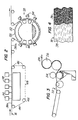
- Fig. 1 shows a fabric production line 10 in accordance with the invention for production of nonwoven wipe fabrics including, a series of conventional carding apparatus C1 - C6, a random web former 12, and pre-wet wire station 14 which feed a composite web 16 to hydroentangling modules 18, 20.
- the line includes a deionized water rinse and vacuum slot extractor station 22, a conventional padder 24, and dry cans 26 which provide a finished nonwoven fabric 28 for stock rolling on a winder 30.
- An antistatic roll 32 and weight determination gauge 34 are also employed on the line.
- Modules 18, 20 effect two sided entanglement of the composite web 16 which includes randomized and carded layers 36, 38 to provide a fabric with well defined interstitial fiber entanglement and structure.
- Particular advantage is obtained in the invention when the composite web 16 is anistropic and includes a blend of at least 10% rayon and polyester staple fibers.
- the preferred composite web 16 is fabricated of a blend of AVTEX SN 6533 1.5 denier 1.5 inch staple hemicellular free rayon manufactured by Avtex Fibers Inc., Front Royal, Virginia, and a non-optically brightened polyester offered by Celanese Corporation, Charlotte, North Carolina, under product designation T-304.
- the AVTEX rayon and Celanese polyester fibers are processed in an open blender to provide web layers 36, 38 each having a 70/30 per cent rayon/polyester content, and weight of approximately 29 gsy.
- Fig. 2 illustrates the entanglement modules 18, 20 which are utilized in a two staged process to hydroentangle, in succession, top and bottom sides 36a, 38a of the composite web 16.
- Module 18 includes a first entangling member 44 supported on an endless conveyor means which includes rollers 46 and drive means (not shown) for rotation of the rollers.
- Preferred line speeds for the conveyor are in the range of 50 to 600 ft/min.
- the entangling member 44 which preferably has a planar configuration, includes a symmetrical pattern of void areas 48 which are fluid pervious.
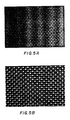
- a preferred entangling member 44 shown in Fig. 5A, is a 36x29 mesh weave having a 23.7% void area, fabricated of polyester warp and shute round wire.
- Entangling member 44 is a tight weave seamless weave which is not subject to angular displacement or snag. Specifications for the screen, which is manufactured by Appleton Wire Incorporated, P.O. Box 508 Kirby, Portland, Tennesse 37148, are set forth in Table I.
- Module 18 also includes an arrangement of parallel spaced manifolds 50 oriented in a cross-direction ("CD") relative to movement of the composite web 16.
- the manifolds which are spaced approximately 10 inches apart and positioned approximately 1 inch above the first entangling member 44, each include a plurality of closely aligned and spaced jet nozzles (not shown) designed to impact the web with fluid pressures in the range of 400 to 2000 psi.
- Manifold pressures are preferably ramped in the machine direction so that increased fluid impinges the web as its lattice structure and coherence develop.
- Effective first stage entanglement in the invention is effected by energy output to the composite web 16 of at least .1 hp-hr/lb and preferably in the range of .1 - .5 hp-hr/lb.
- Module 20 includes a second entangling member, shown in Fig. 5B, which has a cylindrical configuration 52, and 26% symmetrical pattern of void areas 55.
- Entangling member 52 is a 22x24 plain weave, manufactured by Appleton Wire Incorporated, fabricated of stainless steel or bronze warp and round shute wire having the specifications set forth in Table I.
- Module 20 functions in the same manner as the planar module 18.
- Manifolds 54 which carry jet nozzles are stacked in close proximity spaced from the entangling member 52 to impact the web with ramped essentially columnar jet sprays.
- the manifolds are preferably spaced 8 inches apart, 1 inch from the entangling member, and impact the web with fluid pressures in the range of 400 to 2000 psi.
- Effective second stage entanglement is effected by energy output to the composite web 16 of at least .4 hp-hr/lb and preferably in the range of .4 - 1.2 hp-hr/lb.
- the web 16 is rinsed with deionized water and passed through the vacuum slot extractor 22 to remove excess water and prepare the web for saturated application of an aqueous resin binder in the padder station 24.
- Binder compositions for use in the invention are designed to enhance fabric tensile strength, abrasion resistance and resistance to staining.
- Acrylic latex binders have been found particularly suitable for use in wipe fabrics because of their stain resistance capabilities.
- a preferred acrylic composition employed in the invention is set forth in Table II. It will be recognized that the amount of binder applied to the fabric varies with fiber composition, weight and intended end use of the fabric. Typically, the acrylic binder saturates the fabric and comprises 1 to 5% of the finished resin treated fabric weight.
- the binder is cured in a conventional manner in stacks of dry cans 26 operated at steam pressures within the range of 80 to 200 psi. See Fig. 1.
- Nonwoven fabrics produced by the dual entangling process of the invention are characterized by close knit fiber interstitial binding which enhances the fabric porosity and tensile strength.
- Preferred fabrics of the invention have a basis weight in the range of 45 to 70 gsy, and MD and CD grab tensile strengths of approximately 15 lbs/inch and 10 lbs/inch.
- Advantage is obtained through use of the composite web 16 which includes randomized and carded layers 36, 38 to yield fabrics which are uniform in fiber distribution and have MD/CD ratios in the range of 1.5:1 to 2.5:1.
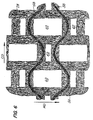
- Fig. 6 schematically illustrates a preferred fabric structure of the invention which is obtained employing the entangling members 44, 52 of Figs. 5A, B.
- Fluid entangled fibers are arranged in a symmetrical array including a lattice structure of spaced approximately parallel MD and CD fibrous bands 56, 58 which intersect and entangle to define a cohesive structure.
- the CD bands 58 have a generally sinusoidal configuration and are arranged in an array in which each band is 180° degrees out of phase with respect to adjourning bands.
- a symmetical array of porous void areas 60, 62 are defined in the fabric by the MD and CD fiber bands 56, 58.
- Void areas 60, 62 are disposed between aligned troughs and peaks of the CD bands and have generally rectangular configurations.
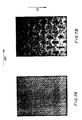
- Figs. 8B and C illustrate this void pattern in open and inverse light detection photographs at 7.5X magnification of a preferred fabric. White and dark regions in the photographs respectively correspond to void areas 60, 62, and fibrous bands 56, 58 in the fabric.
- Examples 1 - 3 and corresponding Figs. 7A, B describe and illustrate representative fabrics produced by the method of the invention employing the entangling members 44, 52 and production line 10 of Fig. 1.
- a fabric designed for food service industry applications was produced employing a 50/50 carded and random web composed of 30% Celanese T304 1.5 inch, 1.45 denier, 5.5 gram/denier non-optically brightened polyester, and 70% AVTEX 6533 1.5 inch denier, 3.5 gram/denier hemicellular free rayon.
- the AVTEX rayon and Celanese polyester fibers were processed in an open blender to provide web layers 36, 38 having a 70/30 per cent rayon/polyester content and weight of approximately 29 gsy. Production speed on the line was ramped from 75 to reach 125 fpm to impart energy to the web at the rate 1 hp-hr/lb to produce a base fabric weighing 58 gsy ⁇ 4 gsy.
- Table III sets forth energy specifications for production of the 58 gsy fabric of example I at an average line speed of 100 fpm.
- the discharge coefficient (C) is dependent on jet pressure and orifice size. Coefficients for a jet having an orifice diameter of .005 inches and water temperature of 85°F are as follows: Pressure (psi) C Pressure C 300 .77 900 .66 400 .74 1000 .74 500 .71 1100 .63 600 .70 1200 .62 700 .68 1300 .62 800 .67 1400 .62 1500 .62 TABLE III Hydroentangling Energy at 100 FPM Flatscreen - Module 18 Manifold No.
- the base fabric was passed through the slot extractor station 22 for in line saturated padding with 2.8% acrylic binder mix having the composition set forth in Table II.
- Padder roll pressure settings were calibrated to effect an application rate of 1.6 gpm for a binder add-on of 2 ⁇ 1 gsy to yield a fabric having a weight of 60 gsy ⁇ 3 gsy.
- the binder was then cured in dry cans 26 to provide a finished fabric for converting.
- Tables IV and V respectively set forth dry can settings and physical characteristics of the fabrics of produced in Examples 1 - 3. TABLE IV Dry Can Settings Speed - FPM Can Number: 1 2 3 4 5-10 10-20 75 20 80 80 90 40 90 100 25 80 80 90 100 105 125 30 80 80 95 110 115
- Nonwoven fabrics having application for use as automobile and hospital service wipes were produced employing the composite web and process conditions of Example I. Desired fabric characteristics were obtained in these applications through use of binder formulations set forth in Tables VI - A and B.
- the automobile service wipe is produced employing the binder formulation of Example I modified to include increased concentrations of ethoxylated alcohol, polyethlyne glycol, and dioctyl sodium. Crock resistant color pigments were also added to the binder for aesthetic effect to provide a uniform streak free wiping fabric that is solvent resistant. See Table VI - A.
- the binder formulation for the hospital service wipe includes a antimicrobial agent of the type offered under the brand designation ULTRA-FRESH by Bio Dor Products Ltd., 1150 Fairfield Avenue, Bridgeport, Connecticut 06604.
- the antimicrobial agent provides a fabric which is resistant to the growth of bacteria and fungi, and consequent rotting and mildewing of the fabric. Effective results are obtained when the antimicrobial is added to the formulation in the order of 1 - 10 pph on binder solids in the formulation. See Table VI - B.
- Example II Example III Basis Weight (gsy) With Binder 58 - 62 58 - 62 58 - 62 Without Binder 56 - 60 56 - 60 56 - 60
- Tensile (lbs/inch) MD 15 - 30 15 - 30 15 - 30 CD 10 - 20 10 - 20 10 - 20 Elongation (%) MD 50 - 65 50 - 70 50 - 65 CD 125 - 145 125 - 145 125 - 145 Thickness (mils) 28 - 32 28 - 36 26 - 34 Mullen Burst (psi) 34 - 40 34 - 45 32 - 42
- food service and hospital wipes are differentiated by the chemical systems employed in the adhesive binder.
- the bacteria free hospital wipe includes an antimicrobial agent, while the food service wipe has larger binder concentrations of dioctyl sodium succinate for improved washability and soil release characteristics.
- All wipes are color pigmented and preferably include a pigment fixative, such as ethoxylated alcohol, which imparts solvent resistance to the binder formulation.
Landscapes
- Engineering & Computer Science (AREA)
- Textile Engineering (AREA)
- Mechanical Engineering (AREA)
- Chemical & Material Sciences (AREA)
- Chemical Kinetics & Catalysis (AREA)
- Dispersion Chemistry (AREA)
- General Chemical & Material Sciences (AREA)
- Nonwoven Fabrics (AREA)
- Cleaning Implements For Floors, Carpets, Furniture, Walls, And The Like (AREA)
Applications Claiming Priority (2)
| Application Number | Priority Date | Filing Date | Title |
|---|---|---|---|
| US221816 | 1988-07-20 | ||
| US07/221,816 US4925722A (en) | 1988-07-20 | 1988-07-20 | Disposable semi-durable nonwoven fabric |
Publications (2)
| Publication Number | Publication Date |
|---|---|
| EP0351949A2 true EP0351949A2 (fr) | 1990-01-24 |
| EP0351949A3 EP0351949A3 (fr) | 1990-10-03 |
Family
ID=22829517
Family Applications (1)
| Application Number | Title | Priority Date | Filing Date |
|---|---|---|---|
| EP19890305654 Withdrawn EP0351949A3 (fr) | 1988-07-20 | 1989-06-05 | Etoffe non tissée jetable semi-durable, et procédé pour sa fabrication |
Country Status (3)
| Country | Link |
|---|---|
| US (1) | US4925722A (fr) |
| EP (1) | EP0351949A3 (fr) |
| JP (1) | JPH0268345A (fr) |
Cited By (9)
| Publication number | Priority date | Publication date | Assignee | Title |
|---|---|---|---|---|
| EP0423619A1 (fr) * | 1989-10-13 | 1991-04-24 | Fiberweb North America, Inc. | Etoffe à essuyer et procédé de fabrication |
| WO1992008834A1 (fr) * | 1990-11-19 | 1992-05-29 | Mölnlycke AB | Procede d'hydro-enchevetrement |
| EP0564306A1 (fr) * | 1992-04-03 | 1993-10-06 | JOHNSON & JOHNSON INC. | Méthode et appareil pour produire une étoffe non-tissée avec une impression |
| EP0602881A1 (fr) * | 1992-12-15 | 1994-06-22 | The Dexter Corporation | Essuie-tout humide |
| WO1999023163A1 (fr) * | 1997-10-31 | 1999-05-14 | Kimberly-Clark Worldwide, Inc. | Composition thermoplastique biodegradable |
| WO1999032559A1 (fr) * | 1997-12-19 | 1999-07-01 | Kimberly-Clark Worldwide, Inc. | Composition thermoplastique renfermant du poly(ethylene oxyde) |
| SG89225A1 (en) * | 1990-03-12 | 2002-06-18 | Mcneil Ppc Inc | Novel apertured non-woven fabric |
| WO2002034987A3 (fr) * | 2000-08-04 | 2002-07-04 | Du Pont | Procede et dispositif permettant d'augmenter l'isotropie dans des non tisses |
| WO2009112015A1 (fr) * | 2008-03-12 | 2009-09-17 | Fleissner Gmbh | Procédé et dispositif de fabrication d'un non-tissé |
Families Citing this family (26)
| Publication number | Priority date | Publication date | Assignee | Title |
|---|---|---|---|---|
| US5142752A (en) * | 1990-03-16 | 1992-09-01 | International Paper Company | Method for producing textured nonwoven fabric |
| WO1994002674A1 (fr) * | 1992-07-27 | 1994-02-03 | The Procter & Gamble Company | Compresses de traitement a plusieurs couches et a deux textures |
| RU2132893C1 (ru) * | 1993-08-30 | 1999-07-10 | Макнейл Ппс, Инк. | Нетканый материал (варианты) |
| US6103954A (en) * | 1997-09-18 | 2000-08-15 | Fibertechgroup, Inc. | Liquid acquisition layer for personal absorbent article |
| US6623853B2 (en) | 1998-08-28 | 2003-09-23 | Wellman, Inc. | Polyethylene glycol modified polyester fibers and method for making the same |
| US6582817B2 (en) | 1999-11-19 | 2003-06-24 | Wellman, Inc. | Nonwoven fabrics formed from polyethylene glycol modified polyester fibers and method for making the same |
| US6300258B1 (en) | 1999-08-27 | 2001-10-09 | Kimberly-Clark Worldwide, Inc. | Nonwovens treated with surfactants having high polydispersities |
| US6509091B2 (en) | 1999-11-19 | 2003-01-21 | Wellman, Inc. | Polyethylene glycol modified polyester fibers |
| KR100737335B1 (ko) * | 2000-03-29 | 2007-07-10 | 미쓰비시 가가꾸 가부시키가이샤 | 카본블랙의 제조장치, 그의 제조방법, 노내 연소장치 및노내 연소방법 |
| US20020176958A1 (en) * | 2000-04-06 | 2002-11-28 | Nord Thomas D. | Wiping cloth |
| US6695941B2 (en) * | 2000-06-01 | 2004-02-24 | Polymer Group, Inc. | Method of making nonwoven fabric for buffing applications |
| US6794352B2 (en) * | 2000-06-12 | 2004-09-21 | Jeffrey S. Svendsen | Cleaning towel having a color identifying label and sanitizer release polymer composition |
| US6632385B2 (en) | 2001-03-23 | 2003-10-14 | First Quality Nonwovens, Inc. | Condrapable hydrophobic nonwoven web and method of making same |
| US6667290B2 (en) | 2001-09-19 | 2003-12-23 | Jeffrey S. Svendsen | Substrate treated with a binder comprising positive or neutral ions |
| SG128436A1 (en) * | 2002-02-08 | 2007-01-30 | Kuraray Co | Nonwoven fabric for wiper |
| US7201777B2 (en) * | 2002-03-28 | 2007-04-10 | Booker Jr Archer E D | Nonwoven fabric having low ion content and method for producing the same |
| US20030186609A1 (en) * | 2002-03-28 | 2003-10-02 | Booker Archer E. D. | Nonwoven fabric having low ion content and method for producing the same |
| KR20040111444A (ko) * | 2002-03-28 | 2004-12-31 | 밀리켄 앤드 캄파니 | 저 이온함량을 갖는 부직 패브릭 및 이를 제조하는 방법 |
| US7144831B2 (en) * | 2002-07-26 | 2006-12-05 | Polymer Group, Inc. | Three-dimensional nonwoven substrate having sub-millimeter orifice structure |
| US20070054072A1 (en) * | 2005-09-08 | 2007-03-08 | Lexmark International, Inc. | Packaging material for a developing agent cartridge |
| USD697722S1 (en) * | 2012-11-22 | 2014-01-21 | Suominen Corporation | Fibrous material sheet with patterned surface |
| JP5712194B2 (ja) * | 2012-12-04 | 2015-05-07 | 花王株式会社 | 拭き取りシート用不織布基材 |
| JP5712195B2 (ja) * | 2012-12-04 | 2015-05-07 | 花王株式会社 | 拭き取りシート用不織布基材 |
| USD873032S1 (en) * | 2018-03-30 | 2020-01-21 | Teh Yor Co., Ltd. | Fabric |
| USD916469S1 (en) * | 2018-11-20 | 2021-04-20 | Fujian Huajin Industrial Co., Ltd. | Fabric |
| USD899100S1 (en) * | 2019-04-17 | 2020-10-20 | Grand Textile Co., Ltd. | Fabric |
Family Cites Families (19)
| Publication number | Priority date | Publication date | Assignee | Title |
|---|---|---|---|---|
| BE538987A (fr) * | 1954-06-16 | 1900-01-01 | ||
| US2862251A (en) * | 1955-04-12 | 1958-12-02 | Chicopee Mfg Corp | Method of and apparatus for producing nonwoven product |
| US3493462A (en) * | 1962-07-06 | 1970-02-03 | Du Pont | Nonpatterned,nonwoven fabric |
| US3508308A (en) * | 1962-07-06 | 1970-04-28 | Du Pont | Jet-treatment process for producing nonpatterned and line-entangled nonwoven fabrics |
| US3498874A (en) * | 1965-09-10 | 1970-03-03 | Du Pont | Apertured tanglelaced nonwoven textile fabric |
| US3458905A (en) * | 1966-07-05 | 1969-08-05 | Du Pont | Apparatus for entangling fibers |
| US3485706A (en) * | 1968-01-18 | 1969-12-23 | Du Pont | Textile-like patterned nonwoven fabrics and their production |
| US3679536A (en) * | 1970-03-24 | 1972-07-25 | Johnson & Johnson | Nonwoven fabric comprising buds plus bundles connected by aligned fibers including bundles |
| US3679535A (en) * | 1970-03-24 | 1972-07-25 | Johnson & Johnson | Nonwoven fabric comprising discontinuous groups of small holes connected by ribbons defining large holes |
| US3682756A (en) * | 1970-03-24 | 1972-08-08 | Johnson & Johnson | Nonwoven fabric comprising rosebuds bounded by bundles |
| GB1550955A (en) * | 1975-12-29 | 1979-08-22 | Johnson & Johnson | Textile fabric and method of manufacturing the same |
| US4024612A (en) * | 1976-04-02 | 1977-05-24 | E. I. Du Pont De Nemours And Company | Process for making an apertured nonwoven fabric |
| DE2625836C3 (de) * | 1976-06-09 | 1985-03-14 | Kuraray Co., Ltd., Kurashiki, Okayama | Vliesstoff mit einer aus zwei unterschiedlichen Mustern bestehenden Gitterstruktur und Verfahren zu seiner Herstellung |
| US4297404A (en) * | 1977-06-13 | 1981-10-27 | Johnson & Johnson | Non-woven fabric comprising buds and bundles connected by highly entangled fibrous areas and methods of manufacturing the same |
| US4379799A (en) * | 1981-02-20 | 1983-04-12 | Chicopee | Nonwoven fabric having the appearance of apertured, ribbed terry cloth |
| US4612226A (en) * | 1982-01-22 | 1986-09-16 | Chicopee | Fabric having excellent wiping properties |
| IN157924B (fr) * | 1982-01-22 | 1986-07-26 | Chicopee | |
| US4465726A (en) * | 1983-06-23 | 1984-08-14 | Chicopee | Ribbed terry cloth-like nonwoven fabric and process and apparatus for making same |
| US4693922A (en) * | 1985-09-26 | 1987-09-15 | Chicopee | Light weight entangled non-woven fabric having excellent machine direction and cross direction strength and process for making the same |
-
1988
- 1988-07-20 US US07/221,816 patent/US4925722A/en not_active Expired - Fee Related
-
1989
- 1989-06-05 EP EP19890305654 patent/EP0351949A3/fr not_active Withdrawn
- 1989-07-18 JP JP1183816A patent/JPH0268345A/ja active Pending
Cited By (15)
| Publication number | Priority date | Publication date | Assignee | Title |
|---|---|---|---|---|
| EP0423619A1 (fr) * | 1989-10-13 | 1991-04-24 | Fiberweb North America, Inc. | Etoffe à essuyer et procédé de fabrication |
| SG89225A1 (en) * | 1990-03-12 | 2002-06-18 | Mcneil Ppc Inc | Novel apertured non-woven fabric |
| WO1992008834A1 (fr) * | 1990-11-19 | 1992-05-29 | Mölnlycke AB | Procede d'hydro-enchevetrement |
| EP0564306A1 (fr) * | 1992-04-03 | 1993-10-06 | JOHNSON & JOHNSON INC. | Méthode et appareil pour produire une étoffe non-tissée avec une impression |
| US5405650A (en) * | 1992-04-03 | 1995-04-11 | Johnson & Johnson Inc. | Method for manufacturing a non-woven fabric marked with a print |
| EP0602881A1 (fr) * | 1992-12-15 | 1994-06-22 | The Dexter Corporation | Essuie-tout humide |
| US6211294B1 (en) | 1997-10-31 | 2001-04-03 | Fu-Jya Tsai | Multicomponent fiber prepared from a thermoplastic composition |
| US6207755B1 (en) | 1997-10-31 | 2001-03-27 | Kimberly-Clark Worldwide, Inc. | Biodegradable thermoplastic composition |
| WO1999023163A1 (fr) * | 1997-10-31 | 1999-05-14 | Kimberly-Clark Worldwide, Inc. | Composition thermoplastique biodegradable |
| US6110849A (en) * | 1997-12-19 | 2000-08-29 | Kimberly-Clark Worlwide, Inc. | Thermoplastic composition including polyethylene oxide |
| WO1999032559A1 (fr) * | 1997-12-19 | 1999-07-01 | Kimberly-Clark Worldwide, Inc. | Composition thermoplastique renfermant du poly(ethylene oxyde) |
| US6479001B1 (en) | 1997-12-19 | 2002-11-12 | Kimberly-Clark Worldwide, Inc. | Methods for making a thermoplastic composition including polyethlene oxide and fibers including same |
| WO2002034987A3 (fr) * | 2000-08-04 | 2002-07-04 | Du Pont | Procede et dispositif permettant d'augmenter l'isotropie dans des non tisses |
| US6877196B2 (en) | 2000-08-04 | 2005-04-12 | E. I. Du Pont De Nemours And Company | Process and apparatus for increasing the isotropy in nonwoven fabrics |
| WO2009112015A1 (fr) * | 2008-03-12 | 2009-09-17 | Fleissner Gmbh | Procédé et dispositif de fabrication d'un non-tissé |
Also Published As
| Publication number | Publication date |
|---|---|
| JPH0268345A (ja) | 1990-03-07 |
| EP0351949A3 (fr) | 1990-10-03 |
| US4925722A (en) | 1990-05-15 |
Similar Documents
| Publication | Publication Date | Title |
|---|---|---|
| US4925722A (en) | Disposable semi-durable nonwoven fabric | |
| US4959894A (en) | Disposable semi-durable nonwoven fabric and related method of manufacture | |
| CA2033594C (fr) | Appareil pour la fabrication de non-tisses textures, et methode connexe | |
| EP0633958B1 (fr) | Tissus de files de filaments entremeles a motifs, renfermant des fibres de cellulose et/ou des fibres de type cellulosique | |
| CA2095427C (fr) | Appareil et methode utilisant un fluide pour mettre en valeur un tissu | |
| DE68929260T2 (de) | Verbundvliesstoffmaterial und sein Herstellverfahren | |
| DE68916455T2 (de) | Elastomerisches, blattartiges Material aus nicht-gewebten Fasern und Verfahren zu dessen Herstellung. | |
| US6692541B2 (en) | Method of making nonwoven fabric comprising splittable fibers | |
| US4442161A (en) | Woodpulp-polyester spunlaced fabrics | |
| CA1285132C (fr) | Non-tisse a fibres emmelees par voie hydraulique, extra-solide a l'etat humide | |
| DE68919492T2 (de) | Elastomerischer Vliesstoff und Verfahren zu dessen Herstellung. | |
| EP1268907B1 (fr) | Non-tisse portant une image durable | |
| EP1458914B1 (fr) | Non-tisses presentant une image durable en trois dimensions | |
| EP0423619A1 (fr) | Etoffe à essuyer et procédé de fabrication | |
| US20020160681A1 (en) | Method for the production of nonwoven webs, the cohesion of which is obtained by means of fluid jets | |
| US20070173163A1 (en) | Low-density nonwoven fabric and production method and installation therefor and uses | |
| US6564436B2 (en) | Method of forming an imaged compound textile fabric | |
| US5727292A (en) | Installation for the production of nonwoven webs, the cohesion of which is obtained by the action of fluid jets | |
| EP1325182B1 (fr) | Textile non tisse a fibres enchevetrees differentiellement | |
| JP2004353162A (ja) | 不織布 | |
| EP1492914B1 (fr) | Non-tisse double face comportant une image tridimensionnelle | |
| HK1002984B (en) | Tricot nonwoven fabric |
Legal Events
| Date | Code | Title | Description |
|---|---|---|---|
| PUAI | Public reference made under article 153(3) epc to a published international application that has entered the european phase |
Free format text: ORIGINAL CODE: 0009012 |
|
| AK | Designated contracting states |
Kind code of ref document: A2 Designated state(s): BE DE FR GB NL |
|
| PUAL | Search report despatched |
Free format text: ORIGINAL CODE: 0009013 |
|
| AK | Designated contracting states |
Kind code of ref document: A3 Designated state(s): BE DE FR GB NL |
|
| RAP1 | Party data changed (applicant data changed or rights of an application transferred) |
Owner name: INTERNATIONAL PAPER COMPANY |
|
| STAA | Information on the status of an ep patent application or granted ep patent |
Free format text: STATUS: THE APPLICATION IS DEEMED TO BE WITHDRAWN |
|
| 18D | Application deemed to be withdrawn |
Effective date: 19910404 |