EP0351991B1 - Dispositif pour protéger des poissons - Google Patents
Dispositif pour protéger des poissons Download PDFInfo
- Publication number
- EP0351991B1 EP0351991B1 EP89306932A EP89306932A EP0351991B1 EP 0351991 B1 EP0351991 B1 EP 0351991B1 EP 89306932 A EP89306932 A EP 89306932A EP 89306932 A EP89306932 A EP 89306932A EP 0351991 B1 EP0351991 B1 EP 0351991B1
- Authority
- EP
- European Patent Office
- Prior art keywords
- pond
- guard
- plates
- guard plate
- guard plates
- Prior art date
- Legal status (The legal status is an assumption and is not a legal conclusion. Google has not performed a legal analysis and makes no representation as to the accuracy of the status listed.)
- Expired - Lifetime
Links
- 241000251468 Actinopterygii Species 0.000 claims description 41
- XLYOFNOQVPJJNP-UHFFFAOYSA-N water Substances O XLYOFNOQVPJJNP-UHFFFAOYSA-N 0.000 claims description 23
- 239000004743 Polypropylene Substances 0.000 claims description 15
- -1 polypropylene Polymers 0.000 claims description 15
- 229920001155 polypropylene Polymers 0.000 claims description 15
- NIXOWILDQLNWCW-UHFFFAOYSA-N acrylic acid group Chemical group C(C=C)(=O)O NIXOWILDQLNWCW-UHFFFAOYSA-N 0.000 claims description 11
- 241000234435 Lilium Species 0.000 claims description 10
- 238000005188 flotation Methods 0.000 claims description 7
- 239000000463 material Substances 0.000 claims description 6
- 239000004033 plastic Substances 0.000 claims description 5
- 229920003023 plastic Polymers 0.000 claims description 5
- 230000005484 gravity Effects 0.000 claims description 4
- 231100000252 nontoxic Toxicity 0.000 claims description 3
- 230000003000 nontoxic effect Effects 0.000 claims description 3
- 241000282326 Felis catus Species 0.000 description 13
- 241000269350 Anura Species 0.000 description 4
- 238000012986 modification Methods 0.000 description 3
- 230000004048 modification Effects 0.000 description 3
- 235000017771 Acacia greggii Nutrition 0.000 description 2
- 241000372389 Anigozanthos humilis Species 0.000 description 2
- 241000196324 Embryophyta Species 0.000 description 2
- 229910000831 Steel Inorganic materials 0.000 description 2
- 230000000284 resting effect Effects 0.000 description 2
- 229910001220 stainless steel Inorganic materials 0.000 description 2
- 239000010935 stainless steel Substances 0.000 description 2
- 239000010959 steel Substances 0.000 description 2
- 229910001369 Brass Inorganic materials 0.000 description 1
- 241001465754 Metazoa Species 0.000 description 1
- 241000699729 Muridae Species 0.000 description 1
- 241000699670 Mus sp. Species 0.000 description 1
- 241000209490 Nymphaea Species 0.000 description 1
- 235000016791 Nymphaea odorata subsp odorata Nutrition 0.000 description 1
- 241000700159 Rattus Species 0.000 description 1
- 239000010951 brass Substances 0.000 description 1
- 238000004140 cleaning Methods 0.000 description 1
- 239000007799 cork Substances 0.000 description 1
- 230000002708 enhancing effect Effects 0.000 description 1
- 239000004794 expanded polystyrene Substances 0.000 description 1
- 239000011152 fibreglass Substances 0.000 description 1
- 239000012774 insulation material Substances 0.000 description 1
- 238000012423 maintenance Methods 0.000 description 1
- 239000011347 resin Substances 0.000 description 1
- 229920005989 resin Polymers 0.000 description 1
- 210000001364 upper extremity Anatomy 0.000 description 1
- 210000003462 vein Anatomy 0.000 description 1
- 239000002023 wood Substances 0.000 description 1
Images



Classifications
-
- A—HUMAN NECESSITIES
- A01—AGRICULTURE; FORESTRY; ANIMAL HUSBANDRY; HUNTING; TRAPPING; FISHING
- A01K—ANIMAL HUSBANDRY; AVICULTURE; APICULTURE; PISCICULTURE; FISHING; REARING OR BREEDING ANIMALS, NOT OTHERWISE PROVIDED FOR; NEW BREEDS OF ANIMALS
- A01K63/00—Receptacles for live fish, e.g. aquaria; Terraria
- A01K63/003—Aquaria; Terraria
- A01K63/006—Accessories for aquaria or terraria
-
- A—HUMAN NECESSITIES
- A01—AGRICULTURE; FORESTRY; ANIMAL HUSBANDRY; HUNTING; TRAPPING; FISHING
- A01K—ANIMAL HUSBANDRY; AVICULTURE; APICULTURE; PISCICULTURE; FISHING; REARING OR BREEDING ANIMALS, NOT OTHERWISE PROVIDED FOR; NEW BREEDS OF ANIMALS
- A01K61/00—Culture of aquatic animals
-
- Y—GENERAL TAGGING OF NEW TECHNOLOGICAL DEVELOPMENTS; GENERAL TAGGING OF CROSS-SECTIONAL TECHNOLOGIES SPANNING OVER SEVERAL SECTIONS OF THE IPC; TECHNICAL SUBJECTS COVERED BY FORMER USPC CROSS-REFERENCE ART COLLECTIONS [XRACs] AND DIGESTS
- Y02—TECHNOLOGIES OR APPLICATIONS FOR MITIGATION OR ADAPTATION AGAINST CLIMATE CHANGE
- Y02A—TECHNOLOGIES FOR ADAPTATION TO CLIMATE CHANGE
- Y02A40/00—Adaptation technologies in agriculture, forestry, livestock or agroalimentary production
- Y02A40/80—Adaptation technologies in agriculture, forestry, livestock or agroalimentary production in fisheries management
- Y02A40/81—Aquaculture, e.g. of fish
Definitions
- This invention relates to a fish protection system, and in particular to a system for preventing predatory animals (such as cats) from attempting to attack fish from the edge of an ornamental pond.
- predatory animals such as cats
- pond should be taken to include tanks or other containers for live fish.
- Another known deterrent is to place a fence round a pond. This is not a very effective deterrent for a cat, and also detracts from the appearance of an ornamental pond.
- CH-A-270487 describes a fish protection system having floating rafts which are secured to the bank of a river by means of cables. Plants are grown on the rafts, the plants hanging down into the water to form hiding places for fish.
- the present invention provides a fish protection system comprising a plurality of guard plates, and a plurality of support devices for supporting the guard plates on the surround of a fish pond, each support device being fixable to the surround of the pond and being fixed to an associated guard plate, the guard plates being designed so as to float on the surface of the water in the pond, and the support devices being such that the guard plates are constrained to lie adjacent to the side walls of the pond, characterised in that each support device is constituted by a rigid support member, in that each fixation of a support member to an associated guard plate permits a relative movement therebetween, permitting the guard plates to float for a varying range of water levels in the pond, in that the rigid support members constrain the guard plates to lie in close proximity to the side walls of the pond and in that the guard plates are such that any given guard plate will tilt downwardly if subjected to a downwards force of a predetermined magnitude.
- the guard plates will not provide a firm "ledge" for a cat's pax. Hence, because of its dislike of water, this will deter a cat from trying to catch fish by placing one front paw on a guard plate in an attempt to reach the surface of the pond with the other front paw.
- each support device is telescopically connected to a further rigid support member which is fixed to the associated guard plate.
- the support member of each support device is a slidable fit within an aperture in the associated guard plate, the support member being provided with a stop for limiting the relative movement between the support member and the guard plate.
- the guard plates are generally fan-shaped, and each is provided with connection lugs on opposite sides of the narrow end portion thereof.
- the connection lugs are used to connect the guard plates pivotally together, so that a plurality of interconnected guard plates can be positioned in close proximity to the side of a pond even when that side curves.
- the guard plates are made of a non-toxic, ultra-violet stabilised plastics material, such as polypropylene, which has a specific gravity substantially equal to 1.0.
- each guard plate could be moulded from green polypropylene so as to take the form of a group of lily pad leaves.
- This arrangement is particularly suitable for ornamental ponds.
- the guard plates could be made of transparent acrylic, in which case they would be provided with flotation means. This alternative arrangement is particularly suitable for fish farmers, who like to be able to see the entire area of a pond.
- the invention also provides a fish protection system comprising a plurality of guard plates, and a plurality of support devices for supporting the guard plates on the surround of a fish pond, each support device being fixable to the surround of the pond and being fixed to an associated guard plate, the support devices being such that the guard plates are constrained to lie adjacent to the side walls of the pond, characterised in that each support device is constituted by a support arm which is fixable to the surround of the pond, a tension spring connecting the support arm to an associated guard plate, and pivot connection means for pivotally supporting an edge portion of that guard plate on the side wall of the pond above the water level, and in that the support devices are such that the guard plates are constrained to lie in close proximity to the side walls of the pond, and so that any given guard plate will tilt downwardly if subjected to a downwards force of a predetermined magnitude.
- each guard plate could be made of either green polypropylene or transparent acrylic, and can be patterned to depict a group of lily pad leaves.
- Fig. 1 shows one unit of a first form of fish protection system, the unit comprising a guard plate 1, a support arm 2, and a connector 3.
- the guard plate 1 is a moulded, non-toxic polypropylene sheet of a generally rectangular shape, and having dimensions of 500 mm by 240 mm.
- the sheet 1 is moulded to depict a group of lily pad leaves (see Fig. 3), and is coloured green so as to give a decorative appearance of lily pad leaves.
- the plate 1 can be moulded to simulate veins or rays on the lily pad leaves.
- the polypropylene sheet has a specific gravity of about 1.0, so that the sheet will float on the surface 4 of a pond (one wall 5 of which can be seen in Fig. 1).
- the support arm 2 is a stainless steel rod which is a friction (or loose) telescopic fit within one end of connector 3, which is a 16 mm (5/8") diameter polypropylene tube.
- the other end of the connector tube 3 is pivotally attached to one edge of the guard plate 1 by means of a plastic nut-and-bolt fixing, push-fit rivets or a snap-on fitting.
- the steel rod 2 can be fixed to the side of the pond, and can be bent, at 2a, to position the guard plate 1 closely adjacent to the wall 5 of the pond at the water level 4. Owing to the vast range of pond design, and the wall materials thereof, the rods 2 can be fixed by resin fibre glass strips, by brass screws, or by any other suitable means.
- the telescopic fit between the connector 3 and the rod 2 enables the guard plate 1 to adjust its floating position to any pond water level within a given range of water levels.
- the first form of system is constituted by a plurality of units of the type described above. These units are placed side-by-side, with say an overlap of about 25 mm between adjacent plates, along the side walls 5 of the pond.
- the plates 1 can be cut with scissors to conform to curved wall portions, or where there would otherwise be an excessive overlap with an adjacent plate.
- This type of system is particularly suitable for rectangular ponds, as the units can be positioned to abut (or overlap) at the corners.
- the polypropylene sheets constituting the guard plates 1 are positioned with their longer sides parallel to the sides of the pond.
- the width of the plates 1 (240 mm) is chosen to be sufficiently large to prevent a cat stretching a foreleg to reach the surface of the water in the pond beyond the guard plates with its paw.
- guard plates 1 float on the surface of the pond water, they do not constitute a firm support for a cat's paw (that is to say such a plate will sink under the surface of the water if a cat puts any weight onto it). Because of cats' dislike of water, therefore, the guard plates 1 are effective to deter cats from attempting to catch fish by scooping them out of the water with their paws (the danger area being calculated to be about 175 to 200 mm from the edge of the pond).
- the guard plates 1, each being moulded into the shape of a group of lily pad leaves, are also decorative, and so do not detract from the appearance of an ornamental pond.
- the plates 1 may be made of transparent acrylic material.
- the modification is particularly advantageous for use by fish farmers, where it is important for the farmer to be able to see into the water over the entire pond area, for example to count the fish. If the decorative green plates 1 were used, fish could lie under the plates at the sides of the pond and so fail to be counted.
- guard plates 1 made of transparent acrylic are provided with flotation units (described below with reference to Figs. 4 and 5) which ensure that the plates float.
- the transparent acrylic plates also have the advantage of not providing hiding places for rats, mice, voles or frogs which might enter the pond and cause pollution.
- the plates 1 are such that a fish landing on the floating guard will be able to escape, either because it is sufficiently heavy partially to submerge the plate concerned, or by flapping around using its fins.
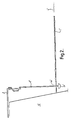
- Fig. 2 shows one unit of a second form of fish protection system, which is a modification of the first system.
- each guard plate 1′ is supported by a support arm 2′, which is made of polypropylene, and a stainless steel rod 3′.
- the rod 3′ is fixed to the wall 5′ of the pond, and the support arm 2′ is fixed to the rod.
- the support arm 2′ is a sliding fit within an aperture 1a′ formed in the guard plate 1′, and carries a stop member 2a′ which is larger than the aperture 1a′.
- the sliding fit between the support arm 2′ and the aperture 1a′ enables the guard plate 1′ to adjust its floating position to any pond water level within a given range of water levels.
- Fig. 3 shows one unit of a third form of fish protection system, the unit comprising a guard plate 11 (identical to the plate 1 of the unit of Fig. 1), a support arm 12 having an externally-threaded portion 12a, and a hollow, internally-threaded barrel adjuster 13.
- the adjuster 13 is pivotally fixed to a wall 15 of a pond, and the free end 12b of the support arm 12 is connected to a fixing point 11a on the plate 11 by means of a lightly-rated coiled tension spring 16.
- the edge portion of the plate 11 adjacent to the wall 15 is formed with fixing points (apertures) 17 (see Fig. 4), by means of which the plate is pivotally supported by means of support lugs 18 fixed to the wall.
- the arrangement is such that the plate 11 is positioned generally horizontally above the surface 14 of the water in the pond.
- the third form of system is constituted by a plurality of units of this type, the units being placed side-by-side along the side walls 15 of the pond.
- this type of system is best suited to a rectangular pond.
- the plates 11 can be made of green polypropylene to give a decorative appearance, or they can be made of transparent acrylic for use by fish farmers.
- guard plates 11 are supported by the springs 16, they do not constitute a firm support for a cat's paw, that is to say such a plate will give if a cat puts any weight on it.
- the fourth form of system (shown in Figs. 5 and 6) is preferable.
- the system is constituted by a plurality of guard plates 21, each being generally fan-shaped.
- the narrow end portion 22 of each plate 21 is provided with a pair of lugs 23 which can be snap-rivetted to the lugs of adjacent plates.
- a plurality of plates 21 can be pivotally connected together by their lugs 23, so that the edges 22a of the narrow edge portions 22 can be shaped to follow even fairly intricate curved walls (as illustrated in Fig. 6).
- each plate 21 is provided with three flotation units 25, each of which is constituted by a sealed tube containing air. Obviously, the number of flotation units 25 required for a given plate 21, and their sizes and positions, depends upon the size and shape of the plate. For the plates 21 illustrated (which have a length of about 230 mm and a maximum width of about 125 mm) three flotation units 25, positioned as shown, are required.
- Each plate 21 is also provided with a fixing point 26, by means of which the plate can be fixed to the side wall of a pond. In practice, not every plate 21 will need to be fixed, and only, say, every fifth plate will need fixing.
- Figs. 8 and 9 show an add-on decorative member 31 (a half-open lily pad leaf), which can be added to any of the four systems described above with reference to Figs. 1 to 7.
- the members 31 can be made of green polypropylene or transparent acrylic to suit the system to which they are add-on members, thereby enhancing the 'natural look' of the system concerned.
- the member 31 is provided with a steel stalk 32 which is a telescopic friction fit within a plastics tube 33, to the lower end of which is fixed an encapsulated lead weight 34.
- Fig. 10 shows an alternative form of add-on member 41, this member being in the form of a lily bud.
- the member 41 could be made of green polypropylene or transparent acrylic.
- the plates 1, 1′ and 11 could be moulded to depict decorative patterns other than lily leaves.
- the plates 1, 1′ and 11 could have a cobbled, rippled, brickwork, basketweave, netting or paved appearance.
- the plates 1, 1′ and 11 could be moulded to depict Japanese characters or symbols.
- the add-on members could take the form of any sort of leaf or bloom of water lily.
- the guard plates 1, 1′, 11 and 21 could be made of other types of plastics material than polypropylene, for example expanded polystyrene or bubble insulation material. These plates could also be made of wood or cork. Where the plates are made of a material that does not float, they would, of course, be provided with flotation units when the plates are required to float.
- the guard plates also constitute an ideal resting ledge for frogs. Normally, with steep-sided ponds, frogs can get in, but cannot get out. The ledge enables frogs to be noticed resting, when they can be removed.
Landscapes
- Life Sciences & Earth Sciences (AREA)
- Environmental Sciences (AREA)
- Marine Sciences & Fisheries (AREA)
- Animal Husbandry (AREA)
- Biodiversity & Conservation Biology (AREA)
- Zoology (AREA)
- Farming Of Fish And Shellfish (AREA)
Claims (9)
- Système de protection pour poissons, comprenant une pluralité de plaques de protection (1;1′) et une pluralité de dispositifs de support (2;2′;3′) servant à supporter les plaques de protection (1;1′) sur le pourtour d'un bassin à poissons (1;1′), chaque dispositif de support (2;2′,3′) pouvant être fixé sur le pourtour du bassin et étant fixé à une plaque de protection associée (1;1′), les plaques de protection (1;1′) étant agencées de manière à flotter sur la surface (4) de l'eau dans le bassin, et les dispositifs de support (2;2′,3′) étant tels que les plaques de protection (1;1′) sont tenues d'être situées au voisinage des parois latérales (5;5′) du bassin,
caractérisé en ce que chaque dispositif de support (2;2′,3′) est constitué par un élément de support rigide (2;2′,3′), en ce que chaque fixation (3;1a′,2a′) d'un élément de support (2;2′,3′) a une plaque de protection associée (1;1′) qui permet un déplacement relatif entre ces éléments, ce qui permet aux plaques de protection (1;1′) de flotter pour une gamme variable de niveaux de l'eau dans le bassin, en ce que les éléments de support rigides (2;2′,3′) retiennent les plaques de protection (1;1′) de manière à se situer à proximité directe des parois latérales (5;5′) du bassin et en ce que les plaques de protection (1;1′) sont telles que n'importe quelle plaque de protection donnée (1;1′) bascule vers le bas si on lui applique une force descendante d'une intensité prédéterminée. - Système selon la revendication 1, dans lequel l'élément de support de chaque dispositif de support est raccordé de façon télescopique à un autre élément de support rigide (3), qui est fixé à la plaque de protection associée (1).
- Système selon la revendication 1, dans lequel l'élément de support (2′,3′) de chaque dispositif de support est monté de manière à pouvoir glisser dans une ouverture (1a′) ménagée dans la plaque de protection associée (1′), l'élément de support comportant une butée (2a′) destinée à limiter le déplacement relatif entre l'élément de support (2′,3′) et la plaque de protection (1′).
- Système selon l'une quelconque des revendications 1 à 3, dans lequel les plaques de protection possèdent d'une manière générale la forme d'un éventail et chaque plaque est équipée de pattes de raccordement (23) située sur des côtés opposés de sa partie d'extrémité rétrécie (22).
- Système selon la revendication 4, dans lequel les pattes de raccordement (23) raccordent les plaques de protection entre elles de manière qu'elles puissent pivoter de sorte qu'une pluralité de plaques de protection interconnectées (21) peuvent être positionnées à proximité directe du côté d'un bassin, même lorsque ce côté s'incurve.
- Système selon l'une quelconque des revendications 1 à 5, dans lequel les plaques de protection sont réalisées en une matière plastique non toxique, stabilisée au moyen d'un rayonnement ultraviolet, comme par exemple du polypropylène, qui possède un poste spécifique sensiblement égal à 1,0.
- Système selon la revendication 6, considéré comme dépendant de l'une quelconque des revendications 1 à 3, dans lequel chaque plaque de protection est formée par moulage à partir de polypropylène vert de manière à posséder la forme d'un groupe de feuilles de nénuphars.
- Système selon l'une quelconque des revendications 1 à 5, dans lequel les plaques de protection sont réalisées en un matériau acrylique transparent et comportent des moyens de flottaison (25).
- Système de protection pour poissons comprenant une pluralité de plaques de protection (11) et une pluralité de dispositifs de support (12,13,16,17) servant à supporter les plaques de protection (11) sur le pourtour d'un bassin à poissons, chaque dispositif de support (12,13,16,17) pouvant être fixé au pourtour du bassin et étant fixé à une plaque de protection associée (11), les dispositifs de support (12,13,16,17) étant tels que les plaques de protection (11) sont tenues d'être adjacentes aux parois latérales (15) du bassin,
caractérisé en ce que chaque dispositif de support (12,13,16,17) est constitué par un bras de support (12,13), qui peut être fixé au pourtour du bassin, un ressort de traction (16) raccordant le bras de support (12,13) à une plaque de protection associée (11) et des moyens de raccordement pivotants (17) pour supporter avec possibilité de pivotement une partie de bord de la plaque de protection (11) sur la paroi latérale (15) du bassin au-dessus du niveau (14) de l'eau, et en ce que les dispositifs de support (12,13,16,17) sont tels que les plaques de protection (11) sont tenues d'être situées à proximité directe des parois latérales (15) du bassin, et qu'ainsi n'importe quelle plaque de protection donnée (11) bascule vers le bas lorsqu'elle est soumise à une force descendante possédant une intensité prédéterminée.
Applications Claiming Priority (2)
| Application Number | Priority Date | Filing Date | Title |
|---|---|---|---|
| GB8817028 | 1988-07-18 | ||
| GB888817028A GB8817028D0 (en) | 1988-07-18 | 1988-07-18 | Fish protection system |
Publications (2)
| Publication Number | Publication Date |
|---|---|
| EP0351991A1 EP0351991A1 (fr) | 1990-01-24 |
| EP0351991B1 true EP0351991B1 (fr) | 1992-09-23 |
Family
ID=10640632
Family Applications (1)
| Application Number | Title | Priority Date | Filing Date |
|---|---|---|---|
| EP89306932A Expired - Lifetime EP0351991B1 (fr) | 1988-07-18 | 1989-07-07 | Dispositif pour protéger des poissons |
Country Status (4)
| Country | Link |
|---|---|
| US (1) | US4941432A (fr) |
| EP (1) | EP0351991B1 (fr) |
| DE (1) | DE68902963T2 (fr) |
| GB (2) | GB8817028D0 (fr) |
Families Citing this family (6)
| Publication number | Priority date | Publication date | Assignee | Title |
|---|---|---|---|---|
| JPH02117331A (ja) * | 1988-10-27 | 1990-05-01 | Takashi Mori | 海水中の生物育成装置 |
| GB2483054A (en) * | 2010-08-19 | 2012-02-29 | Netfloat Ltd | Pond protection system |
| NL2010513C2 (en) * | 2013-03-22 | 2014-09-24 | Frederik Willem Mus | Bird obstructing device, water body and method. |
| CN104823895A (zh) * | 2015-06-03 | 2015-08-12 | 铜陵县国斌水产综合养殖有限责任公司 | 花骨鱼养殖方法 |
| USD988179S1 (en) * | 2020-09-21 | 2023-06-06 | Th Products, Llc | Artificial floating lily pad cluster |
| CN115997751A (zh) * | 2022-12-27 | 2023-04-25 | 宁波博海深衡科技有限公司 | 一种智能鳙鱼拦截网设备及方法 |
Family Cites Families (13)
| Publication number | Priority date | Publication date | Assignee | Title |
|---|---|---|---|---|
| CH270487A (de) * | 1949-08-22 | 1950-09-15 | Thomann Ulrich | Fischgewässeranlage. |
| US3141442A (en) * | 1963-01-24 | 1964-07-21 | Harris Arthur | Aquarium raft for turtles and the like |
| GB1172600A (en) * | 1967-11-08 | 1969-12-03 | Norstel And Templewood Hawksle | Bird Repellers |
| US3517649A (en) * | 1968-09-24 | 1970-06-30 | Aeroquip Corp | Floating aquatic scene |
| US3699921A (en) * | 1970-03-24 | 1972-10-24 | Mark A Janicek | Aquarium platform |
| FR2093141A5 (fr) * | 1970-06-03 | 1972-01-28 | Rhone Poulenc Sa | |
| FR2132959A6 (fr) * | 1971-04-02 | 1972-11-24 | Rhone Poulenc Sa | |
| SU705068A1 (ru) * | 1976-01-30 | 1979-12-25 | Всесоюзный Ордена Ленина Проектно-Изыскательский И Научно-Исследовательский Институт "Гидропроект" Им. С.Я.Жука | Сопр гающее устройство рыбонакопител |
| SU627802A1 (ru) * | 1977-04-12 | 1978-10-15 | Petrov Aleksej A | Устройство дл нереста рыб |
| SU747455A1 (ru) * | 1978-06-12 | 1980-07-15 | Институт Химии Нефти И Природных Солей Ан Казахской Сср | Устройство дл защиты рыб |
| CA1170128A (fr) * | 1980-08-27 | 1984-07-03 | Albert Knowles | Procede et appareil pour accelerer le croissance des poissons |
| US4399770A (en) * | 1980-08-27 | 1983-08-23 | Knowles Albert H | Process and apparatus for fish growth acceleration |
| EP0208462A1 (fr) * | 1985-06-24 | 1987-01-14 | C D Holdings Ltd | Moyen pour protéger des poissons |
-
1988
- 1988-07-18 GB GB888817028A patent/GB8817028D0/en active Pending
-
1989
- 1989-07-03 US US07/374,950 patent/US4941432A/en not_active Expired - Fee Related
- 1989-07-07 DE DE8989306932T patent/DE68902963T2/de not_active Expired - Fee Related
- 1989-07-07 EP EP89306932A patent/EP0351991B1/fr not_active Expired - Lifetime
- 1989-07-07 GB GB8915577A patent/GB2220832B/en not_active Revoked
Also Published As
| Publication number | Publication date |
|---|---|
| GB8817028D0 (en) | 1988-08-24 |
| US4941432A (en) | 1990-07-17 |
| EP0351991A1 (fr) | 1990-01-24 |
| GB2220832A (en) | 1990-01-24 |
| GB2220832B (en) | 1992-02-19 |
| DE68902963D1 (de) | 1992-10-29 |
| GB8915577D0 (en) | 1989-08-23 |
| DE68902963T2 (de) | 1993-04-29 |
Similar Documents
| Publication | Publication Date | Title |
|---|---|---|
| DE69415770T2 (de) | Vorrichtung zum Verhindern dass sich Vögel niederlassen | |
| US6640506B2 (en) | Bird deterrent apparatus | |
| CA1337894C (fr) | Ferme aquicole en mer | |
| US20060248782A1 (en) | Mosquito breeding trap and method for eliminating mosquitoes | |
| WO2006098953A2 (fr) | Systeme magnetique pour piegeage de larves de moustiques/insectes | |
| EP2925597B1 (fr) | Barrière anti-requins | |
| US6955005B2 (en) | Scrobiculate and other fishing floats, demountably attachable fishing lures and kits for assembling them | |
| EP0351991B1 (fr) | Dispositif pour protéger des poissons | |
| US3017858A (en) | Bird nesting and sheltering device | |
| US4328764A (en) | Shellfish mariculture method and apparatus | |
| KR100939204B1 (ko) | 부유식 수변 및 수중생물 서식산란장 | |
| US3487569A (en) | Scarecrow | |
| WO2007116306A2 (fr) | Dispositif de répulsion des oiseaux | |
| GB2194566A (en) | Anti bird device for building ledges | |
| US6378459B1 (en) | Method of deterring climbing animals from accessing elevated bird feeders, nesting boxes and plants | |
| US7124706B2 (en) | Lepidoptera habitat | |
| JP3793807B2 (ja) | 魚類の保護方法及びそれに用いる人工浮島 | |
| GB1578765A (en) | Cloche | |
| KR20230030458A (ko) | 무동력 유해조수 퇴치기 | |
| GB2221822A (en) | Fish protection system | |
| KR100705230B1 (ko) | 어족보호용 부유식 어류산란서식 장치 | |
| CN108124826B (zh) | 生态平衡选择性捕鱼器 | |
| RU2687595C1 (ru) | Установка донного выращивания объектов марикультуры в полувольных условиях | |
| JP7699885B1 (ja) | 害鳥忌避用具 | |
| EP0208462A1 (fr) | Moyen pour protéger des poissons |
Legal Events
| Date | Code | Title | Description |
|---|---|---|---|
| PUAI | Public reference made under article 153(3) epc to a published international application that has entered the european phase |
Free format text: ORIGINAL CODE: 0009012 |
|
| AK | Designated contracting states |
Kind code of ref document: A1 Designated state(s): DE FR GB NL |
|
| 17P | Request for examination filed |
Effective date: 19900525 |
|
| 17Q | First examination report despatched |
Effective date: 19900726 |
|
| RAP1 | Party data changed (applicant data changed or rights of an application transferred) |
Owner name: FERRARI, BERYL ROSE |
|
| RIN1 | Information on inventor provided before grant (corrected) |
Inventor name: FERRARI, PATRICK FREDERICK |
|
| GRAA | (expected) grant |
Free format text: ORIGINAL CODE: 0009210 |
|
| AK | Designated contracting states |
Kind code of ref document: B1 Designated state(s): DE FR GB NL |
|
| PG25 | Lapsed in a contracting state [announced via postgrant information from national office to epo] |
Ref country code: NL Effective date: 19920923 |
|
| REF | Corresponds to: |
Ref document number: 68902963 Country of ref document: DE Date of ref document: 19921029 |
|
| ET | Fr: translation filed | ||
| NLV1 | Nl: lapsed or annulled due to failure to fulfill the requirements of art. 29p and 29m of the patents act | ||
| PLBE | No opposition filed within time limit |
Free format text: ORIGINAL CODE: 0009261 |
|
| STAA | Information on the status of an ep patent application or granted ep patent |
Free format text: STATUS: NO OPPOSITION FILED WITHIN TIME LIMIT |
|
| 26N | No opposition filed | ||
| PGFP | Annual fee paid to national office [announced via postgrant information from national office to epo] |
Ref country code: GB Payment date: 19931108 Year of fee payment: 5 |
|
| PG25 | Lapsed in a contracting state [announced via postgrant information from national office to epo] |
Ref country code: FR Effective date: 19940331 |
|
| PG25 | Lapsed in a contracting state [announced via postgrant information from national office to epo] |
Ref country code: DE Effective date: 19940401 |
|
| REG | Reference to a national code |
Ref country code: FR Ref legal event code: ST |
|
| PG25 | Lapsed in a contracting state [announced via postgrant information from national office to epo] |
Ref country code: GB Effective date: 19940707 |
|
| GBPC | Gb: european patent ceased through non-payment of renewal fee |
Effective date: 19940707 |