EP0352004B1 - Méthode et appareil pour détecter le point final dans un système de gravure pour plaquettes semi-conductrices - Google Patents
Méthode et appareil pour détecter le point final dans un système de gravure pour plaquettes semi-conductrices Download PDFInfo
- Publication number
- EP0352004B1 EP0352004B1 EP89307009A EP89307009A EP0352004B1 EP 0352004 B1 EP0352004 B1 EP 0352004B1 EP 89307009 A EP89307009 A EP 89307009A EP 89307009 A EP89307009 A EP 89307009A EP 0352004 B1 EP0352004 B1 EP 0352004B1
- Authority
- EP
- European Patent Office
- Prior art keywords
- spot
- laser
- semiconductor wafer
- preferred
- endpoint detection
- Prior art date
- Legal status (The legal status is an assumption and is not a legal conclusion. Google has not performed a legal analysis and makes no representation as to the accuracy of the status listed.)
- Expired - Lifetime
Links
Images



Classifications
-
- B—PERFORMING OPERATIONS; TRANSPORTING
- B24—GRINDING; POLISHING
- B24B—MACHINES, DEVICES, OR PROCESSES FOR GRINDING OR POLISHING; DRESSING OR CONDITIONING OF ABRADING SURFACES; FEEDING OF GRINDING, POLISHING, OR LAPPING AGENTS
- B24B37/00—Lapping machines or devices; Accessories
- B24B37/005—Control means for lapping machines or devices
- B24B37/013—Devices or means for detecting lapping completion
-
- B—PERFORMING OPERATIONS; TRANSPORTING
- B24—GRINDING; POLISHING
- B24D—TOOLS FOR GRINDING, BUFFING OR SHARPENING
- B24D7/00—Bonded abrasive wheels, or wheels with inserted abrasive blocks, designed for acting otherwise than only by their periphery, e.g. by the front face; Bushings or mountings therefor
- B24D7/12—Bonded abrasive wheels, or wheels with inserted abrasive blocks, designed for acting otherwise than only by their periphery, e.g. by the front face; Bushings or mountings therefor with apertures for inspecting the surface to be abraded
-
- G—PHYSICS
- G01—MEASURING; TESTING
- G01B—MEASURING LENGTH, THICKNESS OR SIMILAR LINEAR DIMENSIONS; MEASURING ANGLES; MEASURING AREAS; MEASURING IRREGULARITIES OF SURFACES OR CONTOURS
- G01B11/00—Measuring arrangements characterised by the use of optical techniques
- G01B11/02—Measuring arrangements characterised by the use of optical techniques for measuring length, width or thickness
- G01B11/026—Measuring arrangements characterised by the use of optical techniques for measuring length, width or thickness by measuring distance between sensor and object
-
- G—PHYSICS
- G01—MEASURING; TESTING
- G01B—MEASURING LENGTH, THICKNESS OR SIMILAR LINEAR DIMENSIONS; MEASURING ANGLES; MEASURING AREAS; MEASURING IRREGULARITIES OF SURFACES OR CONTOURS
- G01B11/00—Measuring arrangements characterised by the use of optical techniques
- G01B11/02—Measuring arrangements characterised by the use of optical techniques for measuring length, width or thickness
- G01B11/06—Measuring arrangements characterised by the use of optical techniques for measuring length, width or thickness for measuring thickness ; e.g. of sheet material
- G01B11/0616—Measuring arrangements characterised by the use of optical techniques for measuring length, width or thickness for measuring thickness ; e.g. of sheet material of coating
- G01B11/0683—Measuring arrangements characterised by the use of optical techniques for measuring length, width or thickness for measuring thickness ; e.g. of sheet material of coating measurement during deposition or removal of the layer
-
- G—PHYSICS
- G02—OPTICS
- G02B—OPTICAL ELEMENTS, SYSTEMS OR APPARATUS
- G02B7/00—Mountings, adjusting means, or light-tight connections, for optical elements
- G02B7/28—Systems for automatic generation of focusing signals
- G02B7/30—Systems for automatic generation of focusing signals using parallactic triangle with a base line
- G02B7/32—Systems for automatic generation of focusing signals using parallactic triangle with a base line using active means, e.g. light emitter
-
- G—PHYSICS
- G03—PHOTOGRAPHY; CINEMATOGRAPHY; ANALOGOUS TECHNIQUES USING WAVES OTHER THAN OPTICAL WAVES; ELECTROGRAPHY; HOLOGRAPHY
- G03F—PHOTOMECHANICAL PRODUCTION OF TEXTURED OR PATTERNED SURFACES, e.g. FOR PRINTING, FOR PROCESSING OF SEMICONDUCTOR DEVICES; MATERIALS THEREFOR; ORIGINALS THEREFOR; APPARATUS SPECIALLY ADAPTED THEREFOR
- G03F7/00—Photomechanical, e.g. photolithographic, production of textured or patterned surfaces, e.g. printing surfaces; Materials therefor, e.g. comprising photoresists; Apparatus specially adapted therefor
- G03F7/70—Microphotolithographic exposure; Apparatus therefor
- G03F7/70216—Mask projection systems
- G03F7/70358—Scanning exposure, i.e. relative movement of patterned beam and workpiece during imaging
-
- H—ELECTRICITY
- H10—SEMICONDUCTOR DEVICES; ELECTRIC SOLID-STATE DEVICES NOT OTHERWISE PROVIDED FOR
- H10P—GENERIC PROCESSES OR APPARATUS FOR THE MANUFACTURE OR TREATMENT OF DEVICES COVERED BY CLASS H10
- H10P72/00—Handling or holding of wafers, substrates or devices during manufacture or treatment thereof
- H10P72/04—Apparatus for manufacture or treatment
- H10P72/0402—Apparatus for fluid treatment
- H10P72/0418—Apparatus for fluid treatment for etching
- H10P72/0421—Apparatus for fluid treatment for etching for drying etching
-
- H—ELECTRICITY
- H10—SEMICONDUCTOR DEVICES; ELECTRIC SOLID-STATE DEVICES NOT OTHERWISE PROVIDED FOR
- H10P—GENERIC PROCESSES OR APPARATUS FOR THE MANUFACTURE OR TREATMENT OF DEVICES COVERED BY CLASS H10
- H10P72/00—Handling or holding of wafers, substrates or devices during manufacture or treatment thereof
- H10P72/06—Apparatus for monitoring, sorting, marking, testing or measuring
-
- H—ELECTRICITY
- H10—SEMICONDUCTOR DEVICES; ELECTRIC SOLID-STATE DEVICES NOT OTHERWISE PROVIDED FOR
- H10P—GENERIC PROCESSES OR APPARATUS FOR THE MANUFACTURE OR TREATMENT OF DEVICES COVERED BY CLASS H10
- H10P72/00—Handling or holding of wafers, substrates or devices during manufacture or treatment thereof
- H10P72/06—Apparatus for monitoring, sorting, marking, testing or measuring
- H10P72/0604—Process monitoring, e.g. flow or thickness monitoring
-
- H—ELECTRICITY
- H10—SEMICONDUCTOR DEVICES; ELECTRIC SOLID-STATE DEVICES NOT OTHERWISE PROVIDED FOR
- H10P—GENERIC PROCESSES OR APPARATUS FOR THE MANUFACTURE OR TREATMENT OF DEVICES COVERED BY CLASS H10
- H10P74/00—Testing or measuring during manufacture or treatment of wafers, substrates or devices
- H10P74/23—Testing or measuring during manufacture or treatment of wafers, substrates or devices characterised by multiple measurements, corrections, marking or sorting processes
- H10P74/238—Testing or measuring during manufacture or treatment of wafers, substrates or devices characterised by multiple measurements, corrections, marking or sorting processes comprising acting in response to an ongoing measurement without interruption of processing, e.g. endpoint detection or in-situ thickness measurement
Definitions
- This invention relates generally to front-end integrated circuit processing methods and equipment, and more particularly to laser interferometer end point detection systems.
- Integrated circuits are fabricated in bulk on semiconductor wafers.
- scribe lines are provided on the surface of a wafer in a grid pattern, such that the individual integrated circuits or "chips" can be easily separated from each other. After the wafer is fully processed it can be broken or cut along the scribe lines to separate the chips for packaging.
- the semiconductor wafer is repetitively subjected to a number of processes during the integrated circuit fabrication procedure such as masking, etching, layer formation, and doping.
- the present invention is primarily concerned with the etching process, i.e. the removal of layers of materials from the surface of semiconductor wafers.
- the etching process should be highly anisotropic so as to provide an edge profile with a high aspect ratio. Also, the etching process should be very controllable so that the etching process can be predictably stopped after the layer has been etched through.
- Determining when a layer has been etched through can be an open-loop process, i.e. the etching process can be allowed to progress for a predetermined period of time with the hope that the layer will be etched through without too much over-etching.
- the etching process can be allowed to progress for a predetermined period of time with the hope that the layer will be etched through without too much over-etching.
- wafers do not always etch at the same rate, there is a tendency to run the etching process long enough to etch through the slowest etching wafers, resulting in over-etching of the faster etching wafers. As feature sizes become smaller, this results in an unacceptably high defect rate and, thus, this open-loop method is not used on state of the art etching equipment.
- etching equipment make some provisions for endpoint detection. i.e. detection of etch-through in a desired layer.
- One approach which is useful with semi-transparent layers such as silicon dioxide (SiO2) is to use the principles of laser interferometry. With laser beam interferometry, a laser beam is directed at the layer being etched and a reflected portion of the beam is detected by an appropriate photodetector. Since the etching layer is semi-transparent to the frequency of laser light being used, some of the incident beam will be reflected from the top surface of the layer and some of the beam will be reflected from the bottom surface of layer. These two reflections will either constructively or destructively interfere with each other, creating a characteristic sinusoidal etching curve as the layer is etched away. When the etching curve flattens out, the layer has been etched through and endpoint has been detected.
- One such laser interferometer system is described in US-A-4618262.
- the process described includes scanning a laser beam across scribe lines on a wafer being etched, and monitoring the resultant interference pattern.
- An alternative process described includes the scanning of a laser beam across a wafer to find a scribe line, locking the laser beam on to the scribe line, and then monitoring the resulting interference pattern.
- the size of the laser beam spot is comparable to the width of the scribe lines.
- the laser spot is much larger than the width of the scribe lines.
- the noise amplitude obtained while traversing a transition can be significantly higher than the amplitude of the etching curves of the flat surfaces.
- the laser beam might lock onto such a transition due to this high noise level, resulting in the monitoring of the photoresist or a combination of photoresist and silicon dioxide.
- the usefulness of a smaller beam size with an adequate depth of field to alleviate this problem was heretofore unrecognized.
- This invention provides a method for endpoint detection in a semiconductor wafer etching system comprising the steps of: parking a beam of radiant energy on a preferred spot of a semiconductor wafer surface; detecting a reflected portion of said beam to determine an actual etching curve; and analyzing said reflected portion to determine when said surface at said preferred spot has been etched through by comparing said actual etching curve to a projected etching curve.
- the invention includes three major processes, a first of which involves the selection of the preferred parking spot.
- first process pairs of scans are compared to develop a quality factors Q corresponding to the central location of the widest flat area and highest etch rate found in any two scans.
- Q max is used to select the preferred parking spot.
- second process the actual etching curve is compared to a projected etching curve after each maxima is detected.
- a laser beam is focussed by using a novel test wafer and focussing method.
- the focussing method includes scanning the laser beam across a test pattern having lines of varying widths: detecting the variance in the reflected portion of the beam: and adjusting the focus of the beam to minimize the variance.
- This invention provides a laser interferometer endpoint detection system comprising beam forming means adapted to produce a beam spot; scanning means coupled to said beam forming means to scan said beam spot across a surface of a semiconductor wafer; means to determine a preferred parking spot on the wafer; detection means responsive to a reflected portion of said beam spot which is reflected from said preferred parking spot on said semiconductor wafer to determine an actual etching curve, and control means to compare the actual curve with a projected curve to develop an endpoint detection signal when the output of the detection means indicates a deviation between the actual etching curve and the projected etching curve, indicating that the selected area has been etched through.
- the apparatus of the present invention includes a beam forming assembly, a scanning assembly, a detection assembly, an environmental isolation assembly, and a controller.
- the environmental isolation assembly isolates the beam forming assembly from the reaction chamber of the etcher, thereby reducing aberrations due to air currents, heat shimmer, etc.
- the beam forming assembly includes an optical isolation assembly to prevent reflection of the laser beam back into the laser, a beam expanding assembly, and a beam focussing assembly for focussing the expanded beam onto the semiconductor wafer.
- the controller is responsive to an output of the detection assembly, and is operative to carry out the aforementioned processes of the present invention.
- the spot size of the laser beam has been reduced considerably over the previous state of the art.
- the smallest laser spot size having adequate depth of field was approximately 100 micrometers, while the spot size of this invention can be less than 40 micrometers.
- This small spot size permits a preferred parking spot to be chosen within a preferred flat area having a width of 70 micrometers or more. Since the laser beam spot is completely within the preferred flat area, noise associated with reflection from the transition boundaries of the flat area have been eliminated.
- endpoint can be detected within a small fraction of the etching cycle, permitting the etching system to be quickly shut down or to be run for a predetermined time after endpoint detection.
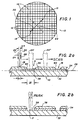
- FIGURE 1 is a top plan view of a scribed semiconductor wafer illustrating a typical laser beam scanning path employed by the method of the present invention.
- FIGURE 2 is a cross-sectional view of a partially process semiconductor wafer illustrating a laser beam located at various spots along the surface of thw wafer.
- FIGURE 2b is a cross-sectional view of a partially processed semiconductor wafer with a laser beam parked at a spot on the surface of the wafer.
- FIGURE 3a is a graph of reflected interference pattern waveforms from two different spots on the semiconductor wafer of Fig. 2a.
- FIGURE 3b is a graph of reflected interference pattern waveforms as a laser beam is scanned along a wafer as shown in Fig. 1 and then parked on a spot as shown in Fig. 2b.
- FIGURE 4 is a graph of seven data-points taken in two successive scans of a semiconductor wafer.
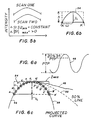
- FIGURES 5a and 5b are graphs used to illustrate a preferred method for finding an optimal spot to park a laser beam.
- FIGURES 6a, 6b, and 6c are portions of an waveform used to illustrate a preferred method for endpoint detection.
- FIGURES 7a and 7b illustrate the optical path of a laser beam through an endpoint detection apparatus in accordance with the present invention.
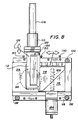
- FIGURE 8 is a top plan view of the endpoint detection apparatus illustrated in Fig. 7a.
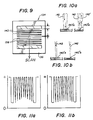
- FIGURE 9 is a top plan view of a test pattern formed on a semiconductor wafer which is used to help focus a laser beam.
- FIGURES 10a and 10b illustrate an unfocussed and a focussed laser beam, respectively, impinging upon different portions of the test pattern of Fig. 9.
- FIGURES 11a and 11b are graphs of the relative intensities of the reflected laser beams from an unfocussed and a focussed laser beam, respectively.
- a semiconductor wafer 10 is provided with a number of scribe lines 12 which are laid out in a grid pattern on the top surface 14 of the wafer.
- Individual integrated circuits are typically batch processed on the wafer 10 within chip locations 16. After the wafer has been fully processed, the wafer is cut or broken along the scribe lines 12 to separate the individual integrated circuits for packaging.
- the present invention scans a laser beam spot 18 along a path 20 to a location 18′.
- This scanning operation is accomplished automatically under computer control, and is highly repeatable such that multiple scans can be accomplished along a substantially identical scan path 20. Since the path 20 is preferably several centimeters long, it will be appreciated that the laser beam spot 18 will cross at least several scribe lines 12 and chip locations 16. If, for some reason, the path 20 does not cross a scribe line, the apparatus can be manually adjusted along an axis 22 such that the beam path 20 does cross a scribe line 12. The adjusted path would still, however, be parallel to the path 20 depicted in Fig. 1.
- laser beam spot 18 is produced by an incident laser beam 24 having an axis 26 which is slightly non-perpendicular to the plane 28 of the top surface 14 of the wafer 10.
- axis 26 of the incident beam 24 can be approximately 91° from the plane 28. This will cause a reflected beam 28 to have an axis 30 which is approximately 89° from the plane 28.
- Figs. 2a and 2b illustrate typical layers of a partially processed semiconductor wafer 10. These layers include the semiconductor substrate, a silicon dioxide (SiO2) layer 34, a photoresist layer 36. As seen in Fig. 2a, as the incident beam 24 is scanned across the top surface 14 of the wafer 10 it will alternately produce a beam spot on the photoresist layer 36, then the silicon dioxide layer 34, and then on the photoresist layer 36 again. This is indicated by the incident beam positions 24, 24′, and 24 ⁇ . This portion of the process is referred to herein as the "scanning mode".
- the width w of the beam spot 18 is considerably smaller than the width W of an opening, such as scribe line S, in the photoresist layer 36.
- the beam spot is approximately 35 micrometers, while the typical width of a scribe line S is on the order of 80 micrometers.
- the beam spot 18 is scanned along surface 14 in steps in the order of approximately 5 micrometers, it is possible to obtain a number of data samples from a flat surface 38 within opening S. This is important in that a great deal of noise is generated when the beam spot falls on steps or transitions such as transitions 40 between the photoresist layer 36 and the silicon dioxide layer 34.
- the beam spot 18 is preferably scanned along path 20 several times, eg. three or four times.
- a process which will be discussed in detail subsequently, is then used to determine a preferred parking spot within a preferred flat area on the wafer 10. For example, and with reference to Fig. 2b, we will assume that the preferred parking spot P is determined to be within flat area 38.
- the beam spot is then moved to parking spot P and is left there for the remainder of the etching process. This mode of operation is known herein as the "parking mode".
- a characteristic photoresist etching curve is shown at 42
- a characteristic silicon dioxide etching curve is shown at 44.
- These curves represent the intensity of the reflected beam 28 as the etching process progresses, and are substantially sinusoidal.
- the curve 42 is typical of the intensity of the reflected beam if the incident beam is parked on photoresist 36
- the curve 44 is typical of the intensity of the reflected beam if the incident beam is parked on silicon dioxide 34.
- the photoresist etching curve 42 is of greater magnitude and lower frequency than the silicon dioxide etching curve 44.
- the higher amplitude is due to the higher reflectivity of photoresist, and the lower frequency is due to the fact that photoresist etches much more slowly than silicon dioxide. Because the characteristic etching curves of photoresist and silicon dioxide are so different, it is not difficult for a system to distinguish between them as a laser beam is scanned across the surface of the wafer.
- the actual etching curve 46 of Fig. 3b has a spiked appearance during the scanning mode because the reflected beam varies greatly in intensity as the inciden beam is scanned across different surfaces and layers of the wafer 10.
- the laser beam is parked on the layer being monitored, in this case silicon dioxide, and, as such, the curve takes on the characteristic etching curve of the silicon dioxide layer.
- the actual etching curve 46 flattens out after the silicon dioxide layer is etched away, indicating endpoint detection.
- the laser beam should be parked on a widest, flattest surface of the SiO2 that can be detected along the scan path 20. Since the scribe lines 12 tend to be order of magnitude greater in width than integrated circuit features, the optimal surface will most often be found within the boundaries of a scribe line 20.
- the beam spot 18 is stepped N times per scan along the scan path 20, and the intensity values of the reflected beam 28 are stored as data values in a digital database. These data values are stored as vectors associated with each scan, i.e. the first scan produces a vector S1 of N data values, the second scan produces a vector S2 of N data values, etc. As will be discussed in detail below, these vectors can be mathematically manipulated to determine the preferred parking location for the laser beam spot 18.
- the seven data values of vector S1 which are centered at n are then compared against the corresponding seven data values of vector S2 which are centered at n to determine the minimum absolute difference 48 between the two.
- This minimum difference 48 will be designated S1S2 min , and is always a positive value.
- 2b+1 data values of vector S1, which are again centered at n are compared to find the maximum absolute difference 50 between any two within the scan.
- b is chosen to be 2. This maximum difference will be designated S1 max , and is also always a positive value.
- the first value for n will typically be a+1, while the last value for n will be N-(a+1). It therefore follows that for vectors of N data values, there will be N-(a+2) values in the vector R 1:2 . These values are then compared to determine a Quality Factor Q 1:2 , which is defined as the maximum data value within vector R 1:2 .
- the values S1 max and S2 max are both greater than zero. Therefore the value of R for the Fig. 5a plot will be greater than the value of R for the Fig. 5b plot by the amount [S1 max + S2 max ] of the Fig. 5b plot.
- the S1 max and S2 max values represent a lack of flatness in the area centered at data point n. Since Fig. 5a has a larger R value than Fig. 5b, the laser beam would rather park on the spot represented by Fig. 5a than the spot represented by Fig. 5b, i.e. on the flatter spot.
- the reflected interference pattern will typically take a sinusoidal shape.
- the sinusoid will flatten, indicating end point detection. At that point in time, the etching process is usually terminated.
- the actual etching curve 46 is continuously monitored by the system to determine its Peak-To-Peak (PTP) value.
- PTP Peak-To-Peak
- This PTP value can be updated every 1/2 cycle of the actual etching curve.
- a calculation is then made to calculate h, which is, in this example, 20% of the PTP value.
- the value h defines a box 54 having corners at points A, A′ on the actual etching curve which encloses the top 20% of the curve.
- the centerline of the box is designated by line C L
- the width of the box is designated as 2W.
- the threshold line will have points at (I max - G′)/2; (I max - F′)/2; (I max - E′)/2; etc.
- the actual etching curve 46 after the centerline C L are then detected, stored, and compared against the threshold line 58. If all of the data values of the actual etching curve 46 centerline C L are above the threshold line 58 then endpoint has been detected. Otherwise, the surface is still etching, and the above process is repeated until endpoint is detected. It will be noted that this method will find the endpoint within h% of the PTP value of the characteristic etching curve, which can be arbitrarily small depending upon the desired endpoint detection sensitivity.
- an endpoint detection system 60 includes a laser 62, an optical isolation assembly 64, an expander assembly 66, a mirror 68, a focussing assembly 70, a window assembly 72, a collector assembly 74, a detector 76, and a controller 78.
- the system 60 is enclosed within an enclosure 79 to protect the delicate optics and to minimize noise from such factors as air currents, etc.
- the laser 62 is preferably a commercially available, polarized helium-neon (HeNe) gas laser.
- the beam 80 of the laser 62 is directed towards the optical isolation assembly 64, which minimizes the amount of light reflected back to the laser 62. Such reflected back light is problematic in that it can cause intensity drift of the laser beam 80.
- the optical isolation assembly includes a polarizing beam splitter 82, and a 1/4 wave plate 84.
- the axis of polarization of the beam splitter 82 is aligned with the axis of polarization of the polarized laser 62, and the 1/4 wave plate 84 circularly polarizes the beam 80.
- the combination of these elements reduces back-reflection of light to the laser 62 considerably because: 1) the back reflected light would have to be circularly polarized in phase with the 1/4 wave plate polarization and 2) only that portion of the in-phase back-reflected circularly polarized light which aligns with the axis of polarization of the beam splitter 82 will make it back to laser 62. This is generally an insignificant amount.
- An optional detector 86 can be used to monitor the output of laser 62.
- Expander assembly 66 includes a pair of lenses 88 and 90 having the same focal point 92. This arrangement of lenses results in a collimated beam 91. This beam is reflected from mirror 68 at substantially right angles and through focussing assembly 90 and window assembly 72 to the wafer 10 (see Fig. 7b), thereby forming incident beam 24. A reflected beam 28 is reflected from the surface of wafer 10 and back through the window assembly 72, focussing assembly 70, past the edge of the mirror 68, into the collector assembly 74, and onto the detector 76.
- the mirror 68 is preferably a front-silvered mirror of minimal reflective loss.
- the window assembly comprises a pair of spaced-apart quartz window panes 96.
- the space 98 between the window panes 96 provides thermal isolation between the optics side 100 and the wafer side 102 of the window assembly. This is an important feature, because the wafer side 102 faces the etcher's reaction chamber and, thus, is exposed to high temperatures.
- the collector assembly 74 includes a collecting lens 104 and a filter 106.
- the lens helps to focus the reflected beam 28 on the detector 76, while the filter removes undesired frequencies of light generated by plasma discharge, ambient lighting, etc.
- the detector 76 can by any of a variety of photodetectors sensitive to light in the frequency range of laser 62.
- controller 78 which is basically a dedicated microcomputer system.
- the controller 78 provides outputs to control the stage movements, the operation of the laser, etc. and has an output indicating endpoint detection.
- the endpoint detection signal generated by controller 78 can be used to automatically shut down the etching process, or to alert an operator to the endpoint condition.
- a top plan view of the endpoint detection system 60 shows a laser head 108, an adaptor 110, an optics housing 112, a slidable plate 114, a stage 115, a detector housing 116, and a base 118.
- the detector housing 116 is rigidly attached to the optics housing 112 and to the stage 115.
- a flange 120 of adaptor 110 couples the adaptor to a flange 122 of optics housing 112.
- a quartz window 96 can be seen in phantom beneath the optics housing 112 and plate 114.
- a stepper motor 124 mounted on plate 114 has a lead screw 125 which can drive the stage 115 and thus the optical housing 112 and detector housing 116 back and forth as indicated by bi-directional arrow 126.
- This movement of the optical housing 112 causes the scanning of the laser beam spot 18 along the path 20.
- the plate 114 and everything carried by the plate 114 can be moved back and forth as indicated by bi-directional arrow 128 after the loosening of thumb screws 130 which clamp along an edge of plate 114.
- This manual adjustment corresponds to the adjustment of the beam path along axis 22 of Fig. 1.
- the beam spot can be focused and aligned by adjusting three screws 132 provided at three corners of the base 118. These screws press against plate 114 to create a conventional three-point adjustment arrangement. With these three screws 132, the pitch, roll, and focus of the beam can be adjusted, as will be apparent to those skilled in the art.
- the fourth corner of plate 114 provides a pivot point for the plate.
- a pattern 134 is produced on a surface 136.
- grooves corresponding to the pattern 134 could be cut into a surface 136.
- a pattern of alternating relatively reflective regions 138 and relatively non-reflecting regions 140 are provided on a planar surface.
- the non-reflecting regions 140 are of varying width, while the reflecting regions 138 are of substantially constant width.
- the center region 140 could be 34 micrometers wide, the two regions 140 flanking the center region could be 36 micrometers wide, the next two flanking regions 140 could be 38 micrometers wide, etc.
- an unfocussed beam 142 impinging on a wide non-reflecting region 140′a is substantially completely absorbed.
- a portion of the incident beam will be reflected at 142′.
- a waveform such as that shown at 11a is developed.
- a focussed beam 142 will be absorbed whether it falls on a wide region 140′b or a narrow region 140 ⁇ b. Therefore, there will be little or no reflected beam for a focussed incident beam. A focussed beam will therefore produce a wave pattern such as that shown at Fig. 11b.
- the method for focussing the beam spot involves scanning the wafer in a direction perpendicular to the pattern 134, and monitoring the intensity of the reflected beam.
- the beam adjustment screws 132 are then adjusted to minimize the variance (and therefor the average intensity) of the reflected beam.
- the beam spot will be focussed at the point of minimum detected variance.
- test patterns can be used other than the one shown.
- the pattern could have reflective regions of varying width, where the object is to minimize the variance by maximizing the average intensity.
Landscapes
- Physics & Mathematics (AREA)
- General Physics & Mathematics (AREA)
- Engineering & Computer Science (AREA)
- Mechanical Engineering (AREA)
- Optics & Photonics (AREA)
- Drying Of Semiconductors (AREA)
- Testing Or Measuring Of Semiconductors Or The Like (AREA)
- Length Measuring Devices By Optical Means (AREA)
- Investigating Or Analyzing Materials By The Use Of Ultrasonic Waves (AREA)
- Weting (AREA)
- Testing Of Optical Devices Or Fibers (AREA)
- Instruments For Measurement Of Length By Optical Means (AREA)
- Recrystallisation Techniques (AREA)
- Lasers (AREA)
Claims (26)
- Procédé pour détecter le point final dans un système de gravure pour plaquettes semiconductrices comprenant les étapes qui consistent :
à parquer un faisceau d'énergie rayonnante sur un point préféré de la surface d'une plaquette semiconductrice;
à détecter une partie réfléchie dudit faisceau pour déterminer une courbe de gravure réelle; et
à analyser ladite partie réfléchie pour déterminer l'instant où ladite surface, audit point préféré, a été traversée par gravure par comparaison de ladite courbe de gravure réelle à une courbe de gravure projetée. - Procédé selon la revendication 1, caractérisé en ce que la surface de la plaquette est balayée et le faisceau réfléchi est détecté pour déterminer une zone où le taux de gravure atteint un maximum sur la surface de la plaquette, le faisceau est parqué sur ladite zone et ladite opération d'analyse par faisceau est effectuée de la façon décrite précédemment.
- Procédé selon la revendication 2, caractérisé en ce que la surface de la plaquette semiconductrice est balayée pour identifier une zone dont le taux de gravure est maximal et où un léger déplacement du faisceau dans la zone a un effet négligeable sur le faisceau réfléchi, le faisceau est parqué sur ladite zone et ladite opération d'analyse par faisceau est effectuée de la façon décrite précédemment.
- Procédé selon l'une quelconque des revendications 1 à 3, caractérisé en ce que la divergence entre les courbes de gravure réelle et projetée est détectée.
- Procédé selon l'une quelconque des revendications 1 à 4, caractérisé en ce que le point final est détecté lorsque la courbe de gravure réelle est supérieure à une fraction prédéterminée de la différence entre une valeur crête de ladite courbe de gravure réelle et ladite courbe de gravure projetée.
- Procédé selon l'une quelconque des revendications 1 à 5, comportant la focalisation d'un faisceau d'énergie rayonnante par les étapes qui consistent :
à faire balayer un faisceau d'énergie rayonnante sur un motif de test comprenant des zones de réflectivités différentes,
à détecter la variance de la partie réfléchie dudit faisceau lorsqu'on le fait balayer ledit motif de test et
à ajuster ledit faisceau pour minimiser ladite variance. - Procédé selon la revendication 6, caractérisé en ce que ledit motif de test comporte un premier ensemble de zones ayant une première réflectivité, alterné avec un second ensemble de zones ayant une deuxième réflectivité, et en ce que les zones dudit premier ensemble ont des largeurs variables.
- Procédé pour détecter un point final dans un système de gravure pour plaquettes semiconductrices selon l'une quelconque des revendications précédentes, comprenant les étapes qui consistent à balayer la surface d'une plaquette semiconductrice avec un faisceau étroitement focalisé d'énergie rayonnante et à détecter une partie réfléchie dudit faisceau, à analyser ladite partie réfléchie pour déterminer un point de parcage préféré sur une zone plane de ladite surface, ladite zone plane préférée ayant une dimension transversale minimale supérieure à une taille de trace dudit faisceau, à parquer ledit faisceau audit point préféré et à analyser ladite partie réfléchie dudit faisceau pour déterminer l'instant où ladite zone plane préférée a été traversée par gravure.
- Procédé selon l'une quelconque des revendications précédentes, comportant un procédé pour trouver un point de parcage préféré pour un faisceau laser d'un interféromètre à faisceau laser, comprenant les étapes qui consistent à effectuer au moins un balayage le long d'un trajet de balayage sur la surface d'une plaquette semiconductrice avec un faisceau laser étroitement focalisé et à détecter une partie réfléchie dudit faisceau, analyser ladite partie réfléchie dudit faisceau pour déterminer un point de parcage préféré à l'intérieur d'une zone plane préférée ayant une dimension transversale minimale qui est supérieure à la taille d'une trace dudit faisceau laser.
- Procédé selon la revendication 9, caractérisé en ce que ladite taille de trace est suffisamment petite pour qu'un ensemble de valeurs de données puisse être pris à l'intérieur de ladite zone plane préférée, afin de minimiser les effets des transitions et des marches sur ladite surface de la plaquette semiconductrice, qui peuvent entourer ladite zone plane préférée.
- Procédé selon la revendication 10, caractérisé en ce que des balayages multiples sont effectués le long dudit trajet de balayage, chacun desdits balayages multiples comprenant un ensemble de valeurs de données, en ce qu'un premier sous-ensemble de valeurs de données du premier balayage S1 est comparé à un premier sous-ensemble correspondant de valeurs de données d'un deuxième balayage S2 pour trouver la différence minimale (S1, S2min) entre deux valeurs quelconques de données correspondantes.
- Procédé selon la revendication 11, caractérisé en ce qu'un second sous-ensemble de balayages S1 est utilisé pour calculer un facteur S1max correspondant à la différence maximale entre deux valeurs quelconques de données à l'intérieur dudit deuxième sous-ensemble de balayages S1, et dans lequel un deuxième sous-ensemble de balayages S2 est utilisé pour calculer un facteur S2max correspondant à la différence maximale entre deux valeurs quelconques de données dudit deuxième sous-ensemble de balayages S2; lesdits deuxièmes sous-ensembles n'étant pas nécessairement différents desdits premiers sous-ensembles.
- Procédé selon la revendication 12, caractérisé en ce qu'une valeur relative R est calculée de la manière suivante :

où ladite valeur relative R représente le caractère souhaitable relatif de ladite trace. - Procédé selon la revendication 13, caractérisé en ce qu'un ensemble de valeurs R est calculé pour des balayages S1 et S2, dont le maximum correspond à un facteur de qualité Q pour les balayages S1 et S2.
- Procédé selon la revendication 14, caractérisé en ce que plus de deux balayages sont comparés pour déterminer un ensemble de valeurs Q, dont le maximum correspond audit point de parcage préféré.
- Système de détection de point final par interféromètre à laser comprenant un moyen (62) de formation de faisceau conçu pour produire une trace de faisceau; un moyen (124, 125) de balayage couplé audit moyen de formation de faisceau pour faire balayer ladite trace de faisceau sur une surface d'une plaquette semiconductrice; un moyen pour déterminer un point de parcage préféré sur la plaquette; un moyen (76) de détection sensible à une partie réfléchie de ladite trace du faisceau qui est réfléchie par ledit point de parcage préféré sur ladite plaquette semiconductrice pour déterminer une courbe de gravure réelle, et un moyen (78) de commande pour comparer la courbe réelle à une courbe projetée et élaborer un signal de détection de point final lorsque la sortie du moyen de détection indique un écart entre la courbe de gravure réelle et la courbe de gravure projetée, indiquant que la zone sélectionnée a été traversée par gravure.
- Système de détection de point final par interféromètre à laser selon la revendication 16, caractérisé en ce que ledit moyen de formation de faisceau comprend une source laser (62) conçue pour produire un faisceau laser; un moyen (66) de dilatation de faisceau placé sur le trajet dudit faisceau laser et conçu pour produire un faisceau laser dilaté; et un moyen (70) de focalisation de faisceau placé sur le trajet dudit faisceau laser dilaté et adapté pour produire un faisceau laser focalisé.
- Système de détection de point final par interféromètre à laser selon la revendication 17, caractérisé en ce que ledit moyen de formation de faisceau comporte en outre un moyen (64) d'isolation optique disposé entre ladite source laser et ledit moyen de dilatation de faisceau le long dudit trajet dudit faisceau laser pour minimiser la réflexion dudit faisceau laser en retour vers ladite source laser.
- Système de détection de point final par interféromètre à laser selon la revendication 18, caractérisé en ce que ledit moyen (64) d'isolation optique comporte un moyen polarisant (82).
- Système de détection de point final par interféromètre à laser selon l'une quelconque des revendications 16 à 19, caractérisé en ce que ledit moyen de détection comporte un photodétecteur (76) et une optique (74) de détection pour focaliser ledit faisceau réfléchi sur ledit photodétecteur.
- Système de détection de point final par interféromètre à laser selon l'une quelconque des revendications 16 à 20, caractérisé en ce que des moyens d'isolation contre l'environnement, comportant des moyens (96, 98) à fenêtre, sont disposés entre ledit moyen de formation de faisceau et ladite plaquette semiconductrice.
- Système de détection de point final par interféromètre à laser selon la revendication 21, caractérisé en ce que lesdits moyens (96, 98) à fenêtre sont adaptés pour isoler thermiquement le côté de ladite fenêtre orienté vers le moyen de formation de faisceau, du côté de ladite fenêtre orienté vers la plaquette semiconductrice.
- Système de détection de point final par interféromètre à laser selon la revendication 22, caractérisé en ce que lesdits moyens à fenêtre comportent un ensemble de vitres (96) espacées les unes des autres.
- Système de détection de point final par interféromètre à laser selon la revendication 23, comprenant en outre un moyen de chauffage pour chauffer au moins la vitre la plus proche de ladite plaquette semiconductrice.
- Système de détection de point final par interféromètre à laser selon l'une quelconque des revendications 21 à 24, caractérisé en ce que ledit moyen d'isolation contre l'environnement comprend en outre un moyen (79) à enceinte renfermant au moins partiellement ledit moyen de formation de faisceau.
- Système de détection de point final par interféromètre à laser selon l'une quelconque des revendications 16 à 25, comprenant en outre un moyen (132) de focalisation de faisceau couplé audit moyen de formation de faisceau et conçu pour focaliser ladite trace de faisceau sur ladite plaquette semiconductrice.
Priority Applications (2)
| Application Number | Priority Date | Filing Date | Title |
|---|---|---|---|
| EP93201860A EP0566217B1 (fr) | 1988-07-20 | 1989-07-11 | Méthode et appareil pour la focalisation d'un faisceau d'énergie radiante |
| EP93201861A EP0566218B1 (fr) | 1988-07-20 | 1989-07-11 | Méthode pour trouver une location préférentielle pour un faisceau laser d'un interféromètre à faisceau laser et appareil interférométrique à laser |
Applications Claiming Priority (2)
| Application Number | Priority Date | Filing Date | Title |
|---|---|---|---|
| US221979 | 1988-07-20 | ||
| US07/221,979 US4953982A (en) | 1988-07-20 | 1988-07-20 | Method and apparatus for endpoint detection in a semiconductor wafer etching system |
Related Child Applications (2)
| Application Number | Title | Priority Date | Filing Date |
|---|---|---|---|
| EP93201860.9 Division-Into | 1993-06-26 | ||
| EP93201861.7 Division-Into | 1993-06-26 |
Publications (3)
| Publication Number | Publication Date |
|---|---|
| EP0352004A2 EP0352004A2 (fr) | 1990-01-24 |
| EP0352004A3 EP0352004A3 (en) | 1990-11-22 |
| EP0352004B1 true EP0352004B1 (fr) | 1994-09-21 |
Family
ID=22830235
Family Applications (3)
| Application Number | Title | Priority Date | Filing Date |
|---|---|---|---|
| EP93201861A Expired - Lifetime EP0566218B1 (fr) | 1988-07-20 | 1989-07-11 | Méthode pour trouver une location préférentielle pour un faisceau laser d'un interféromètre à faisceau laser et appareil interférométrique à laser |
| EP89307009A Expired - Lifetime EP0352004B1 (fr) | 1988-07-20 | 1989-07-11 | Méthode et appareil pour détecter le point final dans un système de gravure pour plaquettes semi-conductrices |
| EP93201860A Expired - Lifetime EP0566217B1 (fr) | 1988-07-20 | 1989-07-11 | Méthode et appareil pour la focalisation d'un faisceau d'énergie radiante |
Family Applications Before (1)
| Application Number | Title | Priority Date | Filing Date |
|---|---|---|---|
| EP93201861A Expired - Lifetime EP0566218B1 (fr) | 1988-07-20 | 1989-07-11 | Méthode pour trouver une location préférentielle pour un faisceau laser d'un interféromètre à faisceau laser et appareil interférométrique à laser |
Family Applications After (1)
| Application Number | Title | Priority Date | Filing Date |
|---|---|---|---|
| EP93201860A Expired - Lifetime EP0566217B1 (fr) | 1988-07-20 | 1989-07-11 | Méthode et appareil pour la focalisation d'un faisceau d'énergie radiante |
Country Status (5)
| Country | Link |
|---|---|
| US (1) | US4953982A (fr) |
| EP (3) | EP0566218B1 (fr) |
| JP (2) | JP2728509B2 (fr) |
| AT (3) | ATE151524T1 (fr) |
| DE (3) | DE68927684T2 (fr) |
Families Citing this family (43)
| Publication number | Priority date | Publication date | Assignee | Title |
|---|---|---|---|---|
| US5196285A (en) * | 1990-05-18 | 1993-03-23 | Xinix, Inc. | Method for control of photoresist develop processes |
| US5208644A (en) * | 1990-05-18 | 1993-05-04 | Xinix, Inc. | Interference removal |
| JPH07111340B2 (ja) * | 1990-10-31 | 1995-11-29 | 信越半導体株式会社 | パターンシフト測定方法 |
| GB2257507B (en) * | 1991-06-26 | 1995-03-01 | Digital Equipment Corp | Semiconductor wafer processing with across-wafer critical dimension monitoring using optical endpoint detection |
| US5245794A (en) * | 1992-04-09 | 1993-09-21 | Advanced Micro Devices, Inc. | Audio end point detector for chemical-mechanical polishing and method therefor |
| US5499733A (en) * | 1992-09-17 | 1996-03-19 | Luxtron Corporation | Optical techniques of measuring endpoint during the processing of material layers in an optically hostile environment |
| US5408322A (en) * | 1993-04-26 | 1995-04-18 | Materials Research Corporation | Self aligning in-situ ellipsometer and method of using for process monitoring |
| US5433650A (en) * | 1993-05-03 | 1995-07-18 | Motorola, Inc. | Method for polishing a substrate |
| US5891352A (en) | 1993-09-16 | 1999-04-06 | Luxtron Corporation | Optical techniques of measuring endpoint during the processing of material layers in an optically hostile environment |
| US6033721A (en) * | 1994-10-26 | 2000-03-07 | Revise, Inc. | Image-based three-axis positioner for laser direct write microchemical reaction |
| US5843363A (en) * | 1995-03-31 | 1998-12-01 | Siemens Aktiengesellschaft | Ablation patterning of multi-layered structures |
| US5708506A (en) * | 1995-07-03 | 1998-01-13 | Applied Materials, Inc. | Apparatus and method for detecting surface roughness in a chemical polishing pad conditioning process |
| KR970053235A (ko) * | 1995-12-20 | 1997-07-31 | 양승택 | 열식각에 의한 기판의 산화층 제거완료를 실시간으로 감지하는 방법 |
| JP4327266B2 (ja) * | 1997-02-26 | 2009-09-09 | 株式会社東芝 | パターン寸法評価方法及びパターン形成方法 |
| US5910011A (en) * | 1997-05-12 | 1999-06-08 | Applied Materials, Inc. | Method and apparatus for monitoring processes using multiple parameters of a semiconductor wafer processing system |
| US6028669A (en) * | 1997-07-23 | 2000-02-22 | Luxtron Corporation | Signal processing for in situ monitoring of the formation or removal of a transparent layer |
| US6129807A (en) * | 1997-10-06 | 2000-10-10 | Applied Materials, Inc. | Apparatus for monitoring processing of a substrate |
| US6632321B2 (en) | 1998-01-06 | 2003-10-14 | Applied Materials, Inc | Method and apparatus for monitoring and controlling wafer fabrication process |
| US6535779B1 (en) | 1998-03-06 | 2003-03-18 | Applied Materials, Inc. | Apparatus and method for endpoint control and plasma monitoring |
| US6081334A (en) | 1998-04-17 | 2000-06-27 | Applied Materials, Inc | Endpoint detection for semiconductor processes |
| US6390019B1 (en) | 1998-06-11 | 2002-05-21 | Applied Materials, Inc. | Chamber having improved process monitoring window |
| EP1125314A1 (fr) | 1998-07-10 | 2001-08-22 | Applied Materials, Inc. | Amelioration de la detection de la fin d'operations de fabrication de substrats |
| US6252227B1 (en) * | 1998-10-19 | 2001-06-26 | Taiwan Semiconductor Manufacturing Company | Method for sectioning a semiconductor wafer with FIB for viewing with SEM |
| EP1200982A1 (fr) | 1999-08-12 | 2002-05-02 | Infineon Technologies AG | Procede de surveillance d'un processus de production pour le traitement d'un substrat dans la fabrication de semi-conducteurs |
| US6400458B1 (en) | 1999-09-30 | 2002-06-04 | Lam Research Corporation | Interferometric method for endpointing plasma etch processes |
| US6580508B1 (en) * | 1999-11-29 | 2003-06-17 | United Microelectronics Corp. | Method for monitoring a semiconductor wafer in a chemical mechanical polishing process |
| US6449038B1 (en) | 1999-12-13 | 2002-09-10 | Applied Materials, Inc. | Detecting a process endpoint from a change in reflectivity |
| US7188142B2 (en) * | 2000-11-30 | 2007-03-06 | Applied Materials, Inc. | Dynamic subject information generation in message services of distributed object systems in a semiconductor assembly line facility |
| US6673199B1 (en) | 2001-03-07 | 2004-01-06 | Applied Materials, Inc. | Shaping a plasma with a magnetic field to control etch rate uniformity |
| JP2002277220A (ja) * | 2001-03-19 | 2002-09-25 | Hitachi Ltd | 膜厚計測のための計測点決定方法およびそれを用いた薄膜デバイスの製造方法並びに薄膜デバイスの製造装置 |
| US6676482B2 (en) | 2001-04-20 | 2004-01-13 | Speedfam-Ipec Corporation | Learning method and apparatus for predictive determination of endpoint during chemical mechanical planarization using sparse sampling |
| US6919279B1 (en) | 2002-10-08 | 2005-07-19 | Novellus Systems, Inc. | Endpoint detection for high density plasma (HDP) processes |
| US20040127030A1 (en) * | 2002-12-31 | 2004-07-01 | Tokyo Electron Limited | Method and apparatus for monitoring a material processing system |
| US6905624B2 (en) * | 2003-07-07 | 2005-06-14 | Applied Materials, Inc. | Interferometric endpoint detection in a substrate etching process |
| US6829056B1 (en) | 2003-08-21 | 2004-12-07 | Michael Barnes | Monitoring dimensions of features at different locations in the processing of substrates |
| US7190458B2 (en) | 2003-12-09 | 2007-03-13 | Applied Materials, Inc. | Use of scanning beam for differential evaluation of adjacent regions for change in reflectivity |
| US7136163B2 (en) | 2003-12-09 | 2006-11-14 | Applied Materials, Inc. | Differential evaluation of adjacent regions for change in reflectivity |
| US20070221640A1 (en) | 2006-03-08 | 2007-09-27 | Dean Jennings | Apparatus for thermal processing structures formed on a substrate |
| US9498845B2 (en) * | 2007-11-08 | 2016-11-22 | Applied Materials, Inc. | Pulse train annealing method and apparatus |
| US9073169B2 (en) * | 2008-11-07 | 2015-07-07 | Applied Materials, Inc. | Feedback control of polishing using optical detection of clearance |
| CN102142384B (zh) | 2010-12-02 | 2013-01-09 | 深圳市华星光电技术有限公司 | 金属蚀刻终点侦测方法及金属蚀刻终点侦测机 |
| CN109148316A (zh) * | 2018-09-07 | 2019-01-04 | 北京智芯微电子科技有限公司 | 用于精确判定等离子体刻蚀机刻蚀芯片终点的监测方法 |
| CN114720097B (zh) * | 2022-04-13 | 2023-06-09 | 安徽科瑞思创晶体材料有限责任公司 | 一种用于tgg晶片检测的光学检测系统 |
Family Cites Families (14)
| Publication number | Priority date | Publication date | Assignee | Title |
|---|---|---|---|---|
| JPS5453864A (en) * | 1977-10-05 | 1979-04-27 | Sanyo Electric Co Ltd | Monitoring method of line widths |
| JPS5741637A (en) * | 1980-08-26 | 1982-03-08 | Dainippon Printing Co Ltd | Microstep tablet |
| EP0091400A1 (fr) * | 1982-04-02 | 1983-10-12 | GRETAG Aktiengesellschaft | Procédé et dispositif de focalisation d'un rayon de lumière cohérente |
| JPS5958885A (ja) * | 1982-09-29 | 1984-04-04 | Toshiba Corp | ビ−ム光出力モニタ装置 |
| JPS59186325A (ja) * | 1983-04-01 | 1984-10-23 | コンパニ−・アンデユストリエル・デ・テレコミユニカシオン・セイテ−アルカテル | ドライエツチング装置 |
| US4569717A (en) * | 1983-05-24 | 1986-02-11 | Dainippon Screen Mfg. Co., Ltd. | Method of surface treatment |
| US4618262A (en) * | 1984-04-13 | 1986-10-21 | Applied Materials, Inc. | Laser interferometer system and method for monitoring and controlling IC processing |
| US4703434A (en) * | 1984-04-24 | 1987-10-27 | The Perkin-Elmer Corporation | Apparatus for measuring overlay error |
| JPH0610694B2 (ja) * | 1985-04-12 | 1994-02-09 | 株式会社日立製作所 | 自動焦点合せ方法及び装置 |
| JPH0682636B2 (ja) * | 1985-04-19 | 1994-10-19 | 株式会社日立製作所 | ドライエッチング方法 |
| JPS6221224A (ja) * | 1985-07-19 | 1987-01-29 | Applied Materials Japan Kk | エンドポイントモニタ |
| DE3600346A1 (de) * | 1986-01-08 | 1987-07-09 | Fraunhofer Ges Forschung | Verfahren zur abbildenden laserinterferometrie und laserinterferometer zur durchfuehrung des verfahrens |
| JPH0691045B2 (ja) * | 1986-03-03 | 1994-11-14 | 日電アネルバ株式会社 | エツチングモニタ−装置 |
| US4818886A (en) * | 1986-11-12 | 1989-04-04 | Quential, Inc. | Method and apparatus for self-referencing and self-focusing a bar-code reader |
-
1988
- 1988-07-20 US US07/221,979 patent/US4953982A/en not_active Expired - Fee Related
-
1989
- 1989-07-11 EP EP93201861A patent/EP0566218B1/fr not_active Expired - Lifetime
- 1989-07-11 DE DE68927684T patent/DE68927684T2/de not_active Expired - Fee Related
- 1989-07-11 EP EP89307009A patent/EP0352004B1/fr not_active Expired - Lifetime
- 1989-07-11 EP EP93201860A patent/EP0566217B1/fr not_active Expired - Lifetime
- 1989-07-11 DE DE68918363T patent/DE68918363T2/de not_active Expired - Fee Related
- 1989-07-11 AT AT93201861T patent/ATE151524T1/de not_active IP Right Cessation
- 1989-07-11 DE DE68927963T patent/DE68927963T2/de not_active Expired - Fee Related
- 1989-07-11 AT AT89307009T patent/ATE112048T1/de not_active IP Right Cessation
- 1989-07-11 AT AT93201860T patent/ATE147849T1/de not_active IP Right Cessation
- 1989-07-19 JP JP1187231A patent/JP2728509B2/ja not_active Expired - Lifetime
-
1994
- 1994-08-22 JP JP6196904A patent/JP2650857B2/ja not_active Expired - Lifetime
Also Published As
| Publication number | Publication date |
|---|---|
| JP2650857B2 (ja) | 1997-09-10 |
| EP0352004A2 (fr) | 1990-01-24 |
| EP0566217A3 (en) | 1993-12-22 |
| JPH07122549A (ja) | 1995-05-12 |
| DE68927963T2 (de) | 1997-07-17 |
| EP0566217B1 (fr) | 1997-01-15 |
| EP0566218B1 (fr) | 1997-04-09 |
| EP0566218A3 (en) | 1993-12-22 |
| US4953982A (en) | 1990-09-04 |
| ATE112048T1 (de) | 1994-10-15 |
| DE68918363D1 (de) | 1994-10-27 |
| ATE151524T1 (de) | 1997-04-15 |
| DE68927684T2 (de) | 1997-05-28 |
| ATE147849T1 (de) | 1997-02-15 |
| DE68918363T2 (de) | 1995-02-23 |
| JP2728509B2 (ja) | 1998-03-18 |
| EP0566217A2 (fr) | 1993-10-20 |
| EP0352004A3 (en) | 1990-11-22 |
| EP0566218A2 (fr) | 1993-10-20 |
| JPH0273629A (ja) | 1990-03-13 |
| DE68927684D1 (de) | 1997-02-27 |
| DE68927963D1 (de) | 1997-05-15 |
Similar Documents
| Publication | Publication Date | Title |
|---|---|---|
| US4953982A (en) | Method and apparatus for endpoint detection in a semiconductor wafer etching system | |
| US5151584A (en) | Method and apparatus for endpoint detection in a semiconductor wafer etching system | |
| US4618262A (en) | Laser interferometer system and method for monitoring and controlling IC processing | |
| US6961131B2 (en) | Film thickness measuring method of member to be processed using emission spectroscopy and processing method of the member using the measuring method | |
| EP0057745B1 (fr) | Moniteur de la vitesse de décapage et de l'épaisseur pour le décapage du silicium | |
| US5233291A (en) | Method of and apparatus for measuring electric characteristics of semiconductor wafer | |
| JPH0834199B2 (ja) | エッチング終点検出方法及び装置 | |
| JPH076771B2 (ja) | Ic処理をモニター及び制御するレーザ干渉計装置及び方法 | |
| US5337144A (en) | Etch rate monitor using collimated light and method of using same | |
| US5077464A (en) | Method and apparatus for endpoint detection in a semiconductor wafer etching system | |
| JP7240495B2 (ja) | 傾斜面レリーフ格子のエッチング深さを検出するためのシステム及び方法 | |
| US20050042777A1 (en) | Control of etch and deposition processes | |
| KR100969636B1 (ko) | 통합 계측법 또는 독립형 계측법을 사용하여 웨이퍼균일성을 개선하기 위한 처리 제어 | |
| US6878301B2 (en) | Methods and apparatuses for trench depth detection and control | |
| JP4642024B2 (ja) | 一体型の多目的光学アラインメントのためのシステムおよび方法 | |
| US6635573B2 (en) | Method of detecting an endpoint during etching of a material within a recess | |
| EP0462599B1 (fr) | Appareil et méthode pour mesurer la vitesse de décapage | |
| US20030082838A1 (en) | Method and system for monitoring a semiconductor wafer plasma etch process | |
| JP2001210626A (ja) | 半導体ウェーハの製造方法及び半導体ウェーハ | |
| JP2006119145A (ja) | 半導体ウエハの処理方法及び処理装置 | |
| JPH05259127A (ja) | プラズマエッチングにおけるエッチング監視方法 | |
| KR20060057036A (ko) | 웨이퍼 모니터링 방법 및 장치 | |
| JPH0444318A (ja) | 半導体製造装置 | |
| KR0137967Y1 (ko) | 반도체 노광장비의 웨이퍼 어라인용 기준미러 | |
| JPH06104215A (ja) | 半導体装置の製造方法 |
Legal Events
| Date | Code | Title | Description |
|---|---|---|---|
| PUAI | Public reference made under article 153(3) epc to a published international application that has entered the european phase |
Free format text: ORIGINAL CODE: 0009012 |
|
| AK | Designated contracting states |
Kind code of ref document: A2 Designated state(s): AT BE CH DE FR GB IT LI LU NL SE |
|
| PUAL | Search report despatched |
Free format text: ORIGINAL CODE: 0009013 |
|
| AK | Designated contracting states |
Kind code of ref document: A3 Designated state(s): AT BE CH DE FR GB IT LI LU NL SE |
|
| 17P | Request for examination filed |
Effective date: 19901218 |
|
| 17Q | First examination report despatched |
Effective date: 19910903 |
|
| GRAA | (expected) grant |
Free format text: ORIGINAL CODE: 0009210 |
|
| AK | Designated contracting states |
Kind code of ref document: B1 Designated state(s): AT BE CH DE FR GB IT LI LU NL SE |
|
| PG25 | Lapsed in a contracting state [announced via postgrant information from national office to epo] |
Ref country code: LI Effective date: 19940921 Ref country code: CH Effective date: 19940921 Ref country code: BE Effective date: 19940921 Ref country code: AT Effective date: 19940921 |
|
| REF | Corresponds to: |
Ref document number: 112048 Country of ref document: AT Date of ref document: 19941015 Kind code of ref document: T |
|
| ITF | It: translation for a ep patent filed | ||
| REF | Corresponds to: |
Ref document number: 68918363 Country of ref document: DE Date of ref document: 19941027 |
|
| ET | Fr: translation filed | ||
| PG25 | Lapsed in a contracting state [announced via postgrant information from national office to epo] |
Ref country code: SE Effective date: 19941221 |
|
| REG | Reference to a national code |
Ref country code: CH Ref legal event code: PL |
|
| PLBE | No opposition filed within time limit |
Free format text: ORIGINAL CODE: 0009261 |
|
| STAA | Information on the status of an ep patent application or granted ep patent |
Free format text: STATUS: NO OPPOSITION FILED WITHIN TIME LIMIT |
|
| PG25 | Lapsed in a contracting state [announced via postgrant information from national office to epo] |
Ref country code: LU Free format text: LAPSE BECAUSE OF NON-PAYMENT OF DUE FEES Effective date: 19950731 |
|
| 26N | No opposition filed | ||
| PGFP | Annual fee paid to national office [announced via postgrant information from national office to epo] |
Ref country code: GB Payment date: 19970516 Year of fee payment: 9 |
|
| PGFP | Annual fee paid to national office [announced via postgrant information from national office to epo] |
Ref country code: FR Payment date: 19970528 Year of fee payment: 9 |
|
| PGFP | Annual fee paid to national office [announced via postgrant information from national office to epo] |
Ref country code: NL Payment date: 19970731 Year of fee payment: 9 |
|
| PGFP | Annual fee paid to national office [announced via postgrant information from national office to epo] |
Ref country code: DE Payment date: 19970925 Year of fee payment: 9 |
|
| PG25 | Lapsed in a contracting state [announced via postgrant information from national office to epo] |
Ref country code: GB Free format text: LAPSE BECAUSE OF NON-PAYMENT OF DUE FEES Effective date: 19980711 |
|
| PG25 | Lapsed in a contracting state [announced via postgrant information from national office to epo] |
Ref country code: NL Free format text: LAPSE BECAUSE OF NON-PAYMENT OF DUE FEES Effective date: 19990201 |
|
| GBPC | Gb: european patent ceased through non-payment of renewal fee |
Effective date: 19980711 |
|
| PG25 | Lapsed in a contracting state [announced via postgrant information from national office to epo] |
Ref country code: FR Free format text: LAPSE BECAUSE OF NON-PAYMENT OF DUE FEES Effective date: 19990331 |
|
| NLV4 | Nl: lapsed or anulled due to non-payment of the annual fee |
Effective date: 19990201 |
|
| PG25 | Lapsed in a contracting state [announced via postgrant information from national office to epo] |
Ref country code: DE Free format text: LAPSE BECAUSE OF NON-PAYMENT OF DUE FEES Effective date: 19990501 |
|
| REG | Reference to a national code |
Ref country code: FR Ref legal event code: ST |
|
| PG25 | Lapsed in a contracting state [announced via postgrant information from national office to epo] |
Ref country code: IT Free format text: LAPSE BECAUSE OF NON-PAYMENT OF DUE FEES Effective date: 20050711 |