EP0352019B1 - Modulationsvorrichtung für optische Kommunikationstechnik - Google Patents
Modulationsvorrichtung für optische Kommunikationstechnik Download PDFInfo
- Publication number
- EP0352019B1 EP0352019B1 EP89307106A EP89307106A EP0352019B1 EP 0352019 B1 EP0352019 B1 EP 0352019B1 EP 89307106 A EP89307106 A EP 89307106A EP 89307106 A EP89307106 A EP 89307106A EP 0352019 B1 EP0352019 B1 EP 0352019B1
- Authority
- EP
- European Patent Office
- Prior art keywords
- regions
- type
- nanometers
- semiconductor material
- semiconductor
- Prior art date
- Legal status (The legal status is an assumption and is not a legal conclusion. Google has not performed a legal analysis and makes no representation as to the accuracy of the status listed.)
- Expired - Lifetime
Links
Images

Classifications
-
- G—PHYSICS
- G02—OPTICS
- G02F—OPTICAL DEVICES OR ARRANGEMENTS FOR THE CONTROL OF LIGHT BY MODIFICATION OF THE OPTICAL PROPERTIES OF THE MEDIA OF THE ELEMENTS INVOLVED THEREIN; NON-LINEAR OPTICS; FREQUENCY-CHANGING OF LIGHT; OPTICAL LOGIC ELEMENTS; OPTICAL ANALOGUE/DIGITAL CONVERTERS
- G02F1/00—Devices or arrangements for the control of the intensity, colour, phase, polarisation or direction of light arriving from an independent light source, e.g. switching, gating or modulating; Non-linear optics
-
- B—PERFORMING OPERATIONS; TRANSPORTING
- B82—NANOTECHNOLOGY
- B82Y—SPECIFIC USES OR APPLICATIONS OF NANOSTRUCTURES; MEASUREMENT OR ANALYSIS OF NANOSTRUCTURES; MANUFACTURE OR TREATMENT OF NANOSTRUCTURES
- B82Y20/00—Nanooptics, e.g. quantum optics or photonic crystals
-
- G—PHYSICS
- G02—OPTICS
- G02F—OPTICAL DEVICES OR ARRANGEMENTS FOR THE CONTROL OF LIGHT BY MODIFICATION OF THE OPTICAL PROPERTIES OF THE MEDIA OF THE ELEMENTS INVOLVED THEREIN; NON-LINEAR OPTICS; FREQUENCY-CHANGING OF LIGHT; OPTICAL LOGIC ELEMENTS; OPTICAL ANALOGUE/DIGITAL CONVERTERS
- G02F1/00—Devices or arrangements for the control of the intensity, colour, phase, polarisation or direction of light arriving from an independent light source, e.g. switching, gating or modulating; Non-linear optics
- G02F1/01—Devices or arrangements for the control of the intensity, colour, phase, polarisation or direction of light arriving from an independent light source, e.g. switching, gating or modulating; Non-linear optics for the control of the intensity, phase, polarisation or colour
- G02F1/015—Devices or arrangements for the control of the intensity, colour, phase, polarisation or direction of light arriving from an independent light source, e.g. switching, gating or modulating; Non-linear optics for the control of the intensity, phase, polarisation or colour based on semiconductor elements having potential barriers, e.g. having a PN or PIN junction
- G02F1/017—Structures with periodic or quasi periodic potential variation, e.g. superlattices, quantum wells
-
- B—PERFORMING OPERATIONS; TRANSPORTING
- B82—NANOTECHNOLOGY
- B82Y—SPECIFIC USES OR APPLICATIONS OF NANOSTRUCTURES; MEASUREMENT OR ANALYSIS OF NANOSTRUCTURES; MANUFACTURE OR TREATMENT OF NANOSTRUCTURES
- B82Y40/00—Manufacture or treatment of nanostructures
Definitions
- the invention is concerned with the modulation and switching of electro-magnetic radiation in response to an electrical signal in optical communications.
- Modulation may take the form of direct intensity modulation of a light source; alternatively, means are desired for indirect modulation, e.g., as applied to radiation from a source having essentially constant intensity.
- One such indirect modulation device disclosed by C. J. Chang-Hasnain et al., "Tunable Electroabsorption in Gallium Arsenside Doping Superlattices", Applied Physics Letters , Vol. 50 (1987), pp.
- 915-917 is based on the use of a superlattice of gallium arsenide semiconductor layers which, in groups of four, are n-doped, intrinsic, p-doped, and intrinsic.
- the invention as disclosed below is motivated by the desire for providing a semiconductor modulator device having improved absorption characteristics as well as enhanced bias capability.
- Electromagnetic radiation as may be used in optical communications is modulated in response to an electrical signal which produces a variable electric field in a semiconductor layered structure as claimed in claim 1.
- An essentially undoped semiconductor material is used as epitaxially deposited on a suitable substrate, with interleaved thin, heavily doped donor (n-type) and acceptor (p-type) regions.
- n-type donor
- p-type acceptor
- a resulting device has a broad wavelength range in which light intensity can be modulated, a desirably large contrast ratio between transparent and opaque states, operating voltages which are in a range as typically used in electronic integrated circuitry, and high-speed (e.g., GHz) capability.
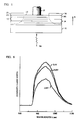
- FIG. 1 shows substrate 11, epitaxially deposited semiconductor material 12, n-type doped regions layers 13, p-type doped regions 14, electrical contacts 15 and 16, and optical fiber 17.
- Contact material is shown diffused into the semiconductor material, thereby forming diffused areas 151 and 161.
- a suitable (modulating) voltage is applied between contacts 15 and 16, absorption of incident electromagnetic radiation of energy h ⁇ in the layered structure varies as a function of such voltage, resulting in the insertion of intensity-modulated radiation into optical fiber 17.
- suitable semiconductor host materials are binary Group III-V materials such as, e.g., gallium arsenide, ternary and quaternary Group III-V materials such as, e.g., gallium-indium phosphide-arsenide, as well as Group II-VI and Group IV materials.
- binary Group III-V materials such as, e.g., gallium arsenide, ternary and quaternary Group III-V materials such as, e.g., gallium-indium phosphide-arsenide, as well as Group II-VI and Group IV materials.
- E g energy gap
- ⁇ g 1.424 eV
- ⁇ g 870 nanometer
- a resulting device is suitable for modulation at wavelengths in the approximate range from 900 to 1000 nanometer.
- a device For light emitted by a gallium arsenide source a device is preferred including a higher-gap host material such as, e.g. aluminum-gallium arsenide. While, typically, a single semiconductor material is used as host material, use of different materials is not precluded, e.g., in the interest of further broadening of the wavelength response.
- a higher-gap host material such as, e.g. aluminum-gallium arsenide.
- semiconductor layers 12 and dopant layers 13 and 14 are deposited sequentially in growth direction x by molecular-beam epitaxy (MBE), other methods such as, e.g., metal-organic chemical vapor deposition (MOCVD) being not precluded.
- MBE molecular-beam epitaxy
- MOCVD metal-organic chemical vapor deposition
- Selective inclusion of dopant material so as to facilitate contacting as depicted in FIG. 1 is facilitated by shadow masking techniques.
- Typical structural dimensions are such that the distance between doped regions is in the range from 50 to 500 nanometers.
- Preferred doped-region thickness is less than 10 nanometers and preferably less than 5 nanometers as further discussed below in connection with preferred minimization of impurity absorption.
- Preferred two-dimensional dopant concentration is in the range from 5x10¹² to 2x1013 cm ⁇ 2.
- p-type doping may be by means of beryllium, and n-type doping by means of silicon; such dopants will occupy on the order of not more than 5 percent of the gallium sites of a gallium monolayer in the gallium arsenide crystal lattice.
- p-type doping can be effected by carbon on arsenic sites.
- FIG. 2 graphically shows dopant concentrations as a function of the spatial coordinate x (in correspondence with FIG. 1), as well as a resulting zig-zag or sawtooth energy-band pattern including a valence band, a conduction band, and a forbidden region (gap region) between the conduction band and the valence band.
- the band diagram as depicted in FIG. 2 may be understood as corresponding to zero bias voltage between contacts 15 and 16, the application of a positive or negative bias voltage resulting in a decrease or an increase, repectively, in the peak-to-valley energy difference of the zig-zag pattern as illustrated by respective FIG. 3 and 4.
- tunneling-assisted absorption or electroabsorption involving, first, the excitation of an electron 51 from the valence band of the semiconductor to an intermediate (virtual) state 52 in the forbidden gap, the energy h ⁇ of the absorbed photon being less than the energy gap of the semiconductor host material.
- a second step involves tunneling from the intermediate state 52 in the gap to an allowed state 53 in the conduction band of the semiconductor. Tunneling probability is directly dependent on the electric field in the semiconductor, and this field in turn is directly related to the voltage applied to the modulator.
- the amounts of tunneling-assisted absorbed light and complementary transmitted light can be controlled by the applied voltage.
- Another important aspect of the invention is related to the prevention of impurity absorption at energies of interest (i.e., energies below the bandgap energy) as such absorption is independent of an applied potential and adversely affects contrast ratio.
- energies of interest i.e., energies below the bandgap energy
- FIG. 5 as the region between dopant spikes 54 and 55 is undoped, impurity absorption at energies less than the energy gap E g is essentially precluded there. Impurity absorption at such energies is precluded also in the doped regions 54 and 55 because of shifting of the lowest energy level E0 in a V-shaped potential well; thus, and in the interest of providing a highly transparent device state, impurity absorption at energies of interest is essentially precluded throughout.
- N 1013 cm ⁇ 2
- Gas-source molecular-beam epitaxy was used to deposit a 10-period structure of ⁇ -doped gallium arsenide on a gallium arsenide substrate.
- the thickness of essentially pure gallium arsenide between dopant "spikes" was approximately 200 nanometers, and doped regions had a thickness of approximately 1 nanometer, with a two-dimensional dopant concentration of approximately 1013 cm ⁇ 2.
- Beryllium and silicon were used as respective p- and n-type dopants.
- the substrates was polished - this in the interest of minimizing scattering of incident radiation.
- the n- and p-type portions were contacted with respective selectively deposited tin and zinc-gold ohmic contacts which were alloyed at an approximate temperature of 425 degrees C for approximately 60 seconds.
- the resulting device was tested in an experimental setup in which a single-pass 1/4-meter monochromator was used to focus light into a multimode silica fiber which was butt-coupled to the device.
- the transmitted light was detected with a silicon photodiode and amplified using a "lock-in" technique. Results were as graphically depicted in FIG. 6 for different voltages as applied between contacts of the device. It is apparent that significant modulation is achieved over a relatively wide range of wavelengths ( ⁇ > 100 nanometers) as is desirable, e.g., in optical communications, because no precise matching of light-source wavelength and modulator wavelength is required (as contrasted, e.g., with a modulator device having a wavelength range on the order of a nanometer).
- the maximum observed contrast ratio between opaque and transparent states is approximately 1 : 1.7 (or 70 percent) at a wavelength of approximately 950 nanometers.
- the voltage difference between transparent and opaque states is approximately 3.3 V, such small voltage difference being desirable for integration of the modulator with typical electronic circuitry.
Landscapes
- Physics & Mathematics (AREA)
- Nonlinear Science (AREA)
- Optics & Photonics (AREA)
- Chemical & Material Sciences (AREA)
- Engineering & Computer Science (AREA)
- Nanotechnology (AREA)
- General Physics & Mathematics (AREA)
- Biophysics (AREA)
- Crystallography & Structural Chemistry (AREA)
- Life Sciences & Earth Sciences (AREA)
- Photo Coupler, Interrupter, Optical-To-Optical Conversion Devices (AREA)
- Optical Integrated Circuits (AREA)
- Led Devices (AREA)
- Optical Communication System (AREA)
- Electrochromic Elements, Electrophoresis, Or Variable Reflection Or Absorption Elements (AREA)
- Semiconductor Lasers (AREA)
Claims (10)
- Modulatoreinrichtung für ein optisches Kommunikationssystem mit einer substratgetragenen Halbleiterstruktur, wobei die Struktur ein im wesentlichen undotiertes Halbleitermaterial mit verschachtelten p-Typ und n-Typ-Bereichen (13, 14) enthält, separate elektrische Kontakte (15, 16), die jeweils für die p-Typ-Bereiche und die n-Typ-Bereiche vorgesehen sind, enthält,
dadurch gekennzeichnet,
daß die Dicke jedes der Bereiche geringer ist als die räumliche Erstreckung des niedrigsten Unterbandes des Potentialtross, der sich aus der Anwesenheit des Bereichs ergibt. - Einrichtung nach Anspruch 1, in welcher die Dicke der Bereiche kleiner als 10 Nanometer ist.
- Einrichtung nach Anspruch 1 oder 2, in welcher der Abstand zwischen den Bereichen im Bereich von 50 bis 500 Nanometern ist.
- Einrichtung nach einem der vorstehenden Ansprüche, in welchem die Dotierstoffkonzentration in den Bereichen im Bereich 5x10¹² bis 2x10¹³ cm⁻² pro dotiertem Bereich ist.
- Einrichtung nach einem der vorstehenden Ansprüche, in welcher die Struktur aus einem Halbleitermaterial besteht.
- Einrichtung nach Anspruch 5, in welcher das Halbleitermaterial Galliumarsenid ist.
- Einrichtung nach einem der vorstehenden Ansprüche, in welchem die Struktur auf einem polierten Substrat ist.
- Einrichtung nach einem der vorstehenden Ansprüche, ferner umfassend eine Quelle elektromagnetischer Strahlung, welche auf die Einrichtung einfällt.
- Einrichtung nach Anspruch 8, wobei der Einfall der elektromagnetischen Strahlung im wesentlichen senkrecht zu den Bereichen ist.
- Einrichtung nach einem der vorstehenden Ansprüche, ferner umfassend eine optische Faser (17), die von der Einrichtung ausgehendes Licht übertragen kann.
Applications Claiming Priority (2)
| Application Number | Priority Date | Filing Date | Title |
|---|---|---|---|
| US07/222,603 US4929064A (en) | 1988-07-21 | 1988-07-21 | Optical communications modulator device |
| US222603 | 1994-04-01 |
Publications (3)
| Publication Number | Publication Date |
|---|---|
| EP0352019A2 EP0352019A2 (de) | 1990-01-24 |
| EP0352019A3 EP0352019A3 (de) | 1991-10-02 |
| EP0352019B1 true EP0352019B1 (de) | 1994-11-17 |
Family
ID=22832911
Family Applications (1)
| Application Number | Title | Priority Date | Filing Date |
|---|---|---|---|
| EP89307106A Expired - Lifetime EP0352019B1 (de) | 1988-07-21 | 1989-07-13 | Modulationsvorrichtung für optische Kommunikationstechnik |
Country Status (7)
| Country | Link |
|---|---|
| US (1) | US4929064A (de) |
| EP (1) | EP0352019B1 (de) |
| JP (1) | JP2672371B2 (de) |
| KR (1) | KR900002104A (de) |
| CA (1) | CA1317364C (de) |
| DE (1) | DE68919385T2 (de) |
| ES (1) | ES2063824T3 (de) |
Families Citing this family (9)
| Publication number | Priority date | Publication date | Assignee | Title |
|---|---|---|---|---|
| JPH02136821A (ja) * | 1988-11-18 | 1990-05-25 | Fujitsu Ltd | 半導体光変調器 |
| JP2758472B2 (ja) * | 1990-01-11 | 1998-05-28 | 三菱電機株式会社 | 光変調器 |
| US5093695A (en) * | 1990-05-18 | 1992-03-03 | At&T Bell Laboratories | Controllable semiconductor modulator having interleaved contacts |
| KR960004594B1 (ko) * | 1993-03-17 | 1996-04-09 | 엘지전자주식회사 | 적외선 광 검출기 |
| US5648297A (en) * | 1994-05-23 | 1997-07-15 | The United States Of America As Represented By The Administrator Of The National Aeronautics And Space Administration | Long-wavelength PTSI infrared detectors and method of fabrication thereof |
| JP3292121B2 (ja) | 1997-12-10 | 2002-06-17 | 日本電気株式会社 | Agcアンプ制御回路 |
| KR20080058335A (ko) * | 2005-08-12 | 2008-06-25 | 맥스리니어 인코포레이티드 | 넓은 동적 범위를 갖는 증폭기의 이득 제어 |
| US7483212B2 (en) * | 2006-10-11 | 2009-01-27 | Rensselaer Polytechnic Institute | Optical thin film, semiconductor light emitting device having the same and methods of fabricating the same |
| US11650438B2 (en) | 2019-08-02 | 2023-05-16 | Raytheon Company | Superlattice electro-optic device including reconfigurable optical elements |
Family Cites Families (8)
| Publication number | Priority date | Publication date | Assignee | Title |
|---|---|---|---|---|
| US3158746A (en) * | 1960-12-27 | 1964-11-24 | Sprague Electric Co | Light modulation in a semiconductor body |
| DE2261527C2 (de) * | 1972-12-15 | 1983-04-21 | Max-Planck-Gesellschaft zur Förderung der Wissenschaften e.V., 3400 Göttingen | Halbleiterkörper mit in einer vorgegebenen Richtung abwechselnd aufeinanderfolgenden n- und p-dotierten Zonen, Verfahren zu seiner Herstellung und Verwendungen des Halbleiterkörpers |
| JPS6045404B2 (ja) * | 1977-12-26 | 1985-10-09 | セイコーインスツルメンツ株式会社 | 半導体表示装置 |
| US4518934A (en) * | 1982-02-16 | 1985-05-21 | At&T Bell Laboratories | Optical bistable device |
| US4579417A (en) * | 1983-01-28 | 1986-04-01 | University Of Delaware | Apparatus for optical fiber communications using standing wave acousto-optical modulator |
| US4561718A (en) * | 1983-08-22 | 1985-12-31 | Sperry Corporation | Photoelastic effect optical waveguides |
| GB2177868B (en) * | 1985-07-11 | 1989-02-22 | Stc Plc | Fibre optic network component |
| US4784476A (en) * | 1987-01-27 | 1988-11-15 | Hughes Aircraft Company | Nipi refractive index modulation apparatus and method |
-
1988
- 1988-07-21 US US07/222,603 patent/US4929064A/en not_active Expired - Lifetime
-
1989
- 1989-06-07 CA CA000602053A patent/CA1317364C/en not_active Expired - Fee Related
- 1989-07-03 JP JP1171738A patent/JP2672371B2/ja not_active Expired - Lifetime
- 1989-07-13 DE DE68919385T patent/DE68919385T2/de not_active Expired - Fee Related
- 1989-07-13 EP EP89307106A patent/EP0352019B1/de not_active Expired - Lifetime
- 1989-07-13 ES ES89307106T patent/ES2063824T3/es not_active Expired - Lifetime
- 1989-07-20 KR KR1019890010262A patent/KR900002104A/ko not_active Ceased
Also Published As
| Publication number | Publication date |
|---|---|
| EP0352019A3 (de) | 1991-10-02 |
| EP0352019A2 (de) | 1990-01-24 |
| DE68919385D1 (de) | 1994-12-22 |
| JP2672371B2 (ja) | 1997-11-05 |
| ES2063824T3 (es) | 1995-01-16 |
| KR900002104A (ko) | 1990-02-28 |
| CA1317364C (en) | 1993-05-04 |
| JPH0268516A (ja) | 1990-03-08 |
| DE68919385T2 (de) | 1995-03-30 |
| US4929064A (en) | 1990-05-29 |
Similar Documents
| Publication | Publication Date | Title |
|---|---|---|
| US5060234A (en) | Injection laser with at least one pair of monoatomic layers of doping atoms | |
| US4882609A (en) | Semiconductor devices with at least one monoatomic layer of doping atoms | |
| US4775881A (en) | Semiconductor device for detecting electromagnetic radiation or particles | |
| US4686550A (en) | Heterojunction semiconductor devices having a doping interface dipole | |
| US5047810A (en) | Optically controlled resonant tunneling electronic devices | |
| US5435856A (en) | Multiple-quantum-well semiconductor structures with selective electrical contacts and method of fabrication | |
| US4929064A (en) | Optical communications modulator device | |
| US6597011B1 (en) | Dual non-parallel electronic field electro-optic effect device | |
| EP0437936B1 (de) | Optische Verarbeitung mit einer mehrschichtigen Heterostruktur | |
| Döhler | The physics and applications of nipi doping superlattices | |
| US7142342B2 (en) | Electroabsorption modulator | |
| Iannelli et al. | Optically controlled absorption modulator based on state filling of In x Ga1− x As/GaAs quantum wells | |
| US5216260A (en) | Optically bistable semiconductor device with pairs of monoatomic layers separated by intrinsic layers | |
| Horikoshi et al. | New long‐wavelength photodetector based on reverse‐biased doping superlattices | |
| US5576249A (en) | Electrochemically etched multilayer semiconductor structures | |
| Tiwari et al. | Lateral Ga/sub 0.47/In/sub 0.53/As and GaAs pin photodetectors by self-aligned diffusion | |
| Wang | High-performance III-V quantum-dot lasers monolithically grown on Si and Ge substrates for Si photonics | |
| Horikoshi et al. | A new doping superlattice photodetector | |
| Peng et al. | Mapping of the localized interface and surface states of InGaAs lattice matched to Fe‐doped InP by infrared spectroscopy | |
| JP2962870B2 (ja) | 光半導体装置 | |
| JPH0862554A (ja) | 半導体光変調器 | |
| Doughty et al. | A tunable quantum well infrared detector based on photon-assisted resonant tunnelling | |
| Bulman et al. | Impact ionization coefficients in In0. 2Ga0. 8As/GaAs strained‐layer superlattices | |
| Bryce et al. | Large modulation depth, single-moded quantum well waveguide modulator operating around 1.57 μm | |
| KR950009630B1 (ko) | 진성 다중 양자 우물층을 갖는 광스위치 소자 어레이의 제조방법 |
Legal Events
| Date | Code | Title | Description |
|---|---|---|---|
| PUAI | Public reference made under article 153(3) epc to a published international application that has entered the european phase |
Free format text: ORIGINAL CODE: 0009012 |
|
| AK | Designated contracting states |
Kind code of ref document: A2 Designated state(s): DE ES FR GB IT NL |
|
| PUAL | Search report despatched |
Free format text: ORIGINAL CODE: 0009013 |
|
| AK | Designated contracting states |
Kind code of ref document: A3 Designated state(s): DE ES FR GB IT NL |
|
| 17P | Request for examination filed |
Effective date: 19920327 |
|
| 17Q | First examination report despatched |
Effective date: 19940202 |
|
| RAP3 | Party data changed (applicant data changed or rights of an application transferred) |
Owner name: AT&T CORP. |
|
| GRAA | (expected) grant |
Free format text: ORIGINAL CODE: 0009210 |
|
| AK | Designated contracting states |
Kind code of ref document: B1 Designated state(s): DE ES FR GB IT NL |
|
| REF | Corresponds to: |
Ref document number: 68919385 Country of ref document: DE Date of ref document: 19941222 |
|
| REG | Reference to a national code |
Ref country code: ES Ref legal event code: FG2A Ref document number: 2063824 Country of ref document: ES Kind code of ref document: T3 |
|
| ITF | It: translation for a ep patent filed | ||
| ET | Fr: translation filed | ||
| PLBE | No opposition filed within time limit |
Free format text: ORIGINAL CODE: 0009261 |
|
| STAA | Information on the status of an ep patent application or granted ep patent |
Free format text: STATUS: NO OPPOSITION FILED WITHIN TIME LIMIT |
|
| 26N | No opposition filed | ||
| PGFP | Annual fee paid to national office [announced via postgrant information from national office to epo] |
Ref country code: DE Payment date: 19970520 Year of fee payment: 9 |
|
| PGFP | Annual fee paid to national office [announced via postgrant information from national office to epo] |
Ref country code: FR Payment date: 19970609 Year of fee payment: 9 |
|
| PGFP | Annual fee paid to national office [announced via postgrant information from national office to epo] |
Ref country code: ES Payment date: 19970716 Year of fee payment: 9 |
|
| PG25 | Lapsed in a contracting state [announced via postgrant information from national office to epo] |
Ref country code: ES Free format text: THE PATENT HAS BEEN ANNULLED BY A DECISION OF A NATIONAL AUTHORITY Effective date: 19980714 |
|
| PGFP | Annual fee paid to national office [announced via postgrant information from national office to epo] |
Ref country code: NL Payment date: 19980731 Year of fee payment: 10 |
|
| PG25 | Lapsed in a contracting state [announced via postgrant information from national office to epo] |
Ref country code: FR Free format text: LAPSE BECAUSE OF NON-PAYMENT OF DUE FEES Effective date: 19990331 |
|
| PG25 | Lapsed in a contracting state [announced via postgrant information from national office to epo] |
Ref country code: DE Free format text: LAPSE BECAUSE OF NON-PAYMENT OF DUE FEES Effective date: 19990501 |
|
| REG | Reference to a national code |
Ref country code: FR Ref legal event code: ST |
|
| PG25 | Lapsed in a contracting state [announced via postgrant information from national office to epo] |
Ref country code: NL Free format text: LAPSE BECAUSE OF NON-PAYMENT OF DUE FEES Effective date: 20000201 |
|
| NLV4 | Nl: lapsed or anulled due to non-payment of the annual fee |
Effective date: 20000201 |
|
| REG | Reference to a national code |
Ref country code: ES Ref legal event code: FD2A Effective date: 20001204 |
|
| REG | Reference to a national code |
Ref country code: GB Ref legal event code: IF02 |
|
| PG25 | Lapsed in a contracting state [announced via postgrant information from national office to epo] |
Ref country code: IT Free format text: LAPSE BECAUSE OF NON-PAYMENT OF DUE FEES;WARNING: LAPSES OF ITALIAN PATENTS WITH EFFECTIVE DATE BEFORE 2007 MAY HAVE OCCURRED AT ANY TIME BEFORE 2007. THE CORRECT EFFECTIVE DATE MAY BE DIFFERENT FROM THE ONE RECORDED. Effective date: 20050713 |
|
| PGFP | Annual fee paid to national office [announced via postgrant information from national office to epo] |
Ref country code: GB Payment date: 20070720 Year of fee payment: 19 |
|
| GBPC | Gb: european patent ceased through non-payment of renewal fee |
Effective date: 20080713 |
|
| PG25 | Lapsed in a contracting state [announced via postgrant information from national office to epo] |
Ref country code: GB Free format text: LAPSE BECAUSE OF NON-PAYMENT OF DUE FEES Effective date: 20080713 |