EP0352433A2 - Brûleur particulièrement pour le fonctionnement automatique - Google Patents
Brûleur particulièrement pour le fonctionnement automatique Download PDFInfo
- Publication number
- EP0352433A2 EP0352433A2 EP89109531A EP89109531A EP0352433A2 EP 0352433 A2 EP0352433 A2 EP 0352433A2 EP 89109531 A EP89109531 A EP 89109531A EP 89109531 A EP89109531 A EP 89109531A EP 0352433 A2 EP0352433 A2 EP 0352433A2
- Authority
- EP
- European Patent Office
- Prior art keywords
- fuel
- burner
- chamber
- cylindrical element
- air
- Prior art date
- Legal status (The legal status is an assumption and is not a legal conclusion. Google has not performed a legal analysis and makes no representation as to the accuracy of the status listed.)
- Withdrawn
Links
Images

Classifications
-
- F—MECHANICAL ENGINEERING; LIGHTING; HEATING; WEAPONS; BLASTING
- F23—COMBUSTION APPARATUS; COMBUSTION PROCESSES
- F23D—BURNERS
- F23D14/00—Burners for combustion of a gas, e.g. of a gas stored under pressure as a liquid
- F23D14/46—Details
- F23D14/72—Safety devices, e.g. operative in case of failure of gas supply
- F23D14/725—Protection against flame failure by using flame detection devices
-
- F—MECHANICAL ENGINEERING; LIGHTING; HEATING; WEAPONS; BLASTING
- F23—COMBUSTION APPARATUS; COMBUSTION PROCESSES
- F23D—BURNERS
- F23D14/00—Burners for combustion of a gas, e.g. of a gas stored under pressure as a liquid
- F23D14/20—Non-premix gas burners, i.e. in which gaseous fuel is mixed with combustion air on arrival at the combustion zone
- F23D14/22—Non-premix gas burners, i.e. in which gaseous fuel is mixed with combustion air on arrival at the combustion zone with separate air and gas feed ducts, e.g. with ducts running parallel or crossing each other
- F23D14/24—Non-premix gas burners, i.e. in which gaseous fuel is mixed with combustion air on arrival at the combustion zone with separate air and gas feed ducts, e.g. with ducts running parallel or crossing each other at least one of the fluids being submitted to a swirling motion
-
- F—MECHANICAL ENGINEERING; LIGHTING; HEATING; WEAPONS; BLASTING
- F23—COMBUSTION APPARATUS; COMBUSTION PROCESSES
- F23D—BURNERS
- F23D2207/00—Ignition devices associated with burner
Definitions
- the invention relates to a burner, in particular for automatic operation, which is used in industrial furnaces.
- Burners from many companies are known, e.g. BLOOM - USA, FULMINA - FRG, HEGWEIN - FRG or UNITHERM - Austria, which are equipped for their automatic operation in additional systems for ignition, flame detection and control of combustion quality.
- the construction of these systems is not integrated with the burner; they are expensive additional equipment for the burner.
- Ignition burner i.e. the igniters in which gas and the combustion air are mixed in the burner body in front of the combustion chamber and the ignition and flame detection which are carried out by common electrodes which extend along the entire length of the burner to the flame region at their mouth are also known.
- Such a construction has many disadvantages, among other things there is a risk of mixture ignition before Outlet nozzle in the burner body. This limits the length of the burner construction, but requires the use of special insulation ceramics and makes it impossible to build burners with a higher heat output. These burners are particularly useful for igniting large excess gas in flares.
- the essence of the invention is to electrically isolate the burner body with a pipe socket of the air and fuel supply.
- the combustion chamber merges into the fuel outlet from a cylindrical element which is fastened coaxially in the burner body by an electrical insulator; this is located in the rear, cool part of the burner.
- An electrical clamp is connected to the cylindrical middle element, which, in connection with the feed regulating and control system, is led out of the outer part of the burner body through the insulation bushing.
- the cylindrical element which is coaxially fastened in the burner body, merges a fuel chamber into the fuel nozzle with a cylindrical end.
- the length of the cylindrical nozzle end is chosen so that its end is in the burner flame and forms the ionization electrode.
- the mixture swirl body is located on the fuel nozzle with the air outlet channels radially in front and behind it.
- the space in the cylindrical element which is arranged coaxially in the cylinder with the larger diameter forms a fuel chamber.
- the conically narrowing fuel chamber and the conically widening end of the middle element form the peripheral electrode nozzle at the mouth.
- the length of the central element is chosen so that its end with the designed end is in the burner flame.
- a mixture swirl body is located on the inner wall of the air chamber opposite to radially arranged fuel channels in the fuel nozzle.
- the air chamber in the burner connects to the air pipe, inside which there is the coaxial cylindrical element that forms the gas line and at the same time the electrical line.
- the cylindrical element is supported on the air pipe by insulators, best designed as ceramic rollers, which are arranged radially or axially in the circumference.
- the air line ends with a conical annular mixing chamber, which is connected at the mouth to the combustion chamber, in which the mouth of the cylindrical element with the fuel nozzle and an end is located.
- connection of the insulated middle element with a high supply voltage, an ionization voltage for flame detection and with the control system of the gas and combustion air inflow enables automatic ignition, detection and Flame control and control over the burning quality of the fuel mixture.
- the correct fuel distribution is achieved by using a circumferential nozzle as in the burner according to the second variant.
- the solution (variant 3) enables the construction of very long burners that can work in high ambient temperatures, since the electrical connection of the ignition and the control is at a safe distance from the heat source.
- burners Since the gas separated from the air is mixed at the end of the combustion chamber and the air flowing through it also cools the burner body, it is possible to build burners with a higher heat output. These burners are particularly useful for igniting large excess gas in gas flares.
- the additional advantages of the burner are the possibility to build the extended part as construction modules, as well as the simplicity of the attachment to industrial installations.
- the burners are simple in construction and fulfill the main functions of burners for automatic operation.
- Fig. 1 shows the schematic of the burner in longitudinal section according to the 1st variant
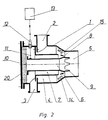
- Fig. 2 shows the burner in longitudinal section according to the 2nd variant
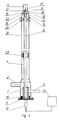
- Fig. 3 shows the burner in longitudinal section according to the 3rd variant for the ignition.
- the burner according to the first variant, is built from the burner body 1 with the air inflow body 2 and the fuel inflow swirl body 3 of the fuel inflow, which forms the air chamber 4 and the combustion chamber 5. It goes into the fuel chamber of the exhaust outlet.
- a cylindrical element 6 is arranged axially, which merges into the fuel nozzle 8 in the combustion chamber 5 and opens out with a cylindrical end 9.
- the seat for fastening the insulating block 10 is formed, which separates the gas space from the combustion air space with the fuel chamber 7 and the fuel nozzle 8.
- the insulating block 10 is arranged tightly between the disjoint fuel inflow swirl body 3 of the fuel inflow, the body 1 and the combustion air chamber 7.
- An electrical terminal (11) is connected to the fuel chamber 7, which is led out of the body 1 by an insulation bushing plug 12 and is connected to the feed regulating and control system 13.
- a mixture swirl body 14 is arranged on the nozzle 8.
- the burner is formed from the body 1 with the air inflow body 2 for the combustion air inflow and the fuel inflow swirl body 3 for the fuel inflow, the body 1 forming the air chamber 4 and combustion chamber 5, which merges into an exhaust gas outlet chamber.
- the cylindrical element 6 is arranged axially.
- the fuel chamber 7 is the space between the cylindrical element 6 and an axially arranged cylinder with a larger diameter.
- the conically widening fuel chamber 7 and the conically widening cylindrical end 9 of the element 6 form the fuel nozzle 8 at the mouth.
- the seat for attaching the insulating block 10 to which the cylindrical element 6 is arranged is formed. Ionization segments are formed on the cylindrical end 9 of the element 6.
- the insulating block 10 is hermetically arranged between the rear cover 20 and the burner 1.
- the electrical terminal 11 is connected to the cylindrical element 6. It is led out of the body 1 through the insulation feedthrough 12 and connected there to the feed, regulating and control system.
- the mixture swirl body 14 is located on the inner wall of the air chamber 4 opposite the radial distributed fuel channels 15 in the fuel nozzle 8.
- the burner is equipped with the air inflow body 2, fuel inflow swirl body 3 and the air chamber 4.
- the air chamber merges into the air pipe 21, which ends with the conical mixing chamber 22. It is connected to the combustion chamber 5 through the mouth.
- the cylindrical element 6 is arranged axially inside the body.
- the element forms the gas line and at the same time the electrical line. It ends with the fuel nozzle 8.
- the fuel nozzle 8 In the rear body part 1 there is a shaped piece which electrically insulates the body 1 from the cylindrical element 6.
- the electrical terminal 11 is connected to the element 6.
- the clamp is led out of the outer body part 1 through an insulation bushing plug and connected to the supply, regulation and control system 13.
- the mouth of the cylindrical element 6, which forms the fuel nozzle 8 with the end 9, which forms the flame detection, is located in the combustion chamber 5.
- the mixture swirl body 14 of the fuel mixture is arranged on the nozzle 8. In front of the mixture swirl body 14 and behind it in the fuel nozzle 8 there are radially distributed fuel channels 15 and 16 of the fuel outlet and in cylindrical nozzle end 8 the fuel channel 17.
- the sharp edge 18, which is arranged opposite the sharp edge 19, is located on the inner combustion chamber circumference 5. This edge is attached to the circumference of the nozzle and forms the circumferential electrode spacing.
- the cylindrical element 6 is supported by insulators 23 on the air pipe 21.
- the insulators 23 in the form of rollers can be distributed axially or radially.
- the air is supplied through the air inflow body 2 into the air chamber 4 and the fuel through the fuel inflow swirl body 3 into the fuel chamber 7.
- the fuel that mixes with the air swirled through the swirl body forms the fuel mixture.
- the ignition of the fuel mixture is achieved by the high-voltage lead from the supply system 13 through the insulation feed-through plug 12 and the electrical terminal 11 to the element 6.
- a flashover between the sharp edges 18 and 19 in the 1st and 3rd variant or between the cylindrical element 6 and the nozzle end in the 2nd variant causes the fuel mixture to ignite.
- the burning fuel mixture causes corresponding electrical signals at the detection and flame control range, which are used by the feed, regulation and control system 13 for the automatic regulation of the combustion quality and the burner work.
Landscapes
- Engineering & Computer Science (AREA)
- Chemical & Material Sciences (AREA)
- Combustion & Propulsion (AREA)
- Mechanical Engineering (AREA)
- General Engineering & Computer Science (AREA)
- Pre-Mixing And Non-Premixing Gas Burner (AREA)
- Gas Burners (AREA)
Applications Claiming Priority (4)
| Application Number | Priority Date | Filing Date | Title |
|---|---|---|---|
| PL272747 | 1988-05-27 | ||
| PL27274788A PL157830B1 (en) | 1988-05-27 | 1988-05-27 | Burner in particular for automatic operation |
| PL27771689A PL158854B3 (en) | 1989-02-14 | 1989-02-14 | Gas burner, especially for lighting |
| PL277716 | 1989-02-14 |
Publications (2)
| Publication Number | Publication Date |
|---|---|
| EP0352433A2 true EP0352433A2 (fr) | 1990-01-31 |
| EP0352433A3 EP0352433A3 (fr) | 1990-03-21 |
Family
ID=26653051
Family Applications (1)
| Application Number | Title | Priority Date | Filing Date |
|---|---|---|---|
| EP89109531A Withdrawn EP0352433A3 (fr) | 1988-05-27 | 1989-05-26 | Brûleur particulièrement pour le fonctionnement automatique |
Country Status (4)
| Country | Link |
|---|---|
| EP (1) | EP0352433A3 (fr) |
| CS (1) | CS318189A2 (fr) |
| HU (1) | HU205443B (fr) |
| RU (1) | RU1838721C (fr) |
Cited By (5)
| Publication number | Priority date | Publication date | Assignee | Title |
|---|---|---|---|---|
| US5971745A (en) * | 1995-11-13 | 1999-10-26 | Gas Research Institute | Flame ionization control apparatus and method |
| US6299433B1 (en) | 1999-11-05 | 2001-10-09 | Gas Research Institute | Burner control |
| DE102004021093B3 (de) * | 2004-04-29 | 2005-08-04 | Bbt Thermotechnik Gmbh | Öl- oder Gasbrenner |
| US7241135B2 (en) | 2004-11-18 | 2007-07-10 | Honeywell International Inc. | Feedback control for modulating gas burner |
| CN108844062A (zh) * | 2018-08-24 | 2018-11-20 | 深圳市迈拓铝设备技术有限公司 | 一种燃烧器 |
Family Cites Families (2)
| Publication number | Priority date | Publication date | Assignee | Title |
|---|---|---|---|---|
| BE721357A (fr) * | 1968-04-10 | 1969-03-03 | ||
| DE1915097C3 (de) * | 1969-03-25 | 1973-11-15 | Ofu Ofenbau-Union Gmbh, 4000 Duesseldorf | Gasbrenner |
-
1989
- 1989-05-24 RU SU894614127A patent/RU1838721C/ru active
- 1989-05-25 HU HU267389A patent/HU205443B/hu not_active IP Right Cessation
- 1989-05-26 CS CS893181A patent/CS318189A2/cs unknown
- 1989-05-26 EP EP89109531A patent/EP0352433A3/fr not_active Withdrawn
Cited By (5)
| Publication number | Priority date | Publication date | Assignee | Title |
|---|---|---|---|---|
| US5971745A (en) * | 1995-11-13 | 1999-10-26 | Gas Research Institute | Flame ionization control apparatus and method |
| US6299433B1 (en) | 1999-11-05 | 2001-10-09 | Gas Research Institute | Burner control |
| DE102004021093B3 (de) * | 2004-04-29 | 2005-08-04 | Bbt Thermotechnik Gmbh | Öl- oder Gasbrenner |
| US7241135B2 (en) | 2004-11-18 | 2007-07-10 | Honeywell International Inc. | Feedback control for modulating gas burner |
| CN108844062A (zh) * | 2018-08-24 | 2018-11-20 | 深圳市迈拓铝设备技术有限公司 | 一种燃烧器 |
Also Published As
| Publication number | Publication date |
|---|---|
| RU1838721C (ru) | 1993-08-30 |
| HUT52614A (en) | 1990-07-28 |
| EP0352433A3 (fr) | 1990-03-21 |
| HU205443B (en) | 1992-04-28 |
| CS318189A2 (en) | 1991-09-15 |
Similar Documents
| Publication | Publication Date | Title |
|---|---|---|
| DE2933040C2 (de) | Verfahren zum Zünden einer Kohlenstaub-Rundbrennerflamme | |
| DE2933060C2 (de) | Brenner zur Verbrennung von staubförmigen Brennstoffen | |
| DE1900035A1 (de) | Zuendung fuer einen Schubverstaerker,insbesondere fuer Gasturbinentriebwerke | |
| DE19717802B4 (de) | Funkenstrecke | |
| DE1918445B2 (de) | Vorrichtung zur verbrennung von fluessigen kohlenwasser stoffen | |
| DE2456217A1 (de) | Zuendeinrichtung | |
| DE19627203C2 (de) | Brenner | |
| EP0543323B1 (fr) | Brûleur pour fours industriels | |
| EP0352433A2 (fr) | Brûleur particulièrement pour le fonctionnement automatique | |
| EP0309723B1 (fr) | Brûleur d'allumage dans un dispositif pour la combustion de particules solides dans le gaz d'échappement de moteurs à combustion interne | |
| DE102012001285B4 (de) | Zündlanze | |
| EP2846091B1 (fr) | Brûleur à oxy-gàz avec allumage à incandescence | |
| DD284082A5 (de) | Brenner besonders fuer den automatischen betrieb | |
| DE1451610B2 (de) | Vorri chtung zum Zünden und überwachen der Flammen eines Zündbrenners und eines Hauptbrenners | |
| EP0108923A1 (fr) | Dispositif d'allumage pour appareils à combustion de charbon pulvérisé | |
| DE1084977B (de) | Elektrische Zuendvorrichtung zum Zuenden des Brennstoff-Luft-Gemisches in Brennkammern von Rueckstosstriebwerken | |
| DE2223009A1 (de) | Gasbrenner | |
| DE2809114A1 (de) | Brennkopf fuer brennanlagen | |
| DE1910033C3 (de) | Hochspannungs-Zündkerze | |
| DE4243036A1 (de) | Brennersystem zur Aufbereitung von flüssigen Brennstoffen für Verbrennungsvorgänge, beispielsweise für Brennkraftmaschinen | |
| DE3050694C2 (de) | Einrichtung zum Gasstrahlschneiden von Materialien | |
| DE1501972C (de) | Einrichtung zur Erzeugung elektri scher Zündfunken für ein gasgespeistes Strahlheizrohr | |
| DE7806382U1 (de) | Brennkopf fuer brennanlagen | |
| DE4320429A1 (de) | Verfahren zum Zünden der Verbrennung in einer Brennkammer sowie Vorrichtung zur Durchführung des Verfahrens | |
| DE1060194B (de) | Zuendvorrichtung fuer Gasturbinen |
Legal Events
| Date | Code | Title | Description |
|---|---|---|---|
| PUAI | Public reference made under article 153(3) epc to a published international application that has entered the european phase |
Free format text: ORIGINAL CODE: 0009012 |
|
| PUAL | Search report despatched |
Free format text: ORIGINAL CODE: 0009013 |
|
| AK | Designated contracting states |
Kind code of ref document: A2 Designated state(s): DE FR GB IT |
|
| AK | Designated contracting states |
Kind code of ref document: A3 Designated state(s): DE FR GB IT |
|
| 17P | Request for examination filed |
Effective date: 19900518 |
|
| 17Q | First examination report despatched |
Effective date: 19910816 |
|
| RAP1 | Party data changed (applicant data changed or rights of an application transferred) |
Owner name: BIURO PROJEKTOW I DOSTAW URZADZEN HUTNICZYCH HPH, |
|
| STAA | Information on the status of an ep patent application or granted ep patent |
Free format text: STATUS: THE APPLICATION IS DEEMED TO BE WITHDRAWN |
|
| 18D | Application deemed to be withdrawn |
Effective date: 19931130 |