EP0352718A2 - Teilweise fluorinierte Verbindungen und Polymere - Google Patents
Teilweise fluorinierte Verbindungen und Polymere Download PDFInfo
- Publication number
- EP0352718A2 EP0352718A2 EP89113654A EP89113654A EP0352718A2 EP 0352718 A2 EP0352718 A2 EP 0352718A2 EP 89113654 A EP89113654 A EP 89113654A EP 89113654 A EP89113654 A EP 89113654A EP 0352718 A2 EP0352718 A2 EP 0352718A2
- Authority
- EP
- European Patent Office
- Prior art keywords
- group
- carbocyclic
- branched
- polymer
- independently selected
- Prior art date
- Legal status (The legal status is an assumption and is not a legal conclusion. Google has not performed a legal analysis and makes no representation as to the accuracy of the status listed.)
- Withdrawn
Links
- 0 CC(C1NC1)C(C)(*)N Chemical compound CC(C1NC1)C(C)(*)N 0.000 description 1
Images
Classifications
-
- C—CHEMISTRY; METALLURGY
- C08—ORGANIC MACROMOLECULAR COMPOUNDS; THEIR PREPARATION OR CHEMICAL WORKING-UP; COMPOSITIONS BASED THEREON
- C08G—MACROMOLECULAR COMPOUNDS OBTAINED OTHERWISE THAN BY REACTIONS ONLY INVOLVING UNSATURATED CARBON-TO-CARBON BONDS
- C08G73/00—Macromolecular compounds obtained by reactions forming a linkage containing nitrogen with or without oxygen or carbon in the main chain of the macromolecule, not provided for in groups C08G12/00 - C08G71/00
- C08G73/06—Polycondensates having nitrogen-containing heterocyclic rings in the main chain of the macromolecule
- C08G73/10—Polyimides; Polyester-imides; Polyamide-imides; Polyamide acids or similar polyimide precursors
- C08G73/1039—Polyimides; Polyester-imides; Polyamide-imides; Polyamide acids or similar polyimide precursors comprising halogen-containing substituents
-
- C—CHEMISTRY; METALLURGY
- C07—ORGANIC CHEMISTRY
- C07C—ACYCLIC OR CARBOCYCLIC COMPOUNDS
- C07C211/00—Compounds containing amino groups bound to a carbon skeleton
- C07C211/01—Compounds containing amino groups bound to a carbon skeleton having amino groups bound to acyclic carbon atoms
- C07C211/02—Compounds containing amino groups bound to a carbon skeleton having amino groups bound to acyclic carbon atoms of an acyclic saturated carbon skeleton
- C07C211/09—Diamines
-
- C—CHEMISTRY; METALLURGY
- C07—ORGANIC CHEMISTRY
- C07C—ACYCLIC OR CARBOCYCLIC COMPOUNDS
- C07C255/00—Carboxylic acid nitriles
- C07C255/01—Carboxylic acid nitriles having cyano groups bound to acyclic carbon atoms
- C07C255/10—Carboxylic acid nitriles having cyano groups bound to acyclic carbon atoms containing cyano groups and halogen atoms, or nitro or nitroso groups, bound to the same acyclic carbon skeleton
-
- C—CHEMISTRY; METALLURGY
- C07—ORGANIC CHEMISTRY
- C07C—ACYCLIC OR CARBOCYCLIC COMPOUNDS
- C07C51/00—Preparation of carboxylic acids or their salts, halides or anhydrides
- C07C51/08—Preparation of carboxylic acids or their salts, halides or anhydrides from nitriles
-
- C—CHEMISTRY; METALLURGY
- C07—ORGANIC CHEMISTRY
- C07D—HETEROCYCLIC COMPOUNDS
- C07D317/00—Heterocyclic compounds containing five-membered rings having two oxygen atoms as the only ring hetero atoms
- C07D317/08—Heterocyclic compounds containing five-membered rings having two oxygen atoms as the only ring hetero atoms having the hetero atoms in positions 1 and 3
- C07D317/10—Heterocyclic compounds containing five-membered rings having two oxygen atoms as the only ring hetero atoms having the hetero atoms in positions 1 and 3 not condensed with other rings
- C07D317/32—Heterocyclic compounds containing five-membered rings having two oxygen atoms as the only ring hetero atoms having the hetero atoms in positions 1 and 3 not condensed with other rings with hetero atoms or with carbon atoms having three bonds to hetero atoms with at the most one bond to halogen, e.g. ester or nitrile radicals, directly attached to ring carbon atoms
- C07D317/42—Halogen atoms or nitro radicals
-
- C—CHEMISTRY; METALLURGY
- C08—ORGANIC MACROMOLECULAR COMPOUNDS; THEIR PREPARATION OR CHEMICAL WORKING-UP; COMPOSITIONS BASED THEREON
- C08G—MACROMOLECULAR COMPOUNDS OBTAINED OTHERWISE THAN BY REACTIONS ONLY INVOLVING UNSATURATED CARBON-TO-CARBON BONDS
- C08G63/00—Macromolecular compounds obtained by reactions forming a carboxylic ester link in the main chain of the macromolecule
- C08G63/68—Polyesters containing atoms other than carbon, hydrogen and oxygen
- C08G63/682—Polyesters containing atoms other than carbon, hydrogen and oxygen containing halogens
Definitions
- the present invention concerns partially fluorinated compounds that are useful as chemical intermediates or monomers.
- the invention further concerns partially fluorinated condensation polymers.
- Fluorinated intermediates are employed in the synthesis of a variety of chemical compounds, such as partially fluorinated polymers. Novel fluorinated intermediates and polymers derived therefrom are of significant interest to the chemical industry.
- Partially fluorinated condensation polymers are known in the literature, see, e.g., I. L. Knunyants, C. Li & V. V. Shokina, Russ. Chem. Rev. 32:461 (1963) and the references described therein. These polymers generally have been made to obtain materials with improved thermo-oxidative stability and solvent resistance, as compared to nonfluorinated polymers.
- U.S. 3,496,215 discloses hydrocyanation of unsaturated compounds using as a catalyst a compound of the structure NI(PXYZ) 4 . wherein X is OR; Y and Z are R or OR; and R is an alkyl or aryl radical of up to 18 carbon atoms.
- U.S. 3,496,217 discloses hydrocyanation of nonconjugated ethylenically unsaturated organic compounds using certain nickel complexes as a catalyst and certain zinc containing compounds as promoters.
- U.S. 3,496,218 discloses hydrocyanation of nonconjugated ethylenically unsaturated organic compounds using certain nickel complexes as catalysts and certain organoboron compounds as promoters.
- Compound (2) can be employed in a condensation type of polymerization reaction to prepare polymers (A) and (B) of this invention.
- Z is any divalent organic radical; and R f is as defined above; or copolymers comprising from 1 to 99 mole percent of at least one independently selected repeating unit of formula (3) and from 99 to 1
- Polymer (B) can be either polymers comprising 100 mole percent of at least one independently selected repeating unit of the formula wherein U is any tetravalent organic radical and R f is as defined above; or copolymers comprising from 1 to 99 mole percent of at least one independently selected repeating unit of formula (5) and from 99 to 1 mole percent of at least one independently selected repeating unit of the formula wherein U and Z are as defined above.
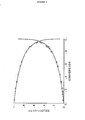
- the crosses are experimental points for mononitrile whereas the squares are experimental points for dinitrile.
- the lines are theoretical fits resulting from the use of a sequential kinetic model in the kinetic modeling computer program, GIT (available through the Quantum Chemistry Program Exchange, Department of Chemistry, Indiana University, Bloomington, Indiana).
- GIT available through the Quantum Chemistry Program Exchange, Department of Chemistry, Indiana University, Bloomington, Indiana.
- the successful fit illustrates that k, is 3.5 times greater than k 2 and that essentially all dinitrile is derived from mononitrile.
- the present invention provides partially fluorinated compounds that are useful as chemical intermediates.
- the unsaturated nitrile compounds are useful for the preparation of unsaturated acids, amines, and esters.
- the unsaturated nitriles and esters are intermediates for the production of dinitriles and esternitriles of the present invention.
- the dinitrile compounds are useful as intermediates for the production of diacids, diesters, diisocyanates, and diamines.
- the esternitrile compounds can be also converted to esteramines. These difunctional species are useful for the synthesis of partially fluorinated condensation polymers. Polymers prepared with compounds of the invention demonstrate improved hydrolytic stability and altered dielectric constants.
- Y is -CN.
- R f is either the branched and carbocyclic 4,5-(2,2-trifluoromethyl)-1,3-dioxolanediyl (as shown in Example 14) or of the formula -(CF 2 CF 2 ) n - wherein n is an integer from 1 to 6.
- Y is -CN.
- R f is either the branched and carbocyclic 4,5-(2,2-trifluoromethyl)-1,3-dioxolanediyl or of the formula -(CF 2 CF 2 ) n - wherein n is an integer from 1 to 6.
- Compound (2) can be employed in a condensation type of polymerization reaction to prepare polymers (A) and (B) of the invention.
- HOOC-CH 2 CH 2 -R f -CH 2 CH 2 -COOH can be used to make polymer (A).
- the preferred R f is either the branched and carbocyclic 4,5-(2,2-trifluoromethyl)-1,3-dioxolanediyl or of the formula -(CF 2 CF 2 ) n - wherein n is an integer from 1 to 6.
- a preferred Z group in repeating units (3) and (4) is a divalent organic radical independently selected from the group consisting of linear, branched, carbocyclic, aromatic, and mixtures thereof having from 1 to about 20 carbon atoms and containing from zero to about 10 ether linkages. If ether linkages are present, there will be up to half as many ether linkages as there are total carbon atoms in the Z chain.
- Another preferred Z group is mesogenic divalent organic radicals.
- the most preferred embodiment of Z is when Z is selected from the group consisting of -C 6 H 4 -, -C 10
- Polymer (B) can be either polymers comprising 100 mole percent of at least one independently selected repeating unit of the formula wherein U is any tetravalent organic radical and R f is as generally defined above; or copolymers comprising 1 to 99 mole percent of at least one independently selected repeating unit of formula (5) and 99 to 1 mole percent of at least one independently selected repeating unit of the formula wherein U and Z are as defined above.
- the preferred R f is either the branched and carbocyclic 4,5-(2,2-trifluoromethyl)-1,3-dioxolanediyl or of the formula -(CF 2 CF 2 ) n - wherein n is an integer from 1 to 6.
- a preferred U group in repeating units (5) and (6) is a divalent organic radical selected from the group consisting of linear, branched, carbocyclic, aromatic, and mixtures thereof having from about 6 to about 20 carbon atoms and containing from 0 to about 5 linkages selected from the group consisting of ether and sulfonyl.
- a preferred Z group is a divalent organic radical independently selected from the group consisting of linear, branched, carbocyclic, aromatic, and mixtures thereof having from 1 to about 20 carbon atoms and containing from zero to about 10 ether linkages. If ether linkages are present, there will be up to half as many ether linkages as there are total carbon atoms in the Z chain.
- Other preferred embodiments of Z are 4,4 -diphenylene ether, m-phenylene, and p-phenylene.
- the diene starting compound can be prepared by the method disclosed in Kim, et al., J. Fluor. Chem. 1:203 (1971) or by other conventional chemistry.
- Compound (2) of the invention wherein one or both values for Y' is -CN can be made by contacting compound (1) with HCN in a manner similar to that described above.
- the kinetic analysis shown in Figure 1 wherein R f is -CF 2 CF 2 - illustrates this and shows that compound (2) is produced only from compound (1). Similar analyses have been carried out for many other R f values and produced the same result.
- Y values for compounds (1) and (2) result from converting the -CN group to other useful functional groups by conventional chemistry.
- the -CN group can be converted to the -CH 2 NH 2 group by reaction with hydrogen in the presence of ammonia and Raney cobalt.
- the -CONH 2 group can be prepared by reaction of the -CN group with water in the presence of sulfuric acid.
- the -COOH group can be prepared by heating the -CN group in 50% sulfuric acid in water.
- the -COCI group can be made by reacting the -COOH group with a reagent such as thionyl chloride or phosporus pentachloride.
- the -COOR group can be made by heating the -CN group in ROH solution in the presence of sulfuric acid.
- the -CHO group can be made by partially reducing the -COOR group with a reagent such as lithium tri-t-butoxyaluminum hydride.
- the -CH z OH group can be made by the reduction of the -COOR, or -COOH group, e.g., by reacting with lithium aluminum hydride.
- Compound (1) of the invention has utility for the preparation of the difunctional compound (2).
- Compound (2) of the invention is useful as an intermediate for the synthesis of polymer (A) and polymer (B) of the invention by condensation type polymerization.
- Partially fluorinated polyamides can be made by heating a salt of the desired acid and amine and allowing the water formed in the reaction to distill off. Higher molecular weights can be obtained by vacuum finishing the molten polymer using standard techniques.
- Polyesters of the invention can be made by heating a partially fluorinated free acid with the diacetate of a diol using calcium acetate as a catalyst.
- Polyimides of the invention can be made by adding a dianhydride to a solution of partially fluorinated diamine in a solvent such as dimethylacetamide (DMAC).
- DMAC dimethylacetamide
- the resulting amid-acid can be cast as a film and imidized by heating in a vacuum.
- 4,4,5,5-tetrafluorosuberic acid can be polymerized with hexamethylenediamine by heating a salt prepared from these materials.
- 4,4,5,5,6,6,7,7-octofluorosebecic acid can be polymerized with 1,4-butanediol diacetate by heating in the presence of calcium acetate as a catalyst.
- Most examples of polymer (A) are moldable or melt processible, and most examples of polymer (B) can be processed like other polyimides.
- the partially fluorinated compounds of the invention can increase the anisotropic range of polymers in which they are incorporated as a monomer.
- poly(oxydecanedioyloxy-1,4-phenylene-2-methylvinylene-1,4-phenylene) melts at 210 C to a nematic anisotropic phase.
- the resulting melt becomes isotropic at 254 C, with an anistropic range of 44 C.
- poly(oxyoctafluorodecanedioyloxy-1,4-phenylene-2-methylvinylene-1,4-phenylene) melts at 153°C to a more highly ordered, smectic anisotopic state.
- the resulting melt becomes isotropic at 280 C, with an anisotropic range of 127 C.
- the partially fluorinated compounds of this invention can alter the solubility properties of polymers in which they are incorporated as a monomer.
- poly(oxydecanedioyloxy-1,4-phenylene-2-methylvinylene-1,4-phenylene) is soluble in chloroform
- poly(oxyoctafluorodecanedioyloxy-1,4-phenylene-2-methylvinylene-1,4-phenylene) is insoluble in all common organic non-acid solvents.
- the compounds and polymers of the present invention are described in the following examples.
- compounds (1) and (2) were prepared according to the following general procedure.
- a 3-necked, round-bottom flask equipped with an overhead mechanical stirrer, reflux condenser (used with a low temperature circulation bath), nitrogen bubbler, and rubber septum was charged under nitrogen with the specified catalyst components, toluene, and the desired diene.
- the resulting mixture was heated in a 50 °C oil bath.
- Hydrogen cyanide was fed to the mixture by vapor transfer by passing nitrogen gas through liquid hydrogen cyanide cooled to 0°C in an ice bath. Under these conditions, the saturated vapor mixture was approximately 30-40% hydrogen cyanide.
- the hydrogen cyanide vapor was admitted to the reaction vessel via a syringe needle passed through the rubber septum and placed slightly above the liquid level.
- H 2 C CH-(CF 2 ) 2 -CH 2 CH 2 -CN and NC-CH 2 CH 2 -(CF 2 ) 2 -CH 2 CH 2 -CN
- CGC capillary gas chromatography
- H 2 C CH-(CF 2 ) 2 -CH 2 CH 2 -CN and NC-CH 2 CH 2 -(CF 2 ) 2 -CH 2 CH 2 -CN
- H 2 C CHC-(CF 2 ) 2 -CH 2 CH 2 -CN was collected, b.p. 60°C at 5mm Hg, 37 g (57%).
- the mixture was diluted with hexanes and cooled to -30°C to crystallize NC-CH 2 CH 2 -(CF 2 ) 8 -CH 2 C2 H -CN.
- the crude product was dissolved in acetone and filtered through Celite to remove the spent catalyst. The acetone was then removed, and the product was recrystallized from methanol. The yield was 202 g (90%).
- NC-CH 2 CH 2 -(CF 2 ) 4 -CH 2 CH 2 -CN 100 g was added to 500 mL of water.
- Concentrated sulfuric acid 700 mL was slowly added, and the resulting reaction mixture was heated to 150°C for about 18 hours. Upon cooling to 0° C, crystals formed. The crystals were filtered, washed with water, and recrystallized from water with a hot filtration through Celite. Yield 55 g of white crystals.
- HOOC-CH 2 CH 2 -(CF 2 ) 2 -CH 2 CH 2 -COOH 25 g was dissolved in 100 mL methanol. Concentrated sulfuric acid (10 mL) was added, the resulting solution was refluxed for 4 hours, and then stirred at ambient temperature for 2 days. The solution was cooled to 0°C and crystals formed. The crystals were filtered, washed with cold methanol, and recrystallized from methanol. The resulting filtrate was added to 500 mL of water and extracted with 4 100 mL portions of ether.
- NC-CH 2 CH 2 -(CF 2 ) 2 -CH 2 CH 2 -CN 50 g was dissolved in 200 mL of methanol. Concentrated sulfuric acid (150 mL) was added slowly and the resulting solution was refluxed for 6 hours. The solution was then dumped into 1 L of ice. The resulting mixture was extracted with 3 200 mL portions of ether. The ether layers were washed with 2 100 mL portions of water and 50 mL of brine. The solution was dryed over MgSO 4 and then stripped to give white crystals that were recrystallized from methanol. Yield 57 g (87%), m.p. 64-65° C. IR (KBr) 2980 cm- 1 , m; 1740 cm -1 , s; 1200 cm- 1 , s.
- NC-CH 2 CH 2 -(CF 2 ) 2 -CH 2 CH 2 -CN (4.8 g) was dissolved in 200 mL of THF. This solution was placed in a 400 mL bomb. The bomb was cooled and evacuated. Ammonia (50 g) was added to the bomb and then hydrogen was added until the pressure was 1500 psi at ambient temperature. The bomb was sealed and heated to 110° C for 10 hours. The bomb was cooled, and the gasses were bled off. The resulting solution was filtered through Celite and then stripped to a pale yellow oil. The oil was dissolved in 300 mL of ether, and HCI gas was bubbled through the resulting solution. A white precipitate formed that was filtered, washed with ether, and dried.
- NC-CH 2 CH 2 -(CF 2 )s-CH 2 CH 2 -CN 50 g was placed into a 400 mL bomb, along with 200 mL of THF and approximately 5 g of Raney cobalt.
- the bomb was sealed and 50 g of ammonia were added.
- Hydrogen was added to a pressure of 500 psi at ambient temperature.
- the bomb was heated to 110 °C and the hydrogen pressure was adjusted to 1500 psi. The temperature and hydrogen pressure were held constant for 18 hours.
- the bomb was cooled, and the gasses were bled off.
- the solution was filtered through Celite, and the solvent was removed to give 13 g of a white waxy solid.
- the resulting reaction mixture was cooled and filtered through Celite. Gas chromatography analysis showed two new products. High resolution GC/MS showed that the first product was and the second product was IR (reaction mixture) 2280 cm -1 ,m; 2255 cm -1 , m; 1300-1100 cm- 1 , vs.
- a 500 mL round-bottom flask was equipped with an overhead stirrer, a nitrogen inlet, and a Liebig's condenser topped with a still head.
- the flask was charged with 35 g of crystals of the salt of tetrafluorosuberic acid and hexamethylenediamine prepared according to the following procedure.
- Tetrafluorosuberic acid (25.00 g) was dissolved in 250 mL of hot ethanol, and 11.79 g of hexamethylenediamine were dissolved in 100 mL of hot ethanol.
- the resulting solutions were combined to produce a suspension containing white crystals.
- the suspension was stirred for 10 minutes, cooled to 0 C, filtered, washed with ethanol, and dried in vacuo to give 35.97 g of white crystals. This material was immediately charged to the flask as described above.
- the flask was heated to 220° C, and the water formed was allowed to reflux. Over a period of about 1 hour, the temperature of the flask was raised to 290° C. The water in the condenser was drained. The water formed in the reaction was allowed to distill off. Over the next hour, the temperature of the flask was slowly raised to 300 °C, giving a viscous amber melt. The melt was allowed to cool, giving 30 g of an amber polymer.
- the inherent viscosity of the polymer in a formic acid solution was 1.07 dl/g.
- the polymer formed strong melt pressed films that had an aqueous contact angle of 74°.
- the polymer was also spun to form strong fibers.
- the melting point of the polymer was 268° C, as compared to 232° C for the melting point of the nonfluorinated polymer.
- a small polymer tube with a side arm was charged with 5.00 g of dimethyltetrafluorosuberate, 1.81 g of butanediol, 3 mg of calcium acetate, and 1.5 mg of antimony oxide.
- the resuting mixture was degassed and heated to 200 C.
- a needle with a slow flow of nitrogen was put at the bottom of the melt and the temperature was raised to 275 C over a period of 3 hours and then held there for 16 hours.
- first methanol and then butanediol slowly distilled from the resulting melt.
- the pressure was then reduced to about 1 mm Hg for a period of 30 minutes.
- the melt was cooled to form an opaque white solid polymer. Fibers and melt pressed films could be made from the polymer.
- the inherent viscosity of the melt in a chloroform solution was 0.28 dl/g.
- the polymer had a melting point of 123 °C as compared to 60 °C for nonfluorinated polymer.
- Dodecafluoro-1,12-dodecadiamine (8.975 g) was dissolved in about 100 mL of N-methylpyrrolidone (NMP) in a 500 mL 3-necked flask equipped with an overhead stirrer and a nitrogen inlet. Pyromellitic- dianhydride (4.567 g) was added in several batches, producing a viscous solution containing some gel. About 100 mL of NMP were added to dissolve some of the gel. The resulting. solution was filtered through a 0.2 micron filter and cast on a glass plate. The solvent was evaporated at 75°C for about 18 hours.
- NMP N-methylpyrrolidone
- the polymer was imidized by heating in vacuo at 150° C for about 16 hours and then at 175 °C for 4 hours to give a tough clear film.
- the polymer had a melting point of 341 °C and did not decompose below 450° C.
- Alpha-methylstilbenediol diacetate (2.62 g), hexadecafluorododecane-1,12-dicarboxylate (5.0 g), and 0.01 g sodium acetate were added to a polymer tube with a side arm.
- the resulting mixture was melted in a metal bath at 200 C, and a needle with a slow purge of nitrogen was placed at the bottom of the resulting melt.
- the melt was held at 200°C for 18 hours while acetic acid distilled off.
- the temperature was then raised to 250 °C for 5 hours.
- the nitrogen purge was stopped, and the pressure was reduced to about 1 mm Hg for 1 hour.
- the resulting combination was cooled to give an off-white solid polymer.
- the polymer melted at 230 C to a smectic anisotropic state.
- the resulting melt remained anisotropic until a temperature of 310 °C was reached, at which point the melt was isotropic.
- the smectic state returned at about 270° C and remained anisotropic until the polymer hardened at about 220° C.
- This polymer had an enantiotropic anisotropic range of 80 °C, as opposed to a monotropic anisotropic range of 7°C for the corresponding nonfluorinated polymer.
- the anisotropic state for the fluorinated polymer was in a more highly ordered smectic state, as compared to the nematic anisotropic state of the nonfluorinated polymer.
Landscapes
- Chemical & Material Sciences (AREA)
- Organic Chemistry (AREA)
- Medicinal Chemistry (AREA)
- Polymers & Plastics (AREA)
- Health & Medical Sciences (AREA)
- Chemical Kinetics & Catalysis (AREA)
- Oil, Petroleum & Natural Gas (AREA)
- Engineering & Computer Science (AREA)
- Organic Low-Molecular-Weight Compounds And Preparation Thereof (AREA)
- Polymers With Sulfur, Phosphorus Or Metals In The Main Chain (AREA)
- Addition Polymer Or Copolymer, Post-Treatments, Or Chemical Modifications (AREA)
- Polyamides (AREA)
- Polyesters Or Polycarbonates (AREA)
Applications Claiming Priority (2)
| Application Number | Priority Date | Filing Date | Title |
|---|---|---|---|
| US22386788A | 1988-07-25 | 1988-07-25 | |
| US223867 | 1988-07-25 |
Publications (2)
| Publication Number | Publication Date |
|---|---|
| EP0352718A2 true EP0352718A2 (de) | 1990-01-31 |
| EP0352718A3 EP0352718A3 (de) | 1991-08-28 |
Family
ID=22838289
Family Applications (1)
| Application Number | Title | Priority Date | Filing Date |
|---|---|---|---|
| EP19890113654 Withdrawn EP0352718A3 (de) | 1988-07-25 | 1989-07-25 | Teilweise fluorinierte Verbindungen und Polymere |
Country Status (2)
| Country | Link |
|---|---|
| EP (1) | EP0352718A3 (de) |
| JP (1) | JPH0299519A (de) |
Cited By (6)
| Publication number | Priority date | Publication date | Assignee | Title |
|---|---|---|---|---|
| WO1991009025A3 (en) * | 1989-12-11 | 1991-07-25 | Du Pont | Partially fluorinated compounds and polymers |
| US5151535A (en) * | 1989-02-16 | 1992-09-29 | Sagami Chemical Research Center | Fluorine-containing α,β-bifunctional compounds and process for their production |
| US5233058A (en) * | 1988-07-25 | 1993-08-03 | E. I. Du Pont De Nemours And Company | Partially fluorinated compounds and polymers |
| EP0558938A3 (en) * | 1992-02-29 | 1993-11-18 | Hoechst Ag | Fluoro-substituted dicarboxylic acids, process for preparing them and use |
| WO1994007936A1 (en) * | 1992-10-06 | 1994-04-14 | Minnesota Mining And Manufacturing Company | Partially-fluorinated polymers |
| WO1994007937A3 (en) * | 1992-10-06 | 1994-06-23 | Minnesota Mining & Mfg | Partially-fluorinated polymers |
Families Citing this family (2)
| Publication number | Priority date | Publication date | Assignee | Title |
|---|---|---|---|---|
| JPH07110837B2 (ja) * | 1989-02-16 | 1995-11-29 | 財団法人相模中央化学研究所 | 含フッ素α,ω―ジカルボン酸ジエステルの製造方法 |
| JPH02289535A (ja) * | 1989-02-16 | 1990-11-29 | Sagami Chem Res Center | 含フッ素α,ω―二官能性化合物 |
Family Cites Families (2)
| Publication number | Priority date | Publication date | Assignee | Title |
|---|---|---|---|---|
| FR1404744A (fr) * | 1963-06-25 | 1965-07-02 | Perfectionnements à la préparation d'acides perfluoro-carboxyliques aliphatiques | |
| FR1546167A (fr) * | 1966-12-02 | 1968-11-15 | Dow Corning | Composés organiques non saturés comprenant un radical perfluoroalcoylène et polymères de ces composés |
-
1989
- 1989-07-25 EP EP19890113654 patent/EP0352718A3/de not_active Withdrawn
- 1989-07-25 JP JP19247289A patent/JPH0299519A/ja active Pending
Cited By (8)
| Publication number | Priority date | Publication date | Assignee | Title |
|---|---|---|---|---|
| US5233058A (en) * | 1988-07-25 | 1993-08-03 | E. I. Du Pont De Nemours And Company | Partially fluorinated compounds and polymers |
| US5286825A (en) * | 1988-07-25 | 1994-02-15 | E. I. Du Pont De Nemours And Company | Partially fluorinated compounds and polymers |
| US5151535A (en) * | 1989-02-16 | 1992-09-29 | Sagami Chemical Research Center | Fluorine-containing α,β-bifunctional compounds and process for their production |
| WO1991009025A3 (en) * | 1989-12-11 | 1991-07-25 | Du Pont | Partially fluorinated compounds and polymers |
| EP0558938A3 (en) * | 1992-02-29 | 1993-11-18 | Hoechst Ag | Fluoro-substituted dicarboxylic acids, process for preparing them and use |
| WO1994007936A1 (en) * | 1992-10-06 | 1994-04-14 | Minnesota Mining And Manufacturing Company | Partially-fluorinated polymers |
| WO1994007937A3 (en) * | 1992-10-06 | 1994-06-23 | Minnesota Mining & Mfg | Partially-fluorinated polymers |
| US5521013A (en) * | 1992-10-06 | 1996-05-28 | Minnesota Mining And Manufacturing Company | Partially-fluorinated polymers |
Also Published As
| Publication number | Publication date |
|---|---|
| EP0352718A3 (de) | 1991-08-28 |
| JPH0299519A (ja) | 1990-04-11 |
Similar Documents
| Publication | Publication Date | Title |
|---|---|---|
| EP0428709B1 (de) | Reaktive perfluorovinylgruppen enthaltende verbindungen | |
| US5198513A (en) | Reactive compounds containing perfluorovinyl groups | |
| KR102797312B1 (ko) | 1,1,1-트리플루오로-2,2-비스아릴에탄의 제조방법 및 1,1,1-트리플루오로-2,2-비스아릴에탄 | |
| US5021602A (en) | Reactive compounds containing perfluorocyclobutane rings | |
| Hedrick et al. | Poly (aryl ether phenylquinoxalines) | |
| US5210265A (en) | Reactive compounds containing perfluorocyclobutane rings | |
| US5130481A (en) | Bis-n,n' nitro or amino benzoyl amino phenols | |
| EP0352718A2 (de) | Teilweise fluorinierte Verbindungen und Polymere | |
| US5233058A (en) | Partially fluorinated compounds and polymers | |
| WO1991009025A2 (en) | Partially fluorinated compounds and polymers | |
| EP0387061A2 (de) | Polyamid-Polyamid- und Polybenzoxazol-Polyamid-Polymere | |
| US4120900A (en) | Fluorocarbon bis(o-aminophenol) compounds containing a hydrocarbon moiety | |
| US3282931A (en) | Dibenzylidene-benzenediacetonitriles | |
| JP3132783B2 (ja) | 芳香族ジニトロ化合物、芳香族ジアミノ化合物及びそれらの製造方法 | |
| Mikroyannidis | Unsaturated polyamides with pendent cyano groups derived from 1, 4-bis (2-cyano-2-carboxyvinyl) benzene | |
| Gaina et al. | New poly (4-chloro) maleimides. I. Synthesis and characterization of poly [ether-ester-(4-chloro) maleimides] | |
| Labadie et al. | Poly (Aryl ether‐phenylquinoxaline) s: Self‐polymerization of an A—B monomer via quinoxaline‐activated ether synthesis | |
| JPS61254543A (ja) | 1−(4−(4−アミノフエノキシ)フエニル)−1,3,3−トリメチル−6−(4−アミノフエノキシ)インダンおよびその製造方法 | |
| JPH01190652A (ja) | 新規な含フッ素芳香族化合物およびその製造方法 | |
| Moore et al. | Synthesis of an aliphatic poly (enamino nitrile) analogous to a polyurea | |
| JP3128162B2 (ja) | 芳香族ジニトロ化合物、芳香族ジアミノ化合物及びそれらの製造方法 | |
| Ueda et al. | Synthesis of polyenamines with pendant hydroxyl groups by ring-opening polyaddition of 5, 5′-oxalylbis (3, 4-dihydro-2H-pyran) with diamines | |
| Feuer et al. | The Reactions of Dinitriles and their Derivatives with Formaldehyde1 | |
| JPH05229994A (ja) | フッ素含有芳香族ジアミン化合物、フッ素含有ビス(アミノベンゼン)化合物、ビス(アミノフェノール)化合物及びこれらの製造法 | |
| JP3132782B2 (ja) | 芳香族ジニトロ化合物、芳香族ジアミノ化合物及びそれらの製造方法 |
Legal Events
| Date | Code | Title | Description |
|---|---|---|---|
| PUAI | Public reference made under article 153(3) epc to a published international application that has entered the european phase |
Free format text: ORIGINAL CODE: 0009012 |
|
| AK | Designated contracting states |
Kind code of ref document: A2 Designated state(s): BE DE FR GB IT NL |
|
| 17P | Request for examination filed |
Effective date: 19901227 |
|
| PUAL | Search report despatched |
Free format text: ORIGINAL CODE: 0009013 |
|
| AK | Designated contracting states |
Kind code of ref document: A3 Designated state(s): BE DE FR GB IT NL |
|
| 17Q | First examination report despatched |
Effective date: 19931012 |
|
| STAA | Information on the status of an ep patent application or granted ep patent |
Free format text: STATUS: THE APPLICATION IS DEEMED TO BE WITHDRAWN |
|
| 18D | Application deemed to be withdrawn |
Effective date: 19941213 |