EP0352749A2 - Polytetrafluorethylenfilament und Verfahren zur Herstellung derselben - Google Patents
Polytetrafluorethylenfilament und Verfahren zur Herstellung derselben Download PDFInfo
- Publication number
- EP0352749A2 EP0352749A2 EP89113713A EP89113713A EP0352749A2 EP 0352749 A2 EP0352749 A2 EP 0352749A2 EP 89113713 A EP89113713 A EP 89113713A EP 89113713 A EP89113713 A EP 89113713A EP 0352749 A2 EP0352749 A2 EP 0352749A2
- Authority
- EP
- European Patent Office
- Prior art keywords
- yarn article
- yarn
- article
- filament
- tetrafluoroethylene polymer
- Prior art date
- Legal status (The legal status is an assumption and is not a legal conclusion. Google has not performed a legal analysis and makes no representation as to the accuracy of the status listed.)
- Granted
Links
Images

Classifications
-
- D—TEXTILES; PAPER
- D01—NATURAL OR MAN-MADE THREADS OR FIBRES; SPINNING
- D01F—CHEMICAL FEATURES IN THE MANUFACTURE OF ARTIFICIAL FILAMENTS, THREADS, FIBRES, BRISTLES OR RIBBONS; APPARATUS SPECIALLY ADAPTED FOR THE MANUFACTURE OF CARBON FILAMENTS
- D01F6/00—Monocomponent artificial filaments or the like of synthetic polymers; Manufacture thereof
- D01F6/02—Monocomponent artificial filaments or the like of synthetic polymers; Manufacture thereof from homopolymers obtained by reactions only involving carbon-to-carbon unsaturated bonds
- D01F6/08—Monocomponent artificial filaments or the like of synthetic polymers; Manufacture thereof from homopolymers obtained by reactions only involving carbon-to-carbon unsaturated bonds from polymers of halogenated hydrocarbons
- D01F6/12—Monocomponent artificial filaments or the like of synthetic polymers; Manufacture thereof from homopolymers obtained by reactions only involving carbon-to-carbon unsaturated bonds from polymers of halogenated hydrocarbons from polymers of fluorinated hydrocarbons
-
- Y—GENERAL TAGGING OF NEW TECHNOLOGICAL DEVELOPMENTS; GENERAL TAGGING OF CROSS-SECTIONAL TECHNOLOGIES SPANNING OVER SEVERAL SECTIONS OF THE IPC; TECHNICAL SUBJECTS COVERED BY FORMER USPC CROSS-REFERENCE ART COLLECTIONS [XRACs] AND DIGESTS
- Y10—TECHNICAL SUBJECTS COVERED BY FORMER USPC
- Y10S—TECHNICAL SUBJECTS COVERED BY FORMER USPC CROSS-REFERENCE ART COLLECTIONS [XRACs] AND DIGESTS
- Y10S57/00—Textiles: spinning, twisting, and twining
- Y10S57/907—Foamed and/or fibrillated
-
- Y—GENERAL TAGGING OF NEW TECHNOLOGICAL DEVELOPMENTS; GENERAL TAGGING OF CROSS-SECTIONAL TECHNOLOGIES SPANNING OVER SEVERAL SECTIONS OF THE IPC; TECHNICAL SUBJECTS COVERED BY FORMER USPC CROSS-REFERENCE ART COLLECTIONS [XRACs] AND DIGESTS
- Y10—TECHNICAL SUBJECTS COVERED BY FORMER USPC
- Y10T—TECHNICAL SUBJECTS COVERED BY FORMER US CLASSIFICATION
- Y10T428/00—Stock material or miscellaneous articles
- Y10T428/29—Coated or structually defined flake, particle, cell, strand, strand portion, rod, filament, macroscopic fiber or mass thereof
- Y10T428/2913—Rod, strand, filament or fiber
-
- Y—GENERAL TAGGING OF NEW TECHNOLOGICAL DEVELOPMENTS; GENERAL TAGGING OF CROSS-SECTIONAL TECHNOLOGIES SPANNING OVER SEVERAL SECTIONS OF THE IPC; TECHNICAL SUBJECTS COVERED BY FORMER USPC CROSS-REFERENCE ART COLLECTIONS [XRACs] AND DIGESTS
- Y10—TECHNICAL SUBJECTS COVERED BY FORMER USPC
- Y10T—TECHNICAL SUBJECTS COVERED BY FORMER US CLASSIFICATION
- Y10T428/00—Stock material or miscellaneous articles
- Y10T428/29—Coated or structually defined flake, particle, cell, strand, strand portion, rod, filament, macroscopic fiber or mass thereof
- Y10T428/2913—Rod, strand, filament or fiber
- Y10T428/2973—Particular cross section
- Y10T428/2975—Tubular or cellular
-
- Y—GENERAL TAGGING OF NEW TECHNOLOGICAL DEVELOPMENTS; GENERAL TAGGING OF CROSS-SECTIONAL TECHNOLOGIES SPANNING OVER SEVERAL SECTIONS OF THE IPC; TECHNICAL SUBJECTS COVERED BY FORMER USPC CROSS-REFERENCE ART COLLECTIONS [XRACs] AND DIGESTS
- Y10—TECHNICAL SUBJECTS COVERED BY FORMER USPC
- Y10T—TECHNICAL SUBJECTS COVERED BY FORMER US CLASSIFICATION
- Y10T428/00—Stock material or miscellaneous articles
- Y10T428/29—Coated or structually defined flake, particle, cell, strand, strand portion, rod, filament, macroscopic fiber or mass thereof
- Y10T428/2913—Rod, strand, filament or fiber
- Y10T428/298—Physical dimension
-
- Y—GENERAL TAGGING OF NEW TECHNOLOGICAL DEVELOPMENTS; GENERAL TAGGING OF CROSS-SECTIONAL TECHNOLOGIES SPANNING OVER SEVERAL SECTIONS OF THE IPC; TECHNICAL SUBJECTS COVERED BY FORMER USPC CROSS-REFERENCE ART COLLECTIONS [XRACs] AND DIGESTS
- Y10—TECHNICAL SUBJECTS COVERED BY FORMER USPC
- Y10T—TECHNICAL SUBJECTS COVERED BY FORMER US CLASSIFICATION
- Y10T428/00—Stock material or miscellaneous articles
- Y10T428/31504—Composite [nonstructural laminate]
- Y10T428/3154—Of fluorinated addition polymer from unsaturated monomers
- Y10T428/31544—Addition polymer is perhalogenated
Definitions
- the present invention relates to a yarn article comprising a tetrafluoroethylene polymer and a process for producing the same. More particularly, the present invention is concerned with a yarn article comprising a tetrafluoroethylene polymer, which has a specific bulk density, a specific orientation degree in an axial direction and a specific crystallinity and exhibits two specific peaks in the thermogram of differential scanning calorimetry in the course of temperature elevation.
- the mechanical strength, e.g., the tensile strength at break, and the tensile modulus of elasticity of the yarn article are extremely high. Therefore, the yarn article of the present invention is advantageously used as a material for producing a woven fabric, a knit, a rope and the like, and the yarn article is useful in fields where the above-mentioned properties are desired.
- Polytetrafluoroethylene has excellent chemical inertness, water repellency, electrical insulating properties and the like when compared with a hydrocarbon polymer. Therefore, a yarn article compris ing polytetrafluoroethylene has advantageously been used in various fields in place of a yarn article comprising a hydrocarbon polymer.
- polytetrafluoroethylene has a drawback in that because of its poor melt moldability, it was necessary to employ a special process to obtain a yarn article of the polytetrafluoroethylene.
- British Patent No. 813,331 and U.S. Patents No. 2,776,465 and No. 4,064,214 disclose various modes of a process which consists in spinning an emulsion of polytetrafluoroethylene or extruding a paste of polytetrafluoroethylene, and sintering the resultant fibrous polytetrafluoroethylene at a temperature not lower than the crystalline melting point of the polytetrafluoroethylene, followed by drawing at a temperature of 340° to 400 °C at a draw ratio of 2 to 30 times, to thereby obtain a yarn article having a high orientation degree.
- the yarn article obtained by the above process has at the most a tensile strength of about 2 g/d and an initial modulus of elasticity of only about 20 to 60 g/d. Therefore, the yarn article obtained by the above process is insufficient in mechanical strength properties for practical application.
- such a porous yarn article has an apparent cross-section area larger than the cross-section area of a non-porous yarn article having the same fineness in terms of denier.
- the cross-section area which contains the area of pore portions, is defined as an apparent cross-section area.
- the mechanical strength of the porous yarn article is not satisfactory in terms of the mechanical strength per unit apparent cross-section area because of its porous structure, as compared to the mechanical strength per unit cross-section area of a non-porous yarn article. Accordingly, the porous yarn article is not satisfactory in applications in which the use of a very fine yarn article having high mechanical strength is required.
- the maximum thread count per unit length or width of the woven fabric depends upon the thickness of the yarn article, the maximum thread count of the fabric made of the porous yarn article is small as compared with that of a fabric made of the non-porous yarn article having the same fineness as the porous yarn article. Accordingly, the tensile strength per unit width of the woven fabric made of the porous yarn article is lower than that of the woven fabric made of the non-porous yarn article. Therefore, when it is intended to produce a woven fabric having a high mechanical strength, it is disadvantageous to use such a porous yarn article.
- the porous yarn article is generally poor in resistance to a force applied in the radial (or thickness-wise) direction, so that the porous yarn article has poor compressive resistance.
- the weave pattern is disarranged, due to the creep of the porous yarn article, so that the woven fabric can no longer serve as a filter fabric.
- U.S. Patents No. 3,953,566 and No. 3,962,153 also disclose a process for producing a film of polytetrafluoroethylene having a low porosity by pressing a film of polytetrafluoroethylene having a high porosity. Although the porosity of the film obtained by this process is reduced by the pressing, the film still has a porosity of about 3 %, and has a structure comprised of nodes interconnected by fibrils. Further, the mechanical strength of the obtained film is not increased or rather is lowered by the pressing as compared to that of the starting film which has not yet been subjected to being pressed.
- the present inventors have conducted extensive and intensive studies with a view toward developing a yarn article comprising a tetrafluoroethylene polymer which has a tensile strength and tensile modulus of elasticity properties which are much higher than those of conventional yarn articles comprising a tetrafluoroethylene polymer.
- a non-porous yarn article comprising a tetrafluoroethylene polymer which has excellent tensile strength and tensile modulus of elasticity can be produced by drawing a tetrafluoroethylene polymer filament having a specific microporous structure provided by a specific manufacturing process at a temperature of not lower than the melting point of the tetrafluoroethylene polymer filament.
- the present invention has been completed, based on this novel finding.
- an object of the present invention to provide a yarn article comprising a tetrafluoroethylene polymer which has excellent tensile strength and tensile modulus of elasticity.
- a yarn article comprising a tetrafluoroethylene polymer, which has an bulk density of 2.15 to 2.30, an orientation degree in an axial direction of 0.9 or more and a crystallinity of 85 % or more and exhibits peaks at 345 ⁇ 5 °C and 380 ⁇ 5 °C in the thermogram of differential scanning calorimetry in the course of temperature elevation at a rate of 10 °C/min.
- the terminology "yarn article” used herein means a staple fiber, a filament, a fine tape and the like. There is no particular restriction with respect to the shape and area of the cross-section of the yarn article of the present invention. However, the yarn article is preferably a monofilament having a fineness of 100 denier or less, more preferably a monofilament having a fineness of several to 50 denier.
- tetrafluoroethylene polymer for use in the preparation of the yarn article of the present invention.
- a tetrafluoroethylene polymer having a polymerization degree which the conventional tetrafluoroethylene polymer generally possesses may be employed.
- the tetrafluoroethylene polymer may be a homopolymer or a copoly mer. In the present invention, a tetrafluoroethylene homopolymer is preferred.
- the tetrafluoroethylene copolymer may comprise tetrafluoroethylene units and a small amount, for example, 1 % or less by mole of other recurring units based on the total mole of all of the units of the copolymer, as long as the effect of the copolymer of the present invention is not impaired by the other recurring units.
- Representative examples of other recurring units include ethylene units; halogen-substituted ethylene units, such as chlorotrifluoroethylene units; fluorine-substituted propylene units, such as hexafluopropyrene units; and fluorine-substituted alkyl vinyl ether, such as perfluoropropyl vinyl ether.
- non-porous yarn article means that the yarn article has permeabilities for gases or liquids which are substantially equal to those of the conventional polytetrafluoroethylene film and has an bulk density of 2.15 to 2.30, preferably 2.20 to 2.25, and that no microporous structure comprised of nodes interconnected by fibrils is observed by electron microscopy.
- microporous yarn article means that the yarn article has a permeability for nitrogen gas of about 1x10 ⁇ 8 to about 1x10 ⁇ 1 [cm3(STP) ⁇ cm/cm2S(cmHg)], and, a porosity of 40 to 97 %, i.e., an bulk density of 0.07 to 1.33, and that a microporous structure comprised of nodes interconnected by fibrils is observed by electron microscopy.
- the features of the microporous yarn article as a starting material are substantially the same as those of the porous material disclosed in U.S. Patent No. 4,187,390 mentioned above.
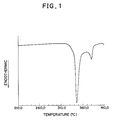
- the yarn article of the present invention exhibits a first endothermic peak at about 345 ⁇ 5 °C and a second endothermic peak at 380 ⁇ 5 °C in the course of temperature elevation from room temperature at a rate of 10 °C/min in the thermal analysis by differential scanning calorimetry (DSC) (see Fig. 1).
- DSC differential scanning calorimetry
- Conventional tetrafluoroethylene polymer yarn articles generally exhibit only one peak at a temperature of about 330 °C (see Fig. 3) in the DSC thermogram.
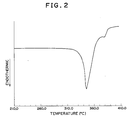
- a tetrafluoroethylene polymer yarn article which exhibits two peaks at 340° ⁇ 5 °C and 380° ⁇ 5 °C, respectively (see Fig. 2) is also known in the art.
- the first of the two peaks has a high intensity but the second of the peaks has an extremely low intensity.
- This conventional tetrafluoroethylene polymer yarn article exhibiting two particular peaks can be produced by conventional processes, e.g., by the processes disclosed in U.S. Patents No. 3,953,566, No. 3,962,153 and No. 4,187,390.
- This type of tetrafluoroethylene polymer yarn article can advantageously be used for preparing the yarn article of the present invention.
- the yarn article of the present invention is preferably produced from such a conventional tetrafluoroethylene polymer yarn article exhibiting two particular peaks in the DSC thermogram, and as mentioned above, exhibits clearly observable peaks at 345° ⁇ 5 °C and 380° ⁇ 5 °C in the DSC thermogram.
- This means that the conversion from this conventional yarn article to the yarn article of the present invention is unexpectedly accompanied by a temperature shift with respect to the first peak and an intensity increase with respect to the second peak. From the above, it is apparent that the yarn article of the present invention has a novel structure which is different from the crystalline system of the conventional polytetrafluoroethylene.
- the two peaks at 345 ⁇ 5 °C and at 380 ⁇ 5 °C in the thermogram of DSC analysis of the yarn article of the present invention are caused to appear due to the drawing of the above-mentioned conventional yarn article having two particular peaks, which is not non-porous but microporous, at a temperature not lower than the crystalline melting point of this microporous yarn.
- the structure of the yarn article of the present invention which exhibits the above-mentioned two peaks in the thermogram of DSC analysis of the yarn article, contributes to high tensile strength and high tensile modulus of elasticity without sacrificing other desired properties inherent in the tetrafluoroethylene polymer.
- the yarn article of the present invention is prepared by drawing in an axial direction, and has an extremely high orientation degree and crystallinity. That is, according to the measurement by X-ray diffractometry, the orientation degree of the yarn article of the present invention is 0.9 or more, preferably 0.95 or more, and its crystallinity is 85 % or more, preferably 95 % or more. There is no particular restriction with respect to the upper limits of the orientation degree and the crystallinity of the yarn article of the present invention. According to the process for producing the yarn article of the present invention as described hereinbelow, it is possible to obtain a yarn article having an orientation degree of 0.99 and a crystallinity of 99 % by conducting the drawing at a high drawing temperature and at a high draw ratio.
- the yarn article according to the present invention has a tensile strength of 4 g/d to 8 g/d, preferably not smaller than 5 g/d in the direction of drawing and a tensile modulus of elasticity of 200 g/d to 500 g/d (as initial tensile modulus of elasticity), preferably not smaller than 250 g/d.
- the yarn article of the present invention can readily be produced by the following process.
- a process for producing a yarn article comprising a tetrafluoroethylene polymer which comprises drawing a tetrafluoroethylene polymer filament at a temperature not lower than the melting point of the tetrafluoroethylene polymer filament, the tetrafluoroethylene polymer filament having an orientation degree of 0.7 or more and having a microporous structure comprised of nodes interconnected by fibrils, to thereby obtain a yarn article of a tetrafluoroethylene polymer having an bulk density of 2.15 to 2.30, an orientation degree in an axial direction of 0.9 or more and a crystallinity of 85 % or more and exhibits peaks at 345 ⁇ 5 °C and 380 ⁇ 5 °C in the thermogram of differential scanning calorimetry in the course of temperature elevation at a rate of 10 °C/min.
- the microporous tetrafluoroethylene polymer filament used as a starting material is monoaxially orientated and generally has an orientation degree of 0.7 to 0.9.
- the starting tetrafluoroethylene polymer filament preferably exhibits one peak with a high intensity at 340° ⁇ 5 °C and another peak with an extremely low intensity at 380° ⁇ 5 °C in the DSC thermogram.
- the starting tetrafluoroethylene polymer filament preferably has a porosity of 40 to 70 % (corresponding to an bulk density of from 1.21 to 0.69), a crystallinity of 70 to 90 %, a tensile modulus of elasticity of 60 to 180 g/d and a tensile strength of 2.8 g/d to 4.0 g/d.
- the starting filament can be obtained in accordance with the conventional processes. For example, as disclosed in U.S. Patents No. 3,953,566, No. 3,962,153 and No.
- the starting filament can be obtained by extrusion-molding a paste comprising a tetrafluoroethylene polymer and mineral spirit as an extrusion auxiliary, drying the resultant extrudate to remove the mineral spirit, and drawing the dried product at a temperature lower than the crystalline melting point of the tetrafluoroethylene polymer at a draw ratio larger than 10 %/sec., if desired, followed by heat treatment (i.e., sintering) of the drawn product at a temperature higher than the melting point of the tetrafluoroethylene polymer.
- heat treatment i.e., sintering
- a starting tetrafluoroethylene polymer filament which has been subjected to the above-mentioned heat treatment at a temperature higher than the melting point of the tetrafluoroethylene polymer (usually at a temperature of from about 360 to about 420 °C) because the effect of the drawing is promoted.
- the microporous tetrafluoroethylene polymer is rendered non-porous, so that unexpected high tensile strength and high tensile modulus of elasticity can be achieved.
- the drawing temperature is important.
- the drawing temperature is selected from the temperatures of not lower than the melting point of a tetrafluoroethylene polymer which is generally in the range of about 327 to about 340 °C melting point.
- the drawing temperature is preferably 350 °C or more.
- the drawing temperature is preferivelyably in the range of 350 to 420 °C.
- the draw ratio is generally in the range of 1.5 to 10, preferably in the range of 2 to 6.5. When the draw ratio is too high, it is difficult to smoothly perform stable drawing.
- the drawing may be carried out in one stage or in multi-stage.
- the microporous tetrafluoroethylene polymer filament as a starting material is twisted prior to the drawing, the stability of drawing operation is improved, so that it is possible to carry out the drawing at a high draw ratio, thereby enabling an extremely fine yarn article to be produced. Moreover, the twisting is effective for to obtaining monofilaments having a highly circular cross-section.
- the twisting is conducted at a twist ratio of generally from 400 to 5000 times per meter, preferively from 700 to 3000 times per meter.
- any conventional twisters for example, the well-known Italy model twister and ring type twister, are used.
- Means and apparatus for the drawing are not particularly limited.
- An apparatus as used in the drawing of conventional yarn articles can be used, which is provided with heated or not-heated feed rolls and wind-up rolls.
- an appropriate heating device for example, a hot plate or an inorganic salt bath comprising potassium nitrate, sodium nitrate or sodium nitrite is used for heating the starting tetrafluoroethylene filament.
- the heating of the filament may be conducted with hot air in an electric furnace.
- a preferred example of apparatus for attaining the drawing is a roll-drawing machine provided with at least one pair of heated rolls.
- a preferred form of the apparatus is shown in Fig. 4. In Fig.
- numerals 1 to 3 represent heated feed rolls numerals 4 and 5 represent wind-up rolls which may optionally be cooled
- numeral 6 represents an unwinder
- numeral 7 represents a winder.
- the drawing is effected between roll 3 and roll 4. Therefore, rolls 4 and 5 are rotated at a higher revolution speed than these of rolls 1 to 3, which speed depends on the draw ratio.
- the drawing speed is not particularly limited, the drawing speed is preferably about 1000 %/min.
- the yarn article of the present invention has high tensile strength and high tensile modulus of elasticity as well as inertness to chemicals and, therefore, it is useful as ropes, woven fabrics, knitted products and the like, particularly in the field where not only chemical resistance but also high tensile strength and high tensile modulus of elasticity are required.
- the orientation degree, tensile strength at break, tensile modulus of elasticity, bulk density and DSC characteristics are measured as follows:
- the orientation in plane (100) of polytetrafluoroethylene is examined by means of X-ray diffraction.
- the orientation degree (f) can be obtained by the formula: wherein an angle ⁇ represents the slant of a crystal face relative to the fiber axis, and ⁇ cos2 ⁇ > is the average of values of cos2 ⁇ obtained by the following formula: wherein, ⁇ represents the angle of rotation (azimuth angle) relataive to the fiber axis and I( ⁇ ) represents the scattering intensity of X-ray at the azimuth angle ( ⁇ ).
- the crystallinity is calculated from the ratio of the area in the range of 15 to 25° (2 ⁇ ) of a peak ascribed to the crystalline phase of the yarn article to the area of the background, assuming that the background is ascribed to the amorphous phase of the yarn article.
- the tensile strength at break and initial tensile modulus of elasticity are measured using an Instron type tensile tester under the following conditions: temperature : 25 °C relative humidity (RH) : 50 % distance between the grips : 50 mm stress rate : 200 mm/min.
- the bulk density is measured by means of a specific gravity bottle using water of 25 °C as a medium.
- DSC Differential scanning calorimetry
- a porous polytetrafluoroethylene sheet of 25 ⁇ m in thickness produced in accordance with the process disclosed in U.S. Patent No. 3,962,153.
- This porous sheet has a porosity of 48 %, an bulk density of 1.15, a crystallinity of 81 % and an orientation degree of 0.86 (orientation angle of 18 °).
- a main endothermic peak appears at 341 °C and its endothermic energy ( ⁇ H) is 35.7 millijoules/mg.
- a second peak appears at 380 °C and its endothermic energy ( ⁇ H) is as small as 1 mj/mg (see Fig. 2).
- the initial tensile modulus of elasticity, tensile strength at break and heat shrinkage at 250 °C of this sheet are 100 g/d (10 GPa), 2.1 g/d (0.21 GPa) and 3.5 %, respectively.
- This sheet is slitted to obtain a filament of 200 denier.
- the filament is then twisted at a twist ratio of 750 times per meter.
- the twisted filament is continuously drawn in a 1 m-length oven at 440 °C at a drawing rate of 1,000 %/min, so that the resultant filament (one form of a yarn article of the present invention) has a length 4 times that of the original filament.
- the temperature of the resultant filament is 400 °C.
- the thus obtained filament has a fineness of 50 denier, an bulk density of 2.20, a porosity of 1 %, a crystallinity of 96 % and an orientation degree of 0.99 (orientation angle of 4.7 °), and exhibits, in the thermogram of DSC, two endothermic peaks at 342 °C and 381 °C with endothermic energies ( ⁇ H) of 38.0 millijoules/mg and 5.7 millijoules/mg, respectively.
- the filament also has an initial tensile modulus of elasticity 330 g/d (64 GPa), a tensile strength at break of 6.5 g/d (1.26 GPa) and a heat shrinkage at 250 °C of 0.5 %.
- Microporous filaments obtained from the start ing polytetrafluoroethylene sheet as used in Example 1 individually are drawn in substantially the same manner as in Example 1, except that the filament is drawn so that the resultant filament has a length 2 times that of the original filament and except that various drawing temperatures are employed as shown in Table 1 to obtain filaments 2-1 to 2-4.
- the filaments 2-1 to 2-4 exhibit two endothermic peaks at 345 °C with an endothermic energy ( ⁇ H) of 38.3 millijoules/mg and at 379 °C with an endothermic energy ( ⁇ H) of 4.8 millijoules/mg; two peaks at 346 °C with an endothermic energy ( ⁇ H) of 37.8 millijoules/mg and at 379 °C with an endothermic energy ( ⁇ H) of 5.2 millijoules/mg; two peaks at 345 °C with an endothermic energy ( ⁇ H) of 33.6 millijoules/mg and at 378 °C with an endothermic energy ( ⁇ H) of 5.1 millijoules/mg; and two peaks at 346 °C with an endothermic energy ( ⁇ H) of 34.0 millijoules/mg and at 380 °C with an endothermic energy ( ⁇ H) of 5.7 millijoules/mg, respectively.
- filaments 2-1 to 2-4 are also shown in Table 1.
- Table 1 2-1 2-2 2-3 2-4 oven temperature (°C) 360 400 440 480 thread temperature at outlet (°C) 350 370 390 410 bulk density 2.20 2.22 2.22 2.23 orientation degree 0.96 0.98 0.98 0.99 orientation angle (°) 9.5 7.0 7.0 4.7 crystallinity (%) 91.2 95.5 95.8 96.1 fineness (denier) 102 98 97 97 initial tensile modulus of elasticity (g/d) 286 325 293 315 tensile strength at break (g/d) 5.4 5.7 5.8 5.7
- a non-sintered sealing tape of 15 mm in width is prepared by extrusion of a polytetrafluoroethylene paste.
- This tape is sintered at 400 °C for 10 minutes in accordance with Example 6 of U.S. Patent No. 2,776,465 to obtain a transparent tape.
- This tape is drawn in an oven at a temperature of 400 °C by means of the same drawing machine used in Example 1, so that the resultant drawn tape has a length 4 times the length of the original transparent tape.
- the drawn tape thus obtained has a crystallinity of 90 %, an orientation degree of 0.92 (orientation angle of 13°), an initial tensile modulus of elasticity of 12 g/d, a tensile strength at break of 1.5 g/d and a tensile elongation at break of 12.5 %, and only one endothermic peak is observed in the thermogram of DSC (see Fig. 3).
- the same microporous filament as used in Example 1 is twisted at a twist ratio of 1000 times per meter, and the twisted filament is continuously drawn for 8 hours at a feed rate of 10 m/min and a take-off speed of 30 m/min by the use of a roll drawing machine with rolls heated at 400 °C, as shown in Fig. 4, thereby obtaining a yarn article.
- the thus obtained yarn article is transparent, and has a circular cross-section, an bulk density of 2.21 and a fineness of 69 denier.
- the yarn article also has an orientation degree, as measured by X-ray diffractiometry, of 0.98, a crystallinity of 95 %, an initial tensile modulus of elasticity of 290 g/d (56 GPa), a tensile strength at break of 6.2 g/d (1.2 GPa) and a tensile elongation at break of 5.6 %.
- the yarn article exhibits a first peak at 345 °C with an endothermic energy ( ⁇ H) of 38 millijoules/mg and a second peak at 382 °C with an endothermic energy ( ⁇ H) of 11 millijoules/mg.
- the same microporous filaments as used in Example 1 individually are subjected to drawing in substantially the same manner as in Example 1, except that the number of twists is varied as shown in Table 2 to obtain yarn articles 3-1 to 3-5.
- the draw ratio is changed stepwise at intervals of 30 minutes to determine the maximum draw ratio of yarn article.
- the maximum draw ratio means a draw ratio at which continuous drawing can be stably conducted for at least 30 minutes.
- the maximum draw ratios of yarn articles 3-1 to 3-5 are also shown in Table 2. Table 2 3-1 3-2 3-3 3-4 3-5 number of twists (times/m) 0 500 1000 2000 3000 maximum draw ratio 1.8 3.5 4.8 6.5 6.0
Landscapes
- Chemical & Material Sciences (AREA)
- Chemical Kinetics & Catalysis (AREA)
- General Chemical & Material Sciences (AREA)
- Engineering & Computer Science (AREA)
- Textile Engineering (AREA)
- Artificial Filaments (AREA)
- Spinning Methods And Devices For Manufacturing Artificial Fibers (AREA)
- Yarns And Mechanical Finishing Of Yarns Or Ropes (AREA)
Applications Claiming Priority (2)
| Application Number | Priority Date | Filing Date | Title |
|---|---|---|---|
| JP183530/88 | 1988-07-25 | ||
| JP18353088 | 1988-07-25 |
Publications (3)
| Publication Number | Publication Date |
|---|---|
| EP0352749A2 true EP0352749A2 (de) | 1990-01-31 |
| EP0352749A3 EP0352749A3 (de) | 1991-05-22 |
| EP0352749B1 EP0352749B1 (de) | 1995-10-25 |
Family
ID=16137446
Family Applications (1)
| Application Number | Title | Priority Date | Filing Date |
|---|---|---|---|
| EP19890113713 Expired - Lifetime EP0352749B1 (de) | 1988-07-25 | 1989-07-25 | Polytetrafluorethylenfilament und Verfahren zur Herstellung derselben |
Country Status (5)
| Country | Link |
|---|---|
| US (1) | US5061561A (de) |
| EP (1) | EP0352749B1 (de) |
| JP (1) | JP2729837B2 (de) |
| CA (1) | CA1305604C (de) |
| DE (1) | DE68924623T2 (de) |
Cited By (13)
| Publication number | Priority date | Publication date | Assignee | Title |
|---|---|---|---|---|
| EP0451729A1 (de) * | 1990-04-06 | 1991-10-16 | Sumitomo Electric Industries, Ltd. | Chirurgischer Nähfaden und Verfahren zu seiner Herstellung |
| US5296292A (en) * | 1990-09-04 | 1994-03-22 | W. L. Gore & Associates, Inc. | Elongated cylindrical tensile article |
| EP0648869A1 (de) * | 1993-09-16 | 1995-04-19 | Japan Gore-Tex, Inc. | Fadenförmiges Material aus Polytetrafluoroethylen |
| EP0685578A3 (de) * | 1994-05-31 | 1996-07-17 | Hitachi Cable | Faser von hoher Festigkeit aus Polytetrafluoroethylen und Verfahren zu ihrer Herstellung. |
| WO2002005018A1 (en) * | 2000-07-12 | 2002-01-17 | Daikin Industries, Ltd. | Porous sheet made of fluoropolymer and process for producing liquid-crystal display panel with the same |
| WO2002050351A1 (fr) * | 2000-12-20 | 2002-06-27 | Daikin Industries, Ltd. | Fil retors au tetrafluoroethylene |
| WO2003033784A1 (en) * | 2001-10-16 | 2003-04-24 | Manegro Administração E Participações Ltda. | Expanded ptfe filament with round cross section |
| WO2003074770A1 (en) * | 2002-03-07 | 2003-09-12 | Manegro Administração E Participações Ltda. | Expanded ptfe fiber |
| EP2167710A4 (de) * | 2007-06-14 | 2011-01-05 | Toray Fluorofibers America Inc | Thermisch stabile polyterafluorethylenfaser und herstellungsverfahren dafür |
| WO2016099913A1 (en) * | 2014-12-19 | 2016-06-23 | W.L. Gore & Associates, Inc. | Dense articles formed from tetrafluoroethylene core shell copolymers and methods of making the same |
| WO2016099914A1 (en) * | 2014-12-19 | 2016-06-23 | W.L. Gore & Associates, Inc. | Dense articles formed from tetrafluroethylene core shell copolymers and methods of making the same |
| US9650479B2 (en) | 2007-10-04 | 2017-05-16 | W. L. Gore & Associates, Inc. | Dense articles formed from tetrafluoroethylene core shell copolymers and methods of making the same |
| CN113122942A (zh) * | 2021-03-16 | 2021-07-16 | 苏州大学 | 一种低收缩聚四氟乙烯长丝规模化制备方法 |
Families Citing this family (33)
| Publication number | Priority date | Publication date | Assignee | Title |
|---|---|---|---|---|
| US5281475A (en) * | 1991-10-17 | 1994-01-25 | W. L. Gore & Associates, Inc. | Continuous polytetrafluoroethylene fibers |
| US6089576A (en) * | 1991-10-17 | 2000-07-18 | W. L. Gore & Associates, Inc. | Low creep polytetrafluoroethylene gasketing element |
| US5262234A (en) * | 1991-10-17 | 1993-11-16 | W. L. Gore & Associates, Inc. | Polyetrafluoroethylene fiber containing conductive filler |
| US5429869A (en) * | 1993-02-26 | 1995-07-04 | W. L. Gore & Associates, Inc. | Composition of expanded polytetrafluoroethylene and similar polymers and method for producing same |
| US5374473A (en) * | 1992-08-19 | 1994-12-20 | W. L. Gore & Associates, Inc. | Dense polytetrafluoroethylene articles |
| US5916671A (en) * | 1993-02-26 | 1999-06-29 | W. L. Gore & Associates, Inc. | Reusable resilient gasket and method of using same |
| US5468314A (en) * | 1993-02-26 | 1995-11-21 | W. L. Gore & Associates, Inc. | Process for making an electrical cable with expandable insulation |
| FR2694940A1 (fr) * | 1993-08-04 | 1994-02-25 | Gore & Ass | Articles en polytétrafluoroéthylène dense. |
| EP0720669B1 (de) * | 1993-09-21 | 1998-09-23 | W.L. Gore & Associates, Inc. | Verpufftes isolierendes material und verfahren zur herstellung eines solchen materials |
| US5792525A (en) * | 1995-03-31 | 1998-08-11 | W. L. Gore & Associates, Inc. | Creep resistant shaped article of densified expanded polytetrafluoroethylene |
| US5637523A (en) * | 1995-11-20 | 1997-06-10 | Micron Technology, Inc. | Method of forming a capacitor and a capacitor construction |
| US5728801A (en) * | 1996-08-13 | 1998-03-17 | The Dow Chemical Company | Poly (arylamines) and films thereof |
| US5948552A (en) * | 1996-08-27 | 1999-09-07 | Hewlett-Packard Company | Heat-resistant organic electroluminescent device |
| US5989709A (en) * | 1998-04-30 | 1999-11-23 | Gore Enterprises Holdings, Inc. | Polytetrafluoroethylene fiber |
| SE517352C2 (sv) * | 2000-09-25 | 2002-05-28 | Possio Ab Publ | En gateway för ett trådlöst internetsystem |
| US20050086850A1 (en) * | 2003-10-23 | 2005-04-28 | Clough Norman E. | Fishing line and methods for making the same |
| US20050238872A1 (en) * | 2004-04-23 | 2005-10-27 | Kennedy Michael E | Fluoropolymer barrier material |
| US20060182962A1 (en) * | 2005-02-11 | 2006-08-17 | Bucher Richard A | Fluoropolymer fiber composite bundle |
| US7296394B2 (en) * | 2005-02-11 | 2007-11-20 | Gore Enterprise Holdings, Inc. | Fluoropolymer fiber composite bundle |
| US9334587B2 (en) | 2005-02-11 | 2016-05-10 | W. L. Gore & Associates, Inc. | Fluoropolymer fiber composite bundle |
| JP4804061B2 (ja) * | 2005-07-29 | 2011-10-26 | 日本ゴア株式会社 | ポリテトラフルオロエチレン製のスリットヤーン |
| US7409815B2 (en) * | 2005-09-02 | 2008-08-12 | Gore Enterprise Holdings, Inc. | Wire rope incorporating fluoropolymer fiber |
| EA013623B1 (ru) * | 2005-12-02 | 2010-06-30 | ДСМ АйПи АССЕТС Б.В. | Канат, содержащий высококачественные полиэтиленовые волокна |
| DE102006023729B3 (de) * | 2006-02-06 | 2007-04-26 | Sprügel, Friedrich A. | Gewindedichtfaden und Verfahren zu seiner Herstellung |
| US7498079B1 (en) | 2007-06-13 | 2009-03-03 | Toray Fluorofibers (America), Inc. | Thermally stable polytetrafluoroethylene fiber and method of making same |
| US9040646B2 (en) | 2007-10-04 | 2015-05-26 | W. L. Gore & Associates, Inc. | Expandable TFE copolymers, methods of making, and porous, expanded articles thereof |
| JP2009235586A (ja) * | 2008-03-26 | 2009-10-15 | Fukushima Prefecture | 微粒子コーティング有機材料及び有機材料の微粒子コーティング方法 |
| RU2501216C2 (ru) * | 2008-10-14 | 2013-12-20 | Уай. Джи Кей КО., ЛТД. | Рыболовная леска, содержащая объединенную композитную нить, включающую короткое волокно |
| CN102471997A (zh) | 2009-08-04 | 2012-05-23 | 帝斯曼知识产权资产管理有限公司 | 经涂布的高强度纤维 |
| JP5473824B2 (ja) * | 2010-08-05 | 2014-04-16 | ニチアス株式会社 | 高密度ポリテトラフルオロエチレンテープ及びその製造方法 |
| WO2019009237A1 (ja) * | 2017-07-06 | 2019-01-10 | 岡本株式会社 | 糸、繊維製品および製造方法 |
| JP7699062B2 (ja) * | 2019-06-13 | 2025-06-26 | ダブリュ.エル.ゴア アンド アソシエイツ,インコーポレイティド | 優れた剛性を有する高配向延伸ポリテトラフルオロエチレン |
| ES3013251T3 (en) * | 2019-06-13 | 2025-04-11 | Gore & Ass | Lightweight expanded polytetrafluoroethylene membranes having high intrinsic strength and optical transparency |
Family Cites Families (9)
| Publication number | Priority date | Publication date | Assignee | Title |
|---|---|---|---|---|
| US2772444A (en) * | 1954-08-12 | 1956-12-04 | Du Pont | Composition comprising a polyhalogenated ethylene polymer and viscose and process of shaping the same |
| US2776465A (en) * | 1954-08-12 | 1957-01-08 | Du Pont | Highly oriented shaped tetrafluoroethylene article and process for producing the same |
| GB813331A (en) * | 1954-08-12 | 1959-05-13 | Du Pont | Improvements in molecular orientation of tetrafluoroethylene polymer films, fibres or filaments |
| CA962021A (en) * | 1970-05-21 | 1975-02-04 | Robert W. Gore | Porous products and process therefor |
| US3962153A (en) * | 1970-05-21 | 1976-06-08 | W. L. Gore & Associates, Inc. | Very highly stretched polytetrafluoroethylene and process therefor |
| AT340561B (de) * | 1975-01-03 | 1977-12-27 | Chemiefaser Lenzing Ag | Verfahren zur herstellung von faden oder fasern aus kunststoffen |
| US4168298A (en) * | 1975-09-22 | 1979-09-18 | E. I. Du Pont De Nemours And Company | Yarn consisting of drawn sintered PTF fibers and woven, non-woven and knitted fabrics; filter bags; ropes; and fire-protective clothing formed therefrom |
| US4064214A (en) * | 1975-09-22 | 1977-12-20 | E. I. Du Pont De Nemours And Company | Process for making polytetrafluoroethylene yarn |
| GB1510553A (en) * | 1976-05-12 | 1978-05-10 | Standard Hose Ltd | Monofilament polytetrafluoroethylene fibre yarn |
-
1989
- 1989-07-20 JP JP18608589A patent/JP2729837B2/ja not_active Expired - Lifetime
- 1989-07-21 CA CA 606371 patent/CA1305604C/en not_active Expired - Lifetime
- 1989-07-21 US US07/382,500 patent/US5061561A/en not_active Expired - Lifetime
- 1989-07-25 DE DE68924623T patent/DE68924623T2/de not_active Expired - Lifetime
- 1989-07-25 EP EP19890113713 patent/EP0352749B1/de not_active Expired - Lifetime
Cited By (24)
| Publication number | Priority date | Publication date | Assignee | Title |
|---|---|---|---|---|
| EP0451729A1 (de) * | 1990-04-06 | 1991-10-16 | Sumitomo Electric Industries, Ltd. | Chirurgischer Nähfaden und Verfahren zu seiner Herstellung |
| US5258014A (en) * | 1990-04-06 | 1993-11-02 | Sumitomo Electric Industries Ltd. | Surgical suture and process for producing same |
| US5296292A (en) * | 1990-09-04 | 1994-03-22 | W. L. Gore & Associates, Inc. | Elongated cylindrical tensile article |
| EP0648869A1 (de) * | 1993-09-16 | 1995-04-19 | Japan Gore-Tex, Inc. | Fadenförmiges Material aus Polytetrafluoroethylen |
| EP0685578A3 (de) * | 1994-05-31 | 1996-07-17 | Hitachi Cable | Faser von hoher Festigkeit aus Polytetrafluoroethylen und Verfahren zu ihrer Herstellung. |
| US5686033A (en) * | 1994-05-31 | 1997-11-11 | Hitachi Cable Ltd. | Process of making PTFE fibers |
| WO2002005018A1 (en) * | 2000-07-12 | 2002-01-17 | Daikin Industries, Ltd. | Porous sheet made of fluoropolymer and process for producing liquid-crystal display panel with the same |
| WO2002050351A1 (fr) * | 2000-12-20 | 2002-06-27 | Daikin Industries, Ltd. | Fil retors au tetrafluoroethylene |
| WO2003033784A1 (en) * | 2001-10-16 | 2003-04-24 | Manegro Administração E Participações Ltda. | Expanded ptfe filament with round cross section |
| WO2003074770A1 (en) * | 2002-03-07 | 2003-09-12 | Manegro Administração E Participações Ltda. | Expanded ptfe fiber |
| EP2167710A4 (de) * | 2007-06-14 | 2011-01-05 | Toray Fluorofibers America Inc | Thermisch stabile polyterafluorethylenfaser und herstellungsverfahren dafür |
| CN101778968B (zh) * | 2007-06-14 | 2012-09-05 | 东丽含氟纤维(美国)公司 | 热稳定的聚四氟乙烯纤维及其制备方法 |
| US9650479B2 (en) | 2007-10-04 | 2017-05-16 | W. L. Gore & Associates, Inc. | Dense articles formed from tetrafluoroethylene core shell copolymers and methods of making the same |
| US9988506B2 (en) | 2007-10-04 | 2018-06-05 | W. L. Gore & Associates, Inc. | Dense articles formed tetrafluoroethylene core shell copolymers and methods of making the same |
| WO2016099913A1 (en) * | 2014-12-19 | 2016-06-23 | W.L. Gore & Associates, Inc. | Dense articles formed from tetrafluoroethylene core shell copolymers and methods of making the same |
| US9644054B2 (en) | 2014-12-19 | 2017-05-09 | W. L. Gore & Associates, Inc. | Dense articles formed from tetrafluoroethylene core shell copolymers and methods of making the same |
| KR20170096176A (ko) * | 2014-12-19 | 2017-08-23 | 더블유.엘. 고어 앤드 어소시에이트스, 인코포레이티드 | 테트라플루오로에틸렌 코어 쉘 코폴리머로부터 형성된 고밀도 물품 및 이의 제조 방법 |
| KR20170096177A (ko) * | 2014-12-19 | 2017-08-23 | 더블유.엘. 고어 앤드 어소시에이트스, 인코포레이티드 | 테트라플루오로에틸렌 코어 쉘 코폴리머로부터 형성된 고밀도 물품 및 이의 제조 방법 |
| CN107106730A (zh) * | 2014-12-19 | 2017-08-29 | W.L.戈尔及同仁股份有限公司 | 由四氟乙烯芯壳共聚物形成的致密制品及其制备方法 |
| CN107108807A (zh) * | 2014-12-19 | 2017-08-29 | W.L.戈尔及同仁股份有限公司 | 由四氟乙烯芯壳共聚物形成的致密制品及其制备方法 |
| WO2016099914A1 (en) * | 2014-12-19 | 2016-06-23 | W.L. Gore & Associates, Inc. | Dense articles formed from tetrafluroethylene core shell copolymers and methods of making the same |
| CN107108807B (zh) * | 2014-12-19 | 2020-03-13 | W.L.戈尔及同仁股份有限公司 | 由四氟乙烯芯壳共聚物形成的致密制品及其制备方法 |
| CN107106730B (zh) * | 2014-12-19 | 2020-12-25 | W.L.戈尔及同仁股份有限公司 | 由四氟乙烯芯壳共聚物形成的致密制品及其制备方法 |
| CN113122942A (zh) * | 2021-03-16 | 2021-07-16 | 苏州大学 | 一种低收缩聚四氟乙烯长丝规模化制备方法 |
Also Published As
| Publication number | Publication date |
|---|---|
| DE68924623D1 (de) | 1995-11-30 |
| DE68924623T2 (de) | 1996-06-05 |
| CA1305604C (en) | 1992-07-28 |
| EP0352749A3 (de) | 1991-05-22 |
| JPH02127509A (ja) | 1990-05-16 |
| US5061561A (en) | 1991-10-29 |
| EP0352749B1 (de) | 1995-10-25 |
| JP2729837B2 (ja) | 1998-03-18 |
Similar Documents
| Publication | Publication Date | Title |
|---|---|---|
| EP0352749B1 (de) | Polytetrafluorethylenfilament und Verfahren zur Herstellung derselben | |
| US5043216A (en) | Porous polyethylene fibers | |
| US5470655A (en) | Polytetrafluoroethylene filamentary material | |
| AU3960189A (en) | Dimensionally stable polyester yarn for high tenacity treated cords | |
| JPWO1996010668A1 (ja) | 混合綿状物、それからえられる不織布ならびにそれらの製法 | |
| KR102735576B1 (ko) | 후가공성이 향상된 폴리에틸렌 원사 및 이를 포함하는 원단 | |
| EP1319097A1 (de) | Dick-/dünn-polyester-multifilamentgarn | |
| KR102238287B1 (ko) | 폴리페닐렌 설파이드 복합 멀티필라멘트를 함유하는 원단 | |
| EP1518012A1 (de) | Polytrimethylenterephthalat konjugatfaser und verfahren zu ihrer herstellung | |
| JPS59130309A (ja) | 異収縮混繊糸の製造方法 | |
| JP2019173212A (ja) | 海島型複合繊維束 | |
| CN114134606B (zh) | 一种聚四氟乙烯膨体纱线及由其制得的纺织品的制备方法 | |
| KR101850628B1 (ko) | 드레이프성이 우수한 고신축성의 레이온-라이크 폴리에스테르 복합사 및 그 제조방법 | |
| EP3514269B1 (de) | Vinylidenfluoridharzfasern und blattförmige struktur | |
| JPH02216295A (ja) | 高強力ポリエステル繊維紙の製造方法 | |
| JPH06257013A (ja) | ポリカーボネートマルチフィラメント | |
| JPH0841725A (ja) | ポリ4−メチル−1−ペンテン系モノフィラメントおよびその製造方法並びに抄紙用ドライヤーカンバス | |
| WO2026026792A1 (en) | A polyamide composition, a polyamide self-crimpling fiber, and a preparation method thereof | |
| JPH0362804B2 (de) | ||
| KR0180825B1 (ko) | 형태 안정성이 우수한 중공 섬유의 제조방법 | |
| JPH0335025A (ja) | 低誘電率プリント基板用基材およびその製法 | |
| JP2592745B2 (ja) | 分散染料易染性を有するポリエステル繊維 | |
| JPS63126912A (ja) | ポリエチレン繊維とその製造法 | |
| KR20240147176A (ko) | 가교형 폴리에틸렌테레프탈레이트/선형 폴리에틸렌테레프탈레이트 병렬형 복합섬유와 이를 이용한 형태안정성이 우수한 고밀도 부직포 및 그 제조방법 | |
| JP2004003053A (ja) | ストレッチ性織編物用ポリエステル複合繊維 |
Legal Events
| Date | Code | Title | Description |
|---|---|---|---|
| PUAI | Public reference made under article 153(3) epc to a published international application that has entered the european phase |
Free format text: ORIGINAL CODE: 0009012 |
|
| AK | Designated contracting states |
Kind code of ref document: A2 Designated state(s): BE DE FR GB IT NL |
|
| 17P | Request for examination filed |
Effective date: 19901219 |
|
| PUAL | Search report despatched |
Free format text: ORIGINAL CODE: 0009013 |
|
| AK | Designated contracting states |
Kind code of ref document: A3 Designated state(s): BE DE FR GB IT NL |
|
| 17Q | First examination report despatched |
Effective date: 19940111 |
|
| GRAA | (expected) grant |
Free format text: ORIGINAL CODE: 0009210 |
|
| AK | Designated contracting states |
Kind code of ref document: B1 Designated state(s): BE DE FR GB IT NL |
|
| REF | Corresponds to: |
Ref document number: 68924623 Country of ref document: DE Date of ref document: 19951130 |
|
| ET | Fr: translation filed | ||
| ITF | It: translation for a ep patent filed | ||
| PLBE | No opposition filed within time limit |
Free format text: ORIGINAL CODE: 0009261 |
|
| STAA | Information on the status of an ep patent application or granted ep patent |
Free format text: STATUS: NO OPPOSITION FILED WITHIN TIME LIMIT |
|
| 26N | No opposition filed | ||
| REG | Reference to a national code |
Ref country code: GB Ref legal event code: IF02 |
|
| PGFP | Annual fee paid to national office [announced via postgrant information from national office to epo] |
Ref country code: DE Payment date: 20080807 Year of fee payment: 20 |
|
| PGFP | Annual fee paid to national office [announced via postgrant information from national office to epo] |
Ref country code: IT Payment date: 20080730 Year of fee payment: 20 Ref country code: NL Payment date: 20080715 Year of fee payment: 20 Ref country code: FR Payment date: 20080718 Year of fee payment: 20 |
|
| PGFP | Annual fee paid to national office [announced via postgrant information from national office to epo] |
Ref country code: GB Payment date: 20080806 Year of fee payment: 20 |
|
| PGFP | Annual fee paid to national office [announced via postgrant information from national office to epo] |
Ref country code: BE Payment date: 20090126 Year of fee payment: 20 |
|
| REG | Reference to a national code |
Ref country code: GB Ref legal event code: PE20 Expiry date: 20090724 |
|
| NLV7 | Nl: ceased due to reaching the maximum lifetime of a patent |
Effective date: 20090725 |
|
| PG25 | Lapsed in a contracting state [announced via postgrant information from national office to epo] |
Ref country code: NL Free format text: LAPSE BECAUSE OF EXPIRATION OF PROTECTION Effective date: 20090725 Ref country code: GB Free format text: LAPSE BECAUSE OF EXPIRATION OF PROTECTION Effective date: 20090724 |