EP0353379A2 - Porte-mine méchanique pourvu de moyens automatiques d'avance de la mine - Google Patents
Porte-mine méchanique pourvu de moyens automatiques d'avance de la mine Download PDFInfo
- Publication number
- EP0353379A2 EP0353379A2 EP89103751A EP89103751A EP0353379A2 EP 0353379 A2 EP0353379 A2 EP 0353379A2 EP 89103751 A EP89103751 A EP 89103751A EP 89103751 A EP89103751 A EP 89103751A EP 0353379 A2 EP0353379 A2 EP 0353379A2
- Authority
- EP
- European Patent Office
- Prior art keywords
- lead
- mechanical pencil
- radially displaceable
- chuck
- rear holder
- Prior art date
- Legal status (The legal status is an assumption and is not a legal conclusion. Google has not performed a legal analysis and makes no representation as to the accuracy of the status listed.)
- Withdrawn
Links
- 230000008878 coupling Effects 0.000 claims description 20
- 238000010168 coupling process Methods 0.000 claims description 20
- 238000005859 coupling reaction Methods 0.000 claims description 20
- 238000006073 displacement reaction Methods 0.000 claims description 7
- 239000002184 metal Substances 0.000 claims description 7
- 229920003002 synthetic resin Polymers 0.000 claims description 6
- 239000000057 synthetic resin Substances 0.000 claims description 6
- 239000013013 elastic material Substances 0.000 claims description 5
- 229920001187 thermosetting polymer Polymers 0.000 claims description 5
- 239000004744 fabric Substances 0.000 claims description 3
- 229920000298 Cellophane Polymers 0.000 claims description 2
- 238000004904 shortening Methods 0.000 claims description 2
- 230000003247 decreasing effect Effects 0.000 description 13
- 238000010276 construction Methods 0.000 description 6
- 239000000463 material Substances 0.000 description 5
- 238000004519 manufacturing process Methods 0.000 description 4
- 238000000034 method Methods 0.000 description 4
- 230000004048 modification Effects 0.000 description 4
- 238000012986 modification Methods 0.000 description 4
- 230000000994 depressogenic effect Effects 0.000 description 3
- 238000005452 bending Methods 0.000 description 2
- 230000036461 convulsion Effects 0.000 description 2
- 230000000694 effects Effects 0.000 description 2
- 239000000835 fiber Substances 0.000 description 2
- 239000012530 fluid Substances 0.000 description 2
- 239000012209 synthetic fiber Substances 0.000 description 2
- 229920002994 synthetic fiber Polymers 0.000 description 2
- 230000002159 abnormal effect Effects 0.000 description 1
- 230000006835 compression Effects 0.000 description 1
- 238000007906 compression Methods 0.000 description 1
- 238000005520 cutting process Methods 0.000 description 1
- 238000010586 diagram Methods 0.000 description 1
- 239000003223 protective agent Substances 0.000 description 1
- 239000000126 substance Substances 0.000 description 1
- 210000000707 wrist Anatomy 0.000 description 1
Images





Classifications
-
- B—PERFORMING OPERATIONS; TRANSPORTING
- B43—WRITING OR DRAWING IMPLEMENTS; BUREAU ACCESSORIES
- B43K—IMPLEMENTS FOR WRITING OR DRAWING
- B43K24/00—Mechanisms for selecting, projecting, retracting or locking writing units
- B43K24/02—Mechanisms for selecting, projecting, retracting or locking writing units for locking a single writing unit in only fully projected or retracted positions
- B43K24/023—Mechanisms for selecting, projecting, retracting or locking writing units for locking a single writing unit in only fully projected or retracted positions with a deformable barrel
-
- B—PERFORMING OPERATIONS; TRANSPORTING
- B43—WRITING OR DRAWING IMPLEMENTS; BUREAU ACCESSORIES
- B43K—IMPLEMENTS FOR WRITING OR DRAWING
- B43K21/00—Propelling pencils
- B43K21/02—Writing-core feeding mechanisms
- B43K21/16—Writing-core feeding mechanisms with stepwise feed of writing-cores
- B43K21/20—Writing-core feeding mechanisms with stepwise feed of writing-cores with writing-cores automatically replaced from magazines
Definitions
- the present invention relates to a mechanical pencil, and more particularly to a mechanical pencil having an automatic lead extending mechanism in which the lead is extended, chucked and released merely by controlling (or increasing and decreasing) a pinching force applied to the pencil body.
- the mechanical pencil when the lead is worn out during writing, it is extended by a turn system in which the mechanical pencil body is turned, a knock system in which the mechanical pencil body is knocked on the top, a side knock system in which the side button of the mechanical pencil body is pushed, a system of turning an end portion of the pencil body, or a system of pulling an end ring of the mechanical pencil body, or a system of pulling the end ring of the pencil body.
- these conventional systems are disadvantageous in that, before the lead is extended, the mechanical pencil body must be held again, or the fingers holding the body must be shifted; that is, the lead cannot be extended without such a troublesome operation.
- the lead can be extended with the fingers holding the mechanical pencil body maintained unchanged in position according to the following systems: a tip knock system in which a tip end of the mechanical pencil is pushed against a writing sheet or the like, a shake system in which the mechanical pencil is strongly shaken up and down, and a bend system in which the mechanical pencil is bent in the form of the character "L".
- a tip knock system in which a tip end of the mechanical pencil is pushed against a writing sheet or the like
- a shake system in which the mechanical pencil is strongly shaken up and down
- a bend system in which the mechanical pencil is bent in the form of the character "L".
- the present applicants have proposed a variety of pinch type mechanical pencils disclosed in, for example, USP 4,270,870 and 4,358,210.
- the lead can be extended merely by controlling (or increasing or decreasing) the pinching force applied to the pinching part of the mechanical pencil.
- they are still disadvantageous in that, since the pinching part does not cover all the circumference of the cylindrical mechanical pencil body, an operation of moving the fingers circumferentially of the mechanical pencil body while holding the latter to write cannot be carried out; that is, a so-called "turning and writing operation" cannot be performed, and also they are not so good in external appearance and design.
- a pinch type mechanical pencil has been developed in which a pinching part covers all the circumference of the cylindrical mechanical pencil body, and the external appearance is excellent.
- it is still disadvantageous in that, in order to depress the pinching part, it is necessary to apply a relatively great pinching force to the pinching part because of the resistance of the latter, and it is rather difficult to completely or positively restore the pinching part depressed to its original condition.
- a mechanical pencil of the type disclosed in USP 4,358,210 by the present applicants suffers from the same disadvantages. Further, in such a mechanical pencil, the pinching operation cannot protrude the lead from the tip end pipe. Furthermore, that type of the mechanical pencil requires an intricate slider member.
- an object of the present invention is to eliminate the above-described problems and difficulties accompanying conventional and developed mechanical pencils. More specifically, an object of the invention is to provide a mechanical pencil having an automatic lead extending mechanism which is capable of performing a so-called "turning and writing operation".
- a mechanical pencil having an automatic lead extending mechanism which, according to the present invention, has a hollow body, a radially displaceable member disposed on an entire circumference of the pencil body, and an inner mechanism including a chuck chucking a lead, a tightening member which tightens the chuck, a lead holding member holding the lead with a predetermined, relatively weak holding force and a spring, in which the inner mechanism clamps, extends and releases the lead in accordance with a radial movement of the radially displaceable member.
- the radially displaceable member is formed of a material having following characteristics: readily radially displaceable; strong in temperature, humidity, and against the pinching force; restored to its original condition positively, rapidly, and substantially completely; and when a part of the member is radially displaced the remaining parts would not obstruct the radially displacement of the part.
- the radially displaceable member is substantially round shaped in cross section.
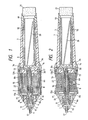
- FIGS. 1 to 5 are longitudinal sectional views showing a mechanical pencil which is a first embodiment of the invention. More specifically, FIG. 1 shows the mechanical pencil to the pinching part of which no pinching force is applied yet; that is, the mechanical pencil is not in use.
- the mechanical pencil shown in FIG. 1 is of the type that the pinching part is held when it is used to write. The lead is chucked when the fingers holding the pinching part apply a pinching force to the latter, and it is extended (fed) as the pinching force is decreased. In this operation, the length of the mechanical pencil body is maintained unchanged.
- the mechanical pencil has a chuck 1 having the front end portion (or the left end portion in FIG. 1) which is longitudinally divided into two or three parts (it being divided into three parts in the case of FIG. 1).
- the head portion of the chuck 1 has a self-expanding force to open itself.
- a rear end of the chuck 1 is connected to one end of a connecting pipe 2, the other end of which is connected to a front end of a lead case 3.
- a conical lead guide 3a is formed at a front end of the inner cylindrical surface of the lead case 3.
- a tightening member 4 is disposed on an outer periphery of the chuck 1.
- the tightening member 4 is inserted into a hole formed in a tightening member receiver 6, onto which a mouth ring 11 is screwed.
- a sliding member 15 having a conical front end portion and a central hole is loosely fitted on the mouth ring 11. Protrusions and grooves 15a are formed on the outer cylindrical surface of the sliding member 15.
- a tightening-member removing ring 5 is press fitted in the front end portion of the inner hole of the tightening-member receiver 6.
- the tightening member removing ring 5 is provided separately; however, it may be formed by bending the front end portion of the tightening member receiver 6, or the step of the mouth ring 11 may be utilized to stop the forward movement of the tightening member 4. In the latter case, the tightening member removing ring 5 can be eliminated.
- the tightening member 4 is slightly movable back and forth between the tightening-member removing ring 5 and the step 6a of the inner hole of the tightening member receiver 6.
- the tightening member receiver 6 has a thin cylindrical rear end portion 6b, the rear end part of which is male-threaded.
- the male-threaded part is engaged with the female-thread central part of the front end portion of a rear holder 7 so that the tightening member receiver 6 and the rear holder 7 form one unit.
- the rear holder 7 is a cylindrical member for accommodating the lead case 3 (described later).
- the cylindrical rear end portion 6b of the tightening member receiver 6 is slidably inserted into a flanged cylinder 8 which has a flange 8a at its front end thereof.
- the flanged cylinder 8 has one to three legs 8b (three legs in FIG. 1) extended from its rear side.
- An annular flanged ring 13 is fitted on the front end portion of the rear holder 7.
- Protrusions or grooves 13a are formed at equal intervals in the outer cylindrical surface of the flanged ring 13.
- the length between the front end of the flange 8a and the rear ends of the legs 8b is slightly smaller than the distance between the step 6c on the outer surface of the tightening member receiver 6 and the front end face 3b of the lead case 3.
- a spring 18 is interposed between the lead case 3 and the rear holder 7 so that the lead case 3 and the chuck 1 are maintained urged forwardly (to the left in FIG. 1) with respect to the rear holder 7.
- the term "forwardly” as used herein is intended to mean “forwardly” relative to the rear holder which is considered to be stationary", when applicable).
- the above-described mechanical pencil is assembled as follows: First, the legs 8b of the flanged cylinder 8 are inserted into the slits 7a formed in the central part of the front end portion of the rear holder 7 (the slits 7a being equal in number to the legs 8b). Then, the rear end portion 6b of the tightening member receiver 6 with the tightening member 4 and the tightening member removing ring 5 is screwed into the front end portion of the rear holder 7. Under this condition, the lead case 3 is inserted into the rear holder 7, and the chuck 1 inserted into the tightening member receiver 6 from a front thereof is coupled through the connecting pipe 2 to the lead case 3 by press-fitting, bonding or screwing.
- the mouth ring 11 with an end pipe 9 and a lead holder 10 is screwed onto the tightening member receiver 6.
- the lead holder 10 is made of an elastic material such as rubber so as to always hold the lead 12 with a predetermined holding force.
- the mouth ring 11 is threadably engaged with the tightening member receiver 6, so that they may be disengaged from each other when necessary.
- the flanged ring 13 is put on the front end portion of the rear holder 7 from fore side, and a connecting ring 14 is put on the flanged ring 13 and the rear holder 7 from behind so that the flanged ring 13 and the rear holder 7 are threadably engaged through the connecting ring 14.
- the sliding member 15 is mounted.
- the protrusions-and-grooves 15a are formed in the outer wall of the rear end portion of the sliding member 15.
- the flanged ring 13 is coupled to the sliding member 15 through a radially displaceable member 16 which is connected between the protrusions-and-grooves 15a of the sliding member 15 and the protrusions-and-grooves 13a of the flanged ring 13 under tension.
- a retaining ring 17 is press-fitted on the flanged ring 13 so as to prevent the radially displaceabel member 16 from detaching.
- the spring 18 is of a compression type.
- the lead case 3 is inserted into the spring 18. With the front end of the spring 18 abutted against the step of the lead case 3, the spring 18 is inserted into the rear holder 7 while being compressed. Under this condition, a rear end part 19 is screwed into the rear holder 7. After spare leads 20 being inserted into the lead case 3, an eraser 21 is fitted to the rear end part.
- the a radially displaceable member 16 are covered with a rubber cylinder 22 (corresponding to the pinching part of the mechanical pencil) so that the mechanical pencil is fine in appearance and can be suitably held with the fingers.
- the mechanical pencil can be more readily assembled by the following method: With the distance between the flanged ring 13 and the sliding member 15 predetermined, a unit is formed by connecting them with the a radially displaceable member 16 (cf. FIG. 11). The unit thus formed is inserted into the mechanical pencil body from fore side, and the flanged ring 13 is coupled through the connecting ring 14 to the rear holder 7.
- the forward movement of the lead case 3 is prevented abutting against the step in the rear holder 7; however, the mechanical pencil may be so modified that the lead case 3 is allowed to move forwardly until the end of the chuck 1 abuts against the lead holder 10 or the step of the mouth ring 11 which eliminating the step in the rear holder 7.
- FIG. 2 shows the mechanical pencil to the pinching part; i.e., the rubber cylinder 22 of which a pinching force is applied with the fingers through the thick thereof. That is, as the a radially displaceable member 16 is radially inwardly displaced thereby shortening the longitudinal length of the member, the member 16 it pulls the sliding member 15, so that the distance between the flanged ring 13 and the sliding member 15 is decreased.
- the pinching part i.e., the rubber cylinder 22 of which a pinching force is applied with the fingers through the thick thereof. That is, as the a radially displaceable member 16 is radially inwardly displaced thereby shortening the longitudinal length of the member, the member 16 it pulls the sliding member 15, so that the distance between the flanged ring 13 and the sliding member 15 is decreased.
- the sliding member 15 is moved backwardly (or towards the rear holder 7), while the lead case 3 is also moved backwardly because the legs 8b of the flanged cylinder 8 push the lead case 3.
- FIG. 3 shows the mechanical pencil in which the pinching force is further increased.
- the a radially displaceable member 16 is further radially inwardly displaced, so that the sliding member 15 further moves backwardly.
- the chuck 1 engages with the tightening member 14 which is stopped moving backwardly any longer, so that the chuck 1 is closed to chuck the lead 12.
- FIG. 5 shows the states of the various components of the mechanical pencil with the pinching force further reduced. In this case, there is no force of moving the sliding member 15 backwardly, and therefore the lead case 3, the connecting pipe 2 and the chuck 1 are moved forwardly by the elastic force of the spring 18, so that the chuck 1 comes out of engagement with the tightening member 4, thus releasing the lead 12.
- the states of the various components shown in FIG. 5 are equal to the states of those in FIG. 1 except that the lead 12 is protruded from the lead pipe 9 as much as the distance l.
- the lead 12 is not fixedly chucked, and therefore, the mechanical pencil cannot be used to write yet.
- a pinching force is applied to the a radially displaceable member 16 again, so that the states shown in FIG. 2 and then those shown in FIG. 3 are obtained.
- the lead 12 protruded from the end pipe 9 is worn out, then it is extended as much as the distance l by applying the pinching force to the mechanical pencil, and therefore the writing operation can be performed again.
- the pinching force should be repeatedly applied to the pinching part of the mechanical pencil with the front end thereof kept at the bottom without changing the position of fingers holding the pencil body.
- the a radially displaceable member 16 should be connected under tension. Therefore, the a radially displaceable member 16 may preferably be thread-shaped members which are made of materials such as filaments which are small in diameter, high in mechanical strength, low in stretchability and high in flexibility.
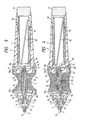
- FIGS. 6 through 10 are longitudinal sectional views showing a mechanical pencil which is a second embodiment of the invention.
- FIG. 6 shows the mechanical pencil to the pinching part of which no pinching force is applied; that is, which is not in use.
- the second embodiment is similar to the first embodiment in that the pinching part, namely, the rubber cylinder 22 is pinched with the fingers to use the mechanical pencil. In operation, the mechanical pencil is maintained unchanged in length.
- components corresponding functionally to those in the first embodiment are therefore designated by the same reference numerals or characters.
- a chuck 1 is equal to that in the first embodiment.
- a rear end of the chuck 1 is coupled to a front end of a connecting pipe 2, a rear end of which is connected to a front end portion of a rear holder 7.
- a rear holder 7 serves also as the lead case 3 of the first embodiment.
- a conical lead guide 3a is formed at the front end of the inside of the rear holder 7.
- the chuck 1 is inserted into the hole of an inner mouth ring 23.
- a lead holder 10 is fitted in the front end portion of the hole of the mouth ring 23.
- the rear end portion of the inner mouth ring 23 is threadably engaged with the front end portion of a cornered cylinder 24.
- the cornered cylinder 24 is inserted into a coupling 25.
- the rear end portion of the coupling 25 has one through three slits (three slits in FIG. 6) 25b.
- the corners 24a formed at the rear end of the cylinder 24 are engaged with the slits 24b thus formed.
- a tightening member 4 is longitudinally slidably inserted into the hole of the inner mouth ring 23. In such a manner that it is movable back and forth the very short distance l between the front step formed on the inner wall of the inner mouth ring 23 and the front end of the cylinder 24.
- the front end portion of the coupling 25 is formed into a large diameter part.
- the inner cylindrical wall of the large diameter part is female-threaded.
- An annular flange 25a is extended from the front end of the large diameter part.
- the outer cylindrical wall of the flange, namely, a front end flange 25a is male-threaded.
- the one through three slits 25b are formed in the rear end portion of the coupling 25, and are engaged with the corners 24a of the cylinder 24.
- the rear end portion of the coupling 25 is fixedly press-fitted in the front end portion of the rear holder 7.
- a mouth ring 11 with an end pipe 9 is threadably engaged with the front end portion of the coupling 25, so that it may be disengaged from the coupling 25 when necessary.
- a spring 26 is interposed between the front step of the coupling 25 and the corners 24a of the cylinder 24 so that the corners 24a are urged backwardly (to the right in FIG. 6) at all times. More specifically, the spring 26 is wound around the small diameter part of the coupling 25.
- a male-threaded flanged ring 13 is mounted on the front end portion of the coupling 25, and secured to the front end flange 25a with a retaining ring 14.
- Grooves 13a are formed in the outer wall of the flange of the flanged ring 13 at equal intervals.
- Grooves 15a are cut in the outer wall of the front end portion of a sliding member 15 at the same intervals as the above-described grooves 13a; that is, the number of grooves 15a is equal to that of grooves 13a.
- the flanged ring 13 and the sliding member 15 are connected with a radially displaceable member 16 under tension.
- the a radially displaceable member 16 is depressed with a rubber cylinder 22 so that the mechanical pencil can be suitably held with the fingers.
- a rear end part 19 is threadably engaged with the rear end of the rear holder 7.
- a spare lead 20 is put into the rear holder 7, and a rubber eraser 21 is fitted to the rear end part 19 to close the lead case.
- a thread retaining ring 17 is mounted on the front end portion of the flanged ring 13 to prevent the radially displaceable member 16 from detaching.
- the mechanical pencil thus constructed will be described with reference to FIGS. 6 through 10.
- the mechanical pencil is held as shown in FIG. 6.
- a pinching fore is applied to the pinching part thereof, the a radially displaceable member 16 are displaced inwardly while the sliding member 15 is moved by a distance l as shown in FIG. 7.
- the cylinder 24 and the inner mouth ring 23 also move forwardly, as a result of which the lead 12 is held by the lead holder 10 with a predetermined holding force, and pulled through the chuck 1 opened.
- the pinching force is further applied to the pinching part of the mechanical pencil body, the latter will be as shown in FIG. 8; that is, the lead 12 is chucked by the chuck 1.
- the pinching force applied to the a radially displaceable member 16 that is, the pinching part of the mechanical pencil when used is utilized to hold the lead.
- a chuck spring is utilized to chuck the lead. With the pinching force applied to normally hold the mechanical pencil, the chuck is not operated; that is, it firmly holds the lead to extend it (cf. FIG. 13). In this operation, the total length of the mechanical pencil is decreased.
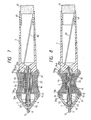
- FIG. 12 is a longitudinal sectional view of the third embodiment of the invention. In FIG. 12, the ordinary pinching force is applied to the pinching part of the mechanical pencil.
- a mouth ring 11 forms the front end portion of the mechanical pencil.
- a lead pipe 9 is press-fitted in the front end portion of the mouth ring 11.
- the lead pipe 9 is formed by cutting a metal pipe.
- a lead holder 10 made of an elastic material such as rubber or synthetic resin is press-fitted into the front end portion of the hole of the mouth ring 11.
- the lead holder 10, being made of the elastic material as is described above, elastically holds the lead at all times with a predetermined, relatively weak force.
- a tightening member receiver 6 is provided in the mouth ring 11 in such a manner that it is located behind the lead holder 10 (or to the right of the lead holder 10 in FIG. 12.
- the tightening member receiver 6 has a flange 6a extending inwardly from its front end.
- the flange 6a serves as a stopper which will permit the passage of the chuck 1 but the front end portion of the tightening member 4. It is not always necessary to provide the flange 6a; that is, where the flange 6a is eliminated, the step provided inside the mouth ring 11 can be utilized to limit the forward movement of the tightening member 4. The backward movement of the tightening member 4 is prevented by the step formed at the rear end of the hole of the tightening member receiver 6.
- the tightening member receiver 6 has a cylindrical rear end portion 6b into which the cylindrical rear end portion of the chuck 1.
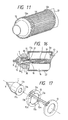
- the mouth ring 11, as shown in FIG. 17, has three protrusions arranged at the rear end at angular intervals of 120 degrees.
- the lead case 3 serves as the rear holder of the mechanical pencil. That is, the lead case 3 forms the rear end portion of the mechanical pencil, and has a flange 3d at the front end.
- the lead case 3 has a spare lead chamber 3b, in which a spare lead 20 is inserted.
- the front end wall of the spare lead chamber 3b is formed into a conical lead guide 3a.
- a cylinder 3c small in wall thickness extends forwardly from the front end face of the lead case 3.
- a spring 18 (which is greater in elastic force than that of the ordinary knock type mechanical pencil) is interposed between the cylinder 3c and the rear end portion 6b of the tightening member receiver 6 so that the lead case 3 and the tightening member receiver 6 are urged to move away from each other at all times. That is, the lead case 3 is pushed backwardly with respect to the tightening member receiver 6 by the elastic force of the spring 18, so that the chuck 1, being urged through the coupling pipe 2, also moves backwardly in the tightening member receiver 6. As a result, the chuck 1 is engaged with the tightening member 4, thus chucking the lead 12.
- a front ring 15 and a rear ring 13 positioned as required are connected with a radially displaceable member 16 under tension.
- the a radially displaceable member 16 may preferably be thread-shaped members such as thin metal wires; however, it must be such that it can easily be displaced inwardly when the pinching force is increased, and it is restored when the pinching force is brought back to the former condition. That is, they may be made of strong and rigid materials, such as chemical synthetic fibers, natural fibers, metal wires or synthetic resin filaments.
- Grooves are cut in the outer cylindrical wall of the front ring 15, and similarly grooves are formed in the outer cylindrical wall of the rear ring 13.
- a radially displaceable member 16 is fitted in the grooves of the front ring 15 and the grooves of the rear ring 13 alternately, and both ends of the radially displaceable member are fastened to the rings 13 and 15.
- the center hole of the front ring 15 is larger in diameter than the flange 3d of the lead case 3 so that the flange 3d can pass through the front ring 15. As shown in FIG.
- three cuts 15a are formed in the inner cylindrical wall of the front ring 15 at angular intervals of 120°, and three recesses 15b are also formed in the inner end face of the front ring 15 at angular intervals of 120° in such a manner that they 15b are located at middle of the aforementioned cuts 15a, respectively.
- the front ring 15, the rear ring 13 and the thread-shaped member 16 are assembled to form a sub-assembly.
- the lead case 3 is inserted into the sub-assembly from front side thereof until the front end flange 3d thereof abuts against the rear ring 13 (the flange 3d being freely passed through the front ring 15).
- the spring 18 With the cuts 15a of the front ring 15 in alignment with the protrusions lla of the mouth ring 11, the spring 18 is compressed to move the mouth ring 11 and the lead case 3 towards each other.
- the front ring 15 is turned through 60° either clockwise or counterclockwise.
- the chuck spring 18 is released, so that the front ring 15 is engaged with the mouth ring 11 with the protrusions 11a inserted in the recesses 15b.
- the a radially displaceable member 16 is stretched under tension, thus eliminating the twist, and the chuck 1 is engaged with the tightening member 4 by the elastic force of the spring 18, thus chucking the lead 12.
- the a radially displaceable member 16 are covered with a rubber cylinder 22 so that the mechanical pencil feels soft when held with the fingers.
- a rubber eraser 21 is fitted in the rear end portion of the lead case 3.
- the lead 12 is extended as shown in FIG. 13. That is, in this operation, the a radially displaceable member 16 are displaced radially inwardly, so that the spring 18 is compressed to move the mouth ring 11 and the lead case 3 towards each other; that is, the total length of the mechanical pencil is decreased.
- the chuck 1 is engaged with the tightening member 4, and, while chucking the lead 12, moved a distance L for which the tightening member 4 is movable in the forward direction as shown in FIG. 12, as a result of which the lead 12 is protruded as much as the distance L from a tip end of the end of the lead pipe 9 against the predetermined, relatively weak holding force of the lead holder 10.
- FIG. 14 shows a state of the mechanical pencil provided when the pinching force used to operate the mechanical pencil as shown in FIG. 13 is restored.
- the lead 12 is protruded by the length L from the lead pipe 9, and the chuck 1 and the tightening member 4 are fixedly engaged with each other in the tightening member receiver 6 by the elastic force of the spring 18; that is, the lead 12 is positively held by the chuck 1.
- the mechanical pencil has become ready for writing.
- the ordinary pinching force for writing is applied to the pinching part of the mechanical pencil, a force corresponding thereto is applied to the chuck in the forward direction; however, the spring 18 is greater in elastic force than that of the ordinary knock type mechanical pencil, so that the lead is positively chucked by the chuck.
- the lead 12 at the end of the lead pipe 9 is worn out, then, as is described above, the lead is extended as much as the length L by momentarily increasing the pinching force applied to the pinching part of the mechanical pencil. That is, the operator can protrude the lead 12 from the end of the lead pipe 9 merely by momentarily increasing the pinching force without changing the positions of the fingers pinching the mechanical pencil, to continue the writing operation.
- FIG. 15 is a longitudinal sectional diagram showing a mechanical pencil which is a fourth embodiment of the invention.
- FIG. 15 shows the mechanical pencil to the pinching part of which no strong pinching force is applied yet.
- the fourth embodiment is fundamentally equal in construction to the third embodiment; however, the former is different from the latter in that it is maintained unchanged in total length when operated.
- its tightening member receiver 6 has a longer leg 6b in the rear end portion of which three slits 6d and cut at angular intervals of 120°C.
- a coupling pipe 2 is connected to the rear end of a chuck 1.
- a cornered cylinder having corners 29a formed on its outer cylindrical wall at angular intervals of 120° is fixedly press-fitted in the rear end portion of the coupling pipe 2.
- the corners 29a are inserted into the slits 6d, respectively.
- the cylinder 29 is inserted into the center hole of a receiving ring 30.
- the rear end portion of the leg 6b of the tightening member receiver 6 is press-fitted into the front end of a rear holder 31.
- a spring 18 is mounted over the rear end portion of the cylinder 29 extending in the rear holder 31.
- the rear end of the cylinder 29 together with the rear end portion of the coupling pipe 2 is fixedly press-fitted in a lead guide 28 coupled to a lead case 32.
- the front end face of the receiving ring 30 abuts against the corners 29a of the cylinder 29, and the rear end face thereof is in contact with the front end face of a slide ring 35.
- a radially displaceable member 16 is stretched between the slide ring 35 and a front ring 15; that is, the two ring 15 and 16 are coupled to each other through the a radially displaceable member 16.
- the spring 18 is interposed between the lead guide 28 and the front end of the longitudinal hole of the rear holder 31.
- the front end part (the mouth ring) is not coupled to the rear end part (the rear holder) through the tightening member receiver 6; that is, they are coupled to each other merely with the a radially displaceable member 16. Therefore, when the pinching force applied to the pinching part (the radially displaceable member) is increased, the radially displaceable member 16 is displaced radially inwardly to move the mouth ring 11 and the rear holder towards each other. That is; the length of the mechanical pencil is decreased.
- the total length thereof will not be decreased, because the tightening member receiver 6 is used to make the mouth ring 11 and the rear holder 31 integral. That is, in the fourth embodiment, the slide ring 35 moves forwardly to move the receiving ring 30 forwardly, so that the cornered cylinder 29, the lead case 32, the coupling pipe 2, and the chuck 1 move forwardly through the corners 29a while the spring 18 being compressed.
- the operation of the fourth embodiment is substantially equal to that of the third embodiment.
- FIG. 16 is a longitudinal sectional view showing essential components of a fifth embodiment of the invention.
- the fifth embodiment is fundamentally equal both in construction and in function to the above-described third embodiment. If the radially displaceable member 16 are so designed as to be readily displaced radially inwardly by a relatively weak pinching force, then the mechanical pencil may suffer from a difficulty that the ordinary pinching force applied during writing may move the chuck 1 forwardly to release the lead 12. This difficulty can be eliminated by the fifth embodiment. In the third embodiment, increasing the elastic force of the chuck spring 18 is limited. Therefore, in the fifth embodiment, as shown in FIG.
- a washer 37 and a breaker, namely, an O-ring 38 formed of an elastic material such as a rubber or the like are interposed between the rear end of the leg 6b of the tightening member receiver 6 and the front end of the spring 18 in the third embodiment.
- the breaker 38 is elastically strongly abutted against the cylindrical portion of the chuck 1.
- the breaker 38 is positioned between the leg 6b of the tightening member receiver 6 and the spring 18.
- the invention is not limited thereto or thereby.
- it may be disposed between the chuck 1 and the tightening member receiver 6; and in the case of the fourth embodiment, it may be interposed between the cornered cylinder 29 and the inner surface of the front step of the rear holder 31.
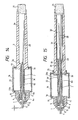
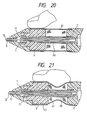
- FIGS. 18 through 21 are sectional views showing a sixth embodiment of the invention.
- the sixth embodiment is fundamentally equal both in construction and in function to the third or fourth embodiment.
- the former is clearly different from the latter in that the pinching part is divided into two parts; a holding part which is held with the fingers for writing, and a lead extending part, that is, a radially displaceable member which is pinched to extend the lead.
- the lead extending part is located adjacent to the holding part. When the lead is extended, the total length of the mechanical pencil is decreased.
- the male-threaded front end portion of a tightening member receiver 6 is threadably engaged with the female-threaded rear end portion of the hole in a mouth ring 11.
- a tightening member 4 is slidably inserted into the axial hole formed in the tightening member receiver 6.
- the rear end of a chuck 1 is connected to the front end of a coupling pipe 2, the rear end portion of which is screwed into the front end of a rear holder 7, which acts as a lead case.
- the coupling pipe 2 is inserted into a pipe 40, the front end portion of which is fixedly press-fitted in the tightening member receiver 6.
- the other end portion of the pipe 40 is inserted in a spring hole 44 formed in the front end of the rear holder 7.
- a chuck spring 18 compressed is arranged in the spring hole 44 in such a manner that it is interposed between the rear holder 7 and the rear end of the pipe 40. That is, the tightening member receiver 6 and the rear holder 7 are urged by the elastic force of the chuck spring 18 to move away from each other.
- the tightening member receiver 6 and the rear holder 7 is coupled to each other through a radially displaceable member 41 which is made cylindrical when assembled.
- the radially displaceable member 41 may preferably be made of a piece of cloth woven with synthetic fibers and/or natural fibers.
- a conventional surface protecting agent of synthetic resin or the like should be applied to the outer surface of the radially displaceable member 41.
- the front end portion of the radially displaceable member 41 is wound on the tightening member receiver 6, and is covered tight with a fixing cylinder 42 which is the holding part held with the fingers for writing, as a result of which the radially displaceable member 41 is fixedly secured to the tightening member receiver 6.
- the rear end portion of the radially displaceable member 41 is wound on the front end of the rear holder 7, and is covered tight with a fixing cylinder 43 so as to be fixedly secured to the rear holder 7.
- the holding part i.e., the fixing cylinder 42 is held similarly as in the case of the conventional mechanical pencil.
- the finger is laid over the radially displaceable member 41 in such a manner as to jerk the mechanical pencil body forwardly, as a result of which, as shown in FIG. 21, the radially displaceable member 41 is depressed by the thick of the finger, thus being displaced inwardly; that is,t he diameter thereof is decreased, and therefore the tightening member receiver 6 and the rear holder 7 move towards each other. That is, if it is assumed for convenience in description that the tightening member receiver 6 is stationary, then the chuck 1 integral with the rear holder 7 moves forwardly while compressing the chuck spring 18.
- the mechanical pencil of the invention is operated for writing.
- the fingers holding the holding part only one finger may be used to push the radially displaceable member to extend the lead.
- FIG. 22 shows a seventh embodiment of the invention.
- the seventh embodiment is fundamentally equal both in construction and in function to the sixth embodiment.
- the former is different from the latter in the mounting position of its chuck spring 18. That is, the chuck spring 18 is interposed between the front end face of the rear holder 7 and a spring retainer 45 which is fixedly mounted on the middle portion of the pipe 40.
- FIG. 23 shows an eighth embodiment of the invention.
- the eighth embodiment is fundamentally equal both in construction and in function to the sixth or seventh embodiment. However, while in each of the sixth and seventh embodiments the total length of the mechanical pencil body is decreased in extending the lead 12, in the eighth embodiment the length of the mechanical pencil is maintained unchanged. Similarly as in the above-described sixth or seven embodiment, the mechanical pencil has a holding part and a lead extending part.
- a radially displaceable member 41 is wound on the rear end portion of a tightening member receiver 6, and a fixing ring 42 is press-fitted through the radially displaceable member 41 into an annular groove 47 formed in the outer cylindrical wall of the rear end portion of the tightening member receiver 6, so that the radially displaceable member 41 is fixedly secured to the latter 6.
- the rear end portion of the radially displaceable member 41 is wound on a slide cylinder 46 which is movable back and forth, and a fixing ring 43 is press-fitted through the radially displaceable member 41 into an annular groove 44 formed in the outer wall of the slide cylinder 46, so that the radially displaceable member 41 is fixedly secured to the slide cylinder 46.
- the slide cylinder 46 has a bottom, or end face, with a center hole 50.
- the rear end of the chuck 1 is connected to a coupling pipe 2, the rear end of which is coupled to the front end portion of a cornered pipe 51.
- the rear end of the pipe 51 is fixedly press-fitted in the front end face of a lead case 3.
- the pipe 51 has three corners 48 at the front end, which are slidably inserted in slits 49, respectively, which are formed in a pipe 40.
- a spring 18 is interposed between the lead case 3 and the inner wall of the bottom of a rear holder 7 so that the corners 48 are pushed against the front end face of the bottom of the slide cylinder 46.
- the outer cylindrical surface of the holding part comprising the mouth ring 11, the tightening member receiver 6 and the fixing ring 42 is flush with the outer cylindrical surface of the radially displaceable part comprising the radially displaceable member 41.
- the eighth embodiment may be modified as follows: That is, the outer cylindrical surface of the mouth ring 11 is roughened as indicated at 52 so that the fingers can more positively hold the mechanical pencil; or the rear end portion of the holding part has a smooth but wavy surface; or the holding part is moderately tapered so that it may be readily and comfortably held with the fingers. Furthermore, the embodiment may be modified in various manners so that the pencil holding operation and the lead extending operation may be smoothly switched over to each other.
- the eighth embodiment operates as follows: Similarly as in the above-described sixth or seventh embodiments, when the radially displaceable member 41 is pinched with the thick of the finger, the slide cylinder 46 is moved towards the tightening member receiver 6. In this operation, the slide cylinder 46 is engaged with the corners 48, so that the chuck 1, the lead 12, the pipe 51, and the lead case 3 are moved forwardly as one unit while the spring 18 is compressed by the lead case 3. When the radially displaceable member 41 is released, it is restored by the elastic force of the spring 18, and only the lead 12 is extended.
- the lead extending and holding operation in the eighth embodiment is different from that in the conventional knock type mechanical pencil only in that the conventional knock type mechanical pencil is operated by knocking it whereas the mechanical pencil of the invention is operated by pushing the radially displaceable member.
- the eighth embodiment is advantageous in the bending strength of its body, because it is maintained unchanged in length when operated.
- FIG. 24 shows one modification of the radially displaceable member 41 of the eighth embodiment.
- a cylinder 60 is made of a thin synthetic resin plate, preferably a material which is flexible, but less elongated in the axial direction when pulled. Both ends 61 and 62 of the cylinder 60 are secured similarly as in the case of the eighth embodiment. the front end portion and the rear end portion of the cylinder 60 serve as the pencil holding part and the lead extending part, respectively.
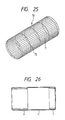
- FIG. 25 shows a cylinder 70 which is another modification of the radially displaceable member 41.
- the cylinder 70 comprises a number of thread-shaped members 71 arranged in the axial direction, and annular retaining rings 72 secured to the thread-shaped members 71. Similarly as in the case of the cylinder 60, both ends of the cylinder 70 are secured.
- the cylinders shown in FIG. 24 and 25 can readily be formed as components, which facilitate the assembling of the mechanical pencils according to the invention. The same effect may be obtained by using a net-shaped cylinder.
- the radially displaceable member may be formed of many materials if it has following characteristics: readily radially displaceable; strong in temperature, humidity, and against the pinching force; restored substantially to its original condition positively, rapidly and completely; and when a part of the member is radially displaced, the remaining parts would not obstruct the radially displacement of the part.
- the radially displaceable member should substantially be round shaped in cross section. The longitudinal length of the radially displaceable member shortens in accordance with the radial displacement thereof.
- the radially displaceable member may be thread-shaped members formed of a fishing line or a metal wire, monofilament, a gauze, a flexible cloth, a net, a bag, a flexible metal thin plate, a rubber, a metal having a plurality of longitudinal slits, a cylinder formed of a synthetic resin, a cellophane tube, a thermosetting film tube or the like.
- Fig. 26 is a cross sectional view showing an essential part of the mechanical pencil, in which a thermosetting film tube is employed as a radially displaceable member 41 of the sixth embodiment of the mechanical pencil shown in Fig. 18.
- a heat is applied to the thermosetting film tube 41 after the tightening member receiver 6 and the rear holder 7 are inserted into the film tube 41 at a position shown in Fig. 26.
- the film tube 41 is fixedly connected to the tightening member receiver 6 and to the rear holder 7, thereby forming these components as one unit.
- the mechanical pencil having an automatic lead extending mechanism according to the present invention can perform a so-called "turning and writing" operation.
- the lead is protruded from a tip end of the pencil body during the writing.
- the lead can be extended with a relatively weak pinching force applied to the pencil body, that is, the radially displaceable member without changing the position of the fingers holding the pencil body.
- the mechanical pencil of the invention can be assembled with small the numbers of components and requires no special techniques in manufacturing.
Landscapes
- Mechanical Pencils And Projecting And Retracting Systems Therefor, And Multi-System Writing Instruments (AREA)
Applications Claiming Priority (2)
| Application Number | Priority Date | Filing Date | Title |
|---|---|---|---|
| JP191074/88 | 1988-07-30 | ||
| JP63191074A JPH0241295A (ja) | 1988-07-30 | 1988-07-30 | つまみ式シャープペンシル |
Publications (2)
| Publication Number | Publication Date |
|---|---|
| EP0353379A2 true EP0353379A2 (fr) | 1990-02-07 |
| EP0353379A3 EP0353379A3 (fr) | 1990-11-07 |
Family
ID=16268432
Family Applications (1)
| Application Number | Title | Priority Date | Filing Date |
|---|---|---|---|
| EP19890103751 Withdrawn EP0353379A3 (fr) | 1988-07-30 | 1989-03-03 | Porte-mine méchanique pourvu de moyens automatiques d'avance de la mine |
Country Status (3)
| Country | Link |
|---|---|
| US (1) | US4979839A (fr) |
| EP (1) | EP0353379A3 (fr) |
| JP (1) | JPH0241295A (fr) |
Cited By (2)
| Publication number | Priority date | Publication date | Assignee | Title |
|---|---|---|---|---|
| EP1046516A1 (fr) * | 1999-04-22 | 2000-10-25 | A.T.X. International, Inc. | Manchon de poignée variable |
| JP2013082206A (ja) * | 2011-09-29 | 2013-05-09 | Pentel Corp | シャープペンシル |
Families Citing this family (3)
| Publication number | Priority date | Publication date | Assignee | Title |
|---|---|---|---|---|
| US6591456B2 (en) | 2001-07-09 | 2003-07-15 | Bic Corporation | Cushioning device |
| US9335874B2 (en) | 2013-03-12 | 2016-05-10 | Bby Solutions, Inc. | Validated touchscreen stylus interaction method |
| US9063588B2 (en) | 2013-03-12 | 2015-06-23 | Bby Solutions, Inc. | Grip-enabled touchscreen stylus |
Family Cites Families (11)
| Publication number | Priority date | Publication date | Assignee | Title |
|---|---|---|---|---|
| US2340665A (en) * | 1942-10-15 | 1944-02-01 | Doyle P Jacobs | Mechanical pencil |
| DE1020256B (de) * | 1953-06-08 | 1957-11-28 | Pelikan Werke Wagner Guenther | Handschreibgeraet mit durch Querdruck auf einen querelastischen Teil des Schreibgeraeteschaftes laengsbeweglich gefuehrter Klemmzange |
| DE2307530C3 (de) * | 1972-02-15 | 1981-01-15 | Mitsubishi Pencil Co. Ltd., Tokio | Füllbleistift |
| US3883253A (en) * | 1972-03-03 | 1975-05-13 | Pentel Kk | Mechanical pencil |
| US3854824A (en) * | 1973-04-03 | 1974-12-17 | Mitsubishi Pencil Co | Mechanical pencil |
| US4270870A (en) * | 1977-05-22 | 1981-06-02 | Ancos Co., Ltd. | Mechanical pencil with chuck closing by normal writing grip |
| JPS54138730A (en) * | 1978-04-19 | 1979-10-27 | Ancos Co Ltd | Rotary mechanical pencil |
| US4358210A (en) * | 1978-11-20 | 1982-11-09 | Ancos Co., Ltd. | Mechanical pencil with chuck closing by normal writing grip |
| EP0219001A1 (fr) * | 1985-10-02 | 1987-04-22 | Ancos Co., Ltd. | Porte-mine mécanique |
| EP0231893A1 (fr) * | 1986-01-30 | 1987-08-12 | Ancos Co., Ltd. | Instrument pour écrire |
| DE8709048U1 (de) * | 1987-07-01 | 1987-11-12 | Halm, Hans, 4690 Herne | Schreib- und Zeichengerät |
-
1988
- 1988-07-30 JP JP63191074A patent/JPH0241295A/ja active Pending
-
1989
- 1989-03-03 EP EP19890103751 patent/EP0353379A3/fr not_active Withdrawn
- 1989-03-03 US US07/318,300 patent/US4979839A/en not_active Expired - Fee Related
Cited By (2)
| Publication number | Priority date | Publication date | Assignee | Title |
|---|---|---|---|---|
| EP1046516A1 (fr) * | 1999-04-22 | 2000-10-25 | A.T.X. International, Inc. | Manchon de poignée variable |
| JP2013082206A (ja) * | 2011-09-29 | 2013-05-09 | Pentel Corp | シャープペンシル |
Also Published As
| Publication number | Publication date |
|---|---|
| JPH0241295A (ja) | 1990-02-09 |
| EP0353379A3 (fr) | 1990-11-07 |
| US4979839A (en) | 1990-12-25 |
Similar Documents
| Publication | Publication Date | Title |
|---|---|---|
| EP0806305B1 (fr) | Porte-mine a poussoir lateral | |
| US4911569A (en) | Mechanical pencil with a fluid actuator | |
| EP0267557A1 (fr) | Instrument d'écriture avec mécanisme pour prévenir le dessèchement | |
| US4382706A (en) | Mechanical pencil | |
| USH1050H (en) | Writing instrument | |
| US4979839A (en) | Mechanical pencil having an automatic lead extending mechanism | |
| US4729684A (en) | Mechanical pencil | |
| GB2100197A (en) | Mechanical pencil with automatic lead advance | |
| EP0917967B1 (fr) | Porte-mine a mine retractable | |
| US5733057A (en) | Slider for mechanical pencil | |
| EP0219001A1 (fr) | Porte-mine mécanique | |
| US4165941A (en) | Mechanical pencil | |
| EP0754127B1 (fr) | Instrument d'ecriture | |
| EP0213275B1 (fr) | Porte-mine automatique | |
| JP3333040B2 (ja) | 触指繰り出し式シャープペンシル | |
| JPH0310899A (ja) | つまみ式シャープペンシル | |
| JP2560818Y2 (ja) | シャープペンシルのスライダ | |
| JPS5842148Y2 (ja) | シヤ−プペンシル | |
| JPS6227431Y2 (fr) | ||
| JPS6227430Y2 (fr) | ||
| JP4786073B2 (ja) | シャープペンシル | |
| KR950004668Y1 (ko) | 샤아프펜슬 | |
| JP2519913B2 (ja) | 自動繰出式シヤ−プペンシル | |
| JPS599917Y2 (ja) | 筆記具 | |
| JPH023912Y2 (fr) |
Legal Events
| Date | Code | Title | Description |
|---|---|---|---|
| PUAI | Public reference made under article 153(3) epc to a published international application that has entered the european phase |
Free format text: ORIGINAL CODE: 0009012 |
|
| AK | Designated contracting states |
Kind code of ref document: A2 Designated state(s): DE FR GB |
|
| PUAL | Search report despatched |
Free format text: ORIGINAL CODE: 0009013 |
|
| AK | Designated contracting states |
Kind code of ref document: A3 Designated state(s): DE FR GB |
|
| RHK1 | Main classification (correction) |
Ipc: B43K 24/02 |
|
| 17P | Request for examination filed |
Effective date: 19910314 |
|
| STAA | Information on the status of an ep patent application or granted ep patent |
Free format text: STATUS: THE APPLICATION HAS BEEN WITHDRAWN |
|
| 18W | Application withdrawn |
Withdrawal date: 19911216 |