EP0353845A1 - Chlorure de sodium sous forme de cristaux tétraédriques et solution aqueuse le contenant - Google Patents
Chlorure de sodium sous forme de cristaux tétraédriques et solution aqueuse le contenant Download PDFInfo
- Publication number
- EP0353845A1 EP0353845A1 EP89305755A EP89305755A EP0353845A1 EP 0353845 A1 EP0353845 A1 EP 0353845A1 EP 89305755 A EP89305755 A EP 89305755A EP 89305755 A EP89305755 A EP 89305755A EP 0353845 A1 EP0353845 A1 EP 0353845A1
- Authority
- EP
- European Patent Office
- Prior art keywords
- tetrahedronal
- flat
- sodium chloride
- crystal
- crystal form
- Prior art date
- Legal status (The legal status is an assumption and is not a legal conclusion. Google has not performed a legal analysis and makes no representation as to the accuracy of the status listed.)
- Withdrawn
Links
- FAPWRFPIFSIZLT-UHFFFAOYSA-M Sodium chloride Chemical compound [Na+].[Cl-] FAPWRFPIFSIZLT-UHFFFAOYSA-M 0.000 title claims abstract description 139
- 239000013078 crystal Substances 0.000 title claims abstract description 129
- 239000011780 sodium chloride Substances 0.000 title claims abstract description 70
- 239000007864 aqueous solution Substances 0.000 title claims abstract description 40
- FBAFATDZDUQKNH-UHFFFAOYSA-M iron chloride Chemical compound [Cl-].[Fe] FBAFATDZDUQKNH-UHFFFAOYSA-M 0.000 claims abstract description 13
- 235000002639 sodium chloride Nutrition 0.000 description 68
- XLYOFNOQVPJJNP-UHFFFAOYSA-N water Chemical compound O XLYOFNOQVPJJNP-UHFFFAOYSA-N 0.000 description 45
- 239000000243 solution Substances 0.000 description 41
- 239000012153 distilled water Substances 0.000 description 29
- 239000000203 mixture Substances 0.000 description 25
- 239000006071 cream Substances 0.000 description 24
- 238000012360 testing method Methods 0.000 description 21
- 230000000694 effects Effects 0.000 description 18
- 238000009472 formulation Methods 0.000 description 18
- 229910021578 Iron(III) chloride Inorganic materials 0.000 description 15
- RBTARNINKXHZNM-UHFFFAOYSA-K iron trichloride Chemical compound Cl[Fe](Cl)Cl RBTARNINKXHZNM-UHFFFAOYSA-K 0.000 description 15
- 230000005856 abnormality Effects 0.000 description 14
- 239000003054 catalyst Substances 0.000 description 13
- 239000003245 coal Substances 0.000 description 12
- SHGAZHPCJJPHSC-YCNIQYBTSA-N all-trans-retinoic acid Chemical compound OC(=O)\C=C(/C)\C=C\C=C(/C)\C=C\C1=C(C)CCCC1(C)C SHGAZHPCJJPHSC-YCNIQYBTSA-N 0.000 description 11
- 229930002330 retinoic acid Natural products 0.000 description 10
- 239000011550 stock solution Substances 0.000 description 9
- 230000001737 promoting effect Effects 0.000 description 8
- 241000220317 Rosa Species 0.000 description 7
- 239000000839 emulsion Substances 0.000 description 7
- 239000007787 solid Substances 0.000 description 7
- 239000000126 substance Substances 0.000 description 7
- XEEYBQQBJWHFJM-UHFFFAOYSA-N Iron Chemical compound [Fe] XEEYBQQBJWHFJM-UHFFFAOYSA-N 0.000 description 6
- DNIAPMSPPWPWGF-UHFFFAOYSA-N Propylene glycol Chemical compound CC(O)CO DNIAPMSPPWPWGF-UHFFFAOYSA-N 0.000 description 6
- 241000212749 Zesius chrysomallus Species 0.000 description 6
- 241001233061 earthworms Species 0.000 description 6
- JEIPFZHSYJVQDO-UHFFFAOYSA-N iron(III) oxide Inorganic materials O=[Fe]O[Fe]=O JEIPFZHSYJVQDO-UHFFFAOYSA-N 0.000 description 6
- 150000003839 salts Chemical class 0.000 description 6
- 238000001704 evaporation Methods 0.000 description 5
- 230000008020 evaporation Effects 0.000 description 5
- KIEOKOFEPABQKJ-UHFFFAOYSA-N sodium dichromate Chemical compound [Na+].[Na+].[O-][Cr](=O)(=O)O[Cr]([O-])(=O)=O KIEOKOFEPABQKJ-UHFFFAOYSA-N 0.000 description 5
- OKTJSMMVPCPJKN-UHFFFAOYSA-N Carbon Chemical compound [C] OKTJSMMVPCPJKN-UHFFFAOYSA-N 0.000 description 4
- PEDCQBHIVMGVHV-UHFFFAOYSA-N Glycerine Chemical compound OCC(O)CO PEDCQBHIVMGVHV-UHFFFAOYSA-N 0.000 description 4
- 238000002485 combustion reaction Methods 0.000 description 4
- -1 for example Chemical compound 0.000 description 4
- 238000000034 method Methods 0.000 description 4
- 238000001953 recrystallisation Methods 0.000 description 4
- 239000013535 sea water Substances 0.000 description 4
- 230000009291 secondary effect Effects 0.000 description 4
- PRAKJMSDJKAYCZ-UHFFFAOYSA-N squalane Chemical compound CC(C)CCCC(C)CCCC(C)CCCCC(C)CCCC(C)CCCC(C)C PRAKJMSDJKAYCZ-UHFFFAOYSA-N 0.000 description 4
- 239000008399 tap water Substances 0.000 description 4
- 235000020679 tap water Nutrition 0.000 description 4
- 229930006000 Sucrose Natural products 0.000 description 3
- CZMRCDWAGMRECN-UGDNZRGBSA-N Sucrose Chemical compound O[C@H]1[C@H](O)[C@@H](CO)O[C@@]1(CO)O[C@@H]1[C@H](O)[C@@H](O)[C@H](O)[C@@H](CO)O1 CZMRCDWAGMRECN-UGDNZRGBSA-N 0.000 description 3
- 239000011575 calcium Chemical class 0.000 description 3
- 229910052799 carbon Inorganic materials 0.000 description 3
- 238000010438 heat treatment Methods 0.000 description 3
- 229910052742 iron Inorganic materials 0.000 description 3
- 239000007788 liquid Substances 0.000 description 3
- 239000011777 magnesium Chemical class 0.000 description 3
- 239000002674 ointment Substances 0.000 description 3
- 235000013311 vegetables Nutrition 0.000 description 3
- LDVVTQMJQSCDMK-UHFFFAOYSA-N 1,3-dihydroxypropan-2-yl formate Chemical compound OCC(CO)OC=O LDVVTQMJQSCDMK-UHFFFAOYSA-N 0.000 description 2
- FDCJDKXCCYFOCV-UHFFFAOYSA-N 1-hexadecoxyhexadecane Chemical compound CCCCCCCCCCCCCCCCOCCCCCCCCCCCCCCCC FDCJDKXCCYFOCV-UHFFFAOYSA-N 0.000 description 2
- QCDWFXQBSFUVSP-UHFFFAOYSA-N 2-phenoxyethanol Chemical compound OCCOC1=CC=CC=C1 QCDWFXQBSFUVSP-UHFFFAOYSA-N 0.000 description 2
- 208000002874 Acne Vulgaris Diseases 0.000 description 2
- 235000009355 Dianthus caryophyllus Nutrition 0.000 description 2
- 240000006497 Dianthus caryophyllus Species 0.000 description 2
- VEXZGXHMUGYJMC-UHFFFAOYSA-N Hydrochloric acid Chemical compound Cl VEXZGXHMUGYJMC-UHFFFAOYSA-N 0.000 description 2
- 241000361919 Metaphire sieboldi Species 0.000 description 2
- PXHVJJICTQNCMI-UHFFFAOYSA-N Nickel Chemical compound [Ni] PXHVJJICTQNCMI-UHFFFAOYSA-N 0.000 description 2
- 241000109329 Rosa xanthina Species 0.000 description 2
- 235000004789 Rosa xanthina Nutrition 0.000 description 2
- VYPSYNLAJGMNEJ-UHFFFAOYSA-N Silicium dioxide Chemical compound O=[Si]=O VYPSYNLAJGMNEJ-UHFFFAOYSA-N 0.000 description 2
- 235000021355 Stearic acid Nutrition 0.000 description 2
- 239000002253 acid Substances 0.000 description 2
- 206010000496 acne Diseases 0.000 description 2
- 239000004480 active ingredient Substances 0.000 description 2
- 230000032683 aging Effects 0.000 description 2
- AXCZMVOFGPJBDE-UHFFFAOYSA-L calcium dihydroxide Chemical compound [OH-].[OH-].[Ca+2] AXCZMVOFGPJBDE-UHFFFAOYSA-L 0.000 description 2
- 239000000920 calcium hydroxide Substances 0.000 description 2
- 229910001861 calcium hydroxide Inorganic materials 0.000 description 2
- 229960000541 cetyl alcohol Drugs 0.000 description 2
- 229910052906 cristobalite Inorganic materials 0.000 description 2
- 238000002425 crystallisation Methods 0.000 description 2
- 230000008025 crystallization Effects 0.000 description 2
- 235000014113 dietary fatty acids Nutrition 0.000 description 2
- 238000010790 dilution Methods 0.000 description 2
- 239000012895 dilution Substances 0.000 description 2
- JYDRNIYTFCBIFC-UHFFFAOYSA-N disodium;oxido-(oxido(dioxo)chromio)oxy-dioxochromium;dihydrate Chemical compound O.O.[Na+].[Na+].[O-][Cr](=O)(=O)O[Cr]([O-])(=O)=O JYDRNIYTFCBIFC-UHFFFAOYSA-N 0.000 description 2
- 239000006185 dispersion Substances 0.000 description 2
- 239000000194 fatty acid Substances 0.000 description 2
- 229930195729 fatty acid Natural products 0.000 description 2
- 239000000706 filtrate Substances 0.000 description 2
- 235000011187 glycerol Nutrition 0.000 description 2
- BXWNKGSJHAJOGX-UHFFFAOYSA-N hexadecan-1-ol Chemical compound CCCCCCCCCCCCCCCCO BXWNKGSJHAJOGX-UHFFFAOYSA-N 0.000 description 2
- JXTPJDDICSTXJX-UHFFFAOYSA-N n-Triacontane Natural products CCCCCCCCCCCCCCCCCCCCCCCCCCCCCC JXTPJDDICSTXJX-UHFFFAOYSA-N 0.000 description 2
- QIQXTHQIDYTFRH-UHFFFAOYSA-N octadecanoic acid Chemical compound CCCCCCCCCCCCCCCCCC(O)=O QIQXTHQIDYTFRH-UHFFFAOYSA-N 0.000 description 2
- OQCDKBAXFALNLD-UHFFFAOYSA-N octadecanoic acid Natural products CCCCCCCC(C)CCCCCCCCC(O)=O OQCDKBAXFALNLD-UHFFFAOYSA-N 0.000 description 2
- 229960005323 phenoxyethanol Drugs 0.000 description 2
- 230000008092 positive effect Effects 0.000 description 2
- 239000003755 preservative agent Substances 0.000 description 2
- 239000000047 product Substances 0.000 description 2
- 230000002787 reinforcement Effects 0.000 description 2
- 239000011734 sodium Substances 0.000 description 2
- 229940032094 squalane Drugs 0.000 description 2
- 239000008117 stearic acid Substances 0.000 description 2
- 238000004736 wide-angle X-ray diffraction Methods 0.000 description 2
- DNIAPMSPPWPWGF-GSVOUGTGSA-N (R)-(-)-Propylene glycol Chemical compound C[C@@H](O)CO DNIAPMSPPWPWGF-GSVOUGTGSA-N 0.000 description 1
- 241000894006 Bacteria Species 0.000 description 1
- OYPRJOBELJOOCE-UHFFFAOYSA-N Calcium Chemical class [Ca] OYPRJOBELJOOCE-UHFFFAOYSA-N 0.000 description 1
- VYZAMTAEIAYCRO-UHFFFAOYSA-N Chromium Chemical class [Cr] VYZAMTAEIAYCRO-UHFFFAOYSA-N 0.000 description 1
- RYGMFSIKBFXOCR-UHFFFAOYSA-N Copper Chemical compound [Cu] RYGMFSIKBFXOCR-UHFFFAOYSA-N 0.000 description 1
- WHXSMMKQMYFTQS-UHFFFAOYSA-N Lithium Chemical class [Li] WHXSMMKQMYFTQS-UHFFFAOYSA-N 0.000 description 1
- FYYHWMGAXLPEAU-UHFFFAOYSA-N Magnesium Chemical class [Mg] FYYHWMGAXLPEAU-UHFFFAOYSA-N 0.000 description 1
- 241001465754 Metazoa Species 0.000 description 1
- 239000004909 Moisturizer Substances 0.000 description 1
- ZOKXTWBITQBERF-UHFFFAOYSA-N Molybdenum Chemical compound [Mo] ZOKXTWBITQBERF-UHFFFAOYSA-N 0.000 description 1
- 206010028980 Neoplasm Diseases 0.000 description 1
- 208000002193 Pain Diseases 0.000 description 1
- ZLMJMSJWJFRBEC-UHFFFAOYSA-N Potassium Chemical class [K] ZLMJMSJWJFRBEC-UHFFFAOYSA-N 0.000 description 1
- 239000000654 additive Substances 0.000 description 1
- 229910052782 aluminium Inorganic materials 0.000 description 1
- XAGFODPZIPBFFR-UHFFFAOYSA-N aluminium Chemical compound [Al] XAGFODPZIPBFFR-UHFFFAOYSA-N 0.000 description 1
- 238000004458 analytical method Methods 0.000 description 1
- 230000001775 anti-pathogenic effect Effects 0.000 description 1
- 239000000427 antigen Substances 0.000 description 1
- 102000036639 antigens Human genes 0.000 description 1
- 108091007433 antigens Proteins 0.000 description 1
- 239000003963 antioxidant agent Substances 0.000 description 1
- 235000006708 antioxidants Nutrition 0.000 description 1
- 229910052793 cadmium Inorganic materials 0.000 description 1
- BDOSMKKIYDKNTQ-UHFFFAOYSA-N cadmium atom Chemical compound [Cd] BDOSMKKIYDKNTQ-UHFFFAOYSA-N 0.000 description 1
- 229910052791 calcium Inorganic materials 0.000 description 1
- 201000011510 cancer Diseases 0.000 description 1
- 150000001720 carbohydrates Chemical class 0.000 description 1
- 238000006243 chemical reaction Methods 0.000 description 1
- 229910017052 cobalt Inorganic materials 0.000 description 1
- 239000010941 cobalt Substances 0.000 description 1
- GUTLYIVDDKVIGB-UHFFFAOYSA-N cobalt atom Chemical compound [Co] GUTLYIVDDKVIGB-UHFFFAOYSA-N 0.000 description 1
- 229910052802 copper Inorganic materials 0.000 description 1
- 239000010949 copper Substances 0.000 description 1
- 239000003246 corticosteroid Substances 0.000 description 1
- 229960001334 corticosteroids Drugs 0.000 description 1
- 238000005034 decoration Methods 0.000 description 1
- 230000001877 deodorizing effect Effects 0.000 description 1
- 230000000994 depressogenic effect Effects 0.000 description 1
- 229940079593 drug Drugs 0.000 description 1
- 239000003814 drug Substances 0.000 description 1
- 230000005611 electricity Effects 0.000 description 1
- 238000000635 electron micrograph Methods 0.000 description 1
- 238000000921 elemental analysis Methods 0.000 description 1
- 230000008030 elimination Effects 0.000 description 1
- 238000003379 elimination reaction Methods 0.000 description 1
- 239000003995 emulsifying agent Substances 0.000 description 1
- 150000004665 fatty acids Chemical class 0.000 description 1
- 239000000446 fuel Substances 0.000 description 1
- 239000010439 graphite Substances 0.000 description 1
- 229910002804 graphite Inorganic materials 0.000 description 1
- 239000010442 halite Substances 0.000 description 1
- 229930195733 hydrocarbon Natural products 0.000 description 1
- 150000002430 hydrocarbons Chemical class 0.000 description 1
- 229910052500 inorganic mineral Inorganic materials 0.000 description 1
- 230000002045 lasting effect Effects 0.000 description 1
- 229910052744 lithium Inorganic materials 0.000 description 1
- 229910052749 magnesium Inorganic materials 0.000 description 1
- 238000012423 maintenance Methods 0.000 description 1
- WPBNNNQJVZRUHP-UHFFFAOYSA-L manganese(2+);methyl n-[[2-(methoxycarbonylcarbamothioylamino)phenyl]carbamothioyl]carbamate;n-[2-(sulfidocarbothioylamino)ethyl]carbamodithioate Chemical class [Mn+2].[S-]C(=S)NCCNC([S-])=S.COC(=O)NC(=S)NC1=CC=CC=C1NC(=S)NC(=O)OC WPBNNNQJVZRUHP-UHFFFAOYSA-L 0.000 description 1
- 238000004519 manufacturing process Methods 0.000 description 1
- 238000005259 measurement Methods 0.000 description 1
- 230000008018 melting Effects 0.000 description 1
- 238000002844 melting Methods 0.000 description 1
- 229910052751 metal Inorganic materials 0.000 description 1
- 239000002184 metal Substances 0.000 description 1
- 150000001455 metallic ions Chemical class 0.000 description 1
- 235000010755 mineral Nutrition 0.000 description 1
- 239000011707 mineral Substances 0.000 description 1
- 239000011259 mixed solution Substances 0.000 description 1
- 230000001333 moisturizer Effects 0.000 description 1
- 229910052750 molybdenum Inorganic materials 0.000 description 1
- 239000011733 molybdenum Substances 0.000 description 1
- 229910052759 nickel Inorganic materials 0.000 description 1
- 231100000989 no adverse effect Toxicity 0.000 description 1
- 239000003921 oil Substances 0.000 description 1
- 239000003973 paint Substances 0.000 description 1
- 239000002304 perfume Substances 0.000 description 1
- 230000000144 pharmacologic effect Effects 0.000 description 1
- 239000011591 potassium Chemical class 0.000 description 1
- 229910052700 potassium Inorganic materials 0.000 description 1
- KMUONIBRACKNSN-UHFFFAOYSA-N potassium dichromate Chemical compound [K+].[K+].[O-][Cr](=O)(=O)O[Cr]([O-])(=O)=O KMUONIBRACKNSN-UHFFFAOYSA-N 0.000 description 1
- 239000012286 potassium permanganate Substances 0.000 description 1
- 230000002335 preservative effect Effects 0.000 description 1
- 230000003405 preventing effect Effects 0.000 description 1
- 230000002265 prevention Effects 0.000 description 1
- 238000000746 purification Methods 0.000 description 1
- 230000001846 repelling effect Effects 0.000 description 1
- 238000011160 research Methods 0.000 description 1
- 239000000565 sealant Substances 0.000 description 1
- 229910052710 silicon Inorganic materials 0.000 description 1
- 239000010703 silicon Substances 0.000 description 1
- 239000002689 soil Substances 0.000 description 1
- 230000003068 static effect Effects 0.000 description 1
- 238000005728 strengthening Methods 0.000 description 1
- 229910052712 strontium Inorganic materials 0.000 description 1
- CIOAGBVUUVVLOB-UHFFFAOYSA-N strontium atom Chemical compound [Sr] CIOAGBVUUVVLOB-UHFFFAOYSA-N 0.000 description 1
- 239000005720 sucrose Substances 0.000 description 1
- 229960001727 tretinoin Drugs 0.000 description 1
- 229910052720 vanadium Inorganic materials 0.000 description 1
- LEONUFNNVUYDNQ-UHFFFAOYSA-N vanadium atom Chemical class [V] LEONUFNNVUYDNQ-UHFFFAOYSA-N 0.000 description 1
- 239000001993 wax Substances 0.000 description 1
Images


Classifications
-
- C—CHEMISTRY; METALLURGY
- C01—INORGANIC CHEMISTRY
- C01D—COMPOUNDS OF ALKALI METALS, i.e. LITHIUM, SODIUM, POTASSIUM, RUBIDIUM, CAESIUM, OR FRANCIUM
- C01D3/00—Halides of sodium, potassium or alkali metals in general
- C01D3/04—Chlorides
-
- A—HUMAN NECESSITIES
- A61—MEDICAL OR VETERINARY SCIENCE; HYGIENE
- A61K—PREPARATIONS FOR MEDICAL, DENTAL OR TOILETRY PURPOSES
- A61K8/00—Cosmetics or similar toiletry preparations
- A61K8/18—Cosmetics or similar toiletry preparations characterised by the composition
- A61K8/19—Cosmetics or similar toiletry preparations characterised by the composition containing inorganic ingredients
- A61K8/20—Halogens; Compounds thereof
-
- A—HUMAN NECESSITIES
- A61—MEDICAL OR VETERINARY SCIENCE; HYGIENE
- A61K—PREPARATIONS FOR MEDICAL, DENTAL OR TOILETRY PURPOSES
- A61K47/00—Medicinal preparations characterised by the non-active ingredients used, e.g. carriers or inert additives; Targeting or modifying agents chemically bound to the active ingredient
- A61K47/02—Inorganic compounds
-
- A—HUMAN NECESSITIES
- A61—MEDICAL OR VETERINARY SCIENCE; HYGIENE
- A61K—PREPARATIONS FOR MEDICAL, DENTAL OR TOILETRY PURPOSES
- A61K8/00—Cosmetics or similar toiletry preparations
- A61K8/02—Cosmetics or similar toiletry preparations characterised by special physical form
- A61K8/0241—Containing particulates characterized by their shape and/or structure
- A61K8/0245—Specific shapes or structures not provided for by any of the groups of A61K8/0241
-
- A—HUMAN NECESSITIES
- A61—MEDICAL OR VETERINARY SCIENCE; HYGIENE
- A61K—PREPARATIONS FOR MEDICAL, DENTAL OR TOILETRY PURPOSES
- A61K8/00—Cosmetics or similar toiletry preparations
- A61K8/18—Cosmetics or similar toiletry preparations characterised by the composition
- A61K8/19—Cosmetics or similar toiletry preparations characterised by the composition containing inorganic ingredients
-
- A—HUMAN NECESSITIES
- A61—MEDICAL OR VETERINARY SCIENCE; HYGIENE
- A61K—PREPARATIONS FOR MEDICAL, DENTAL OR TOILETRY PURPOSES
- A61K9/00—Medicinal preparations characterised by special physical form
- A61K9/0012—Galenical forms characterised by the site of application
- A61K9/0014—Skin, i.e. galenical aspects of topical compositions
-
- A—HUMAN NECESSITIES
- A61—MEDICAL OR VETERINARY SCIENCE; HYGIENE
- A61Q—SPECIFIC USE OF COSMETICS OR SIMILAR TOILETRY PREPARATIONS
- A61Q19/00—Preparations for care of the skin
-
- C—CHEMISTRY; METALLURGY
- C01—INORGANIC CHEMISTRY
- C01D—COMPOUNDS OF ALKALI METALS, i.e. LITHIUM, SODIUM, POTASSIUM, RUBIDIUM, CAESIUM, OR FRANCIUM
- C01D3/00—Halides of sodium, potassium or alkali metals in general
- C01D3/22—Preparation in the form of granules, pieces, or other shaped products
- C01D3/24—Influencing the crystallisation process
-
- C—CHEMISTRY; METALLURGY
- C30—CRYSTAL GROWTH
- C30B—SINGLE-CRYSTAL GROWTH; UNIDIRECTIONAL SOLIDIFICATION OF EUTECTIC MATERIAL OR UNIDIRECTIONAL DEMIXING OF EUTECTOID MATERIAL; REFINING BY ZONE-MELTING OF MATERIAL; PRODUCTION OF A HOMOGENEOUS POLYCRYSTALLINE MATERIAL WITH DEFINED STRUCTURE; SINGLE CRYSTALS OR HOMOGENEOUS POLYCRYSTALLINE MATERIAL WITH DEFINED STRUCTURE; AFTER-TREATMENT OF SINGLE CRYSTALS OR A HOMOGENEOUS POLYCRYSTALLINE MATERIAL WITH DEFINED STRUCTURE; APPARATUS THEREFOR
- C30B29/00—Single crystals or homogeneous polycrystalline material with defined structure characterised by the material or by their shape
- C30B29/10—Inorganic compounds or compositions
- C30B29/12—Halides
-
- C—CHEMISTRY; METALLURGY
- C30—CRYSTAL GROWTH
- C30B—SINGLE-CRYSTAL GROWTH; UNIDIRECTIONAL SOLIDIFICATION OF EUTECTIC MATERIAL OR UNIDIRECTIONAL DEMIXING OF EUTECTOID MATERIAL; REFINING BY ZONE-MELTING OF MATERIAL; PRODUCTION OF A HOMOGENEOUS POLYCRYSTALLINE MATERIAL WITH DEFINED STRUCTURE; SINGLE CRYSTALS OR HOMOGENEOUS POLYCRYSTALLINE MATERIAL WITH DEFINED STRUCTURE; AFTER-TREATMENT OF SINGLE CRYSTALS OR A HOMOGENEOUS POLYCRYSTALLINE MATERIAL WITH DEFINED STRUCTURE; APPARATUS THEREFOR
- C30B7/00—Single-crystal growth from solutions using solvents which are liquid at normal temperature, e.g. aqueous solutions
-
- A—HUMAN NECESSITIES
- A61—MEDICAL OR VETERINARY SCIENCE; HYGIENE
- A61K—PREPARATIONS FOR MEDICAL, DENTAL OR TOILETRY PURPOSES
- A61K2800/00—Properties of cosmetic compositions or active ingredients thereof or formulation aids used therein and process related aspects
- A61K2800/10—General cosmetic use
-
- A—HUMAN NECESSITIES
- A61—MEDICAL OR VETERINARY SCIENCE; HYGIENE
- A61K—PREPARATIONS FOR MEDICAL, DENTAL OR TOILETRY PURPOSES
- A61K2800/00—Properties of cosmetic compositions or active ingredients thereof or formulation aids used therein and process related aspects
- A61K2800/40—Chemical, physico-chemical or functional or structural properties of particular ingredients
- A61K2800/41—Particular ingredients further characterized by their size
-
- A—HUMAN NECESSITIES
- A61—MEDICAL OR VETERINARY SCIENCE; HYGIENE
- A61K—PREPARATIONS FOR MEDICAL, DENTAL OR TOILETRY PURPOSES
- A61K2800/00—Properties of cosmetic compositions or active ingredients thereof or formulation aids used therein and process related aspects
- A61K2800/40—Chemical, physico-chemical or functional or structural properties of particular ingredients
- A61K2800/52—Stabilizers
- A61K2800/524—Preservatives
Definitions
- the present invention relates to sodium chloride having a novel crystal form and to an aqueous solution containing sodium chloride of that novel crystal form or able to convert to that novel crystal form.
- the crystal of sodium chloride has a rock salt structure and, as a crystal form, there are generally known cubes and cubic hexahedrons (tetradecahedrons).
- An object of the present invention is to provide sodium chloride having a novel crystal form.
- Another object of the present invention is to provide an aqueous solution containing sodium chloride having the above-mentioned novel crystal form or able to convert to this crystal form and iron chloride.
- sodium chloride in a flat tetrahedronal crystal form.
- an aqueous solution containing (i) sodium chloride in a flat tetrahedronal crystal form or sodium chloride capable of converting to a flat tetrahedronal crystal form and (ii) iron chloride.
- the present inventors engaged in long years of research and as a result succeeded in the manufacture of sodium chloride having a unique crystal form unknown in the prior art. Further, the present inventor discovered that sodium chloride having this unique crystal form displays the action of improving the chemical stability of skin ointments and suppresses secondary effects. Further, the present inventor discovered that an aqueous solution of sodium chloride having this novel crystal form or sodium chloride able to convert to this crystal form and iron chloride has an unexpected effect of promoting activity. This activity promoting action means, for life, a positive effect on the maintenance of life and, for nonlife, the nature of strengthening the inherent characteristics of a substance and thus a positive effect on, for example, energy conversion action.
- the novel crystal form shown by the sodium chloride of the present invention is a flat tetrahedron comprised of a regular tetrahedron with one height reduced. More precisely speaking, it is formed from three side faces of substantially the same isosceles triangles (however, the equal sides being shorter than the base) and one bottom face of a roughly equilateral triangle with the four vertexes being slightly rounded.
- the degree of flatness of the crystal of the present invention varies over a wide range and in general the degree of flatness advances as the dimensions of the crystal become larger. Here, if the degree of flatness is shown by the length a of one side of the equilateral triangle base (see Fig.
- a : h is 1:0.8 to 50:1.
- a relatively small crystal for example, one where one side a of the equilateral triangle base is about 0.05 mm
- a:h is 1:0.8 to 5:1.
- a relatively large crystal for example, one where the one side a is about 1 mm
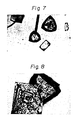
- a : h becomes 5:1 to 10:1. If the crystal grows further and the one side a becomes about 1.5 mm or more, then, as shown in Figs. 4 to 6, the degree of flatness further advances and a : h becomes 5:1 to 50:1 and further the central region of the base becomes depressed and therefore the three vertexes of the base stick out in form.
- flat tetrahedron is used herein as a term expressing all of the above shapes explained along with the above Figs. 1 to 6.
- the dimensions of the sodium chloride of the flat tetrahedronal crystal form of the present invention vary over a wide range depending on the crystallization conditions, but in general are about 0.05 to 3 mm.
- the sodium chloride in the flat tetrahedronal crystal form of the present invention may be manufactured by treating an aqueous solution of sodium chloride with a unique catalyst discovered by the present inventor (that is, a flat tetrahedronal crystal form imparting catalyst, hereinafter sometimes referred to simply as "the catalyst").
- the above-mentioned catalyst may be manufactured, for example, as follows: Iron chloride, for example, ferric chloride, is added to an aqueous solution obtained by treating cristobalite with an aqueous mineral acid (for example, a hydrohalogenic acid, preferably hydrochloric acid). When this solution is left standing for a long period (for example, 1 to 24 hours), a solution with a light brown color is obtained. This solution is referred to below as solution I. Solution I is diluted with a large volume (for example, 102 to 104 fold) of distilled water and again allowed to stand for a long period.
- aqueous mineral acid for example, a hydrohalogenic acid, preferably hydrochloric acid
- solution II a saccharide, for example, sucrose (white sugar, granular sugar, etc.) is added, then the solution allowed to stand for a further long period, whereupon a solution of a light yellow color is obtained.
- a saccharide for example, sucrose (white sugar, granular sugar, etc.) is added, then the solution allowed to stand for a further long period, whereupon a solution of a light yellow color is obtained.
- solution II a saccharide
- a small amount (for example, 0.1 to 5%) of iron chloride for example, ferric chloride
- an aqueous solution of sodium bichromate at close to saturation for example, 100 ml of water in which about 300 g of sodium bichromate dihydrate is dissolved
- potassium bichromate or potassium permanganate instead of sodium bichromate.
- To this solution is added 1/4 to 3/4 volumes of the above-mentioned solution II. This is allowed to stand for a long period and then heated (for example, 60°C to 80°C), whereupon a caramel-like solid is product. This is washed with water, whereupon the desired flat tetrahedronal crystal form imparting catalyst is obtained in the form of a granular solid of a black-brown color.
- the sodium chloride having the unique crystal form of the present invention may be manufactured by treating in the following way an aqueous solution of sodium chloride using the above-mentioned catalyst.
- a concentrated aqueous solution of sodium chloride is prepared.
- sodium chloride use may be made of various types of salt (for example, rock salt, crude salt, culinary salt, table salt.)
- Seawater may also be concentrated and used as the aqueous solution of sodium chloride.
- the concentration of sodium chloride of the aqueous solution of sodium chloride is preferably 25% or more. 0.01 to 1% by weight of the above-mentioned catalyst is added to the above-mentioned concentrated aqueous solution of sodium chloride, then the solution is evaporated to dryness.
- distilled water is added to the solid resulting from the evaporation to dryness so as to dissolve the same, then the solution again evaporated to dryness. This operation is repeated several times.
- distilled water is added to the solid resulting from the evaporation to dryness, then the catalyst is filtered out and the filtrate is evaporated to dryness, whereupon the desired sodium chloride crystals of the flat tetrahedronal crystal form are obtained together with cubical crystals and cubic hexahedronal crystals (below, sometimes referred to simply as cubical crystals).
- the ratio of volume of the obtained flat tetrahedronal crystals and the cubical crystals, etc. differs depending on the crystallization conditions, but in general the ratio of the flat tetrahedronal crystals to the cubical crystals, etc. is 1:100 to 1:3.
- the cubical crystals, etc. obtained together with the above-mentioned flat tetrahedronal crystal form alone are collected, dissolved in distilled water, and recrystallized, whereupon in addition to the cubic crystals, etc., the same flat tetrahedronal crystals as mentioned above are generated. Further, for example, the cubical crystals obtained at this stage alone are collected and similarly recrystallized, whereupon again flat tetrahedronal crystals are generated together with the cubical crystals, etc. Subsequently, the same operation is repeated, whereupon flat tetrahedronal crystals are partially generated.
- sodium chloride treated by the above-mentioned flat tetrahedronal crystal form imparting catalyst can convert to the flat tetrahedronal crystal form upon several repetitions of normal recrystallization.
- "sodium chloride with convertibility to flat tetrahedronal crystal form” means the ability to convert to a flat tetrahedronal crystal by repeated recrystallization since the actual crystal form is a cube or cubic hexahedron, but treatment by the flat tetrahedronal crystal form imparting catalyst has already been undergone.
- the flat tetrahedronal crystals according to the present invention have the effect of suppressing the secondary effects of skin ointments and improving chemical stability.
- the above-mentioned skin ointments are, for example, cream emulsions for the treatment of acne vulgaris, in particular cream emulsions for the treatment of acne vulgaris containing vitamin A acid (tretinoin).
- a cream emulsion containing vitamin A acid generally comprises active ingredients of vitamin A acid and also water repelling substances (liquid and solid fatty acids, aliphatic alcohol, fatty acid esters, waxes and hydrocarbons tolerable as medicines), nonionic emulsifiers, preservatives, antioxidants, and water and further small amounts of other additives (for example, moisturizers, metallic ion sealants, paints, perfumes, sunlight blockers, local corticosteroids).
- water repelling substances liquid and solid fatty acids, aliphatic alcohol, fatty acid esters, waxes and hydrocarbons tolerable as medicines
- nonionic emulsifiers preservatives
- antioxidants for example, moisturizers, metallic ion sealants, paints, perfumes, sunlight blockers, local corticosteroids.
- the flat tetrahedronal crystal sodium chloride of the present invention is added to such vitamin A acid containing cream emulsions in amounts of 0.2% to 10% by weight, preferably 0.3 to 1% by weight, there is no adverse effect on the pharmacological action of the active ingredient, vitamin A acid, and the secondary effects of the above-mentioned cream emulsions (for example, spots, stinging, ichiness) are remarkably suppressed and, further, the chemical stability to ultraviolet rays, etc. is improved.
- the sodium chloride of a flat tetrahedronal crystal form according to the present invention is used compounded with a salt of a metal element, for example, inorganic salts or organic salts of lithium, potassium, magnesium, calcium, vanadium, chrome, manganese, iron, strontium, cobalt, nickel, molybdenum, cadmium, aluminum, copper, etc. or with carbon or silicon, a deodorizing effect or water purification effect is exhibited.
- a salt of a metal element for example, inorganic salts or organic salts of lithium, potassium, magnesium, calcium, vanadium, chrome, manganese, iron, strontium, cobalt, nickel, molybdenum, cadmium, aluminum, copper, etc. or with carbon or silicon
- a preservative and rust preventing effect there are a preservative and rust preventing effect, a freshness maintaining effect for animal and vegetable matter, an antipathogenic bacteria effect, an effect of promotion of antigens and antibodies, a cancer suppressing effect, a suppressive effect on static electricity damage, and a soil and oil improving and vegetable growth promoting effect.
- the composition of the above-mentioned aqueous solution generally is: 2500 to 25 x 108 parts by weight of an iron chloride compound, preferably 2 x 10⁵ to 5 x 10⁵ parts by weight, further preferably 23 x 104 to 25 x 104 parts by weight, to one part by weight of the unique crystal sodium chloride. If the amount of the iron chloride compound becomes less than 2500 parts by weight, the activity promoting action disappears. Further, if it exceeds 25 x 108 parts by weight, the activity promoting effect disappears.
- the amount of water is 106 to 1020 parts by weight, preferably 108 to 1018 parts by weight, more preferably 1010 to 1016 parts by weight with respect to one part by weight of the total of the unique crystal sodium chloride and the iron chloride compound. If the dilution by water is less than 106 fold, the activity promoting effect disappears and if over 1020 fold, the activity promoting effect disappears.
- the method of dissolving the unique crystal sodium chloride and iron chloride compound together in distilled water is not suitable.
- the unique crystal sodium chloride is dissolved in distilled water and this solution is further diluted two or more times with distilled water so as to prepare a dilute aqueous solution of unique crystal sodium chloride.
- Into this dilute aqueous solution may be dissolved the necessary amount of iron chloride compound to prepare the solution.
- the coal When treating fuel (for example, coal) by the above-mentioned aqueous solution according to the present invention, the coal is improved in combustion performance compared with untreated coal. Further, in iron reinforcement, the rust prevention effect is assisted.
- the aqueous solution of the present invention acts to maintain life (for example, prolong and preserve the life of small earthworms) and acts to maintain the freshness of vegetable matter (for example, cut flowers).
- Example 3 The stock solution obtained in Example 3 was further diluted 109 fold by distilled water and taken in a test tube, five small earthworms were placed in the same, then the test tube was sealed. The test tube was allowed to stand, giving no feed at all and maintaining the water temperature at 15°C to 20°C. At the same time as this, similar tests were performed using tap water and distilled water. In the distilled water test, all the small earthworms died after two days from the start of the test. In the tap water test, all died after three days. As opposed to this, in the test of the dilution of the stock solution of Example 3, almost no change could be observed in the small earthworms even after one month.
- Example 3 The stock solution obtained in Example 3 was further diluted l09 fold with distilled water and taken in a test tube.
- the stem portion of a rose for flower arrangement was immersed in the solution. Approximately 3 cm of the stem was cut off in the solution and immersed as it was for 20 minutes. After that, the stem portion was fully flushed with tap water, placed in a vase containing tap water, and allowed to stand indoors away from the sunlight.
- Roses not immersed in the solution containing the stock solution of Example 3 showed abnormalities in the flowers on the fourth day.
- the leaves and stem both wilted on the sixth day.
- the roses immersed in the above-mentioned solution showed abnormalities in the flowers on the 11th day and thereupon became unsuited for decorative use, but almost no change was observed in the leaves and stem, which remained normal until the 20th day.
- Example 4 The following aqueous solution sample was manufactured and diluted 109 fold with distilled water, then the tests of Example 4 and Example 5 were performed under the same conditions. The results are shown below.
- sample No. 3 One gram of nontreated sodium chloride was taken into a beaker and diluted 106 fold with distilled water. The aqueous solution thus obtained is referred to below as sample No. 3.
- sample No. 4 One gram of nontreated sodium chloride was taken into a beaker and diluted 106 fold with distilled water. Next, ferric chloride (FeCl3 ⁇ 6H2O) was added to 24% w/v, the solution was stirred, then it was allowed to stand at ordinary temperature for one night. The aqueous solution obtained in this way is referred to as sample No. 4.
- sample No. 5 One gram of the flat tetrahedronal crystal prepared in Example 1 was taken into a beaker and diluted 106 fold with distilled water. The aqueous solution obtained in this way is referred to as sample No. 5.
- Example 6 One gram of the sodium chloride with convertibility to flat tetrahedronal crystal prepared in Example 1 was taken into a beaker and diluted 106 fold with distilled water. The aqueous solution obtained in this way is referred to as sample No. 6.
- Table 1 Sample No. Small earthworm test (same as Example 4) Cut rose test (same as Example 5) Cut carnation test (same as Example 5) 1 Almost no changes observed in small earth worm even after elapse of one month Rose showed abnormality in flower on 11th day, making it unsuited for use as decoration, but almost no changes were observed in leaves and stem, which remained normal until 20th day. Flower lasted until 13th day, while almost no abnormalities were recognized in leaves and stem even after elapse of one month.
- Example 7 The stock solution obtained in Example 3 (below, referred to as sample No. 7) and the sample Nos. 1 to 6 shown in Example 6 were further diluted 106 fold with distilled water and a coal (powdered coal) test, more specifically, a combustion test of the volatile components in coal, was performed.
- a coal (powdered coal) test more specifically, a combustion test of the volatile components in coal.
- Four ml of the above seven types of aqueous solutions were placed in evaporation dishes, 4 g portions of coal (powdered coal) were added therein and stirred, and the solutions were allowed to stand overnight (until seven types of aqueous solutions were completely absorbed by coal).
- the evaporation dishes were heated from the top and bottom for five minutes for combustion, then the weights of the residues were measured. Using the results, the amounts of reduction in 4 g of coal were found.
- the amounts of reduction, shown in percent by weight, were as follows:
- composition of the coal used in this example was found to be 1.8% moisture (amount of reduction upon heating at 107°C for 60 minutes), 28.5% volatile components (amount of reduction upon heating at 150°C for seven minutes), 14.8% ash (residue after heating at 750°C for three minutes), 54.9% fixed carbon (remainder after elimination of moisture, volatile components, and ash).
- the stock solution obtained in Example 3 was further diluted 106 fold with distilled water. Separately, 203 ml of seawater, 3 g of calcium hydroxide, and 2.5 ml of a rust preventative (Fujisawa Yakuhin Kogyo, trade name Palic C) were placed in a beaker and given the above-mentioned diluted aqueous solution to make the full volume 500 ml. Based on measurement of the natural electrode potential, a polished surface iron reinforcement bar and standard electrode were placed in a beaker. At first, the natural electrode potential was 330 mV. After 15 hours, it became 260 mV and then did not change for the subsequent two days.
- a rust preventative Feujisawa Yakuhin Kogyo, trade name Palic C
- the amount of the rust preventative was 10 ml, the natural electrode potential was 258 mV. From this, it is understood that if use is made of the aqueous solution of the present invention instead of water, the amount of rust preventative used can be reduced to 1/4 or less.
- the sodium chloride of a flat tetrahedronal crystal obtained in Example 2 was added to an emulsion dispersion cream composition containing vitamin A acid. This was used as sample No. 8.
- the composition was as shown below: (%wt) 1. Squalane 7.00 2. Stearic acid 3.00 3. Cetanol 4.00 4. Self-emulsifying type monoglyceride 2.00 5. Cetyl ether 2.00 6. Propylene glycol 5.00 7. Glycerine 5.00 8. Phenoxyethanol 1.00 9. Vitamin A acid 0.05 10. Distilled water 70.65 11. Flat tetrahedronal crystal sodium chloride 0.3
- the components 1 to 8 of the above-mentioned cream formulation are basic components normally used in this type of cream formulation. Even when other normally used components known to persons skilled in the art are formulated in, the flat tetrahedronal crystal sodium chloride according to the present invention displays the same effects as mentioned below.
- sample No. 8 instead of flat tetrahedronal crystal sodium chloride, in sample No. 8, nontreated sodium chloride was added. This cream formulation was used as sample No. 9. Further, instead of the flat tetrahedronal crystal sodium chloride, in sample No. 8, 0.3% by weight of distilled water was added. This cream formulation was used as sample No. 10. The cream formulations of sample No. 8, No. 9, and No. 10 were applied to the head portions of 10 panelers. The application was performed twice a day with about 50 mg of the formulations and continued for 30 days.
- the sodium chloride of a flat tetrahedronal crystal obtained in Example 2 was added to an emulsion dispersion cream composition containing vitamin A acid. This was used as sample No. 11.
- the composition is as shown below: (%wt) 1. Squalane 7.00 2. Stearic acid 3.00 3. Cetanol 4.00 4. Self-emulsifying monoglyceride 2.00 5. Cetyl ether 2.00 6. Propylene glycol 5.00 7. Glycerine 5.00 8. Phenoxyethanol 1.00 9. Vitamin A acid 0.05 10. Distilled water 69.95 11.
- red spots were caused in two persons on the third day after application, one on the fourth day, and one on the fifth day.
- red spots were caused in three persons on the third day after application and one on the fourth day.
- the cream formulation of sample No. 11 none of the persons suffered from red spots even after elapse of 14 days from the application. Further, even in the accelerated ageing test (40°C for six months), the cream formulation of sample No. 11 did not separate and remained stable.
- the flat tetrahedronal crystal sodium chloride has the effect of suppressing secondary effects and the effect of improving chemical stability in a cream formulation including vitamin A acid, it was learned.
Landscapes
- Health & Medical Sciences (AREA)
- Chemical & Material Sciences (AREA)
- Life Sciences & Earth Sciences (AREA)
- Animal Behavior & Ethology (AREA)
- General Health & Medical Sciences (AREA)
- Public Health (AREA)
- Veterinary Medicine (AREA)
- Inorganic Chemistry (AREA)
- Organic Chemistry (AREA)
- Epidemiology (AREA)
- Engineering & Computer Science (AREA)
- Materials Engineering (AREA)
- Birds (AREA)
- Crystallography & Structural Chemistry (AREA)
- Metallurgy (AREA)
- Medicinal Chemistry (AREA)
- Pharmacology & Pharmacy (AREA)
- Dermatology (AREA)
- Physics & Mathematics (AREA)
- Geometry (AREA)
- Cosmetics (AREA)
- Crystals, And After-Treatments Of Crystals (AREA)
- Peptides Or Proteins (AREA)
Applications Claiming Priority (2)
| Application Number | Priority Date | Filing Date | Title |
|---|---|---|---|
| JP151262/88 | 1988-06-21 | ||
| JP63151262A JPH0662297B2 (ja) | 1987-12-12 | 1988-06-21 | 新規な結晶形態の塩化ナトリウム、およびそれを含む水溶液 |
Publications (1)
| Publication Number | Publication Date |
|---|---|
| EP0353845A1 true EP0353845A1 (fr) | 1990-02-07 |
Family
ID=15514818
Family Applications (1)
| Application Number | Title | Priority Date | Filing Date |
|---|---|---|---|
| EP89305755A Withdrawn EP0353845A1 (fr) | 1988-06-21 | 1989-06-07 | Chlorure de sodium sous forme de cristaux tétraédriques et solution aqueuse le contenant |
Country Status (5)
| Country | Link |
|---|---|
| US (1) | US5021079A (fr) |
| EP (1) | EP0353845A1 (fr) |
| KR (1) | KR910000527A (fr) |
| AU (1) | AU624617B2 (fr) |
| CA (1) | CA1321463C (fr) |
Cited By (6)
| Publication number | Priority date | Publication date | Assignee | Title |
|---|---|---|---|---|
| FR2759076A1 (fr) * | 1997-02-06 | 1998-08-07 | Saline D Einville | Procede de fabrication de petales de sel |
| FR2759075A1 (fr) * | 1997-02-06 | 1998-08-07 | Saline D Einville | Procede de fabrication de petales de sel |
| WO2016048408A1 (fr) * | 2014-09-25 | 2016-03-31 | Nassim Haramein | Cristaux à haute énergie taillés avec précision |
| US9435054B1 (en) | 2013-09-27 | 2016-09-06 | Torus Tech Llc | Precision cut high energy crystals |
| CN107002279A (zh) * | 2014-09-25 | 2017-08-01 | 托鲁斯科技有限责任公司 | 精密切割的高能量晶体 |
| US10861350B2 (en) | 2011-11-14 | 2020-12-08 | Ark Crystal, LLC | Modular frames for arrangement and orientation of geometric solids |
Families Citing this family (5)
| Publication number | Priority date | Publication date | Assignee | Title |
|---|---|---|---|---|
| JPH0665606B2 (ja) * | 1988-12-28 | 1994-08-24 | テクノバイオ株式会社 | 超希薄複合水溶液 |
| DE19637576A1 (de) * | 1996-09-14 | 1998-03-19 | Huels Chemische Werke Ag | Verfahren zur Entfernung von Schwermetallspuren aus konzentrierter Alkalichloridlösung bis in den Bereich von 0,01 ppm |
| MXPA05001500A (es) * | 2002-08-08 | 2005-04-19 | Akzo Nobel Nv | Procedimiento para producir sal de alta pureza y su uso en procedimientos de electrolisis. |
| EP2242722B1 (fr) | 2008-01-07 | 2014-03-26 | Council of Scientific & Industrial Research | Procédé pour la préparation des cristaux sphériques de sel ordinaire |
| US20100308255A1 (en) * | 2009-06-03 | 2010-12-09 | Roberts Mark L | Deicer salt shaped forms |
Citations (2)
| Publication number | Priority date | Publication date | Assignee | Title |
|---|---|---|---|---|
| GB191025092A (en) * | 1910-10-28 | 1911-06-15 | Langbein-Pfanhauser-Werke Ag | Improvements in the Manufacture of Detachable Electrolytic Iron Deposits. |
| GB848328A (en) * | 1956-06-15 | 1960-09-14 | Ici Ltd | Improved salt crystals |
Family Cites Families (1)
| Publication number | Priority date | Publication date | Assignee | Title |
|---|---|---|---|---|
| US4061557A (en) * | 1974-05-24 | 1977-12-06 | Marubishi Yuka Kogyo Kabushiki Kaisha | Assembly of electrodes |
-
1989
- 1989-06-07 EP EP89305755A patent/EP0353845A1/fr not_active Withdrawn
- 1989-06-07 AU AU36151/89A patent/AU624617B2/en not_active Ceased
- 1989-06-09 US US07/363,733 patent/US5021079A/en not_active Expired - Fee Related
- 1989-06-09 CA CA000602557A patent/CA1321463C/fr not_active Expired - Fee Related
- 1989-06-10 KR KR1019890008010A patent/KR910000527A/ko not_active Ceased
Patent Citations (2)
| Publication number | Priority date | Publication date | Assignee | Title |
|---|---|---|---|---|
| GB191025092A (en) * | 1910-10-28 | 1911-06-15 | Langbein-Pfanhauser-Werke Ag | Improvements in the Manufacture of Detachable Electrolytic Iron Deposits. |
| GB848328A (en) * | 1956-06-15 | 1960-09-14 | Ici Ltd | Improved salt crystals |
Non-Patent Citations (2)
| Title |
|---|
| I. TARJAN et al.: "Laboratory manual on crystal growth", 1972, pages 64-70, Akadémiai Kiadõ, Budapest, HU * |
| JOURNAL OF CRYSTAL GROWTH, vol. 62, 1983, pages 401-408, North-Holland, Amsterdam, NL; M. MARUYAMA et al.: "Influence of diffusion on the morphology of NaCl crystals grown from the vapor phase" * |
Cited By (19)
| Publication number | Priority date | Publication date | Assignee | Title |
|---|---|---|---|---|
| FR2759076A1 (fr) * | 1997-02-06 | 1998-08-07 | Saline D Einville | Procede de fabrication de petales de sel |
| FR2759075A1 (fr) * | 1997-02-06 | 1998-08-07 | Saline D Einville | Procede de fabrication de petales de sel |
| EP0857690A1 (fr) * | 1997-02-06 | 1998-08-12 | Saline d'Einville | Procédé de fabrication de sel |
| US11908341B2 (en) | 2011-11-14 | 2024-02-20 | Ark Crystal, LLC | Modular frames for arrangement and orientation of geometric solids |
| US10861350B2 (en) | 2011-11-14 | 2020-12-08 | Ark Crystal, LLC | Modular frames for arrangement and orientation of geometric solids |
| US9745669B2 (en) | 2013-09-27 | 2017-08-29 | Ark Crystal, LLC | Precision cut high energy crystals |
| US9435054B1 (en) | 2013-09-27 | 2016-09-06 | Torus Tech Llc | Precision cut high energy crystals |
| RU2668034C1 (ru) * | 2014-09-25 | 2018-09-25 | Арк Кристал, Ллс | Высокоэнергетические кристаллы, полученные прецизионной резкой |
| AU2015322098A1 (en) * | 2014-09-25 | 2017-04-13 | Nassim Haramein | Precision cut high energy crystals |
| EP3198062A4 (fr) * | 2014-09-25 | 2017-09-27 | Torus Tech LLC | Cristaux à haute énergie taillés avec précision |
| US9834862B2 (en) | 2014-09-25 | 2017-12-05 | Ark Crystal, LLC | Precision cut high energy crystals |
| CN107002279B (zh) * | 2014-09-25 | 2018-02-13 | 托鲁斯科技有限责任公司 | 精密切割的高能量晶体 |
| AU2015322098B2 (en) * | 2014-09-25 | 2017-07-06 | Nassim Haramein | Precision cut high energy crystals |
| US10094046B2 (en) | 2014-09-25 | 2018-10-09 | Ark Crystal, LLC | Precision cut high energy crystals |
| AU2017208383B2 (en) * | 2014-09-25 | 2019-06-06 | Nassim Haramein | Precision cut high energy crystals |
| US10612158B2 (en) | 2014-09-25 | 2020-04-07 | Ark Crystal, LLC | Precision cut high energy crystals |
| AU2019226188B2 (en) * | 2014-09-25 | 2020-09-03 | Nassim Haramein | Precision cut high energy crystals |
| CN107002279A (zh) * | 2014-09-25 | 2017-08-01 | 托鲁斯科技有限责任公司 | 精密切割的高能量晶体 |
| WO2016048408A1 (fr) * | 2014-09-25 | 2016-03-31 | Nassim Haramein | Cristaux à haute énergie taillés avec précision |
Also Published As
| Publication number | Publication date |
|---|---|
| CA1321463C (fr) | 1993-08-24 |
| KR910000527A (ko) | 1991-01-29 |
| US5021079A (en) | 1991-06-04 |
| AU624617B2 (en) | 1992-06-18 |
| AU3615189A (en) | 1990-01-04 |
Similar Documents
| Publication | Publication Date | Title |
|---|---|---|
| DE3887233T2 (de) | Hemmung von Mineralabsetzung mit Hilfe von polyanionischen/hydrophobischen Peptiden und deren Derivaten. | |
| US5021079A (en) | Sodium chloride in novel crystal form and aqueous solution containing the same | |
| LeGeros et al. | Conversion of monetite, CaHPO4, to apatites: Effect of carbonate on the crystallinity and the morphology of the apatite crystallites | |
| DE69511539T2 (de) | Eine cyclosporin enthaltende zubereitung und ein verfahren für ihre herstellung | |
| DE69004004T2 (de) | Kolloidales Fluorid und orale Zusammensetzung. | |
| DE2212148A1 (de) | Wirksame Gemische gegen Kariesbefall | |
| EP1899270B1 (fr) | Adsorbant de phosphate a base de sulfate de fer | |
| Okazaki et al. | Crystallinity, solubility, and dissolution rate behavior of fluoridated CO3 apatites | |
| US4097588A (en) | Mineralizing dental mouthrinse | |
| DE2545194A1 (de) | Metallverbindungen und ihre verwendung zum behandeln von metallmangelerscheinungen | |
| AT500521A1 (de) | Pharmazeutische zusammensetzungen mit antibiotischer aktivität | |
| DE69030747T2 (de) | Hemmung von Mineralabsetzung mit Hilfe von phosphorylierten und ähnlichen polyanionischen Peptiden | |
| JPH029714A (ja) | 新規な結晶形態の塩化ナトリウム、およびそれを含む水溶液 | |
| Christoffersen et al. | Growth and precipitation of a monoclinic calcium pyrophosphate tetrahydrate indicating auto-inhibition at pH 7 | |
| KR20180007119A (ko) | 해홍나물 추출물을 유효성분으로 함유하는 보습용 화장료 조성물 | |
| DD202017A5 (de) | Verfahren zur herstellung von calciumoxaprozin | |
| EP0376702A2 (fr) | Solution composite aqueuse ultra-diluée | |
| DE69100053T2 (de) | Arzneimittelzusammensetzung in stabiler wässriger Suspensionsform auf der Basis von Sucralfat und einem Antacidum sowie Verfahren zu ihrer Herstellung. | |
| GB2035801A (en) | Cephradine compositions | |
| DE1792196B2 (de) | Verfahren zum Isolieren eines wasserlöslichen Protein-Metall-Chelats | |
| DE2358312A1 (de) | Verfahren zur gewinnung diploider staemme candida lipolytica und verwendung dieser staemme zur herstellung von alphaketo-glutarsaeure durch fermentation | |
| JP3331033B2 (ja) | 飼料用グルタチオン含有ドライペレットの製造法 | |
| Okazaki | Magnesium-containing fluoridated apatites | |
| KR20200091632A (ko) | 히드록시아파타이트의 결정화 방법 및 이러한 방법으로 제조된 히드록시아파타이트 결정을 포함하는 구취제거용 조성물 | |
| DE102015120167A1 (de) | Algen-Kulturmedium |
Legal Events
| Date | Code | Title | Description |
|---|---|---|---|
| PUAI | Public reference made under article 153(3) epc to a published international application that has entered the european phase |
Free format text: ORIGINAL CODE: 0009012 |
|
| AK | Designated contracting states |
Kind code of ref document: A1 Designated state(s): AT CH DE ES FR GB IT LI NL SE |
|
| 17P | Request for examination filed |
Effective date: 19900731 |
|
| 17Q | First examination report despatched |
Effective date: 19920602 |
|
| STAA | Information on the status of an ep patent application or granted ep patent |
Free format text: STATUS: THE APPLICATION HAS BEEN WITHDRAWN |
|
| GRAH | Despatch of communication of intention to grant a patent |
Free format text: ORIGINAL CODE: EPIDOS IGRA |
|
| 18W | Application withdrawn |
Withdrawal date: 19960603 |