EP0376702A2 - Solution composite aqueuse ultra-diluée - Google Patents
Solution composite aqueuse ultra-diluée Download PDFInfo
- Publication number
- EP0376702A2 EP0376702A2 EP89313621A EP89313621A EP0376702A2 EP 0376702 A2 EP0376702 A2 EP 0376702A2 EP 89313621 A EP89313621 A EP 89313621A EP 89313621 A EP89313621 A EP 89313621A EP 0376702 A2 EP0376702 A2 EP 0376702A2
- Authority
- EP
- European Patent Office
- Prior art keywords
- iron
- ppm
- solution
- aqueous
- ion
- Prior art date
- Legal status (The legal status is an assumption and is not a legal conclusion. Google has not performed a legal analysis and makes no representation as to the accuracy of the status listed.)
- Ceased
Links
- 239000002131 composite material Substances 0.000 title claims abstract description 55
- XEEYBQQBJWHFJM-UHFFFAOYSA-N iron Substances [Fe] XEEYBQQBJWHFJM-UHFFFAOYSA-N 0.000 claims abstract description 84
- FAPWRFPIFSIZLT-UHFFFAOYSA-M Sodium chloride Chemical compound [Na+].[Cl-] FAPWRFPIFSIZLT-UHFFFAOYSA-M 0.000 claims abstract description 50
- 229910052742 iron Inorganic materials 0.000 claims abstract description 48
- 239000013078 crystal Substances 0.000 claims abstract description 43
- 239000011780 sodium chloride Substances 0.000 claims abstract description 25
- -1 iron ion Chemical class 0.000 claims abstract description 20
- VEXZGXHMUGYJMC-UHFFFAOYSA-M Chloride anion Chemical compound [Cl-] VEXZGXHMUGYJMC-UHFFFAOYSA-M 0.000 claims abstract description 13
- FKNQFGJONOIPTF-UHFFFAOYSA-N Sodium cation Chemical compound [Na+] FKNQFGJONOIPTF-UHFFFAOYSA-N 0.000 claims abstract description 12
- 229910001415 sodium ion Inorganic materials 0.000 claims abstract description 12
- 239000000243 solution Substances 0.000 claims description 72
- XLYOFNOQVPJJNP-UHFFFAOYSA-N water Substances O XLYOFNOQVPJJNP-UHFFFAOYSA-N 0.000 claims description 46
- VEXZGXHMUGYJMC-UHFFFAOYSA-N Hydrochloric acid Chemical compound Cl VEXZGXHMUGYJMC-UHFFFAOYSA-N 0.000 claims description 36
- 239000000203 mixture Substances 0.000 claims description 36
- 239000007788 liquid Substances 0.000 claims description 27
- UQSXHKLRYXJYBZ-UHFFFAOYSA-N Iron oxide Chemical compound [Fe]=O UQSXHKLRYXJYBZ-UHFFFAOYSA-N 0.000 claims description 20
- 239000007864 aqueous solution Substances 0.000 claims description 18
- 239000000706 filtrate Substances 0.000 claims description 13
- 239000000126 substance Substances 0.000 claims description 9
- 238000000034 method Methods 0.000 claims description 8
- 238000001914 filtration Methods 0.000 claims description 6
- 150000003839 salts Chemical class 0.000 claims description 6
- 229910001510 metal chloride Inorganic materials 0.000 claims description 5
- 229910052723 transition metal Inorganic materials 0.000 claims description 5
- 239000012670 alkaline solution Substances 0.000 claims description 4
- 238000010438 heat treatment Methods 0.000 claims description 4
- 238000001035 drying Methods 0.000 claims description 3
- IGHXQFUXKMLEAW-UHFFFAOYSA-N iron(2+) oxygen(2-) Chemical compound [O-2].[Fe+2].[Fe+2].[O-2] IGHXQFUXKMLEAW-UHFFFAOYSA-N 0.000 claims description 3
- 238000007865 diluting Methods 0.000 claims 3
- 239000011369 resultant mixture Substances 0.000 claims 2
- 230000003472 neutralizing effect Effects 0.000 claims 1
- 239000000523 sample Substances 0.000 description 43
- 235000002639 sodium chloride Nutrition 0.000 description 31
- 239000012153 distilled water Substances 0.000 description 24
- TWRXJAOTZQYOKJ-UHFFFAOYSA-L Magnesium chloride Chemical compound [Mg+2].[Cl-].[Cl-] TWRXJAOTZQYOKJ-UHFFFAOYSA-L 0.000 description 13
- 229960000443 hydrochloric acid Drugs 0.000 description 13
- 235000011167 hydrochloric acid Nutrition 0.000 description 13
- 229910021578 Iron(III) chloride Inorganic materials 0.000 description 12
- HEMHJVSKTPXQMS-UHFFFAOYSA-M Sodium hydroxide Chemical compound [OH-].[Na+] HEMHJVSKTPXQMS-UHFFFAOYSA-M 0.000 description 12
- RBTARNINKXHZNM-UHFFFAOYSA-K iron trichloride Chemical compound Cl[Fe](Cl)Cl RBTARNINKXHZNM-UHFFFAOYSA-K 0.000 description 12
- 230000000694 effects Effects 0.000 description 8
- JIAARYAFYJHUJI-UHFFFAOYSA-L zinc dichloride Chemical compound [Cl-].[Cl-].[Zn+2] JIAARYAFYJHUJI-UHFFFAOYSA-L 0.000 description 8
- 239000003245 coal Substances 0.000 description 7
- 238000002485 combustion reaction Methods 0.000 description 7
- 230000009471 action Effects 0.000 description 6
- 230000008859 change Effects 0.000 description 6
- JEIPFZHSYJVQDO-UHFFFAOYSA-N iron(III) oxide Inorganic materials O=[Fe]O[Fe]=O JEIPFZHSYJVQDO-UHFFFAOYSA-N 0.000 description 6
- 229910001629 magnesium chloride Inorganic materials 0.000 description 6
- 230000003449 preventive effect Effects 0.000 description 6
- 239000003153 chemical reaction reagent Substances 0.000 description 5
- 239000000460 chlorine Substances 0.000 description 5
- 238000001704 evaporation Methods 0.000 description 5
- 239000000446 fuel Substances 0.000 description 5
- 230000007935 neutral effect Effects 0.000 description 5
- 239000011734 sodium Substances 0.000 description 5
- 238000003756 stirring Methods 0.000 description 5
- OKTJSMMVPCPJKN-UHFFFAOYSA-N Carbon Chemical compound [C] OKTJSMMVPCPJKN-UHFFFAOYSA-N 0.000 description 4
- ZAMOUSCENKQFHK-UHFFFAOYSA-N Chlorine atom Chemical compound [Cl] ZAMOUSCENKQFHK-UHFFFAOYSA-N 0.000 description 4
- DGAQECJNVWCQMB-PUAWFVPOSA-M Ilexoside XXIX Chemical compound C[C@@H]1CC[C@@]2(CC[C@@]3(C(=CC[C@H]4[C@]3(CC[C@@H]5[C@@]4(CC[C@@H](C5(C)C)OS(=O)(=O)[O-])C)C)[C@@H]2[C@]1(C)O)C)C(=O)O[C@H]6[C@@H]([C@H]([C@@H]([C@H](O6)CO)O)O)O.[Na+] DGAQECJNVWCQMB-PUAWFVPOSA-M 0.000 description 4
- 229910052801 chlorine Inorganic materials 0.000 description 4
- 230000003014 reinforcing effect Effects 0.000 description 4
- 239000012488 sample solution Substances 0.000 description 4
- 229910052708 sodium Inorganic materials 0.000 description 4
- 239000011592 zinc chloride Substances 0.000 description 4
- 235000005074 zinc chloride Nutrition 0.000 description 4
- GVJHHUAWPYXKBD-IEOSBIPESA-N α-tocopherol Chemical compound OC1=C(C)C(C)=C2O[C@@](CCC[C@H](C)CCC[C@H](C)CCCC(C)C)(C)CCC2=C1C GVJHHUAWPYXKBD-IEOSBIPESA-N 0.000 description 4
- UXVMQQNJUSDDNG-UHFFFAOYSA-L Calcium chloride Chemical compound [Cl-].[Cl-].[Ca+2] UXVMQQNJUSDDNG-UHFFFAOYSA-L 0.000 description 3
- 229910021380 Manganese Chloride Inorganic materials 0.000 description 3
- GLFNIEUTAYBVOC-UHFFFAOYSA-L Manganese chloride Chemical compound Cl[Mn]Cl GLFNIEUTAYBVOC-UHFFFAOYSA-L 0.000 description 3
- 241000220317 Rosa Species 0.000 description 3
- 229910021536 Zeolite Inorganic materials 0.000 description 3
- AXCZMVOFGPJBDE-UHFFFAOYSA-L calcium dihydroxide Chemical compound [OH-].[OH-].[Ca+2] AXCZMVOFGPJBDE-UHFFFAOYSA-L 0.000 description 3
- 229910052799 carbon Inorganic materials 0.000 description 3
- 239000000919 ceramic Substances 0.000 description 3
- 239000003795 chemical substances by application Substances 0.000 description 3
- HNPSIPDUKPIQMN-UHFFFAOYSA-N dioxosilane;oxo(oxoalumanyloxy)alumane Chemical compound O=[Si]=O.O=[Al]O[Al]=O HNPSIPDUKPIQMN-UHFFFAOYSA-N 0.000 description 3
- 230000008020 evaporation Effects 0.000 description 3
- XLYOFNOQVPJJNP-UHFFFAOYSA-M hydroxide Chemical compound [OH-] XLYOFNOQVPJJNP-UHFFFAOYSA-M 0.000 description 3
- 239000011565 manganese chloride Substances 0.000 description 3
- 235000002867 manganese chloride Nutrition 0.000 description 3
- 229940099607 manganese chloride Drugs 0.000 description 3
- 229910052751 metal Inorganic materials 0.000 description 3
- 239000002184 metal Substances 0.000 description 3
- 239000010457 zeolite Substances 0.000 description 3
- OYPRJOBELJOOCE-UHFFFAOYSA-N Calcium Chemical compound [Ca] OYPRJOBELJOOCE-UHFFFAOYSA-N 0.000 description 2
- 235000009355 Dianthus caryophyllus Nutrition 0.000 description 2
- 240000006497 Dianthus caryophyllus Species 0.000 description 2
- 241000196324 Embryophyta Species 0.000 description 2
- FYYHWMGAXLPEAU-UHFFFAOYSA-N Magnesium Chemical compound [Mg] FYYHWMGAXLPEAU-UHFFFAOYSA-N 0.000 description 2
- CPLXHLVBOLITMK-UHFFFAOYSA-N Magnesium oxide Chemical compound [Mg]=O CPLXHLVBOLITMK-UHFFFAOYSA-N 0.000 description 2
- ZLMJMSJWJFRBEC-UHFFFAOYSA-N Potassium Chemical compound [K] ZLMJMSJWJFRBEC-UHFFFAOYSA-N 0.000 description 2
- 241000109329 Rosa xanthina Species 0.000 description 2
- 235000004789 Rosa xanthina Nutrition 0.000 description 2
- CDBYLPFSWZWCQE-UHFFFAOYSA-L Sodium Carbonate Chemical compound [Na+].[Na+].[O-]C([O-])=O CDBYLPFSWZWCQE-UHFFFAOYSA-L 0.000 description 2
- 238000002441 X-ray diffraction Methods 0.000 description 2
- 229940087168 alpha tocopherol Drugs 0.000 description 2
- 239000011575 calcium Substances 0.000 description 2
- 229910052791 calcium Inorganic materials 0.000 description 2
- 239000001110 calcium chloride Substances 0.000 description 2
- 229910001628 calcium chloride Inorganic materials 0.000 description 2
- 239000000920 calcium hydroxide Substances 0.000 description 2
- 229910001861 calcium hydroxide Inorganic materials 0.000 description 2
- 235000011116 calcium hydroxide Nutrition 0.000 description 2
- 229910010293 ceramic material Inorganic materials 0.000 description 2
- 239000002817 coal dust Substances 0.000 description 2
- 238000005260 corrosion Methods 0.000 description 2
- 230000007797 corrosion Effects 0.000 description 2
- 238000010790 dilution Methods 0.000 description 2
- 239000012895 dilution Substances 0.000 description 2
- 238000004090 dissolution Methods 0.000 description 2
- 239000003814 drug Substances 0.000 description 2
- 229960002089 ferrous chloride Drugs 0.000 description 2
- 150000002505 iron Chemical class 0.000 description 2
- NMCUIPGRVMDVDB-UHFFFAOYSA-L iron dichloride Chemical compound Cl[Fe]Cl NMCUIPGRVMDVDB-UHFFFAOYSA-L 0.000 description 2
- NQXWGWZJXJUMQB-UHFFFAOYSA-K iron trichloride hexahydrate Chemical compound O.O.O.O.O.O.[Cl-].Cl[Fe+]Cl NQXWGWZJXJUMQB-UHFFFAOYSA-K 0.000 description 2
- 239000011777 magnesium Substances 0.000 description 2
- 229910052749 magnesium Inorganic materials 0.000 description 2
- VTHJTEIRLNZDEV-UHFFFAOYSA-L magnesium dihydroxide Chemical compound [OH-].[OH-].[Mg+2] VTHJTEIRLNZDEV-UHFFFAOYSA-L 0.000 description 2
- 239000000347 magnesium hydroxide Substances 0.000 description 2
- 229910001862 magnesium hydroxide Inorganic materials 0.000 description 2
- 235000012254 magnesium hydroxide Nutrition 0.000 description 2
- 150000002739 metals Chemical class 0.000 description 2
- 230000008635 plant growth Effects 0.000 description 2
- 230000008092 positive effect Effects 0.000 description 2
- 239000011591 potassium Substances 0.000 description 2
- 229910052700 potassium Inorganic materials 0.000 description 2
- 230000008569 process Effects 0.000 description 2
- 230000001737 promoting effect Effects 0.000 description 2
- 238000001953 recrystallisation Methods 0.000 description 2
- 229920006395 saturated elastomer Polymers 0.000 description 2
- 230000008023 solidification Effects 0.000 description 2
- 238000007711 solidification Methods 0.000 description 2
- 238000004611 spectroscopical analysis Methods 0.000 description 2
- 229960000984 tocofersolan Drugs 0.000 description 2
- 229910021511 zinc hydroxide Inorganic materials 0.000 description 2
- 239000002076 α-tocopherol Substances 0.000 description 2
- 235000004835 α-tocopherol Nutrition 0.000 description 2
- 206010067484 Adverse reaction Diseases 0.000 description 1
- QGZKDVFQNNGYKY-UHFFFAOYSA-O Ammonium Chemical compound [NH4+] QGZKDVFQNNGYKY-UHFFFAOYSA-O 0.000 description 1
- 235000008733 Citrus aurantifolia Nutrition 0.000 description 1
- ACTIUHUUMQJHFO-UHFFFAOYSA-N Coenzym Q10 Natural products COC1=C(OC)C(=O)C(CC=C(C)CCC=C(C)CCC=C(C)CCC=C(C)CCC=C(C)CCC=C(C)CCC=C(C)CCC=C(C)CCC=C(C)CCC=C(C)C)=C(C)C1=O ACTIUHUUMQJHFO-UHFFFAOYSA-N 0.000 description 1
- RYGMFSIKBFXOCR-UHFFFAOYSA-N Copper Chemical compound [Cu] RYGMFSIKBFXOCR-UHFFFAOYSA-N 0.000 description 1
- WQZGKKKJIJFFOK-GASJEMHNSA-N Glucose Natural products OC[C@H]1OC(O)[C@H](O)[C@@H](O)[C@@H]1O WQZGKKKJIJFFOK-GASJEMHNSA-N 0.000 description 1
- VYPSYNLAJGMNEJ-UHFFFAOYSA-N Silicium dioxide Chemical compound O=[Si]=O VYPSYNLAJGMNEJ-UHFFFAOYSA-N 0.000 description 1
- XUIMIQQOPSSXEZ-UHFFFAOYSA-N Silicon Chemical compound [Si] XUIMIQQOPSSXEZ-UHFFFAOYSA-N 0.000 description 1
- 229920002472 Starch Polymers 0.000 description 1
- 235000011941 Tilia x europaea Nutrition 0.000 description 1
- 230000006838 adverse reaction Effects 0.000 description 1
- 229910052782 aluminium Inorganic materials 0.000 description 1
- XAGFODPZIPBFFR-UHFFFAOYSA-N aluminium Chemical compound [Al] XAGFODPZIPBFFR-UHFFFAOYSA-N 0.000 description 1
- PNEYBMLMFCGWSK-UHFFFAOYSA-N aluminium oxide Inorganic materials [O-2].[O-2].[O-2].[Al+3].[Al+3] PNEYBMLMFCGWSK-UHFFFAOYSA-N 0.000 description 1
- 238000004458 analytical method Methods 0.000 description 1
- WQZGKKKJIJFFOK-VFUOTHLCSA-N beta-D-glucose Chemical compound OC[C@H]1O[C@@H](O)[C@H](O)[C@@H](O)[C@@H]1O WQZGKKKJIJFFOK-VFUOTHLCSA-N 0.000 description 1
- 230000003327 cancerostatic effect Effects 0.000 description 1
- 239000004927 clay Substances 0.000 description 1
- 239000003250 coal slurry Substances 0.000 description 1
- ACTIUHUUMQJHFO-UPTCCGCDSA-N coenzyme Q10 Chemical compound COC1=C(OC)C(=O)C(C\C=C(/C)CC\C=C(/C)CC\C=C(/C)CC\C=C(/C)CC\C=C(/C)CC\C=C(/C)CC\C=C(/C)CC\C=C(/C)CC\C=C(/C)CCC=C(C)C)=C(C)C1=O ACTIUHUUMQJHFO-UPTCCGCDSA-N 0.000 description 1
- 235000017471 coenzyme Q10 Nutrition 0.000 description 1
- 239000000571 coke Substances 0.000 description 1
- 230000000052 comparative effect Effects 0.000 description 1
- 229910052906 cristobalite Inorganic materials 0.000 description 1
- 238000002425 crystallisation Methods 0.000 description 1
- 230000008025 crystallization Effects 0.000 description 1
- 230000000855 fungicidal effect Effects 0.000 description 1
- 239000008103 glucose Substances 0.000 description 1
- 229960001031 glucose Drugs 0.000 description 1
- 235000001727 glucose Nutrition 0.000 description 1
- 239000010439 graphite Substances 0.000 description 1
- 229910002804 graphite Inorganic materials 0.000 description 1
- 239000010442 halite Substances 0.000 description 1
- FBAFATDZDUQKNH-UHFFFAOYSA-M iron chloride Chemical class [Cl-].[Fe] FBAFATDZDUQKNH-UHFFFAOYSA-M 0.000 description 1
- 229910000358 iron sulfate Inorganic materials 0.000 description 1
- BAUYGSIQEAFULO-UHFFFAOYSA-L iron(2+) sulfate (anhydrous) Chemical compound [Fe+2].[O-]S([O-])(=O)=O BAUYGSIQEAFULO-UHFFFAOYSA-L 0.000 description 1
- MVFCKEFYUDZOCX-UHFFFAOYSA-N iron(2+);dinitrate Chemical compound [Fe+2].[O-][N+]([O-])=O.[O-][N+]([O-])=O MVFCKEFYUDZOCX-UHFFFAOYSA-N 0.000 description 1
- 239000004571 lime Substances 0.000 description 1
- 239000000395 magnesium oxide Substances 0.000 description 1
- 159000000003 magnesium salts Chemical class 0.000 description 1
- 230000008018 melting Effects 0.000 description 1
- 238000002844 melting Methods 0.000 description 1
- 239000000843 powder Substances 0.000 description 1
- NPCOQXAVBJJZBQ-UHFFFAOYSA-N reduced coenzyme Q9 Natural products COC1=C(O)C(C)=C(CC=C(C)CCC=C(C)CCC=C(C)CCC=C(C)CCC=C(C)CCC=C(C)CCC=C(C)CCC=C(C)CCC=C(C)C)C(O)=C1OC NPCOQXAVBJJZBQ-UHFFFAOYSA-N 0.000 description 1
- 239000012266 salt solution Substances 0.000 description 1
- 239000013535 sea water Substances 0.000 description 1
- 239000010703 silicon Substances 0.000 description 1
- 229910052710 silicon Inorganic materials 0.000 description 1
- 229910000029 sodium carbonate Inorganic materials 0.000 description 1
- 150000003388 sodium compounds Chemical class 0.000 description 1
- 239000002689 soil Substances 0.000 description 1
- 239000007787 solid Substances 0.000 description 1
- 239000008107 starch Substances 0.000 description 1
- 235000019698 starch Nutrition 0.000 description 1
- 239000007858 starting material Substances 0.000 description 1
- 229940035936 ubiquinone Drugs 0.000 description 1
- 229940088594 vitamin Drugs 0.000 description 1
- 239000011782 vitamin Substances 0.000 description 1
- 229930003231 vitamin Natural products 0.000 description 1
- 235000013343 vitamin Nutrition 0.000 description 1
- 150000003722 vitamin derivatives Chemical class 0.000 description 1
- 239000002699 waste material Substances 0.000 description 1
- 235000020681 well water Nutrition 0.000 description 1
- 239000002349 well water Substances 0.000 description 1
- 150000003751 zinc Chemical class 0.000 description 1
- UGZADUVQMDAIAO-UHFFFAOYSA-L zinc hydroxide Chemical compound [OH-].[OH-].[Zn+2] UGZADUVQMDAIAO-UHFFFAOYSA-L 0.000 description 1
- 229940007718 zinc hydroxide Drugs 0.000 description 1
Images

Classifications
-
- C—CHEMISTRY; METALLURGY
- C09—DYES; PAINTS; POLISHES; NATURAL RESINS; ADHESIVES; COMPOSITIONS NOT OTHERWISE PROVIDED FOR; APPLICATIONS OF MATERIALS NOT OTHERWISE PROVIDED FOR
- C09K—MATERIALS FOR MISCELLANEOUS APPLICATIONS, NOT PROVIDED FOR ELSEWHERE
- C09K15/00—Anti-oxidant compositions; Compositions inhibiting chemical change
-
- C—CHEMISTRY; METALLURGY
- C09—DYES; PAINTS; POLISHES; NATURAL RESINS; ADHESIVES; COMPOSITIONS NOT OTHERWISE PROVIDED FOR; APPLICATIONS OF MATERIALS NOT OTHERWISE PROVIDED FOR
- C09K—MATERIALS FOR MISCELLANEOUS APPLICATIONS, NOT PROVIDED FOR ELSEWHERE
- C09K3/00—Materials not provided for elsewhere
-
- C—CHEMISTRY; METALLURGY
- C01—INORGANIC CHEMISTRY
- C01D—COMPOUNDS OF ALKALI METALS, i.e. LITHIUM, SODIUM, POTASSIUM, RUBIDIUM, CAESIUM, OR FRANCIUM
- C01D3/00—Halides of sodium, potassium or alkali metals in general
- C01D3/22—Preparation in the form of granules, pieces, or other shaped products
- C01D3/24—Influencing the crystallisation process
Definitions
- the present invention relates to an aqueous ultra-dilute composite solution capable of converting conventional sodium chloride having a usual crystal form to sodium chloride having a novel crystal form. Furthermore, the present invention relates to an aqueous ultra-dilute composite solution having the functions of promoting the growth of plants, maintaining freshness, preventing a corrosion of metals, and improving the combustion efficiency of fuels.
- This aqueous ultra-dilute composite solution can convert conventional sodium chloride having a halite-type structure and a cubic or cubic octahedral (tetradecahedral) crystal form to sodium chloride having a novel and particular crystal form.
- activity-promoting action is meant a property such that a positive effect is exerted for the maintaining of life in an organism, and a positive effect is exerted for reinforcing a characteristic inherently possessed by a substance, for example, an energy-converting action, in an inanimate object.
- the ultra-dilute composite aqueous solution of the present invention has the functions of promoting the growth of plants, maintaining freshness, preventing a corrosion of metals, and improving the combustion efficiency of fuels.
- the object of the present invention is to provide a novel aqueous ultra-dilute composite solution having the above-mentioned unexpected characteristics.
- an aqueous ultra-dilute composite solution which comprises 1.4 x 10 ⁇ 7 to 2.7 x 10³ ppm (by weight), preferably 2.8 x 10 ⁇ 5 to 8 ppm of a chlorine ion, and 4 x 10 ⁇ 12 to 4 x 10 ⁇ 3 (ppm by weight), preferably 4 x 10 ⁇ 8 to 4 x 10 ⁇ 4 ppm of a sodium ion or 7 x 10 ⁇ 8 to 1.3 x 10³ ppm (by weight), preferably 1.5 x 10 ⁇ 5 to 4 ppm of an iron ion, and is capable of forming sodium chloride having an oblate tetrahedral crystal form.
- An aqueous sodium ion-containing ultra-dilute composite solution of the present invention can be prepared, for example, by the following process. More specifically, a chloride is added to an aqueous alkaline solution containing a sodium ion to form a sodium-containing alkaline liquid mixture, the liquid mixture is allowed to stand at a temperature of 30 to 40°C for a predetermined time (e.g., 3 to 6 hours or at ordinary temperature for 12 to 18 hours), insoluble substances are removed by filtration, the filtrate is neutralized with hydrochloric acid, the neutralized liquid is dried, the formed salt is crystallized, and the crystallized salt is dissolved in water. The solution is diluted at about 105 to about 1014 times, based on the weight of the crystal, with water to obtain an intended aqueous ultra-dilute composite solution.
- a chloride is added to an aqueous alkaline solution containing a sodium ion to form a sodium-containing alkaline
- Sodium contained in the above-mentioned alkaline liquid mixture can be contained in one of the starting materials of the liquid mixture, i.e., the aqueous alkaline solution or the chloride.
- the above-mentioned alkaline liquid mixture can be prepared by adding a chloride such as magnesium chloride (MgCl2), zinc chloride (ZnCl2), calcium chloride (CaCl2) or ferric chloride (FeCl3.6H2O) in an amount of 0.00005 to 0.001 gram-equivalent to an aqueous alkaline solution containing a sodium compound such as sodium carbonate or sodium hydroxide in an amount of 0.1 to 1 gram-equivalent per liter, preferably 0.2 to 0.5 gram-equivalent per liter, or by adding a hydroxide such as magnesium hydroxide [Mg(OH)2], zinc hydroxide [Zn(OH)2] or calcium hydroxide [Ca(OH)2] to water, dissolving the hydroxide in water while stirring (only a small amount of the hydroxide is dissolved) to form a saturated aqueous solution, and adding sodium chloride to the saturated aqueous solution so that the concentration is 2 to
- the sodium-containing alkaline liquid mixture thus obtained is gradually heated at a temperature of 30 to 40°C for 3 to 6 hours, or is allowed to stand at normal temperature for 12 to 18 hours, the solution is then filtered through a filter paper to remove solids, and the filtrate is neutralized by the addition of hydrochloric acid.
- the aqueous neutral solution thus obtained is gradually evaporation-solidified on a water bath, to obtain a crystalline salt, and then 1 mg of the salt obtained by evaporation solidification is again dissolved in 1 l of water, and a transition metal salt such as ferric chloride (FeCl3 .
- manganese chloride (MnCl2) is added in an amount of 2 to 40% by weight, preferably 5 to 25% by weight, to the aqueous neutral solution according to need.
- the solution is then further diluted with distilled water, at a dilution rate of, for example, 105 to 1014 times, preferably 1010 to 1012 times, based on the crystal formed by the evaporation solidification, and thus an aqueous sodium ion-containing ultra-dilute composite solution is obtained.
- An aqueous iron ion-containing ultra-dilute composite solution of the present invention can be prepared, for example, by the following process. More specifically, iron is gradually heated, for example, to 400 to 1100°C over a period of 30 minutes to 3 hours. The surface of the heated iron is then exposed to steam, to prepare an iron-iron oxide composite having a surface covered with iron oxide. Alternatively, instead of the above-mentioned iron-iron oxide composite, a mixture is prepared by adding an iron salt in an amount of 1 to 50% by weight to 1 part by weight of iron. Examples of the iron salt used in the present invention are iron sulfate, iron oxide, and iron nitrate.
- Hydrochloric acid is added in an amount of the same to 4 times moles to the total moles of the iron contained in the iron and the iron oxide of the mixture or composite obtained above, the mixture or composite is allowed to stand until the iron is substantially dissolved, and insoluble substances are removed by filtration. Then a metal chloride such as zinc chloride, magnesium chloride or calcium chloride is added to the filtrate, so that the concentration in the mixture is 0.1% to 5% by weight, the mixture is allowed to stand, and optionally, hydrochloric acid (e.g., in an amount of dissolving the metal chloride) and/or a transition metal salt such as ferric chloride, manganese chloride in an amount of 1% to 10% by weight is added, whereby a starting liquid is prepared. The starting liquid is diluted 104 to 108 times with distilled water to prepare an aqueous iron ion-containing ultra-dilute composite solution.
- a metal chloride such as zinc chloride, magnesium chloride or calcium chloride
- the aqueous iron ion-containing ultra-dilute composite solution contains 9 x 10 ⁇ 5 to 7 ppm of a chlorine ion.
- the aqueous ultra-dilute composite solution of the present invention is water containing 1.4 x 10 ⁇ 7 to 2.7 x 10³ ppm of a chlorine ion, and 4 x 10 ⁇ 12 to 4 x 10 ⁇ 3 ppm of a sodium ion or 7 x 10 ⁇ 8 to 1.3 x 10³ ppm of an iron ion.
- sodium chloride for example, sodium chloride of the guaranteed reagent class
- sodium chloride having a particular crystal form can be obtained.
- the yield is further improved if recrystallization is repeated.
- the yield of sodium chloride having a particular crystal form is 0.1 to 10% in the case of the aqueous sodium ion-containing ultra-dilute composite solution, and the yield of sodium chloride having a particular crystal form is 0.1% to 5% in the case of the aqueous iron ion-containing ultra-dilute composite solution.
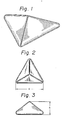
- Sodium chloride having a novel crystal form has an oblate tetrahedral form in which one height of a regular tetrahedron is shortened, as shown in Figs. 1 through 3. More precisely, the form consists of three side faces having substantially the same isosceles triangular shapes (with the proviso that the equal sides are shorter than the base) and one substantially regular triangular base, in which each of the vertexes is slightly rounded.
- the degree of flatness of this crystal changes over a broad range, and in general, with an increase of the size of the crystal, the degree of flatness is increased. If the degree of flatness is expressed by using the length a of one side of the regular triangular base (see Fig.
- the degree of flatness is such that the a/h ratio is from 1/0.8 to 50/l.
- the a/h ratio is from 1/0.8 to 5/1
- the a/h ratio is from 5/1 to 10/1. If the crystal further grows and the length a of one side becomes about 1.5 mm, as shown in Figs. 4 through 6, the degree of flatness further increases, and the a/h ratio is from 5/1 to 50/1 and the central region of the base is dented, with the result that the three vertexes of the base project.
- the size of sodium chloride of the oblate tetrahedral crystal form changes in a broad range according to the crystallization conditions, but in general, the size is about 0.05 to about 3 mm.
- This oblate tetrahedral crystal exerts various effects described in the specification of Japanese Patent Application No. 63-151262.
- the combustion performance of the treated fuel is better than that of an untreated fuel. Furthermore, the anti-corrosive effect is enhanced for a metal, for example, a reinforcing. rod. Further additionallymore, the aqueous ultra-dilute composite solution of the present invention exerts a function of maintaining the freshness of a plant, for example, a cut flower.
- the aqueous ultra-dilute composite solution of the present invention When a transition metal salt, for example, ferric chloride, or an oil-soluble vitamin, for example, ⁇ -tocopherol, ubiquinone or glucose is incorporated in the aqueous ultra-dilute composite solution of the present invention, an effect of maintaining these actions for a long time is obtained.
- the aqueous ultra-dilute composite solution of the present invention is used when mixed with silicon, calcium, aluminum, potassium, ammonium, carbon or starch
- the aqueous composite solution can be utilized as a waste water-treating agent, a soil improver, a carcinostatic agent, or a fodder-fortifying agent.
- a zinc salt for example, zinc chloride
- a magnesium salt for example, magnesium chloride
- the ceramic ware or zeolite when a ceramic ware or zeolite is immersed in the aqueous ultra-dilute composite solution of the present invention, the ceramic ware or zeolite exerts the above-mentioned effects.
- the constitution ratios (by weight) of the respective elements in the resultant crystal after the drying step were as follows (ICP emission spectroscopic analysis). Chlorine: 60.0% Sodium: 39.5% Iron: 0.01 to 0.1% Other elements (potassium and the like): trace
- a 1.5 g amount of iron piece (SPCC-5B) was heated stepwise. Namely, the iron piece was heated at 400°C for 30 minutes, at 800°C for 30 minutes and at 950°C for about 1 hour. Steam was sprayed on the surface of the heated iron piece to form iron oxide on the surface of the iron piece. The iron piece was then thrown into 30 ml of 12N hydrochloric acid, and after stirring, the iron piece was allowed to stand for 7 days. After dissolution of the iron piece, the liquid was filtered to remove insoluble substances, 0.95 g of magnesium chloride was added to the filtrate, and the liquid was allowed to stand for 24 hours. Then hydrochloric acid was added to the liquid so that the total volume was 100 cc, whereby the starting liquid was prepared. Then, 1 ml of the starting liquid was diluted 106 times by adding distilled water twice, to obtain an aqueous ultra-dilute composite solution.
- a 1.5 g amount of iron piece (SPCC-5B) was heated stepwise. Namely, the iron piece was heated at 400°C for 30 minutes, at 800°C for 30 minutes and at 950°C for about 1 hour. Steam was sprayed on the surface of the heated iron piece to form iron oxide on the surface of the iron piece. Then the iron piece was thrown in 30 ml of 12N hydrochloric acid, and after stirring, the iron piece was allowed to stand for 7 days. After dissolution of the iron piece, insoluble substances were removed by filtration, 1.11 g of calcium chloride was added to the filtrate, and the liquid was allowed to stand for 24 hours.
- Example 1 The aqueous ultra-dilute composite solution of the present invention obtained in Example 1 is designated as sample No. 1.
- the aqueous ultra-dilute composite solution of the present invention prepared in Example 2 is designated as sample No. 2.
- Example 3 The aqueous ultra-dilute composite solution of the present invention obtained in Example 3 is designated as sample No. 3.
- Example 4 The aqueous ultra-dilute composite solution of the present invention obtained in Example 4 is designated as sample No. 4.
- a Model RU-200B rotary anticathode type supplied by Rigaku Denki (the X-ray source: CuK ⁇ , a curved crystal monochrometer (graphite), the output: 40 kV and 150 mA) was used.
- a Model 2155D supplied by Rigaku Denki (the slit system: 1°-0.15 mm-1°, the detector: a scintillation counter) was used.
- the counting recorder a Model RAD-B supplied by Rigaku Denki was used.
- a beaker was charged with 1 g of the mixture of sodium chloride of the oblate tetrahedral crystal form obtained by adding 30 g of sodium chloride of the special guaranteed reagent class to 100 ml of the aqueous ultra-dilute composite solution of sample No. 3 and evaporation-solidifying the solution, and the mixture was diluted 106 times with distilled water. Then ferric chloride (FeCl3.6H2O) was added to the dilution so that the concentration was 24% w/v. After stirring, the liquid was allowed to stand at normal temperature overnight. The aqueous solution thus obtained is designated as starting solution A.
- the starting solution A was further diluted 109 times with distilled water and charged in a beaker.
- a stem of a rose for flower arrangement was immersed in the solution.
- the stem portion was cut off along a length of about 5 cm in the solution and the remaining portion was immersed for 20 minutes.
- the stem was thoroughly rinsed with city water and inserted in a flower vase filled with city water, and the vase was kept in a room at a place at which the direct rays of the sun were not imposed.
- an aqueous solution having the same composition as described in Example 1 was prepared as sample No. 5. More specifically, 998 mg of sodium chloride of the special guaranteed reagent class and 1.7 mg of ferric chloride were added to 100 ml of distilled water, and the mixture was stirred. Then 999 ml of distilled water was added to 1 ml of the resultant solution, and the resultant aqueous solution was diluted 106 times with distilled water to prepare an aqueous solution of sample No. 5 having the same composition as described in Example 1.
- an aqueous solution as sample No. 6 was prepared in the same manner as described in Example 1 except that the drying step was omitted. More specifically, 5 mg of ferric chloride was added to 100 ml of 0.5N sodium hydroxide and the mixture was stirred. After the stirring, the mixture was allowed to stand for 14 hours, and was filtered through a filter paper to remove insoluble components. The obtained filtrate was neutralized with 1N hydrochloric acid, 0.05 ml of the aqueous neutral solution was collected, and distilled water was added thereto so that the total volume was 1000 ml. The solution was diluted 106 times with distilled water to obtain sample No. 6.
- sample No. 7 For comparison, an aqueous solution having the same composition as that of sample No. 3 was prepared as sample No. 7.
- ferrous chloride More specifically, 22.7 mg of ferrous chloride, 0.95 mg of magnesium chloride, and 5 mg of ferric chloride were added to 100 ml of 7.2N hydrochloric acid.
- Each of six beakers was charged with 203 ml of sea water, 3 g of calcium hydroxide and 2.5 ml of a rust preventive (Parik C supplied by Fujisawa Yakuhin Kogyo), and sample Nos. 1 through 3, 5, 6 and 8 (distilled water containing 10 ml of the above-mentioned rust preventive) were added to these beakers, respectively, so that the total volume in each beaker was 500 ml.
- a reinforcing iron rod having a polished surface and a reference electrode were placed in each beaker, and the natural electrode potential was measured. The results are shown in Table 3. Table 3 Sample No.
- sample No. 9 An aqueous solution having the same composition as that of sample No. 3 was prepared as a comparative sample designated as "sample No. 9". Namely, 2.6 mg of ferrous chloride and 0.95 mg of magnesium chloride were added to 100 ml of 7.2N hydrochloric acid. Then, 1 ml of the obtained solution was diluted 106 times with distilled water twice. Thus, an aqueous solution having the same composition as that of sample No. 3 was prepared as sample No. 9.
Landscapes
- Chemical & Material Sciences (AREA)
- Organic Chemistry (AREA)
- Engineering & Computer Science (AREA)
- Materials Engineering (AREA)
- Inorganic Chemistry (AREA)
- Compounds Of Iron (AREA)
- Agricultural Chemicals And Associated Chemicals (AREA)
- Liquid Carbonaceous Fuels (AREA)
- Preventing Corrosion Or Incrustation Of Metals (AREA)
- Developing Agents For Electrophotography (AREA)
- Pharmaceuticals Containing Other Organic And Inorganic Compounds (AREA)
- Paper (AREA)
- Peptides Or Proteins (AREA)
Applications Claiming Priority (4)
| Application Number | Priority Date | Filing Date | Title |
|---|---|---|---|
| JP32911488 | 1988-12-28 | ||
| JP329114/88 | 1988-12-28 | ||
| JP1180569A JPH0665606B2 (ja) | 1988-12-28 | 1989-07-14 | 超希薄複合水溶液 |
| JP180569/89 | 1989-07-14 |
Publications (2)
| Publication Number | Publication Date |
|---|---|
| EP0376702A2 true EP0376702A2 (fr) | 1990-07-04 |
| EP0376702A3 EP0376702A3 (fr) | 1990-09-12 |
Family
ID=26500048
Family Applications (1)
| Application Number | Title | Priority Date | Filing Date |
|---|---|---|---|
| EP19890313621 Ceased EP0376702A3 (fr) | 1988-12-28 | 1989-12-27 | Solution composite aqueuse ultra-diluée |
Country Status (6)
| Country | Link |
|---|---|
| US (1) | US5030364A (fr) |
| EP (1) | EP0376702A3 (fr) |
| JP (1) | JPH0665606B2 (fr) |
| KR (1) | KR900009933A (fr) |
| AU (2) | AU639677B2 (fr) |
| CA (1) | CA2006826A1 (fr) |
Families Citing this family (5)
| Publication number | Priority date | Publication date | Assignee | Title |
|---|---|---|---|---|
| AU6026198A (en) * | 1997-01-14 | 1998-08-03 | Joseph B. Cashman | Detoxifying aluminum spent potliners |
| JP2004167467A (ja) * | 2002-11-15 | 2004-06-17 | Lidic Inc | 振動情報記録水 |
| JP2004337831A (ja) * | 2003-05-16 | 2004-12-02 | Lidic Inc | 生体の生命力を支援する振動情報の生成方法 |
| USD640159S1 (en) * | 2007-07-03 | 2011-06-21 | Daniel Andrew Millar | Adhesive phone accessory |
| USD956715S1 (en) * | 2019-12-27 | 2022-07-05 | Samsung Electronics Co., Ltd. | Audio device |
Family Cites Families (11)
| Publication number | Priority date | Publication date | Assignee | Title |
|---|---|---|---|---|
| US399176A (en) * | 1889-03-05 | Johst i | ||
| GB191125092A (en) * | 1911-11-10 | 1912-08-15 | Mallinson Powley | An Improved Soaking Machine for Bottles, Jars and the like. |
| GB848328A (en) * | 1956-06-15 | 1960-09-14 | Ici Ltd | Improved salt crystals |
| US3547597A (en) * | 1967-05-22 | 1970-12-15 | Phillips Petroleum Co | Method for producing high-purity crystals using serially connected crystallization zones |
| US3926566A (en) * | 1973-05-18 | 1975-12-16 | Bicron Corp | Processing alkali metal halide salts for growing into crystals in accordance with stockbarger process |
| SU664662A1 (ru) * | 1977-04-01 | 1979-05-30 | Предприятие П/Я В-8857 | Способ химической кристаллизации |
| JPS6270227A (ja) * | 1985-09-21 | 1987-03-31 | Naikai Engiyou Kk | トレミ−塩の製造方法 |
| DE3764796D1 (de) * | 1986-12-16 | 1990-10-11 | Mannesmann Ag | Verfahren zur gleichzeitigen kristallisation von natriumchlorid und kaliumchlorid. |
| JPH01145320A (ja) * | 1987-11-30 | 1989-06-07 | Japan Tobacco Inc | 8〜14面体結晶食塩製造方法 |
| JPH01145319A (ja) * | 1987-11-30 | 1989-06-07 | Japan Tobacco Inc | 8〜14面体結晶食塩の製造方法 |
| EP0353845A1 (fr) * | 1988-06-21 | 1990-02-07 | Tecno-Bio Co. Ltd. | Chlorure de sodium sous forme de cristaux tétraédriques et solution aqueuse le contenant |
-
1989
- 1989-07-14 JP JP1180569A patent/JPH0665606B2/ja not_active Expired - Fee Related
- 1989-12-22 AU AU47067/89A patent/AU639677B2/en not_active Ceased
- 1989-12-26 US US07/456,756 patent/US5030364A/en not_active Expired - Fee Related
- 1989-12-27 EP EP19890313621 patent/EP0376702A3/fr not_active Ceased
- 1989-12-28 CA CA002006826A patent/CA2006826A1/fr not_active Abandoned
- 1989-12-28 KR KR1019890019954A patent/KR900009933A/ko not_active Ceased
-
1993
- 1993-08-20 AU AU44797/93A patent/AU4479793A/en not_active Abandoned
Non-Patent Citations (3)
| Title |
|---|
| AMERICAN CHEMICAL SOCIETY, File supplier STN; Chemical Abstracts", vol. 102, no. 10, abstract no. 88824e, Columbus, Ohio, (US) * |
| NEGTIEN G. et al.: "MEDICAMENTS HOMEOPATHIQUES. NOTIONS PRATIQUES DE PHARMACIE HOMEOPATIQUE, vol. 16, edition 2, 1986, Galinica, Paris, (FR) pages 404, 437, Technique et Documentation * |
| NOUVEAU TRAITE DE CHIMIE MINERALE, Paul Pascal, tome II, 1966, Masson et Cie, Paris, (FR) pages 291-314 * |
Also Published As
| Publication number | Publication date |
|---|---|
| US5030364A (en) | 1991-07-09 |
| AU4479793A (en) | 1993-12-09 |
| JPH02283612A (ja) | 1990-11-21 |
| CA2006826A1 (fr) | 1990-06-28 |
| JPH0665606B2 (ja) | 1994-08-24 |
| AU639677B2 (en) | 1993-08-05 |
| EP0376702A3 (fr) | 1990-09-12 |
| KR900009933A (ko) | 1990-07-06 |
| AU4706789A (en) | 1990-07-05 |
Similar Documents
| Publication | Publication Date | Title |
|---|---|---|
| Dickens et al. | Crystallographic studies of the role of Mg as a stabilizing impurity in β-Ca3 (PO4) 2. The crystal structure of pure β-Ca3 (PO4) 2 | |
| US4540584A (en) | Composition for promotion of health | |
| ATE163904T1 (de) | Verfahren zur herstellung von kristallinen keramischen pulvern aus perowskitverbindungen | |
| US4132780A (en) | Azide-metal salt formulations for control of fungi and nematodes | |
| US5030364A (en) | Aqueous ultra-dilute composite solution | |
| US5021079A (en) | Sodium chloride in novel crystal form and aqueous solution containing the same | |
| JPH0249248B2 (fr) | ||
| EP1181248B1 (fr) | Cristaux de chlorure de sodium non-agglomerants, procede de leur fabrication et leur application dans un procede d'electrolyse | |
| JPH10273322A (ja) | 抗菌性複合チタン酸化合物およびその製造方法 | |
| JP2675465B2 (ja) | 含水炭酸カルシウムおよびその製造方法 | |
| Beiersdorfer et al. | Solubility and cation exchange properties of zeoponic substrates | |
| WO2018109823A1 (fr) | Adsorbant d'ions strontium et son procédé de production | |
| JP7281796B2 (ja) | 炭酸基高含有炭酸アパタイト | |
| US11649166B2 (en) | Process for producing carbonate apatite | |
| EP0146634A1 (fr) | Procede de production de fines particules de stannate de plomb | |
| Chung-Cherng et al. | Dissolution kinetics of Zn2SiO4 powders: Effects of polymorphs, temperature, particle size, and Fe2+ presence | |
| US2782098A (en) | Method of making manganese dioxide depolarizer | |
| KR100192711B1 (ko) | 은 함유 무기 항균제의 제조방법 | |
| JPH0684244B2 (ja) | 蛍光体基材用高純度金属硫化物の製造方法 | |
| JPH1160416A (ja) | 非晶質抗菌性チタン酸化合物およびその製造方法 | |
| Smičiklas | Cadmium immobilization by hydroxyapatite | |
| JP2000119014A (ja) | 無晶形ケイ酸アルミン酸カルシウム複合酸化物及びその製造方法並びに制酸剤 | |
| CA1071841A (fr) | Procede pour modifier l'aspect du chlorure de sodium cristallin | |
| Chukhrov | New mineral phases of oceanic manganese micronodules | |
| JPH0525541B2 (fr) |
Legal Events
| Date | Code | Title | Description |
|---|---|---|---|
| PUAI | Public reference made under article 153(3) epc to a published international application that has entered the european phase |
Free format text: ORIGINAL CODE: 0009012 |
|
| AK | Designated contracting states |
Kind code of ref document: A2 Designated state(s): AT CH DE ES FR GB IT LI NL SE |
|
| PUAL | Search report despatched |
Free format text: ORIGINAL CODE: 0009013 |
|
| AK | Designated contracting states |
Kind code of ref document: A3 Designated state(s): AT CH DE ES FR GB IT LI NL SE |
|
| 17P | Request for examination filed |
Effective date: 19910302 |
|
| 17Q | First examination report despatched |
Effective date: 19920626 |
|
| STAA | Information on the status of an ep patent application or granted ep patent |
Free format text: STATUS: THE APPLICATION HAS BEEN REFUSED |
|
| 18R | Application refused |
Effective date: 19960725 |