EP0355548B1 - Feuille autoportante constituée d'un substrat et d'un revêtement et son procédé de fabrication - Google Patents
Feuille autoportante constituée d'un substrat et d'un revêtement et son procédé de fabrication Download PDFInfo
- Publication number
- EP0355548B1 EP0355548B1 EP89114536A EP89114536A EP0355548B1 EP 0355548 B1 EP0355548 B1 EP 0355548B1 EP 89114536 A EP89114536 A EP 89114536A EP 89114536 A EP89114536 A EP 89114536A EP 0355548 B1 EP0355548 B1 EP 0355548B1
- Authority
- EP
- European Patent Office
- Prior art keywords
- corona discharge
- film
- substrate
- sheet
- coating
- Prior art date
- Legal status (The legal status is an assumption and is not a legal conclusion. Google has not performed a legal analysis and makes no representation as to the accuracy of the status listed.)
- Expired - Lifetime
Links
- 239000000758 substrate Substances 0.000 title description 27
- 239000011248 coating agent Substances 0.000 title description 16
- 238000000576 coating method Methods 0.000 title description 16
- 238000004519 manufacturing process Methods 0.000 title description 8
- 239000000443 aerosol Substances 0.000 description 21
- 238000000034 method Methods 0.000 description 13
- 239000003795 chemical substances by application Substances 0.000 description 8
- 230000000052 comparative effect Effects 0.000 description 8
- 239000000463 material Substances 0.000 description 6
- 229920000642 polymer Polymers 0.000 description 6
- 239000006185 dispersion Substances 0.000 description 5
- 229920006254 polymer film Polymers 0.000 description 5
- NIXOWILDQLNWCW-UHFFFAOYSA-M Acrylate Chemical compound [O-]C(=O)C=C NIXOWILDQLNWCW-UHFFFAOYSA-M 0.000 description 4
- 238000004873 anchoring Methods 0.000 description 4
- 239000012159 carrier gas Substances 0.000 description 4
- 229920001577 copolymer Polymers 0.000 description 4
- 238000003851 corona treatment Methods 0.000 description 4
- 239000000839 emulsion Substances 0.000 description 4
- -1 ethylene, propylene, butylene, methyl pentene Chemical class 0.000 description 4
- 238000005259 measurement Methods 0.000 description 4
- 239000000126 substance Substances 0.000 description 4
- 229920001634 Copolyester Polymers 0.000 description 3
- PEDCQBHIVMGVHV-UHFFFAOYSA-N Glycerine Chemical compound OCC(O)CO PEDCQBHIVMGVHV-UHFFFAOYSA-N 0.000 description 3
- 239000007864 aqueous solution Substances 0.000 description 3
- 230000001588 bifunctional effect Effects 0.000 description 3
- 239000011261 inert gas Substances 0.000 description 3
- 239000007788 liquid Substances 0.000 description 3
- 229910052751 metal Inorganic materials 0.000 description 3
- 239000002184 metal Substances 0.000 description 3
- 239000000203 mixture Substances 0.000 description 3
- 239000002245 particle Substances 0.000 description 3
- 229920003023 plastic Polymers 0.000 description 3
- 239000004033 plastic Substances 0.000 description 3
- 230000008569 process Effects 0.000 description 3
- VBICKXHEKHSIBG-UHFFFAOYSA-N 1-monostearoylglycerol Chemical compound CCCCCCCCCCCCCCCCCC(=O)OCC(O)CO VBICKXHEKHSIBG-UHFFFAOYSA-N 0.000 description 2
- CARJPEPCULYFFP-UHFFFAOYSA-N 5-Sulfo-1,3-benzenedicarboxylic acid Chemical compound OC(=O)C1=CC(C(O)=O)=CC(S(O)(=O)=O)=C1 CARJPEPCULYFFP-UHFFFAOYSA-N 0.000 description 2
- QGZKDVFQNNGYKY-UHFFFAOYSA-N Ammonia Chemical compound N QGZKDVFQNNGYKY-UHFFFAOYSA-N 0.000 description 2
- IJGRMHOSHXDMSA-UHFFFAOYSA-N Atomic nitrogen Chemical compound N#N IJGRMHOSHXDMSA-UHFFFAOYSA-N 0.000 description 2
- KAKZBPTYRLMSJV-UHFFFAOYSA-N Butadiene Chemical compound C=CC=C KAKZBPTYRLMSJV-UHFFFAOYSA-N 0.000 description 2
- VTYYLEPIZMXCLO-UHFFFAOYSA-L Calcium carbonate Chemical compound [Ca+2].[O-]C([O-])=O VTYYLEPIZMXCLO-UHFFFAOYSA-L 0.000 description 2
- CURLTUGMZLYLDI-UHFFFAOYSA-N Carbon dioxide Chemical compound O=C=O CURLTUGMZLYLDI-UHFFFAOYSA-N 0.000 description 2
- 229920000877 Melamine resin Polymers 0.000 description 2
- VYPSYNLAJGMNEJ-UHFFFAOYSA-N Silicium dioxide Chemical compound O=[Si]=O VYPSYNLAJGMNEJ-UHFFFAOYSA-N 0.000 description 2
- GWEVSGVZZGPLCZ-UHFFFAOYSA-N Titan oxide Chemical compound O=[Ti]=O GWEVSGVZZGPLCZ-UHFFFAOYSA-N 0.000 description 2
- 230000009471 action Effects 0.000 description 2
- TZCXTZWJZNENPQ-UHFFFAOYSA-L barium sulfate Chemical compound [Ba+2].[O-]S([O-])(=O)=O TZCXTZWJZNENPQ-UHFFFAOYSA-L 0.000 description 2
- 239000011230 binding agent Substances 0.000 description 2
- 229920002678 cellulose Polymers 0.000 description 2
- 239000002612 dispersion medium Substances 0.000 description 2
- 230000000694 effects Effects 0.000 description 2
- 239000004744 fabric Substances 0.000 description 2
- 238000005286 illumination Methods 0.000 description 2
- 238000001000 micrograph Methods 0.000 description 2
- 229920000728 polyester Polymers 0.000 description 2
- 229920002635 polyurethane Polymers 0.000 description 2
- 239000004814 polyurethane Substances 0.000 description 2
- 230000008092 positive effect Effects 0.000 description 2
- 238000002360 preparation method Methods 0.000 description 2
- 239000002994 raw material Substances 0.000 description 2
- 239000007787 solid Substances 0.000 description 2
- 239000000243 solution Substances 0.000 description 2
- 239000002904 solvent Substances 0.000 description 2
- 230000003068 static effect Effects 0.000 description 2
- 239000012815 thermoplastic material Substances 0.000 description 2
- XLYOFNOQVPJJNP-UHFFFAOYSA-N water Substances O XLYOFNOQVPJJNP-UHFFFAOYSA-N 0.000 description 2
- SMZOUWXMTYCWNB-UHFFFAOYSA-N 2-(2-methoxy-5-methylphenyl)ethanamine Chemical compound COC1=CC=C(C)C=C1CCN SMZOUWXMTYCWNB-UHFFFAOYSA-N 0.000 description 1
- NIXOWILDQLNWCW-UHFFFAOYSA-N 2-Propenoic acid Natural products OC(=O)C=C NIXOWILDQLNWCW-UHFFFAOYSA-N 0.000 description 1
- 239000005995 Aluminium silicate Substances 0.000 description 1
- 239000004971 Cross linker Substances 0.000 description 1
- 235000009161 Espostoa lanata Nutrition 0.000 description 1
- 240000001624 Espostoa lanata Species 0.000 description 1
- JIGUQPWFLRLWPJ-UHFFFAOYSA-N Ethyl acrylate Chemical compound CCOC(=O)C=C JIGUQPWFLRLWPJ-UHFFFAOYSA-N 0.000 description 1
- 239000004594 Masterbatch (MB) Substances 0.000 description 1
- CERQOIWHTDAKMF-UHFFFAOYSA-N Methacrylic acid Chemical compound CC(=C)C(O)=O CERQOIWHTDAKMF-UHFFFAOYSA-N 0.000 description 1
- VVQNEPGJFQJSBK-UHFFFAOYSA-N Methyl methacrylate Chemical compound COC(=O)C(C)=C VVQNEPGJFQJSBK-UHFFFAOYSA-N 0.000 description 1
- BPQQTUXANYXVAA-UHFFFAOYSA-N Orthosilicate Chemical compound [O-][Si]([O-])([O-])[O-] BPQQTUXANYXVAA-UHFFFAOYSA-N 0.000 description 1
- 229910019142 PO4 Inorganic materials 0.000 description 1
- 239000004952 Polyamide Substances 0.000 description 1
- 239000004962 Polyamide-imide Substances 0.000 description 1
- 239000004697 Polyetherimide Substances 0.000 description 1
- 239000004642 Polyimide Substances 0.000 description 1
- 229920002367 Polyisobutene Polymers 0.000 description 1
- 239000004734 Polyphenylene sulfide Substances 0.000 description 1
- 239000004793 Polystyrene Substances 0.000 description 1
- 239000004372 Polyvinyl alcohol Substances 0.000 description 1
- PPBRXRYQALVLMV-UHFFFAOYSA-N Styrene Natural products C=CC1=CC=CC=C1 PPBRXRYQALVLMV-UHFFFAOYSA-N 0.000 description 1
- 238000006887 Ullmann reaction Methods 0.000 description 1
- 150000001252 acrylic acid derivatives Chemical class 0.000 description 1
- 239000002390 adhesive tape Substances 0.000 description 1
- 125000001931 aliphatic group Chemical group 0.000 description 1
- 229910052783 alkali metal Inorganic materials 0.000 description 1
- 150000001340 alkali metals Chemical class 0.000 description 1
- 150000001336 alkenes Chemical class 0.000 description 1
- 235000012211 aluminium silicate Nutrition 0.000 description 1
- 229910021529 ammonia Inorganic materials 0.000 description 1
- 239000003125 aqueous solvent Substances 0.000 description 1
- 125000003118 aryl group Chemical group 0.000 description 1
- 229920006378 biaxially oriented polypropylene Polymers 0.000 description 1
- 239000011127 biaxially oriented polypropylene Substances 0.000 description 1
- 230000000903 blocking effect Effects 0.000 description 1
- 235000010216 calcium carbonate Nutrition 0.000 description 1
- 229910000019 calcium carbonate Inorganic materials 0.000 description 1
- 239000003990 capacitor Substances 0.000 description 1
- 239000001569 carbon dioxide Substances 0.000 description 1
- 229910002092 carbon dioxide Inorganic materials 0.000 description 1
- 239000001913 cellulose Substances 0.000 description 1
- 230000008859 change Effects 0.000 description 1
- 238000006243 chemical reaction Methods 0.000 description 1
- 229910052681 coesite Inorganic materials 0.000 description 1
- 150000001875 compounds Chemical class 0.000 description 1
- 229910052906 cristobalite Inorganic materials 0.000 description 1
- 150000001991 dicarboxylic acids Chemical class 0.000 description 1
- 239000003989 dielectric material Substances 0.000 description 1
- 150000005690 diesters Chemical class 0.000 description 1
- 150000002009 diols Chemical class 0.000 description 1
- 239000002270 dispersing agent Substances 0.000 description 1
- 238000005516 engineering process Methods 0.000 description 1
- RTZKZFJDLAIYFH-UHFFFAOYSA-N ether Substances CCOCC RTZKZFJDLAIYFH-UHFFFAOYSA-N 0.000 description 1
- 150000002170 ethers Chemical class 0.000 description 1
- 239000010419 fine particle Substances 0.000 description 1
- 239000011888 foil Substances 0.000 description 1
- IVJISJACKSSFGE-UHFFFAOYSA-N formaldehyde;1,3,5-triazine-2,4,6-triamine Chemical compound O=C.NC1=NC(N)=NC(N)=N1 IVJISJACKSSFGE-UHFFFAOYSA-N 0.000 description 1
- 239000007789 gas Substances 0.000 description 1
- YQEMORVAKMFKLG-UHFFFAOYSA-N glycerine monostearate Natural products CCCCCCCCCCCCCCCCCC(=O)OC(CO)CO YQEMORVAKMFKLG-UHFFFAOYSA-N 0.000 description 1
- SVUQHVRAGMNPLW-UHFFFAOYSA-N glycerol monostearate Natural products CCCCCCCCCCCCCCCCC(=O)OCC(O)CO SVUQHVRAGMNPLW-UHFFFAOYSA-N 0.000 description 1
- 229910052736 halogen Inorganic materials 0.000 description 1
- 150000002367 halogens Chemical class 0.000 description 1
- 238000009998 heat setting Methods 0.000 description 1
- 230000006872 improvement Effects 0.000 description 1
- 238000010348 incorporation Methods 0.000 description 1
- 229920000554 ionomer Polymers 0.000 description 1
- QQVIHTHCMHWDBS-UHFFFAOYSA-N isophthalic acid Chemical group OC(=O)C1=CC=CC(C(O)=O)=C1 QQVIHTHCMHWDBS-UHFFFAOYSA-N 0.000 description 1
- NLYAJNPCOHFWQQ-UHFFFAOYSA-N kaolin Chemical compound O.O.O=[Al]O[Si](=O)O[Si](=O)O[Al]=O NLYAJNPCOHFWQQ-UHFFFAOYSA-N 0.000 description 1
- 150000004668 long chain fatty acids Chemical class 0.000 description 1
- 239000000314 lubricant Substances 0.000 description 1
- 230000007246 mechanism Effects 0.000 description 1
- 239000002609 medium Substances 0.000 description 1
- JDSHMPZPIAZGSV-UHFFFAOYSA-N melamine Chemical compound NC1=NC(N)=NC(N)=N1 JDSHMPZPIAZGSV-UHFFFAOYSA-N 0.000 description 1
- 239000000155 melt Substances 0.000 description 1
- FQPSGWSUVKBHSU-UHFFFAOYSA-N methacrylamide Chemical compound CC(=C)C(N)=O FQPSGWSUVKBHSU-UHFFFAOYSA-N 0.000 description 1
- WSFSSNUMVMOOMR-NJFSPNSNSA-N methanone Chemical compound O=[14CH2] WSFSSNUMVMOOMR-NJFSPNSNSA-N 0.000 description 1
- 230000004048 modification Effects 0.000 description 1
- 238000012986 modification Methods 0.000 description 1
- 229920005615 natural polymer Polymers 0.000 description 1
- 230000006855 networking Effects 0.000 description 1
- 229910052757 nitrogen Inorganic materials 0.000 description 1
- 230000003287 optical effect Effects 0.000 description 1
- 239000011146 organic particle Substances 0.000 description 1
- 125000005375 organosiloxane group Chemical group 0.000 description 1
- 230000010355 oscillation Effects 0.000 description 1
- 229920006280 packaging film Polymers 0.000 description 1
- 239000012785 packaging film Substances 0.000 description 1
- 238000004806 packaging method and process Methods 0.000 description 1
- PNJWIWWMYCMZRO-UHFFFAOYSA-N pent‐4‐en‐2‐one Natural products CC(=O)CC=C PNJWIWWMYCMZRO-UHFFFAOYSA-N 0.000 description 1
- 229920000110 poly(aryl ether sulfone) Polymers 0.000 description 1
- 229920000090 poly(aryl ether) Polymers 0.000 description 1
- 229920003229 poly(methyl methacrylate) Polymers 0.000 description 1
- 229920002492 poly(sulfone) Polymers 0.000 description 1
- 229920002647 polyamide Polymers 0.000 description 1
- 229920002312 polyamide-imide Polymers 0.000 description 1
- 229920006260 polyaryletherketone Polymers 0.000 description 1
- 239000004417 polycarbonate Substances 0.000 description 1
- 229920000515 polycarbonate Polymers 0.000 description 1
- 229920006267 polyester film Polymers 0.000 description 1
- 229920001601 polyetherimide Polymers 0.000 description 1
- 229920000139 polyethylene terephthalate Polymers 0.000 description 1
- 239000005020 polyethylene terephthalate Substances 0.000 description 1
- 229920001721 polyimide Polymers 0.000 description 1
- 239000002861 polymer material Substances 0.000 description 1
- 239000004926 polymethyl methacrylate Substances 0.000 description 1
- 229920000098 polyolefin Polymers 0.000 description 1
- 229920000069 polyphenylene sulfide Polymers 0.000 description 1
- 229920002223 polystyrene Polymers 0.000 description 1
- 229920002451 polyvinyl alcohol Polymers 0.000 description 1
- 239000004800 polyvinyl chloride Substances 0.000 description 1
- 229920000915 polyvinyl chloride Polymers 0.000 description 1
- 238000012545 processing Methods 0.000 description 1
- 239000000377 silicon dioxide Substances 0.000 description 1
- 235000012239 silicon dioxide Nutrition 0.000 description 1
- 159000000000 sodium salts Chemical class 0.000 description 1
- 238000005507 spraying Methods 0.000 description 1
- 229910052682 stishovite Inorganic materials 0.000 description 1
- 230000003746 surface roughness Effects 0.000 description 1
- 229920001059 synthetic polymer Polymers 0.000 description 1
- 229920001169 thermoplastic Polymers 0.000 description 1
- 239000004416 thermosoftening plastic Substances 0.000 description 1
- 235000010215 titanium dioxide Nutrition 0.000 description 1
- 238000012549 training Methods 0.000 description 1
- 229910052905 tridymite Inorganic materials 0.000 description 1
- 238000002604 ultrasonography Methods 0.000 description 1
Images

Classifications
-
- B—PERFORMING OPERATIONS; TRANSPORTING
- B05—SPRAYING OR ATOMISING IN GENERAL; APPLYING FLUENT MATERIALS TO SURFACES, IN GENERAL
- B05D—PROCESSES FOR APPLYING FLUENT MATERIALS TO SURFACES, IN GENERAL
- B05D1/00—Processes for applying liquids or other fluent materials
- B05D1/62—Plasma-deposition of organic layers
-
- B—PERFORMING OPERATIONS; TRANSPORTING
- B05—SPRAYING OR ATOMISING IN GENERAL; APPLYING FLUENT MATERIALS TO SURFACES, IN GENERAL
- B05D—PROCESSES FOR APPLYING FLUENT MATERIALS TO SURFACES, IN GENERAL
- B05D3/00—Pretreatment of surfaces to which liquids or other fluent materials are to be applied; After-treatment of applied coatings, e.g. intermediate treating of an applied coating preparatory to subsequent applications of liquids or other fluent materials
- B05D3/14—Pretreatment of surfaces to which liquids or other fluent materials are to be applied; After-treatment of applied coatings, e.g. intermediate treating of an applied coating preparatory to subsequent applications of liquids or other fluent materials by electrical means
- B05D3/141—Plasma treatment
- B05D3/145—After-treatment
-
- B—PERFORMING OPERATIONS; TRANSPORTING
- B05—SPRAYING OR ATOMISING IN GENERAL; APPLYING FLUENT MATERIALS TO SURFACES, IN GENERAL
- B05D—PROCESSES FOR APPLYING FLUENT MATERIALS TO SURFACES, IN GENERAL
- B05D5/00—Processes for applying liquids or other fluent materials to surfaces to obtain special surface effects, finishes or structures
- B05D5/08—Processes for applying liquids or other fluent materials to surfaces to obtain special surface effects, finishes or structures to obtain an anti-friction or anti-adhesive surface
-
- B—PERFORMING OPERATIONS; TRANSPORTING
- B29—WORKING OF PLASTICS; WORKING OF SUBSTANCES IN A PLASTIC STATE IN GENERAL
- B29C—SHAPING OR JOINING OF PLASTICS; SHAPING OF MATERIAL IN A PLASTIC STATE, NOT OTHERWISE PROVIDED FOR; AFTER-TREATMENT OF THE SHAPED PRODUCTS, e.g. REPAIRING
- B29C59/00—Surface shaping of articles, e.g. embossing; Apparatus therefor
- B29C59/10—Surface shaping of articles, e.g. embossing; Apparatus therefor by electric discharge treatment
- B29C59/12—Surface shaping of articles, e.g. embossing; Apparatus therefor by electric discharge treatment in an environment other than air
-
- H—ELECTRICITY
- H01—ELECTRIC ELEMENTS
- H01T—SPARK GAPS; OVERVOLTAGE ARRESTERS USING SPARK GAPS; SPARKING PLUGS; CORONA DEVICES; GENERATING IONS TO BE INTRODUCED INTO NON-ENCLOSED GASES
- H01T19/00—Devices providing for corona discharge
Definitions
- the invention relates to a self-supporting flat structure with a substrate layer and a coating, which is produced by treating at least one surface of the substrate layer by an electrical corona discharge in a corona discharge zone between a live electrode and a counter electrode, and a method for the surface pretreatment of a substrate layer by means of an electrical corona discharge in a corona discharge zone between a live electrode, which is supplied with an alternating voltage of 5000 to 25000 V, and a grounded counter electrode, and for applying a coating to the substrate layer by means of an aerosol.
- an arrangement with a generator and a corona discharge device is provided, the generator applying a high-frequency alternating current of high voltage to the discharge electrode of the corona discharge device.
- the metal core of a roller forms a grounded counterelectrode, and a film web is transported over its circumferential coating.
- a housing of the corona discharge device is connected to a line Connected atomizer device, in which a liquid is atomized into a floatable aerosol by means of a piezoelectric ultrasonic oscillation system or by means of two-substance atomizing nozzles operating at ultrasonic speed.
- the flow rate regulates a blower which is connected to the atomizing device and guides the carrier gas for the aerosol through the atomizing device into the corona discharge device.
- a usually suitable measure for solving this problem is to incorporate inert particles into the material of the substrate layer, which lead to a certain surface structure and thus have a positive effect on the sliding behavior of the molded body.
- inert particles which are incorporated either during the production of the thermoplastic or via a masterbatch during the production of the shaped body can be, are inorganic natural or synthetic compounds such as BaSO4, CaCO3, TiO2, kaolin, Ca-phosphates etc. or organic particles, for. B. from cross-linked acrylates.
- the concentrations are within wide limits, ie in the range from 0.001 to 1.0% by weight.
- the inert particles have to be subjected to a very complex, costly preparation process before incorporation in order to avoid other disadvantages such as e.g. B. exclude increased wear when contacting guide elements and the like.
- the optical properties of the substrates can also be negatively influenced in some cases.
- EP-A-0 153 853 describes a magnetic tape carrier film with a reticulated coating containing fine particles, which gives it the necessary friction properties.
- This process requires mixing the coating materials together, e.g. B. the colloidal silicate-containing polymeric binder and the application thereof to the surface of the substrate between the individual orientation steps.
- a disadvantage of this method is that the training the structures presuppose at least one stretching step, ie is linked to the production process of the film.
- the object of the present invention was to provide easy-to-use flat structures, such as foils, plates and the like, with slip-promoting surfaces, the slip-promoting substances and the structures resulting therefrom being able to be applied independently of the manufacturing process and nevertheless having a permanently good anchoring on the substrate.
- This object is achieved by a self-supporting sheet material in such a way that the coating has a layer thickness, corresponding to a weight per unit area of 1 to 100 mg / m 2, and contains a film-forming polymeric agent to improve the sliding properties, which is introduced as an aerosol into the corona discharge zone during the corona discharge .
- the flat structure contains a film made of thermoplastic material, in particular a biaxially oriented polyester film or a biaxially oriented polypropylene film, as the substrate layer.
- the substrate layer can consist of materials such as paper, sheets based on foamed polymers, films based on polymers, fabrics.
- polymers are in particular polymer films, e.g. Films made from natural and synthetic polymers such as cellulose, cellulose esters, polyvinyl chloride, polystyrene, styrene copolymers with butadiene, polycarbonate, polymers and copolymers of olefins such as ethylene, propylene, butylene, methyl pentene etc., polysulfone, aliphatic and aromatic polyesters, polyimides, polyisobutylene, polymethyl methacrylate, Polyphenylene sulfide, polyurethane, polyamide, polyaryl ether ketone, polyaryl ether ether ketone, polyaryl ether sulfone, polyamide imide, polyether imide, etc.
- films made from natural and synthetic polymers such as cellulose, cellulose esters, polyvinyl chloride, polystyrene, styrene copolymers with butadiene, polycarbonate, polymers and cop
- Self-supporting, oriented or non-oriented films are produced from the polymers mentioned according to various known technologies, which are also described in the cited literature, the term self-supporting film being used to describe both monofilms from one layer and multilayer films from several layers of the same or different ones Polymer materials or laminates containing layers of plastics and non-plastics such as Paper or metal should be understood.
- the coating on the substrate layer results from the simultaneous action of an electrical corona discharge in the presence of an aerosol on the substrate surface.
- the corona discharge triggers and / or favors reaction mechanisms that a chemical Surface modification of the treated substrate result. It is imagined that the corona discharge firmly anchors the aerosol or the agents contained therein to the substrate surface.
- the high-voltage generator applies an alternating voltage between 5,000 and 25,000 V to the live electrode.
- the alternating voltage present between the live electrode and the grounded counter electrode should be proportional to the transport speed at which the substrate to be treated moves through the corona discharge zone, i.e. at higher transport speeds, the AC voltage should be in the upper range, while at lower transport speeds a medium to low voltage in the range from 5,000 to 18,000 V can be set in order to achieve an equally large effect.
- the preparation of the aerosols can be carried out with the aid of known two-substance atomizing nozzles or preferably by means of piezoelectric ultrasonic atomizing systems.
- emulsions preferably dispersions or solutions of organic polymeric binders can be used, which are placed in solvents and dispersants, very particularly preferably in water.
- the film-forming polymeric agents are homo- or copolymers based on acrylic acid or methacrylic acid or their derivatives, non-crystalline copolyesters or copolyester ethers, which optionally contain alkali metal-containing building blocks such as, for. B. sodium salt of 5-sulfoisophthalic acid in amounts of 1 to 50 mol% or mixtures of these.
- copolymers containing acrylate that are crosslinkable, e.g. B. with melamine, polyurethanes, polyolefins or ionomers, which are dispersed in water are suitable film-forming agents.
- aqueous solutions or emulsions of bifunctional fluoropolyethers in particular bifunctional derivatives such as diols, dicarboxylic acids and diesters.
- Other lubricants include Monocarboxylic acid esters of glycerol with long-chain fatty acids such as glycerol monostearate and organosiloxanes such as polydiorganosiloxanes added.
- the amount of film-forming agent to be applied can be varied within wide limits and is preferably matched to the particular application at hand.
- the film-forming agents are first dispersed, emulsified or dissolved in a solvent or dispersion medium, preferably using an aqueous solvent or dispersion medium, and are then sprayed together with a carrier gas stream into the corona discharge space as an aerosol.
- the dispersions or emulsions generally have a solids or droplet content of 0.5 to 20% by weight, based on the total weight of the dispersion or emulsion, and the solutions have concentrations in the range of 1 to 30% by weight . It may be advantageous to increase the temperature of the carrier liquid in order to improve the dispersibility or emulsifiability.
- air is used as the carrier gas for the aerosol, but nitrogen or another inert gas, e.g. an inert gas.
- nitrogen or another inert gas e.g. an inert gas.
- particularly advantageous anchoring effects can also be achieved with reactive gases such as, for example, halogens, carbon dioxide, ammonia or formaldehyde, optionally in a mixture with inert gases.
- the coating can be applied off-line to the substrate layer after the completion of the substrate layer using the method according to the invention; this applies in particular if plate-shaped substrate layers are to be coated.
- the coating can also be used during the manufacturing process of the substrate layer, in-line, be applied.
- biaxially oriented films made of thermoplastic materials by extruding a melt, subsequent biaxial stretch orientation and subsequent heat setting.
- the coating can be applied before, between or after the individual stretching steps taking place in succession or before or after the heat fixation.
- the coating has particularly good adhesion to the substrate surface.
- the layer thickness of the coating usually corresponds to a weight per unit area in the range from only 1 to 100 mg / m2.
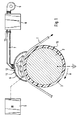
- the invention is explained in more detail below with reference to the single figure which shows an aerosol-corona device for treating various polymer films.
- the device consists of a generator 5 which is connected to a corona discharge device 11.
- the generator 5 attaches to discharge electrodes 4 Corona discharge device 11 to a high-frequency alternating current of high voltage.
- the metal core 2 of a roller 10 serves as the grounded counter electrode, and a self-supporting polymer film web 1 to be coated is transported over the circumferential coating 3 thereof.
- a housing 6 encloses the discharge electrodes 4 of the corona discharge device 11 and is connected via a line 7, for example a pipe or hose line, to an atomizer device 8, in which an aqueous liquid is atomized into a suspended aerosol by means of a piezoelectric ultrasound system.
- a blower 9 is connected to the atomizer device and conveys the carrier gas (air) for the aerosol through the atomizer device into the corona discharge device 11.
- the line 7 is connected to a pipe socket 13 of the atomiser device 8 and a pipe socket 12 of the housing 6.
- the surface roughness was determined by measurements according to DIN 4768.
- the slip properties of the film are determined by measurements according to DIN 53 375, the measurement of the friction taking place at five measuring points distributed over the entire film width.
- a pigment-free polyester raw material with an SV value of 810 was melted, formed into a film by means of a slot die, which was then quenched into an amorphous film on a cooled, highly polished roller.
- the amorphous prefilm was stretched lengthwise at 95 ° C. and then stretched crosswise at 110 ° C., the area stretch ratio being 13.
- the 15 ⁇ m thick film obtained was then heat-set at 230 ° C. (frame temperature). The film was then coated using the device described.
- the film was treated with a crosslinkable acrylate-containing dispersion with a solids content of 4% by weight according to the invention.
- the exact composition of the acrylate was: 52 mol% methyl methacrylate, 43 mol% ethyl acrylate and 5 mol% methacrylamide.
- the acrylate was mixed in a 4 to 1 ratio with a crosslinker based on melamine-formaldehyde.
- the illumination 1 shows a scanning electron microscope image of the surface of the film obtained at a magnification of 300 times.
- Example 1 was repeated, but the aerosol was formed with the aid of an aqueous dispersion containing a copolyester with isophthalic acid units and 5-sulfoisophthalic acid units (35 mol%).
- the illumination 2 shows a scanning electron microscope image of the film surface produced according to Example 2 at a magnification of 300 times. A structure similar to a crater landscape can also be seen, but the individual structural elements do not stand out in terms of color due to the lack of networking.
- the haze of the film according to Example 2 was 0.5%.
- Example 1 was repeated using an aqueous solution (concentration: 4% by weight) of polyvinyl alcohol. No structuring could be determined on the film surface produced in this way with the aid of the scanning electron microscopic examination method.
- a polyethylene terephthalate raw material which contains 1000 ppm SiO2 as an antiblocking agent, melted in an extruder, shaped into a film using a slot die and quenched into an amorphous pre-film.
- the pre-film is then stretched lengthwise at 95 ° C and stretched at 110 ° C, with an area stretch ratio of about 13 being maintained.
- the 50 ⁇ m thick film is then heat set in a frame at 230 ° C.
- the heat-set film is then further processed according to four process variants.
- the heat-set film is subjected to a corona treatment and a simultaneous aerosol application in accordance with the method according to the invention.
- the sliding friction according to DIN 53 375, measured at five points across the film width, is very even and is 0.14 to 0.15.
- the film obtained has a strong anchoring of the slip-improving coating on the substrate.
- the durability or the anchoring of the coating under mechanical action is checked in such a way that ten times with a cotton ball over the film surface is wiped with a contact pressure in the range of 1 to 5 kPa.
- the sliding friction subsequently measured shows no change compared to the first measured sliding friction values.
- the heat-set film is not subjected to corona treatment or aerosol exposure.
- the sliding friction is about twice as high as in the example given above and is in the range from 0.28 to 0.32, the fluctuation of the sliding friction, measured over the film width, being low or there being good uniformity of the friction over the film width.
- the heat-set film is subjected to a corona treatment without aerosol application.
- the sliding friction is approximately 2.6 to 2.7 times the value of the example according to the invention and is in the range from 0.37 to 0.40.
- the fluctuation of the sliding friction, measured over the film width, is small, i.e. in other words, the uniformity of the friction across the film width is good.
- the heat-set film is subjected to an aerosol treatment without corona treatment.
- the sliding friction is lower than in Comparative Examples 1 and 2. It has about 1.6 to 2.1 times the value of the example according to the invention and is in the range from 0.22 to 0.29.
Landscapes
- Physics & Mathematics (AREA)
- Engineering & Computer Science (AREA)
- Plasma & Fusion (AREA)
- Health & Medical Sciences (AREA)
- Toxicology (AREA)
- Application Of Or Painting With Fluid Materials (AREA)
- Treatments Of Macromolecular Shaped Articles (AREA)
- Laminated Bodies (AREA)
Claims (13)
- Structure plane autoporteuse comprenant un substrat et un revêtement, qui est obtenue par traitement d'au moins une surface du substrat par une décharge électrique corona, dans une zone de décharge corona comprise entre une électrode sous tension et une contre-électrode, caractérisée en ce que le revêtement présente une épaisseur de couche correspondant à un poids surfacique de 1 à 100 mg/m² et qu'il contient, pour améliorer le glissement, un agent filmogène polymère qui est introduit dans la zone de décharge corona, sous forme d'aérosol, lors de la décharge corona.
- Structure plane selon la revendication 1, caractérisée en ce qu'elle contient, comme couche substrat, un film en matière thermoplastique, en particulier un film de polyester orienté biaxialement ou un film de polypropylène orienté biaxialement.
- Structure plane selon la revendication 1, caractérisée en ce que le substrat est constitué de matériaux, tels que papier, plaques à base de polymères expansés, films en polymère, tissus.
- Structure plane selon la revendication 3, caractérisée en ce que le substrat est constitué d'un film à base d'un polymère choisi parmi les polymères naturels ou synthétiques, tels que cellulose, esters de cellulose, poly(chlorure de vinyle), polystyrène, copolymères de styrène et de butadiène, polycarbonate, polymères et copolymères d'oléfines, telles que: éthylène, propylène, butylène ou méthylpentène, polysulfones, polyesters aliphatiques et aromatiques, polyimides, polyisobutylène, poly(méthacrylate de méthyle), poly(sulfure de phénylène), polyuréthanes, polyamides, poly(aryléthersulfone), poly(amido-imide), poly(étherimide), etc.
- Structure plane selon la revendication 3, caractérisée en ce que le substrat est constitué de tissus en fibres artificielles à base de polyesters, de polyacrylonitrile, de polyamides, de viscose, de mélanges de ces tissus de fibres artificielles entre eux ou avec des fibres naturelles.
- Structure plane selon une quelconque des revendications 1 à 5, caractérisée en ce que les agents filmogènes polymères appropriés englobent des homo- ou copolymères à base d'acide acrylique ou d'acide méthacrylique ou de leurs dérivés, des copolyesters ou copoly(ester-éthers) non cristallins, qui peuvent éventuellement renfermer des éléments structuraux contenant un métal alcalin, tels que p.ex. le 5-sulfoisophtalate de sodium, à raison de 1 à 50 % en moles, ou des mélanges de ces substances, des copolymères à base d'acrylate, qui sont réticulables, par exemple avec la mélamine, des polyuréthanes, des polyoléfines ou des ionomères, ou encore des polyéthers fluorés difonctionnels, en particulier des dérivés difonctionnels tels que diols, acides dicarboxyliques et diesters.
- Structure plane selon la revendication 6, caractérisée en ce qu'on ajoute, comme autres lubrifiants, des monoesters du glycérol avec des acides gras à longue chaîne, tels que le monostéarate de glycérol, et des organosiloxanes, tels que des poly(diorganosiloxanes).
- Procédé pour le prétraitement de la surface d'un substrat au moyen d'une décharge électrique corona, dans une zone de décharge corona comprise entre une électrode sous tension, qui est alimentée avec une tension alternative de 5000 à 25000 V, et une contre-électrode mise à la terre, afin de déposer un revêtement sur le substrat à l'aide d'un aérosol, caractérisé en ce qu'on met en dispersion ou en émulsion un agent filmogène polymère, améliorateur de glissement, dans un solvant ou un dispersant, de telle sorte que la dispersion ou l'émulsion en contienne de 0,1 à 20 % en poids, de préférence de 0,5 à 10 % en poids, par rapport au poids total de la dispersion ou de l'émulsion, et que la dispersion ou l'émulsion soit atomisée en présence d'un gaz vecteur, sous forme d'aérosol, dans la zone de décharge corona.
- Procédé selon la revendication 8, caractérisé en ce que la vitesse de transport, avec laquelle le substrat à traiter se déplace à travers la zone de décharge corona, est proportionnelle à la valeur de la tension du courant alternatif sous laquelle fonctionne la décharge corona.
- Procédé selon la revendication 8 ou 9, caractérisé en ce que les aérosols sont introduits dans la zone de décharge corona à l'aide de buses d'atomisation à deux matériaux ou de systèmes d'atomisation piézoélectriques fonctionnant aux ultrasons.
- Procédé selon une quelconque des revendications 8 à 10, caractérisé en ce que les solutions présentent une concentration de 1 à 30% en poids d'agent polymère, par rapport au poids total de solution, de préférence de 5 à 20 % en poids.
- Procédé selon la revendication 8, caractérisé en ce qu'on utilise comme gaz vecteur un gaz inerte, tel que l'air, l'azote ou un gaz noble.
- Procédé selon la revendication 8, caractérisé en ce qu'on utilise comme gaz vecteur un gaz réactif, tel que p.ex. un halogène, le dioxyde de carbone, l'ammoniac ou le formaldéhyde, ou des mélanges de gaz réactifs avec des gaz inertes.
Applications Claiming Priority (4)
| Application Number | Priority Date | Filing Date | Title |
|---|---|---|---|
| DE3827632A DE3827632A1 (de) | 1988-08-16 | 1988-08-16 | Selbsttragendes flaechengebilde mit wenigstens einer strukturierten oberflaeche |
| DE3827632 | 1988-08-16 | ||
| DE3827634 | 1988-08-16 | ||
| DE3827634A DE3827634A1 (de) | 1988-08-16 | 1988-08-16 | Selbsttragendes flaechengebilde aus einem substrat und einem ueberzug und verfahren zu seiner herstellung |
Publications (3)
| Publication Number | Publication Date |
|---|---|
| EP0355548A2 EP0355548A2 (fr) | 1990-02-28 |
| EP0355548A3 EP0355548A3 (en) | 1990-10-17 |
| EP0355548B1 true EP0355548B1 (fr) | 1993-09-15 |
Family
ID=25871136
Family Applications (1)
| Application Number | Title | Priority Date | Filing Date |
|---|---|---|---|
| EP89114536A Expired - Lifetime EP0355548B1 (fr) | 1988-08-16 | 1989-08-07 | Feuille autoportante constituée d'un substrat et d'un revêtement et son procédé de fabrication |
Country Status (3)
| Country | Link |
|---|---|
| EP (1) | EP0355548B1 (fr) |
| JP (1) | JPH02107370A (fr) |
| DE (3) | DE3827634A1 (fr) |
Families Citing this family (1)
| Publication number | Priority date | Publication date | Assignee | Title |
|---|---|---|---|---|
| CN113681877B (zh) * | 2021-07-12 | 2023-02-28 | 广东美士达药包材料股份有限公司 | 一种防止复合包装膜反面电晕的处理装置 |
Family Cites Families (7)
| Publication number | Priority date | Publication date | Assignee | Title |
|---|---|---|---|---|
| US3274089A (en) * | 1963-10-21 | 1966-09-20 | Du Pont | Surface treatment of polymeric shaped structures |
| DE1285745B (de) * | 1964-06-11 | 1968-12-19 | Kalle Ag | Herstellen siegelfaehiger Oberflaechen auf Folien aus Polyolefinen oder Polyaethylenterephthalat |
| GB1526918A (en) * | 1977-06-24 | 1978-10-04 | Fuji Photo Film Co Ltd | Process for producing an extruded thermoplastic polymer sheet |
| FR2549869B1 (fr) * | 1983-07-29 | 1986-07-11 | Electricite De France | Procede et dispositif pour realiser la polymerisation in situ de monomeres fluocarbones sur un substrat |
| DE3416405A1 (de) * | 1984-05-04 | 1985-11-07 | Hoechst Ag, 6230 Frankfurt | Verfahren und vorrichtung zur oberflaechenbehandlung von folienbahnen |
| FR2578176B1 (fr) * | 1985-03-04 | 1989-01-13 | Electricite De France | Procede et dispositif de traitement d'un substrat plat par decharge couronne. |
| DE3705482A1 (de) * | 1987-02-20 | 1988-09-01 | Hoechst Ag | Verfahren und anordnung zur oberflaechenvorbehandlung von kunststoff mittels einer elektrischen koronaentladung |
-
1988
- 1988-08-16 DE DE3827634A patent/DE3827634A1/de not_active Withdrawn
- 1988-08-16 DE DE3827632A patent/DE3827632A1/de not_active Withdrawn
-
1989
- 1989-08-07 DE DE89114536T patent/DE58905608D1/de not_active Expired - Fee Related
- 1989-08-07 EP EP89114536A patent/EP0355548B1/fr not_active Expired - Lifetime
- 1989-08-16 JP JP1210231A patent/JPH02107370A/ja active Pending
Also Published As
| Publication number | Publication date |
|---|---|
| EP0355548A3 (en) | 1990-10-17 |
| DE3827634A1 (de) | 1990-02-22 |
| JPH02107370A (ja) | 1990-04-19 |
| EP0355548A2 (fr) | 1990-02-28 |
| DE58905608D1 (de) | 1993-10-21 |
| DE3827632A1 (de) | 1990-03-08 |
Similar Documents
| Publication | Publication Date | Title |
|---|---|---|
| EP0951500B1 (fr) | Corps en polytetrafluoroethylene (ptfe) microporeux comprenant une charge | |
| DE60105649T2 (de) | Geladene mikrofasern, mikrofibrillierte gegenstände und ihre verwendung | |
| DE69217712T2 (de) | Polymerfilm | |
| DE60225526T2 (de) | Polyesterfolie für Trennfolie | |
| DE3650693T2 (de) | Mit Aziridin behandelte Gegenstände | |
| EP0355621B1 (fr) | Feuille comprenant un substrat et un revêtement et son procédé de fabrication | |
| DE2132323A1 (de) | Mikroporoese Membran aus Polyvinylidenfluorid sowie Verfahren und Vorrichtung zu ihrer Herstellung | |
| DE68928498T2 (de) | Mehrschichtfolie | |
| DE2747305C2 (fr) | ||
| DE60034901T2 (de) | Abdeckfilm für einen Trockenfilmresist | |
| EP1559740A1 (fr) | Feuille orientée, structurable par rayonnement électromagnétique, à base de polyester thermoplastique, leur procédé de préparation et leur utilisation | |
| DE69527148T2 (de) | Aromatische polyamidfolie, verfahren zu ihrer herstellung und daraus hergestellte magnetische aufzeichnungsmittel und solarzelle | |
| EP0308811B1 (fr) | Procédé de production d'une feuille autoportante antistatique | |
| DE69730862T2 (de) | Kunstharzmasse | |
| DE2730522A1 (de) | Verfahren zur herstellung thermoplastischer kunststoffolien | |
| DE2435220A1 (de) | Polymerfilme bzw. -folien mit verbesserten antiblockeigenschaften und verfahren zur herstellung derselben | |
| EP1371681A2 (fr) | Films biaxialement orientés, résistants à l'hydrolyse, leur procédé de production et leur utilisation | |
| DE69505388T2 (de) | Polysiloxanharz und ton enthaltender polymerfilm | |
| EP0355549B1 (fr) | Feuille autoportante pourvu d'au moins une surface structurée | |
| DE4034869A1 (de) | Flaechenhafter formkoerper mit wenigstens einseitig regelmaessig strukturierter oberflaeche | |
| EP0355548B1 (fr) | Feuille autoportante constituée d'un substrat et d'un revêtement et son procédé de fabrication | |
| DE69627451T2 (de) | Polymerfilme | |
| DE102005052441C5 (de) | Verfahren zur Erhöhung der Oberflächenspannung einer biaxial orientierten Folie aus thermoplastischen Polymeren, sowie Verfahren zur Herstellung von bedruckten, metallisierten, laminierten, kaschierten oder beschichteten Folien, hergestellt nach diesem Verfahren zur Erhöhung der Oberflächenspannung | |
| DE69521318T2 (de) | Film aus polymer | |
| DE69924849T2 (de) | Thermoplastische harzzusammensetzung, verfahren zu deren herstellung und biaxial orientierter film der die zusammensetzung enthält |
Legal Events
| Date | Code | Title | Description |
|---|---|---|---|
| PUAI | Public reference made under article 153(3) epc to a published international application that has entered the european phase |
Free format text: ORIGINAL CODE: 0009012 |
|
| AK | Designated contracting states |
Kind code of ref document: A2 Designated state(s): BE DE FR GB IT LU NL SE |
|
| GBC | Gb: translation of claims filed (gb section 78(7)/1977) | ||
| PUAL | Search report despatched |
Free format text: ORIGINAL CODE: 0009013 |
|
| AK | Designated contracting states |
Kind code of ref document: A3 Designated state(s): BE DE FR GB IT LU NL SE |
|
| RHK1 | Main classification (correction) |
Ipc: B29C 59/12 |
|
| 17P | Request for examination filed |
Effective date: 19901211 |
|
| 17Q | First examination report despatched |
Effective date: 19920302 |
|
| GRAA | (expected) grant |
Free format text: ORIGINAL CODE: 0009210 |
|
| AK | Designated contracting states |
Kind code of ref document: B1 Designated state(s): BE DE FR GB IT LU NL SE |
|
| ITF | It: translation for a ep patent filed | ||
| REF | Corresponds to: |
Ref document number: 58905608 Country of ref document: DE Date of ref document: 19931021 |
|
| ET | Fr: translation filed | ||
| GBT | Gb: translation of ep patent filed (gb section 77(6)(a)/1977) |
Effective date: 19931115 |
|
| PLBE | No opposition filed within time limit |
Free format text: ORIGINAL CODE: 0009261 |
|
| STAA | Information on the status of an ep patent application or granted ep patent |
Free format text: STATUS: NO OPPOSITION FILED WITHIN TIME LIMIT |
|
| ITTA | It: last paid annual fee | ||
| 26N | No opposition filed | ||
| EAL | Se: european patent in force in sweden |
Ref document number: 89114536.9 |
|
| PGFP | Annual fee paid to national office [announced via postgrant information from national office to epo] |
Ref country code: NL Payment date: 19950725 Year of fee payment: 7 |
|
| PGFP | Annual fee paid to national office [announced via postgrant information from national office to epo] |
Ref country code: GB Payment date: 19950731 Year of fee payment: 7 |
|
| PGFP | Annual fee paid to national office [announced via postgrant information from national office to epo] |
Ref country code: LU Payment date: 19950801 Year of fee payment: 7 |
|
| PGFP | Annual fee paid to national office [announced via postgrant information from national office to epo] |
Ref country code: BE Payment date: 19950814 Year of fee payment: 7 |
|
| PG25 | Lapsed in a contracting state [announced via postgrant information from national office to epo] |
Ref country code: LU Free format text: LAPSE BECAUSE OF NON-PAYMENT OF DUE FEES Effective date: 19960807 Ref country code: GB Effective date: 19960807 |
|
| PG25 | Lapsed in a contracting state [announced via postgrant information from national office to epo] |
Ref country code: BE Effective date: 19960831 |
|
| NLS | Nl: assignments of ep-patents |
Owner name: CLAUDIA FLEMING |
|
| BERE | Be: lapsed |
Owner name: FLEMING CLAUDIA Effective date: 19960831 |
|
| PG25 | Lapsed in a contracting state [announced via postgrant information from national office to epo] |
Ref country code: NL Effective date: 19970301 |
|
| GBPC | Gb: european patent ceased through non-payment of renewal fee |
Effective date: 19960807 |
|
| NLV4 | Nl: lapsed or anulled due to non-payment of the annual fee |
Effective date: 19970301 |
|
| PGFP | Annual fee paid to national office [announced via postgrant information from national office to epo] |
Ref country code: FR Payment date: 19970527 Year of fee payment: 9 |
|
| REG | Reference to a national code |
Ref country code: FR Ref legal event code: TP |
|
| PG25 | Lapsed in a contracting state [announced via postgrant information from national office to epo] |
Ref country code: FR Free format text: LAPSE BECAUSE OF NON-PAYMENT OF DUE FEES Effective date: 19990430 |
|
| REG | Reference to a national code |
Ref country code: FR Ref legal event code: ST |
|
| PGFP | Annual fee paid to national office [announced via postgrant information from national office to epo] |
Ref country code: DE Payment date: 19991130 Year of fee payment: 11 |
|
| PGFP | Annual fee paid to national office [announced via postgrant information from national office to epo] |
Ref country code: SE Payment date: 20010228 Year of fee payment: 12 |
|
| PG25 | Lapsed in a contracting state [announced via postgrant information from national office to epo] |
Ref country code: DE Free format text: LAPSE BECAUSE OF NON-PAYMENT OF DUE FEES Effective date: 20010501 |
|
| PG25 | Lapsed in a contracting state [announced via postgrant information from national office to epo] |
Ref country code: SE Free format text: LAPSE BECAUSE OF NON-PAYMENT OF DUE FEES Effective date: 20010808 |
|
| EUG | Se: european patent has lapsed |
Ref document number: 89114536.9 |
|
| PG25 | Lapsed in a contracting state [announced via postgrant information from national office to epo] |
Ref country code: IT Free format text: LAPSE BECAUSE OF NON-PAYMENT OF DUE FEES;WARNING: LAPSES OF ITALIAN PATENTS WITH EFFECTIVE DATE BEFORE 2007 MAY HAVE OCCURRED AT ANY TIME BEFORE 2007. THE CORRECT EFFECTIVE DATE MAY BE DIFFERENT FROM THE ONE RECORDED. Effective date: 20050807 |