EP0355645B1 - Neue cyclische Amidine und Verfahren zu ihrer Herstellung - Google Patents
Neue cyclische Amidine und Verfahren zu ihrer Herstellung Download PDFInfo
- Publication number
- EP0355645B1 EP0355645B1 EP89114978A EP89114978A EP0355645B1 EP 0355645 B1 EP0355645 B1 EP 0355645B1 EP 89114978 A EP89114978 A EP 89114978A EP 89114978 A EP89114978 A EP 89114978A EP 0355645 B1 EP0355645 B1 EP 0355645B1
- Authority
- EP
- European Patent Office
- Prior art keywords
- alkyl
- formula
- aryl
- hydrogen
- phenyl
- Prior art date
- Legal status (The legal status is an assumption and is not a legal conclusion. Google has not performed a legal analysis and makes no representation as to the accuracy of the status listed.)
- Expired - Lifetime
Links
- 0 C1C2[C@@]3C1*CC2C3 Chemical compound C1C2[C@@]3C1*CC2C3 0.000 description 2
Classifications
-
- C—CHEMISTRY; METALLURGY
- C07—ORGANIC CHEMISTRY
- C07D—HETEROCYCLIC COMPOUNDS
- C07D401/00—Heterocyclic compounds containing two or more hetero rings, having nitrogen atoms as the only ring hetero atoms, at least one ring being a six-membered ring with only one nitrogen atom
- C07D401/02—Heterocyclic compounds containing two or more hetero rings, having nitrogen atoms as the only ring hetero atoms, at least one ring being a six-membered ring with only one nitrogen atom containing two hetero rings
- C07D401/12—Heterocyclic compounds containing two or more hetero rings, having nitrogen atoms as the only ring hetero atoms, at least one ring being a six-membered ring with only one nitrogen atom containing two hetero rings linked by a chain containing hetero atoms as chain links
Definitions
- the invention relates to cyclic amidines whose exocyclic nitrogen is substituted by a 2,2,6,6-tetraalkylpiperidine residue.
- tetraalkylpiperidines are used to stabilize synthetic polymers (e.g. US Pat. No. 4,322,531, EP-OS 6536; Polymer Photochemistry 2 (1982) 3, 175 ff).
- Cyclic amidines can be used as fungicides. They can be made from the corresponding cyclic O-methyl lactim ether and a primary amine - e.g. Appl. 6413085, "Methods of Organic Chemistry, Houben-Weyl, Vol. XI / 2, p. 57, 4th edition, published by G. Thieme, Stuttgart 1958).
- radicals R1, R2, R3 and R4 are: methyl, ethyl, propyl, i-propyl, butyl, hexyl, cyclohexyl, heptyl, nonyl, decyl, undecyl etc. Methyl is preferred.
- radicals R5 are for example those mentioned for R1 to R4, benzyl, naphthyl, methylphenyl, ethylphenyl, etc
- Examples of compounds of the formula II which can be used according to the invention are 4-amino-2,2,6,6-tetramethylpiperidine, 4-methylamino-2,2,6,6-tetramethylpiperidine and 4-phenylamino-2,2,6,6 -tetramethylpiperidine, 4-amino-2,2,6,6-tetraethylpiperidine, 4-methylamino-2,2,6,6-tetraethylpiperidine, 4-phenylamino-2,2,6,6-tetraethylpiperidine, etc.
- 4-Amino-2,2,6,6-tetramethylpiperidine can, for example, according to Liebigs Ann. Chem. 417 , 118 to 119 (1918) can be prepared from the corresponding oxime by reduction with zinc dust.
- Examples of compounds of the formula III which can be used according to the invention are 2-methoxy- ⁇ 1-1-tetrahydroazepine, 2-ethoxy- ⁇ 1-1-tetrahydroazepine, 2-methoxy- ⁇ 1-pyrroline, 2-ethoxy- ⁇ 1-1-pyrroline, 2-methylmercapto- ⁇ 1-1-tetrahydroazepine, 2-ethylmercapto- ⁇ 1-1-tetrahydroazepine, 2- Phenylthio- ⁇ 1-tetrahydroazepine, 2-amino- ⁇ 1-tetrahydroazepine, 2-dimethylamino- ⁇ 1-tetrahydroazepine, 2-methoxy-1-azacyclotridecen-1 or 2-methylmercapto-1-azacyclotridecen-1 etc.
- the methoxy compounds of formula (III) can, for example, from the corresponding lactam and dimethyl sulfate according to J. Am. Chem. Soc 70 , 2115 to 2116 (1948) or Org. Synth. Coll. Vol IV (1963) 588.
- the primarily obtained sulfuric acid monomethyl ester salts of the methoxy heterocycles of the formula (III) can also be used for the production of the products according to the invention.
- acids for example protenoic acids such as hydrohalic acids, e.g. Hydrochloric acid, sulfonic acids such as fluorosulfonic acid, p-toluenesulfonic acid, boric acids such as tetrafluoroboric acid, sulfuric acid (ester), e.g. Sulfuric acid monoester, dimethyl sulfate
- Bases can also be used as catalysts, e.g. Amines such as trialkylamines, e.g. Triethylamine, aromatic amines, e.g. Dialkylanilines such as dimethylaniline, heterocyclic amines such as pyridine, etc.
- Organic solvents such as alcohols (e.g. C1-C5 alcohols such as methanol, ethanol), halogenated hydrocarbons, e.g. Chlorinated hydrocarbons such as methylene chloride, chloroethane, ethers, esters, aromatic solvents such as toluene, etc. can be used.
- alcohols e.g. C1-C5 alcohols such as methanol, ethanol
- halogenated hydrocarbons e.g. Chlorinated hydrocarbons such as methylene chloride, chloroethane, ethers, esters, aromatic solvents such as toluene, etc.
- the process according to the invention is carried out at temperatures from 0 to 200 ° C., catalyzed reactions preferably being carried out at temperatures from 0 to 50 ° C. and non-catalyzed reactions preferably at temperatures from 100 to 200 ° C.
- the process according to the invention is carried out at pressures of 0.1 to 50 bar, preferably under atmospheric pressure.
- the ratio of the molar amounts of starting material of the formula (II) to the starting material of the formula (III) is 0.8: 1 to 1: 1.2, preferably 1: 1.
- the ratio of reactant to solvent is 1: 0 to 1:20, preferably 1: 3 to 1:10.
- the reaction time is 10 minutes to 10 hours, with catalyzed reactions lasting between 10 to 60 minutes.
- the products of the formula (I) are isolated by distilling off the solvent and, if appropriate, removing acidic catalysts by means of aqueous solutions of alkali metal hydroxides, carbonates or hydrogen carbonates.
- the products can optionally be purified by high vacuum distillation or recrystallization.
- cyclic amidines according to the invention are suitable, for example, as crop protection preparations, intermediates or as stabilizers for plastics, for example polyolefins or polyvinyl chloride.
Landscapes
- Chemical & Material Sciences (AREA)
- Organic Chemistry (AREA)
- Hydrogenated Pyridines (AREA)
- Plural Heterocyclic Compounds (AREA)
- Nitrogen And Oxygen Or Sulfur-Condensed Heterocyclic Ring Systems (AREA)
- Anti-Oxidant Or Stabilizer Compositions (AREA)
- Compositions Of Macromolecular Compounds (AREA)
Description
- Die Erfindung betrifft cyclische Amidine, deren exocyclischer Stickstoff durch einen 2,2,6,6-Tetraalkylpiperidinrest substituiert ist.
- Tetraalkylpiperidine werden bekanntlich zur Stabilisierung von synthetischen Polymeren eingesetzt (z.B. US-PS 4 322 531, EP-OS 6536; Polymer Photochemistry 2 (1982) 3, 175 ff). Cyclische Amidine können als Fungizide eingesetzt werden. Sie können aus dem entsprechenden cyclischen O-Methyl-Lactimether und einem primären Amin hergestellt - z.B. Appl. 6413085, "Methoden der organ. Chemie, Houben-Weyl, Bd. XI/2, S. 57, 4. Auflage, Verlag G. Thieme, Stuttgart 1958).
- Es wurde nun gefunden, daß 4-Amino-2,2,6,6-tetraalkylpiperidine mit cyclischen O-Alkyl-Lactimethern, deren Salzen oder Tetrahydroazepine mit einer anderen Abgangsgruppe zu neuen cyclischen Amidinen reagieren.
- Gegenstand der Erfindung sind cyclische Amidine der Formel (I)

in welcher - R¹ bis R⁴
- gleich oder verschieden sind und C₁₋₂₂-Alkyl bedeuten,
- R⁵
- für Wasserstoff, C₁₋₂₂-Alkyl, C₇₋₂₂-Aralkyl oder -Aryl-alkyl, vorzugsweise Benzyl, C₆₋₁₄-Aryl, vorzugsweise Phenyl, besonders bevorzugt Wasserstoff bedeutet und
- n
- für die Zahl 3, 4, 5, 6, 7, 8, 9, 10, 11, bevorzugt 5 steht.
- Als Reste R¹, R², R³ und R⁴ sind beispielsweise genannt: Methyl, Ethyl, Propyl, i-Propyl, Butyl, Hexyl, Cyclohexyl, Heptyl, Nonyl, Decyl, Undecyl usw. Bevorzugt ist Methyl.
- Als Reste R⁵ sind beispielsweise die für R¹ bis R⁴ genannt, Benzyl, Naphthyl, Methylphenyl, Ethylphenyl u.s.w.
- Ein weiterer Gegenstand der Erfindung ist ein Verfahren zur Herstellung der cyclischen Amidine der Formel (I)

in welcher - R¹ bis R⁴
- gleich oder verschieden sind und C₁₋₂₂-Alkyl bedeuten,
- R⁵
- für Wasserstoff, C₁₋₂₂-Alkyl, C₇₋₂₂-Aralkyl oder -Aryl-alkyl, vorzugsweise Benzyl oder C₆₋₁₄-Aryl, vorzugsweise Phenyl, besonders bevorzugt Wasserstoff bedeutet und
- n
- für die Zahl 3, 4, 5, 6, 7, 8, 9, 10, 11, bevorzugt 5 steht,
- R¹ bis R⁵
- die bereits angegebene Bedeutung haben,
- n
- die bei Formel (I) angegebene Bedeutung hat
- X
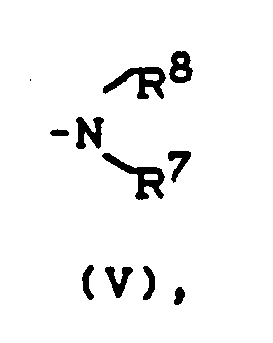
- für eine Gruppe der Formeln (IV), (V) oder (VI)
-S-R⁶ (IV),

-O-R⁶ (VI),
steht, - R⁶
- C₁₋₆-Alkyl, vorzugsweise Methyl oder Ethyl, C₇₋₂₂-Alkylaryl oder Arylalkyl, bevorzugt Benzyl oder C₆₋₂₂-Aryl vzw. Phenyl bedeutet und
- R⁷ und R⁸
- gleich oder verschieden sind und Wasserstoff C₁₋₂2-Alkyl, bevorzugt Methyl, Ethyl, Propyl oder Butyl oder C₆₋₂₂-Aryl, bevorzugt Phenyl bedeuten,
- Beispiele für erfindungsgemäß einsetzbare Verbindungen der Formel II sind 4-Amino-2,2,6,6-tetramethylpiperidin, 4-Methyl-amino-2,2,6,6-tetramethylpiperidin, 4-Phenylamino-2,2,6,6-tetramethylpiperidin, 4-Amino-2,2,6,6-tetraethylpiperidin, 4-Methylamino-2,2,6,6-tetraethylpiperidin, 4-Phenylamino-2,2,6,6-tetraethylpiperidin usw.
- 4-Amino-2,2,6,6-Tetramethylpiperidin kann beispielsweise nach Liebigs Ann. Chem. 417, 118 bis 119 (1918) aus dem entsprechenden Oxim durch Reduktion mit Zinkstaub hergestellt werden.
- Beispiele für erfindungsgemäß einsetzbare Verbindungen der Formel III sind 2-Methoxy-Δ¹-1-tetrahydroazepin, 2-Ethoxy-Δ¹-1-tetrahydroazepin, 2-Methoxy-Δ¹-pyrrolin, 2-Ethoxy-Δ¹-1-pyrrolin, 2-Methylmercapto-Δ¹-1-tetrahydroazepin, 2-Ethylmercapto-Δ¹-1-tetrahydroazepin, 2-Phenylthio-Δ1-tetrahydroazepin, 2-Amino-Δ1Tetrahydroazepin, 2-Dimethylamino-Δ1-tetrahydroazepin, 2-Methoxy-1-azacyclotridecen-1 oder 2-Methylmercapto-1-azacyclotridecen-1 usw.
- Die Methoxyverbindungen der Formel (III) können z.B. aus dem entsprechenden Lactam und Dimethylsulfat nach J. Am. Chem. Soc 70, 2115 bis 2116 (1948) bzw. Org. Synth. Coll. Vol IV (1963) 588 hergestellt werden. Für die Herstellung der erfindungsgemäßen Produkte können auch die primär anfallenden Schwefelsäuremonomethylestersalze der Methoxyheterocyclen der Formel (III) eingesetzt werden.
- Erfindungsgemäß können als Katalysatoren Säuren, beispielsweise Protenensäuren wie Halogenwasserstoffsäuren, z.B. Salzsäure, Sulfonsäuren wie Fluorsulfonsäure, p-Toluolsulfonsäure, Borsäuren wie Tetrafluorborsäure, Schwefelsäure(ester), z.B. Schwefelsäuremonoester, Dimethylsulfat eingesetzt werden. Weiterhin können auch Basen als Katalysatoren eingesetzt werden, z.B. Amine wie Trialkylamine, z.B. Triethylamin, aromatische Amine, z.B. Dialkylaniline wie Dimethylanilin, heterocyclische Amine wie Pyridin, usw.
- Pro Mol der Heterocyclen der Formel (II) werden 0,001 bis 1,5, vorzugsweise 0,01 bis 1 Äquivalente Katalysatoren eingesetzt.
- Als Lösungsmittel können organische Lösungsmittel wie Alkohole (z.B. C₁-C₅-Alkohole wie Methanol, Ethanol), halogenierte Kohlenwasserstoffe, z.B. Chlorkohlenwasserstoffe wie Methylenchlorid, Chlorethane, Ether, Ester aromatische Lösungsmittel wie Toluol usw. eingesetzt werden.
- Das erfindungsgemäße Verfahren wird bei Temperaturen von 0 bis 200°C durchgeführt, wobei katalysierte Reaktionen vorzugsweise bei Temperaturen von 0 bis 50°C und nicht katalysierte Reaktionen vorzugsweise bei Temperaturen von 100 bis 200°C durchgeführt werden.
- Das erfindungsgemäße Verfahren wird bei Drücken von 0,1 bis 50 bar, vorzugsweise unter atmosphärischem Druck durchgeführt.
- Das Verhältnis der Molmengen an Edukt der Formel (II) zum Edukt der Formel (III) beträgt 0,8:1 bis 1:1,2, vorzugsweise 1:1. Das Verhältnis Reaktionspartner zu Lösungsmittel beträgt 1:0 bis 1:20, vorzugsweise 1:3 bis 1:10.
- Die Reaktionsdauer beträgt 10 min bis 10 h, wobei katalysierte Reaktionen zwischen 10 bis 60 min dauern.
- Die Isolierung der Produkte der Formel (I) erfolgt durch Abdestillieren des Solvens und gegebenenfalls Entfernen von sauren Katalysatoren durch wäßrige Lösungen von Alkalihydroxiden, -carbonaten oder Hydrogencarbonaten. Die Produkte können gegebenenfalls durch Hochvakuumdestillation oder Umkristallisieren gereingt werden.
- Die erfindungsgemäßen cyclischen Amidine eignen sich beispielsweise als Pflanzenschutzpräparate, Zwischenprodukte oder als Stabilisatoren für Kunststoffe, z.B. Polyolefine oder Polyvinylchlorid.
- Man versetzt 23,4 g 4-Amino-2,2,6,6-tetramethylpiperazin mit 19,05 g O-Methylcaprolactimether (2-Methyl-Δ1-tetrahydroazepin) und 0,3 g p-Toluolsulfonsäure. Dann wird 8 h auf 170°C erhitzt, wobei Methanol abdestilliert. Man nimmt in 150 ml Methylenchlorid auf und schüttelt mit gesättigter Natriumcarbonat aus. Die organische Phase wird eingeengt und der Rückstand aus Toluol umkristallisiert. Die Ausbeute an 2-(2′,2′,6′,6′-Tetramethylpiperidinyl-4′)-amino-Δ1-tetrahydroazepin beträgt 20,1 g, Fp 90°C.
- Man mischt 26 g Caprolactam und 25,2 g Dimethylsulfat und erhitzt 8 h auf 80°C. Dann werden 150 ml Methylenchlorid hinzugefügt und unter Eiskühlung die Lösung von 31,2 g 4-Amino-2,2,6,6-tetramethylpiperazin in 30 ml Methylenchlorid so zugetropft, daß die Temperatur unter 20°C bleibt. Man schüttelt mit 150 ml 10 Gew.-% NaOH aus, engt die organische Phase ein und kristallisiert aus Toluol um. Die Ausbeute an dem Produkt aus Beispiel 1 beträgt 42,7 g.

in welcher

in welcher
Claims (3)
- Cyclische Amidine der Formel (I)
 R¹ bis R⁴ gleich oder verschieden sind und C₁₋₂₂-Alkyl
bedeuten,R⁵ für Wasserstoff, C₁₋₂₂-Alkyl, C₇₋₂₂-Aralkyl oder -Aryl-alkyl, vorzugsweise Benzyl, C₆₋₁₄-Aryl, vorzugsweise Phenyl, besonders bevorzugt Wasserstoff bedeutet undn für die Zahl 3, 4, 5, 6, 7, 8, 9, 10, 11, bevorzugt 5 steht. - Verfahren zur Herstellung der cyclischen Amidine der Formel (I)
 R¹ bis R⁴ gleich oder verschieden sind und C₁₋₂₂-Alkyl bedeuten,R⁵ für Wasserstoff, C₁₋₂₂-Alkyl, C₇₋₂₂-Aralkyl oder -Aryl-alkyl, vorzugsweise Benzyl oder
C₆₋₁₄-Aryl, vorzugsweise Phenyl,
besonders bevorzugt Wasserstoff bedeutet undn für die Zahl 3, 4, 5, 6, 7 , 8, 9, 10, 11, bevorzugt 5 steht,dadurch gekennzeichnet, daß in an sich bekannter Weise 4-Amino-2,2,6,6-tetraalkylpiperidine der Formel (II) R¹ bis R⁵ die bereits angegebene Bedeutung haben,mit Heterocyclen der Formel (111)
 n die bei Formel (I) angegebene Bedeutung hatundX für eine Gruppe der Formeln (IV), (V) oder (VI)in welchen
-S-R⁶ (IV),
-O-R⁶ (VI),
steht,R⁶ C₁₋₆-Alkyl, vorzugsweise Methyl oder Ethyl, C₇₋₂₂-Alkylaryl oder Arylalkyl, bevorzugt Benzyl oder C₆₋₂₂-Aryl vzw. Phenyl bedeutet undR⁷ und R⁸ gleich oder verschieden sind und Wasserstoff C₁₋₂2-Alkyl, bevorzugt Methyl, Ethyl, Propyl oder Butyl oder C₆₋₂₂-Aryl, bevorzugt Phenyl bedeuten,in Gegenwart von Katalysatoren in einem Lösungsmittel umgesetzt werden. - Verwendung von cyclischen Amidinen nach Anspruch 1 als Zwischenprodukte zur Herstellung von Kunststoffen.
Applications Claiming Priority (2)
| Application Number | Priority Date | Filing Date | Title |
|---|---|---|---|
| DE3828759A DE3828759A1 (de) | 1988-08-25 | 1988-08-25 | Neue cyclische amidine und verfahren zu ihrer herstellung |
| DE3828759 | 1988-08-25 |
Publications (3)
| Publication Number | Publication Date |
|---|---|
| EP0355645A2 EP0355645A2 (de) | 1990-02-28 |
| EP0355645A3 EP0355645A3 (de) | 1991-10-02 |
| EP0355645B1 true EP0355645B1 (de) | 1994-04-27 |
Family
ID=6361518
Family Applications (1)
| Application Number | Title | Priority Date | Filing Date |
|---|---|---|---|
| EP89114978A Expired - Lifetime EP0355645B1 (de) | 1988-08-25 | 1989-08-12 | Neue cyclische Amidine und Verfahren zu ihrer Herstellung |
Country Status (3)
| Country | Link |
|---|---|
| EP (1) | EP0355645B1 (de) |
| JP (1) | JPH02117673A (de) |
| DE (2) | DE3828759A1 (de) |
Families Citing this family (1)
| Publication number | Priority date | Publication date | Assignee | Title |
|---|---|---|---|---|
| US7449499B2 (en) | 2003-08-12 | 2008-11-11 | 3M Innovative Properties Company | Self-etching dental compositions and methods |
Family Cites Families (3)
| Publication number | Priority date | Publication date | Assignee | Title |
|---|---|---|---|---|
| DE2119163A1 (de) * | 1970-04-24 | 1971-11-04 | E.Gy.T. Gyogyszervegyeszeti Gyar, Budapest | Verfahren zur Herstellung von semicyclischen Amidinen |
| DE2029299C3 (de) * | 1970-06-13 | 1980-08-21 | Bayer Ag, 5090 Leverkusen | Neue Aminophenylamidine, Verfahren zu ihrer Herstellung und diese enthaltende Arzneimittel |
| DE3529692A1 (de) * | 1985-08-20 | 1987-02-26 | Bayer Ag | Verwendung von lactamamiden als leistungsfoerderer bei tieren |
-
1988
- 1988-08-25 DE DE3828759A patent/DE3828759A1/de not_active Withdrawn
-
1989
- 1989-08-12 DE DE58907558T patent/DE58907558D1/de not_active Expired - Fee Related
- 1989-08-12 EP EP89114978A patent/EP0355645B1/de not_active Expired - Lifetime
- 1989-08-23 JP JP1215125A patent/JPH02117673A/ja active Pending
Also Published As
| Publication number | Publication date |
|---|---|
| JPH02117673A (ja) | 1990-05-02 |
| DE58907558D1 (de) | 1994-06-01 |
| EP0355645A3 (de) | 1991-10-02 |
| EP0355645A2 (de) | 1990-02-28 |
| DE3828759A1 (de) | 1990-03-01 |
Similar Documents
| Publication | Publication Date | Title |
|---|---|---|
| JPH01160959A (ja) | 4−ホルミルアミノピペリジン誘導体及び該誘導体からなる安定剤 | |
| DE2656769A1 (de) | Neue phenol-stabilisatoren | |
| DE2516868A1 (de) | Verfahren zur herstellung von 6-amino-5-r tief 3 -2,4-diamino- pyrimidin-3-oxiden | |
| DE2719211C3 (de) | 1-(2-Phenylamino-äthyl)-4-(N-phenyl-N-propionylamino)-piperidine, Verfahren zu ihrer Herstellung und sie enthaltende Arzneimittel | |
| EP2155679B1 (de) | Verfahren zur herstellung von 4-formylaminopiperidinderivaten | |
| DE2141616C3 (de) | Oxazole- und Oxazine eckige Klammer auf 3,2-c eckige Klammer zu chinazolinone, Verfahren zu ihrer Herstellung und diese Verbindungen enthaltende Arzneimittel | |
| DE3027106C2 (de) | ||
| EP0355645A2 (de) | Neue cyclische Amidine und Verfahren zu ihrer Herstellung | |
| DD247217A5 (de) | Verfahren zur herstellung von 2,6,-dimethyl-4-(3'-nitrophenyl)-1,4-dihydropyridin-3,5-dicarbonsaeure-3 beta (n-benzyl-n-methylamino)-ethylester-5-methylester und dessen hydrochlorid-salz | |
| DD243491A5 (de) | Verfahren zur herstellung neuer 3-phenyl-2-propanamin-derivate | |
| DE3314479A1 (de) | Pleuromutilin-derivate, verfahren zu ihrer herstellung und ihre verwendung als pharmazeutika | |
| WO1989009768A1 (fr) | Procede de production d'heteroaromates azotes a 5 membres | |
| IL27999A (en) | Naphthyl-and tetrahydronaphthyl-formamidines | |
| DE1570034A1 (de) | Verfahren zur Herstellung von Nikotinsaeureamiden | |
| EP0761655A1 (de) | Verfahren zur Herstellung von N-Alkenylcarbaminsäureestern | |
| DE2517278A1 (de) | Butyrophenon-derivate | |
| DE2551235B2 (de) | Aryloxyalkylpiperidine, Verfahren zu ihrer Herstellung und sie enthaltende Arzneimittel | |
| DE1199264B (de) | Verfahren zur Herstellung von Phospholin-derivaten | |
| DE2643671A1 (de) | 4-phenylpiperidinyl- und 4 phenyltetrahydropyridinyl-alkylamino-ketoalkancarbonsaeuren und ihre salze mit saeuren und basen | |
| AT218506B (de) | Verfahren zur Herstellung von basisch substituierten Carbinolen, sowie von ihren sterisch einheitlichen Razematen und deren optisch aktiven Komponenten und/oder ihren Säureadditionssalzen | |
| DE2456280A1 (de) | Verfahren zur herstellung von aminophenolen | |
| DE1102157B (de) | Verfahren zur Herstellung von ungesaettigten Acylaminomethyl-aminen | |
| DE2145513A1 (de) | Verfahren zur herstellung von 5-(omegaaminoalkyl)ox-2,4-diazolen | |
| DE69228670T2 (de) | Cyclohexylaminderivate | |
| DE1126373B (de) | Verfahren zur Herstellung von Salicylamid-O-essigsaeureamiden |
Legal Events
| Date | Code | Title | Description |
|---|---|---|---|
| PUAI | Public reference made under article 153(3) epc to a published international application that has entered the european phase |
Free format text: ORIGINAL CODE: 0009012 |
|
| 17P | Request for examination filed |
Effective date: 19890817 |
|
| AK | Designated contracting states |
Kind code of ref document: A2 Designated state(s): CH DE FR GB IT LI |
|
| PUAL | Search report despatched |
Free format text: ORIGINAL CODE: 0009013 |
|
| AK | Designated contracting states |
Kind code of ref document: A3 Designated state(s): CH DE FR GB IT LI |
|
| 17Q | First examination report despatched |
Effective date: 19931014 |
|
| GRAA | (expected) grant |
Free format text: ORIGINAL CODE: 0009210 |
|
| AK | Designated contracting states |
Kind code of ref document: B1 Designated state(s): CH DE FR GB IT LI |
|
| REF | Corresponds to: |
Ref document number: 58907558 Country of ref document: DE Date of ref document: 19940601 |
|
| ITF | It: translation for a ep patent filed | ||
| ET | Fr: translation filed | ||
| GBT | Gb: translation of ep patent filed (gb section 77(6)(a)/1977) |
Effective date: 19940804 |
|
| PLBE | No opposition filed within time limit |
Free format text: ORIGINAL CODE: 0009261 |
|
| STAA | Information on the status of an ep patent application or granted ep patent |
Free format text: STATUS: NO OPPOSITION FILED WITHIN TIME LIMIT |
|
| 26N | No opposition filed | ||
| PGFP | Annual fee paid to national office [announced via postgrant information from national office to epo] |
Ref country code: DE Payment date: 19950717 Year of fee payment: 7 |
|
| PGFP | Annual fee paid to national office [announced via postgrant information from national office to epo] |
Ref country code: FR Payment date: 19950727 Year of fee payment: 7 |
|
| PGFP | Annual fee paid to national office [announced via postgrant information from national office to epo] |
Ref country code: GB Payment date: 19950801 Year of fee payment: 7 |
|
| PGFP | Annual fee paid to national office [announced via postgrant information from national office to epo] |
Ref country code: CH Payment date: 19950816 Year of fee payment: 7 |
|
| PG25 | Lapsed in a contracting state [announced via postgrant information from national office to epo] |
Ref country code: GB Effective date: 19960812 |
|
| PG25 | Lapsed in a contracting state [announced via postgrant information from national office to epo] |
Ref country code: LI Effective date: 19960831 Ref country code: CH Effective date: 19960831 |
|
| GBPC | Gb: european patent ceased through non-payment of renewal fee |
Effective date: 19960812 |
|
| REG | Reference to a national code |
Ref country code: CH Ref legal event code: PL |
|
| PG25 | Lapsed in a contracting state [announced via postgrant information from national office to epo] |
Ref country code: FR Effective date: 19970430 |
|
| PG25 | Lapsed in a contracting state [announced via postgrant information from national office to epo] |
Ref country code: DE Effective date: 19970501 |
|
| REG | Reference to a national code |
Ref country code: FR Ref legal event code: ST |
|
| PG25 | Lapsed in a contracting state [announced via postgrant information from national office to epo] |
Ref country code: IT Free format text: LAPSE BECAUSE OF NON-PAYMENT OF DUE FEES;WARNING: LAPSES OF ITALIAN PATENTS WITH EFFECTIVE DATE BEFORE 2007 MAY HAVE OCCURRED AT ANY TIME BEFORE 2007. THE CORRECT EFFECTIVE DATE MAY BE DIFFERENT FROM THE ONE RECORDED. Effective date: 20050812 |