EP0356842A2 - Verfahren zum Herstellen von Homo- und Copolymerisaten des Propens mittels eines Ziegler-Natta-Katalysatorsystems - Google Patents
Verfahren zum Herstellen von Homo- und Copolymerisaten des Propens mittels eines Ziegler-Natta-Katalysatorsystems Download PDFInfo
- Publication number
- EP0356842A2 EP0356842A2 EP89115312A EP89115312A EP0356842A2 EP 0356842 A2 EP0356842 A2 EP 0356842A2 EP 89115312 A EP89115312 A EP 89115312A EP 89115312 A EP89115312 A EP 89115312A EP 0356842 A2 EP0356842 A2 EP 0356842A2
- Authority
- EP
- European Patent Office
- Prior art keywords
- stage
- titanium
- component
- bis
- titanium tetrachloride
- Prior art date
- Legal status (The legal status is an assumption and is not a legal conclusion. Google has not performed a legal analysis and makes no representation as to the accuracy of the status listed.)
- Granted
Links
- QQONPFPTGQHPMA-UHFFFAOYSA-N propylene Natural products CC=C QQONPFPTGQHPMA-UHFFFAOYSA-N 0.000 title claims abstract description 19
- 229920001577 copolymer Polymers 0.000 title claims description 5
- 238000004519 manufacturing process Methods 0.000 title abstract description 10
- 230000003197 catalytic effect Effects 0.000 title 1
- 125000004805 propylene group Chemical group [H]C([H])([H])C([H])([*:1])C([H])([H])[*:2] 0.000 title 1
- VYPSYNLAJGMNEJ-UHFFFAOYSA-N Silicium dioxide Chemical compound O=[Si]=O VYPSYNLAJGMNEJ-UHFFFAOYSA-N 0.000 claims abstract description 48
- RTAQQCXQSZGOHL-UHFFFAOYSA-N Titanium Chemical compound [Ti] RTAQQCXQSZGOHL-UHFFFAOYSA-N 0.000 claims abstract description 46
- 229910052719 titanium Inorganic materials 0.000 claims abstract description 41
- 239000010936 titanium Substances 0.000 claims abstract description 41
- XJDNKRIXUMDJCW-UHFFFAOYSA-J titanium tetrachloride Chemical compound Cl[Ti](Cl)(Cl)Cl XJDNKRIXUMDJCW-UHFFFAOYSA-J 0.000 claims abstract description 36
- 239000007790 solid phase Substances 0.000 claims abstract description 22
- 229910052782 aluminium Inorganic materials 0.000 claims abstract description 19
- XAGFODPZIPBFFR-UHFFFAOYSA-N aluminium Chemical compound [Al] XAGFODPZIPBFFR-UHFFFAOYSA-N 0.000 claims abstract description 19
- ZAMOUSCENKQFHK-UHFFFAOYSA-N Chlorine atom Chemical compound [Cl] ZAMOUSCENKQFHK-UHFFFAOYSA-N 0.000 claims abstract description 18
- 239000011777 magnesium Substances 0.000 claims abstract description 18
- FYYHWMGAXLPEAU-UHFFFAOYSA-N Magnesium Chemical compound [Mg] FYYHWMGAXLPEAU-UHFFFAOYSA-N 0.000 claims abstract description 17
- 239000000460 chlorine Substances 0.000 claims abstract description 17
- 229910052749 magnesium Inorganic materials 0.000 claims abstract description 17
- 150000002901 organomagnesium compounds Chemical class 0.000 claims abstract description 17
- 150000003021 phthalic acid derivatives Chemical class 0.000 claims abstract description 17
- 239000000741 silica gel Substances 0.000 claims abstract description 17
- 229910002027 silica gel Inorganic materials 0.000 claims abstract description 17
- 229910052801 chlorine Inorganic materials 0.000 claims abstract description 16
- YNQLUTRBYVCPMQ-UHFFFAOYSA-N Ethylbenzene Chemical compound CCC1=CC=CC=C1 YNQLUTRBYVCPMQ-UHFFFAOYSA-N 0.000 claims abstract description 14
- 229930195733 hydrocarbon Natural products 0.000 claims abstract description 14
- 239000004215 Carbon black (E152) Substances 0.000 claims abstract description 13
- BLRPTPMANUNPDV-UHFFFAOYSA-N Silane Chemical compound [SiH4] BLRPTPMANUNPDV-UHFFFAOYSA-N 0.000 claims abstract description 12
- 229910000077 silane Inorganic materials 0.000 claims abstract description 12
- 239000012320 chlorinating reagent Substances 0.000 claims abstract description 11
- 150000002430 hydrocarbons Chemical class 0.000 claims abstract description 11
- 239000000203 mixture Substances 0.000 claims abstract description 9
- 239000007788 liquid Substances 0.000 claims abstract description 8
- 239000011954 Ziegler–Natta catalyst Substances 0.000 claims abstract description 5
- 238000007493 shaping process Methods 0.000 claims abstract description 5
- WPYMKLBDIGXBTP-UHFFFAOYSA-N benzoic acid Chemical class OC(=O)C1=CC=CC=C1 WPYMKLBDIGXBTP-UHFFFAOYSA-N 0.000 claims abstract description 4
- 239000003054 catalyst Substances 0.000 claims description 21
- 238000000034 method Methods 0.000 claims description 18
- 238000002156 mixing Methods 0.000 claims description 12
- 125000004432 carbon atom Chemical group C* 0.000 claims description 11
- 239000000377 silicon dioxide Substances 0.000 claims description 8
- 239000013067 intermediate product Substances 0.000 claims description 7
- 239000000047 product Substances 0.000 claims description 7
- 235000012239 silicon dioxide Nutrition 0.000 claims description 7
- 229910052681 coesite Inorganic materials 0.000 claims description 6
- 229910052906 cristobalite Inorganic materials 0.000 claims description 6
- 239000007791 liquid phase Substances 0.000 claims description 6
- 239000002245 particle Substances 0.000 claims description 6
- 229910052682 stishovite Inorganic materials 0.000 claims description 6
- 229910052905 tridymite Inorganic materials 0.000 claims description 6
- 239000000178 monomer Substances 0.000 claims description 5
- 229920001519 homopolymer Polymers 0.000 claims description 4
- 229910052739 hydrogen Inorganic materials 0.000 claims description 4
- 229920001155 polypropylene Polymers 0.000 claims description 4
- 229910052710 silicon Inorganic materials 0.000 claims description 4
- 239000010703 silicon Substances 0.000 claims description 4
- 125000001931 aliphatic group Chemical group 0.000 claims description 3
- 125000000217 alkyl group Chemical group 0.000 claims description 3
- PNEYBMLMFCGWSK-UHFFFAOYSA-N aluminium oxide Inorganic materials [O-2].[O-2].[O-2].[Al+3].[Al+3] PNEYBMLMFCGWSK-UHFFFAOYSA-N 0.000 claims description 3
- 125000003118 aryl group Chemical group 0.000 claims description 3
- 229910052593 corundum Inorganic materials 0.000 claims description 3
- 238000000605 extraction Methods 0.000 claims description 3
- 229910052760 oxygen Inorganic materials 0.000 claims description 3
- 239000001301 oxygen Substances 0.000 claims description 3
- 239000011148 porous material Substances 0.000 claims description 3
- 238000002360 preparation method Methods 0.000 claims description 3
- 239000011541 reaction mixture Substances 0.000 claims description 3
- 229910001845 yogo sapphire Inorganic materials 0.000 claims description 3
- 125000005037 alkyl phenyl group Chemical group 0.000 claims description 2
- QVGXLLKOCUKJST-UHFFFAOYSA-N atomic oxygen Chemical compound [O] QVGXLLKOCUKJST-UHFFFAOYSA-N 0.000 claims description 2
- 125000001997 phenyl group Chemical group [H]C1=C([H])C([H])=C(*)C([H])=C1[H] 0.000 claims description 2
- 230000000379 polymerizing effect Effects 0.000 claims 1
- 238000000926 separation method Methods 0.000 claims 1
- 229920000642 polymer Polymers 0.000 abstract description 12
- 239000000284 extract Substances 0.000 abstract 2
- IMNFDUFMRHMDMM-UHFFFAOYSA-N N-Heptane Chemical class CCCCCCC IMNFDUFMRHMDMM-UHFFFAOYSA-N 0.000 description 22
- LFQSCWFLJHTTHZ-UHFFFAOYSA-N Ethanol Chemical compound CCO LFQSCWFLJHTTHZ-UHFFFAOYSA-N 0.000 description 20
- 238000006116 polymerization reaction Methods 0.000 description 14
- 235000019441 ethanol Nutrition 0.000 description 12
- -1 alkyl radical Chemical class 0.000 description 10
- 239000012071 phase Substances 0.000 description 7
- 238000003756 stirring Methods 0.000 description 6
- XUIMIQQOPSSXEZ-UHFFFAOYSA-N Silicon Chemical compound [Si] XUIMIQQOPSSXEZ-UHFFFAOYSA-N 0.000 description 5
- DOIRQSBPFJWKBE-UHFFFAOYSA-N dibutyl phthalate Chemical compound CCCCOC(=O)C1=CC=CC=C1C(=O)OCCCC DOIRQSBPFJWKBE-UHFFFAOYSA-N 0.000 description 4
- VEXZGXHMUGYJMC-UHFFFAOYSA-N Hydrochloric acid Chemical compound Cl VEXZGXHMUGYJMC-UHFFFAOYSA-N 0.000 description 3
- DKGAVHZHDRPRBM-UHFFFAOYSA-N Tert-Butanol Chemical compound CC(C)(C)O DKGAVHZHDRPRBM-UHFFFAOYSA-N 0.000 description 3
- 150000001335 aliphatic alkanes Chemical class 0.000 description 3
- KXDANLFHGCWFRQ-UHFFFAOYSA-N magnesium;butane;octane Chemical compound [Mg+2].CCC[CH2-].CCCCCCC[CH2-] KXDANLFHGCWFRQ-UHFFFAOYSA-N 0.000 description 3
- VXNZUUAINFGPBY-UHFFFAOYSA-N 1-Butene Chemical compound CCC=C VXNZUUAINFGPBY-UHFFFAOYSA-N 0.000 description 2
- ZOXJGFHDIHLPTG-UHFFFAOYSA-N Boron Chemical compound [B] ZOXJGFHDIHLPTG-UHFFFAOYSA-N 0.000 description 2
- UFHFLCQGNIYNRP-UHFFFAOYSA-N Hydrogen Chemical compound [H][H] UFHFLCQGNIYNRP-UHFFFAOYSA-N 0.000 description 2
- 239000002879 Lewis base Substances 0.000 description 2
- TWRXJAOTZQYOKJ-UHFFFAOYSA-L Magnesium chloride Chemical compound [Mg+2].[Cl-].[Cl-] TWRXJAOTZQYOKJ-UHFFFAOYSA-L 0.000 description 2
- 239000004743 Polypropylene Substances 0.000 description 2
- 229910003074 TiCl4 Inorganic materials 0.000 description 2
- 239000004411 aluminium Substances 0.000 description 2
- 229910052796 boron Inorganic materials 0.000 description 2
- 238000013461 design Methods 0.000 description 2
- AAMBIAPMLISIDH-UHFFFAOYSA-N dimethoxy-bis(2-methylphenyl)silane Chemical compound C=1C=CC=C(C)C=1[Si](OC)(OC)C1=CC=CC=C1C AAMBIAPMLISIDH-UHFFFAOYSA-N 0.000 description 2
- 238000009826 distribution Methods 0.000 description 2
- 238000001914 filtration Methods 0.000 description 2
- 229910052736 halogen Inorganic materials 0.000 description 2
- 150000002367 halogens Chemical class 0.000 description 2
- 239000001257 hydrogen Substances 0.000 description 2
- IXCSERBJSXMMFS-UHFFFAOYSA-N hydrogen chloride Substances Cl.Cl IXCSERBJSXMMFS-UHFFFAOYSA-N 0.000 description 2
- 229910000041 hydrogen chloride Inorganic materials 0.000 description 2
- 150000007527 lewis bases Chemical class 0.000 description 2
- 239000000463 material Substances 0.000 description 2
- VLKZOEOYAKHREP-UHFFFAOYSA-N n-Hexane Chemical class CCCCCC VLKZOEOYAKHREP-UHFFFAOYSA-N 0.000 description 2
- PARWUHTVGZSQPD-UHFFFAOYSA-N phenylsilane Chemical compound [SiH3]C1=CC=CC=C1 PARWUHTVGZSQPD-UHFFFAOYSA-N 0.000 description 2
- 238000012545 processing Methods 0.000 description 2
- 239000007787 solid Substances 0.000 description 2
- 238000012360 testing method Methods 0.000 description 2
- QOOQLKSEGVNYLA-UHFFFAOYSA-N 1-$l^{1}-oxidanylbutane Chemical compound CCCC[O] QOOQLKSEGVNYLA-UHFFFAOYSA-N 0.000 description 1
- WSSSPWUEQFSQQG-UHFFFAOYSA-N 4-methyl-1-pentene Chemical compound CC(C)CC=C WSSSPWUEQFSQQG-UHFFFAOYSA-N 0.000 description 1
- VEXZGXHMUGYJMC-UHFFFAOYSA-M Chloride anion Chemical compound [Cl-] VEXZGXHMUGYJMC-UHFFFAOYSA-M 0.000 description 1
- XDTMQSROBMDMFD-UHFFFAOYSA-N Cyclohexane Chemical compound C1CCCCC1 XDTMQSROBMDMFD-UHFFFAOYSA-N 0.000 description 1
- MYMOFIZGZYHOMD-UHFFFAOYSA-N Dioxygen Chemical compound O=O MYMOFIZGZYHOMD-UHFFFAOYSA-N 0.000 description 1
- VGGSQFUCUMXWEO-UHFFFAOYSA-N Ethene Chemical compound C=C VGGSQFUCUMXWEO-UHFFFAOYSA-N 0.000 description 1
- OFBQJSOFQDEBGM-UHFFFAOYSA-N Pentane Chemical class CCCCC OFBQJSOFQDEBGM-UHFFFAOYSA-N 0.000 description 1
- LGRFSURHDFAFJT-UHFFFAOYSA-N Phthalic anhydride Natural products C1=CC=C2C(=O)OC(=O)C2=C1 LGRFSURHDFAFJT-UHFFFAOYSA-N 0.000 description 1
- 229910000831 Steel Inorganic materials 0.000 description 1
- ATJFFYVFTNAWJD-UHFFFAOYSA-N Tin Chemical compound [Sn] ATJFFYVFTNAWJD-UHFFFAOYSA-N 0.000 description 1
- 229910000323 aluminium silicate Inorganic materials 0.000 description 1
- FYXKZNLBZKRYSS-UHFFFAOYSA-N benzene-1,2-dicarbonyl chloride Chemical compound ClC(=O)C1=CC=CC=C1C(Cl)=O FYXKZNLBZKRYSS-UHFFFAOYSA-N 0.000 description 1
- 229920001400 block copolymer Polymers 0.000 description 1
- JHIWVOJDXOSYLW-UHFFFAOYSA-N butyl 2,2-difluorocyclopropane-1-carboxylate Chemical compound CCCCOC(=O)C1CC1(F)F JHIWVOJDXOSYLW-UHFFFAOYSA-N 0.000 description 1
- 229910052799 carbon Inorganic materials 0.000 description 1
- 239000000969 carrier Substances 0.000 description 1
- 239000003795 chemical substances by application Substances 0.000 description 1
- 238000005660 chlorination reaction Methods 0.000 description 1
- 230000000052 comparative effect Effects 0.000 description 1
- 150000001875 compounds Chemical class 0.000 description 1
- 238000010924 continuous production Methods 0.000 description 1
- 230000007797 corrosion Effects 0.000 description 1
- 238000005260 corrosion Methods 0.000 description 1
- TUZXHLFJEVFZAF-UHFFFAOYSA-N diethoxy-bis(2-methylphenyl)silane Chemical compound C=1C=CC=C(C)C=1[Si](OCC)(OCC)C1=CC=CC=C1C TUZXHLFJEVFZAF-UHFFFAOYSA-N 0.000 description 1
- HNPSIPDUKPIQMN-UHFFFAOYSA-N dioxosilane;oxo(oxoalumanyloxy)alumane Chemical compound O=[Si]=O.O=[Al]O[Al]=O HNPSIPDUKPIQMN-UHFFFAOYSA-N 0.000 description 1
- QUPDWYMUPZLYJZ-UHFFFAOYSA-N ethyl Chemical compound C[CH2] QUPDWYMUPZLYJZ-UHFFFAOYSA-N 0.000 description 1
- 238000002474 experimental method Methods 0.000 description 1
- 239000010419 fine particle Substances 0.000 description 1
- 239000000499 gel Substances 0.000 description 1
- 125000005843 halogen group Chemical group 0.000 description 1
- 230000002140 halogenating effect Effects 0.000 description 1
- 229910052809 inorganic oxide Inorganic materials 0.000 description 1
- 125000000959 isobutyl group Chemical group [H]C([H])([H])C([H])(C([H])([H])[H])C([H])([H])* 0.000 description 1
- 238000002955 isolation Methods 0.000 description 1
- 125000001449 isopropyl group Chemical group [H]C([H])([H])C([H])(*)C([H])([H])[H] 0.000 description 1
- 229910001629 magnesium chloride Inorganic materials 0.000 description 1
- 150000002681 magnesium compounds Chemical class 0.000 description 1
- KJJBSBKRXUVBMX-UHFFFAOYSA-N magnesium;butane Chemical compound [Mg+2].CCC[CH2-].CCC[CH2-] KJJBSBKRXUVBMX-UHFFFAOYSA-N 0.000 description 1
- RVOYYLUVELMWJF-UHFFFAOYSA-N magnesium;hexane Chemical compound [Mg+2].CCCCC[CH2-].CCCCC[CH2-] RVOYYLUVELMWJF-UHFFFAOYSA-N 0.000 description 1
- 229910052751 metal Inorganic materials 0.000 description 1
- 239000002184 metal Substances 0.000 description 1
- 150000002739 metals Chemical class 0.000 description 1
- 125000002496 methyl group Chemical group [H]C([H])([H])* 0.000 description 1
- 230000000877 morphologic effect Effects 0.000 description 1
- 125000004108 n-butyl group Chemical group [H]C([H])([H])C([H])([H])C([H])([H])C([H])([H])* 0.000 description 1
- 125000004123 n-propyl group Chemical group [H]C([H])([H])C([H])([H])C([H])([H])* 0.000 description 1
- 150000002894 organic compounds Chemical class 0.000 description 1
- AJQDYNXUEQUEFI-UHFFFAOYSA-N phenyl(2,2,2-triethoxyethyl)silane Chemical compound C(C)OC(C[SiH2]C1=CC=CC=C1)(OCC)OCC AJQDYNXUEQUEFI-UHFFFAOYSA-N 0.000 description 1
- 125000005498 phthalate group Chemical class 0.000 description 1
- 239000000843 powder Substances 0.000 description 1
- 230000001105 regulatory effect Effects 0.000 description 1
- 239000010959 steel Substances 0.000 description 1
- 238000010557 suspension polymerization reaction Methods 0.000 description 1
- 229910052718 tin Inorganic materials 0.000 description 1
- JCVQKRGIASEUKR-UHFFFAOYSA-N triethoxy(phenyl)silane Chemical compound CCO[Si](OCC)(OCC)C1=CC=CC=C1 JCVQKRGIASEUKR-UHFFFAOYSA-N 0.000 description 1
- WBYKGOGDEZGLDO-UHFFFAOYSA-N triethoxy-(2-methylphenyl)silane Chemical group CCO[Si](OCC)(OCC)C1=CC=CC=C1C WBYKGOGDEZGLDO-UHFFFAOYSA-N 0.000 description 1
- VOITXYVAKOUIBA-UHFFFAOYSA-N triethylaluminium Chemical compound CC[Al](CC)CC VOITXYVAKOUIBA-UHFFFAOYSA-N 0.000 description 1
Classifications
-
- C—CHEMISTRY; METALLURGY
- C08—ORGANIC MACROMOLECULAR COMPOUNDS; THEIR PREPARATION OR CHEMICAL WORKING-UP; COMPOSITIONS BASED THEREON
- C08F—MACROMOLECULAR COMPOUNDS OBTAINED BY REACTIONS ONLY INVOLVING CARBON-TO-CARBON UNSATURATED BONDS
- C08F10/00—Homopolymers and copolymers of unsaturated aliphatic hydrocarbons having only one carbon-to-carbon double bond
-
- C—CHEMISTRY; METALLURGY
- C08—ORGANIC MACROMOLECULAR COMPOUNDS; THEIR PREPARATION OR CHEMICAL WORKING-UP; COMPOSITIONS BASED THEREON
- C08F—MACROMOLECULAR COMPOUNDS OBTAINED BY REACTIONS ONLY INVOLVING CARBON-TO-CARBON UNSATURATED BONDS
- C08F10/00—Homopolymers and copolymers of unsaturated aliphatic hydrocarbons having only one carbon-to-carbon double bond
- C08F10/04—Monomers containing three or four carbon atoms
- C08F10/06—Propene
-
- Y—GENERAL TAGGING OF NEW TECHNOLOGICAL DEVELOPMENTS; GENERAL TAGGING OF CROSS-SECTIONAL TECHNOLOGIES SPANNING OVER SEVERAL SECTIONS OF THE IPC; TECHNICAL SUBJECTS COVERED BY FORMER USPC CROSS-REFERENCE ART COLLECTIONS [XRACs] AND DIGESTS
- Y10—TECHNICAL SUBJECTS COVERED BY FORMER USPC
- Y10S—TECHNICAL SUBJECTS COVERED BY FORMER USPC CROSS-REFERENCE ART COLLECTIONS [XRACs] AND DIGESTS
- Y10S526/00—Synthetic resins or natural rubbers -- part of the class 520 series
- Y10S526/909—Polymerization characterized by particle size of product
Definitions
- the catalyst system is said to be easy to produce and to provide a high yield of polymer which must contain the largest possible isotactic fraction.
- the catalyst system is also intended to produce polymers with special morphological properties, for example in the sense of a uniform particle size and / or a reduction in the fine particle fraction and / or a high bulk density.
- a low halogen content of the polymer is also important, particularly with regard to corrosion problems, which can be achieved by increasing the polymer yield and / or a catalyst system. which contains as little halogen as possible.
- EP-OS 0 195 497 describes a catalyst system whose titanium component is obtained by treating SiO2 with an organic Mg compound, an alcohol, a Lewis base and TiCl4. Productivity is also low with this catalyst system.
- a catalyst system which comprises one from (I) a special carrier, which in a defined manner from (Ia) a certain finely divided silica gel, (Ib) a certain organomagnesium compound, (Ic) one certain gaseous chlorinating agent and (Id) a specially selected phthalic acid derivative has been obtained, and (II) a certain alkanol and (III) titanium tetrachloride contains titanium component (1) prepared in a special way.
- a special carrier which in a defined manner from (Ia) a certain finely divided silica gel, (Ib) a certain organomagnesium compound, (Ic) one certain gaseous chlorinating agent and (Id) a specially selected phthalic acid derivative has been obtained, and (II) a certain alkanol and (III) titanium tetrachloride contains titanium component (1) prepared in a special way.
- the process according to the invention can be carried out with particularly good success if a catalyst system is used whose silane component (3) is one in its formula R 1 n Si (OR2) 4-n stand R1 is a phenyl, a C1 to C4 alkylphenyl or a C1 to C5 alkyl radical, R2 for an alkyl radical having no more than 4 carbon atoms, especially a methyl or ethyl radical, and n for the number 1 or 2
- the polymerization process as such can be carried out - taking into account the characteristic peculiarity - in practically all relevant conventional technological configurations, for example as a discontinuous, cyclical or - in particular - continuous process, be it e.g. as a suspension polymerization process or - in particular - dry phase polymerization process.
- the molecular weights of the polymers can also be regulated by the relevant customary measures, e.g. by means of regulators, such as in particular hydrogen.
- the small-particle silica gel (Ia) to be used for the production of the titanium component will generally be an aluminosilicate or - in particular - a silicon dioxide; it is important that it has the required properties.
- the commercially available silica gels which are customary for carriers, are well suited to the given specification.
- the organomagnesium compound (Ib) which is also to be used can e.g. Dibutylmagnesium, Dihexylmagnesium and in particular Butyloctylmagnesium be.
- the gaseous chlorinating agent (Ic) to be used should be as dry and pure as possible; it consists of chlorine or especially hydrogen chloride.
- the phthalic acid derivative (Id) to be used which is defined in more detail above, can be a commercially available one; it should advantageously have a high degree of purity.
- the phthalic acid dibutyl ester is very particularly suitable for the purpose according to the invention; but other dialkyl phthalates as well as phthalic anhydride and phthaloyl chloride are also suitable.
- the liquid inert hydrocarbon serving as an auxiliary can be a hydrocarbon of the type which is usually brought together with titanium components for Ziegler-Natta type catalyst systems without damage to the catalyst system or its titanium component.
- suitable hydrocarbons are: pentanes, hexanes, heptanes, gasolines and cyclohexane.
- the alkanols (II) to be used for the production of the titanium component (1) can be commercially available; they should advantageously have relatively high levels of purity.
- Ethanol, n-propyl, i-propyl, n-butyl, i-butyl or tert-butyl alcohol; ethanol is particularly suitable.
- the titanium tetrachloride (III) also to be used for the production of the titanium component (1) should be a customary one in Ziegler-Natta catalyst systems; any ethylbenzene to be used in a mixture with the titanium tetrachloride should be as pure and dry as possible.
- the hydrocarbon to be used for the production of the titanium component (1) in stage (1.4) can also be a conventional one; it should advantageously have a relatively high degree of purity.
- Suitable aluminum components (2) with the formula given are the relevant customary ones which obey this formula; they are so well known from literature and practice that they need not be discussed in more detail. An outstanding representative is, for example, triethyl aluminum.
- the silane component (3) completing the catalyst system is in particular a trialkoxyphenylsilane, a trialkoxy (alkyl) phenylsilane, a dialkoxydiphenylsilane or a dialkoxydi (alkyl) phenylsilane of the formula given.
- An outstanding representative is triethoxytoluylsilane; further examples include triethoxyethylphenylsilane, dimethoxyditoluylsilane and diethoxyditoluylsilane.
- dialkoxydialkylsilanes and trialkoxyalkylsilanes are also very suitable.
- the process according to the invention allows homopolymers and copolymers, e.g. of the binary or ternary type, - also block copolymers - of propene with minor amounts of other C2 to C12- ⁇ -monoolefins in an advantageous manner, particularly suitable ⁇ -monoolefins to be polymerized as comonomers ethene, butene-1, 4-methylpentene-1 and are witches-1; but it is also suitable e.g. n-octets-1, n-decene-1 and n-dodecene-1.
- a steel autoclave with a volume of 10 l, equipped with a stirrer, is filled with 50 g polypropene powder, 10 mmol aluminum triethyl (in the form of a 1 molar solution in n-heptane) as aluminum component (2), 1 mmol triethoxyphenylsilane (in the form of a 1 molar solution in n-heptane) as the silane component (3), 5 normal liters of hydrogen and finally 120 mg ( ⁇ 0.11 mmol titanium), the above-described titanium component (1) at 30 ° C.
- the reactor temperature is brought to 70 ° C. in the course of 10 minutes, and the reactor pressure is brought to 28 bar by injecting gaseous propene during this time.
- the actual polymerization is carried out with constant stirring at 70 ° C. and 28 bar for 2 hours, the monomer consumed here is continuously replaced by fresh one.
- the productivity of the catalyst component (1), the heptane-soluble fraction (as a measure of the isotacticity) and the particle size distribution of the polymer obtained are summarized in the table below.
- a titanium component is obtained which contains 3.6% by weight of titanium, 4.4% by weight of magnesium and 16% by weight of chlorine.
- the catalyst component from the comparative experiment has a significantly lower productivity and stereospecificity than the catalyst components from the examples according to the invention.
- the chlorine content in the polymer is significantly higher than in the cases according to the invention.
Landscapes
- Chemical & Material Sciences (AREA)
- Health & Medical Sciences (AREA)
- Chemical Kinetics & Catalysis (AREA)
- Medicinal Chemistry (AREA)
- Polymers & Plastics (AREA)
- Organic Chemistry (AREA)
- Transition And Organic Metals Composition Catalysts For Addition Polymerization (AREA)
- Addition Polymer Or Copolymer, Post-Treatments, Or Chemical Modifications (AREA)
Abstract
Description
- Die vorliegende Erfindung betrifft ein Verfahren zum Herstellen von Homopolymerisaten des Propens sowie Copolymerisaten des Propens mit untergeordneten Mengen anderer C₂- bis C₁₂-, insbesondere C₂- bis C₆-α-Monoolefine durch Polymerisation, insbesondere durch Trockenphasenpolymerisation, des bzw. der Monomeren bei Temperaturen von 20 bis 160, insbesondere 50 bis 120°C und Drücken von 1 bis 100, insbesondere 10 bis 70 bar, mittels eines Ziegler-Natta-Katalysatorsystems aus
- (1) einer Titankomponente, die auf einem feinteiligen, formgebenden Kieselgel basiert und Titan, Magnesium, Chlor sowie ein Benzolcarbonsäurederivat enthält,
- (2) einer Aluminiumkomponente der Formel
Al R₃,
worin steht
R für einen nicht mehr als 8, insbesondere nicht mehr als 4 Kohlenstoffatome aufweisenden Alkylrest,
sowie - (3) einer Silankomponente der Formel
R
worin stehen
R¹ für einen nicht mehr als 16, vorzugsweise nicht mehr als 10 Kohlenstoffatome aufweisenden Kohlenwasserstoffrest gesättigt-aliphatischer und/oder aromatischer Natur,
R² für einen nicht mehr als 15, vorzugsweise nicht mehr als 8, und insbesondere nicht mehr als 4 Kohlenstoffatome aufweisenden Alkylrest, und
n für eine Zahl von 0 bis 3, vorzugsweise von 0 bis 2, und insbesondere die Zahl 1 oder 2, - Polymerisationsverfahren dieser Art sind bekannt; ihre Besonderheit gegenüber vergleichbaren anderen Verfahren liegt in der speziellen Ausgestaltung des Katalysatorsystems, wobei als Prototypen für den vorliegenden Fall die aus den EP-OSen 0 014 523, 0 045 977, 0 171 200 und 0 195 497 sowie den GB-Psen 2 101 609 und 2 101 611 bekannten Verfahren genannt werden können.
- Die speziellen Ausgestaltungen der Katalysatorsysteme werden vorgenommen, um bestimmte Ziele zu erreichen, wie die folgenden:
- Das Katalysatorsystem soll leicht herstellbar sein und eine hohe Ausbeute an Polymerisat liefern, welches einen möglichst großen isotaktischen Anteil zu enthalten hat. Das Katalysatorsystem soll darüber hinaus Polymerisate mit speziellen morphologischen Eigenschaften erzeugen, etwa im Sinne einer einheitlichen Korngröße und/oder einer Verringerung der Feinstkornanteile und/oder eines hohen Schüttgewichts. Neben diesen für die Beherrschung der Polymerisationssysteme, die Aufarbeitung der Polymerisate und/oder ihre Verarbeitung wichtigen Parametern ist auch ein niedriger Halogengehalt des Polymerisats - besonders im Hinblick auf Korrosionsprobleme - von Bedeutung, was durch Steigerung der Polymerausbeute und/oder ein Katalysatorsystem zu erreichen ist, welches möglichst wenig Halogen enthält.
- Manche dieser Ziele sind nach dem Stand der Technik nur mit sehr aufwendigen Verfahren zu erreichen, oder dann, wenn man andere Ziele zurücksetzt:
- So wird z.B. in der EP-OS 0 045 977 ein Katalysatorsystem, bestehend aus "aktivem" MgCl₂, TiCl₄ und einem Phthalsäurederivat, beschrieben. Mit Kieselgel als formgebendem Trägermaterial ist die Produktivität des Katalysatorsystems jedoch nicht mehr befriedigend; auch ist der Chlorgehalt der Polymerisate vergleichsweise hoch.
- In den EP-OSen 0 014 523 und 0 171 200 sowie den GB-PSen 2 101 609 und 2 101 611 werden Katalysatorsysteme beschrieben, deren Titankomponente durch Behandeln eines festen, anorganischen Oxids mit einer organischen Magnesiumverbindung, einer Lewis-Base und Titantetrachlorid erhalten wird, wobei zusätzlich ein Halogenierungsmittel, das kein Titantetrachlorid ist und/oder eine organische Verbindung der Metalle Bor, Aluminium, Silicium oder Zinn oder ein Bortrihalogenid oder ein Halogenatome enthaltender Alkohol eingesetzt werden muß. Trotz aufwendiger und langwieriger Herstellungsweise ist die Produktivität des entsprechenden Katalysatorsystems nicht befriedigend.
- In der EP-OS 0 195 497 wird ein Katalysatorsystem beschrieben, dessen Titankomponente durch Behandeln von SiO₂ mit einer organischen Mg-Verbindung, einem Alkohol, einer Lewis-Base und TiCl₄ erhalten wird. Auch bei diesem Katalysatorsystem ist die Produktivität gering.
- Die bekannten Verfahren lassen somit Wünsche offen, insbesondere was eine gute Produktivität und einen geringen Chlorgehalt in den Polymerisaten bei zugleich hoher Isotaktizität und guter Morphologie betrifft.
- Hier setzt die Aufgabenstellung der vorliegenden Erfindung an, nämlich eine Titankomponente zu schaffen, die gegenüber den Verfahren des Standes der Technik bei guter Produktivität zugleich Polymerisate mit geringem Chlorgehalt, hoher Isotaktizität und guter Morphologie zu liefern vermag.
- Es wurde gefunden, daß die gestellte Aufgabe gelöst werden kann mit einem Katalysatorsystem, das eine aus (I) einem speziellen Trägerstoff, der in definierter Weise aus (Ia) einem bestimmten feinteiligen Kieselgel, (Ib) einer bestimmten magnesiumorganischen Verbindung, (Ic) einem bestimmten gasförmigen Chlorierungsmittel sowie (Id) einem speziell ausgewählten Phthalsäureabkömmling erhalten worden ist, sowie (II) einem bestimmten Alkanol und (III) Titantetrachlorid in besonderer Weise hergestellte Titankomponente (1) enthält.
- Gegenstand der vorliegenden Erfindung ist dementsprechend ein Verfahren zum Herstellen von Homopolymerisaten des Propens sowie Copolymerisaten des Propens mit untergeordneten Mengen anderer C₂- bis C₁₂ insbesondere C₂-bis C₆-α-Monoolefine durch Polymerisation, insbesondere durch Trockenphasenpolymerisation, des bzw. der Monomeren bei Temperaturen von 20 bis 160, insbesondere 50 bis 120°C und Drücken von 1 bis 100, insbesondere 10 bis 70 bar, mittels eines Ziegler-Natta-Katalysatorsystems aus
- (1) einer Titankomponente, die auf einem feinteiligen, formgebenden Kieselgel basiert und Titan, Magnesium, Chlor sowie ein Benzolcarbonsäurederivat enthält,
- (2) einer Aluminiumkomponente der Formel
Al R₃,
worin steht
R für einen nicht mehr als 8, insbesondere nicht mehr als 4 Kohlenstoffatome aufweisenden Alkylrest,
sowie - (3) einer Silankomponente der Formel
R
worin stehen
R¹ für einen nicht mehr als 16, vorzugsweise nicht mehr als 10 Kohlenstoffatome aufweisenden Kohlenwasserstoffrest gesättigt-aliphatischer und/oder aromatischer Natur
R² für einen nicht mehr als 15, vorzugsweise nicht mehr als 8, und insbesondere nicht mehr als 4 Kohlenstoffatome aufweisenden Alyklrest, und
n für eine Zahl von 0 bis 3, vorzugsweise von 0 bis 2, und insbesondere die Zahl 1 oder 2, - Das erfindungsgemäße Verfahren ist dadurch gekennzeichnet, daß man als Titankomponente (1) eine solche einsetzt, die erhalten wird, indem man zunächst
- (1.1) in einer ersten Stufe (I) einen Trägerstoff herstellt aus (Ia) einem feinteiligen Kieselgel, das das einen Teilchendurchmesser von 1 bis 1000, insbesondere 10 bis 400 µm, ein Porenvolumen von 0,3 bis 5, insbesondere 1 bis 3,5 cm³/g sowie eine Oberfläche von 100 bis 1000, insbesondere 200 bis 600 m²/g besitzt und die Formel SiO₂ . a Al₂O₃ - worin a steht für eine Zahl im Bereich von 0 bis 2, insbesondere 0 bis 0,5 -hat, (Ib) einer magnesiumorganischen Verbindung der Formel MgR³R⁴ - worin R³ und R⁴ stehen für einen C₂- bis C₁₀-, vorzugsweise C₄- bis C₈-Alkylrest -, (Ic) einem gasförmigen Chlorierungsmittel der Formel ClZ - worin Z steht für Cl oder H, vorzugsweise H -, sowie (1d) einem Phthalsäureabkömmling der Formel
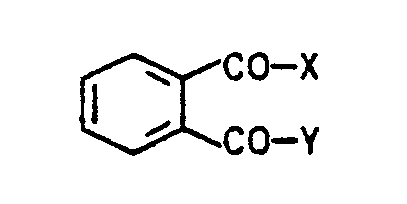
- (1.1.1) in einer ersten Unterstufe in einem flüssigen inerten Kohlenwasserstoff, insbesondere einem Alkan, unter ständiger Durchmischung bei Raumtemperatur das feinteilige Kieselgel (Ia) und die magnesiumorganische Verbindung (Ib) zusammenbringt, wobei mengenmäßig eingesetzt werden auf 10 Molteile Silicium des Kieselgels (Ia) 1 bis 10, insbesondere 1,5 bis 4 Molteile der magnesiumorganischen Verbindung (Ib), und das Zusammengebrachte während 0,5 bis 5, insbesondere 1 bis 2 Stunden bei einer Temperatur im Bereich von 20 bis 140, insbesondere 60 bis 90°C, hält, dann
- (1.1.2) in einer zweiten Unterstufe unter ständiger Durchmischung bei einer Temperatur im Bereich von -20 bis +80, insbesondere 0 bis +20°C, in das aus der ersten Unterstufe Erhaltene (i) das gasförmige Chlorierungsmittel (Ic) einleitet, wobei mengenmäßig eingesetzt werden auf 1 Molteil der magnesiumorganischen Verbindung (Ib) 2 bis 40, insbesondere 10 bis 20 Molteile des Chlorierungsmittels (Ic), sowie (ii) den Phthalsäureabkömmling (Id) einbringt, wobei mengenmäßig eingesetzt werden auf 1 Molteil der magnesiumorganischen Verbindung (Ib) 0,01 bis 1, vorzugsweise 0,1 bis 0,4, und insbesondere 0,20 bis 0,35 Molteile des Phthalsäureabkömmling (Id), das Ganze 0,5 bis 5, insbesondere 0,5 bis 1 Stunden bei einer Temperatur in dem genannten Bereich beläßt und gegebenenfalls das dabei resultierende festphasige Produkt - d.i. den Trägerstoff (I) -unter Abtrennung der flüssigen Phase isoliert, daraufhin
- (1.2) in einer zweiten Stufe ein festphasiges Zwischenprodukt herstellt aus (I) dem in der ersten Stufe erhaltenen Trägerstoff, (II) einem C₁- bis C₈-, vorzugsweise C₂- bis C₆-Alkanol, insbesondere Ethanol und (III) Titantetrachlorid derart, daß man zuerst
- (1.2.1) in einer ersten Unterstufe in einem flüssigen inerten Kohlenwasserstoff, insbesondere einem Alkan, unter ständiger Durchmischung bei Raumtemperatur den Trägerstoff (I) und den Alkanol (II) zusammenbringt, wobei mengenmäßig eingesetzt werden auf 1 Molteil Magnesium des Trägerstoffs (I) 1 bis 5, insbesondere 2,5 bis 3,5 Molteile des Alkanols (II), und das Zusammengebrachte während 0,5 bis 5, insbesondere 1 bis 2 Stunden bei einer Temperatur im Bereich von 20 bis 140, insbesondere 70 bis 90°C hält, anschließend
- (1.2.2.) in einer zweiten Unterstufe unter ständiger Durchmischung bei Raumtemperatur in das aus der ersten Unterstufe resultierende Reaktionsgemisch das Titantetrachlorid (III) einbringt, wobei mengenmäßig eingesetzt werden auf 1 Molteil Magnesium des Trägerstoffs (I) 2 bis 20, insbesondere 4 bis 8 Molteile des Titantetrachlorids (III), das Zusammengebrachte während 0,5 bis 5, insbesondere 1 bis 2 Stunden auf einer Temperatur im Bereich von 10 bis 150, insbesondere 90 bis 120°C hält und das dabei resultierende festphasige Zwischenprodukt unter Abtrennung der flüssigen Phase isoliert, dann
- (1.3) in einer dritten Stufe das aus der zweiten Stufe erhaltene festphasige Zwischenprodukt bei einer Temperatur im Bereich von 100 bis 150, insbesondere 115 bis 135°C, während einer Zeitspanne von 0,2 bis 8, insbesondere 1 bis 6 Stunden einer ein- oder mehrstufigen oder - vorzugsweise - kontinuierlichen Extraktion mit Titantetrachlorid oder einer Mischung aus Titantetrachlorid und Ethylbenzol, deren Gewichtsanteil an Titantetrachlorid mindestens 2, vorzugsweise mindestens 5, insbesondere mindestens 10 Gew.-%, beträgt, unterzieht, wobei mengenmäßig eingesetzt werden auf 10 Gewichtsteile des aus der zweiten Stufe erhaltenen festphasigen Zwischenprodukts insgesamt 10 bis 1000, vorzugsweise 20 bis 800, insbesondere 50 bis 300 Gewichtsteile des Extraktionsmittels, und schließlich
- (1.4) in einer vierten Stufe das in der dritten Stufe entstandene festphasige Produkt ein- oder mehrmals mit einem flüssigen inerten Kohlenwasserstoff, insbesondere einem Alkan, wäscht - und derart die Titankomponente (1) gewinnt.
- Wie sich gezeigt hat, läßt sich das erfindungsgemäße Verfahren mit besonders gutem Erfolg durchführen, wenn ein Katalysatorsystem eingesetzt wird, dessen Silankomponente (3) eine solche ist, in deren Formel
R
stehen
R¹ für einen Phenyl-, einen C₁- bis C₄-Alkylphenyl- oder einen C₁- bis C₅-Alkylrest,
R² für einen nicht mehr als 4 Kohlenstoffatome aufweisenden Alkylrest, vor allem einen Methyl- oder Ethylrest, und
n für die Zahl 1 oder 2 - Zu dem erfindungsgemäßen Verfahren ist im einzelnen das folgende zu bemerken:
- Das Polymerisationsverfahren als solches kann - unter Beachtung der kennzeichnenden Besonderheit - in praktisch allen einschlägig üblichen technologischen Ausgestaltungen durchgeführt werden, etwa als diskontinuierliches, taktweises oder - insbesondere - kontinuierliches Verfahren, sei es z.B. als Suspensionspolymerisationsverfahren oder - insbesondere - Trockenphasenpolymerisationsverfahren. Die erwähnten technologischen Ausgestaltungen - mit anderen Worten: die technologischen Varianten der Polymerisation von α-Monoolefinen nach Ziegler-Natta - sind aus der Literatur und Praxis wohlbekannt, so daß sich nähere Ausführungen zu ihnen erübrigen.
- Der Vollständigkeit halber ist zu erwähnen, daß sich beim erfindungsgemäßen Verfahren auch die Molekulargewichte der Polymerisate durch die einschlägig üblichen Maßnahmen regeln lassen, z.B. mittels Reglern, wie insbesondere Wasserstoff.
- Was die stoffliche Seite des neuen Katalysatorsystems betrifft, ist im einzelnen das folgende zu sagen:
- (1) Das zur Herstellung der Titankomponente einzusetzende kleinteilige Kieselgel (Ia) wird im allgemeinen ein Alumosilikat oder - insbesondere - ein Siliciumdioxid sein; wichtig ist, daß es die geforderten Eigenschaften besitzt. Wie sich gezeigt hat, sind die der gegebenen Spezifikation entsprechenden im Handel erhältlichen, für Trägerstoffe einschlägig üblichen Kieselgele gut geeignet.
- Die gleichfalls einzusetzende magnesiumorganische Verbindung (Ib) kann z.B. Dibutylmagnesium, Dihexylmagnesium und insbesondere Butyloctylmagnesium sein.
- Das ferner einzusetzende gasförmige Chlorierungsmittel (Ic) sollte möglichst trocken und rein sein; es besteht aus Chlor oder insbesondere Chlorwasserstoff.
- Der einzusetzende, oben näher definierte Phthalsäureabkömmling (Id) kann ein handelsüblicher sein; er sollte vorteilhafterweise einen hohen Reinheitsgrad aufweisen. Wie sich gezeigt hat, ist für den erfindungsgemäßen Zweck ganz besonders gut geeignet der Phthalsäuredibutylester; aber auch andere Pthalsäuredialkylester sowie Phthalsäureanhydrid und Phthalsäuredichlorid sind geeignet.
- Der als Hilfsstoff dienende flüssige inerte Kohlenwasserstoff kann ein Kohlenwasserstoff der Art sein, die üblicherweise mit Titankomponenten für Katalysatorsysteme des Ziegler-Natta-Typs ohne Schaden für das Katalysatorsystem bzw. dessen Titankomponente zusammengebracht wird. Als Beispiele für geeignete Kohlenwasserstoffe seien genannt: Pentane, Hexane, Heptane, Benzine und Cyclohexan.
- Die zur Herstellung der Titankomponente (1) einzusetzenden Alkanole (II) können handelsübliche sein; sie sollten vorteilhafterweise relativ hohe Reinheitsgrade aufweisen. Gut geeignet sind z.B. Ethanol, n-Propyl-, i-Propyl-, n-Butyl-, i-Butyl- oder tert.-Butylalkohol; besonders geeignet ist Ethanol.
- Das zur Herstellung der Titankomponente (1) ebenfalls einzusetzende Titantetrachlorid (III) sollte ein bei Ziegler-Natta-Katalysatorsystemen übliches sein; das gegebenenfalls im Gemisch mit dem Titantetrachlorid einzusetzende Ethylbenzol sollte möglichst rein und trocken sein.
- Der zur Herstellung der Titankomponente (1) in Stufe (1.4) einzusetzende Kohlenwasserstoff kann ebenfalls ein üblicher sein; er sollte vorteilhafterweise einen relativ hohen Reinheitsgrad aufweisen.
- Die Herstellung der Titankomponente (1) ist einfach und für den Fachmann ohne Erläuterungen möglich. Zu den Stufen (1.1), (1.2) und (1.3) ist lediglich zu erwähnen, daß gegebenenfalls die Isolierung des jeweils resultierenden Feststoffs zweckmäßigerweise durch Absaugen erfolgt.
- (2) Als Aluminiumkomponenten (2) mit der angegebenen Formel kommen die einschlägig üblichen, dieser Formel gehorchenden in Betracht; sie sind aus Literatur und Praxis so wohlbekannt, daß auf sie nicht näher eingegangen zu werden braucht. Als herausragender Vertreter sei beispielsweise genannt Triethylaluminium.
- (3) Die das Katalysatorsystem vervollständigende Silankomponente (3) ist insbesondere ein Trialkoxyphenylsilan, ein Trialkoxy(alkyl)phenylsilan, ein Dialkoxydiphenylsilan oder ein Dialkoxydi(alkyl)phenylsilan der angegebenen Formel. Als herausragender Vertreter ist zu nennen das Triethoxytoluylsilan; ferner seien beispielsweise genannt Triethoxyethyl-phenylsilan, Dimethoxyditoluylsilan sowie Diethoxyditoluylsilan. Aber auch Dialkoxydialkylsilane und Trialkoxyalkylsilane sind gut geeignet.
- Das erfindungsgemäße Verfahren erlaubt es, Homo- und Copolymerisate, z.B. des binären oder ternären Typs, - auch Blockcopolymerisate - des Propens mit untergeordneten Mengen anderer C₂- bis C₁₂-α-monoolefine in vorteilhafter Weise herzustellen, wobei besonders geeignete zu polymerisierende α-Monoolefine als Comonomere Ethen, Buten-1, 4-Methylpenten-1 und Hexen-1 sind; es eignen sich aber auch z.B. n-Okten-1, n-Decen-1 sowie n-Dodecen-1.
- Es wird so verfahren, daß man zunächst
- (1.1) in einer ersten Stufe (I) einen Trägerstoff herstellt aus (Ia) einem feinteiligen Kieselgel, das einen Teilchendurchmesser von 20 bis 45 µm, ein Porenvolumen von 1,75 cm³/g sowie eine Oberfläche von 320 m²/g besitzt und die Formel SiO₂ hat, (Ib) Butyl-octylmagnesium, (Ic) Chlorwasserstoff sowie (Id) Phthalsäure-di-n-butylester, derart, daß man zuerst
- (1.1.1) in einer ersten Unterstufe in n-Heptan, unter ständiger Durchmischung mittels Rühren bei Raumtemperatur das feinteilige Kieselgel (Ia) und die magnesiumorganische Verbindung (Ib) zusammenbringt, wobei mengenmäßig eingesetzt werden auf 10 Molteile Silicium des Kieselgels (Ia) 2,5 Molteile der magnesiumorganischen Verbindung (Ib), und das Zuammengebrachte während 1,5 Stunden bei einer Temperatur im Bereich von 90°C hält, dann
- (1.1.2) in einer zweiten Unterstufe unter ständiger Durchmischung mittels Rühren bei einer Temperatur im Bereich von 10°C in das aus der ersten Unterstufe Erhaltene (i) das gasförmige Chlorierungsmittel (Ic) einleitet, wobei mengenmäßig eingesetzt werden auf 1 Molteil der magnesiumorganischen Verbindung (Ib) 10 Molteile des Chlorierungsmittels (Ic) sowie (ii) fünf Minuten nach Beginn der Chlorierung den Phthalsäureabkömmling (Id) einbringt, wobei mengenmäßig eingesetzt werden auf 1 Molteil der magnesiumorganischen Verbindung (Ib) 0,3 Molteile des Phthalsäureabkömmlings (Id), das Ganze 1,5 Stunden bei einer Temperatur in dem genannten Bereich beläßt, und das dabei resultierende festphasige Produkt - d.i. den Trägerstoff (I) - in der flüssigen Phase beläßt, daraufhin
- (1.2) in einer zweiten Stufe ein festphasiges Zwischenprodukt herstellt aus (I) dem in der ersten Stufe erhaltenen Trägerstoff, (II) Ethanol und (III) Titantetrachlorid, derart, daß man zuerst
- (1.2.1) in einer ersten Unterstufe in n-Heptan unter ständiger Durchmischung mittels Rühren bei Raumtemperatur den Trägerstoff (I) und das Ethanol (II) zusammenbringt - wobei mengenmäßig eingesetzt werden auf 1 Molteil Magnesium des Trägerstoffs (I) 3 Molteile des Ethanols (II) - und das Zusammengebrachte während 1,5 Stunden bei einer Temperatur im Bereich von 80°C hält, anschließend
- (1.2.2) in einer zweiten Unterstufe unter ständiger Durchmischung mittels Rühren bei Raumtemperatur in das aus der ersten Unterstufe resultierende Reaktionsgemisch das Titantetra chlorid (III) einbringt - wobei mengenmäßig eingesetzt werden auf 1 Molteil Magnesium des Trägerstoffs (I) 7 Molteile des Titantetrachlorids (III) -, das Zusammengebrachte unter Rühren während 2 Stunden auf einer Temperatur im Bereich von 100°C hält, und das dabei resultierende festphasige Zwischenprodukt unter Abtrennung der flüssigen Phase mittels Absaugen isoliert, dann
- (1.3) in einer dritten Stufe das aus der zweiten Stufe erhaltene festphasige Zwischenprodukt bei einer Temperatur von 125°C während einer Zeitspanne von 4 Stunden einer kontinuierlichen Extraktion mit einer Mischung aus Titantetrachlorid und Ethylbenzol, deren Gewichtsanteil an Titantetrachlorid 15 Gew.% beträgt, unterzieht - wobei mengenmäßig eingesetzt werden auf 10 Gew.-Teile des aus der zweiten Stufe erhaltenen festphasigen Zwischenprodukts 100 Gew.-Teile der Titantetrachlorid-Ethylbenzol-Mischung - hierauf das entstandene festphasige Zwischenprodukt mittels Filtration isoliert und schließlich
- (1.4) in einer vierten Stufe das in der dritten Stufe gewonnene festphasige Produkt dreimal mit n-Heptan wäscht - und derart die Titankomponente (1) gewinnt; sie enthält 4,4 Gew.-% Titan, 6,5 Gew.-% Magnesium und 27,5 Gew.-% Chlor.
- Ein Stahlautoklav von 10-l-Volumen, ausgerüstet mit einem Rührer, wird mit 50 g Polypropenpulver, 10 mMol Aluminiumtriethyl (in Form einer 1-molaren Lösung in n-Heptan) als Aluminiumkomponente (2), 1 mMol Triethoxyphenylsilan (in Form einer 1-molaren Lösung in n-Heptan) als Silankomponente (3), 5 Normalliter Wasserstoff und schließlich 120 mg (=̂ 0,11 mMol Titan), der oben beschriebenen Titankomponente (1) bei 30°C beschickt. Die Reaktortemperatur wird binnen 10 Minuten auf 70°C, der Reaktordruck mittels Aufpressen von gasförmigem Propen in dieser Zeit auf 28 bar gebracht.
- Die eigentliche Polymerisation wird unter ständigem Rühren bei 70°C und 28 bar während 2 Stunden durchgeführt, hierbei verbrauchtes Monomer wird kontinuierlich durch frisches ersetzt.
- Die Produktivität der Katalysatorkomponente (1), der heptanlösliche Anteil (als Maß für die Isotaktizität) und die Kornverteilung des dabei erhaltenen Polymerisats sind in der nachstehenden Tabelle zusammengestellt.
- Es wird verfahren wie in Beispiel 1, mit der einzigen Ausnahme, daß als Silankomponente (3) die gleiche Molmenge Dimethoxyditoluylsilan eingesetzt wird.
- Zum so erhaltenen Polymerisationsergebnis siehe ebenfalls die nachstehende Tabelle.
- Es wird verfahren wie im Beispiel 1 der EP-OS 0 195 497.
- Man erhält eine Titankomponente, die 3,6 Gew.-% Titan, 4,4 Gew.-% Magnesium und 16 Gew.-% Chlor enthält.
- Sie erfolgt wie im Beispiel 1, jedoch nicht mit der dort beschriebenen Titankomponente, sondern mit der gleichen Molmenge der vorstehend bezeichneten Titankomponente. Zum dabei erreichten Polymerisationsergebnis siehe wiederum die nachstehende Tabelle.
Produktivität (g PP/g Kat.) Heptanlösliche Anteile (Gew.-%) Kornverteilung (mm) Chlorgehalt im Produkt (ppm) <0,25 0,25-0,5 0,5-1 1-2 >2 Beispiel 1 13 400 2,3 1,3 4,4 64,6 29,5 0,1 20,5 Beispiel 2 15 600 1,6 1,1 3,8 50,3 44,5 0,3 17,6 Vergleichsversuch 3 500 4,0 3,0 29,8 54 12,2 1,0 46 - Wie aus der Tabelle zu ersehen ist, weist die Katalysatorkomponente aus dem Vergleichsversuch eine wesentlich geringere Produktivität und Stereospezifität auf als die Katalysatorkomponenten aus den erfindungsgemäßen Beispielen. Darüber hinaus ist der Chlorgehalt im Polymerisat wesentlich höher als in den erfindungsgemäßen Fällen.
Claims (2)
(1) einer Titankomponente, die auf einem feinteiligen, formgebenden Kieselgel basiert und Titan, Magnesium, Chlor sowie ein Benzolcarbonsäurederivat enthält,
(2) einer Aluminiumkomponente der Formel
Al R³,
worin steht
R für einen nicht mehr als 8 Kohlenstoffatome aufweisenden Alkylrest,
sowie
(3) einer Silankomponente der Formel
R

worin stehen
R¹ für einen nicht mehr als 16 Kohlenstoffatome aufweisenden Kohlenwasserstoffrest gesättigt-aliphatischer und/oder aromatischer Natur,
R² für einen nicht mehr als 15 Kohlenstoffatome aufweisenden Alkylrest, und
n für eine Zahl von 0 bis 3,
mit den Maßgaben, daß das Atomverhältnis Titan aus der Titankomponente (1) : Aluminium aus der Aluminiumkomponente (2) 1 : 10 bis 1 : 800 und das Molverhältnis Aluminiumkomponente (2) : Silankomponente (3) 1 : 0,01 bis 1 : 0,8 beträgt, dadurch gekennzeichnet,
daß man als Titankomponente (1) eine solche einsetzt, die erhalten wird, indem man zunächst

R

stehen
R¹ für einen Phenyl-, einen C₁- bis C₄-Alkylphenyl- oder einen C₁- bis C₅-Alkylrest,
R² für einen nicht mehr als 4 Kohlenstoffatome aufweisenden Alkylrest, und
n für die Zahl 1 oder 2.
Priority Applications (1)
| Application Number | Priority Date | Filing Date | Title |
|---|---|---|---|
| AT89115312T ATE102960T1 (de) | 1988-08-31 | 1989-08-19 | Verfahren zum herstellen von homo- und copolymerisaten des propens mittels eines ziegler-natta-katalysatorsystems. |
Applications Claiming Priority (2)
| Application Number | Priority Date | Filing Date | Title |
|---|---|---|---|
| DE3829519 | 1988-08-31 | ||
| DE3829519A DE3829519A1 (de) | 1988-08-31 | 1988-08-31 | Verfahren zum herstellen von homo- und copolymerisaten des propens mittels eines ziegler-natta-katalysatorsystems |
Publications (3)
| Publication Number | Publication Date |
|---|---|
| EP0356842A2 true EP0356842A2 (de) | 1990-03-07 |
| EP0356842A3 EP0356842A3 (de) | 1991-08-07 |
| EP0356842B1 EP0356842B1 (de) | 1994-03-16 |
Family
ID=6361969
Family Applications (1)
| Application Number | Title | Priority Date | Filing Date |
|---|---|---|---|
| EP89115312A Expired - Lifetime EP0356842B1 (de) | 1988-08-31 | 1989-08-19 | Verfahren zum Herstellen von Homo- und Copolymerisaten des Propens mittels eines Ziegler-Natta-Katalysatorsystems |
Country Status (6)
| Country | Link |
|---|---|
| US (1) | US5006620A (de) |
| EP (1) | EP0356842B1 (de) |
| JP (1) | JPH02105805A (de) |
| AT (1) | ATE102960T1 (de) |
| DE (2) | DE3829519A1 (de) |
| ES (1) | ES2061836T3 (de) |
Cited By (1)
| Publication number | Priority date | Publication date | Assignee | Title |
|---|---|---|---|---|
| EP0558137A3 (en) * | 1992-02-26 | 1994-07-06 | Enichem Spa | Catalyst for the polymerization of olefins |
Families Citing this family (14)
| Publication number | Priority date | Publication date | Assignee | Title |
|---|---|---|---|---|
| ES2126973T3 (es) * | 1995-10-02 | 1999-04-01 | Borealis Ag | Catalizador soportado para la polimerizacion de olefinas. |
| ES2125081T3 (es) | 1995-11-08 | 1999-02-16 | Borealis Ag | Catalizador soportado para la polimerizacion de olefinas. |
| ATE173743T1 (de) * | 1995-11-08 | 1998-12-15 | Borealis Ag | Trägerkatalysator für die olefinpolymerisation |
| ATE181340T1 (de) * | 1995-12-01 | 1999-07-15 | Borealis Ag | Trägerkatalysator für die olefinpolymerisation |
| EP0776912B1 (de) | 1995-12-01 | 1999-06-16 | Borealis AG | Trägerkatalysator für die Olefinpolymerisation |
| DE19637367A1 (de) * | 1996-09-13 | 1998-03-19 | Basf Ag | Bei ihrer Herstellung modifizierte Ziegler-Natta-Katalysatorsysteme |
| CZ34998A3 (cs) * | 1997-02-17 | 1999-08-11 | Pcd Polymere Gesellschaft M. B. H. | Způsob přípravy pevného nosiče pro katalyzátory polymerace olefinů |
| DE69807367D1 (de) * | 1997-02-17 | 2002-10-02 | Borealis Gmbh Schwechat Mannsw | Träger für Olefinpolymerisationskatalysatoren |
| US6831032B2 (en) | 2002-08-19 | 2004-12-14 | Novolen Technology Holdings C.V. | Ziegler-Natta catalyst and methods of making and using same |
| JP2007517122A (ja) * | 2003-12-24 | 2007-06-28 | ペトロキミカ クーヨ エスエイアイシー | シール層樹脂組成物 |
| US7071137B2 (en) * | 2004-08-25 | 2006-07-04 | Novolen Technology Holdings, C.V. | Method of making a ziegler-natta catalyst |
| US7329626B2 (en) * | 2004-09-07 | 2008-02-12 | Lummus Novolen Technology Gmbh | Ziegler-Natta catalyst, preparation, and use for the polymerization of alkenes |
| US20070213204A1 (en) * | 2006-03-10 | 2007-09-13 | Novolen Technology Holdings C.V. | Ziegler-Natta catalyst with in situ-generated donor |
| US9481741B2 (en) | 2012-11-26 | 2016-11-01 | Lummus Novolen Technology Gmbh | High performance Ziegler-Natta catalyst systems, process for producing such supported catalysts and use thereof |
Family Cites Families (10)
| Publication number | Priority date | Publication date | Assignee | Title |
|---|---|---|---|---|
| IT1042711B (it) * | 1975-09-19 | 1980-01-30 | Montedison Spa | Compnenti di catalizzatori per la polimerizzazione di olefine |
| NZ192572A (en) * | 1979-01-10 | 1981-11-19 | Ici Ltd | Catalyst component and olefine polymerisation catalyst containing this component |
| IT1209255B (it) * | 1980-08-13 | 1989-07-16 | Montedison Spa | Catalizzatori per la polimerizzazione di olefine. |
| JPS57205406A (en) * | 1981-06-11 | 1982-12-16 | Toyo Sutoufuaa Chem:Kk | Catalytic component for alpha-olefin polymerization and homopolymerization or copolymerization of alpha-olefin |
| GB2101609A (en) * | 1981-07-14 | 1983-01-19 | Ici Plc | Catalyst composition, production and use |
| GB2101611A (en) * | 1981-07-14 | 1983-01-19 | Ici Plc | Catalyst composition, production and use |
| JPH0655780B2 (ja) * | 1984-07-09 | 1994-07-27 | 東燃株式会社 | オレフイン重合用触媒成分 |
| JPH072775B2 (ja) * | 1985-01-28 | 1995-01-18 | 東燃株式会社 | オレフイン重合用触媒成分の製造法 |
| DE3713943A1 (de) * | 1987-04-25 | 1988-11-03 | Basf Ag | Verfahren zum herstellen von homo- und copolymerisaten des propens mittels eines ziegler-natta-katalysatorsystems |
| DE3730022A1 (de) * | 1987-09-08 | 1989-03-16 | Basf Ag | Verfahren zum herstellen von homo- und copolymerisaten des propens mittels eines ziegler-natta-katalysatorsystems |
-
1988
- 1988-08-31 DE DE3829519A patent/DE3829519A1/de not_active Withdrawn
-
1989
- 1989-08-19 DE DE89115312T patent/DE58907214D1/de not_active Expired - Lifetime
- 1989-08-19 AT AT89115312T patent/ATE102960T1/de not_active IP Right Cessation
- 1989-08-19 ES ES89115312T patent/ES2061836T3/es not_active Expired - Lifetime
- 1989-08-19 EP EP89115312A patent/EP0356842B1/de not_active Expired - Lifetime
- 1989-08-28 JP JP1218753A patent/JPH02105805A/ja active Pending
- 1989-08-30 US US07/400,350 patent/US5006620A/en not_active Expired - Fee Related
Cited By (1)
| Publication number | Priority date | Publication date | Assignee | Title |
|---|---|---|---|---|
| EP0558137A3 (en) * | 1992-02-26 | 1994-07-06 | Enichem Spa | Catalyst for the polymerization of olefins |
Also Published As
| Publication number | Publication date |
|---|---|
| DE58907214D1 (de) | 1994-04-21 |
| EP0356842B1 (de) | 1994-03-16 |
| JPH02105805A (ja) | 1990-04-18 |
| ATE102960T1 (de) | 1994-04-15 |
| US5006620A (en) | 1991-04-09 |
| DE3829519A1 (de) | 1990-03-01 |
| EP0356842A3 (de) | 1991-08-07 |
| ES2061836T3 (es) | 1994-12-16 |
Similar Documents
| Publication | Publication Date | Title |
|---|---|---|
| EP0306867B1 (de) | Verfahren zum Herstellen von Homo- und Copolymerisaten des Propens mittels eines Ziegler-Natta-Katalysatorsystems | |
| EP0530599B1 (de) | Verfahren zum Herstellen von Homo- und Copolymerisaten des Propens mittels eines Ziegler-Natta-Katalysatorsystems | |
| EP0356842B1 (de) | Verfahren zum Herstellen von Homo- und Copolymerisaten des Propens mittels eines Ziegler-Natta-Katalysatorsystems | |
| EP0307813B1 (de) | Verfahren zum Herstellen von Homo- und Copolymerisaten des Propens mittels eines Ziegler-Natta-Katalysatorsystems | |
| EP0226003B1 (de) | Verfahren zum Herstellen von Homo- und Copolymerisaten des Propylens mittels eines Ziegler-Natta-Katalysatorsystems | |
| EP0288845B1 (de) | Verfahren zum Herstellen von Homo-und Copolymerisaten des Propens mittels eines Ziegler-Natta-Katalysatorsystems | |
| EP0144021B1 (de) | Verfahren zum Herstellen von Homo- und Copolymerisaten von alpha-Monoolefinen mittels eines Ziegler-Natta-Katalysatorsystems | |
| EP0401776B1 (de) | Verfahren zur Herstellung eines poly-1-olefins | |
| EP0288762B1 (de) | Verfahren zum Herstellen von Homo- und Copolymerisaten des Propens mittels eines Ziegler-Natta-Katalysatorsystems | |
| EP0274099B1 (de) | Verfahren zum Herstellen von Homo- und Copolymerisaten des Propens mittels eines Ziegler-Natta-Katalysatorsystems | |
| EP0356841A2 (de) | Verfahren zum Herstellen von Homo- und Copolymerisaten des Propens mittels eines Ziegler-Natta-Katalysatorsystems | |
| EP0226004B1 (de) | Verfahren zum Herstellen von Homo- und Copolymerisaten des Propylens mittels eines Ziegler-Natta-Katalysatorsystems | |
| EP0421197A2 (de) | Katalysatorsysteme vom Typ der Ziegler-Natta-Katalysatoren | |
| DE2441541C2 (de) | Verfahren zum Herstellen einer modifizierten Titan-Komponente für Katalysatoren des Ziegler-Natta-Typs | |
| EP0427060B1 (de) | Katalysatorsysteme vom Typ der Ziegler-Natta-Katalysatoren | |
| EP0829490A1 (de) | Bei ihrer Herstellung modifizierte Ziegler-Natta-Katalysatorsysteme | |
| DE3830195A1 (de) | Verfahren zum herstellen von homo- und copolymerisaten des propens mittels eines ziegler-natta-katalysatorsystems | |
| DE3644368A1 (de) | Verfahren zum herstellen von homo- und copolymerisaten des propens mittels eines ziegler-natta-katalysatorsystems | |
| DE3540701A1 (de) | Verfahren zum herstellen von homo- und copolymerisaten des propylens mittels eines ziegler-natta-katalysatorsystems | |
| DE3327520A1 (de) | Verfahren zum herstellen von homo- und copolymerisaten von (alpha)-monoolefinen | |
| DE2219711C3 (de) | Verfahren zum Polymerisieren von Olefinen | |
| DE3432759A1 (de) | Verfahren zum herstellen einer modifizierten titankomponente fuer ziegler-natta-katalysatorsysteme | |
| DE3540697C2 (de) | Verfahren zum Herstellen von Homo- und Copolymerisaten des Propylens mittels eines Ziegler-Natta-Katalysatorsystems | |
| DE3428478A1 (de) | Verfahren zum herstellen von homo- und copolymerisaten von (alpha)-monoolefinen mittels eines ziegler-natta-katalysatorsystems | |
| EP0260507A1 (de) | Verfahren zum Herstellen von Homo- und Copolymerisaten des Propylens mittels eines Ziegler-Natta-Katalysatorsystems |
Legal Events
| Date | Code | Title | Description |
|---|---|---|---|
| PUAI | Public reference made under article 153(3) epc to a published international application that has entered the european phase |
Free format text: ORIGINAL CODE: 0009012 |
|
| AK | Designated contracting states |
Kind code of ref document: A2 Designated state(s): AT BE DE ES FR GB IT NL |
|
| 17P | Request for examination filed |
Effective date: 19901227 |
|
| PUAL | Search report despatched |
Free format text: ORIGINAL CODE: 0009013 |
|
| AK | Designated contracting states |
Kind code of ref document: A3 Designated state(s): AT BE DE ES FR GB IT NL |
|
| 17Q | First examination report despatched |
Effective date: 19930622 |
|
| GRAA | (expected) grant |
Free format text: ORIGINAL CODE: 0009210 |
|
| AK | Designated contracting states |
Kind code of ref document: B1 Designated state(s): AT BE DE ES FR GB IT NL |
|
| REF | Corresponds to: |
Ref document number: 102960 Country of ref document: AT Date of ref document: 19940415 Kind code of ref document: T |
|
| ITF | It: translation for a ep patent filed | ||
| REF | Corresponds to: |
Ref document number: 58907214 Country of ref document: DE Date of ref document: 19940421 |
|
| GBT | Gb: translation of ep patent filed (gb section 77(6)(a)/1977) |
Effective date: 19940407 |
|
| PGFP | Annual fee paid to national office [announced via postgrant information from national office to epo] |
Ref country code: FR Payment date: 19940722 Year of fee payment: 6 |
|
| PGFP | Annual fee paid to national office [announced via postgrant information from national office to epo] |
Ref country code: AT Payment date: 19940801 Year of fee payment: 6 |
|
| ET | Fr: translation filed | ||
| PGFP | Annual fee paid to national office [announced via postgrant information from national office to epo] |
Ref country code: GB Payment date: 19940815 Year of fee payment: 6 |
|
| PGFP | Annual fee paid to national office [announced via postgrant information from national office to epo] |
Ref country code: DE Payment date: 19940816 Year of fee payment: 6 |
|
| PGFP | Annual fee paid to national office [announced via postgrant information from national office to epo] |
Ref country code: ES Payment date: 19940817 Year of fee payment: 6 |
|
| PGFP | Annual fee paid to national office [announced via postgrant information from national office to epo] |
Ref country code: BE Payment date: 19940824 Year of fee payment: 6 |
|
| PGFP | Annual fee paid to national office [announced via postgrant information from national office to epo] |
Ref country code: NL Payment date: 19940831 Year of fee payment: 6 |
|
| REG | Reference to a national code |
Ref country code: ES Ref legal event code: FG2A Ref document number: 2061836 Country of ref document: ES Kind code of ref document: T3 |
|
| PLBE | No opposition filed within time limit |
Free format text: ORIGINAL CODE: 0009261 |
|
| STAA | Information on the status of an ep patent application or granted ep patent |
Free format text: STATUS: NO OPPOSITION FILED WITHIN TIME LIMIT |
|
| 26N | No opposition filed | ||
| PG25 | Lapsed in a contracting state [announced via postgrant information from national office to epo] |
Ref country code: DE Effective date: 19950811 |
|
| PG25 | Lapsed in a contracting state [announced via postgrant information from national office to epo] |
Ref country code: GB Effective date: 19950819 Ref country code: AT Effective date: 19950819 |
|
| PG25 | Lapsed in a contracting state [announced via postgrant information from national office to epo] |
Ref country code: ES Free format text: LAPSE BECAUSE OF THE APPLICANT RENOUNCES Effective date: 19950821 |
|
| PG25 | Lapsed in a contracting state [announced via postgrant information from national office to epo] |
Ref country code: BE Effective date: 19950831 |
|
| BERE | Be: lapsed |
Owner name: BASF A.G. Effective date: 19950831 |
|
| PG25 | Lapsed in a contracting state [announced via postgrant information from national office to epo] |
Ref country code: NL Effective date: 19960301 |
|
| GBPC | Gb: european patent ceased through non-payment of renewal fee |
Effective date: 19950819 |
|
| PG25 | Lapsed in a contracting state [announced via postgrant information from national office to epo] |
Ref country code: FR Effective date: 19960430 |
|
| NLV4 | Nl: lapsed or anulled due to non-payment of the annual fee |
Effective date: 19960301 |
|
| REG | Reference to a national code |
Ref country code: FR Ref legal event code: ST |
|
| REG | Reference to a national code |
Ref country code: ES Ref legal event code: FD2A Effective date: 19991007 |
|
| PG25 | Lapsed in a contracting state [announced via postgrant information from national office to epo] |
Ref country code: IT Free format text: LAPSE BECAUSE OF NON-PAYMENT OF DUE FEES;WARNING: LAPSES OF ITALIAN PATENTS WITH EFFECTIVE DATE BEFORE 2007 MAY HAVE OCCURRED AT ANY TIME BEFORE 2007. THE CORRECT EFFECTIVE DATE MAY BE DIFFERENT FROM THE ONE RECORDED. Effective date: 20050819 |